Tuesday, December 23, 2025
More
    Home Blog Page 416

    FAMAS for FELIN – Assault Rifle Upgrades the FELIN Combat Suit

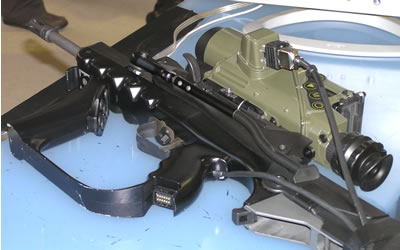
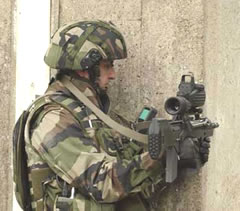
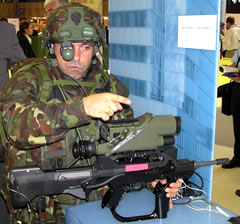
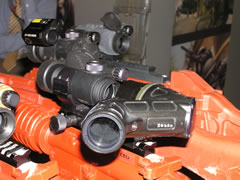
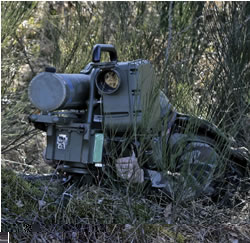
    Retrofitting the FAMAS assault rifle for FELIN include the installation of a front handle, ensuring the weapon can be handled effectively in all firing positions, especially when a bipod cannot be used. This handle enables a firm grip of the rifle when employing it to observe and engage targets in an indirect mode – around corners or behind cover.

    The camera view can be displayed onthe helmet mounted eyepiece (below) or a hand-held display (left). Remote controls for the weapon’s sights and radio ‘push to talk’ buttons are mounted on the handle.

    Each button has distinctive dexterity and form, enabling safe and intuitive operation in the dark. With the addition of day/night sight, FAMAS becomes an effective observation device, which enables the warfighter to simultaneously observe, capture images and video sequences, acquire targets and engage them while employing the radio, and maintaining constant line of sight with the target.

    Modifications also replaced the weapon’s top and iron sights with a Picatinny rail, mounting a new sight with an advanced thermal observation and sighting device, fitted with a holographic daylight sight for daylight operation and instinctive aiming. The weapon also received a new bayonet.

    CEU – Concealed Engagement Unit from Aimpoint

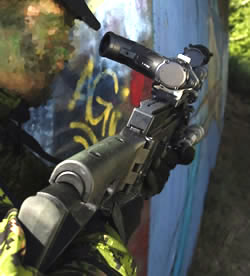
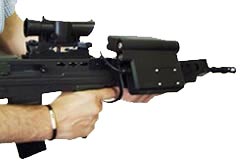
    Concealed Engagement Unit (CEU) accessory from Aimpoint enables converting every weapon equipped with an Aimpoint sight to enable firing around a corner or from behind an obstacle. CEU switches from side to side, so an operator can safely look around either right or left hand corners. It can be quickly flipped out of the way in either direction to rapidly return to direct engagement. Since CEU does not affect the weapon’s point of impact, the unit can be passed from one operator to another as long as both weapons are outfitted with the proper interface. “CEU turns an operator’s standard weapon into a scouting tool allowing him to look over walls or around corners without exposing to enemy fires.
    CEU was developed by DSTO defense research establishment in Australia and Aimpoint has worldwide exclusive rights to produce and sell the system outside Australia.

    Aimpoint has introduced its red-dot sight at the core of a new “system of systems” approach, supplementing it with various accessories such as the 3xMag image magnifier and night vision device in addition to the CEU.

    Avionic Digital Video Recorder

    Elbit Systems has developed a DVR to record synchronized video, audio, and data utilizing solid-state memory cartridges. The system records up to 10 hours of information from four MPEG-2 compressed video channels, two audio channels synchronized with the video, and two 1553 data-bus data channels. The system can accommodate up to four 32 GB cartridges. Fixed and rotary wing aircraft, and UAVs are the main applications for the Elbit Systems’ DVR.

    F-135 – High Performance Jet Engine for Lightning II

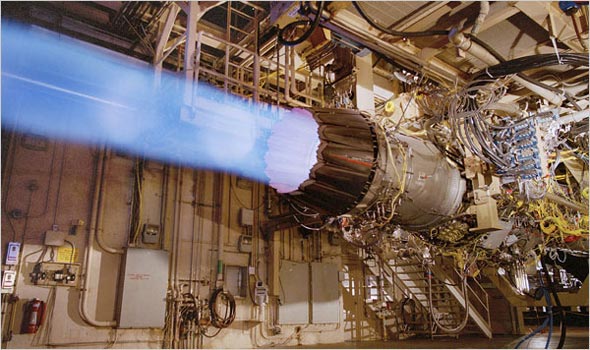
    Pratt & Whitney announced today the certification of its F135 engine to power the Lightning II’s first flight later this year after successfully completing all tests scheduled to date. The F135 has achieved Initial Flight Release from the F-35 Joint Program Office (JPO). Robert Burnes, JPO F-35 propulsion director, has declared all F135 tests and verification reports complete, clearing the F-35 Lightning II to fly.

    The JPO has certified the F135’s flight worthiness to power the F-35 Conventional Take Off and Landing (CTOL) flight test program. Pratt & Whitney is the lead propulsion system supplier for the F-35 program. The F-35 recently completed its first series of F135 engine runs culminating in a full afterburner test with 40,000 pounds of thrust. The F135 engine is on schedule to begin taxi testing this fall.

    The technologically advanced F135 is an evolution of Pratt & Whitney’s highly successful F119 engine for the F-22 Raptor. Together the F135 and F119 will have logged more than 800,000 hours before the F-35’s introduction into operational service in 2012. Rated at more than 40,000 pounds of thrust, the F135 is the most powerful fighter engine ever built.

    The F135 propulsion system team consists of Pratt & Whitney, the prime contractor with responsibility for the main engine and system integration; Rolls-Royce of the United Kingdom, providing lift components for the STOVL F-35B; and UTC’s Hamilton Sundstrand unit, provider of the F135’s control system, external accessories and gearbox.

    PELE/ALP Enhanced Tube-Fired Ammunition

    PELE and ALP technologies significantly enhance the effectiveness and versatility of existing tube-fired ammunition (tank projectiles, artillery shells and rockets).

    Penetrator with Enhanced Lateral Effect (PELE)
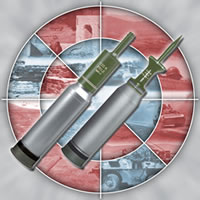
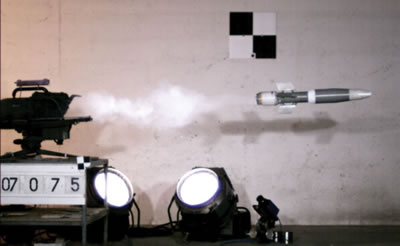
    PELE technology makes it possible to produce fully inert projectiles. The new technology modifies the projectile performance characteristics, significantly enhancing the accuracy of tank and artillery fire, while substantially reducing the risk of collateral damage. Non-explosive PELE ammunition consists of a high-density casing containing a core made of low-density, low-compressibility material. Upon impact with the target, the low-density material inside the shell is compressed to such an extent that the casing bursts, generating numerous fragments that are propelled in the direction of fire. This way, the round’s lethal impact is restricted to a defined space or limited area, reducing the likelihood of collateral damage. PELE and ALP make it possible to manufacture warheads containing little or no explosive. Moreover, existing ammunition can be inexpensively retrofitted with PELE and ALP technology. Both technologies can be integrated in full- and sub-caliber rounds, and fired from current and future weapon systems.

    In August 2006 Rheinmetall Defense acquired the industrial property and trademark rights of PELE and ALP. According to Rheinmetall, the company plans to market them in conjunction with ammunition procurement and upgrade programs both at home and abroad. Concurrently, negotiations are underway with Diehl BGT Defence GmbH & Co. KG of Überlingen, Germany to acquire licenses in various special caliber segments.

    In November 2006 Rheinmetall announced the first order from Denmark, for DM-53 and upgrading of DM-33 120mm KE rounds, fielding the PELE technology.

    Active Lateral Penetrator (ALP)

    The Active Lateral Penetrator takes the PELE principle a step further: ALP technology can be used to create a highly effective inert penetrator or a delayed-action shell containing small amounts of explosive; the ratio between penetrating power and lateral impact can be adjusted in the process. With an Active Lateral Penetrator, the projectile’s final ballistic impact in and on the target is attained with a small amount of explosive that can be activated irrespective of the charge’s position. This creates a pressure field which is transmitted via an inert conducting medium (e.g. liquid, plastic or metal) to the surrounding shell casing, causing it to burst into fragments or release a swarm of sub-projectiles.


    GSM-200 Cellular SIGINT/EW – Electronic Combat Suit

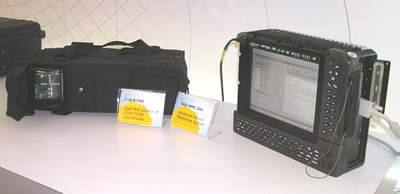
    Tadiran Electronic Systems, a subsidiary of the Israeli Elisra Group unveiled a family of cellular SIGINT and EW systems enabling military law enforcement security forces to track, trace and engage suspected cellular phones. In contrast to common use of “brute force” jamming, attempting to disrupt communications and isolate an IED suspected target from the cellular network, the new system employs selective jamming, therefore enabling continued operation of friendly units while deactivating suspected or unidentified cellphones.

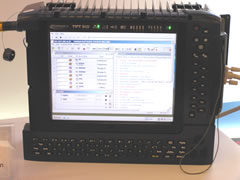
    The system employs the GSM-2000, a sophisticated cell scanner, which charts all the cellular traffic in the area, alerting the operator on the presence of defined targets in the designated area. The system operates as a “selector”, locating all known (friendly) units and filtering unknown or suspicious units, based on their individual profiles. When specific sets are identified as “suspects”, they can be individually intercepted, localized and deactivated by the use of Elisra’s hand-held passive Locator which can lead intervention forces to the suspect, or use the Cellective – selective cellular jammer to deactivate the suspected device even without locating it. This new ensemble enables security forces to intervene in an evolving situation in a “surgical” way, without alarming the local population or alerting the suspects.

    GunCam Video recorder

    Macroswiss has developed the Guncam recorder unit for use by Police Forces and Armies that need to record firefights from the users perspective for accountability purposes. These miniature DVR units can be attached to a weapon or be kept on a belt or in the pouch of a vest. When not mounted directly on the weapon the camera and the recorder are connected to the weapon mounted camera by a coil-cable. The camera can be set to record video only when the weapon’s safety is released, in user-switchable recording mode where the user decides when to record, or in continuous recording mode. Data is recorded on a compact flash card.

    The GunCam DVR records high-definition 640×480 pixel images, which can be viewed as a video or exported as single high definition frames. Every frame has its unique timestamp, which is recorded in a tamper-proof format. The system is powered by Lithium-Polymer batteries that can provide up to 14 hours of standby time and up to 8 of hours recording. Approximately 4 hours can be recorded on a single 4 Gb Compact Flash Card. For extended use, the system employs a ‘Circular Buffer’ recording method, where new files record over the oldest files. The camera records video in a proprietary SYAC™ FLM™ format. After a mission, the images are downloaded and displayed using a PC and SYAC™ DigiEye PC Player software.

    C-130 Avionics Modernization Program (AMP)

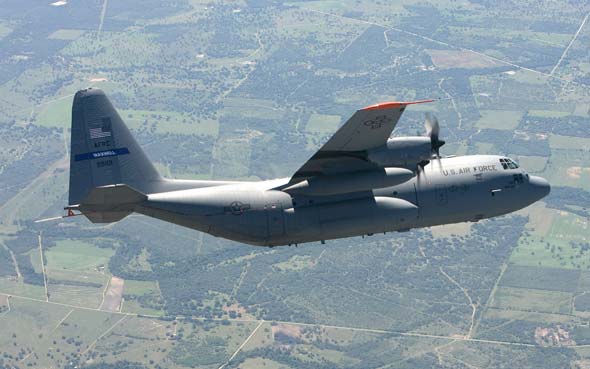
    AMP modernization will focus on replacement of the old “round dial” instruments with state-of-the-art “glass cockpit” displays, including a heads-up display (HUD). The new avionics system features digital displays and the 737 commercial airliner’s proven flight management system, providing navigation, safety and communication improvements to meet Communication Navigation Surveillance/Air Traffic Management requirements. The upgrade boosts C-130 capabilities as the aircraft continues its world-wide employment. AMP will bring the C-130 into compliance with current navigation and safety requirements, standardize the avionics across the C-130 fleet, improving reliability, and eliminating the requirement for a navigator in most of the aircraft.

    The first modified C-130 AMP completed its maiden flight on September 19, 2006 in San Antonio. The C-130 AMP program is managed by the Aeronautical Systems Center’s 866th Aeronautical Systems Group at Wright Patterson AFB.

    Boeing will also modify the C-130 Aircrew Training System to support the C-130 Avionics Modernization Program (AMP). The $56.3 million contract covers the modification of the lead C-130 AMP scheduled for delivry by 2009. The work will be performed by a team consisting of Boeing, CAE and Lockheed Martin.

    SpyBowl reconnaissance Sphere from Exavision

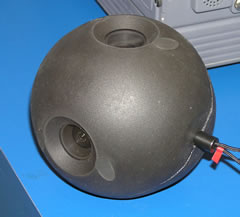
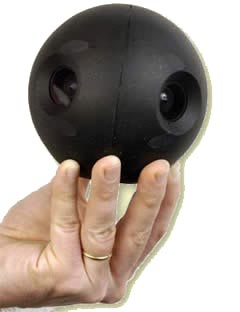
    Thrown or rolled into a suspicious target area, Spybowl uses four cameras to generate an omni-directional view of its surrounding and a microphone to detect and transmit voices.
    The system uses HF radio for data transmission over range of up to 30 meters inside buildings or 100 meters outdoors. All components are packed inside an rubber coated aluminum sphere, enabling Spybowl to sustain severe and repetitive shocks. Future versions will be equipped with infrared and laser illumination devices, augmented by advanced target recognition and identification algorithms.


    GCCS-I3 – Global Command and Control System – Integrated Imagery and Intelligence

    U.S. Joint Forces Command (USJFCOM) is fielding a web portal-styled intelligence information analysis system enabling users an immediate access to imagery and intelligence directly from a Common Operational Picture (COP).

    Global Command and Control System – Integrated Imagery and Intelligence (GCCS-I3) improves rapid development of situational awareness pictures of intelligence, provided to joint forces commanders. GCCS-I3 offers users a standard set of integrated, linked tools and services which give immediate access to imagery and intelligence directly from a common operational picture (COP).

    It does this by bringing assessment and battlespace visualization abilities together, via the COP, which provides situational awareness and analysis to joint force commanders. It uses the Web-based portal to push and pull information from the various information sources.

    The GCCS-I3 fuses data from multiple sensors and intelligence sources to enable situational awareness. The system supports the integration of locally collected tactical imagery, live video streams and other intelligence with national and theater – produced intelligence. Operational or tactical displays alongside continuously updating operational-intelligence information directly plot the intelligence, providing users vastly improved knowledge of the tactical battlespace. According to Brian Moses, USJFCOM J2 Agile Development Branch Chief, users have a screen that offer a variety of applications within the GCCS-I3 system. “They are looking at a blue force, red force and neutral force disposition of all contacts of interest,” said Moses. Users can manipulate their data screens, they can change their mapping projections to suit their needs so the individual analyst can modify and change the presentation of information.

    DOD USJFCOM article, August 16, 2006

    TACNAV independent Vehicular navigation system

    KVH TACNAV is a tactical navigation system which augments GPS navigation systems with complimentary position references used on combat vehicles, such as odometer, electronic compass, fiber-optic gyro etc. The system enables continued navigation, position keeping, dead reckoning navigation, and targeting even when GPS is jammed, or unavailable.

    TACNAV is provided as commercial off the shelf (COTS) system, providing simple compass display showing bearing, north position and distance traveled from last reference point. The system interfaces with on board navigation systems (such as GPS, odometer) and BMS to complement the GPS when GPS. This function has become essential with the fielding of Blue Force Tracking systems, as location reporting from all units are critical for establishing a broad situational picture at all levels.

    Most systems rely exclusively on GPS data, which is vulnerable to interference and jamming. The addition of backup positioning reference enables the Blue-Force Tracking position location unit to continue and transmit the vehicle’s position even when GPS is not available. With an Enhanced Fiber-Optic Gyro (FOG) module, and turret angle encoder, TACNAV becomes a Target Location System (TLS) for turreted platforms. Enabling the system to monitor and process the turret position, thus feeding essential information to on-board threat warning and countermesures system, BMS etc. The FOG improves the pointing accuracy of the system from 35mil to 10 mils, providing redundant GPS backup options. It also improves dead reckoning accuracy by reducing error rate from 3% to 1% of the distance traveled. Using TLS target location accuracy is quadrupled from 300 (meters at 5 km range) to 75 meters.

    The latest addition to the system is the TACNAV Enhanced Navigation and Visualization System. This interface provides a large touch-screen controlled display showing navigation and positioning data, steer-to-navigation guidance, heading, distance and waypoint data over a map of aerial photo. The reference image can be a high resolution topographical map or variable scale aerial photo. The system also shows the traveled path (DR) and various objects of interest (such as red and blue forces, IED threats etc.) on a geo-referenced overlay.

    SOD IV – Surveillance & Observation Device (SOD) Micro UAV

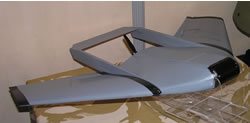
    The British company Cyberflight unveiled two micro UAVs at Eurosatory 2006. The new members of the Surveillance Observation Device (SOD) family of mini-UAVs include SOD IV, a 0.5kg Maximum Take-Off Weight (MTOW) platform carrying a 250 gram payload. The Micro UAV can fly on a 15-35 minute mission to a range of 9 km at an altitude of 1,000 – 2,000 feet, loitering at a minimum speed of 15 knots. Unlike other micro UAVs of its class, SOD IV uses a swept wing plan-form, enabling efficient flight in urban environment. The system is carried and operated by a single soldier and is prepared for a mission within seconds. SOD IV can be assembled from three subsystems (two wings and a single body/tail section) mission company’s systems. The system is fitted with nose mounted EO payload comprising a CCD chip, a lens and a remotely controlled mechanism enabling 90 deg tilt of the sensor, for forward or down looking views.

    Cyberflight product range on display focused on a new family of Surveillance Observation Device (SOD) – including the SOD I flying wing, SOD III mini UAV and SOD IV Micro-UAV. SOD I is a 3kg MTOW flying wing UAV, designed for 60 minute operation at an altitude of 500 – 2,000 feet, carrying a 0.5 kg payload including a color, fuselage mounted color daylight camera or a thermal night camera. SOD III follows a more conventional plan-form; it weighs 5.4kg MTOW including a 2 kg payload, and is designed to sustain mission duration of 2.5 hours.

    Milan ER (Extended Response)

    The latest generation of Milan anti-tank missile, the Milan ER (Extended Response) was test fired for the first time on May 18, 2006. Further tests are planned for 2006 validate the missile’s performance and operation of the ADT firing post, currently undergoing qualification. A fully digitized firing post, ADT is designed to integrate into a net-centric battlespace incorporating remote-video and weapon control features and integrated geo-positioning, built-in test and maintenance tools and embedded training.

    Milan ER maintains all performance and operational features of the Milan family while introducing new technologies in warhead design, propulsion system, in-flight maneuverability and extended range.

    Hunter Killer Drone Target Ballistic Missile Launchers

    A derivative of the operational Harpy radar killer drone, developed and built by IAI/MBT is proposed as a hunter-killer drone, operated from land based truck mounted launchers or from ship based launchers. The unmanned weapon, will be able to strike targets of opportunities such as silent enemy air defense weapons, and ballistic missile launchers.

    The joint program was initially proposed by IAI/MBT and Raytheon as “Cutlass” for Combat Uninhabited Target Locate and Strike System. Initially displayed in the Paris Air Show in 1999, the system combined the airframe of the Harpy UAV, made by Israel Aircraft Industries, with advanced sensors made by Raytheon Systems, which also manufactures the HARM (High Speed Anti-Radiation) missile. Cutlass was adapted for ship-based operations to support US Navy operations over land. It is designed for six hours missions, flying at speed of 100 knots and maximum range of 1,000 km.

    Unlike the autonomous Harpy, Cutlass also has a direct line-of-sight datalink capability at range up to 150 km. This range can be extended via relays built into each weapon. Like Harpy, Cutlass primarily is a SEAD weapon, relying on a blast-fragmentation warhead, but Cutlass is different from Harpy in its semi-autonomous mode of operation. When a potential target is located, the information is data-linked to an operator in the ground station to confirm target identification and to provide positive man-in-the-loop attack permission. With different seekers, the killer drone can also be used for hunting of ballistic missile launchers, urban warfare, and attacking vehicles. Other potential missions for an unarmed version of the Cutlass could be reconnaissance, target acquisition and battle-damage assessment, he said. It operates at an altitude of 6,000 feet, to avoid ground fire.

    In October 2005 a derivative of Harpy presented by MBDA in cooperation with IAI/MBT Division was selected as one of the finalists for the UK Loitering Munition Capability Demonstration (LMCD) program.

    Skunk Works and XTEND Simplify Multi-Drone Command

    0
    Lockheed Martin Skunk Works® and XTEND have achieved a major milestone in JADC2 by integrating the XOS operating system with the MDCX™ autonomy platform. This technical breakthrough enables a single operator to simultaneously command multiple drone classes, eliminating the friction of mission handoffs. From "marsupial" drone deployments to operating in GPS-denied environments, explore how this collaboration is abbreviating the data-to-decision timeline and redefining autonomous mission execution.

    From Ukraine to Taiwan: The Global Race to Dominate the New Defense Tech Frontier

    0
    As traditional defense primes face mounting competition from agile “neoprimes” such as Anduril, Palantir and Helsing, the balance of innovation is shifting toward software-defined warfare and scalable, dual-use technologies, while global industry consolidation—marked by Boeing’s integration of Spirit AeroSystems and other strategic mergers—signals an intensified race to secure control over the defense technology value chain. Our Defense-Tech weekly report highlights these trends.

    Europe’s “Drone Wall”

    0
    In early October 2025, a coordinated wave of unmanned aerial system (UAS) incursions—widely attributed to Russia—targeted critical infrastructure across at least ten European nations. The unprecedented campaign exposed the fragility of Europe’s air defenses...

    Weekly Defense Update & Global Security Assessment

    0
    Executive Summary The past week (September 18-25, 2025) represents an inflection point where strategic defense concepts have transitioned from doctrine to tangible reality. An analysis of global events reveals four primary, interconnected trends shaping an...

    U.S. Air and Space Forces Push Next-Gen Programs at the AS&C 2025 Conference and...

    0
    At the 2025 Air, Space & Cyber Conference, U.S. Air Force and Space Force leaders unveiled major updates on next-generation fighters, bombers, unmanned systems, and space initiatives, highlighting both rapid innovation and critical readiness challenges as the services race to outpace global competitors. A short version is available here, with a more detailed version for subscribers.

    TADTE 2025: Reflecting Taiwan’s Strategic Themes

    0
    The Taipei Aerospace & Defense Technology Exhibition (TADTE) 2025 crystallized around four dominant strategic themes that collectively illustrate Taiwan's comprehensive approach to defense modernization amid escalating regional tensions. Based on a detailed report by Pleronix (available upon request). Includes a Podcast discussion on TADTE 2025's highlighting Taiwan's four strategic themes beyond the post's coverage.

    Iron Beam 450 Completes Testing, Soon to Join With Operational Air Defense Units

    0
    Israel’s Iron Beam 450 high-power laser system has completed final testing, marking a major leap in air defense. Developed by Rafael, it offers precise, cost-effective interception of rockets, UAVs, and mortars, and is set for IDF deployment by 2025.