
Tuesday, December 23, 2025
More
    Home Blog Page 415

    Advanced Add-on Armor for Light Vehicles

    Start < Page 3 of 6 >

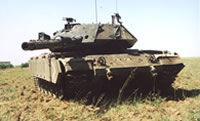
    A combination of passive and reactive armor was introduced in the 1980s, as more advanced armor solutions were implemented with upgraded and new platforms, such as Leopard-2A6 (below), Challenger 2, Leclerc, Merkava Mk4, Mk3, and IMI Sabra (modernized M-60 version developed by IMI for the Turkish Army Tank Upgrade Program – photo below). Composite armor uses various materials different hardness and elasticity, heat and shock absorbing materials, layered and sandwiched together, to provide improved protection against specific threats, such as multiple-hits of Kinetic Energy (KE), and Chemical Enegry (CE) ammunition.
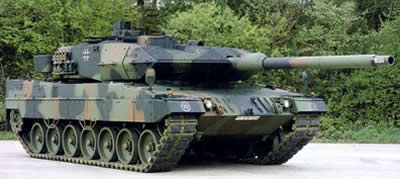

    Composite passive armor is designed to absorb the energy of the impact, and prevent penetration and internal damage by the penetrating projectile or its residual effects. Active and Reactive protection systems are designed to detect and deflect an incoming round or destroy it during the initial phase of the penetration. Deflection of shaped-charge weapons such as rocket-propelled grenades and anti-tank missiles without adding extra weight, as did the current reactive armor system. Composite armor is usually provided in modules or tiles, which are composed of a mosaic of hard (ceramic) materials, soft but strong (composite fibers) embedded in concrete matrixes. The frontal plan is usually covered with softer material, such as rubber or other composites, which are used to dissipate the initial impact and minimize the damage to the internal mosaic, thus retaining its multi-hit protection capability. Typical passive add-on armor is the MEXAS, produced by IBD in Germany. In some models of passive composite armor, reactive, non energetic materials are contained between the different layers of the armor. These materials react when hit by a projectile, and cause the whole module to change its physical characteristics.

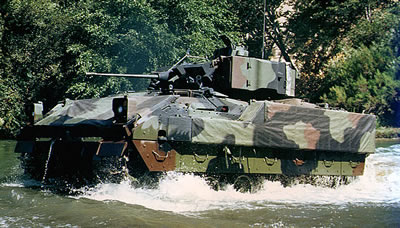
    Different passive protection was developed for amphibious vehicles. In the 1990s, an enhanced appliqué armor kit (EAAK) was developed by RAFAEL and installed on the USMC Amphibious Assault Vehicles (AAV7A1). This add-on armor retains the vehicle’s floating capability. More advanced add-on protection suits are based on hybrid modules, such as the IMI-RAFAEL L-VAS protection suite for the M-113 and LAV/Stryker APCs. This system is utilizing a hybrid armor solution, comprising of both passive and reactive armor, added with mesh traps, to provide front and side multi-hit protection from RPGs, 14.5mm AP and 155mm shell fragments, at a total weight increase of only two tons. Mesh traps also known as Slat Armor are also deployed on the Stryker Armored Personnel carriers, currently deployed in Iraq. Within a decade, futuristic concepts such as the Future Combat Systems armored elements are expected to field protection systems capable of deflecting large caliber HEAT (High Explosive Anti-Tank) and kinetic munitions (APFSDS).

    For Future Combat Systems, planned for deployment in the next decade, the US Army is studying optimized armor configurations, including frontal armor that will weigh 80lb/ft2 which will be capable of defeating medium-caliber automatic cannon threats, shaped-charge threats, and residual threat debris from large-caliber KE intercepted by an Active Protection Systems (APS). Another type of armor, designed for light vehicles, will be able to defeat heavy machine gun threats at 20 lb/ft2. Tests of various candidate designs is expected in 2004.

    Further in the future, advanced protection techniques are developed, including stealth, smart armor, which attempts to deflect a round once it has penetrated the first layer of armor, and electromagnetic armor, which deforms and reshapes the penetrating rounds or plasma jet – both methods are causing the projectile’s disintegration inside the armor, by its own kinetic or heat energy. These technologies are expected to mature in time for FCS Block II. The US Army is currently testing electromagnetic armor concepts on the Bradley. The system uses spaced, add-on modular elements, formed with a charged element and a forward surface, used as a precursor. the HEAT jet which penetrates the forward layer discharges the internal layer, and the effect causes the jet to dissipate and loose its energy. The system can be recharged and therefore protect the vehicle from multiple shots. The current version of electromagnetic armor is designed primarily against relatively small (RPG style) threats, but could be upgraded (with more power) to protect against larger HEAT warheads. United Defense, which develops the system under an ARL program, expects that the concept could mature in a few years, if adequate funding is made available for the program.

    Additional Parts of this article :

    Add-On – Reactive Armor Suits

    Start < Page 2 of 6 >

    Explosive Reactive armor (ERA) is a common form of add-on armor, used on many Armored Fighting Vehicles (AFV). This concept is combat proven. Protection by explosive modules was deployed by the Israel Defense Forces in the late 1970s, and was first, and successfully used in combat with the Israeli Army M-60s and Centurion tanks in the 1982 War, and later, by the Russian Army by the mid 80s. Reactive armor utilize add-on protection modules conforming of thin metal plates and a sloped explosive sheath, which explode when sensing an impact of an explosive charge (such as High Explosive Anti-Tank – HEAT projectile).

    The ERA enables a significant increase in the level of protection, primarily against shaped charges, without a proportional increase in the weight of the protected platform. The operating mechanism is based on an initiation of an explosion, that disrupts the plasma jet created from the shaped charge warhead as it penetrates the armor. The early models of reactive armor were considered effective against all types of chemical energy projectiles, primarily ATGMs and HEAT rounds but they did not have redundancy and offered limited protection against multiple attacks.  Modern reactive armor is designed to use a combination of energetic and passive materials and formation that can withstand multiple attacks. The modern modular armor is designed in smaller tiles, and more complex shapes that offer optimal plate slopes to counter potential threats.

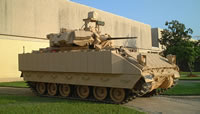
    A typical reactive armor suite was developed by RAFAEL for the Bradley M-2 Infantry Fighting Vehicle (BIFV), under cooperation between General Dynamics and RAFAEL.

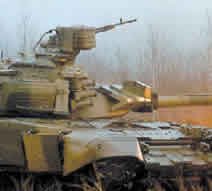
    The latest version of Russian ERA, dubbed Kontakt5, deployed with T-80 and T-90 tanks. This version is believed to provide some protection improvements to counter kinetic energy (KE) rounds as well as shaped charges. (Photo at left shows Kontakt5 modules on a Russian T-90 Tank).

    An advanced version of ERA is the Self Limiting ERA (SLERA). Based on better understanding of the dynamics of ERA based shaped charge defeat mechanism, modern systems are utilizing improved mechanisms, which utilize lower masses of explosives which could be classified as passive armor. These considerations have significant implications on the logistics, storage and handling of AFVs and protection systems, without degradation in the protection levels. Other applications of reactive armor are based on the use of reactive properties of the protection module, yet the initiation of such reactions are not triggered by an explosive charge. Another type of non-metallic ERA is the CLARA, developed by Dynamit Nobel. As Non-Explosive Reactive Armor (NERA) or Non Explosive reactive Armor (NxRA) modules do not use energetic components, and therefore are not consumed when being hit. Therefore, they provide an effective multi-hit protection capability which cannot be obtained by ERA or SLERA. Furthermore, the loads inflicted on the vehicle’s structure are much smaller and therefore, such modules can be applied to lighter vehicles. from the reactive armor system. The downside of  NERA is that while it is effective against CE threats, its performance is not sufficient when engaging KE threats. Scientists are predicting that future developments of NERA will be able to defeat medium caliber KE threats.

    Further advancements of the ERA, considered for future implementation, include a “Smart Armor” concept that will has integrated sensors and microprocessors embedded into the armor, which sense the location, type, velocity and diameter of the projectile or jet, will trigger smaller explosive elements, to form an effect tailored against a specific penetrator. Another future version of the reactive armor concept is the Momentum Transfer Armor – which is also designed to counter KE threats. This technology is applicable for front and side protection, where adequate space can be allocated for such installation. The system will be activated by threat warning sensors that will detect an incoming projectile and launch a small steel bar in a direction perpendicular to the flight-path of the approaching threat. Such concepts are studied as part of futuristic armor concepts, among others to the US Army FSAP and French Leclerc 2010 concept.

    Additional Parts of this article :

    Protection Systems For Future Armored Vehicles

    Start < Page 1 of 6 >

    This article covers a wide range of protection systems designed for heavy, medium and light armored vehicles, including passive and reactive armour, hybrid armour, active protection systems, active armor defenses, missile defense systems, countermeasures and sensors. US, European, Russian, Chinese and Israeli systems are covered.
    Modern Armored Fighting Vehicles (AFV), such as the M-1A2, Challenger II, T-80 Leopard II and Merkava Mk4 are all demonstrating superb armor protection based on advanced armor concepts. However, the proliferation of new generations of Anti-Tank Guided Missiles (ATGM) and the wide use of hand held anti-tank rifle grenades (such as RPG) pose a serious threat to even the heaviest protected vehicles, as attacks are carried out at close range and from all directions.

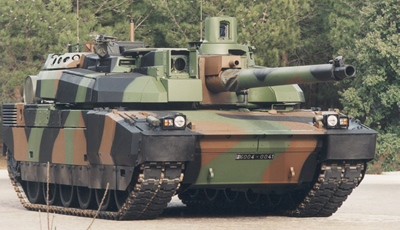
    The French Leclerc MBT utilize some of the most advanced protection suits, including advanced hybrid armor applied to the turret and hull, threat warning systems and countermeasures and active defensive systems.
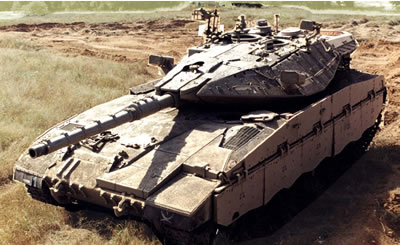
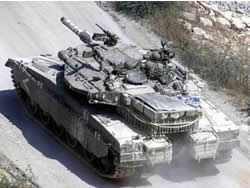
    Protection all around by passive armor is becoming too heavy for even the heaviest tanks, and even these cannot stop all threats in all directions. Therefore, a modern armor is a suite of protection means, comprising of relatively thin shell of ballistic steel and composite armor, (also known as hybrid armor) which can be designed to provide optimal protection from specific threats. Such armor can accommodate steel, various combinations and matrixes of composite materials, soft and elastic heat absorbing materials, kinetic energy (KE) absorbing materials such as ceramics, or depleted uranium and energetic materials (various explosives) that form reactive armor elements. A typical utilization of compound armor, designed to counter specific threats was designed for the British Challenger II and the latest upgrades of the German Leopard 2, as well as the Merkava Mk 2 Type C (shown below). The later uses augmented armor to counter roadside bombs and mines, anti-tank missiles and RPGs. This armor was added on the standard Merkava Mk3 and was later integrated into the Mk-3 Baz version of the tank (pictured below left).

    Future applications of lightweight hybrid armor can also adequate protection from small caliber ammunition, as well as Chemical Energy (CE – HEAT) threats, but are not providing full protection against KE threats. Future Combat Systems (FCS), as well as upgrades for existing platforms, will rely on a combination of passive and active protection, as well as detection avoidance and stealth. Full implementation of today’s Defensive Aids Suites is expected to increase the platform’s survivability in up to a factor of two. The addition of advanced ceramics, as well as composite-based lightweight armor, that already provides effective protection against small arms up to 14.5mm, is expected to defeat medium caliber guns ammunition (such as 35mm HE/AP (High Explosive / Anti-Tank) cannon projectiles) by 2006. Providing lightweight and effective protection against KE threats is yet to be proven, yet the use of advanced composite armor and new technologies currently being explored, is expected to yield a solution by 2015.

    Additional Parts of this article :

    Yak – Armored Command vehicle

    Yak
    Yak protected truck

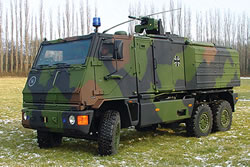
    Rheinmetall Landsysteme is producing the Yak command post vehicle. This high mobility armored 12 ton vehicle is designed to carry command post elements. The vehicle is based on the 6×6 multi-role Duro wheeled vehicle chassis, fitted with interchangeable multi-purpose modules. The command post module accommodates three workstations, comprising two rack mounted PCs and a single notebook. Two VHF radios, accommodations for additional communications equipment (SATCOM, HF etc.), network switch and external network access are available. Rheinmetal is producing 130 Yaks under a contract awarded by the German MOD. The vehicle is produced under co production with MOWAG GmbH of Switzerland.

    VAP – Desert Patrol vehicle

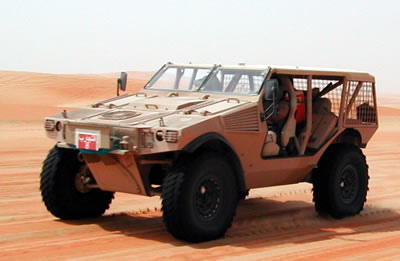
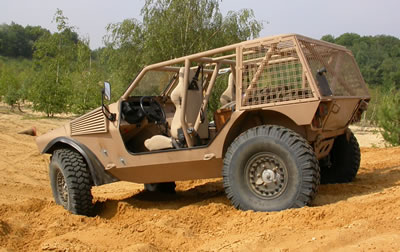
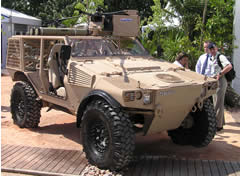
    Panhard unveiled an unarmored version of the VBL designated VAP, formerly known as the experimental desert patrol vehicle. The VAP is designed for deep penetration reconnaissance and patrols missions. It has a payload of 1.5 tons, transporting four men, supplies and mission equipment for extended patrols. The vehicle can carry various types of armament including a 20mm cannon, anti-tank missiles, observation equipment and communications gear. VAP has an integral anti-personnel mine floor protection.

    Australian Light Armored Vehicle (ASLAV)

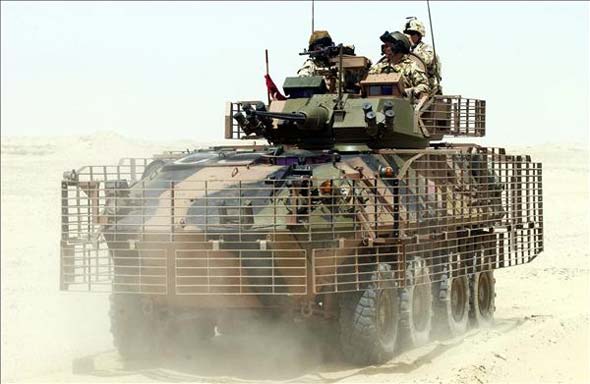
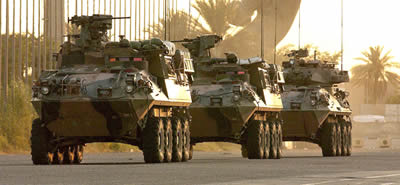
    Australian defence is expecting to complete the A$35M Australian Light Armored Vehicle (ASLAV) program next week, delivering the last two upgraded vehicles to the Australian troops. 59 of the 62 ASLAVs deployed since 2005 to the Middle East have been fitted with the Protector Remote Weapon Stations from Kongsberg, mounting the 12.7mm heavy machine gun. Australia bought 59 Protectors for A$17.9 million. The vehicles received improved protection, fitted with “bar” (slat) armor and internal spall liners to better withstand blast, small-arms hits and fragmentation. In operational service the ASLAV fleet has achieved availability rates of greater than 90%.

    The next modernization will be Phase 4 mid-life upgrade, which is expected to cost up to A$250 million which is currently in approval process. This phase will enhance the survivability and situational awareness capabilities of the ASLAV fleet with improved mine protection, spall liners and ballistic protection, introduction of battlefield management systems, and signature management. A surveillance version of the ASLAV will use the mast-mounted Multi-Spectral Surveillance System (MSSS) from DRS. ASLAV-S is currently in development and is expected to be fielded by 2008.

    The DRS Multi-Spectral Surveillance System (MSSS) is a reconnaissance and surveillance package consisting of a laser rangefinder, thermal imager, and ground surveillance radar integrated with a stabilized common gimbal (SCG-100) and soldier machine interface provided by DRS. The MSSS will be capable of three modes of operation: mounted on the vehicle, connected to the vehicle by a cable, and completely dismounted. The MSSS package will be designed as a kit for installation on the ASLAV-S by the Australian Defence Forces.

    AMX30B2DT

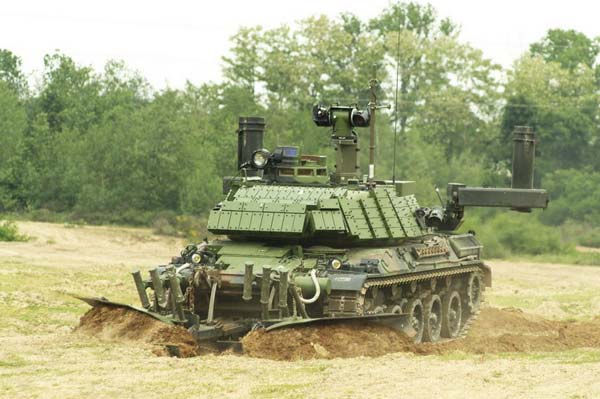
    The assault mine clearing vehicles of the French Army are planned for operation as part of the future modular assault mine-clearing system, consisting of sections of three remotely operated AMX30B2DT vehicles, equipped with mine clearing systems, operated by remote control from a VAB armored personnel carrier. The system was qualified for production in 2005 after a series of field tests conducted by the DGA.

    David – Light Armored Combat Vehicle

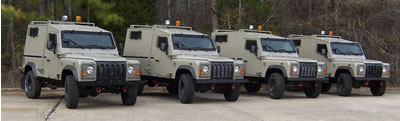
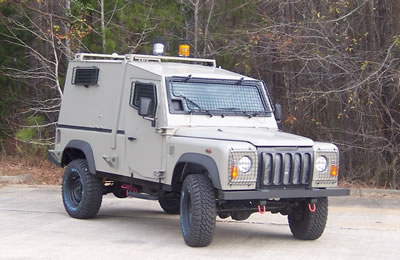
    The IDF selected the British Land-Rover Defender, up-armored by the Arotech subsidiary MDT for a replacement of the Israeli based Automotive Industries Storm (Sufa) vehicles. Responding to the growing threats by small-arms and IEDs, the IDF modified the Storm (AIL M-240) with extensive armoring. With a large loading bed, and a narrow body, enabling the vehicle to move in dense urban area, the Storm is offered with a 180 HP gasoline engine or 107 HP diesel engines, coupled with a manual transmission. With a gross weight of up to 2,350 kg, the Storm can carry up to 750 kg of payload, including five or seven passengers. Storm could handle well the additional weight of add-on armor required to stop low threats, but it does not have the payload capacity to carry heavier armor or combat loads. The IDF is currently buying the new Storm II but no armored versions have been released yet.

    The current configuration fitted, with an armor hull, bullet-proof windscreen, protected roof and more, provides a good protection converts this lightweight patrol, utility and command vehicle into a maximum weight up-armored vehicle. The modifications added significantly to the gross weight of the vehicle, causing safety hazards, limiting mobility and maneuverability, limiting its operability in combat operations, causing rapid wear and frequent breakdown of automotive systems and assemblies. The IDF is looking for Storm replacement for some time, and has recently announced an initial order for David armored vehicles, under a $22 procurement order to replace its veteran urban warfare workhorse. In August 2006 MDT received a follow-on order of US$10 million to supply more vehicles through July 2007.

    Promising to be a more flexible ‘Urban Combat Vehicle’, “David” uses a larger chassis based on the LandRover Defender, designed in Israel by Arotech’s MDT Protective Industries in collaboration with the IDF. The ‘David’ will be built in MDT Armor’s Alabama facility. With a small footprint, considerably shorter, lighter and narrower than the up-armored HMMWV, the 3.7 ton armored defender is well suited for operating in urban and other densely populated areas. The vehicle offers full 360 deg. Protection against assault rifles at point blank velocities, limited protection against IEDs, roof protection designed to defeat typical threats fired at very short range and augmented floor protection. The vehicle is fitted with run-flat inserts to maintain mobility even with deflated or damaged tires. The 2.5 liter turbocharged diesel engine develops maximum power of 122 bhp, coupled via manual 5 gear transmission to the 4×4 propulsion system. MDT followed a modular design allowing for several armor options, seating arrangements and equipment installations carrying 4, 5 or 6 soldiers in full battle gear. Gun ports in all 4 directions allow for accurate return fire as soldiers have full view of gun sites and surrounding area through the armored windows.

    SmartMTI – Multiple Object Tracking Moving Target Indicator

    Technest Holdings, Inc. is developing a real-time, multiple target tracking Moving Target Indicator (MTI) algorithm to be used in video surveillance systems deployed on with unmanned aerial systems. The system, called SmartMTI will be able to detect, extract and track the locations and movement history of multiple targets in real time within any image data.

    Technest’s SmartMTI will enable to monitor random air vehicle motion mitigation and tracking of an unlimited number of targets; with accurate target location, while maintaining low false alarm rate.

    SmartMTI uses a variety of mathematical models in a unique design that considers the ‘state’ of each object, implementing motion detection and target tracking methods to improve tracking reliability. TechNest launched the program after successfully testing the method in empirical Phase-I concept study, which demonstrated proof-of-concept design. On October 18 2006 the company announced US Army is funding the continued exploration and evaluation of the commercialization potential of SmartMTI algorithms with US$730,000, which will support the program through September 2008.

    PARS 3 Anti-Tank Missile

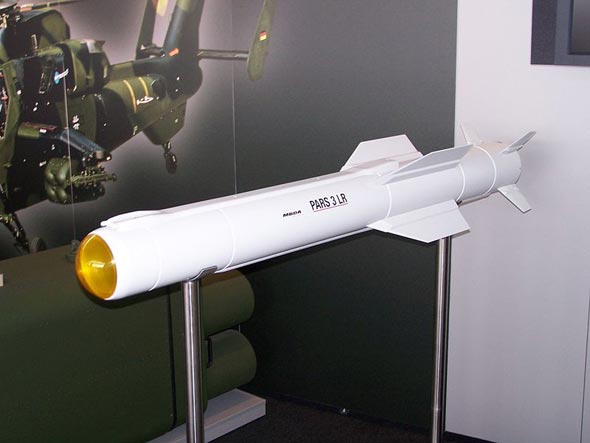
    The German Army selected the PARS 3 anti-tank missile to equip its Tiger helicopters and is awaiting Parliamentary approval for its plans to buy 680 missiles. The missile is a “fire and forget” weapon, capable of engaging heavy armor at ranges of 5,000 – 6,000 meters. It uses a tandem warhead to penetrate the most advanced armor, including ERA. Each Tiger will be equipped with two containers carrying four missiles each. By utilizing “fire and forget” techniques, the gunner acquires the target when the helicopter is covered in defilade position, exposing only the mast mounted sight. The target’s image is transferred to the missile’s infrared seeker which locks on the designated image and holds it in position throughout the flight. Both the sight and the missile’s seeker use IR detectors operating in the 10 micron range to eliminate false identification or target ambiguity between the two sensors.

    PARS 3 LR

    On June 30, 2006, the Federal Office of Defence Technology and Procurement (BWB) signed a 380 million euros contract for the procurement 680 PARS 3 LR missiles. PARSYS, a joint venture between LFK-Lenkflugkorpersysteme GmbH (50%) and Diehl BGT Defence (50%) will be responsible for industrialization and series production of the new missiles which will be delivered through year 2014.

    Development of the PARS 3 LR was formally completed in mid-2004. However, since the series production contract for the TIGER helicopter, of which 80 helicopters are destined for the Bundeswehr, was signed back in 1998, LFK GmbH has been manufacturing the components of the PARS 3 LR system to be installed in or on the helicopter – such as launchers, electronics, etc. and Eurocopter has been integrating these into the platform.

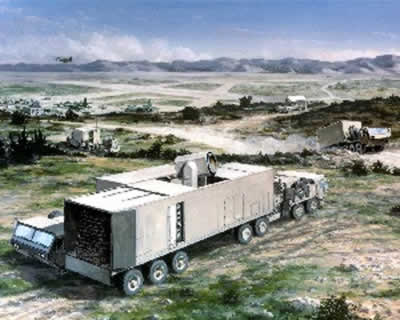
    Mobile Tactical High Energy Laser (MTHEL)

    MTHEL uses directed energy (laser beam) to intercept aerial targets such as rockets, missiles, artillery shells and other aerial threats. The target destruction is achieved by projecting a highly focused, high-power laser beam, delivered by a chemical laser, with enough energy to affect the target, and explode it in midair. This operational concept is offering the first “reusable” interception element. Existing interceptors use kinetic energy kill vehicles (such as fragmentation warheads), which are not reusable.

    MTHEL represents a transformational weapon system – the first mobile directed energy weapon that will be able to destroy tactical airborne threats in midair. In order to achieve a high rate of fire, designers are looking into the use of high energy capsules, which can be loaded prior to each shot. The cost per shot, primarily cost of the chemicals used to fuel the laser, is expected to be in the thousands of dollars – far less expensive than the cost of kinetic energy defense systems.


    MTHEL is a development of the mobile version of the Tactical High Energy Laser (THEL) testbed weapon, developed by Northrop Grumman under a US Army contract. The program was expected to provide a completed prototype by 2007. By January 2006 the THEL/Nautilus program was shelved due to lack of budget. However, In July 2006, Northrop Grumman unveiled the Skygoard laser based C-RAM/air defense system, designed to protect civilian and deployed military forces.

    Since the year 2000, THEL intercepted five artillery projectiles and 28 rocket targets, including the short range 122mm Katyusha type rockets fired singly and in salvos and larger, long range 160mm rockets which has twice the range of the standard katyusha. Most recently, on August 24, 2004 the system intercepted and destroyed mortar bombs, fired both single and in salvos. During the most recent test conducted on May 2004, THEL destroyed a large caliber rocket target, containing a live warhead, which was intercepted by the laser weapon. However, in late 2004 funding for the program was stopped claiming it was too bulky for army deployments. Northrop Grumman continued with development of a “relocateable” version of THEL to provide some defensive capability as part of Rocket, Artillery and Mortar Defense (RAM-D). The system’s radar is already operational in Israel, providing early warning from Palestinian attacks on the the city of Shderot.

    The purpose of the planned MTHEL program was to develop and test the first mobile Directed Energy weapon system capable of detecting, tracking, engaging, and defeating Rockets/Artillery/Mortars (RAM), cruise missiles, short-range ballistic missiles, and unmanned aerial vehicles. MTHEL would have been the first tactical and mobile, directed-energy weapon capable of shooting down in flight airborne targets such as rockets, cruise missiles and other weapons, protecting expeditionary forces or deployed forces as well as civilians areas targeted by such threats. The alternative “relocatable” system will be optimized to protect critical and sensitive military sites at forward area deployments. It could also provide limited area protection for population centers threatened from attack by RAM – as evident in Israel and Iraq.

    THEL/ACTD program was developed for US Space & Missile Defense Command and the Israel MOD demonstration tests by TRW, now part of Northrop Grumman corp. Subcontractors for the program include Ball Aerospace and Ball Aerospace in the US and the Israeli companies: Elbit/El-Op, IAI/Elta which built the radar and fire control system, RAFAEL and Tadiran.

    AN/PRC-150(C) HF Manpack Radio

    Harris AN/PRC-150(C) HF manpack radio provides secure, long-range voice and data. It also supports secure Type-1 interoperability with the Marine Corps’ AN/PRC-117F(C) multi-band multi-mission radios (MBMMR). It uses embedded information-security features to enable secure, ground-to- ground and ground-to-air communications in all HF modes and in fixed-frequency modes with SINCGARS radios. The system dual mode system covers the full HF band and part of the VHF band, from 1.6 to 60 MHz. The AN/VRC-104(V)3 vehicular product is a fully integrated communications system that includes the Harris AN/PRC-150(C) tactical radio and 150 watt high-frequency power amplifier.

    On 17 August 2006 the US Marine Corps awarded Harris a $35 contract to replace their legacy MRC-138s and GRC-193s high-frequency tactical radio systems with new AN/PRC-150(C) manpack and AN/VRC-104(V)3 vehicular systems to be supplied by Harris, under a $35 million contract. The new sets will modernize Marine Corps active duty and reserve components.

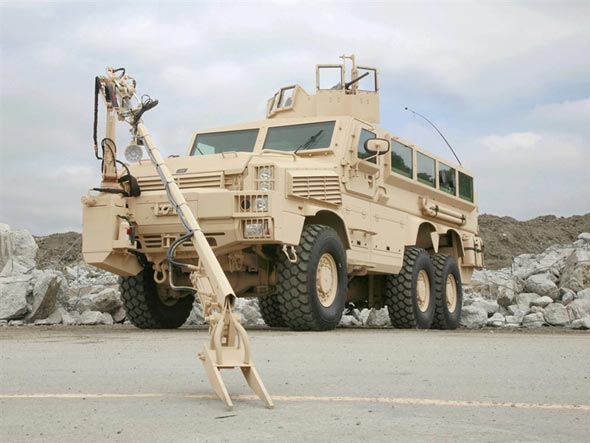
    RG33L Armored, Mine Protected Vehicle

    The RG33L IED and mine protected armored vehicle was designed by BAE Systems’ South African based division (formerly OMG). The vehicle can be configured as an Infantry Carrier, Ambulance, Command and Control, Convoy Escort, Explosive Ordnance Disposal and other roles. The new RG33L is an air transportable 6×6 Mine-Protected Vehicle (MPV), incorporating a classic monocoque V-shaped hull design, similar to all modern MPVs. It utilizes a base armor protecting anagisnt small-arms fire and mine attacks, panoramic windows utilizing the TRAPP transparent armor, and modular, mission configurable appliqué armor kits.

    The vehicle is equipped with a hydraulic ramp, a gunner’s protection kit, a robotic arm for handling IEDs, survivability gear, and dedicated space for equipment stowage. Survivability enhancements include provisions for modular add-on armor kits, TRAPP transparent armor that provides excellent visibility and improved situational awareness, and run-flat tires. The vehicle is mission configurable for Infantry Carrier, Ambulance, Command and Control, Convoy Escort, Explosive Ordnance Disposal and other roles, and is recoverable by another RG33L.

    The vehicle is equipped with multi-positional mine protected seating and air conditioning. Base armor protects the vehicle against medium machine gun or small arms fire and mine blasts at a level equal to or exceeding any fielded mine protected vehicle. The platform is designed with a power train equipped to handle upgrades and enhancements. The vehicle features on-board exportable power for C4I and other mission equipment.

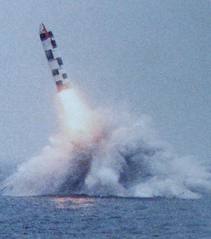
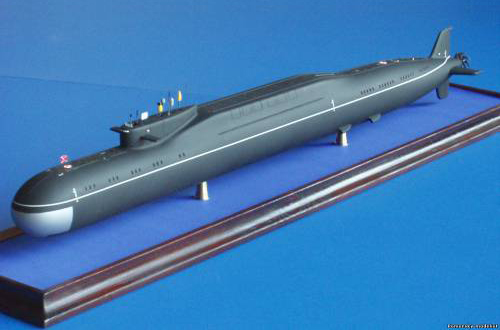
    Bulava M – Submarine Launched Nuclear, Intercontinental Ballistic Missile

    Bulava M is considered a sub-launched version of the Topol. The missile is being developed by the Moscow-based Heat Technology Institute, which ALSO designed the ground-based Topol-M (SS-27). Both missiles are considered to form the core of the Russian nuclear deterrent forces until 2040, allowing Russia to maintain nuclear parity with its nuclear opponents. Bulava M has a range of 6,200 (8600 km) miles and is designed to carry six individually targeted reentry vehicles equipped with nuclear warheads. The missile is fitted with ten maneuverable independent reentry warheads, each loaded with 550 kT yield nuclear warhead. Each Borei class submarine can carry 12 missiles. The converted Typhoon class submarine Dmitry Donskoi carries ten missiles.


    Repeating failures have drawn much scrutiny and attention to the Bulava, but the Russian Navy insists there is no alternative to the missile. The missile started engine flight tests from ground launch pads in 2004. The first two sea launches in September and December 2005 were successful. Two additional launches failed, in September and October 2006. Russian Navy experienced seven failures with these submarine launched missiles. Two failures happened during Northern Fleet maneuvers, attended by President Vladimir Putin in February 2004. One missile failed to blast off from a submarine and a day later, another exploded shortly after launch. In July 2009 a test flight failed after the missile’s first stage malfunctioned. Annother test flight in December 2009) terminated over the White Sea in the Arctic Circle, short of the designated target. According to official reports from Moscow, the first two stages functioned smoothly, but the flight faltered at the third stage due to a technical failure that caused instability in the third stage engines.

    Official investigation of the recent failure of the Russian Bulava has established that the missile failure was caused by a design flaw, rather than a faulty component. Earlier official statements cited a number of reasons for the repeated failures of Bulava tests, including faulty components, attempts to replace specific materials with cheaper substitutes and obsolete manufacturing equipment. Of the 12 Bulava missile testes conducted in recent years seven failed and only five determined ‘successful’. Provided the fault can be corrected in time, Russia plans to renew Bulava testing in May-June 2010.

    Bulava was scheduled to equip the new Project 955 Borei class submarines, which will replace the older Typhoon class nuclear powered missile subs currently in service. The lead submarine Yury Dolgoruky was scheduled to receive its complement of 12 Bulava missiles around 2008, while two sister ships Alexander Nevsky and Vladimir Monomakh will be completed in 2008 and 2010. Delays in the completion of the SSBM will undoubtedly push back the commissioning of the new submarines.

    Skunk Works and XTEND Simplify Multi-Drone Command

    0
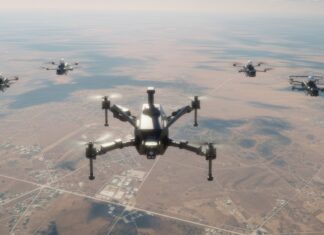
    Lockheed Martin Skunk Works® and XTEND have achieved a major milestone in JADC2 by integrating the XOS operating system with the MDCX™ autonomy platform. This technical breakthrough enables a single operator to simultaneously command multiple drone classes, eliminating the friction of mission handoffs. From "marsupial" drone deployments to operating in GPS-denied environments, explore how this collaboration is abbreviating the data-to-decision timeline and redefining autonomous mission execution.

    From Ukraine to Taiwan: The Global Race to Dominate the New Defense Tech Frontier

    0
    As traditional defense primes face mounting competition from agile “neoprimes” such as Anduril, Palantir and Helsing, the balance of innovation is shifting toward software-defined warfare and scalable, dual-use technologies, while global industry consolidation—marked by Boeing’s integration of Spirit AeroSystems and other strategic mergers—signals an intensified race to secure control over the defense technology value chain. Our Defense-Tech weekly report highlights these trends.

    Europe’s “Drone Wall”

    0
    In early October 2025, a coordinated wave of unmanned aerial system (UAS) incursions—widely attributed to Russia—targeted critical infrastructure across at least ten European nations. The unprecedented campaign exposed the fragility of Europe’s air defenses...

    Weekly Defense Update & Global Security Assessment

    0
    Executive Summary The past week (September 18-25, 2025) represents an inflection point where strategic defense concepts have transitioned from doctrine to tangible reality. An analysis of global events reveals four primary, interconnected trends shaping an...

    U.S. Air and Space Forces Push Next-Gen Programs at the AS&C 2025 Conference and...

    0
    At the 2025 Air, Space & Cyber Conference, U.S. Air Force and Space Force leaders unveiled major updates on next-generation fighters, bombers, unmanned systems, and space initiatives, highlighting both rapid innovation and critical readiness challenges as the services race to outpace global competitors. A short version is available here, with a more detailed version for subscribers.

    TADTE 2025: Reflecting Taiwan’s Strategic Themes

    0
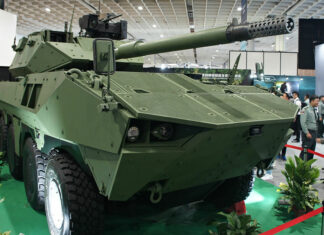
    The Taipei Aerospace & Defense Technology Exhibition (TADTE) 2025 crystallized around four dominant strategic themes that collectively illustrate Taiwan's comprehensive approach to defense modernization amid escalating regional tensions. Based on a detailed report by Pleronix (available upon request). Includes a Podcast discussion on TADTE 2025's highlighting Taiwan's four strategic themes beyond the post's coverage.

    Iron Beam 450 Completes Testing, Soon to Join With Operational Air Defense Units

    0
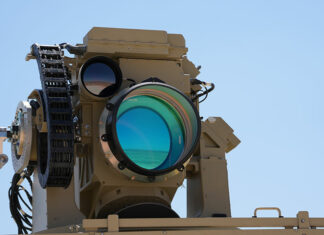
    Israel’s Iron Beam 450 high-power laser system has completed final testing, marking a major leap in air defense. Developed by Rafael, it offers precise, cost-effective interception of rockets, UAVs, and mortars, and is set for IDF deployment by 2025.