
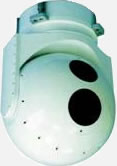
 Developed by Controp, the MSSP-3 is an evolution of the MSSP-1 payload, designed for maritime patrol missions. The payload ball retains the same (400mm) diameter, but height was reduced to 570mm. Weight was cut from 48 to 42.5 kg. The 4 gimbals gyro-stabilized payload (<25microRad) which carries multiple sensors including high resolution 3rd generation FLIR with unique and powerful zoom, high resolution daylight channel with CCD camera and 15x zoom lens and optional lasers rangefinder. The system also offers image processing for imagery enhancement, added symbology and automatic target tracking.
MSSP-3 Payload
MOSP – Multi-purpose Optical Stabilized Payload
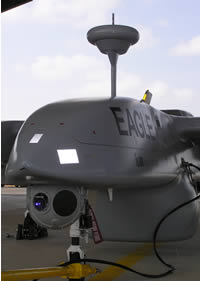
Multi-purpose Optical Stabilized Payload MOSP was one of the first integrated multi-sensor payloads developed specifically for UAV applications. Unlike the specialized payloads of its time, MOSP was designed as a common system, with all sensors, optics and associated electronics packed on a stabilized platform in a compact 14″ ball, which could be fitted on many UAVs. Over 500 units are currently operational with various UAVs including Hunter, Searcher, Heron, Ranger, FireScout, Hermes 450.
MOSP was developed at IAI/TAMAM in response to Israel Defense Force (IDF) requirements. Further modifications of MOSP and adaptation to US requirements were pursued under US/Israeli collaborative program, in support of Pioneer and the Hunter programs. Additional development of the system was carried out under IIA/Northrop Grumman cooperation, under the brand “Raven Eye“.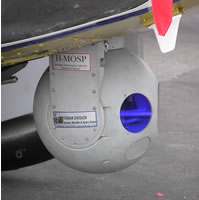
MOSP is provided with a choice of sensors, including 2nd or 3rd Generation FLIR, color CCD with high power telephoto zoom lens, laser rangefinder/designator etc. The payload can be fitted with dual-channel video link which enable simultaneous transmission of both FLIR and CCD images via datalink. Other software features include automatic target tracker, which can pick up a targets sized 3 pixels or more, even at low contrast level of 8%. The payload can be slaved to the UAV navigation system, flight control computer or to external sensors, such as SIGINT or SAR.
LEV-2 Miniature Stabilized EO Payload

Lev 2 is an 800 gram miniature x2 / x3 stabilized payload, using the day channel camera of the IAI/TAMAM POP-200 payload, LEV-2 uses an X25 zoom (optical). These miniature payloads are installed on lightweight masts as well as with the Casper-250 mini-UAV.
miniPOP Lightweight Modular EO payload
MiniPOP – IAI/Tamam
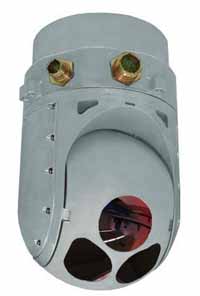
MiniPOP is based on the concept of the modular POP200 payload, taking advantage of current miniaturization and technological improvements. The payload provides dual axis gyro-stabilization for plug-in “slices”, which can be replaced in the field in minutes. Basic MiniPOP “slices” have a continuous zoom color day camera, a cooled or uncooled forward-looking infrared (FLIR) and daylight color TV. Other configurations include other sensors required for specific missions. Weighing less then 7 Kg, this payload is ideal for small unmanned platforms requiring enhanced image processing and automatic video tracker.
TESAR UAV Recce SAR Payload
MiniSAR – Tactical UAV SAR Payload (Sandia Labs / USA)
Sandia National Labs, the developers of the Lynx SAR system, are developing a smaller version of a Ku band SAR, which will maintains the Lynx’s performance in a much smaller package. MiniSAR weighs 25 lbs, (future production versions could be downsized to 18 lbs) and fit tactical UAVs such as the RQ-7A Shadow. The whole assembly is packed into two 7″ and 10″ cubes. The radar will operate initially in the 16.7 GHz frequency and will be extensible to X or Ka bands in the future. It is designed for affordability, and expected to cost 1/3 of the cost of a contemporary SAR. MiniSAR offers the basic SPOT mode with 4″ resolution, and with future enhancements, will also enable StripMap, Stereo-SAR, GMTI and CCD. When deployed on medium-sized UAVs, MiniSAR will be able to interface with other sensors to enable on-board multi-sensor fusion. Due to its small dimensions, particularly the size of the antenna, the range of MiniSAR is limited to 15km (4″ resolution). When lower resolution is acceptable, the system can generate a 12″ resolution image of an area from 23km. An even smaller antenna can provide a 4″ resolution image from a range of 5 kilometers.
Controp ESP-600 Lightweight EO payload

ESP-600C is a lightweight payolad stabilized with three gimbals (azimuth and elevation), which can be used by small UAVs and helicopters. The stabilized payload (better than 10 microRad, 0.7deg pointing accuracy) is configured to carry two CCD cameras – including 1/4″ color CCD with 0.75 to 11.5 deg. FOV and a wide FOV 1//2″ camera offering 22.6×17 deg. Coverage for general orientation. The payload can also accommodate an optional 3CCd camera with extended focal length for longer acquisition ranges (0.35×0.26). The payload weighs 12.3 kg. Diameter is 300mm, height: 435mm. Truck target detection range is 30km, recognition: 12km. The system is provided with automatic target tracking capability.
Multi-Spectral Targeting System (MTS) AN/AAS-52
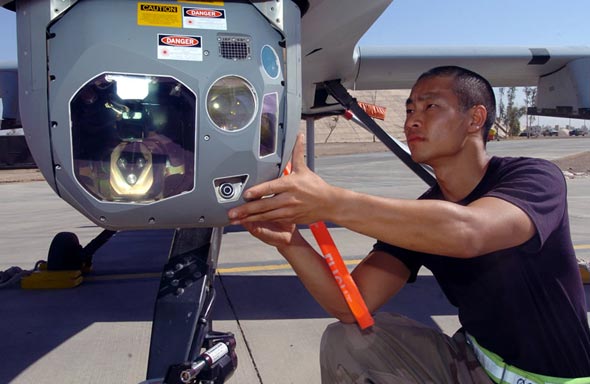
The MTS multi-sensor payload integrates infrared and CCDTV sensors, laser rangefinder, designator, and illuminator with optional addition of a laser spot tracker.
The system provides high rate of stabilization (six axis) and flexible operating modes including integrated line-of-sight targeting (for laser designating), sensor fusion and automatic target tracking, using centroid, area and feature tracks. Embedded maintenance and alignment contribute to high reliability and reduced field support. An Inertial Measurement Unit is installed on the gimbal to enable accurate target geo-location, supporting J class weapons and automatic line of sight positioning.
A different version of the payload designated MTS-B was designed for the Predator B hunter-killer missions. This version uses a 20″ ball with visible and IR imagers, to provide long range surveillance from high altitude, Including a 2048×2048 pixel focal plane array which enables a footprint of 200×48 meters from 25,000 feet, compared with 50×10 footprint obtained by standard MTS, from an altitude of 10,000 feet. When “stepping” such larger frames in rapid succession, the UAV operators can obtain a wider view of the area, and eliminate the “straw” view of existing payloads. This capability dramatically improves the resolution and coverage of the sensor. Utilizing existing digital zoom (up to x4 factor) the extended range sensor can quadruple the area coverage capacity of the sensor, when adequate bandwidth is provided for the system.
Besides intelligence gathering, the system performs target acquisition and engagement tasks by tracking, rangefinding and laser designation for on-board or remotely fired laser guided weapons such as the HELLFIRE missile, The system supports all tri-service and NATO qualified laser-guided munitions.
Microview
Microview is a stabilized payload developed by EMIT for the Sparrow UAV program. The payload is mounted at the nose of the vehicle with unobstructed lower hemisphere view (+20 TO -110 degrees elevation and +/- 40 degrees in rotation). For vertical mounting, the payload can be configured to cover full 260 degrees rotations. MicroView can be fitted with a variety of sensors, including cooled or uncooled 2nd Generation FLIRs, Daylight CCD TV with high power zoom, laser target illuminator and an eyesafe laser rangefinder. This payload is designed for harsh naval environment.
OLOSP EO Payload
Multi-sensor stabilized payload developed by Sagem, OLOSP is fielded with most of the Sperwer UAV users and is proposed for other programs. The payload weighs 25 – 40 kg, depending on the configuration, and can accommodate color or high resolution monochromatic TV sensor, laser rangefinder and designator and a choice of FLIRS produced by Sagem (2nd Generation IRIS or 3rd generation MATIS). The optical system is mounted on a four axis gimbal and has an automatic tracker.
StarSAFIRE III / HD (AN/AAQ-21/22)
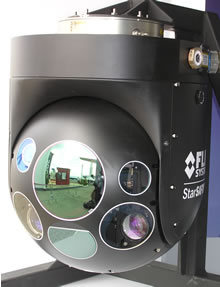
An advanced multi-sensor EO payload from the USA is the FLIR Systems StarSAFIRE. The StarSAFIRE III version is the most advanced, some 800 are used on 35 reconnaissance and surveillance platforms. StarSAFIRE uses five axis stabilization and high power optics, including Super Narrow field of view, to support operation at extended range. The payload can be configured with 6 (SAFIRE III) or 7 (SAFIRE HD) sensors including 3rd Generation FLIR, CCDTV with haze penetration filters, I2CCD, color spotter scope, laser pointer and illuminator, and laser rangefinder.
The Star SAFIRE HD system uses a 1,500 mm focal length for mid-wave IR and coaxial “two-in-one” telescope for the visible wavelengths sensors. The system facilitates high precision geo-pointing, directing the payload to look at exact geographic coordinates. Feeds from multiple sensors can be fused into a single image, to obtain optimal contrast and presentation of hidden details, generating up to x3 more information compared to conventional NTSC systems. Multiple video feeds from the different sensors can be transmitted simultaneously over a single datalink for further processing, storage and display. The system carries both wide-area and narrow-beam covert laser illuminators to support covert scene illumination and target pointing.
TESAR UAV Recce SAR Payload
The Northrop Grumman TESAR synthetic aperture radar which provides all-weather surveillance capability has a maximum resolution of 0.3 m’ (1ft.) Other payload options, which can be selected to meet mission requirements, include a laser designator and rangefinder, electronic support and countermeasures and a moving target indicator (MTI). TESAR provides strip-mapping continuous variable-resolution imagery from 1 meter to 0.3 meter (1 foot). The imagery is processed on-board the aircraft, compressed and sent to ground control station where it is scrolled over the SAR display workstation and saved for later use. As the imagery scrolls by, the operator has the ability to select 1,000 by 1,000 pixel image patches for exploitation on another workstation. TESAR was first deployed on the US Air Force Predator UAV and later, on the Army Gnat – both produced by General Atomics.
Ground Sensors – Acoustic
While expensive IR based systems offer superior performance, the most common sniper/gunshot detection systems are the acoustic sensors. Advanced systems employ an array of acoustic detectors (microphones or piezoelectric pressure sensors) which pick up supersonic shockwaves to give an approximate location of gunfire, while analysis of sound waves measured from the muzzle blast further narrow the aiming to point at the source of the gunshot. Such systems can determine the azimuth, bearing, elevation and sometime, even the identification of the firing source. Sensor arrays can also fix on the location of the sniper, enabling rapid and effective counter fire. While acoustic systems have the benefit of instant 360 degrees coverage, but have limited range (typically up to 500 meters). Infrared systems offer limited coverage (typically 120 degrees field of view) but can detect a gunshot beyond 1,000 meters. An integrated system promises to offer hemispherical detection capability at extended distances, well beyond the range of the threat (high power sniper rifle).
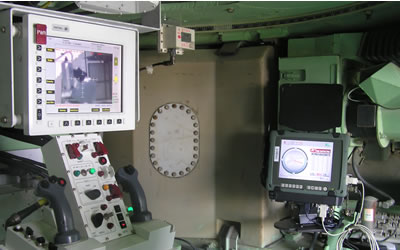
Acoustic sensors can be mounted on vehicles, augmenting the situational awareness of the crew to potential threats. Other acoustic sensors can also be used for the location of mortar and artillery fire as well as identify impact points. Acoustic sensors can be deployed in static locations, such as on rooftops, or at remote field locations, where they can rapidly fix artillery and mortar positions. By analyzing the acoustic waves of the passing bullet (Shock Wave) and the Muzzle Blast of the firing weapon, the acoustic sensor extracts the bearing, elevation, range and trajectory of the incoming projectile. A typical acoustic detector is the Pilar, a small-arms and sniper location system. Similar systems include SADS, developed by RAFAEL and the Boomerang, vehicle mounted acoustic gunshot locator system, developed by BBN Technologies. These systems display the fire source on a small LCD or LED display inside the vehicle which enables the crew to effectively respond and suppress the firing sources. When fully integrated in patrol vehicles, acoustic systems are directly controlling remote controlled weapon station to provide rapid reaction. Such a system is the Mobile Counter Fire System (MCFS) developed for the US Marine Corps and Army. For the coverage of large areas, artillery fire location systems, such as RAFAEL’s Artiloc and BAE System’s HALO are used identifying artillery or mortar sources, as well as IED explosions. The system can detect hostile firing near to adjacent friendly forces and identify areas of intensive activities. By detecting the occurrence of explosions of mortar fires, launching of RPGs or improvised rockets, sniper attacks and other gunshots, HALO automatically defines an area assigned with more attention from aerial and ground surveillance, ambushes and patrols.
Additional parts of this article:
Target Geolocation

Simple geolocation (currently supporting 90 and 30 meter positioning accuracy) could be sufficient for general orientation but will not be suitable for targeting of GPS guided weapons, such as JDAM. This level of accuracy is yet to be provided by unmanned systems. At present, the US Air Force is operating systems such as the Gridlock advanced concept technology demonstrator, integrated with the Global Hawk system. Gridlock uses a high precision navigation system generating a digital terrain database with 10 meter accuracy. Even these levels of accuracy are insufficient for precision engagement by unmanned systems – future unmanned combat systems will be required to deliver targeting accuracy of 1 – 3 meters.
Accurate location is not the only factor needed for precision engagement – cruise missiles, and EO guided weapons such as Storm Shadow, Taurus 350 and SPICE requires precise and detailed imagery for navigation and terminal guidance. Live video is required for “man in the loop” control of guided weapons, such as Hellfire and SPIKE, to avoid fratricide and collateral damage. Users requiring such live imagery can link directly to the sensor, using “tactical video receiver” which receives analog video streams. UAV images can be shared by multiple users, including helicopter pilots, field commanders as well as dismounted troops. More advanced systems enable active control of the payload.
Additional parts of this article:
Twister – Net-Centric, Multi-Mission Joint Operations Control Center
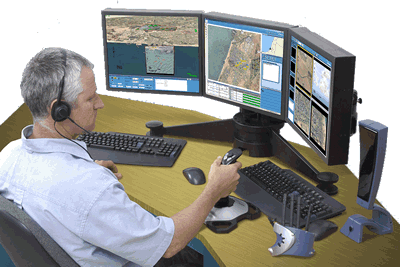
IAI is introducing the Twister, net-centric command and control system. Twister is designed as a scalable system to manage multiple missions by joint forces at divisional level and higher. Twister, co-developed by IAI/MALAT, IAI/MLM and NESS TSG is designed to assist commanders and their staff in planning, execution and control of time critical complex missions, by sharing sensors, and control ad-hoc task-oriented joint forces, effectors and support elements.
The system can integrate airborne UAVs, airborne, ground or mobile observation posts, air- and ground-mobile, as well as maritime forces, to perform complex synchronized missions. Twister operators can tap into live imagery delivered from imaging and electronic sensors, as well as radar, air operations picture (AOP), as well as archived data to deliver actionable intelligence. Utilizing the same net-centric connectivity, The commander can dynamically allocate these resources to be shared by all mission participants and target specific forces and effectors.
To simplify the complex battlespace picture, Twister implements unique information visualization technologies to support intuitive situational understanding. The Twister Tactical Situation Display utilizes three flat-panel displays showing different mission views. A typical display shows a detailed 2D digital map, presenting the locations of the task force members, blue forces, and enemy. All assets associated with the mission are also presented, indicating progress of execution and critical synchronization data.
A second display focuses on sensor management, showing a large number of simultaneous real-time video streams and “thumbnails” of other available sensors which can be tasked to support the mission. Primary windows are using MPEG 2 compression while multiple thumbnails windows use MPEG 4. When the mission controller assumes control of specific sensors he can point them to look at the target of interest and designate a target of interest for the “lead sensor” which automatically slaves the other sensors to ensure continuous coverage from multiple directions. This capability enables the mission controllers to ensure the continuous coverage while leaving platform management and control tasks to the individual system operators. Interpretation of data is immediately dispatched to the relevant users with annotations, marking and text overlaid on the image or video and shared through the network.
A third display can be used to create a 3D view of the battlespace. The system has a unique capability to integrate, correlate and display real-time image or video stream depicting the sensor’s location, line of sight and footprint in real-time. This representation enables more intuitive situational understanding, to enable rapid extraction of target location required for targeting and attack.
Collaboration tools include combined mission awareness picture, graphical tools and application sharing, and instant messenger. are utilized for planning and Simulation technology based on the latest CAE simulation architecture, are inherent with Twister to supports joint mission training, planning and debriefing, to retain and develop combat experience and expertise gained by personnel and systems. By optimal utilization of sensors and efficient assignment of the various means of engagement the system dramatically cuts Sensor-to-effector cycles and distributes complete situational understanding among all mission participants, improving the readiness and rapid response during joint forces operations.
Based on state of the art Commercial Off the Shelf (COTS) technologies, industry standards, and on open, modular and robust architecture, Twister enables cost effective customization and simple integration to adapt for customer specific requirements. Advanced mission interfaces of video, voice and data are used to establish a common graphic collaborative language between joint forces.
Each of the resources managed by the system, including sensors, units and effectors is an element. Each element interfaces with Twister’s core system through a Mission Interface Gateway (MIG) which translates its properties, capabilities, performance, doctrine and rules of engagement to common language used by the Twister Core System (TCS). The system also expends the Mission Situation Picture to include environmental effects such as weather, visibility, and other dynamic parameters which could affect the performance of its elements. Twister operators and supported forces can communicate with each other and collaborate via advanced messaging, data, voice and live video embedded within the system.
Skunk Works and XTEND Simplify Multi-Drone Command
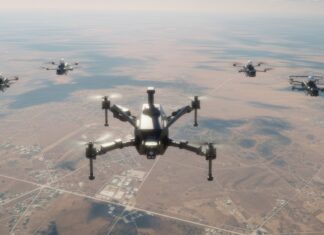
Lockheed Martin Skunk Works® and XTEND have achieved a major milestone in JADC2 by integrating the XOS operating system with the MDCX™ autonomy platform. This technical breakthrough enables a single operator to simultaneously command multiple drone classes, eliminating the friction of mission handoffs. From "marsupial" drone deployments to operating in GPS-denied environments, explore how this collaboration is abbreviating the data-to-decision timeline and redefining autonomous mission execution.

From Ukraine to Taiwan: The Global Race to Dominate the New Defense Tech Frontier
As traditional defense primes face mounting competition from agile “neoprimes” such as Anduril, Palantir and Helsing, the balance of innovation is shifting toward software-defined warfare and scalable, dual-use technologies, while global industry consolidation—marked by Boeing’s integration of Spirit AeroSystems and other strategic mergers—signals an intensified race to secure control over the defense technology value chain. Our Defense-Tech weekly report highlights these trends.

Europe’s “Drone Wall”
In early October 2025, a coordinated wave of unmanned aerial system (UAS) incursions—widely attributed to Russia—targeted critical infrastructure across at least ten European nations. The unprecedented campaign exposed the fragility of Europe’s air defenses...
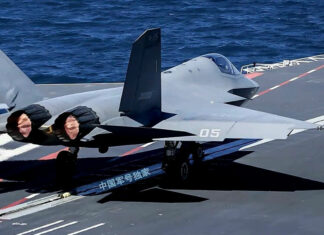
Weekly Defense Update & Global Security Assessment
Executive Summary
The past week (September 18-25, 2025) represents an inflection point where strategic defense concepts have transitioned from doctrine to tangible reality. An analysis of global events reveals four primary, interconnected trends shaping an...

U.S. Air and Space Forces Push Next-Gen Programs at the AS&C 2025 Conference and...
At the 2025 Air, Space & Cyber Conference, U.S. Air Force and Space Force leaders unveiled major updates on next-generation fighters, bombers, unmanned systems, and space initiatives, highlighting both rapid innovation and critical readiness challenges as the services race to outpace global competitors. A short version is available here, with a more detailed version for subscribers.
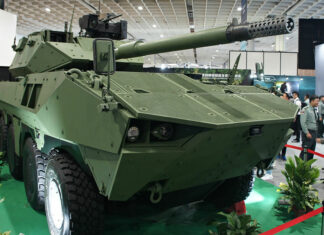
TADTE 2025: Reflecting Taiwan’s Strategic Themes
The Taipei Aerospace & Defense Technology Exhibition (TADTE) 2025 crystallized around four dominant strategic themes that collectively illustrate Taiwan's comprehensive approach to defense modernization amid escalating regional tensions. Based on a detailed report by Pleronix (available upon request). Includes a Podcast discussion on TADTE 2025's highlighting Taiwan's four strategic themes beyond the post's coverage.
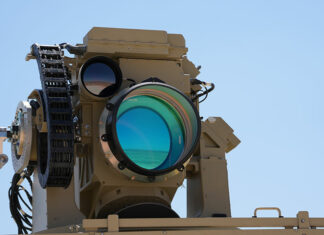
Iron Beam 450 Completes Testing, Soon to Join With Operational Air Defense Units
Israel’s Iron Beam 450 high-power laser system has completed final testing, marking a major leap in air defense. Developed by Rafael, it offers precise, cost-effective interception of rockets, UAVs, and mortars, and is set for IDF deployment by 2025.