Thursday, January 1, 2026
More
    Home Blog Page 201

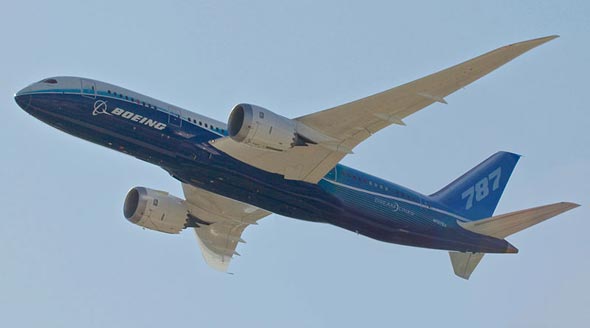
    Boeing 787 Dreamliner Swings into Singapore

    Boeing is displaying its latest mid-size Dreamliner 787 airplane at the Singapore Airshow, emphasizing the new passenger jet’s long distance flying capability. The Dreamliner demonstrated its long-range capabilities a few days ago, flying nonstop from Seattle’s Boeing Field to Bangkok’s Suvarnabhumi International Airport — a distance of 7679 miles (12,358 km). The 787 ability to fly long distance, point-to-point routes appeals to Asian airlines ability to serve direct flights to more destinations, thus avoiding congested hub airports. Because it is made from lighter composite materials, the 787 is the first mid-size passenger airplane capable of flying nonstop to many more distant cities without having to go through a hub airport.

    That capability for a mid-size jet pleases not only passengers who would no longer need to detour to a hub airport, but also airlines who can establish long-haul routes previously served only by jumbo jets requiring many more passengers to be profitable.

    The Dreamliner is in the midst of a six-month “Dream Tour” taking it around the world so customers and partners can experience the revolutionary jet first hand.

    The Dream Tour airplane, test plane ZA003, is outfitted with the 787’s special cabin features including a welcoming entryway, dramatically larger dimmable windows, bigger bins and dynamic LED lighting. The airplane is configured with a luxurious business-class cabin, an overhead crew rest compartment and an economy class section.

    The 787, the first new airplane type of the 21st century, has garnered more than 800 orders from airlines around the globe. Singapore Airlines has 20 of the higher capacity 787-9 on order.

    Bombardier Growing In China

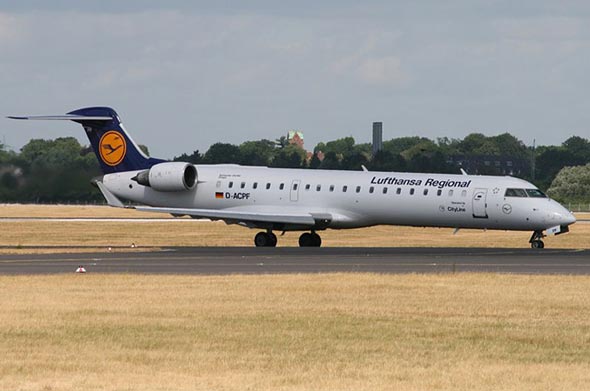
    China Express Airlines is buying six Bombardier CRJ900 NextGen aircraft and has options to increase the number to 11, as part of a contract worth up to $491 million Bombardier announced yesterday. China Express, the first private regional airline in China, already operates fleet of five Bombardier CRJ200 aircraft. The expanded fleet will enable the company to expand its regional network.

    More than 80 Bombardier aircraft are currently operating in China; the country’s fleet is expected to grow as the world’s second largest market for new aircraft deliveries, with a forecasted demand of almost 2,400 commercial aircraft in the 60-149 seat segment over the next 20 years.

    Further expanding its position in this market Bombardier has signed a memorandum of understanding (MOU) with Chinese lease financing company AVIC Leasing. The MOU that was signed yesterday will provide optimized aircraft and financing solutions in China and abroad.

    South Korea seeks to build T-50 jet training center in Portugal

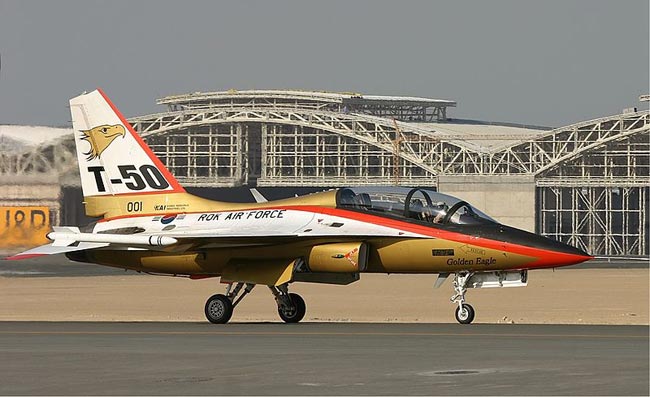
    South Korea is seeking to build a pilot training center in Portugal that will be equipped with Korean Aerospace Industries’ T-50 supersonic military jet trainers. a government source in Seoul said Saturday. Portugal was tapped as the primary negotiation partner for the International Military Flight Training Center Consortium (IMFACC) last year. Negotiations about the US$267 million Korean venture are currently underway, and expected to lead to the signing of a memorandum of understanding (MOU) in March.

    Seoul plans to invest over quarter billion dollars in the project over 30 years, to set up this jet pilot training facility. The center will be manned by South Korean military instructors who will be tasked with training foreign pilots on the T-50 Golden Eagle. Since 2009 Seoul has been looking for sites for the IMFACC in the United States, the Philippines and Spain.

    The plan is part of Seoul’s campaign to promote attract international interest in the T-50. The supersonic Golden Eagle trainer is already in service with the South Korean Air Force and was selected last year as the future trainer for the Indonesian Air Force. It is currently being evaluated by a number of air forces, including Israel and Poland.

    US Congress Approves Second Warship For The Philippines

    The United States Congress gave its blessing for the US Coast Guard to transfer a second ship to the Philippine Navy on February 10.  This approval is in keeping with the increased emphasis the United States is placing on the Asia-Pacific region.

    Most US-Philippine cooperative efforts have in the recent past been primarily focused on fighting terrorists.  Now, the US appears to be embarking on a campaign to strengthen the Philippine Navy’s long neglected warfighting capabilities.

    A spokesman for the US State Department has publicly commented that every effort will be made to deliver the ship as fully equipped as possible.

    One warship was delivered to the Philippines back in May 2011 as authorized by the US-Philippine Mutual Defense Treaty of 1951.  Delivery of a second ship is just one of many defense related issues being negotiated between the two nations.  The US Navy has regularly conducted port visits, refueling stops, and large-scale training exercises with Philippine forces.  US Marine forces have engaged in multiple exercises in the island nation for several years past.

    The Philippines has encountered some tense disputes with China regarding sovereignty over areas of the South China Seain recent months as have other nations.  All or portions of this region are simultaneously claimed by Malaysia, Vietnam, Brunei, Taiwan, and China as well as the Philippines.

    The United States has repeatedly stated that it will not be placed in a position of determining if these claims are valid or not and has long advocated negotiation as the only practical means of resolving the conflicting claims.  However, the US has also made it clear that it will exercise whatever means are required to satisfy the terms of the Mutual Defense Treaty.

    Official statements continue to deny that the United States has any plans or intentions of reintroducing a permanent military presence into the Philippines in the foreseeable future.  The US closed all of its major military installations in the islands as demanded by the Philippine Senate in 1991 and there remains strong opposition to any permanent US presence among the general Philippine population.

    Some DoD Budget Numbers Leak Out

    On February 11, Reuters News Service and other media outlets announced some specific details contained in the US Department of Defense’s Fiscal Year 2013 budget submission.  Much of what was released was already known.  The official budget proposal is expected to be released on February 13.  The numbers being reported were derived from documents obtained by Reuters.

    The Reuters exclusive indicates that funding for ships and aircraft will be reduced, but will remain high while a significantly lower amount will be spent on ground combat vehicles.  The total of the Pentagon’s proposal is approximately 12.2 percent less than the previous year’s request.

    Of the total budget request of $525 billion, $109.1 billion is earmarked for procurement and $69.7 billion for research and development.  Overall this represents a funding request of approximately 7.5 percent below what was previously forecast.

    The budget request includes $9.17 billion to continue development and eventual production of the F-35 Joint Strike Fighter (JSF).  This amount includes $2.7 billion in development funding and $6.15 billion to fund procurement of 29 aircraft.  The funding being requested for the F-35 project is down slightly from the 2012 request of $9.25 billion.

    Overall funding for aircraft will decline by approximately 12 percent.  The 2012 budget request asked for $54.2 billion while the 2013 request drops to $47.6 billion.  Some of this savings will come at the expense of the Lockheed Martin C-130J cargo aircraft and the Bell Boeing V-22 Osprey.  The Pentagon is asking for only seven C-130Js costing $835 million as compared to the 2012 request for $1.43 billion to buy twelve aircraft, a decrease of 41 percent.  In 2012, the Pentagon requested $2.8 billion for 35 V-22s while the 2013 proposal includes only $1.91 billion for 21 aircraft, a drop of 32 percent.

    DoD also included $1.25 billion in the budget request to fund procurement of six Northrop Grumman Block 40 RQ-4 Global Hawk spy drones, three for NATO and three for the US Navy.  Plans for additional purchases of the Block 30 Global Hawk were scrapped by Secretary of Defense Leon Panetta last month.

    Funding being requested for helicopters remains robust.  The budget proposal asks for a 55 percent increase in funding to procure 40 rebuilt AH-64 Apache helicopters and 10 new aircraft.  The five-year $1.3 billion agreement to purchase 59 Sikorsky UH-60 Black Hawk helicopters is not changed in the 2013 budget request.

    In the case of missile funding, the Pentagon is asking for $9.7 billion for continuation work on the Lockheed Martin Patriot PAC-3 and other missile/air defense systems to include $400.9 million for the Medium Extended Air Defense System (MEADS) in cooperation withGermanyandItaly.

    The US Navy shipbuilding program will be reduced from the $24 billion requested in 2012 to a request for $22.6 billion in 2013.  This money is earmarked to fund two Virginia-class nuclear attack submarines, four Littoral Combat Ships (LCS), two Arleigh Burke-class destroyers, and to cover the costs associated with the initial year of construction for a second new aircraft carrier.

    Funding for ground vehicles takes a hit in the 2013 budget, declining 32 percent from the previous year.  The Pentagon is asking for $10.9 billion to cover ground vehicle costs.  Included in this amount is $117 million to fund further design and development of a new light tactical vehicle and a heavier enhanced Ground Combat Vehicle (GCV) for use by the Army and Marine Corps.

    The funding request for the Oshkosh lineup of Heavy Tactical Vehicles will also be reduced from the 2012 order for 9,336 machines costing $650 million to 1,534 vehicles priced at $58.1 million for 2013.

    Space-related funding will also take a hit, dropping from $10 billion in 2012 to $8 billion in 2013, a decrease of 22 percent.  This decline is in recognition of the cancellation of Northrop Grumman’s Defense Weather Satellite System and anticipation that fewer space launches will be conducted in 2013 and fewer satellites will require funding.

    More detailed information will be released on February 13 with the official submission of the Defense budget.

    Laser detect Systems (LDS)

    A world-leading developer of stand-off laser-based trace detection technology, Laser Detect Systems (LDS) commercializes ultra-sophisticated, reliable and advanced laser spectrometry-based trace detection technology for homeland security, law enforcement, and industrial application. Among the products introduced by LDS are explosive scanners, enabling detection of liquid explosives and remote detection of IEDs, as well as hand-held raman scanner for manual inspection at checkpoints.

    Established in 2004, LDS has developed patented, ground-breaking remote trace detection technology using real-time laser spectroscopy, with applications targeting all types of explosives, narcotics, and hazardous materials, in liquid and aerosol form.

    LDS corporate and R&D center is located in Petach Tikva, Israel. The company also operates a U.S. based Subsidiary, Laser Detect Systems LLC located in N.J USA.

    Company website: laser-detect.com

    Israel Tests Arrow 2 Block 4 ATBM with Super Green Pine Radar

    An early image of the Super Green Pine radar. (Photo: IAI)
    An early image of the Super Green Pine radar. (Photo: IAI)

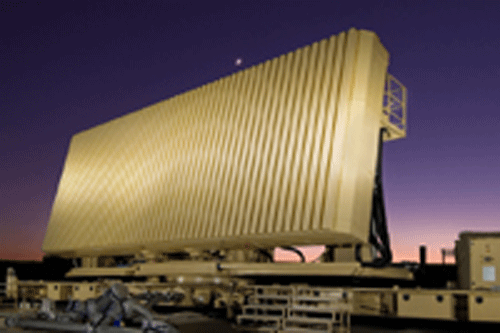
    The Israel Missile Defense Organization and the U.S. Missile Defense Agency completed a successful test of the key elements of the joint U.S.-Israel IAI Arrow Weapon System (AWS) today. The test was carried out over the Eastern Mediterranean Sea and involved a Rafael Blue Sparrow 2 target missile, launched toward Israel from an F-15 fighter jet. The target missile was detected and tracked by the EL/M-2080 Super Green Pine radar, the primary sensor of the AWS. Intercept solutions were plotted by the Golden Citron battle management controller and transferred to the launch units.

    This Block 4 System Verification Flight Test (B4SVFT) was a target-only tracking exercise. In fact, Arrow 2 Block 4 missiles have already been verified through a number of long-range intercept tests over the Mediterranean and Pacific Ocean in 2008, 2009 and 2011.

    According to the official announcement, “Elements of the U.S. Ballistic Missile Defense System (BMDS) successfully performed interoperability with the AWS and collected data.”this probably pertains to the BMDS Raytheon AN/TPY-2 radar station in the Arava valley.

    Israel MOD says the success of the test is the final test prior to delivery of block 4 Arrow Weapons System. This was a major milestone in the development of the Arrow Weapon System and provides confidence in operational Israeli capabilities to defeat the developing ballistic missile threat. The next step in the AWS progress is expected in 2013, as the Arrow 3 exo-atmospheric interceptors enter flight testing. Arrow 3 will form the upper layer in the Israeli multi-layered missile defense system. Arrow 3 and Arrow 2 Block 4 are expected to form the top and upper layers, with Rafael David’s Sling providing the mid-tier and lower tiers, defending against tactical missiles, long range rockets, cruise missiles and attack aircraft. The low-level will be protected by Rafael’s Iron Dome Countering short-range rockets (C-RAM).

    The evolution of the Arrow Weapon System follows a spiral (blocks) development cycle. The operational AWS is currently the Block 3, with Block 4 undergoing testing for the past four years. This block improves the Arrow ability to overcome countermeasures, offering higher discrimination of false targets (including decoys and elements separated from the main target). The missile has already been tested several times in Israel and the US. The two recent tests in 2008, 2009 and 2011 were0 performed at the pacific missile range on the Pacific coast, as the ranges involved in the intercept (over 1,000 km) have not allowed Israel to realistically evaluate the missile’s performance over the Mediterranean. The final firing test conducted on February 2011 validated the block-4 missile performance, which scored a direct hit on this test. Among the improvements introduced in the Arrow 2 Block 4 missile are refined midcourse guidance section, improved target identification and discrimination and enhanced lethality. Other improvements were implemented throughout the system, increasing the target discrimination capability, situational assessment and overall target engagement, battle management.

    The Green Pine radar has a proven track record demonstrated in over 20 successful ballistic missile intercepts. The radar was developed with Israeli funding and as such is not subjected to U.S. export limitations. As such, Green Pine was exported to a number of Asian countries, among them India and South Korea. The system was also mentioned in a recent $1.5 billion contract finalized with another country in Asia. The first Green Pine radar was delivered to India in 2002, and has since been integrated with the country’s indigenous missile defense system as the Swordfish radar system. Two sites are currently operational – northeast of Bangalore, and on India’s northeast coast. Representing the next phase in this strategic roadmap, Super Green Pine is bound to attract even more interest, with its enhanced capabilities.

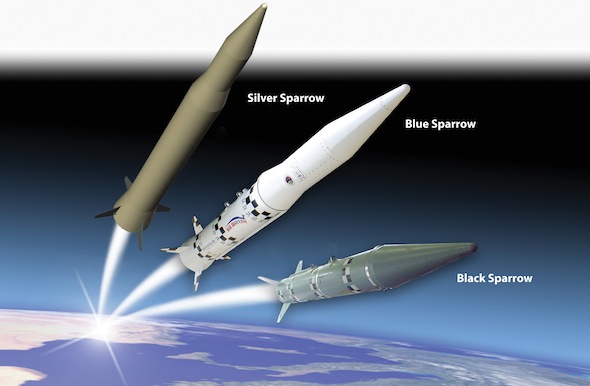
    The Blue Sparrow 2 target missile was employed in today's test. Rafael is also developing the heavier (+3 ton) Silver Arrow target, designed for long-range exo-atmospheric intercept testing. Photo: Rafael

    The Blue Sparrow, the target missile used in this test was developed by RAFAEL as an air-launched target simulating medium-range ballistic missile of the Scud B/D class. Rafael is already building a larger version known as ‘Silver Sparrow’. The Sparrow targets have a modular warhead section carrying different payloads such as inert, high explosive or water. This 8.39 m’ long missile weighs over three tons. It will simulate Shihab 3 class missiles (1500-2000 km) for the testing of the Arrow-3 interceptor. The Silver Sparrow uses a single stage solid rocket propellant, and shares a common reentry vehicle with the mid-range Blue Sparrow. The Silver Sparrow is also considered as a candidate for  air-launching of RAFAEL’s future LiteSat micro-satellite, providing Operationally Responsive Space capability supporting ad-hoc requirement for satellite imagery.

    Its Flying Time at the Singapore Airshow 2012

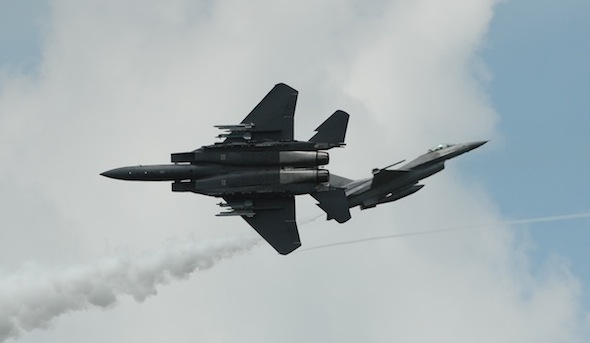
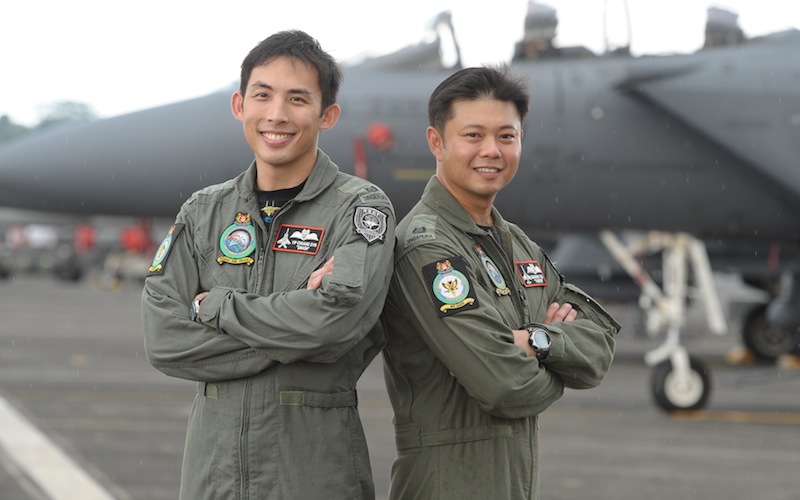
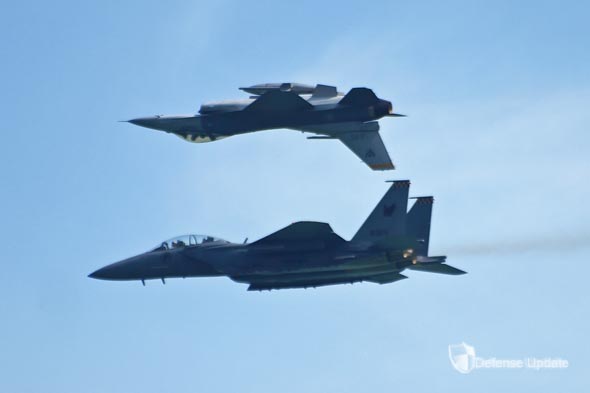
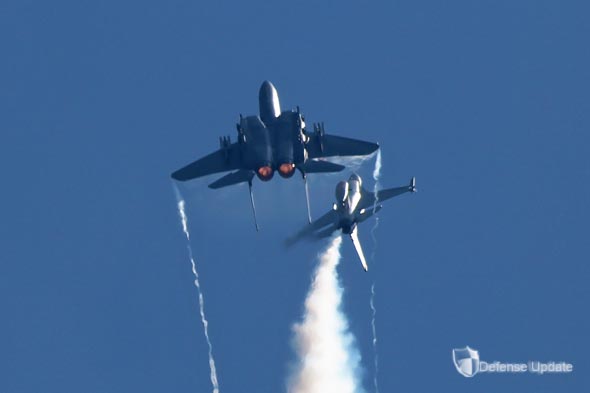
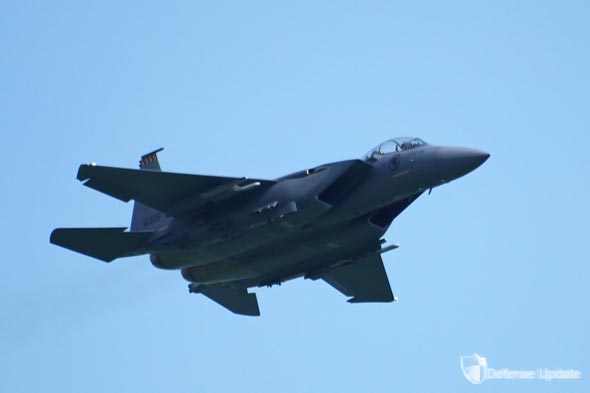
    Part of the action at the upcoming Singapore Airshow next week will be the flying display including top performers from several Asian countries. For the first time, the Republic of Singapore Air Force is demonstrating combined aerobatic maneuvering of F-16C and F-15SG, appearing together for the first time in an aerial display flown by MAJ Yip (left) flying the F-15SG and MAJ Too, flying the F-16C. The team has been rehearsing for this complex display for three months; between them, the two pilots have clocked more than 3,000 flying hours.

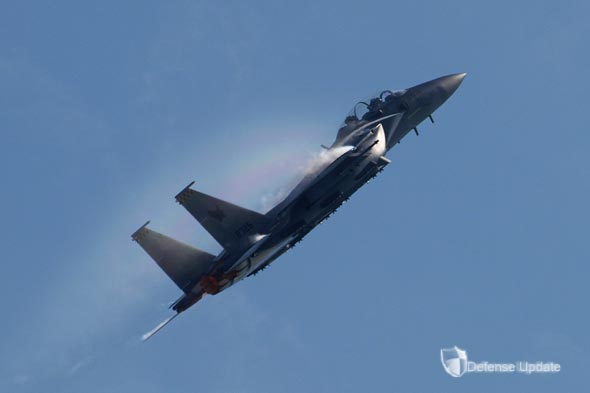
    Among the top performers at the Singapore Airshow 2012 are the recently acquired RSAF F-15SG and F-16C fighter aircraft flown together on a combined aerobatic display for the first time at a public show. During the Integrated Inverted Mirror Pass manoeuvre that the two fighter aircraft will come within metres of each other. To add to the complexity, the F-16C will be flying upside-down above the twin-engined F-15SG. Photo: MINDEF, Cyberpioneer

    F-15SG pilot MAJ Yip (left) and F-16C pilot MAJ Too, who will be performing at the Singapore Airshow 2012.
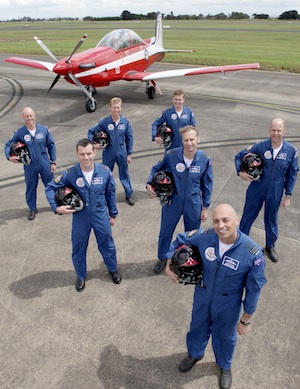
    The Roulettes team for season 1 of 2012. From left rear: Roulette 6 Flight Lieutenant Bernie Gleeson Roulette 4 Flight Lieutenant Cory Fischer Roulette 7 Flying Officer Richard Morris From left center: Roulette 2 Flight Lieutenant Steve English Roulette 3 Flight Lieutenant Glenn Stegink Roulette 5 Squadron Leader Matt Plenty Front: Roulette Leader Squadron Leader Steve Bake

    The Australian Roulettes aerobatic team flying RAAF P-9C. Singapore is part of a busy season for the Australian team that regularly perform throughout Australia, and occasionally in friendly countries around the South-east Asian region. The Roulettes are part of the RAAF Central Flying School (CFS) at RAAF Base East Sale, Victoria.

    The Malaysian Smokey Bandits aerobatic performers flying RMAF MiG-29 will also take part in the flight display. Boeing is expected to fly a solo display with a USAF C-17, and the US Air Force is expected to send a B-52 performing a flyby during the air display.

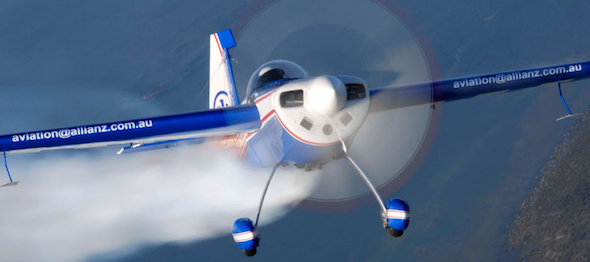
    An impressive solo aerobatic display by Tony Blair, is one of Australia’s top aerobatic pilots, Blair has 20 years Air Force experience flying jets, including over 1,000 flight hours on the F-111. Upon his retirement, Blair became involved with Experimental and Competition Aerobatic aircraft. Blair is flying the Rebel 300 unlimited aerobatic aircraft in 2007. The Rebel aircraft is an unlimited “stunt” plane with the ultimate level of performance. With huge power to weight ratio, large wingspan, and lots of volume for smoke, Rebel 300 is a great performer. In Australia, Blair is one of the few pilots has ‘unlimited’ altitude approval for aerobatics, that is, a ground level approval but at the Singapore Airshow, expect minimum altitude restrictions to apply. But Tony says he has the experience, dedication and professionalism to bring a spectacular display!.

    lair Aerosport Rebel 300. In Australia, Blair is one of the few pilots has 'unlimited' altitude approval for aerobatics, that is, a ground level approval but at the Singapore Airshow, expect minimum altitude restrictions to apply. But Tony says he has the experience, dedication and professionalism to bring a spectacular display!.

    Photos from Singapore airshow 2012 Aerial Display:

    Photo: Tamir Eshel, Defense-Update
    Photo: Tamir Eshel, Defense-Update
    Photo: Tamir Eshel, Defense-Update
    Photo: Tamir Eshel, Defense-Update


    IAI Introduces the ‘Total Connectivity Solution’ at the Singapore Airshow 2012

    IAI - Singapore Special report
    IAI - Singapore Special report

    With military operations becoming ever more interconnected, a fresh look at networking architecture is required, to enable complex, large-scale systems to work together and progress at the rapid pace dictated by technological change.

    The military requires information to be transferred across echelons, supporting joint operations of manned and unmanned systems, integrating assets on land, at sea, in the air and in outer space. Communicating video streams in real time between multiple sources and users require handling of massive databases and huge volumes of data, to be processed, transferred, stored and displayed to the right users, with minimal delay. Reliable communications must be maintained at all time, under combat conditions, regardless of environmental, physical or man-made interference.

    Singapore Airshow Special Report from Asian Defense & Diplomacy

    Israel Aerospace Industries (IAI) decided to turn this challenge into an opportunity. Realizing the solution must rely on a pool of experience, and not on a single, specific technological answer, IAI has established a corporate-wide technical team, mapping the technologies the company divisions already have in-house, and focusing on new capabilities that should be addressed. After three years of development, IAI’s total connectivity solutions are unveiled at the Singapore Airshow 2012, where the company is introducing a new, cross-service command, control and networking approach designed to support intelligence, surveillance and reconnaissance (ISR) services, active defense systems and offensive precision strike capabilities.IAI’s new family of networking systems integrates common core capabilities and specific solutions designed for land forces missions, and airborne applications supporting air operations. A special subset of the system is uniquely tailored for the operation of precision-guided weapons.

    This networking architecture integrates a number of IAI developed technologies, based on open architecture and commercial standards, including software defined radios (SDR) and next generation commercial, cellular communications (4G/LTE). In addition, the systems also include unique elements required for military operations, employing the mobile elements of the system, supporting tactical users, physical and electronic hardening, enhanced redundancy, higher level of security, minimizing latency and support for real-time operations. The resulting system is a ’network of networks’ offering the best Commercial Off The Shelf (COTS) technology with unique capabilities derived from military and airborne systems.

    The new architecture enables members to contact other users over the ’mesh’ without binding themselves to specific properties such as frequencies, bandwidth or locations. Connectivity is generated ‘on the fly’ utilizing advanced IP based technology, combining terrestrial, wireless and satellite communications, offering rapid, secure and predictable information exchange, supporting the mission in hand to the best of its ability.

    Typical services include enhancement of airborne networks, exchanging ‘everything from everywhere’, for example, providing small tactical units with precision strike capability using a ‘see & strike’ operating concept, where the warfighter can designate targets from an Unmanned Aerial Vehicle (UAV) and call a remote weapon to automatically engage it, without involving the complex procedures mandated by passing through redundant command levels. The new system will also enable superior integration of command and control – sharing a common operating picture throughout all operational and tactical levels. The new networks will provide all this, while improving connectivity and optimizing spectrum utilization.

    Having analyzed future requirements and technological trends affecting the market, IAI assigned a special expert team to study, evaluate and develop the designated hardware and software required. Now underway, through a two-year company funded program, IAI applied for several patents forming part of the intellectual property and unique offering of its new technological solutions.

    Designed an open system, the new integrated networking architecture will become available to technology and business partners, enabling the company full access to export, with focus on the Asian market.

    Russian Helicopters Expand to Vietnam

    Russian Helicopters

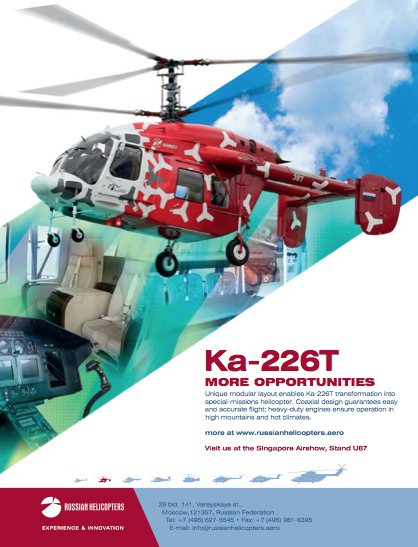
    Russian Helicopters, one of the world’s largest helicopter manufacturers, is coming to the Singapore Air Show shortly after the opening of a representative office in Hanoi, Vietnam, as it beefs up its presence in the region.

    The company is using this to office to boost its presence not just in Vietnam, a long term buyer of Russian hardware, but also the wider South-East Asia region and even further afield. “One of the main goals of this opening is to gain access to broader markets, search for new partners and new cooperation modes in Southeast Asia and Australia.” says the manufacturer.

    Singapore Airshow Special Report from Asian Defense & Diplomacy

    The Hanoi office will mean that the company is closer to the customer in order to provide aftermarket support. “By opening a representative office in Hanoi we will be able to establish an after sale support system for rotorcraft of Russian make that will be very accessible and comfortable for operators in this region,” says Russian Helicopters CEO, Dmitry Petrov.

    Russian Helicopters has been building up a global support network based on certified MRO centres and joint ventures across the world. As well as the new centres being established in locations such as Vietnam, existing ones are undergoing certification in various regions around the world.
    Over 300 Mil and Kamov helicopters are operated today in Southeast Asia and Australia. The fleet of the Republic of Vietnam numbers over 60 rotorcraft, constituting about 50% of the total civil helicopter fleet and up to 90% in the military segment. These include various modifications of civil helicopters, such as the Mi-8/17, Ka-32, and the military Mi-24 and Ka-28.

    Russian Helicopters has also recently upped its presence in the Middle East, appointing Emirates Corporation Trading Agencies as a regional distributor of the light single-engine helicopter Mi-34C1 in the Gulf countries. The Agreement was signed in Dubai, UAE, at the recent Dubai Airshow. The Agreement involves marketing, sales and technical support for the Mi-34C1, as well as flight training.

    A key market for the company is India, where last year the first batch of Mi-17V-5 helicopters was delivered. The helicopters are manufactured by Kazan Helicopters, a subsidiary of Russian Helicopters. Joint Russian-Indian projects to deliver new helicopters, spares, and aviation equipment are under way and as of last year, the Indian Air Force operated over 200 Mi-8/17 type medium rotorcraft of Russian make.

    Russian Helicopters is also active in the Chinese market – last year a deal was agreed for the delivery of a civil all-weather multirole coaxial Ka-32A11BC helicopter in its firefighting variant to Inner Mongolia. The helicopter is equipped with the Simplex firefighting system, horizontal water cannon, and VSU-5 water-dumping system. The unit will be delivered to Ordos City in Inner Mongolia in September this year.

    One Ka-32A11BC is currently operated in China, performing various missions for the Chinese Arctic and Antarctic Administration. The Ka-32A11BC is certified in China and has also received airworthiness certificates in the world’s largest regions – in America, Asia, and Europe.

    Today Ka-32 helicopters of various modifications are successfully operated in Spain, Portugal, Switzerland, Canada, South Korea, Taiwan, Japan, China, and other countries. In South Korea the 60- plus strong fleet of Ka-32s are used for firefighting with the Forestry Service, and by the Coast Guard.

    Headquartered in Moscow, Russian Helicopters operates five helicopter assembly plants, two design bureaus, two components production plants, one overhaul plant and one helicopter service company providing aftermarket services in Russia and abroad. Although Russian Helicopters was established only in 2007, some of the company’s subsidiaries have existed for more than 60 years.

    The Wide Range – Bombardier Aerospace Heritage

    Bombardier page on the special report
    Bombardier page on the special report

    Demonstrating its commitment to the Asia-Pacific marketplace, Bombardier Aerospace showcases its comprehensive range of products at the 2012 Singapore Airshow.

    Canadian manufacturer Bombardier Aerospace has more than 100 years of experience in aircraft manufacturing – its facility in Belfast, Northern Ireland for example, is one of the oldest aircraft manufacturing facilities in the world. This experience has been put to use across a wide range of different uses in the military, governmental, commercial and business aviation fields, and Bombardier aircraft have accumulated millions of flight hours.

    Singapore Airshow Special Report from Asian Defense & Diplomacy

    The diversity of the different original entities that are part of Bombardier’s heritage, such as Canadair, Short Brothers, Learjet and de Havilland, gives the Company a unique blend of aerospace experience.

    This combination produces an enviable track record with respect to special mission aircraft. Together, these entities have de- signed, built and delivered more than 300 special mission aircraft for customers worldwide, dating back to the early 1900s when the Royal Aero Club offered the Admiralty the use of two Gnome-engined Short Brothers aircraft (S.28 & S.29) with free tuition.

    Bombardier has built on this track record and now offers an extensive range of aircraft with special mission capabilities designed to cater to a variety of requirements. Each of Bombardier’s business jets and regional aircraft are firmly established in service with specialized mission operators, putting the aircraft in a diverse range of uses.

    Bombardier Aerospace has also a long history in the field of commercial turboprop production, especially when factoring in its ancestry. Bombardier currently markets the Q400 NextGen turboprop, which stands apart as a fast, quiet and fuel-efficient aircraft.

    In the regional jet sector, Bombardier’s CRJ Series aircraft is the most successful commercial regional jet program in history. Bombardier also continues to innovate with the introduction of the CSeries mainline aircraft, the new benchmark in the 100- to 149-seat class, offering advanced technology, a reduced environmental impact and unsurpassed economics. The CSeries aircraft program is scheduled to enter into service in 2013, and Korean Air will be the Asian launch customer.

    Bombardier also markets and supports a wide range of business jets. The Learjet aircraft, a legendary family of aircraft in business aviation that consistently shapes the way the world flies; the Challenger aircraft, with its proven dependability, over more than twenty-five years since it first soared into service, and the Global jets, extraordinary long and ultra long-range business aircraft with advanced technologies and an uncommon elegance and synergy.

    The Bombardier 415 aircraft, a purpose-designed amphibious fire fighting aircraft, has proven invaluable in maritime missions such as search and rescue, coastal patrol and utility transport.

    More than 35 governments worldwide are using variants of Bombardier’s business and commercial and amphibious aircraft in such missions as C4ISR, coastal patrol, search and rescue and government officials’ transport.

    The Royal Air Force (RAF) Sentinel and United States Air Force Global 6000 aircraft (previously known as Global Express XRS) E11 fleets are two examples of recent programs which have made use of Bombardier’s expertise in special mission aircraft. In addition, the Hong Kong Government Flying Service (GFS) recently placed an order for two Challenger 605 aircraft to be used primarily in search and rescue, as well as other special mission applications. With the future in mind, Bombardier is continuing with the research and development of a variety of special mission applications.

    This is down to technological innovation, Bombardier says. The company has a long history of fielding new, disruptive technology solutions and products by focusing on the continuing advancement of core technologies and by participating in major demonstration projects.

    Core technologies include aerodynamics, materials, structures, flight sciences and electromagnetics. Examples of recent and ongoing major demonstration projects include the development of automatic fibre placement for composite fuselages; the “more electric aircraft” project; and environmental research – an increasingly important field. These projects have often involved collaboration with research and development agencies, universities and other industries.

    Bombardier is already generating results – The 2008 demonstration of an all-electrical braking system was a civilian aviation world first. Other examples are the soon-to-be fielded “Equivalent Visual Operations” system, which fuses the Enhanced Vision System, Synthetic Vision System, advanced radar and other navi- gation and collision alerting systems; advanced electrical ice pro- tection; and a significant reduction of carbon dioxide and nitrous oxide.

    Reducing greenhouse gas emissions of its products and facilities is also one of Bombardier’s main focuses and the Company is working hard through its research programs to significantly reduce carbon and noise footprints. Current collaborative projects involve the Consortium for Research & Innovation in Aerospace in Quebec (CRIAQ); Green Aviation Research & Development Program (GARDp); Smart Affordable Green Efficient Technology Demonstrators (SAGE); and Future Major Platforms (FMP).

    Part of the drive behind these programs is that, while much of the pressure to reduce emissions is currently aimed at the commercial and business aviation sphere, in the not-so-distant future, government and military operators too will have to modify their practices.

    The Future

    Throughout its long history, Bombardier has been responsible for a long list of technological innovations, and this tradi- tion continues today. Emerging platforms, such as the Learjet 85 aircraft, the world’s first, primarily composite business jet; the CSeries aircraft, which will include various cutting edge technologies, and the new Global 7000 and Global 8000 busi- ness aircraft are evidence of Bombardier’s commitment to pushing the boundaries of technology in the aerospace industry.

    These new aircraft programs and technological advancements, combined with Bombardier’s existing product portfolio, will ensure that the Company continues to prove attractive for business, commercial and specialized government operators around the world.


    Alenia Aermacchi’s C-27J: The TACTICAL Transport Aircraft

    Alenia Aermacchi - Singapore Special Report
    Alenia Aermacchi - Singapore Special Report

    A tactical transport aircraft is today a real force-multiplier as it can enable many different operations in the new asymmetric scenario. War against terrorism, tactical support for the frontline troops and humanitarian/natural disaster relief missions operating from short/unpaved strips are new requirements that very few aircraft are able to accomplish.

    In the medium tactical transport sector, when the word “tactical” is a true requirement, the only answer is: Alenia Aermacchi C-27J Spartan.

    Singapore Airshow Special Report from Asian Defense & Diplomacy

    With a total of 83 aircraft ordered by eight air forces, the C-27J is combat proven in Afghanistan with Italian, Lithuanian and U.S. Air Force. It has notched up hundreds of flying hours, with operations on unpaved strips, in hot environment and high altitude, in all weather conditions, with performances far better than the ones accomplished by its competitor. The difference is so great that it is easy to say that there is only one real, purpose-designed, medium tactical transport aircraft available on the market.

    With its outstanding rate of climb, high G ma
noeuvrability and inherent rugged design, the
 C-27J has been designed to operate from any
type of unpaved strip, including sand, gravel and grass. The addition of the In-Flight-Refuel-
ling capability, Heads-Up Display or helmet-mounted display, Defensive Aids Sub System (DASS), On Board Inert Gas Generating System (OBIGGS), SATCOM and ballistic protection for the crews has made this aircraft completely prepared to accomplish a wide variety of tactical missions, from humanitarian support to deep insertion of special forces.

    The visibility from the cockpit is excellent. There are 16 windows in the cockpit and two dedicated wide windows in the cargo area for extra observers. This is a very important feature also for operations in potentially security-concerned environments. Being able to look around effectively is the first “active” defence against ground-to-air threats.

    The Spartan is very easy to fly – all systems are redundant to ensure maximum survivability, the cockpit allows unmatched situational awareness and the aircraft can accomplish airlift missions with unrivalled tactical performance.

    The C-27J is also equipped with the OBIGGS (On Board Inert Gas Generating System), a protection system designed to prevent fuel tanks from exploding if hit by enemy fire and has an APU that not only guarantees the total self-deployment of the aircraft everywhere, but also enhances the safety in flying, allowing easy restart of engines or the supply of energy for the on-board systems.

    Produced by Alenia Aermacchi, a Finmeccanica company, the C-27J is a new aircraft, with new systems, new capabilities, and improved “survivability”. These are extremely important characteristics for such type of aircraft. The new emerging scenarios increasingly require the use of tactical air transport to effectively survive hostile environments. The C-27J has built-in capabilities to perform missions in highly demanding war scenarios.

    RUAG Aerospace Plans to Set MRO Partnership in Malaysia

    RUAG - Singapore Special report
    RUAG - Singapore Special report

    Ruag Aviation is hopeful that Malaysia will order up to five new generation Dornier 228 New Generations for maritime patrol purposes, and is in talks about setting up an MRO partnership in Malaysia. A decision could even be announced at the Singapore Air Show. “We are about to set up a global services network,” says Alexander Mueller, managing director of Ruag. “We will have at least one located in Malaysia, and are also looking at other options. Possibly the southern Pacific.”

    The company already has a presence in Malaysia covering the radar system for the F/A-18 radar – Ruag Malaysia. But Mueller says Ruag is looking at a number of options in the country. “We like to be close to our customer,” says Klaus-Peter Leinauer, VP sales & business development.

    The possibility of Malaysia buying up to five Dornier 228 New Generations is one of the drivers behind the search. Mueller points to the relatively new design (dating back to the early eighties) of the original aircraft, particularly in areas such as the wing profile, and also points out that unlike some older designs, the 228 has FAR Part 23, making it safer to operate if case of engine failure, amongst other things. Mueller also says that the relatively small design of the aircraft is an advantage.

    Singapore Airshow Special Report from Asian Defense & Diplomacy

    In Asia, there is already one Dornier 228 New Generation operating on commuter services in Japan, while the Bangladeshi coast guard recently ordered two units. The Bangladesh Navy has purchased two modern Dornier 228 New Generation turboprop aircraft from Ruag for maritime air patrol and rescue mission along the countries’ coastline. The two Dornier 228 New Generations are the first fixed wing aircraft to be purchased by the Bangladesh Navy for patrolling its coast line. Both aircraft are being equipped with special equipment for maritime air patrol operations. This includes radio and navigation aid and other selected systems as well as rescue equipment.“The cost-effectiveness and, despite its sophisticated technology, ease of use sealed the decision in favour of the Dornier 228 New Generation,” Mueller added. In addition to the two aircraft, the contract includes comprehensive pilot and aircraft maintenance training for the Navy ground crew on location. Delivery of both aircraft is scheduled for early summer 2013.

    The Bangladeshi order adds to a customer list that includes Japan, Norway and Germany. There are around 150-180 older Do-228 versions flying around the world.
    Telephonics: Integrated Surveillance and Communication Systems

    Telephonics - Singapore Special Report
    Telephonics - Singapore Special Report

    Telephonics Corporation is a worldwide leader in Integrated Surveillance and Communication Systems technology. We serve aerospace, defense, and commercial markets around the globe. Whether it is in the air, on the sea, or ground based, our advanced electronic systems are on board to ensure the safety and security of thousands of military and civilians worldwide.
    Singapore Airshow Special Report from Asian Defense & Diplomacy

    Since our founding in 1933 as a manufacturer of audio headsets, Telephonics has grown into a broad based, advanced technology company specializing in cutting-edge radar technology and communication systems. A subsidiary of Griffon Corporation (NYSE: GFF), Telephonics’ high-tech engineering capabilities provide integrated information and

    communication systems solutions to both domestic and international markets. The company is organized into three operating divisions: Communication and Integrated Systems, specializing in aircraft intercommunications, wireless and audio products, air traffic management systems, homeland security, and custom application specific integrated circuits for military and commercial applications; Radar Systems, specializing in maritime surveillance radar and identification friend or foe interrogators; and the Systems Engineering Group provider of air and missile defense threat analysis, combat systems engineering and analysis, and radar systems engineering and software development.

    Long recognized for its high-technology applications in defense and aerospace systems, Telephonics is gaining an ever-increasing share of the niche markets it serves for its military, paramilitary and commercial customer base. Telephonics manufactures lightweight helicopter-borne and fixed wing aircraft maritime surveillance radar. In addition, Telephonics’ products include secure digital intercommunication systems, wired and wireless audio products, communication systems integration and homeland security products. As a fables semiconductor company, TLSI develops products utilizing state-of-the-art CMOS, BICMOS and Bipolar processes.

    Today, Telephonics continues to grow its business base by applying the technical know-how of our original defense communication and radar products to new electronic systems and technologies. Total customer satisfaction is our quality benchmark, and towards that end ISO 9001 has been extended within Telephonics to cover all operations.

    Skunk Works and XTEND Simplify Multi-Drone Command

    0
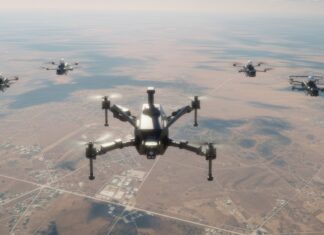
    Lockheed Martin Skunk Works® and XTEND have achieved a major milestone in JADC2 by integrating the XOS operating system with the MDCX™ autonomy platform. This technical breakthrough enables a single operator to simultaneously command multiple drone classes, eliminating the friction of mission handoffs. From "marsupial" drone deployments to operating in GPS-denied environments, explore how this collaboration is abbreviating the data-to-decision timeline and redefining autonomous mission execution.

    From Ukraine to Taiwan: The Global Race to Dominate the New Defense Tech Frontier

    0
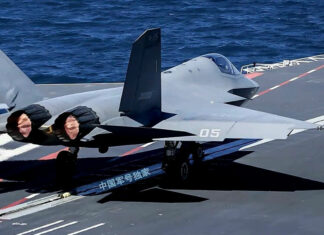
    As traditional defense primes face mounting competition from agile “neoprimes” such as Anduril, Palantir and Helsing, the balance of innovation is shifting toward software-defined warfare and scalable, dual-use technologies, while global industry consolidation—marked by Boeing’s integration of Spirit AeroSystems and other strategic mergers—signals an intensified race to secure control over the defense technology value chain. Our Defense-Tech weekly report highlights these trends.

    Europe’s “Drone Wall”

    0
    In early October 2025, a coordinated wave of unmanned aerial system (UAS) incursions—widely attributed to Russia—targeted critical infrastructure across at least ten European nations. The unprecedented campaign exposed the fragility of Europe’s air defenses...

    Weekly Defense Update & Global Security Assessment

    0
    Executive Summary The past week (September 18-25, 2025) represents an inflection point where strategic defense concepts have transitioned from doctrine to tangible reality. An analysis of global events reveals four primary, interconnected trends shaping an...

    U.S. Air and Space Forces Push Next-Gen Programs at the AS&C 2025 Conference and...

    0
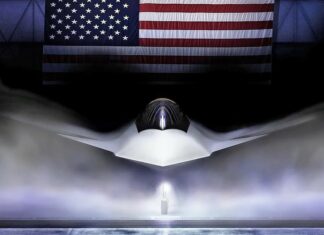
    At the 2025 Air, Space & Cyber Conference, U.S. Air Force and Space Force leaders unveiled major updates on next-generation fighters, bombers, unmanned systems, and space initiatives, highlighting both rapid innovation and critical readiness challenges as the services race to outpace global competitors. A short version is available here, with a more detailed version for subscribers.

    TADTE 2025: Reflecting Taiwan’s Strategic Themes

    0
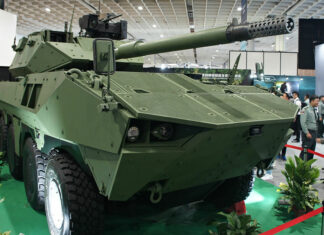
    The Taipei Aerospace & Defense Technology Exhibition (TADTE) 2025 crystallized around four dominant strategic themes that collectively illustrate Taiwan's comprehensive approach to defense modernization amid escalating regional tensions. Based on a detailed report by Pleronix (available upon request). Includes a Podcast discussion on TADTE 2025's highlighting Taiwan's four strategic themes beyond the post's coverage.

    Iron Beam 450 Completes Testing, Soon to Join With Operational Air Defense Units

    0
    Israel’s Iron Beam 450 high-power laser system has completed final testing, marking a major leap in air defense. Developed by Rafael, it offers precise, cost-effective interception of rockets, UAVs, and mortars, and is set for IDF deployment by 2025.