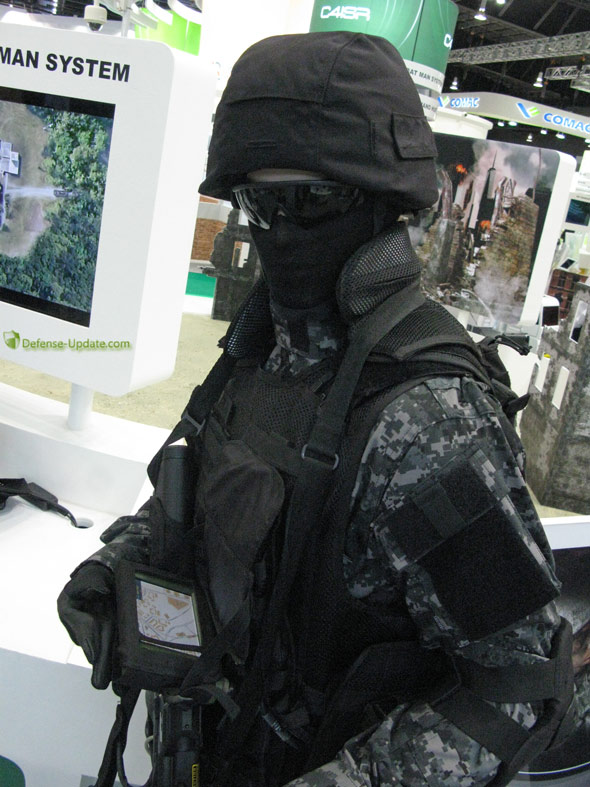
ST Kinetics is displaying two versions of the Advanced Combat Man Systems (ACMS) at the Singapore Airshow 2012. The basic ACMS is currently deployed with Singapore Army units’ with the ACMS Lite version being developed for future applications.
Key components of the current ACMS system shown in the picture below are the soldier computer subsystem, including a wearable computer and power pack, the communications subsystem supporting wireless radio and data connectivity through mesh networking, full color OLED based helmet mounted display and active noise diction hearing protection, indoor and outdoor navigation system with GPS support, and weapon-mounted camera (offering round the corner vision), MARS reflex sight with laser aiming device. The weapon subsystem offers hands-on-weapon operation of six functions via the weapon interactor.
ACMS KIT. Photo: Tamir Eshel, Defense-Update
ACMS Lite
The ACMS Lite was unveiled today at the Singapore Airshow. This design uses the latest ARM processor and mobile communications technology to enhance the soldiers’ networking and situational awareness capability. The new kit, currently in evaluation, includes a smartphone portable device providing mesh-networking communications, processing and display of situational awareness, and support of C2 applications. It will also include fabric cabling integrated into the load Bering vest, offering more reliable and lightweight, low power solution. ACMS Lite is designed to be used by team members and team leaders.
ACMS Lite. Photo: Tamir Eshel, Defense-Update
STELOP Unveils HELMIS Prototype
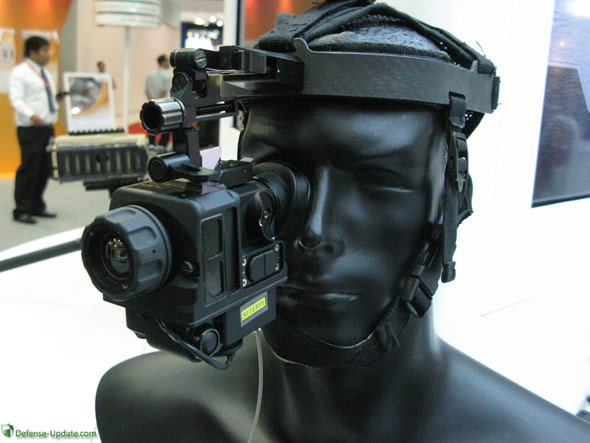
A possible future component of the soldier system is the HELMIS thermal viewer developed by STELOP. The Singapore based JV is unveiling an uncooled thermal viewer at the Singapore Airshow, developed for modern soldier system programs. The main advantage of such thermal viewer over image intensifier viewers is its capability to operate in mixed lighting condition, (no saturation effect) as well as in total darkness (such as underground facilities). Helmis is currently at a prototype stage, expected to be tested with the Singapore Advanced Combat Man System (ACMS) soon. The viewer weighs less than 500 grams, and can be mounted on a helmet or strapped onto a headband as shown its photo. It uses an uncooled 8-12 micron sensor offering 30 degree field of view, supported by a 800×600 OLED display. Operating time is more than four hours.
Lockheed Martin signed a teaming agreement with Indonesian technology firm PT CMI Teknologi to improve airspace surveillance, safety, and management over the Indonesian Archipelago in support of the government s defense revitalization initiative.
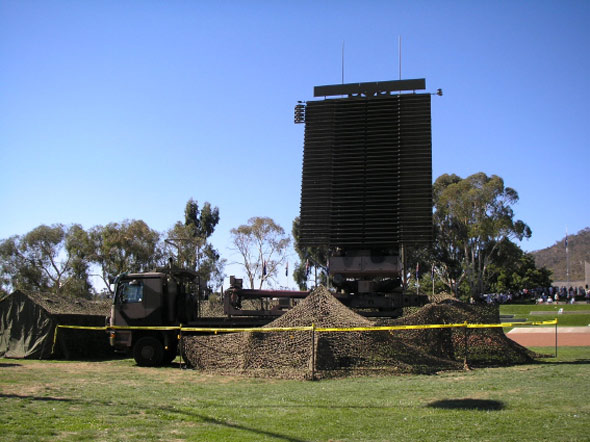
During a signing ceremony at the Singapore Air Show, company representatives agreed to jointly pursue the National Airspace Surveillance Republic of Indonesia (NASRI) program with the intent to produce more than 40 new TPS-77 and FPS-117 long-range surveillance radars in-country.
Lockheed Martins' AN/TPS-77 Radar
“CMI s strong background in microwave electronics makes them an ideal partner for the manufacture and long-term support of these radar systems in Indonesia,” said James Gribbon, Asia Pacific regional president for Lockheed Martin. “By integrating new sensors with Indonesia s command and control system, the NASRI network will greatly enhance air sovereignty and surveillance over the country s more than 17,000 islands, spanning a distance wider than the United States.”
Data feeds from the network will also enhance civilian air traffic control, including commercial air traffic management, which is currently handled by radars in nearby Singapore.
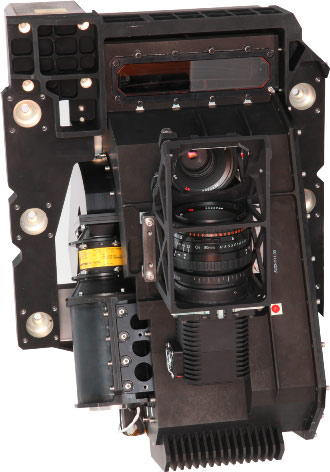
Israel’s Elbit Systems is introducing a new hyperspectral sensor payload developed specifically for UAVs designed by the company’s ElOp electro-optics division. Elbit Systems has completed the development of the system and has recently conducted a series of successful test flights. Particularly useful for this application is the Hermes 900, with its large payload bay, where the new hyperspectral sensor fits in a streamlined configuration, without any interference with other payloads. The new system facilitates remote sensing and monitoring capabilities for various scenarios.
Photo: Elbit SystemsPhoto: Elbit Systems
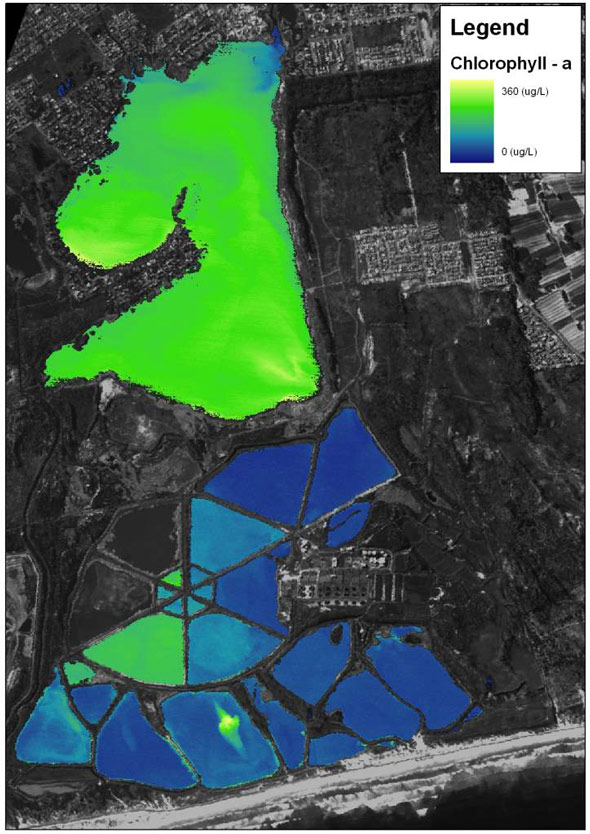
Hyperspectral sensing opens new capabilities for intelligence collection, particularly in the identification of specific materials, coverage of large areas and spotting concealed or underground activity by tracking the presence of specific signatures resulting from known activities (including heat, chemical residues etc.) Conventional sensing is unable to spot such signals. The airborne segment of the hyperspectral sensor is responsible of collecting the signals, transferring them via datalink to the ground segment, where automatic interpretation of the images and data extraction is produced. The ground segment also provides the mission planning for the sensor.
Hyperspectral imaging technology enables simultaneous view of a special area of interest ‘sliced’ into hundreds of specific wavelengths, each tuned to capture a narrow frequency in a process similar to that of a spectrometer. The resulting image offers the viewer to view the image through each frequency band, therefore spotting the ‘chemical fingerprints’ of chemical, or organic materials with great details and accuracy.
This new sensing capability enables the detection and tracking of potential targets on the basis of their material signature. The new payload enables intelligence gathering via identification, measurement and tracking of materials and objects including uncovering low signature military activity and invisible obstacles, as well as identification of hazardous materials.
ElOp is also developing a space-based hyperspectral payload for earth observation applications. Such payload could be useful for the monitoring of environmental contamination, assisting in natural disaster management etc. Potential satellite platforms for such payloads are a future EROS series spacecraft and an experimental satellites being jointly developed by Israel and Italy.
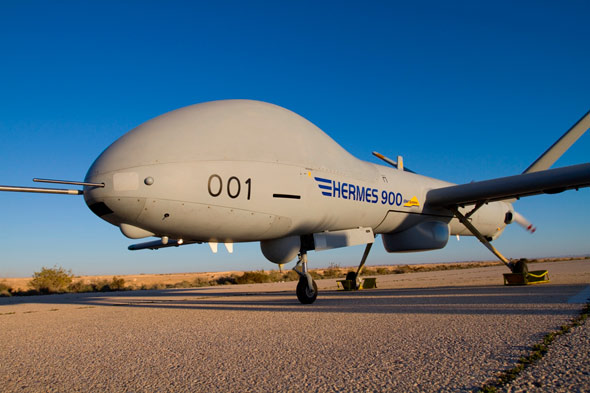
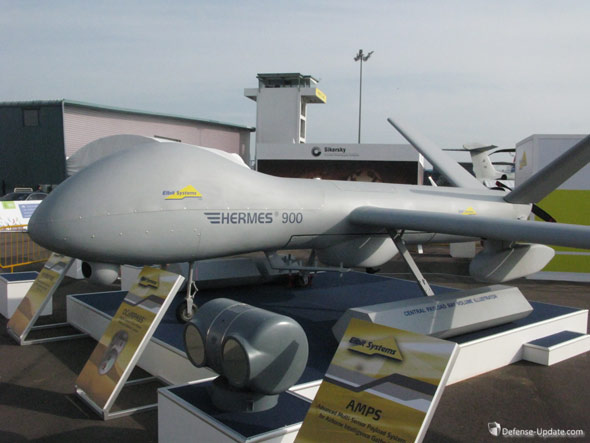
Elbit Systems is displaying its largest platform of the Hermes family of UAS – Hermes 900.
Hermes 900 was designed as a derivative of the Hermes family of UAS, introducing significant savings and enhanced capabilities over existing platforms. With over 300,000 operational flight hours with Hermes 450 UAS, the new ‘900 inherits the reliable building blocks, ground support equipment, payloads and ground mission controls, while expanding the flight envelope and endurance to new levels.
Among the key capabilities offered by the new drone are longer endurance, flight altitude of 30,000 ft. and a large payload capacity (up to 350kg). Unlike many other UAS, the Hermes 900 is designed with a 2.5 meter long internal payload bay, capable of accommodating up to 250 kg and allowing quick modular payload installation and replacement. The spacious bay accommodates multiple payloads with more installed on four hard points under the wings. The UAS includes innovative avionics and electronic systems, a low noise engine, as well as solutions that can be offered for sense & avoid capabilities and safe integration of the UAS into the relevant air space.
The ‘900 employs the same ground control station, line of sight data link, various sensors and key ground support equipment elements as the Hermes 450. This enables seamless insertion of the new UAS into Hermes 450 units, enabling users to benefit from reduced logistics and operational cost.
A typical sensor suite includes the baseline EO payload DCoMPASS, or Stand off EO/IR/Laser system such as the AMPS from ElOp. Different area surveillance missions can be performed in parallel to the EO payloads; these include various radar systems such as the SAR/GMTI and Maritime Search Radars. Three new mission specific sensor packages are being introduced for the drone – the electro optic mapping and survey area scanning systems (LASSO), hyperspectral payload and wide area persistent stare system.
The sheer size of the drone enables the deployment of other sensors – hence, the SIGINT payloads include the Skyfix COMINT/DF and Skyfix-G COMINT GSM systems. Electronic attack configurations may include the SKYJAM communication jamming system and AES 210 V/V2 ESM (ELINT) systems.
Hermes 900 uses an integral satellite communication data link enabling operations beyond line of sight and in mountainous areas, where line-of-sight restricts non SATCOM UAS from descending to lower altitude. In addition, the UAS can takeoff from a launch and recovery site in theater and be controlled from a mission station positioned remotely and conveniently in the user’s home facilities thousands of miles away. In order to implement this capability, Elbit Systems uses a cutting edge SATCOM system that combines highly advanced technologies, increasing bandwidth efficiency and assuring maximum cost effectiveness for its customers.
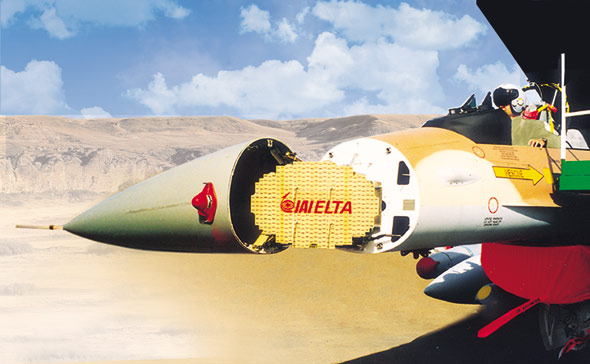
Israel Aerospace Industries (IAI)’sELTA Systems will provide fire control radars for installation on an unspecified fighter aircraft, as part of a major upgrade of one of the Asian air forces. ELTA Systems Ltd., IAI’s group and subsidiary, will deliver the ELM-2032 under a recently signed $150 Million contract, spanning over five years.
Photo: IAI
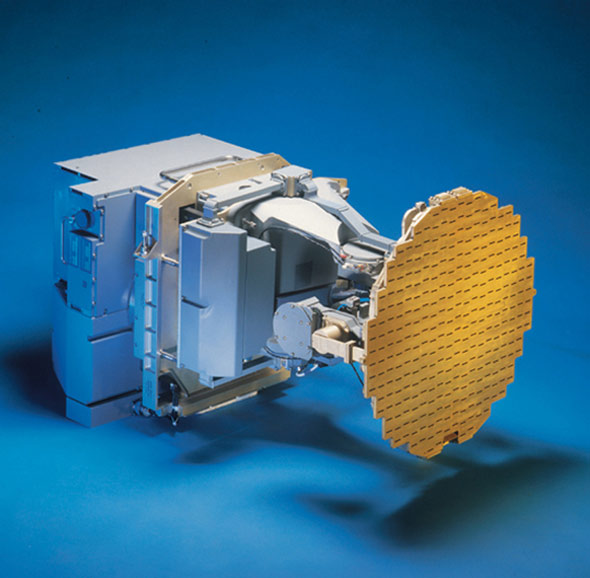
The modern ELM-2032 fire control radar implements advanced technologies that greatly enhance surveillance and fire control capabilities in air-to-air, air-to-ground and air-to-sea operation modes. Its compact, lightweight design offers high performance standards with a competitive attractive price. The EL/M-2032 implements modular hardware design, software control and flexible avionic interface ensuring flexible integration in different aircraft and limited nose space. Unlike the latest generation fighter radars based on electronic scanning antennae, the EL/M-2032 radar operates a mechanical scanning, yet is compact enough to be installed in different fighter aircraft including MiG-21, Sea Harrier, F-5, Mirage, Kfir C-10 and F-4.In addition to upgrade programs, the EL/M-2032 has already been selected for the South Korean F/A-50 (strike version of the T-50 trainer) and Indian Tejas Light Combat Aircraft.
Lova Drori, Rafael's Executive VP Marketing. Credit: Rafael
“We are investing a great deal in supporting our activities in the Asian market,” Lova Drori,Executive VP Marketing at RAFAEL Advanced Defense Systems Ltd, told Defense Update, “Defense exhibitions offer part of our activities in this region. In addition to Singapore Airshow RAFAEL will also participated this year in defense exhibitions in Australia and will participate in the exhibitions in Thailand and India over the next month or so. We view these events as an important part of our marketing effort, a way to show our appreciation and an opportunity to conduct meetings at all levels, alongside the equipment we bring to the display.”
Lova Drori, Rafael's Executive VP Marketing. Credit: Rafael
This is quite a busy season for us in Asia. Here at Singapore we display a wide range of airborne, ISR, air defense and land systems and solutions. In Australia we are presenting our broad naval systems portfolio, including the Typhoon weapon system, Toplite EO payload, Infra-Red Search & Track and the new 11m’ Protector Unmanned Surface Vessel. Next month in Thailand, we are expecting delegates from the whole region, while at Defexpo India we’ll highlight our land systems offering.
The solutions addressing different requirements of each customer also have common lines, particularly in endorsing new capabilities such as the need to maintain persistent surveillance of certain areas, especially when combating terror activity, insurgency and control of vast areas of land, airspace and sea. Evolution of air and missile defense offering effective active defense against all types of threats, highlighting different solutions represented by the Spyder, combat-proven Iron Dome and the next generation David’s Sling. Precision attack provides the tools employing actionable intelligence to achieve the required effect. RAFAEL also offers such capabilities, with our Spice family of aerial guided weapons and newly expanded Spike family of EO guided missiles. This family has recently been expanded to include non line of sight and short range members, in addition to the man portable and platform mounted medium, long range and extended-range versions.
RAFAEL is displaying these tactical missile systems in Singapore, as well as in Thailand, where we show the missiles in helicopter-mounted configurations. The infantry member, Spike LR will be presented By Smart Systems PTe, Singapore-based.company manufacturing and marketing the missile under RAFAEL license.
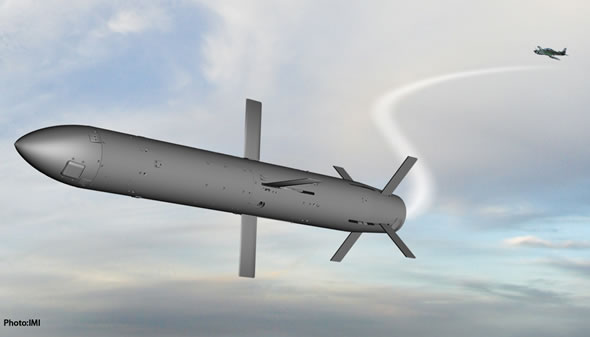
IMI's Whip-Shot guided missile is designed as an affordable remotely controlled guided missile to be used by light attack aircraft. Photo: IMI
IMI is unveiling the Whipshot, a guided weapon developed for light aircraft, offering operators of light aircraft affordable precision firepower. IMI is discussing the new weapon with a number of aircraft manufacturers, including Embraer, which was recently selected to deliver the Super Tucano under the US Air Force Light Attack aircraft (LAAR) program. The WhipShot uses an airframe derived from the Mapatz missile, using the original missile guidance system. Instead of having an on-board guidance solution the missile is tracked by the launching aircraft EO target acquisition system, utilizing a wireless command link to update the weapon’s flight directing it to the target. According to IMI, the result is a highly affordable aerial weapon, that costs much less than the Hellfire, but offers the precision and control of a guided weapon. IMI also plans to offer an enhanced version equipped with an aided INS/GPS guidance.
IMI's Whip-Shot guided missile is designed as an affordable remotely controlled guided missile to be used by light attack aircraft. Photo: IMI
Elbit Systems is showing the Hermes with a full range of sensors, including the AMPS, a heavy, high resolution EO payload providing Highly detailed imagery from medium and high altitude. Until now such sensors were commonly employed by manned aircraft, such as the Beechcraft B-200 and similar, as unmanned aerial platforms could not carry such heavy payloads. Hermes 900 was also shown here with the DCOMPASS EO stabilized ball, an airborne radar, SIGINT and COMINT sensors (underwing and belly); all can be employed simultaneously on the Hermes 900.
Photo: Tamir Eshel, Defense-Update
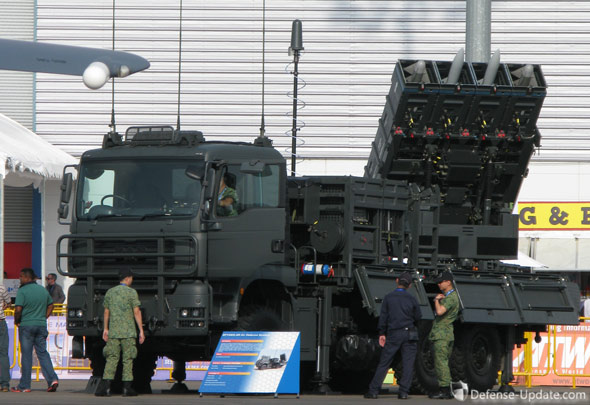
Singapore is displaying its latest air defense asset – the Israeli Spyder short range air defense system. The system acquired by Singapore shares many common features with the Indian Spyder, although the version on display at the Singapore Airshow does not have the Toplite EO system, operational systems will receive this function soon. Rafael has developed two versions of the Spyder – the short range (Spyder SR) employing the Derby and Python surface-launched interceptors (identical to the air launched missiles) and the Medium Range (Spyder MR) featuring the same missiles equipped with boosters for additional range.
Photo: Tamir Eshel, Defense-Update
The ACMS Lite uses the latest ARM processor and mobile communications technology to enhance the soldiers’ networking and situational awareness capability. The new kit, currently in evaluation, includes a smartphone portable device providing mesh-networking communications, processing and display of situational awareness, and support of C2 applications. It will also include fabric cabling integrated into the load Bering vest, offering more reliable and lightweight, low power solution. ACMS Lite is designed to be used by team members and team leaders.
Photo: Tamir Eshel, Defense-Update
Key components of the system are the soldier computer subsystem, including a wearable computer and power pack, the communications subsystem supporting wireless radio and data connectivity through mesh networking, full color OLED based helmet mounted display and active noise diction hearing protection, indoor and outdoor navigation system with GPS support, and weapon-mounted camera (offering round the corner vision), MARS reflex sight with laser aiming device. The weapon subsystem offers hands-on-weapon operation of six functions via the weapon interactor.
STELOP is unveiling an uncooled thermal viewer at the Singapore Airshow, developed for modern soldier system programs. The main advantage of such thermal viewer over image intensifier viewers is its capability to operate in mixed lighting condition, (no saturation effect) as well as in total darkness (such as underground facilities). Helmis is currently at a prototype stage, expected to be tested with the Singapore Advanced Combat Man System (ACMS) soon. The viewer weighs less than 500 grams, and can be mounted on a helmet or strapped onto a headband as shown in its photo. It uses an uncooled 8-12 micron sensor offering 30 degree field of view, supported by a 800×600 OLED display. Operating time is more than four hours.
Photo: Tamir Eshel, Defense-Update
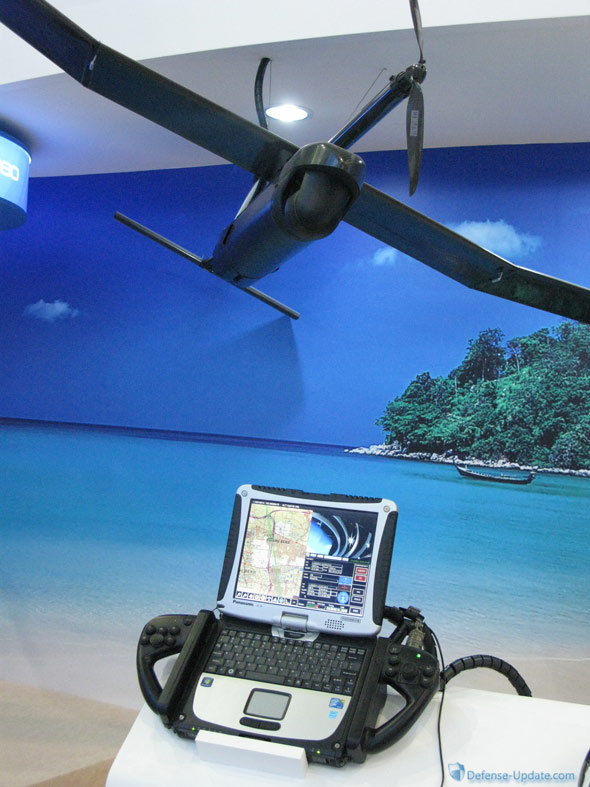
ST Aerospace is showing a civil version of its Skyblade 3 mini UAV system designed for homeland security and law enforcement. It is designed to carry a modular payload, operated by a two-man crew assisted by a new, redesigned ground control unit.The new drone dubbed Skyblade 360 is designed for quick reaction missions supporting emergency response, scientific or law enforcement missions. The drone weighs about nine kilograms and can operate at an altitude of 300 up to 3,000 above ground, (90-920 m’), up to 15 km away from the ground control station. Powred by battery, it can operate for three hours, or up to six hours using a fuel cell. Its length is 1.8 meters and the span is 3 meters.
Photo: Tamir Eshel, Defense-Update
Skyblade 3 was shown at the Singapore Airshow 2012 using a new uncooled stabilized thermal imager. Skyblade 3 has a take off weight of five kilograms, operational altitude of 90-460 meters. Flying at a speed of 35 knots, it has an endurance of more than 60 minutes. It can operate on a mission up to eight kilometers from the ground control unit.
Photo: Tamir Eshel, Defense-Update
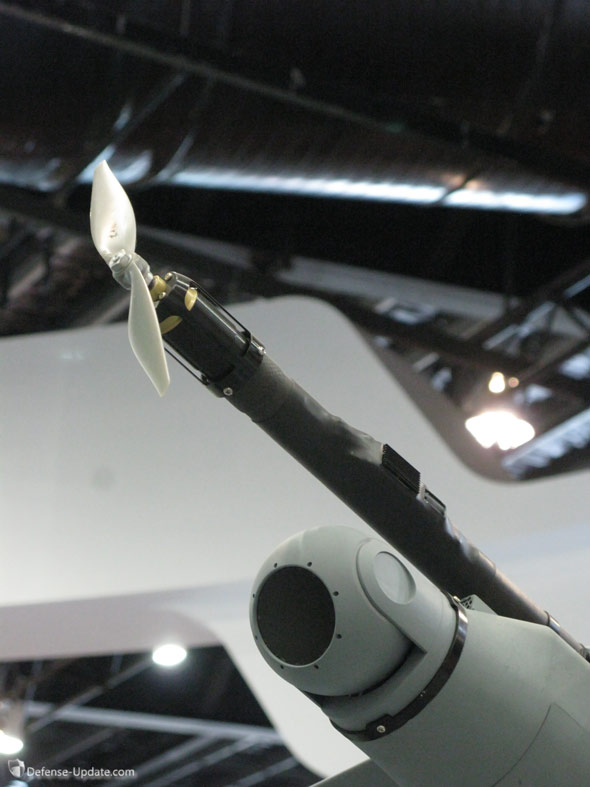
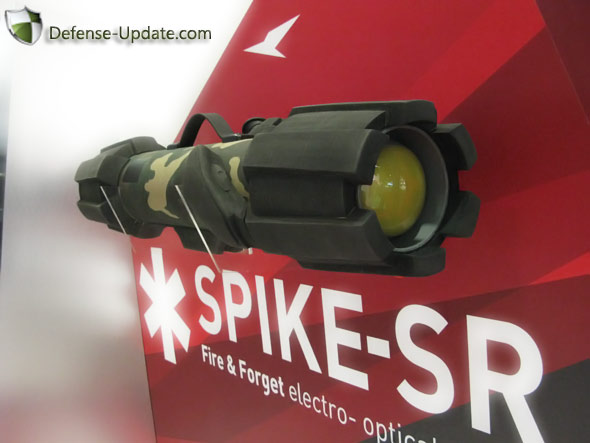
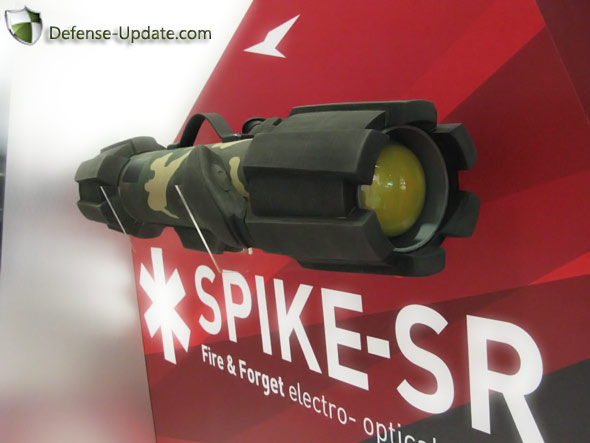
Rafael is expanding the Spike missile family with the lightweight, man-portable Spike SR, a ‘fire and forget’ short range guided missile enabling infantrymen to engage a wide range of targets with high precision, from ranges up to 800 meters. Spike SR is positioned between the Spike MR (medium-range) weapon and the unguided Matador multipurpose rocket, offering the advantages of both weapons for infantry-relevant ranges, at a full system weight of less than 10 kg., therefore reducing load by 3 percent.
Photo: Tamir Eshel, Defense-Update
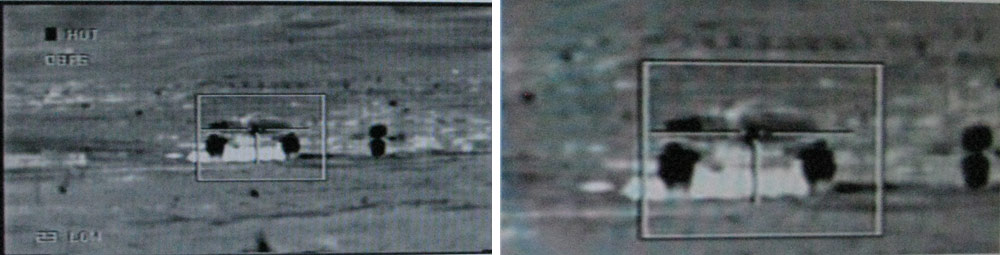
This is the thermal camera (seeker) view as seen by the Spike SR operator, just before launching at a MBT target from a range of 500 meters. The missile is effective at ranges of 800 meters. The operator has an option to zoom in to aid target identification. the seeker automatically corrects and locks on the stationary or moving target, aiming to maximize probability of kill. New aiming algorithms can be added to improve the missile’s hit probability against specific targets.
Photo: Rafael
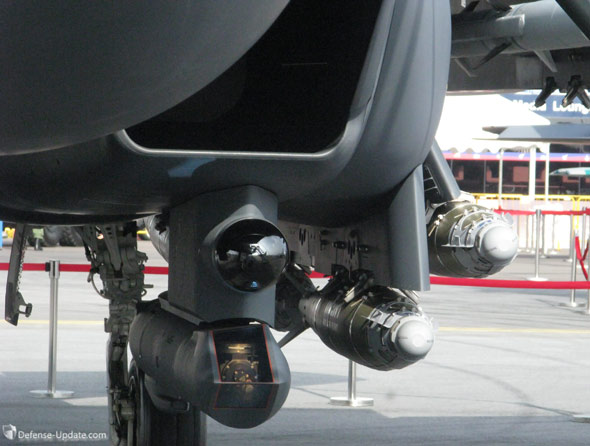
The new Boeing F-15SG of the Singapore air Force are equipped with Lockheed Martin AN/AAQ33 Sniper targeting pod and the new TigerEyes InfraRed Search & Track (IRST) sensor mounted on the sniper’s carrying pylon. TigerEyes has already been unveiled at the RSAF open day at Paya Lebar last year, but is being shown at an airshow for the first time. TigerEyes, developed by Lockheed Martin has been selected for the Korean Slam Eagle and most recently for the Saudi Arabian F-15SA program.
Photo: Tamir Eshel, Defense-Update
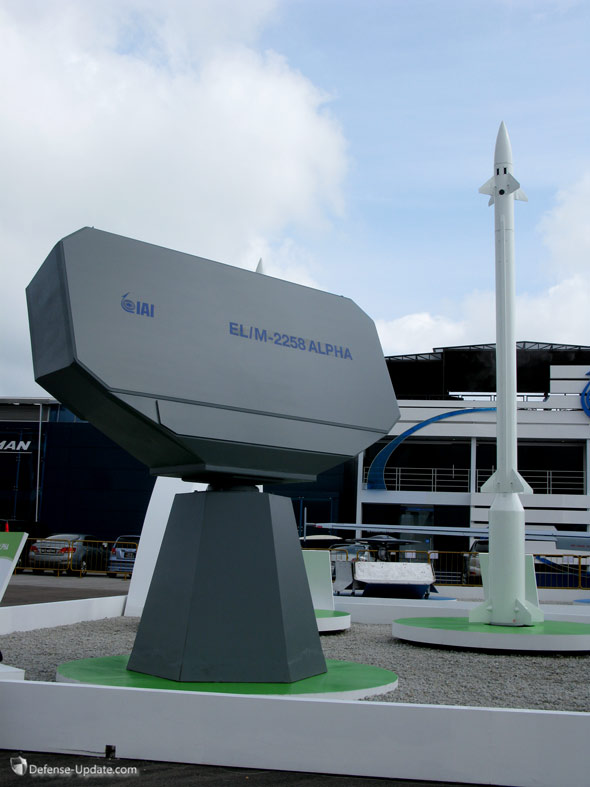
IAI is displaying the EL/M 2258 ALPHA Advanced Lightweight phased Array Radar at the Singapore Airshow 2012. The new radar is designed to support the latest Barak 8 Air and missile defense missiles deployed on corvettes and frigates, where installation of the large, four-panel MF-STAR radar cannot be supported.
Photo: Tamir Eshel, Defense-Update
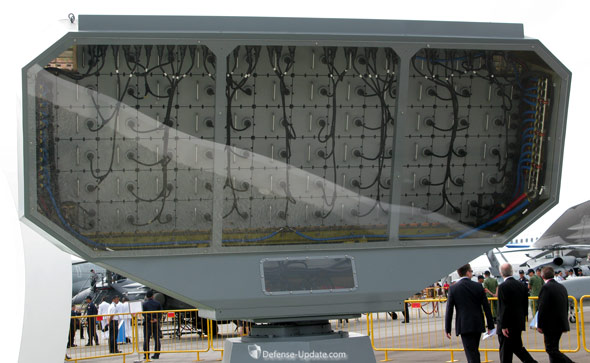
Rear view of the ALPHA radar:
Photo: Tamir Eshel, Defense-Update
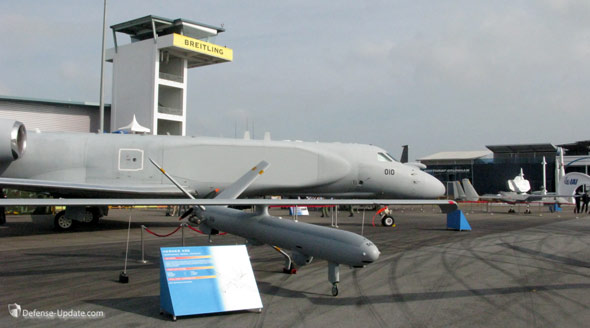
Gulfstream/IAI G5500 CAEW and Elbit System’s Hermes 450 UAV displayed at the Singapore Airshow 2012. Photo: Tamir Eshel, Defense-Update
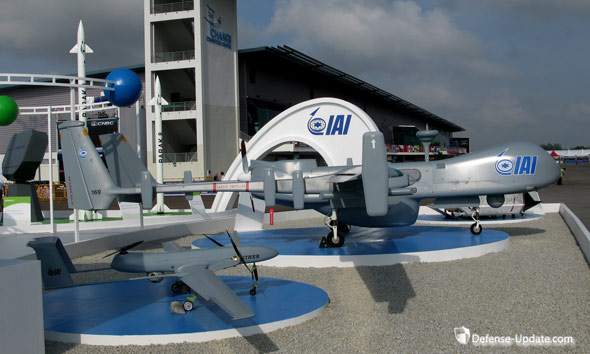
IAI combined outdoor display showing the Heron, Panther, and Barak 8 Air Defense Missiles. Photo: Tamir Eshel, Defense-Update
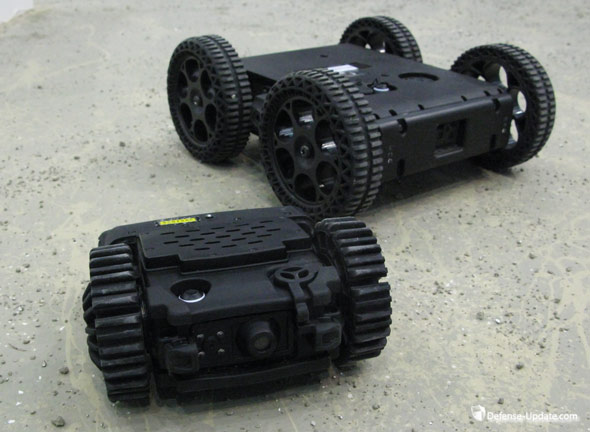
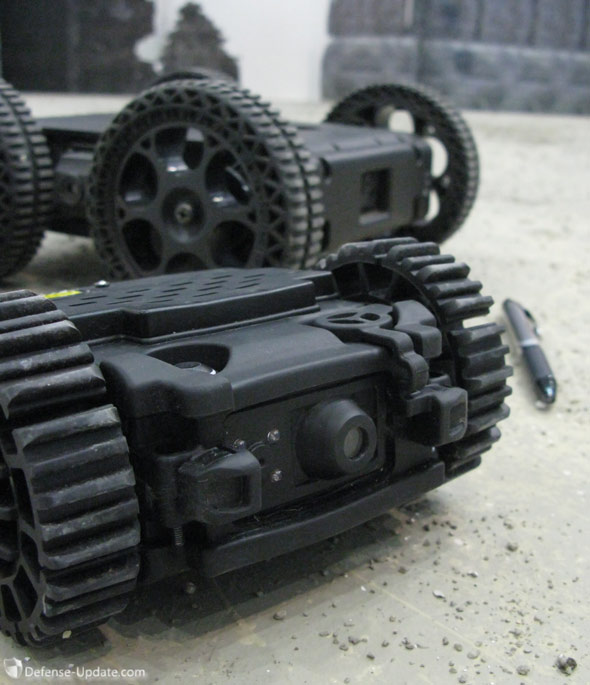
Two throwable robots were inveiled today by ST Engineering. Photo: Tamir Eshel, Defense-Update
ST Electronics Info-Com Systems has unveiled an unmanned duo sensor, dubbed Tactical Throwing Sensor (TTS) and Forward Sensor System (FSS), both are mobile recce robots specially designed to support the Singapore Army Advanced Combat Man System (ACMS). The sensors provide real-time indoor surveillance supporting law enforcement, counter terror, infantry and special forces assault teams. The robots perform effectively at all light levels, using built in infrared surveillance for use in conditions of total darkness. The two-wheel TTS is designed for indoor operations, thrown into its target by hand. It can be controlled from a handheld Control Display System from a distance of up to 150 meters. The FSS is a four-wheel robot, equipped with powerful motors for indoor and outdoor operation on gravel, sand or rocky terrain. Its multiple cameras are providing 360 degree coverage.
Two throwable robots were unveiled today by ST Engineering. Photo: Tamir Eshel, Defense-Update
The development of hand thrown robots stemmed from a study of Singapore Defense Science Organization (DSO) to explore the production of stealth-class robots – small and stealthy light-weight robots that are deployable for surgical close-in surveillance or suicide missions in an urban environment. The concept envisaged a hand thrown robot that carries a pan-tilt-zoom camera and that could survive drops of up to 6 meters. It also allows the soldier to throw the robot into windows or openings and provides a real-time video of the interior to the soldier.
Rafael is expanding the Spike missile family with the lightweight, man-portable Spike SR, a ‘fire and forget’ short range guided missile enabling infantrymen to engage a wide range of targets with high precision, from ranges up to 800 meters. Spike SR is positioned between the Spike MR (medium-range) weapon and the unguided Matador multipurpose rocket, offering the advantages of both weapons for infantry-relevant ranges, at a full system weight of less than 10 kg., therefore reducing load by 3 percent.
SPIKE SR. Photo: Tamir Eshel, Defense-Update
RAFAEL has completed the program’s feasibility testing and is now seeking international customers and partners to pursue full-scale development. The company positions the new weapon at a level well above RAFAEL’s own Matador rocket system, Talley SMAW or Saab AT4, as well as the Saab MBT LAW. According to Rafael, despite the much improved precision, performance and probability of kill, Spike SR will be slightly more expensive than those other unguided rockets.
The guidance system provides the distinctive advantage of the Spike SR – a strapdown camera located at the tip providing both target acquisition sensor and a seeker, employed for in-flight guidance. Spike SR carries a multi-purpose tandem shaped-charge warhead with blast-fragmentation effect, offering capabilities similar to those of the Spike LR missile.
The seeker tracks the target sending flight control commands to the aerodynamic controls, keeping the missile on its flight course to hit the target with high precision. The missile offers very high-hit probability, against point targets, as well as moving targets. Its target acquisition functionality enables Spike SR to operate in both day and night modes, without a dedicated magnifying day/night optics or laser rangefinder, thus saving significant additional weight, power consumption, logistics complexity and costs.
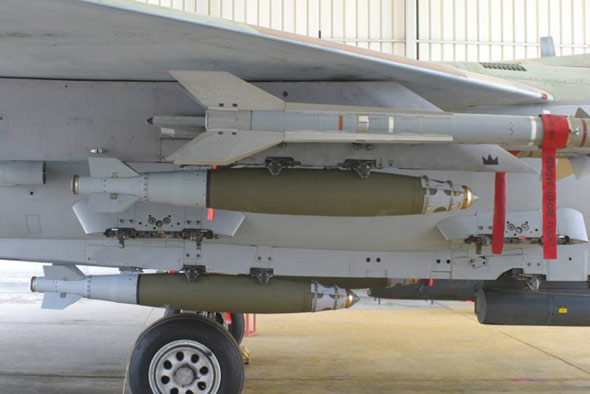
Israel Military Industries Ltd. announced today that the Boeing Company [NYSE:BA] has approved IMI’s 500-pound Multi Purpose Rigid (MPR 500) Bomb as compatible with their Joint Direct Attack Munition (JDAM) guidance kit.
The combination of IMI’s MPR 500 with Boeing’s JDAM guidance kit substantially enhances operational flexibility while reducing total ownership costs. With increased penetrating power and reduced collateral damage fragmentation, the MPR 500 was designed to defeat targets more commonly found in today’s fighting arena. By delivering IMI’s focused munition with Boeing’s reliable history of precision guidance, the MPR 500 JDAM system is ideal for gardened targets in dense urban areas or in close proximity to friendly troops.
Photo: IMIPhoto: IMI
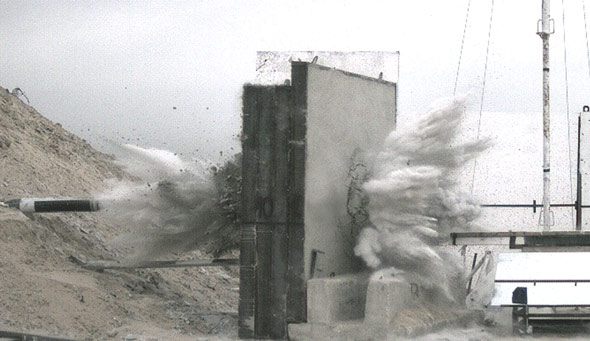
IMI’s MPR 500 is a combat-proven 500-pound bomb with improved penetration capabilities and gas the same dimensions as a MK-82.
The bomb can penetrate more than one meter of reinforced concrete or punch through four 200mm thick walls or floors.
Because of its 500-pound size, MPR 500 enhances aircraft carriage efficiency, increasing the number of targets that can be engaged per sortie.
MPR 500 provides concentrated blast effects, utilizing approximately 26,000 controlled fragments. This reduces collateral damage risk within one hundred meters. By creating a straight penetration path through the target, the MPR 500 virtually eliminates the “J Effect”, in which the bomb’s warhead breaks on impact causing it to explode incorrectly.
MPR 500 is being displayed by IMI at the Singapore Airshow.
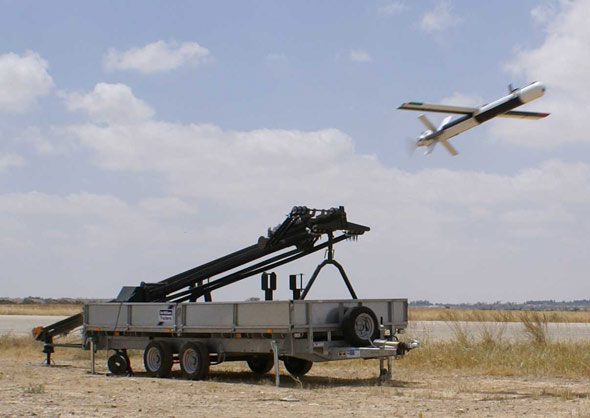
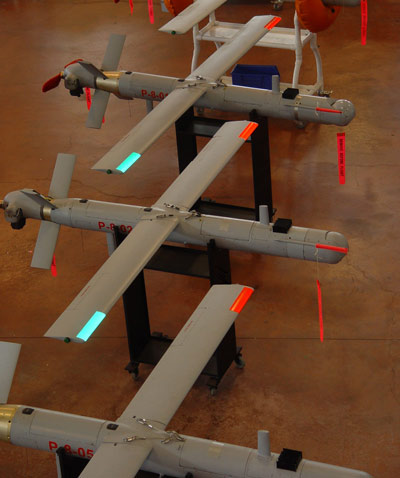
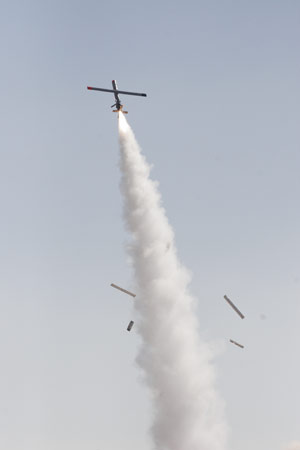
The Blade Arrow Precision Attack Munition (PAM) was unveiled today by UVision Air Ltd. five years after being first demonstrated. The PAM concept brings new offensive capabilities for precision strike of high-value and time sensitive targets, in complex terrain and urban background.
UVision’s Blade Arrow provides long range, highly flexible precision strike capability for the modern battlefield. Blade Arrow allows the maneuver echelon to conduct independent target acquisition, and allows ‘ambush’ of short-lived targets-of opportunity, using small warheads and high precision for reduced collateral damage.
Blade Arrow is a long endurance PAM which can be launched from either a launch canister or a rail-launcher, and provides full tactical UAV ISR capabilities using the MicroView high performance FLIR/color CCD electro-optical seeker with autotracking capability. The operator can search, detect, attack and hit high value relocatable, time critical, land or sea-based, moving targets with pinpoint accuracy at long ranges. A Blade Arrow unit is comprised of PAM launchers and a Ground Control Shelter (GCS) that enables vehicle control with Man-in-the-Loop operation, engagement or abort attack capability in real time, avoiding collateral damage.
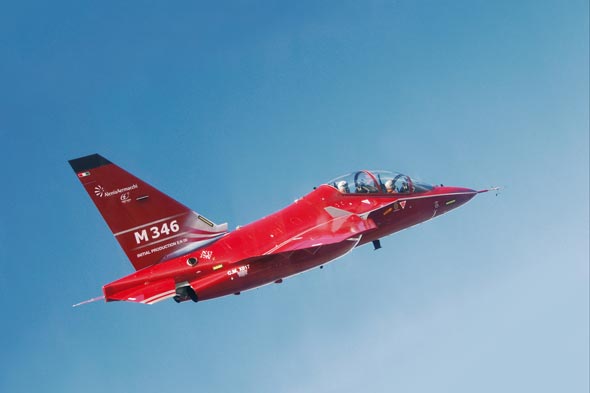
Alenia Aermacchi is back at the Singapore Airshow 2012 with the first two T-346 jet trainers built for the Italian Air Force. These jets are of special interest for Singapore, since the Singapore Air Force is about to receive its own 12 aircraft of this type, ordered in 2010 under an international contract to supply these aircraft through the consortium formed by ST Aerospace (prime contractor) and Boeing. In June 2011, Alenia
Aermacchi finalized contracts with ST Aerospace to provide logistics support for the RSAF’s fleet of M-346s, again as part of the Fighter Wings Course (FWC) program. The M-346 has also been selected for a jet trainer program in the UAE. Two Italian Air Force’s M-346 aircraft (T-346A) and a C-27J will be displayed at the Singapore Air Show. According to the company, there are also some interesting opportunities for the C-27J in Asia – Indonesia in particular.
Another competitor for the Asian jet trainer market is the Yak-130. According to the Russian aircraft company UAC, the company has made the first deliveries of export orders in 2011. The Yak-130 is positioned providing the highest level training for both Russian and foreign 4+ and 5 generation aircraft, and is best suited for pilot training in the Asia-Pacific region. UAC estimates the world market capacity for Yak-130 aircraft in the middle-term in
about 250 aircraft. Air forces operating Russian Su-27, 30 and MiG-29 are most likely to consider the Russian trainer.
A third major player in the Asian market is the korean T-50, which is already operational with the Republic of Korea Air Force and will soon enter service with the Indonesian Air Force. Korean Aerospace Industries (KAI) is promoting the aircraft throughout the world, and has been selected among the finalists in Poland and Israel.
prospects in relation to the replacement of the Singapore Navy’s patrol aircraft and the supply of ATR 42 and ATR 72 maritime patrol aircraft (MPA) to the Malaysian Maritime Enforcement Agency (MMEA) and the Philippines’ Air Force. A model of the ATR 42 MP, the maritime patrol version of the ATR 42 is displayed at the Finmeccanica stand.
For the Finmeccanica group company, Singapore and the Asia region are a fundamental part of its growth strategy, offering business opportunities in the short and medium term. Through the Italo-French joint venture ATR (Alenia Aermacchi/EADS), the company has formed a close relationship with Singapore, and more generally South East Asia, not only by selling a large number of regional transport aircraft, but also by opening a customer
support centre in Singapore and training facilities in Bangkok and Kuala Lumpur. Furthermore, it has some exciting
Singapore Airshow 2012, Asia’s largest and one of the three most important aerospace and defence exhibitions in the world, returns from 14 – 19 February 2012 at the Changi Exhibition Centre. In its third edition Singapore Airshow continues to grow hosting more than 900 exhibitors from 50 countries, and 266 delegations from 80 countries attending. Singapore Airshow 2012 is set to be the biggest one yet. Covered exhibition
space has increased to 50,000 sqm this year, with over 65 of the latest military aircraft, passenger airliners and luxury business jets on display over 100,000sqm of outdoor space as well as participating in the aerial display. There will also be 22 national/group pavilions, including, for the first time, Japan and Ukraine Pavilions.
The Singapore Airshow continues to attract a large number of high level delegations from the Asia-Pacific region as well as globally. Over 70% of exhibitors are returning exhibitors, bearing testimony to the strong vote of confidence the event receives year on year, with 60 of the top 100 aerospace companies represented. Some 20 airline and industry association CEOs will also be present during show week.
“Singapore Airshow is the premier aviation event in Asia, and an ideal platform for leading companies, top airlines, industry experts and government officials to exchange ideas and explore new opportunities. This week, we anticipate several announcements to be made on new investments to Singapore. The continued growth and success of Singapore Airshow is a good measure of our efforts to strengthen Singapore’s position as the leading
aerospace hub in Asia-Pacific, and we are delighted Singapore remains the choice location for leading aerospace companies seeking to establish a presence in this part of the world”, said Mr Lim Kok Kiang, Executive Director, Transport Engineering, Singapore Economic Development Board (EDB).
Visitors can look forward to several special showcases at this year’s show. To reflect the growth of the Unmanned Aerial Vehicles (UAVs) market globally, Singapore Airshow 2012 will feature the first integrated Land Defence and Unmanned Systems Pavilion, showcasing UAVs, Intelligence, Surveillance and Reconnaissance (ISR) platforms and high-tech land-based defence products and technologies. In addition, the Green Pavilion
will make a return, with a focus on alternative fuels to reduce carbon emissions. This year’s Green Pavilion will include a newly added component called ‘Deminars’ (seminars and demonstrations combined). In addition to the popular Business Forums on China and India, this year’s show will feature the inaugural Southeast Asia Business Forum, to help companies understand procurement opportunities and make inroads into key growth
markets.
Singapore Airshow continues to demonstrate its thought leadership through its highly anticipated key conferences, the Singapore Airshow Aviation Leadership Summit (SAALS) and the Asia Pacific Security Conference (APSEC). SAALS and APSEC will provide a platform for government, military and industry leaders to address challenges and discuss issues facing aviation and regional peace and security.
Mr Jimmy Lau, Managing Director of Experia Events, organizer of the Singapore Airshow, said: “Response to this year’s show has been very positive and we are delighted that Singapore Airshow continues to be the event of choice for major players from across the aviation spectrum to network, exchange ideas and explore business opportunities. Despite current economic uncertainties, we will be putting on our biggest show yet. This is a
promising sign of things to come for the industry and especially for the Asia-Pacific region.”
“The Asia-Pacific is leading the way in growth for the aviation industry worldwide, and Singapore, with its strategic position in the heart of Asia, plays a crucial role as a springboard into this thriving region. We are confident that this year’s show will be a fruitful one that will open new doors for all our visitors,” commented Mr Lau.
Lockheed Martin Skunk Works® and XTEND have achieved a major milestone in JADC2 by integrating the XOS operating system with the MDCX™ autonomy platform. This technical breakthrough enables a single operator to simultaneously command multiple drone classes, eliminating the friction of mission handoffs. From "marsupial" drone deployments to operating in GPS-denied environments, explore how this collaboration is abbreviating the data-to-decision timeline and redefining autonomous mission execution.
As traditional defense primes face mounting competition from agile “neoprimes” such as Anduril, Palantir and Helsing, the balance of innovation is shifting toward software-defined warfare and scalable, dual-use technologies, while global industry consolidation—marked by Boeing’s integration of Spirit AeroSystems and other strategic mergers—signals an intensified race to secure control over the defense technology value chain. Our Defense-Tech weekly report highlights these trends.
In early October 2025, a coordinated wave of unmanned aerial system (UAS) incursions—widely attributed to Russia—targeted critical infrastructure across at least ten European nations. The unprecedented campaign exposed the fragility of Europe’s air defenses...
Executive Summary
The past week (September 18-25, 2025) represents an inflection point where strategic defense concepts have transitioned from doctrine to tangible reality. An analysis of global events reveals four primary, interconnected trends shaping an...
At the 2025 Air, Space & Cyber Conference, U.S. Air Force and Space Force leaders unveiled major updates on next-generation fighters, bombers, unmanned systems, and space initiatives, highlighting both rapid innovation and critical readiness challenges as the services race to outpace global competitors. A short version is available here, with a more detailed version for subscribers.
The Taipei Aerospace & Defense Technology Exhibition (TADTE) 2025 crystallized around four dominant strategic themes that collectively illustrate Taiwan's comprehensive approach to defense modernization amid escalating regional tensions. Based on a detailed report by Pleronix (available upon request). Includes a Podcast discussion on TADTE 2025's highlighting Taiwan's four strategic themes beyond the post's coverage.
Israel’s Iron Beam 450 high-power laser system has completed final testing, marking a major leap in air defense. Developed by Rafael, it offers precise, cost-effective interception of rockets, UAVs, and mortars, and is set for IDF deployment by 2025.