Wednesday, December 31, 2025
More
    Home Blog Page 202

    Northrop Grumman Scalable Agile Beam Radar (SABR)

    Today’s battlespace demands the very best in airborne Active Electronically Scanned Array (AESA) fire control radar solutions. Since mission effectiveness relies on the capability and reliability of the aircraft’s most important sensor, it is imperative that the solution is uncompromised.

    Northrop Grumman has industry-leading radar design, development and integration experience, and has produced thou- sands of airborne fire control radars for the U.S. Air Force and numerous international customers over the past 35+ years. As a world leader and sole provider of AESA radars for 5th Generation Fighters, Northrop Grumman supplies the

    AN/APG-77 and AN/APG-81 radars for the F-22 and F-35, respectively. The Northrop Grumman APG-80 AESA radar is the world’s first F-16 production AESA in operational use, and was recently deployed by UAE forces in the Libya campaign.

    Singapore Airshow Special Report from Asian Defense & Diplomacy

    The Scalable Agile Beam Radar (SABR), designed specifically for the F-16, is the newest addition to the Northrop Grumman robust family of multi-function sensors. Leveraging Northrop Grumman’s world-leading AESA technology base, SABR was designed to maximize radar system performance within existing F-16 allocations. SABR is a full performance fire control AESA designed to the support next generation weapons and tactics, in the presence of the world’s densely-packed electronic threat environment. Backed by decades of experience in the design, development and integration of electronically scanned radar technology, SABR immediately showed its strong heritage, building an unmatched record of successful “firsts,” when flight operations started. SABR made its debut on an F-16 in November, 2009, making it the first retrofit AESA to fly in an F-16. Because of Northrop Grumman’s 35+years of experience with the F-16, SABR spent only 3 days in a systems integration lab (SIL) and quick-turned to flight at Edwards AFB. With only USAF flight test pilots and flight test engineers aboard, SABR flew 17 sorties with 100% mission success rate.

    SABR Leverages Commonality to Maximize Affordability

    Since SABR’s initial unveiling, Northrop Grumman has continued efforts to expand capability and reduce risk. Our SABR system has accumulated thousands of operating hours in the lab and in the air, all without failure, demonstrating superior operational performance and reliability. The antenna has proven as robust as any of the other 5th generation AESAs Northrop Grumman has produced. SABR takes advantage of Northrop Grumman’s world-leading processes established for rapid, accurate production of the APG-77, -77(V)1, -80, and -81. Northrop Grumman produces AESA radars in a single facility at one location, allowing for tight quality control at every step. The facility houses both the AESA design and production teams. This enables cross-program synergies and rapid innovation producing very consistent, highly reliable systems. Unique in-house automated manufacture and test, antenna test ranges, and our one-of-a-kind flight engineering and test organization assure that SABR’s customers benefit from these synergies.

    5th Generation Fighter Capability

    Northrop Grumman has continued to grow SABR’s capabilities. By using an internal software porting process, SABR operational capabilities were enhanced to host F-35 modes. SABR participated along with US Forces in operational scenarios and showcased revolutionary operational performance. SABR flew side-by-side with the APG-81 in matching Northrop Grumman flight test aircraft and produced exceptional results in a very challenging environment. For all those who seek AESA performance to deal with the current and evolving threats, there is no substitute for proven flight test results. Only Northrop Grumman can provide these results, and only Northrop Grumman can link them to 5th Generation Fighter capabilities in an F-16.

    Dependable Engines: Pratt & Whitney

    P&W page on Singapore Special Report
    P&W page on Singapore Special Report

    During the past 87 years, military technology and capabilities have changed drastically, but one thing has stayed the same – Pratt & Whitney’s steadfast commitment to delivering an ever-expanding arsenal of propulsion systems to military customers. Since 1925, Pratt & Whitney has provided top-of-the-line engines to 29 armed forces around the world – including Singapore.

    As we continue to evolve to meet the needs of today’s warfighters, we are proud to be the only manufacturer of fifth-generation engines powering the only two fifth-generation fighters in the world – the F-22 Raptor and the F-35 Lightning II. Pratt & Whitney’s F135, the world’s most powerful fighter engine, has successfully passed numerous milestones in its more than 10 years of development and testing, including recent sea trials aboard the United States Navy’s USS Wasp. The F135 powering Lockheed Martin’s F-35 Lightning II has completed more than 1,500 flight tests, 2,500 flight hours and more than 280 vertical landings.

    Singapore Airshow Special Report from Asian Defense & Diplomacy

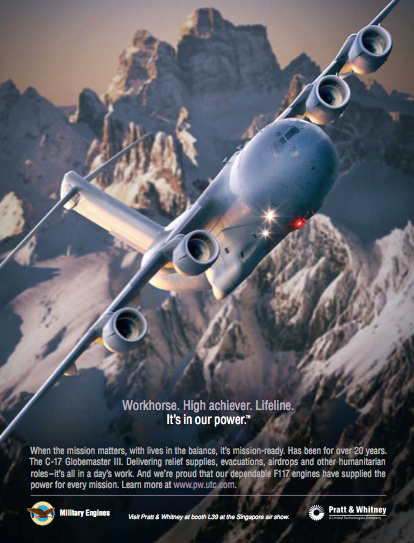
    Singapore’s fleet of F-16 and F-15 fighters is powered by Pratt & Whitney’s F100-series engines. The F100 is the workhorse of 23 air forces around the world, including the Republic of Singapore Air Force (RSAF). The F100-PW-229 engine has been in service powering the RSAF’s F-16 Block 52 aircraft for more than 13 years (since 1998). More than 7,200 F100 engines have been built since entering into service in 1972. Throughout this time, the F100 engine has continuously demonstrated the highest degrees of safety and sustained fleet readiness as the RSAF fulfills the national security interests of Singapore.Pratt & Whitney’s F117 engines provide exclusive power for the C-17 Globemaster III, the world’s premier heavy airlifter. The C-17 Globemaster III enables forces around the globe to meet their coalition and humanitarian missions with dependability. Pratt & Whitney’s F117 engine continues to prove its reliability, recently exceeding 8 million engine flight hours. The F117-PW-100 first entered service in 1993 and is a modified version of Pratt & Whitney’s PW2037 commercial engine powering the Boeing 757.

    Pratt & Whitney’s ongoing investment in product improvements has enabled the engine to continuously surpass established goals for time on wing, in-flight shutdowns and support turnaround time. As nations like Singapore look to the future needs of their aircraft fleets, Pratt & Whitney will remain a partner in technology innovation and foresight that pushes the industry forward. Our military engines, including the F135, F119, F117 and F100, continue a legacy of providing unmatched safety, dependability, reliability, and maturity to warfighters around the world. As forces continue to support peacekeeping and military missions, Pratt & Whitney will remain devoted to delivering world-class propulsion systems to help power our customers into the future.


    Singapore Airshow Demonstrates Asian Aerospace Market Growth

    To download the Singapore Special Report click on the image above.

    The Singapore Air Show 2012 will be a crucial notch on the calendar for the global aviation and defense industries. Our Special Report for the Singapore Air Show comes at a time when Asia is becoming ever more important to the global aviation and defense industries. With defense spending in Europe and the US being held back as governments look to rein in spiraling debt levels, defense manufacturers are looking to Asia to take up the slack. The Middle East, India and the entire Asia-Pacific region are becoming increasingly important to military suppliers and this will no doubt be in evidence in Singapore.

    It can already be seen at other regional events such as the Seoul Air Show, LIMA and AeroIndia, to name but a few. European, North American and others – including a growing indigenous element – are increasingly seeing Asian shows as crucial elements of their marketing strategy. And the Singapore Air Show is the regional highlight – at least for the Asia- Pacific region.

    Download: Singapore Special Report

    It is a similar story with commercial aviation. Of IATA’s 2011 full year forecast of US$6.9 billion net profit, some US$3.3 billion of that is expected t o come from the Asia-Pacific region. Europe and North America will no doubt recover over time, but the long-term picture is of Asia being on a par with the other two regions.

    Aircraft manufacturer Boeing estimates that the Asia-Pacific region will require some 11,450 new aircraft in the 2011 to 2030 time period, around a third of new deliveries worldwide. And Asia-Pacific airlines will spend US$1,510 billion (S$1,950 billion) almost as much as European and North America combined, reflecting the fact that the region has and will have a higher proportion of long-haul aircraft.

    So, whether its defence or commercial, Asia is and will be the place to be. If companies haven’t already got a presence in the region, they soon will have if they want to be a global player and tap into the most dynamic market.

    This may well involve partnerships – the list of joint ventures in the region is growing and is probably going to be even longer by the time the Air Show has finished.

    Having the ability not just to sell equipment into the region but also to service it as well, is becoming increasingly crucial. Russian Helicopters’ decision to set up a representative office in Vietnam last year is just one example of this.

    “One of the main goals of this opening is to gain access to broader markets, search for new partners and new cooperation modes in Southeast Asia and Australia,” says the Russian manufacturer.

    It will also mean that the manufacturer is closer to the customer and can provide the just-in-time style support that modern operators require. “By opening a representative office in Hanoi we will be able to establish an after sale support system for rotorcraft of Russian make that will be very accessible and comfortable for operators in this region,” says Russian Helicopters CEO, Dmitry Petrov.

    With Asia set to keep on growing – not withstanding any possible short term challenges and uncertainty – it will increasingly be a key part of the strategic planning for aviation and defense companies.

    Company Highlights:

    Raytheon AESA Radars – Technology Solutions Mapped to Regional Needs

    Raytheon - Singapore Special report

    Raytheon - Singapore Special report
    The Asia-Pacific market has significant potential in the coming years due to growing customer security needs. As a technology innovator, Raytheon is well-positioned to meet these needs with a range of advanced sensor capabilities including AESA, electronic warfare, and intelligence, surveillance and reconnaissance technologies,” said Jim Hvizd, vice president, International Business Development and Strategy, Raytheon Space and Airborne Systems.

    “Raytheon AESA radars are the only combat proven AESA radars currently in production. They have logged more operational flight hours and have the largest installed customer base of any AESA system in the world,” said Mark Kula, vice president of Tactical Airborne Systems for Raytheon Space and Airborne Systems.

    Singapore Airshow Special Report from Asian Defense & Diplomacy
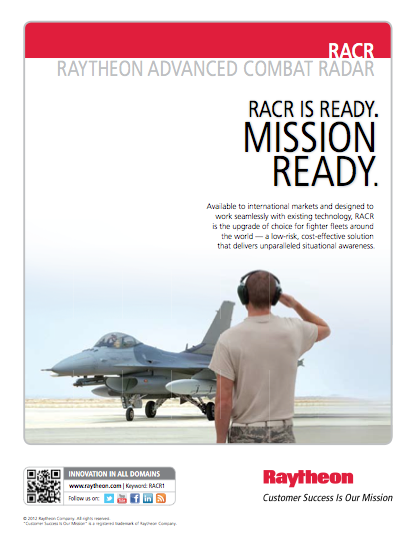
    The only provider of AESA radar systems across the Asia-Pacific, Raytheon is well-attuned to regional requirements. Singapore has equipped its F-15s with the company’s AESA, and Australia has a squadron of 24 Raytheon AESA-equipped Super Hornets. Raytheon’s Advanced Combat Radar (RACR), the latest member of the company’s family of AESA systems, is available for F-16 customers looking to incorporate the latest radar capabilities into their F-16 fleets. Approved for export and available to customers now, this new capability is generating significant interest and demand across the region.

    RACR incorporates the latest generation of proven AESA technology from the U.S. Air Force F-15E radar modernization program now in production, as well as from other U.S. Air Force and Navy AESA programs. Specifically designed to meet F-16 customer needs, RACR is cost-effective, highly reliable, and successfully flight tested on the F-16 platform.

    Compact, lightweight and sized for multiple fighter aircraft, RACR features 90 percent commonality with combat proven Raytheon AESA radars. This allows customers to benefit from the economies of scale derived from Raytheon’s multiple AESA production lines. It also enables long-term sustainability and maintainability of the system.

    Advanced and Proven Technology

    Raytheon has been an innovator in the field of AESA radars. The company was the first to design, develop and field an AESA radar system for a tactical fighter in 2000 for the United States Air Force. The first to have AESA technology tested in combat. The first to pass 250,000 AESA flight hours. The first to retrofit AESA radars onto multiple aircraft: F/A-18E/F, F-15C, and F-15E.

    Two of the advantages of Raytheon’s AESA technology are significantly increased overall radar performance and greater situational awareness; the ability to conduct simultaneous air-to-air and air-to-ground missions, more effective tracking of widely spaced targets and unique savings due to low required maintenance costs.

    RACR increases interoperability with coalition forces by delivering a common radar picture and common logistics, while enhancing the aircraft’s overall multirole mission capabilities. Its versatility bridges the capability gap that current radars will face as more sophisticated threats evolve. Raytheon is thoroughly familiar with the F-16 aircraft, its systems and capabilities. The company provides the mission computer (the heart of the jet), electronic warfare and weapon systems as well as a new col- or display, a key enabler for future sensor upgrades. Leveraging Raytheon technology and expertise, the F-16 is well equipped to handle current and future threats.

    Multirole Force Multiplier

    Raytheon continues to lead AESA innovation through strategic roadmaps designed to meet emerging requirements. For future upgrades and software maintenance, RACR customers will realize cost savings from common hardware and software used across multiple AESA product lines at the company’s advanced radar manufacturing facility. Offering proven effectiveness across three international theaters, Raytheon AESAs are available now for customers who need growth-oriented, next generation capabilities for their airborne platforms.

    Elettronica and the art of Innovation

    Elettronica at the Singapore Special review

    The Elettronica S.p.A.’s philosophy, as referred to by its founder Filippo Fratalocchi, rotates around a key word that reflects and embodies the absolute commitment towards pursuing prefixed objectives. The word is: Innovation. We can write it on a blank page, in capital letters with the attempt to gather its greatness, its feeling of accomplishment, but without achieving any results since the concept of Innovation is endless.

    The late Steve Jobs stated that “Innovation distinguishes between a leader and a follower” and with this same spirit Elettronica has been active for over 60 years, working today, thinking about tomorrow, pushing on and imagining things that would ultimately be conceived, walking on thread suspended between the present and future, ceaselessly seeking the breakthrough that will widen its horizon. The human mind that attends upon technology remains one of ELT’s basic principles, it was thus at its outset in 1951 and it is still so today.

    “In a highly competitive market niche you can’t afford to be runner up, but you must always get their first – explains the CEO Mr. Enzo Benigni – and to do so you must be at the forefront and invest in Research & Development. Neutralizing a threat implies knowing what’s happening, and transforming this know-how into a realistic undertaking.”

    Singapore Airshow Special Report from Asian Defense & Diplomacy

    Confirming Elettronica’s leadership in the EW sector are its Hi-Tec products, among which two of its last generation systems stand out, exploiting highly advanced design features: the Integrated EW System and the EW Manager. The first one, that bears the name of Virgilius, is an advanced, fully integrated Electronic Warfare airborne system also suitable for Air-to-Air and Air-to-Surface operations. It is conceived to perform emitter detection, classification, identification and to counter a large threat variety including: radar controlled Anti-Aircraft Artillery (AAA), Surface-to-Air Missiles (SAM), Air-to-Air Missiles (AAM), Early Warning, Search and modern Multifunction Radars. Virgilius is a complete break-through in the traditional approach to ESM-ECM system design drawing on all the possible advantages of the state-of-the-art technology, stressing the signal processing technique and market component availability aspects to deliver a superior integrated product.

    The second one is a key element of modern self protection suites for aircraft and helicopters and ensuring an effective management of a large number individual on-board sensors and countermeasures resources. In a dense environment it often results difficult and time consuming for the pilot to extract the right information at the right time in order to activate a prompt and effective response. The solution is the multi-sensor / multi-actuators integration provided by the Electronic Warfare Manager. All situational awareness and self-protection subsystems are linked to a single coordinating system. The crew is provided with a unique multispectral picture of the scenario ensuring a clear and improved situational awareness. The current status of the platform and all available countermeasure resources are taken into account. Besides the Controller capability the EWM features an added value integration level that will interpret data from on-board sensors exploiting correlation opportunities to obtain enhanced situation awareness and generating a more effective response and coordinated countermeasure actions.

    Elettronica has always allocated private and considerable investments in research for the purpose of developing its Hi-Tec assets, so as to achieve the utmost in-house capability; the ownership of employed technology allows a more complete, timely and unrestricted relationship with the Customer, as well as to continuously update the latter on any new product developments.

    Another key to Elettronica’s success, is constantly scouting young talents that can integrate with the great ELT family: 763 employees adhering to the same philosophy. “There is no business, strategic agreement, or achievement that can make me more proud than when I see the twinkle in the eyes of a new employee. – says Mr Benigni – A sparkle that in time will turn into a creative technological miracle at the service of a country’s defence.”

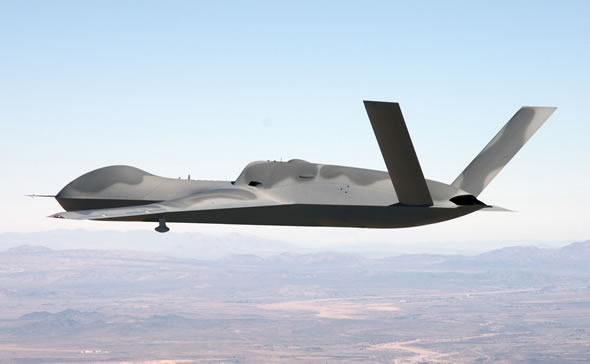
    A Second Avenger is Airborne

    The second Avenger aircraft built by General Atomics made its maiden flight January 12. The aircraft is larger and is designed to carry heavier loads in its internal bay and underwing pylons. Photo: General Atomics

    General Atomics Aeronautical Systems, Inc. (GA‑ASI) marked the first flight of a larger, heavier Avenger jet powered ‘Predator C‘ unmanned aerial vehicle. “The first flight of our second Avenger aircraft is a significant achievement as it refines the first prototype design to an operational capability,” said Frank Pace, president, Aircraft Systems Group, GA-ASI. “Avenger provides the right capabilities for the right cost at the right time and is operationally ready today. This aircraft offers unique advantages in terms of performance, cost, timescale, and adaptability that are unmatched by any other UAS in its class.”

    The first flight of the second aircraft in the Avenger fleet occurred on January 12 at the company’s Gray Butte Flight Operations Facility in Palmdale, Calif. Tail 2 met all performance objectives in its first flight. The aircraft features a longer fuselage than the first Avenger aircraft – increased by four feet to accommodate larger payloads and fuel. The aircraft is equipped with avionics based upon the battle-proven Predator B/MQ-9 Reaper.

    Avenger is designed to perform high-speed, long-endurance, multi-mission Intelligence, Surveillance, and Reconnaissance (ISR) and precision-strike missions over land or sea. Powered by a single Pratt & Whitney Canada PW545 jet, the aircraft has a 13.41 m’ (44-foot) long fuselage, a 20.11 m’ (66-foot) wingspan, is capable of flying at airspeed of over 740 km/h (400 KTAS), and has an endurance of over 16 hours. The aircraft can support a wide array of sensors and weapons loads and has been designed to carry an all-weather GA-ASI Lynx Multi-mode Radar, an Electro-optical/ Infrared (EO/IR) sensor.

    Avenger can carry up to 3,500 lb internally and its wing hard points are capable of carrying weapons ranging from the 500 lb class to the 2,000 lb class. For example, with the 2,000 lb Joint Direct Attack Munition (JDAM) the Avenger will be able to deliver an optimal balance of long loiter ISR and precision-strike capability.

    Production of a third and fourth UAS in the Avenger series is also underway, with Tail 3 expected to fly by late summer. One of these aircraft will be delivered to the U.S. Air Force for flight testing and evaluation by the U.S. Air Force. Tail 4 is expected to fly by early next year.

    Terrorist Threat Outlook in 2012

    Counter-Terror Expo 2012 website

    Counter Terror Expo 2012 delegates are set to discover how the momentous events that have occurred during the past year, will force us to reassess and realign counter terrorism strategies to meet potential new threats emerging from the turmoil we have witnessed.

    Previously hard-line autocracies across a swathe of North Africa have been toppled in popular uprisings; significant civil unrest has occurred in Middle East countries where demand for change continues to be heard loudly, political turmoil in some South Asian nations has given rise to fears a period of dangerous instability may be looming, whilst insurgency in some Sub Saharan countries has led to jihadist inspired terrorist atrocities.

    Escalating belligerence from Iran, a rapidly deepening political crisis in Pakistan, continuing instability in Tunisia, Egypt and Libya, widespread civil unrest in Syria and Yemen and extremist sponsored violence in Nigeria, all combine to set the stage for an uncertain year ahead and have the potential to directly threaten stability elsewhere in the world.

    These issues have emerged at a time of significant fiscal crisis amongst leading world economies; thus presenting a substantial challenge to industry professionals tasked with delivering effective countermeasures in constrained circumstance.

    This is the fractious backdrop against which delegates from across the globe will gather in London in late April for Counter Terror Expo 2012.

    Regional Instability
    Al Qa’ida leader Osama bin Laden is dead; the remaining leadership is being successfully targeted and the terrorist organisation continues to fragment according to reports. Hard-line leaders Zine al-Abidine Ben Ali of Tunisia and Muhammad Hosni Sayyid Mubarak of Egypt have been removed from office, whilst Muammar Muhammad Abu Minyar Gaddafi of Libya has been killed. Ali Abdullah Saleh of Yemen has been forced to cede power to Vice President Abd Rabbuh Mansur al-Had, whilst the increasingly beleaguered Bashar al-Assad of Syria may also be forced from office soon.

    Western politicians have been happy to stress that these are the positive outcomes of the past year, but somewhat less than keen to discuss the possible challenges this period of regional upheaval may present us with.

    Counter Terror Expo 2012 delegates will discover that the successful targeting of the Al Qa’ida leadership and the much welcomed regional regime change, has prompted significant concern behind the headlines as to the potential consequences stemming from a region that continues to be in flux.

    Europe has particular concern regarding continuing instability in these neighboring regions; given the events have potential consequence for security along its fragile southern and eastern borders. Europe had a taste of the impact mass migration from conflict zones can have early last year and has no desire to see this issue reemerge at a time of deepening fiscal crisis in particular.

    The geopolitical aspects of both terrorist group fragmentation and regime change form key elements of the high level Global Counter Terrorism conference.

    Over a two-day period, many world-leading experts in their respective fields, will bring clarity to the issues faced and potential solutions to them.

    The transatlantic relationship will also be a focus of the conference.
    US President Barak Obama has recently announced a slimming of US military expenditure and a shift in focus to the Pacific borders.

    Europe’s long reliance on transatlantic support could be in jeopardy as the US Administration turns its attention elsewhere at a critical moment. Obama declared that the tide of war is receding, called for a shrinking of Army and Marine forces, but identified Naval and Airborne assets as the means by which to address emerging threats from Iran and China. He outlined the shift in strategy during a rare appearance at the Pentagon and emphasised the White House desire to pivot away from domestically unpopular conflicts in an election year.

    Europe could potentially face the fallout from elongated regional conflict; when it is least able to do so, without the long reach superpower support previously given.

    Counter Terror Expo 2012 delegates will find themselves immersed in these geopolitical issues and possible regional solutions to them within the context of lead and supporting conference environments.

    Potential Trajectories
    Very many geopolitical issues task minds in the US, Europe and particular Middle Eastern states, as we prepare to gather for this year’s event.

    Iran is of particular concern since it has threatened to close the strategic Straight of Hormuz to international shipping, should currently imposed sanctions limit or cut off its oil exports. This is the only passage to open ocean for a large proportion of oil exporting nations in the region. Iran’s continuing belligerence is at the top of the agenda, since some 35 percent of the world’s seaborne oil shipments and 20 percent of all oil traded worldwide passed through the Straight of Hormuz last year. The impact wrought from even a temporary closure of this strategic sea passage could be catastrophic given the economic woes faced by many nations.

    Yemen is also of concern to the international community given political instability has enabled Al Qa’ida in the Arabian Peninsula (AQAP) to gain a foothold from which to launch terrorist attacks against targets elsewhere. AQAP has been behind the attempted assassination of the Saudi Deputy Interior Minister, the failed suicide bombing of Northwest Airlines flight 253 and the very nearly successful plot to ship live and deadly explosive devices to targets in the US by air. Counter Terror Expo 2012 delegates will discover that AQAP remains a dangerous foe despite the fragmentation of its parent organisation.

    North Africa: Regime change amongst several of the North African nations had been warmly welcomed, but the positive spin regarding their future political stability, is giving way to cautious optimism that all will be well. A particular concern is the potential for current instability to be exploited by militants including Al Qa’ida in the Islamic Maghreb (AQIM).

    Central Africa: Pentagon officials have warned that links may be growing between AQIM and the fundamentalist Boko Haram in Nigeria. This group has been behind widespread terrorist activity across the country including the Christmas Day bombing of multiple churches. The rise of Boko Harem is understood to be a particular concern in the UK, with intelligence services said to be keeping a close watch for any connections within the large Nigerian community here.

    Domestic Agenda
    Counter Terror Expo 2012 not only focuses on the global threat from terrorism, but also examines the regional and domestic aspects as well. UK officials are gearing up to mount the biggest security operation since the Second World War during the forthcoming Olympic Games. A massive private security operation will be further bolstered by the deployment of over 13000 military personnel, naval and air assets as well as surface to air missile batteries.

    Major events such as the Olympic Games are classed as trophy targets and every measure is therefore being taken to protect the principal venues, as delegates to the Protecting Crowded Places conference will discover.

    This specialist two-day conference will give considerable insight into UK counter terrorism strategies specific to the forthcoming Olympic Games.

    Cyber Security
    Counter Terror Expo 2012 will also address the issues of Cyber Security and Electronic Terrorism in a dedicated conference.

    Increasing global interconnectivity brings huge benefits to the way we live and work, but conversely delivers with it many challenges that we must still overcome.

    This digital phenomenon has become a playground for state actors, terrorists, criminals and hacktivists, bent on infiltrating computer networks and individual computer systems to steal information and disrupt operations.

    UK officials say they are fighting a constant arms race in cyberspace and the government is investing heavily in protective measures.

    The conference examines the magnitude of the threat and outlines how government agencies and corporate entities are putting in place effective counter-measures to appropriately protect restricted information, intellectual property and customer data.

    The digital world is said to be the new frontier in the constant battle against those who wish to inflict harm for ideological, commercial or monetary gain and requires robust defences.

    Counter Terror Expo 2012  will be held 25-26 April 2012 at London Olympia.
    The event has brought clarity to the issues professionals in this demanding field face since its inception. The forthcoming event will once again deliver a secure setting in which to distil the key issues, identify the challenges and formulate solutions, within its range of high level conferences and specialist workshop environments. The event is supported by a world-class exhibition of software and hardware presented by global leaders in their respective fields.

    Defense-Update is proud to be a sponsor of this year’s event.

    Singapore Airshow – Event Highlights

    Positioned as the leading aerospace event in the booming Asian aerospace and defense market, the Singapore Airshow 2012 opening for business 14-19 February, is expected to be 25% larger than the 2010 event, covering some 50,000 square meters of exhibition space at the Changi Exhibition Centre. Singapore’s leading defencse manufacturer Singapore Technologies (ST) Engineering is the biggest exhibitor at the show, spanned over 3,000 square meters of space.

    The show covers commercial, business and military aviation and defense systems. The Land Defense Pavilion at Singapore Airshow and Unmanned Systems Showcase, which will include indoor and outdoor demonstrations and displays.

    The following list outlines some of the planned participants in the static display Singapore Airshow 2012.

    Performers in the daily flying displays will include The Republic of Singapore Air Force F-16C and F-15SG appearing together for the first time in an aerial display. The Australian Roulettes aerobatic team flying RAAF P-9C, the Malaysian Smokey Bandits aerobatic performers flying RMAF MiG-29, and the Australian Blair Aerosports Rebel 300. The Boeing C-17 is also expected to perform solo aerobatics with a B-52 expected to flyby during the air display.

    Static Aircraft Display

    • Airbus ACJ318
    • Airbus Military A-330 MRTT
    • Alenia Aermacchi T346B
    • Beriev Be-200
    • Blair Aerosports Rebel 300
    • Boeing AH-6i
    • Boeing AH-64 APACHE (RSAF)
    • Boeing C-17 (USAF)
    • Boeing E-3B Sentry (AWACS)
    • Boeing KC-135 (USAF)
    • Bombardier Challenger 300
    • Bombardier CRJ 900
    • Bombardier Global Express XRS
    • Bombardier Q400
    • Cessna Citation Sovereign
    • Cessna Citation XLS+
    • Cessna Grand Caravan
    • Dassault Falcon 7X
    • Dassault Falcon 2000LX
    • Elbit Systems Hermes 450 (RSAF)
    • Elbit Systems Hermes 900
    • Embraer E-190
    • Embraer Legacy 500
    • Embraer Legacy 650
    • Embraer Lineage 1000
    • Embraer Phenom 100
    • Embraer Phenom 300
    • Eurocopter EC-135
    • Eurocopter EC-145
    • Eurocopter AS 350B
    • Gulfstream 150
    • Gulfstream 450
    • Gulfstream 550 AEW (RSAF)
    • Hawker Beechcraft Hawker 900 XP
    • Hawker Beechcraft Hawker 4000
    • Hawker Beechcraft Beech Kingair 350
    • IAI Heron I (RSAF)
    • Lockheed martin C-130J (RAAF)
    • Lockheed Martin F-35 JSF
    • Lockheed Martin F-15SG (RSAF)
    • Lockheed Martin F-16D+ (RSAF)
    • Lockheed Martin P-3C (US Navy)
    • MiG-29N (RMAF)
    • Piaggio Aero P180 AVANTI II
    • RUAG Dornier 228NG
    • Pilatus PC-9 (RAAF Roulettes)
    • UAC MiG-29 (RMAF Smokey Bandits)
    • Sikorsky S-70B (RSAF)
    • Sikorsky S-92
    • Viking Air Twin Otter 400

    International Conference on Unmanned Systems – AUVSI Israel 2012

    Israel has pioneered the field of unmanned aerial vehicles since the mid 1970s. The country’s aerospace industries have maintained their world leading position for four decades, developing a broad range of systems, platforms, mission payloads, subsystems and services centered around unmanned systems applications.

    The International Conference on Unmanned Systems, taking place at the David Intercontinental Hotel in Tel Aviv, 20-22 March is promising to be a groundbreaking event in this field, endorsed by the countries’ most prominent academic, research and development centers, and defense companies.

    Organized by AUVSI’s Israel chapter the event will be an exceptional opportunity for reviewing, assessing and discussing the current state of unmanned systems in Israel, and provide a unique insight to the development and future directions of Israel’s unmanned systems technologies development and operational utilization.

    Among the prominent speakers presenting at the conference are senior officers from the Israel Ministry of Defense Department ofdefense research and Development (DDR&D), including Brigadier General Ofir Shoham, Head of DDR&D and Colonel (ret) Dubi Lavi, Director UAV-PEO in the Israel MOD DDR&D;

    International guest speakers include Mr. Chuck Thorpe, Assistant Director for Advanced Manufacturing and Robotics, The White House Office of Science and Technology Policy, USA.
Major Mark Whittel, 2IC 32 Regt RA, United Kingdom.
 Dr. Ron Diftler, Robonaut Project Manager, Robotics Systems Technology Branch – NASA, USA.
Prof. Johann Borenstein, The University of Michigan, USA.

    The sessions will focus on the following topics:
    Unmanned Ground Vehicles, Unmanned Airborne Systems, Unmanned Marine Surface Vehicles, Autonomous Underwater Vehicles, UAS Regulation & Certification, Unmanned Vehicle Systems, UVS Sub-Systems, Propulsion, Operational Missions, UVS Civil Applications, Homeland Security, Simulation & Training, European R&D Project: PPLANE, Unmanned Hovering Platforms, Operational Lessons Learned, Unmanned Airborne Systems – Design Considerations, Human Machine Interface. At the adjacent exhibition 30 Israeli companies are expected to show, demonstrate and discuss Unmanned Vehicles and related technologies. The organizers have also dedicated a day for a tour of some of Israel’s leading UVS industries.

    Reserve your place at the conference now. You can use this link to apply.

    US Navy Revisiting Feasibility Of A Sub-Launched Global Strike Weapon

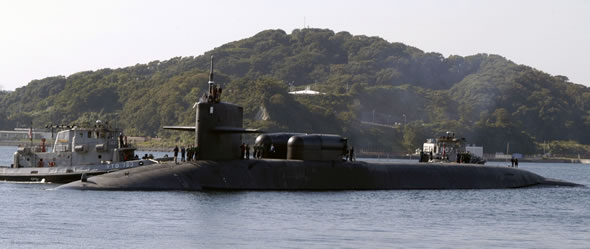
    USS Ohio SSGN 726
    USS Ohio (SSGN 726) arrived in Yokosuka, Japan, Oct. 16 for a scheduled port visit. (U.S. Navy Photo). Back in the mid 2000s the U.S. Navy converted four nuclear missile submarines (SSBN) into guided-missile submarines (SSGN). The converted submarines carry up to 154 Tomahawk or Tactical Tomahawk land-attack cruise missiles. The missiles are loaded in seven-shot Multiple-All-Up-Round Canisters (MACs) in up to 22 missile tubes. These missile tubes can also accommodate additional stowage canisters for Special Operations Forces (SOF) equipment, food, and other consumables, extending the amount of forward-deployed time for on board SOF forces. The missile tubes also promise additional capability to host future payloads such as new types of missiles, unmanned aerial vehicles, and unmanned undersea vehicles. Each submarine has the capacity to host up to 66 SOF personnel at a time. Additional berthing was installed in the missile compartment to accommodate the added personnel and other measures have been taken to extend the amount of time that the SOF forces can spend deployed aboard the SSGNs. The two forward most missile tubes were permanently converted to lock-out chambers that allow clandestine insertion and retrieval of SOF personnel. Each lock-out chamber can also accommodate a Dry Deck Shelter (DDS), enhancing the SSGNs' SOF capabilities.

    With proposed defense budget reductions creating a need to reshape American military forces, the US Department of Defense is once again looking into the possibility of developing a sub-launched “Prompt Global Strike” (PGS) weapon as a means of reinforcing America’s power projection capability.

    Secretary of Defense Leon Panetta announced during a press conference on January 26 that the administration’s proposed Fiscal Year 2013 budget request of $525 billion includes funding for the US Navy to renew efforts to develop a non-nuclear, sub-launched missile capable of striking a target anywhere in the world within an hour of launch. The only weapons presently available in the inventory capable of hitting global targets so quickly are nuclear Intercontinental Ballistic Missiles (ICBMs). ICBMs are subject to severe restrictions regulating their numbers, deployment, warhead capacity, and range by multiple international treaties.

    USS Ohio SSGN 726
    USS Ohio (SSGN 726) arrived in Yokosuka, Japan, Oct. 16 for a scheduled port visit. (U.S. Navy Photo). Back in the mid 2000s the U.S. Navy converted four nuclear missile submarines (SSBN) into guided-missile submarines (SSGN) providing conventional strike and improving the Navy's clandestine operational support capabilities.

    Back in 2000, the US Navy attempted to adapt the D-5 Trident missile for use as a Prompt Global Strike weapon, but met with strong opposition from members of the Senate Armed Services Committee. Committee members, and other legislators, expressed their concern that the launch of a modified non-nuclear Trident would be mistaken for a nuclear strike and could potentially spark a nuclear retaliatory strike from Russia.

    During the January 26 press conference, Chairman of the Joint Chiefs of Staff General Martin Dempsey assured the audience that advances in missile technology now made it possible for a purpose-built PGS weapon to be sufficiently recognizable so it would not be mistaken for a nuclear strike. He indicated that Navy engineers now had the technology to develop a missile with a distinctive trajectory and trademark speed that would preclude the possibility of mistaken identity.

    The Department of Defense’s renewed interest in development of a sub-launched PGS is tacit recognition that advanced conventional weapons are needed to meet the security demands of the new century to maintain US military superiority. Such weapons are sparking increased interest as fiscal reality forces a reduction in American forces and weaponry.

    Defense sources have long lobbied for deployment of a non-nuclear PGS weapon, arguing that such a weapon would be invaluable for taking out high-profile targets like Osama Bin Laden quickly and with minimal risk to combat forces. Such a weapon would also serve to bolster the Defense Department’s missile defense shield and would add a much needed warfighting capability ideally suited for service with a smaller, more flexible US military force.

    In his address, Mr. Panetta did not provide any specifics regarding the ships expected to carry a PGS weapon. It is not yet known if the Navy plans to deploy the PGS missiles aboard the older Ohio-class subs or the newer Virginia-class submarines or both.

    Poland Requests Enhanced Weapons for its F-16 Falcons

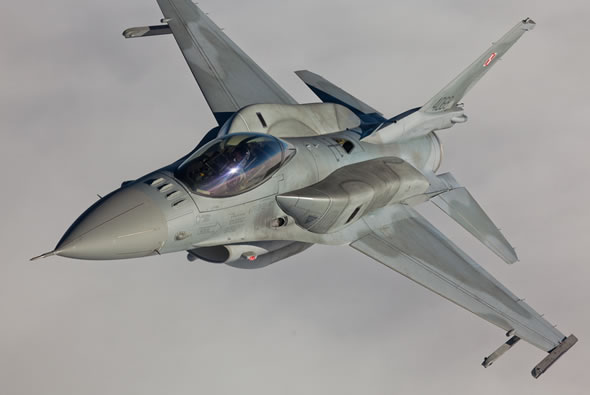
    Enhanced weapons for Poland's F-16s Photo: Mariusz Adamski

    Poland is shopping for upgraded weapons for its F-16 Block 50/52 Falcons, the Defense Security Cooperation Agency told the U.S. Congress Feb. 2. The request for a Foreign Military Sale (FMS) is worth US$447 million will support the 48 F-16 aircraft supplied to Poland in 2006. These aircraft were delivered under the ‘Peace Sky’ program equipped with AIM-120C Advanced Medium Range Air-to-Air Missiles (AMRAAM) and a balanced mix of short range missiles, including AIM-9M and early generation AIM-9X Sidewinder missiles. Warsaw now requests to add newer versions, namely 93 of the latest model  AIM-9X-2 Sidewinder Block II short range missiles and 65 AIM-120C-7 AMRAAM, both produced by Raytheon.

    For air/ground missions the Polish Falcons will receive 242 guidance kits including 42 GBU-49 Enhanced Paveway II 500 lb Bombs (GPS augmented laser guided bombs) and 200 GBU-54 (2000 lb) Laser Joint Direct Attack Munitions (JDAM) Bombs. The Air Force will receive 849 general purpose bombs (which also provide the warhead section for the guided weapons), including 642 BLU-111 (500 lb), 127 MK-82 (500 lb), 80 BLU-117 (2000 lb). Poland already operate the Paveway II/III laser guided bombs (GBU-22/24/16/10) and GPS guided AGM-154 JSOW, but has not fielded modern dual-guidance munitions yet. The new acquisition will expand their operational flexibility in operating against moving targets and in as well as in overcoming weather limitations.

    A Joint Mission Planning System and 12 Autonomous Air Combat Maneuvering Instrumentation (ACMI) P5 pods will enhance the Air Forces’ training capability. The Polish request also spare parts shopping list including nine F-100-PW-229 Engine Core Modules, 28 Night Vision Devices in addition to five years support and sustainment services for Poland’s F-16 fleet.

    Photo: Mariusz Adamski

    New X-Drone to Test Advanced Wing Design for Future HALE UAS

    X-56A is based on the MUTT design. Photo: AFRL Concept
    X-56A is based on the MUTT design. Photo: AFRL Concept

    A new X-Plane designed and developed by Lockheed Martin Skunk Works is expected to fly this year at the Edwards Air Force Base in the California Mojave desert, becoming a key test asset for the Air Force Research Laboratory (AFRL)-led Multi-utility Aeroelastic Demonstration Program (MAD). These tests will contribute to AFRL’s follow-on work to SensorCraft, a class of High Altitude Long Endurance (HALE) vehicles intended for surveillance as well as telecommunication relay and environmental sensing.

    On its AFRL lead mission the 28-ft.-span vehicle will test active flutter suppression and gust load alleviation. Following that phase the X-56A will be transferred to NASA, to support NASA Dryden Flight Research Center, to assist the research of lightweight structures and advanced technology for future low-emissions transport aircraft. Active flutter suppression and gust load alleviation considered vital for the successful development of the slender, lightweight, high-aspect-ratio wings that could be used by future transports as well as intelligence, surveillance and reconnaissance UAVs.

    Designed as a cranked delta planform the X-56A bears similarity to former jet-powered Lockheed Martin UAV programs such as the P-175 Polecat, RQ-170 and DarkStar. It will be powered by twin JetCat P240 turbojets, and be configured for easy wing replacement. According to Guy Norris of Aviation Week, The flight-test package will include two identical center bodies measuring 7.5 ft. long, as well as four sets of constant-chord wings. One set will be stiff for baseline flight tests, as well as follow-on research, while the remaining three will be identical flexible wings made with lighter skin material for flutter testing.

    The X-56A will test to the edge of the flight envelope where flutter occurs. Flutter is the potentially catastrophic dynamic coupling that can occur between the elastic motion of the wing and the aerodynamic loads acting on it. If a test goes too far and a wing fails in flight, the X-56A is fitted with a fuselage-mounted ballistic parachute recovery system.

    What motivated AFRL and NASA to join forces to develop the X-56A was similar interest in pursuing configurations for future aircraft. AFRL MAD Program Manager Pete Flick says the SensorCraft studies explains, “this led us to very different configurations that are inherently more flexible with high-aspect-ratio wings. Gust-load alleviation and flutter suppression are two key technologies we needed to pursue, and there was no testbed out there where we could test active flutter suppression without a lot of risk. So we went out to develop a vehicle specifically for that purpose.” Derived from the ‘Multi-Use Technology Testbed’ (MUTT) design, the X-56A is in final assembly at GFMI Aerospace and Defense, a Fountain Valley, Calif.-based engineering company specializing in prototype and mockup development. The aircraft is due to be delivered to Lockheed Martin in late April and will be transported to Edwards AFB in June. Flights with the 452nd Flight Test Squadron, part of the 412th Test Wing, will begin at the North Base in July and continue through September. Following an approximately 25-hr.-long flight test effort, the X-56A is expected to transfer to NASA by year’s end.

    This news item was also reported by Brad Lucht on the Defense-Update Linkedin group.

    Israels’ Intelligence Chief: ‘Iran Can Obtain Nuclear Weapons Within a Year’

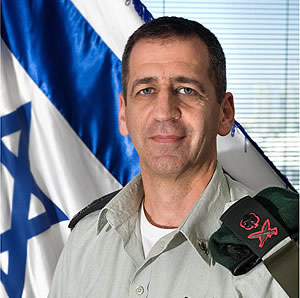
    Maj. general Aviv Kochavi
    Maj. General Aviv Kochavi, Director, Israel's Military Intelligence. Photo: IDF
    Maj. general Aviv Kochavi
    Maj. General Aviv Kochavi, Director, Israel's Military Intelligence. Photo: IDF

    “Iran has enough nuclear material for four bombs,” the Director of Military Intelligence Major General Aviv Kochavi warned Thursday in a rare appearance at the 2012 Herzliya Conference, where he reviewed regional changes, the effects of the ‘Arab Spring’, the Iranian threat and their effect on Israel’s security. “Vigorously pursuing its nuclear capabilities, Iran is estimated to have over four tons of enriched materials and nearly 100Kg of 20% enriched uranium – sufficient fissile material for four bombs,” he added.


    According to General Kochavi, Iran’s motivation stems from three reasons. The first is maintaining regional Shi’ite hegemony over a Sunni Arab Middle East, primarily in the oil rich Gulf region. The second motivation is maintaining and increasing deterrence against hostile attack. The third – Iran’s desire to be a key regional player, as the United States is leaving a strategic void, after withdrawing its troops from Iraq and Afghanistan. While Iran still maintains that its nuclear program is for civilian, peaceful purposes, Kochavi said “We have conclusive evidence that they are definitely committed on acquiring nuclear weapons capability.
    According to the Israeli MI chief, the final decision whether to pursue nuclear weapons has little to do with technical capabilities and much to do with one man’s decision: “When Seyed Ali Hoseyni Khāmene’i, Iran’s supreme leader gives the “green light” ordering production of the first nuclear weapon – it will be done. Israel’s Military Intelligence estimates that will happen in about one year.

    Iran, he added, has to deal with various pressures: The international spotlight on its every action, the crippling international sanctions, the deteriorating relations with Bashar Assad’s plight in the Syrian uprising and Iran’s own internal problems, which could increase substantially as the Arab revolt continues, nearing their immediate strategic sphere. “These pressures have yet to result in a change in Iranian strategy, but if they intensify they might lead to change, because the most important thing to them is the regime’s sustainability.” The military intelligence chief added that the sanctions on Iran “are taking their toll. There’s 16% unemployment, 24% annual inflation, and practically no growth,” he said adding “at this point the pressure isn’t leading Iran to a strategic shift.”

    The ‘Middle East rediscovering its voice’

    Iran is not the only threat uprising in the region: “Israel’s enemies possess more rockets than ever before,” Kochavi said. Israel’s intelligence estimates the country is under threat of 200,000 rockets and missiles of all calibers, from the smallest Qasams to the largest Shihabs. Many such weapons are now capable of hitting every part of Israel, which can be especially significant when strategic installations, such as airbases, port facilities and vital economic areas could be targeted, With missiles’ warheads becoming more accurate and effective, these threats may turn out to be more lethal. The array is sporadic – hidden in urban areas and more difficult to pinpoint, or shot at without risking causing severe collateral damage. The quantity of these missiles and rockets has become a strategic dimension in itself, which the Israel Defense Forces must deal without delay. “We’re also witnessing the disappearance of the enemy off the classic battlefield. The battlefield is now in urban terrain, which harbors large quantities of modern weapons. That forces intelligence gathering to change as well,” he said.
    “The Middle East is rediscovering its voice and translating it into political power,” Kochavi added. “There is a new component in the Middle East, one the leaders and the political parties have realized that they have to pay attention to – the public. This public has discovered that it can overthrow regimes and shape the public agenda.

    “This public demands its basic right… The young Arab person today is educated, exposed to what’s going on in the world and in the West through TV and the Internet. The contrast between that and what they experience is very sharp, creating growing frustration. The public is growing stronger and it’s encouraged by the power of social media,” he said.

    “The main asset possessed by the Arab regimes – fear – is dissipating. The public dares to dare, while the regimes’ power is dwindling. The public in the Middle East has become a pivotal factor in the regimes’ decision-making process. “This change has led to various things, first and foremost the rise of Islam in Tunisia, Morocco and Egypt, which, being the largest Arab nation in the region- also its key leader having most influence on its neighbor Sunni nations. But that was not the driving force behind the uprising. The Islamists recognized the wave (of unrest) and translated their vast infrastructure into political power. The upset in balance was devoid of two things – leadership and clear ideology. The Islamic organizations entered that void with their clear ideology. That move was natural. “Egypt will continue to have a significant role in the shaping of the new Middle East and whatever model it chooses is likely to have significant impact on the rest of the Middle East.”

    ‘Mid-East undergoing Islamization’

    The Middle East, he continued, “is clearly undergoing a process of Islamization and religious argumentation may find its way into the Israeli-Palestinian conflict at the expense of a national one. We’re also seeing an old-new altercation in the Middle East, of the tribal ethos.” These changes are not limited to the arena of the public versus the regime. “We can also see them between nations: There’s tension between three countries – Iran, Saudi Arabia and Turkey. They each aspire for regional hegemony: Saudi Arabia aspire to have things remain as they are in the Gulf; Iran, for years, has been pursuing an agenda meant to increase its global influence and its influence over the Gulf; and Turkey, that refuses to give up any of its influence in the region, given Europe’s cold shoulder.” Kochavi continued.

    He added that Iran is watchful of the political changes in the region, which it sees as an opportunity to infuse the Middle East with Iranian funds and arms – actions that have the Saudi’s view Tehran as a political and military threat.

    Turkey, meanwhile, offers democracy-infused Islam – nationalistic passion combined with a link to the West. But Turkey and Iran – though they have bilateral ties – are at odds: Turkey has taken several steps that are in contrast to Iranian interests, Kochavi said.
    The regional changes, he continued, also spell a decrease in the power of the radical axis, “Iran-Syria-Lebanon-Hezbollah on the one hand, and Iran-Hamas-Islamic Jihad in Gaza, on the other hand… The difficulties are compounded by shrinking economy, which is that all of these countries have in common. That will be their test in the next few years.”

    Still, according to M.I. Chief, Israel’s deterrence remains intact: “We’re preserving deterrence but we are now facing a more hostile Middle East. This Middle East will be permanently unstable, which means we have to be ready for all kinds of twists and turns.”
    He added that the Military Intelligence is constantly reviewing how it can modify its practices to comply with the new reality. “We’re establishing ourselves as an operational branch, not just a supportive one… If the veil of secrecy could be lifted from over all the thousands of soldiers involved in intelligence work, I assure you, the Israeli people would be very proud,” he concluded.

    The remarks by Military Intelligence Chief Major General Aviv Kochavi came after IDF Chief of Staff Lt. Gen. Benny Gantz said on Wednesday that the threats facing Israel have increased and intensified in recent years due to regional instability.

    Speaking to the Herzliya Conference, General Gantz said that Iran’s nuclear program is a “global problem and a regional problem,” adding that Tehran’s attempts to acquire nuclear weapons must continue to be disrupted. General Gantz said that the Gulf States are just as concerned about Iran’s nuclear program as Israel is. He added, however, that “we must not forget one basic thing: Israel is the only country in the world which someone is calling for its destruction and which someone is building the tools to do so. This is something that cannot be ignored.”

    On other threats facing Israel, General Gantz said: “Gaza and Lebanon are some of the largest munitions depots I know. These [weapons] enter from Iran and Syria, unfortunately even Russia continues to send arms to this day, where in Syria it is not clear who will control and operate them later. The Middle East is the most extensively armed region in the world, and the bad news is that we are the target of these arms. We must always keep this in mind.”

    Defense Minister Ehud Barak added that Israel’s challenge is to continue aiding the international community to work toward halting Iran’s nuclear program, “without taking any option off the table.”

    BAE Systems, GD-OTS Join Forces to Develop 81mm Guided Mortar Bombs

    British Army 81mm mortar team. The RCGM guided bomb will introduce precision guided weapons at the infantry platoons level.

    BAE Systems and General Dynamics Ordnance and Tactical Systems have teamed to develop, demonstrate, and produce the 81mm Roll Controlled Guided Mortar (RCGM), an affordable 81mm precision mortar round. The companies have been maturing the guided mortar technology over the last 12 months and will be conducting tactical demonstrations early in 2012. In October 2011 GD-OTS and ATK announced a teaming offering a similar, 120mm guided mortar bomb for the U.S. Marine Corps’ Expeditionary Fire Support System (EFSS).


    British Army 81mm mortar team. The RCGM guided bomb will introduce precision guided weapons at the infantry platoons level.

    The teaming arrangement between with BAE Systems will also reach beyond the US services, targeting the UK and other foreign military. The 81mm RCGM uses the current UK L41 round and US M734A1 fuze, but incorporates GPS guidance and General Dynamics’ patented Roll Controlled Fixed Canard (RCFC) technology to provide a precision strike capability.“By using existing warheads and fuzing with our low-cost control and guidance system, we can offer a truly affordable precision mortar round to the US, UK and allies across the world.” Michael Wilson, President of General Dynamics Ordnance and Tactical Systems said.

    The new mortar launched guided munition will provide the infantry for the first time, a low-cost indirect precision attack system into the hands of the front-line soldier, dramatically increasing his combat effectiveness. According to Ian Anderton, managing director of BAE Systems’ Munitions business, “The system’s increased accuracy will help bring effective fire on target quicker and the reduced number of rounds required for a typical mission will mean an approximate 30 percent reduction in logistics demands”

    Skunk Works and XTEND Simplify Multi-Drone Command

    0
    Lockheed Martin Skunk Works® and XTEND have achieved a major milestone in JADC2 by integrating the XOS operating system with the MDCX™ autonomy platform. This technical breakthrough enables a single operator to simultaneously command multiple drone classes, eliminating the friction of mission handoffs. From "marsupial" drone deployments to operating in GPS-denied environments, explore how this collaboration is abbreviating the data-to-decision timeline and redefining autonomous mission execution.

    From Ukraine to Taiwan: The Global Race to Dominate the New Defense Tech Frontier

    0
    As traditional defense primes face mounting competition from agile “neoprimes” such as Anduril, Palantir and Helsing, the balance of innovation is shifting toward software-defined warfare and scalable, dual-use technologies, while global industry consolidation—marked by Boeing’s integration of Spirit AeroSystems and other strategic mergers—signals an intensified race to secure control over the defense technology value chain. Our Defense-Tech weekly report highlights these trends.

    Europe’s “Drone Wall”

    0
    In early October 2025, a coordinated wave of unmanned aerial system (UAS) incursions—widely attributed to Russia—targeted critical infrastructure across at least ten European nations. The unprecedented campaign exposed the fragility of Europe’s air defenses...

    Weekly Defense Update & Global Security Assessment

    0
    Executive Summary The past week (September 18-25, 2025) represents an inflection point where strategic defense concepts have transitioned from doctrine to tangible reality. An analysis of global events reveals four primary, interconnected trends shaping an...

    U.S. Air and Space Forces Push Next-Gen Programs at the AS&C 2025 Conference and...

    0
    At the 2025 Air, Space & Cyber Conference, U.S. Air Force and Space Force leaders unveiled major updates on next-generation fighters, bombers, unmanned systems, and space initiatives, highlighting both rapid innovation and critical readiness challenges as the services race to outpace global competitors. A short version is available here, with a more detailed version for subscribers.

    TADTE 2025: Reflecting Taiwan’s Strategic Themes

    0
    The Taipei Aerospace & Defense Technology Exhibition (TADTE) 2025 crystallized around four dominant strategic themes that collectively illustrate Taiwan's comprehensive approach to defense modernization amid escalating regional tensions. Based on a detailed report by Pleronix (available upon request). Includes a Podcast discussion on TADTE 2025's highlighting Taiwan's four strategic themes beyond the post's coverage.

    Iron Beam 450 Completes Testing, Soon to Join With Operational Air Defense Units

    0
    Israel’s Iron Beam 450 high-power laser system has completed final testing, marking a major leap in air defense. Developed by Rafael, it offers precise, cost-effective interception of rockets, UAVs, and mortars, and is set for IDF deployment by 2025.