Bowing under economical burden the german Government plans deep cuts in defense spending, dramatically reducing planned procurement of main weapon systems and platforms. Overall the personnel level in military services will be reduced from 185,000 to 65,000, to include only professional service members. Among the hardest hit industry group will be EADS, with its Eurofighter Typhoon, NH90, Tiger helicopters and Euro Hawk drones affected, all programs are managed by EADS subsidiaries. (Defense-Update)
Boeing’s New Electronic & Mission Systems (E&MS) Division to focusing on ISR
October 15, 2011: The Boeing Company has restructured its Command, Control, Communications, Computers, Intelligence, Surveillance and Reconnaissance (C4ISR) activities under the new Electronic & Mission Systems (E&MS) division, to control the Network and Space Systems business unit along with Argon ST, Digital Receiver Technology (DRT) and Boeing’s tactical intelligence, surveillance and reconnaissance (ISR) programs. The manager of the new division is Terry Collins, who previously served as vice president and general manager of Argon ST. The new division’s portfolio will include Ship’s Signal Exploitation Equipment (SSEE) Increment F systems, serving the U.S. Navy; the Enhanced Medium Altitude Reconnaissance Surveillance System (EMARSS), serving the U.S. Army; and many of Argon’s legacy Navy and Marine Corps programs.
Russia Grants Venezuela US$4 Billion Line of Credit for Arms Purchases
October 7, 2011: Russia has granted Venezuela a new US$4-billion line of credit for military and technical cooperation, Venezuela’s president Hugo Chavez announced.
Ian Godden, Chairman A|D|S
A|D|S chief: “the U.K. is heading in the wrong direction on Defense
October 7, 2011: The U.K. defence industry could be expecting further job losses following the government’s historic and recent cutbacks in defense spending. Further layoffs of 20,000 – 30,000 skilled employees are at risk across the defense industry, jeopardizing the ability of the British industry to recoup and sustain its market leading position, according to Ian Godden, Chairman A|D|S
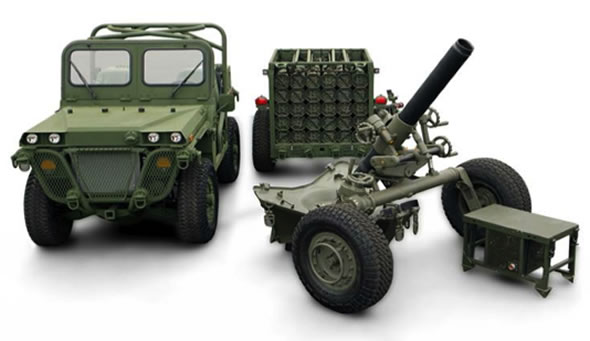
Marine Corps EFSS - Photo: U.S. Marine Corps.
ATK-GD OTS Team to Deliver the marines with Precision Mortar Bombs
October 4, 2011: ATK and General Dynamics Ordnance and Tactical Systems are teaming to offer a full-up solution for the U.S. Marine Corps’ requirements for the rifled, 120mm Precision Extended Range Mortar (PERM). The new guided munition will provide the Corps’ Expeditionary Fire Support System (EFSS) towed-mortar the option to engage point targets from ranges of 16 – 20km. ATK will be the prime contractor to the USMC for the PERM Engineering and Manufacturing Development (EMD) program, providing the guidance fuze technology, to be combined with the propulsion and warhead subsystems delivered by General Dynamics. ATK is already providing a similar solution for the U.S. Army 120mm mortars. (Defense-Update)
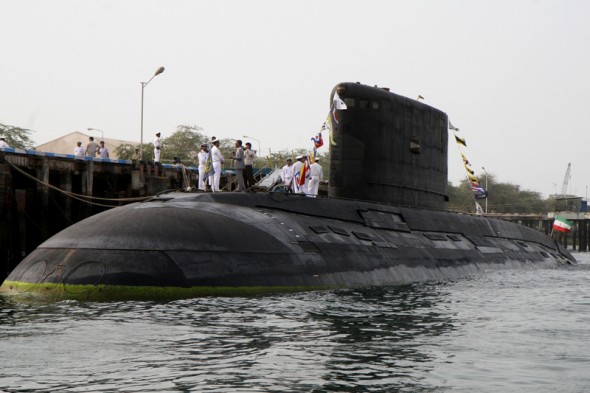
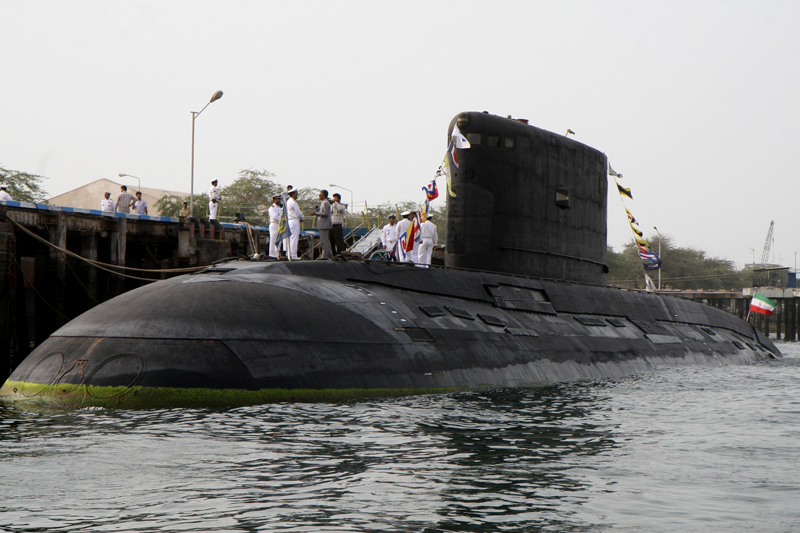
The first of three Kilo class submarine bought from Russia, I2,300 ton Younes returned from its first operational mission in July 2011.
Korean Daewoo Expects to win a US$1.1 billion Indonesian Submarine Contract
October 10, 2011: Korea’s Daewoo Shipbuilding and Marine Engineering expects to sign its first submarine export contract with Indonesia next month to build new submarines. The contract worth about US$1.1 billion will include three 1,400 ton Daewoo designed submarines destined for the Indonesian Navy. Indonesia has been evaluating competing bids from France, Russia, and Germany, offering subs built in Turkey. Korea and France were selected as preferred bidders in June.
Decision Time for M-MRCA
October 7, 2011: India’s Defence Acquisition Council headed by Defense Minister AK Antony have met today to set the terms critical for the decision concerning the fighter plane that will serve the Indian Air Force for the next decades. At this meeting the DAC decided the final commercial and offset guidelines to be implemented with this exceptionally large program. According to Indian offset requirements the winning firm will have to reinvest more than US$5 billion in India, either alone or in partnership with an Indian company, in military, homeland security and civil aviation. Once decisions are made, the offers placed by the two companies will be opened on monday. Formal decision is not expected immediately, as the determination of ‘lowest bidder’ is expected to be a complex process taking several weeks. For the US$10.4 billion buy of 126 advanced fighters India have to opt between the Eurofighter Typhoon and Dassault Rafale, the the two European contenders which were also the most expensive offerers, remained last in the game. They have beaten Lockheed Martin and Boeing, the world’s biggest defense industries and the Indian long-time arms supplier MiG. Saab, which may have placed the lowest cost bid, was also beaten. The IAF wants plans to induct of the new fighter by 2015, in time for the beginning of retirement of its MiG-29s.
India to test 5,000 km Agni-5 IRBM by December
India’s Defense Research & Development organization (DRDO) is planning to test fly the Agni-5 ballistic missile for its full range in December 2011. The missile will be launched from Wheeler Island, on the Orissa coast, traveling its full range of 5,000 km southward, halfway to Antarctica. The 17.5 m’ high Agni-5 weighs about 50 tons. The DRDO predicts that if all goes well, the can strike within a few hundred meters of the designated target. This high level of precision enables the Agni-5 to carry relatively small nuclear weapon while maintaining an effective deterrence high priority targets deep inside hostile territory. (Business Standard)
The first of three Kilo class submarine bought from Russia is 2,300 ton Younes.
The Iranian Navy to get a new ‘Compact’ Submarine Next Year
October 6, 2011: The Iranian Navy is soon to field a new ‘compact’ submarine with a displacement of 600 tonns. The new submarine will be armed with locally produced torpedoes and mines. The lead submarine in this family called ‘Fateh’ will soon be delivered to the Iranian Navy and is expected to formally join the fleet next year. According to Iran’s FARS news agency, the fateh can dive to a depth of 200 meters and operate on a mission extending about five weeks. Iran currently operates three Russian made Kilo submarines and 11 locally built Ghadir-class 120 ton midget submarines operating short range missions from the port of Bandar Abbas. Iran has been steadily developing its sub-surface capabilities in recent years. In July 2011 the 2,300 ton submarine ‘Younes’, the first of three Kilo class submarine bought from Russia, returned from its first operational mission. Covering 3,800 km in 68 days, Younes operated at the Red Sea and the Gulf of Aden, along with a number of surface vessels operating with the Iranian 14th fleet.
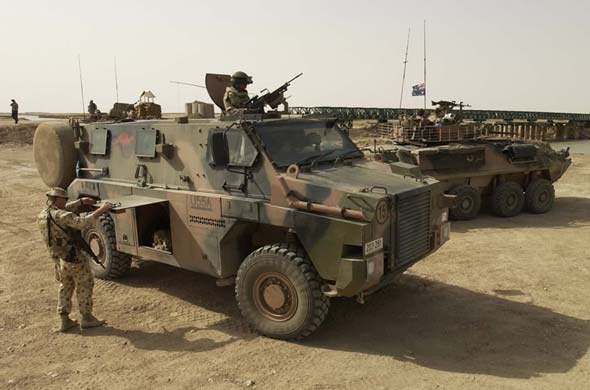
Bushmaster armored, mine protected vehicle
Australian Bushmasters get Upgraded Protection
October 6, 2011: Australian Bushmaster vehicles operating in Afghanistan have been upgraded recently to provide soldiers with better protection against Improvised Explosive Devices (IEDs). The upgrade was completed in Afghanistan in August 2011. Upgrades to the vehicles included the installation of new blast protecting seating and cabin floor protecting the vehicles from blast effects. Expert Defense and industry engineers from Thales and Stratos Seating developed the upgrades based on data from damaged Bushmaster vehicles hit by improvised explosive devices in Afghanistan and blast trials conducted in Australia. Stratos developed the BattleSafe range of seats to offer protection from explosion IEDs underneath, or on the road side, in addition to offering physical protection for the troops inside the vehicle. In May the Australian Government announced plans to buy additional 101 Bushmasters to support current and future Australian operations.
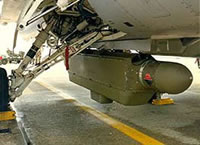
The new AIDEWS based EW pod from ITT will fit the size, weight and form factor of this ALQ-131 pod. Photo: Northrop Grumman
October 5, 2011: The ITT Corporation (NYSE: ITT) has been awarded a $49 million Foreign Military Sales contract to provide a pod-variant version of the Advanced Integrated Defensive Electronic Warfare System (AIDEWS) for the Pakistani Air Force F-16s. The new pod will use a variant of the digital radio frequency memory (DRFM) -based electronic-countermeasure system based on the ALQ-211 Electronic Warfare (EW) jamming system employed with several types of rotary wing aircraft and the F-16 fighter. The system provides fighter pilots with situational awareness and protection against radar-based threats, including modern surface-to-air and air-to-air weapon systems. (Defense-Update)
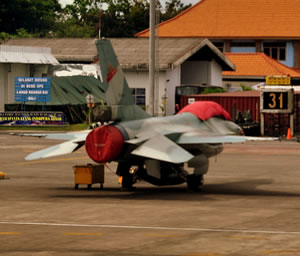
Indonesian Air Force F-16B stationed in Bali. Photo: M. Yudhistira
Indonesia Considers Buying 24 Ex-USAF F-16C/Ds
October 5, 2011: Indonesia is considering modernizing its fleet of 10 F-16A/B and F-5E/F Tiger II fleet with mothballed, ex-USAF F-16A/B fighters, to be renovated with new avionics and engines. Indonesia plans to take take 30 planes and use six of them for spares. While the U.S. is expected to transfer the planes free of charge, Indonesia will spend about half a billion US$ for their modernization. Deliveries could begin in 2014 and span over three years. Indonesia currently have several F-16A/Bs but only part of them are serviceable. Ex-USAF planes would be better maintained than the ones Indonesia already have.
C295 of the Brazilian Air Force. Photo: EADS
Airbus Military, PT DI Indonesian to Modernize C295 Manufacturing Process
Oct 5, 2011: Airbus Military and PT Dirgantara Indonesia (PT DI) today announced a teaming agreement, setting the course for the Indonesian aerospace company’s recovery. The 18 month recovery plan aims to upgrade the PT DI processes and engineering, marketing and MRO capabilities, based on Airbus Military technology and know-how. The two companies have already co-produce the C295 in the past and are anticipating more sales once the Indonesian government confirm their plans to replacement of the Fokker 27 aircraft of the Indonesian Air Force. Airbus Military hopes its C295 will also benefit from the growth in demand for 19-50 passenger-utility aircraft in Indonesia and throughout the region, paving the PY DI partnership growth for the coming decade.
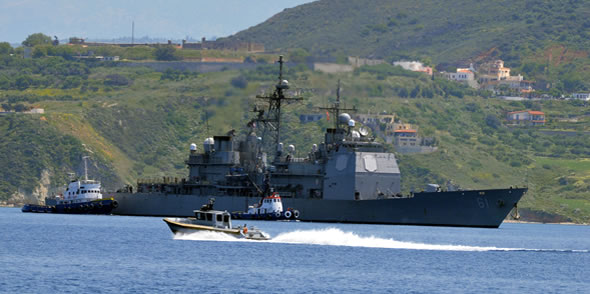
In March 2011 USS Monterey (CG 61) deployed for a six-month independent deployment to the U.S. 6th Fleet area of responsibility. On this voyage, the AEGIS cruiser provided the first ballistic missile defense under the European Phased Adaptive Approach. The cruiser is seen here on one of its Mediterranean port visits in Greece, in May 2011. Photo: U.S. Navy
The U.S. Navy is relocating four AEGIS destroyers to be stationed at port of Rota, spain on the Atlantic Ocean coast. “The alliance is significantly boosting combined naval capabilities in the Mediterranean, and enhancing our ability to ensure the security of this vital region.” The move comes just seven months after the Pentagon sent another AEGIS ship, USS Monterey, to the Mediterranean, marking the first of the administration’s four-phase plan to put a missile defense system in Europe by 2018.
In March 2011 USS Monterey (CG 61) deployed for a six-month independent deployment to the U.S. 6th Fleet area of responsibility. On this voyage, the AEGIS cruiser provided the first ballistic missile defense under the European Phased Adaptive Approach. The cruiser is seen here on one of its Mediterranean port visits in Greece, in May 2011. Photo: U.S. Navy
Secretary of Defense Leon E. Panetta said. These AEGIS ships will support NATO’s missile defense effort, alongside the planned positioning of radar stations and, eventually, land-based AEGIS missile systems in Romania, Poland, and Turkey. “Spain’s decision represents a critical step in implementing the European Phased Adaptive Approach, as our leaders agreed to in Lisbon. For its part, the United States is fully committed to building a missile defense capability for the full coverage and protection of all our NATO European populations, their territory and their forces against the growing threat posed by ballistic missiles.” Panetta added.
According to Spanish President José Luis Rodríguez Zapatero, by 2013, Spain would “decisively support a large part of the naval portion” of the [European missile defense] system. The system, the Spanish president added, will have a positive economic impact on Rota, requiring the presence of 1,100 military staff and their families, representing 1,000 jobs.
In addition to supporting the new missile defense capability, these Aegis ships will support the Standing NATO Maritime Groups, and maritime security cooperation activities in the Mediterranean Basin and the Atlantic Ocean. The agreement also enables the United States to provide rapid and responsive support to the U.S. Africa and U.S. Central Commands, as needed.
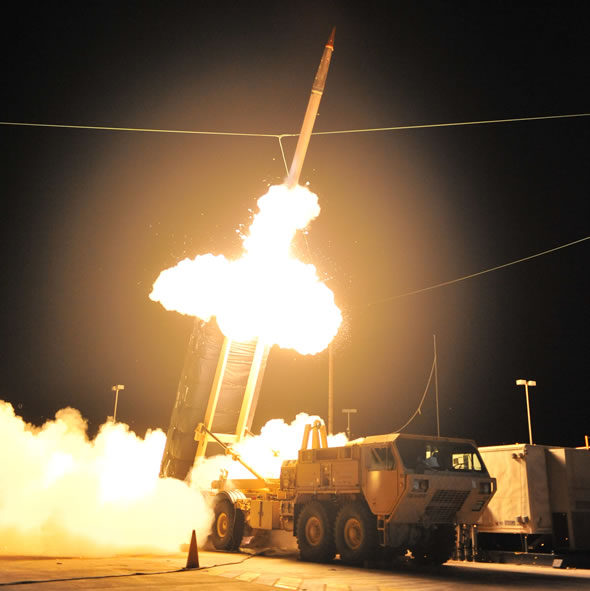
The U.S. Army Terminal High Altitude Area Defense (THAAD) missile system performed a successful intercept October 5, 2011, scoring simultaneous kills of two targets. Photo: Lockheed Martin
The U.S. Army Terminal High Altitude Area Defense (THAAD) missile system performed a successful intercept today, scoring almost simultaneous kill of two targets. The test was conducted at the Pacific Missile Range Facility (PMRF) on Kauai, Hawaii, as part of the The test, part of the first THAAD unit’s initial operational qualification phase. During the mission, the first THAAD missile intercepted an air-launched short-range ballistic missile target. The second THAAD missile intercepted a sea-launched short-range ballistic missile target a short time later.
The first THAAD unit, Alpha Battery, 4th Air Defense Artillery Regiment, 11th Air Defense Artillery Brigade deployed from its home base at Fort Bliss, Texas, in mid-August, operating at the PMRF under the control of the 94th Army Air and Missile Defense Command during the flight test. In order to make this a realistic tactical environment, the soldiers did not know what day or time the mission would occur. Since 2005, the program has completed 12 flight tests, with nine-for-nine intercepts. the first THAAD battery was activated in 2008.
The U.S. Army Terminal High Altitude Area Defense (THAAD) missile system performed a successful intercept October 5, 2011, scoring simultaneous kills of two targets. Photo: Lockheed Martin
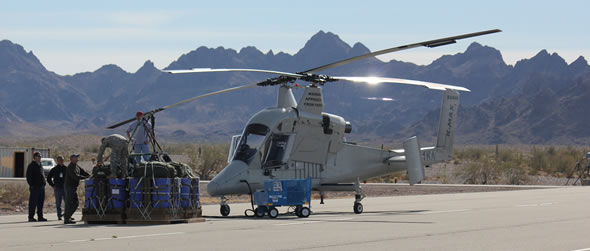
October 2011 Update: during the five-day Quick Reaction Assessment for the U.S. Navy's Cargo Unmanned Aircraft Systems (UAS) program, the corps confirmed that the unmanned K-MAX has met and exceeded the Navy and Marines' requirement to deliver 6,000 pounds of cargo per day. Photo: Lockheed Martin
The U.S. Marine Corps plans to deploy the unmanned K-MAX to Afghanistan in November 2011. Following a successful evaluation of the unmanned helicopter, during the five-day Quick Reaction Assessment for the U.S. Navy’s Cargo Unmanned Aircraft Systems (UAS) program, the corps confirmed that the unmanned K-MAX has met and exceeded the Navy and Marines’ requirement to deliver 6,000 pounds of cargo per day.
During the recent five-day Quick Reaction Assessment for the U.S. Navy's Cargo Unmanned Aircraft Systems (UAS) program, the corps confirmed that the unmanned K-MAX has met and exceeded the Navy and Marines' requirement to deliver 6,000 pounds of cargo per day. The photo shows the KMAX at an earlier test in January this year. Photo: Lockheed Martin
K-MAX will be the Navy’s first-ever cargo unmanned aircraft system to deploy in an operational environment. The deploying team consists of active duty mission commanders and air vehicle operators of the Cargo Resupply Unmanned Aircraft System (CRUAS) Detachment of Marine Corps VMU-1 stationed at Yuma, Az. company employees will also join the team for the mission. The unit has recently concluded training and flight tests at its base in Twenty-nine Palms, Calif., and is currently preparing the aircraft for shipment into theater. Two helicopters will be deployed to a forward base to be used for the cargo dispatches. Most of the missions will be conducted at night and at higher altitudes, avoiding threat of small arms fire.
Since partnering in 2007, Lockheed Martin and Kaman Aerospace have successfully transformed Kaman’s proven K-MAX power-lift manned helicopter into a UAS capable of autonomous or remote controlled cargo delivery.
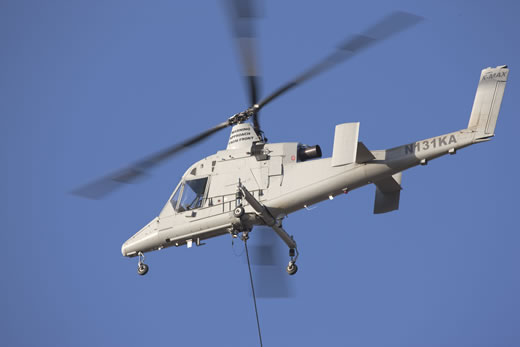
Next Month, Unmanned K-MAX to Begin Operations in Afghanistan. Photo: Lockheed Martin
The new AIDEWS based EW pod from ITT will fit the size, weight and form factor of the ALQ-131 which has been flying with F-16s for decades. Photo: Northrop Grumman
The new AIDEWS based EW pod from ITT will fit the size, weight and form factor of the ALQ-131 which has been flying with F-16s for decades. Photo: Northrop Grumman
The ITT Corporation (NYSE: ITT) has been awarded a $49 million Foreign Military Sales contract to provide a pod-variant version of the Advanced Integrated Defensive Electronic Warfare System (AIDEWS) for the Pakistani Air Force F-16s. The new pod will use a variant of the digital radio frequency memory (DRFM) -based electronic-countermeasure system based on the ALQ-211 Electronic Warfare (EW) jamming system employed with several types of rotary wing aircraft and the F-16 fighter. The system provides fighter pilots with situational awareness and protection against radar-based threats, including modern surface-to-air and air-to-air weapon systems.
The podded version of AIDEWS will be delivered to the Pakistani Air Force. It will have the form factor of the ALQ-131 electronic countermeasures pod currently flying on U.S. Air Force and international F-16s. This export version of the pod incorporates the same hardware configuration from ITT’s AIDEWS, currently flying with five international customers. The new contract will provide for the flight qualification of the pod-mounted variant of AIDEWS for the F-16. AIDEWS has been selected to equip F-16 fighters operating with by six international air forces; ITT has already delivered 134 AIDEWS systems, out of 160 systems ordered.
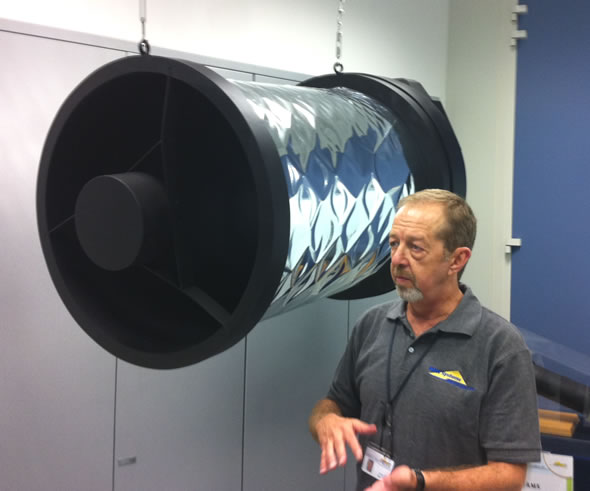
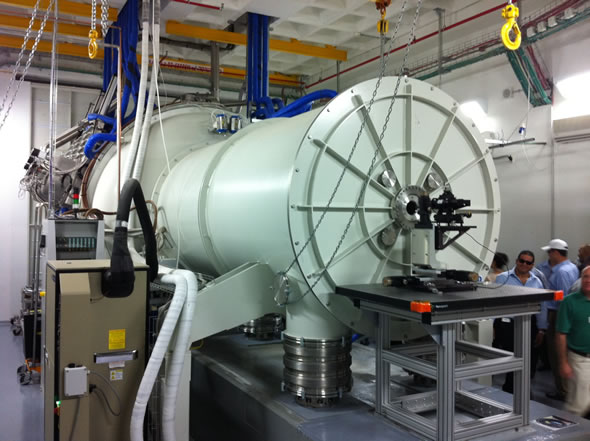
The Daniel center is currently working on several new payloads, including the Jupiter multi-spectral payload, designed for the next generation Ofeq satellite. The Jupiter is shown here by Ilan Porat, head of space systems at ElOp. Photo: Tamir Eshel, Defense-Update
October 5, 2011: Elbit Systems opened today its newly established national space laboratory to the local and international press. For the first time the company unveiled the ‘space simulator’, used to test satellite electro-optical payloads in space-like conditions.
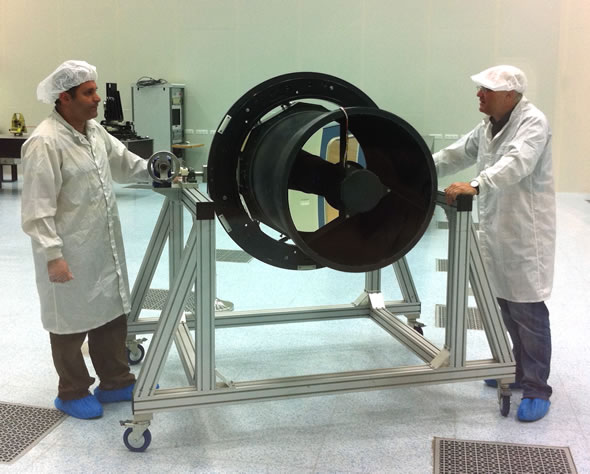
ElOp space lab personnel carry the Multi-Spectral Camera (MSC) satellite payload to be tested at the Elbit Systems' new Space Simulator. Photo: Tamir Eshel, Defense-UpdateThe vacuum chamber of the space simulator sits on a 250 ton concrete slab floating on nitrogen filled cylinders to isolate the test instruments from vibrations and other environmental effects. Photo: Tamir Eshel, Defense-Update
Located at the company’s ElOp facility in Rehovot, the ‘Daniel’ space lab is providing all the necessary infrastructure for the development of space cameras. According to Ilan Porat, head of space systems at ElOp, unique test equipment was designed, developed and produced by ElOp to facilitate the new lab, at an investment of US$15 million. This equipment includes a large vacuum chamber, providing simulated space environment, and isolation from seismic and acoustic vibrations and noise, required for the testing of space cameras.
The large test cell sits on a 250 ton concrete block, ‘floating’ on nitrogen filled cylinders, isolating vibrations that would compromise the sensitive measurements of the cameras. The test cell comprises a collimator simulating the 600 kilometer distance for the camera optics. Through the test the equipment is maintained in vacuum and exposed to extreme temperature gradients simulating the harsh operational environment the equipment is exposed to in space.
The Daniel center is currently working on several new payloads, including the Jupiter multi-spectral payload, designed for the next generation Ofeq satellite. The Jupiter is shown here by Ilan Porat, head of space systems at ElOp. Photo: Tamir Eshel, Defense-Update
The Daniel center is currently working on several new payloads, including the Jupiter multi-spectral payload, designed for the next generation Ofeq satellite. With a focal plane of 70 cm, (compared to 50 cm of the Neptune) the larger, more powerful payload detector and associated optics will provide images with a resolution of 50 cm, from an altitude of 600 km. To meet the high resolution while maintaining efficient area coverage, ElOp has developed a new, high density 30,000 element Time Delay Integration (TDI) detector, offering three-times the density over current detectors used in the neptune payloads used in current Ofeq and Eros satellites and twice the density over the panchromatic-multi-spectral MSC cameras used on the Korean Kompsat-2 family satellites. Compressed into a tube just over 1.5 meter long, Jupiter’s optics provide a 16 meter focal length.
ElOp is also working on Multi-Spectral Camera (MSC) payloads destined for foreign satellites and VeNUS, a super-spectral payload developed for the French Space Agency, the VeNUS camera is currently in the integration phase, and is scheduled for delivery within a year.
The new test chamber at ElOp's Daniel Space Lab provides a simulator for space conditions, for the testing of the company's satellite payloads and cameras. Photo: Tamir Eshel, Defense-Update
This Analysis is written by Daniel Goure, Ph.D. Early Warning Blog, Lexington Institute
The U.S. Army has just published its long-anticipated Request for Proposal (RFP) for the next phase of its Joint Light Tactical Vehicle (JLTV) program. The JLTV was intended initially to replace the venerable Humvee while improving on that system’s survivability and performance. At the same time, the JLTV was supposed to have survivability on a par with the MRAP/M-ATV while being substantially cheaper. The new RFP is for what is called the Engineering and Manufacturing Development (EMD) phase. This phase comes after the completion of a technology development phase which saw three companies — BAE Systems-Navistar, General Tactical Vehicles (GTV), and Lockheed Martin-BAE Systems — provide competing designs. The EMD competition will be open to all interested parties, not just those that completed the first round. A final downselect is expected in 2015 for a single company that will produce a minimum of 20,000 vehicles for the Army and an as yet undefined number for the Marine Corps.
From the start the performance parameters the Army established for the JLTV were sporty, to say the least. The JLTV was to be more survivable than the Humvee while having equal or greater ability to carry payloads, additional power generation capacity compared to current vehicles, better mobility than the MRAP and advanced diagnostics. Did I mention that the JLTV was supposed to come in at least six different varieties as well? All this and a price tag well below that of the MRAP/M-ATV armored trucks built for Iraq and Afghanistan.
One of the perennial problems in defense contracting is that technical success is no guarantee of winning the brass ring. The three companies that won the initial development contracts have by all accounts achieved amazing success in most regards. Yet, the JLTV program appears caught in a budget-cost cap squeeze that could doom the entire effort. The defense budget is shrinking, somewhere between $400 billion and a trillion dollars over the next 10 years, depending on whether sequestration goes into effect. Moreover, the House and Senate Armed Services committees agreed to cut $50 million from the requested $172 million fiscal 2012 budget for the JLTV. Within the Army’s shrinking portion of that pie, the competition for acquisition dollars is becoming more intense as that service tries to support not only JLTV but the new Ground Combat Vehicle, a recap program for the Humvee and ongoing modernization programs for the Bradley Fighting Vehicle and the Stryker. The Army has already signaled that it wants to take more money out of the JLTV program. In addition, the Army has been steadily reducing its estimates of the total number of JLTVs it intends to buy.
Even as the size of the JLTV buy appears to be shrinking and the pot of money available diminishes, the contractors are faced with another challenge: the price the Army wants to pay for the vehicles. According to the new RFP, the target price of the JLTV, depending on the variant, is between $230,000 and $270,000, exclusive of an additional set of heavy armor, the so-called B-kit, which is to cost no more than $65,000. This compares with a ceiling price of $180,000 for a recapped Humvee. So, the Army wants a next generation tactical vehicle at a premium of less than fifty cents on the dollar compared to the one it is replacing. Good luck.
What exactly is good about this deal for the three companies that put so much effort into the first phase competition? A failure to meet the cost caps, even if for good reasons such as to meet performance requirements, will pretty much kill JLTV. In addition, the companies have to compete not only against the other teams who won the initial round but anybody else who wants to enter the game, for less money in the EMD phase, a reduced overall buy and the possibility that the Congress or even the Army might pull the plug on the whole effort. In any other sector, this is a deal no company would touch. Frankly, it says something about the commitment of defense firms to their customers and the American people that they are willing to work under these conditions.
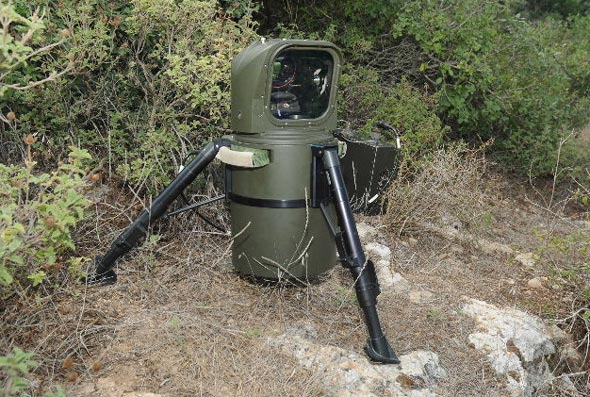
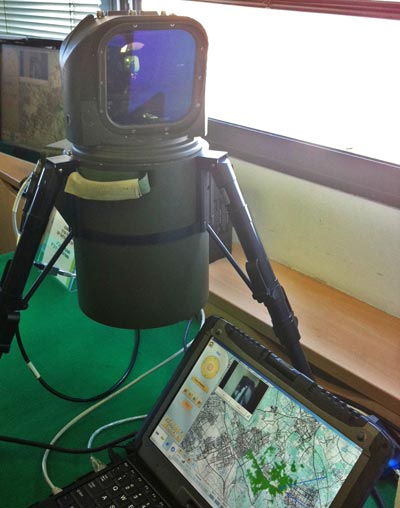
Elbit Systems unveiled today a new, unattended day-night target acquisition system designed for special operation forces and tactical intelligence teams.
Engager packs all the elements employed by target acquisition systems, enclosed in a single, man-portable system designed for concealed and unattended operation. Its sensors include a day TV and a compact, low-power consuming cooled thermal imager, both fitted with powerful zoom, enabling vehicular target recognition from a distance of 8 km at night, and recognition of man-sized target from 4.5 km. The payload also includes the lightweight Rattler miniature laser designator, enabling target marking and designation for precision guided weapons.
The Engager. Photo: Elbit SystemsPhoto: Tamir Eshel, Defense-Update
The system is operated remotely via cable, or over standard wireless radio. The operating system offers various features optimizing operation and minimizing power consumption, including mission plannning, recording and revisit-programming, thus optimizing multi-sensor performance. ElOp plans to introduce additional features in the near future, including fused imaging and video-3D map integration.
The system is provided with a rechargeable battery sufficient for 24-36 hours. Additional cells can be connected In daisy chain, suppprting missions extending over several days.
The Marine Corps anticipates PERM guided bombs will expand the effect of its Expeditionary Fire Support mortar System to engage targets at distances up to 20 km. , with precision of 20 meters and up to 10 meters. Photo: U.S. Marine Corps.
ATK and General Dynamics Ordnance and Tactical Systems (GD-OTS) have both announced they will submit bids for the Marine Corps’ requirements for the rifled, 120mm Precision Extended Range Mortar (PERM). The Marine Corps is planning to award contracts for the PERM development and demonstration phase, by mid-2012 with demonstration tests expected by 2014 and production contract awarded in 2015.
On October 4 ATK announced it will be teaming with GD-OTS to offer a full-up solution for the U.S. The new guided munition will provide the Corps’ Expeditionary Fire Support System (EFSS) towed-mortar the option to engage point targets from ranges of 16 – 20km. ATK announced it will be the prime contractor to the USMC for the PERM Engineering and Manufacturing Development (EMD) program, providing the guidance fuze technology, to be combined with the propulsion and warhead subsystems delivered by General Dynamics. ATK is already providing a similar solution for the U.S. Army 120mm mortars.
The Marine Corps anticipates PERM guided bombs will expand the effect of its Expeditionary Fire Support mortar System to engage targets at distances up to 20 km. , with precision of 20 meters and up to 10 meters. Photo: U.S. Marine Corps.
Three days later, GD-OTS also announced it will also submit a proposal for the PERM program, positioning itself as a prime contractor for the program. For its bid GD-OTS will employ its own technologies, already demonstrated with mortar munitions, such as the Roll Control Guided Mortar (RCGM) and Extended-Range Rocket-Assisted Propulsion system. The 120mm RCGM provides a low-cost guided mortar solution, as it employs a standard M934A1 mortar warhead and M734A1 fuze components, and patented Roll-Controlled Fix Canard (RCFC) technology. It uses GPS guidance to provide an effective, truly affordable precision-strike capability. In March 2011, General Dynamics successfully guided 120mm mortar rounds to less than 10 m CEP at both minimum and maximum range in test firings at the Yuma Proving Grounds, Arizona. All live test rounds detonated successfully and were demonstrated in proximity, point detonate and delay fuze modes. In October 2009, the company also successfully demonstrated 120mm rocket-assisted mortars fired from the M327 rifled mortar at ranges from 17 to 18 km. General Dynamics has been marketing and supporting the 2R2M 120mm (M327) rifled mortar selected for the EFSS. The mortar was originally built by the TDA Armaments, a joint venture between France’s Thales and the European Aeronautic Defence and Space Co. (EADS).
In service with the marine Corps since 2009, the EFSS is a light, mobile and air-transportable mortar system designed for missions requiring tactical versatility, speed, and close-in fire support. The system is composed of a pair of Prime Mover vehicles, the 120mm M327 weapon, the four-round family of munitions and an ammunition trailer. It is designed to be internally transportable in the MV-22B Osprey and the CH-53 helicopter. GD-OTS is currently producing the ammunition for this mortar system. The current M-327 ammunition suite utilizes a standard Insensitive Munition (IM) based High Explosive (HE), Smoke, Illumination and Practice rounds, offering an effective range of 8.2 km. The standard fuse fitted to the projectiles provides point detonation or airburst capabilities.
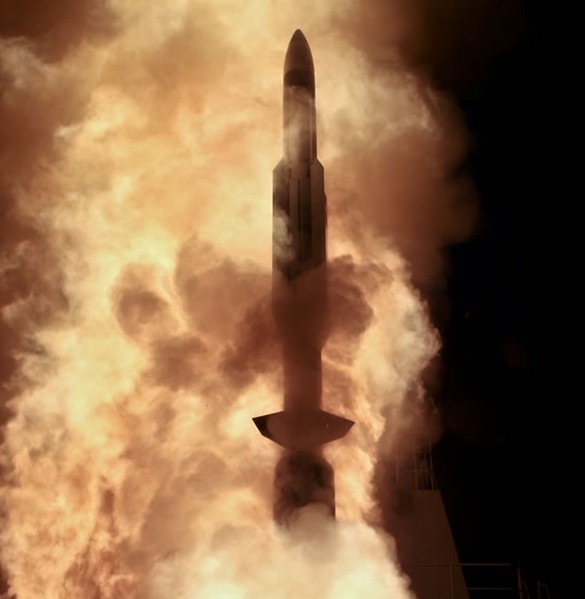
October 4, 2011: The Next generation AEGIS Missile is currently underway with conceptual designs developed by three competitors – Lockheed Martin, Raytheon Missile Systems and Boeing Defense, Space & Security; all three were awarded contracts by the Missile Defense Agency (MDA) earlier this year. The three contracts are worth US$126 million combined. For fiscal years 2013-2016 the full scale development is expected to cost additional $1.6 billion, with additional funding to be allocated for flight testing. However, with budget cuts looming, the program is already facing opposition from the U.S. Senate, with the Senate Appropriations Committee proposing to cut the funding for the program from the proposed 2012 defense spending bill).
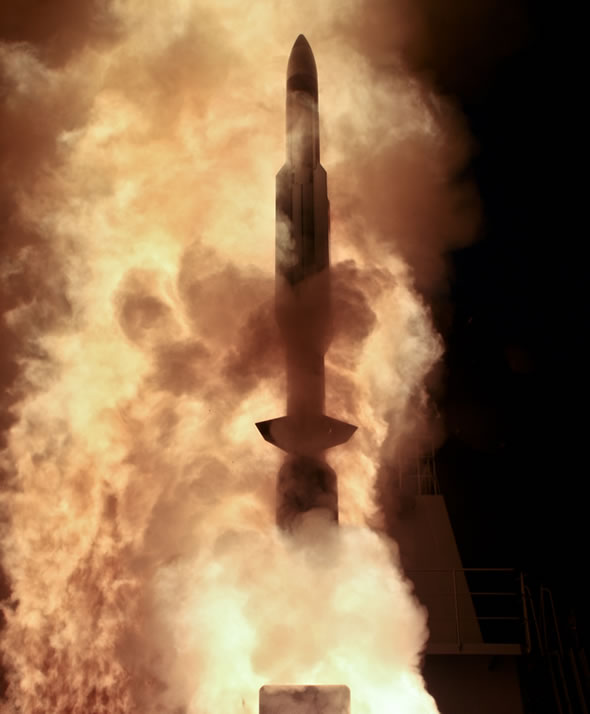
The Missile Defense Agency plans to enhance the capabilities of the SM-3 missile interceptor (seen above) throughout this decade, with the phased improvement process culminating with the introduction of the Block IIB 'Next generation AEGIS Missile' by 2020. Photo: MDA
While the specific technologies to be employed with the Next Generation AEGIS Missile have yet to be defined, it is likely the new missile will derive some of the capabilities already under development for the SM-3 Block IIA. This advanced missile interceptor will be fitted with a new kill vehicle carrying a ‘High Divert Kinetic Warhead’, designed to defeat intercontinental ballistic missiles (ballistic missiles with range of up to 12,000 km).
To further enhance the Block IIB kill vehicle capabilities, MDA will evaluate two different ‘liquid divert’ technologies considered the new divert system, to reduce the technological risk associate with this next generation kill vehicle. The MDA has recently awarded two contracts worth about $14 million each, to Aerojet and Pratt & Whitney Rocketdyne, Inc., both will test specific liquid divert and attitude control system technologies for the next two years. Alliant Techsystems, (ATK) Inc., has also been awarded about $10 million for the development and testing of the third stage rocket motor associated with the future missile’s kill vehicle.
The Next Generation AEGIS missile is positioned to become the mainstay of the MDA’s Phased Adaptive Approach for a European missile defense after 2020. According to the MDA, 24 naval vessels (5 cruisers and 19 destroyers, including four of the Japanese Navy) have already been upgraded with the AEGIS BMD system, and equipped with SM-3 Block 1A missile interceptors; the agency and the U.S. Navy are planning ti increase the number of BMD capable ships to 32 by end of 2013. These vessels will be gradually equipped with the more advanced SM-3 Block 1B missile, fitted with a two-color seeker and new Throttleable Divert Attitude Control System (TDACS). Both Block I missiles are designed to intercept short- to medium-range ballistic missiles. The forthcoming Block 2 and 2A, developed in cooperation with Japan, will employ new high velocity kinetic warhead with high divert capability (2A), a new seeker improving target discrimination and a larger diameter, more powerful first stage rocket motor, extending the weapon’s range beyond the current missiles’ capabilities. MDA is requesting funding of nearly one billion US$ for the SM-3 program, including $565 million for buying 46 SM-3 Block 1B missiles along with $424 million for the development of the SM-3 Block 2A.
Although described by MDA as the ‘Next Generation AEGIS missile’, the specific performance of the Block IIB remain vague, a fact which has lead the Senate committee to focus on current programs, which already suffer 1-2 year delays, consequently pushing the SM-3 Block IIB well into the next decade.
Valanx, the model BAE Systems/Navistar proposed for the JLTV program was evaluated through the recent Technology Development phase. Photo: BAE Systems
The U.S. Army Tank Automotive Command has released the draft request for proposal (RFP) for the for the next phase of the Army/Marine Corps Joint Light Tactical Vehicle program. According to the current schedule, the Army plans to select the preferred teams for the Engineering and manufacturing Development (EMD) phase, by May 2012 with contract award to the winner expected by 2015. The EMD is a full and open competition, meaning the services will be open to consider proposals from manufacturers that have not participated in the TD phase.Three teams participated in the technology development phase, including a team lead by Lockheed Martin, the BAE Systems – Navistar team and the GTV team, including General Dynamics, teamed with AM General, all are expected to compete for the next phase.
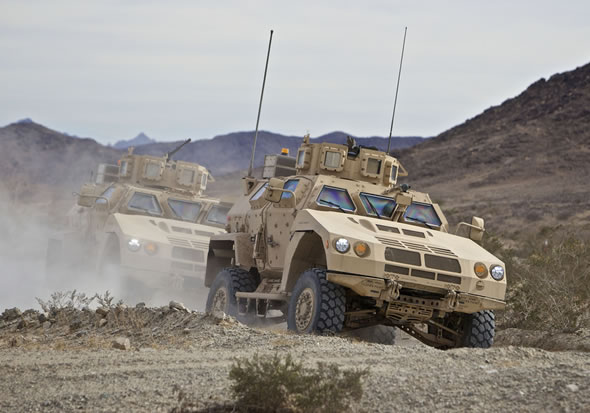
Valanx, the model BAE Systems/Navistar proposed for the JLTV program was evaluated through the recent Technology Development phase. Photo: BAE SystemsThe JLTV variant developed by the GTV team (General Dynamics and AM General), configured as a General Purpose Utility Vehicle, undergoing testing at the Aberdeen Proving Ground. Photo: U.S. Army/REDCOM
The JLTV program began in 2006. Through the technology development phase, the Army and marine Corps have analyzed different alternatives and concluded that the JLTV will offer the best option to fulfill the capability gaps in off-road transportability, protection, payload and performance.
The services have narrowed their requirements into a family of vehicles that consists six models based on two Mission Role Variants (MRVs) – a two seat MRV and a four seat MRV. The family of vehicles will be designed to offer maximum commonality in terms of subsystems, essential line replaceable units (LRU) and maintenance spare parts and logistics. Overall, the services are considering buying 20,750 vehicles, to include three primary configurations: Utility/Shelter Carrier (JLTV-UTL), two seat; Close Combat Weapons Carrier (JLTV-CCWC), four seat; General Purpose (JLTV-GP), four seat. Additional models will also include a Special Purpose (JLTV-SP); Heavy Guns Carrier (JLTV-HGC); and the Command and Control on the Move (JLTV-C2OTM).
For the $52 million EMD Phase each of the teams to be selected will deliver 20 prototype vehicles and armor plates for testing. The vehicles are expected within a year from the contract award. Once the program reaches ‘Milestone C’, by mid 2015, the services are planning to select a single manufacturer for the vehicle in 2015, awarding procurement orders for three consecutive years of low rate initial production orders for a total of 3,950 vehicles, toward a steady production of 280 JLTVs per month by 2018. By that year the Army is expected to have the first operational unit equipped with JLTVs.
The Army has also capped the vehicle’s Average Unit Manufacturing Cost (AUMC) for the base vehicle configurations across the family of vehicles within the range of $230,000-270,000 (FY11 dollars), with additional $65,000 paid for the B-kit Armor.
The RFP signals the services commitment to continue with the new program, Although at a smaller scale than previously planned, despite current budget cuts and funding shifted from JLTV to the HMMWV program it was intended to replace, to fund the HMMWV recapitalization and modernization program.
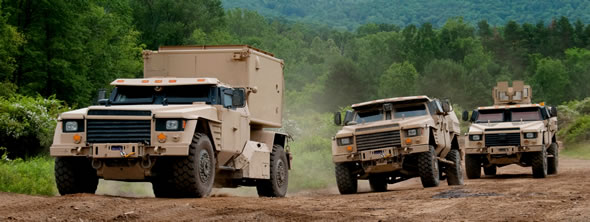
The JLTV program will include three primary variants - Utility/Shelter Carrier with a two seat cabin; a four-seat Close Combat Weapons Carrier, and General Purpose four seat vehicle. This photo depicts the three variants as proposed by Lockheed martin. Photo: Lockheed Martin
The U.S. is embarking on a development of a future Global Positioning System (GPS) receiver to better cope with hostile electronic attacks. Last week the Air Force awarded two contracts worth $47 million each to BAE Systems and Northrop grumman, for the development of ‘navigation warfare’ (NAVWAR) Sensor that could replace military GPS receivers used on aircraft and missiles. The system is developed under the Air Forces’ the Navigation Warfare Technology initiative, also known as The Navigation Trinity (TNT), designed to maintain Air Force the freedom of action under extreme GPS countermeasures.
Designed to replace traditional GPS elements in airborne GPS/INS systems the NAVWAR Sensor will be compatible with existing embedded GPS receivers, and offer 10 meter CEP location accuracy even under heavy jamming. In addition to providing consistent position, navigation and timing data it will help protect secure Blue Force tracking networks (Blue force Electronic Attack – BFEA) and datalinks, both considered critical infrastructures susceptible to enemy electronic attacks.
Designed to operate in hostile electronic environment, the future receiver will also offer situational awareness acting as a signals intelligence sensor, enabling GPS jammer detection, characterization, geolocation and reporting of GPS jammers. Networked NAVWAR sensors will also be able to exchange hostile jammer locations with other networked NAVWAR receivers, thus optimizing collective countermeasures against the threat. The system will integrate the multi-mode Y-Code, M-Code and C/A-code (YMCA) receiver to offer more advanced capabilities, compared with current military code anti-jam GPS receivers. It will possibly include advanced technologies such as inertial sensing, chip scale atomic clocks, anti-jam antenna electronics, direction finding and geolocation algorithms to achieve the high level of survivability the Air Force expects.
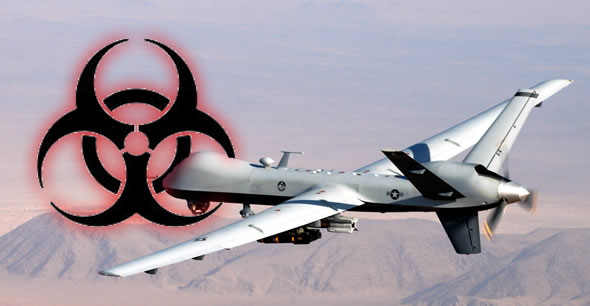
Spyware may have Compromised Killer Drones Missions
A computer ‘Keylogger’ spyware (virus) has infected the cockpits of America’s Predator and Reaper drones, logging every keystroke pilots were doing while remotely flying their missions over Afghanistan and other warzones, Wired danger Room reports. The virus was first detected nearly two weeks ago by the Creech Air Force base security; however, the virus resisted multiple efforts to remove it from Creech’s computers, network security specialists say. The virus has not prevented pilots at Creech Air Force Base in Nevada from flying their missions overseas. While the ground control systems (GCS) are maintained separated from other networks to prevent such attacks, security experts suspect the virus has penetrated the system through removable hard drives used to load map updates and transport mission videos from one computer to another. The virus is believed to have spread through these removable drives. Drone units at other Air Force bases worldwide have now been ordered to stop their use. A senior Air Force source with knowledge of the drone program and familiar with the virus that was caught in recent weeks told FoxNews.com that Wired’s story is “blown out of proportion” and “vastly overwritten.” However, as the Iranians combating the Stuxnet at Natanz enrichment plant could tell, you should never underestimate your opponent when he is inside your system.
The U.S. Army Command Post of the Future (CPOF) system, born at General Dynamics C4 Systems as a DARPA technology demonstration program continues to evolve, the company has recently been awarded a two-year $78 million contract maintaining the systems’ continued evolution. As part of the planned enhancements, the system’s collaboration capabilities will be expanded, with users able to see and share information from multiple control systems, including ground, aviation, logistics, fires and airspace control systems. The system will also integrate the ‘next-generation command and control architecture’, increasing the number of concurrent users sharing the same information from hundreds to thousands. This will allow users who are purposely or inadvertently disconnected from the network to continue their collaborative efforts without interruption to operations or loss of data. The work done to enhance the collaborative command and control capabilities for the CPOF system directly supports the Army’s Mission Command Collapse initiative in which several mission command and control systems are collapsed into a consolidated product line. (Defense-Update)
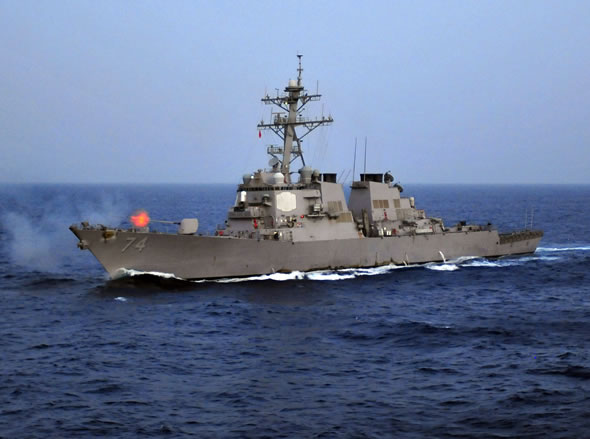
The guided-missile destroyer USS McFaul (DDG 74) fires its MK-45 5-inch/54-caliber lightweight gun during a live-fire weapons exercise. Photo: U.S. Navy
The U.S. Navy is relocating four AEGIS destroyers to be stationed at Rota in spain. These AEGIS ships will support NATO’s missile defense effort, alongside the planned positioning of radar stations and, eventually, land-based AEGIS missile systems in Romania, Poland, and Turkey. According to Spanish President José Luis Rodríguez Zapatero, by 2013, Spain would “decisively support a large part of the naval portion” of the [European missile defense] system. The system, the Spanish president added, will have a positive economic impact on Rota, requiring the presence of 1,100 military staff and their families, representing 1,000 jobs. (Defense-Update)
Next Month, Unmanned K-MAX to Begin Operations in Afghanistan. Photo: Lockheed Martin
October 5, 2011: The U.S. Marine Corps plans to deploy the unmanned K-MAX to Afghanistan in November 2011. Following a successful evaluation of the unmanned helicopter, during the five-day Quick Reaction Assessment for the U.S. Navy’s Cargo Unmanned Aircraft Systems (UAS) program where the helicopter demonstrated the delivery of 6,000 pounds of cargo per day. K-MAX will be the Navy’s first-ever cargo unmanned aircraft system to deploy in an operational environment. The deploying team consists of active duty mission commanders, air vehicle operators and company employees has recently concluded training and flight tests at its base in Twenty-nine Palms, Calif., and is currently preparing the aircraft for shipment into theater. (Defense-Update)
The U.S. Army Terminal High Altitude Area Defense (THAAD) missile system performed a successful intercept October 5, 2011, scoring simultaneous kills of two targets. Photo: Lockheed Martin
The U.S. Army Terminal High Altitude Area Defense (THAAD) missile system performed a successful intercept today, scoring almost simultaneous kill of two targets. The test was conducted at the Pacific Missile Range Facility (PMRF) on Kauai, Hawaii, as part of the The test, part of the first THAAD unit’s initial operational qualification phase. (Defense-Update)
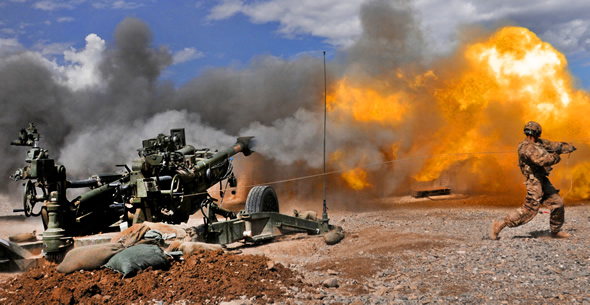
An M-777 155mm howitzer fires at a low ballistic trajectory in Afghanistan. Photo: U.S. Army
Infantry Brigade Combat Teams to Get M777 Lightweight Howitzers
The U.S. Department of Defense is ordering 70 lightweight M777 howitzers worth $134, to begin equipping the U.S. Army’s Infantry Brigade Combat Teams (IBCTs). The new order takes the U.S.-UK production program at BAE Systems to Oct. 2013 and a total of 1071 guns. Weighing less than 4.2 tons, the M777 is the world’s first artillery weapon to make widespread use of titanium and aluminum alloys, resulting in a howitzer which is half the weight of conventional towed 155mm systems. As a result, it can be deployed by medium-lift helicopters quickly and beyond the reach of roadside bombs to otherwise inaccessible areas, extending its reach over the theater of operations. BAE Systems’ facility at Hattiesburg, Mississippi, is responsible for final integration and testing of the weapon system. The prime contract management of the M777 program and manufacture and assembly of the complex titanium structures and associated recoil components are undertaken at Barrow-in-Furness in the United Kingdom.
October 4, 2011: ATK and General Dynamics Ordnance and Tactical Systems are teaming to offer a full-up solution for the U.S. Marine Corps’ requirements for the rifled, 120mm Precision Extended Range Mortar (PERM). The new guided munition will provide the Corps’ Expeditionary Fire Support System (EFSS) towed-mortar the option to engage point targets from ranges of 16 – 20km. ATK will be the prime contractor to the USMC for the PERM Engineering and Manufacturing Development (EMD) program, providing the guidance fuze technology, to be combined with the propulsion and warhead subsystems delivered by General Dynamics. ATK is already providing a similar solution for the U.S. Army 120mm mortars. (Defense-Update)
The JLTV variant developed by the GTV team (General Dynamics and AM General), configured as a General Purpose Utility Vehicle. Photo: U.S. Army
October 4, 2011: The Army has also capped the vehicle’s Average Unit Manufacturing Cost (AUMC) for the base vehicle configurations across the family of vehicles within the range of $230,000-270,000 (FY11 dollars), with additional $65,000 paid for the B-kit Armor. The service released a draft Request for proposal for the vehicle’s Engineering and manufacturing Development (EMD) phase, setting the stage for selecting the preferred manufacturer for producing 20,750 vehicles by 2015. (Defense-Update)
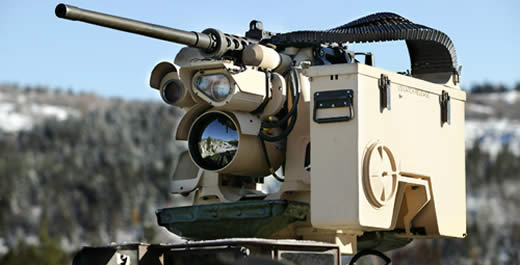
The U.S. Army initially selected Kongsberg for the CROWS II program in 2007, to provide a common solution for its light and medium armored vehicles. Photo: Kongsberg Group
Army to Cut CROWS Procurement by Half
October 4, 2011: The U.S. Army is cutting $1.6 billion from the Common Remotely Operated Weapon Station (CROWS), built by Norwegian defense Kongsberg, from $2.6 billion down to $970 million. The reduction reflects other reductions in procurement of armored vehicles, such as the JLTV and GCV. The Army has been using the CROWS primarily with combat vehicles while protected gunner kits were employed on tactical and patrol vehicles such as HMMWVs and MRAPs. To date, the Army has put over 11,000 CROWS systems in the field and the plan was to buy another 7,000 with orders split between two suppliers. However, the actual number has been reduced to 3,000 and. (AOL Defense) Commenting on the planned cut, Kongsberg said the change expresses that there will be only one supplier and its CROWS design is still the chosen one for the competition.
October 04, 2011: The U.S. is embarking on a development of a future Global Positioning System (GPS) receiver to better cope with hostile electronic attacks. Last week the Air Force awarded two contracts worth $47 million each to BAE Systems and Northrop grumman, for the development of ‘navigation warfare’ (NAVWAR) Sensor that could replace military GPS receivers used on aircraft and missiles. The system is developed under the Air Forces’ the Navigation Warfare Technology initiative, also known as The Navigation Trinity (TNT), designed to maintain Air Force the freedom of action under extreme GPS countermeasures. (Defense-Update)
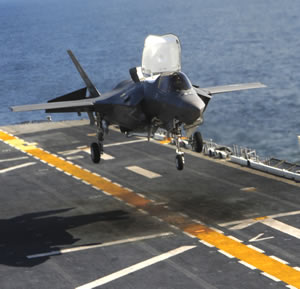
F-35B - touchdown on the Wasp. Photo via Lockheed Martin
October 3, 2011: Marine Corps test pilot Lt. Col. Fred Schenk recorded a major milestone yesterday, flying his F-35B (BF-2) to a safe landing on the flight deck of USS Wasp’s (LHD-1), the first at sea vertical landing for the Marine Corps’ F-35 JSF version. (Defense-Update)
October 3, 2011: The Missile Defense Agency will evaluate two different ‘liquid divert’ technologies considered the new divert system for the ‘Next Generation AEGIS Missile’, to reduce the technological risk associate with the weapon’s advanced kill vehicle. Two contracts worth about $14 million each were awarded to Aerojet and Pratt & Whitney Rocketdyne, Inc., both will test specific liquid divert and attitude control system technologies for the next two years. (Defense-Update)
Lockheed Martin Skunk Works® and XTEND have achieved a major milestone in JADC2 by integrating the XOS operating system with the MDCX™ autonomy platform. This technical breakthrough enables a single operator to simultaneously command multiple drone classes, eliminating the friction of mission handoffs. From "marsupial" drone deployments to operating in GPS-denied environments, explore how this collaboration is abbreviating the data-to-decision timeline and redefining autonomous mission execution.
As traditional defense primes face mounting competition from agile “neoprimes” such as Anduril, Palantir and Helsing, the balance of innovation is shifting toward software-defined warfare and scalable, dual-use technologies, while global industry consolidation—marked by Boeing’s integration of Spirit AeroSystems and other strategic mergers—signals an intensified race to secure control over the defense technology value chain. Our Defense-Tech weekly report highlights these trends.
In early October 2025, a coordinated wave of unmanned aerial system (UAS) incursions—widely attributed to Russia—targeted critical infrastructure across at least ten European nations. The unprecedented campaign exposed the fragility of Europe’s air defenses...
Executive Summary
The past week (September 18-25, 2025) represents an inflection point where strategic defense concepts have transitioned from doctrine to tangible reality. An analysis of global events reveals four primary, interconnected trends shaping an...
At the 2025 Air, Space & Cyber Conference, U.S. Air Force and Space Force leaders unveiled major updates on next-generation fighters, bombers, unmanned systems, and space initiatives, highlighting both rapid innovation and critical readiness challenges as the services race to outpace global competitors. A short version is available here, with a more detailed version for subscribers.
The Taipei Aerospace & Defense Technology Exhibition (TADTE) 2025 crystallized around four dominant strategic themes that collectively illustrate Taiwan's comprehensive approach to defense modernization amid escalating regional tensions. Based on a detailed report by Pleronix (available upon request). Includes a Podcast discussion on TADTE 2025's highlighting Taiwan's four strategic themes beyond the post's coverage.
Israel’s Iron Beam 450 high-power laser system has completed final testing, marking a major leap in air defense. Developed by Rafael, it offers precise, cost-effective interception of rockets, UAVs, and mortars, and is set for IDF deployment by 2025.