Tuesday, December 30, 2025
More
    Home Blog Page 220

    F-35B Performs First Landing at Sea

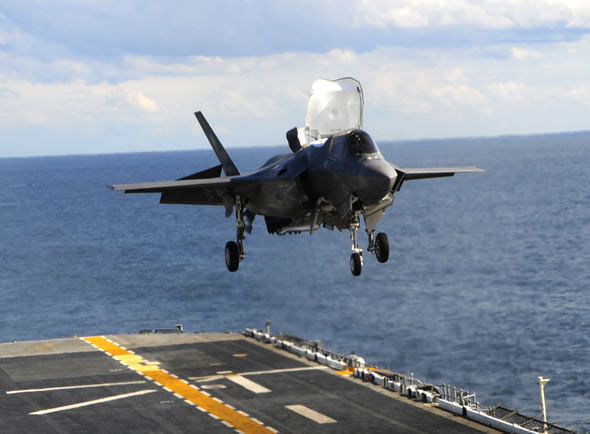
    F-35B - touchdown on the Wasp. Photo via Lockheed Martin

    October 3, 2011: Marine Corps test pilot Lt. Col. Fred Schenk recorded a major milestone yesterday, flying his F-35B (BF-2) to a safe landing on the flight deck of USS Wasp’s (LHD-1), the first at sea vertical landing for the Marine Corps’ F-35 JSF version. The first vertical landing is part of the initial ship trials for the F-35B which started Monday and is expected to last two-weeks. The tests are scheduled to collect data on the aircraft’s ability to perform short take-offs and vertical landings on a ship at sea, as well as determine how the aircraft integrates with the ship’s landing systems, and deck and hangar operations.

    Marine Corps test pilot Lt. Col. Fred Schenk lands his F-35B (BF-2) on the Amphibious Deck Ship Wasp LHD-1 for the first time, October 3, 2011. Photo: via Lockheed Martin

    “The first at sea vertical landing is a huge milestone,” said Marine Corps Col. Roger Cordell, military site director for F-35 test and evaluation at Naval Air Station Patuxent River.  “We’re still early in this test period, and we expect to learn a lot more, but this is a great step toward delivering the capability to the fleet.”

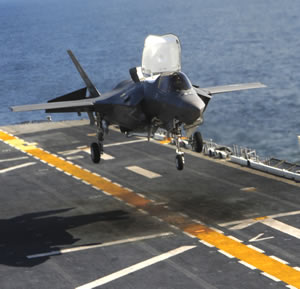
    F-35B - touchdown on the Wasp. Photo via Lockheed Martin

    In addition to being the first ship to successfully land the F-35B, USS Wasp was also the first ship to host the V-22 Osprey during shipboard trials in October 2007. Prior to the recent test Wasp spent time in a shipyard earlier this year, preparing for conducting the F-35 operations on board, adding specialized instrumentation to measure deck environmental effects. This test period is the first of three scheduled at-sea test periods over the course of the development program, will also collect environmental data on the deck through added instrumentation to measure the F-35B’s impact to flight deck operations. According to Vice Admiral David Venlet, F-35 Program Executive Officer the current test was scheduled back in the early spring 2011 and was carried out on the planned date. “Signs of dependable performance are emerging across broad aspects of the development program.  Professionals from the Navy, Marine Corps and industry team of Lockheed Martin, Northrop Grumman, BAE Systems and Pratt and Whitney and Rolls Royce continue to work tirelessly to deliver this aircraft to the fleet.” General Venlet said, adding that the data collected from this event will assist further development work necessary to successfully integrate the F-35B on large-deck amphibious ships.

    The F-35B is the variant of the Joint Strike Fighter for the U.S. Marine Corps, capable of short take-offs and vertical landings (STOVL) for use on amphibious ships or expeditionary airfields to provide air power to the Marine Air-Ground Task Force.  The F-35B will replace Marine AV-8B Harriers and F-18 Hornets and is undergoing test and evaluation at NAS Patuxent River prior to delivery to the fleet.

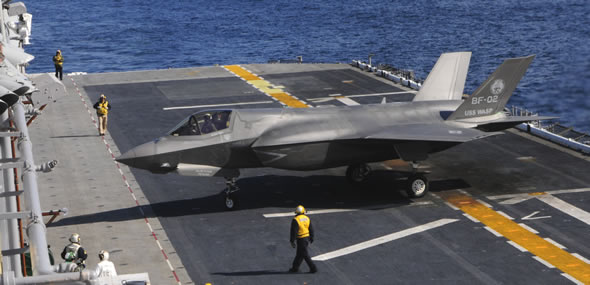
    F-35B BF-2 recovered on the Wasp. Photo: vai Lockheed Martin

    HQ-4 Xianglong UAV Ready for Flight

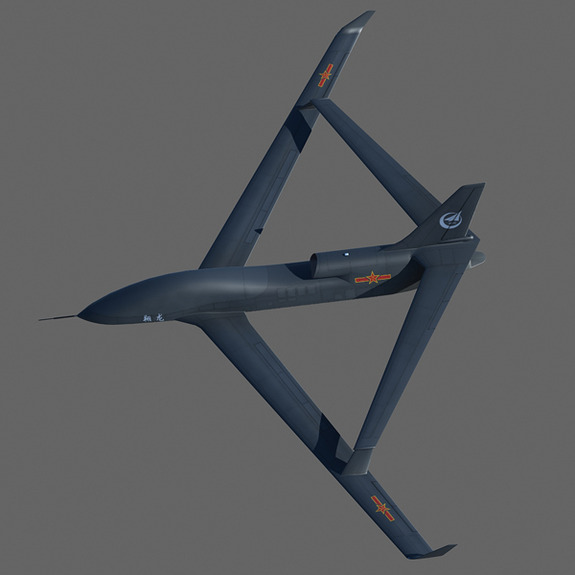
    Xianlong High Altitude Long Endurance (HALE) UAV from China.

    The Chinese Xianglong ‘Soaring Dragon’ UAV was recently seen at Chengdu seemingly prepared for the first test flight. The Soaring Dragon uses an innovative ‘joined wing’ design, employing a conventional swept wing joined with a forward swept wing. A model depicting this configurationwas shown at the Zuhai China Airshow 2006.

    Xianglong is powered by a single jet engine is mounted on top of the fuselage, between the forward-swept tail wings. Xianglong has a normal take-off weight of 7,500kg. Cruising at a speed of 750km/h, Xianglong has a maximum range of 7,000km. The UAV carries a mission payload of 650kg.

    A different type of jet-powered unmanned aerial vehicle, developed under a joint venture between the Guizhou Aviation Group and the Chengdu Aircraft Design Institute (CADI) is also designated Xianglong. It flew its maiden flight on November 7, 2009. It was a smaller design, roughly the size of a Predator, this version of Xianglong was fitted with a V tail and swept wings witha span larger than the current design.

    A model of the Xianglong High Altitude Long Endurance (HALE) UAV.

    Iran Introduces the Qader, an Enhanced, Locally Produced Version of the C-802 Anti-Ship Missile

    Qader is a medium-range anti-ship developed in Iran, based on an enhanced version of the Chinese C-802 missile (The C-802 is also locally produced in Iran under the designation 'Noor') Photo: Iran's President Office

    Iran is fielding a new version of the C-802 anti-ship missile designed to defeat large surface combattants. The Qader missile can be launched from surface naval platforms or from vehicles, in its coastal defense configuration. Following qualification tests carried out in August 2011 off the Streits of Hurmoz, the first production lot of missiles was handed to the Iranian Navy and Iran Revolutionary Guards Corps (IRGC) in September, 2011. The missile carried a smaller warhead 1/6 of the size of the full warhead, but, according to the IRGC commander, the missile succeeded to sink the target vessel. Iran claims the missile is capable of defeating large surface vessels and aircraft carriers.

    Qader is a medium-range anti-ship developed in Iran, based on an enhanced version of the Chinese C-802 missile (The C-802 is also locally produced in Iran under the designation 'Noor') Photo: Iran's President Office

    On launch the Qader uses a solid rocket booster, accelerating the missile on its initial phase. Then, the missile’s turbojet sustainer kicks in propelling the missile through its midcourse phase. The solid rocket powered C-701 and rocket booster/turbojet powered C-802 derivatives of Chinese anti-ship missiles, are both locally produced by Iran. Unlike these two ‘anti-ship’ missile types, the new Qader is designated a ‘cruise missile’, for its long range (more than 200km). The weapon’s jam-resistant radar and digital, programmable guidance system are claimed to be two of the enhancements introduced by the Iranians.

    In May 2011 Iran also unveiled a land-based terminally guided ballistic missile capable of hitting vessels at sea at distances exceeding 200 km.

    Vietnam – Defense Market Report

    Opportunities and Entry Strategies 2011-2016

    The Vietnamese defense industry is expected to undergo a period of investment with a considerable increase of expenditure from 2011–2015 (the forecast period), according to a survey by ICD Research. This investment comes from the increasing necessity to improve the now outdated Vietnamese military technology and a wariness of China’s growing military power, which is perceived as hostile to Vietnam.

    Vietnam is also expected to increase spending on homeland security, as its location near maritime trade routes and shared borders with several other countries make it a prime location for illicit drug and people trafficking as well as smuggling. As such, Vietnam will need to invest to improve border surveillance and critical infrastructure.

    The Vietnamese defense industry is not self-sufficient, and Vietnam is dependent on foreign imports to supply its military. Russia has dominated Vietnam’s defense imports throughout 2006–2010 (the review period) and this is expected to continue in the forecast period. Vietnam has, however, undertaken a policy of building cordial relationships with its neighbors and western countries to have potential allies against China’s growing influence. As a result of this policy there are new opportunities for entry into the Vietnamese defense industry.

    Vietnam’s defense expenditure expected to increase at a CAGR of 14.32% during the forecast period

    The Vietnamese defense expenditure, which was around US$3 billion in 2011, is expected to reach around US$5 billion in 2015. It recorded a compound annual growth rate (CAGR) of 19.13% during the review period and is expected to grow at a CAGR of 14.32% during the forecast period. This defense expenditure growth should be accompanied by a modest growth in defense expenditure as a percentage of GDP from 2.5% in 2011 to 2.8% in 2015. Overall, the country is expected to spend an estimated US$18.6 billion on its armed forces during the forecast period, of which approximately US$6.4 billion will be allocated for capital expenditure.

    During the review period, the country allocated an average of 31% of its defense budget for capital expenditure and 69% for revenue expenditure. However, during the forecast period, the share of capital expenditure in the overall defense budget is predicted to increase to an average of 35%. The main reasons for this growth in capital expenditure are that Vietnam is seeking to modernize its armed forces and has planned a number procurement programs to run during the forecast period. Capital expenditure also saw a slight increase in 2009, when Vietnam signed deals for the procurement of six Kilo class submarines and 12 Su-30 aircrafts from Russia.

    The country’s homeland security spending is expected to increase at a CAGR of 12.90% during the forecast period.

    Vietnamese homeland security expenditure registered a CAGR of 19.27% during the review period and is expected to grow at a CAGR of 12.90% during the forecast period to reach over US$2 billion in 2015. Homeland security improvements are required in Vietnam as it is a prime location for illicit drug and people trafficking as well as smuggling, due to its strategic location near maritime trade routes and the borders the country shares with several other countries. Throughout the forecast period, homeland security equipment manufacturers expect to experience increased demand for products which are capable of enhancing seaport and airport security to prevent drug trafficking and smuggling. Vietnam also intends to invest in border surveillance equipment such as CCTV technology and biometric identification systems. Furthermore, increased demand is expected for equipment to protect Vietnam’s critical infrastructure, borders and maritime security.

    Russia accounts for the majority of Vietnam’s defense imports

    Vietnam’s domestic defense production capabilities are relatively underdeveloped, as a result of which the country relies on foreign original equipment manufacturers (OEMs) to meet its military requirements. During the review period, Russia emerged as the largest supplier of military hardware to Vietnam, providing 93% of Vietnam’s defensive imports, followed by Ukraine with 6% and Romania and Israel sharing less than 1% each. In 2010, Russia accounted for 98% of the country’s defense imports. The main equipment which Russia supplies to Vietnam consists of surface combat vessels, submarines and aircraft.

    Foreign OEMs venture into the market through government to government deals and direct commercial sales

    Vietnam’s limited domestic defense industrial capability offers an opportunity for a considerable number of foreign OEMs to venture into the Vietnamese defense market. The country’s defense industry is largely dominated by Russian defense equipment suppliers, but during the forecast period European suppliers are expected to enter Vietnam’s military market thorough the direct commercial sale of advanced defense systems. Moreover, Vietnam prefers government to government deals in procuring defense systems. The General Import-Export Vanxuan Corporation (VAXUCO), a military goods importer owned by the Ministry of Defense (MOD), is the only designated importer for the MOD for non dual-use military goods, and is authorized to sign purchases on behalf of the MOD. Hence developing government to government relationships is expected to open up business opportunities.

    Lack of private participants and a lack of transparency restrict domestic defense industry growth

    In March 2011, the Vietnamese government passed legislation that prohibits selling stakes of state-owned defense companies to the private sector. The legislation also requires that the state will hold 100% of the charter capital in enterprises involving national defense, and security and military held commercial enterprises. This legislation prevents private participation and thwarts any foreign direct investment into the country’s defense sector. Furthermore, Vietnam does not give any specifics on the defense budget break-down or amount spent on procurement. This lack of transparency within the government budget allocation and procurement plans can discourage investors from entering the country’s defense market.

    About ICD Research
    iCD Research is a full-service market research consultancy providing both online and offline research capabilities. Our areas of expertise include online research, qualitative and quantitative research, custom approaches, and actionable insights. Our capabilities provide a one-stop research and analysis service with full-spectrum consulting, from problem recognition and conducting fieldwork to the delivery of strategic recommendations. We deliver our expertise across a broad range of industry sectors and product lifecycle areas. From product innovation to brand management and CRM, we offer full service research and analysis that drives loyalty and lifetime value.

    [box type=”info” style=”rounded”]<h3>Report Information Request</h3>

    [/box]

    Oto Melara Introduces a 76mm Version of Vulcano Multi-Mission, Long Range Naval Projectile Technology

    Oto Melara has conducted firing tests of the Ballistic Extended Range Vulcano 127 projectile designed for the 127/46 gun mounted on the Italian FREMM and German F125 frigates. Photo: Oto Melara/

    Oto Melara unveiled yesterday a family of extended range and guided 76mm projectiles it is developing for the popular 76/62 naval gun system. The new Vulcano 76 round transforms this classic naval weapon into a multi-mission weapon system, capable of handling surface targets at sea and on land. The weapon addresses new operational requirements evolving from modern littoral warfare missions; as reflected in the Second lebanon War (2006) and the Libyan campaign in 2011. In addition to engaging surface targets, the system can handle air-defense as well as fulfil classic naval gunnery support (NGS). The system is poised to revitalise the role of the naval gun, offering new operational capabilities that could not be achieved with contemporary (unguided) gunnery systems.

    Oto Melara has conducted firing tests of the Ballistic Extended Range Vulcano 127 projectile designed for the 127/46 gun mounted on the Italian FREMM and German F125 frigates. Photo: Oto Melara/

    “The Vulcano capability introduces a revolution in naval gunnery” Oto Melara CEO Carlo Alberto Iardella told Defense Update, “the expansion of this technology to the 76mm gun is part of our strategy to expand Vulcano through our lines of cannons” he added saying the new capability provides the 76/62 naval cannon a range of authority unmatched by competing weapon systems. According to Iardella, the Vulcano family will be expanded in the future to offer semi0-active laser homing capability, enabling naval and land artillery to effectively engage fast moving targets.

    Beside the 127mm/5 inch and 155mm, other calibers that could be supported include the 105mm field artillery cannon. The company is already introducing a land-based version of the 76mm gun as a self propelled configuration known ad “DARCO”, and is developing a sub-caliber version of Vulcano for the 155mm SPH2000 self propelled cannon in service with the Italian Army. However, company officiels do not plan to include Russian calibers of 122mm or 152mm among future derivatives.

    Vulcano 127 has already performed firing testing verifying the enhanced ballistic characteristics of the projectile. The one in the photo is the 127mm Guided Long Range projectile, showing the canard section and GPS/INS guidance and advanced multi-mode fuse section installed in the nose. Photo: Oto Melara

    As a guided projectile, the fin-stabilized Vulcano 76 will offer autonomous GPS/INS guidance, practically doubling the range of current 76/62 systems. When engaging fixed land based targets or surface targets at sea, the new projectile enables even small vessels to engage targets with high precision, from ranges exceeding 40 km, at a high rate of fire. The new capability will enable small littoral combat ships, frigates or gunboats to dominate a wide coastal area from a stand-off distance, out of the range of contemporary medium range anti-ship coastal defense missiles, rockets or artillery. Vulcano 76 will use a common guided or unguided projectiles, fitted with a new multi-modal RF microwave fuse offering altimetric (airburst), proximity (against aerial, naval and surface targets) or delayed impact (penetrating) and self-destruct modes. Employing the optimal fusing method enables the five kilogram pre-fragmented warhead made of tungsten-steel compound to provide twice the lethality of existing rounds at 80% of the weight.

    Oto Melara claims the use of fin stabilized sub-caliber technology offers significant advantages over extended range Rocket Assisted Projectiles (RAP), and trajectory corrected projectiles. While eliminating the barrel wear and corrosion associated with the rocket propellant burning inside the barrel, the fin-stabilized sub-caliber projectile has improved aerodynamic performance thus maximizing range and increasing precision. It also offers significant range benefit compared with trajectory correction systems that trades-off range for precision. The sustained rate of fire is also high, with the water cooling system enabling the gun to expending the entire magazine containing 80 rounds in one continuous burst, in less than one minute. The time of flight reaching targets at 40 km is about 120 seconds.

    Oto Melara is offering the new weapon system either as an upgrade for existing 76/62 turrets or as new systems. To support the Ballistic Extended range (BER) type, minor software changes are required, (loading the appropriate ballistic tables to the fire control computer). To support Vulcano 76 GPS/INS and GPS/INS/IR Guided Long Range (GLR) projectiles, a minimal upgrade requires the installation of a Vulcano kit (V-KIT), which implements the ammunition programmer within existing auto-loader subsystems, feeding the projectiles’ electronics  with target data, trajectory parameters, fuse setting and GPS initialization. For optimal performance the system would also include a new multi-feeing ammunition selection system, and a dedicated module installed with existing Naval Fire Control Systems, to handle the gun’s multi-mission capabilities. The multi-feeding system enables a single gun system to automatically select, load and fire different types of ammunition at different targets in rapid bursts, without adding additional weight to existing gun systems.

    The upgrade is available to all existing 76/62 gun systems, including the Compact Gun, Super Rapid and the new Strales gun system. The later already supports the Oto Melara DART, another sub-caliber guided munition designed for counter-air and anti-missile applications. While an upgrade would require several months of work on a vessel, the company offers a more efficient ‘drop in’ replacement of existing system, while existing gun systems are undergoing periodical overhaul.

    Oto Melara has already completed the feasibility studies of Vulcano 76. The design of the new projectile is currently in progress, with firing trials of the unguided BER version scheduled to be 2013, to follow a year later with the GLR projectile. The company is planning to qualify the new round for low rate initial production by 2015. With 55 navies using the 76/62 gun systems, Oto Melara gears to process over 300 systems over a 10 year period beginning 2015. Upgrades will be available exclusively from Oto-Melara with Volcano ammunition to be produced under License, using company furnished kits. There are about ten providers for 76mm ammunition, offering the company significant commercial advantages in local offset agreements, securing sales of its systems worldwide.

    This ambitious schedule is realized with the new projectile being a spin off from the matured Vulcano technology developed at Oto Melara with the support of the Italian Navy. Subassemblies for the guided Vulcano 76 are currently in progress include a prototype of the multi-modal fuse, warhead under design and infrared seeker at a prototype stage. Safe and arm and GPS/INS subsystems are already in testing. currently maturing with two products, destined for the new generation Italian Navy FREMM and German F125 frigates, both to be equipped with 127mm gun system.

    The Strales 76/62 turret is equipped with dual-feed loading system and fire control and illumination radar supporting the DART sub-caliber anti-air and anti-missile ammunition. It will also be able to support the new Vulcano 76 sub-caliber guided and unguided munitions. Photo: Oto Melarabe

    European Report Defense Update – September 27, 2011

    Eurocopter considers offering this innovation with its series production helicopters. Photo: Patrick Gertner, Eurocopter

    Eurocopter Tests Hybrid propulsion for Helicopters, to Enhance Safety on Emergency Landing

    October 4, 2011: Eurocopter has successfully tested a hybrid helicopter that combines a turboshaft internal combustion engine with an electric motor. The supplemental electric system is used to enhance safety on emergency landing, by increasing maneuverability of the single-engine helicopter during an autorotation landing – which is performed by helicopters in the event of a main engine failure. Eurocopter integrated the hybrid system in a production version of the light, single-engine AS350. In the event of an engine failure, the electric motor provides power to the rotor, allowing a pilot to control the helicopter during the descent to a safe touchdown. Eurocopter considers offering this innovation with its series production helicopters.

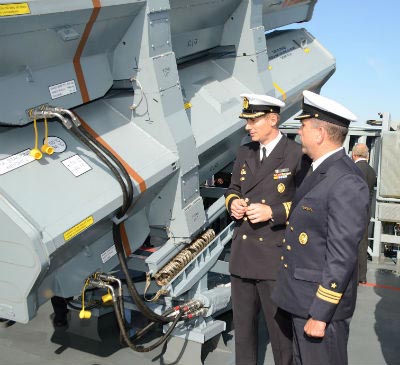
    Representatives from the The German Navy inspects the RBS15 Mk3 missiles in their canisters on-board the new K130 corvette. Photo: Diehl

    German Navy receives new RBS15 Mk3 missile

    September 27, 2011: The official roll-out of the RBS15 Mk3 Surface-to-Surface Missile for the German Navy took place at a ceremony of the Federal Office of Defence Technology and Procurement. Representatives of the Federal Ministry of Defence, the Federal Office of Technology and Procurement, the German Navy, Diehl Defence and Saab Dynamics participated in the event at the naval base Kiel on September 22, 2011.

    Diehl delivers the RBS15 Mk3 anti-ship missile as the main weapon system of the German Navy´s new K130 corvette. A special feature of this German-Swedish Missile is its additional capability enabling precise engagement of land targets. The launch customers include the German Navy as well as Poland which is equipping its ORKAN class speedboats with RBS15 Mk3 missiles. The delivery of the first missiles began in March 2011.


    Thermal imager for every soldier

    The goal of LCTI-M is to develop a wafer scale manufacturing process that will result in a camera on a chip, making thermal imagers affordable, accessible, and ubiquitous to every warfighter.

    The Advanced Research Projects Agency (DARPA) is laying the basis for the next step in thermal imaging – developing mass-produced thermal imaging sensors integrated into that will be integrated into thermal cameras the size of today’s button size cameras used on mobile phones. Using uncooled sensor technology, such cameras could be employed by every warfighter, bringing ‘the soldier is the sensor’ vision to reality.

    The goal of LCTI-M is to develop a wafer scale manufacturing process that will result in a camera on a chip, making thermal imagers affordable, accessible, and ubiquitous to every warfighter.

    The key for such capabilities are low cost production methods, capable of integrating miniature thermal cameras into handheld military hardware that will be compact and lightweight as mobile phones. Another challenge is providing efficient connectivity for all those devices to dynamically share these images into a dynamic and ultra-detailed ‘world image’.

    DARPA awarded two low Cost Thermal Imager Manufacturing (LCTI-M) contracts worth $13 million, to Raytheon Vision Systems, and BAE Systems, for the development of production processes for such low-cost, miniature thermal cameras within two years. The goal is to bring the cost of such micro-camera, optics, manufacturing, and software to under $500 per unit. And the target weight of the device is 25 grams.

    Raytheon’s development effort aims to reduce the cost of uncooled infrared sensors by 10 times, to enable widespread use of this technology in the modern battlefield. BAE Systems will develop the wafer-scale integrated thermal imager manufacturing capability to produce very low-cost and high-throughput thermal camera components. Also, the performer will facilitate technology transition of a very compact fully integrated thermal camera interfaced to a small handheld platform, such as a cell phone.

    Asia Pacific Defense Update September 26, 2011

    F/A-18F

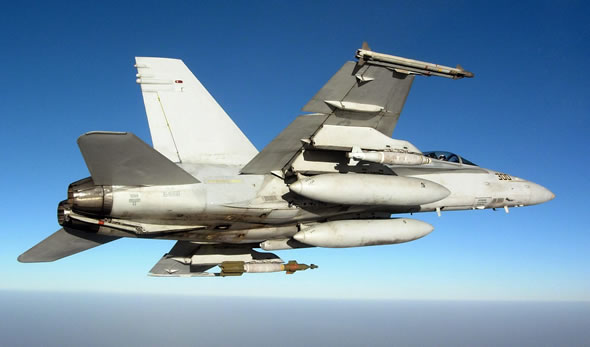
    Boeing Offers Super Hornet F/A-18E Block II or Japan’s FX

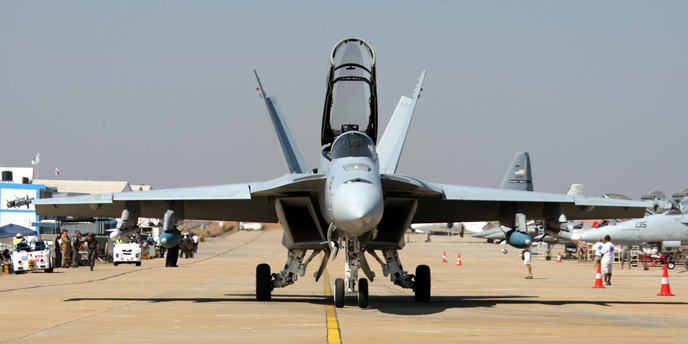
    September 26, 2011: Boeing and the U.S. Navy have submitted a proposal to sell an enhanced version of the F/A-18E Super Hornet block II multirole fighter for the next generation fighter competition in Japan. A request for proposal was issued by Japan Air Self Defense Force’s (JASDF) for its Qnext premier fighter aircraft (FX). The deadline for submissions was today,  Sept. 26. The advanced Super Hornet version offered to Japan is based on the F/A-18E/F model operated by the U.S. Navy and the Royal Australian Air Force. The two other competitors in this program are Lockheed Martin offering the F-35A and BAE Systems/Eurofighter, offering the Typhoon. Given the delay in the Lightning II program, the Typhoon and Super Hornet, both being matured production programs, are more likely to meet the delivery date of early 2017 set by Japan. (More news about F-X)

    Moscow, Beijing and Tehran Discussing Missile Defense Alliance?

    September 26, 2011: What does the Russian envoy to NATO, Dmitry Rogozin has to do in Tehran this week? According to Russian news agency RIA Novosti, Rogozin is arriving this week in Tehran to discuss “strategic issues”. Unofficial sources in Iran are reporting that Iran, Russia, and China are discussing a proposal to establish a joint missile defense shield as a counterweight to a NATO missile defense initiative. According to the Iranian daily newspaper Kayhan, the three countries have raised common concern about the NATO initiative, that pretends to be defending against threats from Iran and North Korea, but rather aim at diminishing the Russian and Chinese ballistic missile capability and, therefore destabilising the current balance of power between East and West. Rogozin denied the report stating “Iran is Russia’s good neighbor and economic partner but not a military ally… Russia has one military ally –the CSTO (Collective Security Treaty Organization)” Rogozin said. Iran As a precursor to this visit Russia refunded the downpayment Iran made on the S-300 missiles Iran ordered but Moscow refused to transfer.

    16 Dead in Rebel Attack in the Philippines

    September 25, 2011: At least 13 rebels, two Marines soldiers and one civilian were killed when 50 armed rebels linked with the Philippine Abu Sayyaf terrorist group attacked a Marine detachment shortly before dawn, in Barangay Kabungkol in Talipao, Sulu, in the Philippines. Brig. Gen. Romeo Tanalgo, chief of the Sulu Island Command, said six soldiers, including a junior officer, were also wounded when the rebel faction stormed the detachment of the 30th Marine Company under the Marine Battalion Landing Team 10 (MBLT). (Phil Star)

    Previous Reports:

    U.S. & Canada Defense Update – September 25, 2011

    Senate Proposes Cuts in Funding for the SM-3B2 ABM Interceptor

    September 25, 2011: In its version of the 2012 defense spending bill, unveiled Sept. 15, the Senate Appropriations Committee provides no funding for the Standard Missile SM-3 Block 2B AEGIS interceptor, slated to become the interceptor of choice for the forward land-based missile defense system the Pentagon plans to position in Europe. The Missile Defense Agency (MDA) requested $123.5 million for the effort next year. Boeing, Lockheed Martin and Raytheon are competing for program. The SM-3 Block 2A is also in trouble, suffering a two year delay in development. The current missile being deployed is the SM-3 Block 1A. The SM-3 Block 1B has recently failed a test flight. (Space News)

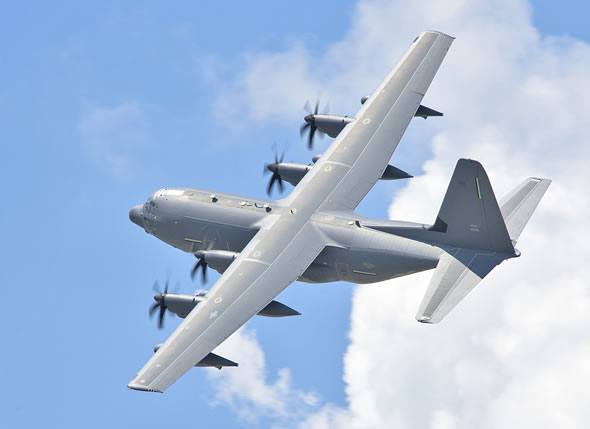
    Lockheed Martin delivered the first of 11 HC-130J Combat King II personnel recovery aircraft to the United States Air Force's Air Combat Command (ACC). Photo: USAF

    USAF Gets its First Combat King II

    September 24, 2011: Lockheed Martin delivered the first of 11 HC-130J Combat King II personnel recovery aircraft to the United States Air Force’s Air Combat Command (ACC). Combat King II is the successor of the HC-130P (Combat King I) based on the modern C-130J tanker configuration has the Enhanced Service Life Wing, Enhanced Cargo Handling System, a Universal Aerial Refueling Receptacle Slipway Installation for boom refueling. It is equipped with an electro-optical/infrared sensor for night piloting. A combat systems operator station is also added on the flight deck. The aircraft also has dual Satcom links. (Defense-Update)

    HC-130J Combat King II

    Lockheed Martin delivered the first of 11 HC-130J Combat King II personnel recovery aircraft to the United States Air Force's Air Combat Command (ACC). Photo: USAF

    Lockheed Martin delivered the first of 11 HC-130J Combat King II personnel recovery aircraft to the United States Air Force’s Air Combat Command (ACC). Combat King II is the successor of the HC-130P (Combat King I) based on the modern C-130J tanker configuration has the Enhanced Service Life Wing, Enhanced Cargo Handling System, a Universal Aerial Refueling Receptacle Slipway Installation for boom refueling. Self protection systems include radar and missile warning receivers, chaff and flare dispensers. It is equipped with an electro-optical/infrared sensor for night piloting. A combat systems operator station is also added on the flight deck. The aircraft also has dual Satcom links supporting low-probability of detection data-burst communications. The 71st and 79th Rescue Squadrons in Air Combat Command, the 550th Special Operations Squadron in Air Education and Training Command, the 920th Rescue Group in Air Force Reserve Command and the 106th Rescue Wing, 129th RQW and 176th Wing in the Air National Guard will operate the new aircraft.

    The first of 11 HC-130J Combat King II personnel recovery aircraft delivered by Lockheed Martin to the U.S. Air Force's Air Combat Command (ACC). Photo: USAF

    The HC-130J is a result of the HC/MC-130 recapitalization program, replacing the Air Combat Command’s aging HC-130P/N fleet as the dedicated fixed-wing personnel recovery platform in the Air Force inventory. The HC-130P/N are operated by the Air Combat Command since 2006.

    The HC-130J can fly in the day; however, crews normally fly night at low to medium altitude levels in contested or sensitive environments, both over land or overwater. Its mission is to rapidly deploy to execute combatant commander directed recovery operations to austere airfields and denied territory for expeditionary, all weather personnel recovery operations to include airdrop, airland, helicopter air-to-air refueling, and forward area ground refueling missions.

    Crews use NVGs and the new stabilized EO payload for tactical flight profiles, avoiding detection to accomplish covert infiltration/exfiltration and transload operations. To enhance the probability of mission success and survivability near populated areas, crews employ tactics that include incorporating no external lighting or communications, and avoiding radar and weapons detection.

    Drop zone objectives are done via personnel drops and equipment drops. Rescue bundles include illumination flares, marker smokes and rescue kits. Helicopter air-to-air refueling can be conducted at night, with blacked out communication with up to two simultaneous helicopters. Additionally, forward area refueling point operations can be executed to support a variety of joint and coalition partner.

    Defense Update – Business Briefs – September 2011

    BAE Systems to Axe 3,000 Jobs in the U.K.

    BAE Systems is set to announce up to 3,000 job losses in the U.K., as it struggles to secure new orders for the Eurofighter Typhoon combat jet and slows deliveries to the project’s existing customers amid cuts to defense budgets. According to the The Telegraph, the job cuts are part of the company’s cost cut measures, preparing for a possible slowdown in production of the Eurofighter Typhoon line. Typhoon is currently in the final competition in India, and is positioned to be one of three possible fighters considered for Japan’s next generation fighter, but for the interim phase, production levels are expected to fall as the European air forces set to meet budget cuts by reducing operational and procurement costs.

    Lockheed Martin, Raytheon Announce Stock Repurchase, Dividends

    September 22, 2011: Lockheed Martin (NYSE:LMT) and Raytheon (NYSE:RTN) both announced stock repurchase plans yesterday; LMT board of directors authorized spending up to $2.5 billion for the purchase of the company’s common stock. The board also authorized a fourth quarter 2011 dividend of $1.00 per share, marking the ninth consecutive annual increase of at least 10% in Lockheed Martin’s quarterly dividend rate. “We continue to deliver on our long-standing goal to return at least 50 percent of free cash flow [to the shareholders]” said Chairman and CEO Bob Stevens. The Board of Directors of Raytheon Company has allocated $2.0 billion for common stock repurchase and declared a quarterly cash dividend of $0.43 cents per outstanding share of common stock.

    Qatar Interested in Daimler’s EADS Shares

    September 21, 2011: Qatar has shown interest in buying a 7.5 percent share of EADS currently held by German company Daimler, Defense News reports. Controlling 22.5 percent of the European Aerospace and defense giant, Daimler decided to sell its holdings in EADS but denied negotiating the sale with Qatar. Selling of these stocks is particularly complex since, according to the shareholders’ agreement, France and Germany should own exactly equal percentage of EADS. (Defense News)

    Second Successful Launch of the Indian Shourya Ballistic Missile

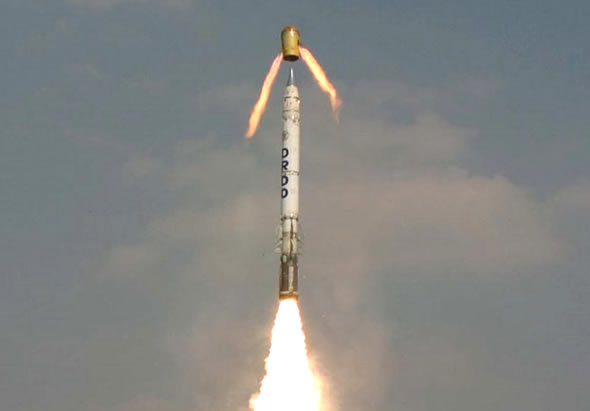
    DRDO Shourya Ballistic Missile

    India has tested the Shourya nuclear-capable surface/surface missile September 24, 2011, at the Integrated Test Range (ITR) at Chandipur off Orissa coast, about 15 km from Balasore. The missile took off from a 35 foot, underground silo. Shourya is a derivative of the K-15 missile developed by the DRDO for the Indian Navy submarines. The launch marks the second developmental trial of the missile. The first was conducted on November 12, 2008. Both tests were successful.

    An Indian Shourya ballistic missile launched from the Integrated Test Range (ITR) at Chandipur off Orissa coast. Derived from the submarine launched ballistic missile K-15, Shourya uses a waterproof protecting cap ejected after launch (seen in this picture), exposing the aerodynamic shaped cone as the first stage solid rocket ignites for the high-speed ascent.

    The missile is being developed by the Indian Defence Research Development Organisation (DRDO). The two-stage missile is powered by solid propellant. The weapon is described as a ‘hybrid’ missile, that can shape its descent trajectory. To achieve this capability in atmospheric flight the missile uses aerodynamic flight controls enabling sufficient maneuverability to reduce the missile’s vulnerability to missile interceptors while rendering it more accurate for conventional attack. The range of the missile is 750 kilometers.

    The Shourya missile can carry a warhead weighing one ton, a weight sufficient for a nuclear device. However, its massive warhead combined with relatively high accuracy of less than 20-30 meters (GPS aided INS) make the Shourya effective for conventional attack of high value targets. Shourya is scheduled to enter service with the Indin Army in 2013.

    At Defexpo 2010 the missile was displayed without the container shroud, mounted on a land-mobile erector-launcher. According to V K Saraswat of the India Defense Research and Development Organization (DRDO), the Shaurya can be launched from under water as well as from land. The K-15 missile is contained in a gas-filled canister stored inside the submarine’s hull and uses a two-stage solid propelled rocket after launch. To achieve high accuracy, the missile can perform trajectory corrections using an on-board inertial navigation system.

    EGBU-28 / GBU-37 / BLU-113 Deep Penetrating Weapon

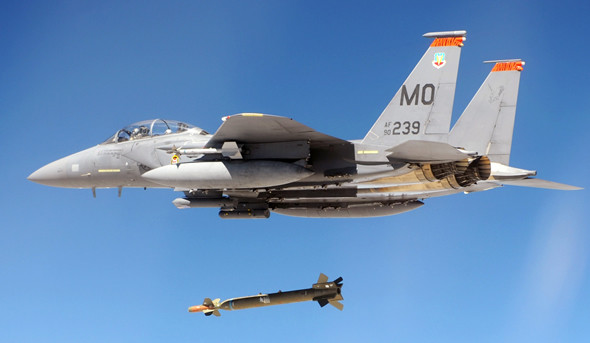
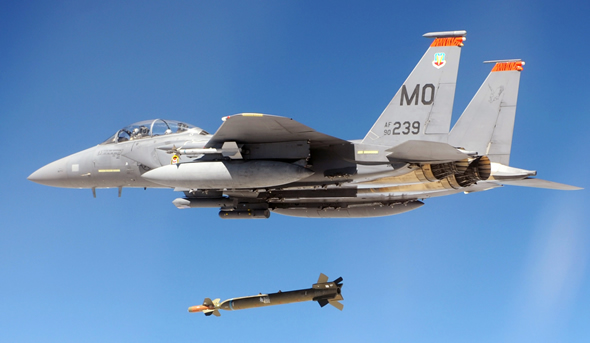
    GBU-28 dropped from an U.S. Air Force F-15E. The Strike Eagle and B-2A are the only two aircraft in U.S. Air Force inventory capable of carrying this heavy weapon. Photo: USAF

    The EGBU-28/BLU-113 Hard Target Penetrator was first deployed during the First Gulf War in 1991 as a laser guided munition. It is now available with GPS aided guidance (offering all-weather accuracy of less than six meters, or with laser guidance. These 18 foot long (5.7 meters) weapons, weighing 4,400 pounds (2.2 tons) each, are capable of penetrating 20 foot (6 meter) of reinforced concrete or 100 foot of earth (30 meter); these weapons are now a standard weapon with the B-2A Spirit F-15E Strike eagle in USAF service.

    GBU-28 dropped from an U.S. Air Force F-15E. The Strike Eagle and B-2A are the only two aircraft in U.S. Air Force inventory capable of carrying this heavy weapon. Photo: USAF

    Two versions are available – the EGBU-28B/BLU-113 carried by the Strike eagle, employing the GPS enhanced laser guidance kit and GBU-37/GAM, using a GPS Aided Munition guidance kit, carried by the B-2A Spirit stealth bomber. The bombers’ almost undetectable APQ-181 Attack Radar and GPS aided GAM/GATS targeting system provide a true all weather around the clock precision capability. (More on the GBU-28 development at from ausairpower)

    The U.S. has recently delivered deep penetration guided bombs to Israel, according to the New York Times quoting unidentified U.S. officials. In the past, Israel requested such weapons several times but delivery was halted due to political pressure. EGBU-28 weapons were already on the way to Israel two years ago but the shipment was diverted elsewhere.

    AIM-9X Block II Successful in Flight Tests

    Navy F-18D performed two successful test firings of the AIM-9X Block II, the latest version of the Sidewinder, enhanced with Lock on After Launch capability. Photo: Raytheon

    The U.S. Navy recently completed two successful live fire tests of the Raytheon AIM-9X Block II Sidewinder air/air missile. Following the recent approval for Raytheon to enter low rate initial production, AIM-9X Block II is now scheduled to enter operational testing in spring 2012.

    The recent tests were conducted by Air Test and Evaluation Squadron (VX) 31 at the Naval Air Warfare Center Weapons Division in China Lake, Calif. The mission was part of a developmental testing of the missile that began in September 2010. AIM-9X Block II missiles have already performed several test firings at Eglin Air Force base in November 2009, but development have stalled for two years due to technical problems, part of which was attributed to technical problems with the weapon’s laser proximity fuse.

    Navy F-18D performed two successful test firings of the AIM-9X Block II, the latest version of the Sidewinder, enhanced with Lock on After Launch capability. Photo: Raytheon

    The Navy team conducted the two developmental tests on Aug.31 and Sept.1 to demonstrate Block II’s ability to deliver expanded air-to-air warfare capabilities. During both missions, an F/A-18D fired one telemetry-equipped missile against a BQM-74 sub-scale target, testing the new model’s improved lock-on-after-launch capability employing the new data link, extended range lofting fly-out profile and improved all weather DSU-41 laser fusing, optimized against small targets. The first mission tested the weapon’s ability to fire against an extremely small target flying at low altitudes over the California desert at an extended beyond visual range. The second mission demonstrated Block II’s all-weather capability when the test pilot, flying below the 1,000 feet marine layer of clouds off the Point Mugu, Calif. coast, shot at a target flying above the clouds. The second test employed a new, high precision telemetry system accurately profiling the endgame profile and target engagement.

    Skunk Works and XTEND Simplify Multi-Drone Command

    0
    Lockheed Martin Skunk Works® and XTEND have achieved a major milestone in JADC2 by integrating the XOS operating system with the MDCX™ autonomy platform. This technical breakthrough enables a single operator to simultaneously command multiple drone classes, eliminating the friction of mission handoffs. From "marsupial" drone deployments to operating in GPS-denied environments, explore how this collaboration is abbreviating the data-to-decision timeline and redefining autonomous mission execution.

    From Ukraine to Taiwan: The Global Race to Dominate the New Defense Tech Frontier

    0
    As traditional defense primes face mounting competition from agile “neoprimes” such as Anduril, Palantir and Helsing, the balance of innovation is shifting toward software-defined warfare and scalable, dual-use technologies, while global industry consolidation—marked by Boeing’s integration of Spirit AeroSystems and other strategic mergers—signals an intensified race to secure control over the defense technology value chain. Our Defense-Tech weekly report highlights these trends.

    Europe’s “Drone Wall”

    0
    In early October 2025, a coordinated wave of unmanned aerial system (UAS) incursions—widely attributed to Russia—targeted critical infrastructure across at least ten European nations. The unprecedented campaign exposed the fragility of Europe’s air defenses...

    Weekly Defense Update & Global Security Assessment

    0
    Executive Summary The past week (September 18-25, 2025) represents an inflection point where strategic defense concepts have transitioned from doctrine to tangible reality. An analysis of global events reveals four primary, interconnected trends shaping an...

    U.S. Air and Space Forces Push Next-Gen Programs at the AS&C 2025 Conference and...

    0
    At the 2025 Air, Space & Cyber Conference, U.S. Air Force and Space Force leaders unveiled major updates on next-generation fighters, bombers, unmanned systems, and space initiatives, highlighting both rapid innovation and critical readiness challenges as the services race to outpace global competitors. A short version is available here, with a more detailed version for subscribers.

    TADTE 2025: Reflecting Taiwan’s Strategic Themes

    0
    The Taipei Aerospace & Defense Technology Exhibition (TADTE) 2025 crystallized around four dominant strategic themes that collectively illustrate Taiwan's comprehensive approach to defense modernization amid escalating regional tensions. Based on a detailed report by Pleronix (available upon request). Includes a Podcast discussion on TADTE 2025's highlighting Taiwan's four strategic themes beyond the post's coverage.

    Iron Beam 450 Completes Testing, Soon to Join With Operational Air Defense Units

    0
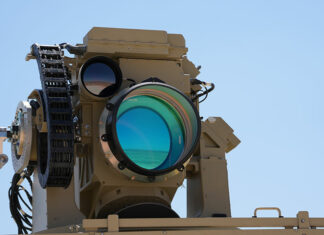
    Israel’s Iron Beam 450 high-power laser system has completed final testing, marking a major leap in air defense. Developed by Rafael, it offers precise, cost-effective interception of rockets, UAVs, and mortars, and is set for IDF deployment by 2025.