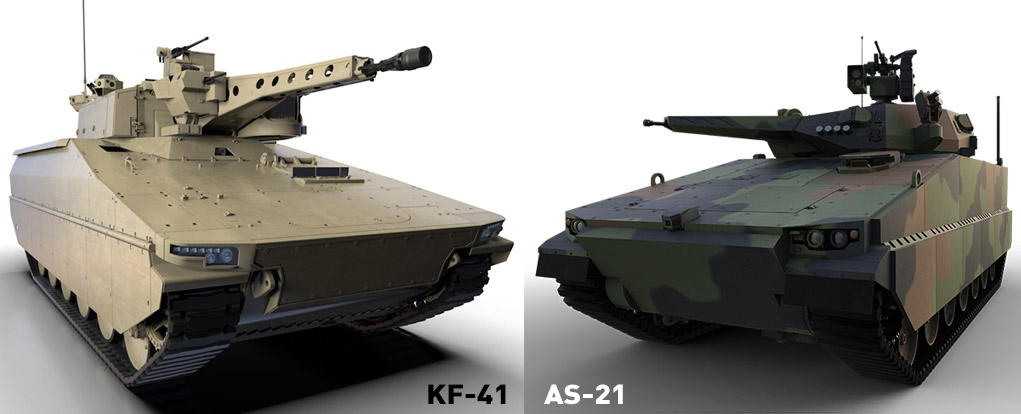
KF-41 Lynx from Rheinmetall and AS-21 Redback from Hanwha are shortlisted to the final evaluation for the Australian Land 400 Phase 3 program.
The Australian MOD has shortlisted two companies for the Land 400 Phase 3 Risk Mitigation Activity (RMA) of the next-generation tracked infantry fighting vehicle (IFV) and armored personnel carriers (APC), to replace the Australian M-113s. The two contenders are Hanwha Defense System AS21 Redback and Rheinmetall Lynx KF-41.
LAND 400 Phase 3 is a $10-15 billion program which will recapitalize the M113 Armoured Personnel Carrier (APC) force of the Australian Army, with a combination of tracked IFV and APCs. The new family of vehicles will be better armed, highly protected and more efficient than the current M-113s. They will also be heavier and will rely on a new combat service support systems to sustain the battle.
Defence Minister Linda Reynolds said: “These advanced vehicles will provide new levels of protection, firepower, mobility, and enhance communications… When fully delivered the LAND 400 Program will allow the Army to successfully sustain mounted close combat operations against emerging and future threats, as part of an integrated Australian Defence Force”
The Lynx KF-41 is based on a brand new platform developed by Rheinmetall, which is operated by a crew of three and has the capacity to carry nine troops. It mounts the Lance 2.0 turret with 30-35mm automatic cannon, 7.62 mm coaxial machine gun. Rheinmetall can rely on the significant workshare already launched with Australian industries, and the Military Vehicle Centre of Excellence MILVEHCOE (facility) being established Redbank to support the Land 400 Phase 2 (Boxer) vehicle acquisition.
The AS21 Redback is also based on a new platform that integrates an advanced Australian designed and built turret that mounts a 40mm automatic cannon, 7.62 mm coaxial machine gun and provisions for active protection system (APS). The vehicle is operated by a crew of three and has the capacity to carry eight troops. Both vehicles have an operational range of 500 km, and a top road speed of 70 km/h. Hanwha has approached Australian companies and has already teamed with some, to develop the Australian configuration of AS21. While the power train and automotive elements would be delivered by the Koreans, Hanwha said it is open to local participation in the fields of armor, electronics, structural assemblies, and system integration for the AS21.
Defense Industry Minister Melissa Price welcomed the announcement and stressed the importance of Australian Industry Content (AIC) in the multi-billion recapitalization effort. During the testing-phase Defence will work with the shortlisted tenderers to ensure small and medium enterprises across Australia have the opportunity to showcase their capabilities. Minister Price said.
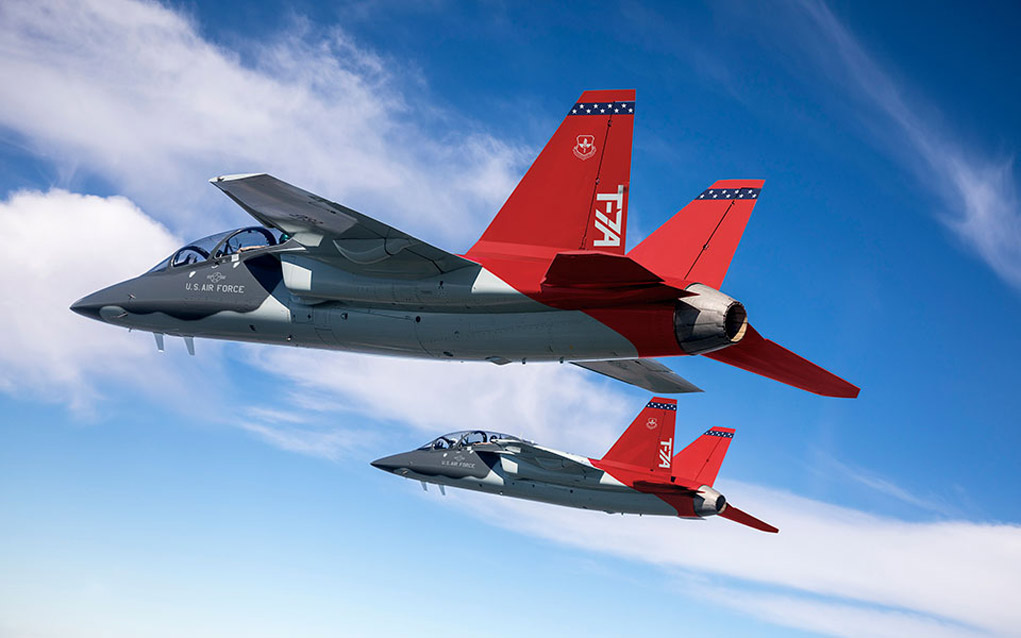
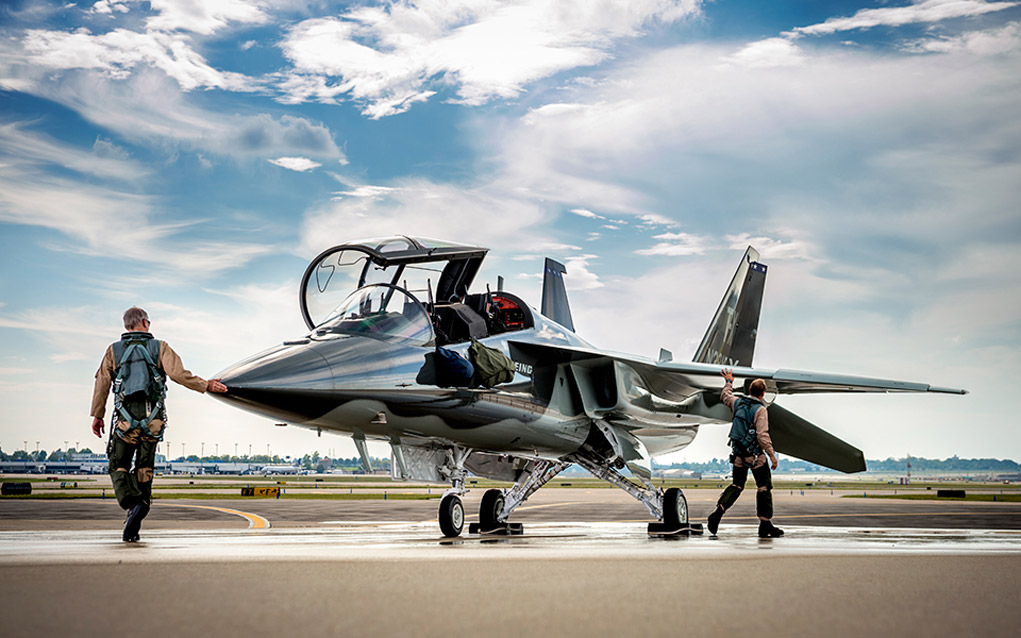
Boeing T-X was formally designated today by the US Air Force as T-7A. Photo: Boeing
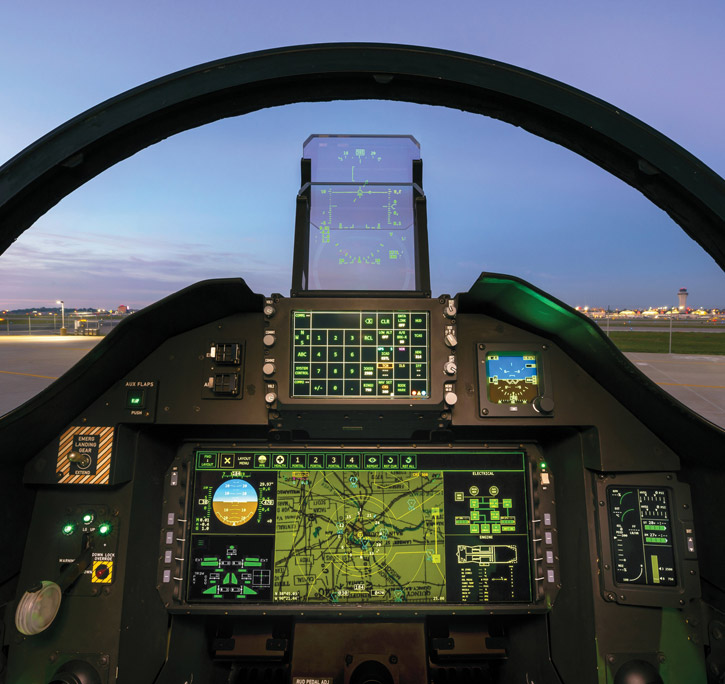
The cockpit arrangement of the T-X prototype depicts the central large area display, engine and fuel indicator panel on the left side, the HUD and touch panel UFPC.
Elbit Systems of America confirmed it will supply Boeing a number of products – including cockpit displays, datalinks, and embedded training capabilities for the T-7A Red Hawk (formerly known as T-X) advanced pilot training aircraft Boeing is developing for the United States Air Force. In the initial phase, Boeing was selected to deliver 351 trainers, 46 simulators and associated ground equipment at a contract value of $9.2 billion with deliveries commencing over 10 years, from 2024 to 2034.
Over the program life, that number is expected to grow to 1,000 trainers. Elbit Systems of America has joined the Boeing-Saab team at an early stage and is expected to become a sole supplier for those items. Analyst estimates of the package value are $250 million for the initial phase and over one billion US$ over the life of the program, not including future exports.
Fires erupted at the largest oil refinery in Saudi Arabia, following a cruise missile attack on the facility.
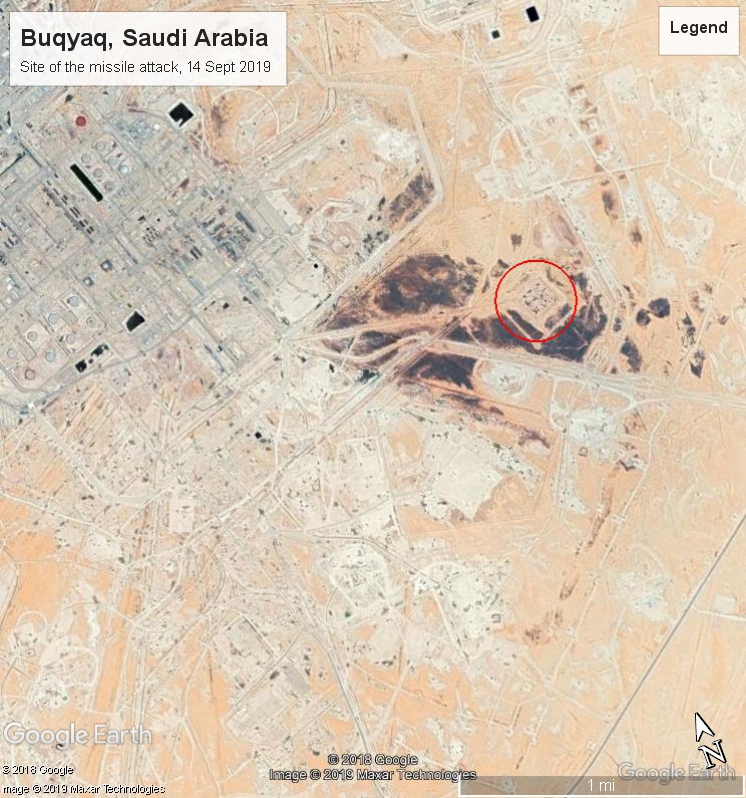
The location of the fire is an open reservoir south of the main facility. Photo: Google Earth
Updated Report: On the night of September 14, 2019, several attacks rocked two strategic infrastructure sites in Saudi Arabia. One target was a gas plant near the large oil field at Khurais, recently developed by the Saudi national oil company Aramco. The second was the company’s main processing center and one of the world’s largest oil refineries at Abqaiq (Buqayq), 200 km northeast of Khurais.
U.S. officials blame Iran as the culprit, indicating that the attack was launched from known staging areas across the Persian Gulf. But Iran’s proxy in the Arabian Peninsula, the Yemen Houthi Ansarallah stepped forward to take responsibility.
At the morning after the attack Yemeni Houthi military spokesperson, General Yahya Sari, the attack, called ‘Operation Deterrent Balance 2’ was carried out by ten drones. However, the number of hits (18 in Abqaiq, four in Khurais) contradict the Houthi claim.
According to Houthi military spokesman, Brig. Gen. Yahya Sari the attack was launched from three different positions within Yemen. Three types of drones were used – the Qasef-3, a hitherto unknown type with a range of 1700 km, that can carry four weapons, the long-range Samad-3 UAVs (a small drone with a maximum range of 1,500 km unveiled by Yemen two months ago) and a jet-powered UAVs (Sari did not identify the type but this was likely the Quds-1 cruise missile. The range of that missile has not been confirmed and, according to different sources, could be from 700 to 1,350 km). Each type of missile was launched from a different location. Sari said that some of the UAVs released decoys to jam Saudi radars and distract their air-defenses. Sari provided those details on a press conference on September 18.
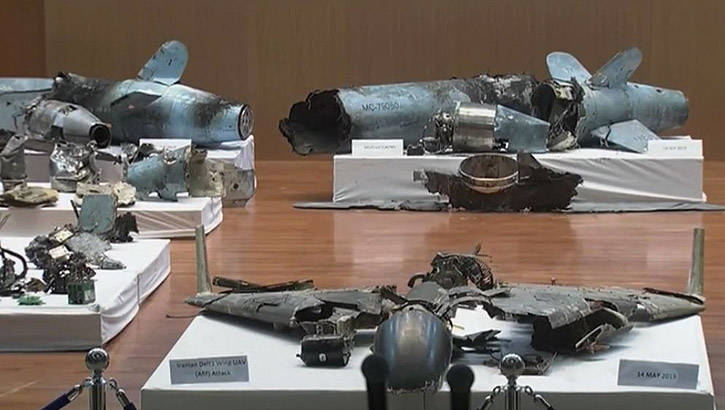
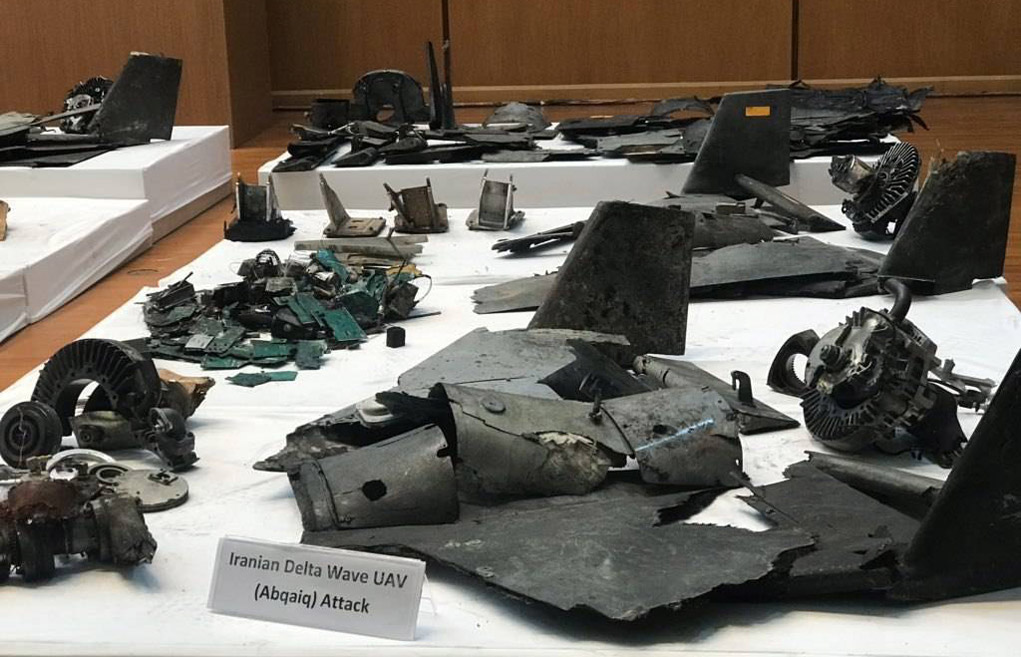
The US and Saudi Arabia pointed at Iran as responsible for the attack, claiming it came from Iran’s territory or from the Iran/Iraq border. On a press conference on September 18, Saudi defense officials confirmed that the weapons that performed were made by Iran. During the conference, the ministry presented the wreckage of seven delta-wing UAVs and two cruise missiles used in the attacks.
Based on the forensic evidence collected at three sites attacked (two this month and another in May this year), the Saudis determined that 18 ‘delta-winged suicide drones’ participated in the attack on the Abqaiq refinery. The exact type of drone was not disclosed. Seven cruise missiles were launched at the oil field Khurais. The Saudis claim these missiles were of the Iranian Ya-Ali type. Only four of the seven missiles actually reached their target.
Parts retrieved from the Abqaiq refinery site attacked by 18 suicide drones on the night of September 14, 2019, show a propeller-driven delta-winged drone, similar to the Iranian Toophan 2 (also known as Chamran 2)
Defence Ministry spokesperson Colonel Turki al-Maliki said in a press conference in Riyadh a total of 25 drones and missiles were launched at two oil plants in last weekend’s strikes, including what he identified as Iranian Delta Wing unmanned aerial vehicles (UAV) and ‘Ya Ali’ cruise missiles. He said the missiles are known to be used by Iran’s Revolutionary Guards and could not be used by the Houthis due to their limited range.
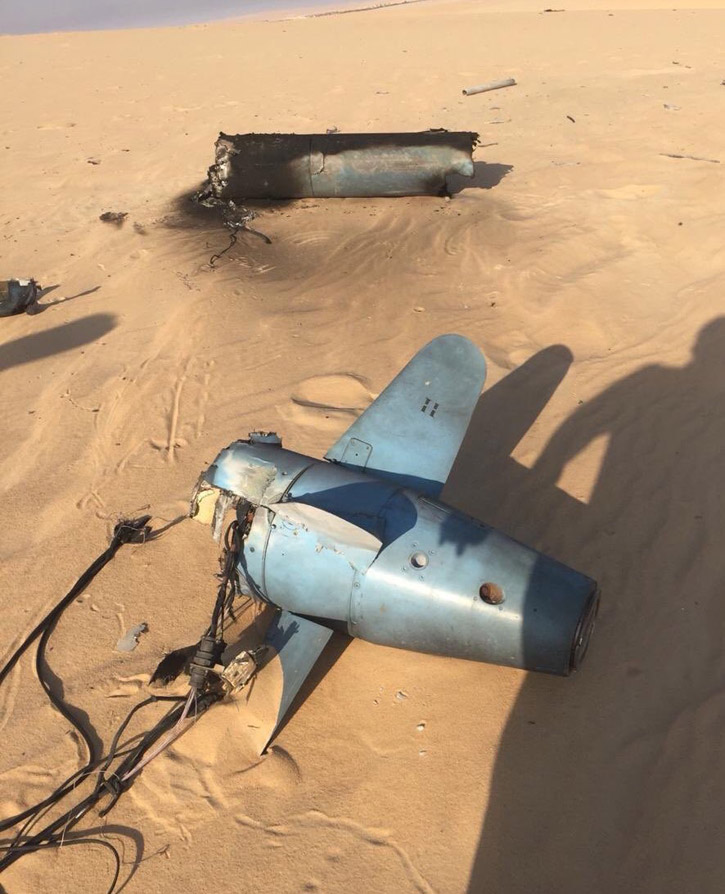
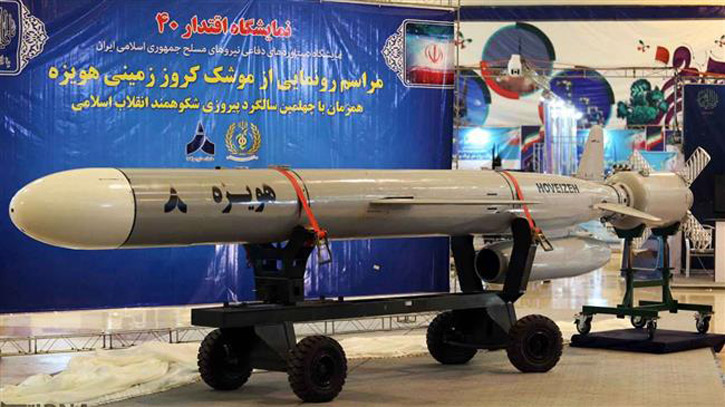
The Iranian Ya-Ali missile has a range of 700km, shorter than the range of Soumar missiles, previously indicated as culprits. Each Ya-Ali missile carries a warhead of 200 kg. However, missile parts presented by the Saudis were not similar to the Iranian Ya-Ali.
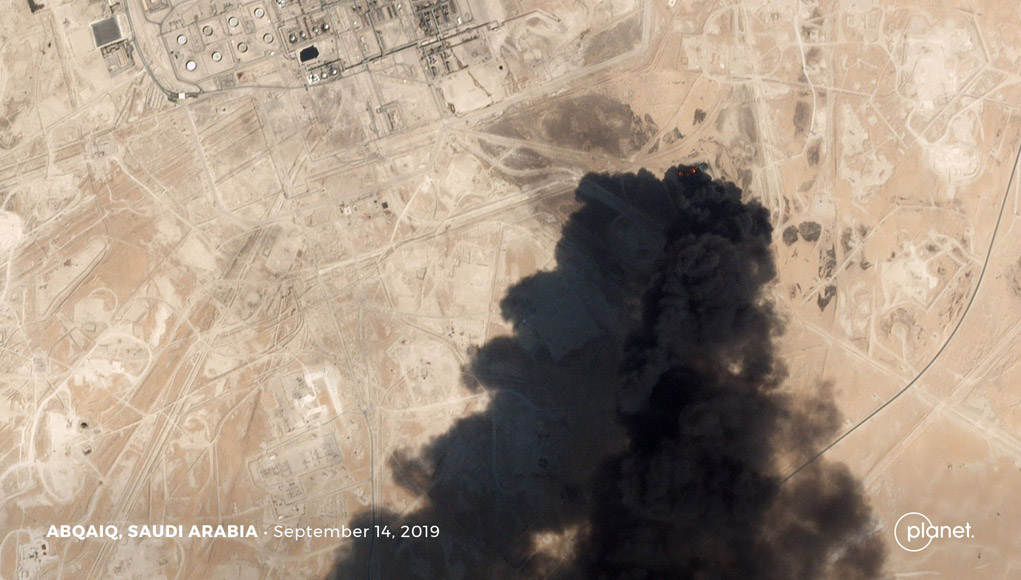
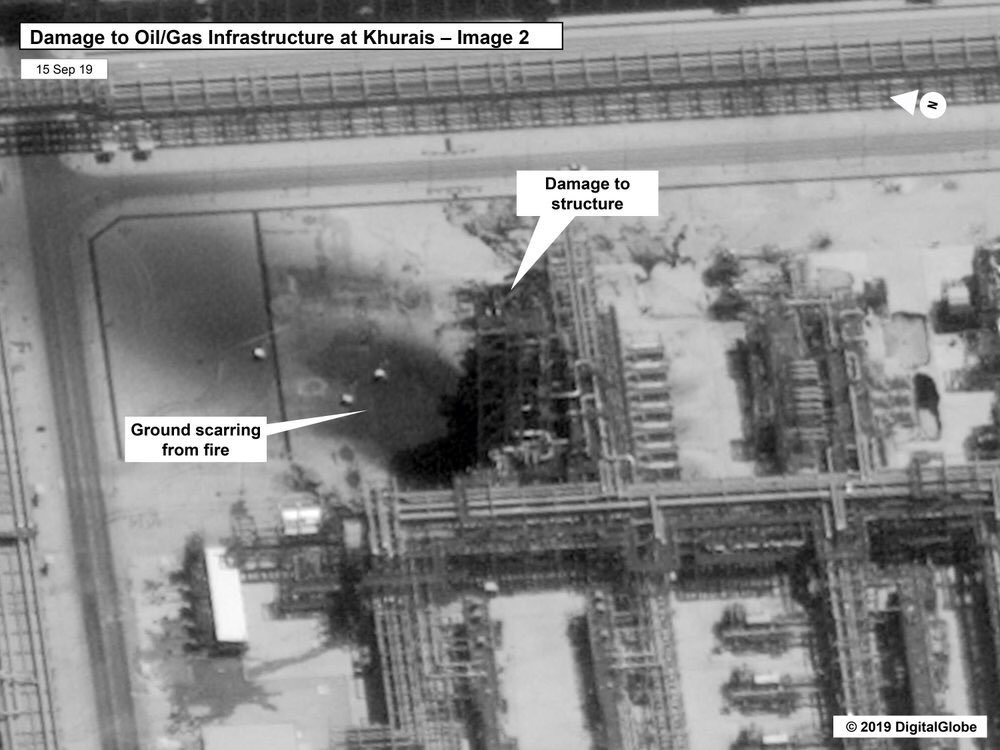
Satellite photo from September 14, 2019, shows a major fire at the outskirt of Buqyaq (Abqaiq) refinery in Saudi Arabia. Satellite Photo: PlanetDamage to structures and signs of fire are seen in this satellite image from Khurais. Photo: DigitalGlobe
According to reports from Buqayq, 12 explosions were heard around 03:00 AM local time before multiple fires erupted at the site. The fires raged at least till morning, but according to Saudi sources, by then the fires were under control. Satellite images taken on the morning of September 15th confirm the main fires were put out by the next day. Images from Khurais indicate fires at the Hawiyh gas plant, though and satellite images of that site show no open fires. No casualties were reported by the Saudi authorities. Few minutes before the attack, tweets on twitter reported loud, low flying jets in the area (Kuwait?) and ‘noise of several drones.’
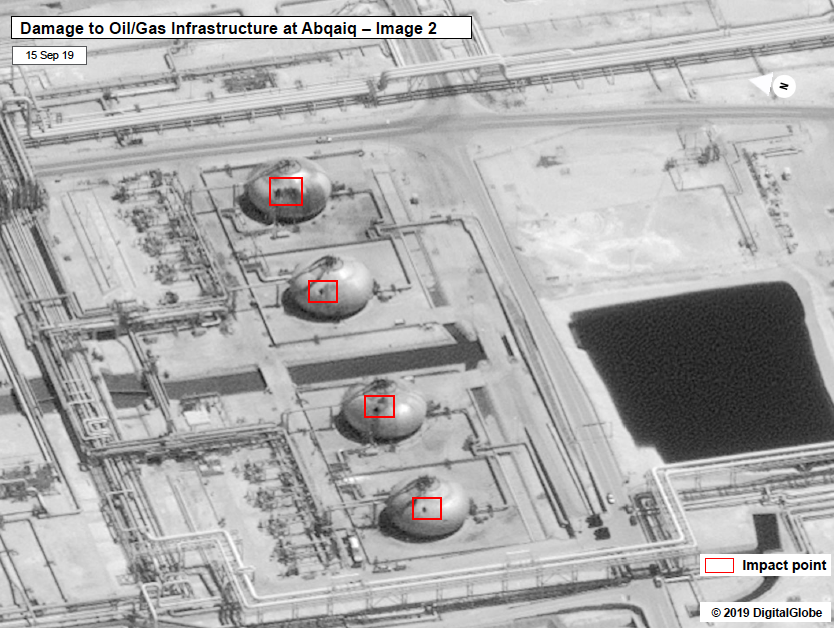
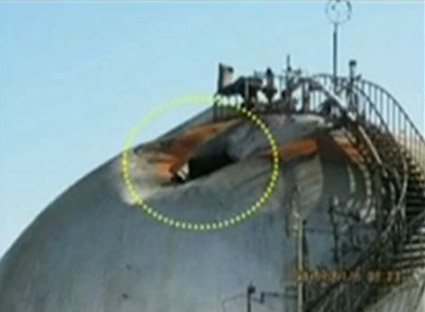
Satellite images released by the US Administrations today indicate 17 points of impact on key infrastructure at the Abqaiq, some of the impacts punctured holes in liquified natural gas (LNG) storage tanks, but, no structural damage that would be caused by a major explosion. Some of the tanks do indicate fire damages.
Punctured LNG storage tanks at Abqaiq. The damage from the September 14 attack seems to be caused by a small explosive shaped charge, (guided weapons?) rather than large cruise missiles such as the Soumar. The Iranians do have small, stealthy suicide drones that can cause such effects or drones that carry multiple PGM that would cause this damage. However, flying such drones over this protected site would be extremely difficult. Photo: DigitalGlobe.The damage inflicted by the Iranian suicide drone on the LNG tank indicates a small warhead and low speed.
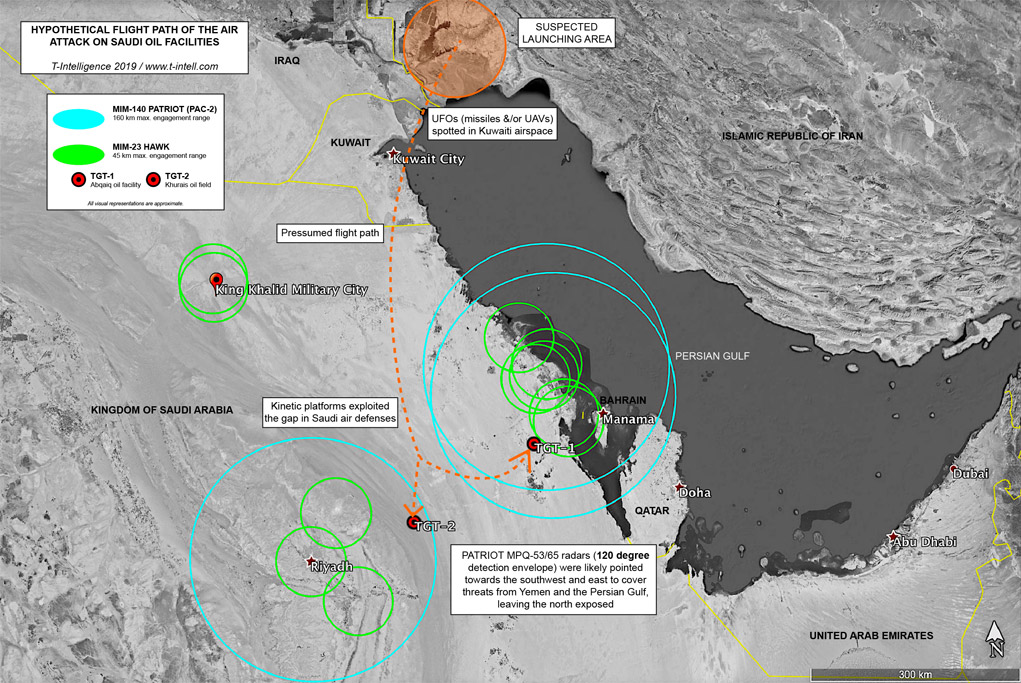
According to preliminary information, the successful attacks were made by low-flying aerial platforms, although the exact type of those platforms is yet unknown. Some speculations claim the attacks could have launched from Iraq, but this claim hasn’t been substantiated yet.
While the Houthis, who originally took responsibility, have claimed several attacks in Saudi Arabia and the UAE so far, some of them by drones, most of their attacks used ballistic missiles, and more recently, cruise missiles, alas at shorter range. So far most of which targeted the south-western region, only a few have reached as far as Riyadh and the East of the kingdom.
The US blames Iran for the strike, and current assessments are that it came from the north – i.e. – from Iraq. Nevertheless, the short-range from Iran to Saudi Arabia enables cruise missiles and drones to take a long route and reach their targets from any direction, in an attempt to circumvent the coastal-based air defenses and conceal the true origin of the attack.
The recent strike was the second attack at Aramco oil facilities in a month. On August 17th the Houthis directed a similar attack at the Shaybah oil field in the kingdom’s South East region, under ‘Operation Deterrent Balance 1’. That attack that used three unmanned aerial vehicles, targeted wells and a refinery. Saudi officials acknowledged the report admitting the attack involved three unmanned aerial vehicles that have caused ‘slight damage’ to a gas station on site. According to preliminary assessments, the recent strike was more severe and effective than past attacks, causing Saudi Arabia to announce it may have to halve the supply of sweet (refined) oil in the coming days.
Wreckage remaining from two cruise missiles retrieved after the attack on the Saudi Khurais oil field. The Saudis claim these are the Iranian Ya-Ali types.Tail parts that remained from one of the cruise missiles that crashed in Saudi Arabia and the remains of cruise-missiles shown by the Saudis do not conform to the Ya-Ali model, but to the Soumar, with much longer range.
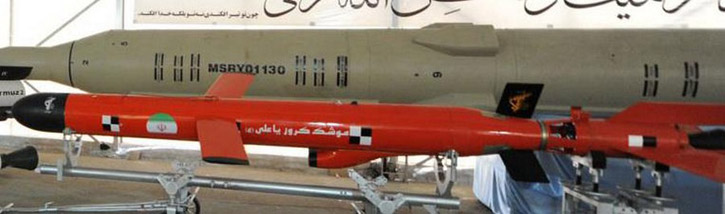
Most of the recent attacks involved Quds-1 cruise missiles. These are believed to be the Iranian built Soumar cruise missiles. Quds-1 is believed to be the Soumar, itself an Iranian developed canister stored, booster-launched surface-to-surface cruise missile. Soumar is an Iranian clone of the Russian Kh-55 obtained from Ukraine. The Iranian/Yemeni missile is powered by a small turbojet. Its claimed range is 1,350 km.
The Ya-Ali light cruise missile was unveiled by the Iranian Revolutionary Guards in public in 2014. The Saudi Defense Ministry claimed the Ya-Ali was used by the Houthis in their attack on the Abha airport on June 2019. On that attack parts similar to the Soumar were also presented.
If the recent attack was carried out by Quds-1 cruise missiles launched from Yemen, the operation indicates a step-change from previous attacks, for the simultaneous use of 10 missiles. The successful attack at an area well protected by several surface-to-air (Patriot and Improved Hawk) sites confirms the effectiveness of cruise missiles even in open and flat terrain. While at least one of the missiles have crashed on the way to the target, most of the missiles managed to break through the defenses and strike the refinery.
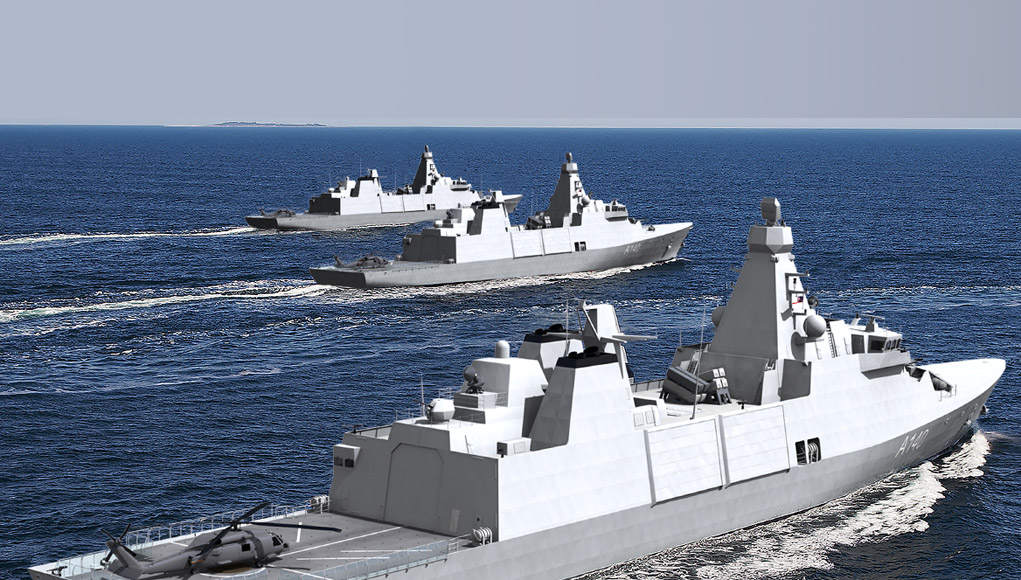
Babcock Team 31 has been selected by the UK Ministry of Defence (MOD) as the preferred bidder to deliver its new warships. Led by Aerospace and Defence company Babcock, in partnership with the Thales Group, the T31 general-purpose frigate program will deliver the Royal Navy with five light frigates, at an average production cost of £250 million per ship. The first ship is scheduled for launch in 2023. The ships follow Babcocks’s Arrowhead 140 design, balancing between global mission capability in blue or white waters, both at an affordable cost. Work on the fleet of five ships will begin immediately following formal contract award later this financial year, with detailed design work to start now and manufacture commencing in 2021 and concluding in 2027.
Delivered in parallel to the £8 billion construction of eight Type 26 multi-mission frigates built by BAE Systems, the £1.25 billion worth multi-purpose Arrowhead 140 fleet will offer the Royal Navy a more affordable class of ship tasked primarily with peacekeeping, humanitarian and low-intensity warfighting capabilities. Some of the vessels are expected to be forward-deployed in the Middle East and the Far East, hence, the need for operation with reduced crews.
Arrowhead 140 is larger than other vessels in the General Purpose Frigate market. At almost 140 m’ long, and with a 20 m’ beam, this design delivers stability supporting increased performance and safe operations, of the weapons and sensor suite, helicopter and sea-boat operations, in all sea states. A key element of the Type31 program is to provide a competitive design featuring price, capability, and flexibility to secure export orders, by leveraging the Royal Navy’s choice. The frigate is engineered to minimize through-life costs and features the open-architecture TACTICOS combat management system, an established, proven and exportable system developed and supplied by Thales to 24 navies and 182 ships worldwide. While the systems on the Royal Navy Type31 will be optimized for multi-purpose use, the Arrowhead 140 design, space, power and combat mission system is designed to take more missions, including enhanced air defense, surface, and anti-submarine warfare.
“Driven by innovation and backed by experience and heritage, Arrowhead 140 is a modern warship that will meet the maritime threats of today and tomorrow,” said Archie Bethel, CEO Babcock, adding that “It provides a flexible, adaptable platform that delivers value for money and supports the UK’s National Shipbuilding Strategy.” With Babcock’s Rosyth facility as the central integration site, the solution provides value for money and squarely supports the principles of the National Shipbuilding Strategy. It builds on the knowledge and expertise developed during the Queen Elizabeth aircraft carrier modular build program. At its height, the program will maximize a workforce of around 1,250 highly- skilled roles in multiple locations throughout the UK, with around 150 new technical apprenticeships likely to be developed. The work is expected to support an additional 1,250 roles within the wider UK supply chain.
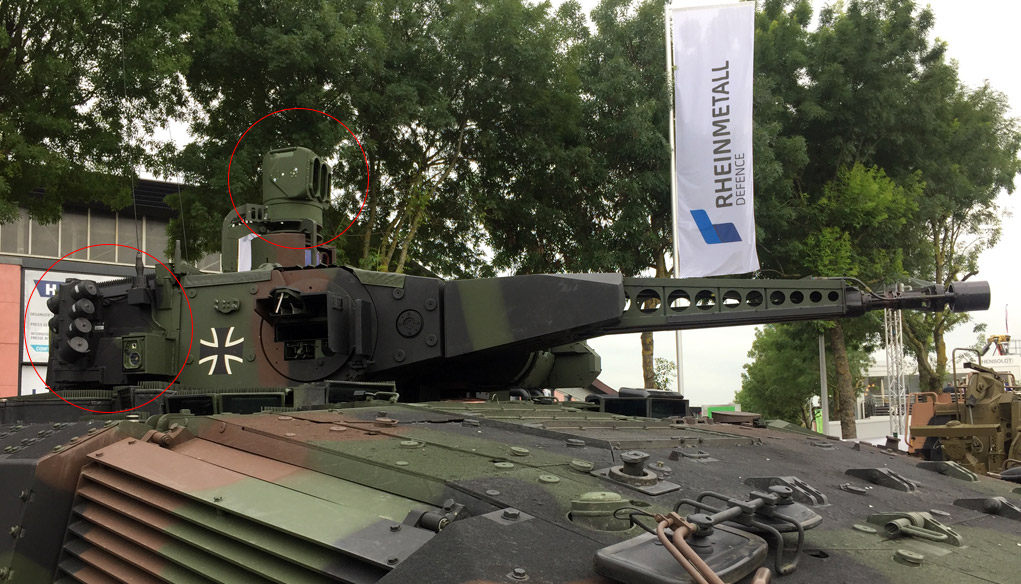
The German Army Puma armored infantry fighting vehicle showing the MUSS system elements with jammer mounted on top of the commander's sight,one of four sensors on the side and smoke launchers at the rear. The Puma was display by PSM at Eurosatory 2018
The HENSOLDT company has delivered the 300th active protection system (soft kill) equipping the German Puma infantry fighting vehicle. In total, the company is under contract to deliver 342 MUSS equipment sets by 2020 to PSM, the vehicle manufacturing JV.
MUSS has also been selected for testing by the UK Defense Science & Technology Lab (DSTL) under the MEDUSA APS study, delivered by QinetiQ in the UK and Australia. In addition, MUSS was successfully integrated by BAE Systems onto its version for the British Army Challenger 2 MBT modernization capability and extensively trialed by serving British Army personnel during the Op User Trials.
Similar defensive aid systems (DAS) used on aircraft and helicopters, soft-kill APS such as MUSS increase the platform’s level of protection without adding significant weight. MUSS drastically reduces the likelihood of a hit by antitank guided missiles or laser-guided ammunition. It achieves a level of protection which is not possible for the same total weight with passive armor while avoiding collateral damage.
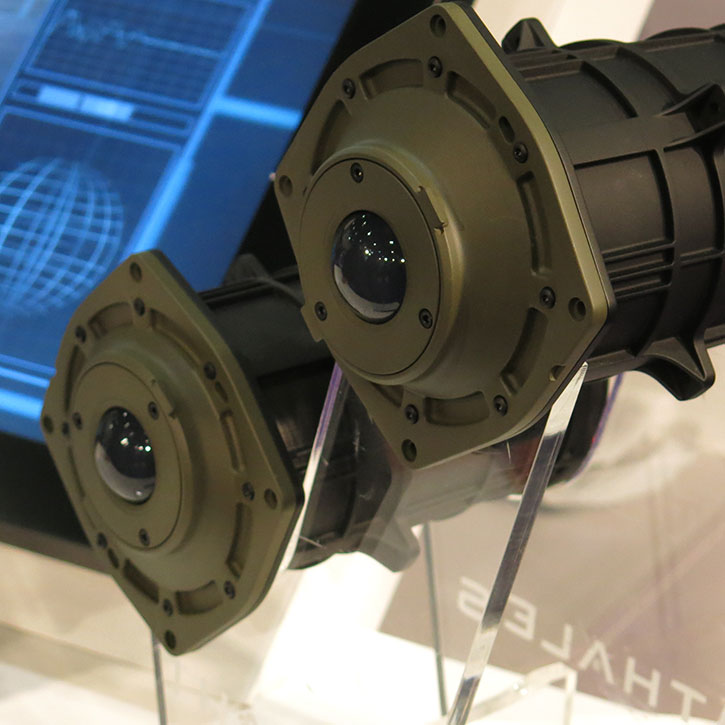
Elix-IR threat detection sensors are part of the new protection system for the RAF Shadow R1. Photo: Defense-Update
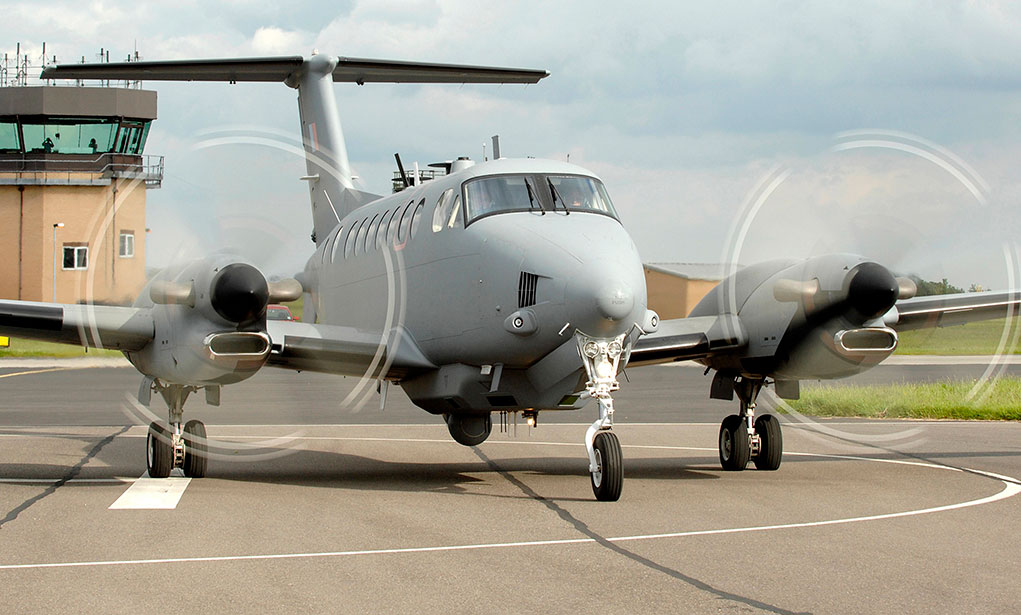
The UK Ministry of Defence has chosen Leonardo/Thales protection system to protect the RAF Shadow ISTAR fleet. This single-source selection by the MOD follows the recent SALT III international trials hosted by the Swedish Defence Materiel Administration in Sweden. There, the integrated Miysis/Elix-IR system, using a jamming waveform developed by the UK MOD’s Defence Science and Technology Laboratory, proved its ability to defeat Infra-Red missiles in live-fire exercises.
The UK Ministry of Defence has chosen Leonardo and Thales, under a single-source procurement, to deliver an integrated Defensive Aids System (DAS) under an Urgent Capability Requirement, equipping the eight RAF King Air 350CER Shadow R1 aircraft. The new system will enhance the protection of those intelligence, surveillance, and reconnaissance (ISR) aircraft that have been exposed to advanced, latest generation heat-seeking man-portable air defense systems (MANPADS) and another surface to air threats. The UCR will be delivered by a combined MOD/Leonardo/Thales team under a Leonardo prime systems integration contract, with the equipment being integrated with the platform by Raytheon UK. Initial Operating Capability is targeted for early 2021.
The suite consists of a combination of four elements – a threat warning and defensive aids system, comprising a DIRCM and countermeasures dispenser. Thales’ Elix-IR threat warning system was selected, with the Miysis Directed Infra-Red Countermeasure (DIRCM) from Leonardo and the Vicon countermeasure dispensing system, also from Thales.
Elix-IR is constantly on the lookout for missile and gunfire threats, providing long-range, rapid and accurately-located alerts when they occur.
The DAS Controller is able to assess multiple threats to the aircraft and prioritize the appropriate response using the Countermeasure Dispensing System (CMDS) and Miysis DIRCM.
The Miysis DIRCM from Leonardo provides an agile and effective countermeasure against most known heat seeking missiles. It operates with flare dispensers providing the conventional countermeasures against such missiles.
The dual-head fit of the Miysis DIRCM provides 360-degree protection and the ability to defeat multiple threats simultaneously by accurately directing a jamming laser onto the missile’s seeker, confusing its guidance system and steering the missile away from the aircraft. The integrated and optimized threat-warning/threat-defeat chain ensures that sequential incoming missiles are thwarted quickly and effectively.
The British Royal Air Force (RAF) has selected Leonardo to support the next stage of their research and development program, exploring the current and future threat posed by hostile drones, and evaluating a range of technologies for counter-drone capability. The three-year program will commence in early 2020. Leonardo counter-drone technology has already seen use with the RAF and is under contract for the Italian Army and Air Force. In 2018 and 2019, following drone sightings at Gatwick and Heathrow airports, elements of Leonardo’s counter-drone technology were deployed by the RAF to allow airport operations to resume.
The rapidly evolving drone industry rapidly creates a significant challenge for organizations which need to secure themselves against the misuse of such aircraft. The RAF’s research program will inform how the Air Force will respond to current and future threats, and keep pace with technology over time, examining how operators will be able to detect, track, identify and defeat rogue drones. The study will help the RAF understand the requirements for a potential future core capability which will be able to respond to the rapidly-evolving threats posed by hostile drones.
The RAF’s research program will draw on this experience and build on previous collaborative C-UAS research to understand and meet the threat of rogue drones. In the long-run, the research and development program will help understand and inform requirements for a core RAF counter-drone capability, which would then be used to protect RAF Bases.
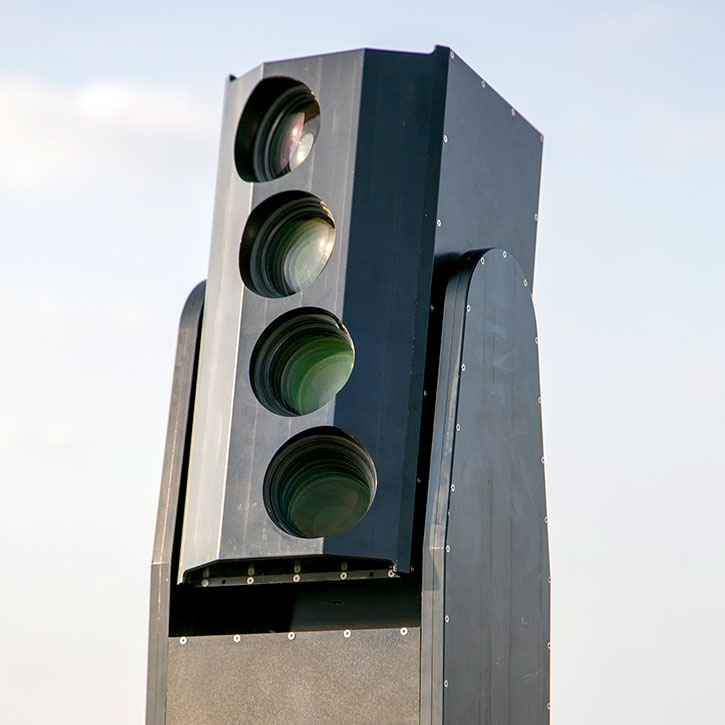
Covering 60 degrees by 10, POPSTAR is mounted on a gimballed base that enables the system to cover up to 180 degrees in high elevations. Photo: IAI
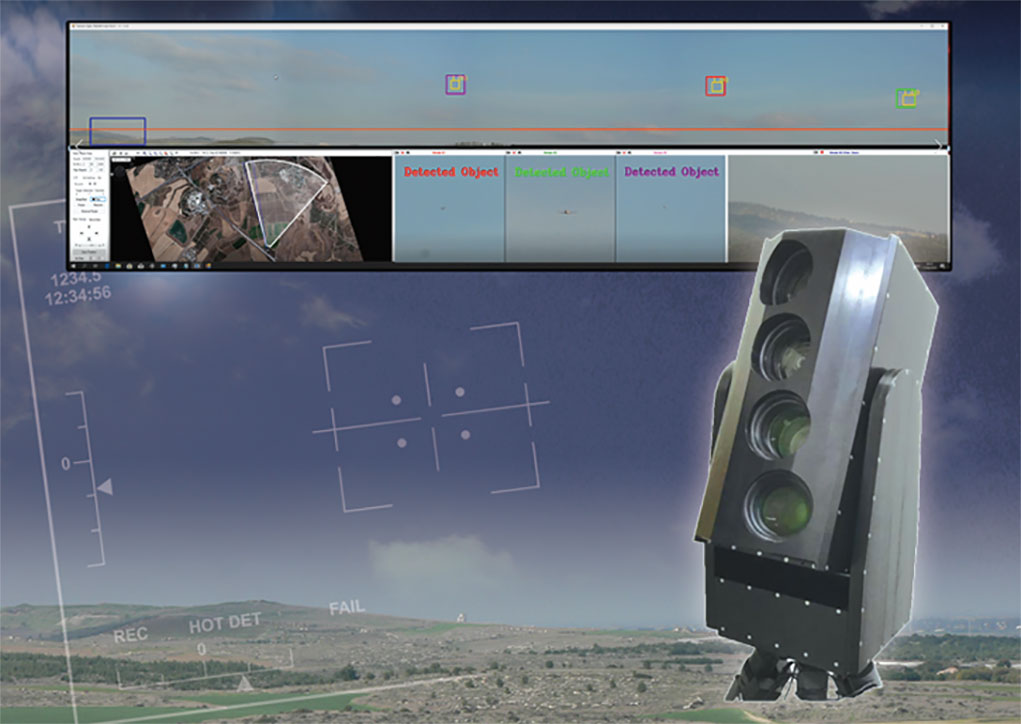
An electro-optical passive surveillance system designed by Israel Aerospace Industries (IAI) is the latest sensor innovation developed by Israel’s defense industries in their effort to contain the cross-border harassment by Palestinians militants in Gaza.
What began as innocent kites and balloons carrying messages, gradually turned to arson attacks using lighter than air incendiary devices, booby traps transferred over the border by balloons and, most recently, multirotor drones hacked into ‘flying IEDs’. All these threats utilize a known gap in situational awareness, that, until now, ignored small, slow and low targets that appeared to be what they should be – birds, balloons, kites or small drones operated by hobbyists, not improvised aerial weapons.
Named as innocent as the targets it is designed to detect, ‘POPSTAR’ uses passive EOIR sensors to automatically detect and track small, flying or moving targets in the air and on the ground, track those targets and designate the targets deemed suspicious and dangerous for engagement by countermeasures or weapons. Using multiple high-resolution cameras operating in the visual, low-light and IR, POPSTAR performs continuous surveillance of a wide area, in daylight and at night. The system successfully completed an operational evaluation and was demonstrated to customers in Israel and abroad.
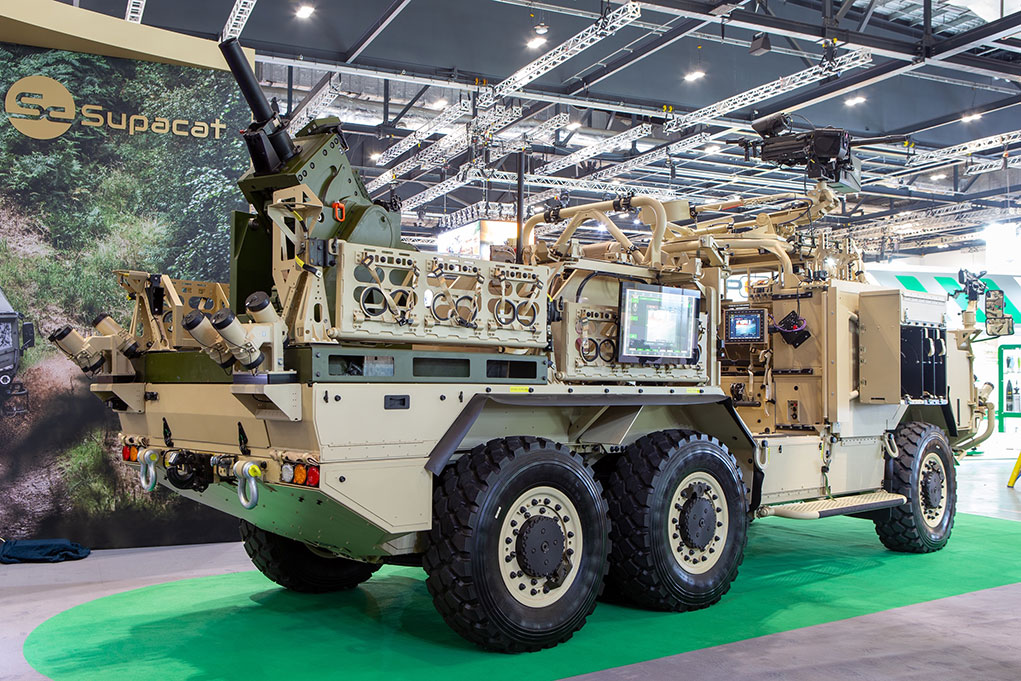
High Mobility Integrated Fires Capability demo on HMT Extenda: Photo: Supacat
Supacat, Rheinmetall Defence and SCISYS have partnered to showcase at DSEI 2019 the ‘High Mobility Integrated Fires Capability’. A mobile fire support capability for light forces, the partnership demonstrates the system on a Supacat’s 6×6 HMT platform mounted with Rheinmetall’s MWS81 mortar system. The target acquisition and integrated fire support platform is networked with SCISYS GVA compliant platform and mission software.
The weapon benefits from the superior off-road performance of the HMT, which allow users to conduct high tempo operations and deliver indirect fire from off-road firing positions. The vehicle on display is Supacat’s HMT Extenda Mk2 Special Forces vehicle, which is made its show debut at the show.
The MWS81 mortar, used here for its first integration on a light vehicle, allows for rapid entry into firing position. The system integrates the Vingmate sight, providing target acquisition, and self-location during day and night, with targets being shared over the battlespace data network enabling Support Weapon effects to be directed precisely onto targets.
The SCISYS developed GVA compliant platform and mission software shares data and video around the platform to each crew member’s display and into the battlespace networks, enhancing shared situational awareness and speed of decision making. The displays are supplied by Leonardo. “This enhanced capability is a first for light forces and offers a solution to a number of potential requirements among the green army and Special Forces”, said Phil Applegarth, Head of Supacat.
Hybrid, Optionally Manned Autonomous ATMP
On a different venture, Supacat experiments with an optionally manned and autonomous hybrid vehicle, designed for extreme off-road mobility. The Technology Demonstrator (TD) addresses logistical requirements of dismounted forces, deployed in remote areas where vehicles are required to move in rough terrain and unpredictable routes. The Technology Demonstrator uses the Supacat All Terrain Mobility Platform (ATMP), as its base vehicle. The hybrid vehicle retains the ATMP payload carrying capacity of up to 1,600g.
The company plans to demonstrate the new vehicle’s performance at its Devon facility over the next six months and is actively seeking new mission challenges that will benchmark its performance and level of autonomy in conducting realistic tasks.
Supacat developed the TD in collaboration with the University of Exeter as part of an Innovate UK-supported Knowledge Transfer Partnership (KTP). “We have focussed our efforts on designing open system architectures, allowing extensive use of commercial off the shelf (COTS) components, which we see as key to a successful and sustainable military solution in a rapidly evolving technology sector”, explains Steve Austen, Engineering Director of Supacat parent, SC Group. “Our approach uses a common electric drivetrain, each of which can be customized through different powering options depending on the mission, range, payload, and operating environment.
“We are exploring, developing and incorporating autonomous technologies in a way that will permit the level of collaboration and control from human to vehicle or from vehicle to vehicle to be altered depending on the complexity of the work being undertaken. “Few autonomous vehicle projects focus on highly technical off-road terrain. The challenge here is to manage and reduce the volume of data needed about the unpredictable non-linear environment around the vehicle to assure effective, safe and predictable performance without having to import and export masses of data from it”, Austen noted.
The ‘optionally manned’ demonstrator utilizes a terrain detection and response system for enhanced mobility and optimized endurance, an object categorization, and response system for obstacle clearance or avoidance during technical off-road driving, which can be tailored to the capabilities of the vehicle, driver or a remote operator, and a path planning and motion behavior system using simultaneous localization and mapping (SLAM) for the navigation of lead and follow on vehicles. Use of Machine Learning, supported by Neural Networks will continue to allow the system to develop and be adapted to different off-road vehicles and applications.
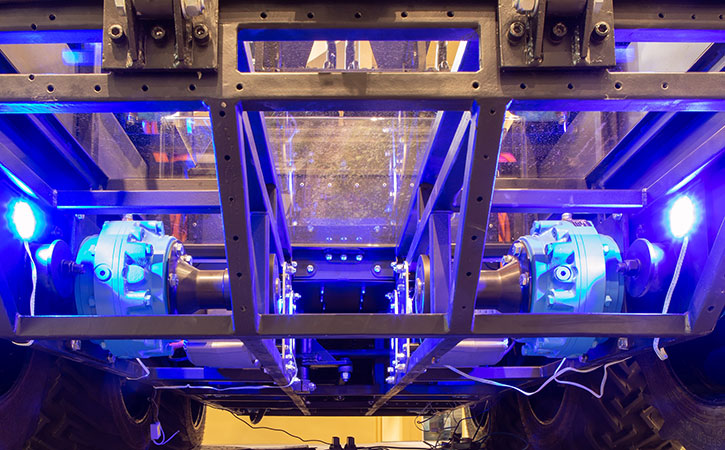
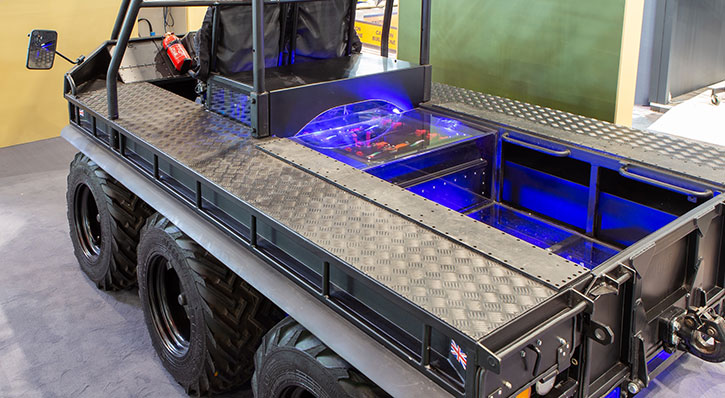
A mission profile could be a mixture of on-road and off-road operations, with a need for silent operation for a percentage of the time. The proportion of these components will determine whether series or parallel hybrid options are employed, or if full electric propulsion is needed. Photo: SupacatAs battery or fuel cell technology advances and diesel engine development responds to legislation, these options will blend into the ATMP. Photo: Supacat
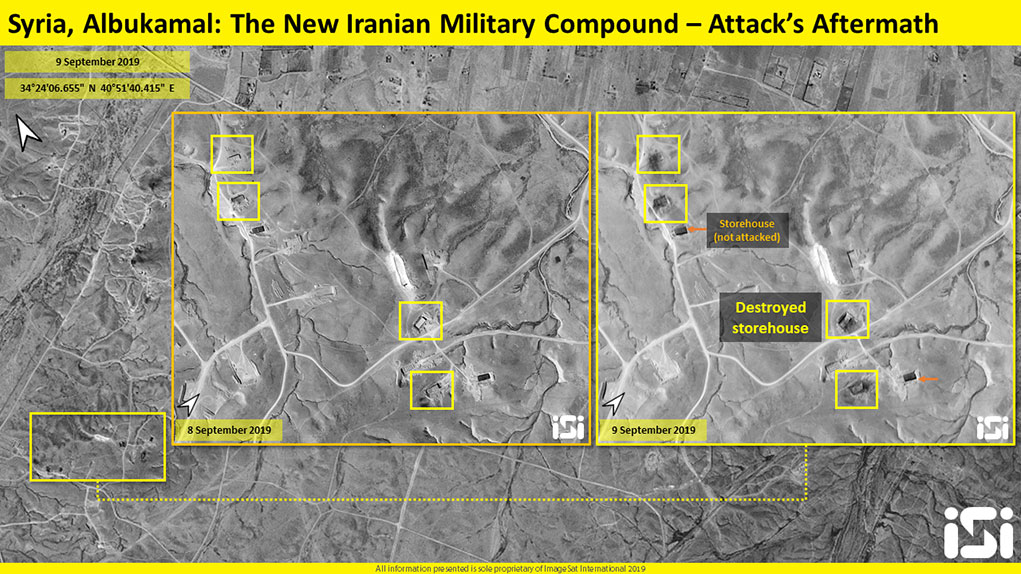
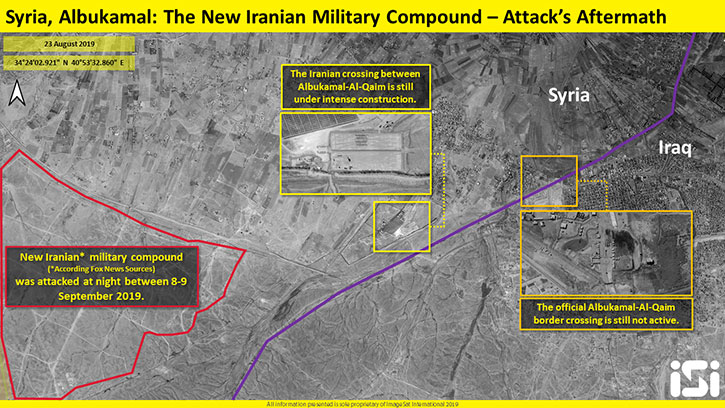
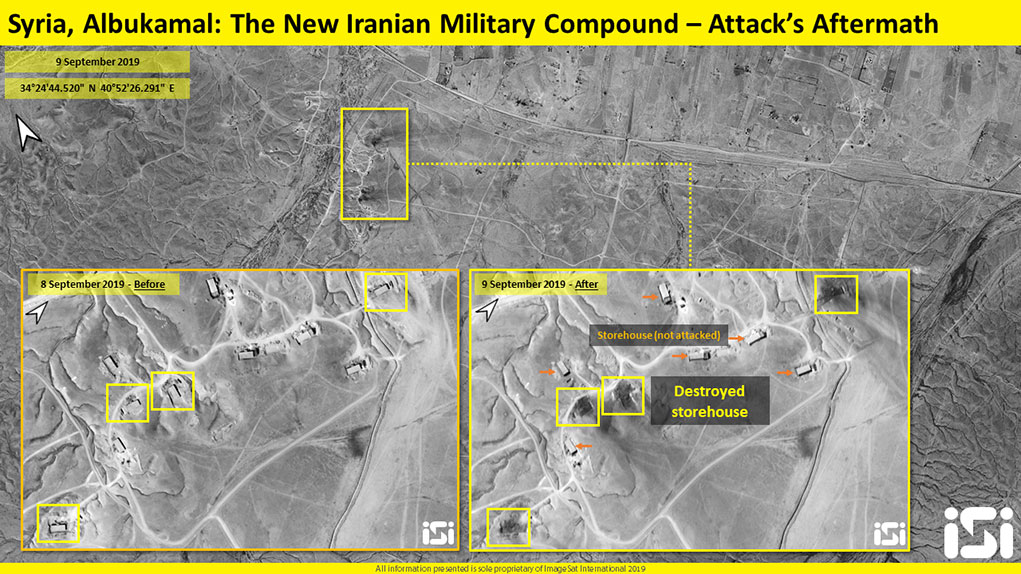
Two satellite images taken before and after the attack show the amount of damage caused to fortified structures protected by earth revetments. Photo; ISI
Few days after Fox News reported about extensive construction of a new military base near the Syrian border crossing at Albukamal-Al-Qaim, the site suffered an airstrike that destroyed some of the site’s protected structures, allegedly providing forward storage for Iranian ballistic missiles. The new site, like others, that recently struck in Iraq and Syria, was manned by the Iranian sponsored Popular Mobilization Force (PMF).
An intelligence report backed by satellite images released by Imagesat International indicates extensive damage at the base, located five kilometers to the official border crossing of Albukamal-Al-Qaim, on the Syrian-Iraqi border. The satellite images were taken on the morning following the attack, show damages in two storage areas. Some of the structures have been completed, others were under construction. Some of the targets indicate marks of residual fires caused by ordnance or ammunition.
According to Fox News, the facility would be used to house thousands of troops. The classified Iranian project, called the Imam Ali compound, was approved by the top leadership in Tehran and is being completed by the Iranian al-Quds Forces. Using a civilian satellite company, Fox News verified the information and obtained images that show a base being constructed on the Syria-Iraq border.
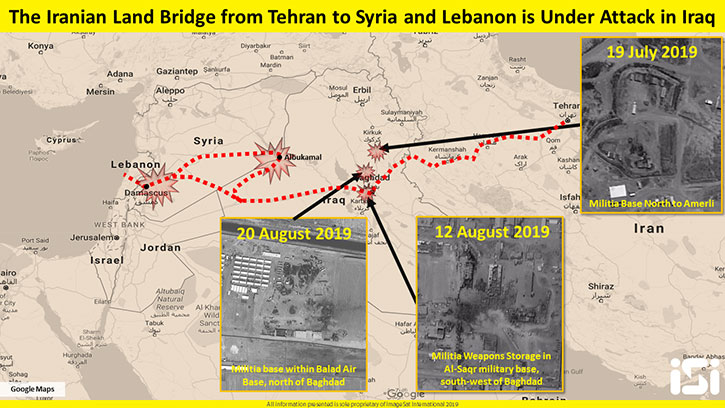
If indeed it is an Iranian base, it is probable that the strike is part of the struggle with Tehran to prevent the establishment of a land corridor from Iran to its allies in Syria and Lebanon.
Some of the recent attacks attributed to Israel, along the Iranian ‘land bridge’ from Iran to Lebanon. Map: ISI
Fox quoted analysts at Image Sat International (ISI) who reviewed the images say that precision-guided missiles could be housed at five different newly constructed buildings that are surrounded by large dirt mounds. Other facilities, located in the northwest part of the base, have less external protection. The analysts said that construction could be completed over the next few months and the base would be operational shortly after.
On the night of September 8-9, an air attack was directed at the base, destroying some of the heavily protected storage facilities likely prepared for the missiles. Local observers reported several people were killed in that attack. Since mid-July, five arms depots and training camps belonging to the Popular Mobilization Forces have been targeted in apparent attacks. The PMF has blamed both Israel and the US for the recent string of blasts and drone sightings at its bases but Israel and the US have not responded to these allegations.
A satellite image showing the general area of Abulkamal al Qiam, both new (not yet operational) Syrian facility and nearby Iranian installation, also under construction. Photo: ISIThe second target group at Abulkamal al Qiam, struck on the night of 8-9 September. Photo: ISI
A tank destroyer platform based on the K9, carrying 24 Brimstone missiles. Photo: MBDA
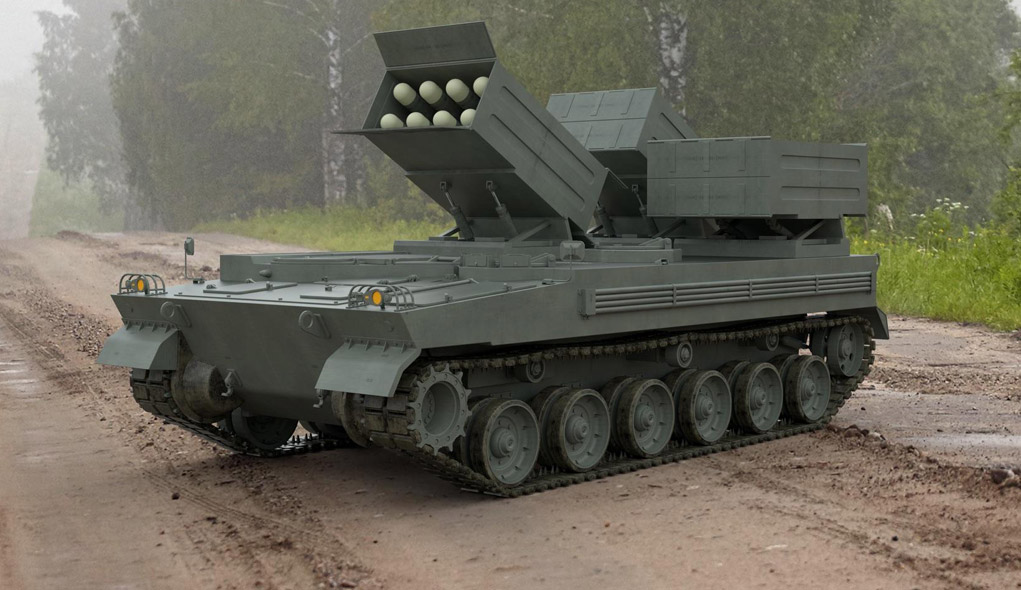
MBDA and the Polish defense enterprise PGZ have unveiled at MSPO 2019 two configurations of tracked tank destroyers armed with Brimstone precision strike missiles. The initiative comes in response to Poland’s requirement for a Tank Destroyer able to counter massed armor formations on its Eastern border with Russia. The Polish Army currently operates BRDM-2 wheeled vehicles carrying four 9P133 Malyutka (Sagger) remotely controlled anti-tank missiles.
These vehicle and missiles are both considered obsolete, as the engage targets at short range (up to three kilometers) and require continuous guidance, making the launch platform extremely vulnerable. The tank destroyer destined to replace these assets would be able to engage targets beyond line-of-sight and at extended range, thus covering a larger area with improved survivability and combat effectiveness. HSW and Obrum have both announced plans to compete for this opportunity.
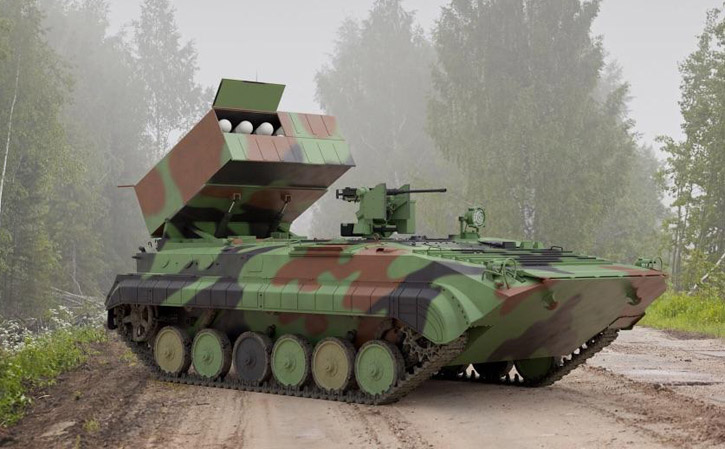
The two variants introduced with the recent announcement include tracked vehicles carrying 12-24 missiles in self-contained launch modules carrying multiple missiles. One platform is the BWP-1, based on a locally modernized BMP-1 Puma modernized infantry fighting vehicle. This vehicle carries one launch module containing two stacks of six missiles (for a total of 12 missiles). The launcher is elevated before launch, providing optimal position for line-of-sight and beyond-line-of-sight engagement.
The BWP-1 tank destroyer platform proposed by PGZ carries 12 Brimstone missiles. Photo: MBDA
Another platform provided by HSW SA and Obrun is the K9 chassis used with the Krab self-propelled howitzer. This larger vehicle accommodates three launch modules containing eight missiles each (for a total 24 missile count). The missiles rely on targeting data relayed to the vehicle over standard secure military networks, fully interoperable with NATO. The Brimstone supports long-range, all-weather performance, against stationary and moving targets. It has the ability to defeat targets defended by active protection systems (APS), by using salvo-firing.
Other candidates for the tank-destroyer program at MSPO2019:
According to MBDA, the flexible integration and ease of integration with the existing Polish targeting systems make multiple types of Polish platforms available for the Brimstone integration in various configurations. These including platforms from WZM SA, HSW SA, and Obrum.
“Pairing the combat-proven MBDA Brimstone missile with the diverse range of current and future Polish platforms provides the ability to deliver rapid military capability for Poland and for wider markets, whilst strengthening our co-operation with PGZ Group on missiles.” Adrian Monks, MBDA Sales Director in Poland, said. On that occasion, PGZ Companies and MBDA have signed a statement of co-operation to confirm readiness to co-operate on offering this solution to Poland and export markets. Under the agreement, MBDAs is ready to transfer Brimstone missile technology and know-how to Poland, with MESKO SA to be responsible for missile production.
According to Monks, Brimstone’s flexible platform approach provides armed forces users with a “one missile, multiple platform” capability, for surface launch, fast jet, remotely piloted air systems (RPAS), attack helicopter, land, and maritime platforms, all utilizing the same missile.
Widely used in recent combat by coalition forces in Syria, Libya, and Afghanistan, Brimstone has proved to deliver effective, surgical strikes in time and collateral critical missions.
Designed with a friendly, ’Point & Shoot’ interface developed by General Robotics, managing the robot inside a building is simple and intuitive. Photo: General Robotics by Oren Cohen
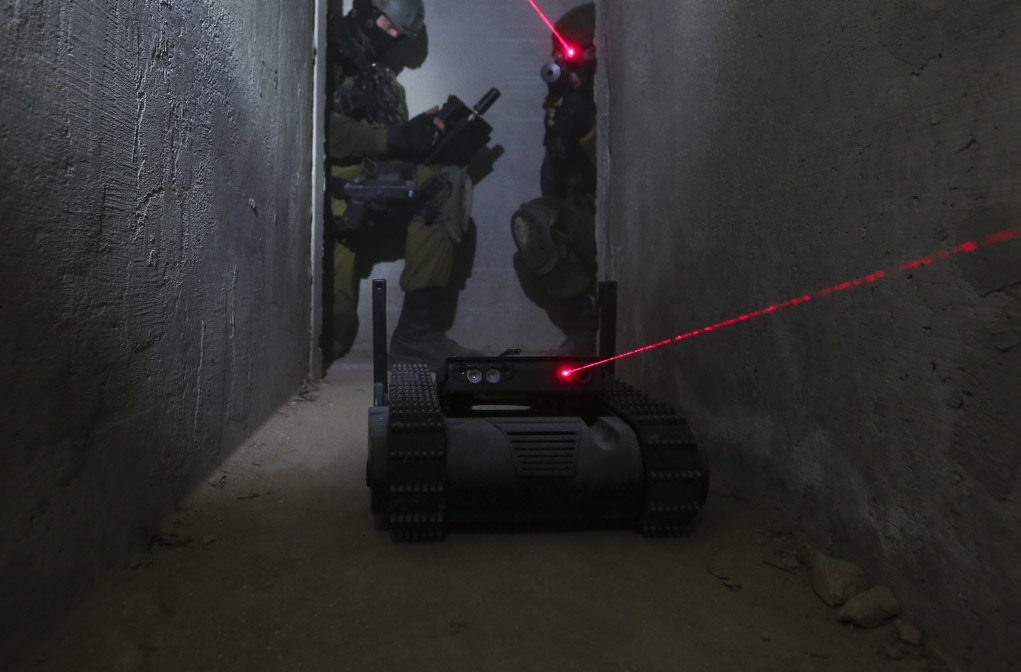
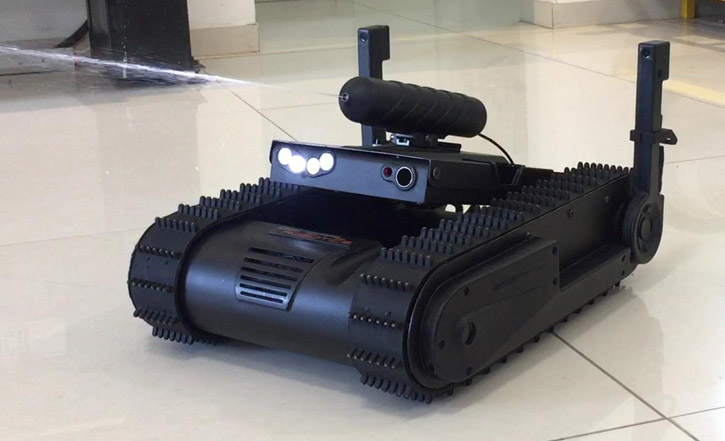
General Robotics brings the new Dogo Mk II tactical robot to DSEI 2019. The new robot is optimized to assist SWAT teams and close-quarters combat (CQB), inside buildings and underground. With a faster Point & Shoot interface, DOGO can accurately move, designate and use lethal or non-lethal means simply by clicking on the screen.
According to Shahar Gal, CEO of General Robotics, until now the robotics market was dominated by robots that were designed to handle explosives (EOD). “Technological advancements now make robots more responsive, accurate and lethal without compromising safety.”
According to Gal, DOGO is used by special forces and SWAT and close quarter combat (CQB) operators, as a means of surveillance and as a pioneer, sent into a fatal funnel to provide situational awareness and remote engagement capability thus increase the survivability of the entire team. Until DOGO, the only way to obtain such capabilities was to send a team member into the potentially deadly situation, risking them suffering enemy and friendly fire.
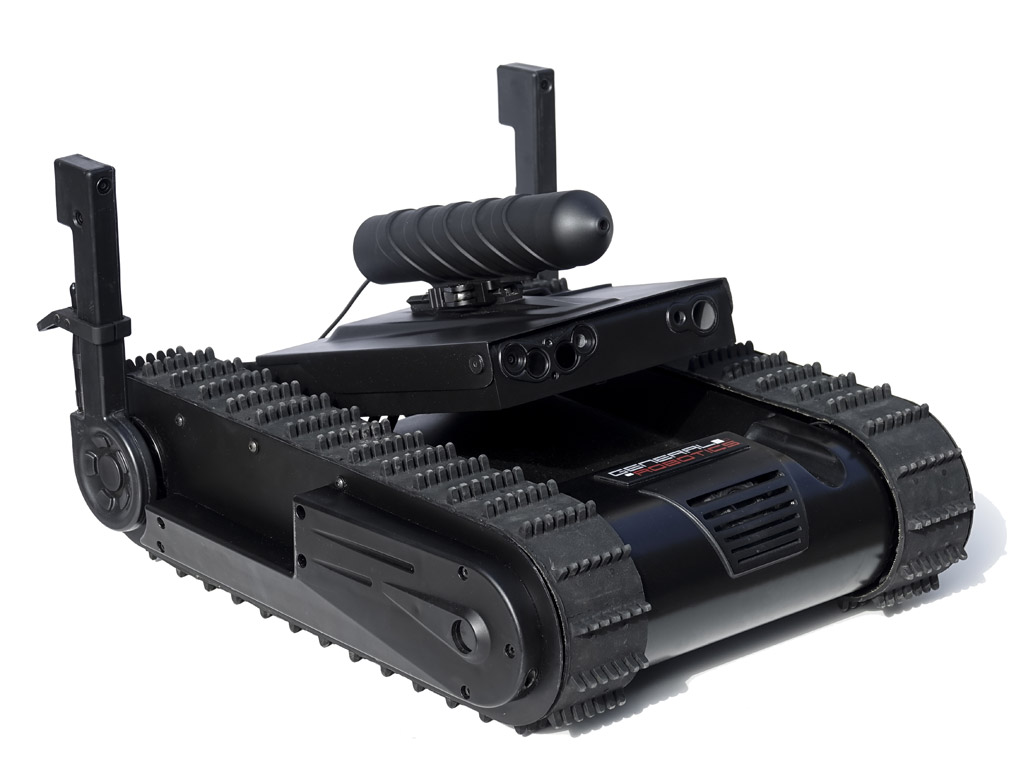
Weighing 12 kg, Dogo Mk II has two front extenders, enabling it to overcome obstacles and stairs, using a stair climbing mechanism. Photo: General Robotics
Designed with a friendly, ’Point & Shoot’ interface developed by General Robotics, managing the robot inside a building is simple and intuitive. I was able to control the robot across several rooms and corridors, spot and track targets and shoot, after a few minutes of training.
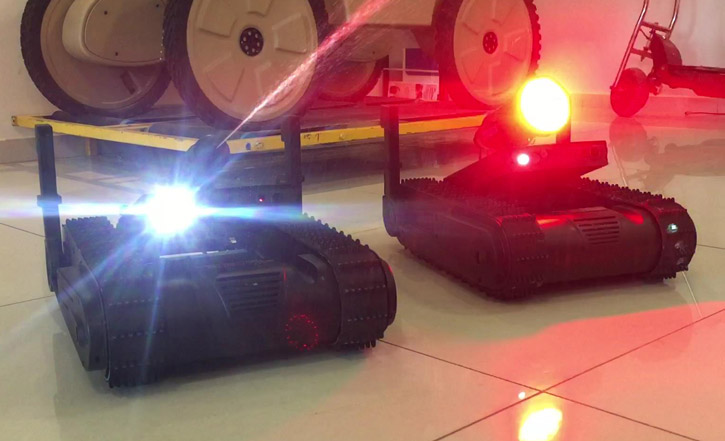
Weighing 12 kg, Dogo Mk II has two front extenders, enabling it to overcome obstacles and stairs, using a stair climbing mechanism. The robot includes eight video cameras that provide 360° live video and boresight views and can communicate in hostage situations. As an unmanned element spearheading the assault team Dogo Mk II can be equipped to carry both non-lethal pepper spray, or dazzling light module attachments, effective at a range of five to 10 meters.
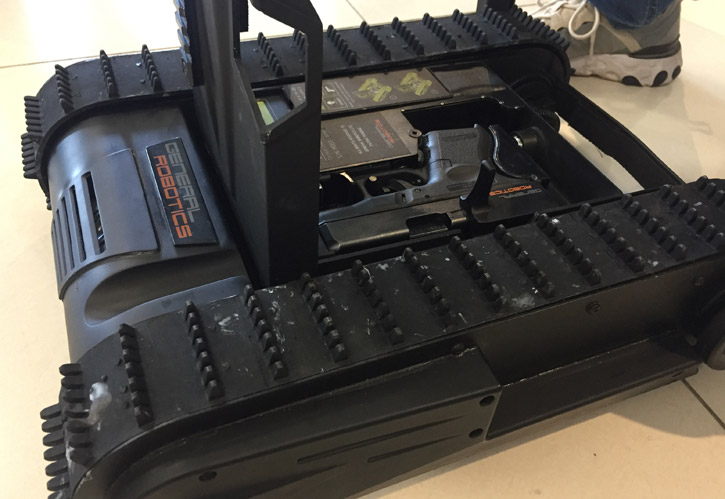
DOGO MK II It also retains the integral pistol mount, enabling the user to engage targets with lethal fire. Photo: Defense-Update
It also retains its integral pistol mount, enabling the user to engage targets with lethal fire. DOGO also has a built-in loudspeaker and mike to enable the combat team to picket and negotiate with the suspect or hostages. The robot uses a laser designator and Near IR illumination to operate in dark or underground spaces.
According to Gal, DOGO Mark II has already been delivered to special forces among which are NATO members and has been pre-ordered by several other customers.
The dazzler is effective particularly in a dark enclosure’ using high-intensity flashing light and noise to distract a target at distances up to 10 meters. Photo: Defense-UpdateThe pepper spray non-lethal effect module is effective to five meters. Photo: Defense-Update
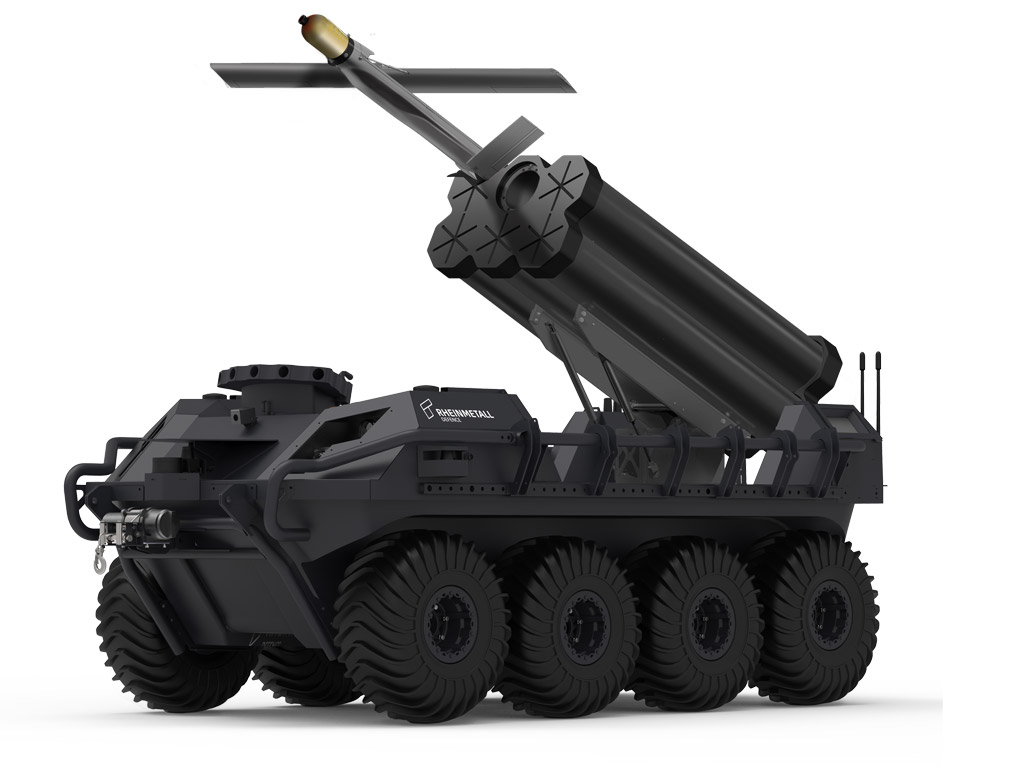
Rheinmetall has partnered with WB GROUP of Poland to provide dismounted troops with high precision strike capabilities using loitering munitions, by integrating Rheinmetall's 8x8 all-terrain Mission Master UGV with WB's WARMATE Loitering Munition System. Photo: Rheinmetall
Rheinmetall has partnered with WB GROUP of Poland to provide dismounted troops with high precision strike capabilities using loitering munitions. Rheinmetall and WB are displaying a new version of Rheinmetall’s 8×8 all-terrain Mission Master UGV carrying the WARMATE Loitering Munition System. Operators can command both the Mission Master UGV and the WARMATE, from a mobile ground control station. Rheinmetall Command and Control Software can be installed in the user’s battle management system, including the standard handheld control unit, used with the Rheinmetall’s Argus.
Rheinmetall has already integrated rocket launchers and a remotely operated weapon station on the Mission-Master. The addition of WARMATE micro combat unmanned air vehicle (UAV) opens up a range of new offensive and observation capabilities.
As an unmanned aerial observation platform Warmate can be used for scanning the battlefield, detecting and determining exact enemy positions. Using the system in its loitering weapon capacity, users can pursue and attack those targets. When an attack is aborted, the WARMATE can be recalled, continue loitering, or be directed at another target.
Given the Mission Master’s payload capacity, the UGV can be loaded with six WARMATE launch tubes that can be used in individual attacks or as a coordinated ‘flock’ of guided loitering munitions.
“The use of micro combat UAVs on our Mission Master UGVs is an incredible opportunity for ground commanders,” says Alain Tremblay, Rheinmetall
Canada’s vice-president for business development. “Being able to observe hidden targets and conduct precise identification before initiating a surgical strike with minimal collateral damage is a real tactical advantage on today’s battlefield. And since both the Mission Master and the WARMATE are able to conduct certain autonomous operations, it reduces the number of military personal required and lets troops focus on mission success”, explains Tremblay.
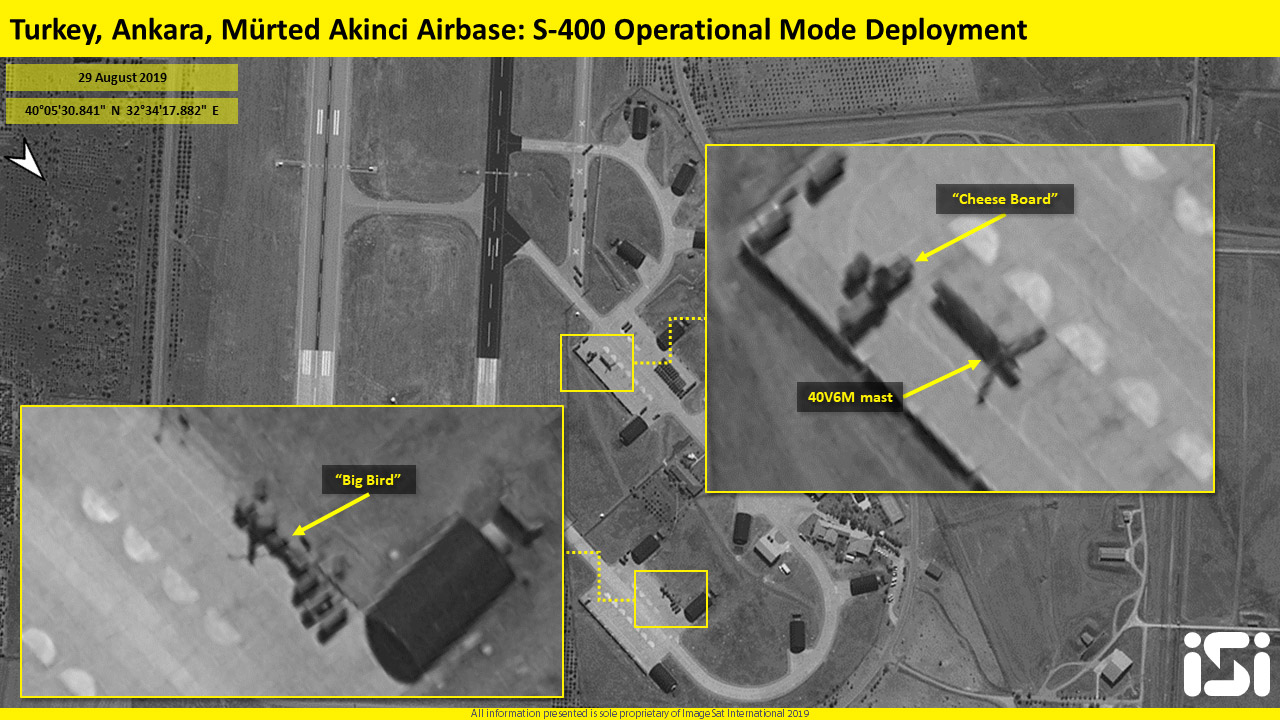
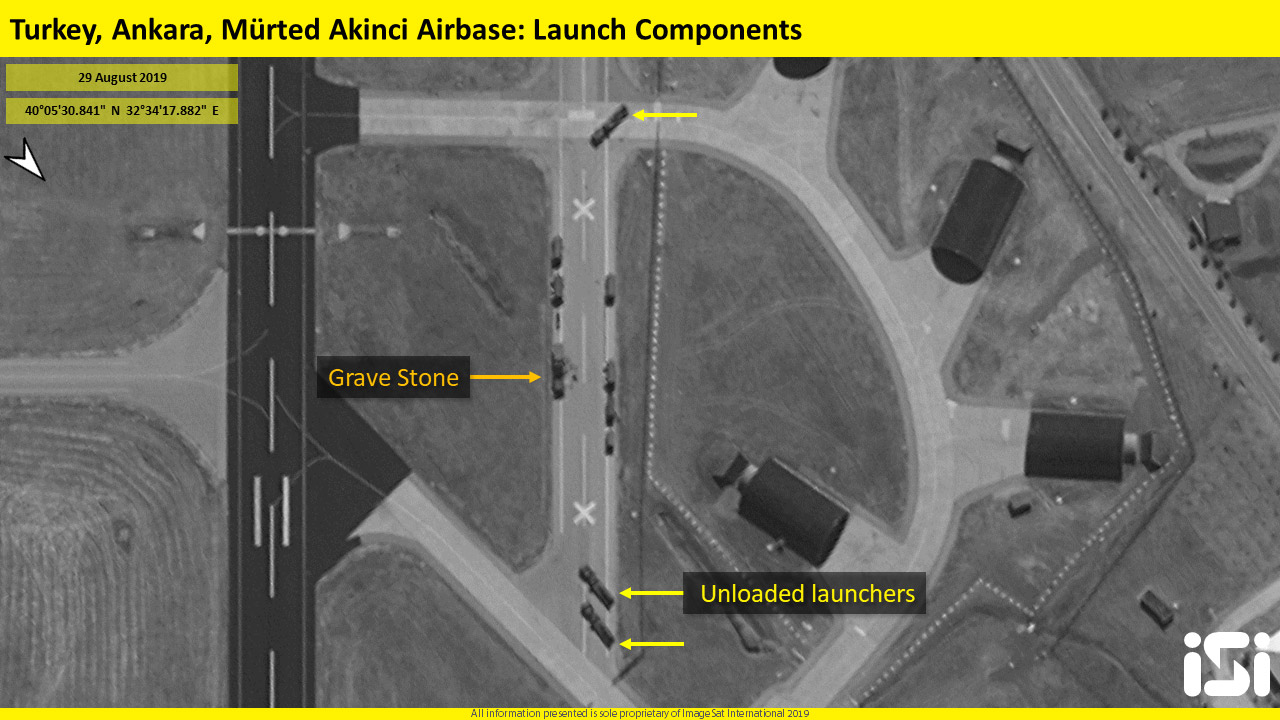
Magnification of the image showing some of the S-400 radars. Photo: ISI
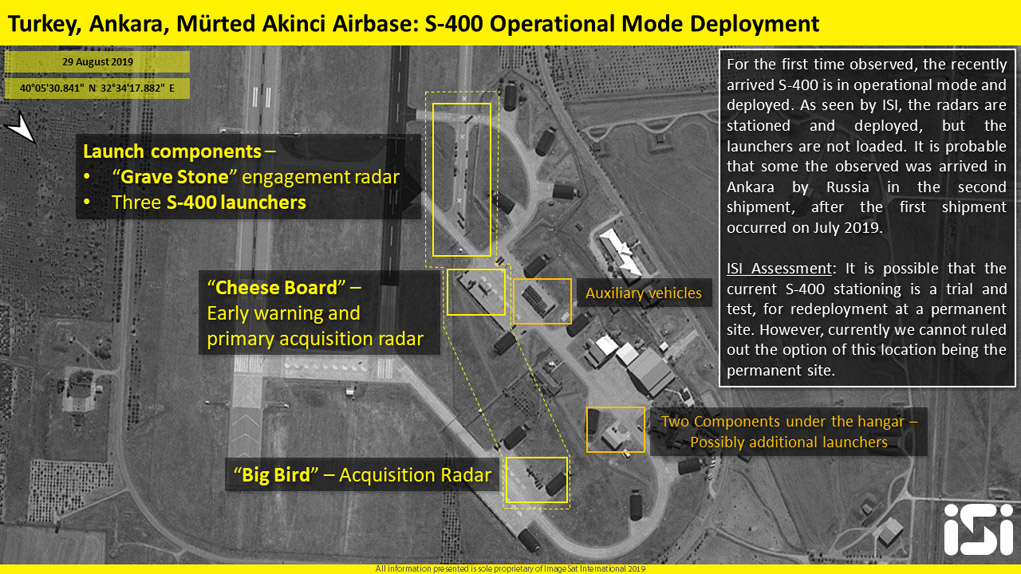
ImageSat International – ISI released today an intelligence report indicating what seems to be the first deployment of the new Turkish S-400 air defense unit. The deployment spotted on August 29, 2019, at Murted Akinci airbase in Ankara shows the S-400 battery in an operational mode deployment, including radars (‘Grave Stone’ engagement radar and ‘Cheese Board’ early warning and primary acquisition and ‘Big Bird’ acquisition radars), communications equipment, and missile launchers (on this event the launchers were not loaded with missile canisters). The first shipment of the S-400 unit was delivered by Russia in July, followed by a second shipment delivered in late August. According to the ISI intelligence assessment, the deployment at the airbase could be a trial before the unit is delivered to its permanent site. Photos and report Courtesy of: ImageSat International – ISI
Magnification of the image showing some of the S-400 radars. Photo: ISI
Visiting the UMEX & SimTEX 2026 exhibition taking place at the ADNEC Centre in Abu Dhabi this week, a new system caught our attention. Slovenian company Carboteh has introduced an unconventional approach to protecting...
The opening week of 2026 has been defined by a singular, paradigmatic shift in modern warfare: the "catastrophic failure" of Venezuela's integrated air defense network during a U.S. special operation. The operation succeeded not through brute force, but by rendering Venezuela's Russian S-300VM and Chinese "anti-stealth" radars effectively blind, validating the supremacy of advanced electronic warfare over legacy kinetic defenses. This failure has sent shockwaves through the global defense market, underscoring why nations like Spain and Germany are rushing to modernize their air defense architectures with Western alternatives, while massive procurement programs exceeding $301 billion signal an accelerated transformation toward unmanned systems, directed energy weapons, and indigenous production capabilities.
Turkey's defense industry transformation extends far beyond its celebrated drones. Now ranking 11th globally in defense exports, Turkey is executing a comprehensive strategy to become a top-tier arms supplier. With 75% of exports flowing to Western markets and five firms in Defense News' Top 100, Turkey is methodically building a complete defense ecosystem through combat-proven systems, integrated defense diplomacy, strategic self-reliance, and real-world R&D in active conflict zones.
Lockheed Martin Skunk Works® and XTEND have achieved a major milestone in JADC2 by integrating the XOS operating system with the MDCX™ autonomy platform. This technical breakthrough enables a single operator to simultaneously command multiple drone classes, eliminating the friction of mission handoffs. From "marsupial" drone deployments to operating in GPS-denied environments, explore how this collaboration is abbreviating the data-to-decision timeline and redefining autonomous mission execution.
As traditional defense primes face mounting competition from agile “neoprimes” such as Anduril, Palantir and Helsing, the balance of innovation is shifting toward software-defined warfare and scalable, dual-use technologies, while global industry consolidation—marked by Boeing’s integration of Spirit AeroSystems and other strategic mergers—signals an intensified race to secure control over the defense technology value chain. Our Defense-Tech weekly report highlights these trends.
In early October 2025, a coordinated wave of unmanned aerial system (UAS) incursions—widely attributed to Russia—targeted critical infrastructure across at least ten European nations. The unprecedented campaign exposed the fragility of Europe’s air defenses...
Executive Summary
The past week (September 18-25, 2025) represents an inflection point where strategic defense concepts have transitioned from doctrine to tangible reality. An analysis of global events reveals four primary, interconnected trends shaping an...



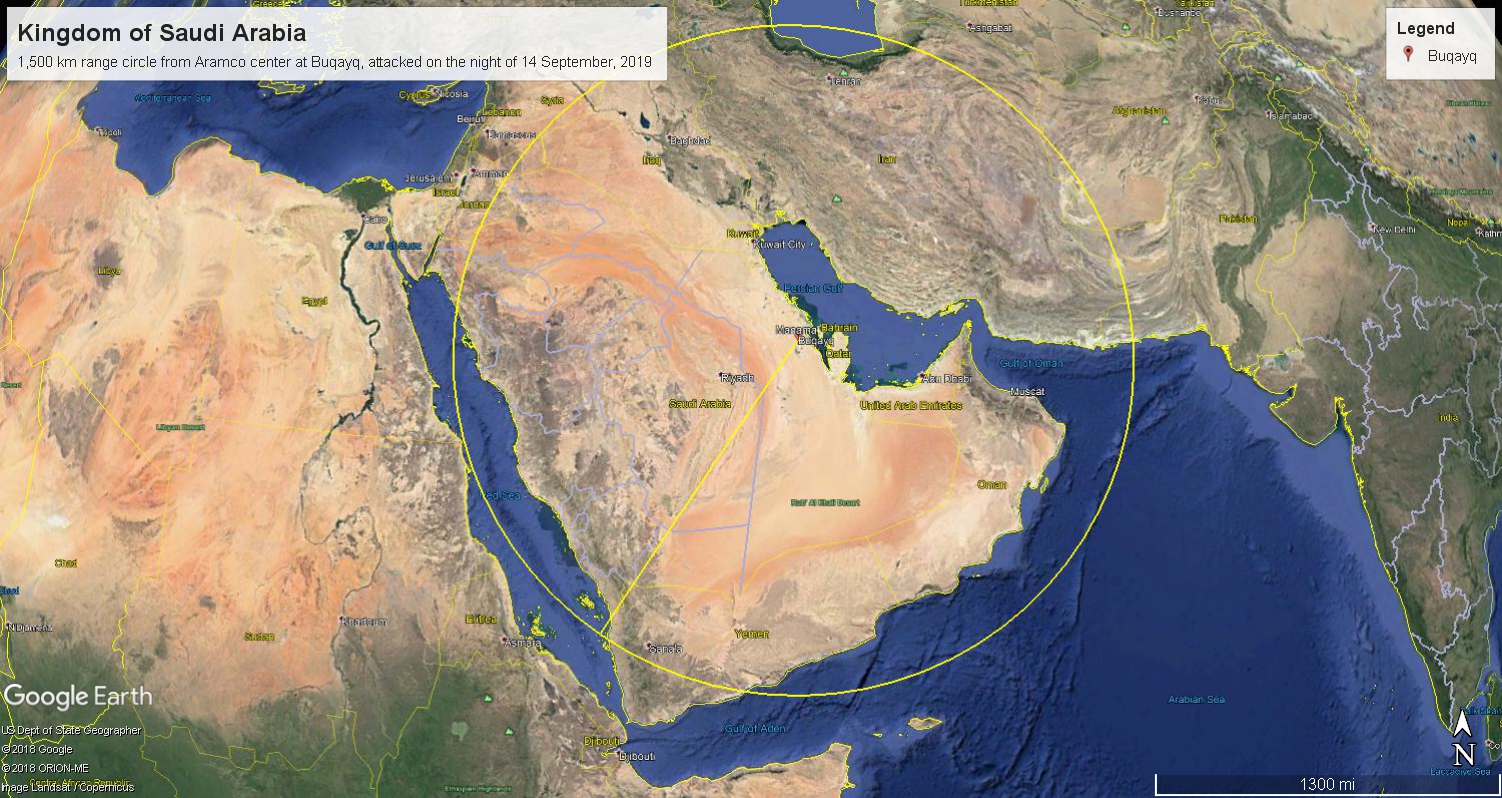 The recent strike was the second attack at Aramco oil facilities in a month. On August 17th the Houthis directed a similar attack at the Shaybah oil field in the kingdom’s South East region, under ‘Operation Deterrent Balance 1’. That attack that used three unmanned aerial vehicles, targeted wells and a refinery. Saudi officials acknowledged the report admitting the attack involved three unmanned aerial vehicles that have caused ‘slight damage’ to a gas station on site. According to preliminary assessments, the recent strike was more severe and effective than past attacks, causing Saudi Arabia to announce it may have to halve the supply of sweet (refined) oil in the coming days.