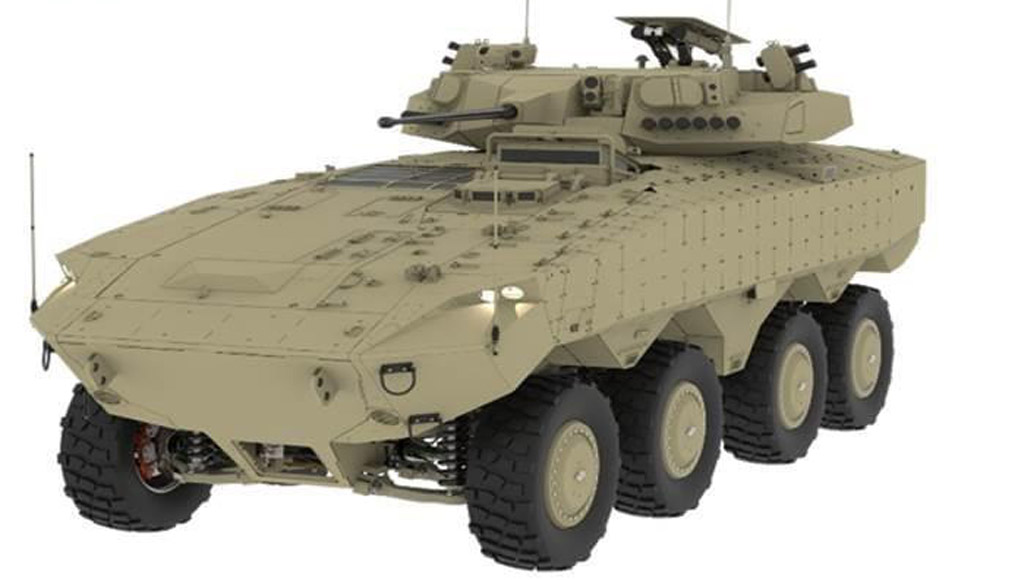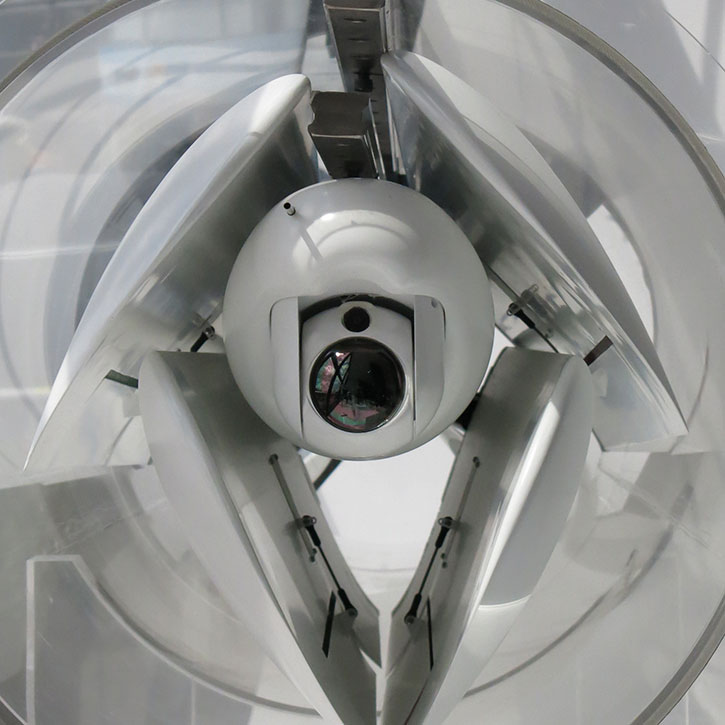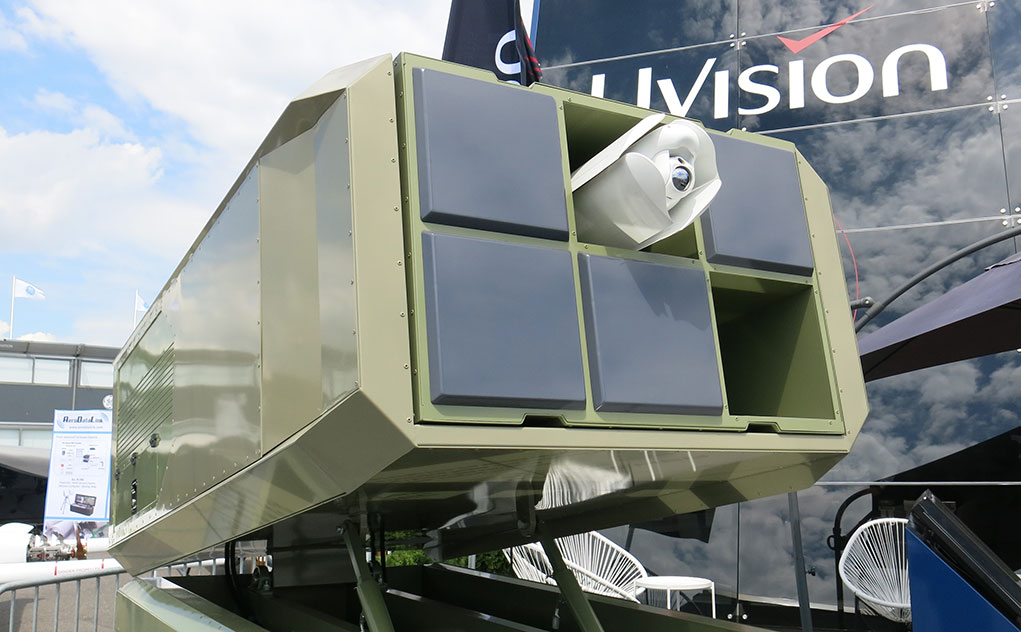

Israel’s Ministry of Defense announced today the selection of Elbit Systems’ Iron-Fist Active Protection System (APS) for the protection of some of the IDF combat and combat support armored vehicles. The selection followed a competitive evaluation of several APS solutions.
IMOD selected a new variant of the Iron-Fist, known as Light-Decoupled (IF-LD) version, a decoupled configuration that evolved from the first generation Iron-First originally developed by IMI in competition to Rafael’s Trophy APS. The Trophy is currently installed on IDF Merkava Mk4 and Mk3 Main Battle Tanks and various variants of the Namer heavy infantry fighting vehicle.
IF-LD uses independent optical sensors, tracking radar, rotatable launchers, and countermeasure munitions to defeat threats at a safe distance from the defended vehicle. The system provides 360-degree protection coverage for close-range scenarios in both open terrain and urban environments. Compact size and low weight make it more adaptable to smaller and lighter combat vehicles. Compared to wall-mounted APS, IF-LD defeats threats at a distance from the protected vehicle, thus eliminating the probability of residual penetration and simplify integration with the platform, particularly on turreted configurations.
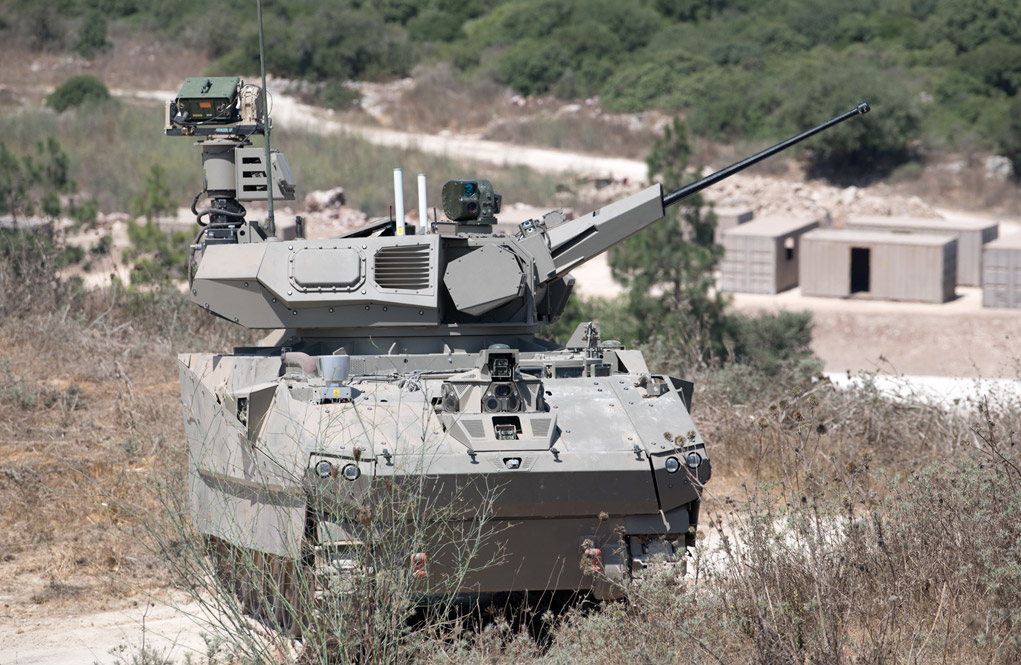
The Carmel variant presented by Rafael. Photo: IMOD
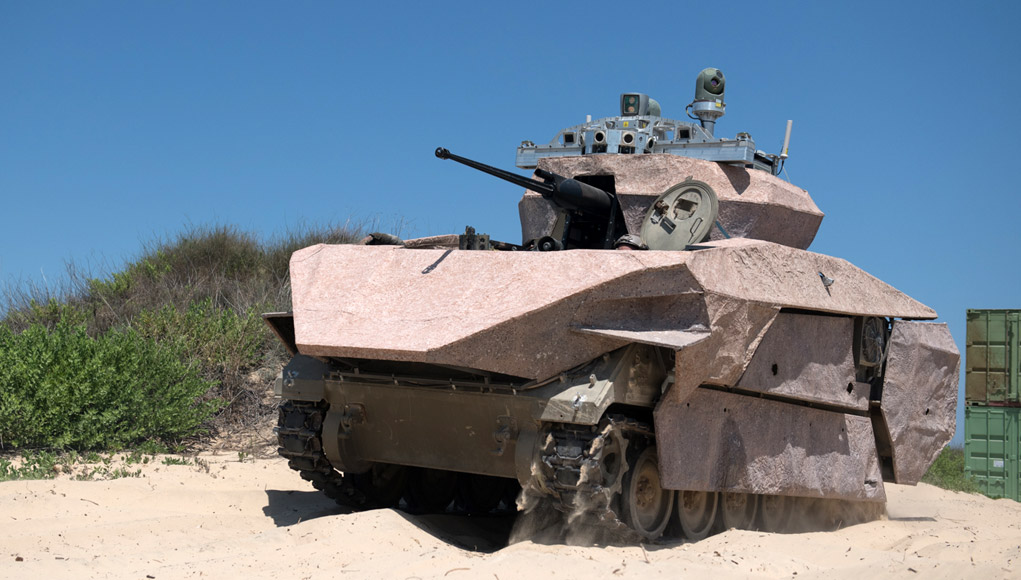
Israel’s Ministry of Defense Defense Research and Development Directorate (DR&DD) provided today a glimpse into the Carmel technology demonstration program, evaluating future combat vehicle technologies for the late 2020 and beyond.
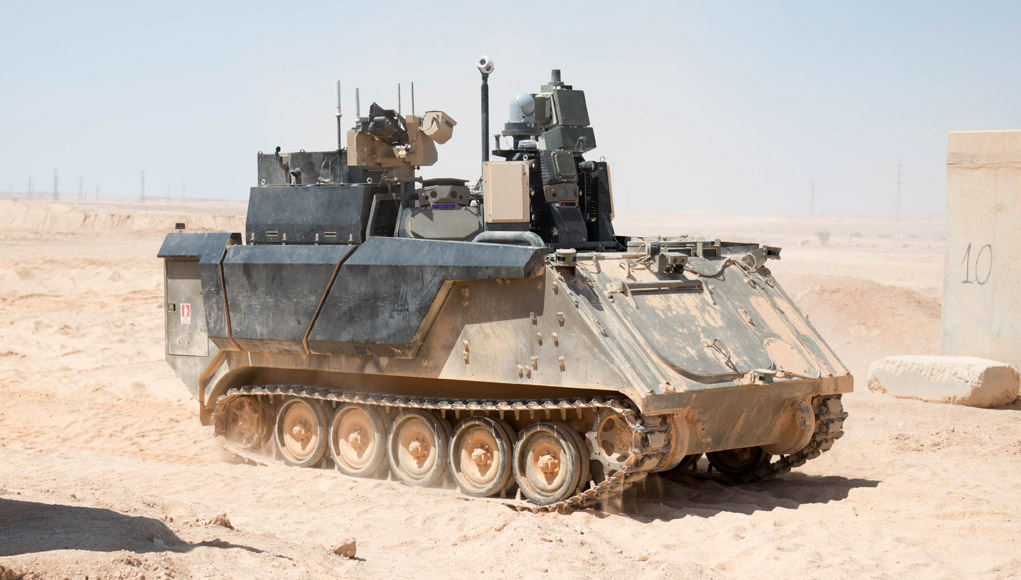
DR&DD invited three industry groups to provide technology demonstrators for the program – Rafael, Elbit Systems and IAI. The demonstrators were all based on an M-113 used as a platform surrogate for the combat vehicle. The future platform will utilize a new chassis powered by a diesel generator powering a rechargeable battery bank to provide the electricity for propulsion and all systems.
During the first phase of the Carmel Program, a significant challenge was presented to the three major defense industries in Israel: to prove the feasibility of an AFV that is operated by only two combat soldiers, with closed hatches. The two persons employ different sensors onboard and off-board, including radars, thermal imaging sensors, video cameras, acoustic and lasers and drones, all inputs are fused and displayed to the crew for situational assessment and response.
The Carmel variant presented by Elbit Systems. Photo: IMOD
Each group took a different approach to meet the objectives – a light (35 ton) combat vehicle armed with medium caliber auto-cannon and missiles, and operated by a crew of two, with an additional position for a third person operating specialist systems. Designed for manned operation, Carmel is equipped with sensors, artificial intelligence, and advanced automation and system autonomy thus reducing operator workload. This approach enables human operators to take decisions and actions in a timely and optimal manner.The Carmel Program also includes the development of other capabilities not presented in the demo day, such as the platform with hybrid-electric propulsion and energy storage with high capacity to support the electronic systems on board, signature reduction, including active camouflage, multi-task radar providing both self defense (active protection) from anti-tank threats as well as detection and tracking of drones, vehicles and humans, blue force tracking and various types of weapon systems, including direct and indirect fires, self-protection and high-energy lasers. Another aspect to be pursued in a later stage is teamwork – the synergy between several Carmel vehicles, sharing information and tasks using broadband connectivity. ‘Manned-Unmanned Teaming’, will evaluate the advantages of augmenting the small crew with the capabilities of associated robotic team members.
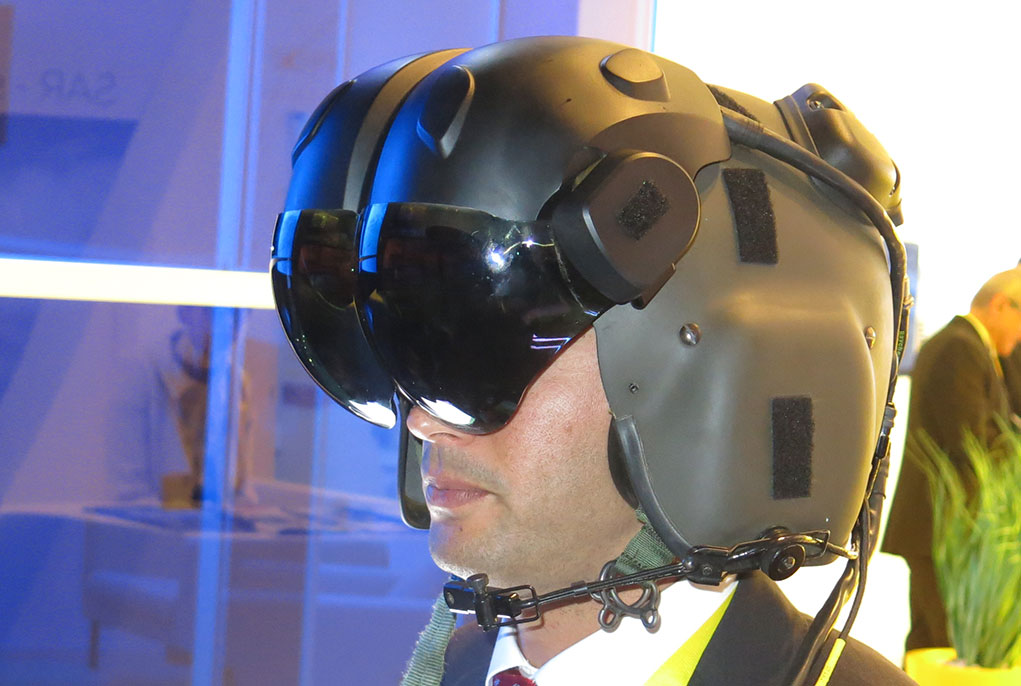
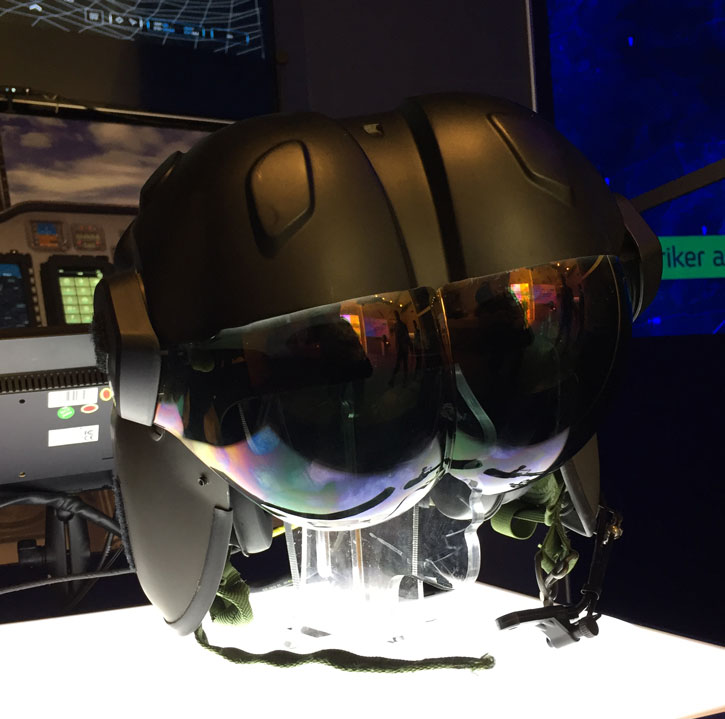
The lessons learned from the recent evaluation will be assessed and presented to the DR&DD for further action. DR&DD is expected to recommend a technology mix for further development and integration in a future platform or select a single provider or a team to act as a prime contractor. Among the technologies already selected for integration in future platforms is the Iron Vision helmet display from Elbit Systems, that will be integrated in the next phase of the Merkava Main Battle Tank – the Merkava Mk4 Barak. Other systems could be included in the future in the Eitan APC and Namer heavy armored infantry combat vehicle.
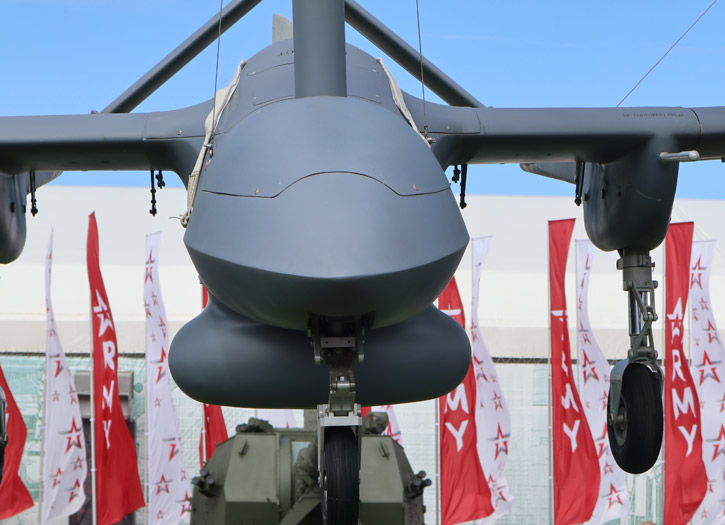
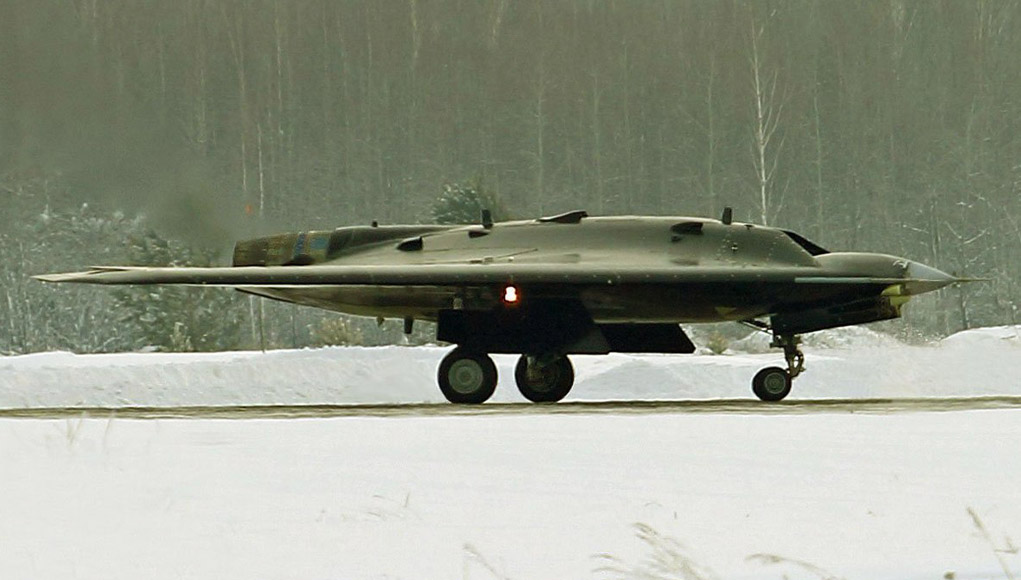
First photos of the Su-70 Okhotnik-B UCAV were leaked online in January 2019.
The Russian Su-70 Okhotnik-B (Hunter) unmanned combat aerial vehicle (UCAV), developed by the Sukhoi Design Bureau, has made its maiden flight on Saturday, August 3rd. 2019. The news released by the Russian Defense Ministry on Saturday, according to Russian Tass news agency. No photos were released at the time of publication.
According to a Russian Ministry of Defense release, “The first flight took place at 12.20 Moscow time and lasted for over 20 minutes.” This first flight was designed to test the UCAV’s takeoff and landing capabilities. Okhotnik-B was controlled by a human operator throughout the flight, making several circles around the airfield at an altitude of 600 meters and then successfully landed. According to Tass news agency, quoting an unnamed industry source, more flights are scheduled this year to open the drone’s flight envelope and test its autonomous control capabilities levels. These could include full autonomous flight, from takeoff to landing.
The drone is being tested at the Chkalov State Flight Test Centre, near Akhtubinsk in the Astrakhan Region, where Su-57 fighters were also tested. In May 2019 the President of the Russian Federation, Vladimir Putin, visited the center and viewed the Okhotnik-B, along with other drones, manned aircraft, and air defense systems. The Chkalov Centre is the largest test center of Russia’s Aerospace Forces.
Many inlets and uncovered engine exhaust showing in this rear view of the Russian Su-70 UCAV indicate the Russian design is not as stealth-oriented as its US and European counterparts.
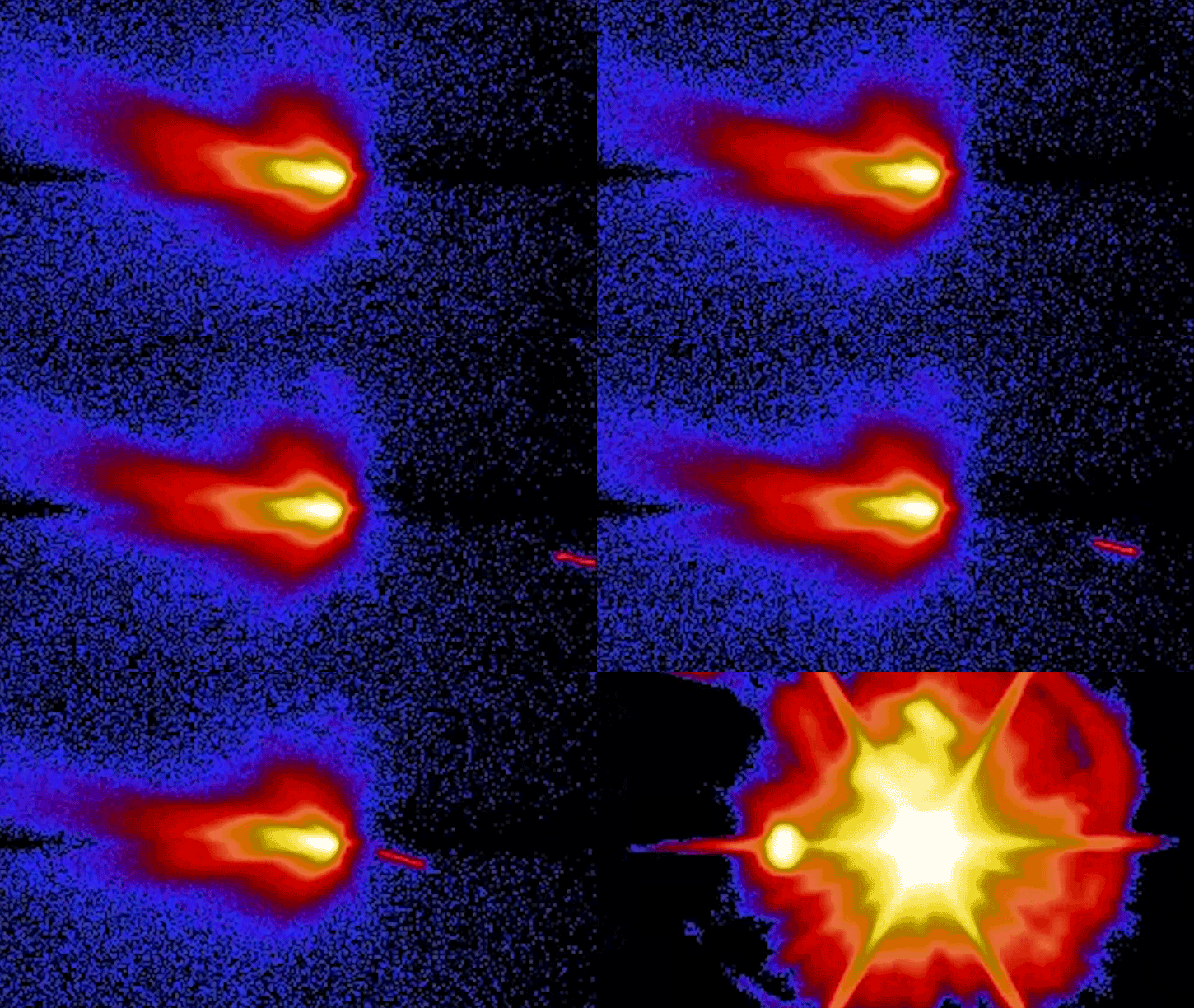
The test clearly shows the sharp divert maneuver performed by the interceptor a fraction of second before the collision with the target, resulting in a direct hit. Video: MDA
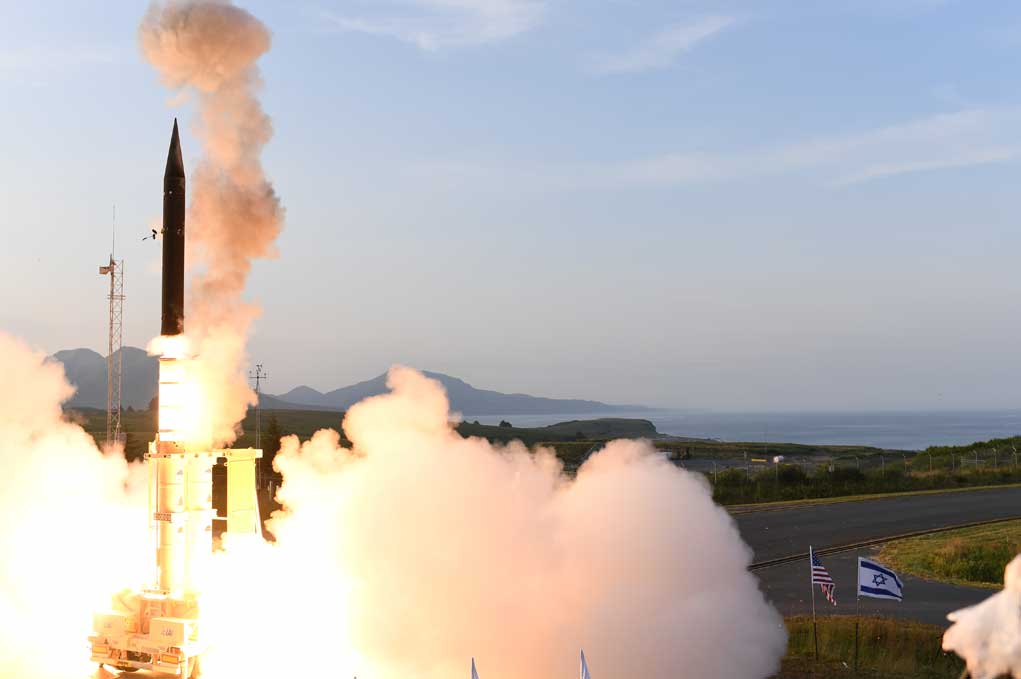
Arrow-3, the Israeli exo-atmospheric ballistic missile interceptor successfully intercepted three medium-range missile targets over the North Pacific Ocean. The event marked the completion of a full-capacity flight test campaign. Three Medium-Range Ballistic Missile targets were intercepted in outer space, by Arrow-3 interceptors launched from Kodiak, Alaska. The tests were conducted under a joint Israeli-US program led by Israel’s Missile Defense Organization (IMDO) of the Directorate of Defense Research and Development (DDR&D) and the U.S. Missile Defense Agency (MDA).
Flight Test Arrow-01 demonstrated the Israeli Arrow Weapon System’s ability to conduct a high altitude hit-to-kill engagement. The video that recorded the test clearly shows the sharp divert maneuver performed by the interceptor a fraction of second before the collision with the target, resulting in a direct hit that destroys the target. These tests were conducted at Pacific Spaceport Complex-Alaska (PSCA) in Kodiak, Alaska. “This unique success in Alaska provides confidence in future Israeli capabilities to defeat the developing threats in the region.” MDA Director Vice Adm. Jon Hill commented, adding: “We are committed to assisting the Government of Israel in upgrading its national missile defense capability to defend the State of Israel from emerging threats.”
The Arrow-3 Interceptor successfully demonstrated an engagement capability against the exo-atmospheric target during the test. Although not part of the Israeli architecture, a U.S. AN-TPY2 radar participated in the test. Preliminary analysis indicates that test objectives were successfully achieved. The integration of the US radar with the Israeli missile defense system is important, as Israel relies on US missile defenses as a backup for its own missile defense capabilities. Under such cooperation US missile destroyers often visit the Israeli ports of Haifa and Ashdod and the US Army deploys missile defense units to Israel, to participate in the biennial Juniper Cobra exercise. operates a radar station with this type of radar from the Israel Negev desert and has deployed a THAAD missile defense system to Israel as part of its theater rapid deployment tests.
The Arrow Weapon System (AWS) represents the upper layer of Israel’s multi-layer defense system. When fully integrated with the AWS, Arrow-3 extends the system’s capability to engage missile targets in space, typically, before such targets separate and deploy decoys and countermeasures. at long range and high altitude, Israel’s multi-layer defense system is currently employs four operational layers: Iron Dome Defense System defending against rockets of different sizes, David’s Sling Weapon System defending against rockets, short-range missiles, cruise missiles and aircraft, and the Arrow Weapon System engaging medium to long-range missiles with Arrow-2, and the new Arrow-3.
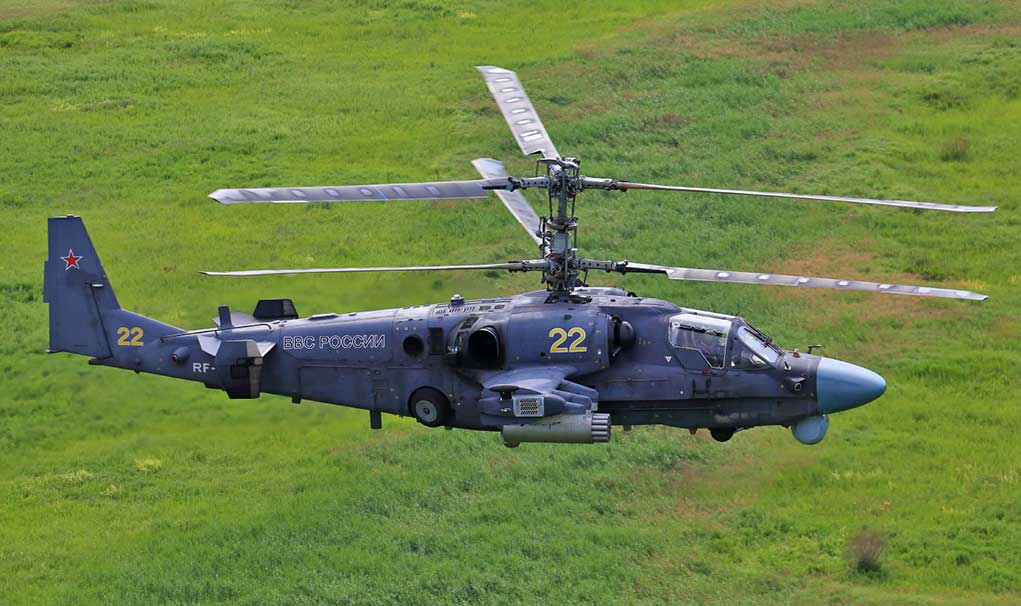
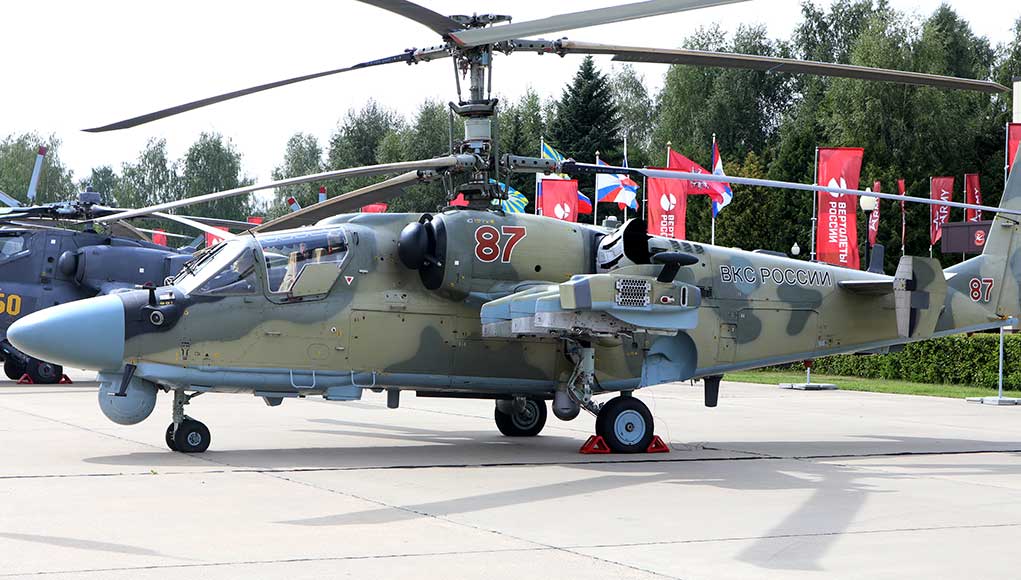
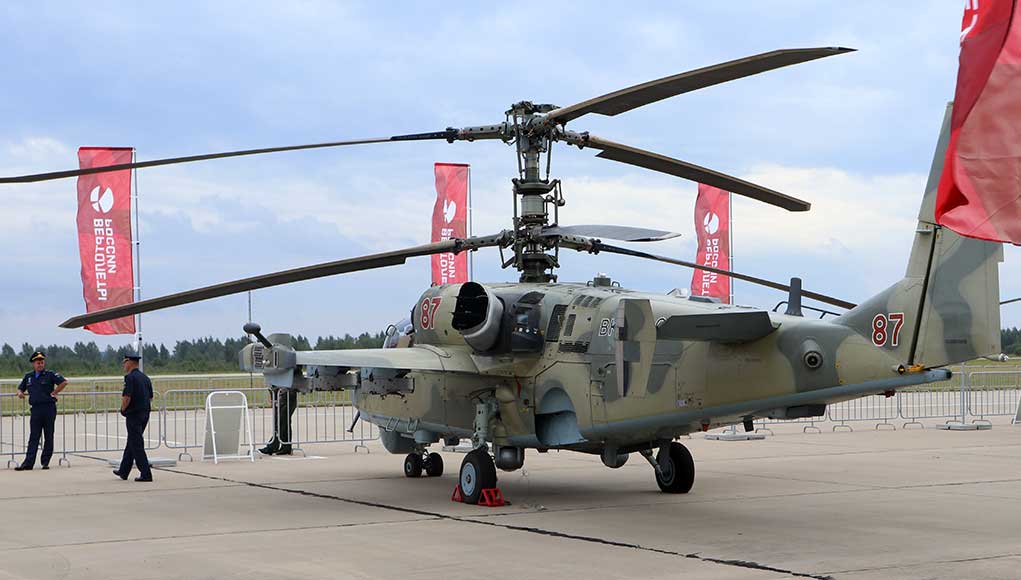
Russian Helicopters has displayed the latest version of the KA-52 attack helicopter at the Army 2019 defense expo at Kubinka, in the Moscow region.
A derivative of the Kamov KA50 helicopter that used a tandem cockpit, KA-52 This version is based on the KA50, KA-52K is in service with the Russian Army and a navalized version, KA-52K is operated by the Egyptian Navy.
This version has foldable rotors and wings to fit the confined storage space aboard the ships. The Russian Helicopters company is currently developing the next generation combat rotorcraft to be introduced in 2024. This new platform is expected to be significantly faster, compared to current rotorcrafts.
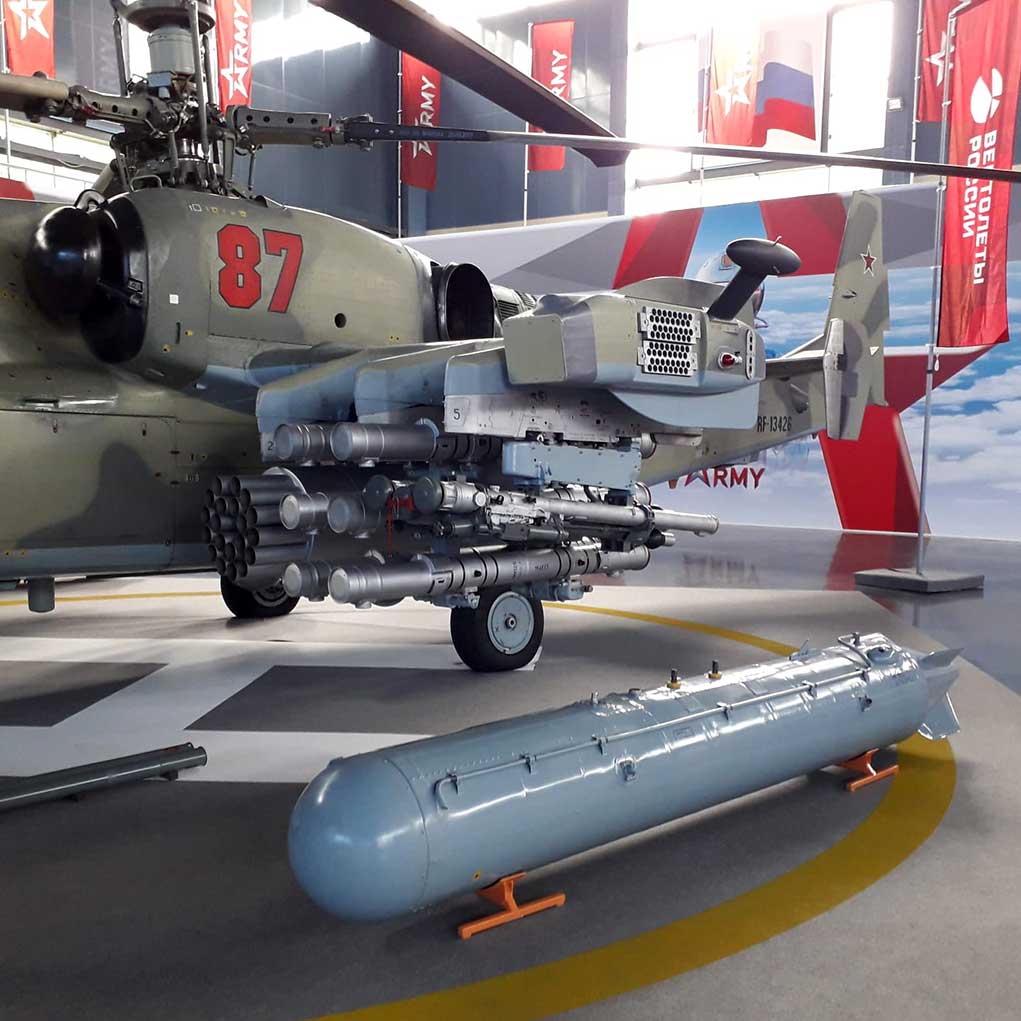
KA-52 on display at the Army Forum 2018. Photo: Defense-UpdateA rear view of the KA-52 shows the tail area with a second UV missile-launch sensor completing the 360-degree coverage of the President-S system. Photo: Defense-UpdateKA-52 Armaments include the chin-mounted 30mm 2A42 automatic cannon with 460 rounds, the stub wings are configured four hardpoints each. Three are under the wing, mounting up to 12 missiles such as VIKHR or ATAKA, and four Igla S used as air-launched anti-aircraft missiles, rocket pods (up to 80 x 80mm rockets) and up to four 500 liters (130 Gal) external fuel tanks. Photo: Defense-Update.
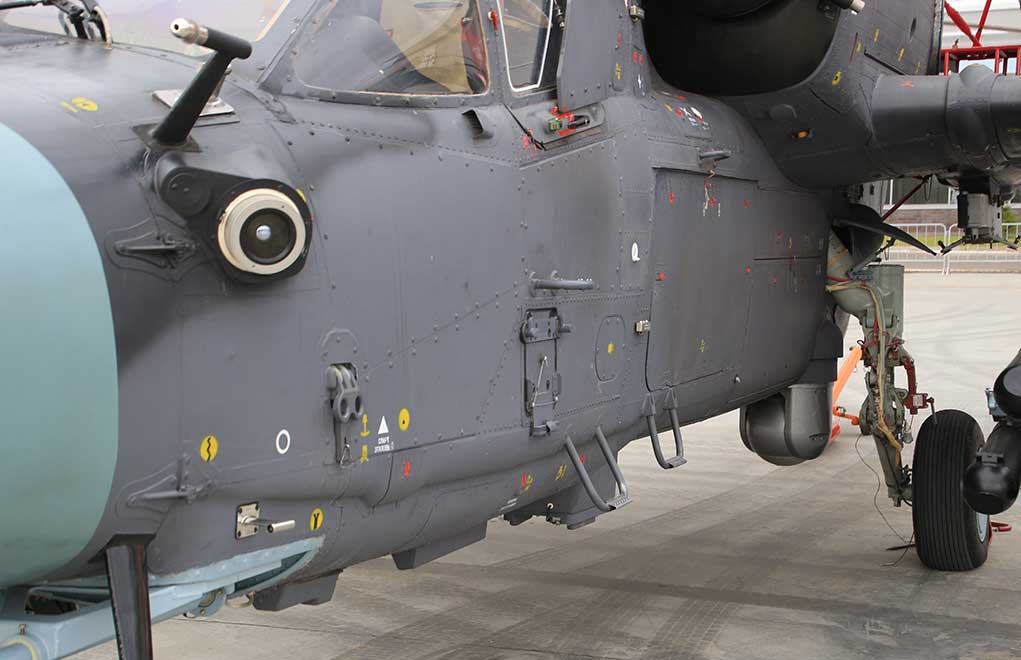
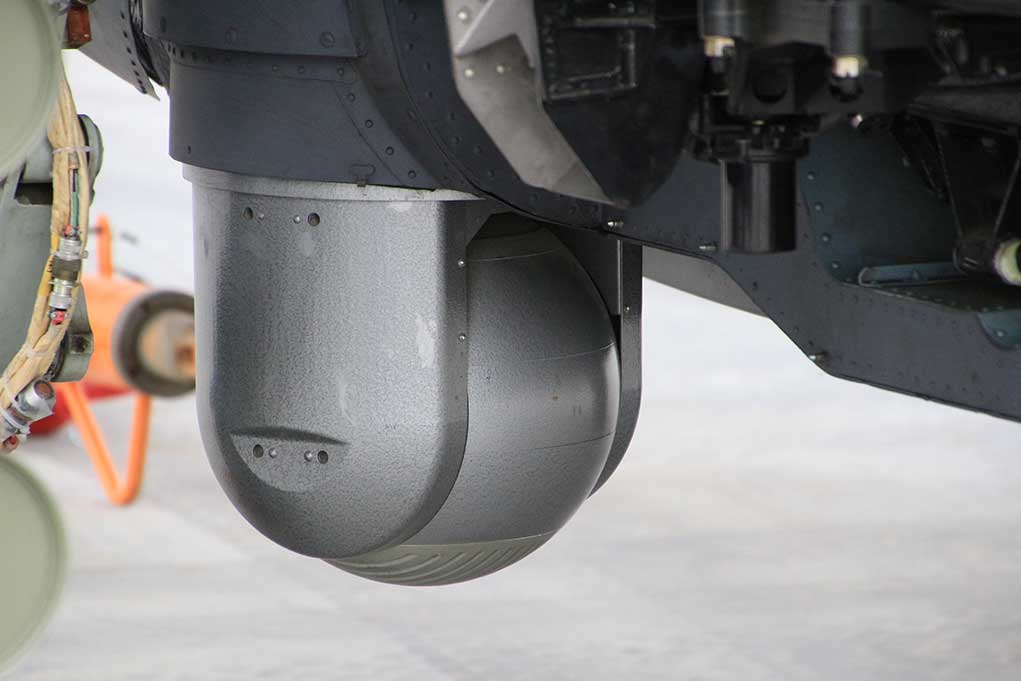
The helicopter carries the President-S countermeasures suite including laser detectors and UV missile launch sensors, infrared jammers mounted in two rotatable turrets and UV-26 chaff-flare dispenser pods carried in pods mounted one each of the wing tips. Armaments include the chin-mounted 30mm 2A42 automatic cannon with 460 rounds, the stub wings are configured four hardpoints each. Three are under the wing, mounting up to 12 missiles such as VIKHR or ATAKA, Igla S used as an air-launched anti-aircraft missile, rocket pods (80mm) and 500 liters (130 Gal) fuel tanks.
The lower side of the KA-52N showing different elements of the PresidentS ECM suite. Photo: Defense-UpdateThe President-S ECM suite used on the KA-52K and is released for export.The UV missile launch sensor mounted on each side of KA-52K Photo: Defense-UpdateTwo optronic jammers are mounted on the KA-52K belly, one on each side. Photo: Defense-Update
KA-52 Specifications
Specs
KA-52K Ship Based
Attack Helicopter
KA-52 Land Based
Attack Helicopter
Max TOW (kg.)
12,200
10,800
Max Payload (kg.)
2,000
2,000
Flight range (km.)
450
460
Service Ceiling (m.)
5,200
5,500
Maximum Speed (km/h.)
290
300
Cruising Speed (km/h.)
250
260
Engines (Hp)
2x Klimov VK-2500 Turboshaft engines – each 2,400 shp
2x Klimov VK-2500 Turboshaft engines – each 2,500 shp
Information based on manufacturers’ data presented in public.
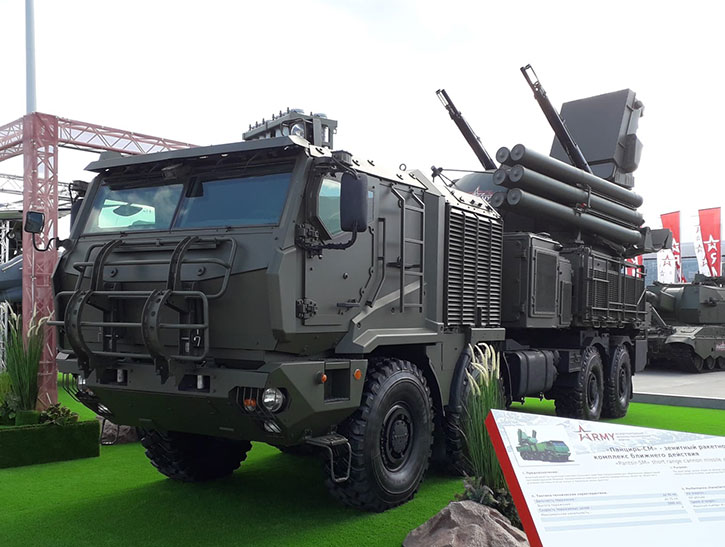
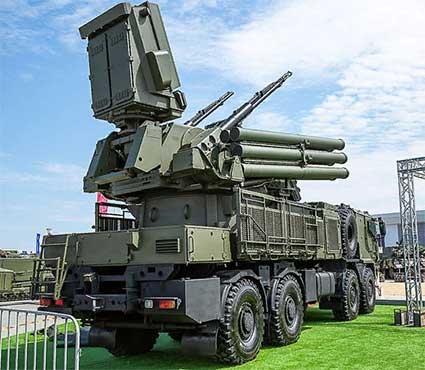
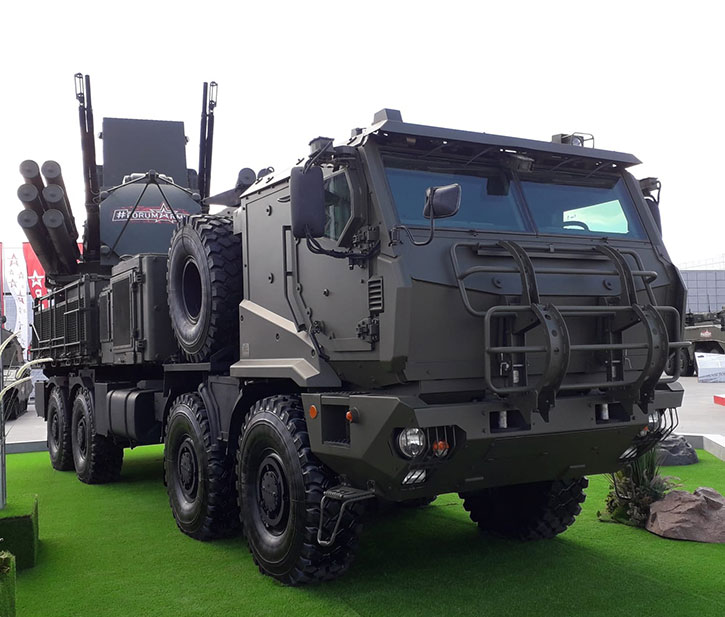
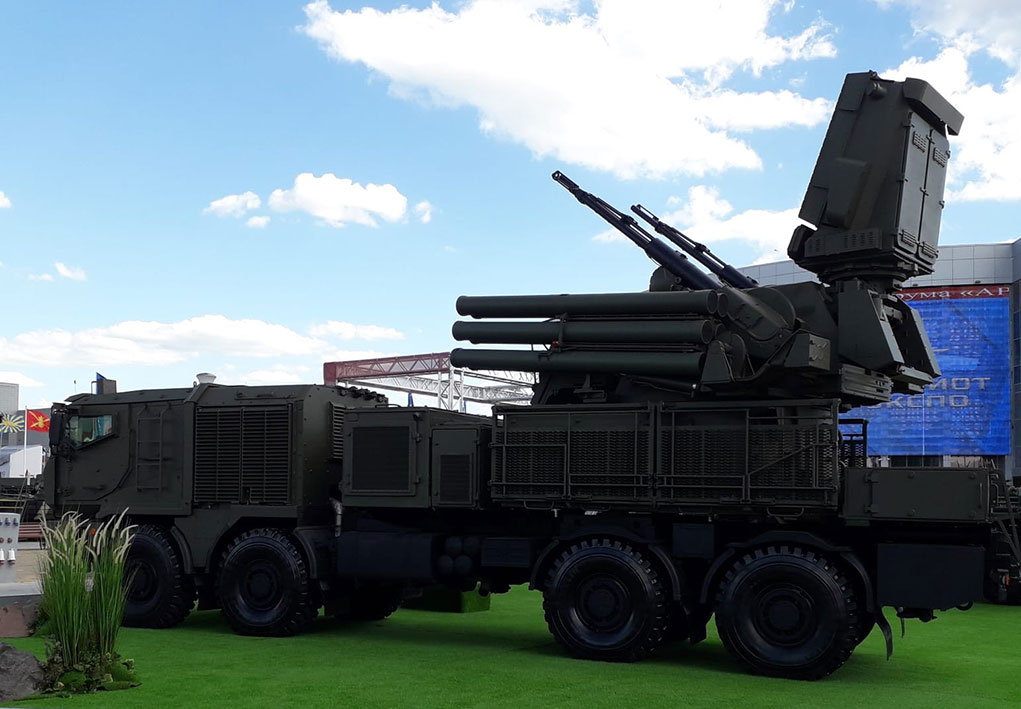
Pantsir SM on display at the Army 2019 exhibition, Moscow, 2019. Photo: Defense-Update
The Russian KBP group has launched an upgraded export version of the Pantsir – the Pantsir-SM that implements some of the lessons Russia gained from recent combat engagements in Syria. The new configuration improves the capability of the system dealing with guided weapons and unmanned aerial systems (drones) of all types. The company showcases the new Pantsir at the #Army2019 exhibition taking place at the Patriot Expo park near Moscow this week. Pantsir-SM is intended to enter service with the Russian military in 2021 supports a line-of-sight radar surveillance range of 75 km and missile engagement at up to 40 km.
The export-oriented Pantsir-S1M packs 12 ready to fire missiles of two types. The 57E6-E covers a range of 15-18 km and the new 57E6M-E missile doubles the range to 30 km. The export-oriented Pantsir-S1M system was launched earlier this year at the IDEX 2019 expo in Dubai. The new missile has a longer minimum range of 1,200 meters, compared to the original missile effective at 15 meters.
In recent years Pantsir air defense systems were engaged in multiple combat events in Syria. Systems operated by Russian teams have been deployed to the Hmeymim air base near Latakiya, where it was deployed along the S-400 to protect the base. Syrian manned Pantsirs attempted to counter repeated attacks on Syrian air bases but often failed to defeat guided weapons allegedly used by the Israel Air Force. Defending the Russian forces at Hmeymim the systems encountered multiple attacks by improvised attack drones (aerial IEDs) initially demonstrating marginal success.
Opposition groups in Syria made several attempts to attack the Russian airbase at Hmeymim with makeshift drones or bombard it with rockets. The missiles were able to intercept the rockets, but drones posed a more challenging target. Some of the attacks were repelled by electronic warfare activities, as well as SA-15 and SA-22 air defenses, others managed to penetrate the perimeter and hit exposed targets at the base. In total, at least 22 drone attacks were documented in the area of the base, some of which were able to target the Airbase and cause material damage. 13 of the attacks occurred in the month of July 2018 and 12 occurred in April 2019. The airbase is protected by the Pantsir-S1 system. The Defense Ministry says the system demonstrated its high effectiveness in countering such threats.
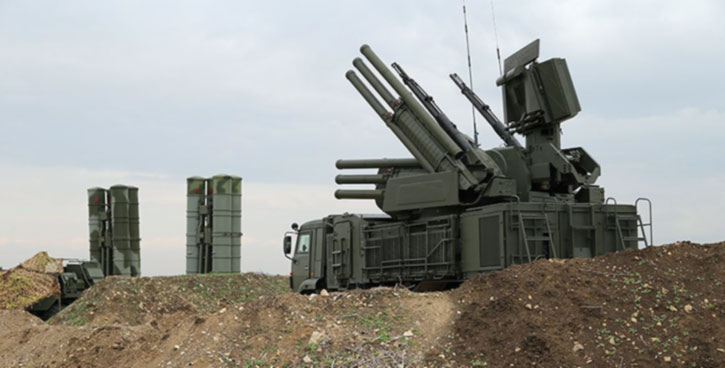
Russian Army Pantsir S1 deployed in defense of the Russian contingent at the Hmeymim air base near Latakia, Syria, 2016.
A video showing Russian air defense missiles intercept drones near Hmeymim air base in Syria.
Boomerang can float and swim in water at a speed of five knots.
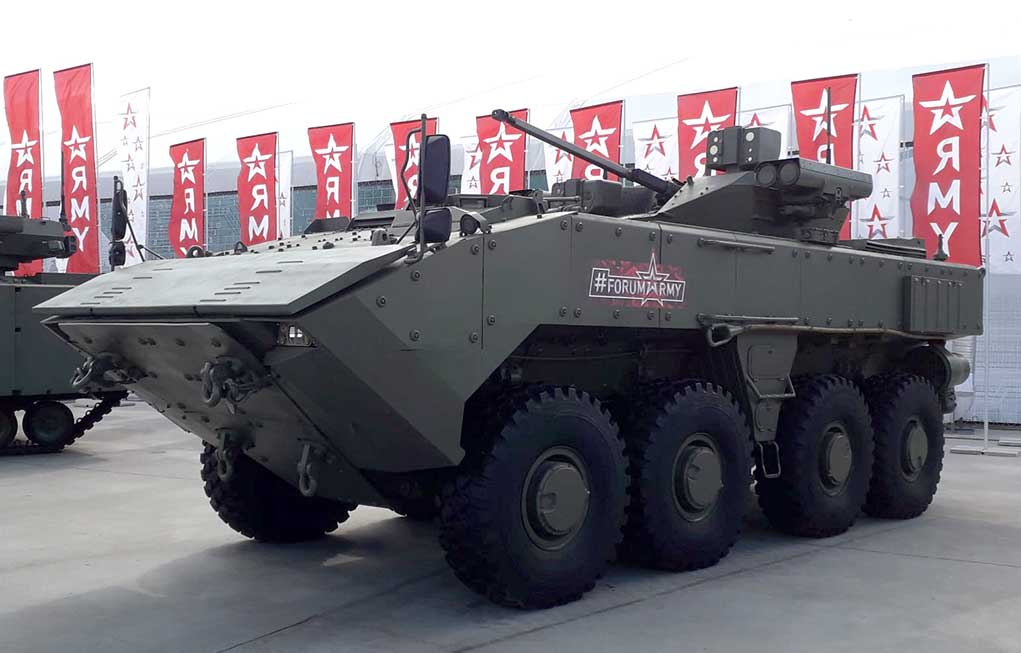
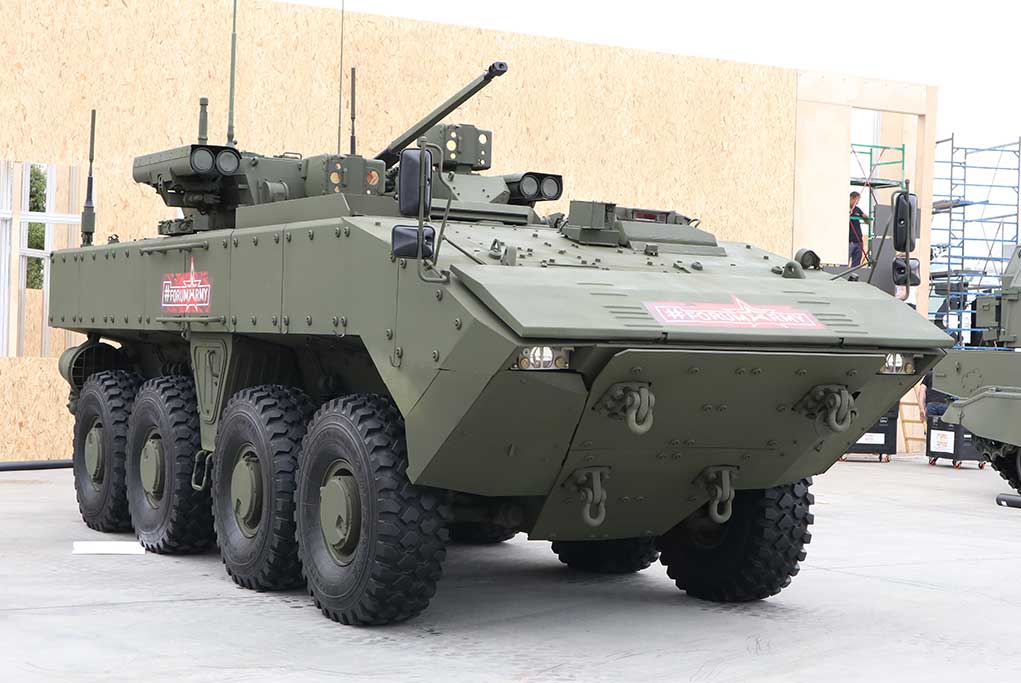
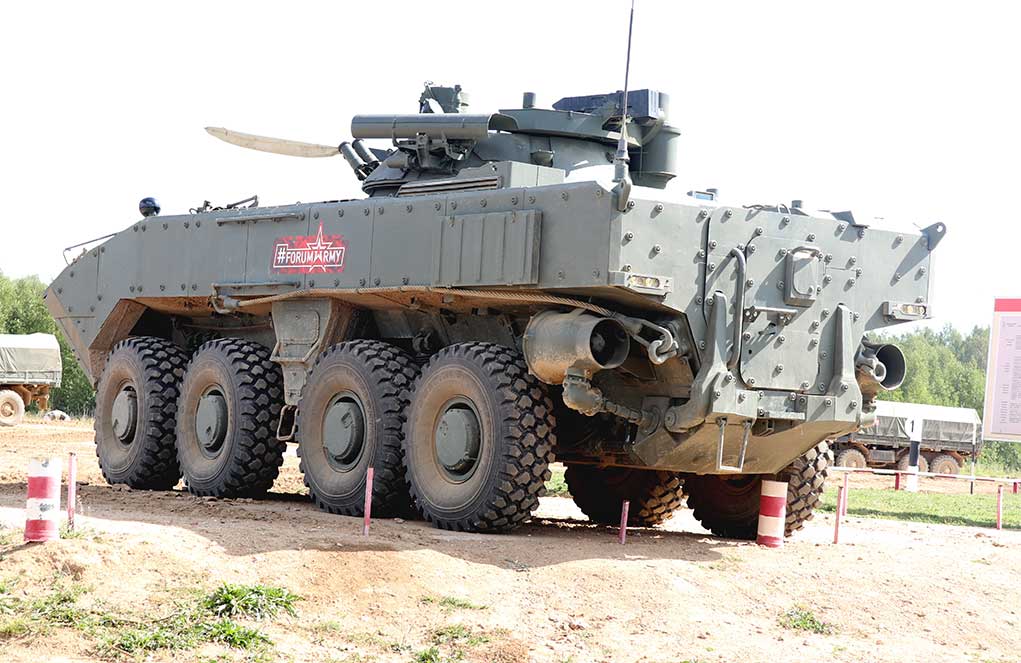
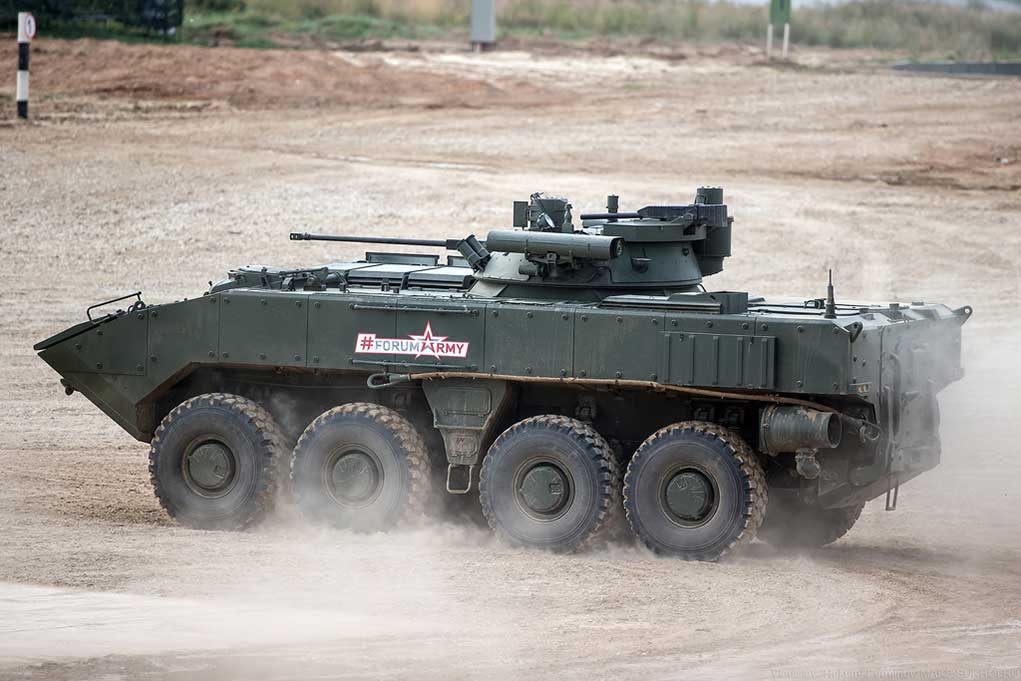
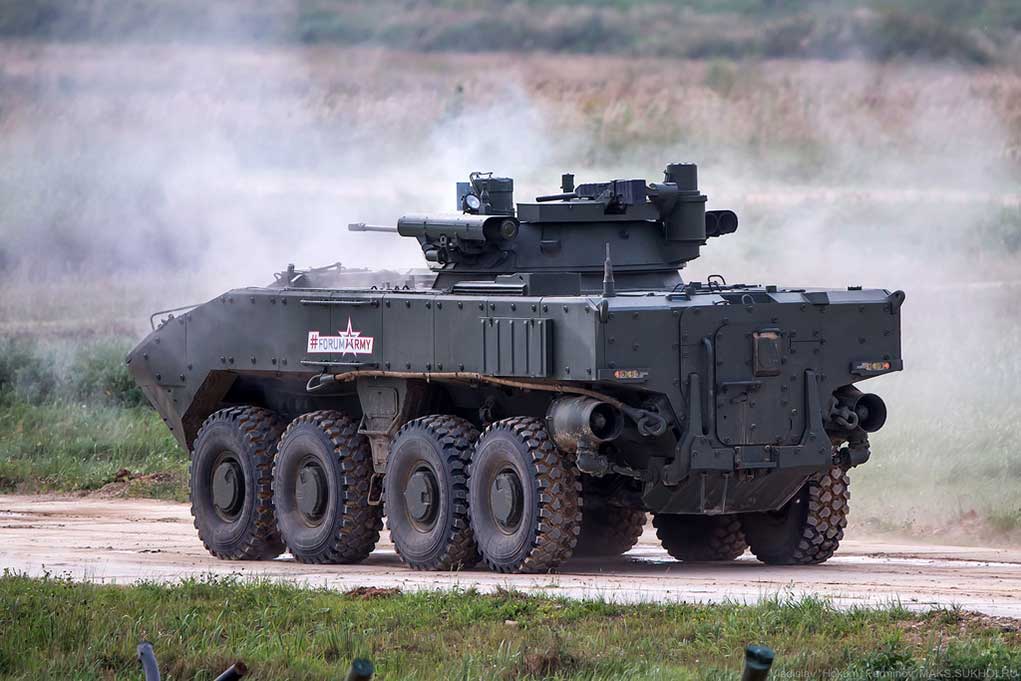
The Russian Boomerang 8×8 VPK 7829 combat vehicle was developed by the VPK company in two configurations, the 25-ton K17 Armored Fighting Vehicle (AFV) and a 22-ton amphibious Armored Personnel Carrier (APC) designated K16. Intended to replace heeled combat vehicles such as the BTR80, in service with the Russian Army and border guards, Boomerang represents a new approach in all aspects – a new chassis, more ground clearance, and significantly higher vehicle, new armor, and new armament. According to Russian defense sources, VPK is building new Boomerang prototypes for the planned state trials by the Russian Army. The Boomerang was unveiled on the May 9 parade in 2015, along with the Armata family and Kurganets 25 AFVs.
VPL7829 Boomerang AFV on display at the Army 2019 exhibition taking place at the Patriot Expo near Moscow this week. Photo: Defense-Update
The Boomerang has an operating range of 800 km. It is powered by a new, 750 HP digitally controlled diesel engine developed by the Yaroslavl Engine Plant. It is coupled to an automatic transmission. It has a road speed of 100 km/h and 50 km/h offroad. On amphibious operation, the Boomerang can swim at a speed of five knots (10 km/h).
Each vehicle is manned by a crew of three – a commander, gunner, and driver. It can carry eight troops with their combat loads. Unlike the side access doors used on the BTR 80, the Boomerang uses a rear access ramp, similar to western and BMP-type Russian APCs. Access hatches are also available on the top. Both versions use passive protection comprising a combination of steel and composite/ceramic armor. Laser detectors and instant multi-spectral smoke dischargers offer a form of ‘soft’ active protection, enabling the vehicle to maneuver under the smoke cover to avoid the hit. multiple video cameras are mounted around the vehicle providing a 360-degree vision for the crew.
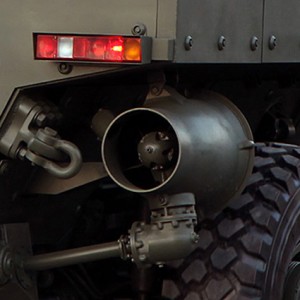
K17 is equipped with a multi-weapon turret mounting a 30mm 2A42 gun, 7.62mm COAX, and four Kornet missiles, along with Afganit APS. Photo: Defense-UpdateA rear view of the K17 Boomerang showing the closed access ramp and swimming thrusters. Photo: Defense-Update
The K-17 can also be equipped with the Afganit hard Kill countermeasures, that utilizes radars to detect the threat, and launches blast-fragmenting countermeasures to intercept anti-tank missiles, anti-tank projectiles (including kinetic) and rockets at ranges of 4-200 meters from the vehicle. To improve protection from mine blasts and Improvised Explosive Devices (IED) the Boomerang is higher, relative to the previous generations of Russian AFVs. The additional height enables the blast’s mitigation and opens some space for blast attenuating seats for the crew and passengers.
The K17 version uses a multi-purpose remotely controlled turret mounting a 2A42 30mm gun with 500 rounds (160 AP, 340 HE-Frag). This gun can effectively engage ground targets at ranges of 1.5 – 2.0 km, and airborne targets, such as helicopters and UAS, at a distance of 2.5 km. The cannon can fire semi-automatic fire, slow automatic (200-300 rounds per minute) or fast bursts of 550 – 600 rounds per minute. The turret has two identical optronic sights enabling the crew to engage two targets simultaneously, including firing two Kornet missiles (a method engaging targets defended by active protection) or firing a missile and the gun simultaneously.
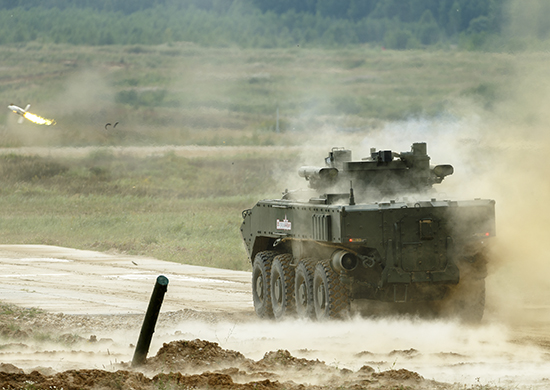
The turret also carries two pairs of Kornet-D anti-tank/anti-material guided missiles, stored in ready to launch containers. Kornet-D is the domestic version of the Export-version of the weapon known as Kornet-E. The missile is available with a tandem High-Explosive Anti-Tank warhead capable of penetrating a 1,100 – 1,300 mm rolled homogeneous steel (RHA) armor protected by reactive armor. It can also carry a blast-fragmenting thermobaric warhead effective against structures and buildings. The turret also has a coaxial 7.62 PKT machine gun and can also mount a 30mm grenade launcher on top. The K16 uses a smaller turret mounting a 12.7mm machine gun, 7.62mm coax or grenade launcher.
K17 Boomerang armored personnel carrier fires a Kornet-EM missile during Army-2107 fires demonstration at Alabino, Photo: Russian MOD
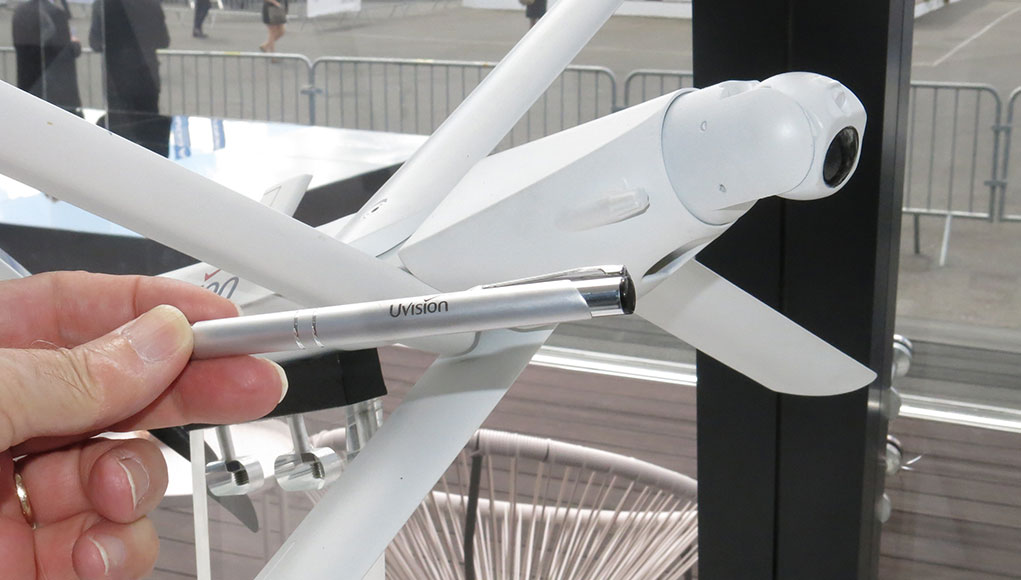
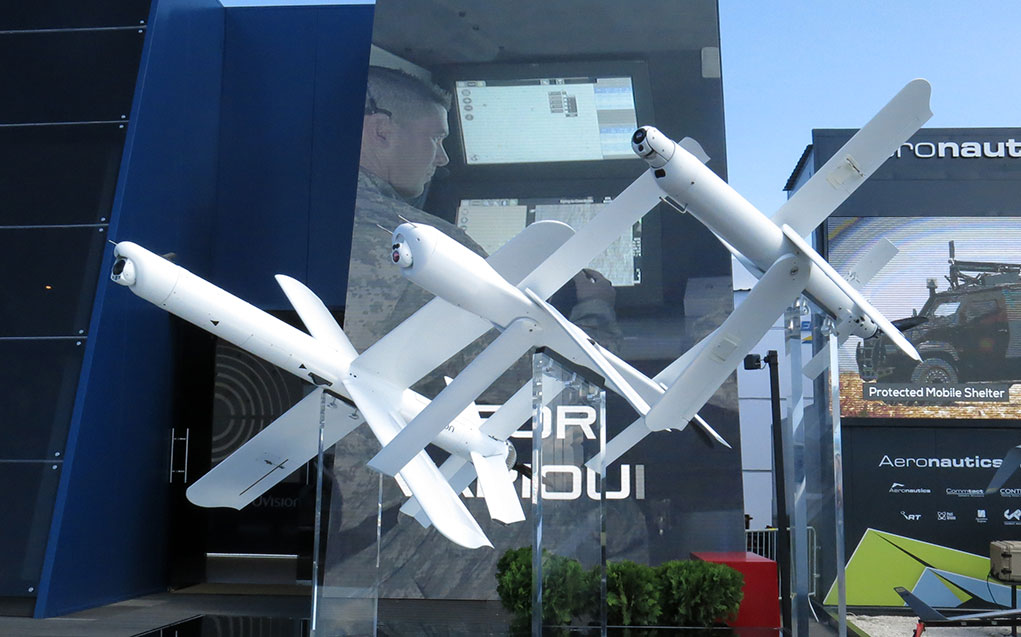
Although Loitering Munitions (LM) have been introduced decades ago, these weapons have gained general acceptance and maturity in recent years, following their operational debut in battlefields in the Caucasus and the Middle East. While several manufacturers already offer various types of ‘suicide drones’, only a few are committed to this category as Israel’s UVision Air, the developer, and producer of the Hero line of loitering missiles that unveiled a range of new members of its Hero family of LMs this week at the recent Paris Air Show. Uvision has already sold Hero LMs to multiple customers, including the Israel Defense Forces, and leading NATO countries.
The first product introduced by the company was the light-weight man-packed Hero-30, a man-portable loitering system offering dismounted forces unmatched, precision beyond the line of sight surveillance and attack capability. Deployable within minutes, with 30 minutes of autonomy and a range of up to 40km, Hero-30 can engage moving targets such as light vehicles, speed-boats, and dismounted armed forces.
Hero-20. Photo: Tamir Eshel
At the Paris Air Show, the company unveiled the smallest member of the Hero family – Hero 20 – a loitering weapon that weighs only 1,800 grams, including a fully stabilized and gimballed EO/IR day/night payload for target search and track, and a small blast fragmentation warhead weighing only 200 grams. The miniature Hero-20 can operate at a range of 10 kilometers and packs a battery for 20 minutes of endurance. It is launched from a single or multiple-launcher that is operated by a single person.
The loitering and pinpointed strike capabilities set the Hero LM apart of other loitering munitions and missiles, in its ability to locate targets of opportunity, pursue an attack and safely abort a strike even at the last seconds of its terminal phase, thus enabling military forces the operational freedom to pursue targets in in populated areas or remote locations while minimizing the risk of collateral damage. Training with loitering weapons can be performed with the system’s training simulator or by retrieving unarmed weapons using the platforms parachute system.
While Hero-30 is the smallest and lightest loitering weapon UVision offers, it is not the only one operated by dismounted forces. In fact, the Hero operational concept foresees different loitering platforms supporting the lowest echelon with weapons launched at different levels – organic assets carried and delivered at company and platoon level, Hero 120 launched by vehicles maintained at battalion and brigade level, and Hero 400EC operated from multiple launchers at the division level. Hero 30 and its larger sibling, Hero 400EC, are already matured and operational.
Hero 120 Multi-Mission Loitering Weapon. Photo: Tamir Eshel
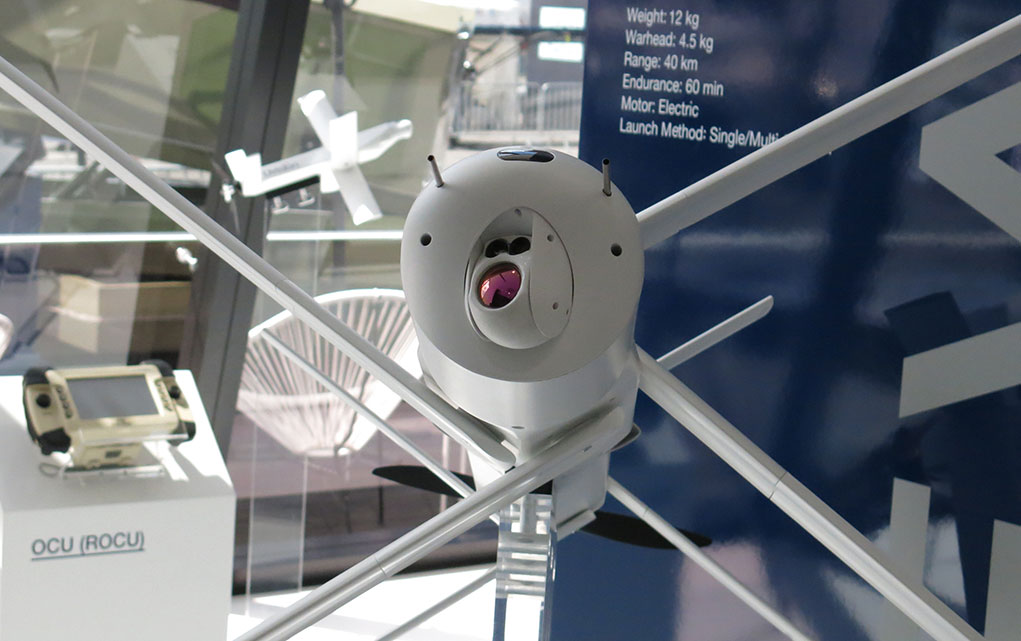
At the Paris Air Show 2019, the company introduced the 1.34-meter-long Hero-120 Mid-Sized Loitering Munition (MSLM), offering customers the flexibility to optimize the loitering weapon effect against different targets. With modular warhead and scalable battery pack, MSLM can carry different warheads triggered by a common multi-mode fuze, from 1.5 kg up to 4.5 kg, featuring Airburst Fragmentation for beyond line of sight anti-personnel effect, Point Detonation for anti-structure effect, a High Explosive Anti-Tank (HEAT) option, defeating the armor of modern main battle tanks with a top and proximity mode for penetration of windows and vehicles. The Hero-120 operates at a typical altitude of 1,500 ft. above ground, where it maintains a low acoustic, thermal and visual signature. The flight time has increased to 60 minutes, thanks to a redesigned fuselage that offers a compact packing in the launch canister while maintaining a large warhead size. Hero 120 is controlled via datalink from 40 km afar, and dive on its target at 100 knots. Total weight is 12 kg.
Hero 400EC packed in its launch canister Photo: Tamir Eshel
UVision also offers the larger Hero 400EC, a 2.1-meter-long LM that weighs 40 kg, and a cruciform wing assembly that spans 2.4 meters. The Hero 400EC has an operational ceiling of 18,000 ft. (above sea level) and speed of 50-100 knots. The LM can operate at a range of 40 km from its launcher using the standard data link, or use a directional antenna to extend that range to 150 km. It uses a multipurpose warhead that includes a tandem HEAT or fortification penetration (PBR) warhead.
In addition, the company revealed the Hero-400EC Multi-tube launcher system, weighing 650 kg including 6 munitions. Customers can configure the launcher with four, six or up to 12 loitering munitions, depending on the vehicle load and space specifications. The multi-tube launcher stores, transports and launches the loitering missiles straight from their sealed canisters. The multi-canister launcher can be mounted on a range of land or naval platforms, including Multiple Launch Rocket Systems (MLRS) and High Mobility Rocket Systems (HiMARS) that are widely used with the US Army, US Marine Corps, and international military forces. The four-tube launcher can be operated from a JLTV. Due to the Hero-400EC long range and endurance capabilities, the launcher can be operated from the relative safety of rear areas, distant from enemy lines or from forwarding Operating Bases (FOB), controlled by remote by the user or from the FOB command post.
Excite brings the F-35 display, and image fusion technology to cockpits of future helicopters, such as Future Attack & Reconnaissance Aircraft (FARA) and Future Vertical Lift (FVL), both families are expected to appear in the US and European market in the next decade. Photo: Tamir Eshel
Defense-Update had the opportunity to test Elbit Systems’ brand new X-Sight helmet display system at the company’s closed exhibit at the Paris Airshow. X-Sight brings the F-35 display, and image fusion technology to cockpits of future helicopters, such as Future Attack & Reconnaissance Aircraft (FARA) and Future Vertical Lift (FVL), both families are expected to appear in the US and European market in the next decade.
It has two curved visors, offering a combined field of view of 60 degrees with an overlapping center area. It uses optical, magnetic and inertial trackers to refine line of sight measurement, giving smooth tracking and visualization of obstacles, or targets even through sharp movement. Photo: Tamir Eshel
Until now the company produced integrated helmet displays for fighter pilots, but helicopter pilots had to settle for Helmet Mounted Systems (HMS). These systems use display generators projecting their pictures on beam splitters that superimpose the generated image on the world view. For night operation, the system incorporates an additional, binocular Aviator Night Vision System (ANVIS). This combination enables pilots to maneuver and fly ‘heads out,’ fast and low, in the day and at night.
The new X-Sight helmet delivers the F-35 display technology (the developers argue it is even better) to the helicopter cockpit. It has two curved visors, offering a combined field of view of 60 degrees with an overlapping center area. It uses optical, magnetic and inertial trackers to refine line of sight measurement, giving smooth tracking and visualization of obstacles, or targets even through sharp movement. It combines day and night displays with 360 degrees view of Pilot Visual Systems (PVS) or Pilotage distributed aperture Sensors (PDAS), offering ultimate viewability for the pilot. The team calls this capability ‘SuperVision’ that provides a brand new ‘connected avionics’ capability, which we will cover in a later post.
Unlike current helmets that are heavily loaded to the front (by the ANVIS), and must be balanced with extra weight in the back, X-Sight is balanced to the center, The night vision is provided by an integral camera delivering seamless visibility at the line of sight, added with a wider field from additional sensors such as Britenight or PDAS. Additionally, the synthetic world view (of terrain maps and known obstacles) enhances situational awareness, even at degraded or low visibility.
As the system is connected to the aircraft’s 360 vision system, it continuously tracks the landscape extracting potential obstacles such as electrical lines and other distinctive obstacles without prior mapping. The system also warns the pilot and plots recommended a route to avoid the risk. With information layers anchored to the relevant location and perspective, X-Sight depicts a rich situational picture that assists pilots on their missions under all conditions, even in degraded visibility.
The privately funded development leverages Elbit Systems’ experience gained through numerous development programs the Israeli company have done in recent years and secures its position with future rotorcraft programs. A first prototype has been developed and is currently being tested, toward further refinements and adaptations to future applications.
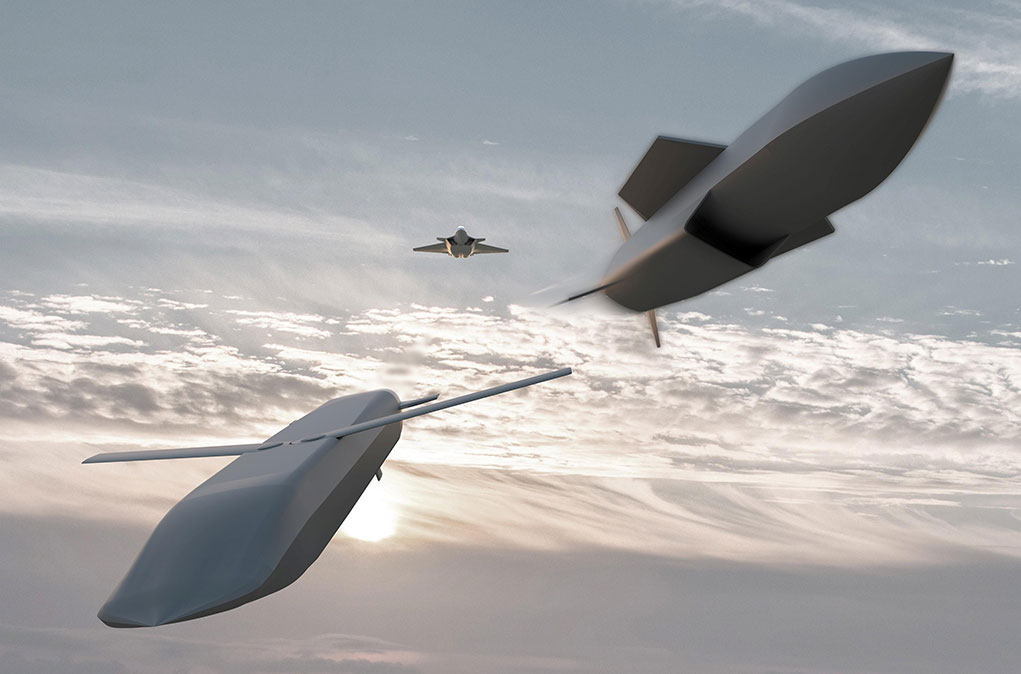
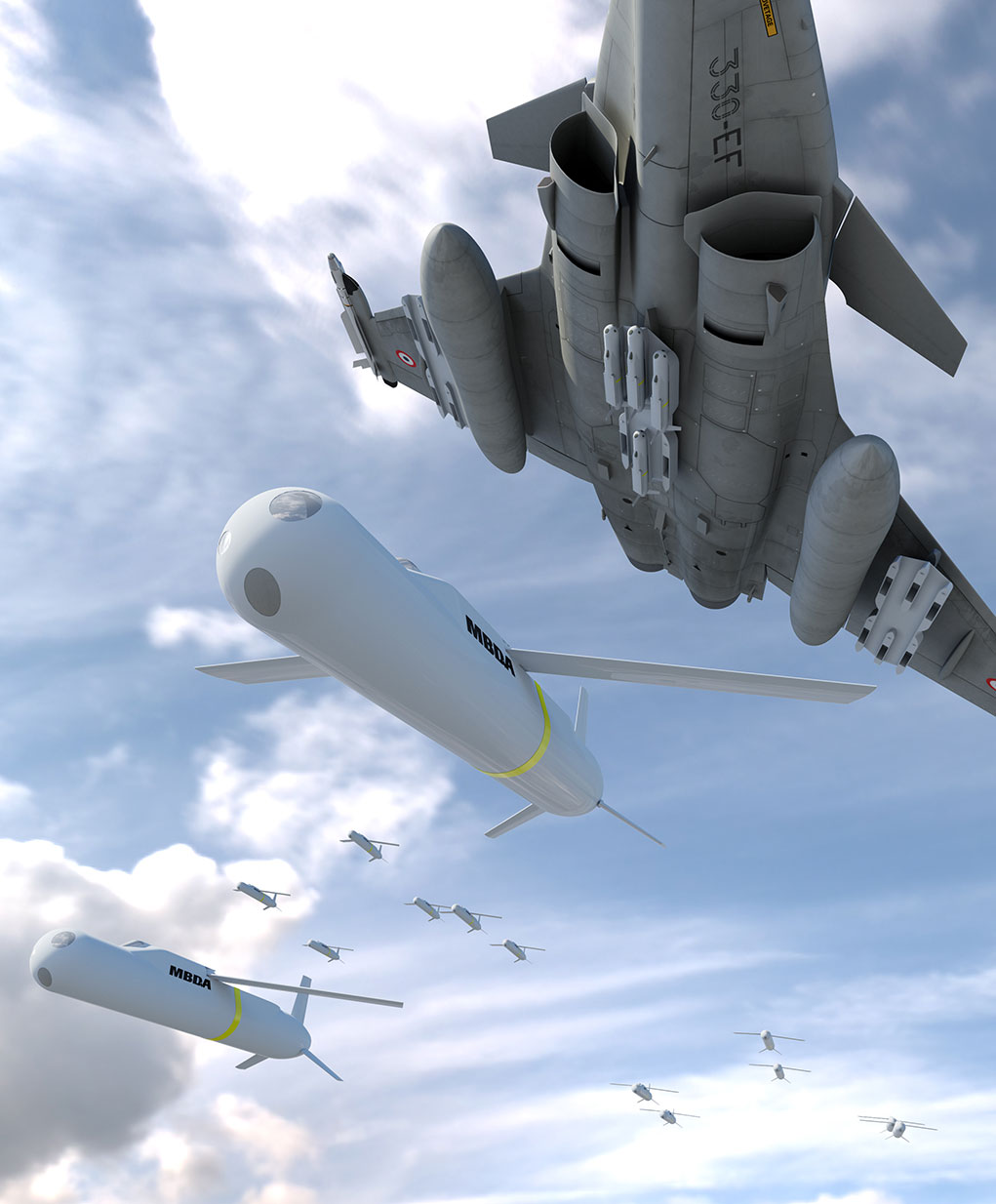
MBDA’s concept for future deep strike features two types of cruise missiles that will be optimised to penetrate and open breaches in advanced and cohesive modern Anti Access Area Denial (A2AD) deployments. Such cruise missiles feature stealthy subsonic designs and supersonic strike missiles. Artist rendering: MBDA
MBDA provided today a fresh vision of future air warfare. A range of future weapons presented by the company at Paris Air Show 2019, to illustrate the weapons that the Franco-German Next Generation Fighter (NGF) or as it has been known until now – Future Combat Air System (FCAS) and Britain’s Tempest would carry by 2030-2040. According to MBDA, these concepts form a coherent set of capabilities for Future Air System projects. The new concept bears some similarities to the current US programs such as the Gremlins and Loyal Wingman, other elements rely on existing MBDA designs, such as SPEAR 3 and Meteor which will be fielded in the early 2020s.
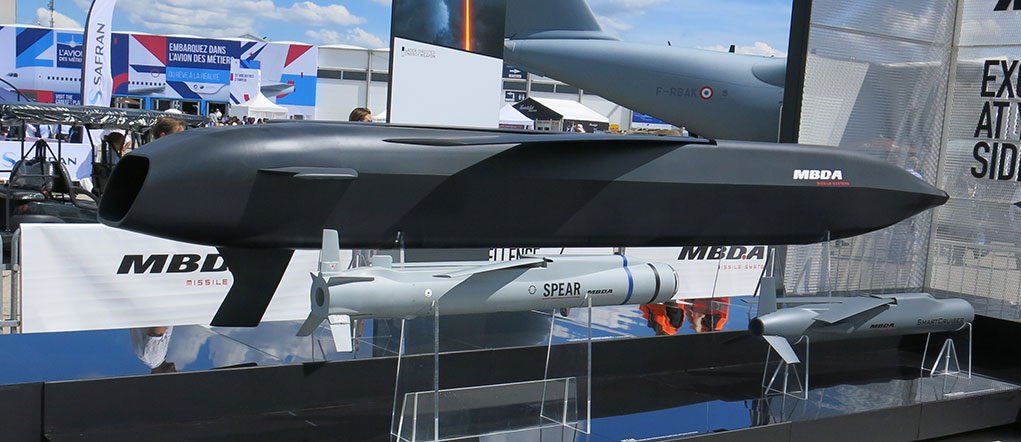
The subsonic deep strike variant is a stealthy weapon designed for external carriage on current or future aircraft. The proposed weapon will be the successor of MBDA’s Storm Shadow / SCALP EG currently known only as SPEAR 4. Most likely this will be a mix of weapons, that will include both subsonic and high supersonic cruise missiles, the later will be optimized for deep buried target penetration and attack of naval targets. Its stealthy design enables survivability in defended airspace. Photo: Tamir Eshel
The new concepts cover key domains of future air warfare including:
Deep Strike: MBDA’s concept for future deep strike features two types of cruise missiles (depicted in the dramatic artist rendering showing above) that will be optimized to penetrate and open breaches in advanced and cohesive modern Anti-Access Area Denial (A2AD) deployments. Such cruise missiles feature stealthy subsonic designs and supersonic strike missiles.
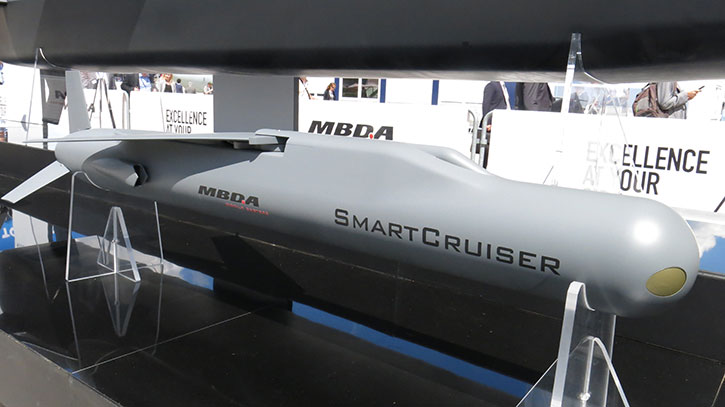
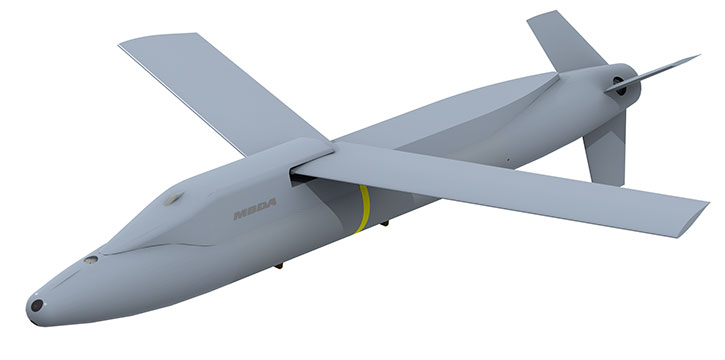
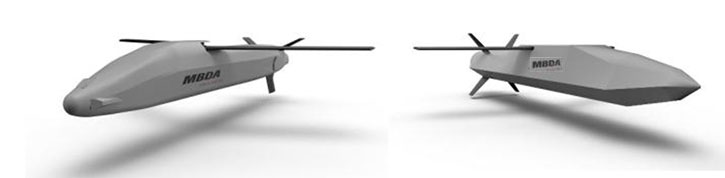
MBDA SmartCruiser. Photo: Tamir EshelCompact, lightweight strike weapons will be available in powered and gliding versions. Both configurations will be equipped with networking, collaboration, and intelligence for an autonomous swarm-like strike.Six SmartGliders can be carried by each ‘smart rack’, enabling the smart, networked and autonomous weapons to carry out swarm-like attacks. Illustration: MBDA
Tactical Strike: extending the range of weapons beyond the reach of adversary short and medium-range air defense systems, compact weapons based on precision-guided powered and unpowered (gliding) weapons will be able to deliver precision strike from stand-off range, delivering precision effects but also able to saturate enemy defenses thanks to pack or swarm behaviors, relying on networking and collaboration between smart and affordable strike weapons.
Two years ago MBDA unveiled a similar compact weapon called ‘SmartGlider’ and SmartCruiser. Two versions were described – a light weapon, 2 meters long that weighs 120 kg. and a heavy version, at a weight of 1,300 kg. The SmartGlider would be able to carry a 1,000 kg to deal with large and hardened infrastructures. With a loadout of 12 to 18 SmartGlider Lights per aircraft, thanks to a Hexabomb Smart Launcher (HSL) capable of managing reactive strikes without affecting the pilot’s workload. As such, the SmartGlider Light will allow first-day-entry by saturating and destroying enemy air defenses.
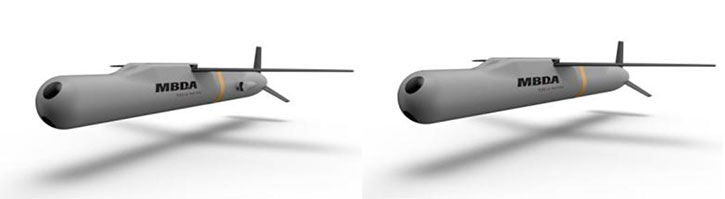
The illustration above shows a ‘SmartCruiser’ similar to the SmartGlider design, with a miniature turbojet emplaced at the rear. The strike weapons unveiled today are different from the heavy variant of the SmartGliger (shown in the illustration below) since the current approach favors strike weapons with a more stealthy design.
MBDA SmartGlider Heavy
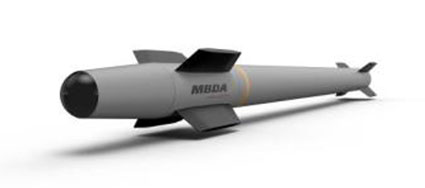
MBDA Hard-Kill Anti-missile system. The miniature missile is 100 cm long and weighs about 10 kg.
The Meteor long-range Air-to-Air missile will remain a powerful asset for next-generation fighter aircraft, but the increasing sophistication and performance of missiles is likely to challenge existing self-protection means, based on electronic warfare and decoys. MBDA considers adding a hard-kill anti-missile system, to counter incoming missiles, particularly ‘stand-in’ combat when soft-kill counter-measures and decoys are no longer sufficient. Such a system is able to reverse the balance of power against saturating defenses.
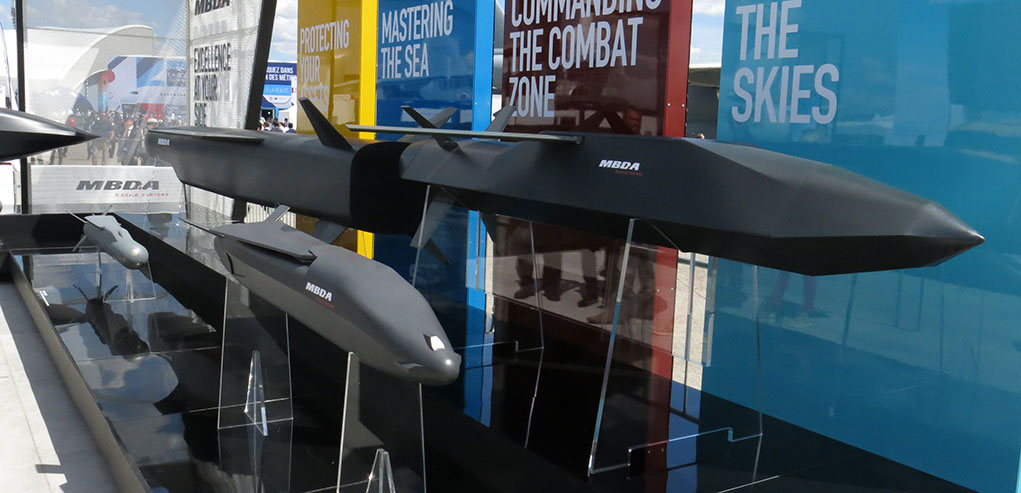
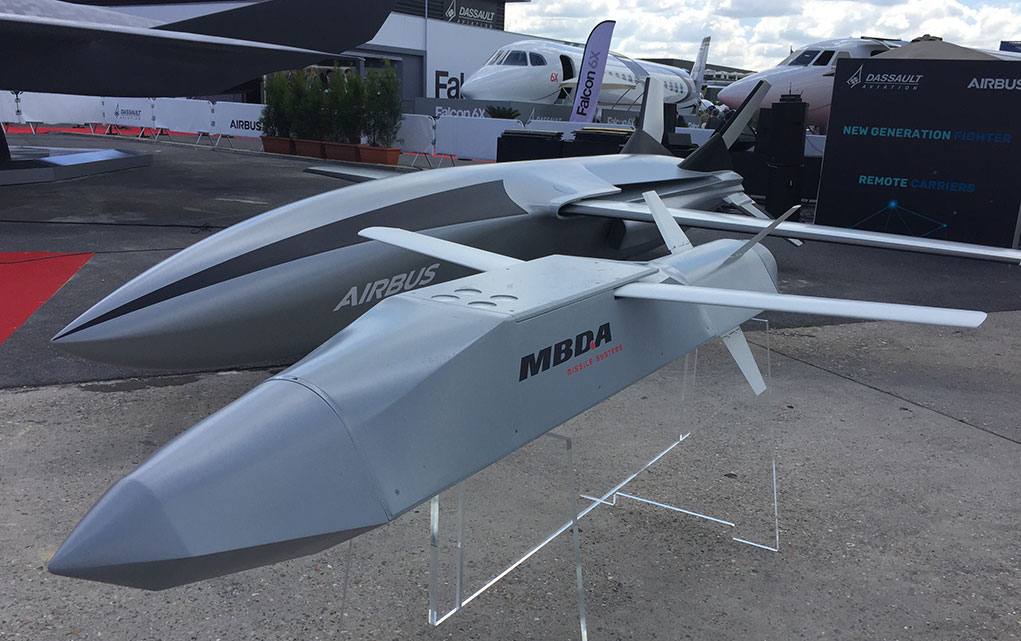
Two versions of MBDA’s Remote Carriers. The light (100) and Medium (200). Both will be able to be carried internally or externally on multi-weapon carriers. Photo: Tamir EshelMBDA Remote Carriers
A new category of weapon is ‘Remote Carriers’, various air-launched autonomous platforms that deliver multiple effects, whether lethal or non-lethal, as well as new services for munitions such as intelligence, targeting, and deception of enemy sensors. Two categories are considered, of weight classes of 120 and 240 kg. Such remote carriers would function as baits and decoys, carry additional weapons ahead of the manned aircraft and closer to heavily defended targets, collect ISR or establish communications nodes.
Unlike today’s massive weapons weighing several tons, MBDA plans these future weapons to be compact airframes, enabling large loadout on current and future aircraft. These missiles will share connectivity infrared and radio frequency sensors, performing data fusion and artificial intelligence for automated target identification in complex environments, threat detection, complex engagements planning, and decision aids will enable the weapons to pursue an attack with or without humans in the loop.
“We are ready to take on the challenge to deliver to our domestic nations the full sovereignty of their future air combat systems by taking part in the definition and development of the armaments that these systems will operate.” Éric Béranger, CEO of MBDA, stated. Eying the successful development and deployment of the Meteor Air/Air missile, Béranger said he is confident MBDA will be equally able to develop the next weapons that will ensure European nations can sustain their air superiority in the long term.
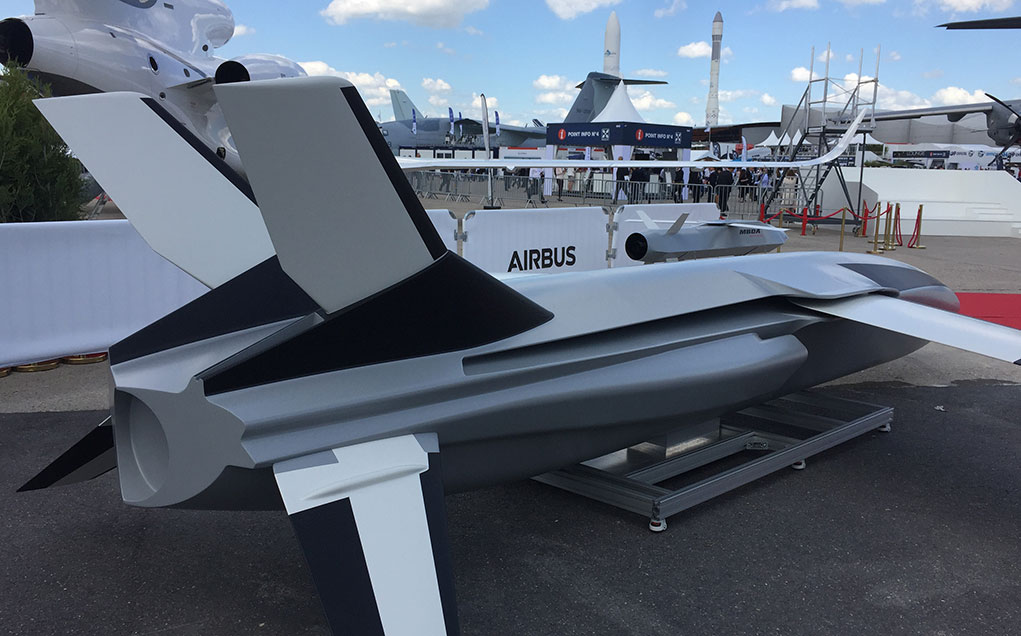
Airbus has also developed a heavy variant of the ‘Remote Carrier’, designed for external carriage. This weapon was unveiled today at the Paris Airshow with the Future Air Combat System (FCAS).
MBDA and AIRBUS are developing different vehicles for the ‘Remote Carrier’ family. Airbus is developing the heavy variant while Airbus focus on the medium and light versions. The heavy (left) and medium (right) versions are shown in this picture taken at the Paris Airshow 2019. Photo: Tamir EshelThe large Remote Carrier designed by Airbus will be launched from transport aircraft such as A-400M, thus maintaining the Next Generation Fighter (NGF) as stealthy as possible. Photo: Tamir Eshel
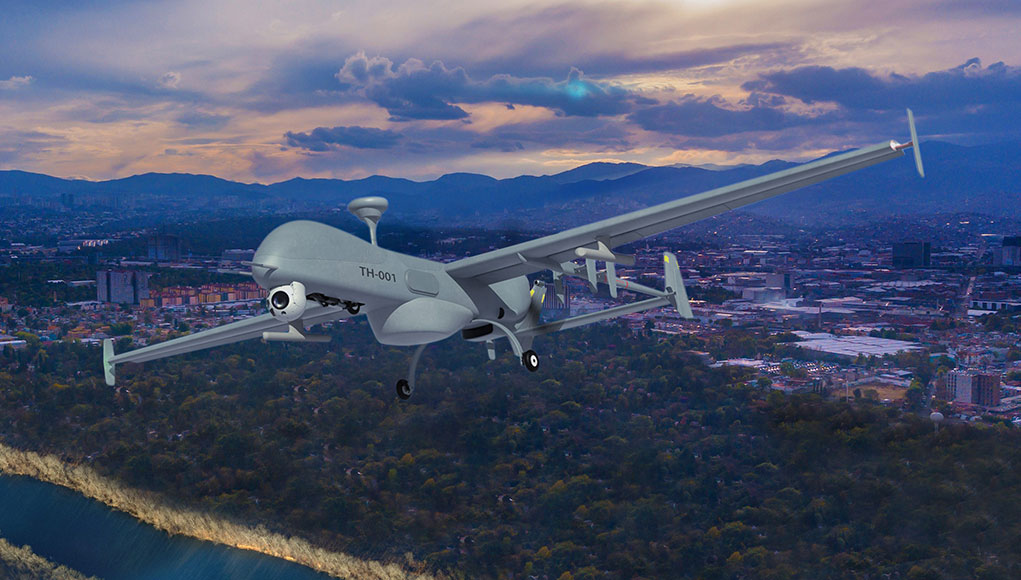
IAI Unveils the T-Heron, a successor to the Searcher tactical UAS.
IAI is introducing a new member of the Heron family of Unmanned Aerial Systems, designed for tactical operations. The Tactical Heron or T-Heron is positioned as the successor for the company’s Searcher tactical UAS, the second generation remotely piloted vehicle introduced in the early 1990s. The T-Heron joins the Heron family that currently includes Heron I, Super Heron, Heron TP-XP and Heron TP. T-Heron brings the advanced capabilities that evolved with this family to the tactical level, assisting contingency operations in remote areas. Flight testing of the new UAS is expected to begin in 2019 and continue through the next year.
Designed for tactical missions on the battlefield, the T-Heron is slated for operation by land forces and coastal security organizations. Like the larger Heron family members, T-Heron can carry and operate multiple payloads simultaneously, enabling the drone’s operation in the day, night and limited visibility conditions. Configured with a large, rectangular fuselage and low center of gravity enables the T-Heron to deploy from forward, unpaved runways with minimum preparations, and with different payload configurations. The drone and its support systems are transported in two standard containers and can operate from unpaved surfaces with minimal logistical support. The T-Heron utilizes the ground support equipment common to all Heron family UAS and is self-supported with integral power and cooling, and brakes, thus requiring no special equipment (such as cable arresting gear and power cart).
On tactical deployment, the system can minimize the support crew, utilizing the Heron family ‘Long Runner’ remote operation feature, forward-deployed T-Heron can be controlled remotely from a control center, performing all functions, including takeoff, landing, and taxi without relying on local support teams. IAI offers customers a full logistics package, providing flight line, intermediate and depot level (D level) maintenance and support, ensuring complete
independence.
Powered by a single Rotax aviation certified engine T-Heron can climb to a ceiling of 24,000 feet, fly at a maximum speed of 120 knots and carry a useful payload of up to 180 kg, including the M-19HD, IAI’s most powerful EO/OIR payload designed specifically for standoff operation. The aircraft has a gross takeoff weight of 600 kg.
Uses FAR33 aviation certified Rotax 912iSC engine, provisions for deicing systems and redundant safety-critical systems The new drone complies with UAV systems airworthiness requirements defining by STANAG 4671. To enable sharing the airspace with civilian aircraft, T-Heron also carries IFF/TCAS for identification and collision avoidance. Similar to other family members, T-Heron has an integral ‘pilot window,’ using a tail-mounted panoramic camera.
The German Federal Ministry of Defense (MOD) has selected Elbit Systems’ German subsidiary to equip its infantry units with the PNR1000 advanced soldier radio, part of Elbit Systems’ E-Lynx family of Software Defined Radios (SDR). The PNR1000, the smallest member of the family, will be delivered in handheld and vehicular configurations. These soldier radios will be used at the platoon and company levels and will be installed onboard various combat vehicles including the SPz PUMA.
The order requires an extensive transfer of technology from Elbit Systems to its German-based subsidiary, facilitating local development and manufacturing of the radios supplied to the German military, along with further extensions and capabilities. Development and production will be done in the company’s research & development (R&D) and manufacturing facilities in Ulm, Germany, which will also serve as the support and R&D center for Germany.
The E-LynX soldier radios facilitate advanced networked combat solutions in both open fields and in urban areas. This radio system provides forces with the capability to use several voice groups in a single channel, enabling flexible operation of multiple units and networks along with fast data services. With an integral Blue Force Tracking (BFT) capability, for effective, agile operations. While the soldier radio is designed for short-range operation, the E-Lynx also supports advanced networking waveform with unique concurrent flooding techniques that extend the range over a multi-hop network, improve network agility and robustness while dramatically reducing network latency.
Medium Range Surface to Air Missile Firing Trials Conducted by Indian Navy. Photo: Indian Navy
Updated: The Indian Navy conducted the first firing test of an MRSAM naval air defense missile employed in the full Joint Taskforce Coordination (JTC) mode. JTC implements the MRSAM ‘Cooperative Engagement’ operating mode which sets the system apart from other air defense systems. The recent trial comprised two complex scenarios involving multiple platforms and several simultaneous targets.
On the recent test, conducted on 15 May at India’s western seaboard, two destroyers, INS Kochi and INS Chennai detected multiple targets using their MF-STAR radars and launched several missiles at those targets. What was different was that only one of the ships controlled the engagement, intercepting different aerial targets at extended ranges by the missiles fired from both ships using the systems’ JTC mode. The test demonstrated the ability of MRSAM to operate wide-area air defense, distributing assets and control over different platforms and locations. Previous MRSAM firing trials were conducted on a single platform, in the stand-alone mode.
The new engagement capability derives from the network-centric architecture of the Barak 8 system and its MF-STAR 360º radar system that harness multiple sensors, launch platforms, and effectors into a single air defense system. By fitting a data link to each interceptor, missiles can be updated via data-link after launch by any network member. With this capability, Barak-8 missiles can receive target updates on their mid-course, with updated target information, retasking the highest priority target, until the missile enters the terminal engagement. This capability maximizes missile utilization and battle economy. It enables a single ship to orchestrate the air defense mission or allocate missions to other vessels when required.
Barak 8 (MRSAM) features a dual pulse rocket motor as well as Thrust Vector Control, and possesses high degrees of maneuverability at target interception range. A second motor is fired during the terminal phase, at which stage the active radar seeker is activated to home in on to the enemy track. Barak 8 has been designed to counter a wide variety of airborne threats, such as; anti-ship missiles, aircraft, UAVs drones, and supersonic missiles. The missile has a maximum speed of Mach 3 (3,700 km/h_ with a maximum operational range of 38 nm (70 km), which was later increased to 80 nm (150 km) with the introduction of Barak 8 ER.
MRSAM Surface to Air Missiles (also known as Barak 8) are fitted onboard the Kolkata Class Destroyers (Kolkata, Cochi, and Chennai) and would also be fitted on all future major warships of the Indian Navy. The test was carried out by the Indian Navy, DRDO, and Israel Aerospace Industries. Bharat Electronics (BEL) is the prime contractor for the Indian MRSAM system.
Cooperative engagement involves using data links between ships and platforms to have a “common picture” of a battle situation and taking control of weaponry on multiple platforms. In addition to the target hard-kill, such capability also improves the battlegroup’s resilience against jamming.
A SPICE 1000 weapon strikes a hard target on a trial. Photo: RAFAEL
Lockheed Martin and RAFAEL have signed a cooperation agreement to jointly develop, manufacture, market and support RAFAEL’s Smart, Precise Impact and Cost-Effective (SPICE) missile guidance kits to Lockheed Martin’s platforms. RAFAEL already subcontracts about 80 percent of SPICE subassemblies to US manufacturers in eight states. The agreement will enable Israel to buy SPICE kits from the USA, using US military support funds. The agreement follows a market assessment evaluation done by the two partners in the past year.
“Access to GPS is becoming increasingly limited in contested environments,” said Mr. Yuval Miller, executive vice president, and general manager of Rafael’s Air & C4ISR Division. “SPICE provides a solution to this challenge. Finalizing this exclusive agreement sets the scene for our two companies to provide unmatched mid-range guided air-to-surface weapon systems to enhance mission flexibility and success.
SPICE kits are compatible with Lockheed Martin F-16, and, following full integration, will also equip Israel’s Air and Space Forces F-35A. Once concluded, the SPICE will also be available to other F-35 operators. SPICE has also been integrated with the Saab Gripen E, and has already been selected to equip the new Brazilian Gripen NG fighters. RAFAEL also develops the SPICE 250 unitary guided munitions. The bigger SPICEs are designed as guidance kits added to standard bombs. The current agreement does not mention the SPICE 250.
SPICE is a family of stand-off, autonomous, air-to-surface weapon systems, capable of destroying targets with pinpoint accuracy and at high attack volumes in a GPS-denied environment. Combat-proven and in service with the Israeli Air Force and several international customers, SPICE employs a state-of-the-art electro-optical seeker with unique scene-matching algorithms, navigation guidance and homing techniques to achieve operational missions in adverse weather without GPS. The MOU covers the SPICE 1000 (453 kilogram / 1,000 pound weight class) and SPICE 2000 (907 kilogram / 2,000 pound weight class) precision-guided missile kit variants. The SPICE extends the aircraft strike range to 100 km, thus enabling attack from standoff range.
The cooperation agreement follows the partnership RAFAEL and Lockheed Martin established for the international marketing of The POPEYE EO guided missile back in the 1990s. Known as HAVE NAP (AGM-142) POPEYE was fielded by B-52 of the US Strategic Air Command, as well as F-4, and F-111 of the Australian, South Korean, Turkish and Indian Air Forces.
“SPICE is a leading air-to-surface weapon system offering U.S. and international air forces operating Lockheed Martin’s platforms, as well as strategic bomber aircraft, an important complement to their existing operational capabilities,” Miller added. “SPICE’s unique features greatly enhance the U.S.’ ability to operate in contested environments.”
“SPICE offers the U.S. Department of Defense and many allies a capability that no other weapon currently in inventory provides,” said John Varley, vice president of Close Combat Systems at Lockheed Martin Missiles and Fire Control. “By applying our expertise in aircraft integration, mission planning, and tailkit design, along with our experience in affordable, streamlined production, we will adapt SPICE to meet U.S. standards so bomber and fighter aircraft can benefit from the added mission flexibility that SPICE offers.” Lockheed Martin is the prime contractor providing the AGM-158 family of Joint Attack Air to Surface Missile (JASSM) cruise missiles, and the Paveway family of laser-homing weapon guidance kits, widely used by airforces worldwide. SPICE adds an alternative guidance technique, strike autonomy, and independence of GPS, extending the air forces’ operational flexibility in planning and performing strike missions with modern combat aircraft.
SPICE 2000 carried on an IAF F-16. The Viper can carry four SPICE 2000 guided weapons. Photo: RAFAEL
As traditional defense primes face mounting competition from agile “neoprimes” such as Anduril, Palantir and Helsing, the balance of innovation is shifting toward software-defined warfare and scalable, dual-use technologies, while global industry consolidation—marked by Boeing’s integration of Spirit AeroSystems and other strategic mergers—signals an intensified race to secure control over the defense technology value chain. Our Defense-Tech weekly report highlights these trends.
In early October 2025, a coordinated wave of unmanned aerial system (UAS) incursions—widely attributed to Russia—targeted critical infrastructure across at least ten European nations. The unprecedented campaign exposed the fragility of Europe’s air defenses...
Executive Summary
The past week (September 18-25, 2025) represents an inflection point where strategic defense concepts have transitioned from doctrine to tangible reality. An analysis of global events reveals four primary, interconnected trends shaping an...
At the 2025 Air, Space & Cyber Conference, U.S. Air Force and Space Force leaders unveiled major updates on next-generation fighters, bombers, unmanned systems, and space initiatives, highlighting both rapid innovation and critical readiness challenges as the services race to outpace global competitors. A short version is available here, with a more detailed version for subscribers.
The Taipei Aerospace & Defense Technology Exhibition (TADTE) 2025 crystallized around four dominant strategic themes that collectively illustrate Taiwan's comprehensive approach to defense modernization amid escalating regional tensions. Based on a detailed report by Pleronix (available upon request). Includes a Podcast discussion on TADTE 2025's highlighting Taiwan's four strategic themes beyond the post's coverage.
Israel’s Iron Beam 450 high-power laser system has completed final testing, marking a major leap in air defense. Developed by Rafael, it offers precise, cost-effective interception of rockets, UAVs, and mortars, and is set for IDF deployment by 2025.
WB Group unveiled its Future Task Force (FTF) at MSPO, a new warfighting concept integrating manned, unmanned, and autonomous systems. Combining hybrid-electric vehicles, loitering munitions, and AI-enabled command tools, the FTF is designed to sustain firepower and autonomy while reducing battalion size and logistical footprint.