Sunday, December 21, 2025
More
    Home Blog Page 385

    RAFAEL, General Dynamics Team to Supply Spain with 2600 Spike Missiles

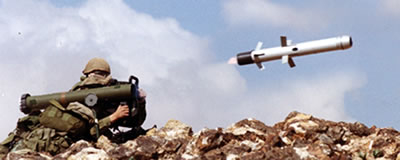
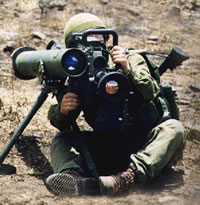
    SPIKE-LR, a member of the SPIKE Family of fourth generation multi-purpose, multi-platform electro-optic guided missiles offers autonomous as well as ‘man-in-the-loop’ day, night and adverse weather operation. The SPIKE Family is comprised of missiles for a variety of ranges (2.5-8 km) and warheads and is designed for use by infantry, on vehicles, helicopters and naval platforms.


    SPIKE-LR’s basic mode of operation is Fire and Forget, however an advanced fiber-optic data link provides the added benefit of Fire, Observe and Update operation, enabling the operator to change the direction of the missile after launch, thereby increasing precision and minimizing collateral damage. The SPIKE system is specially designed for all types of conflicts, ensuring maximum survivability for its operator.

    At present, sales of SPIKE systems amount to over a billion dollars and have been sold and are operational in many countries including Israel, The Netherlands, Poland, Italy, Romania, Finland, Singapore, Czech Republic, some South American countries and others.

    More details of the recent Spanish procurement reported by Defense Update in November 2006 were released January 11, 2007, with the announcement of formal contract between General Dynamics Santa Barbara Systems of Spain and the Israel’s RAFAEL. Spain evaluated the Spike LR against the US Javelin and European Milan-ER. The new missiles offering will replace outdated Milan and Dragon missiles currently in service.

    According to the contract, the Israeli company will supply its Spanish counterpart with 2,600 SPIKE-LR missile and 260 launchers, for a total value of over US$400 million. General Dynamics Santa Barbara Systems is the prime contractor for the $425 million, eight year program. Approximately 60 percent of the program work will be completed in Spain, where General Dynamics Santa Barbara Sistemas will manufacture system components and perform final assembly and testing. Deliveries are expected to start in 2008.

    Inmarsat, ViaSat to develop Mobile Military Satellite Communications Terminal

    A new joint venture co-funded by mobile satellite communications provider Inmarsat (LSE:ISAT) and digital communications equipment provider ViaSat Inc. (Nasdaq:VSAT) is offering mobile satellite communications services for the defense sector. The two companies will develop a new mobile satellite communications terminal, providing secure, highly mobile voice and high-speed data communications destined for use by the armed forces.


    The new service is targeted specifically at the U.S. and NATO markets. The terminal will combine Inmarsat’s IP-based Broadband Global Area Network (BGAN) technology with ViaSat AltaSec IP inline encryption equipment while utilizing the commercially available Inmarsat network, to create a portable, ruggedized BGAN user terminal capable of uplinking IP data fully compliant with HAIPE version 1.3.5 Type 1 security standards.

    BGAN mobile satellite communications service delivers simultaneous voice and broadband IP data to users anywhere on the globe utilizing highly portable devices. It supports mobile broadband data at speeds up to half-a-megabit per second, as well as guaranteed IP data rates up to 256 kbps. Engineers from both companies have already successfully demonstrated the compatibility of using the BGAN service with ViaSat KG-250 Type-1 High Assurance Internet Protocol Encryptor Interoperability Standard (HAIPE IS) compliant encryption products over the new constellation of Inmarsat advanced broadband satellites, the Inmarsat-4s.

    SOCOM Launches Silent Knight Airborne Radar Development

    The U.S. Special Operations Command has awarded Raytheon Company (NYSE:RTN) a $135.4 million contract to develop a new tactical radar for rotary and fixed-wing aircraft. The radar, called Silent Knight will be initially integrated in the service’s new MH-47G helicopter, serving as a common multi-mode terrain following/terrain avoidance radar, allowing airborne forces safe low-level flight and safe ingress and egress in adverse environments.

    The current phase will be funded by cost plus incentive fee contract with potential value of US$164 million, which will include six production units. Future contracts will fund additional procurement for more MH-47Gs, MH-60M, MC-130H, and CV-22 block 30 aircraft. Raytheon’s team for the program includes AIC, Crestview, Fla.; DRS Technologies, St. Louis, Mo.; and Rockwell Collins, Cedar Rapids, Iowa.

    Javelin Block 1 in Test Firing Qualification

    Block 1 upgraded Javelin missile recently passed qualification flight tests at Redstone Arsenal, in Huntsville, Alabama. The U.S. Army continues to field the Javelin missile and has already contracted for Block 1 missiles as part of its fiscal year 2005 contract. The upgraded missile uses an improved rocket motor that reduces the missile’s time of flight. Other improvements are made in the command launch unit (CLU), introducing software enhancements. The warhead has also been modified to increase lethality against a wider range of target sets. The combat proven Javelin have scored over 95 percent mission success in more than 1,000 rounds fired in ongoing operations worldwide. Production is well underway at suppliers and began in Troy, Ala., in the fourth quarter of calendar year 2006.


    Javelin is in service with the U.S. Army and Marine Corps and has been deployed by the U.S. and Australia in Operations Enduring Freedom and Iraqi Freedom. Coalition forces also are employing the CLU effectively in surveillance. Javelin has been selected by the armed forces of 10 nations: the United States, United Kingdom, Australia, New Zealand, Ireland, Norway, Lithuania, the Czech Republic, Taiwan, Jordan, and the Sultanate of Oman.

    Raytheon Company provides system engineering management and support for the Javelin Joint Venture and produces the command launch unit, missile guidance electronic unit and system software. Lockheed Martin provides missile engineering and production support for the Javelin Joint Venture in Orlando, Fla., produces the missile seeker and the electronic safe, arm and fire electronic module in Ocala, Fla., and performs missile all-up-round assembly in Troy, Ala.

    Protecting Naval Surface Ships from Fast Attack Boat Swarm Threats

    Lockheed Martin (NYSE:LMT) has successfully completed at-sea demonstration operational testing of a new Fast Inshore Attack Craft (FIAC) Defense System, which provides an innovative and cost-effective way to quickly extend the defensive perimeter of most naval vessels out to five miles.

    To counter the globally emerging threat of small attack boat swarms – referred to as FIAC by the U.S. Navy – a Lockheed Martin-led industry team, with the support of the Navy, developed the FIAC Defense System. The system integrates existing sensors, weapons and decision support systems with innovative command and control (C2) elements to allow host ships to detect, identify, verify hostility and target small boat threats beyond visual range, and then to engage hostile craft with Hellfire missiles as they penetrate the system’s five-mile defensive perimeter.
    The FIAC Defense System derives its capabilities from the fusion of onboard radar and optical sensors, as well as potentially off-board sensors aboard Unmanned Aerial Systems (UASs), to provide both persistent and predictive situational awareness. The system uses the host ship’s radar for initial detection and the UAS’s advanced optical sensors to confirm target identification, capability and intent. Once a potential threat is identified as hostile, the target is then laser-illuminated and engaged with Hellfire missiles from either a deck-mounted launcher, the UAS or from a Hellfire- capable helicopter. The UAS’s optical sensors can then be used to confirm the successful engagement and provide a visual battle damage assessment.


    During the recent Spiral 3 at-sea testing conducted in the Pacific Ocean, the FIAC Defense System was installed in standard U.S. Navy mission modules and loaded aboard Lockheed Martin’s Sea SLICE research vessel. With the exception of live lasing and live missile firing, the fully functional system successfully demonstrated its ability to detect and identify multiple potential threats at greater distances than what can be currently done using existing systems.

    During the next phase of testing – Spirals 4 and 5 – the FIAC Defense System will include at-sea operations on a U.S. Navy test range with live lasing and surface-to-surface firings of Hellfire missiles against multiple FIAC threat scenarios.

    “The FIAC Defense System provides the ability to protect ships from one of their most serious littoral threats,” said Dave Broadbent, vice president and general manager of Lockheed Martin’s Littoral Ships & Systems line of business in Baltimore, which is leading the industry team. “By investing our own research and development funds and relying primarily on existing, off-the-shelf software and hardware, Lockheed Martin and its partners are providing an affordable solution that can now be brought to market much faster than a custom-designed system.”

    Other Lockheed Martin businesses partnered on the FIAC Defense System include Integrated Systems & Solutions in Valley Forge, PA; Missiles and Fire Control in Orlando, FL; and Simulation, Training and Support in Orlando. U.S. Navy partners include the Program Executive Office for Integrated Warfare Systems, Helo Strike Maritime Weapons School Pacific and the Surface Warfare Development Group. Other industry partners include Terma, of Denmark; FLIR Systems Inc. based in Oregon; and Cisco Systems, headquartered in California.

    General Atomics Team with Sener, Promoting Predator in Spain

    General Atomics Team with Sener, Strengthening Predator Offering in Spain General Atomics Aeronautical Systems, Inc. (GA-ASI) is teaming with SENER Ingeniería y Sistemas, S.A., a leading Spanish engineering, consulting and systems integration company, to promote GA-ASI’s Predator Unmanned Aerial Systems meeting Spain’s airborne surveillance and reconnaissance requirements.

    Following the impressive performance of Predator family UAS in combat, in Central Asia and the Middle East, the company won significant sales in the UK, with other NATO countries considering the system for their air forces. According to Thomas J. Cassidy, Jr., president, Aircraft Systems Group at GA-ASI the Predator will “offer a proven, versatile, and cost-effective solution that will meet Spain’s surveillance requirements and expectations”.

    SENER participates in several European aerospace programs, among them the Eurofighter and Eurojet, Airbus A-380 and A-400M. The company is also involved in European space programs, including earth observations satellites, including the Galileo. Rafael Quintana, general manager for Aerospace, SENER said that the company’s expertise in delivering ISR systems to the Spanish Defense and Security Forces through the adaptation and integration of platforms and sensors and its capability to provide in-country operational and logistical support will contribute to the team’s offering.

    S4R – Solid-State Radar Demonstrator

    Lockheed Martin (NYSE:LMT) successfully displayed live tracks with an innovative solid state active electronically steered antenna used in an engineering development model of the Scalable Solid-State S-band Radar (S4R). The system utilizes new high power silicon carbide (SiC) based Transmit/Receive (T/R) modules. “According to Carl Bannar, vice president of Lockheed Martin’s Radar Systems business, the system provides evidence of a proven approach using high-power Silicon Carbide technology. S4R design is derived from the S-band antenna developed for the U.S. Navy’s Volume Search Radar on the DDG-1000 next-generation destroyer.

    The S4R EDM is an active, electronically-steered, antenna-based radar system designed to be scalable to support multiple missions, including air surveillance, cruise missile defense, ballistic missile defense, counter target acquisition and littoral operations.

    The S4R EDM was developed using Silicon Carbide (SiC) based high-power Transmit/Receive (T/R) modules. SiC provides greater power than other commonly used materials due to its increased heat tolerance. With more power, the radar has longer range and provides more precise target discrimination. Transmit/Receive modules are the most critical components of a solid-state antenna. They serve as multiple function circuits that generate and transmit signal power over the full face of the radar, receive the reflected radar signal, amplify it for processing and electronically steer the radio frequency beams in space.

    Solid State Laser Destroys Mortar Bombs

    Raytheon Company (NYSE:RTN) successfully tested a prototype Laser Area Defense System (LADS) combining the Phalanx radar guided gun system with a powerful solid-state laser weapon to defeat rockets, mortars and missiles at a combat significant range. During three tests performed in the past 6 months, the prototype system successfully detonated 60-millimeter mortar bombs at a range greater than 550 yards.


    The LADS demonstration used a proven, existing, off-the-shelf solid-state laser, coupled with commercially available optics technology. The goal of the demonstration was to rapidly prove that lasers can yield military utility now by demonstrating that such a system could protect warfighters against mortars. Secondary goals of the demonstration were to offer a near-term alternative to chemical lasers, which may create logistics challenges for the warfighter, and to prove that existing optical and targeting components can significantly lower total laser system costs and speed their ultimate transition to the warfighter.

    Solid-state laser technology makes LADS safe to the environment, does away with the need for caustic chemicals and radically reduces the life-cycle cost. LADS is highly mobile and has the operational capability to simultaneously engage multiple targets at tactically relevant ranges. The laser system is powered by a commercially available generator or grid electricity and provides an extremely inexpensive, almost infinite magazine for countering mortar and rocket threats.

    “Our solid-state LADS proves you don’t have to wait another three to five years for solid-state lasers to have military utility on the battlefield. They are ready now, with no chemicals required.” Says Mike Booen, vice president of Advanced Missile Defense and Directed Energy Weapons at Raytheon Missile Systems in Tucson, Ariz.

    Swiss Army gets Kodiak Armored Engineer Vehicle

    Rheinmetall Defense Systems will supply 12 heavy armored engineer vehicles based on the Leopard 2 chassis to the Swiss Army Engineer. The first “Geniepanzer” designated Kodiak, will be delivered within two years. Kodiak represents a new generation of armored engineer vehicles, for which the Swiss Army is the first customer. The new vehicle was developed by a consortium established by Rheinmetall Landsysteme GmbH of Kiel, Germany and RUAG Land Systems of Thun, Switzerland. According to RDE, A number of nations have already expressed an interest in this state-of-the-art system; some have launched procurement projects already.

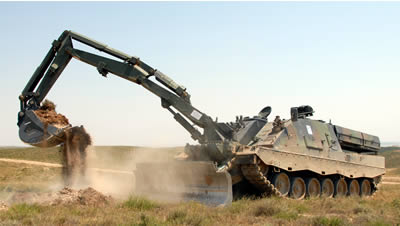
    Geniepanzer - Kodiak heavy armored combat engineer vehicle, based on teh Leopard 2 chassisThe Kodiak is equipped with various sets of mission specific engineer tools to support various missions, such as heavy-duty combat engineering including obstacle breaching, earthworks, digging, trenching and debris removal etc, as well as minefield breaching.
    To perform its primary mission, the Kodiak is equipped with a high-performance hinged arm excavator mounted in center position, as well as a dozer system with innovative cutting and tilt angle settings and a double-winch system consisting of two 9 ton capstan winches. When combined and deployed in multiple traction mode, these provide a pulling force of up to 62 tons. The excavator bucket can be exchanged for a number of other devices, including a hydraulic hammer and a universal-gripper, attached to a quick-release coupling. All these tolls are electro-hydraulically controlled and can be operated by the driver with two joysticks.

    When tasked for minefield breaching, the dozer blade is replaced by a full-width mine plough. For this role, additionally equipment is provided, including a signature-duplicator and lane-marking units. The Kodiak’s anti-landmine protection technology features correspond to those of the latest generation of Leopard 2 MBT.

    The minebreaching version of the Kodiak Geniepanzer is fitted with mine plough, lane markers and other counter-mine equipment. The vehicle retains the Leopard 2 mine protection capabilities.

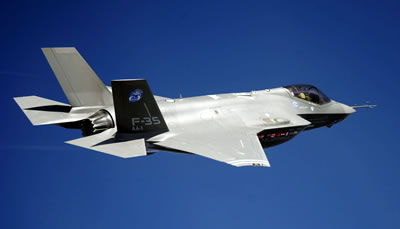
    F-35 Makes Second Flight


    The second flight was flown by F-35 Chief test pilot Jon Beesley made on January 8th, 2007. 10 minutes after takeoff Beesley retracted the landing gear, climbed from 15,000 to 20,000 feet to evaluate handling qualities and engine operation in the cruise mode at Mach 0.6 (~ 450 m.p.h.) and Mach 0.7 (~ 530 m.p.h.). The handling tests included rolls, turns, angle-of-attack changes and engine throttle changes. The flight lasted 62 minutes and was executed exactly as planned.

    “The maturity of this highly integrated aircraft for its second flight is dazzling – when it’s time to fly it is always ready and takes minimal time to get out of the chocks,” said Jon Beesley, F-35 Chief Test Pilot. “The flight underscores that the Lightning II flies just as our engineers predicted. This was the first time that we have retracted the landing gear and the aircraft handling qualities were outstanding. I continue to be impressed by this marvelous airplane’s performance and handling characteristics.”

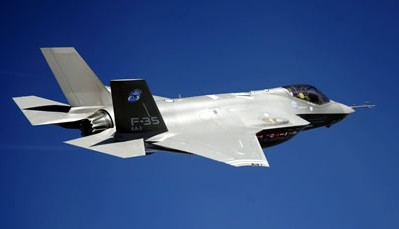
    The first F-35 Lightning II Joint Strike Fighter took off on its initial test flight from Lockheed Martin in Fort Worth, Texas on 12:44 December 15, 2006 piloted by the program’s Chief Pilot Jon Beesley. The aircraft was airborne 35 minutes on its maiden flight. the jet lifted off and began a climb-out to 15,000 feet. Beesley then performed a series of maneuvers to test aircraft handling and the operation of the Pratt & Whitney F135 turbofan and subsystems.

    F-35 takes off on its maiden flight, Dec. 15, 2006
    Lockheed Martin F-35 JSF takes off on its first flight, December 15, 2006. Photo: Lockheed Martin

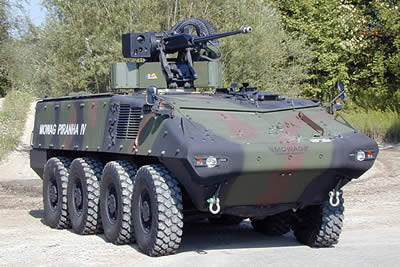
    Elbit Contracted to fit Belgian Piranhas with 30 mm Turrets

    Elbit Systems and Mowag signed a contract valued at €44.8 Million (Approximately $58 Million) to equip 138 Mowag’s Pirhana III armored vehicles, destined for Belgium, with unmanned turrets monting 30mm automatic guns and electro-optical systems. The unmanned urret, known as ORCWS Overhead Remotely Controlled Weapon System is installed over the vehicle’s roof, and is remotely controlled by the gunner from within the vehicle, leaving much needed space inside the fighting compartment for troops, supplies and command and control systems.

    The Belgian Army was one of the pioneers to select medium caliber (30mm) remotely operated weapon stations. It was later followed by further selections by Portugal, and the Czech Republic. In 2006 the Belgian MOD selected Mowag as prime contractor for the supply 138 Piranha III vehicles for the Program. The full scope of the program could reach 242 vehicles. Elbit Systems is cooperating with the Swiss company Mowag of the General Dynamics European Land Combat Systems Group to deliver the turrets and electro-optical fire control systems. Deliveries are scheduled to take place between 2007 – 2012.

    Mowag (GDLS Europe) Pirhana IV mounting th eunmanned 300mm weapon turret, developed by Elbit Systems

    Franch Army Orders New Eryx Missiles

    The French armed forces have ordered will maintain the Eryx short range anti-tank missile in service through 2020. Last month MBDA received an order worth €66.5 million, for combat and training missiles destined for the Army and Marine commandos. Deliveries will commence between the second half of 2008 through 2011. Under a separate forthcoming contract MBDA is will also improve parts of the Eryx missiles currently in service, particularly the tripod.

    Eryx is a 13kg anti-tank weapon system, capable of defeating armoured vehicles at ranges of 50 to 600 meters. According to MBDA, of the 52,000 missiles produced to date some 7000 were fired scoring over 90% successful hits. The missile entered service with the French Army in 1993 and is operational with seven countries.

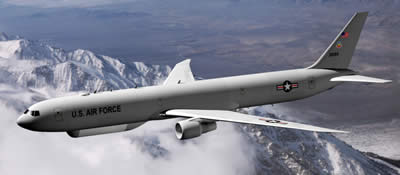
    Northrop Grumman gets US$256 for Continued E-10A Development


    Northrop Grumman Corporation (NYSE:NOC – News) announced an award of US$256 million contract received for continued technology development of the E-10A wide area surveillance and battle management command and control (MNC2) platform. The contract covers design and analysis of the E-10A Technology Development Program (TDP) through Initial Design Review, which is scheduled for May 2007.

    According to Dave Nagy, vice president of Northrop Grumman’s Intelligence Surveillance Reconnaissance Programs, the current phase will test the new radar technology to be used for wide-area surveillance, offering ground and air surveillance targeting capabilities. The program integrates and Northrop Grumman’s Battle Management Command and Control (BMC2) mission suite into an airborne system that provides a able to detect, classify, characterize and report cruise missile targets, ground moving target. Several E-10As are planned to operate within a networked multi-sensor command and control constellation environment to cover a wide area. The program is managed by Air Force Material Command’s Electronic Systems Center at Hanscom Air Force Base, Mass.

    The Khuzestan Gambit

    Could the new naval build-up in Persian Gulf signal a new US strategy against Iran, one which differs completely, by taking a fresh approach in the troubled four-year-old quagmire in Iraq, which has already cost over 3,000 American lives? Military experts see in the new naval deployment evidence that President George W. Bush has already rejected the key Baker-Hamilton Iraq Study Group’s recommendation to engage Iran for an exit strategy on Iraq. This indication is further strengthened, by President Bush’s reshuffling of his military brass in Iraq and CentralLt. Gen. David Petraeus, US ArmyAdmiral William Fallon, US NavyCommand. Lt. Gen. David Petraeus (left), who replaces General William Casey, is an Iraq veteran , who headed the effort to train Iraqi security forces, will take Casey’s place as ground commander in Iraq. Admiral. William Fallon (right), a Navy veteran who to some may be an odd choice to oversee a ground conflict in a nearly landlocked country. But perhaps the new plan is based on a strong naval and air support for an offensive option, which has sofar been neglected, through protracted coalition-led counter insurgency warfare, which bogged down thousands of troops in a losing battle for Iraq.
    Stenis Carrier Battle Group is underway to the Arabian Gulf, to reinforce the US Navy presence during the upcoming months.

    Little attention has been paid to the potential role of ethnic minorities in the Iran crisis, particularly of the Iranian Arab minority, centered in the southwestern province of Khuzestan. Events in the oil-rich province bordering Iraq could serve as a harbinger of U.S.-British intentions in Iran, and expose Khuzestan as Iran’s Achilles Heel. Recently, a series of bombings and ethnic clashes has begun to show that something is definitely happening in Khuzestan, which could be an early warning of things to come.

    One look at the Iraq-Iran map could suffice to sustain such a theory. Khuzestan is a small part in south west of Iran which was once part of the great and independent government of Elam in ancient times. The province’s military topography makes it ideal for an attack from the south-west.

    An aerial map of the oil rich Kuzestan region, where some of the world's richest oil reserves. are located
    The large plains there, bordering with the Iraqi marshes and the mountain regions situated to its north and eastern part, being part of the Zagros mountain ranges, shield it from the interior. This already made Khuzestan the first objective for Saddam Hussein’s assault on Iran in 1980.


    Khuzestan has important advantages for the US from a military point of view. It has a long border with Iraq, and the terrain is flat, so an American military invasion could be mounted and carried out relatively swiftly. It is a short drive from Basra, the main city in southern Iraq, to Ahvaz, the Khuzestan capital. The US could carry out this kind of partial invasion in the name of “stabilizing” Iraq.

    In fact, The reliable website Globalsecurity has even named such a strategic move the “Khuzestan Gambit” under which U.S. and British forces aiding an Arab uprising would turn Khuzestan into a de facto autonomous protectorate of “Arabistan” or “Ahwaz,” in order to take control of the country’s oil-dependent economy. Whether such a move could be implemented, remains to be carefully contemplated, taking into consideration that the Iranian Revolutionary Guard Corps (IRGC –Pasdaran-e Inqilab) could be a hard nut to crack if they decide to stand up and fight. For one, some 16,238 hectares of minefields in Khuzestan are still spread over a vast sector of the region, bordering with Iraq. Only last May, Islamic Revolutionary Guards Corps (IRGC) Commander Major General Rahim-Safavi claimed that the forces of Islam “are fully prepared to defend the Islamic homeland , as Khuzestan Province has always been a target for foreign greed”.


    In fact, any American venture, should it come to be, could face a surprise, pre-emptive move by the Iranian Pasdaran, before it is implemented! Iran’s primary target could be a long aspired annexation of southern Iraq and its oil wealth at Basra. The newly created so-called “Arvand Free Zone” is stretching 30km from Abadan along the Shatt Al-Arab to the land border between Basrah and Khuzestan. This is in two segments: an island and adjacent land measuring 30 square km and a strip of land north of Khorramshahr measuring 25 square km. literally within a stone’s throw of Basrah. Now a large part of the Khuzestan-Basrah border is about to become an exclusive military zone, which will allow Iran to effectively annex Basra, in a relatively swift operation. The port city of Khorramshar was the scene of some of the most intense fighting during the Iran-Iraq War (1980-88). It is regarded as one of the Middle East’s most strategic points. On February 1986, 30,000 Iranian troops crossed the Shatt Al-Arab in a surprise attack to invade and occupy Iraq’s Al-Faw peninsula and create a bridgehead for further advances into southern Iraq, only to be held-up through US political intervention.

    Not only for military and political reasons is Southern annexation imperative for Iran’s economy. Contrary to most assessments, it is little known that Iran must have Basrah because of future energy shortages in Iran. A John Hopkins energy assessment, just released, indicates that a steep and irreversible near term decline in Iran’s own oil production (50 per cent decline in five years) is underway!

    Thus, it is of no surprise that the Iranian Revolutionary Guards’ elite Qods Force, based in Ahwaz City and the Revolutionary Guards Corps’ (IRGC) Fajr Garrison deployed in Khuzestan, serves as the organisation’s main headquarters, running the vast underground network in Iraq supporting Iran loyalists among the Arab Shiite insurgencies, which could already prepare the groundwork for a military operation into Iraq, when the timing is right. This could even happen sooner than expected.

    According to predictions, President Bush has decided to escalate against Muqtada al Sadr by committing an additional 20,000 US troops to Iraq to break up his militia and apprehend him in Baghdad. For this offensive, the US Army has already shifted its main bulk of forces from the combat zone in Western Iraq to the Capital. (Defense -update Analysis -December 03, 2006: Western Iraq – becoming Al Qaeda’s Safe Haven?) But experts believe, that even if the new venture will succeed, Iraq will then fall into Iran’s orbit. Iran could then take Basrah and southern Iraq, with Sadr’s forces out of the way. By taking Basra, Iran would also control the US’s main exit point from Iraq as the battle for Iraq focuses mainly on the Battle for Baghdad. It goes without saying, that the consequences to the Coalition would be catastrophic!

    But on the other side of the hill matters are not that simple either. Much of the civil unrest seen in Iran over the past few months has occurred in Khuzestan, which was once an autonomous Arab emirate protected by the British and known as Arabistan or Al-Ahwaz. until it was over-run by Reza Pahlavi’s forces in 1925. Here, Iranian Arabs have reacted to state terrorism with mass protests, which remain largely unreported in the Western news media. Indeed, for a short period in April 2005, the Iranian government even lost total control over large parts of Khuzestan in an Arab uprising. The riots became sparked by the leaking of a top secret memo written by former Vice-President Ali Abtahi which outlined a 10-year plan for the ‘ethnic restructuring’ of Khuzestan to reduce the Arab population from 70 per cent of the total population to less than a third.

    In perhaps a last moment effort, to pacify the outrageous Khuzestanis, President Mahmoud President Mahmoud Ahmadinejad and his cabinet ministers arrived in the southwestern Khuzestan province last Tuesday on a four-day visit.In perhaps a last moment effort, to pacify the outrageous Khuzestanis, President Mahmoud President Mahmoud Ahmadinejad and his cabinet ministers arrived in the southwestern Khuzestan province last Tuesday on a four-day visit. Ethnic unrest is a problem throughout Iran and the regime traditionally attributes this to foreign agitation. Two former visits to Khuzestan were cancelled abruptly, when the president’s motorcade was ambushed in the Province on 14 December 2005.

    US new strategy evolving into an open conflict with Iran, would not only aim to stem its nuclear ambition, which at this stage could become of less than immediate concern, based on assumptions, that this would still take time to mature. But to prevent an Iraqi offensive into Basrah Province, should become top priority to US strategy in Iraq and the Gulf region, in order to, at least secure a safe “exit gate” for a planned and orderly withdrawal from Mesopotamia when this becomes due.

    As of early January 2007, USS Bataan, is heading to the gulf
    In any such contingencies, Khuzestan presents the the lynchpin of any western ground operation. According to Zolton Grossman in his provocative article published last year, ” the first step taken by an invading force would be to occupy Iran’s oil-rich Khuzestan Province, securing the sensitive Straits of Hormuz and cutting off the Iranian military’s oil “. With sufficient airpower deployed already in the region, the carrier groups can launch massive strikes supporting an even limited ground offensive. Of especial is the latest deployment of the USS Bataan Strike group carrying over 2,000 Marines of 26th Marine Expeditionary Unit. Equipped to insert forces ashore by helicopter, landing craft and amphibious vehicles. The Bataan is also equipped with helicopters and fast hovercraft capable of landing thousands of Marines on beaches and providing the landing with superb air cover support. The Bataan Strike Group is commanded by Capt. Donna Looney and includes Amphibious Squadron Two, Bataan, USS Shreveport (LPD 12), USS Oak Hill (LSD 51) , USS Vella Gulf (CG 72) , USS Nitze (DDG 94) , USS Underwood (FFG 36) , and USS Scranton (SSN 756).

    No doubt the situation may well clear up by coming Wednesday, when US President George W Bush will offer some of his new strategic plans solving the Iraq fiasco.


    Skunk Works and XTEND Simplify Multi-Drone Command

    0
    Lockheed Martin Skunk Works® and XTEND have achieved a major milestone in JADC2 by integrating the XOS operating system with the MDCX™ autonomy platform. This technical breakthrough enables a single operator to simultaneously command multiple drone classes, eliminating the friction of mission handoffs. From "marsupial" drone deployments to operating in GPS-denied environments, explore how this collaboration is abbreviating the data-to-decision timeline and redefining autonomous mission execution.

    From Ukraine to Taiwan: The Global Race to Dominate the New Defense Tech Frontier

    0
    As traditional defense primes face mounting competition from agile “neoprimes” such as Anduril, Palantir and Helsing, the balance of innovation is shifting toward software-defined warfare and scalable, dual-use technologies, while global industry consolidation—marked by Boeing’s integration of Spirit AeroSystems and other strategic mergers—signals an intensified race to secure control over the defense technology value chain. Our Defense-Tech weekly report highlights these trends.

    Europe’s “Drone Wall”

    0
    In early October 2025, a coordinated wave of unmanned aerial system (UAS) incursions—widely attributed to Russia—targeted critical infrastructure across at least ten European nations. The unprecedented campaign exposed the fragility of Europe’s air defenses...

    Weekly Defense Update & Global Security Assessment

    0
    Executive Summary The past week (September 18-25, 2025) represents an inflection point where strategic defense concepts have transitioned from doctrine to tangible reality. An analysis of global events reveals four primary, interconnected trends shaping an...

    U.S. Air and Space Forces Push Next-Gen Programs at the AS&C 2025 Conference and...

    0
    At the 2025 Air, Space & Cyber Conference, U.S. Air Force and Space Force leaders unveiled major updates on next-generation fighters, bombers, unmanned systems, and space initiatives, highlighting both rapid innovation and critical readiness challenges as the services race to outpace global competitors. A short version is available here, with a more detailed version for subscribers.

    TADTE 2025: Reflecting Taiwan’s Strategic Themes

    0
    The Taipei Aerospace & Defense Technology Exhibition (TADTE) 2025 crystallized around four dominant strategic themes that collectively illustrate Taiwan's comprehensive approach to defense modernization amid escalating regional tensions. Based on a detailed report by Pleronix (available upon request). Includes a Podcast discussion on TADTE 2025's highlighting Taiwan's four strategic themes beyond the post's coverage.

    Iron Beam 450 Completes Testing, Soon to Join With Operational Air Defense Units

    0
    Israel’s Iron Beam 450 high-power laser system has completed final testing, marking a major leap in air defense. Developed by Rafael, it offers precise, cost-effective interception of rockets, UAVs, and mortars, and is set for IDF deployment by 2025.