Sunday, December 21, 2025
More
    Home Blog Page 384

    Near-Space Brokers to Empower Tactical Wide Area Networks

    Boeing [NYSE: BA] and the U.S. Air Force carried out the first test in a series of demonstrations evaluating the use of near-space airborne platform providing theater-wide information broker services, dispatching real-time tactical communications and information to ground forces. The series, dubbed Project Marti, will integrate persistent, High-Altitude, Long Endurance (HALE) concept vehicles, acting as communications relay and hub, communicating between unmanned air systems operating at lower altitude, and users across the theater. The links will span over a large geographic region, beyond the reach of a single low-altitude asset, without the need for expensive space-based assets that are often reserved for higher priority missions.

    “The challenge here is much more than just the establishment of a high-altitude communications relay,” said Patrick Stokes, Boeing Phantom Works manager of Network-Centric Operations-related programs. “It’s really all about effectively bringing the power of real-time information to bear within a tactical theater, and doing so without the need for an expensive, fixed infrastructure.”


    To bring this communication power to the troops, Project Marti is leveraging the latest information management brokering techniques, to provide advanced publish and subscribe capabilities across a broad geographical region. In a recent risk reduction evaluation, simulated UAV sensors delivered imagery and embedded data in ‘near real-time’ through an Internet Protocol network to an airborne information broker placed in a high altitude balloon acting as a surrogate for a near-space vehicle.

    The sources transmitted the data simultaneously in a Cursor-on-Target format that allows accurate tactical information to be passed more efficiently among multiple systems. The information broker then successfully distributed to ground stations only the data that matched users’ subscriptions. This concept enables multiple sensors to be shared by many users, thus optimizing the utilization and availability of sensors. “The subscribers need only display the data that’s relevant to their tactical missions, much in the way that an Internet user would employ a search engine to obtain relevant information.” said Dr. Jim Paunicka, Phantom Works principal investigator on Project Marti.

    The tests will culminate next year (early 2008) in flight demonstration involving multiple airborne and near-space assets operating over an extended range to support a large number of ground units. Live imagery and tactical data acquired by unmanned aerial systems’ sensors operating at medium and low altitudes will be published through information broker to a balloon, acting as a network node, deployed to near space elevation of 80,000 feet. Ground units will be able to collaborate with each other by subscribing to data relevant to their respective missions.

    Republic of Korea Shop for More Multi-role Fighters

    After India’s planned procurement of 126 multi-purpose fighter aircraft, South Korea is also planning to invest some $2.4 billion to introduce 20 ‘next generation’ fighters. These aircraft are planned for introduction into service by 2010 – 2012, therefore ruling out the Lockheed Martin’s F-35 model. Korea is planning to purchase up to 120 next-generation fighter jets, as part of the planned air-force modernization, drastically increasing combat capability by 2020. A request for proposal is expected by Defense Acquisition Program Administration in March 2007, followed by a selection and contract within a year.

    Korean sources indicated that the country aims for a twin-engine fighter, thus making the F-15K option most likely. In 2002, Korea selected the F-15K out of four candidates, including Rafale, Typhoon and Su-35. Seoul is fielding the first F-15K squadron with the delivery of 18 of the 40 aircraft ordered from Boeing under the current $4.6 billion program.


    F-16 Recce Pod Completes Flight Tests

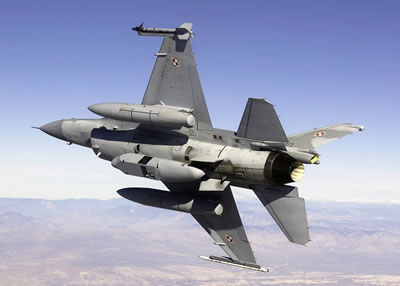
    Goodrich Corporation’s (NYSE: GR) new reconnaissance pod has successfully completed flight testing as part of the F-16 Poland Peace Sky program. Testing was conducted recently at Edwards Air Force Base, Calif. The Goodrich DB-110 reconnaissance pod is carried on the F-16’s centerline station and is controlled by the pilot using a cockpit Multifunction Display (MFD). The pilot has the ability to: collect imagery automatically via a pre- programmed mission plan; edit the plan; view imagery in the cockpit; and command the pod to collect targets of opportunity.

    According to Tom Bergeron, General Manager and Vice-President of Goodrich’s Surveillance and Reconnaissance Systems business, the DB-110 system is already integrated and tested on other aircraft such as the Tornado, F-4, F-15 and P-3, offering a unique, low-risk solution.” Goodrich was selected by the Polish Air Force to supply seven DB-110 reconnaissance pods with fixed and mobile ground stations.

    The Goodrich DB-110 is already in service with NATO, being operated on the U.K. Royal Air Force Tornado aircraft in the RAPTOR pod (Reconnaissance Airborne Pod for Tornado). Providing three different fields-of-view in a single pod, the DB-110 system can be operated at low, medium and high altitudes by day and by night. This pod also incorporates the NATO Common Data Link system, allowing operators on the ground to receive imagery in real-time from the aircraft for immediate exploitation and analysis.

    Northrop Grumman To Complete 100KW Solid State Laser by 2008

    An engineer with Northrop Grumman Space Technology in Redondo Beach, Calif., monitors a solid-state laser as it generates a beam at the company's new Directed Energy Production Facility. The specialized facility is the first of its kind in the U.S. by private industry dedicated to the production of high-energy laser systems for the military services. (Northrop Grumman Photo)Northrop Grumman is working on a high power, solid-state ‘electric’ powered laser developed under phase 3 of the Joint High-Power Solid State Laser (JHPSSL) program. The new high power laser is developed at the newly established specialized facility exclusively for system integration and production of high-energy laser systems for military uses – the first of its kind by private industry in the United States. Located at the Space Technology sector’s Space Park campus, the Directed Energy Production Facility is specifically designed for the production of high-energy, solid-state lasers and their integration onto military vehicles.

    When completed next year (2008) the new laser will demonstrate 100 kW solid-state lasers with power sufficient for a variety of force protection battlefield and precision strike missions. This system will be followed by future technologies of lasers including fiber lasers even more powerful than 100kW. The facility will also handle the integration of electric lasers onto various military platforms, such as armored combat vehicles. Another system to be developed at the new facility is the Skyguard high power chemical laser system, designed to protect civilian, strategic and military targets from rockets, artillery and mortar (RAM) attacks. Northrop said it obtained US government permission to market the system overseas, and has already proposed the system to Israel. Northrop is one of four to five bidders proposing the Israeli MoD with counter-rocket solutions.

    US Army to Expand Counter-RAM Defenses

    The Counter-Rocket, Artillery, Mortar (C-RAM) capability, employed since 2006 by the U.S. Army’s to defend coalition forces in the Middle East theater is being expanded, under a recent $71 million contract awarded to Northrop Grumman Corporation (NYSE:NOC). The new award funds continued development and support of the program.


    The system integrates sensors (such as target acquisition and tracking radars), command and control, and visualization tools to detect imminent attacks by rockets and mortars, locate the sources of incoming fire, and issue accurate warning to exposed units. Simultaneously, the C2 system provides correlated track data to the intercept system to negate the incoming RAM threat. Additionally, the C2 system passes Point of Origin and Point of Impact information on to other systems and sensors, queuing them and aiding the proper response.

    According to Kelley G. Zelickson, vice president and general manager of Northrop Grumman’s Tactical Systems Division, the quick-response effort have integrated existing systems into a system-of-systems architecture to quickly deploy additional capabilities. Future enhancements will include the ability to detect, track, target and destroy in-flight rounds in time to meet time-critical operational warfighter needs.

    The program began in $38 million contract awarded in October 2005 to Northrop Grumman, which assisted in the integration, deployment, and installation of the C-RAM command and control systems architecture and the integration of sensors, command and control and warning systems.

    Excalibur Armed VTOL UAV

    Excalibur UAV

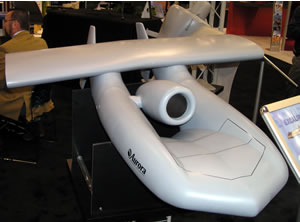
    Excalibur, designed by Aurora Flight Sciences is expected to fill a gap between current weaponized UAVs and manned tactical air support platforms. When fielded, sometime in the next decade, Excalibu could fill the gap between current weaponized UAVs such as Predator and FireScout and manned strike platforms such as Apache and A-10.


    The 21 foot wingspan aerial vehicle will weigh about 2,600 lbs. The empty weight will be 700 lbs., Excalibur will be able to carry a payload of up to 400 lbs. To enable the attack role, Excalibur will be compatible with Hellfire, APKWS II, Viper Strike and SPIKE. Excalibur will combine VTOL launch and recovery, high-speed flight (460 knots), and low speed loiter (100 knots) into one aircraft. The vehicle will be able to operate in a STOL or STOVL mode for increased mission durations or payloads. The Excalibur’s weapons carriage concept is unique. When the aircraft is on the ground, weapons and payloads are placed over the wings to protect them from damage from dust or debries. After takeoff, Excalibur rolls upside-down to normal flight pattern, with payload and weapons in normal position under the wings.

    It is powered by a turbine engine, placed in oblique position, generating thrust and lift for forward flight and rotating into vetical, for take-off and landing. The turbine generates sufficient thrust to accelerate the vehicle to dash speed, in excess of 300 knots, enabling the Excalibur to reach flash points in half the time of an attack helicopter. The UAV can also loiter over the target area for much longer, even after flying long distances. Excalibur uses a unique three-fan design to lift augmentation for vertical takeoff and landing. The battery powered lift fans are embedded in the wings and fuselage. The wing stored fans slide out to augment turbine thrust during takeoff and landing. Excalibur will be cleared for operation at altitudes up to 40,000 feet, and 3 hours flight endurance.

    The flight control system will be designed to enable high level of autonomy, since the aircraft is not be remotely piloted, like current Predators, operators are able are expected to focus on mission planning, finding, and engaging targets instead of flying the aircraft.

    Excalibur is under development as a technology demonstrator aircraft, funded by the US Army’s Aviation Applied Technology Directorate. Excalibur is scheduled for flight in 2007 pending availability of funds.

    Highly autonomous flight control system will reduce human involvement in controlling the platform, enabling the operator to focus on mission planning, finding, and engaging targets. The Excalibur, designed by Aurora, is scheduled for flight in 2007. General Dynamics Robotics Systems (GDRS) is responsible for the ground control station and data links.

    Excalibur is developed by Aurora Flight Sciences in conjunction with the Army Aviation Applied Technology Directorate and the Office of Naval Research. Aurora conducted extensive wind tunnel testing of scaled-down vehicles and plans to test a proof of principle aircraft in 2007, after which, the company plans to continue the development into full scale system.

    General Electric, Smiths Group Announce Strategic Business Moves

    The British company Smith Group agreed to sell its Aerospace division Smith Aerospace to General Electric Company for US$4.8 billion. The Sale is targeted for completion during the second quarter of 2007. Under a separate move, Smith Detection and GE will establish a joint venture aiming at the homeland security market.

    According to .Smiths’ chief executive Mr Butler-Wheelhouse , increased capital requirements and the growing importance of supplier scale, especially as the next generation of large programs kicks in were the drivers for the decision to sell the avionics group.


    In 2001 the European Union blocked a similar move by GE – the acquisition of Honeywell. The current acquisition is expected to meet less obstacles as the two companies are complementing each other in their activities. GE Chairman and CEO Jeff Immelt said he is looking forward to a constructive process with EU antitrust regulators. “GE and Smiths fit together well because our product offerings are complementary and because we have similar customers and deep domain expertise in this industry.” said GE Chairman and CEO Jeff Immelt. Smiths Aerospace demonstrated continued strong growth in the growing aerospace and defense market. GE plans to add Smith’s flight management systems, electrical power management, mechanical actuation systems and airborne platform computing systems to its offerings to the commercial and military aviation markets. “This acquisition is consistent with our strategy to invest in high-technology infrastructure businesses that deliver strong growth, earnings expansion and higher margins” Immelt said. “GE Aviation is growing about 10% a year and this acquisition gives us a technology growth platform that will be accretive to our net income and will deliver immediate and future value for our investors.”

    In a parallel move, GE and the Smith Group signed today a letter of intent with creating a joint venture including GE Security’s Homeland Protection business and Smiths Detection. Upon completion of the transaction, GE will own 36% and Smiths 64% of the joint venture and both companies will have board representation, with Smiths having a majority. The joint venture, to be called Smiths GE Detection, will be headquartered in London. Keith Butler-Wheelhouse will serve as the chairman of the board. Stephen Phipson, currently group managing director of Smiths Detection, will serve as the president.

    US Air Force Launches Joint STARS Enhancement

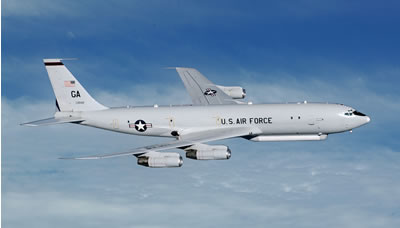
    Northrop Grumman will enhance the capabilities of its Joint Surveillance Target Attack Radar System (Joint STARS), installed on the fleet of E-8C Joint STARS aircraft. The enhancements will introduce improved mobile target precision tracking and engagement capability with the radar’s Land/Maritime Mode (ELMM). The technology to be used for the upgrade is an outgrowth of the successful DARPA Affordable Moving Surface Target Engagement (AMSTE) program, demonstrated in recent exercises and includes an Advanced Radar Mode (ARM) upgrade to the Joint STARS sensor. During these demonstrations, target coordinates were exported from Joint STARS radars directly to GPS guided JDAM munitions.


    The E-8C Joint STARS is the world’s most advanced wide-area airborne ground-surveillance, targeting and battle-management system. It detects, locates, classifies, tracks and targets hostile ground movements, communicating real-time information through secure data links with joint and component command and control elements. The ARM upgrade will provide a Swath Synthetic Aperture Radar (Swath SAR) mode and provide an Enhanced SAR mode in a new processing architecture that provides additional growth for future enhancements. It also provides additional capability to disseminate high resolution imagery from the Joint STARS radar to ground commanders.

    All Joint STARS aircraft are assigned to the Georgia Air National Guard’s 116th Air Control Wing, a “total-force blended wing,” based at Robins Air Force Base, Warner Robins, Ga. The wing comprises active-duty Air Force, Army and Air National Guard personnel.

    Northrop Grumman is providing the wing with operations as part of multi-year Total System Support Responsibility (TSSR) sustainment and Joint STARS Extended Test Support (JETS) programs.

    Traumatic Future looming over Iraq

    In his pre-war planning, President George Walker Bush, his political and military advisors have refused to rise to the challenge of reality by ignoring the facts on the ground. In order to achieve any success in Operation Iraqi Freedom, the US should have regarded the Iraqi scene, not as it was in the past, nor as Washington’s decision makers hoped that it would shape up to their expectations. Having been blind to these realities, which were widely known to Middle East scholars, Bush and his compatriots made one blunder after the other placing US forces, in a predicament, which can hardly be set right now, by what is regarded too little and too late to have any effect to solve, what appears as an impossible situation.

    Judging by what is said and done, in Washington, it seems quite obvious that American people do not fully comprehend the complex dynamics of this sectarian war. The present surge in troops, regarded as a desperate move, will only increase the United States’ failures in Iraq, while certainly deepen the sectarian divides in the already war-fractured country, leading inevitably to more bloodshed. The new plan seems to be based on even more of the past strategems, depending on a weak Iraqi government to fulfill promises it has repeatedly broken, to take on sectarian militias, ending political squabbles. Calling on to beef up efforts in Baghdad to help quell raging violence, Al-Maliki has pledged to deploy more Iraqi forces to stabilize Baghdad But as the Iraqi military has been a recruiting ground for militias and death squads, based on past experience, it seems highly unlikely, that the Iraqi government will be able to fulfil its commitments now, nor in the near future.

    12/12/06 - Iraqi army soldiers and U.S. Army Soldiers from 5th Battalion, 20th Infantry Regiment provide security during a mission to bring sectarian violence and insurgency activities down while increasing Iraqi security force capabilities in Adhamiya, Iraq, Dec. 12, 2006. DoD photo by Spc. Jeffrey Alexander, U.S. Army.

    In fact, no matter what the strategists in Washington believe, it is crystal clear that America is no longer in the driving seat here. It has virtually lost Iraq and adding a few thousands troops is not going to make significant difference, because the situation is already too far beyond fixing. Even if the entire order of battle of the United States military will be deployed, under the present and forseen circumstances, the US can hardly expect to forge and restore a new united Iraqi national entity, which will live in peace and harmony under a democratic regime, which President Bush has hoped for, when he set out to fight his “Iraqi Freedom” war.

    Still, the biggest danger to US forces in Iraq, does not represent the new “Battle for Baghdad” to which the Pentagon is now dispatching the new 21,000 man troop contingent. Iran will not admit this publicly, but Tehran views keeping as many American troops as possible bogged down in Iraq and especially in Baghdad, as long as it takes, to strengthen its own strategic position in the region. While Iraq is convulsed by a brutal civil war between Shiite and Sunni Muslims, its central government being weak, Mahmoud Ahmadinejad and Tehran’s radical Shiite clerics are waiting on the sidelines only to take advantage of US political and military dilemma until the timing is right to strike on the US’ most sensitive jugular.

    Bush’s offensive against Muqtada al-Sadr, which almost certainly will bring down the Maliki government; will turn Baghdad into another Sarajevo and tempt Iran to take the advantage of Iraq’s power vacuum to annex Iraq’s huge oil fields at Basrah province. In control of this highly strategic area, US forces will have to mount a powerful counterstrike in order to evict the Iranians from their hold, before they can consolidate their position.

    In order to maintain the only logistical land line from Kuwait into Iraq, Basrah is not only a highly strategic area, but irreplaceable, if the US Army logistical lifeline remain secure. However, should Iran implement its ambition to control Basrah province, it will become operationally imperative to shift large forces from the Baghdad area southward into this new combat zone. Such a move will inevitably leaving Baghdad once more prone to an even more brutal sectarian bloodbath in the city.

    No doubt, Baghdad would bear the brunt of the political and military shock of Maliki’s downfall. Muqtada al-Sadr’s Shiite Mahdi Army is based in eastern Baghdad. Iran’s own Shiite militia in Iraq, the Badr Brigade, which dominates the high command of Iraq’s army and police, is also based in Baghdad. Finally, the Sunni “ultras” including Al-Qaeda have a strong presence in western Baghdad. These three factions would certainly battle for full control of Baghdad city, block by block.

    The Shiites stronghold are these endless slums, at Sadr City, Eastern Baghdad

    Moreover, a new US military in surge in Baghdad, could not only wind up strengthening the power of the anti-American Sadr, who is actively backed by Tehran, but accelerate hastening the creation of a radical, al Qaeda supported, Sunnistan in al Anbar. As the civil strife worsens, Iraq’s neighbors – like Sunni Saudi Arabia and Jordan and others in the region- would feel compelled to give their Iraqi co-religionist Sunnis more active support, which would mean further military involvement, getting out of control by insurgents. Iraq’s civil war could quickly escalate into a regional Sunni-Shia conflict, with catastrophic consequences.

    Saddam’s execution, identified as a Shiite revenge move, precisely on the dawn of the holiest day in the Muslim calendar has already electrified the Sunni Arab world and echoed the Sunni-Shiite sectarian struggle that is tearing Iraq asunder. There are first signs of a new “inter-Sunni” conflict in the Gaza Strip, where Sunni Fatah activists even accuse Hamas being so-called “Shiite vassals” fighting in the name of the Tehran clerics in an inter-Palestinian civil war. The American plan asking that Iraqis agree to a program of national reconciliation, changes in the constitution to protect Sunni interests, and an oil law that would share revenues equitably- is nothing but sheer wishful thinking.

    Unfortunately, Washington’s policy makers are persisting desperately to cling to the illusion of an Iraqi unity. President Bush’s hopes for success in Iraq are still depending on two, erroneous pillars: Prime Minister al-Maliki’s national-unity government and the establishment of security forces that are trusted and respected by all Iraqis .Regrettably, reality on the ground, proves quite different.

    01/06/07 - Iraqi army soldiers participate in Iraqi Army Day, a celebration marking the 86th birthday of the Iraqi army, at the Tomb of the Unknown Soldier in Baghdad, Iraq, Jan. 6, 2007. The event was attended by military and civilian leaders from both the United States and Iraq. (U.S. Army photo by Sgt. Curt Cashour)

    The new Iraqi army, is divided along sectarian lines and is therefore largely ineffective. The US, having introduced a Shiite majority government, inevitably brought about a Shiite dominated military and police force, almost criminally underestimating the sectarian prism, under which Iraq is divided into highly volatile sectarian units. By unseating Saddam Hussein and his decades-long iron rule of a Sunni overlords administration, the US made its biggest mistake by disbanding the regular Iraqi armed forces, largely officered by professional Sunnis, without immediately establishing an effectively functioning replacement, which could be favorably accepted by the public throughout Iraq. In fact, what worries the Sunni minority most, at this stage, is being left to fend for themselves against the Shiites, out for bloody revenge over years of brutal segregation by the Sadadm’s Sunni rule. This very fear, will no doubt fuel their determination to fight against, what they regard a hostile, even life threatening regime, supported by an outside power of infidels.

    Recently Prime Minister Nuri al-Maliki said, “cheek in tongue” when asked how to subdue the current bloodshed in Baghdad: ” Let my troops to their own devices and in six months there will be no further insurgence in Baghdad”. Analysts warn, that if the new Bush plan will actually sanction such a move, Shia will crush the Sunni in a horrible blood bath, with strongest repercussion throughout the Arab world, no doubt, blaming American irresponsible incompetence again.


    Raytheon’s Radars To Offer Common Datalink Interoperability

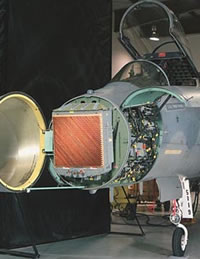
    Raytheon Company (NYSE:RTN) will design and develop a Radar Common Data Link for the U.S. Air Force Research Laboratory. The program will establish datalink connectivity with for active electronically scanned array (AESA) radar systems to enable rapid exchange of non-traditional ISR (intelligence, surveillance and reconnaissance). The new protocols will match AESA radars installed in F-22, B-2, and the latest models of F/A-18E/F Super Hornet and F-15 aircraft. Raytheon is teamed with L-3 Communications and Boeing on the program. L-3 will provide experience with common data link waveforms. Boeing is the platform partner for integration of the AESA technology on the F-15 and F/A-18 aircraft.

    The Department of Defense considers the program especially significant to non-traditional ISR tactical fighter missions. Air crews could use wide-band communication links to transfer imagery and other high-bandwidth information to and from AESA-equipped tactical, surveillance and bomber aircraft. The new capability will establish cost-effective, high-speed communication capability with existing tactical platforms, without the addition of dedicated datalink radios, providing the ability to publish time-critical information products to users on the global information grid.

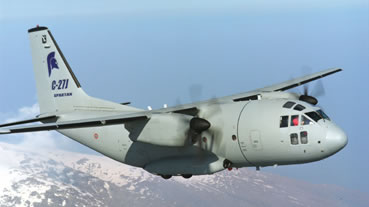
    Italian Air Force Receives First C-27J

    The C-27J, new-generation medium tactical airlifter provides full interoperability with other aircrafts in service with NATO Air Forces and it is the only medium airlifter specifically designed as tactical transport aircraft, offering unique take-off and landing performances; full self-deployment operations thanks to its APU, Auxiliary Power Unit; a large cargo compartment and strong cargo floor that allows the use of NATO-standard pallets and a state-of-the art avionic and self-protection systems, in order to operate in the most difficult operational scenarios. The aircraft is capable of taking-off and landing from paved and unimproved surfaces, less than 500 metres long; of transporting up to 10 tons of materials, 62 persons in the pax configuration or 36 stretchers and 6 assistants in the medical-evacuation version.

    The aircraft uses two Rolls-Royce AE2100 D2 of 4637 shp engines, the same types as those powering with of the new C-130J aircraft used by the Italian Air Force for the medium/long-range transport role, leads to clear advantages in terms of logistics and personnel training.

    The C-27Js delivered to the Italian Air Force will be fitted with an advanced flight data-transmittal system, with digital map and double head-up display (HUD), a flight refuelling system, and one of self-protection (DASS – Defensive Aids Sub Systems, with radar warning receiver, missile warning, chaff -&-flares laser warning).

    The aircraft has been ordered by several air forces including: Italy (12), Greece (12 aircraft, plus 3 options), Bulgaria (5 aircraft, plus 3 options), Lithuania (3 aircraft). It was also selected by Rumania (7 aircraft). In the United States, the C-27J runs for the Army’s and Air Forces’ Joint Cargo Aircraft (JCA) program, while in Canada it is proposed for the renewal of the Search and Rescue aircraft fleet. The C-27J is also under evaluation by Australia, Ireland, Qatar, Saudi Arabia, and by other countries recently become NATO members, such as Czech Republic, Slovakia and Slovenia.

    The first C-27J aircraft was delivered to the Italian Air Force on January 11, 2007. The remaining 11 will be delivered by 2008. The new C-27Js will replace the G.222s previously in service with the 46th Wing ItAF and will be used for troops, cargo, paratroopers and cargo drops, for civil protection and fire-fighting operations.

    Gallium nitride (GaN) Chips Contribute to More Agile Radars

    GaN semiconductors offer substantially improved power and functionality, beyond current semiconductor technologies. They operate at higher voltage levels allowing significantly greater power output for the same size chip. Additionally, the material characteristics of GaN semiconductors offer efficient multi-band or wideband operation.

    According to Mark Russell, IDS’ vice president of engineering, when matured, GaN semiconductors technology will be capable of delivering up to 10-times higher power levels compared with the current technology. With enhanced thermal characteristics, GaN technology enables engineers to trade off increases in range, sensitivity and search capability for same sized antennas. Alternatively, radar antenna made of GaN Transmit/Receive (T/R) elements can reduce the size by half while more than doubling the search volume.

    Raytheon Company is developing monolithic microwave integrated circuits (MMICs) applications of GaN technology ‘s at the Integrated Defense Systems (IDS) division. In January 2007 the company completed 8,000 hours of successful operational testing of Gallium nitride (GaN) semiconductor monolithic microwave integrated circuits (MMICs). The tests demonstrated the reliability of this new technology for high-power applications in military radar, communications, electronic warfare and missile systems. Raytheon plans to continue accumulating test hours on these GaN MMICs and perform an independent concurrent validation of the testing through 2007.

    Distributed Operations (DisOps)

    Elbit Systems introduced its latest electronic countermeasure IED jammer designed to combat Remotely-Controlled Improvised Explosive Devices (RCIED). The new IED Jammer (IEDJ) represents Elbit Systems’ latest generation system, earlier countermeasures developed by Elbit and its subsidiaries have been combat proven in different war zones worldwide. The new vehicle-mounted system is designed as a modular, programmable multi-band radio-frequency jammer which denies enemy use of selected portions of the RF spectrum in the system’s vicinity.


    Unlike earlier generation devices using broadband ‘barrage’ to block entire wavelengths associated with suspected RCIED triggering devices (which usually cover most of the frequencies used by radio communications and cellular phones), Elbit’s IEDJ uses specific waveforms, rather than barrage jamming. Barrage can be programmed into the hardware, where required. The system can transmit on all bands simultaneously, effectively countering a wide range of potential threats.

    The IEDJ consists of multiple programmable RF modules housed in a single, sealed cabinet served by a common power supply. The system operates automatically, based on pre-mission programming distributed to multiple devices by pre-loaders or individually through a laptop PC. On a mission, the jammer can operate automatically controlled by the vehicle’s commander or driver, through a remote control unit. The jammer is designed as an ‘open’ waveform generator, enabling rapid updating and adaptation to evolving threats, uploading new “waveform” software using standard laptop PC and the system’s software. The jammer operates automatically, with full synchronization with other on-board systems such as C4ISR and networking equipment. Programming is performed either for several systems or individually, using a laptop PC loaded with the system’s programming application.

    The system’s modules were designed to provide frequency overlap between some channels, offering system redundancy and the capability to focus more RF power on a particular threat. Each of the RF bands has a separate, independent exciter and waveform generator, so the jammer can be operated band-by-band. Each band has the capability to output 100 watts (50dBm) average and the output power is controllable. The special design of the exciter enables a very “clean” waveform to be transmitted. This feature ensures the capability to maintain communications with a vehicle carrying a full power operating jammer on-board protecting the troops.
    Another member of the Elbit Systems Group, Elisra, has recently developed a portable jammer which is deployed in a “suitcase” and can be either hand-held or vehicle-mounted. The innovative, sophisticated Elisra solution utilizes battle-proven electronic jamming superiority to block remote activation of IEDs via RF frequency and other communication means – radio, cellular phone, satellite and remote control devices.

    RAFAEL, General Dynamics Team to Supply Spain with 2600 Spike Missiles

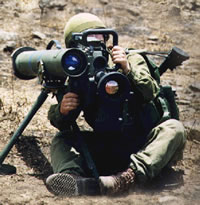
    SPIKE-LR, a member of the SPIKE Family of fourth generation multi-purpose, multi-platform electro-optic guided missiles offers autonomous as well as ‘man-in-the-loop’ day, night and adverse weather operation. The SPIKE Family is comprised of missiles for a variety of ranges (2.5-8 km) and warheads and is designed for use by infantry, on vehicles, helicopters and naval platforms.

    SPIKE-LR’s basic mode of operation is Fire and Forget, however an advanced fiber-optic data link provides the added benefit of Fire, Observe and Update operation, enabling the operator to change the direction of the missile after launch, thereby increasing precision and minimizing collateral damage. The SPIKE system is specially designed for all types of conflicts, ensuring maximum survivability for its operator.

    Spike LR missile launched from a portable launcher

    At present, sales of SPIKE systems amount to over a billion dollars and have been sold and are operational in many countries including Israel, The Netherlands, Poland, Italy, Romania, Finland, Singapore, Czech Republic, some South American countries and others.

    More details of the recent Spanish procurement reported by Defense Update in November 2006 were released January 11, 2007, with the announcement of formal contract between General Dynamics Santa Barbara Systems of Spain and the Israel’s RAFAEL. Spain evaluated the Spike LR against the US Javelin and European Milan-ER. The new missiles offering will replace outdated Milan and Dragon missiles currently in service.

    According to the contract, the Israeli company will supply its Spanish counterpart with 2,600 SPIKE-LR missile and 260 launchers, for a total value of over US$400 million. General Dynamics Santa Barbara Systems is the prime contractor for the $425 million, eight year program. Approximately 60 percent of the program work will be completed in Spain, where General Dynamics Santa Barbara Sistemas will manufacture system components and perform final assembly and testing. Deliveries are expected to start in 2008.

    Skunk Works and XTEND Simplify Multi-Drone Command

    0
    Lockheed Martin Skunk Works® and XTEND have achieved a major milestone in JADC2 by integrating the XOS operating system with the MDCX™ autonomy platform. This technical breakthrough enables a single operator to simultaneously command multiple drone classes, eliminating the friction of mission handoffs. From "marsupial" drone deployments to operating in GPS-denied environments, explore how this collaboration is abbreviating the data-to-decision timeline and redefining autonomous mission execution.

    From Ukraine to Taiwan: The Global Race to Dominate the New Defense Tech Frontier

    0
    As traditional defense primes face mounting competition from agile “neoprimes” such as Anduril, Palantir and Helsing, the balance of innovation is shifting toward software-defined warfare and scalable, dual-use technologies, while global industry consolidation—marked by Boeing’s integration of Spirit AeroSystems and other strategic mergers—signals an intensified race to secure control over the defense technology value chain. Our Defense-Tech weekly report highlights these trends.

    Europe’s “Drone Wall”

    0
    In early October 2025, a coordinated wave of unmanned aerial system (UAS) incursions—widely attributed to Russia—targeted critical infrastructure across at least ten European nations. The unprecedented campaign exposed the fragility of Europe’s air defenses...

    Weekly Defense Update & Global Security Assessment

    0
    Executive Summary The past week (September 18-25, 2025) represents an inflection point where strategic defense concepts have transitioned from doctrine to tangible reality. An analysis of global events reveals four primary, interconnected trends shaping an...

    U.S. Air and Space Forces Push Next-Gen Programs at the AS&C 2025 Conference and...

    0
    At the 2025 Air, Space & Cyber Conference, U.S. Air Force and Space Force leaders unveiled major updates on next-generation fighters, bombers, unmanned systems, and space initiatives, highlighting both rapid innovation and critical readiness challenges as the services race to outpace global competitors. A short version is available here, with a more detailed version for subscribers.

    TADTE 2025: Reflecting Taiwan’s Strategic Themes

    0
    The Taipei Aerospace & Defense Technology Exhibition (TADTE) 2025 crystallized around four dominant strategic themes that collectively illustrate Taiwan's comprehensive approach to defense modernization amid escalating regional tensions. Based on a detailed report by Pleronix (available upon request). Includes a Podcast discussion on TADTE 2025's highlighting Taiwan's four strategic themes beyond the post's coverage.

    Iron Beam 450 Completes Testing, Soon to Join With Operational Air Defense Units

    0
    Israel’s Iron Beam 450 high-power laser system has completed final testing, marking a major leap in air defense. Developed by Rafael, it offers precise, cost-effective interception of rockets, UAVs, and mortars, and is set for IDF deployment by 2025.