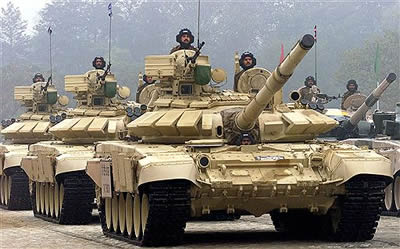
India considers buying additional Russian made T-90Cs, while delaying production of the locally assembled. India considers buying 300 upgraded T-90C tanks to be produced by Uralvagonzavod in Nizhni Tagil, Russia for $866 million during two years. Originally, the tanks were to be assembled in India, from Russian delivered kits. According to Russian sources, the Indian plant licensed to produce the tanks has not yet built the capacity to ramp up serial production.
In 2001 India agreed to buy up to a thousand T-90C tanks, to be locally assembled at the Indian tank factory located at Avadi. The agreement included the delivery of 124 tanks to be assembled in Russia, and 186 kits, to be assembled in India. When explaining the decision to buy a consignment of ready-made tanks in Russia, Singh said India hadn’t managed to master the line assembly work for some key devices of the tanks and the coordination with Russia’s suppliers was rather poor.
Defense and homeland security companies continued to outperform the broader market in 2006 as the benchmark SPADE Defense Index (AMEX: DXS) gained 19.33% and marked the seventh consecutive year it has outperformed the S&P500. Defense stocks are expected to continue to perform well in 2007, and Merrill Lynch cited them among its top 10 picks for 2007. Since 2000, the Index has gained 113.86% compared with a (3.47%) loss by the S&P 500. The Powershares Aerospace & Defense Portfolio ETF (AMEX: PPA), which tracks the SPADE Defense Index, saw its assets increase more than 80% to nearly $110 million.
Sixteen companies (of the 58 in the Index) posted gains in excess of 30% and the 12 largest constituents all posted gains of 10% or more with 10 of the 12 posting gains of 20%+. Returns generated by the large-cap infrastructure prime contractors were: Lockheed Martin (NYSE: LMT) 44.70%; General Dynamics (NYSE: GD) 30.38%; Raytheon (NYSE: RTN) 31.51%, Boeing (NYSE: BA) 26.48%, and Northrop Grumman (NYSE: NOC) 12.63%. By te end of the year the Index added SAIC (NYSE: SAI) and Stanley Inc. (NYSE: SXE), bringing the number of constituents to 58.
According to Scott Sacknoff, manager of the SPADE Defense Index, performance gains can be attributed to five factors:
1. Across-the-board increases in government spending,
2. Rising budgets for defense and homeland security,
3. Supplemental spending to cover the estimated $7 billion monthly cost of the wars in Iraq and Afghanistan,
4. An ongoing rebound in the commercial aircraft manufacturing business, and
5. Continued expansion of the space and satellite market
2007 Outlook
With the Defense budget scheduled to grow by nearly $30 billion in FY07 and supplemental spending forecast to add between $110 Billion and $170 Billion, CNBC cited defense as one of their seven plays for 2007 and Merrill Lynch cited defense as one of its top 10 picks. Investors Business Daily asked on 7 Dec 06, “…with global tensions high…where else would you want to be?” and the Economic Times stated on 6 Dec 06, “…Wall Street may be fretting that the U.S. economy is slowing down, but the aerospace and defense industries are hard pressed to figure out when their party will end.” Overall, the U.S. currently spends roughly 4.6% of GDP, the same percentage on defense as it did in 1991 during the Gulf War.
The SPADE Defense Index is a modified cap-weighted index designed to benchmark the performance of companies involved with defense, homeland security, and space.
The Pinzgauer, in service with the British elite and Special Forces, are designed to fit inside a C-130, CH-47 Chinook or MV-22 Osprey, or slung-carried by most heavy helicopters. The British (Supacat) designed and manufactured by the British HMT Vehicles company, recently acquired by Lockheed Martin, is offering another air-mobile Tactical Wheeled Vehicles designated LM4x4 and 6×6. This light truck is designed to offer high off-road mobility, enabling it to keep pace with tracked vehicles. The Supacat is provided in armored or standard non-armored, which are transportable with CH-47, CH-53 and MV-22 or C-130 aircraft.
Future Trends
In the near term, the US Marine Corps is leading a procurement program for a Mine Resistant Ambush Protected (MRAP) vehicle, designed to enhance the survivability of U.S. forces deployed in Iraq nd Afghanistan. Procurement of 4,100 vehicles of various types is planned, at a total spending of over US$2 billion. The USMC Systems command selected nine companies to produce test vehicles for evaluation, and has initiated orders for the initial 120 vehicles, selected from currently available models (4×4 and 6×6 Cougars, and RG33 vehicles).
Armor protection will be integrated as an integral part of the design of new vehicles, currently developed for the U.S. forces under the Joint Light Tactical Vehicle (JLTV) program. rotection will be provided at various levels, depending on the application and missions the vehicle is designed for. As a rule, all armor solutions will be based on the Long Term Armoring Strategy (LTAS), defining two levels of protection – a basic protection level (A KIT) built into the platform on the production line, will ensure the vehicle’s capability to endure mine and some IED blasts. The vehicle will also have attachments for add-on armor (B KIT) which will meet higher threat levels and could be applied in the field. Lockheed Martin plans on incorporating HMT’s designs into its vehicles for U.S. programs such as the Lightweight Prime Mover program and the U.S. Army’s Future Tactical Truck System (FTTS), which is positioned to become the company’s proposed platform for the future JLTV program. Other contenders include Oshkosh and General Dynamics Land Systems.
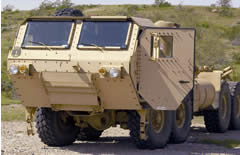
Improved protection is required for utility and logistical vehicles, supply trucks and prime movers. When heavier trucks are concerned, armor protection is simpler and is usually more straightforward than the work associated with lighter vehicles such as the HMMWV, since trucks can trade off some of their cargo capacity for the additional protection; especially as such protection is usually limited for the cab.
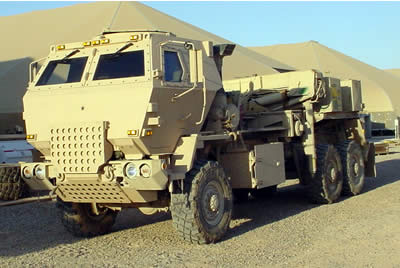
Protected cabins are tailored for new trucks, or offered as replacement cabs. An example is the HEMTT replacement cab, designed by Armor Holdings. Utilizing the modular systems and bulkhead connections of the original HEMTT cab, the armored cab can be installed in the field, on the HEMTT vehicles within hours, improving the heavy tactical fleet crew survivability.
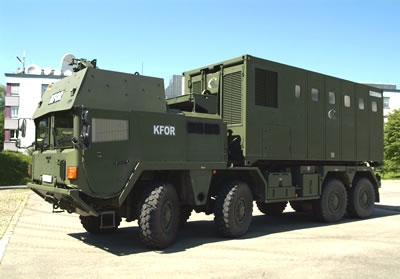
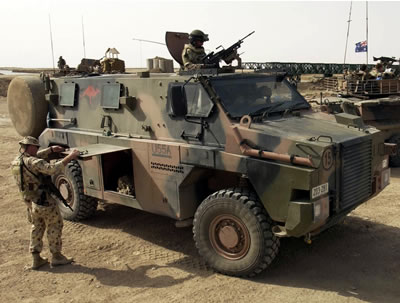
The new cab provides small-arms protection, defeating IED and AT mine attacks and offers overhead protection against fragmentation. Further protection to the exposed gunner’s position is provided with an optional gunner’s protection kit. Extensive protection, both external and covert, is provided for trucks and prime movers used by the German Army in Kosovo and for coalition trucks operating in Iraq and Afghanistan. In 2004 Armor Holdings introduced an armored version of the Oshkosh Trucks MTVR family of tactical trucks. For missions requiring wheeled Armored Personnel Carrierss (APC), combat support and tactical logistics applications, Oshkosh is offering the Australiann Bushmaster, ecently combat tested in Afghanistan.
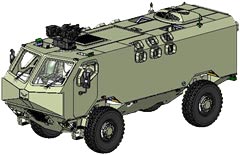
Protected cabs are also provided for various trucks including M997 (HEMTT), M1070 (HETS), M915 trucks and M1074/1075 Palletized Load Systems (PLS) at an additional weight of 1.3 – 1.9 tons. For medium trucks, the “low signature armored cab” is in development for the 2.5 and 5 ton FMTV Tactical vehicle System (TVS) retaining air mobility of the truck. The FMTV is produced by Stewart Stevenson Services which, in 2005 acquired Automotive Technik Holdings Limited (ATL) of the UK, producer of the Pinzgauer all-terrain vehicle are themselves being acquired by Armor Holdings, which are producing the armoring kits for these trucks. Several NATO Armies are employing protected containers such as the TransProtec to safely transport troops to and from forward bases in the combat zone. The US Army is evaluating the MTTCS, based on a composition of modular armor elements link to shelter-sized transportable module.
BAE Systems has successfully demonstrated a passive geo-location capability that enables aircraft to quickly pinpoint the location of enemy emitters positions (radars, communications equipment etc) in crowded radio frequency (RF) environments. The new system can be deployed on any type of military aircraft. The company demonstrated, for the first time, the ability to nearly instantaneously construct a geo-location solution, based on data received on a single platform. Other signals intelligence (SIGINT) sensors conduct a more complex process, “fixing” a hostile emitter by measuring angles of arrival of the emitter’s pulses at several stations receiving the same pulse simultaneously, at different locations.
The new capability, demonstrated at the U.S. Naval Air Warfare Center Weapons Division, China Lake, Calif., enables aircraft to calculate geo-location with any radio frequency (RF) signal. “The battlespace is a complex environment that is increasingly saturated with RF energy. These conditions make it hard for multiple aircraft to simultaneously detect the same signal,” said Dr. Hugh Kao, BAE Systems technical director at Yonkers, N.Y. “The technology we have demonstrated enables accurate real-time geo-location of threat signals from bits and pieces of data.” The capability has already been tested in a series of flights.
The Department of Defense’s Joint Strike Fighter program office supported the flight testing, which was accomplished with a single T-39 aircraft and a ground station performing as a “virtual” aircraft. The demonstration follows BAE Systems’ successful demonstration, in November 2004, of how a single aircraft can passively detect and locate threat radars. The flights were conducted at Eglin Air Force Base, Fla., using an F-15 fighter.
Recent wars, particularly the war in Iraq and the continued hostilities in South Lebanon, Gaza and the West Bank raised the army’s concerns about the vulnerability of utility and wheeled combat vehicles. While sufficient bulletproof protection is available with most up-armored vehicles, counter-mine and particularly counter-IED remain an issue, as both solutions require significant weight increase, which cannot be met with common light platforms.
RPG protection is even more problematic, as, lacking the availability of proven active protection systems, current countermeasures require the use of explosive reactive armor (ERA), which is not suitable for “thin skin” armored vehicles. The latest models of ERA, comprising low-burning or insensitive explosives are more suitable for lightweight platforms such as armored trucks and, in fact, preliminary designs are already in development for armored trucks, to be used as heavy troop carriers or armored infantry carriers, optimized for urban warfare.
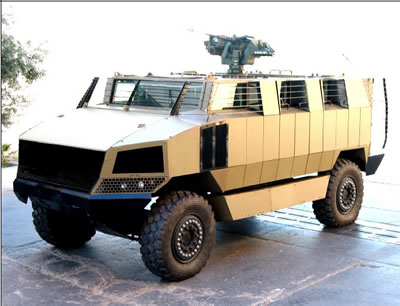
Several types of mine-protected armored trucks are in service. Some of these designs are based on commercial chassis, including those manufactured by Ford International and Unimog, trading most of their payload with an armored hull, leaving enough capacity to accommodate the crew, troops and mission payload (usually, around two tons). Most vehicles are utilizing a monocoque V shaped armored hull to with blast mitigating single or double floor, protecting against mine blast and bottom or roadside IEDs.
Typical examples include Force Protection Cougar, BAE Systems RG-31, Australian Bushmaster – all three are currently are in service with coalition forces in Iraq and Afghanistan. Similar designs are used in the South African Casspir, Indian OFB Trojan and the Israeli Zeev (Wolf), which recently entered operational service with the 900th Infantry Brigade (urban warfare specialist). New vehicles currently undergoing various phases of development include the Sand-Cat, from Plasan Sasa, Golan from RAFAEL and PVI, the RG-33L from BAE Systems, and the WildCat, currently under development at IMI. Another design is the Oryx, from International Trucks and Engines.
The FireFly is a medium sized Precision Aerial Delivery System (PADS) platform capable of delivering 500 lb to 2,200 lb (225 kg to 1.000 kg). With a 4:1 glide ratio and 25,000 ft deployment altitude, the FireFly is capable of significant vertical and horizontal standoff. The system has demonstrated excellent accuracy, landing within 150 meters of the designated Impact Point over 80% of the time. When using the roadway landing feature, the FireFly has a greater than 80% probability of landing within 50 meters of the designated road. FireFly uses a roadway landing feature enabling the user to designate an azimuth for landing rather than the default into-the-wind heading to take advantage of roads and other paved surfaces for cargo retrieval.
The distance to the Impact Point for ram air canopies is predominantly affected by the efficient glide capability of the airfoil. Vertical deviations are multiplied by the glide ratio of the canopy. In the case of the Airborne Systems JPADS platforms, all canopies have a minimum 4:1 glide ratio meaning that if the system is 10 meters too high on approach, the system would overshoot the target by 40 meters. Left and right deviations are not affected by the glide performance of the system so the overall landing area has a rectangular shape as depicted by the graphic at right. This rectangle is known as the Roadway Landing Area.
If the system would approach the Impact Point from any direction, the Roadway Landing Area would be equivalent to the Circular Error Probable. However, by dictating the approach azimuth, the system’s potential for error is decreased significantly. If the system can be forced to fly a designated approach, the left and right limits in the Circular Error Probable do not apply and can be effectively removed from the potential landing area, a 75% reduction in the total potential landing area. The data at left are the results of test drops conducted by Airborne Systems. The results clearly show that the concept of the Roadway Landing Feature does greatly decrease the potential landing area of the system.
Operational advantages of the Roadway Landing Feature include the ability to land the system on a linear terrain feature (road, ridgeline, long axis of a Drop Zone, etc.). Landing the system on a road allows for easier recovery of the payload and reduced exposure in a potentially hostile environment.
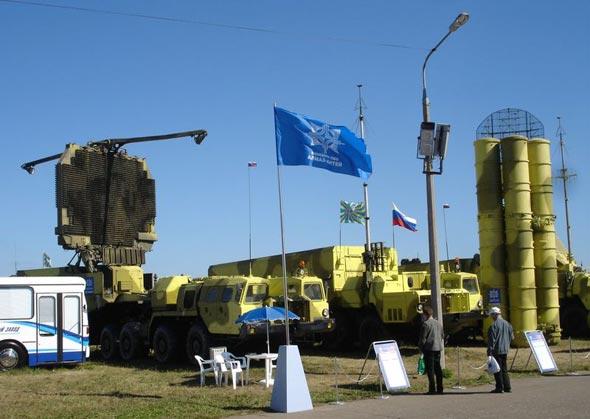
The Favorit Surface to Air Missile System, known by its NATO code name Gragoyle, is designed to protect fixed sites against missile and air attacks. The system uses wheeled transporters for mobility. The Favorit system uses the 48H6E2 interceptor missile (also used in the naval RIF-M system) updated with improved guidance algorithms, an improved warhead and enhanced ECCM capabilities. The system can also employ the 48H6E missile to increase its air-defensive capability (the same missile used in the S-300PMU1 SAM system). The system detects targets at ranges of up to 300 km and can handle up to 100 simultaneous tracks. Up to 36 interceptor missiles can engage targets simultaneously. Aircraft targets can be engaged between 3 and 200 km, and missiles can be intercepted at ranges of 5 – 40 km, and from 30 to 90,000 feet altitude.
The Favorit system is comprised of the 54K6E2 command post, a 64H62E detection radar, up to six missile carriers (designated 5P85TE2 or 5P85CE2) and an illumination and guidance radar vehicle (30H6E2). Other elements associated with the system include an all altitude detection radar (96L6E), a low altitude detection radar (76H6) and a 40B6M tower for elevating the antenna for improved coverage.
The latest version of the S300 is the PMU3, also known as S400 Triumf.
Israel is interested in integrating its into its missile defense program with deployable U.S.missile defenses, such as the ground based THAAD and naval AEGIS SM-3 systems. Such integration will enable full interoperability between Israeli made Arrow, and U.S. Patriot missiles and the new missile interceptors developed for the US Missile Defense Agency, to enhance defenses against potential nuclear attack from Iran, if and when this country acquires nuclear capability for its long range missiles.
Israeli Patriot and Arrow missile interceptors are already linked with U.S. missile defense systems, such as the AEGIS cruisers and other early warning assets. Israel is seeking to extend these links to full interoperability with the new systems developed in the U.S., to support future deployments of such systems in the region.
Israel and the USA are also cooperating on the development of smaller interceptors, to be used against short range missiles and medium to lng range rockets.
AM General and General Dynamics Land Systems today announced they will form a joint venture to compete for the U.S. Army and Marine Corps Joint Light Tactical Vehicle (JLTV) program. The new joint venture company called General Tactical Vehicles will design, develop and produce a highly mobile, highly survivable and innovative wheeled utility vehicle for the armed services to meet all the requirements of the JLTV program. Lockheed Martin, Armor Holdings have already Teamed to bid on the JLTV program in October 06.
General Tactical Vehicles will locate in the Detroit metropolitan area to leverage the best of American automotive technology and military research and development to deliver the JLTV. The joint venture is the first-ever collaborative project for the two American defense companies, both of whom were awarded JLTV “Best Technical Approach” trade studies by the Office of Naval Research in 2006. Earlier in 2006 General Dynamics Land Systems and Oshkosh Truck to build Joint Light Tactical Vehicle (JLTV) mock-ups and conceptual designs, modeling and simulation to provide tradeoff analysis for the evaluation of future development of such vehicles.
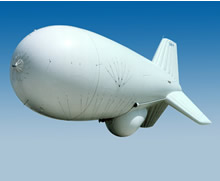
JLENS utilizes a tethered early warning and surveillance sensor installed in an aerostat, positioned at medium altitude. Such system provides over-the-horizon detection and tracking of aircraft, helicopters, UAVs and primarily – the most illusive cruise missiles.
Each aerostat will be elevated to an altitude of up to 15,000 feet for extended periods, carrying radars, Electronic SUpport Measures (ESM) and communication and networking systems to provide wide-area surveillance and tracking of land attack cruise missiles. Such targets may go undetected by surface-based sensors because of terrain masking and line-of-sight locations of targets. These systems will provide persistent, wide-area cruise missile detection and tracking, detecting ballistic missiles at their boost phase, tracking ground targets and providing elevated communications capabilities.
JLENS System testing is scheduled to begin in 2010 with program completion in 2012. Work on the program will be performed at Raytheon sites in Massachusetts, California, Texas and Maryland. Raytheon IDS will develop the fire control radar and processing station. TCOM, L.P., based in Maryland, will develop the aerostat and associated ground equipment.
At the lower tier, the market is preparing new air defense systems for simultaneous missile and rocket defense. Due to its unique geopolitical situation, Israel is the only country constantly subjected to cross-border rocket attacks. However, with the proliferation of global terrorism, demand for such systems is expected to grow in the coming years.
Several Israeli companies are collaborating in the development of such systems, including IAI subsidiaries Elta and RAFAEL. This consortium has already introduced the Barak I missile defense system, and is currently developing the Barak II and Spyder systems. Although unconfirmed by Israel’s official sources, it was reported that Barak II has entered a $330 million development program funded jointly by the Indian and Israeli defense ministries. The Spyder was jointly funded by RAFAEL and IAI and is currently evaluated by several air forces. “The RAFAEL Spyder concept reflects the multi-mission aspect of modern air and missile defense systems” a senior IAF official told Defense Update. “The Israel Air Force plans to evaluate the system.”
Yossi Horowitz, marketing manager for air defense systems at RAFAEL confirms the growing interest in the new systems: “At Defexpo 2006 exhibition in India RAFAEL unveiled the new Spyder MR, a growth version of the Spyder SR system currently in development. The MR system will employ the Derby and Python 5 missiles fitted with boosters to enable vertical launching, to gain the initial speed and altitude. Both interceptors will engage targets at ranges beyond 35 kilometers and up to an altitude of 16,000 meters.
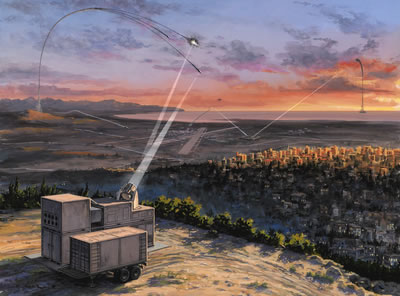
Counter Rocket, Artillery and Missile (C-RAM) defenses based on directed energy weapons are also evolving and could be expected to mature within the next few years. Chemical lasers are already providing such capabilities, while safer solid state lasers, which are still in development, promise to have even more potential. C-RAM systems will become a reality in the future, offering multi-mission, low-cost per kill, simple to operate tactical air defense system. While not replacing current missile defenses, they will represent an evolutionary phase enabling air defenses to handle new threats, expected to be smaller and stealthier – based on high precision weapons, long and short range cruise missiles and armed and unarmed UAVs. The challenge faced by air defense systems developers is to establish a mix of multi-mission systems operating in different and rapidly changing scenarios.
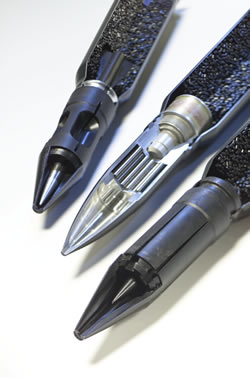
The IDF constantly monitors potential launch areas in the Gaza strip, detecting improvised rocket launches, calculating their ballistic trajectory and plotting the expected target, thus issuing a “Red Dawn” warning for the population to take cover. These early warning systems could be employed with active protection elements, such as low-cost ‘hit to kill’ interceptor missiles, C-RAM laser such as the Northrop Grumman Skyguard or air defense artillery, firing special ammunition, which could defeat the rockets in flight. Reportedly, Israel evaluated the Rheinmetall Air-Bursting munitions (ABM) ammunition as a potential countermeasure against improvised rocket attacks from Gaza but ABM was found immature for operational use for the C-RAM role. Therefore, at present, C-RAM countermeasures remain an “unsolved issue”.
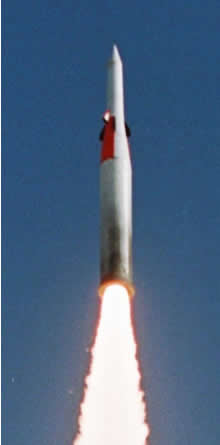
To maintain the Arrow’s effectiveness against evolving threats, the missile is developed through a typical “spiral” development, maintaining “one step ahead” of the threat. In the 1980s Israel evaluated several missile defense concepts, including boost phase and mid-course attacks. The Arrow, proposed by IAI was selected as a defensive system designed for terminal phase intercept. Arrow is integrated into a larger multi-layered defensive network which can also provide mid course engagement, within an international coalition of defenses (with the US and NATO, for example).
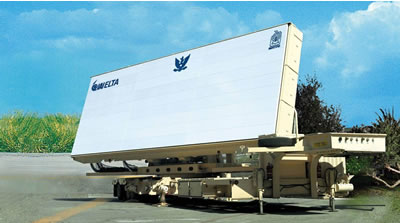
The Green Pine, Arrow II early warning and fire control radar. Photo: IAI
“The Arrow was developed as a robust interceptor, continuously evolving through a spiral development process, accommodating advanced capabilities and adapts to face evolving threats.” Herzog told Defense Update, “The same interceptor designed with 1990s hardware and fielded in the year 2000 is operational today, upgraded with software modifications to defend against new threats such as the Shihab”. Since its initial fielding in the year 2000 the Arrow system received two software-block upgrades. Currently operational with Block 2, the system is expected to receive Block 3 which is currently in final testing. Under a parallel Arrow System Improvement Plan (ASIP) program, the system is undergoing hardware improvement through all its subsystems. Since the production of the missile was commenced also in the USA, the missile has been updated with more advanced computers, designed to form-fit into existing missiles, resulting in improved performance and lower cost. Block 3 will expand the missile’s intercept envelope, to include the anticipated Iranian unconventional threat. The Block 3 missile completed system integration and testing, this version was used during all three tests, conducted in 2004 and 2005. The Arrow program is currently developing Block 4 which is expected to become operational long before the Iranian threats against which it was developed are expected to enter the Mid-East Theater. “We are evaluating what are the characteristics of a future nuclear threat and prepare our defenses to be ready for it well in advance of such threat”.
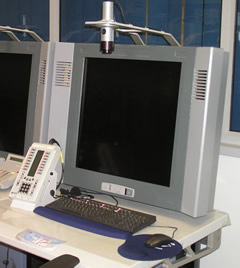
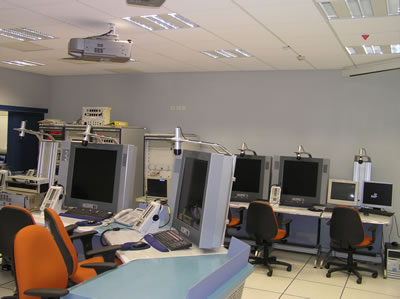
Arrow II (Golden Citron) battle station workplace. Photo: Tamir Eshel, Defense Update
Citron Tree Battle Management, command, Control and Communications (BMC3) system, developed by Tadiran Systems, is one of the world’s most advanced net-centric system, This computing network is built around a huge software application including some two million lines of code, performing real-time sophisticated computations, of calculating intercept, assigning launchers to specific threats, and assessing the effects, probabilities and threats of each intercept to enable maximum defense for the protected areas. Citron Tree’s net-centric interoperability was operationally proven during Operation Iraqi Freedom (OIF), as it was integrated with coalition air defense units (Patriot) and naval missile defense systems, deployed in the East Mediterranean and other locations in the region. The Arrow command and control facility has recently moved from its previous shelter facilities into a new spacious bunker, fully protected from nuclear, chemical and bacteriological threats. Defense Update was allowed to photograph this facility for the first time.
As the U.S. Thaad system entered production, by the end of 2006, Israel is interested in integrating its into its missile defense program with deployable U.S. missile defenses, such as the ground based THAAD and naval AEGIS SM-3 systems. Such integration will enable full interoperability between Israeli made Arrow, and U.S. Patriot missiles and the new missile interceptors developed for the US Missile Defense Agency, to enhance defenses against potential nuclear attack from Iran, if and when this country acquires nuclear capability for its long range missiles.
The 'Defensive Sword' Arrow missile battalion Battle Management Center Photo: Tamir Eshel, Defense Update
In recent years, new tactical missiles and rockets designed for short range have added a numerical and qualitative edge. “A tactical weapon that threatens a third of our population and most of our strategic sites cannot be regarded as mere ‘tactical’, it becomes a strategic threat. There is no clear definition between a rocket and a missile. They carry almost the same payload and reach the same range and thus, should be addressed equally by defensive means” states Arieh Herzog.
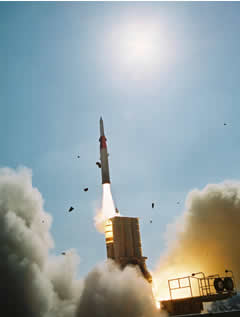
The Arrow II launched on a test intercept. Photo: IAI
Typically, such weapons have a range between 70 and 200 km, flying through short, relatively flat and low ballistic trajectories w making intercept much more challenging. Like the medium range ballistic missiles such weapons carry warheads of 100 up to 600 kg which can cause significant damage. On the other end of the scale, Israel is facing a “low tech” but equally dangerous threat from short range improvised rockets and mortars. These weapons are also employed as part of the asymmetric terror warfare, by Iranian- and Syrian-backed Palestinian and Lebanese terrorist organizations. The firing of rockets on Israeli territory, by terrorists from Palestine and Lebanon is characterized as a new type of “cross-border terrorism”, which, if not countered effectively, can spread to strategic locations in the densely populated narrow coastal area. At present, there are no effective means to counter such threats, although some promising technologies are over the horizon.
“We are expecting new defensive systems to evolve in the next few years, to provide effective answers to such challenges. 2005 marked the initiation of this process, as the US congress earmarked funding for the Short Range Missile Defense (SRMD)” Herzog told Defense Update.
Responding to the challenge of short range threats is the Nautilus laser interceptor system, a joint US-Israeli program developed over the past few years. In its first live-fire test in June 2000, the system shot down a single Russian-made Katyusha rocket. Two months later, the system shot down two Katyushas simultaneously. “Directed energy is ideally suited to be used against such short range, short flight targets”, says Herzog, “Nautilus, based on chemical laser technology is practically terminated, but other systems, based on solid state lasers continue development in the US. Israel is pursuing several directions, to defend against such threats. Based on local know-how, Israel could pursue similar development to protect its cities and military forces from rocket attacks, if the current situation continues”. In July 2006, a delegation from Northrop Grumman presented the new deployable Skyguard system to the Israeli MOD. Skyguard is based on the THEL concept, utilizing modern systems and is designed to be operated by the military.
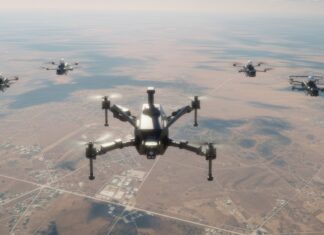
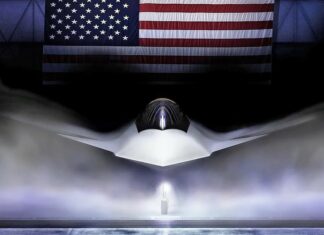
Lockheed Martin Skunk Works® and XTEND have achieved a major milestone in JADC2 by integrating the XOS operating system with the MDCX™ autonomy platform. This technical breakthrough enables a single operator to simultaneously command multiple drone classes, eliminating the friction of mission handoffs. From "marsupial" drone deployments to operating in GPS-denied environments, explore how this collaboration is abbreviating the data-to-decision timeline and redefining autonomous mission execution.
As traditional defense primes face mounting competition from agile “neoprimes” such as Anduril, Palantir and Helsing, the balance of innovation is shifting toward software-defined warfare and scalable, dual-use technologies, while global industry consolidation—marked by Boeing’s integration of Spirit AeroSystems and other strategic mergers—signals an intensified race to secure control over the defense technology value chain. Our Defense-Tech weekly report highlights these trends.
In early October 2025, a coordinated wave of unmanned aerial system (UAS) incursions—widely attributed to Russia—targeted critical infrastructure across at least ten European nations. The unprecedented campaign exposed the fragility of Europe’s air defenses...
Executive Summary
The past week (September 18-25, 2025) represents an inflection point where strategic defense concepts have transitioned from doctrine to tangible reality. An analysis of global events reveals four primary, interconnected trends shaping an...
At the 2025 Air, Space & Cyber Conference, U.S. Air Force and Space Force leaders unveiled major updates on next-generation fighters, bombers, unmanned systems, and space initiatives, highlighting both rapid innovation and critical readiness challenges as the services race to outpace global competitors. A short version is available here, with a more detailed version for subscribers.
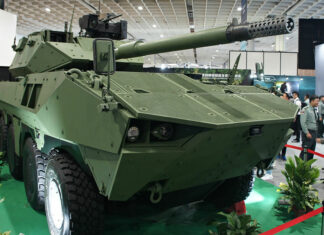
The Taipei Aerospace & Defense Technology Exhibition (TADTE) 2025 crystallized around four dominant strategic themes that collectively illustrate Taiwan's comprehensive approach to defense modernization amid escalating regional tensions. Based on a detailed report by Pleronix (available upon request). Includes a Podcast discussion on TADTE 2025's highlighting Taiwan's four strategic themes beyond the post's coverage.
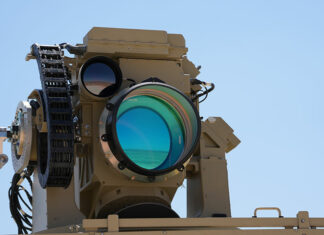
Israel’s Iron Beam 450 high-power laser system has completed final testing, marking a major leap in air defense. Developed by Rafael, it offers precise, cost-effective interception of rockets, UAVs, and mortars, and is set for IDF deployment by 2025.