
Monday, December 22, 2025
More
    Home Blog Page 393

    High Capacity DVR

    Start < Page 6 of 6 >

    High capacity digital recorders are available primarily for special applications. These devices provide both processing power and multi-channel recording capability. These systems use either of two types of media: hard disk drives and solid-state memory (flash). Hard Disk Drive (HDD) based devices currently offer virtually unlimited online memory capacity, but this type of storage media is vulnerable to high G shocks encountered during vehicle movement over rough terrain. Vibrations, dust, heat and humidity also affect the reliability of HDD based systems. Solid-state memory is used for applications where systems are exposed to extreme environmental conditions. Systems that use solid-state memory are usually more expensive and have more limited capacity, but modern technology enables operators to use field replaceable cartridges, which can hold as much as 128 GB of data each, therefore offering nearly unlimited storage capacity.
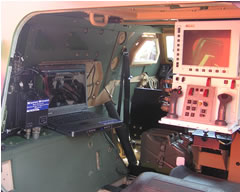
    One typical lightweight Digital Video Recorder is offered by Tactronics. This DVR can store up to 26 hours of full motion video on a 60 GB 2.5″ hard disk. It can be mounted on aircraft, naval platforms or AFVs, connecting directly to the video source (weapon’s sight, surveillance equipment etc.). This system uses removable recording media to transfer files to an associated docking station for review.

    The ‘Mission Witness’ is a typical solid-state recorder recently introduced by RADA Electronic Systems for field applications. RADA is offering the system, which is a derivative of its avionic Net-Centric Digital Recorder (NCDR), to support video capture from vehicular military platforms. The system uses solid-state memory and has no moving parts, thus offering very high resistance to shock and vibration damage. Its built-in processor can be used as a network server that offers shared memory for other systems on board. RADA recently demonstrated this system in a RAFAEL built “Interceptor” armored patrol vehicle based on the armored Humvee.

    NCDR was integrated with the patrol vehicle’s remotely controlled weapon station and acoustic gunshot detector. ‘Mission Witness’ can record up to 11 channels simultaneously, including six video channels, two voice channels and three data channels. It can also monitor and record all vehicle and weapons employment details. These recorders can be integrated in combat vehicles to augment and enhance their operability, for training, and for post-mission debriefing.

    Continue reading this article:
    Wearable and Portable Micro DVR Systems

    Start < Page 5 of 6 >

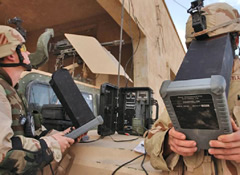
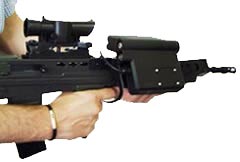
    As digital recorders get smaller they become suitable for more applications, such as integration into the soldier’s combat suit or weapon system. One such device is the Guncam gun camera recorder, developed by Macroswiss. This unit has been developed for use by Police Forces and Armies that need to record firefights from the user’s perspective, for accountability purposes. The miniature DVR unit can be connected to a weapon, attached to the belt, or carried in a pouch on the vest (in which case the camera on the weapon is connected to the recorder by a spiral cable). The camera can be set to record video only upon release of the safety, in user-switchable recording mode where the user decides when to record, or in continuous recording mode. The data is recorded on a compact flash card.

    Miniature DVR devices are suitable for ‘wearable’ man-portable applications. As a digital wallet, Micro-DVR can store up to 60,000 high-resolution digital photos (1024×768). The Micro-DVR also has a built-in microphone for recording audio. The Enhanced Wavelet algorithm, with high quality video capture and play back at 720 x 480 resolution, enables storage of compressed video in commercially standard MPEG 4 format (320 x 240 pixels, 25~28 frames per second), recorded on a built-in 20 GB 2.5″ hard drive. The units can be upgraded with a 40 GB drive. Micro DVR supports continuous recording of a single video and audio channel for up to 40 hours. Recordings can be archived to PC via a built-in USB 2.0 interface. It can also store digital photo files and display them from its built-in 3.5″ Full-Color LCD screen, a TV monitor, or a projector.

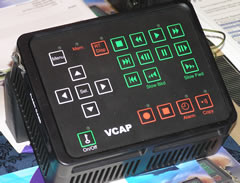
    The Israeli Army is currently using several different digital recorders, both imported and locally made. Two new digital video recorders were recently unveiled by Goldtech Technologies. The first is the ultra compact VCAP, which connects to a video source such as a video camera, ground sensor, weapon sight, etc. VCAP compresses video to the MPEG-2 standard, which preserves details better than MPEG 4. The data is recorded on either a hard disk or solid state memory. A larger system is the RAV-2, a dual-channel digital recorder with a storage capacity of 100GB, sufficient for 24 hours of operation. RAV2 has a built-in mini display enabling instant playback or monitoring. It is equipped with a remote control unit for convenient field operation. It can also play back a video stream to any PC, TV or standard video monitor.

    Continue reading this article:
    Land Based Applications for Digital Recorders

    Start < Page 3 of 6 >

    Full motion video has become one of the most effective means of acquiring and sharing intelligence and situational awareness data. Commercial standards such as MPEG 2 and MPEG 4 are well established, enabling military users to employ Commercial Off The Shelf (COTS) systems and applications to capture, store, retrieve and distribute video imagery, from the field level to all command echelons. While the intelligence community has been using video recording technology for years, it hasn’t yet been accepted as an integral part of modern combat systems.

    The emergence of high precision weaponry and growing concerns about collateral damage have made it necessary to equip warfighters, and their commanders and leaders at all levels, with tools that can document actions and events, in order to enable them to conduct better informed operations, and provide accountability for decisions and actions. The availability of this type of information, either locally developed or shared over a network, enables commanders to support every decision they make, assess actions and their consequences in after action reviews, and defend themselves in case of public scrutiny.

    New solid-state digital recorders are now providing the tools for monitoring events in combat situations. In the past recorders were used mainly to track and record communications. Today’s digital recorders are providing the resources necessary to record analyze and present a multi-dimensional situational picture, which is developed and monitored at command posts, by sharing information collected at the individual level, by the warfighter, leader and commander at the lowest echelon. Miniature video recorders can capture snapshots every time the soldier aims and fires his rifle, or take video sequences from observations posts, or through sniper’s sights – information that can be relevant for situational understanding and decision making or, if something goes wrong, provide critical evidence in after-action investigations.

    Continue reading this article:
    Avionic Solid-State Recorders

    Start < Page 2 of 6 >

    The first applications of digital recorders were in avionics systems, where analog and tape based systems are gradually being replaced by digital, solid-state recorders, which can monitor, record and retrieve information in-flight as well as for post mission debriefings.

    These recorders, connected to a standard 1553 data-bus, monitor all aircraft electronics systems, and the condition of critical mechanical systems on board, utilizing the Health & Usage Management System (HUMS). Multi-channel systems store all video feeds, including Helmet Mounted Displays (HMD), Head-Up Display (HUD), multifunction displays, and images received from the targeting pod or EO guided weapons. All of this data is stored on removable memory modules, which interface directly with the ground debriefing system. This allows flight records to be instantly used for mission debriefing and post mission analysis. With their large capacities and available processing power, these systems are transformed into networked memory banks to provide all networked systems with common access to virtually unlimited memory capacity.

    Among the solid-state avionics recorders available on the market are TEAC’s MDR-87 and MDR-80, Smith Aerospace’s Digital Video Information System (DVIS) and Airborne Video Solid-State Recorder (AVSR), RADA Electronics Systems NCDR, and Elbit System’s DVR.

    Continue reading this article:
    Digital Video Recorders Reach the Battlefield

    Start < Page 1 of 6 >

    During the last few years solid-state digital players and Digital Video Recorders (DVR) have become very popular with civilian consumers. Recently several companies have developed military applications for these systems, ranging from portable memory banks to massive network servers, for use with network-centric applications.

    Continue reading this article:
    Maritime Surveillance Radars from Elta

    Elta EL/M 2226 ACSR integrated with an electro-optical payload, to perform as a coastal surveillance post. (picture: IAI/Elta)

    Coastal defense radars introduce different type of systems, which are uniquely capable of detecting small boats and floating objects even at rough sea. These systems include the EL/M-2226 ACSR which is deployed along the Israeli coastline. The system has recently been connected into a coastal defense network where additional radars are planned for installation on the top of the chimneys of five power stations, located along the Israeli coastline. This network is also integrated with maritime surveillance radars (EL/M-2022A) employed on aircraft and helicopters. These radars are employing special inverse SAR algorithms to detect and classify surface vessels, automatically identifying hostile targets even in a dense maritime traffic. The Israeli Navy utilized this unique capability in its tracking of the Palestinian weapons ship Kareen A, before its interception in the Red sea in January 2002.

    Elta EL/M 2226 ACSR integrated with an electro-optical payload, to perform as a coastal surveillance post. (picture: IAI/Elta)

    SkyRaider OPV/UAV


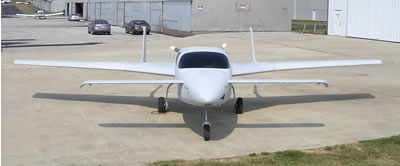
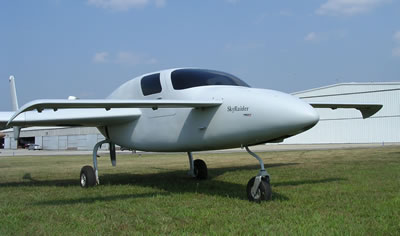
    SkyRaider is an advanced, optionally piloted vehicle (OPV), which is capable of both manned and unmanned operations to fulfill a wide range of missions. The a 4,000 pound gross weight aircraft has a wing span of 32’ and is equipped to carry a variety of sensors and external stores. The aircraft is capable of mission duration of 20 – 30 hours. For example, when configured to carry an internal payload of 1,000 pounds it can sustain a 20 hour missions. The aircraft can also carry and release external stores weighing 160 pounds on each wing. SkyRaider operates at a ceiling of 24,000 feet and at cruising speed of 175 kTAS. Loiter speed is 120 KTAS. The basic platform uses an FAA certified 260 horsepower AVGAS aircraft engine. Proxy also offers a heavy fuel propulsion option for lower fuel consumption and increased endurance.

    A variety of quick change payloads enable the operators to quickly task the aircraft for specific missions. The platform is capable of carrying heavy payloads to support variable mission requirements including Synthetic Aperture Radar (SAR), Electro Optic (EO) / InfraRed (IR) imaging, Signal Intelligence (Sigint), Communications Intelligence (Commint), Communications Relay and others. When operated on an autonomous mission, SkyRaider is preloaded with a flight plan which can include tactical objectives for autonomous missions. As an OPV, SkyRaider has a unique capability to rapidly deploy across civil airspace.

    By utilizing Proxy Aviation’s SkyForce Distributed Management System (DMS), SkyRaider features a number of advanced flight capabilities to achieve Group Tactical Goals, including cooperative flight and Automatic Take-Off and Landing (ATOL). SkyForce DMS provides a single point of management and control of up to 12 fully autonomous air vehicles and 20 ground stations engaging in concurrent, cooperative flight, performing group tactical goals to meet a wide range of mission requirements.

    Advanced Infantry Weapon’s Sights

    The Multi-Purpose Rifle System (MPRS) fire control system is designed by International Technologies Lasers (ITL) for modern and future “land warrior” type applications. The MPRS measures the range to the target, displays a corrected aiming point for proper elevation necessary for an accurate fire, and automatically sets the time delay fuse in the grenade to activate the bomb just before impact, at a preset altitude over the target. The fuze can also be set to explode at a preset delay after an impact, to enable penetration of a soft target (a window, for example). IMI is also developing two new submunitions for the Refaim. The MPRS has additional C4I functions, including a digital compass and laser pointer which provide effective coordination in the battlefield, as well as full integration into tactical command and control systems. Information from the system can be displayed at the team and squad level, neighboring forces such as tanks or helicopters, or link up to higher echelons.

    Based on the MPRS, or its standard MARS reflection sight, ITL is also offering “round the corner” application for its advanced “Urban Warrior” program. The system comprises of a video camera mounted on the weapon, “looking” through the MARS  (red dot sight used on the current Tavor assault rifles) which clearly shows the aiming point. The image can be transmitted to an eyepiece work by the soldier or sent back to a forward command post where it provides real-time monitoring of the combat situation. ITL also offers a wearable computer for the “Urban Warrior”, which provides navigation, situational awareness and coordination, target identification, ranging, reporting etc.

    When integrated into infantry weapon systems, MPRS can be coupled with the Warrior Compact Targeter (WACT) developed by IAI/MLM.

    LUNA X-2000 Tactical UAV System

    The LUNA UAV is an autonomous lightweight unmanned powered glider UAV, currently fielded by the German and Norwegian Armies. The Luna is powered by a two-cylinder twin-stroke engine. It is powered by a 6 HP piston engine driving a pusher propeller mounted above the wing. The glider flying capabilities enables Luna to shut the engine and perform unique stealthy glides without an acoustic signature. Another advantage is the use of robust takeoff by bungee catapult and crash-safe parachute landing system using redundant parachute release and impact dampers.

    Using a 3D digital terrain map model, the aircraft constantly monitors the terrain and known obstacles in its flight path, to avoid collision. The aircraft is programmed to perform automated reconnaissance and surveillance missions, without the need for radio emissions by the ground station. Mission update or active remote control is also available. The vehicle transmits secure real-time images and system data to the ground station via the communications downlink.

    When communications is not possible (such as in mountainous terrain) images are stored on-board for later transmission or manual retrieval. Luna has a 10 liter payload bay, which can be occupied by the quad sensor down-looking color video camera which offers both wide-field of view and close-range viewing capability. Optional 3 axis stabilized payload is also available, or a wide range of alternative payloads, including a new miniature SAR, radio jammers, meteorological sensors, GPS deception emitters, acoustical sensors, particle samplers and CBRN sensors and radiometers and more. According to the manufacturer’s data, after landing with parachute, Luna can be prepared for a new mission within 15 minutes.

    Raven Miniature UAV

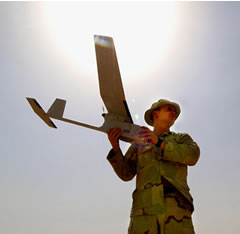
    Today, the US Army uses the Raven as an organic mini-UAV operated at battalion level. The 4.2 lbs (1.9kg) Raven can operate at ranges up to 10 km. Originally designed for operation at battalion level, the U.S. Army uses the Raven mini-UAV at company and platoon levels, to provide “over the hill” intelligence quick response missions in direct support of the battalion’s activities.

    Ravens are supporting Army units in Iraq and Afghanistan, enhancing U.S. Army, Special Operation (SOCOM) forces and other services, performing reconnaissance, surveillance, and target acquisition (RSTA). Since 2004, the Army bought 1,000 Raven systems, comprising of 3,000 air vehicles.

    So far, AeroVironment, the producer of Raven announced the total production of 3,000 vehicles. As of November 2005, Raven became the official US Army Small UAV (SUAV), responding to a USSOCOM Operational Requirements Document (ORD). The buy is for 1,328 systems plus training and logistics support. The Air Force is also procuring the Raven mini-UAV which will be used with the larger Pointer UAV already in service with Air Force Special Operation units.

    In May 2010 AeroVironment announced it received an order valued over $11million under an existing contract with the U.S. Army. The order comprises 63 new digital Raven small unmanned aircraft systems (UAS), services supporting the Army’s evaluation of the small UAS Family of Systems concept and additional engineering services. Each Raven system typically consists of three aircraft, two ground control stations and spares.

    With this recent order the total value of orders for Raven awarded by the Army under the joint small UAS program of record this year has exceeds $18 million, funding the production of 114 new digital Raven systems under the existing U.S. Army contract that had previously been announced by the Department of Defense. In addition, the Army has ordered 216 datalink kits retrofitting analog Ravens with AV’s digital data links. The Army is the contracting authority for the program, procuring the Raven for Army, Marine Corps, Special Operations Command and other U.S. military services. AV has delivered thousands of small unmanned aircraft to date. International purchasers of Raven systems include Italy, Denmark, the Netherlands and Spain.

    HALE UAV Systems – UAS High Flyers

    Start < Page 2 of 5 >

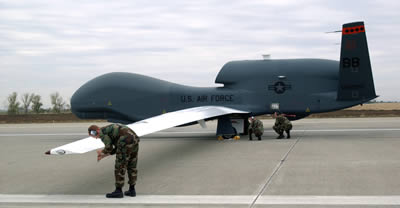
    The largest platforms, such as Global Hawk, and other High Altitude Long Endurance (HALE) systems currently under development, are performing missions similar to Low Earth Orbit (LEO) satellites. Typical equipment used the multi-sensor package of Electro-Optical / Infra-Red (EO/IR) and SAR radar. As HALE systems fly at very high altitudes, the details provided by its EO/IR sensors are sufficient for general intelligence gathering, but for close-in investigation of time critical targets, a closer look is essential. High flying UAS can descend to lower altitude for a closer look, but this is commonly done with UAS flying at medium altitude. A significant advantage of UAS over satellites is their capability to loiter over a particular area, and cover a specific location for an extended time period. This usually requires changing the mission planning, or penetration of a closed airspace. Alternatively, the UAV can deploy an expendable sensor (mini UAV) which can descend and loiter at lower altitude over an area for an extended period. Fighter aircraft equipped with EOIR targeting pods or other UAV systems, (such as Predator) can be used to augment the HALE mission and seek specific targets spotted by a high flying Global Hawk.

    Typical sensors deployed with HALE platforms perform best when rapidly covering a very large area. Such sensors could use line scanners or stepping cameras, in addition to Synthetic Aperture Radar (SAR) to cover as large an area as possible. While HALE platforms have large payload capacity and long endurance capability, they are designed to operate high in the stratosphere. At such altitude they fly “above the weather’ and by using multi-spectral sensors, including EO, NIR, IR, and SAR, can penetrate clouds, dust, or darkness to provide excellent intelligence and recce for the higher command echelons. However, the resolution overview provided by such platforms are rarely detailed enough to support direct engagement by tactical echelons, especially in low intensity urban terrain warfare. These missions require more detailed, more flexible and responsive ad-hoc imagery, which can be obtained by other means.

    This feature covers the following chapters:

    Advanced Infantry Weapon’s Sights

    The Multi-Purpose Rifle System (MPRS) fire control system is designed by International Technologies Lasers (ITL) for modern and future “land warrior” type applications. The MPRS measures the range to the target, displays a corrected aiming point for proper elevation necessary for an accurate fire, and automatically sets the time delay fuse in the grenade to activate the bomb just before impact, at a preset altitude over the target. The fuze can also be set to explode at a preset delay after an impact, to enable penetration of a soft target (a window, for example). IMI is also developing two new submunitions for the Refaim. The MPRS has additional C4I functions, including a digital compass and laser pointer which provide effective coordination in the battlefield, as well as full integration into tactical command and control systems. Information from the system can be displayed at the team and squad level, neighboring forces such as tanks or helicopters, or link up to higher echelons.

    Based on the MPRS, or its standard MARS reflection sight, ITL is also offering “round the corner” application for its advanced “Urban Warrior” program. The system comprises of a video camera mounted on the weapon, “looking” through the MARS  (red dot sight used on the current Tavor assault rifles) which clearly shows the aiming point. The image can be transmitted to an eyepiece work by the soldier or sent back to a forward command post where it provides real-time monitoring of the combat situation. ITL also offers a wearable computer for the “Urban Warrior”, which provides navigation, situational awareness and coordination, target identification, ranging, reporting etc.

    When integrated into infantry weapon systems, MPRS can be coupled with the Warrior Compact Targeter (WACT) developed by IAI/MLM.

    Shaped Charges IED in the Middle East

    Start < Page 3 of 4 >

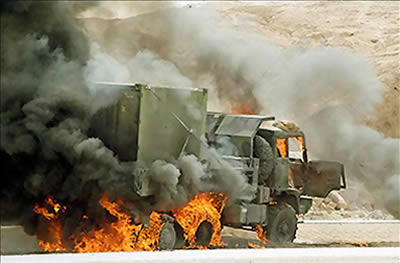
    Shaped charge IEDs are not new in the Middle East insurgency wars. The IDF Bomb Disposal crews have uncovered, what they designate as Kela type IEDs, in Lebanon and in Gaza. Activated through catapulted triggering devices, the weapon uses an improvised chemical shaped charge type, between 10-50kg and can be launched from stand-off or electrical fuze from several meters distance. The initial types have been relatively ineffective against armored vehicles, but the heavier versions have caused catastrophic results in softer or lightly armored vehicles.

    Other types of IED used by Hamas and Hezbollah are super-heavy “belly” explosive devices, also frequently packing some special types of shaped charge explosives to penetrate AFV hulls from the vulnerable bottom. Penetration by chemical jet stream into the fighting compartment activated catastrophic secondary explosions in unprotected internal tank ammunition stores. Israeli experts assumed that the know-how about the preparation and use of such devices was imported from Iranian demolition experts.

    Accordingly, latest IDF versions of (Low Intensive Combat) LIC Merkava tanks have been fitted with armored steel base-plates, which can absorb the blast. US experts consider a similar trend to take place in Iraq, as know-how is transferred to Iraqi insurgents by Hezbollah and their Iranian Revolutionary Guard Corps sabotage instructors. Iraqi insurgents have already adopted such tactics utilizing a variety of shaped charges. Some have been hung from overpasses others planted on roadsides, One of the heaviest IEDs used so far contained 600 pounds of explosives placed in an under devastated an Amphibious armored vehicle killing four marines. Another ambush which used four stacked mines buried in a road, destroyed another amphibious carrier and killed 14 marines. Other methods of operations call for placement of heavy IEDs in road underpasses, and most lately – mounted in suicide vehicles.

    Additional parts of this article:

    IED – Shaped Charges part II

    Start < Page 2 of 4 >

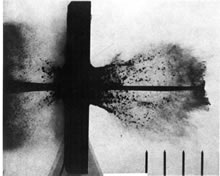
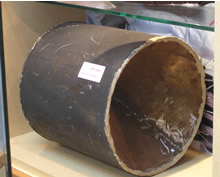
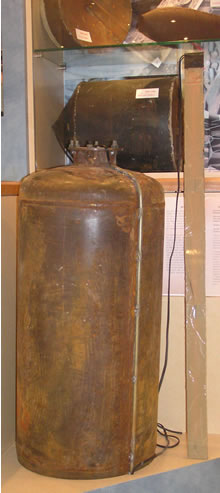
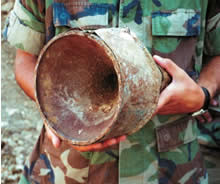
    A new type of IED consists of “shaped charge”, located under the road surface or at the side of the road. In these explosive devices, a cone (also known as concave) made of copper is covering an explosive charge creating a hollow space in front of and along the axis of the charge.

    When the explosive is activated, the copper transforms into a forceful jetstream of molten metal also known as “plasma”. This plasma jet easily perforates an unprotected steel armor, hitting the surface at a speed of 8,000 meters per second and extremely high pressure. If the plasma is not obstructed by a target within few meters, it solidifies into a kinetic slug which is less effective against heavy armor but is still devastating against softer targets. In both cases, the effect inside the target interior can be catastrophic, especially if it ignites unprotected ammunition stores, causing secondary explosions. Anti-tank shaped charges must be employed with utmost accuracy (activation distance, and design accuracy). Therefore, they are used primarily with buried mines, and lightweight anti-tank weapons.

    Heavier IEDs which utilize the heavy slug concept can be used with roadside ambushes, detonating at a standoff distance from the target, inflicting devastating effect and fragmentation on the protected and light armored targets and their surrounding. To be most effective, the shaped charge has to be detonated at the right distance from the target. If it detonates too close to the steel armor, an optimal plasma jet cannot be formed dissipating the penetration effect. If detonated too far from the armor, the plasma jet is already unfocused and partly spent itself.

    Additional parts of this article:

    Skunk Works and XTEND Simplify Multi-Drone Command

    0
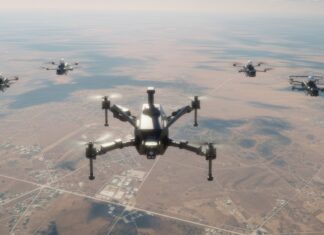
    Lockheed Martin Skunk Works® and XTEND have achieved a major milestone in JADC2 by integrating the XOS operating system with the MDCX™ autonomy platform. This technical breakthrough enables a single operator to simultaneously command multiple drone classes, eliminating the friction of mission handoffs. From "marsupial" drone deployments to operating in GPS-denied environments, explore how this collaboration is abbreviating the data-to-decision timeline and redefining autonomous mission execution.

    From Ukraine to Taiwan: The Global Race to Dominate the New Defense Tech Frontier

    0
    As traditional defense primes face mounting competition from agile “neoprimes” such as Anduril, Palantir and Helsing, the balance of innovation is shifting toward software-defined warfare and scalable, dual-use technologies, while global industry consolidation—marked by Boeing’s integration of Spirit AeroSystems and other strategic mergers—signals an intensified race to secure control over the defense technology value chain. Our Defense-Tech weekly report highlights these trends.

    Europe’s “Drone Wall”

    0
    In early October 2025, a coordinated wave of unmanned aerial system (UAS) incursions—widely attributed to Russia—targeted critical infrastructure across at least ten European nations. The unprecedented campaign exposed the fragility of Europe’s air defenses...

    Weekly Defense Update & Global Security Assessment

    0
    Executive Summary The past week (September 18-25, 2025) represents an inflection point where strategic defense concepts have transitioned from doctrine to tangible reality. An analysis of global events reveals four primary, interconnected trends shaping an...

    U.S. Air and Space Forces Push Next-Gen Programs at the AS&C 2025 Conference and...

    0
    At the 2025 Air, Space & Cyber Conference, U.S. Air Force and Space Force leaders unveiled major updates on next-generation fighters, bombers, unmanned systems, and space initiatives, highlighting both rapid innovation and critical readiness challenges as the services race to outpace global competitors. A short version is available here, with a more detailed version for subscribers.

    TADTE 2025: Reflecting Taiwan’s Strategic Themes

    0
    The Taipei Aerospace & Defense Technology Exhibition (TADTE) 2025 crystallized around four dominant strategic themes that collectively illustrate Taiwan's comprehensive approach to defense modernization amid escalating regional tensions. Based on a detailed report by Pleronix (available upon request). Includes a Podcast discussion on TADTE 2025's highlighting Taiwan's four strategic themes beyond the post's coverage.

    Iron Beam 450 Completes Testing, Soon to Join With Operational Air Defense Units

    0
    Israel’s Iron Beam 450 high-power laser system has completed final testing, marking a major leap in air defense. Developed by Rafael, it offers precise, cost-effective interception of rockets, UAVs, and mortars, and is set for IDF deployment by 2025.