Monday, December 22, 2025
More
    Home Blog Page 394

    IED – Shaped Charges

    Start < Page 1 of 4 >

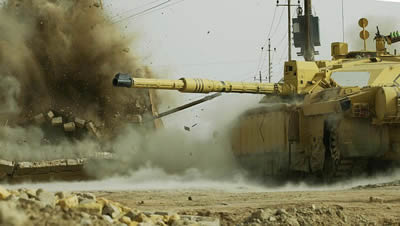
    American casualties from bomb attacks in Iraq have reached new heights in the last months as insurgents improved their tactics, deploying more sophisticated improvised explosive devices (IED) targeting armored vehicles. In May 2005 alone, there were about 700 attacks against American forces using IEDs, the highest number since the invasion of Iraq in 2003. Attacks on Iraqis at recent months also reached unprecedented levels. Among the deadliest attacks was the destruction of a growing number of armored vehicles, including M-1 tanks, amphibious armored assault vehicles, Bradley armored vehicles, Stryker APCs and up-armored Humvees – all recently protected with various types of add-on armor.

    So far, IEDs were made of roadside bombs, the most common were made of artillery shells detonated by a command wire or remote control. Such shells contain tens of kilograms of explosives which, when exploded, cause extensive blast and shrapnel but are less effective against armored targets. Troops started identifying the devices on roadways, often tipped off by the wires used to trigger them, so the insurgents began burying the devices under trash or hiding them in dead animals’ carcasses and detonating them remotely with cell phones and garage-door openers. The US forces already use some 4,200 portable electronic jamming devices including Warlock Red and Warlock Green systems. Among the known projects undergoing field tests, are the new Joint Improvised Explosive Device Neutralizer (JIN), using controlled directed energy and the Scorpion II Demonstration System, a transportable high-powered microwave system capable of disabling a wide variety of improvised explosive devices. Insurgents are countering these countermeasures by the use of infrared lasers command links, attached to IED detonators, thus bypassing the electronic jammers, used to pre-activate roadside bombs or block their detonation. After the troops started using specialized equipment to probe debris for suspected IEDs, the terrorists began disguising them better: atop telephone poles or buried behind concrete abutments.

    Additional parts of this article:

    KZO Tactical UAV System

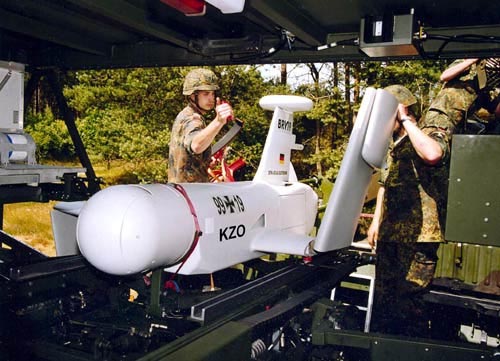
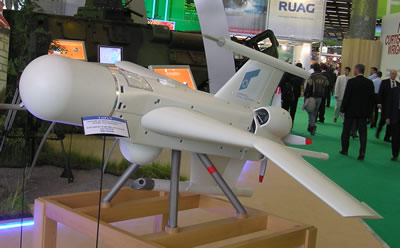
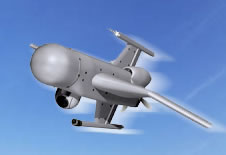
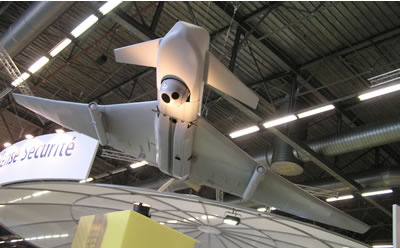
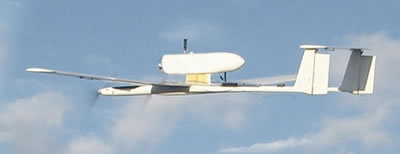
    The KZO battlefield reconnaissance system was developed to respond to NATO and specifically German Army requirements for a rapid reaction short range UAV, able to provide high precision targeting and damage assessment for theater operations. The system is designed to operate in day or night and under limited weather conditions. To enable the drone to fly through icing conditions it is equipped with warm-air wing surface deicing system. KZO is launched by a catapult and retrieved by parachute and airbag system. When operating under high winds of up to 50 km/h it can be launched from a container, with booster assist. The KZO drone operates at altitudes of 300 to 3,500 metres. ,Designed to operate under all the climatic environments encountered in Europe, KZO is equipped with a de-icing system, enabling deployment in virtually all weathers. Even under conditions of heavy electromagnetic interference, it can transmit target information back to base at ranges of over 100 kilometres. The KZO can detect stationary and moving targets alike, including their speed and direction of travel; it can remain aloft for over 3.5 hours. KZO has a wingspan of 3.42 metres and a length of 2.26 metres; the fuselage measures a mere 36 centimetres in diameter.

    Stealth techniques enable KZO to operate in hostile electromagnetic environment. Acoustic mufflers are used to attenuate engine sound and reduce the exhaust’s thermal signature. KZO operates autonomously over a distance of 100 – 200 km. Data transmission is done via Ku band jam resistant datalink located in a disk-shaped antenna on the tip of the vertical tail fin. The nose mounted payload comprises of a 3x stabilized mid-wave FLIR (8-12micron) and CCD with x8 zoom.

    A similar platform, the Taifun attack drone, searches and engages high priority targets. It destroys its target with a hollow-charge warhead. A third configuration – the “Muecke” jamming drone is believed to be in development.

    The first of six KZO systems ordered by the Bundeswehr was delivered on November 28, 2005. All systems are expected to be delivered by the end of 2007, comprising sixty drones and twelve ground systems. Rheinmetall is marketing the system under cooperation with Teledyne Brown Engineering Inc.

    Artillery Ammunition at the 2006 Eurosatory Exhibition

    New ammunition currently under development could extend the current effective range of artillery beyond 40 km, which was the realistic limit of conventional 39 and 45 caliber 155mm guns. In the UK, QINETIQ, the prime contractor for Team IMPAQT‘s Advanced Ordnance demonstrator program, is developing a composite airframe design suitable for precision delivery of a variety of payloads. IMPAQT aims at the development of a new type of artillery ammunition capable of attacking targets with an accuracy of less than 10 meters, at a range of 80 km. The British consortium is currently evaluating three IMPAQT munitions. One is an extended range variant utilizing roll stabilized projectile which employs an attitude controlled steel projectile to deliver two BONUS sensor fused munitions or a unitary warhead to a range beyond 60 km. A different variant uses an advanced lightweight composite projectile to deploy three BONUS SFMs to a range of 75km. The third will utilize composite projectile form making precision attacks over a wide area from a single 155mm round.


    Two versions of precision attack artillery munitions are already in service with European armies. Germany, Greece and Switzerland are fielding the Rheinmetall Waffe Munition’s SMArt 155 (DM702) intelligent, autonomous artillery round while, BONUS, designed primarily to engage mobile, armored formations, is in service with Sweden and France (over 4,500 rounds have been produced). A twin-warhead BONUS MkII Sensor Fuzed Munition (SFM) is in development, fitted with IR and profile detector sensors, enabling target discrimination and detection even through camouflage. Further work is being done on a new version of BONUS Insensitive Munition (IM), to address current restrictions imposed by European regulations. BAE Systems Bofors and GIAT are developing the BONUS IM for consideration for the British Indirect Fire Precision Attack (IFPA) program. BONUS could also be part of the program’s advanced phases, addressing Guided Artillery Shells.

    Aerodynamic projectile design will also enable range performance similar to conventional ordnance systems with reduced barrel pressures, matching the capabilities of lightweight artillery platforms. This program is pursued as a joint initiative supported by the defense ministries of France and the UK as part of the IMPAQT team, including GIAT, BAE Systems Bofors, MBDA and Qinetiq. Rheinmetall was recently able to fire Dm131 155mm high explosive artillery rounds at ranges over 40 km. This round uses insensitive explosive and is loaded with DM662 bomblets. DM131 has been accepted by the German Army and is currently in production for the Netherlands and Greece.

    To improve the precision of current artillery projectiles, the US Army is pursuing the development of Precision Guidance Kit (PGK) upgrades for its 155mm ammunition stockpiles. Under the 6 months technology demonstration program, the Army will evaluate several proposals, to be  followed with down-select the final PGK system.  ATK, with team members Rockwell Collins and Draper Labs are proposing a PGK utilizing a GPS guidance and navigation system designed to fit the fuze well of an existing 155mm round. ATK’s PGK solution features fixed canard guidance, gun-hardened electronics, self-generated power, and a minimum number of moving parts. The company expects its system will exceed the Army’s requirements for accuracy, effectiveness, range, and cost.

    Another multinational program is the Excalibur – a cooperative effort between Raytheon Missile Systems and BAE Systems Bofors of Sweden for developing a GPS guided projectile, providing current 155mm artillery with high precision attack capability at extended ranges. In June 2006 the U.S. Army awarded Raytheon Company a $42.7 million production contract for tactical and test projectiles. The US Army is already pursuing Block 1B upgrades for Excalibur with the Saber program. A successful test firing of the Saber was conducted in June 2006. The advanced projectile was fired to a range of 48 km from a 155mm cannon.

    Other recent Improvements made to conventional munitions primarily address adherence to Insensitive Munitions regulations which have been imposed by the European community. GIAT is already manufacturing insensitive artillery ammunition, producing the 155mm LU211-IM for the Caesar. Artillery rounds using Insensitive Explosives are also in production at BAE Systems. In May 2006 the company opened its new production facility, with filling capacity of more than 375,000 shells per year, at Glascoed, UK. Specializing in insensitive explosives, the new facility is filling 105mm and 155mm shells with Rowanex 1100 Polymer Bonded Explosive (PBX). Under a new 12,000 105mm HE improved ammunition shells are to be delivered by October 2006.

    105mm artillery is again becoming popular among many armies due to the high mobility and low weight of the 105 mm gun, which makes it suitable for supporting Rapid Deployment Forces. IMI is also entering the field of 105mm ammunition and is developing a new series 105mm artillery projectiles that are designed to fit all types of 105mm artillery systems currently in service. The new range will include Dual Purpose Incendiary Counter Material (DPICM) and Extended Range (ER) ammunition. Hollow Base (HB) versions extend the reach of 105mm guns up to 14 km and the extended range Base Bleed (BB) versions, currently in development, will reach ranges beyond 20km. IMI’s 105mm cargo round carries 42 “Hornet” bomblets, each equipped with IMI’s combat proven Self-Destruct Fuze (SDF) the same fuse used for the 155 mm cargo projectiles. Each bomblet produces has a kill radius of  approx. five meters and can penetrate more than 50 mm of RHA steel. Smoke, illumination and WP rounds are also available.

    Start < Page 2 of 2 >

    Taifun Attack Drone

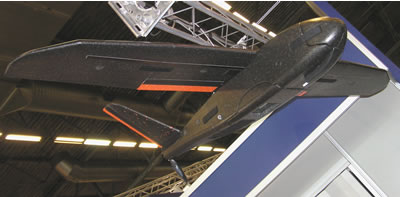
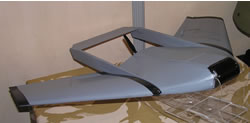
    Taifun attack drone based on the KZO recce UAV searches and engages high priority targets. It destroys its target with a hollow-charge warhead. Taifun is powered by piston-engines with a pusher propeller. A cross-wing design configuration enables the drone to dive at a steep angle when attacking ground targets. The aerial vehicle itself is designed with stealth materials to reduce its signature, attenuate engine sound and reduce the exhaust’s thermal signature. Taifun is equipped with a UHF jam-resistant, frequency hopping datalink and relay which extend its operation up to 200km. An advanced version of the Taifun, designated TARES is in development.

    Taifun is fitted with Ka band millimeter-wave radar seeker, which uses Doppler beam sharpening (DBS) for target acquisition and monopulse tracking during the final phase of the attack. An infrared sensor operating in the 3-5 band is providing snapshot target verification, just prior to the attack maintaining positive “man in the loop” control for target selection, identification and supervision of target approach. Taifun attack can be interrupted until the final five seconds before impact. When interrupted, the UAV is available for another mission. Taifun is designed to autonomously navigate over any terrain, using inertial, GPS and terrain matching navigation techniques. The attack drone can be employed in several modes of operation, including target search and attack in a designated area, dedicated geographical spot or attacking moving targets along designated routes.

    Fire Support Systems at the 2006 Eurosatory Exhibition

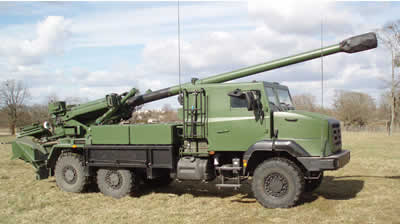
    In Parallel with the growing popularity of wheeled combat vehicles is an interest in wheeled artillery, as represented at Eurosatory 2006 by the Caesar system, from GIAT, the FH55BW Arthur, from the Swedish SWS Company and Portee – from BAE Systems. These guns offer improved mobility, enhanced autonomous operability, and, with the introduction of advanced, precision ‘smart’ munitions, they can also be selective and effective against point and mobile targets. A wide range of artillery munitions were also displayed, highlighting the entry of insensitive munitions, trajectory corrected systems and development progress of advanced precision attack munitions.

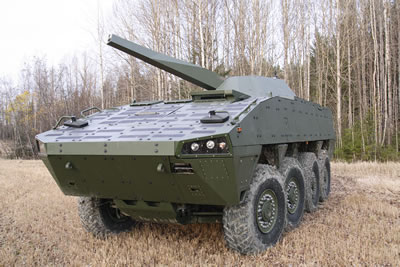
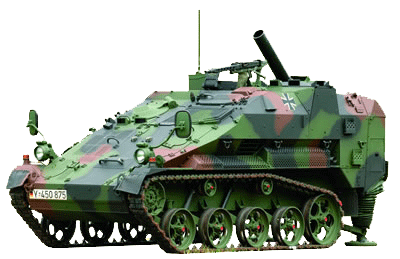
    Another trend is the growing popularity of mobile 120mm mortars. Two new 120mm mortar carriers were unveiled here – the NEMO, introduced by Patria on an 8×8 AMV and the Wiesel 2, developed to address the German Army requirements for an air-mobile fire support.

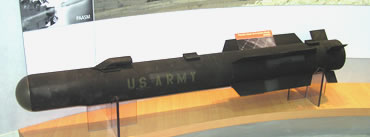
    Mortars and artillery present a relatively low-cost weapon, but both are limited by range and can only engage a target within a range of  “statistical error”, which cannot be tolerated with sensitive operations where restricted use of force is required. During firing, mortar and artillery projectile are exposed to very high loads, therefore, converting artillery and mortar bombs into precision weapons is a complex and costly technical challenge. Rockets and missiles do not have the same  limitations and several experienced manufacturers are proposing various modifications and improvements for their systems to enable rocket based fire support elements to strike at point targets up to hundreds of kilometers deep into enemy area. Precision attack weapons on display also included the Precision Attack Missile (PAM), displayed by Raytheon and the proposed Hellfire/JCM follow-on Precision Attack Air/Surface Missile (PAASM).

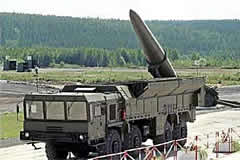
    Among these systems are the GMLRS, which is under development by a US-European team. A similar program called EXTRA (Extended Range Rocket) is currently underway in Israel, as a collaboration between IAI and IMI. In Russia, similar work is done on Grad, and Smerch rockets. For attacks at even longer ranges several missiles are in production, including the Russian Iskander E, US ATACMS and Israeli LORA.

    Start < Page 1 of 2 >

    TARES – Tactical Advanced Recce Strike System

    TARES attack drone is based on the Taifun attack UAV. Unlike its predecessor, which operated autonomously, the new UAV is designed to facilitate “man in the loop” operation.  TARES will provide IIR and radar images and automatic target identification capabilities. When high priority targets are detected, TARES will be able to switch mode and attack them. The drone will have a range of 200 km and flight endurance of four hours. Operating several UAVs over the area of operation, TARES will be able to deliver images and sensor data over a range of up to 600 km, using automatic relay systems. also have the  searches and engages high priority targets as instructed by the operator.

    TARES uses the Taifun’s nose-mounted Ka band millimeter-wave radar seeker, which uses Doppler beam sharpening (DBS) for target acquisition and monopulse tracking during the final phase of the attack. A new infrared sensor is mounted in a stabilized payload used for area surveillance, target search and reconnaissance.

    REFAIM Advanced Infantry Weapon System

    The Refaim system was designed for the advanced version of the Tavor but is compatible with any rifle, enhancing the accuracy, lethality agility and flexibility of the weapon.

    The system offers line of sight and beyond line of sight activity, around the corner viewing and shooting capability and embedded training and mission rehearsal functions.
    Refaim uses an air-burst telescopic bullet trap rifle grenade with point detonation, time delay and self destruct functions. The fragmentation charge is optimized against infantry targets but can also penetrate vehicles and windows by utilizing a short time delay, thereby maximizing the effect behind or within cover.

    The system can also use an add-on grenade launcher such, such as the M-203. The airburst grenade uses a programmable time delay fuse which is set by the Multi-Purpose Rifle System (MPRS) fire control system designed by International Technologies Lasers (ITL). The MPRS measures the range to the target, displays a corrected aiming point for proper elevation necessary for accurate firing, and automatically sets the time delay fuse in the grenade to activate the bomb just before impact, at a preset altitude over the target. The fuze can also be set to explode at a preset delay after an impact, to penetrate a soft target (a window, for example).

    IMI is also developing two new submunitions for the Refaim. The MPRS has additional C4I functions, including a digital compass and laser pointer which provide effective battlefield coordination, as well as full integration into tactical command and control systems. Information from the system can be displayed at the team and squad level, neighboring forces such as tanks or helicopters, or link up to higher command echelons.

    At LIC 2004 IMI unveiled an inert Refaim grenade with an embedded camera and communications link, which can send a view of the target as it descends to strike. This low cost system provides a “bird’s view” of the target. The image is collected by the receiving unit and displayed to the user as a static image of the target, with various zoom options.

    The second new Refaim grenade is equipped with CS irritating gas, and is designed to provide security force effective non lethal means, fired at a range of a few hundred meters, over five times the distance currently used by CS grenades and canisters.

    Mobile Commander’s Associate (MCA)

    Lockheed Martin has completed flight demonstrations of Mobile Commander’s Associate (MCA), that will enable U.S. Army command and control helicopters to form and manage teams of unmanned aerial vehicles (UAVs) and manned strike aircraft.

    MCA integrates key functionality required for manned / unmanned teaming: connectivity to multiple digital radio links to provide simultaneous command and control of UAVs and communicate with ground and manned aerial forces; decision-aiding technology to monitor the UAV team’s flight activity with minimal human input; and fusion of ground and airborne sensor data so as to build a situational picture of the evolving battlefield.


    With the MCA system installed aboard an UH-60 Black Hawk Airborne Command and Control (A2C2S) helicopter, Lockheed Martin demonstrated control of a Hunter UAV and its imaging sensors across a Tactical Common Data Link; exchanged position reports, tracks and engagement messages with an F/A-18 aircraft via Link 16 data link; and shared targeting data with a Longbow Apache attack helicopter via an Improved Data Modem communications connection. The airborne battle commander used KineMap™ digital map software to monitor the evolving tactical situational awareness picture.

    Lockheed Martin developed the MCA system as part of a research and development program with the Army’s Aviation Applied Technology Directorate (AATD). The AATD sponsored the demonstration flights aboard the A2C2S helicopter as part of the Hunter Stand-off Killer Team Advanced Concept Technology Demonstration at Fort Huachuca, AZ and Fort Hood, TX. The MCA system has now entered an extended evaluation period with the Army’s 21st Cavalry Brigade (Air Combat) based at Fort Hood to determine operational applicability for the warfighter.

    “These integrated capabilities are important because they give airborne commanders control of UAVs that can fly reconnaissance missions and provide targeting information to manned attack aircraft,” said Michele Evans, vice president for Aircraft Systems at Lockheed Martin Systems Integration – Owego. “As these teaming technologies mature, joint forces will significantly reduce the risk to manned aircraft and the timeline to find and engage targets.”

    SADS – Small-Arms Detection System

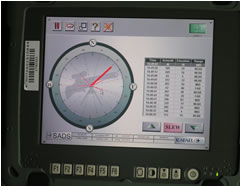
    An acoustic detection and direction finding system developed by RAFAEL detects the gunshot’s supersonic signatures of both shockwave and muzzle blast, using a single detector array. SADS triggers an alarm when a sniper shot or small arms fire is detected in the protected area. The system can be mounted on a vehicle (including a tank or other tracked vehicles), rooftop or be used as a portable device. The system can be carried by a single soldier. SADS covers 360 degrees, detecting and identifying 90-95% of sniper firing instances, at ranges of up to 1,000 meters (3,000 ft) with standard deviation of less than ±3°.

    Unmanned Aerial Systems (UAS) at the 2006 Eurosatory Exhibition

    Extensive development efforts have been invested in unmanned systems, which are gradually being integrated into modern warfare. Many companies displayed unmanned systems technologies at Eurosatory 2006, including small and miniature aerial vehicles, (UAVs), unmanned ground vehicles (UGV) of various sizes. Developers exhibited models of both types designed for carrying remotely operated systems, sensors and weapon. The exhibition provided a venue to introduce several new systems, including the Sperwer B armed UAV (shown by Sagem carrying two Spike LR missiles). Just prior to the show Sagem reported that Greece is planning to double the numbers of Sperwer UAVs in its inventory.

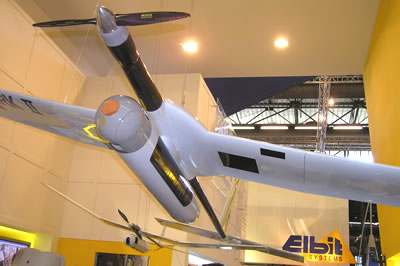
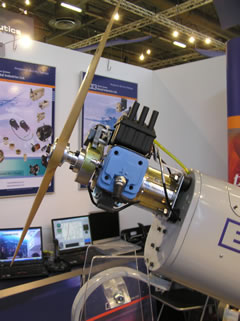
    Several new Israeli UAVs were unveiled, including the Skylark II from Elbit Systems and the I-View 50 from IAI/Malat, which also released details about its miniature Pelican hand launched micro-UAV. Another new Micro UAV is the Modular Airborne Sensor (MAS) from Patria. Even smaller Micro-UAVs were displayed by Cyberflight, as part of their newly launched SOD family of vehicles. New propulsion techniques for UAVs were also demonstrated by Bental Industries, showing the 4KW electrical motor used by the Skylark II and a new hybrid propulsion system, utilizing an internal combustion engine and an alternator / electrical cruise 2KW electrical  motor which can be used for extended “silent phases” of the UAV mission. Hybrid system is considered as one of the propulsion options for IAI’s I-View 50. (The hybrid system is shown below left).

    Many armed forces are currently fielding, or will soon field, mini-UAVs. The leading supplier of mini-UAVs is Aeronvironment, which has manufactured more than 1,000 units of their Raven model. At Eurosatory 2006 Aeronvironment demonstrated new models, including the larger, more sophisticated Puma and their smaller, Wasp micro UAV. Elbit Systems already delivered units of the Skylark I to the IDF, Australian Army and most recently – the Canadian armed forces.

    EADS is delivering a total of 160 DRAC Close-Range Reconnaissance UAVs under a contract awarded by DGA. The system was originally designed to be an “extended pair of binoculars” utilizing an 8kg autonomous aerial vehicle enabling the operator to gather, display and process real-time images at distances up to 10 km by day or night. DRAC is scheduled to become operational with the French Army by 2007. EADS also demonstrated the Scorpio 6 rotary wing UAV, designed for operations in urban terrain. This miniature helicopter can operate at ranges of up to 10 km, equipped with interchangeable EO/IR payloads. The vehicle communicates with the portable ground station via digital datalink. Both Scorpio and DRAC and their payloads were developed by the French UAV specialist Surveycopter.

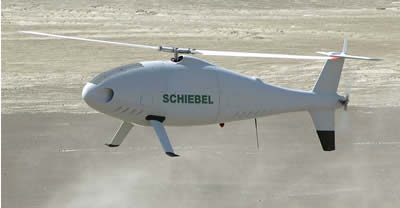
    Progress is made with heavier Vertical Take-Off and Landing (VTOL) UAS, as evident by the appearance of several new systems. The IAI/Malat Hoverspy, a new VTOL UAS from Israel is an autonomous, 20kg VTOL platform, designed for all- terrain operation while carrying a 5 kg payload for a 90 minute mission. It can fly an autonomous mission based on GPS navigation, and offers continuous payload control by the operator. Heavier systems include the new V-150 Skeldar from Saab, which was unveiled at the show. Much progress has been made with the Sciebel S100 autonomous helicopter. Its El-Saber version developed for the UAE is currently undergoing testing in the Middle East. Both these systems weigh more than 100 kg per unit.

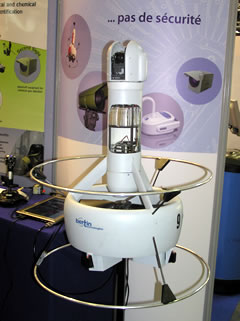
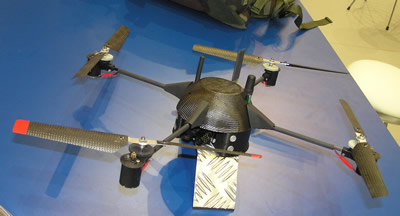
    Other systems in this category are much smaller; the Class I UAV developed for the US Forces FCS program was displayed at the Honeywell stand. The French equivalent is the Hovereye from Bertin, which has been selected for incorporation into the advanced version of the French Army’s FELIN dismounted warrior program. An even smaller system is the CPX4 quadrocopter, displayed by Novadem. This vehicle is being evaluated by the DGA as a mini-UAV concept for further FELIN enhancement. Other miniature quadrocopter designs were displayed by Rheinmetall Defense and EADS.

    Start < Page 1 of 5 >

    SlowFast Tactical Drone Tactical ISTAR UAV

    Based on the Moyen Duc demonstrator, Dassault Aviation and Sagem are jointly developing a concept of a new stealthy tactical drone which will be able to penetrate hostile airspace at high speed and loiter over targets undetected, collecting real-time information.

    This versatile vehicle will be designed for two optimal performances at high speed (in excess of Mach 1.6) and fast climb, to comply with airspace management constraints, and relatively low-speed (around 120 kt), long endurance flight profiles. Speed will be adapted to the mission requirements and sensors, to enable high performance on fast reconnaissance missions. Its flexibility will allow reaching the target within minimal time to carry out selective surveillance tasks at speeds in line with the sensor’s acquisition capabilities, including pursuit of time sensitive targets and battle damage assessment.

    The aircraft will be powered by a two jet engines, and maintain a gross takeoff weight of 500 kg. Planned mission endurance will be 3 – 4 hours. The vehicle is expected to be used with the French Army at corps and division level. It will utilize common ground elements, also used by Sperwer UAVs.

    Micro Tavor

    Israel’s Weapons Industries (IWI)

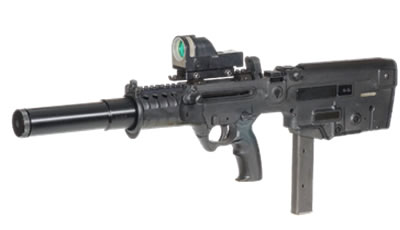
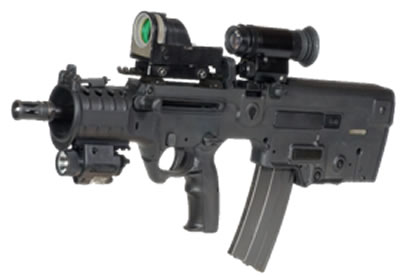
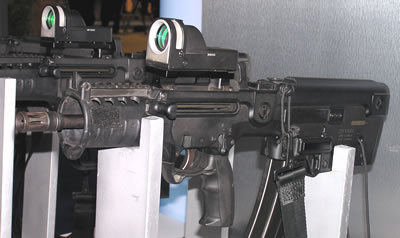
    Micro Tavor (MTAR 21) is based on the IWI Tavor Assault Rifle, yet this small weapon is tailored for the Special Forces market. Its compact dimensions make this weapon a perfect match for drivers and tank crews. MTAR was developed in close cooperation with special operations units and is tailored to their specific requirements and needs.

    With length of only 59 cm MTAR21 is considered to be the shortest 5.56mm weapon in the market yet its barrel is only five centimeter short of the assault rifle version, thus offering accurate fire at contingencies. Utilizing a conversion kit, MTAR 21 can be turned into a 9mm sub-machinegun loaded with 25 rounds magazines. This capability has significant logistical, training and operational advantages for special operations and SWAT units, which usually maintain two dedicated weapons for short and medium range operations.

    The Indian version of Micro-Tavor, called Zittara, is designed by the India’s Ordnance Factory Board (OFB) for use by India’s special operations units. Zittara differs from the Israeli Micro-Tavor by allowing the use of three different configurations and ammunition types for different situations – a carbine (firing 5.56×30 ammunition), an assault rifle (firing 5.56x45mm) and submachine-gun firing 9x19mm rounds with accuracy of up to 200 meters. These conversions can be performed in the field with standard tools.

    Standard Tavor accessories are also applicable for the MTAR platform. However, this weapon has built-in Mil-Std 1913 (Picatinny) accessory mounting rails without the need for bulky adapters. Micro Tavor uses an integral silencer for the 9mm barrel, which, unlike add-on silencers, does not add to the weapon’s length.

    Surface Launched (SL)AMRAAM Complementary Low Altitude Weapon System (CLAWS)

    SLAMRAAM also known as Complementary Low Altitude Weapon System (CLAWS) offers effective defense against the low-flying cruise missile and the unmanned aerial vehicle. The system is already deployed with the Norwegian army, the Spanish army and has recently been acquired for the US Army and marine Corps. The system concluded the developmental testing phase in January 2005.
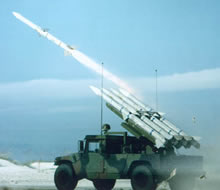
    SLAMRAAM can also integrate with other assets, such as Hawk, Patriot or sea based Aegis units, to provide an effective protection against all types of delivery means, from ballistic missiles, cruise missiles, asymmetric aerial threats and unmanned aerial vehicles.The system utilizes distributed architecture, for improved survivability and support of multiple, simultaneous engagements, the Surface Launched – (SL) AMRAAM provides close range as well as Beyond Visual Range intercept capability under all weather conditions, day and night. AMRAAM can effectively engage cluster targets, and employs an all aspect look-down seeker to overcome difficult topography.

    In 2004, contracts were awarded to Raytheon to supply SLAMRAAMs to the U.S. Army and U.S. Marine Corps. The system configuration uses common elements, comprising of the missile launcher, mounted on a Hummer; a new Integrated Fire Control Station (IFCS) which will be netted to the Sentinel radar; the Army’s future Joint Land Attack Cruise Missile Defense Elevated Netted Sensor system (JLENS) and the Marine Corps’ future Multi-Role Radar System. The new missiles will increases the number of firing channels per battery, and introduce an effective defense against cruise missile threat.
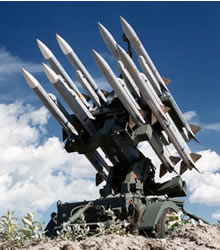
    The standard missile launcher operated by the Norwegian army, carry six AMRAAM missiles protected in a containers. A universal launcher carries six AMRAAM missiles, or three HAWKs. It is also equipped with a datalink which communicates with the missiles on during their flight, with mid-course target updates. The mobile Hummer launcher carries four to six missiles. A mobile version utilizes a six missiles launcher, carried on a light tactical vehicle such as the Hummer. A firing unit is also equipped with the AN/MPQ-64 Sentinel radar and Fire Distribution Center (FDC).

    A typical “Family of Systems” architecture was recently tested during the system’s development testing phase, engaging surrogate cruise missile targets. The system included the TPS-59 radar and AN/TYQ-23 Tactical Air Operations Module, which provide the large volume air picture. Close air picture and tracking data were provided by the Thales Raytheon Systems MPQ-64 Sentinel Radar. Command and control, with air picture and track correlation, was performed by the Marine Air Defense Communications Platform updated with the Raytheon Solipsys Multi-Source Correlator Tracker and Tactical Display Framework. The CLAWS launcher provides Fire control and facilitates the AIM-120 AMRAAM missile launch. In a test conducted Nov. 22, 2005 the CLAWS system successfully engaged six targets. According to a Raytheon press release, the system achieved all test objectives during the three days of firing. The test marked the completion development testing, paving the way for the system’s fielding phase.


    In October 2006 Raytheon announced the completion the development of software upgrades for the ground launched AMRAAM missile system, demonstrated the system in test firing conducted in partnership with the Spanish Army and the U.S. Air Force. Among the new capabilities added to the system are command destruct/self destruct (CD/SD) capabilities, improving the missile’s capability of intercepting cruise missiles and other unmanned targets, over urban terrain. The CD/SD capability provides greater flexibility in the employment of Surface Launched AMRAAM (SL-AMRAAM) while engaging cruise missile and unmanned aerial vehicle threats. The capability helps mitigate collateral damage when used in a surface launch role within an urban environment. Additionally, CD/SD software provides the capability of a programmable self-destruct to help reduce fratricide. These successful tests concluded more than 24 months of work on the Software Upgrade Program 2006 for AMRAAM.

    Since May 2006 Raytheon demonstrated the missile’s accuracy with seven direct hits, during tests conducted with the Norwegian Air Force. A more recent test, in association with the Spanish Army and US Air Force, was conducted in Sweden in October, where three missiles scored direct and instrumented hits, demonstrating the new command destruct/self destruct capability (CD/SD).

    The US Army is evaluating further roles for the SLAMRAAM, including the use of an AMRAAM derivative for missile defense. The Multi-service Extended Range Low-cost Interceptor (MERLIN), could use a dual-stage boosted missile designed to intercept and destroy unsophisticated cruise missiles and unmanned aerial vehicles (UAV). Used as a low-cost, shorter range complement to the AMRAAM missiles, which will be saved for more difficult targets. Other missiles to be evaluated for this role include the single-stage Low Cost Interceptor (LCI), which is being developed as a low-cost complement to the Patriot missile.

    On May 26, 2006 Raytheon and Boeing announced the first delivery of an Integrated Fire Control Station (IFCS) for the U.S. Army. Boeing is under contract through 2007 to design and develop the system’s IFCS. The IFCS is the first of five to be designed and developed by subcontractor Boeing. The program  will now move to integration at Raytheon’s, to be followed by flight testing of the integrated system.

    In addition to its primary mission as control center for teh SLAMRAAM, the IFCS can be networked to the U.S. Army’s Sentinel radar, the Army’s future Joint Land Attack Cruise Missile Defense Elevated Netted Sensor system under development by Raytheon, the existing Patriot radar and the Marine Corps’ future multi-role Ground/Air Task Oriented radar system to provide truly integrated fire control for the air defense battlespace.


    LIC-2005 Review

    During the past four years Israel’s acquired unprecedented operational experience in Low Intensity Warfare. Much of the gains can be attributed to new operational procedures, advanced technologies and comprehensive sensor-C4I-weapons integration, designed to enable military commanders to operate as flexibly and efficiently as possible, within strict rules of engagement. A major prerogative is in utilizing all available weapon systems with measured and minimum lethal force necessary to achieve the missions. This trend has resulted in the establishment of more effective and efficient units of action, more cohesive integration of infantry, armor and combat engineers, operating in combined arms formations, which are perfecting the art of war. Based on well informed command and control with real-time intelligence, accurate situational awareness benefiting professional and responsible decision process can be reached at all levels of command – from the tactical team leader upwards to the national command authority.
    The second Low Intensity Conflict exhibition and conference held in Tel Aviv during in March 2005 provided an insight into the doctrine and operations developed through four years of intensive Low Intensity Conflict (LIC). The IDF is undergoing many changes in the formation of forces, employment and equiping units and individual soldiers in all combat units. LIC 2005 provided an exciting first view of many new systems, among them armored vehicles, new miniature UAVs and ground robotic systems, command and control systems, electro-optical systems, urban warfare. New details were provided on technologies developed in Israel for subterranean warfare. Tunnels became an important facet of the LIC at the Gaza strip, where the IDF faced tunnels used for infiltration of people, military hardware as well as for subterranean attacks on IDF fortifications.

    This presentation focuses on new systems, and systems enhancements announced at this year’s exhibition. For more coverage, check LIC-2004 coverage.

    In the following coverage you can read about the following highlights:

     < page 1 out of 10 > Next

    Skunk Works and XTEND Simplify Multi-Drone Command

    0
    Lockheed Martin Skunk Works® and XTEND have achieved a major milestone in JADC2 by integrating the XOS operating system with the MDCX™ autonomy platform. This technical breakthrough enables a single operator to simultaneously command multiple drone classes, eliminating the friction of mission handoffs. From "marsupial" drone deployments to operating in GPS-denied environments, explore how this collaboration is abbreviating the data-to-decision timeline and redefining autonomous mission execution.

    From Ukraine to Taiwan: The Global Race to Dominate the New Defense Tech Frontier

    0
    As traditional defense primes face mounting competition from agile “neoprimes” such as Anduril, Palantir and Helsing, the balance of innovation is shifting toward software-defined warfare and scalable, dual-use technologies, while global industry consolidation—marked by Boeing’s integration of Spirit AeroSystems and other strategic mergers—signals an intensified race to secure control over the defense technology value chain. Our Defense-Tech weekly report highlights these trends.

    Europe’s “Drone Wall”

    0
    In early October 2025, a coordinated wave of unmanned aerial system (UAS) incursions—widely attributed to Russia—targeted critical infrastructure across at least ten European nations. The unprecedented campaign exposed the fragility of Europe’s air defenses...

    Weekly Defense Update & Global Security Assessment

    0
    Executive Summary The past week (September 18-25, 2025) represents an inflection point where strategic defense concepts have transitioned from doctrine to tangible reality. An analysis of global events reveals four primary, interconnected trends shaping an...

    U.S. Air and Space Forces Push Next-Gen Programs at the AS&C 2025 Conference and...

    0
    At the 2025 Air, Space & Cyber Conference, U.S. Air Force and Space Force leaders unveiled major updates on next-generation fighters, bombers, unmanned systems, and space initiatives, highlighting both rapid innovation and critical readiness challenges as the services race to outpace global competitors. A short version is available here, with a more detailed version for subscribers.

    TADTE 2025: Reflecting Taiwan’s Strategic Themes

    0
    The Taipei Aerospace & Defense Technology Exhibition (TADTE) 2025 crystallized around four dominant strategic themes that collectively illustrate Taiwan's comprehensive approach to defense modernization amid escalating regional tensions. Based on a detailed report by Pleronix (available upon request). Includes a Podcast discussion on TADTE 2025's highlighting Taiwan's four strategic themes beyond the post's coverage.

    Iron Beam 450 Completes Testing, Soon to Join With Operational Air Defense Units

    0
    Israel’s Iron Beam 450 high-power laser system has completed final testing, marking a major leap in air defense. Developed by Rafael, it offers precise, cost-effective interception of rockets, UAVs, and mortars, and is set for IDF deployment by 2025.