Tuesday, December 23, 2025
More
    Home Blog Page 91

    Squad X Core Technology – the Warfighter’s information superiority

    Warfighters in aircraft, on ships and in ground vehicles have benefited tremendously from technological advances in recent decades, with advanced capabilities ranging from real-time situational awareness to precision armaments. But many of these benefits depend on equipment with substantial size, weight and power requirements, and so have remained unavailable to dismounted infantry squads who must carry all their equipment themselves. This gap leaves squad members without the degree of real-time situational awareness and support for decision-making that warfighters typically experience while on board aircraft and ships and in vehicles.

    “We are working towards advanced capabilities that would make dismounted infantry squads more adaptable, safe and effective”

    DARPA’s new ‘Squad X Core Technologies’ (SXCT) program aims to address this challenge and ensure that dismounted infantry squads maintain uncontested tactical superiority over potential adversaries without being overburdened by cumbersome hardware. The goal is to speed the development of new, lightweight, integrated systems that provide infantry squads unprecedented awareness, adaptability and flexibility in complex environments, and enable dismounted Soldiers and Marines to more intuitively understand and control their complex mission environments.

    “SXCT aims to help dismounted infantry squads have deep awareness of what’s around them, detect threats from farther away and, when necessary, engage adversaries more quickly and precisely than ever before,” said Maj. Christopher Orlowski, DARPA program manager. “We are working towards advanced capabilities that would make dismounted infantry squads more adaptable, safe and effective.”

    SXCT is seeking to introduce overwhelming tactical superiority at the small-unit level by enabling squad members to more quickly and effectively collect, synthesize and share data about their fellow members, their environment and potential threats without increasing physical or cognitive burdens.

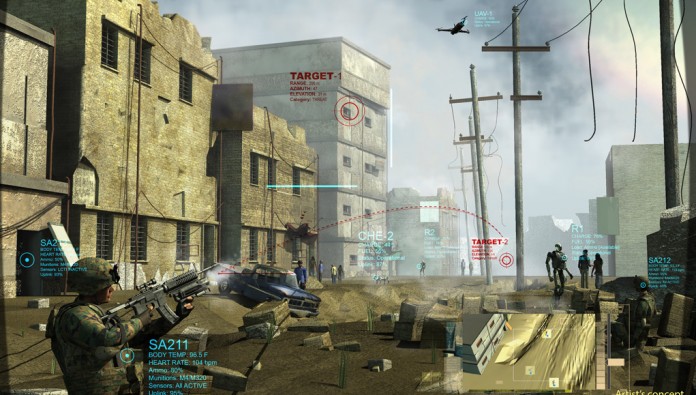
    DARPA’s new Squad X Core Technologies (SXCT) program aims to help dismounted infantry squads continue to achieve and maintain overwhelming tactical superiority over potential adversaries. SXCT seeks to adapt, extend and develop capabilities that would enhance small units’ real-time situational awareness and ability to precisely verify and engage hostile targets at multiple ranges. The goal is to speed the development of new, lightweight, integrated systems that provide infantry squads unprecedented awareness, adaptability and flexibility in complex environments, and enable dismounted Soldiers and Marines to more intuitively understand and control their complex mission environments. DARPA artist concept.
    DARPA’s new Squad X Core Technologies (SXCT) program aims to help dismounted infantry squads continue to achieve and maintain overwhelming tactical superiority over potential adversaries. SXCT seeks to adapt, extend and develop capabilities that would enhance small units’ real-time situational awareness and ability to precisely verify and engage hostile targets at multiple ranges. The goal is to speed the development of new, lightweight, integrated systems that provide infantry squads unprecedented awareness, adaptability and flexibility in complex environments, and enable dismounted Soldiers and Marines to more intuitively understand and control their complex mission environments. DARPA artist concept.

    Among the areas included in the program are:

    • Precision Engagement: Precisely engage threats out to 0.6 mile (1,000 meters), while maintaining compatibility with infantry weapon systems and without imposing weight or operational burdens that would negatively affect mission effectiveness
    • Non-Kinetic Engagement: Disrupt enemy command and control, communications and use of unmanned assets at a squad-relevant operational pace (walking with occasional bursts of speed)
    • Squad Sensing: Detect potential threats out to 0.6 mile (1,000 meters) at a squad-relevant operational pace
    • Squad Autonomy: Increase squad members’ real-time knowledge of their own and teammates’ locations to less than 20 feet (6 meters) in GPS-denied environments through collaboration with embedded unmanned air and ground systems

    Specifically, Squad X plans to focus on providing:

    • Integrated access to and control of mobile sensors, including full-motion streaming video
    • A three-dimensional common operating picture
    • The ability to organically locate and identify friendly forces and threat locations in near real time
    • In previous request the agency also requested proposals for other focus areas including sensing technologies for warfighter health and operational status and non-optical and distributed sensing solutions.

    Studies commissioned by Squad X program are to define the critical issues in Squad X implementation. The agency is also looking at critical infrastructure components such as radios, networking, computing applications, sensing, autonomous systems and size weight and power (SWaP). Integration Studies should also address Squad X architecture and integration approach. The goal is to establish an open, common, commercially extensible, government-owned architecture; defining key interfaces and standards; outlining the technology integration plan.

    DARPA has scheduled a Proposers Day on Friday, February 27, 2015 to discuss the program with potential participants. In addition to the regular performers the agency invited ‘non-traditional performers’, including small businesses, academic and research institutions and first-time government contractors to participate. Special Notice document announcing the Proposers Day and describing the specific capabilities sought is available here.


    Russian group offers communications upgrades for Indian Su-30MKI

    A Su-30MKI of the Indian Air Force. Photo: wikipedia (g4sp)
    A diagram of the NKVS-27 system
    A diagram of the NKVS-27 system

    The Russian group United Instrument Manufacturing Concern (UIMC) is introducing advanced communications gear to enhance data communications on the Indian Sukhoi Su-30MKI fighter jet. Among the systems UIMC plans to introduce at Aero India 2015 next week are the S-112 aviation data communication system, and NKVS-27 multi-channel voice/data communication system and AT-E data exchange terminal, connecting command and control centers with airborne aircraft.

    The NKVS-27 entered production for Russian and foreign customers since 2006, the system was developed by the Polyot Research & Production Company, a subsidiary of UIMC. The system facilitates a land based communications network linking airborne aircraft and command centers on the ground, enabling efficient air defense, intercept and strike missions by airborne forces.

    Sergey Skokov, Deputy CEO of UIMC said he expects India to consider the system for its planned upgrade of the Su-30MKI fighter jets, as well as for the Ka-31 helicopter and the future FGFA and MTA programs – all are joint projects undertaken by the Russian Sukhoi company and Indian HAL.

    UIMC is also offering the AT-E ‘aviation information exchange terminal’ supporting communications, navigation, identification and information management on board combat aircraft. Developed by NPP Polet, another subsidiary of the UIMC, AT-E is considered the Russian equivalent to the western JTIDS/Link 16 (Joint Tactical Information Distribution System) used with NATO air forces.

    IAI Introduces: a business Jet with stings

    Israel Aerospace Industries (IAI) is introducing a new maritime surveillance, and anti-submarine and anti-surface warfare aircraft at Aero India 2015. The platform is based on a specially modified Bombardier G-5000 business jet, configured with the new generation ELI-3360 Maritime Patrol Aircraft (MPA) system. Photo: IAI ELTA

    Israel Aerospace Industries (IAI) is introducing a new maritime surveillance, anti-submarine and anti-surface warfare aircraft at Aero India 2015. The platform is based on a specially modified Bombardier Global 5000 business jet, configured with the new generation ELI-3360 maritime warfare mission system. For the first time, the Global 5000 business jet will be configured for combat missions, carrying a wide range of internal and external stores, including lightweight anti-submarine torpedoes and anti-ship missiles. IAI/Elta has already configured the weaponized ELI-3360 for the Q400 turboprop – another Bombardier platform.

    With the Global 5000 platform Elta claims its system offers the most comprehensive yet affordable solution for maritime dominance, combining sensors and weapon delivery capabilities offered for the first time on a business jet class aircraft.
    According to Avishai Izhakian, deputy General Manager, airborne systems and radars division, IAI ELTA, until now such capabilities have been available only with dedicated, heavy platforms, such as the P-3C and P-8A.

    India is one of the few countries that could afford the fielding of high-end systems such as the P-8. However, the Indian Navy and coast guards are also seeking more affordable, yet high performance solutions for their missions. IAI also considers other countries in Asia as potential customers for the system, given its versatility (high and low speed, low altitude handling, for example) and affordability. IAI will be the prime contractor for the ELI-3360 solution, providing platform modification and the complete sensor suite.

    The modified Global 5000 will be military certified under civilian standards, thus maintaining operational flexibility from both military and civilian airfields

    IAI will modify the Global 5000 for this application, adding the different hardpoints, pylons and pods, clearing the flight envelope, weapon carriage and release and certifying the new configuration for military and civil standards, maintaining its operational flexibility from both military and civilian airfields. According to Izhakian IAI has already modified a similar Bombardier business jet for an undisclosed customer.

    “We are delighted that IAI ELTA continues to put their confidence in the Global 5000 aircraft, relying on the platform to host its integrated mission solutions,” said Stephane Villeneuve, Vice President, Specialized Aircraft, Bombardier. “With its superior operational capabilities, the Global 5000 aircraft is the ideal choice for IAI ELTA’s next generation Maritime Patrol Aircraft.”

    Elta has already designed a similar platform for over-land application, mounting a Synthetic Aperture Radar (SAR), signals intelligence (SIGINT) and electro-optical (EO) payloads on a single platform.

    Providing surface and subsurface surveillance, reconnaissance and weapon delivery capabilities, the system incorporates the latest version of ELTA’s Maritime Patrol Radar (MPR) – ELM-2022ES Maritime Patrol Radar, incorporating active, electronically scanned array (AESA) technology, an electro-optical sensor and the ELL-8385 ESM/ELINT system. The aircraft can also be equipped with a Magnetic Anomaly Detection tail boom, to enable aerial detection of submerged submarines or moored mines. It also carries launchers and holds storage for multiple sonobuoys, enabling effective acoustic monitoring of wide areas, for submarine detection.

    The aircraft will receive an integrated communications suite comprising radios, broadband SATCOM and data-links. The communications suite enables the ELI-3360 system to operate in a network centric architecture, sharing data and missions with remote maritime, manned and unmanned aerial platforms as well as coastal units. The aircraft is also equipped with an advanced Electronic Warfare (EW) and self-protection suite.

    “High endurance, speed, range and multi-mission versatility of such SMAs is unmatched by large commercial transport aircraft or turbo-props”

    Utilizing the spacious cabin, the Global 5000 is fitted with multiple command and control (C2) consoled to support a mission crew of 7-8 people (pilot and copilot, plus 5-6 mission operators). The multi-purpose operator workstations enable operators to monitor all sensors, deploy sonobuoys, control weapons and stores management system.

    Four wing hardpoints introduced along the wings would be used to mount pylons carrying weapons or external pods for Search and Rescue (SAR) missions. Under-wing weapons may include lightweight, air dropped anti-submarine torpedoes and Harpoon class anti-ship missiles, as well as dispensable Search & Rescue (SAR) stores. In addition, two fixed pylons positioned at the outer wing tip would carry part of the ESM antenna array.

    “Since IAI’s pioneering conception of business-jet Special Mission Aircraft (SMA), 30 years ago, the SMA market has moved steadily over the past decade towards cost-effective business jets.” Izhakian said; “High endurance, speed, range and multi-mission versatility of such SMAs is unmatched by large commercial transport aircraft or turbo-props” he added.

    IAI’s line of operational, combat proven business-jet SMA includes the Gulfstream G550 Conformal Airborne Early Warning (CAEW), and the G-V Signal Intelligence Aircraft (SEMA) – the world’s first business-jet based mission aircraft.

    100 Israeli armored vehicles supplied to three African countries

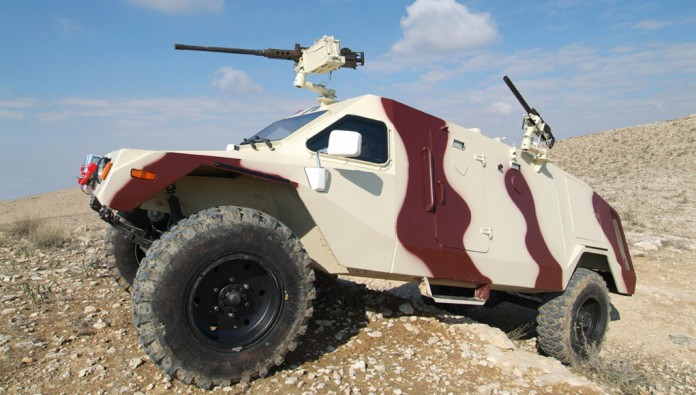
    IAI Ramta RAM 3 light armored vehicle (Photo: IAI)
    Two Senegalese army platoons equipped with their new RAM MK3 armored vehicles have recently completed training with the French Army, preparing to support UN missions in the Ivory Coast.
    Two Senegalese army platoons equipped with their new RAM MK3 armored vehicles have recently completed training with the French Army, preparing to support UN missions in the Ivory Coast.

    IAI announced today that the company has signed three contracts for the supply of 100 RAM armored vehicles from three military customers in Africa. One of these contracts is a follow-on to a previous order in which a military customer ordered 50 vehicles. IAI’s Ramta, the developer and manufacturer of the vehicle expects to complete the delivery of all vehicles within this year (2015). The RAMs will be used mainly for peacekeeping operations in Africa.

    The RAM has an armored capsule built entirely of steel armor, providing high level of protection against ballistic, mine blast and IED threats. Applique armor kits are also provided, to meet higher levels of threat. The vehicle is configured to carry various payloads and weapon mounts. Powered by a powerful, air-cooled Deutz diesel engine, the 4×4 RAM can operate offroad and on rough terrain.

    Senegalese troops training with Ramta RAM Mk. 3 armored vehicles.
    Senegalese troops training with Ramta RAM Mk. 3 armored vehicles.

    To date Ramta has delivered more than 450 RAMs configured as troop carriers, command vehicles, Casualty Evacuation, and Intelligence, Surveillance and Reconnaissance missions for military and law enforcement customers worldwide. Some vehicles were also configured for protected VIP transportation.

    Foreign sources have indicated one of the customers recently to receive the Israeli RAM MK 3 was Senegal. Senegalese forces equipped with the new armored vehicles trained with French forces last month, before their deployment with the rapid reaction force for the UN Operation in Côte d’Ivoire (UNOCI). Since 2011 the French detachment in Senegal has assisted militaries in West Africa, especially with regard to peacekeeping and the launch of Operational Serval in January 2013.

    Other African users of the RAM include Botswana, Cameroon, Chad, the Democratic Republic of the Congo, Gabon, Lesotho, and Morocco.

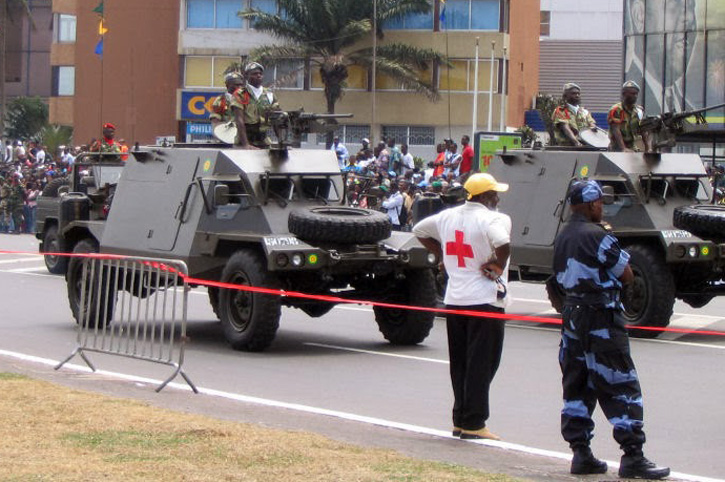
    Another African country operating the RAM is Gabon, its RAMs are seen here on a military display in Gabon's capital city Liberville.
    Another African country operating the RAM is Gabon, its RAMs are seen here on a military display in Gabon’s capital city Liberville.

    The Eyes of the Future RN Carrier Strike Force

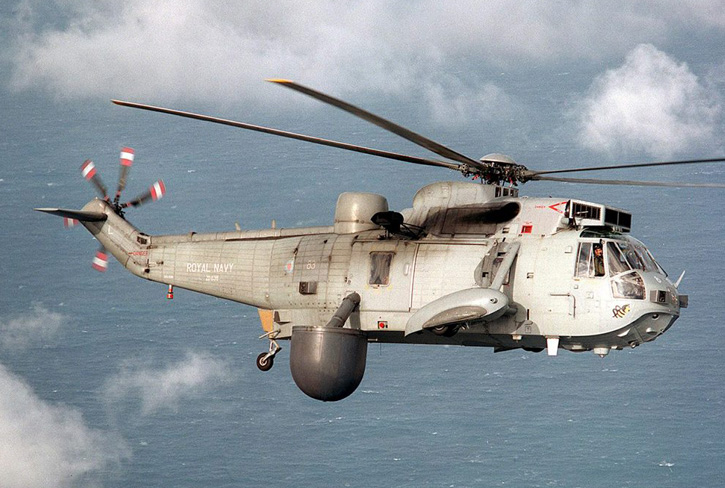
    849 AEW Sea King from 849 squadron in flight over southwest of Cornwall. Photo: Crown Copyright by Bernie Pettersen
    849 AEW Sea King from 849 squadron in flight over southwest of Cornwall. Photo: Crown Copyright by Bernie Pettersen

    The British MOD is set to select soon the future Airborne Early Warning (AEW) system to be deployed on the future Royal Navy (RN) Queen Elizabeth II aircraft carriers. The Crowsnest airborne surveillance and control (ASaC) program set to become operational in 2019, will providing the Queen Elizabeth Class aircraft carriers an organic air surveillance and battlespace management for the carrier strike force from 2020.

    Thales UK and Lockheed Martin submitted final offers for the Crowsnest solutions last month, competing for the £500 million ($761 million) contract. Although the two radar systems proposed by the companies are designed for the Royal Navy AgustaWestland EH101 Merlin Mk 2 ASaC helicopters, they are profoundly different in their mission approach, future capabilities and cost. As part of the U.K. defense ministry’s assessment of the two options, both have been flight tested on a Merlin Mk. 2.

    As the Sea King family helicopters is due to retire in 2016, MOD is extending the service of a number of the Sea King helicopters operated by 849 Naval Air Squadron through 2018, to prevent a capability gap between the withdrawal of the Sea King ASaC.7 and the introduction of Merlin ASaC.2. 10 of the Merlin helicopters are to be modified to accept the Airborne Surveillance and Control (ASaC) system, configured as ‘roll on/roll off’ kit.

    Leading a £750 million ($1.15 billion) upgrade to 30 of the Royal Navy’s legacy Merlin HM1 helicopters, Lockheed Martin UK has been awarded a £24 million contract to run a competition to design, develop and demonstrate Crowsnest. As the company is also one of the competitors for the tender, the Merlin team has to be ‘firewalled’ to prevent leaking commercially sensitive information to Lockheed Martin UK.

    The solution proposed by Thales UK recapitalizes existing the Searchwater 2000 radars currently providing the AEW mission for the Royal Navy on board HMS Ocean. These helicopters carry the mechanically rotating radar in a retractable drum-shaped dome lowered into position below the helicopter after takeoff. Positioned below the fuselage, the rotating radar gains unobstructed view of the hemisphere below, thus covering effectively 360 degrees. Thales plans to utilize this system for the new platform, using a modernized and updated radar along with its associated Cerberus mission system – both are currently used on the Sea King ASaC7.

    Netherlands to field four MQ-9 Reaper drones by 2017

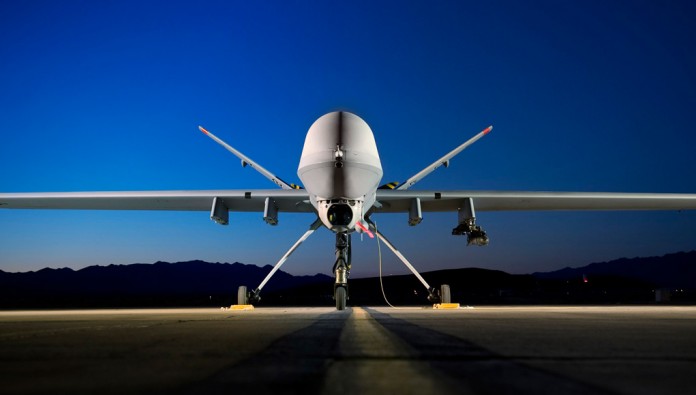
    The US is moving forward with the sale of four General Atomics MQ-9 Reaper Medium Altitude Long Endurance (MALE) Unmanned Aircraft Systems (UAS) to the Netherlands. The Royal Netherlands Air Force (RNLAF) will begin receiving the new drones in 2016 and expects to have the first unit operational in 2017. The Reapers will be bought ‘off the shelf’ at a cost about €300 ($339 million) – up €50 million from previous estimated cost published by the Dutch ministry of Defense. The Dutch defense ministry selected the MQ-9 Reaper unmanned aircraft in 2013, becoming the fourth international air force to choose the US made drone.

    french_reaper_harfang-niger1021
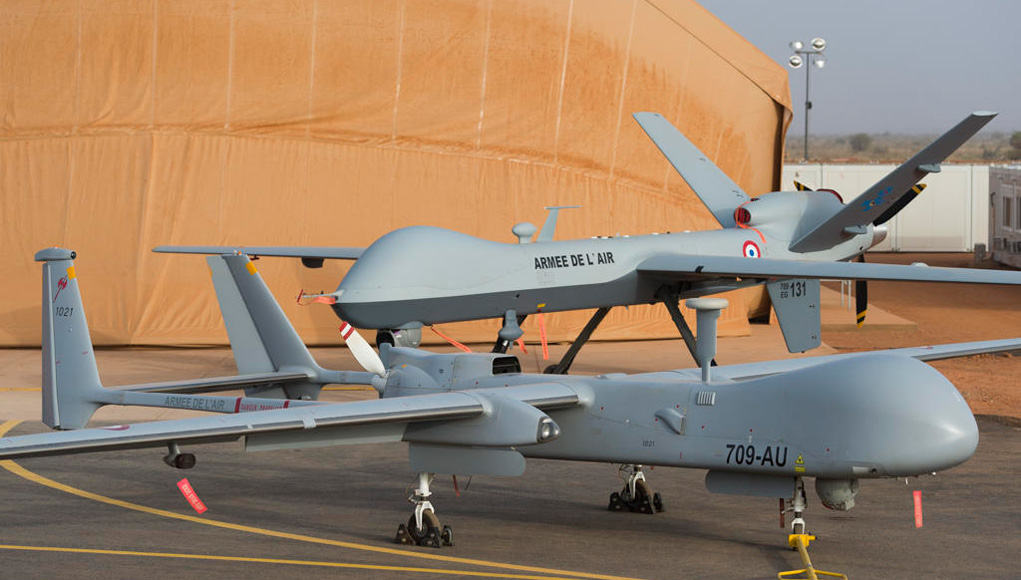
    The French Air Force operates the Harfang (Heron I) and Reaper drones in reconnaissance missions over Mali. Photo: French Air Force

    The Reapers will “enhance the intelligence, surveillance, and reconnaissance (ISR) capability of the Dutch military in support of national, NATO, UN-mandated, and other coalition operations.” US sources at the Defense Security Cooperation Agency (DSCA) said, “Commonality of ISR capabilities will greatly increase interoperability between U.S and Dutch military and peacekeeping forces.”

    Although the MQ-9 can be armed with weapons the RNLAF is not planning to deploy its drones in armed reconnaissance missions in the near future. The UK and US are the only Reaper operators weaponizing their drones for armed-ISR operations.

    The four air vehicles the Dutch will receive will be of the MQ-9 Block 5 variant, powered by a single Honeywell TPE-331-10T turboprop engine. Each drone will also carry the Honeywell H-764 Adaptive Configurable Embedded Global Positioning System/Inertial Guidance Unit (GPS/EGI) with Selective Availability Anti-Spoofing Module (SAASM), protecting the drone’s navigation system from GPS jamming.

    These Reapers will also get a comprehensive communications package integrating KU band satellite communications (SATCOM) terminal, ARC-210 RT-1939 radios and KY-1006 Common Crypto Modules providing secure communications and datalink between the drone, ground control and users. In addition, each Reaper system will be equipped with KIV-77 Mod 4/5 Identification Friend or Foe (IFF) and AN/APX-119 Mod 4/5 IFF transponder, ensuring the drones are well integrated with friendly, coalition air operations.

    F-15Es will soon be able to send microsatellites into orbit

    ALASA_Concept_725DARPA is seeking to develop new ways to launch and deploy small satellites in orbit. One of the concepts being explored by the agency is the Air Launched Assist Space Access (ALASA), seeking to reduce cost, time and weather constraints for launching small satellites from an aircraft.

    Key elements in the program are the development and testing of new propulsion systems. ALASA demonstration system draws on emerging technologies to provide increased specific impulse propellants, stable propellant formulations, hybrid propellant systems, potential “infrastructure free” cryogen production, new motor case materials, new flight controls and mission planning techniques, new nozzle designs, improved thrust vectoring methods and new throttling approaches. “We’re moving ahead with rigorous testing of new technologies that we hope one day could enable revolutionary satellite launch systems that provide more affordable, routine and reliable access to space.” said Bradford Tousley, director of DARPA’s Tactical Technology Office.

    Pending successful testing of the new monopropellant, the program plan includes 12 orbital launches to test the integrated ALASA prototype system. Currently, DARPA plans to conduct the first ALASA flight demonstration test in late 2015 and the first orbital launch test in the first half of 2016. Depending on test results, the program would conduct up to 11 further demonstration launches through summer 2016.

    Satellites today are launched via booster rocket from a limited number of ground facilities, which can involve a month or longer of preparation for a small payload and significant cost for each mission. Launch costs are driven in part today by fixed site infrastructure, integration, checkout and flight rules. Fixed launch sites can be rendered idle by something as innocuous as rain, and they also limit the direction and timing of orbits satellites can achieve.

    The goal of ALASA is to develop a significantly less expensive approach for routinely launching small satellites, with a goal of at least threefold reduction in costs compared to current military and US commercial launch costs. Currently, small satellite payloads cost more than $30,000 per pound to launch, and must share a launcher with other satellites. ALASA seeks to launch satellites on the order of 100 pounds (45 kg) for less than one million dollar total, including range support costs, to Low Earth Orbits (LEO) that are selected specifically for each 100 pound payload.

    “A revolutionary satellite launch systems that provide more affordable, routine and reliable access to space”

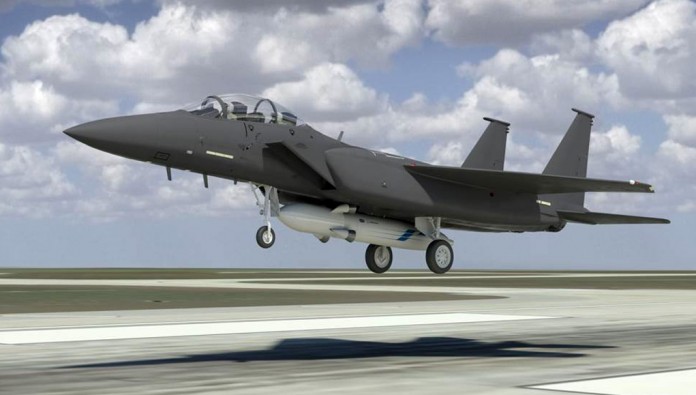
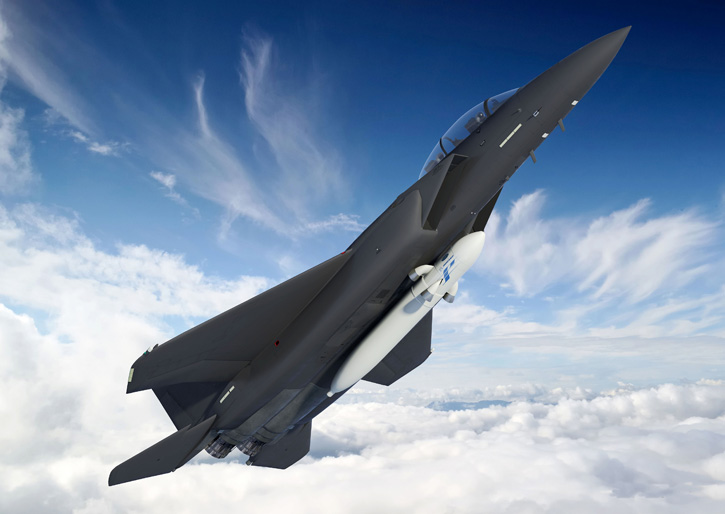
    ALASA aims to develop and employ radical advances in launch systems, to include the development of a complete launch vehicle requiring no recurring maintenance or support, and no specific integration to prepare for launch. The 24-foot (7.3-meter) ALASA vehicle is designed to attach under an F-15E aircraft. Once the airplane reaches approximately 40,000 feet, it would release the ALASA vehicle. The vehicle would then fire its four main engines and launch into low-Earth orbit to deploy one or more microsatellites weighing up to a total of 100 pounds (45 kilograms).

    The program conducted initial trade studies and a market/business case analysis in FY 2011. In November 2011, the two-year Design Risk Reduction phase began with performers developing both system designs and enabling and enhancing technologies. A second phase began in March 2014 with a contract award to Boeing. The base value of the contract was $30 million; with options, it could reach $100 million. The 11 month contract covers the develop and build up to a dozen launchers to be used for flight testing of the new concept. Boeing and DARPA intend to test the system in 2015, demonstrating an airborne launch of micro satellites into orbit.

    Harris Corporation acquires Exelis for $4.7 Bn.

    The U.S. Communications company Harris Corporation (NYSE:HRS) and defense electronics company Exelis, Inc. (NYSE:XLS) today announced a definitive agreement under which Harris will acquire Exelis  in a cash and stock transaction valued at $23.75 per share, or an approximately $4.75 billion enterprise value.

    Based on the performance of Harris and Exelis in 2014 the combined company would have had more than $8 billion in revenue and about 23,000 employees globally, including 9,000 engineers and scientists.

    The agreement has been unanimously approved by the Boards of Directors of both companies. The transaction is expected to close in June 2015 and is subject to customary closing conditions, including regulatory and Exelis shareholder approval.

    “Acquiring Exelis is transformational for Harris,” said William M. Brown, chairman, president and chief executive officer of Harris. “The combination of the two companies’ highly complementary core franchises creates a competitively stronger company with significantly greater scale. We are expanding in a market, where we have decades of success and a workforce dedicated to providing our customers with innovative and cost-effective solutions for some of their most complex challenges.”

    “This agreement to become part of Harris Corporation represents an exciting new chapter for Exelis,” said David F. Melcher, chief executive officer and president of Exelis. “Combining the companies not only creates shareholder value, but the commitment to excellence and innovation that both companies share will significantly benefit customers and provide new opportunities for employees.”

    Enhanced Tomahawk cruise missile engages moving targets

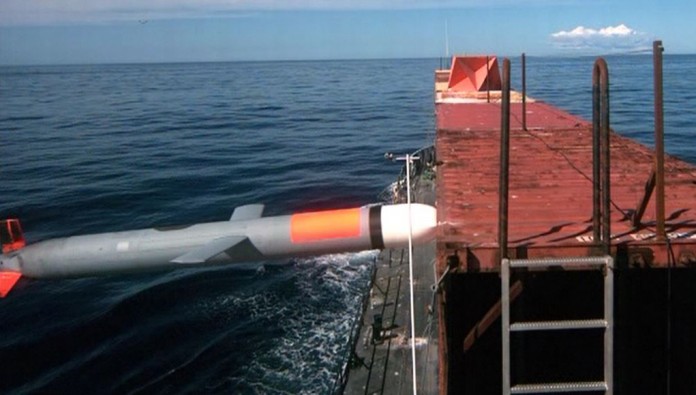
    A synthetically guided Tomahawk cruise missile successfully hits a moving maritime target Jan. 27 after being launched from the USS Kidd (DDG-100) near San Nicolas Island in California. The missile altered its course toward the target after receiving position updates from surveillance aircraft. Photo: US Navy

    The US Navy has tested a ‘synthetically guided’ Tomahawk Block IV cruise missile last month, demonstrating the capability of existing Tomahawk missiles as netted weapons. The latest variant of the Tomahawk includes a two-way satellite data-link that enables the missile to be retargeted in flight to any one of 15 alternate targets pre-programmed in its memory before launch. “This capability extends the Tomahawk’s reach beyond fixed and re-locatable points, to moving targets.” Tomahawk Weapons System (PMA-280) program manager Capt. Joe Mauser explained.

    Raytheon, the missile’s developer is also developing a new seeker designed to hit moving targets at sea or on land, in darkness and under all weather conditions. Other enhancements planned for the Tomahawk Block IV weapon include the integration of upgraded communications and a more powerful multi-effects warhead. Other enhancements implemented in the Block IV include a ‘sea-skim’ mode – low-altitude flight over water at high subsonic speeds. The Block IV missile is capable of loitering over a target area in order to respond to emerging targets or, with its on-board camera, provide battle damage information to warfighting commanders. “We are modernizing Tomahawk to stay ahead of the threat,” said Jeff Meyer, a Tomahawk business development manager at Raytheon. “The tests are designed to prove Tomahawk can hit a moving target and targets at sea, and that the missile isn’t affected by smoke or other obscurants such as bad weather.”

    The Naval Air Warfare Center Weapons Division (NAWCWD) team leveraged existing Tomahawk strike communications frameworks to develop this cost-saving solution. “This is a significant accomplishment,” Capt. Mauser continued. “It demonstrates the viability of long-range communications for position updates of moving targets. The synthetically guided Tomahawk successfully hit its first moving maritime target Jan. 27 after being launched from the USS Kidd (DDG-100) near San Nicolas Island in California. The flight test demonstrated guidance capability when the missile in flight altered its course toward the moving target after receiving position updates from surveillance aircraft.

    The Tomahawk weapons system is the U.S. Navy’s precision strike standoff weapon for long and medium range attack of tactical targets. The Navy is currently fielding Tomahawk Block IV weapons on surface and subsurface platforms across the globe. In 2013, Raytheon delivered the 3,000th Tomahawk Block IV missile to the U.S. Navy.

    Raytheon has produced thousands of GPS guided BGM-109 Tomahawk missiles. Over 2,000 were used in combat. The Block IV design was initiated as both a cost savings and a capability improvement effort. The new enhancements are considered as part of ‘mid life modernization’ package Raytheon is hoping to launch in 2018-2019, enabling the Navy to maintain its cruise missiles ahead of the threat well into the 2020s.

    Top 10 Defense Websites – January 2015

    DMD_header_wlogos725

    Digital Marketing for Defense (DMD) is publishing today the list ten most visited defense industry websites in January 2015. The list was compiled based on analysis of data provided by SimilarWeb, a leading website traffic analysis company. In January we noticed a growth trend in the performance of most of the Top-10 websites, except #1 on the list – Lockheed Martin that remained flat, compared to December, and Rostec, that dropped two points, from #6 to #8 compared to its peak position in November and December. HAL continued its growth and is now rated #9 on our list. More information will be provided for subscribers later this week.

    Top 10 Defense Websites (January 2015)

    1. top10dmd90x220Lockheed Martin
    2. Boeing
    3. BAE Systems
    4. Thales
    5. Northrop Grumman
    6. Raytheon
    7. FLIR Systems
    8. Rostec
    9. HAL India
    10. L-3 Communications

    For last month’s Top 10 click here.

    The ‘Digital Marketing for defense’ (DMD) forum discusses the means and best practices used by marketers in the defense sector. With your cooperation we are planning to establish benchmarks for successful campaign implementation, highlight the best in class websites, online campaigns, and provide our members with insight about the means and resources necessary to gain competitive and successful online campaigns.

    For the survey of defense websites DMD teamed with SimilarWeb, one of the most powerful website traffic estimator tools and web measurement services, providing an unprecedented insight into website structure, performance and audience. As part of this cooperation, DMD is publishing a list of the top 25 defense websites. The list will be updated on a monthly basis, reflecting the trends, interest and destinations of the defense audience online.

    Subscribe ($7.95/month) to get the full list (Top 25) and more data

    Submit your site

    dmd_award_invitation725

    DMD is also launching an annual survey of the defense website, ranking best of class among defense industries, government, associations and community. You are invited to suggest your favorite defense-related website for nomination to this survey.

    Continue to the presentation

    Tutorial: Digital Marketing for Defense #1: Campaign Planning Essentials

    Navy scientists experiment with Firefighting robots

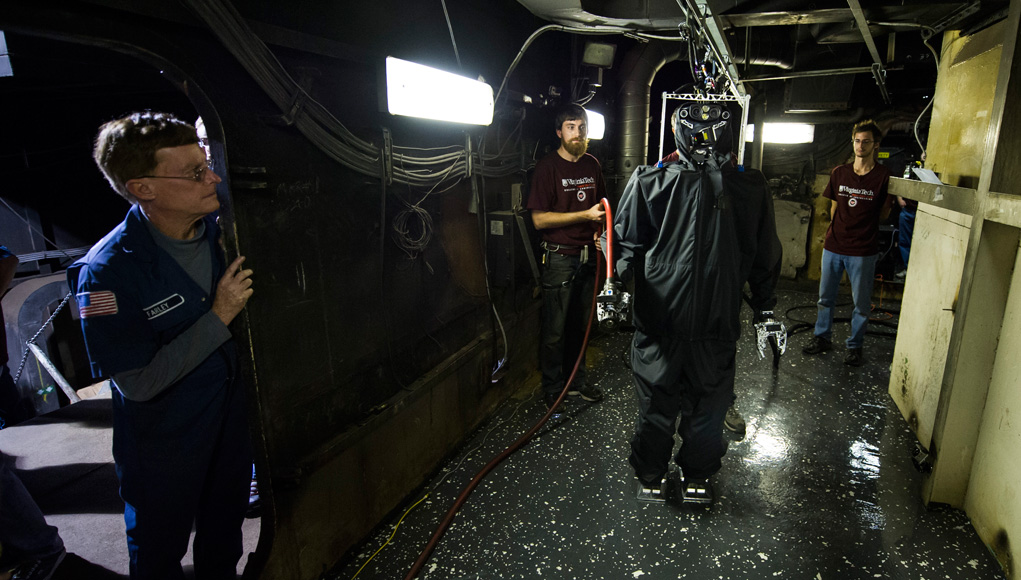
    "Balancing on any type of terrain that's unstable - especially for bipedal robots - is very difficult," said Brian Lattimer, associate professor for mechanical engineering at Virginia Tech. "Whole-body momentum control allows for the robot to optimize the locations of all of its joints so that it maintains its center of mass on uncertain and unstable surfaces." Photo: US Navy
    “Balancing on any type of terrain that’s unstable – especially for bipedal robots – is very difficult,” said Brian Lattimer, associate professor for mechanical engineering at Virginia Tech. “Whole-body momentum control allows for the robot to optimize the locations of all of its joints so that it maintains its center of mass on uncertain and unstable surfaces.” Photo: US Navy

    The US Navy is experimenting with a bipedal humanoid robot that can assume basic fire fighting tasks on board ships. Navy Scientists unveiled a firefighting robot prototype Feb. 4 at the Naval Future Force Science & Technology EXPO, revealing details about its successful demonstrations last fall.

    The Shipboard Autonomous Firefighting Robot (SAFFiR), sponsored by the Office of Naval Research (ONR), walked across uneven floors, used thermal imaging to identify overheated equipment, and used a hose to extinguish a small fire in a series of experiments Nov. 3-5, 2014 aboard the USS Shadwell, a decommissioned Navy vessel.

    Developed by researchers at Virginia Tech, the two-legged, or bipedal, humanoid robot is helping ONR evaluate the applications of unmanned systems in damage control and inspections aboard naval vessels, supporting the autonomy and unmanned systems focus area in the Navy’s Science and Technology Strategy.

    “It’s what we call the hybrid force: humans and robots working together”

    SAFFiR stands 5 feet 10 inches and weighs 143 pounds. The unique mechanism design on the robot equips it with super-human range of motion to maneuver in complex spaces.

    Sensors, including infrared stereo vision and a rotating laser for light detection and ranging (LIDAR), enable the humanoid to see through dense smoke. It is programmed to take measured steps and handle hoses on his own, but for now, takes his instruction from researchers at computer console.

    "We set out to build and demonstrate a humanoid capable of mobility aboard a ship, manipulating doors and fire hoses, and equipped with sensors to see and navigate through smoke," said Dr. Thomas McKenna, ONR program manager for human-robot interaction and cognitive neuroscience. "The long-term goal is to keep Sailors from the danger of direct exposure to fire." Photo: US Navy
    “We set out to build and demonstrate a humanoid capable of mobility aboard a ship, manipulating doors and fire hoses, and equipped with sensors to see and navigate through smoke,” said Dr. Thomas McKenna, ONR program manager for human-robot interaction and cognitive neuroscience. “The long-term goal is to keep Sailors from the danger of direct exposure to fire.” SAFFiR is seen here dressed in a firefighting coverall and pulling a hose during the exercise on board the USS Shadwell. Photo: US Navy

    “The robot has the ability to do autonomous tasks, but we have a human in the loop to allow an operator to intervene in any type of task that the robot’s doing,” Lattimer said.

    ONR plans to sponsor a more advanced design as part of the long-term investigational research program. Blueprints include equipping the robot with enhanced intelligence, communications capabilities, speed, computing power and battery life for extended applications.

    “The long-term goal is to keep Sailors from the danger of direct exposure to fire”

    “We have taken a look at other kinds of sensors that you can put on these robots,” said Dr. Thomas McKenna, ONR program manager for human-robot interaction and cognitive neuroscience. “For instance, a bipedal robot could be configured to take shipboard measurements, scan for corrosion and leaks, and identify changes to the shape of the room from its original configuration. By taking on these time-consuming tasks, SAFFiR could free up Sailors for jobs that more fully take advantage of their training and technical skillsets.”

    Even with added intelligence, however, SAFFiR will take its instruction from Sailors and “fire bosses” working remotely in the event of a fire or other dangerous event. “We’re working toward human-robot teams” McKenna said. “It’s what we call the hybrid force: humans and robots working together.”

    Previous research at the Naval Research Lab (NRL) focused on other enabling technologies necessary for man-robot damage control teams operating onboard ships. In 2012 NRL released a video showing some of these experiments, where another robot called ‘Octavia’ worked with a human team member to extinguish a fire in a compartment. Through a combination of speech and visual recognition, the robot is able to identify trusted individuals, in this case, the human fire-fighting teammate. The human is able to provide situational information to the robot by voice and gestural commands. Here, the human partner is telling Octavia the general location of the fire before she enters the compartment. Octavia was used as a testing platform developing software for cognitive robotics and human-robot interactions. According to NRL, the knowledge gained from this research will be applied to firefighting robots used on ships.

    The robot Used two infrared cameras, to localize the fire, allowing her to target it with the compressed air/water backpack. As can be witnessed from the video, the voice and interaction are highly synthesized. Ongoing work is focused on improving the naturalness of the interactions so that the human partners can interact with the robot as if it were another human teammate.

    Additional work is focused on recognizing and characterizing the type and behavior of the fire so that proper extinguishing techniques can be used.

    Defense Advanced Research Programs Agency (DARPA) is also at work with robots assisting in damage control handling emergency situations in high risk environment under the Robotic Challenge. 11 teams will attempt to complete the challenge set by DARPA’s DRC, using robots similar to SAFFiR. These teams will compete for a $3.5 million in prizes.

    US Army invites proposals for Hellfire successor

    The new missile consists of a newly developed Guidance Section (GS) mated to the existing HELLFIRE Romeo backend (motor, warhead and associated electronics). Lockheed Martin has stated the hardware it has qualified through the continued technology development (CTD) phase is built on the active production lines it has used for the production of 65,000 Hellfire and Longbow missiles. Photo: Lockheed Martin
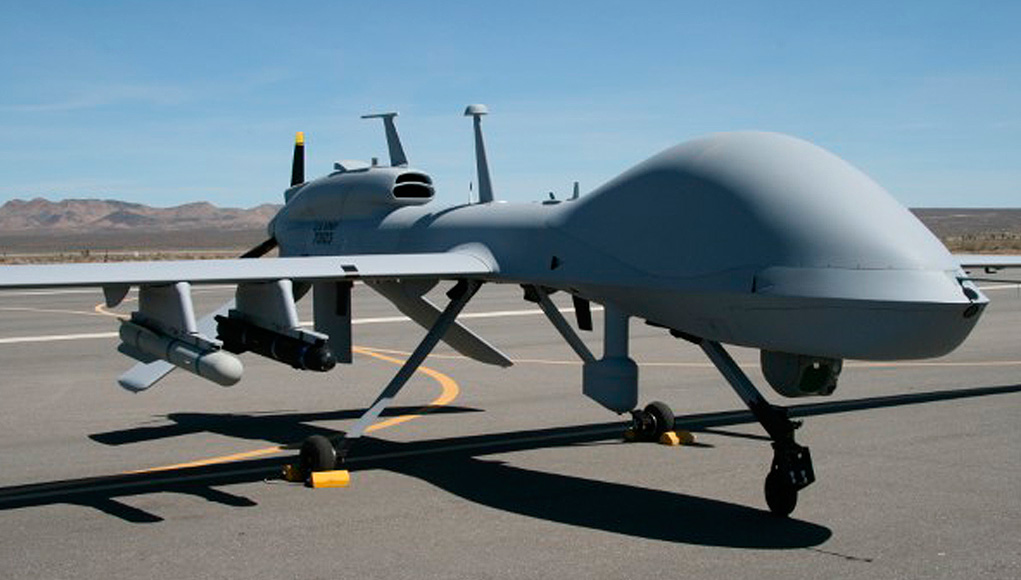
    The modular seeker design is independent of the missile bus. When paired with the HELLFIRE II missile bus, JAGM is fully compatible with all HELLFIRE platforms including this MQ-1C Gray Eagle drone used by the US Army. (Photo: Lockheed Martin)
    The modular seeker design is independent of the
    missile bus. When paired with the HELLFIRE II missile bus, JAGM is fully compatible
    with all HELLFIRE platforms including this MQ-1C Gray Eagle drone used by the US Army. (Photo: Lockheed Martin)

    The US Army has released a Request for Proposals for the Engineering (EMD) and development of the Joint Air-to-Ground Missile (JAGM) – new air/ground missile designed to replace the current air-launched BGM-71 TOW, AGM-114 Hellfire and AGM-65 Maverick missiles. The US Army will offer the winner options for Low Rate Initial Production (LRIP), toward fulfilling the Army and Navy plan to buy thousands JAGM missiles. The Army that has published the RFP in January 2015 plans to award the contract in August this year.

    The main advantage of the new missile over the Hellfire will be its dual-mode seeker, adding millimeter-wave (MMW) radar guidance to the Hellfire’s semi-active laser (SAL) guidance. The user can select the missile’s effect from the cockpit, setting the missile’s tandem, shaped charge warhead to deliver armor piercing or blast fragmentation effect. This capability adds fire-and-forget engagement modes to the weapon, significantly increasing the JAGM user survivability against threat defenses in GPS denied and austere communications environments.

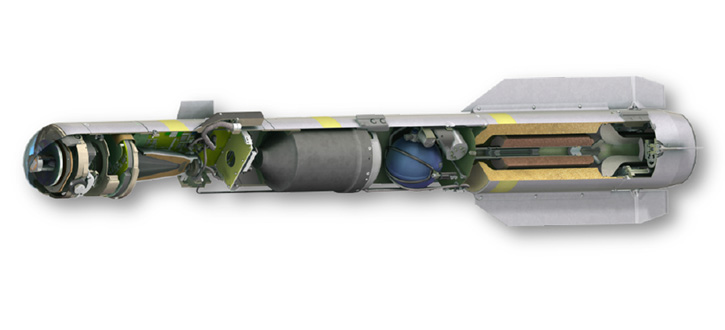
    jagm-cutaway725
    JAGM Cutaway. (Photo: Lockheed Martin)

    The new missile consists of a newly developed Guidance Section (GS) mated to the existing HELLFIRE Romeo backend (motor, warhead and associated electronics). Compatible with the current Hellfire AGM-114R, JAGM will be used with AH-64D/E Apache and AH-1Z Cobra attack helicopters and MQ-1C Gray Eagle and MQ-9 Reaper unmanned aerial systems.

    JAGM’s target sets include moving and stationary armor, air defense units, patrol craft, artillery, transporter erector/launchers, radar sites and C2 nodes in addition to bunkers and other structures in urban and complex terrain.

    JAGM can engage multiple stationary and moving targets, in the presence of adverse weather, battlefield obscurants and advanced countermeasures. Laser and radar guided engagement modes allow JAGM users to strike accurately across wide target sets and reduce collateral damage.

    JAGM can engage multiple stationary and moving targets, in the presence of adverse weather, battlefield obscurants and advanced countermeasures

    The combination of two sensors enable the weapon to engage stationary or moving targets, designated by laser; the radar seeker can acquire a target designated by the laser and pursue the engagement even when the target is obscured by smoke or clouds.

    As part of the risk reduction studies JAGM guidance section was mated with the AGM-114R missile bus, demonstrated during multiple guided flight tests. In February and July 2014 Lockheed performs two flight tests of their JAGM dual-mode guidance section. The target was initially acquired with its semi-active laser, then engaged its millimeter wave radar, hitting a moving target at 6.2 km (3.9 mi). The dual seeker has evolved at Lockheed Martin since 2012 through the Continued Technology Development (CTD) that was funded by the Army in recent years. According to the company, CTD qualified hardware is built on active production lines by the same team that has produced over 65,000 HELLFIRE and LONGBOW missiles with reliability rate exceeding 97%.

    sdb_ii_34
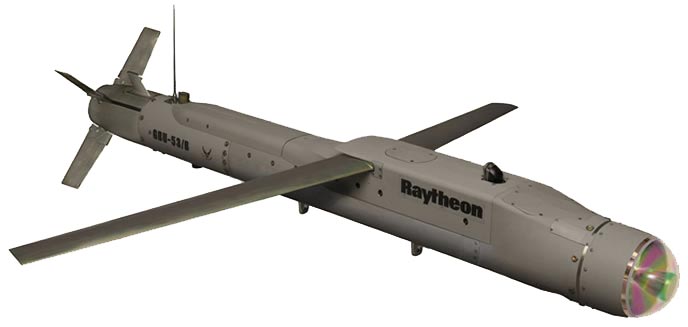
    Raytheon’s SDB II (AGM-54) Photo: Raytheon

    While Lockheed Martin seems well aimed to grab the tender, Raytheon, has developed a tri-mode seeker for the weapon integrating SAL, MMW and imaging infrared (IIR) seekers into a single seeker. Raytheon is still assessing whether to bid on the EMD contract. Back in 2012 Raytheon won an Army $28 million award for the development of the modification of the seeker for use on JAGM. However, seven months later, the Army suspended the program, realizing that the seeker that proved useful for the SDB II was ‘over qualified’ for the Hellfire successor.

    Raytheon argued that, because JAGM’s seeker head has a high level of commonality with the SDB II seeker head, the JAGM program can potentially take advantage of some of the qualification testing already accomplished with SDB II.

    Brimstone missiles loaded on an MQ-9 Reaper drone. Photo: MBDA
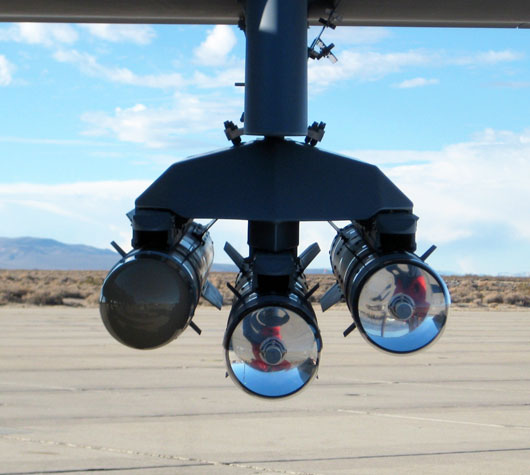
    Dual Mode Brimstone (SAL+MMW) and standard Brimstone (MMW) missiles loaded on an MQ-9 Reaper drone. Photo: MBDA

    The Army dropped its requirement for a tri-mode seeker due to budget cutbacks. The current plan is to separate JAGM into increments, with the first adding a low-frequency millimeter wave radar to Hellfire-R model missiles to augment its laser seeker, making it dual-mode. A more expensive tri-mode seeker adding an imaging infrared sensor is delayed.

    Whether Lockheed Martin or Raytheon win the program to develop a dual or tri-mode seeker for the missile, a third missile manufacturer – MBDA already has a mature, combat proven solution for the same requirement. The ‘Dual Mode Brimstone’ (DMB) missile was developed to address British ‘Urgent Operational requirement’ (UOR) reuested by the British forces that fought in Afghanistan and Libya. The RAF plans to incrementally field the DMB technology with current (Brimstone) and future weapons, to meet the RAF’s Selectable Precision Effects at Range (SPEAR) Capability 2 requirement. The changes will replace the missile’s energetics with a new Insensitive Munition (IM) compliant warhead and rocket motor, along with a new, modular airframe.

    “The JAGM EMD program [is] not releasable to foreign firms”

    Brimstone 2’s new IM subsystems will enhance the missile’s air carriage life and reduce the logistics footprint when used with fast jets. According to MBDA, recent operations have demonstrated DMB’s flexibility to engage any static and fast moving ground target with lethal efficiency,combined with precision, man-in-the-loop target June 2014Press Information Internet : www.mbda-systems.com – Page 2/3 discrimination, extremely localised effects and, provides a transformational capability for an air force, allowing its pilots to select a precision effect for the target even when it is in close proximity to property and non-combatant personnel.

    Brimstone is also based on the Hellfire, is designed for firing from fast jets such as Tornado GR4, Typhoon and Longbow Apache. However, at present international companies are excluded from the JAGM program – “The JAGM EMD program will require a development effort in certain critical technologies/data that are not releasable to foreign firms,” Army said.

    brimstone_target_50mph700
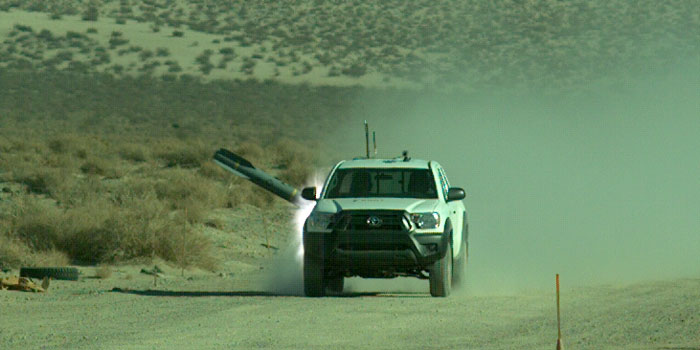
    Dual Mode Brimstone fired from a Reaper drone striking a pickup truck target driving at high speed. Photo: MBDA


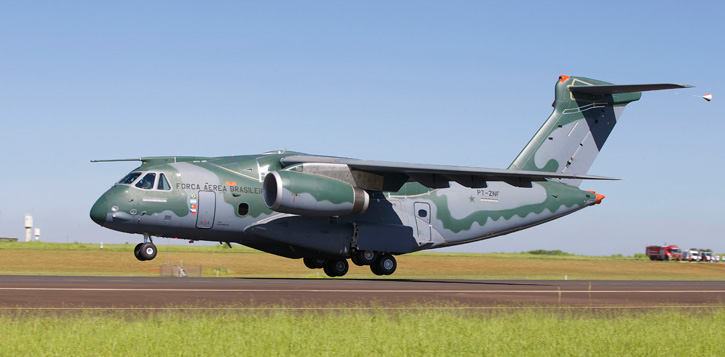
    KC-390 Embarks on its maiden flight

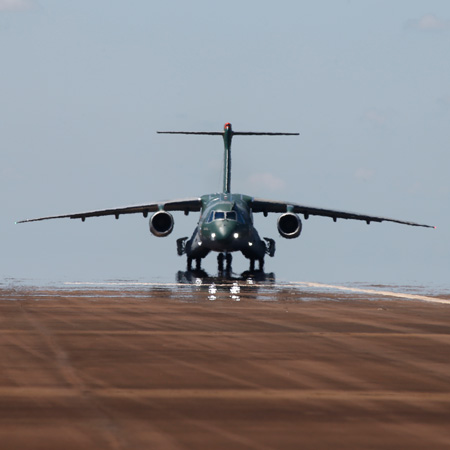
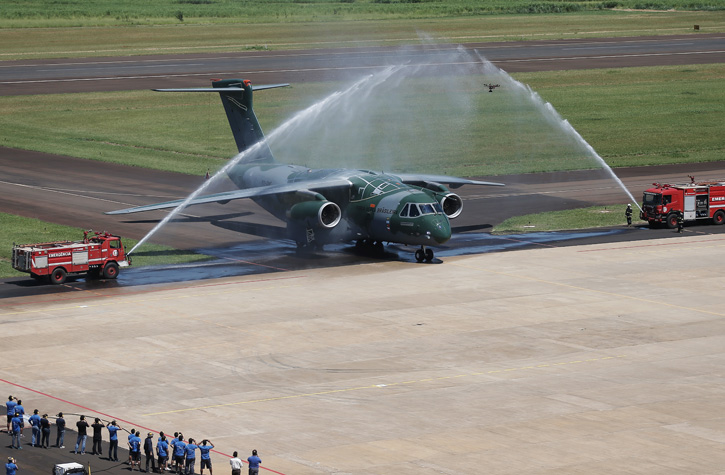
    KC-390 lines up on the runway before takeoff.
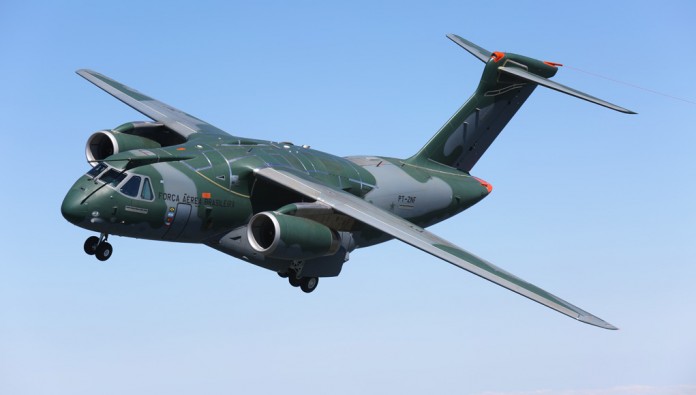
    KC-390 lines up on the runway before takeoff. Photo: Embraer

    Embraer today successfully performed the first flight of the new military transport and aerial refueling jet, the KC-390. Having benefited from an advanced campaign of simulations and extensive ground tests, the KC-390 crew spent 1 hour 25 minutes airborne on the first flight, performing maneuvers to evaluate its flight characteristics and test systems on board. “The KC-390 behaved in a docile and predictable manner,” said Captain Mozart Louzada.”The advanced fly-by-wire flight control system and the latest-generation avionics make flying easy and render a smooth and precise flight.” According to the original schedule (of 2009) the KC-390 was planned to begin flight testing last year and delivered to the Brazilian Air Force in 2015. Due to the delay, the first customer will receive the aircraft in 2016.

    “The program continues to move forward as planned and the KC-390 has drawn interest from several countries around the world”, said Jackson Schneider, President and CEO of Embraer Defense & Security. “We are proud to once again keep our commitments in the development of this aircraft, which will set a new standard in the category of tactical military transport.”

    “The KC-390 will be the backbone of transport aviation for the Brazilian Air Force.”

    The KC-390 is a joint project of the Brazilian Air Force and Embraer to develop and produce a tactical military transport and air-to-air refueling plane that represents a significant advance in terms of technology and innovation for the Brazilian aeronautics industry. This is an aircraft designed to set new standards in its class, at a lower operational cost and with flexibility to perform a wide range of missions: transport and airdropping of cargo and troops, aerial refueling, search and rescue, and forest fire response, among others.

    Touchdown! the KC-390 returns for on its first flight, 3 February 2015, landing after one hour, 25 minutes.
    Touchdown! the KC-390 returns for on its first flight, 3 February 2015, landing at the airport of Gavião Peixoto, Brazil after one hour, 25 minutes. Photo: Embraer

    On May 20, 2014, Embraer and the Brazilian Air Force signed the serial production contract for the delivery of 28 KC-390 aircraft and initial logistic support. Besides the order from the Brazilian Air Force, there are current purchase intentions from other countries, including Colombia (12), Argentina (6), Chile (6), Portugal (6) and the Czech Republic (2) – for a total of 32 additional aircraft. Sweden is also a prospect, following a proposal submitted in 2010 to buy the KC-390 if Brazil would choose the Gripen for its next generation jet fighter. Embraer and Boeing have also entered into a cooperative agreement, to market and support the Brazilian aircraft in the US market and a number of international territories, including the UK and parts of the Middle East.

    “The KC-390 will be the backbone of transport aviation for the Brazilian Air Force. From the Amazon to Antarctica, the fleet of 28 aircraft will play a key role in the diversity of projects of the Brazilian State, from scientific research to the maintenance of sovereignty”, said Aeronautics Commander, Lieutenant-Brigadier General Nivaldo Luiz Rossato.

    “This first flight is a fundamental step toward accomplishing the task with which we were entrusted. The KC-390 is the result of a close cooperation with the Brazilian Air Force and international partners, representing what is most likely the greatest technological challenge that the Company has ever encountered in its history. We are profoundly moved for having achieved this key milestone”, said Frederico Fleury Curado, President and CEO of Embraer. The crew on the first flight included Captain Louzada, co-pilot Marcos Salgado de Oliveira Lima and flight test engineers Raphael Lima and Roberto Becker.

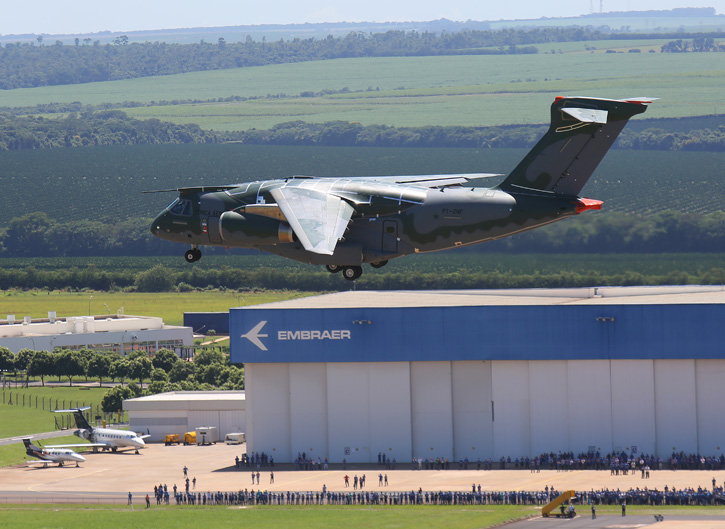
    KC-390_Air-to-air_725
    KC-390 returns for landing on its maiden flight today, it is seen here passing Embraer’s hangar at the Gavião Peixoto airport. Photo: Embraer
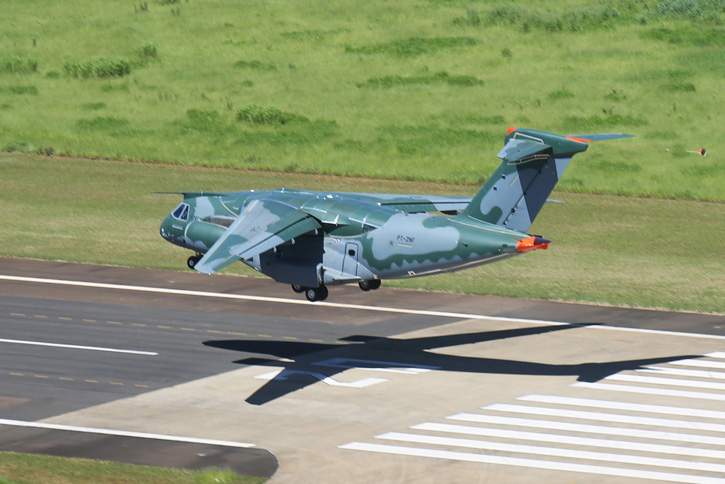
    KC-390_Take_Off_725
    KC-390 takes off on its maiden flight. Photo: Embraer
    KC-390_Baptism_725
    Christening the KC-390 after its maiden flight. Photo: Embraer
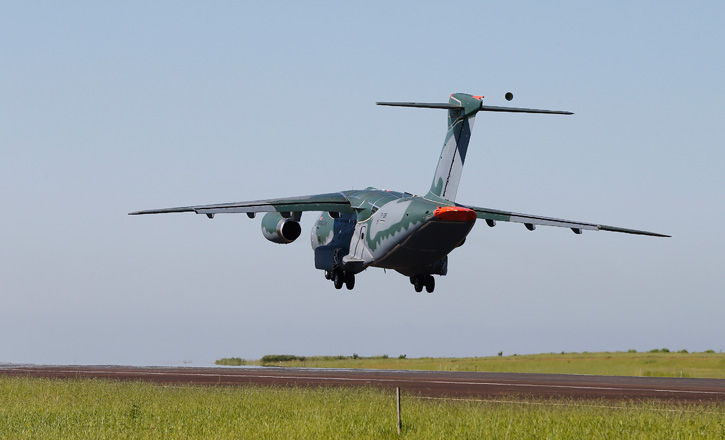
    KC-390_2725
    First touchdown of the KC-390. The aircraft is scheduled for delivery to the Brazilian Air Force next year. Photo: Embraer


    Cyber Intelligence Report – Febuary 1, 2015

    cyber_report

    ISRAEL

    New Israeli Cyber Defense Authority

    A new executive decision will soon be submitted for government approval in Israel. The decision proposes the establishment of a national authority for cyber defense within the Israeli Prime Minister Office. The proposed decision aims to provide up-to-date measures for “cyber defense.” According to the proposed decision, the present measures are incomplete and insufficient. The new authority will absorb most of the powers currently vested with National Authority for Information Security (NISA, Hebrew: RE’EM) that operates under the Israeli Security Agency (ISA, Hebrew: Shabak). The proposal states that the primary rules of the new authority would be to manage control and carry out the overall, nationwide operational efforts to protect cyberspace. Additionally, the new authority would strengthen and reinforce the economy’s resilience through preparatory measures and regularization. However, some information security experts and lawyers object to the establishment of the new authority and have sent a letter to the Attorney General of Israel, in which they claim that the new authority would have too many powers and much less regulatory mechanisms in the matter of privacy policy. The new authority is another step in the regulation of Israeli cyber domain, in view of its strategic importance.


    USA

    Senate panel begins crafting cybersecurity bill

    A key Senate panel took the first step toward crafting legislation to give businesses greater incentives to share information about cyber threats with the federal government.
    The Senate Homeland Security and Governmental Affairs Committee asked corporate leaders and civil liberties experts how best to write a bill that would boost information-sharing while still protecting consumers’ personal data.
    “One of our missions for this Congress is to address the cybersecurity threat,” said the committee’s new chairman, Sen. Ron Johnson, R-Wis.
    Lawmakers appear to be moving quickly to take a bill to the new Congress as President Obama and a coalition of tech and business groups push for action in the wake of the high-profile hack of Sony Pictures in November.

    China puts cybersecurity squeeze on US technology companies

    US business lobbies have responded with alarm after China’s government moved to force American companies selling technology to Chinese banks to hand over their software secrets and adopt encryption algorithms dictated by Beijing.
    The American Chamber of Commerce in China and 17 similar US business groups have called for “urgent discussions” with the Chinese government over the new cybersecurity regulations and urged Beijing to postpone the implementation of the new policies.
    In a letter to China’s top cybersecurity policy group dated 28 January, they said the new rules would require “intrusive” security testing and the disclosure of sensitive intellectual property.


    RUSSIA

    First conference for information security of Russia in the global information society

    On February 5, Moscow will host a plenary congress called “information security of Russia in the global information society,” in which the following will participate: The First deputy Minister of Defense – Chief of the General Staff of the Russian Armed Forces, First Deputy Head of the scientific and technical service of the Russian FSB service, Director of Information Security of Microsoft Russia, and The Director of the Department of Information Technologies and Communications of the Government of the Russian Federation. On the same day, February 5, Positive Technologies Co. will hold a conference on “how it hacked and protected the global network in 2014.” Company experts will introduce the conference participants with the most modern methods of attacks and will present proven methods of protection.


    MIDDLE-EAST

    Abu Dhabi Police issue warning on new cyber bank scam

    Police in Abu Dhabi have issued a warning about an increasing number of cyber email scams aimed at stealing bank savings of their targets.
    Police have urged potential victims not to respond to the emails sent by international gangs operating from abroad, adding that some of these emails contain malware or phishing scams to trick people in order to get information like their bank account numbers and passwords.
    Colonel Dr. Rashid Borshid, head of the Criminal Investigation Department (CID), warned against the increasing number of cyber crimes.


    CHINA and APAC

    Obama discussed cyber security issues with India

    Cybersecurity was among the topics discussed between President Barack Obama and Indian Prime Minister Narendra Modi. Obama was the chief guest at the Indian Republic Day Parade, which was held on Jan 26. US Deputy National Security Advisor Ben Rhodes said during the visit that cybersecurity “was identified as an area where there can be increased cooperation.” As he noted further, “The cyber discussion came up specifically in that context with the need to protect intellectual property.” President Obama later added, “In knowledge-based economies, entrepreneurs and innovators need to feel confident that their hard work and, in particular, their intellectual property will be protected.” Much of India’s cyber security infrastructure is inadequate and has been penetrated on a number of occasions. Given an obvious shared concern for securing cyber infrastructure, expanding the scope of cooperation with the US seems to be a natural course of action for both nations. As detailed in a US-India joint statement, “The President and the Prime Minister also noted the serious risks to national and economic security from malicious cyber activity and agreed to cooperate on enhancing operational sharing of cyber threat information, examining how international law applies in cyberspace, and working together to build agreement on norms of responsible state behavior.”

    SINGAPORE: A dedicated agency for national cyber security

    The Cyber Security Agency (CSA) of Singapore will come under the Prime Minister’s Office and will provide dedicated and centralised oversight of national cyber security functions.
    The agency will take over the functions of the Singapore Infocomm Technology Security Authority (SITSA) and some roles of IDA.
    The CSA will consolidate and build upon the government’s cyber security capabilities. These include strategy and policy development, cyber security operations, industry development, and outreach. CSA will also work closely with the private sector to develop Singapore’s cyber security eco-system.


    EUROPE

    UK fighting alongside US to counter cyber threats against financial institutions

    During his visit to the White House in Washington on Thursday, January 15th, UK Prime Minister David Cameron announced that he would strengthen cyber cooperation with the US. He announced that the MI5 and FBI plan to join forces in a series of exercises to counter cyber-attacks. The two intelligence agencies will share information on emerging threats and trends. Prime Minister David Cameron and President Barak Obama discussed a series of joint cyber war games, which will simulate cyber-attacks against UK financial institutions. This cyber cooperation will involve both countries’ intelligence agencies as well as financial organizations and banks. The goal of this new cooperation is to counter large-scale cyber-attacks that the UK is currently experiencing and strengthen the security of their critical national infrastructures. This new cooperation between the two countries is just another among others already established. Indeed, The UK and US have been working together for a while. The NSA and the GCHQ are the two largest communication intelligence agencies currently cooperating on issues such as counter terrorism, cyber jihad, and cyber threats. Moreover, this new cyber security agreement was announced following the release of a cyber security report made by the UK CERT of the GCHQ. The report focused several issues such as the current cyber-attacks and the threats toward British businesses. Moreover, the report revealed that over 80 per cent of large UK firms suffered from cyber-attacks in 2014. The UK is on constant alert due to the number of cyber-attacks against their infrastructures, which include financial institutions, industrial systems, and defense corporations.

    France held International Forum on Cyber Security

    The International Forum on Cyber Security was held in France on January 20th and 21st in Lille. The forum discussed the recent cyber-attacks, trends, and emerging threats. On this occasion the French Vice Admiral Armand Coustillère, who is leading the French Cyber Command, has recently declared that the recent international cyber-attacks have been considered as an act of cyber-warfare. His US counterpart, John Davis, has meanwhile expressed that “a growing number of countries are entering in the club of security threats targets.” In France, the defense minister, Jean-Yves Le Drian, announced on January 13th the creation of a “Fourth Army” with “cyber soldiers.” To reach this goal, France has released a “cyber defense pact” which includes a budget of one billion euros over five years. Today, French intelligence services count about 250 cyber specialists, and this number is expected to reach 400 by 2017. For the past few years, France started to change its cyber defense strategy. Indeed the hexagon increased its number of cyber security specialists and its budget. Moreover, cyber security degree programs have been developed in several French universities in cooperation with French authorities. France is developing its national cyber policy. Similar to China or Russia, France wants to only use French cyber products developed and made in France for its national security in order to avoid backdoors. This strategic choice is becoming more popular, due to the number of backdoors introduced by manufacturers in order to gather intelligence on several country infrastructures and defense corporations.

    Cyber warfare: Army creates ‘Twitter troops’

    Members of the British Army’s new 77th Brigade have been trained to use guerrilla tactics and will be experts in psychological warfare operations. The Army hopes the brigade will impact the traditional battlefield using non-lethal techniques including social media to reflect the digital age. Using creative thinking, it is hoped that 77th Brigade will influence the minds and shape the behaviour of the enemy and local populations.


    inss150About the Cyber Intelligence Report:

    This document was prepared by The Institute for National Security Studies (INSS) – Israel and The Cyber Security Forum Initiative (CSFI) – USA to create better cyber situational awareness (Cyber SA) of the nature and scope of threats and hazards to national security worldwide in the domains of cyberspace and open source intelligence. It is provided to Federal, State, Local, Tribal, Territorial and private sector officials to aid in the identification and development of appropriate actions, priorities, and follow-on measures. This product may contain U.S. person information that has been deemed necessary for the intended recipient to understand, assess, or act on the information provided. It should be handled in accordance with the recipient’s intelligence oversight and/or information handling procedures. Some content may be copyrighted. These materials, including copyrighted materials, are intended for “fair use” as permitted under Title 17, Section 107 of the United States Code (“The Copyright Law”). Use of copyrighted material for unauthorized purposes requires permission from the copyright owner. Any feedback regarding this report or requests for changes to the distribution list should be directed to the Open Source Enterprise via unclassified e-mail at: [email protected]. CSFI and the INSS would like to thank the Cyber Intelligence Analysts who worked on collecting and summarizing this report.


    Skunk Works and XTEND Simplify Multi-Drone Command

    0
    Lockheed Martin Skunk Works® and XTEND have achieved a major milestone in JADC2 by integrating the XOS operating system with the MDCX™ autonomy platform. This technical breakthrough enables a single operator to simultaneously command multiple drone classes, eliminating the friction of mission handoffs. From "marsupial" drone deployments to operating in GPS-denied environments, explore how this collaboration is abbreviating the data-to-decision timeline and redefining autonomous mission execution.
    From Ukraine to Taiwan: The Global Race to Dominate the New Defense Tech Frontier

    0
    As traditional defense primes face mounting competition from agile “neoprimes” such as Anduril, Palantir and Helsing, the balance of innovation is shifting toward software-defined warfare and scalable, dual-use technologies, while global industry consolidation—marked by Boeing’s integration of Spirit AeroSystems and other strategic mergers—signals an intensified race to secure control over the defense technology value chain. Our Defense-Tech weekly report highlights these trends.

    Europe’s “Drone Wall”

    0
    In early October 2025, a coordinated wave of unmanned aerial system (UAS) incursions—widely attributed to Russia—targeted critical infrastructure across at least ten European nations. The unprecedented campaign exposed the fragility of Europe’s air defenses...

    Weekly Defense Update & Global Security Assessment

    0
    Executive Summary The past week (September 18-25, 2025) represents an inflection point where strategic defense concepts have transitioned from doctrine to tangible reality. An analysis of global events reveals four primary, interconnected trends shaping an...

    U.S. Air and Space Forces Push Next-Gen Programs at the AS&C 2025 Conference and...

    0
    At the 2025 Air, Space & Cyber Conference, U.S. Air Force and Space Force leaders unveiled major updates on next-generation fighters, bombers, unmanned systems, and space initiatives, highlighting both rapid innovation and critical readiness challenges as the services race to outpace global competitors. A short version is available here, with a more detailed version for subscribers.

    TADTE 2025: Reflecting Taiwan’s Strategic Themes

    0
    The Taipei Aerospace & Defense Technology Exhibition (TADTE) 2025 crystallized around four dominant strategic themes that collectively illustrate Taiwan's comprehensive approach to defense modernization amid escalating regional tensions. Based on a detailed report by Pleronix (available upon request). Includes a Podcast discussion on TADTE 2025's highlighting Taiwan's four strategic themes beyond the post's coverage.

    Iron Beam 450 Completes Testing, Soon to Join With Operational Air Defense Units

    0
    Israel’s Iron Beam 450 high-power laser system has completed final testing, marking a major leap in air defense. Developed by Rafael, it offers precise, cost-effective interception of rockets, UAVs, and mortars, and is set for IDF deployment by 2025.