Saturday, December 27, 2025
More
    Home Blog Page 144

    Israeli Weapon Systems on the Flying Gunship?

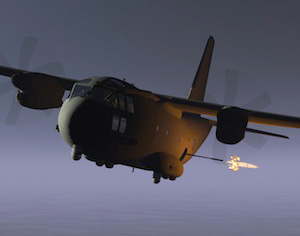
    The Italian-produced MC-27J will soon embark on an in-flight firing tests evaluating the plane's new roll-on/roll-off palletized weapon system. Photo: ATK
    The Italian-produced MC-27J will soon embark on an in-flight firing tests evaluating the plane’s new roll-on/roll-off palletized weapon system. Photo: ATK

    Israeli sources confirmed that Israeli weapon system may be offered to the package of the MC-27J aircraft equipped with a 30 mm gun. The planned gunship variant of the C-27J will undertake the first test firings of its 30mm cannon while slaved to an electro-optical/infrared sensor at the end of this year or early 2014.

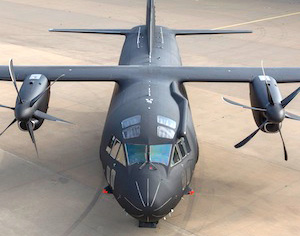
    MC-27J is a new multi mission transport aircraft jointly produced and marketed by Alenia Aermacchi and ATK. It is a roll on/roll off (RO/RO) aircraft based on the C-27J Spartan. The MC-27J is designed to support air forces and Special Forces involved in the tactical transport, intelligence, surveillance and reconnaissance (ISR) missions, and provide and accurate rapid fire support assisting in anti-terrorism operations, the evacuation of military and civilians from crisis zones and the fight against asymmetric threats. The MC-27J is based on airframe of the C-27J, its length is 22.7m, wing span of 28.7m and a height of 9.6m. The maximum take-off weight of the MC-27J is 30,500kg.

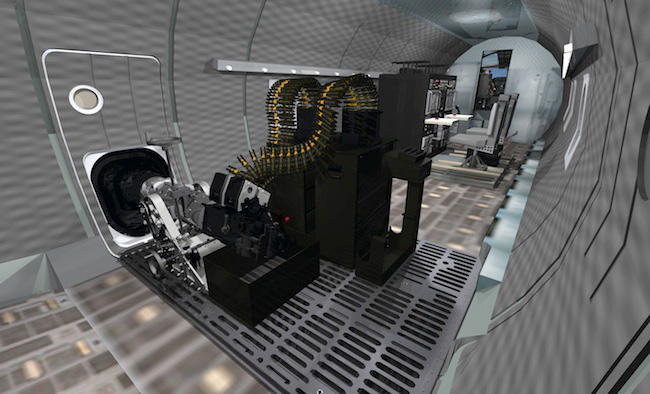
    The palletized weapon system enables quick configuration of the MC-27J for combat missions. Artist impression: ATK
    The palletized weapon system enables quick configuration of the MC-27J for combat missions. Artist impression: ATK

    The MC-27J is modified to accept a pallet-mounted mission system comprising a mission management system, and different weapons systems, expanding the aircraft capabilities with mission-specific strike capabilities. The principal weapon system to be adapted at the baseline is the  ATK GAU-23 Chaingun with two ammunition loaders. The aircraft will also mount two electro-optical gimballed 15″ payloads with day, night and target designation capability, as well as an expanded communications suite.

    The aircraft load will be determined by the mission – the basic cargo transport will devote the entire cargo bay for payload. On basic ISR missions, one mission payload will be used, providing persistent area surveillance and mission oversight. When used as an airborne command and control, the aircraft will carry two mission pallets, providing battlefield communications and video gateways and enhanced intelligence support in addition to the ISR pallet. The basic gunship configuration will use the ISR pallet, mission oversight and coordination and gun pallet while enhanced gunship configuration will also add the PGM payload.

    ATK and Elbit Systems Ltd. had recently received a contract award through the Defense Acquisition Challenge (DAC) Program to provide a low-cost, light-weight, precision guided missile for the U.S. Special Operations Command (USSOCOM) evaluation. This missile incorporates lock-on before and after launch and employs a penetrating warhead with sufficient kinetic energy to defeat hardened targets. The project directly supports a USSOCOM requirement that the companies are ready to meet with their Guided Advanced Tactical Rocket (GATR) and Precision Guided Rocket Launcher (PGRL). The Israeli sources point to a possibility that the cooperation between Elbit systems and ATK may result in adding Israel made weapons systems on the MC-27J.

    Unlike other strike aircraft, the MC-27J will mount the PGRL on its loading ramp, and fire the weapons backwards. This configuration will enable the aircraft to deploy both the gun and PGM on the same mission.

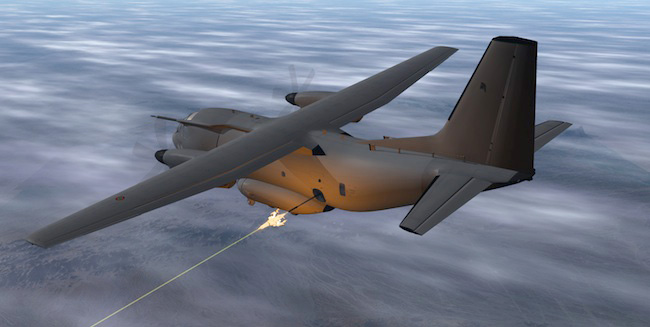
    An artist depiction of the MC-27J in action. Photo: ATK
    An artist depiction of the MC-27J in action. Photo: ATK

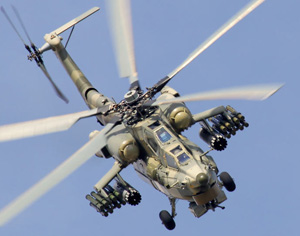
    Iraq to get the Russian Night Hunter Helicopters

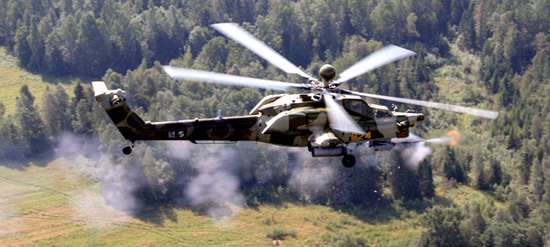
    Mi-28N at a firing range in Russia. Photo: RHC
    Mi-28N at a firing range in Russia. Photo: RHC

    Russia will supply over 10 Mi-28NE ‘Night Hunter’ attack helicopters to Iraq under a multi-billion dollar agreement. These helicopters are the export version of the Mi-28N, produced by the Russian Helicopter Corporation. Russian news agency Novosti quoted Alexander Mikheyev, deputy general director at Russia’s state arms exporter Rosoboronexport, saying the $4.3 billion arms transfer agreement signed between Moscow and Baghdad includes the transfer of attack helicopters, training of aircrews and technicians, as well as the weapons systems typically employed with these helicopters.

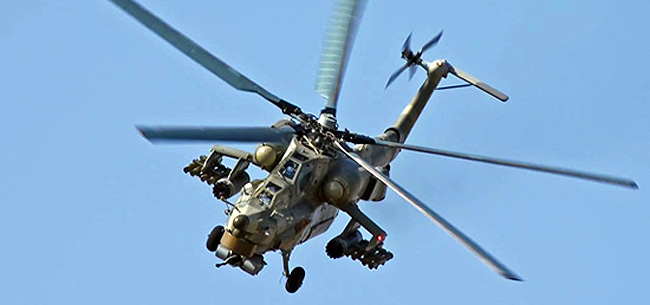
    The $4.2 billion package will also include the transfere of additional armament systems, Mikheyev added. The Mi-28NE is the export version of the ‘Night Hunter’ currently employed with the Russian Army. This helicopter code named ‘HAVOC’ by NATO was developed in the 1980s to counter the US Boeing AH-64 Apache. The typical armament of this helicopter includes a 30mm chin mounted gun, two rocket BL13 rocket pods carrying five S13 (100mm) or 20xS8 (80mm) rockets plus and two pairs of AT-8 ATAKA anti-tank missiles pods each carrying four missiles.

    Iraq will be the second international operator of the ‘Night Hunter’. In 2012 Kenya has ordered 16 of these helicopters, four have been received sofar. In recent years Rosoboronexport offered the Mi-28NE to India, Venezuela and Algeria, but failed to gain firm orders for the helicopter.

    Russia will supply Iraq 10 Mi-28NE attack helicopters as part of a multi-billion dollar arms procurement package. Iraq is expected to receive up to 30 such helicopters. In 2012 Russia sold 16 such helicopters to Kenya for $15 a piece.
    Russia will supply Iraq 10 Mi-28NE attack helicopters as part of a multi-billion dollar arms procurement package. Iraq is expected to receive up to 30 such helicopters. In 2012 Russia sold 16 such helicopters to Kenya for $15 a piece.

    Iranian, Russian Navies to Launch Joint Naval Wargames in the Caspian Sea

    Russian Navy Caspian Flotilla badge
    Russian Navy Caspian Flotilla badge

    The Russian and Iranian navies are planning to hold joint exercises in the Caspian Sea in the second half of this year, the Russian news agency Novosti reported. According to Nikolai Yakubovsky, deputy commander of Russia’s Caspian Flotilla, the exercise follows a previous one held in 2009. Caspian Flotilla commander Admiral Sergey Alekminsky confirmed few months ago that that the two navies could strengthen their collaboration in the future.

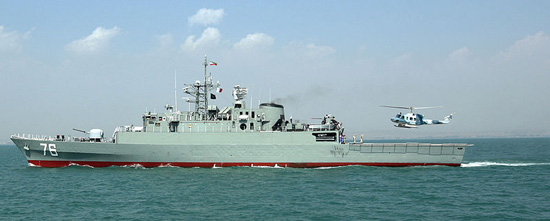
    The Russian flotilla maintains a small force comprising two Gepard class frigates, three Tarantul class corvettes and several missile patrol boats. The Iranian Caspian fleet based at Bandar-e Anzali also maintains a small fleet of patrol boats and minesweepers. The fleet will get a major boost next year, as the domestically built  Jamaran-2 frigate, recently launched at Bandar-e Anzali.

    Yakubovsky made the announcement after a meeting with the commander of a group of Iranian guided-missile boats that were visiting the port of Astrakhan. Iranian navy representatives welcomed the opportunity to take part in the joint exercises, but declined to discuss the plans in more detail. In 2009, Russia and Iran held their first joint naval exercise in the Caspian, involving about 30 ships.

    The Russian Navy Caspian Flotilla at parade in Astrakhan. Photo: Wikimedia
    The Russian Navy Caspian Flotilla at parade in Astrakhan. Photo: Wikimedia
    The first Jamaran 2 frigate will soon join the Iranian Caspian Fleet.
    The first Jamaran 2 frigate will soon join the Iranian Caspian Fleet.


    Pentagon, White House Outline Policies, Rules of Engagement for Cyber Ops

    cyber-attack-hackers-socialmarketingfella

    Deputy assistant secretary of defense for cyber policy Eric Rosenbach cited Defense Department progress in creating a concept for operating in the newest warfare domain, building and training a joint cyber force, and updating the standing rules of engagement for operating in cyberspace to align with Presidential Policy Directive 20, or PPD-20, on cyber operations, Defense-Update reports.

    Without naming specific countries, Rosenbach also said that senior DOD officials have made a conscious decision to expand the traditional U.S. circle of allied engagement to “key regions” to defend common interests in cyberspace.

    “Through an intense deliberative process, the [most senior] leadership in the department decided that we needed to make a significant investment in the people who would constitute the cyber force,” the deputy assistant secretary told American Forces Press Service. “The investment is going into a structure that is now more defined than it ever was in the past, and this has been helpful in having everyone in the department understand what the missions will be for the new influx of personnel.”

    From now until at least fiscal year 2016, each service will contribute teams of fully trained cyber warriors to U.S. Cyber Command, which has three operational focus areas: defending the nation, supporting the combatant commands and defending the DOD information networks.

    The service teams will become what Cybercom Commander Army Gen. Keith B. Alexander described June 12 in written testimony before the Senate Appropriations Committee as the command’s cyber mission forces, organized into national mission teams, combat mission teams and cyber protection teams.

    “The idea of defending the nation in cyberspace is just like it is in other domains,” Rosenbach explained. “If there’s a very significant attack that’s launched against the United States, it’s the department’s mission to stop that attack.” The main role of the combat mission forces, he added, “is to support the Combatant Commands in their missions and to support contingency operations when directed by senior civilian leaders.”

    A contingency operation is one in which members of the armed forces become involved in military actions, operations or hostilities against an enemy of the United States or against an opposing force, according to Title 10 of the U.S. Code. Rosenbach said the job of cyber protection teams will be to defend DOD’s information networks against all attacks. “A lot of credit should go to Cybercom leadership for figuring out a structure that would work,” the deputy assistant secretary noted.

    Below the large team framework is a smaller team framework, and then specific positions that drive training, standards and exercise requirements for everything Cybercom will do within its mission areas, Rosenbach said. The teams are not completely in place, “but Cybercom has a very good plan within the next few years of getting everyone there trained to standard and operational,” he added.

    “It’s going to take time to find and train the right people and get them out there, and also for us to become more confident with the doctrine and the way doctrine works compared to the way the threat is evolving,” Rosenbach said. “We’re doing all these things at once, which makes it very interesting on one hand and very complicated on the other.”

    DOD also has made progress in updating the standing rules of engagement for cyber, which had more to do with information technology and network security than operating in cyberspace when they were put in place in 2005, the deputy assistant secretary said.

    “It’s important to remember that standing rules of engagement are about defense and defending either your unit or the country or something in particular, like critical infrastructure,” Rosenbach said. “Very often, you’ll see in the press people confusing these standing rules of engagement with something that has to do with offensive cyber operations, but that’s not the case.” Rules of engagement always are classified to keep such knowledge from adversaries, he noted, “but the intellectual work and process work is complete now, and it’s very close to the official signature.”

    The department’s process for establishing standing rules of engagement is closely intertwined with the process for creating a presidential policy directive on cyber operations, Rosenbach said, referring to the classified PPD-20 issued by the White House in October and then leaked to the media this month. But in an unclassified fact sheet released Oct. 16, the White House described PPD-20 as a classified policy that, among other things, does the following:

    • Takes into account the evolution of the threat and growing experience with the threat;
    • Establishes principles and processes for using cyber operations so cyber tools are integrated with the full array of national security tools; and
    • Provides a whole-of-government approach consistent with values promoted domestically and internationally and articulated in the International Strategy for Cyberspace.

    “It is our policy,” the fact sheet states, “that we shall undertake the least action necessary to mitigate threats and that we will prioritize network defense and law enforcement as preferred courses of action.”

    In Senate Appropriations Committee testimony June 12, Cybercom Commander Army Gen. Keith B. Alexander referred to the presidential policy directive. “Last fall, the departments negotiated and the president endorsed a broad clarification of the responsibilities of the various organizations and capabilities operating in cyberspace,” he said. The Cybercom commander added that the clarification revised “the procedures we employ for ensuring that, in the event of a cyber incident of national significance, we are prepared to act with all necessary speed in a coordinated and mutually supporting manner.”

    Rosenbach called the policy an important step forward for the administration and the government.

    “It was a very intense yearlong effort to sharpen the decision-making process for deciding when to use cyber operations,” he said. “That includes getting a better conceptual idea of what is offense and what is defense, and it’s the framework you would use to decide when those types of operations are appropriate.”

    Rosenbach stressed that offensive operations in cyberspace would be extremely rare and would depend on specific situations. Such a decision is made by the president in very unique cases, he added, “and some of the criteria would be outlined in the presidential directive. “But a very small number of cases would ever be under consideration,” he said.

    Source: Defense-Update

    “Cyber Attack on the U.S. Could be Met with Conventional Military Response”

    cyber_logo

    Cyber attacks on U.S. infrastructure or networks could be met with a conventional military response, the chairman of the Joint Chiefs of Staff Army Gen. Martin E. Dempsey warned. “The rise of cyber is the most striking development in the post-9/11 national security landscape,” Dempsey told the audience. “We are doing everything we can inside the military to be ready to operate in cyberspace. Defense-Update reports

    “There is an assumption out there … that a cyberattack that had destructive effects would be met by a cyber response that had destructive effects,” Army Gen. Dempsey said to an audience at a Brookings Institution forum. “That’s not necessarily the case. I think that what [President Barack Obama] would insist upon, actually, is that he had the options and the freedom of movement to decide what kind of response we would employ.”

    General Martin E. Dempsey CJCS
    General Martin E. Dempsey Chairman, Joint Chiefs of Staff

    The impact of a cyberattack is a key question for elected officials to answer when considering the level of response, Dempsey said. “When does cyber theft become a hostile act?” the chairman asked. “Or when does cyber theft, added to distributed denial of services, become a hostile act? Or is a hostile act simply defined as something that literally is destructive in nature?”

    Cyber has many features in common with other domains, and shouldn’t be thought of as a wholly exceptional realm, Dempsey continued. Although it can sometimes feel abstract, he explained, cyber is a physical domain in the sense that it is operated by men and women over routers and servers, and cyberattacks can result in real, physical damage.

    “I think that to the extent that we can always think about it in the way that we’ve always organized our thinking about the other domains, it might illuminate the challenge a little better,” the chairman said. “I do think that there are capabilities out there that are so destructive in nature and potential that it would be very difficult not to see them as acts of war.”

    But, he noted, “the decision to declare something a hostile act — an act of war — is certainly one that resides in the responsibility of our elected leaders.In its mission to defend the nation, the Defense Department must stay ahead of the ongoing technological revolution and its attendant rise in “anywhere, any time” cyber threats, the chairman of the Joint Chiefs of Staff said here today.

    “One thing is clear: cyber has escalated from an issue of moderate concern to one of the most serious threats to our national security,” Dempsey said. Now, the entire country could be disrupted by the click of mouse, he added. To address these threats, the military must take on new missions, the chairman said.

    “Cyber incidents have steadily escalated over the past year, Banks and oil companies have been targeted by sophisticated attacks, he said, and more than 20 nations now have military cyber units… This is the new normal in cyberspace,” Dempsey said. “Disruptive and destructive cyberattacks are becoming a part of conflict between states, within states, and among nonstate actors. The borderless nature of cyberspace means anyone, anywhere in the world, can use cyber to affect someone else.”

    It isn’t enough to just strengthen cyber defenses on military systems, the chairman said. Intrusion attempts on critical civilian infrastructure systems have increased 17-fold over the last two years, he said. “The gap between cyber defenses deployed across critical infrastructure and offensive tools we now know exist presents a significant vulnerability for our nation,” Dempsey said.

    In response to the threat, the Defense Department is growing its capacity to protect its own networks, and it’s adding a new mission: defending the nation, when asked, from attacks of significant consequence — those that threaten life, limb, and the country’s core critical infrastructure, the chairman said, announcing that over the next four years, 4,000 cyber operators will join the ranks of U.S. Cyber Command, and $23 billion will be invested in cybersecurity.

    USCYBERCOM300Three types of teams will operate around the clock at Cyber Command, Dempsey said. National mission teams will counter adversary cyberattacks on the United States. A second and larger set of teams will support combatant commanders as they execute military missions around the globe. The largest set of teams will operate and defend the networks that support our military operations worldwide.

    Although the Defense Department has made significant progress in embracing cyber, the nation’s effort to protect critical civilian infrastructure is lagging — a worrisome vulnerability, the chairman said.Sharing information about cyber threats is one of the most important ways to strengthen cybersecurity across the private sector, he added, but threat information primarily is shared in only one direction: from the government to critical infrastructure operators. “That has to change,” Dempsey said. “We can’t stop an attack unless we can see it.”

    The most immediate priority is securing the “dot-mil” domain, the chairman said. “But in the event of a domestic cyber crisis,” he added, “our cyber forces will work in support of the Department of Homeland Security and the FBI, who lead our nation’s response in the dot-gov and dot-com domains.”
    cyber_war_0529To ensure this force is able to operate quickly, the Defense Department now has a “playbook” for cyber, Dempsey said, noting that a presidential directive codifies how each part of the government will respond in the event of a serious cyberattack. Under this directive, the department has developed emergency procedures to guide its response to imminent, significant cyber threats, the chairman said. The Defense Department is updating its cyber rules of engagement for the first time in seven years, he added, and also is improving mission command for cyber forces.

    While cyber may be the nation’s greatest vulnerability, Dempsey said, it also presents the military with a tremendous asymmetric advantage. “The military that maintains the most agile and resilient networks will be the most effective in future war,” he told the audience. “This is the kind of force we are building for the future.”

    Each branch of the military is doing its part, the chairman said, by investing in equipment and personnel that will ensure the joint force can operate in cyberspace as capably as it can on land, sea, air, and space. The next step is the planned Joint Information Environment, he said — a single, easy to secure, joint network delivering data to the department’s personnel wherever and whenever they need it.

    “As part of this new Joint Information Environment, we’re building a secure 4G wireless network that will get iPads, iPhones and Android devices online in 2014,” the chairman said. “With tools like this, the smartphone generation joining our military will help us pioneer a new era of mobile command and control.”

    Source: Defense-Update

    US Agency Details French RPA (UAS) Procurement Package

    Poland is considering replacing its Su-22 strike fighters with armed UAVs.
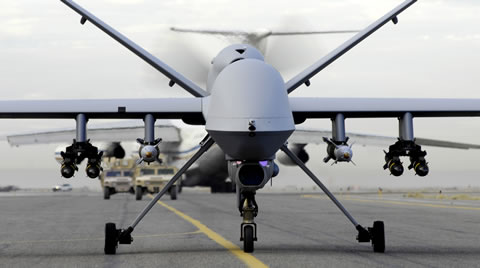
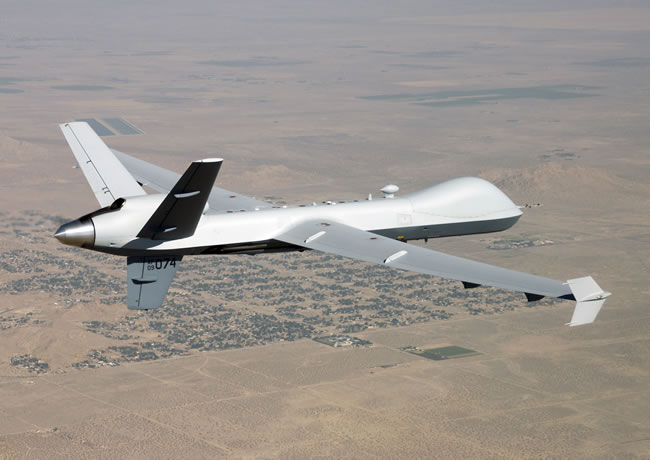
    An MQ-9 Reaper is tasked with armed recce missions, armed with laser guided bombs and Hellfire missiles. At present, France intends to use its new Reapers for ISR missions. Photo: General Atomics
    An MQ-9 Reaper is tasked with armed recce missions, armed with laser guided bombs and Hellfire missiles. At present, France intends to use its new Reapers for ISR missions. Photo: General Atomics

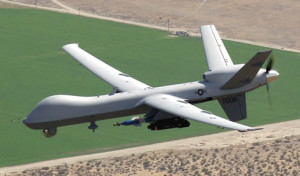
    France has formally requested to buy 16 General-Atomics Aeronautical Systems Inc. (GA-ASI) MQ-9 Reaper Remotely Piloted Aircraft (RPA) from the U.S., a sale that could top US$1.5 billion. France had allocated $250 million to buy the first two Reapers ordered in May 2013, to be delivered from production lots destined for the US Air Force. These drones will be delivered by the end of this year to fulfill urgent requirements for persistent, long-range ISR support of the French led operation in Mali. The remaining 10-14 (depending on the actual order) aircraft will be shipped in late 2015 or early 2016. To maintain its ISR capability, France plans to extend the support contract with EADS, maintaining the Heron I ‘Harfang’ in service until 2016.

    The formal request came days after GA-ASI announced it is investing in the development of an ‘exportable’ version of the Reaper Unmanned Aerial System (UAS) that will make this platform easier to modify and adapt for European airworthiness certification. One of the sour spots of the Reaper in RAF and Italian service was insufficient access to the aircraft systems, allowing its certification for civilian airspace use in Europe.

    These aircraft will be supplied with eight mobile ground control stations, and 24 Satellite Earth Terminals (supporting home-based and forward based operations). According to the US Defense Security Cooperation Agency notification to Congress, no offset agreements were offered in connection with this potential sale.

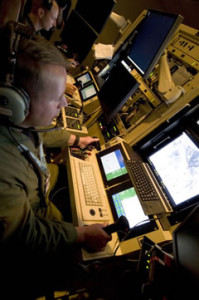
    reaper_station
    Reaper Ground Control Systems (GCS) Operators in position.

    The drones will be supplied with 40 mission payload packages, which will consist of exportable versions of the GA-ASI Lynx Synthetic Aperture Radar / ground Moving Target Indicator (SAR/GMTI) systems, Raytheon AN/DAS-1 Multi-Spectral Targeting Systems (MTS)-B, Embedded Global Positioning System/Inertial Navigation Systems (EGI), ARC-210 airborne radios, KU band airborne communications links and associated Ground Data Terminals. The drones will also get the AN/APX-119 and KIV-119 Identify Friend or Foe (IFF) Systems.

    France plans to employ the new Reapers with its Air Force, to enhance Intelligence, Surveillance, and Reconnaissance (ISR) capability in support of national, NATO, United Nation-mandated, and other coalition operations. According to the DSCA, the commonality of ISR capabilities with such Unmanned Aerial Vehicles (UAV) with those of the US and the UK will increase interoperability between the U.S and French military and peacekeeping forces.

    The agency noted that France has requested these capabilities to meet current and future threats by providing improved ISR coverage that promotes increased battlefield situational awareness, anticipates enemy intent, augments combat search and rescue, and provides ground troop support. Weaponization of those 16 Reapers has not been disclosed in the recent report and was not mentioned in the Defense White Paper recently published by the French Government.

    Source: Defense-Update


    AUSR-180x250Autonomous Unmanned Systems & Robotics

    As one of the world’s leading technological drivers of unmanned systems and robotics, Israel provides a hub for technological innovation, technical knowhow and practical, operational experience.

    The upcoming Autonomous Unmanned Systems & Robotics conference will provide an opportunity for local and international experts in the field, for networking and exchange of ideas.

    Defense-Update is a Media Partner of AUS&R. Defense-Update membersRegister here!


    Israel Will Be First International Customer To Fly Operational F-35 Units

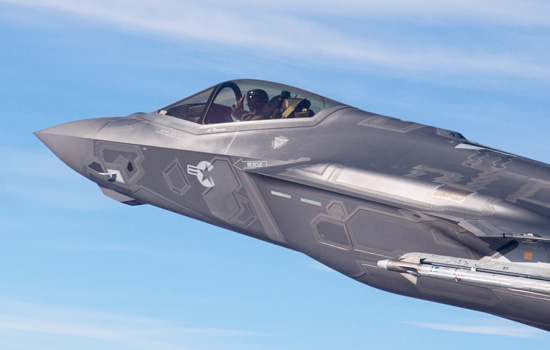
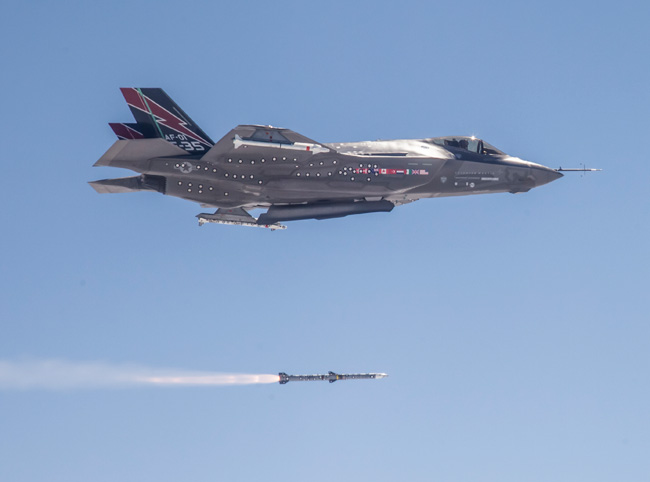
    F-35A flying with an AIM-9X Super Sidewinder Air/Air missile carried on the outer pylon. Typically the F-35 will carry four AIM-120D missiles in the weapon's bay, on stealth missions. Photo: Lockheed Martin
    F-35A flying with an AIM-9X Super Sidewinder Air/Air missile carried on the outer pylon. Typically the F-35 will carry four AIM-120D missiles in the weapon’s bay, on stealth missions. Photo: Lockheed Martin

    Though late to sign on to the network of nations purchasing the F-35 Joint Strike Fighter, Israel will be the first international customer to operate the fifth-generation fighter, Aviation Week’s David Eshel reports. “Israel will become the first non-U.S. operator of the F-35 in the world,” said Steve O’Bryan, Lockheed Martin’s vice president for F-35 program integration and business development in an interview at the Paris air show. The first F-35I combat squadron is expected to achieve initial operational capability in 2018. Eight other countries have already committed to the program with firm contracts.

    “The F-35 fighters going into service with these users will use different initial versions that will be upgraded later into the latest version, as it becomes available,” O’Bryan said. That mean F-35s will be tailored to individual nations, he says. “Specific capabilities developed for certain users will remain exclusive, and open to other users only with the original user’s consent. For example, the software blocks pertaining to the Norwegian anti-ship missile will not be available to other F-35 operators except Norway, unless it decides to sell those missiles to one of the F-35 users. The same goes to the Rafael Spice 1000. Similarly, the advanced electronic warfare, data links and specific software modes developed for the Israeli air force will remain unique to Israel and not delivered to any other user. These capabilities will also be fully integrated with the aircraft capabilities, adhering to the stealth characteristics of the aircraft, particularly, at specific apertures cleared for the Israeli systems integration in the lower fuselage and leading edge,” he said.

    The first Israeli pilots plan to arrive at Eglin AFB, Fla., for training on the F-35A in early 2016 (Aviation Week, 17 June 2013). The first aircraft is tentatively set to be delivered to the Israel air force toward the end of that year, and arrive in Israel in 2017. These F-35Is will be produced under Low Rate Initial Production (LRIP) lots 8, 9 and 10. By that time, all 19 aircraft included under the $2.75 billion order will be delivered to the IAF under the current five-year plan. A follow-on order for more F-35Is is expected in 2018, under the next five-year plan. As the new fighter enters full-production rate, volumes are expected to increase, leading to proportionally lowering cost, expected to drop below $85 million in then-year dollars. Financing of this follow-on procurement is already under discussion with the U.S. Jerusalem is seeking creative ways for Washington’s agreement to guarantee payment for these planes, including the foreign military sales budget allocated annually to Israel. If this concept is approved, Israel will be required to pay for the interest but will be able to commit willingly to follow-on orders and receive the second squadron immediately after the first is delivered.

    “With the F-35 Israel is expected to receive the AIM-9X short-range air/air missile (AAM) and the Raytheon AIM-120 AMRAAM Beyond Visual Range (BVR) AAM,” O’Bryan added. The F-35 currently carries the Raytheon AIM-9X Block at the outboard under-wing stations, in non-stealth configuration, as the current Block I missiles cannot be carried internally. This shortcoming will be corrected in Block II, which is to follow soon.

    Nevertheless, the optimal weapon carriage for the F-35 comprises exclusively the AMRAAM missiles, enabling the fighter to maximize its “see-first, shoot-first, kill-first” strategy. The next generation BVR-AAM will offer both active and passive guidance techniques, offering effective intercept ranges in excess of 100 km. This makes part of the argument not to include the Rafael Python V missile in the aircraft configuration; the next generation Python VI will be designed to fit the new fighter. Yet, according to IAF sources, a decision whether to use a derivative of the Stunner or a brand-new AAM has yet to be made.

    F-35s are prepared to fight air combat as a “networked formation,” sharing all information between all members at all time. The data link used for this process, called MADL, will also be available to all F-35 operators. In addition, Harris Multi-Function Advanced Data-Link (MADL) terminals could be installed on certain support elements, to extend information sharing and update the data available to the stealthy F-35 formation. In addition, the F-35 is now offering Link-16 connectivity and would obviously include a satellite link as well, providing secure, low-probability-of-detection communications on extended range missions.

    In August 2012 Lockheed Martin received a $206 million award from the U.S. Navy Naval Air Systems Command, covering the development and integration of Israeli systems in the F-35A. Part of a larger package, the integration support agreement with Lockheed Martin covers a $450 million program to enhance Electronic Warfare (EW) equipment on the F-35, and integrate Israeli-unique systems beginning in 2016 (Aviation Week, Aug. 16, 2012).

    The US Navy recently received its first F-35C Lightning II that joined the training fleet at Eglin AFB. Israeli pilots are expected here by 2016, toward the handover of the first F-35Is to Israel, in 2017.

    “The advantage of this F-35 for the Israel air force is not about higher performance or a specific weapon capacity, but the ability to understand the battlespace, identify, locate targets from standoff range and neutralize them before being engaged,” Brig. Gen. Hagi Topolanski, Chief of Air Staff and Deputy Israeli Air Force Commander, told Aviation Week in a recent interview (Aviation Week subscription required). “These capabilities are meaningful in dealing with modern fighter aircraft and advanced SAMs. While the F-35 has its limitations, it can take on and win against any threat currently available in-theater. Its ability to independently collect, assess and process a battlespace situational picture, and strike those targets by itself, from standoff range, is providing a qualitative edge over anything the enemy can confront with, in the foreseeable future.”

    Israel insisted upon a number of requirements throughout the procurement negotiations on the F-35I. Those included the adaptation of the baseline F-35A including all its systems, to the Israeli air force’s operational environment, which will require some necessary additions. “Our F-35I will be equipped with our specific networks, armament and electronic warfare, among them the Spice autonomous EO guided weapon. It will also carry the AIM-9X2 air-to-air missile, which will become the first platform in the IAF to employ this advanced air-to-air missile. We also plan to continue and pursue the development of future air-to-air missiles; we are still evaluating the cost/performance trade-off between a common air-to-air and air-to-ground missile and a dedicated AAM design,” Topolanski explained. “Assuming the F-35 will offer the capabilities it is planned to deliver, it will bring a new dimension to air battles as we know today.”

    One of the advantages of the F-35 is the aircraft’s ability to fly long-range missions with internal weapons, accelerate faster and maintain higher speed, compared to current F16s or F-15s or any of the opposing force combat aircraft (flying with internal fuel). To further extend the F-35’s range, Lockheed Martin is exploring an innovative concept from Israel, of using unique drop tanks, developed by Elbit Systems Cyclone. Designed in a similar concept to the F-22 under-wing drop tanks, these tanks, each containing 425 gal. of fuel, will use special attachment pylons that would completely separate from the wing, regaining full stealth capability after separation. An additional 900 gal. of fuel will significantly extend the F-35I range, enabling the IAF to operate its new stealth fighter at the “outer ring” of operation without mandatory aerial refuelling.

    This article was first published by Aviation Week 

    F-35A launching the first AIM-120 AMRAAM missile from the weapon's bay. The aircraft also carries two dummy AIM-9X Air/Air which will not be carried on full  stealth missions. Photo: Lockheed Martin
    F-35A launching the first AIM-120 AMRAAM missile from the weapon’s bay. The aircraft also carries two dummy AIM-9X Air/Air which will not be carried on full stealth missions. Photo: Lockheed Martin

    Airborne Sense and Avoid Radars for RPAs

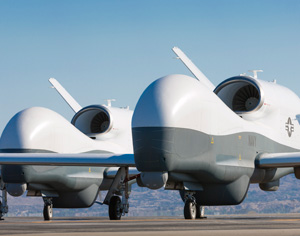
    The first MQ-4C Triton maritime surveillance drones were recently delivered to the US Navy. Photo: Northrop Grumman
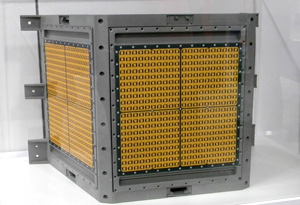
    ITT Exelis displayed the airborne sense-and-avoid radar it is developing for the U.S. Navy’s MQ-4C Triton at the Unmanned Systems North America conference in Las Vegas. (Photo: Bill Carey, AIN)
    ITT Exelis displayed the airborne sense-and-avoid radar it is developing for the U.S. Navy’s MQ-4C Triton at the Unmanned Systems North America conference in Las Vegas. (Photo: Bill Carey, AIN)

    Sierra Nevada Corporation (SNC) successfully completed its second airborne demonstration for the Air Force Research Lab under its Multi Sensor Detect Sense and Avoid (MSDSA) program using a prototype radar sensor. This new Airborne Sense and Avoid (ABSAA) sensor, utilized on Unmanned Aerial Vehicles (UAV), repeatedly detected and tracked airborne intruders resulting in over 60 seconds of avoidance time, exceeding the program requirements. The ABSAA provides unparalleled performance with its sense and avoid capability. Defense-Update reports.

    According to John Koger, MSDSA program manager, for the Air Force Research Lab in Dayton, Ohio, a key program objective is to advance the technology at lower cost relative to current electronically steered antennas. “Our sense and avoid sensor incorporates SNC’s unique Electronically Reconfigurable Array (ERA). The entire sensor has been designed and developed as an ABSAA building block that is easily scalable to serve as the solution to multiple UAV CONOPS and installation challenges,” said Greg Cox, corporate vice president of SNC’s Communication, Navigation, Surveillance/Air Traffic Management Business Area.

    ABSAA has evolved from a requirement made by the Air Forces’ Aeronautical Systems Center (ASC) Intelligence, Surveillance, and Reconnaissance and Special Operations Force (ISR&SOF) Directorate to develop a sensor agnostic, platform agnostic sensor fusion and avoidance maneuver product. Such product was needed to satisfy the regulatory ‘see and avoid’ requirement, paving the way for the integration of Remotely Piloted Aircraft (RPA) into the National Airspace System (NAS) and maritime environment. This requirement is specially acute with the introduction of the MQ-4C Triton maritime surveillance drone, flying over wide and remote areas of the ocean, where absence of ABSAA would significantly hinder its operational flexibility. The initial increment of ABSAA is expected to utilize Traffic Alert and Collision Avoidance System (TCAS), Automatic Dependent Surveillance – Broadcast (ADS-B), radar, and Electro-Optical/Infrared (EO/IR) input while allowing easy integration of other sensor types in the future.

    The regulatory requirements are 14 Code of Federal Regulation (CFR) Part 91.111 & 91.113. To satisfy these CFRs, sensors will connect to the sensor agnostic, platform agnostic sensor fusion and avoidance maneuver product, then to the flight controls and operator interface. The prototype, x-band Multi Sensor Detect Sense and Avoid (MSDSA) radar sensor developed by SNC was demonstrated for the first time in November 2011, when it repeatedly detected and tracked airborne intruders resulting in over 60 seconds of avoidance time.

    At the AUVSI exhibition last year ITT Exelis unveiled the SkySense 2020H airborne sense-and-avoid (ABSAA) radar it said was under development for the U.S. Navy’s MQ-4C Triton. The company is under contract from Northrop Grumman to provide the air-to-air radar subsystem for the Triton. The sense-and-avoid radar enables the aircraft to comply with the International Civil Aviation Organization requirement that military and other state aircraft operate with “due regard” for the safety of civil aircraft when operating over international waters. The radar will provide information to the RPA operator to maneuver the aircraft away from possible collisions; maintaining ‘air traffic separation’. In the future, an autonomous aircraft will perform its own maneuvers based on the ABSAA radar data (Collision avoidance mode).

    According to AIN’s Bill Carey, the radar will be positioned behind the nose cone of the aircraft, the ABSAA radar is a three-panel, thin-tile array operating in the Ku-band. The range will be 8 to 10 nm, with a wide field of view (110 degrees on either side and 30 degrees up and down). The system is self-contained, with no supporting racks of processing electronics, and weighs 50 pounds. “This isn’t a repurposed radar; it’s dedicated for sense-and-avoid, but it can also be multiuse,” Jones said, adding that communications and weather-radar modes are being explored.

    The Triton unmanned aircraft system completes its first flight May 22, 2013 from the Northrop Grumman manufacturing facility in Palmdale, Calif. The 80-minute flight successfully demonstrated control systems that allow Triton to operate autonomously. Triton is designed to fly surveillance missions up to 24-hours at altitudes of more than 10 miles, allowing coverage out to 2,000 nautical miles. The system's advanced suite of sensors can detect and automatically classify different types of ships. Photo: Northrop Grumman
    The Triton unmanned aircraft system completes its first flight May 22, 2013 from the Northrop Grumman manufacturing facility in Palmdale, Calif. The 80-minute flight successfully demonstrated control systems that allow Triton to operate autonomously. Triton is designed to fly surveillance missions up to 24-hours at altitudes of more than 10 miles, allowing coverage out to 2,000 nautical miles. The system’s advanced suite of sensors can detect and automatically classify different types of ships. Photo: Northrop Grumman

    midcasThales is also working on a Sense and Avoid radar sensor developed specifically for RPA/UAS. The company is focusing on X or Ku bands for best weather and angular resolution accuracy. Thales plans to use Digital Beam Forming (DBF) rather than Electronic Scanning (E-Scan) offering higher dewll time, better angular coverage and lower cost implementation. As an all weather sensor, such radar will be able to provide the direction of intruders, measure closing velocity and distance of targets, thus providing all necessary data for evasive action calculation.

    This radar will be one of the systems to be evaluated under the Europe Mid-Air Collision Avoidance System (MIDCAS) launched in 2009. The program has entered development and simulation this year and is expected to reach the flight demonstration phase by year’s end. Through this collaborative European program, MIDCAS is contributing to the integration of RPA in civilian airspace, by proposing a baseline of solutions for the “Unmanned Aircraft System Mid-air Collision Avoidance Function” acceptable by the manned aviation.

    Currently, Mid-Air Collision avoidance is ensured by several safety layers handled by Air Traffic Management, Local Air Traffic Controller, embedded Collision Avoidance systems as ACAS and the “See & Avoid” capability of a human pilot. This capability shall respect ICAO “Rules of the Air”. MIDCAS goal is to implement such capabilities with UAS. As such, MIDCAS should detect (or sense) aircraft flying in the the vicinity of the RPA equipped with the system, maintain situational awareness for the human pilot controlling the RPA, and, if needed, recommend an evasive manoeuvre or execute such manoeuvre automatically, thus restoring safe situation between UAS and others aircraft.

    Source: Defense-Update


    AUSR-180x250Autonomous Unmanned Systems & Robotics

    As one of the world’s leading technological drivers of unmanned systems and robotics, Israel provides a hub for technological innovation, technical knowhow and practical, operational experience.

    The upcoming Autonomous Unmanned Systems & Robotics conference will provide an opportunity for local and international experts in the field, for networking and exchange of ideas.

    Defense-Update is a Media Partner of AUS&R. Defense-Update members – Register here!

    Guided Projectiles Competing Over Naval 5-Inch Guns

    The Multi-Service Standard Guided Projectile (MS-SGP) went through a successful first test firing from a 5-inch 62-caliber Mk 45 Mod 4 Naval Gun System at White Sands Missile Range, New Mexico. According to BAE Systems, the projectile’s developer, all MS-SGP guided flight test objectives were achieved. The guided flight test, culminating more than 110 MS-SGP subsystem tests, demonstrates the tactical capability to a range of 38 kilometers. The MS-SGP’s maximum range is nearly 100 kilometers, with accuracy of less than five meters. The MS-SGP significantly enhances the capability of U.S. Army and Marine Corps field artillery and U.S. Navy Mk 45 gun systems.

    The MS-SGP provides a single projectile capable of responsive, tactical fires for addressing stationary or moving targets for multiple U.S. or allied services at a fraction of the cost of current alternatives. “Currently the U.S. and its allies are using significantly more expensive solutions to address fire support and tactical targets,” said Chris Hughes, vice president and general manager of Weapon Systems at BAE Systems. “The projectile can provide the U.S. forces with an affordable, long-range, and precision gun-launched projectile to greatly expand our fire support capability.”

    The guided projectile is developed in the standard 5-Inch naval gun configuration and saboted 5-Inch variant sized for 155mm howitzers operated by the Army and Marine Corps. The naval Mk 45 Mod 4 five inch guns has been deployed worldwide with more than 25 navies. Designed to fit this popular caliber in naval gun systems, SGP offers current naval platforms the capacity to provide long range joint fires and support asymmetric operations around the world. The Mk 45 Mod 4 will deliver 5-Inch fires at a maximum rate of 10 rounds per minute to 52 nautical miles to achieve desired effects.

    While BAE Systems has achieved this milestone with its guided projectile, Raytheon is moving into this slot with a new derivative of its combat proven Excalibur Ib. The company is funding a development program to enhance its the current GPS-guided projectile with a new Guidance and Navigation Unit (GNU) employing a semi-active laser (SAL) offering ‘end-game targeting capability’. According to Raytheon, the addition of the SAL seeker will allow the munition to attack moving targets designated by other sources, such as forward observers or remotely piloted aircraft (RPA). Using laser targeting Excalibur will be able to attack targets that have re-positioned after firing, or change the impact point to avoid casualties and collateral damage. Raytheon plans to integrate the new GPS/SAL capability in 5-inch (127mm) naval guns, enabling such weapons to engage moving targets on land and at sea. Counter-swarming boat capability will be the prime focus of such at-sea moving target capability using a high-firing rate naval guns. According to company sources the transition to the naval 5-inch configuration will be easily made as the existing 155mm Excalibur Ib GNU design also fits in a 127mm projectile body.

    “No other gun-launched GPS-guided artillery round is as precise as Excalibur, which in its current design gives one the ability to hit within 4 meters of the target 90 percent of the time,” said Kevin Matthies, Excalibur program director for Raytheon Missile Systems. “Now we’re ready to take this to the next level, giving the warfighter the ability to not only re-target the munition in flight, but leverage Excalibur’s maneuverability to use the pinpoint precision of a semi-active laser seeker to hit targets on the move.”

    Recent tests of the SAL seeker have demonstrated the robustness of the design in a severe gun-firing environment. The company said it will offer existing customers to upgrade their Excalibur Ib guidance and navigation units with the new GPS/SAL capability.

    On the other side, BAE is moving into Raytheon’s turf offering the land-based derivative of the saboted 5-Inch SGP, that can be fired from standard 155mm howitzers in service with the Army and Marine Corps. The company plans to fire the MS-SGP from an M777 towed howitzer in the summer of 2013. MS-SGP will expand the range and area covered by direct and general support artillery units, to provide long range joint fires in support of ground combat operations. Artillery units firing the 5-Inch Saboted SGP will deliver a volume of effects on desired area targets out to a range of 70 kilometers. By use of flight profiling, the 5-Inch Saboted SGP can execute Multiple Rounds Simultaneous Impact (MRSI) missions, magnifying lethal effects.

    Both the 5-Inch SGP and Saboted SGP offer rapid time of flight and the capability of in-flight retargeting to address moving targets, changing target conditions, and surface threats. They both deliver all weather precision attack capability to fully defeat targets with high-explosive warheads, while operating within a jamming environment. Tested component designs are based on a spiral of the highly successful 155-mm Long Range Land Attack Projectile (LRLAP).

    GA-ASI Touts Exportable Version of MQ-9

    MQ-9 Block 1-plus on its first flight on May 24, 2012
    new communications capabilities also will be available in the Block 5, including dual ARC-210 VHF/UHF radios with wingtip antennas, allowing for simultaneous communications between multiple air-to-air and air-to-ground parties. Photo: GA-ASI

    Following its successful penetration of the French market, General Atomics Aeronautical Systems, Inc. (GA‑ASI) is planning to introduce an exportable, certifiable variant of its Predator B Remotely Piloted Aircraft System (RPA), paving its way into more markets where the current Predator B ‘Reaper’ was excluded from by US export limitations. The current Predator B is currently in service with the US Air Force, the British Royal Air Force and Italian Air Force, and has recently selected to provide an interim solution equipping the French Air Force units. Defense-Update reports.
    “It is imperative that we ensure airworthiness certification of Predator B both at home and abroad as coalition forces withdraw from Afghanistan and nations transition mission focus to protection of the homeland and other civil uses.” Neal Blue, chairman and CEO, GA-ASI

    While the aircraft has been fully compliant with the airworthiness requirements of the U.S. Air Force and anticipated NATO foreign customers and is also offering enhanced capabilities for integration into domestic and international airspace, limitations are hindering the use of these drones in European civil managed airspace.

    The new variant will be based on the company’s MQ-9 Block 5 Predator B aircraft, using only exportable technology (similar to the Predator XP), and will support the Advanced Cockpit Ground Control Station (GCS) layout. In 2011 GA-ASI introduced the Predator XP, licensed by the U.S. Government to be proposed for sale to a broader customer base, including countries in the Middle East and North Africa. It seems that the new variant of Predator B will follow this path, although it initially addresses European opportunities.

    “Predator B is the most cost-effective and best-valued RPA in its class and continues to draw significant interest from our NATO allies,” said Neal Blue, chairman and CEO, GA-ASI. “It is imperative that we ensure airworthiness certification of Predator B both at home and abroad as coalition forces withdraw from Afghanistan and nations transition mission focus to protection of the homeland and other civil uses.”

    GA-ASI is required to carry out enhancements in its aircraft to meet airworthiness to the NATO Standardization Agreements (STANAGs) and UK Defence Standardization (DEFSTANs). For these tasks the US company has partnered with the German company RUAG Aerospace Services GmbH. The two companies have been teamed for the past two years to offer Predator B to meet the surveillance needs of the Federal Republic of Germany, but this is the first formal contract between them. Effective April 1 2013, RUAG has been engaged to provide technical assistance with the analysis, decomposition, and management of airworthiness requirements as they pertain to Predator B RPA airworthiness.

    Pursuing more opportunities in Europe, GA-ASI has recently signed an agreement with the Dutch company Fokker, to support positioning Predator B to the Dutch Government’s need for a Medium-Altitude Long-Endurance (MALE) Unmanned Aircraft System (UAS) requirement. Under the agreement announced last week, Fokker will assist in the adaptation of Predator B hardware to Dutch national standards; offer guidance and support for Dutch airworthiness certification requirements; provide design, manufacturing, and support for the Electrical Wiring Interconnection system; engineering support related to landing and arresting gears; and logistical, operational, and maintenance support of Predator B after delivery to The Netherlands Ministry of Defence.

    Source: Defense-Update.


    AUSR-180x250Autonomous Unmanned Systems & Robotics

    As one of the world’s leading technological drivers of unmanned systems and robotics, Israel provides a hub for technological innovation, technical knowhow and practical, operational experience.

    The upcoming Autonomous Unmanned Systems & Robotics conference will provide an opportunity for local and international experts in the field, for networking and exchange of ideas.

    Defense-Update is a Media Partner of AUS&R. Defense-Update members – Register here!


    Israel Receives the First C-130J Shimshon

    Lockheed Martin delivered today the first C-130J Super Hercules airlifter to the State of Israel during a ceremony at Lockheed Martin’s Marietta, Ga., production facility. This is first of three C-130Js currently on order for the Israeli Air Force (IAF), which has operated legacy C-130s since 1971. The aircraft will remain in the USA, to receive mission specific hardware delivered from the US and from israel, configuring the aircraft to meet the IAF requirements. The aircraft is expected to be delivered to Israel by within a year.

    According to IAF Chief of Staff Brig. General Hagai Topolanski, the new C-130J will offer almost 30 percent improvement over the current ‘Hs models in service with the IAF. “These new aircraft will not replace all H models in service. Those C-130Hs that will remain in service will upgraded, extending their life and bringing them to higher operational capability” Topolanski told Aviation Week in a recent interview.

    Israel Received today the first C-130J Super Hercules: ‘Shimshon’. Photo: Lockheed martin
    Israel Received today the first C-130J Super Hercules: ‘Shimshon’. Photo: Lockheed martin

    Improved Water Purification Technology Reduces SWaP, Logistics Burden

    prototype water desalination system developed for DARPA by Teledyne Scientific Company. Photo via DARPA
    prototype water desalination system developed for DARPA by Teledyne Scientific Company. Photo via DARPA

    Military vehicles don’t run without fuel—and warfighters don’t run without water. As little as a six to eight percent water deficit can be debilitating. As a result, military logistics plans must take into account the approximately three gallons of daily drinking water that each warfighter requires. However, the logistics burden of supplying water to deployed troops is comparable to that of fuel and the economic cost is high. Even more important is the cost in lives; former Marine Corps commandant Gen. James Conway said in 2010, “We take 10 to 15 percent of casualties among Marines involved in the delivery of fuel and water.”

    The Department of Defense (DoD) currently relies on a number of water desalination systems to produce clean water from local sources. These systems help keep supply convoys off the road and allow troops to conduct their missions far from the infrastructure of a military base. However, all of these systems have size, weight and power (SWaP) constraints that affect their suitability for some missions.

    The Lightweight Water Purifier (LWP) is an example of one highly capable desalination system fielded by the Army, able to produce approximately 75 gallons of potable water per hour (gph) from seawater. This capacity, however, comes at a cost in energy, weight and size. A three-kilowatt generator supplies energy, and the entire 2,000-pound LWP system must be transported on the back of a HMMWV.

    Four fresh water pumps are used to draw water from the Euphrates River to supply reverse osmosis water purification units operated by Marines of the 6th Engineer Support Battalion, 1st Force Support Group, 1st Marine Expeditionary Force, at a tactical water distribution system located at Logistics Support Area, Camp Viper, Iraq. (U.S. Marine Corps photo)
    Four fresh water pumps are used to draw water from the Euphrates River to supply reverse osmosis water purification units operated by Marines at Logistics Support Area, Camp Viper, Iraq. (U.S. Marine Corps photo)

    To facilitate water supply at much smaller physical and energetic footprint, DARPA initiated the Materials with Novel Transport Properties (MANTRA) program to improve water desalination technologies and reduce their SWaP requirements. With funding from the MANTRA program, Teledyne Scientific Company, based in Thousand Oaks, Calif., developed an advanced capability prototype desalination system. Government testing by the Navy and Army found this prototype is capable of producing 90 gph of potable water from seawater, but weighs only 400 pounds. The Teledyne system performance was comparable to an LWP operating under similar conditions, and consumed approximately half the power.

    Teledyne’s prototype system uses a new antifouling coating applied to the ultrafiltration (UF) membranes. This is an important step as effective separation of particles from the seawater prevents the downstream reverse osmosis membranes from clogging. Compared to uncoated membranes, the coating enables the UF membranes to operate seven times longer without cleaning, filter seawater at a higher throughput and consume less power. Engineers from the Navy believe this coating can be applied to various types of commercial-off-the-shelf membranes, thus improving currently deployed systems.

    “From the beginning of the program, we worked with potential Navy and Army transition partners,” said DARPA program manager Barry Pallotta. “They agreed that even a 10 to 20 percent reduction in SWaP for a water desalination system would be of enormous value. MANTRA clearly exceeded that goal, and now the program is complete. Small, efficient water purification technology translates into greater expeditionary range and reduced exposure for military personnel.”

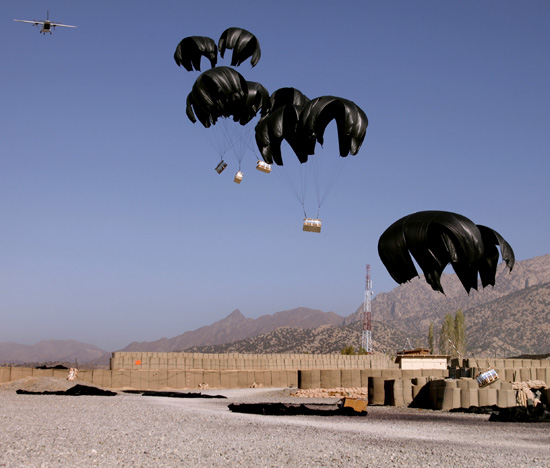
    Bundles of bottled water attached to parachutes fall from an aircraft during an aerial resupply on Combat Outpost Herrera, Paktiya province, Afghanistan. Photo:  Staff Sgt. Andrew Smith
    Bundles of bottled water attached to parachutes fall from an aircraft during an aerial resupply on Combat Outpost Herrera, Paktiya province, Afghanistan. Photo: Staff Sgt. Andrew Smith


    Standoff Detection of IEDs – with DARPA’s MEDS Program

    In October 2012 The US Defense Advanced Research Projects Agency (DARPA) published a call for technology developers to come up with innovative ideas for explosive detection technologies capable of detecting and identifying explosives from standoff distance. The ‘Methods for Explosive Detection at Standoff’ or MEDS program is seeking to rapidly develop and demonstrate non-contact methods to detect explosives packaged in opaque cases, or embedded with high water content (e.g., mud, meat, animal carcasses). Defense-Update reports.

    Improvised Explosive Devices have always posed a major threat to military forces, but in the past two decades IEDs have gone through continuous evolution, with coalition forces countering such threats with numerous countermeasures and avoidance tactics (C-IEDs). Such techniques are manifesting ever increasing levels of sophistication. These range from indirect methods to detect packaging, wiring, or fusing to direct detection and neutralization of IEDs.

    Back in february this year DARPA awarded the first contract under the MEDS initiative to Quasar Federal Systems. QFS has developed and employed an integrated electric and magnetic field sensing systems, providing ultra low noise, low frequency electromagnetic sensing systems and applications in mapping surface and subsurface objects. The $1.17 million contract from DARPA will evaluate the use of a combined MRI and Quadrupole Resonance (QR) modality for standoff explosives detection. Other contracts were awarded to BAE Systems, the University of Arizona, Northeastern University of Massachusetts and the Stanford University of California.

    Last week DARPA has awarded the biggest contract under the MEDS program to NIITEK, Inc. This $2.13 million contract will span over 18-months. This thrust aims to develop novel sensors capable of detecting explosives by tracing their unique signatures from a distance. According to Juan Navarro, President of Chemring Sensor and Electronics, NIITEK parent company, the current development is defined as a ‘proof-of-principle’ experimentation, but NIITEK and its academic and small business partners are confident that, with proper development, the technology can be transitioned into a system that could prove useful to both the Department of Defense as well as domestic security and law enforcement.

    Traditionally, direct detection methods are placed into two categories – trace detection and bulk detection. Trace detection methods include optical absorption and fluorescence, light detection and ranging (LIDAR), and biosensors. Bulk detection methods include spectroscopic methods such as nuclear magnetic resonance (NMR) and nuclear quadrupole resonance (NQR); imaging using ionizing (X-Ray, γ−Ray); and electromagnetic sensing techniques detecting threats in the infrared (IR), terahertz (THz), millimeter (mm), and radar) spectral ranges.

    Each of these technologies has their strengths and limitations in terms of sensitivity, speed, specificity, ability to penetrate various media, and health effects. Applicability of these methods can be highly dependent on packaging and operational conditions. In addition, the use of ionizing radiation, other than possible employment of backscatter technology must be excluded because of health concerns to military personnel and civilians in proximity to the area of concern.

    While trace detection offers reliable performance in uncontaminated environment, such methods are vulnerable to relatively simple masking techniques, by hiding the explosive in opaque media with high water content – such as animal Caracas or water containers. This will preclude the use of trace detection methods and bulk methods where significant penetration into the medium is not possible.

    New technologies that could be implemented for such applications including Ultra wide band (UWB) imaging, capable of penetrating deeper into a structure without the negative effect of ionizing radiation, could be derived from medical imaging technologies developed for oncological research. Other sensors could implement  thermoacoustic imaging, and novel nonlinear acoustic methods also developed for cancer detection open the opportunity to develop and apply non-contact acoustic methods to this application. Unlike the medical instruments that can penetrate 10-16 cm into a living tissue, DARPA’s MEDS research is seeking a contactless penetration of such target from standoff distance.

    Apart from these researches, mixed modality mechanisms could also be implemented, by combining electromagnetic indicators and acoustic vibration, indicating sub-surface anomaly. According to models and simulations such detection techniques could detect millilitre scale objects at a depth of one centimeter inside an opaque container. Enhancing these techniques with Doppler effect processing could further increase detection depth.

    Northrop Grumman Delivers First AQS-24A Airborne Mine-hunting Vehicle to Japan

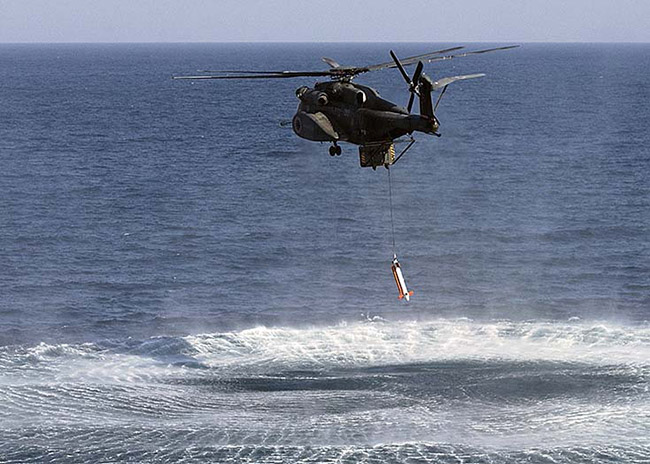
    The Japanese Maritime Self-Defence Force (JMSDF) has received the first of four AQS-24A airborne mine-hunting systems (as shown in the photo above) from Northrop Grumman. Photo: Northrop Grumman
    The Japanese Maritime Self-Defence Force (JMSDF) has received the first of four AQS-24A airborne mine-hunting systems (as shown in the photo above) from Northrop Grumman. Photo: Northrop Grumman
    The Japanese Maritime Self-Defence Force (JMSDF) has received the first of four AQS-24A airborne mine-hunting systems (as shown in the photo above) from Northrop Grumman. Photo: Northrop Grumman

    Northrop Grumman Corporation has delivered the first of four AQS-24A airborne mine-hunting vehicles to the Japanese Maritime Self-Defense Force (JMSDF) for deployment on Japan’s new MCH-101 helicopter platform.

    The AQS-24A and its predecessors, the AQS-24 and the AQS-14 are the only operational airborne mine-hunting search systems used by the U.S. Navy for the past 29 years. The AQS-24A is a high-speed mine-hunting system that is primarily towed from the MH-53E helicopter and has been adapted easily to the JMSDF version of the EH-101 aircraft.

    The AQS-24A contains a laser line scanner that provides precision optical identification of underwater mines and other objects of interest. The AQS-24A allows for simultaneous operation of the sonar and laser, which significantly improves area coverage rate, shortens the mine clearance timeline and alleviates unnecessary maintenance cycles. Advanced navigation controls and processing provide highly accurate target positioning.

    Later this summer, Northrop Grumman will deliver the first of four Airborne Laser Mine Detection Systems (ALMDS) to the JMSDF to operate in conjunction with the AQS-24A. ALMDS is a laser-based, light detection and ranging sensor system that detects, classifies and localizes near-surface mine-like objects from above the waterline and is complementary to the AQS-24A.

    Skunk Works and XTEND Simplify Multi-Drone Command

    0
    Lockheed Martin Skunk Works® and XTEND have achieved a major milestone in JADC2 by integrating the XOS operating system with the MDCX™ autonomy platform. This technical breakthrough enables a single operator to simultaneously command multiple drone classes, eliminating the friction of mission handoffs. From "marsupial" drone deployments to operating in GPS-denied environments, explore how this collaboration is abbreviating the data-to-decision timeline and redefining autonomous mission execution.

    From Ukraine to Taiwan: The Global Race to Dominate the New Defense Tech Frontier

    0
    As traditional defense primes face mounting competition from agile “neoprimes” such as Anduril, Palantir and Helsing, the balance of innovation is shifting toward software-defined warfare and scalable, dual-use technologies, while global industry consolidation—marked by Boeing’s integration of Spirit AeroSystems and other strategic mergers—signals an intensified race to secure control over the defense technology value chain. Our Defense-Tech weekly report highlights these trends.

    Europe’s “Drone Wall”

    0
    In early October 2025, a coordinated wave of unmanned aerial system (UAS) incursions—widely attributed to Russia—targeted critical infrastructure across at least ten European nations. The unprecedented campaign exposed the fragility of Europe’s air defenses...

    Weekly Defense Update & Global Security Assessment

    0
    Executive Summary The past week (September 18-25, 2025) represents an inflection point where strategic defense concepts have transitioned from doctrine to tangible reality. An analysis of global events reveals four primary, interconnected trends shaping an...

    U.S. Air and Space Forces Push Next-Gen Programs at the AS&C 2025 Conference and...

    0
    At the 2025 Air, Space & Cyber Conference, U.S. Air Force and Space Force leaders unveiled major updates on next-generation fighters, bombers, unmanned systems, and space initiatives, highlighting both rapid innovation and critical readiness challenges as the services race to outpace global competitors. A short version is available here, with a more detailed version for subscribers.

    TADTE 2025: Reflecting Taiwan’s Strategic Themes

    0
    The Taipei Aerospace & Defense Technology Exhibition (TADTE) 2025 crystallized around four dominant strategic themes that collectively illustrate Taiwan's comprehensive approach to defense modernization amid escalating regional tensions. Based on a detailed report by Pleronix (available upon request). Includes a Podcast discussion on TADTE 2025's highlighting Taiwan's four strategic themes beyond the post's coverage.

    Iron Beam 450 Completes Testing, Soon to Join With Operational Air Defense Units

    0
    Israel’s Iron Beam 450 high-power laser system has completed final testing, marking a major leap in air defense. Developed by Rafael, it offers precise, cost-effective interception of rockets, UAVs, and mortars, and is set for IDF deployment by 2025.