Tuesday, December 30, 2025
More
    Home Blog Page 216

    Amstaff Robot Expands Capabilities as Tactical Support UGV

    Amstaf Combat Support UGV

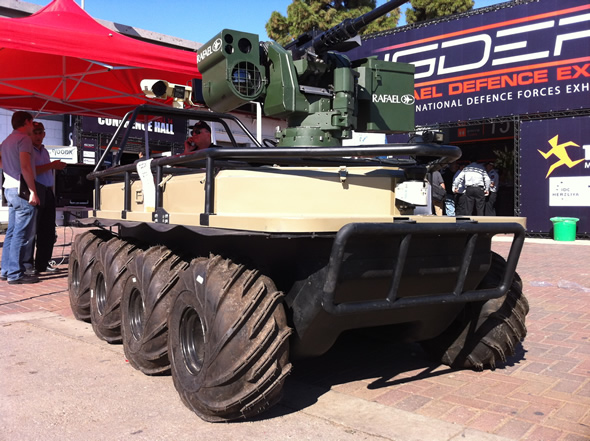
    A new robot at the show is new weaponized version of the Amstaf from Automotive Robotic Industries (ARI). The company has already displayed the security guard version in the past, and the system is currently being evaluated for airport security missions. Amstaf on Guard provides a robotic, autonomous platform that can be configured with mission specific sensors, supporting perimeter defense elements such as a smart fens, radar and motion detection systems. Other Amstaf configurations may include CBRNE, fire and EOD sensors and neutralizers as part of their payloads. The vehicle has already been operated patrolling the area south of the demilitarized zone in South Korea, where a patrol version using a telescopic mast was recently fielded.

    Amstaf Combat Support eight weel UGV mounting the Rafael Mini Samson Remotely Controlled weapon Station. Photo: Tamir Eshel, Defense update

    The combat support vehicle represents ARI’s concept of a vehicle combining the fire support and load carrying platform (mule), supporting dismounted infantry teams. “Amstaf provides an effective and versatile autonomous platform that can assume different roles in support of military and special operations units” said Amos Goren, founder of ARI. “Fitted with a remote weapon system and sensors, it can be used as an unmanned forward watch or pathfinder, replacing today’s manned vehicles and scouts. The same platform can be reconfigured in the field to carry supplies supporting dismounted teams, carry and launch guided weapons or transport wounded soldiers to safety, without risking the lives of more soldiers.” Goren added. Guidance and control of tactical robots will be performed using a Toughbook laptop computer or wrist-mounted controller, with the Amstaf understanding basic commands like ‘halt!’, ‘follow me’, for simple coordination with dismounted teams. When operating as observation outposts or mobile forward watch, the robot could be operated from fully equipped control systems already developed for the Amstaf On Guard system, enabling maximum flexibility and functionality.

    Amstaf on Guard is built to sustain up to 24 hour continuous duty cycles, with the combat support version supporting continuous missions of six hours offering quiet, stealthy operation. The vehicle has an integrated generator supplying 2.5KVA for 18 hour mission. When extended quiet missions are required a quick charge is needed, an external quick charger can top up the batteries for extra four hours in just 15 minutes. The vehicle weighs 900 kg and carries 850 kg plus one ton tow capability. the vehicle has a maximum speed of 32 km/h on land and 5 km/h swimming.

    Virtual Reality Prepares Soldiers for the Real Fight

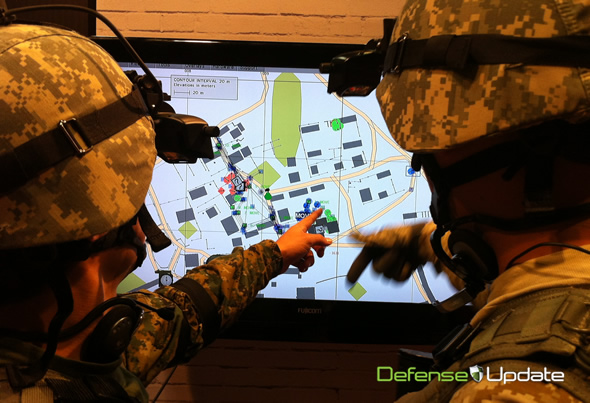
    Israeli trainees are introduced to the Quantum ExpeditionDI at ISDEF 2011. Photo: Tamir Eshel, Defense-Update

    Quantum 3D is displaying at ISDEF 2011 the ExpeditionDI wearable simulator, also known as ‘immersive dismounted infantry training platform’, the system was recently ordered by the U.S. Army will be used to help preparing U.S. forces for missions to international theaters.

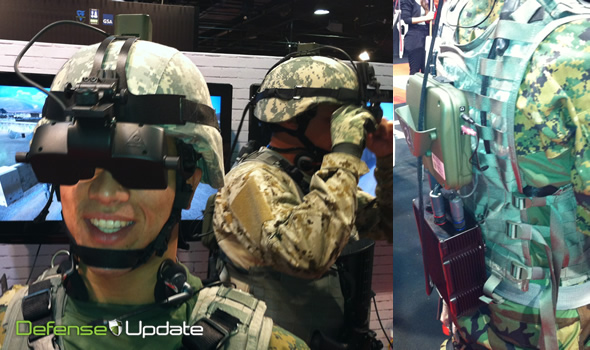
    The ExpeditionDI system comprises a wearable computer and an interface unit carried on a load bearing vest. This immersive display uses high fidelity, binocular 1280x1024 OLED displays and audio headset. Right Insert: the backpack wearable Theramite computer running the ExpeditionDI application. Photo: Tamir Eshel, Defense Update

    The system was first unveiled in 2007 and has been tested by the U.S. Special Operations Command, Army and Marine Corps through Joint Forces Command’s Future Immersive Training Environment (FITE ) since 2008. After a long evaluation, the Army recently award

    The $50 million contract was awarded to Intelligent Decisions, where Quantum as a subcontractor, is expected to deliver several thousands systems over 18 months. The evaluation of the trial batches is scheduled to begin at Ft. Bennings in January 2012, supporting the Army’s Force Generation (ARFORGEN) cycle.


    “The most dangerous time for warfighters is when they are in a new environment while learning in actual combat” says Pratish Shah, Director of Marketing at Quantum3D. Nearly 40 percent of infantry fatalities occur during just the first three months of deployment. ExpeditionDI was designed to introduce soldiers to the combat scene through immersive training, enabling them to experience the locations they are assigned too fight in, through realistic Virtual Reality (VR) environment.

    In this safe but realistic scene they can practice and rehearse future missions through individual and team-based exercises developing their combat skills, understanding the physical and human terrain.

    The system follows the movement, lines of sight and to body movements of individual trainees, displaying them the virtual world with computer generated threat and neutral elements and friendly elements depicting other trainees, all immersed in the 3D world accurately representing the unit’s objectives.

    With this platform, warfighters are not simply looking at a simulation on a computer screen from a distance, but become an integral part of the scene, with the display changing according to the diction the soldier look, and points his weapon’s sight, 3D audio cues coming from the proper origin, communications operate in realistic way and position location providing the cues relevant to the soldier’s simulated position.

    The ExpeditionDI system comprises a wearable computer and an interface unit carried on a load bearing vest. This immersive display uses high fidelity, binocular 1280×1024 OLED displays and audio headset. The display area is determined by the helmet mounted head motion tracker, porting the trainee’s line of sight and position. Weapon position trackers and body posture tracker are complementing the system, weapon’s aiming and effect, and basic body postures such as tracking standing, crouching and prone positions.

    Israeli trainees are introduced to the Quantum ExpeditionDI at ISDEF 2011. Photo: Tamir Eshel, Defense-Update

    CTI Unveils the Octopus, Wearable Computer for the IDF

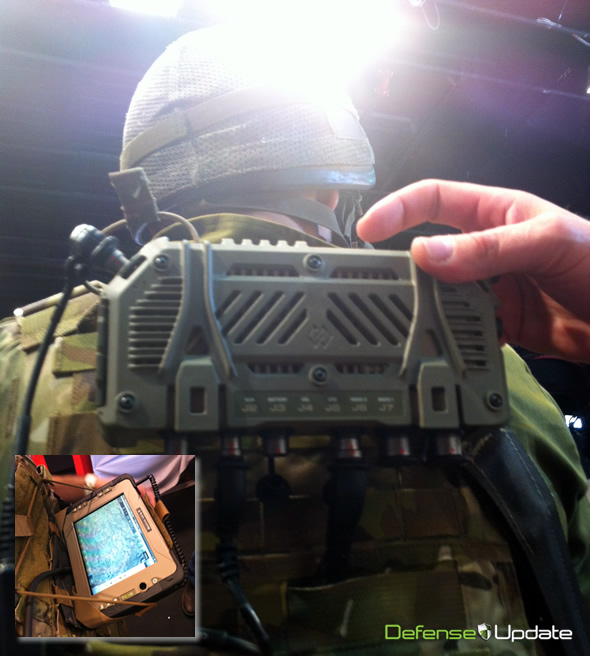
    The Modular Tactical System (MTS) is already operational with various special forces and is one of the candidates for the US Army Nett Warrior (NW) soldier system wearable computer. Photo: Tamir Eshel, Defense-Update

    At the Israeli ISDEF 2011 defense show ComputerTech International (STI) has unveiled several Commercial Off The Shelf (COTS) computers designed for military operations, introducing higher performance yet cost effective computing solutions for military users. The new Tamnun (Octopus in Hebrew) was developed to support the IDF dismounted command and control system.

    CTI developed the DACS system based on of the shelf hardware to provide an advanced, yet affordable wearable computer. Photo: Tamir Eshel, Defense-Update

    Originally the IDF considered a fully militarized solution, but the Digital Army Computer System (DACS) was proven to deliver more affordable and flexile solution using off the shelf hardware which typically advances faster than military systems. DACS is now being integrated with the IDF Digital Army System (Zayad) army-wide C4I system provided by Elbit Systems.

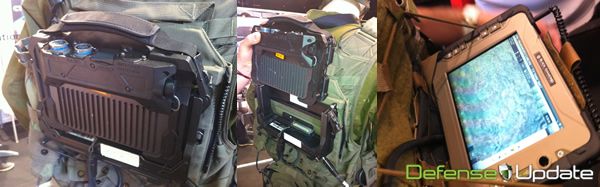
    At a weight of 7.76 lbs. (3.52kg) DACS comprises a computer ‘core’ provided by Black Diamond, integrated with GPS receiver and customer specific interface panel mounted on a wearable dock and universal tactical display carried on the soldier’s chest. Both elements are mounted on a load bearing harness. The IDF configuration also comprises an external battery pack supporting almost nine hours of operation for the entire suite. The rugged computer is designed to Mil-Spec 810F standard and sealed to IP67 immersion, enabling continuous use in harsh combat conditions.

    DACS uses the new Intel Celeron M 1.2GHz processor, powered by hot swappable 3850 mAh batteries. The magnesium made made dock weighs only 760 grams, interfacing with the computer through a integrates high speed data and power connector. The dock has multiple USB, RS232 and Ethernet connections, battery input and multiple display connectors. The dock also provides connectivity to backpack radio, integrating into a wearable soldier system. The dock is designed to be used as a wearable backpack system or a vehicular mount, enabling the soldier to pull a computer from the vehicle straight into his wearable system, with no loss of data. The UTD has a 6.5 inch sun-visible XGA (1024×768) display, it also features USB and power input connectors.

    According to Eyal Shachi, CEO, the system was developed specifically to address the IDF requirement for using COTS based hardware where possible. In addition to the DACS, CTI has also displayed at ISDEF the new Modular Tactical System, developed by Black Diamond for the U.S. military. MTS is lighter and less powerful compared to the DACS, which also uses a Black Diamond computer. The system uses an Intel Atom 1.1 or 1.6 GHz processors running Windows XP, 7 or Linux operating systems; similar to DACS, the system uses a computer, wearable dock and display, mounted on a load carrying vest. System expansion utilizes standard SD cards supporting up to 32GB additional memory. The display uses the same 6.5 inch display used by the DACS. The overall weigh of the MTS is about two pounds less than DACS. The computer has five programmable buttons and dedicated on-screen ‘hot zones’ for ease of use in the field. MTS is now available for the U.S. military And international users As an ITAR exportable Commercial Off The Shelf (COTS).

    A derivative of this Black Diamond Modular Tactical System (MTS) shown here is also offerred for the U.S. Army. Insert: the 6.5 inch Universal Tactical Display (UTD) is common to the DACS and MTS displayed at ISDEF by CTI. The unit folds on top of the body armor vest, at the chest level. When opened, the user can monitor the display while operating other systems (like weapons, observation equipment or radio) with both hands. Photo: Tamir Eshel, Defense-Update

    Israel’s INSS Report Follows Trends in Middle-East Military Powers

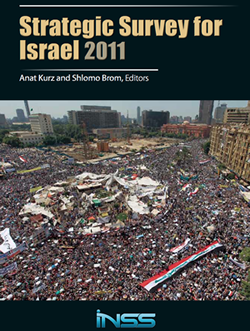
    Strategic Survey for Israel 2011
    Strategic Survey for Israel 2011

    The Despite the turmoil of the ‘Arab Spring’ uprising in many Arab states, the Middle East continues to be one of the world’s leading markets for defense systems. Israel’s Institute of National Security Studies has released the annual assessment of Middle East military forces. Following is a short assessment by the editor of the report Yiftah S. Shapir.

    The report is part of the new publication “Strategic Survey for Israel 2011” Edited by Anat Kurz and Shlomo Brom, this volume includes thirteen analytical essays written by INSS researchers. Focus is on Israel’s strategic environment in the period under review, particularly in the wake of the major changes experienced in the Middle East commonly known as the “Arab spring.” The ongoing Palestinian issue and Iran’s nuclear program remain at the fore of the challenges facing Israel. Other issues explored in the volume include the “new” Middle East and the role of the superpowers;Turkey’s regional role; and questions of particular urgency to Israel, including the deligitimization threat, military and civilian defense, and economic challenges.

    Middle East arms acquisitions are dominated by Persian Gulf markets, as these states perceive a growing threat from Iran’s drive toward regional hegemony. The fact that all the countries along the coast of the Gulf procured and deployed Patriot SAM batteries with added capabilities against ballistic missiles is testifying to the severity of the threat they perceive. Iraq is investing large amounts of money to rebuild its military from scratch, while Iran, unable to acquire weapons in the open markets is relying mostly on its indigenous industry.

    Israel continues to implement the lessons of the Second Lebanon War (2006) and Operation Cast Lead (2008-9). It continues to buy advanced fighter jets and surveillance and early warning planes and expand its satellite capabilities. At the same time, it has accelerated the rate of outfitting the military with anti-rocket systems and with better protected armored personnel carriers and tanks.

    The Arab Maghreb is also arming itself. Algeria is absorbing its acquisitions from Russia and from Europe, while Morocco is making an effort and stretches its limited resources to renew its military with acquisitions in the US and Europe.

    As a result of the recent developments in the region, most of the Arab states that are not monarchies are undergoing changes. In some cases these changes have already affected the command structure and the military forces (e.g., in Libya, Syria, and Yemen), and are expected to affect existing and future programs (e.g., in Egypt).

    In summary, INSS assessment expects states with financing capabilities will continue to arm themselves with precision guided weapon systems, aerial warning systems, and intelligence. At the same time, the threats of guerrilla warfare and terrorism originating in the region and in neighboring countries will increase the importance of arms dedicated to fighting terrorism, defending against rockets and missiles, and protecting population centers. Since arms deals are processes that proceed slowly, trends in arms acquisitions presented in previous recent INSS annual publications are still valid.

    These include: acquisitions of the most advanced and sophisticated weapon systems, primarily by oil-rich countries; efforts to develop indigenous military industries; and reduction of expenses by upgrading older weapon systems rather than purchasing new ones. The countries in the region with limited monetary resources that do not receive defense assistance from the US cannot compete in the advanced weaponry market. Instead, they tend to adopt asymmetrical approaches that enable them to counter the technological advantages of their rivals. They rely on guerilla warfare and terrorism on the one hand, and on the other hand, on strategic capability offered by ballistic missiles, artillery rockets, and weapons of mass destruction. Non-state actors such as Hizbollah and Hamas continue to develop semi-regular military forces with large inventories of artillery rockets, as well as anti-tank and anti-aircraft capabilities.

    The US remains the biggest weapons supplier to the region. Russia has also made attempts to extend its market share in the region, but so far with limited success. Other important players are key European Union countries, particularly France and the UK. In addition, indigenous military industries play an important role in some states in the region. Israel and Turkey operate the most advanced industries, while the UAE is investing extensive resources to build its own military industry. Iran too aims to be as autonomous as possible in its weapons production, although its industry’s actual capability is far smaller that what is officially declared.


    Following are some of the defense modernization and procurement highlights for 2011, by country:

    Algeria

    Algeria is in the midst of a massive military expansion. At the heart of this expansion is a large weapons deal with Russia (approximately $8 billion). Within the framework of this arms deal Algeria received 180 T-90 tank and

    28 Su-30MKA combat aircraft. The first batches of these aircraft arrived in 2007 and are already operational. Recently Algeria signed a further contract for additional Su-30. Algeria received two Il-78 refueling aircraft and its air defense forces received some Tunguska and Pantsyr point defense systems, although no heavy systems, such as the S-300 PMU-2, arrived. Aside from the Russian deal, Algeria signed a large deal for some 30 utility helicopters of several types from Italy. This deal follows a previous deal for ten helicopters that were already supplied.

    The Algerian navy received two Type 636 submarines, but there is no news regarding its intention to acquire four frigates. This deal is still under negotiations with potential suppliers in France, Germany, Italy, and Great Britain. Meanwhile Algeria began taking deliveries of its FPB-98 small patrol boats from France.

    Another significant development was the launch of Algeria’s first satellite with some military capabilities: the ALSAT-2A. This satellite carries a multi-spectral camera with resolution of 2.5m, manufactured by EADS Astrium. A second satellite is being assembled in Algeria.

    Egypt

    Egypt, like Israel, benefits from ongoing American defense aid and recieves $1.3 billion a year. An agreement signed in 2007 ensures Egypt continued aid at least until 2018, which enables Egypt to purchase American-made weapons without having to worry about economic difficulties. The future regime in Egypt will likely make efforts to maintain this aid, and therefore Egypt’s armament programs will not change course abruptly.

    Egypt, which already boasts a substantial fleet of 217 F-16s, has ordered 20 more of these multi-role combat aircraft for $3.2 billion. Apart from this deal, Egypt’s primary deals in recent years have included AH-64D Apache attack helicopters (though the acquisition of the Longbow radar system for these helicopters has not yet been approved) and additional M1A1 Abrams tanks. These tanks are bought as kits for assembly in Egypt. Since starting to purchase these tanks, the Egyptian defense industry has assembled 880 tanks, and the new transaction, now underway, includes an additional 125 tanks.

    Egypt also buys weapons from other sources, finances permitting. It is negotiating with Germany to buy Type 214 submarines (a model quite similar to the Israeli Dolphin class submarines). It maintains military contacts with Russia and other former Soviet Union countries – both for the upgrade of its aging Soviet era weapons (such as the recent upgrade of APCs in the Ukraine), and for acquisition of new weapon systems – such as the recent acquisition from Russia of Strelets point defense SAMs. In addition, the Egyptian navy has a standing order for four fast missile patrol boats from the US, the first of which is scheduled to be delivered in mid 2012.

    Iran

    Iran is in the midst of a long process of rearming its military, although reliable weapons suppliers are scarce because of the Security Council sanctions in force. Hopes for large arms deal with Russia were shelved as Russia, in light of the sanctions, officially declined to supply Iran with S-300 air defense systems ordered (and paid for) by Iran.

    Iran continues to arm itself with locally produced arms, mainly missiles and rockets. In the field of long range ballistic missiles, Iran has made

    progress on two tracks: in the first track, Iran based its efforts on liquid fueled missiles, such as the Shehab-3. On the basis of this technology Iran developed the Safir-e-Omid satellite launcher, a two stage missile that launched the Kavoshgar research capsule and the Omid satellite in February 2009. A further development in the same direction was the heavy satellite launcher Simorgh, which was displayed in public but not yet tested. Another development in this direction was the Qiam-1 missile, test-launched in August 2010, probably to test new guidance and control systems. In the second track, Iran is also developing a two stage solid fuel powered surface-to-surface missile intended to reach a range of up to 2000 km. This missile, alternatively known as Ghadr, Sejjil, or Ashura was tested for the first time in November 2007 (and again in May and December 2009 – and possibly in early 2011 as well). These missiles will likely become operational within a few years.

    It is harder to estimate Iran’s true R&D and production capabilities in other fields. The Iranian media reports regularly about the development of innovative weapon systems – tanks, armored personnel carriers, fighter planes, helicopters, various missiles (sea-to-sea, air-to-air, air-to-ground, surface-to-air), and more – but it is difficult to distinguish between propaganda and actual progress. For example, only recently the Iranian media reported on new precision guided munitions for combat aircraft and helicopters, new air defense systems, and new versions of coastal defense missiles, as well as the construction of a new destroyer and mini submarines. It does not seem that Iran is in fact capable of producing all the types and models it professes to produce in significant quantities Iran is certainly capable of producing several models of artillery rockets and perhaps some anti-tank and sea-to-sea missiles (based on Russian and Chinese designs). However there is no evidence, for example, that Iran is producing fighter planes with real capabilities of engaging in a modern battle, although it claims to have this capability.

    Iraq

    The process of rebuilding the Iraqi military is taking longer than expected, and has been accompanied by a host of problems, including the lack of suitable personnel and graft and corruption connected to questionable arms deals. In purchasing, the Iraqi army is mostly engaged in basic outfitting of a military force. However, investment in rebuilding the army will also be complicated by the withdrawal of the remaining US forces, which have thus far guaranteed the day to day security of the country.

    Sources for arms acquisitions are varied. The US supplied Iraq with its first M1A2 Abrams main battle tanks, APCs, T-6A training aircraft, helicopters, and fast patrol boats. France supplied helicopters; Ukraine supplied APCs; Russia supplied Mi-17 helicopters, and Serbia supplied more training aircraft. The Iraqi government also announced its intention to procure F-16 combat aircraft, but no contracts have yet been signed

    Morocco

    Morocco is yet another country in the region that has undergone a substantial military buildup in recent years. After long and heated competition between suppliers, the Moroccan air force decided to procure 24 F-16 multi-role combat aircraft. These aircraft have apparently already been supplied. In addition, the Moroccan air force procured 24 T-6A Texan II trainers (12 of which have already been supplied), as well as four C-27J transport planes.

    The Moroccan navy became the first export customer for the new French made FREMM frigates when it signed a deal for one such frigate, which is now being constructed in France.

    Saudi Arabia

    When the deal was signed in 2007, Saudi Arabia’s acquisition of 72 Typhoons from the UK, at an estimated cost of $7.9 billion, was the most impressive deal in the Middle East. At the same time, Saudi Arabia also ordered upgrades for its Tornado and for its F-15S combat aircraft. Other major deals that exceeded the Typhoon deal have since followed. Another major deal, signed in mid 2009, involves an upgrade to the Saudi Arabian National Guard (SANG). The contract, worth some $2.2 billion, is for the acquisition of different types of combat armored vehicles. The upgrade program is typically divided between the US and France, from which SANG ordered new artillery pieces.

    Additional arms orders include more M1A2 tanks from the US, as well as upgrades for existing tanks – a transaction of some $3 billion. This project also includes setting up a large facility that will assemble the tanks in the kingdom. In late 2010 the US administration approved further sales valued at $60 billion. These include the sale of 84 new F-15S combat aircraft, as well as upgrade of the existing F-15S in Saudi inventory, and hundreds of helicopters – AH-64D Apache attack helicopters and UH- 60 M Black Hawk utility helicopters, as well as light reconnaissance helicopters – for the Saudi land forces and for the Saudi National Guard. These authorizations have yet to be turned into actual contracts but they are indicative of Saudi intentions, as well as US willingness to support the country.

    UAE

    The UAE armed forces are among the military forces that have grown most intensively. The UAE, like other Gulf states, prefers to deal with a variety of vendors and buys primarily from the US and France. The UAE beefed up its air force with 63 Mirage 2000-9 planes from France and 80 F-16E/F planes, a model developed specifically for the Emirates, and the country has continued to procure equipment for the air force, navy, and air defense forces. It signed a deal to upgrade the 30 Apache helicopters to the AH-64D model, and ordered three Airbus A330 refueling aircraft. More recently it ordered twelve C-130J tactical transport aircraft as well as six C-17 Globemaster strategic transport aircraft.

    The Baynunah ships project has been underway for several years. These corvettes were designed in France, and the first of them is being built by the CMN shipyard in Cherbourg, France. The rest are constructed in Abu Dhabi by ADSB. Despite the French design and local manufacture, some of the armaments will actually be American-made. Thus, for example, the UAE has ordered RAM missiles from Raytheon Corporation to defend the ships against cruise missiles.

    The UAE is investing heavily in air defense systems and ballistic missile defense systems that will be supplied in the coming years in different deals estimated at some $9 billion. In the realm of air defense, the UAE was scheduled to receive the Russian-made Pantsyr S-1 systems, short range mobile air defense systems developed in Russia at the UAE’s request and with its funding. It will also include in the short term upgrades for the Patriot missile batteries it already has and purchases of the PAC-3 interceptors (for ballistic missile interception) for these batteries. In the longer run it will include the purchase from the US of THAAD dedicated anti-ballistic missile defense systems. The value of this transaction is estimated at about $7 billion.

    U.S. & Canada Defense Update – October 27, 2011

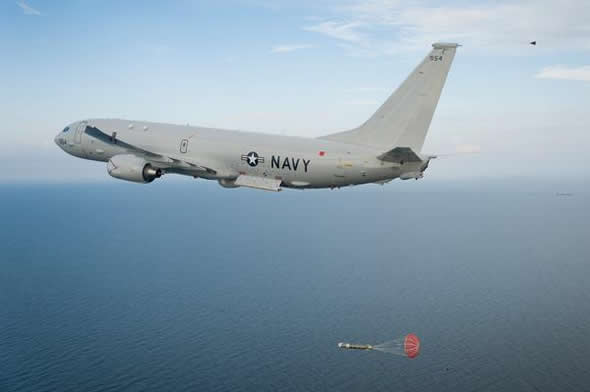
    Boeing P-8A Poseidon T3 performs the first Mk54 Torpedo separation test
    GDLS Stryker

    GDLS to Equip Two Brigades with Double-Hull Strykers

    October 25, 2011: Over a year after receiving the first order for the new Double-V hulls (DVHs) version of its 8×8 Piranha vehicle design, production and modification of the new vehicles are running at full steam.

    Following an order for 550 LAV III vehicles worth over one billion US$ from Canada, General Dynamics Land Systems won other orders this month, an award of $367 million to deliver 177 Stryker combat vehicles equipped with DVH. This award comes in addition to a similar $267 million order for 115 vehicles awarded earlier this month. Combined with previous orders for DHVs, this production order will provide the U.S. Army with vehicles to equip two Stryker brigade combat teams by July 2013. GDLS delivered the first vehicle Stryker DVH in May 2011, following 14 months of development. (Defense-Update)

    Litening Pod on the F-16

    Northrop Grumman Delivers Litening G4 Advanced Targeting Pods

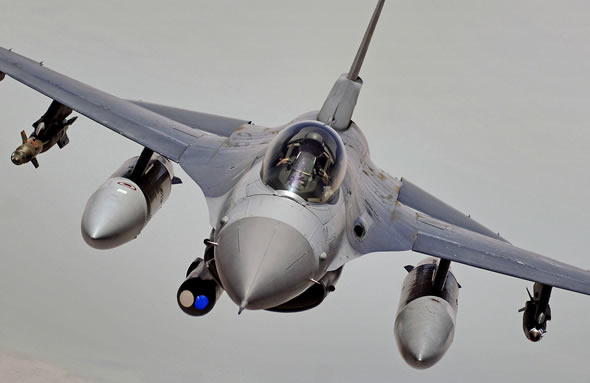
    October 22, 2011: The Northrop Grumman Corporation has completed delivery of the first 50 Litening G4 Advanced Targeting Pods under a U.S. Air Force contract. Litening G4 offers enhanced imaging capability, with wider field of view, better target identification at longer ranges than previous versions. The new pod has begun full operations at its first military base with seven additional base deployments planned in the near future.

    Canada's Upgraded LAV III

    Canada to Upgrade LAV III for One Billion US$

    October 21, 2011: General Dynamics Awarded $1 Billion to Upgrade LAV III Vehicles by Government of Canada. The LAV III Upgrade Project will modernize 550 vehicles, significantly enhancing their survivability, mobility and firepower and extending the fleet’s lifecycle to 2035.

    Boeing P-8A Poseidon

    P-8 launches First MK 54 Torpedo

    October 13, 2011: The P-8A Poseidon successfully launched the first MK 54 torpedo during a test event in the Atlantic Test Range Oct. 13. The test verified safe separation of the MK 54 weapon from the P-8A. Future tests will evaluate delivery accuracy, weapon integration, and end-to-end test. (More on the P-8A from defense-Update)

    Recent & previous reports:
    U.S. & Canada Defense Update – October 4, 2011
    U.S. & Canada Defense Update – September 25, 2011
    U.S. & Canada Defense Update – September 2, 2011

    GDLS to Deliver Double-V-Hull Strykers to Equip Two Brigades

    Over a year after receiving the first order for the new Double-V hulls (DVHs) version of its 8×8 Piranha vehicle design, production and modification of the new vehicles are running at full steam.

    Following an order for 550 LAV III vehicles worth over one billion US$ from Canada, General Dynamics Land Systems won other orders this month, an award of $367 million to deliver 177 Stryker combat vehicles equipped with DVH. This award comes in addition to a similar $267 million order for 115 vehicles awarded earlier this month. Combined with previous orders for DHVs, this production order will provide the U.S. Army with vehicles to equip two Stryker brigade combat teams by July 2013. GDLS delivered the first vehicle Stryker DVH in May 2011, following 14 months of development.

    The average cost per vehicle, as reflected by these recent orders is US$1.8 – 2 million.

    The Double-V-Hull adds to blast protection to the Stryker armored vehicle, designed primarily to provide protection from small caliber weapons. Photo: U.S. Army

    Over 320 double-V-hulled Stryker vehicles have been produced so far, under a contract awarded in July 2010 for the production of 450 DVH vehicles. The double-V hull was developed on an accelerated timeline to provide Stryker-borne soldiers increased protection from the effects of roadside mines and improvised explosive devices. Recent Army reports indicate that deployed vehicles with the new double-V-hull design are providing significantly increased protection and survivability to soldiers.

    These vehicles will be delivered in seven variants including Infantry Carrier, Medical Evacuation Vehicle, Engineers Squad Vehicle, Fire Support Vehicle, Commanders Vehicle, Mortar Carrier Vehicle and Anti-tank Guided Missile Vehicle. GDLS also offers Reconnaissance Vehicle, Nuclear Biological Chemical Reconnaissance Vehicle and Mobile Gun System variants. Work on double-V-hulled Stryker vehicles is performed in Anniston, Ala., Lima, Ohio, and London, Ontario, Canada.

    The Stryker vehicles have gone through phased upgrades to meet the escalating threats in Iraq and Afghanistan. The new hull will also address the devastating blast effects caused by mines and IEDs.

    In addition to the U.S. Army, the Canadian Army will also field the DVH on its LAV III armored vehicles.

    Oman Requests SL-AMRAAM, Avenger Air Defense Systems

    Oman is requesting to receive an integrated air defense system based on the Boeing Avenger very short range air defense (VSHORAD) system, augmented with Surface launched medium range AIM-120 AMRAAM interceptors. The Defense Security Cooperation Agency (DSCA) estimates the value of this potential order at US$1.28 Billion. The package includes 18 fire units, an Improved AN/MPQ-64F1 Sentinel radar and 290 AIM-120C-7 290 AIM-120C-7 Surface- Launched Advanced Medium Range Air-to-Air Missiles. The system will also comprise six guidance sections, grouping self sustained elements comprising three fire units each.

    In April 2011 Raytheon has demonstrated the SL-AMRAAM capability to intercept a cruise missile, addressing one of the concerns of the Gulf states (UAE and Oman) seeking effective defenses against Iranian cruise missiles. Photo: Raytheon
    A larger version of the Avenger, mounting two AIM-9X and four Stinger missiles was displayed at the AUSA 2010 exhibition, mounted on an M-ATV vehicle. Photo: Tamir Eshel, Defense Update

    The announcement did not specify what platform will carry the SL-AMRAAM or, if it will be integrated on the Avenger system or operated independently on other launchers not listed in the package.

    Raytheon has originally developed the SL-AMRAAM system for the U.S. Marine Corps. After the corps cancelled the program SL-AMRAAM caught the interest of the U.S. Army, specifically, the AIr National Guard, which considered it a viable path for the Avenger upgrade. Despite this interest, in January 2011 but the program was terminated, but funding was provided to complete development and testing, maintaining the system for emergency operational capability and supporting export sales.

    In 2008 the DSCA announced the UAE expressed interest in buying Avengers and 288 SL-AMRAAM air defense weapons for $445 million. the UAE would have been the first customer of the system. No platform for the SL-AMRAMs was mentioned in this announcement either.

    Earlier this year Raytheon has demonstrated the SL-AMRAAM capability to intercept a cruise missile, addressing one of the concerns of the Gulf states (UAE and Oman) seeking effective defenses against Iranian cruise missiles.

    Raytheon displayed several configurations of SL-AMRAAM integrated with other missiles, but only two were mounted on the compact HMMWV. An SL-AMRAAM system integrated with AIM-9X sidewinder was displayed by Raytheon while Boeing have shown their version of the Avenger system integrated with the AIM-9X, at the 2010 AUSA exhibition.

    While the Boeing Company is the prime contractor of the Avenger system, Raytheon will be the largest beneficiary of this package, providing the two types of interceptors, as well as the software and hardware for the radar and fire control systems.

    Asia Pacific Defense Update – October 26, 2011

    Kawasaki Heavy Industries MCH-101 (Mine Countermeasure Helicopter) Photo: Kurokishi
    Kawasaki Heavy Industries MCH-101 (Mine Countermeasure Helicopter) Photo: Kurokishi

    Northrop Grumman to Equip Japan’s MCH-101 Mine Countermeasure Helicopters

    October 26, 2011: Northrop Grumman Undersea Systems business unit has been selected to supply the AQS-24A airborne mine-hunting system to the Japan Maritime Self-Defense Force. The system will be integrated with the Kawasaki Heavy Industries MCH-101 (Mine Countermeasure Helicopter. The AQS-24A high speed mine-hunting system is operated by the U.S. Navy, towed from the MH-53E helicopter. According to Northrop Grumman the system can be adapted to the smaller Japanese MCH-101 aircraft. The system operates the sonar and laser simultaneously, thus improving area coverage rate, shortens the mine clearance timeline and alleviates unnecessary maintenance cycles. The laser line scanner that provides precision optical identification of underwater mines and other objects of interest.

    Japan’s parliament Members Hacked

    October 25, 2011: Computers in Japan’s lower house of parliament were targeted by cyber attacks from a server based in China that left information exposed for at least a month. Passwords and other information could have been compromised in the attacks, which began in July but were not reported to security authorities until the end of August. It was not clear who was behind the attack, which first struck a lower house politician that opened an attachment to an e-mail in late July. The virus infection continued through the network until late August.

    P10412 Patrol Boat

    Vietnam Receives New Patrol Boats from Russia

    October 25, 2011: Vietnam has accepted two Project 10412 patrol ships built in Russia by Almaz Shipbuilding. The boats are export versions of the Project 10410 Svetlyak  patrol ship developed by Almaz Design Bureau in late 80’s for Soviet KGB Coast Guard. The Vietnamese Navy already operate two boats of this type, delivered in 2002. Two additional vessels are under production at JSC Vostochnaya Verf in Vladivostok, slated for completion by 2012. Vietnam is seeking to strengthen its control of certain disputed areas in the South China Sea, particularly, near Spratly Archipelago and Paracel Islands, where fishery areas, oil and gas reserves exist.

    Philippines to Invest US$230 Million in Military Modernization

    October 25, 2011: Philippines President Benigno Aquino III has ordered the release of 10 billion Philippine Peso (about US$230 million) for military modernization programs, including $40 million funding three new aircraft – a special mission plane and two light cargo aircraft. The Philippine Navy will get a strategic sealift vessel for $50 million. In addition, the 2011 budget will fund two search and rescue helicopters, 30 special purpose vehicles and 15 amphibian vehicles for the Navy. The Philippine Army will use $30 million for procurement of 14 armored personnel carriers, personal protection gear and manpack radios. Additional funding will cover buying 32 five-ton dump trucks and 55 special purpose vehicles and 150 mortars, 100 sniper rifle systems and 2,000 standard weapon systems. The Army also will get 1,376 handheld radios, 210 AV configuration radios and 100 base radios.

    Past Reports

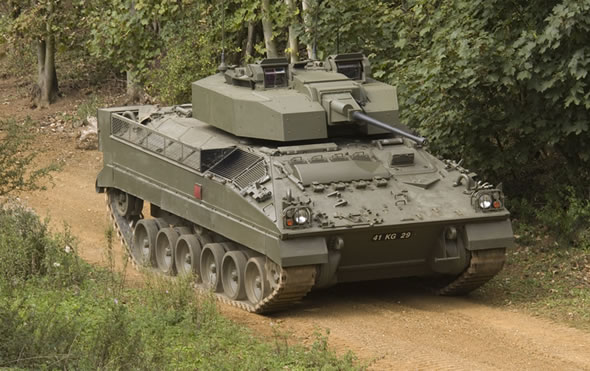
    British MOD Launches £3 Billion Warrior Upgrade

    The Warrior has been in service with the British Army since 1989 and has distinguished itself on the battlefield throughout its extensive deployments, including in Kuwait, Bosnia, Kosovo and Iraq, and it continues to do so in Afghanistan. The WCSP upgrade will add a new turret, enhanced lethality and protection, extending the vehicle's life span for the next 25 years. Photo: Lockheed Martin UK

    The British Ministry of Defense has finally launched the billion pound (US$1.6 billion) worth Warrior Capability Sustainment Program (WCSP) that will extend the vehicles’ service life to beyond 2040, ensuring that Warrior continues to play an essential role in future land operations. The upgraded Warriors are expected to enter service by 2020, with the first deliveries beginning in 2018.

    The Warrior has been in service with the British Army since 1989 and has distinguished itself on the battlefield throughout its extensive deployments, including in Kuwait, Bosnia, Kosovo and Iraq, and it continues to do so in Afghanistan. The WCSP upgrade will add a new turret, enhanced lethality and protection, extending the vehicle's life span for the next 25 years. Photo: Lockheed Martin UK

    The vehicles will be fitted with a new turret built by Lockheed Martin, mounting a stabilized 40mm Case Telescope Ammunition, offering improved firepower and lethality. The new cannon will be provided by the Anglo-French co-operation through CTA International, a joint venture between BAE Systems Global Combat Systems Munitions and Nexter Munitions. The turret will also employ new armor system offering modular upgrades in the future. The upgraded Warriors will also benefit from a new electronic architecture, which will be able to work with advancing technology.

    Lockheed Martin UK will develop and manufacture the upgraded package vehicles along with similar turrets developed for the FRES SV vehicle. Lockheed martin UK will get the lion’s share of the program, £642 million  will create and sustain around 600 British jobs across the country within Lockheed Martin UK and its supply chain. Among the members of the Warrior Transformation Team (WTT) established by Lockheed Martin are Ultra Electronics; the Defence Support Group; SCISYS; Rheinmetall Defence; Curtiss Wright; Thales UK; Moog; Meggitt; CTA International; Westwire; TKE; MTL and Caterpillar UK.

    The British government recently announced its commitment to a one-per-cent-a-year real-term increase in the MOD’s equipment and support budget from 2015 – the equivalent of an extra £3 billion.

    The Warrior has been in service with the British Army since 1989 and has distinguished itself on the battlefield throughout its extensive deployments, including in Kuwait, Bosnia, Kosovo and Iraq, and it continues to do so in Afghanistan.

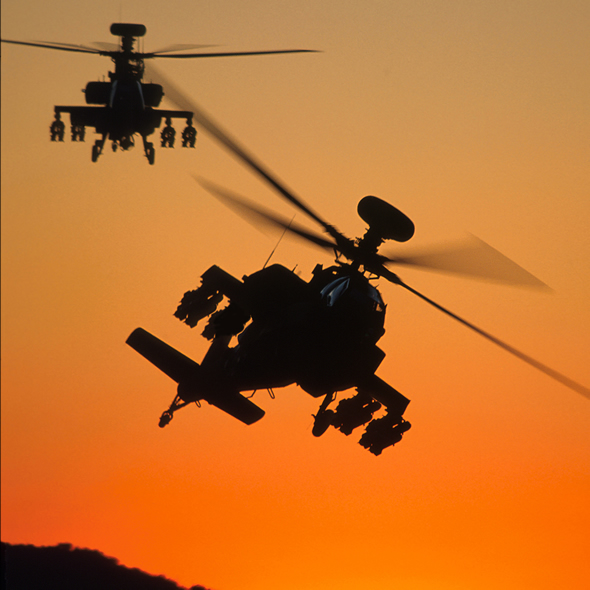
    Apache Block III Remains the Finalist in India’s Attack Helicopter Selection

    Indonesia will receive eight Apache AH-64E for $500 million arms package to be signed with the USA
    The U.S. Boeing AH-64D Apache Block III remains the finalist in the Indian Army evaluation of attack helicopters. The planned procurement of 22 attack helicopter is expected to commence soon. Photo: Boeing

    Russian news agency Novosti reported today the Russian candidate for the Indian Army procurement of 22 attack helicopter, has not met Indian requirements and has dropped from the competition, leaving the Boeing AH-64D Apache Block III the only competitor. According to the agency’s Russian sources the Russian Mi-28N ‘Night Hunter’ failed in meeting 20 criteria, mostly on technical ground and maturity issues involving its sensors and combat systems integration. Russia was ready to offer the 22 helicopters at a flyaway cost of $600 million, less than half the value the Pentagon mentioned in the notification to Congress in 2010.

    While this may pave the way for New Delhi to select the Apache, being left as a sole bidder could actually delay the process of ordering the U.S. helicopter since sole bidder programs are extensively regulated under new anti-corruption policies. Selecting the AH-64D will also pave the way for India to receive the AGM-114L-3 Hellfire Longbow anti-tank guided missile for the first time. The failure of the Russian helicopter also means a setback for the two companies counting on providing the weapons for the helicopter – European MBDA Missile Systems and Israel’s Rafael Advanced Defense Systems. Both competed on supplying the missiles for the Mi-28N or Ka-52 helicopters, hoping to win a ‘short cut’ into future Indian Army and Air Force programs.

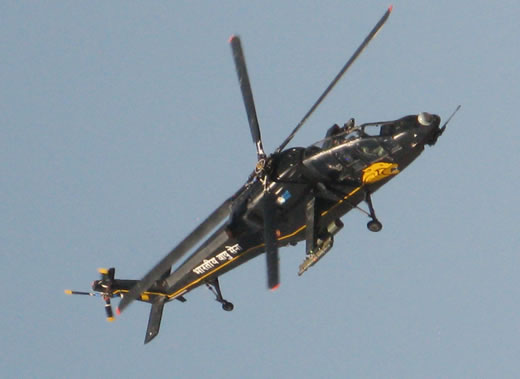
    India plans to field one of these missiles another anti-tank guided missile with a weaponized version of the Hindustan Aeronautics Ltd. (HAL) Advanced Light Helicopter (ALH). This ‘Weapon Systems Integrated’ Dhruv Mk.3 (‘Rudra’) is currently being completed at HAL and will be made available for the testing soon. Field evaluation trials (FET) of the MBDA Missile System’s Pars 3 LR and Rafael Advanced Defence System’s Spike-ER, both ‘fire-and-forget’ anti-tank guided missile (ATGM) are expected to commence as soon as HAL delivers the Rudra for testing.

    India is expected to field another ‘third generation’ missile with its Light Combat Helicopter (LCH) fleet, slated to replace the Mi-25/35 currently in service with the Air Force and Army. The Indian MOD determined that as a fully indigenous program, the missile to be used with the LCH will be the NAG, developed by India’s Defense research & Development Organization (DRDO).

    India plans to field over 179 Hindustan Aeronautics Ltd. (HAL) Light Combat Helicopter (LCH), configured to carry the NAG anti-tank guided missile. The Indian Army plans to buy 114 such helicopters with the Air Force fielding 65. Photo: Defense-Update

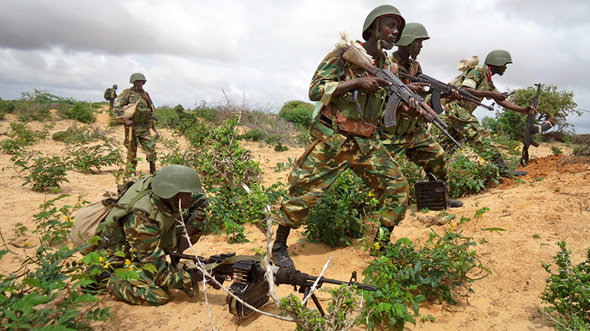
    Kenyan Forces Enter Somalia Fighting al-Shabaab Militias

    Kenyan troops advancing into Somalia.

    With the Libyan campaign wrapping to an end, a new theater is broiling in Somalia, as Kenyan land forces are operating in southern Somalia, in an effort to route Al-Shabaab militants bases in townships near the Somali South-East border with Kenya. Like the Libyan campaign, the kenyan forces are assisted by foreign air and naval support. (Kenya Daily Nation)

    AU troops operating in Somalia.

    Senior American officials in Washington said Sunday that neither the United States military nor the Central Intelligence Agency had carried out airstrikes in Somalia in recent days. One of the officials, who follows American military operations closely, said the Kenyan offensive had forced many Shabab fighters and commanders to disperse, making them easier potential targets, but emphasized that there had been ‘no U.S. military strikes in Somalia at all recently.’ (New York Times)

    Arba Minch airfield in Southern Ethiopia was officially confirmed as an operating base for the U.S. Air Force MQ-9 Reaper unmanned reconnaissance and attack drones in Africa. It is believed to be one of the new operational bases to support the U.S. Africa Command in theater. The red circle depicts the 1,000 nautical miles combat range of the Reaper, as confirmed by the Air Force. Source: Google Earth

    The U.S. has recently completed a forward operating facility at the Arba Minch civil airfield in southern Ethiopia, where MQ-9 Reaper drones are operating on counterterrorism missions, U.S. military officials told the Washington Post. According to the Washington Post story, a small annex was built at the base to house a fleet of drones that can be equipped with Hellfire missiles and satellite-guided bombs. The Reapers began flying missions earlier this year over neighboring Somalia, where the United States and its allies in the region have been targeting al-Shabab, a militant Islamist group connected to al-Qaeda. Officially, the Ethio­pian Foreign Ministry deny the presence of U.S. drones in the country.

    Kenya said it was retaliating for a series of raids by Somali gunmen who have attacked and abducted foreigners from Kenyan territory. On its side of the border the Kenyan security forces are launching a crackdown on Kenyan residents suspected to be helping al Shabab.

    During the six-day campaign in six towns have already been captured in southern Somalia, including the pirates’ haven of Ras Kamboni, Dhobley, Tabda, Beles Qooqani, Oddo and Kolbio. Currently, Kenyan Army troops are heading toward the town of Afmadow, a junction town controlling transportation lines from Kismayu inland, where the militias are believed to be grouping to face the Kenyans, assisted by other Somalian forces loyal to the Transitional Federal Government (TFG). meanwhile, a French naval gunship patrolling Somali waters is engaging al-Shabab targets along the coastline, in the town of Kuday, south of Kismayu.

    The main objective of the current campaign is the town of Kismayu, and nearby ports of Marka and Baraawe, providing the main source of revenue for al Shabaab, from port fees, business taxes and smuggling, providing the militant group over US$110 million per year. (Map link: New York Times)

    Kenya are increasingly concerned about the prospect of al-Shabab attacking Kenya’s capital, Nairobi, and westerners. Last week, al-Shabab threatened to bring the ”flames of war” to Kenya.

    Iron Dome in Action: A Preliminary Evaluation

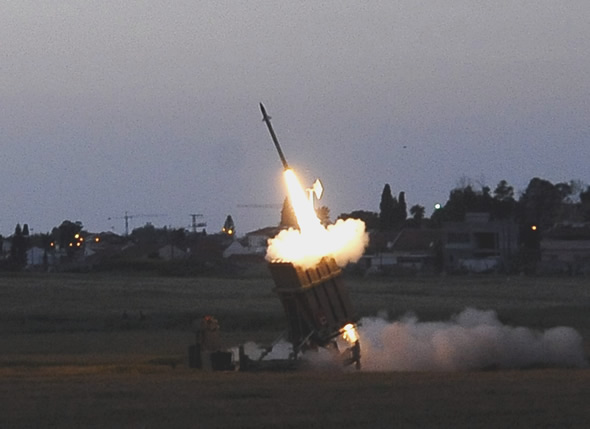
    A Tamir missile fired by an Iron Dome fire unit near Ashkelon, Israel, intercepting a Palestinian 122mm Grad rocket fired at the city. The iron Dome has repeatedly intercepted Palestinian rockets since its first deployment in April 2011, demonstrating impressive score. Photo via RAFAEL

    This study prepared by Uzi Rubin was released by Begin-Saadat Center for Strategic Studies (BESA), October 24, 2011.

    Summary: The “Iron Dome” anti-rocket active defense system was first used by Israel in April 2011 with great technical success. This prompted defense officials to finally make public the strategic objectives and limitations of the system, which, until then, had not been divulged. It also expanded the public debate on missile defense from one that focused on the
    threat to Sderot and the Gaza envelope communities to a debate that included the threat of longer range rockets on larger cities deep within Israel. It can reasonably be concluded that the Iron Dome system has succeeded in saving lives and reducing damages, thus providing more flexibility to the political leadership for containing the fighting with the Hamas government in Gaza.

    Israel’s new “Iron Dome” anti-rocket active defense system made its operational debut in southern Israel in two rounds of escalation in the fighting along the Gaza strip (April and August 2011). The development of active defense systems in Israel that started with Arrow in the early 1990’s and in which Iron Dome is the latest chapter has always been accompanied by acrimonious public debate and behind-the-doors battles within the defense establishment. These battles have been mainly between the political leadership and the professional military echelons – which resisted the diversion of resources from offensive to defensive weapons.

    This operational debut of Iron Dome, which can be characterized as a technical success, provides an opportunity to evaluate its performance and the degree to which it fulfilled its expectations. There exists a significant degree of ambiguity about the technical and strategic expectations from the system, since Israel’s defense establishment never specified them publicly. Similarly there exists significant ambiguity about the actual performance of the system in battle, as practically no official data was released. Yet the very appearance of Iron Dome on the battlefield generated world-wide interest and was widely reported in Israel and abroad. The wealth of public domain reports permits a preliminary evaluation of its performance and implications.


    Objectives and Goals

    The shock of the 2006 Lebanon War was a catalyst for Israel’s decision to develop an anti-rocket system. In February 2007, Iron Dome was selected as the preferred system, though by that time, daily life in northern Israel had returned to normal. In the south, however, the tempo of the rocket offensive from Gaza was increasing. Accordingly, the public debate on Iron Dome revolved around its effectiveness in the lower limit of its capacity – namely rockets fired from 4 km away – and its ability to destroy mortar shells. Sderot, the city that suffered most from increasing Qassam rocket attacks, was the focal point of discussions on Iron Dome. The public debate barely touched on the need to defend larger cities deeper within Israel, despite the fact that longer range rockets from Gaza had been targeting Ashkelon since mid-2006.

    Initially, much uncertainty surrounded Iron Dome’s role in the overall response strategy to the rocket and missile threat on Israel. Its fundamental goals – what was it expected to defend against, who or what would be defended, and what were the required defense levels – were withheld from the public. From its laconic statements one might have concluded that the defense establishment saw the role of Iron Dome as limited to the defense of the Gaza envelope against Qassams.

    For example, at the end of 2007, Ehud Barak, Israel’s Minister of Defense, assumed that “within two and a half years we will be able to deploy the first system in Sderot.”1 It was only after the initial success of Iron Dome in April 2011 that senior officials in Israel’s Ministry of Defense (MOD) elaborated on its strategic objectives and limitations. Brig. Gen. (res.) Ophir Shoham, Director of the Ministry of Defense (MOD) Directorate for Research and Development (known by its acronym MAFAT), said that the system’s strategic goal is to allow the political leadership room for maneuver and to provide an alternative to escalation.2

    Then-head of MAFAT’s R&D Division Brig. Gen. Danny Gold stated more specifically that the rationale for the system was threefold: ethical, economic and strategic. Ethically, the system represents the state’s obligation to protect citizens’ life and property. Economically, the system prevents the paralysis of the nation’s economy. And strategically, “[the system] is a response to the main threat from the enemy” – a way to “avoid costly military operations and allow the political leadership to have alternative courses of actions other than escalation.”3

    As for the defensive capacity of Iron Dome, the program’s manager at Rafael, Yossi Drucker, warned that no system guarantees 100 percent protection. The head of the MOD program office, Lieutenant Colonel C. similarly cautioned, “No system is hermetic; the citizens should avoid complacency,”4 and Israel’s Minister of Defense Ehud Barak warned that “(Iron Dome) does not provide a 100 percent answer.”5 In a wider perspective, MAFAT Director Ophir Shoham declared that “We do not presume to shoot down thousands of rockets. Rather, we aim to minimize the damage and let the Israel Defense Forces (IDF) do other things…”6 Such objectives are much wider than simply protecting the town of Sderot.

    It is unclear whether such MOD considerations played a role in the decision to launch the development of Iron Dome in February 2007 or whether they were adopted only more recently. It is reasonable to assume, however, that such or similar arguments were made behind the scenes during the acerbic confrontations between the High Command and the political leadership about the need for active defense in general and Iron Dome in particular. Be it as it may, Iron Dome is now officially tasked to fulfill three goals: Protecting Israeli life and property, providing new flexibility to the political leadership, and giving the IDF extra time to prepare for offensive operations

    Iron Dome in Action

    The first operational use of Iron Dome in April 2011 was in reaction to an escalation in rocket attacks from Gaza on Israeli targets. After the IDF’s offensive responses failed to stop the accelerated and deep-reaching attacks, a decision was made to deploy one of two available Iron Dome batteries over Beersheba. At this time, Iron Dome was not yet declared to have Initial Operational Capability. The deployment was completed on March 23, 2011 and was called an “operational experiment.” As tensions continued to rise and with exchanges of fire along the Gaza border, the second available battery was deployed on April 4, near Ashkelon.

    On April 7, as revenge for the targeted killing of three senior operatives, Hamas fired an anti-tank missile at an Israeli school bus, killing a 16-year-old boy. In response, the IDF ratcheted up its attacks on Palestinian targets while Gaza terrorist groups (not Hamas) launched long-range rockets at Ashkelon. The Iron Dome battery that had been deployed there achieved its first interception of a Palestinian rocket that day. Over the next couple of days, Iron Dome successfully destroyed several other rockets launched at Ashkelon, while the other battery, stationed in Beersheba, was first activated on April 8, destroying at least one Grad rocket aimed at the city. Media sources reported that the new system had destroyed eight of the nine rockets that it engaged. (According to the director of MAFAT, the success rate was nine out of 10). On April 11, the Palestinians declared a ceasefire and southern Israel returned to a state of tense calm.

    The next period of escalation began on August 18, 2011 when Palestinian terrorists attacked several vehicles on the highway to Eilat, killing eight Israelis. In swift retaliation the IDF killed five senior operatives of the Popular Resistance Committees, held responsible by Israel for the cross-border raid. This led to an intensified rocket offensive from Gaza on Ashkelon, Beersheba and other areas deep within Israel. The two batteries defending Beersheba and Ashkelon destroyed a significant number of incoming rockets (but rockets fired at Ashdod, Kiryat Gat, Kiryat Malachi and other towns were not engaged because no additional batteries were available).

    On August 20, the Palestinians fired the largest yet salvo of rockets (the media reported 11 simultaneous launches) at Beersheba. While many of the rockets were destroyed in mid-air, one penetrated the defense screen, killing an Israeli civilian and wounding 10. The next day, another three salvoes were fired at Beersheba. No Israeli was injured, but one rocket hit an empty school that was likely located within the protective radius of Iron Dome. Seemingly then, this rocket managed to penetrate the defense screen.

    The Palestinians declared another ceasefire on August 28, but the targeted killing of an Islamic Jihad operative spurred renewed rocket fire. This did not cause any further casualties in Israel and several more rockets were successfully intercepted. The IDF reacted with restraint and the rocket fire subsided after several days. According to the media, Iron Dome destroyed between 18 and 20 rockets during this period of escalation, but the Israeli defense establishment declined to provide official information on the success rate. The sole official statement came from Israel’s ambassador to the US, who cited an 85 percent success rate.7

    Evaluating Iron Dome’s Technical Performance

    It seems that the achievements of Iron Dome in April pleasantly surprised the IDF and the Israeli public, yet its performance in August somewhat disappointed the public (but not the IDF). The initial successes created an unjustified perception among the public of a hermetic, leak-proof defense system. The few rockets that subsequently penetrated the system during the August fighting dispelled this perception and caused a degree of disillusionment.

    In the absence of official figures, our system performance evaluation must rely on indirect evidence. A total of 300 to 350 rockets of all kinds were fired by the Palestinians at Israeli targets near Gaza and deeper into Israel in the course of the two cycles of violence. Only one Israeli was killed, which means then that the effective lethality of the rockets in the two events was 300 rockets per fatality (RPF).8

    The lethality of the Gaza rockets during the eight-year (2001-2009) offensive on the Gaza envelope communities averaged 254 RPF9 – however, when the 300th rocket hit Israel, four fatalities had already been incurred, hence the initial RPF stood at 75. In the 2006 Lebanon War, the initial RPF stood at 50 (it later dropped to 75).

    In both cases, initial lethality was higher than the average since it took some time for the public to comply with civil defense instructions and take shelter upon alerts. Media reports on the public’s behavior during the two cycles of escalation in 2011 show that it resembled the initial pattern of the eight-year rocket offensive, with a sizable proportion of the public failing to take cover. Hence, it is legitimate to compare the effective lethality of the April and August 2011 cycles of attacks to the initial lethality of the two previous campaigns. From this perspective, the initial lethality in the 2011 escalations with an RPF of 300 was extraordinarily low.10 Since this cannot be attributed to public discipline or compliance with civil defense instructions,11 it must have been Iron Dome’s effectiveness that reduced the rockets’ lethality by about two thirds. It seems, then, that Iron Dome has achieved a significant technical success.

    Israeli and Palestinian Reactions

    Initial reports of Iron Dome’s success in April 2011 were received with some skepticism in Israel and even attributed by some commentators to pure luck. Nevertheless, when the April escalation ended with no Israeli casualties and the full extent of Iron Dome’s capabilities was realized, euphoria prevailed.

    Throughout this round of escalation, the pattern of rocket attacks from Gaza was markedly different than in the past. Sderot, previously a magnet for Qassam attacks, enjoyed relative calm, suffering only one rocket impact throughout the April fighting. The Palestinians, instead, evidently preferred to launch longer range rockets at larger cities deeper within Israel. This facilitated the task of Iron Dome since it had to deal with longer range targets.

    During the next cycle of violence in August, the Palestinians maintained their new policy of attacking larger, more distant cities. Sderot was “neglected” once again, with only two rocket impacts. It seems that the Palestinians chose this time to attack cities defended by Iron Dome in order to probe its weaknesses and attempt to penetrate its defensive screen, thereby gaining “points” among constituents for any Israeli casualties. The heavy salvo on Beersheba on August 20 – that may well have been aimed at the equidistant, undefended city of Ashdod – lends credence to this theory.

    The public responses in Israel following this second cycle of escalation were more muted than previously. This time, praises for the system’s performance were accompanied by some criticism. Reuven Pedatzur, a Haaretz defense analyst and a long-time critic of missile defense in Israel (and abroad), declared that the Iron Dome concept collapsed because, among other things, “it was shown that civilians under attack could not maintain their daily life without fear”.12 A similar sentiment was expressed by former Israeli Minister of Defense Moshe Arens, who lauded the system’s technical achievement but pointed out that despite the active defense, “the rockets forced the residents of southern Israel to run for shelter.”13

    Considering the warning of senior defense officials that Iron Dome cannot provide a hermetic, leak proof shield and the constant pleading by the Homeland Defense Command for the public to take cover even in cities defended by Iron Dome, it is difficult to see why both critics nurtured the mistaken notion that Iron Dome was supposed to provide “normal daily life without fear” under rocket fire.

    Israel’s defense establishment continued praising the system after the August events while mayors in southern Israel clamored for Iron Dome’s deployment to their cities as it evoked a sense of security.14 Defense Minister Ehud Barak ordered the prompt deployment of a third Iron Dome battery to Ashdod and promised a fourth battery would be delivered by the end of 2011. It seems then that both the defense establishment and the general public regarded Iron Dome’s performance in the August fighting as a success, despite the Beer Sheba casualties. It also appears that the IDF overcame its historical distaste for missile defense, embracing Iron Dome with some enthusiasm.

    Palestinian officials kept silent about the debut of an active defense system in the arena. Yet some sense of the mood in Gaza can be deduced from media reports on Gazans’ reactions. A Palestinian resident of Beit Lahia was quoted as saying: “People in the northern Gaza Strip can clearly see Iron Dome in action. The uselessness of our rockets was never as evident to the people as it is now.”15

    Strategic Implications

    About two months after the April 2011 fighting, a senior Israel Air Force officer declared, “The success of Iron Dome saved the IDF another major operation in Gaza.”16 In his view, the successful performance of the system provided decision makers with an added degree of freedom and gave them an alternative to a major offensive action. The enemy did not achieve its goal, became frustrated and ceased firing. The IDF has apparently concluded that its newly introduced active defense arm achieved its strategic goals: protecting Israeli life and property, providing new flexibility to the political leadership, and giving the IDF extra time to prepare for offensive operations. In the view of the above quoted officer, there was one further achievement: A dissuasive effect that was brought about by the enemy’s sense of frustration, motivating him to cease his fire.

    It is still too early to judge how accurate this evaluation is. Iron Dome did indeed save lives and protect property. It can also be reasonably concluded that the low number of civilian casualties allowed the political leadership to act with restraint and minimize its aerial attacks on Gaza, thereby reducing collateral damage and containing the situation.

    However, it is hard to see how Israel would otherwise have risked a major ground offensive in Gaza when the collapse of the Mubarak regime has strained it relations with Egypt, when Israel was gearing up for a diplomatic battle over the Palestinian UN bid for statehood, and when the political damage from Operation Cast Lead was still fresh in mind.

    As for the alleged dissuasive effect of Iron Dome, this did not prevent Palestinian armed organizations in Gaza from launching large-scale rocket attacks in August. In fact, Iron Dome may have challenged them to ratchet up their fire in an effort to break through the defensive shield.

    Another lesson from the two recent periods of escalation was the race between the offense and defense. The lively public debate about Iron Dome focused exclusively on its capability to defend Sderot and other Gaza envelope communities, neglecting the growing threat on larger cities deeper within Israel. It is now clear that the system’s architects were correct in designing it against both the shorter and longer range threats.

    In conclusion, the jury is still out on the full implications of active defense for the Israeli-Palestinian battlefield. More data must be gathered (hopefully not too soon). Nevertheless, having already saved the lives of Israeli civilians and soldiers, and having helped the political leadership contain the fighting – which apparently it did – Iron Dome has already made a significant contribution to Israel’s security.

    Uzi Rubin was head of the Israel Ministry of Defense “Arrow” defense program against long-range missiles, and is the author of the recent BESA Center study: The Missile Threat from Gaza: From Nuisance to Strategic Threat.

    BESA Perspectives is published through the generosity of the Greg Rosshandler Family.

    _________________________________

    1 Amos Harel: “Minister of Defense: A missile defense system will protect Sderot within two and a half years,” Haaretz, December 24 2007
    2 Anshel Pfeffer: “Ophir Shoham, Is it cost effective to intercept a rocket with a 100000 shekels interceptor?” Haaretz, April 11, 2011.
    3 Noam Barkan, “Ruling the Dome,” Yediot Aharonot, April 11, 2011.
    4 Ibid.
    5 Hanan Greenberg and Elior Levi, “Barak on Iron Dome: Does Not Provide a 100 Percent Answer,” Ynet, March 25, 2011.
    6 Ibid.
    7 Eli Lake, “Israel Iron Dome Missile Defense System Hits 8% of Targets,” Washington Post, August 29, 2011.
    8 Lethality is reciprocal to RPF. A large RPF means that more rockets are needed to cause one fatality, and vice versa.
    9 See “From Harassment to Strategic Threat” by the present author, BESA publication no. 87, page 17 fig. 3 (Hebrew).
    10 According to a Ministry for Foreign Affairs website detailing Palestinian rocket and mortar fire on Israel, the number of rockets hitting Israel in April 2011 was 65, and in August 2011 149 – a grand total of 214 rockets. Link . It is not clear whether this source is more reliable than general media. In any case, even with this lower estimate of the total number of rockets, the main conclusions herein remain valid.
    11 The victims of the Beersheba rocket attack on the night of August 20 failed to take cover when the rocket hit, see “ZAKA volunteer: the killed and wounded were not sheltered within a protected space
    12 Reuven Pedatzur, “The Collapsed Dome,” Haaretz, August 26, 2011.
    13 Moshe Arens, “An Imperfect Pride,” Haaretz, August 31, 2011.
    14 The mayor of Ashdod, Yechiel Lassri, told the Walla news website that “…the deployment of Iron Dome…is good news for the residents of Ashdod and adds to their sense of security,” August 31, 2011.
    15 Amira Hass, “In the Gaza strip they erected mourning huts for the victims of (Israel’s) air raids, but not for the perpetrator of the (Eilat road) raid,” Haaretz, August 25, 2011.
    16 Amos Harel, “A senior IAF officer: the success of Iron Dome saved another IDF operation in Gaza,” Haaretz, July 26, 2011.


    Could Gaza be the Independent Palestinian State?

    Following the exchange of thousand Palestinian prisoners for a single israeli abducted soldier, Israeli-Palestinian relations do not seem to go in a positive direction.

    Israel’s willingness to repeatedly exchange thousands of Palestinian prisoners, legally accused, sentenced and incarcerated with several lifelong terms, against single or even deceased soldiers, is giving clear signals to future abductions as a modus operandi by Islamic terrorists. Escalating violence between Israel and the palestinian authority is almost inevitable, resulting from deliberate actions by the Palestinian side or in reaction to provocations of Jewish extremists. Should such clashes get out of control, it will become inevitable that the Israel Defense Forces (IDF) will have to intervene and then an armed engagement with the Palestinian police might not be far away, probably inflaming the entire region.

    However, in his recent post, David Eshel points at another way, one, which could be regarded utopian by many skeptics with only doomsday scenarios in their future perception. Such plan could concern a “different Gaza”, which seems already in the making, In fact, while Mr Abbas seeks a virtual state at the UN, Hamas already controls a real one. (David Eshel’s Blog)

    German Military to Administer Deep Cuts in Manpower, Procurement

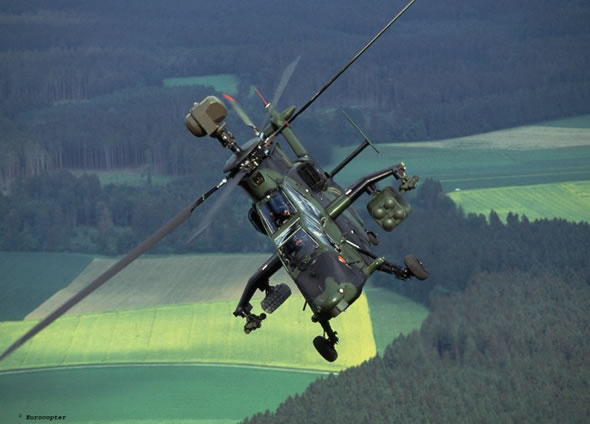
    German Army will slash its Tiger fleet by half, if the current budget cuts are implemented

    Bowing under economical burden the german Government plans deep cuts in defense spending, dramatically reducing planned procurement of main weapon systems and platforms. Overall the personnel level in military services will be reduced from 185,000 to 65,000, to include only professional service members. Among the hardest hit industry group will be EADS, with its Eurofighter Typhoon, NH90, Tiger helicopters and Euro Hawk drones affected, all programs are managed by EADS subsidiaries.

    German Army will slash its Tiger fleet by half, if the current budget cuts are implemented
    Northrop Grumman has delivered the first Euro Hawk earlier in 2011, anticipating the lead HALE drone will be followed with five additional drones. If the current cuts are fully implemented, only three additional platforms will be built. The photo above shows the first Euro Hawk 99+01 preparing to depart Edwards AFB for Manching, Germany. Photo: Northrop Grumman

    Among the planned cuts recommended by German Defence Minister Thomas de Maiziere are reduction of 37 planned orders of Eurofighter Typhoon fighter jets, reducing the number Typhoons to be fielded by the Luftwaffe to 140. The Army will lose 60 Puma infantry fighting vehicles, reducing the total procurement to 350, and the fleet of Tiger combat helicopters will be slashed by half, from 80 to 40. The number of NH90 helicopters to be operated by the services will also drop by 40 to 80 helicopters.

    Germany will also reduce the number of unmanned aerial systems from 22 to 16 (the German Air Force currently operates the Heron UAV). The Luftwaffe will also be required to trim the number of ‘Euro Hawk’ High Altitude Long Endurance (HALE) drones by two aircraft, operating the SIGINT unit with only four aircraft.

    The group hardest by these cuts is EADS, with its Eurofighter, Eurocopter and Casidian subsidiaries involved in the Typhoon, Tiger, NH-90 and Euro Hawk programs. The leading German armored vehicle manufacturers Germany’s Rheinmetall and Krauss-Maffei Wegmann (KMW) will share the loss over the Puma program reduction while Rheinmetall Defense may also be affected by the drop in UAS orders. International companies affected are Britain’s BAE Systems, and Italy’s Finmeccanica sharing the Eurofighter Typhoon program and U.S. based Northrop Grumman, manufacturing the Euro Hawk system.

    Skunk Works and XTEND Simplify Multi-Drone Command

    0
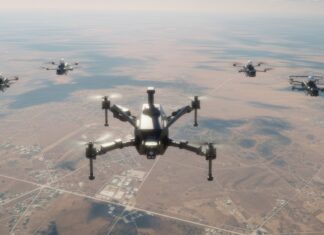
    Lockheed Martin Skunk Works® and XTEND have achieved a major milestone in JADC2 by integrating the XOS operating system with the MDCX™ autonomy platform. This technical breakthrough enables a single operator to simultaneously command multiple drone classes, eliminating the friction of mission handoffs. From "marsupial" drone deployments to operating in GPS-denied environments, explore how this collaboration is abbreviating the data-to-decision timeline and redefining autonomous mission execution.

    From Ukraine to Taiwan: The Global Race to Dominate the New Defense Tech Frontier

    0
    As traditional defense primes face mounting competition from agile “neoprimes” such as Anduril, Palantir and Helsing, the balance of innovation is shifting toward software-defined warfare and scalable, dual-use technologies, while global industry consolidation—marked by Boeing’s integration of Spirit AeroSystems and other strategic mergers—signals an intensified race to secure control over the defense technology value chain. Our Defense-Tech weekly report highlights these trends.

    Europe’s “Drone Wall”

    0
    In early October 2025, a coordinated wave of unmanned aerial system (UAS) incursions—widely attributed to Russia—targeted critical infrastructure across at least ten European nations. The unprecedented campaign exposed the fragility of Europe’s air defenses...

    Weekly Defense Update & Global Security Assessment

    0
    Executive Summary The past week (September 18-25, 2025) represents an inflection point where strategic defense concepts have transitioned from doctrine to tangible reality. An analysis of global events reveals four primary, interconnected trends shaping an...

    U.S. Air and Space Forces Push Next-Gen Programs at the AS&C 2025 Conference and...

    0
    At the 2025 Air, Space & Cyber Conference, U.S. Air Force and Space Force leaders unveiled major updates on next-generation fighters, bombers, unmanned systems, and space initiatives, highlighting both rapid innovation and critical readiness challenges as the services race to outpace global competitors. A short version is available here, with a more detailed version for subscribers.

    TADTE 2025: Reflecting Taiwan’s Strategic Themes

    0
    The Taipei Aerospace & Defense Technology Exhibition (TADTE) 2025 crystallized around four dominant strategic themes that collectively illustrate Taiwan's comprehensive approach to defense modernization amid escalating regional tensions. Based on a detailed report by Pleronix (available upon request). Includes a Podcast discussion on TADTE 2025's highlighting Taiwan's four strategic themes beyond the post's coverage.

    Iron Beam 450 Completes Testing, Soon to Join With Operational Air Defense Units

    0
    Israel’s Iron Beam 450 high-power laser system has completed final testing, marking a major leap in air defense. Developed by Rafael, it offers precise, cost-effective interception of rockets, UAVs, and mortars, and is set for IDF deployment by 2025.