Tuesday, December 23, 2025
More
    Home Blog Page 435

    Enhanced Tactical Computer (ETC)

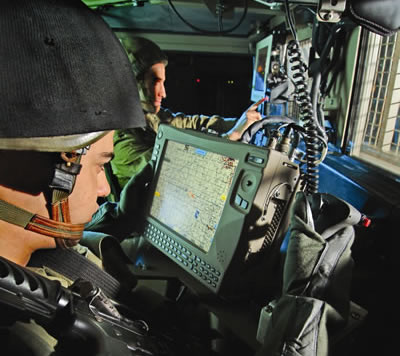
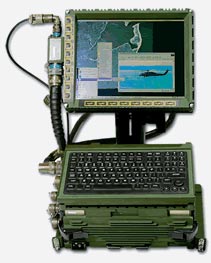
    The ETC is designed as a modular system, utilizing common building blocks applicable to a wide range of C3 systems. These common modules are based on COTS hardware, encased in Mil-Std-810E ruggedized packages designed to endure harsh field conditions and temperatures from -25° to 55°C. The system is based on a Pentium III processor embedded in a specially designed removable electronic module. This design enables easy maintenance and upgrading at the pace of processor technology advances.

    The system uses a 10.4″ TFT display with panel resolution of 800×600 pixels and a touch screen, supports direct sunlight readable display. Other modules include the removable, sealed power supply, high capacity (10 – 40 GB) removable hard disk drive, designed to meet Mil-Standard shock, thermal and vibration specs.

    ETC supports a wide range of IOs and enhancements required for powerful applications. These could include support for direct video link, powerful graphic cards, or 3D accelerators etc. The ETC’s upper back is fitted with all connectors, including GPS antenna, LAN, radios, external display, power connector and connectors to commercial peripherals. Two PCMCIA Type II or a single Type Iii are available. Communications interfaces are supported via Elbit’s communications controller, supporting up to six networks at 64 Kb/s). ETC has an embedded GPS receiver. ETC is compatible with Windows or Linux operating systems.

    DSP-1 FLIR payload

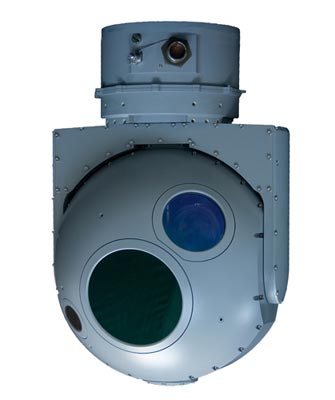
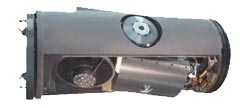
    A compact day/night sensor payload configured especially for light reconnaissance platforms such as UAVs. DSP-1’s optical system is mounted on a four-axis gimbal with stabilization of 25 microRadian and pointing accuracy of 0.7 degree. The payload uses two optical channels, a 3rd Generation InSb FPA with continuous x22.5 zoom lens and high resolution color CCD daylight channel with x20 zoom lens. The payload uses Controp’s FOX 3rd generation 320×256 FPA FLIR equipped with the company’s proprietary x22.5 power FLIR-zoom function and optional microscan function.

    Brite-Star EO Payload

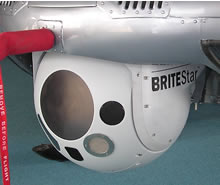
    A military-qualified, multisensor laser designation system which incorporates a third-generation (3-5 µm) thermal imager, a CCD camera, a laser designator and a laser designator / rangefinder. BriteSTAR is a derivative of the SAFIRE family, using compatible mountings and interfaces. The system uses automatic boresighting for improved alignment and reduced need for field support.

    Bighorn 120mm Mortar System

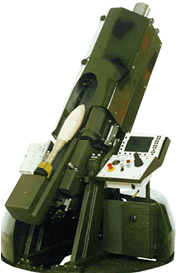
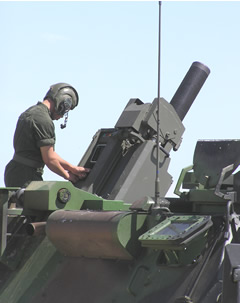
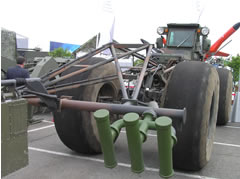
    RUAG of Switzerland have developedan autonomous, smoothbore,recoiled 120 mm mortar system, designed for installation on mobile platforms such as light APCs and trucks. Among the platforms tested were Mowag 8×8 Piranha and M-113. The Bighorn system can fire all types of 120mm mortar ammunition, including guided projectiles such as STRIX and Cargo munitions. he system is designed for autonomous operation, including integral navigation, positioning and fire control capabilities. When fully configured for autonomous operation, Bighorn can deploy into a firing position, fire and leave quickly before being intercepted by enemy counterfire.

    calibre 120 mm
    barrel length 2000 mm
    recoil travel 300 mm
    system weight <1490 kg
    elevation 40 to 85°
    traverse ±45 ° (optional 360°)
    range up to 10 km
    rate of fire burst: 4 rds in <20 s
    sustained: 4 rds/min up to 150 rds
    intense: 6 rds/min up to 64 rds (depending on charge)
    navigation accuracy 0.50% DT CEP (X-, Y-coordinate)
    0.25% DT RMS (altitude)
    positioning accuracy 3.00‰ RMS (azimut)
    2.00‰ RMS (elevation)
    required vehicle power supply 24 V DC MIL STD 1275 A
    top rate electric current <210 A
    duration of top rate < 5 ms


    RQ-1A/MQ-1 Predator UAV

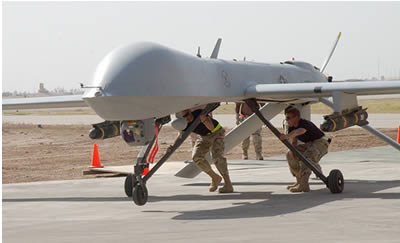
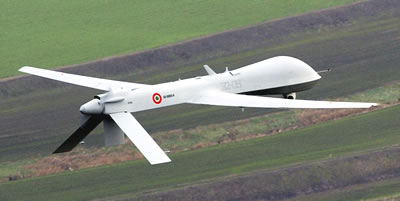
    The Predator Unmanned Aerial System (UAS) designated RQ-1, was launched in January 1994 as an Advanced Concept Technology Demonstration (ACTD). The armed version that followed the RQ-1 was designated MQ-1. The design was based on a modified Gnat 750 UAV built by General Atomics Aeronautical Systems. (The Gnat does not have the Ku Band satellite link). The US Air Force received its first Predators in 1994, and deployed them for the first time over Bosnia between 1995-6. Since then, Predators were operated by both USAF and the Central Intelligence Agency, designated RQ-1A.

    Following successful integration of Hellfire missiles, an armed version of Predator was deployed in Afghanistan during Operation Enduring Freedom (OEF) in 2002. These aircraft are designated MQ-1. Officially, the Predator A system was declared “operational” only in 2004, ten years after it began flying with the US Military. Predator UAVs are currently operated by the US Air Force and Italian Air Force. By September 2007 the Predator fleet accumulated a total of 300,000 flight hours, over 80 percent in combat missions and this pace is increasing. In October 2007 alone, the Predator fleet performed 12,000 hours. More recently the USAF fielded the Reaper, a larger more capable UAS based on an outgrowth of the Predator platform.

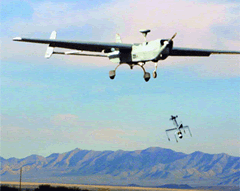
    Every Predator system consists of four unmanned aerial vehicles (UAVs), a ground control station, a satellite communications terminal and 55 personnel. The Predator Unmanned Aerial Vehicle (UAV) is equipped with reconnaissance equipment and weapons to provide persistent Intelligence gathering, Surveillance, and Reconnaissance (ISR) capability. It is designed to perform over-the-horizon, long-endurance, medium-altitude surveillance, reconnaissance, and weapons delivery on mission endurance of up to 40 hours. Predators have also been tested with optionally expendable Finder mini-UAVs, facilitating a high flying Predator to perform low-altitude recce missions without descending and becoming vulnerable to enemy fire.

    The production version of the Predator aircraft is equipped with a turbo-charged Rotax 914 engine producing 105 horsepower. The aircraft measures 27 feet (8 m’) long, 6.9 feet high. The Predator weighs 1,130 pounds (512 kg) empty, and 2,300 (1,043 kg) pounds Maximum Take Off Weight (MTOW). On a typical mission the Predator cruises at an altitude of up to 25,000 feet and 70 – 84 mph, with maximum speed of 135 mph. The Predator can maintain a 40 hours patrol over a large area, at a distance of 400 miles from its operating base. The payload capacity is 450 pounds (204kg) internal plus 300 lbs (136 kg) in external stores, and fuel capacity 665 pounds (100gal./286 kg). Enhancements for Predator include replacing the original electro-optical/infrared sensor ball with an improved system that adds a laser designator/rangefinder and adding wing hard-points and wiring to carry and launch two Hellfire missiles. These improvements evolve Predator to into an armed reconnaissance platform which retains all the capability of a traditional ISR asset, and adds a direct strike capability.

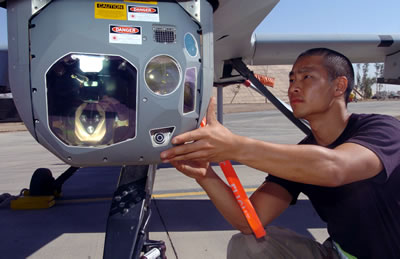
    As a multi-sensor platform, Predator is equipped with an EO/IR and SAR payloads. The for day/night imagery, the system uses the Raytheon AN/AAS-52 Multisensor Tactical System (MTS) electro-optical stabilized turret, offering day and night operation. When weather conditions limit its operations, for coverage of a large area,Northrop Grumman’s TESAR Synthetic Aperture Radar is used. The UAV uses line of sight communications datalink or satellite communications, to receive flight instructions and transmit video streams, still images and other sensor information to the mission control center. Information gathered by a Predator can be shared instantaneously with commanders around the world via Rover remote receiving terminals. Imagery products are distributed worldwide via defense communications satellites or commercial services, utilizing the Trojan Spirit II intelligence distribution satellite terminals and DCGS intelligence support network.

    During operations in Iraq the Air Force used both in- and out-of-theater ground control stations, with beyond-line-of-sight air vehicle control, to fly Predator. This gave the Combined Forces Air Component Commander great flexibility since he could increase capability and have redundant control using up to five ground control stations at multiple locations. Three orbits were controlled, via remote operations, from the United States. Four simultaneous Predator orbits were flown over Iraq, and an additional orbit operated over Afghanistan. Combining the reach back operation in support of combat operations in-theater, used for both Global Hawk and Predator significantly reduced troop deployment and improved system availability, reduced theater force protection needs, and saved significant operating costs. Moving data rather than people was a demonstration of “networked” operations and another example of the rapidly evolving use of UAVs. This enhanced capability shortens the kill chain and dramatically reduces the opportunity for targets to flee if tactical aircraft are unavailable to deliver weapons.

    The USAF preferred to operate the Predator with “pilot in the loop”. During operation in Iraq and Afghanistan, Predators are flown by USAF pilots located in Nellis AFB California. The aircraft and mission payloads are controlled via satellite data link. Sensor feeds are received in the mission control center back in USA via satellite where they are processed and analyzed. The imagery and intelligence products are distributed on the global intelligence network (DCGS) and are accessible to USAF and other forces worldwide. Raw images can also be used, as they are received directly by units in theater, using video links. The air vehicle is equipped with UHF and VHF radio relay links, a C-band line-of-sight data link which has a range of 150 nautical miles and UHF and Ku-band satellite data links.

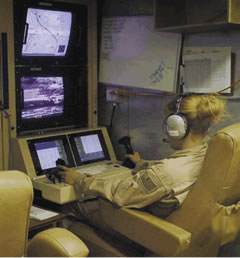
    The UAV Ground Control Station is built into a single 30ft. trailer, containing pilot and payload operator consoles, three Boeing Data Exploitation and Mission Planning Consoles and two synthetic aperture radar workstations On board communications equipment include satellite and line-of-sight) ground data terminals. The Ground Control Station can send imagery data via a land line to the operational users or to the Trojan Spirit data distribution system. The Trojan Spirit II data distribution system is equipped with a 5.5m dish for Ku-band Ground Data Terminal and a 2.4m dish for data dissemination.

    In February 2009 the U.S. Air Force (USAF) MQ-1 Predator unmanned aircraft fleet have surpassed the 500,000 flight hour milestone, 87 percent of those hours were flown in combat.  “In July 1994 we delivered the first MQ-1 Predator, and next month we are scheduled to deliver the 200th Predator aircraft to our U.S. Air Force customer,” said Thomas J. Cassidy, Jr., president, Aircraft Systems Group, General Atomics Aeronautical Systems, Inc.  “In less than two years, flight hours for all Predator A type aircraft have almost doubled and are now approaching 20,000 hours per month, with USAF MQ-1s flying nearly 85 percent of those hours.  The 500,000 hour milestone was achieved by USAF Predator P-143 on February 16 while it performed an armed reconnaissance mission in support of Operation Iraqi Freedom (OIF).  This particular aircraft has flown over 330 combat missions in the two-and-a-half years it has been deployed.

    Predator News:

    August 2006: The fleet of MQ-1 Predator unmanned aerial systems achieved a milestone of 200,000 flight hours in July 2006. According to the manufacturer, General Atomics, more than three-quarters of that time spent in combat for a total of 10,961 combat missions. According to Thomas J. Cassidy, Jr., president, Aircraft Systems Group, General Atomics Aeronautical Systems, Inc. “the Predator aircraft have flown nearly 100,000 flight hours over the past two years and are currently flying more than 6,000 flight hours per month while maintaining the highest operational readiness rates in U.S. Air Force inventory.”

    May 2007: The US Air Force received five Predator Mission Aircrew Training System (PMATS). By June 2007 seven PMATS systems will be based at the Creech Air Force Base in Indian Springs, NV to support the newly established 432nd unmanned systems wing, the first US Air Force wing totally dedicated to Predator and Reaper operations.

    June 2007: An armed MQ-1 Predator on display at the Paris Air Show

    July 2007: The US Air Force is planning to accelerate the fielding of Combat Air Patrols (CAP) maintained by MQ-1 armed Predator Unmanned Aerial Vehicles, from 12 orbits currently operating in Iraq and Southwest Asia to 21 Predator combat air patrols by December 2009.

    August 2008: The US Air Force lost two Predator Unmanned Aerial Vehicles (UAVs) in the past two nights, when operating from Balad airbase in central Iraq.

    Predator Users

    Predator UAVs are currently fielded with the USAF, US Air National Guard and Italian Air Force.

    RVS 330 Rugged Computer (V4+)

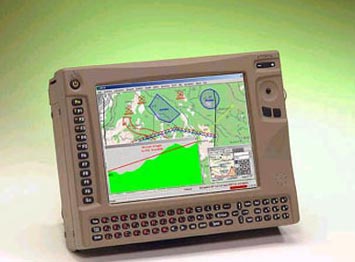
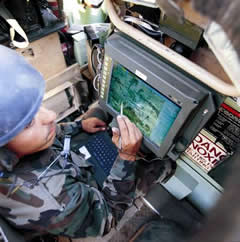
    RVS-330 Rugged Vehicle System, also known as “the Applique”, is an “Off the shelf” based MIL-STD-810E rugged computer hardware designed to offer flexible expansion and customization to suit different applications. This model provides the standard user interface for vehicular mounted FBCB2 terminals.

    It is powered by the vehicle’s 28VDC power supply or via AC adapter. The terminal uses sunlight readable display and is designed to operate at temperatures ranging from -35° to 60°C. Utilizing commercial Intel Pentium III, 600 MHz or faster processor, with 256K L2 cache, socket 370, the system can also accommodate lower cost Celeron processors for less demanding processing. 

    The system uses 192 Megabytes PC-I00 SDRAM, and is expandable to 512M bytes. Removable internal 10 GB hard drive is installed, expandable to 28+ GB. The system uses SVGA, 12.1 inch diagonal, color LCD with touch screen, active matrix sunlight readable TFT with 800 by 600 pixels resolution and Side-to-side viewing angle of +/- 60°. The display can be relocated up to 8 meters (25 foot) away from the processor, to facilitate optimal installation inside the vehicle or in a command post. The system uses sealed keyboard, embedded a sealed pointing device.

    RVS-330 is compliant with MS-DOS, Windows 95, 98, 2000, Microsoft NT v. 4.0 and Solaris X86 (UNIX) v. 2.6 and 7. The system can be expanded utilizing a internal PMC slot, 3U compact PCI expansion slot, Device bay 20 form factor slot and a Disk on chip socket. It can support an external display through an SVGA port, supporting up to 1280 x 1024 pixel resolution 18-bit LVDS video, Sound Blaster compatible PCI audio input and output, two USB ports, IEEE 802.3 10/100BaseT LAN interface, an RS-232C port, five RS-422/RS-423 and two synchronous serial communications ports for Conditioned Di-Phase (CDP) and MIL-STD-188-144 non-return-to-zero communications interfaces.

    In November 2006 DRS Technologies, Inc. received an additional US$19 million order for FBCB2 hardware. This contract adds 1,700 Appliqué Computer Systems and peripheral equipment to already supplied 25,000 FBCB2 systems already deployed with the U.S. Army.

    DHY322 Laser Countermeasures

    DHY 322, laser countermeasure system, first introduced by CILAS in late 2005 is designed to protect high value fixed and deployable targets such as command posts and naval vessels from laser guided weapon attacks. When a hostile laser designator is aimed at the protected target, DY 322 generates a deceptive spot, by illuminating a high power laser spot near the actual target, coded to mimic the hostile laser signal, thus deceiving the attacker to lock on the new spot instead of the targeted object. The system is already operational on warships.

    DHY 322 is able to counter any laser guided weapon attack in less than one second, much faster than alternative countermeasures systems such as smoke system or guns. DHY 322 is efficient even against the latest generation of laser guided weapons which needs only few seconds illumination duration. The DHY 322 countermeasures system uses a combination of one or several powerful lasers turrets. Fully automatic and multidirectional, this system works 24 hours a day for a full protection of the sensitive area.

    Artillery & Mortars at Eurosatory 2004

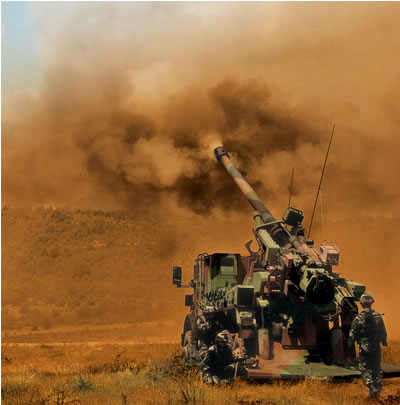
    In recent years, fire support innovations are not provided by new platforms, or more powerful cannons, but by the integration of advanced systems, which maintain the artillery’s position as one of the most dominant effectors of the modern battlefield. Some of the modern trends could be seen at Eurosatory 2004, including mobilization and automation, which contribute to more flexible and survivable operation; long range and precision improvements, and moving toward net centricity. Among the systems shown were the Caesar autonomous truck mounted gun system which was also demons strated in the field.

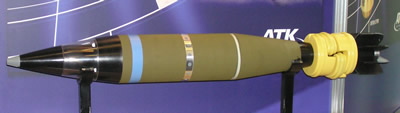
    Caesar will soon entering production for the French army. As a model of the Romanian ATROM was also on display. Among the self propelled mortars, Thales’ D2DR demonstrated its dramatic rapid performance in the field. This mortar is also entering Frenc Army service. A self-propelled dual barrel AMOS mortar was also displayed by Patria’s AMOS, as configured for the Finnish Army, while CARDOM was shown by Soltam – this mortar is being produced for the US Army. Smart munitions for 120mm mortars were also on display – a new arrival was the PGMM shown by ATK for the first time.

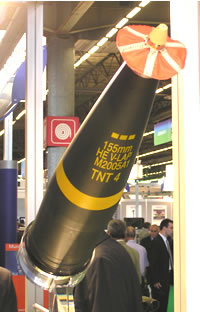
    IAI displayed its new Fireball laser guided bomb and IMI unveiled its own version for a 120mm laser guided bomb. Among the artillery smart ammunitions, several versions of cargo shells were shown including 155mm versions of Excalibur, IMPAQT, Volcano and GAA, but their payloads is narrowing down into two choices – SMART and BONUS. Conventional ammunition stocks can also be upgraded, with the introduction of Course Correction Techniques, demonstrated by GIAT’s Spadico, Diehl and IMI.

    In the air defense field, systems displayed included MEADS and SAMP-T for long range engagements, and the short range SL-AMRAAMBAMSE and Vertical Launched VL/MICA, Rafael Spyder and the new SkyRanger mobile air defense gun system, shown for the first time. A new system on display was the Bofors Advanced Effects Protection System (AEPS). Also related to air defense, several companies emphasized the capabilities of systems to provide protection from cruise missiles – operating sensors such as JLENS and other tethered systems.

    Start – Previous – Next

    Combat Engineering & Mine Clearing Systems at Eurosatory 2004

     Detection and neutralization systems against a broad spectrum of threats, including mechanical, magnetic, heat and pressure sensitive mines. MBDA demonstrated at Eurosatory an enhanced mine countermeasure system based on the operational SOUVIM, in use by the French Army. Another system – Dedale magnetic decoy device which activates magnetically fused mines at a safe distance from the carrying vehicle was also on display. IAI Ramta also introduced several EOD/IED disposal systems and mine clearing devices, optimized for rapid deployment of light forces. IAI/Ramta unveiled its third generation magnetic mine activation system which has completed evaluation and testing with several armed forces. Another system, shown here for the second time is the RAFAEL Carpet minefield breaching system, based on fuel-air explosive technology. The system was recently integrated into the future French Army combat engineering (EBG) upgrade program.

    Start – Previous – Next

    Viper Strike Laser Guided Weapon for UAVs

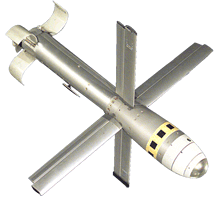
    Viper Strike is a gliding munition capable of stand-off precision attack using GPS-aided navigation and a semi-active laser seeker. It is intended for operations that require a flexible angle of inclination (steep or shallow), particularly in mountainous terrain or built-up areas where strict rules of engagement are in force. Its small size and precision provide for low collateral damage in cluttered urban environments.

    The weapon was developed as a derivative of the autonomous Brilliant Attack Munitions (BAT) Submunitions during a quick reaction, nine-week program at Northrop Grumman’s Land Combat Systems facility at Redstone Arsenal, Huntsville, Ala.The weapon is suitable for operations that require top-down attack, particularly in built-up areas where strict rules of engagement are in force. It requires a “man in the loop” to lase the target, either from the ground in sight of the target or from directly by the UAV, controlled from the ground station, a process which ensures the greatest possible accuracy and minimizes the chances of collateral damage.

    The Viper Strike’s warhead is smaller than the hellfire’s, which is used with the US Air Force armed Predator UAVs, containing only four pounds of Anti-Tank High Explosive (HEAT) charge, for reduced collateral damage in an urban built-up area. It also has a self-destruct mechanism, to eliminate post-strike hazards. The final version of Viper Strike could be equipped with fragmentation belt as well as an optional blast fragmentation and thermobaric warhead.

    By late 2004 the US Army deployed to Iraq some Viper Strike munitions with MQ-5 Hunter unit. There were no details about combat engagements of these weapons. In 2005 Northrop Grumman continued development of the weapon, and is preparing to test it with MQ-1 armed Predator and AC-130 gunships, which will use the weapon as a stand-off precision  guided munition (SOPGM). Ac-130 integration with Viper Strike is currently developed under a Special Operations Command (SOCOM) for an advanced technology demonstration (ACTD). The first phase of the program is scheduled for completion by December 2006. The weapon is being updated with additional GPS guidance system and fragmentation belt, placed around the shaped charge warhead.

    Exote Armor Technology

    Exote ballistic test plates

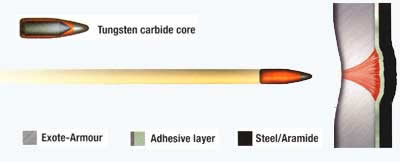
    This composite armor material is formed of titanium-carbide metal matrix, attached to metal or composite base liner. Exote armor is produced in various shapes and thicknesses, ranging from small 5x5cm cubes to 20x20cm tiles. This material is claimed to be able to break even the hardest AP bullets, as its structural design and high hardness completely eliminates the penetrating bullet and this fact enabling use of thinner composite liners. The damage to the armor, caused by the absorption of one hit is 20-30% of the caliber of the bullet. According to the manufacturer, Exote resists multi-hits better than alumina or boron carbide ceramics

    Post Arafat: Two Palestine Entities?

    Barely two days after Yasser Arafat was buried, under the chaotic circumstances in his Ramallah Mukhata fortress, some forty gunmen, belonging to his loyal Al Aqsa Martyrs’ brigades ( renamed after his death to Arafat’s Martyr’s brigades), rushed into a mourning tent in Gaza City, November 15, and opened fire on the congregation. Two men were killed and four badly wounded. Among the congregation was Mahmoud Abbas ( Abu Mazen), the man Fatah had just nominated to run for Palestinian president, they could easily have killed him and gunned down all the mourners packed in the tent. As it turned out he was unhurt.

    Colonel Mohammed Dahlan had sought to place the Gaza-based Presidential guard, Force 17, in charge of overall security for the mourners’ tent and the Palestinian dignitaries gathering there that evening. He was snubbed by the chiefs of all the local Gaza security, intelligence and terrorist groups, including Hamas, Jihad Islami and the Popular Resistance Committees, the umbrella for Gaza’s al Aqsa Brigades. Each chief insisted on his personal bodyguards accompanying him into the tent, with no coordination among them. Moussa Arafat, for instance, is never seen without his 60-70 bodyguards; Gaza Strip general intelligence chief Mohammed Hindi employs between 40 and 50.


    Notwithstanding these armies of protectors, a hostile band of gunmen managed to break into the tent, keep up a 10-minute barrage of automatic fire and make a clean getaway. Palestinian sources agree that this brazen demonstration of strength and clean escape could not have been carried off without the connivance of most of the faction chiefs present – which bodes ill for Abu Mazen’s chances of gaining Gaza Strip support for his bid for the presidency.

    Tension rose already during Arafat’s funeral in Ramallah. Moussa Arafat, one of the dead leaders’s closest relatives present, was visibly ignored by the Ramallah leadership. None of dignitaries approached him with condolences. Things became even more hectic next day, when Moussa Arafat was left out at the graveside of his uncle. This serious affront did not go unnoticed in Gaza and revenge was inevitable.

    An investigation into the attack revealed that the perpetrators belonged to a group (led by leaders of the Gaza Branch of Fatah, among these, secretary Ahmed Hallas Abu Mazher) arch rival of Dahlan and Moussa Arafat’s ally.
    The message from the Gazaeans to the Ramallah was crystal clear: ” No one can replace Arafat and look out, next time we shall shoot to kill, if you ignore us!”

    Monday’s high profile provocation was not the first in lawless Gaza.

    A similar clash between Dahlan’s men and Hallas’ faction took place on January 1, Fatah’s commemoration day, when hundreds of armed men participated in a show of strength in the Gaza stadium, only weeks after a similar event held by Hamas. When Dahlan’s supporters took over the podium, the brawl ensued, with casualties on both sides.

    Since the beginning of this year, these incidents have included mutual killings, the explosion of a booby-trapped car outside the headquarters of Moussa Arafat, an attack on Hallas by unknown assailants, and a series of kidnappings of Arafat supporters in the Gaza Strip.

    Yasser Arafat had lent his complete backing to the camp headed by Hallas and by his cousin, Moussa Arafat, which had the upper hand during his lifetime. It is a camp that has many members from, or associated with, the Arafat family. Other members are from the “Fatah hawks” in Rafah. Now with Arafat’s demise, it has lost considerable power.

    Dahlan, on the other hand, controls the preventive security force, several other central groups in Fatah, and some of the other armed groups such as Amin al-Hindi’s general intelligence service. According to sources in Gaza, the two camps are now of about equal strength.

    Dahlan also has control of the revenues that come from the crossing points into the Gaza Strip, and undoubtedly can lay his hands on tens of millions of dollars that have been gathered over the years.

    The Struggle for Arafat’s Legacy

    The Palestinian Authority (PA) has been disintegrating for months and virtually ceased functioning as a central control element. Although, following the recent election of Abu Mazen’s determination has given a glimmer of hope for stabilisation in the territories, the newly elected president will face some highly precarious hurdles, in order to step into the shoes of the deceased Rai’s- Arafat. One of those hurdles will be to establish some law and order in the chaotic gaza strip and especially in its southern sector, Khan Yunis and Rafah, in which even the dominating Rai’s could not break the ruling local family clans. Rafah, with its strategic location and traditional smuggling routes, could become a break or make effort for any central control in the Gaza strip and it is highly doubtful, wether a man like Abu Mazen is up to this task.

    Last spring, former US Ambassador to Israel Martin Indyk reported that a state of semi-anarchy and gang rule was engulfing the West Bank and Gaza.

    The glue that held the West Bank and Gaza strip together is now gone. The aftershocks of his demise are still pending, before nearly four million Palestinians will come to realize that a new era has started, with hopes and and expectations, but equally dangerous escalation and despair in the offing.

    With no single leader or clear chain of command, it is going to be very hard for anyone to change Palestinian policy or take decisive action such as ending the violence or engaging in serious negotiations. A post-Arafat period anarchy, in which different groups, factions, local warlords, and security agencies operate on their own and ignore instructions from the top could be dangerous for all concerned. The Palestinian movement will split along a number of possible lines: between Palestinians inside ( local leadership, West Bank and Gaza ) and outside leaders in exile: like Khaled Mishal of Hamas in Damascus and Farouk Qadoumi of PLO in Tunis.
    Furthermore, rivalries between factions in the West Bank and Gaza themselves will create local power bases in different towns, seeking self rule for personal interests.

    Into such chaotic circumstances dangerous elements like Hezbollah, backed by Iran, or even Al Qaeda, will try to expand their influence, which could, if not curbed in time, reach strategic proportions in the region .
    One outcome of this disintegration could be the breakup of the Palestinian self rule areas into two geographically distinct entities. This would not be all that surprising. Palestinian society, after all, has always been strongly characterized by tribalism, as well as strong regional differences that set apart hill dwellers from plainsmen, nomads from settled population, urbanites from villagers, and Easterners from Westerners. While the West Bank is only about thirty miles from Gaza, there is more separating the two territories than an expanse of the Israeli Negev Desert.

    In the West Bank, only 27 percent of the population are refugees, as opposed to the 64 percent that inhabit the Gaza Strip. Residents of the two areas have for decades, developed a quiet, and sometimes not so quiet, animosity toward each other.
    For one, the different regional patriarchal clans have always dominated local politics in the two territories. In the West Bank, the Nashishibi, Huseini, Ja’abari and Masri families are among the dominant political elite. By nature, these clans are regional, and are often at odds, since they compete for economic, political and social stature.
    Khalil Shiqaqi, a prominent Palestinian sociologist, after conducting hundreds of interviews, notes the presence of “a psychological barrier between the inhabitants of the two territories and . . . mutual suspicion” that cannot be “disregarded or ignored.”

    Shiqaqi’s study, entitled The West Bank and Gaza Strip: Future Political and Administrative Relations, shows the existence of a prevalent West Bank belief that the Gaza Strip is “nothing but a big refugee camp.” Further, West Bankers see the Gaza Strip as a backward society with “increased crime, inclined to roughness, extremism, grimness, fanaticism and instability.”

    Gaza’s stronger local families include the Shawwa, Shafei and Middein families. But they remain a clear minority but Gazans, for their part, expressed their misgivings over the patronizing and discriminating West Bankers, who show them little respect.
    According to an Israeli internal security (Shin-Bet) report before the outbreak of the Intifada, those sentiments have generally gone unchanged. The report noted “mounting hostility and a growing rift between the West Bank and Gaza Strip,” to the point that “senior officials in the West Bank are against opening the ‘safe passage’ route [between the West Bank and Gaza Strip according to the Oslo accord], as the result could be to flood Judea and Samaria with Gazans!

    The notion of Palestinian regionalism is further reinforced by the varied Arabic dialects spoken throughout the territories. West Bank dialects are similar to the Jordanian dialect, while influences of Egyptian dialect are heard throughout Gaza.

    Palestinian Territories Might Become Two Separate States

    Geopolitics have long exacerbated Palestinian tribalism and limited ties between the West Bank and Gaza. After the first Arab-Israeli war in 1948, Egypt occupied Gaza and Jordan occupied the West Bank. A pro-Egypt, pan-Arabist movement developed in Gaza, while many Palestinians in the West Bank developed an allegiance to the Hashemite Kingdom.

    The West Bank was merged legally and administratively into the Hashemite Kingdom of Jordan in 1950. Notwithstanding Israeli occupation of the territory since 1967, Jordan maintained its links with the West Bank until August 1988 when King Hussein declared the “dismantling of legal and administrative links” with the West Bank..Transjordanians tended to fear that the numerically preponderant Palestinians could emerge as a dominant force in Jordan itself ( an estimated over fifty percent of Jordan’s population is of Palestinian origin!).

    In the first months after the 1967 war, it was, strangely enough, the leadership of Nablus who were the first considered what they could do in order to begin negotiations between Israel and King Hussein of Jordan. They offered to act as mediators. They declared their wish to be returned to Jordan, even though they had suffered heavily under Jordanian rule. As is widely known, Jordan dealt very harshly with them because of their frequent uprisings against King Hussein in the West Bank in the 1950s and early 1960s. Those uprisings had endangered Hussein’s regime, his rule and his crown, and the Jordanians subdued them with brutal force.
    The Nablus leaders’ offer to mediate was not accepted.

    Recent insider reports have indicated that behind the scene, young King Abdullah II of Jordan has taken new interest in the West Bank and a possible revival of the shelved “Jordan Option” of the late eighties. According to Ehud Ya’ari, a leading Middle East expert, in closed forums, central figures from the Palestinian leadership have lately started talking about the need for Jordan to resume an active, substantive role in the West Bank. Sixteen years after the late King Hussein was forced to declare his kingdom’s disengagement from its former possessions across the river amid the wrath of the first Intifada, there are whispers about the need to find a new formula establishing some kind of linkage between efforts to create an independent Palestinian state and the neighbour to the east.

    However, even if the “Jordanian Option” should materialise, its efforts to re-establish some stability in the prevailing West Bank anarchy seems highly dubious.
    Factually, the Palestine National Authority (PNA) can exercise control only over the ‘greater Ramallah’ region and even there it is not complete, as the dramatic scenes of Rafat’s funeral demonstrated.
    A major problem exists through the geographical non- linkage between northern Samaria ( Nablus-Jenin) and southern Judea ( Bethlehem and Hebron) will continue to pose critical interconnection problems for any central authority control, as long as the Jerusalem issue remains unresolved, which is blocking direct traffic routes between the two PNA enclaves.

    Chaotic Situation in The West Bank Towns

    Local warlords are the de-facto rulers of all major West Bank cities.
    Three of those stand out in particular.
    Jenin, in the north is virtually under control of the head of the Al-Aqsa Martyrs Brigades Zacharia Zubeidi. In an interview published Mid November, Zubeidi told the Financial Times that he would accept Abbas as the Fatah candidate if he were freely elected, but said that his loyalty would only last for as long as he kept to the enduring Palestinian stance in negotiations.
    The 28-year-old Zacharia Zubeidi is one of the highest-profile armed militants in the West Bank. He rose to local prominence in the battle that came after Israeli tanks rolled into the Jenin refugee camp in April 2002, and which left 52 Palestinians – including one of his five brothers – and 23 Israeli soldiers dead.

    Young Zubeidi became famous, when in July 2003 he kidnapped the then governor of Jenin Heydar Irsheid, accusing him of corruption, torching the municipal offices and parading in the streets clutching Arafat’s portrait.
    Perhaps the most embarrassing incident which occured in Jenin happened on May 14, 2002 when Arafat made his first trip by helicopter to visit the ruins of Jenin refugee camp after the battle. While thousands of Palestinians were waiting below, countless TV crews awaiting his arrival, Arafat sudenly cancelled his landing , following strict warnings by his security men, that angered crowds in the camp could assault him. Ominously, a stage from which Mr Arafat was to address the crowd in Jenin refugee camp was mysteriously burnt shortly before he began his journey. What was planned as a triumphant return ended in dreadful calamity for which the people of Jenin never forgave their cherished leader.

    Hebron is large terrorist center ruled by a prominent family clan.
    In October 2003, more than 100 members of the Qawasma family and others were arrested in an attempt to put a stop to the activities of the cell, which have resulted in the deaths of over 80 Israelis. But the terror cell that dispatched Ahmed Qawasma and Nisim Jabri on the double suicide attack in Be’er Sheva, last September, was orchestrated by Imad Qawasma, head of the military wing of Hamas, Iz a-Din al-Qassam, in Hebron. Shortly afterwards, Imad Tsalah A-Fatah Qawasma, 31, surrendered after soldiers surrounded his home.
    Until April 2002 Colonel ( later Brigadier General) Jibril Rajoub virtually exercised control over Hebron, but since Israel’s destruction of his headquarters, his authority has waned deteriorating into total lawlessness in the clan-ruled city.

    How independent Hebronites felt even during Arafat’s rule can demonstrate an incident which happened last July.
    As pro-reform Palestinian legislator Nabil Amer was nursing the wounds inflicted by Yasser Arafat’s gunmen, a phone call came through to his room at the Amman university hospital from none other than Arafat. The Palestinian leader inquired about his health and offered to pay his hospital expenses.
    Amer did not bother to reply.

    Sitting beside his bed was a fellow Hebronite, Rafiq Natshe, once Palestinian legislative council speaker, for many years PLO ambassador in Saudi Arabia and a highly respected figure in the Palestinian community. Known also as Abu Shakar, he is the head of the leading Natshe family of Hebron. Since Amer belongs to the largest Mt Hebron clan, which is centered on the large village of Dura, Natshe’s frequent hospital visits are ominously charged: the two great clans of the southern West Bank have decided to make common cause against Arafat. These people will not readily submit to a centralised Post Arafat rule from Ramallah!
    An even worse situation of anarchy prevails in Nablus, the lagest West Bank town.
    Nablus, the largest city in the northern West Bank, represents an extreme illustration of the anarchy which has taken hold in the Palestinian territories – a situation which, according to analysts, could well descend into civil war as veteran Palestinian leader Yasser Arafat finally departs the scene.
    Struggles between different factions of Arafat’s Fatah movement are thought to be behind the assassination last April of the Palestinian journalist Khalil al-Ziban, who also served as an advisor to Arafat, as well as a raft of other violent crimes in the territories.

    The internecine warfare claimed its most high-profile casualty early May when the long-standing and respected mayor of the city, Ghassan al-Shaka, announced his resignation to President Arafat.
    His intention was to “ring the alarm bell” urging the Palestinian Authority to implement draconian measures to put an end to the reign of terror of the armed groups.
    While Shaka was reluctant to point the finger, many Palestinians lay the blame for the chaos in Nablus at the door of the Al Aqsa Martyrs Brigades, an armed offshoot of Fatah which appears commanded by Abu Mahmud, an outspoken critic of Shaka.

    According to Hazem Zhokan, who heads the ruling Fatah party’s branch in the Nablus refugee camp of Balata, the growing crime rate is a direct consequence of a bitter power struggle between former mayor, governor Mahmud al-Alul and the leaders of the various security services. PNA officials, who attempted to restore some degree of law and order in Nablus were chased out by local armed gangs at gunpoint.

    The Gaza Connection: International Transitional Protectorate?

    In view of the dangerous developments in the Post-Arafat era and a continued impasse in Israeli politics towards a common solution, analysts consider future international intervention imperative in order to prevent a dangerous Iranian-backed power base, especially in Gaza, once Ariel Sharon’s disengagement initiative is realised in 2005.

    Although Israel has vehemently opposed such a move, an international transitional protectorate vehicle for the West Bank and Gaza strip, formally replacing Israel’s occupation authority ( and the disintegrating PNA) cannot be ruled out if the deadlock continues with its vicious circle of violence.
    Within such a ” protectorate” Jordan and Egypt would have to play an active part, each in their immediate sphere of influence and the help of Egyptian intelligence chief Omar Suleiman, can become a crucial element in search for a viable solution.

    Mohammed Dahlan, former security chief in Gaza, is carefully signaling readiness to consider its disengagement from the West Bank in what is named a Palestinian Transitional Administration (PTA).
    Colonel Dahlan, won the largest number of votes in internal Fatah elections, last July, in the northern Gaza Strip which is significant and could undermine a central Palestinian Authority influence in Gaza. His meteoric rise from the son of a poor refugee family in Khan Yunis to one of the wealthiest Palestinians in the Gaza Strip has become legendary. Dahlan has many rivals and Monday’s attack on the mourners tent, signalled that any bid of his for control in the strip would not remain unchallenged.

    Working through emmissaries, Dahlan is said to be one of the proponents of an important document recently published called “A Proposal for Governance of the Gaza Strip in the Context of the Announced Israeli Withdrawal.”
    This document, also called “the Toledo Plan” is the result of workshops and deliberations held jointly by Israelis and Palestinians with the participation of experts from Canada, Ireland and Spain, under the auspices of the Madrid-based Toledo International Center for Peace. First published by the Haaretz on Friday November 19 it has already caused significant attention in Israel and Gaza.

    The Israeli team included former senior personnel from the defense establishment and the Prime Minister’s Office – Major General (res.) Ze’ev Livneh, who was the military aide to Benjamin Netanyahu when he was prime minister; Pini Meidan from the Mossad espionage agency and from the bureau of former prime minister Ehud Barak; Peri Golan from the Shin Bet security service; Motti Krispal from Ehud Barak’s peace directorate; and Uri Ne’eman from the Mossad. Of the public figures, the best known is Shlomo Ben-Ami, who served as foreign minister in the Barak government; among the representatives of his party who took part in the discussions were MKs Matan Vilnai and Ophir Pines-Paz ( Labour), both have joined Ariel Shraon’s new coalition in January 2005.

    Heading the other side’s team was Dr. Khaled al-Yazji, former chief of protocol in the Palestinian Authority, and with him three others identified themselves by name, with all the risks this entails: Basil Jibril, Amjad Atallah and Abdullah Sati. About three months ago, Al-Yazji was one of the few who dared to call on Yasser Arafat to resign, at long last, and to let the Palestinians get on with the peace process. His call reflected the frame of mind of Dahlan during one of the peaks of his disputes with Arafat.

    The central aim of the Toledo plan is “to facilitate the development of a reliable Palestinian structure of governance that would create the conditions for a peaceful and successful execution of the withdrawal plan.” That structure is meant to take the form of a temporary Palestinian Authority for Gaza, known as the Palestinian Transitional Administration (PTA). Under the Toledo Plan, a reliable governing body in Gaza should be endorsed by a special United Nations Security Council resolution; in the same resolution the Security Council should also reiterate its recognition of the two-sovereign state principle. (For details see: www.toledopeace.org)
    Wether anyone will be strong enough to control the crucial Rafah region, however remains highly questionable. The dominant family clans and their lucrative smuggling activities will hardly give in to any authority without a fight.

    Outlook

    Experienced Mid-East analysts estimate that there is little chance that liberal democracy will succeed in the Palestinian Authority. Not now. Not for a long time.
    In the best-case scenario, temporary Palestinian leadership and future leadership will be mired in powerlessness. Before anything positive can happen the winners in this election will have to break the logjam of the Arafat legacy, a legacy that demanded that the Palestinian people fight for everything and compromise on nothing. A legacy that most hold dear.

    Finally, there is the problem of Hamas, whose power has grown significantly since 2000. Hamas has signaled its readiness to join the new Palestinian leadership on the basis of equality, but that would mean veto power over major political decisions, particularly those related to the conflict with Israel. At the same time, Hamas spokesmen have hinted that while the movement accepted Arafat’s personal status as leader, it might challenge the current leadership in the coming election. Given Fatah’s ongoing disintegration, Hamas could emerge as the most powerful organization, at least in the Gaza Strip, even though its current leaders lack the stature and charisma of former leaders Ahmad Yasin and Abd al-Aziz al-Rantisi, killed by Israel in March 2004. Thus, while Arafat only sought to co-opt Hamas, the new leaders may be forced to accept it as a partner in government, thereby ending Fatah’s monopoly of power in Palestinian politics.

    Mahmoud Abbas and Ahmed Qurei lack any power base among the grassroots activists or “Tanzim” (organization) leaders of the “interim generation” who led the 1987-1993 intifada and have served as the backbone of Fatah ever since. Under Arafat, these Tanzim activists were relegated to secondary positions in the PA institutions; the front ranks were reserved for the “Tunisians.”
    The most prominent of these is Marwan Barghouti, former Secretary-General of Fatah in the West Bank, who is now serving five life terms in an Israeli prison for the murder of Israeli civilians. Unlike the Tunis-based leaders, he enjoys widespread popularity for his incorruptibility and defiance of Israel.

    Indications of the potential challenge of the Tanzim leaders may be found in the news spread by his supporters that Barghouti would run in the elections for PA chairman, scheduled for January 2005.
    But no matter who takes the reigns, the chance of a West Bank-Gaza Strip split is very real. Despite a recent flood of books and articles attesting to long-standing patriotism, the Palestinian Arab community has a longer tradition of factionalism and disunity. Indeed, it was tribalism and clan rivalries that rendered the Palestinian nationalist movement ineffectual against the Zionist movement during the first half of the 20th century.
    Incidentally, this notion of separation is not without precedent. In 1948, after the withdrawal of the British, Bangladesh and Pakistan became two separate, culturally distinct territories under a single rule. For more than two decades, Bangladeshis grumbled about their role as junior partner in this unlikely marriage.

    Then, in 1971, with a deepened sense of nationalism that could no longer be denied, Bangladesh seceded from Pakistan after 23 years.
    However in the Middle East, clocks go differently and by the end of the day decisions will inevitably be made, neither in Jerusalem, nor Ramallah, but as usual since 2001, in Washington.


    EL/M-2055 SAR/MTI – UAV Recce Payload

    Packed in an autonomous, compact package, EL/M-2055 tactical airborne recce system, provides Synthetic Aperture Radar (SAR) or Moving Target Indication (MTI) functions, effectively and rapidly covering wide areas of ground. The UAV payload includes the radar sensor and integral signal processor which processes the raw radar signals to create photographic quality images of the scanned area, operating under all weather and visibility conditions including clouds, heavy dust, fog, smog and moderate rain, day and night. These pictures are sent with metadata, via data-link to the Ground Extploitation Segment (GES) where image intelligence (IMINT) interpretation is performed.

    SAR provides an effective, long range, wide area reconnaissance means offering high resolution imaging and flexible area geometry. SAR images are usually delivering a “flat” view of the area, even at very long distances. The mission planning and control enables real-time management of the mission and on-line re-tasking during the mission. The SAR generally operates in three distinctive operating modes – STRIP, SPOT and GMTI.

    STRIP mode enables rapid coverage and mapping of a large area from a distance from few tens of kilometers to over 100km. The area coverage rate depends on the resolution which determines the level of details required for interpretation and target detection. Usually, STRIP mode resolution is set at 3 to 1 meter level, considered as sufficient for target detection and overall assessment of an entire region. SPOT mode is equivalent to the narrow field of view of an imaging sensor. It offers detailed examination of a designated area of interest, at “sub meter” resolution level. Such levels are ranging from 60 to 30 and even 10 cm. This mode provides very detailed images at qualities adequate for target classification.

    Moving Target Indication (MTI) mode is employed when automatic detection and tracking of moving targets is required. This mode can be used to cover a specific sector and trigger automatic alert when suspicious activities (movements) are detected in a designated area, or for tracking of known elements as they move along known routes or through a large area (such as armor units, air defense assets or logistical convoys) MTI can cover specific sectors or an entire 360 degrees.

    DB110 Aerial Reconnaissance Pod

    The Goodrich’s DB-110 reconnaissance pod is a digital, real-time, tactical reconnaissance system designed to capture images in day or night, using electro-optical sensor technology. The pod can transmit Images via datalink to the ground in real time. The system is produced Goodrich’s Surveillance and Reconnaissance Systems (SRS) team based in Chelmsford, Mass. The data link ground stations are designed and built by a Goodrich facility in Malvern, U.K. for the Poland Peace Sky Program.

    The DB-110 is a long-range oblique sensor to provide long-range, medium range and short-range imaging systems to support standoff and penetrating missions. It can be operated autonomously, by the pod’s reconnaissance management system. Imagery is viewed on the F-16’s cockpit video display, enabling the pilot to verify targets and conduct tasks such as battle damage assessment. This system allows the pilot increased flexibility over current fielded systems.

    The DB-110/RAPTOR (Reconnaissance Airborne Pod for Tornado) delivers high definition imagery in the visible and infrared bands at extremely long ranges. Its offers broad area coverage, spot and stereo coverage. The systems use an 11″ aperture telescope with adjustable focal length of 110″ in the visible range and 55″ in the IR range. The EO assembly is mounted on a two-axis stabilized maintaining 180° field of regard across, and ± 20° along the line of flight. The system has two-axis line of sight stabilization, and is compensated for ground speed range of 0.1 to 1.6 Mach, at altitude above 10,000 feet. It provides variable overlap capability, from 10 to 100% and panoramic scanning (4° to 28°).

    September 2006: Poland will soon receive the first of seven DB-110 airborne reconnaissance pods to equip its newly procured F-16C/Ds (Peace Sky). DB-110 (known as Raptor) is built by Goodrich and is operational with the U.K. Royal Air Force Tornados, used during Operation Iraqi Freedom It is also in operation on the OP-3C aircraft flown by the Japanese Maritime Staff Office.

    Skunk Works and XTEND Simplify Multi-Drone Command

    0
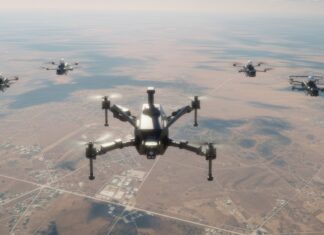
    Lockheed Martin Skunk Works® and XTEND have achieved a major milestone in JADC2 by integrating the XOS operating system with the MDCX™ autonomy platform. This technical breakthrough enables a single operator to simultaneously command multiple drone classes, eliminating the friction of mission handoffs. From "marsupial" drone deployments to operating in GPS-denied environments, explore how this collaboration is abbreviating the data-to-decision timeline and redefining autonomous mission execution.

    From Ukraine to Taiwan: The Global Race to Dominate the New Defense Tech Frontier

    0
    As traditional defense primes face mounting competition from agile “neoprimes” such as Anduril, Palantir and Helsing, the balance of innovation is shifting toward software-defined warfare and scalable, dual-use technologies, while global industry consolidation—marked by Boeing’s integration of Spirit AeroSystems and other strategic mergers—signals an intensified race to secure control over the defense technology value chain. Our Defense-Tech weekly report highlights these trends.

    Europe’s “Drone Wall”

    0
    In early October 2025, a coordinated wave of unmanned aerial system (UAS) incursions—widely attributed to Russia—targeted critical infrastructure across at least ten European nations. The unprecedented campaign exposed the fragility of Europe’s air defenses...

    Weekly Defense Update & Global Security Assessment

    0
    Executive Summary The past week (September 18-25, 2025) represents an inflection point where strategic defense concepts have transitioned from doctrine to tangible reality. An analysis of global events reveals four primary, interconnected trends shaping an...

    U.S. Air and Space Forces Push Next-Gen Programs at the AS&C 2025 Conference and...

    0
    At the 2025 Air, Space & Cyber Conference, U.S. Air Force and Space Force leaders unveiled major updates on next-generation fighters, bombers, unmanned systems, and space initiatives, highlighting both rapid innovation and critical readiness challenges as the services race to outpace global competitors. A short version is available here, with a more detailed version for subscribers.

    TADTE 2025: Reflecting Taiwan’s Strategic Themes

    0
    The Taipei Aerospace & Defense Technology Exhibition (TADTE) 2025 crystallized around four dominant strategic themes that collectively illustrate Taiwan's comprehensive approach to defense modernization amid escalating regional tensions. Based on a detailed report by Pleronix (available upon request). Includes a Podcast discussion on TADTE 2025's highlighting Taiwan's four strategic themes beyond the post's coverage.

    Iron Beam 450 Completes Testing, Soon to Join With Operational Air Defense Units

    0
    Israel’s Iron Beam 450 high-power laser system has completed final testing, marking a major leap in air defense. Developed by Rafael, it offers precise, cost-effective interception of rockets, UAVs, and mortars, and is set for IDF deployment by 2025.