Tuesday, December 23, 2025
More
    Home Blog Page 434

    3D audio for Warrior Programs

    An advanced 3D audio communication systems is developed by a team led by Sennheiser Canada under the Canadian Soldier Integrated Headgear System (SIHS) program. The team also includes AuSIM Inc. from the US and Britain’s Davies Communications from the Selenia Communications group.

    The soldier-worn systems will provide three-dimensional reception of electronic communications and 3D audio cues to enhance situational awareness. 3D audio feature provides spatial information of the incoming call, improving the soldier’s capability to monitor multiple communications channels and prioritize important information as it is received. 3D cues are based on GPS information encoded with every transmission. SIHP monitors the soldier’s head position, decodes the incoming signal, and plays the signal in 3D audio, accurately simulating the source of the signal’s location. The system also function as a navigation guide, triggering audible cues near navigation waypoint, alerting of threat locations and exposure to enemy line of sight etc.

    The SIHS performs as “transparent” system, maintaining the wearer’s natural hearing throughout the use of the system. It also protects the user’s hearing from the damage of loud or impulsive noise, using active noise reduction.

    Advanced Information Architecture

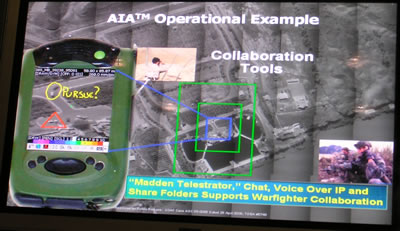
    The US Marine Corps is testing a tightly integrated information network designed to provide warfighters at every level with collaborative, real-time information and imagery. During the “Agile Lion” demonstration, the Corps will test Northrop Grumman’s Advanced Information Architecture (AIA) providing commanders on the ground an access to real-time aerial imagery taken by Litening targeting pods. The digital imagery files will be filed and stored into a dynamic catalog of tactical information including targeting video.

    AIA will be integrated into a variety of Marine Corps tactical platforms, including an AV-8B and an F/A-18D aircraft equipped with a Litening pod, a Cobra attack helicopter, a C-130J air refueling tanker, ground vehicles and even individual Marines, which will allow them all to share tactical information in real time. “The tanker will be equipped with an AIA suite enabling it to expand its role of aerial refueling to ‘digital refueling,'” said Dale Burton, sector vice president and chief technology officer for Northrop Grumman’s Integrated Systems sector. “In Northrop Grumman’s Brilliant Constellation concept, digital refueling means delivery and sharing of information and situational awareness products between warfighters, in the cockpit or on the ground, via its real-time network.”

    A Command Operations Center (COC) at Marine Corps Air Station Yuma has also been equipped with a ground-based AIA command node to provide data access, chat and e-mail capability so that ground forces can exchange information with the COC without using voice
    communications. Marine Corps ground units will use personal-data assistants and laptop computers to access data provided through the AIA network.

    “Our goal in Agile Lion is to show the value of tactical, ad-hoc networks that enable both air- and ground-based warfighters to collaborate in real time, especially while on the move,” said Burton, “Today, most of the raw data collected by tactical assets is available only in cockpits and command centers. The demonstration of AIA in Agile Lion will highlight how forces in convoys and dismounted Marines can ‘pull’ or ‘push’ data-imagery, signals, intelligence, chat, e-mail or other information-to and from a network of airborne and ground-based servers, allowing real-time collaboration among users.”

    Automated Deep Operations Coordination System – ADOCS

    The Automated Deep Operations Coordination System (ADOCS) is one example of a joint mission management software application. The concept originated as a DARPA Program and evolved into the “go to war” automated support system for deep operations in several theaters. The US Army is using over 5,000 such systems worldwide.

    ADOCS is also a major segment of the intelligence application package for Theater Battle Management Core System (TBMCS) functionality at wing and squadron level. Deployed to the smallest detachments and all the way up to the Combined Joint Task Force Headquarters, ADOCS shares a Common Operational Picture through all users. The system enables joint planning, coordinating, and executing with horizontal and vertical integration across the joint battle space.

    Enabling the service level commander and staff to allocate critical air resources in an efficient way, the Air Tasking Order (ATO) planning and execution tools are optimizing the employment air assets, improving the flow of information for identification, assignment, and nomination of targets. The process provides early assessment of potential and planned missions. The center monitors ATO execution through all phases and provides immediate visibility into air nominations throughout the targeting process, including distributed 8- and 4-hour updates to allow for detailed target validation prior to strike. ADOCS also supports analysis to assess the changes and movements of the Fire Support Coordination Line (FSCL) on current and planned missions in the ATO. It provides immediate visibility of targets exposed or covered by movements in the FSCL. Situational awareness is provided by battlespace visualization functions to support faster, accurate deep attack planning, and battle space assessment. Tools provide visualization of coordination measures, ingress and egress routes, and air defense threats. Friendly fires are shown in 3D space over any area to effectively deconflict dangerous situations. Battlefield geometries can also be overlaid with imagery and terrain data to improve situation awareness and planning. No Strike List (NSL) and Restricted Targets List (RTL) are constantly referenced in all phases of mission development to eliminate potential to collateral damage and fratricide.

    Key integration functions within ADOCS are Joint Time Sensitive Target management, The Joint Time Sensitive Targets Manager (JTSTM) in ADOCS allows for target creation, vetting, coordination, and execution across the Joint Command structure. It is tailored to allow the Region Combatant Commander to use all of the weapons systems in the joint battle space to engage time sensitive targets. Another feature of ADOCS is the Intra-Air Operations Center Targets Management (ITM), provides a tool for the Air Operations Center (AOC) to coordinate and engage those targets which have a significant impact on the conduct of the air battle. The ITM allows the users to coordinate, deconflict, match aircraft to the target, and submit to Theater Battle Management Core System (TBMCS) the request for a change to the Air Tasking Order (ATO). The digital coordination and deconfliction features of this manager greatly reduce detect to destroy times for AOC critical targets. The ITM is also capable of linking its mission data to the Joint Time Sensitive Target (JTST), Intelligence Surveillance and Reconnaissance (ISR), and Fires managers in ADOCS for joint visibility and engagement.

    ADOCS supports coordination of certain air space through it is Airspace Coordination Request (ACR) manager. The ACR Manager can conduct time and altitude, zone and corridor deconfliction. ADOCS also allows air space requests to be modified and coordinated across boundary lines and through the echelons. The ACR manager is also seamlessly integrated with the Tactical Airspace Integration System (TAIS) for airspace management and visibility. ADOCS can display the Airspace Control Order (ACO) from both TAIS and TBMCS and constantly compares missions against the protected airspace to alert the users of potentially dangerous conflicts. The Combat Search and Rescue (CSAR) manager in ADOCS allows the local rescue coordination center to plan, coordinate, and execute search and rescue operations across the joint battlefield. By consolidating all of the critical information elements into an in-depth mission roll-up, the agencies involved in Personnel Recovery are able to view and track the progress of the recovery operation. ADOCS uses the ATO to automatically recommend recovery assets for direct pairing with a particular mission. The CSAR manager also allows dynamic tasking of other assets to assist in the recovery operation.

    ADOCS contains mission managers that allow the user to coordinate and execute indirect fires including tube artillery, multiple launch rocket systems, ship fired missiles, and coordinated engagements on seaborne Special Operations Forces. Not only does ADOCS have the ability to weapon-target pair and begin the engagement process, it always performs conflicts checks against the targets to ensure there is no unnecessary collateral damage or fratricide. The system supports Counterfire Common Operational Picture (CF-COP) functions providing a near real-time picture of the artillery battle. It allocates tube and rocket counter-battery resources for more efficient counterfire operations through digital integration at multi-echelons; from joint/combined level down to tactical firing units. CF-COP also includes munitions allocation and weapon system status. Weapon-target pairing provides improved use of available munitions to maximize lethality while conserving time and munitions for follow-on engagements.

    The Intelligence, Surveillance, and Reconnaissance Manager in ADOCS allows the intelligence community to coordinate multiple collection platforms in a synchronized collection effort on the target. Following the cross-queue collection effort, ADOCS has the ability to pass the mission to its other target execution managers. Similarly, the JTST and ITM managers in ADOCS can send missions to the ISR Manager for detailed collection prior to determining the execution course of action.

    Faust (FIST) Battle Management System

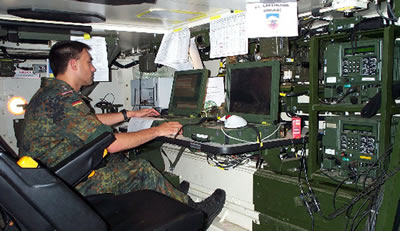
    After parallel development of two Army C2 systems designated GeFuSys and FuWES-Kern H, the two programs were integrated into the C2 system currently known as “Faust” (Fahrungsausstattung Taktische). Faust was further designed to be integrated into the division level and army-wide FuInfosys H C4I system. the tactical C2 system, was deployed in 2003 with a battalion-size Battle Group West, part the allied forces in Afghanistan (ISAF). Since June 2004, Faust was introduced for operational evaluation the German elements in the peacekeeping forces in KFOR, SFOR and has been cleared for operational use in February 2005.

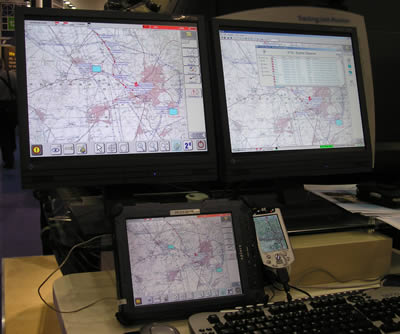
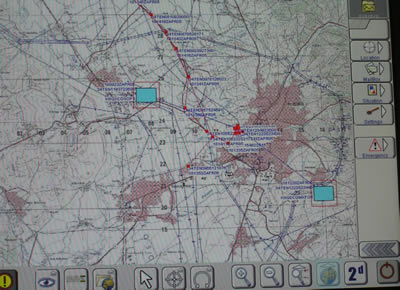
    Faust is designed with modular elements, which can implement new modules, regular upgrades and local adaptations to the basic system. Each Faust unit is linked to a vehicle and transmits its own GPS position to the network. The basic service provided by the system are the geographic information display (GIS) map display and “Blue Force Tracking”, monitoring all friendly elements in the area over a digital map, and providing commanders with common and updated operational picture. Other services include secure messaging, communications management and control and general office automation functions. Monitoring all activities and resources over a digital map dramatically improves the utilization of assets, reduces voice communications and generally improves command and control. This function also supports an “emergency call” which transmits the vehicle’s position and emergency alert which flashes on the recipients’ map. Faust was developed by EADS Deutchland GmbH.

    Faust has been integrated with a wide range of communications systems. Primary terrestrial communications were provided by VHF (combat net radios) and GSM (commercial cellular networks). Satellite communications were also provided during testing and expeditionary deployments. The system can also utilize terrestrial lines using ISDN/AUTAOKO 90 protocol. Following the decision by the German Ministry of Defense to field Future introduction of Tetrapol military communications systems will be required in the future.

    The GIS and mapping functions support different scales of maps, as well as on-screen position, range and area measurements, path finding, perspective views etc. The system provides automated task organization. Tasks can be displayed in a “tree” form, enabling “drag and drop” of elements between various units for. Every change is reflected in the relevant unit’s organization, and “to do” list.

    PR 4G Combat Net Radio & IP Networking Capability

    The CIP program, part of the British MOD BOWMAN program, encompass three interrelated projects – the development of common ComBAT software tools designed to enhance situational awareness at all levels and aid the planning and control of operations. The £330M tri-year development program be supplied to approximately 13,000 computers. CIP Infrastructure will further interface with over 2,000 terminals integrated into armored fighting vehicles, creating battlefield information software applications (BISAs). When fully implemented, P-BISA will be fitted to over 1,000 vehicles.

    The initial CBM(L) capability will be introduced with BOWMAN to provide a core battle management system. It will enable the battlefield information systems being developed for armored fighting vehicles, artillery fire control, ground based air defense, to exploit BOWMAN’s data messaging capability concurrently, and insure effective interoperability issues with our allies.

    Future Combat Systems (FCS)

    Army, FCS Team to Establish Evaluation Facilities in Texas

    The US Army plans to establish an Future Combat System’s Brigade Combat Team evaluation unit Beginning in 2007 at Fort Bliss, Texas. The unit will be part of the Army’s Training and Doctrine Command and FCS Program Management Office. commanded by MG Charles Cartwright, program manager, FCS Brigade Combat Team. The activity at Ft. Bliss will be supported by the new FCS regional office established by Boeing and Science Applications International Corporation (SAIC) in neighboring El Paso, Texas.

    The mission of the Evaluation Brigade Combat Team will be to evaluate all FCS systems as they mature in preparation for deployment. They will also evaluate those technologies slated for early spin out into the current force beginning in 2008. These technologies include initial network capabilities, Unattended Ground Sensors, the Non-Line of Sight – Launch System, and the Intelligent Munitions System. These are all intended to fill existing capability gaps and enhance the effectiveness and survivability of current troops. Data compiled by the evaluation unit will then flow back into the broader FCS program and significantly reduce program risk while providing valuable user feedback to help ensure long-term program success.

    BOWMAN Tactical Communications System

    UK’s Land Digitization Program is an central enabler for the British Army’s Network Enabled Capability (NEC) initiative. The £1.9 billion Bowman program comprises a new family of radios, computers and C3 applications, which will establish the communications and computing infrastructure for existing and future forces. Bowman digital radios are replacing the aging Clansman range of analog radios, in service since the 1970s. As a data-capable radio. Bowman systems will support communications between headquarters, replacing part of the Ptarmigan trunk system currently in service.

    The new radios provide tactical, secure voice communications, and data messaging and are embedded with GPS receivers to provide location information for “Blue Force Tracking” systems.

    Bowman systems entered service in 2004 and are expected to remain in service at least through 2026. Some 46,500 radios and 26,000 computers will be procured under the multiyear program, fitted to 20,000 military vehicles, 156 ships and 276 aircraft.

    The VHF elements are based on the ITT’s SINCGARS technology developed for the US military. Bowman is also integrating the Harris HF radios Both systems are embedded with UK specific encryption technology. Both VHF and HF radios are supporting secured voice and data communications. VHF sets use fixed or frequency hopping regimes, while HF supports advanced Automatic Link Establishment (ALE) and Free Channel Search (FCS). DRS Tactical Systems is providing four variants of its Scorpion notebook computers for the Bowman program, including vehicle mounted and dismountable terminals. AEA Battery Systems is supplying rechargeable li-ion batteries and chargers for the dismountable and man-portable sets.

    Bowman networks will automatically establish a “tactical Internet” network to support IP based communications over HF, VHF and High Capacity Radio networks. ALl communications devices will be able to communicate over Local Area Sub System (LAS), connecting individual vehicles fitted with the Vehicle Internal Distribution System (VIDS) set to receipt of radio nets from designated, similarly equipped vehicles.
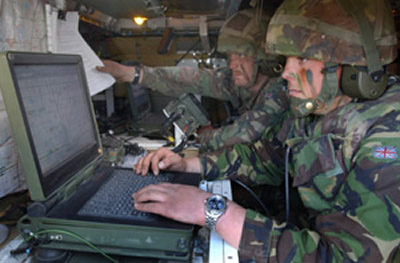
    The first increment of the current digitization program started in 2002. Designated DS1, it was fielded at Brigade headquarters level, in support the Battle group HQ and HQ Allied Rapid Reaction Corps. The current system encompass a battlefield management system generating situational awareness information locally and between HQs. Another feature is the personnel tracking application, aggregating information gathered from personnel role radios allocated to all mounted and dismounted combat elements operating under the battle group command. This application is being used as the OPLOC tracking system in Kosovo, Afghanistan and Iraq. DS1 is scheduled to transition to full Bowman configuration by 2006. In April 2005, 12 Mechanized Brigade deployed to Iraq with a core Bowman capability alongside some existing capability. Another milestone for the program was in July 2005 as the systems were fielded with the Scots Dragoon Guards battle group, taking part in Exercise Medicine Man at the British Army Training Unit Suffield (BATUS).

    Apart from the various radios, the program will integrate new C4 application systems, such as the Common Battlefield Applications Toolset (ComBAT), and Platform Battlefield Information Systems Application (P-BISA), collectively known as CIP. Personal Role Radio (PRR) will also integrate with the Bowman program in its future course.  One such application is the integration of Bowman with vetronics under the Challenger 2 main battle tank Digitization program.

    The initial CBM(L) capability will be introduced with Bowman to provide a core battle management system. It will enable the battlefield information systems being developed for armored fighting vehicles, artillery fire control, ground based air defense, to exploit Bowman’s data messaging capability concurrently, and insure effective interoperability issues with our allies.

    The Royal Netherlands Navy is buying Bowman systems worth of EUR94 million from General Dynamics UK for the Royal Dutch Marines, under the Dutch Integrated Marines Communications and Information System (NIMCIS). This is the first export contract for the Bowman C4I system. The systems are expected to be installed on tactical vehicles such as the BAE Systems Land Systems Hägglunds BvS 10 armored all-terrain tracked vehicles recently ordered for the forces.


    Modular Fortifications

    Concertainer Bastion, designed to replace conventional field fortification materials such as sandbags, concertainer was first used operationally by the British Army in the Gulf War. Walls constructed by such units can protect against direct fire, explosion blasts and fragments. Protection of guard posts, barracks, parked aircraft and helicopters, command posts, hospitals, fuel storage can all be erected using such rapidly constructed in contingency area. Since then it has seen action with many armies around the world.

    A typical unit of Concertainer equivalent to approximately 1500 sandbags can be constructed and filled by two men and a single common loader in less than 20 minutes. An equivalent wall of sandbags would take 10 men seven hours to build. Bunkers and protective revetments can be built from standard Concertainer Bastion units. The units are constructed with special joining elements enabling rapid and flexible construction of walls and other complex construction elements. The units are stored in a collapsed form for compact and efficient storage and transportation. Concertainer units are also used for construction of bunkers.

    The living compartment is comprised of a standard 20 foot container, surrounded by standard Concertainer units filled with 170 cubic meters of filling material. All materials required for the construction, including pre-fabricated personnel door and rear escape hatch are stored in the container for storage and transportation. Units required for over 500 meters of wall can be stored in a standard 20 foot container. The units are filled with any available filling material, including sand, rubble, rocks and even snow.

    The company has recently tested an Extended Overhead Protection System (EOPS) utilizing steel rails for roofing, covered by earth filled Mil-1units for overhead protection. EOPS was designed by QinetiQ to improve protection against mortar attacks.

    DynaShield Spray-On Armor

    An innovative spray-on armor protection system is currently being evaluated for potential use in Iraq. The system, developed by a British company uses DynaShield SPI blast and ballistic resistant polymer, which can be sprayed on existing surfaces (such as vehicle’s body parts). When the polymer dries, it provides additional protection, at lower weight compared to comparable protection provided by add-on steel plates.

    A 3/4 inch layer of DynaShield SPI demonstrated ballistic protection similar to a 3/8 inch thick steel plate (RHA). A 0.2″ steel plate covered with 3/4″ DynaShield SPI stopped 0.50 Cal bullet at 2736 fps, and multiple shots of 7.62x54mm at 2741 ft/sec. DynaShield SPI can be applied in the field to existing surfaces and structures, without modifications or redesign. It can also be applied to protect shelters or fortifications.

    DynaShield SPI also provides a reactive sealant; protecting forward positioned fuel storages. The polymer is sprayed on regular barrels, to protect from leakage of hazardous or flammable liquids. The spray-on polymer seals the barrel after it is penetrated by multiple bullet hits and prevents further leakage from the perforated barrel.

    Portee Artillery Support vehicle

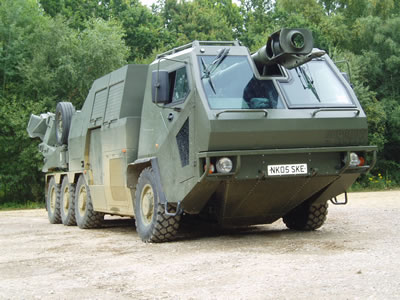
    Portee is comprised of a 155mm/39 calibre M777 towed lightweight artillery system and a purpose-built portee 8×6 version of the Supacat high mobility cross country vehicle. The gun is carried on the rear of the vehicle. The Supacat’s High Mobile Truck (HMT) family is entering service with US and British forces in a two and three axels configurations.

    M777 is already in low rate initial production for the US Marine Corps. With additional orders from the US Army and National Guards the total US bound production of M777 is expected to top 600 guns.

    In the traveling mode the M777 is carried in the rear part of the chassis, while the ammunition is stowed at the front, between the armored, NBC protected split cab. On reaching the combat area the howitzer is quickly dismounted an onboard mechanical handling system, allowing it to be towed rapidly into and out of action and up to 3 ammunition containers can be carried in its place allowing a total of over 70 readily available rounds.

    Equipped with a fully integrated digital fire control system the M777 howitzer can be brought into action in less than one minute, and moved to an alternative firing position in less than three minutes. Portee was privately developed at BAE Systems in an anticipation of future British Army requirements for up to 45 Lightweight Mobile Artillery Weapon System – Gun (LIMAWS (Gun). In a series of tests, Portee fired over 350 rounds demonstrating its flexibility as a medium weight, highly mobile artillery system. The main advantage of Portee is the fact that the unit can be split into two loads slung under a transport helicopter. The complete M777 Portee System weighs about 12.3 tons and can be carried inside a C-130 Hercules transport aircraft. The British Army evaluates other alternatives, including Giat Industries CAESAR 155mm/52 calibre system based on a 6×6 truck chassis, and the standard 155mm M777 lightweight artillery system.

    Force XXI Battle Command Brigade and Below – FBCB2

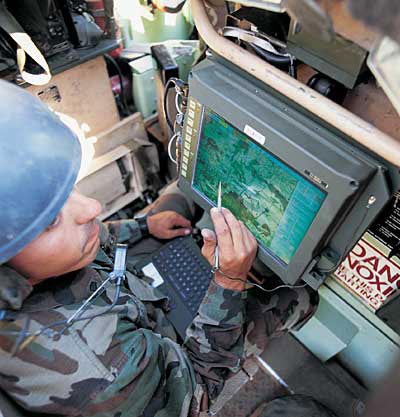
    The FBCB2 system provides software and hardware tools that supporting battle command and near-real-time brigade level situational pictures, down to the individual soldier, single platform level. The system integrates over 1,000 subscriber sets covering the brigade’s entire area of interest, including Bradley or Stryker combat vehicles, M-1A2 tanks, AH-64D, OH-58D and Black Hawk helicopters, artillery and combat support elements etc. The system’s coverage extends far beyond the line of sight and visual communications ranges provided by previous C2 systems. The system relies on advanced communications devices, which integrate position navigation and reporting capability (such as GPS integrated SINCGARS or EPLRS). Subscribers also embed some battlefield identification capability (such as BCIS Blue Force Tracking facilities deployed during OIF) to generate instant alerts on instances where engagement between friendly forces is at risk.

    FBCB2 is designed to support commanders at lower echelons with real-time situational awareness, target identification and graphical combat area displays. The system’s situational awareness component displays the geographical location of all weapons, platforms, soldiers, command posts and other facilities based on actual locations reported automatically by the system’s subscribers in near-real time. The system is used in conjunction with the Army’s Tactical Internet (TI) seamless Internet and legacy Army Tactical Command and Controls System (ATTCS) to link to the Army Battle Command Systems (ABCS). Operating at division level and above, ABCS collects information from both the operation center and the individual units, processes a common operational picture (COP) and disseminates it through FBCB2 computers to all levels of command, thus improved situational awareness, coordination and combined operations and support.

    FBCB2 subscribers automatically post their position and status messages, via wireless or satellite radios, to nearby subscribers as well as to central hubs at the brigade’s Command Post. The information is transmitted over wireless and secured internet, which enables every member of the network receiving relevant information on nearby friendly forces, and creates common, constantly updated digital maps of the battlespace, shared by all the combat echelons below or above the brigade, as well as nearby forces or joint forces. This common picture displays positions and details about enemy forces, and specific targets, friendly and own forces, logistics information etc. FBCB2 is designed to operate with current systems, and is fully functional with relatively slow wireless data modems and narrowband links. To support such operation the system relies on a number of common messages, and the delivery of textual messages.

    DRS’s FBCB2 appliqué V-4 terminals consist of rugged computers and hard disk drives, display units, keyboard units. The current configuration uses upgraded processor units with one gigabyte (GB) of Dynamic Random Access Memory (DRAM).

    DRS started the delivery of FBCB2 hardware under low rate production of 9,000 sets in 2001. By June 2004 the program moved into full rate production under a five year $100 million US Army contract. DRS received the latest $45.5 milliom order in October 2005, for the supply of more than 5,500 sets to be delivered through 2006. Systems are installed on M1A2 Abrams Main Battle Tanks and M2A3 Bradley Fighting Vehicles, to support the Army’s Blue Force Tracking requirements, which include beyond line-of-sight reporting and tracking, as well as significant improvements in vertical and horizontal information integration for incorporation into the Army’s overall battlefield visualization efforts.

    In November 2006 DRS Technologies, Inc. received an additional US$19 million order for FBCB2 hardware. This contract adds 1,700 Appliqué Computer Systems and peripheral equipment to already supplied 25,000 FBCB2 systems already deployed with the U.S. Army.

    Satellite Based Blue Force Movement Tracking

    The company  which supplied much of the Blue Force and Movement Tracking add-ons for the US Army FBCB2 system currently operational in Iraq, is developing an extension which can cover British Army Bowman tactical communications program. The integrated system, utilizing commercial L-band satellite communications, will provide integrated situational awareness picture for the two armies and reducing the risk of fratricide. Each army is responsible for the generation of its situational picture. The two pictures are then combined into common operating picture which can be displayed back at the individual vehicle level, showing all coalition friendly forces. Similar integration is planned between US and Republic of Korea forces.

    Dec. 21, 2006: Comtec receives $2.7 Million order for FBCB2 related satellite transceivers.

    Blue Force Tracking (BFT) Battle Management System

    EADS has equipped Allied forces in the Balkans with an Interim Forces Tracking System (IFTS), which monitors the position of all units operated under Allied forces command in Kosovo and the Balkans (Bosnia Herzegovina and the former Yugoslavian republic of Macedonia). Apat from unit tracking, the system facilitates emergency messaging and establishment of real-time common situational picture for all levels of command. EADS Defence and Communications Systems is supplying the system under a €13 million contract with NATO Consultation Command and Control Agency (NC3A). This deployment will enable NATO to field-test the system which is destined to equip all units under NATO command in its theatres of operation.

    The central server is installed at the KFOR command post in Pristina. This server can track up to 600 vehicles equipped with rugged data terminals, transmitting GPS locations over secured TETRAPOL radio channels. The TETRAPOL network first deployed in year 2000 already covers over 90% of the Kosovo area of operation. To support BFT, the network will undergo significant enhancements, including the introduction of data transmission functions, and an increased number of communication channels.

    The information system is based on Imp@ct, a derivative of the SIR (System d’Information Régimentaire) already deployed by the French Army. Imp@ct enables a vehicle to transmit and receive geographical location of vehicles in their vicinity, as well as receiving geographical tactical information such as prohibited or dangerous zones, as well as free-text and form-based messages.

    The system generates specific displays for different levels of command, including HQ, command and vehicle levels. The system uses PCs at headquarter level, touch-screen terminals for vehicular applications and PDAs for dismounted users. At HQ, BFT provides monitoring of all vehicle’s locations over a large area (operation theater) map. At the brigade or battalion command level, the system generates the relevant subsets of the HQ view, focusing on the local area of operation, utilizing larger scale maps. At the vehicle level, the system provides a local, vehicle centered view of the immediate area, showing neighboring vehicles. The system supports several messaging standards, including FRAGOs, SITREP and can rapidly generate alerts indicating accidents, attacks and other emergencies.

    BFT supports a wide range of communications means supported by QoS policies to ensure rapid delivery of high priority transmissions. The network is controlled by buit-in switch capable of integrating tactical VHF communications, as well as satellite communications, commercial networks including PMR and COTS based networks such as WiFi, WiMAX etc. The system can utilize secured communications with “over the air” key management service. Each unit can be deactivated or “killed” by remote control, denying access by unauthorized users to network resources or classified data stored on captured units.

    "USAF To Spend $2 Billion on Airborne Communications"

    According to a Forecast International Research

    Forecast International is projecting sales of airborne communications systems for the U.S. military to reach $2 billion over the next 10 years. 66% of the total will be spent in the next five years. The 2011-2015 time period makes up $687 million in projected sales will undoubtedly be influenced by decisions related to Joint Tactical Radio System (JTRS) related programs. The report predicts that sales volumes could increase once the JTRS issue is resolved.

    The report designates the leading U.S. military airborne communications program as Integrated Communications, Navigation and Identification Avionics (ICNIA) system. This program should revolutionize aircraft avionics by combining the communications, navigation, and identification functions into one lightweight, space-saving module. ICNIA accounts for $514 million or 25.32 percent of the market value in the study. Another significant program, currently at research and development stage is the Tactical Targeting Network Technology (TTNT), which will account for $439 million (21.63 percent of the report). Various RF Sensors and Countermeasures Projects account for further $294.34 million (14.5%).

    JTRS, has a significant impact on the U.S. military communications market,” said Electronics Analyst, Theresa Hartley, author of the study. When JTRS requirements are clearly defined, vendors are expected to develop new products or modify existing hardware to meet these specifications. “When these JTRS products are marketed, sales should take off.” Hartle commented, Once fully developed, JTRS will replace virtually all radios currently in U.S. military service. Further spending is expected to upgrade existing hardware to comply with JTRS waveforms. An example for such modification is the Multifunctional Information Distribution System (MIDS), which is expected to bring in $415.6 million over 10 years. MIDS accounts for approximately 20% of the market dollars in this analysis.

    Two companies, Northrop Grumman and Rockwell Collins combined have at least 49 percent of the market. This number would be even higher if Rockwell Collins’ share in Data Link Solutions (DLS) was broken out and credited to it. DLS as a separate entity and MIDS manufacturer enjoys 13.78 percent of the market or approximately $279.7 million in expected sales over 10 years. Raytheon, ViaSat, and BAE Systems complete the list of airborne communications major players.

    Skunk Works and XTEND Simplify Multi-Drone Command

    0
    Lockheed Martin Skunk Works® and XTEND have achieved a major milestone in JADC2 by integrating the XOS operating system with the MDCX™ autonomy platform. This technical breakthrough enables a single operator to simultaneously command multiple drone classes, eliminating the friction of mission handoffs. From "marsupial" drone deployments to operating in GPS-denied environments, explore how this collaboration is abbreviating the data-to-decision timeline and redefining autonomous mission execution.

    From Ukraine to Taiwan: The Global Race to Dominate the New Defense Tech Frontier

    0
    As traditional defense primes face mounting competition from agile “neoprimes” such as Anduril, Palantir and Helsing, the balance of innovation is shifting toward software-defined warfare and scalable, dual-use technologies, while global industry consolidation—marked by Boeing’s integration of Spirit AeroSystems and other strategic mergers—signals an intensified race to secure control over the defense technology value chain. Our Defense-Tech weekly report highlights these trends.

    Europe’s “Drone Wall”

    0
    In early October 2025, a coordinated wave of unmanned aerial system (UAS) incursions—widely attributed to Russia—targeted critical infrastructure across at least ten European nations. The unprecedented campaign exposed the fragility of Europe’s air defenses...

    Weekly Defense Update & Global Security Assessment

    0
    Executive Summary The past week (September 18-25, 2025) represents an inflection point where strategic defense concepts have transitioned from doctrine to tangible reality. An analysis of global events reveals four primary, interconnected trends shaping an...

    U.S. Air and Space Forces Push Next-Gen Programs at the AS&C 2025 Conference and...

    0
    At the 2025 Air, Space & Cyber Conference, U.S. Air Force and Space Force leaders unveiled major updates on next-generation fighters, bombers, unmanned systems, and space initiatives, highlighting both rapid innovation and critical readiness challenges as the services race to outpace global competitors. A short version is available here, with a more detailed version for subscribers.

    TADTE 2025: Reflecting Taiwan’s Strategic Themes

    0
    The Taipei Aerospace & Defense Technology Exhibition (TADTE) 2025 crystallized around four dominant strategic themes that collectively illustrate Taiwan's comprehensive approach to defense modernization amid escalating regional tensions. Based on a detailed report by Pleronix (available upon request). Includes a Podcast discussion on TADTE 2025's highlighting Taiwan's four strategic themes beyond the post's coverage.

    Iron Beam 450 Completes Testing, Soon to Join With Operational Air Defense Units

    0
    Israel’s Iron Beam 450 high-power laser system has completed final testing, marking a major leap in air defense. Developed by Rafael, it offers precise, cost-effective interception of rockets, UAVs, and mortars, and is set for IDF deployment by 2025.