Sunday, December 14, 2025
More
    Home Blog Page 457

    AHEAD Air Burst Munition

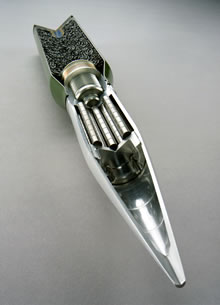
    AHEAD technology, developed by Oerlikon Contraves improves the capability of air defense guns such to engage and destroy aerial targets, from large aircraft to small targets such as missiles or PGMs. The gun fires short, 24 round burst of high velocity Ahead rounds aimed at the target’s intercept point. Every projectile is programmed by a muzzle based electromagnetic inductor, which sets an electronic timer to activate and separate the projectile into 152 heavy tungsten metal spin-stabilized sub-projectiles (3.3 gram each), forming a lethal cone shaped metal cloud, placed ahead of the target in its flight path.

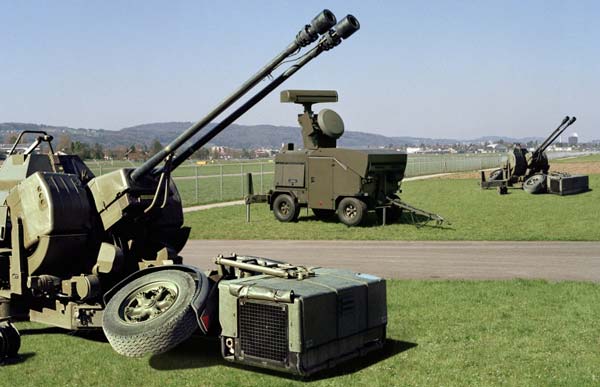
    AHEAD is designed to fit existing Skyguard air defense systems, operating twin 35/1000 rpm revolver cannon and Super-fledermaus. The manufacturer claims a very short response time for the system, as low as 4.5 seconds from target detection to firing. With the addition of AHEAD modernization, existing Skyguard fire are fitted with the fire control subsystems which enable the system to be operated as a stand-alone gun or in a “fire unit network”, separated up to three kilometers from each other. The fire units can exchange target search and track data at a fast rate, and share a common, full hemispherical situational picture to facilitate optimal target engagement by each fire unit. AHEAD technology is available today for naval Close-In Weapon Systems, as well as the remote controlled, point defense gun mount and mobile battlefield air defense systems, both are lightweight systems, transportable in a C-130.

    The 30mm AirBurst Munition (ABM) is currently being qualified for the German Army for deployment with the Mk30-2 ABM cannon mounted on the Puma AIFV. A 35mm version optimized for ground-to-ground effect is being qualified for the Bushmaster III chain gun mounted on the new CV9035 IFV of the Royal Dutch Army. Denmark has also selected the ABM capability for its CV9035.

    The ABM concept is also highly suitable as a Counter-Rockets, Mortars and Artillery (C-RAM). During the last year (2005) the Skyshield 35mm systems with ABM munitions were tested in the US and Germany and evaluated against typical C-RAM threats. Further trials are underway. The Israeli Ministry of Defense also evaluated the ABM solution for C-RAM.

    The Power Vest

    A futuristic “power fabrics” is currently in developed by SRI International, in collaboration with Hexcel Schwebel. The team proposes the utilization of multifunctional fabrics, embedded with thin filaments made of lithium ion compounds, shaped into long yarns, wound into high-strength polymer fibers. Such fabrics will provide both electrical power for a soldier’s equipment and protection against projectile impact. Such fabrics will reduce and distribute the weight of batteries that now must be carried separately.

    TDA 2R2M Rifled 120mm Mortar System

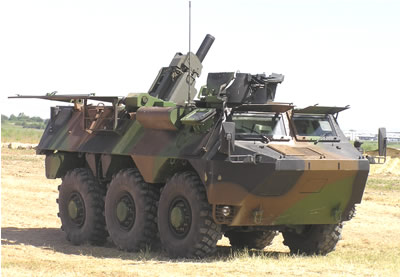
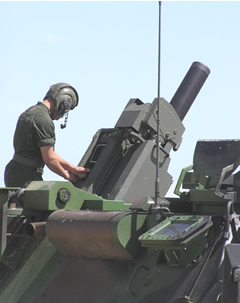
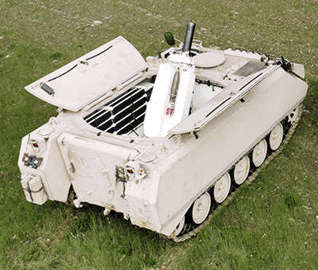
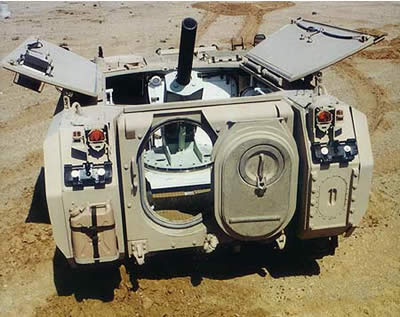
    A joint development by the US- Picatinny Arsenal and Thomson Daimler-Benz Aerospace (TDA) has created the Dragon Fire, an autonomous mortar system. The current prototype consists of a modified TDA 2R2M rifled 120mm mortar, with a maximum range unassisted/rocket-assisted of nine and 14kms respectively. It can be operated remotely by radio and can calculate (GPS) within three to five seconds its own location and elevation and bearing to the target. An on-board magazine holds 33 rounds ready to fire, and the package can be towed by a HMMWV tactical vehicle or fit inside a V-22 Osprey. A derivative, dubbed Mobile Dragon Fire, has been mounted on a USMC light armoured vehicle (LAV), and the addition of a gyro stabiliser should result in accurate fire on the move out to maximum ranges.

    A second prototype, the Armoured Mortar vehicle, with a semi-automatic 120mm recoiling rifled mounted mortar, 2R2M, with an optional smooth bore version, was designed and developed by FNSS in cooperation with the Deutsche Aerospace.

    Interceptor DV-15 – Fast patrol Boat

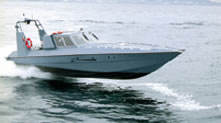
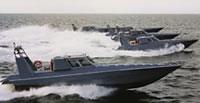
    CMN is offering the Interceptor family of fast patrol boats, designed for coastal patrol, and special missions that require high speed interdiction, in the littoral water. Powered by two surface motors, the IDV 15 lightweight boat is designed for low draft (less than 0.8 meter), for operation in shallow water, to ranges of 200 nm. The boat offers minimum accommodation for a four men crew and heavy machine gun, for fire support. The 15.5 meter boat can sprint to a speed of 53 knots. The lightweight boat is designed for low draft (less than 0.8 meter), for operation in shallow water.

    The boat offers minimum accommodation for a four men crew and heavy machine gun, for fire support. Two larger versions are designed for extended operations – DV 20 is a 20.2 meter long high performance craft, its structure is built from advanced composite materials, including carbon fiber and other advanced composites structures, hardened with epoxy resins, offering high resistance to sea conditions. DV 20 is powered by two 846 kW engines, developing maximum speed of 43 knots. Its range is extended to 350 nm. at max speed.

    The boat is operated by a crew of 5, and can accommodate a Raptor GS optronic directed 30 mm gun turret. CNM is also developing a larger member of the Interceptor family. The DV 33 is also manufactured from advanced composites. The vessel will accommodate two 2,720 kW engines, to reach speed up to 45 kt. And range of 340 nm. This larger boat can accommodate a Raptor gun turret, surveillance, navigation and fire control radar and countermeasures systems.

    FIST Program To Use New Chikara class rechargeable Batteries

    AGM Batteries Ltd, a subsidiary of AEA, has announces in 2003 the launch of a new, high capacity Lithium-ion rechargeable cell called Chikara (power in Japanese) developed specifically for a 24-hour-mission-life HF (high frequency) radios. (four hours over the current maximum life). The new lightweight cell will retain AEA’s Li-ion capabilities but will sustain operation environment at -40C to +70C degrees range. Typical application are soldier modernization programs such as the Land Warrior and the FIST programs in the US and the UK respectively.

    Spike Multi-Purpose Anti-Armor Missile

    Manufacturer: RAFAEL / Eurospike

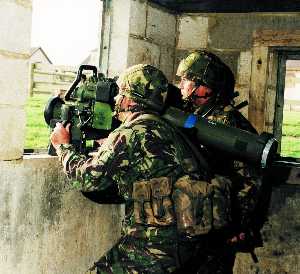
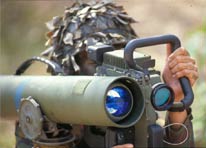
    Spike is a new generation, electro-optical, medium to long range anti-tank missile developed at the RAFAEL Missile Division Anti-Armor Directorate. Spike can defeat advanced Main Battle Tanks (MBT) as well as secondary targets such as buildings and soft-skin vehicles. The system is based on a common system architecture providing medium, long and extended long range precision attack capability for infantry, mobile, airborne and sea-based applications. The Spike family members include:

    The weapon consists of the missile in its canister and the firing post comprising a command launch unit, thermal imager and firing post. Command and launch unit, imaging infrared/CCD seekers, and part of the missile electronics are common to all family members. The powerful tandem warhead, rocket motor and flight control mechanisms also utilized similar elements, to reduce production cost.

    Spike’s high probability of kill (Pk) of both stationary and moving targets, is achieved by a sophisticated tracking algorithms and simple but effective guidance controls. Spike can be employed in two trajectories – in the lofted trajectory mode, the missile climbs high above the ground and then dives onto the target. Utilizing the low trajectory, the missile flies close to ground level and makes a direct attack on the target. This type of attack is useful especially at close range and in urban terrain. The weapon’s lofted trajectory is more suitable for attack of armoured vehicles, which are more vulnerable to top attack. From this position, the target is clearly visible at the terminal attack phase, and the operator can aim the missile to hit at the most vulnerable points. The basic operating mode for the Spike is a “fire and forget”. After firing, the missile automatically guides itself to the target impact. However, utilizing the fiber-optic communications link, Spike missile can also get target and guidance updates during the flight. This capability also enables the gunner to observe the target throughout the whole flight, as seen through the missile seeker. He can control the aim point during flight, thus ensuring the target is hit at its most vulnerable spot, which may not have been visible from the firing position. The fibre-optic data link also provides man-in-the-loop control all the way to target impact, hence permitting Spike to be used in operations which are subject to tough Rules of Engagement.

    Rafael offers a complete Integrated Logistics Support package including training. The gunners’ training program utilizes the Spike gunnery simulator, covers all skills necessary to operate the weapon at full combat efficiency, thus minimizing the need for training firings and.

    Spike is currently operational with the armies of: Israel, Singapore, Netherlands and Finland. The missile was selected as the future anti-tank missile for Poland, and is currently competing for the replacement of Milan with the British Army.

    RAMTECH

    RAMTECH is composed of Ceramic modules, encased in energy absorbing rubber molds, are also utilized in the RAMTECH armor. This material can be used as appliqué armor, for land and amphibious vehicles, as it offers both environmental durability and exceptional multi-hit performance, against 12.7, 14.5 and up to 30mm protection levels.

    Energy Harvesting Programs for Military Use

    The development of longer life, lighter and thinner batteries is some of the challenges facing battery manufacturers in programs such as the Land Warrior system. The battery should be paratrooper qualified, weigh below two pounds and up to 1.6 inches (4 cm) thick. The battery should power all the systems electronics, for 8-10 hours missions, including computers, communications devices and vision enhancement devices. Some innovative ideas are currently being tested for Land Warrior type applications, such as integrating rechargeable cells into the clothing of the soldier or into ammunition belts. This requires flat cells such as those used in Lithium-ion polymer rechargeable batteries. For the near term, The Army considers advanced, rechargeable and primary batteries. For the longer term, the Army is studying a one-pound rechargeable battery belt, 1.5 pound fuel cells, and 1.5 pound methanol canisters.

    Further into the future, micro fuel cell solutions are considered. The fuel cell is an energy-generating device that creates power through the chemical reaction of a fuel in the presence of a catalyst. Recent results have shown that liquid hydrocarbon fuels can be converted directly into electricity in a solid oxide fuel cell. Considerable challenges are still to be tackled, primarily thermal integration, signature reduction, etc. The introduction of new materials is one of the solutions for the challenges. Porous super-thermal conductors and advanced aerogel materials are being considered for heat transfer and isolation in advanced fuel cells. Battery Intelligence’ is developing fuzzy logic methodology to monitor the state of health of power cells. Such systems could be based on impedance and other output parameters. With a carefully characterized fuel cell, it is possible to detect changes in humidity in fuel supply gas and correct it before permanent damage occurs to the fuel cell. As before, the software is code efficient and the additional logic circuitry is minimal

    2S31 Vena Self Propelled Howitzer/Mortar

    AMOS II mobile mortar system.

    In 1996 the Russian Motovilikha Plants Corporation fielded the latest of its Nona family, the 2S31 Vena, an automated self propelled mortar, with a longer barrel, (Russian 120mm 2A80) also firing the Gran laser-guided bomb against point targets to 13km range.

    The known version was mounted on a BMP-3 chassis and has 70 rounds on board storage ( about twice as much as the former). A similar version was developed by the Chinese Army, designated WZ 551 6×6 mounted on an armoured personnel carrier. Finally, as the Russians seem to love super-big guns, they have designed the mammoth 420mm SP Oka mortar system, which was originally intended to fire tactical nuclear rounds. Fortunately it was never commissioned.


    AMOS II mobile mortar system.

    Conformal Fuel Tanks for Advanced F-16 Block 50/52/60

    Block 52/60 F-16 aircraft, currently procured for Israel, Greece and the UAE, have structural, plumbing, and wiring provisions for the Conformal Fuel Tanks (CFT). These external, pod-like fuel reservoirs are attached on the upper surface of the F-16’s fuselage, with the tank’s lower surface conforming to the aircraft shape. The upper surface arrangement allows the CFTs to be relatively light weight because nothing is suspended from them. With an empty weight of 900 pounds, tank set holds 450 gallons (ca. 3,050 pounds, or 2,271 litres) of additional JP-5/8 fuel.
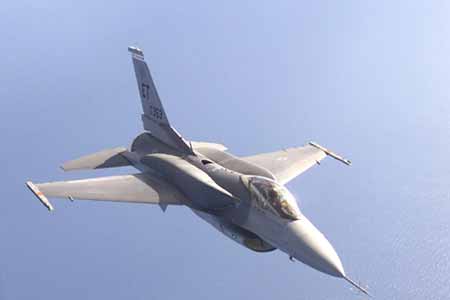
    The extra fuel increases range, loiter time, and combat persistence as well as reduces the demand for tanker support. Range increase is on the order of twenty to forty percent, depending on the stores configuration and mission profile. The tanks have neglible effect on the aircraft agility, at subsonic speed, However, at supersonic speed, the drag is increased proportionally to the increase in speed. When fitted with CFT the aircraft retains almost the full handling qualities, flight limits, and signature. A complete set can be removed or replaced within two hours. The CFTs are built to Lockheed Martin’s specification, by IAI as a sole source, as part of the Peace Marble V program offsets.

    “The CFTs have very little adverse effect on the F-16’s renowned performance,” said Maj. Timothy S. McDonald, U.S. Air Force project pilot for CFT testing at Eglin. “A set of CFTs carries 50 percent more fuel than the centerline external fuel tank, but has only 12 percent of the drag.” The CFTs are designed for the full F-16 flight envelope – up to 9 g’s, maximum angle of attack and sideslip and maximum roll rate.

    Israel, for example placed a special significance to the operational flexibility of its new F-16I, derived from the added range and endurance provided by the CFT. For medium range air-to-surface missions, CFTs can eliminate the need for wing tanks. This allows doubling the F-16’s primary weapon capacity and flying with two, rather than one, types of large weapons in a balanced configuration. In long range missions, the use of CFT dramatically increases the operational radius of the aircraft, since it enables the aircraft to fly a long range strike mission, with full weapon’s load, and engage in air combat when external (370 Gal) fuel tanks are dropped. When external 370 gal jetissonable tanks or 600gal non-jetissonable external tanks are added the F-16 can demonstrate up to 60-70 percent increase in operational radius. Another Israeli development utilizes a new fuel carrying configuration for the F-16, which enables the carrying of up to four 370 gallon external tanks, plus one 300 gallon under the belly, resulting in 25% increase in mission radius and twice the endurance on patrol missions.


    Visual Stealth for F-16?

    After two years of development of digital camouflage pattern application for military aircraft HyperStealth Biotechnology Corp\ is now ready to apply the KA2 camouflage scheme on an F-16 fighter. According to HyperStealth’s President and CEO, Guy Cramer, the application will be painted on the Royal Jordanian Air Force F-16 fighters, following successful testing on Blackhawk helicopters. The test will be conducted as part of a comprehensive camouflage program commissioned by His Majesty, King Abdullah II of Jordan (shown on the right, wearing the new uniform in the picture below).

    Under this program, advanced digital KA2 camouflage patterns were developed for the Jordan Armed Forces, Police, Customs and Counter Terrorism Battalion. The KA2 camouflage pattern uses digital fractal patterns which were proven to be more difficult to detect than traditional (analog) camouflage patterns. KA2 design are already used with combat uniform issued to Jordanian troops (shown below). Similar patterns were also tested on weapons, complementing a complete set of urban camouflage suit. Other tests were carried out with vehicle camouflage, using vehicle wrap technology developed by 3M Commercial Graphics division. Similar materials were used to wrap UH-60 Blackhawk helicopters. The complex KA2 pattern is now considered for the F-16 fighter making the Kingdom of Jordan the first in the world to use this advanced visual mitigation method.

    Rakshak Plus

    Mahindra, the large Indian vehicle manufacturer has developed the Rakshak and Rakshak Plus, advanced bullet protected vehicles, designed for rapid reaction teams, mounted patrols and transportation of commanders and VIP transportation.

    Rakshak Plus utilizes interchangeable armor protection plates designed to stop multiple 7.62mm hits. The protection suite consists of hardened steel, high performance polyethylene and aramid laminates and bullet proof glass. The protection suite was designed by Plasan Sasa.


    POMALS – Directional Pedestal for Active Protection Systems

    Israel’s Active Defense Systems for AFV

    IMI offers a more compact and sophisticated directional decoy launcher, utilizing the POMALS – Pedestal Operated Multi Ammunition Launching System. This platform is designed to deploy countermeasures with high directional accuracy. Two pedestals, one on each side of the vehicle, provide 360 degrees protection using only two “grenade hives” that can store various payloads such as flares, decoys, smoke charges or fragmentation charges. POMALS has a multi-salvo capability, to enable activation of multi-level countermeasures, such as thermal smoke, or Quick Shield flares (also produced by IMI), these obscurants provide continuous protection from ATGMs, for up to 100 seconds. POMALS can be activated by a laser warning device, which provides immediate and automatic traversing of the launchers to point at the direction of the incoming threat. The IMI system can also accommodate the Violin Mk-1 IR jammer.

    BA-5390/U Lithium Battery

    The BA-5390/U is a lithium/manganese dioxide primary (non-rechargeable) battery, and, with 50 percent more energy, is an alternative to the lithium/sulfur dioxide BA-5590/U battery, the most widely used military battery in the U.S. Armed Forces. The BA-5390/U provides soldiers with the latest and best battery technology in a cost effective manner. More energy in each battery provides longer mission time with fewer batteries for soldiers to carry, and fewer batteries to ship and dispose of, all of which reduce cost to the Army.

    Ultralife Batteries is one of the leading manufacturers of this type. in 2003 the company expanded its manufacturing capacity for BA-5390, under US Army investments of $3.1 million. In May and August the company received a US Army orders totaling $41 million worth of BA-5390/U battery supplies.In December 2003 a follow on $13 million production contract announced, to be supplied within the first half of 2004. A $12 million contract followed in February 2004 but significant follow-on orders although expected in 2004, were not received during the following two quarters of 2004 and revised its financial outlook to reflect the situation.


    From Ukraine to Taiwan: The Global Race to Dominate the New Defense Tech Frontier

    0
    As traditional defense primes face mounting competition from agile “neoprimes” such as Anduril, Palantir and Helsing, the balance of innovation is shifting toward software-defined warfare and scalable, dual-use technologies, while global industry consolidation—marked by Boeing’s integration of Spirit AeroSystems and other strategic mergers—signals an intensified race to secure control over the defense technology value chain. Our Defense-Tech weekly report highlights these trends.

    Europe’s “Drone Wall”

    0
    In early October 2025, a coordinated wave of unmanned aerial system (UAS) incursions—widely attributed to Russia—targeted critical infrastructure across at least ten European nations. The unprecedented campaign exposed the fragility of Europe’s air defenses...

    Weekly Defense Update & Global Security Assessment

    0
    Executive Summary The past week (September 18-25, 2025) represents an inflection point where strategic defense concepts have transitioned from doctrine to tangible reality. An analysis of global events reveals four primary, interconnected trends shaping an...

    U.S. Air and Space Forces Push Next-Gen Programs at the AS&C 2025 Conference and...

    0
    At the 2025 Air, Space & Cyber Conference, U.S. Air Force and Space Force leaders unveiled major updates on next-generation fighters, bombers, unmanned systems, and space initiatives, highlighting both rapid innovation and critical readiness challenges as the services race to outpace global competitors. A short version is available here, with a more detailed version for subscribers.

    TADTE 2025: Reflecting Taiwan’s Strategic Themes

    0
    The Taipei Aerospace & Defense Technology Exhibition (TADTE) 2025 crystallized around four dominant strategic themes that collectively illustrate Taiwan's comprehensive approach to defense modernization amid escalating regional tensions. Based on a detailed report by Pleronix (available upon request). Includes a Podcast discussion on TADTE 2025's highlighting Taiwan's four strategic themes beyond the post's coverage.

    Iron Beam 450 Completes Testing, Soon to Join With Operational Air Defense Units

    0
    Israel’s Iron Beam 450 high-power laser system has completed final testing, marking a major leap in air defense. Developed by Rafael, it offers precise, cost-effective interception of rockets, UAVs, and mortars, and is set for IDF deployment by 2025.

    WB Group Unveils Future Task Force Concept at MSPO

    0
    WB Group unveiled its Future Task Force (FTF) at MSPO, a new warfighting concept integrating manned, unmanned, and autonomous systems. Combining hybrid-electric vehicles, loitering munitions, and AI-enabled command tools, the FTF is designed to sustain firepower and autonomy while reducing battalion size and logistical footprint.