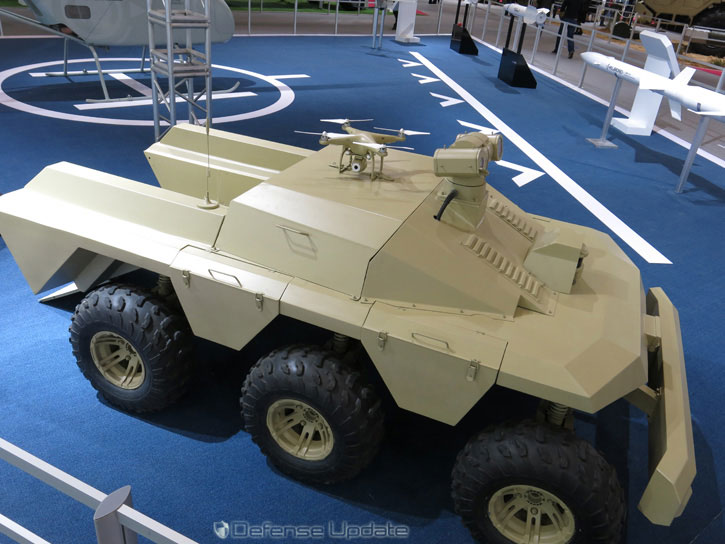
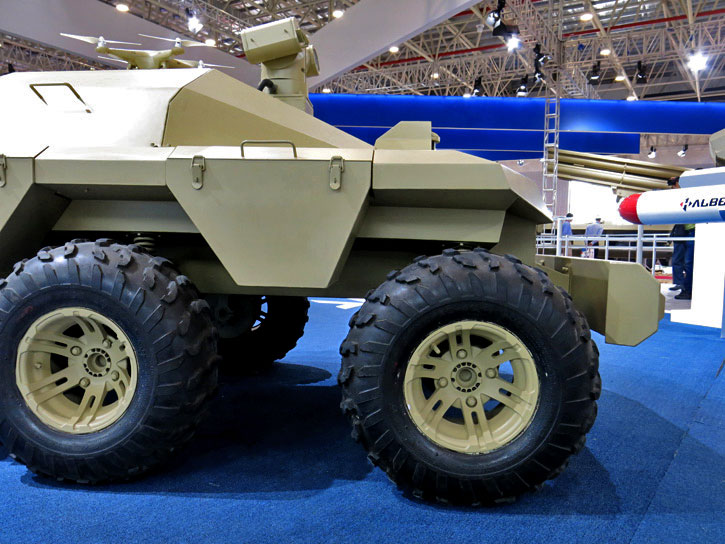
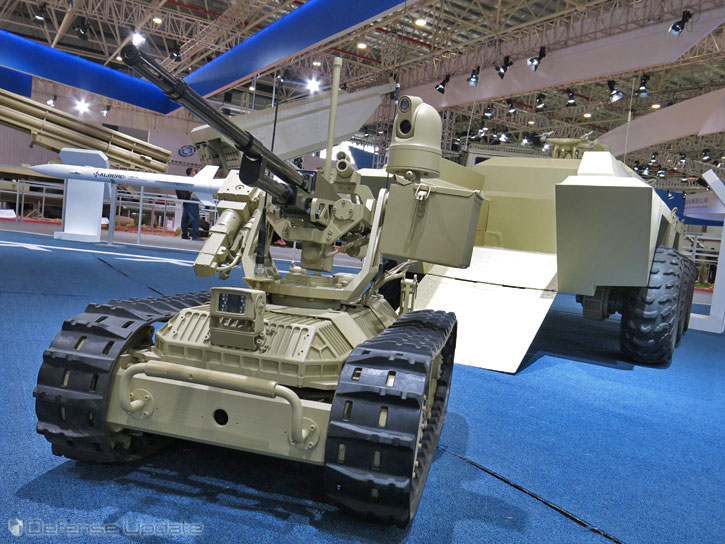
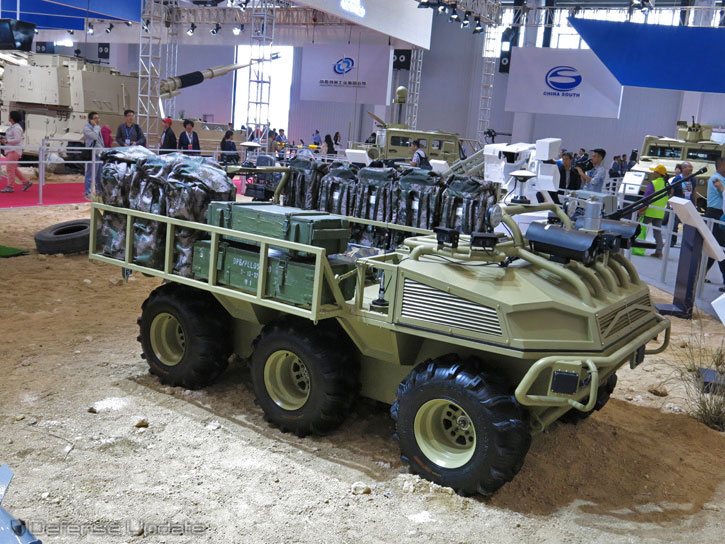
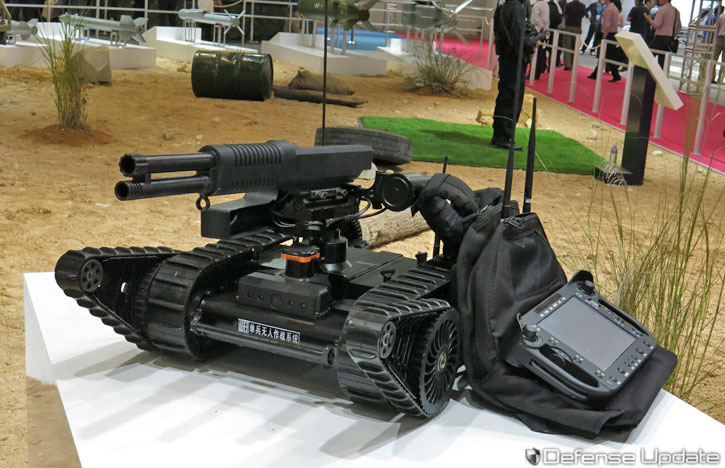
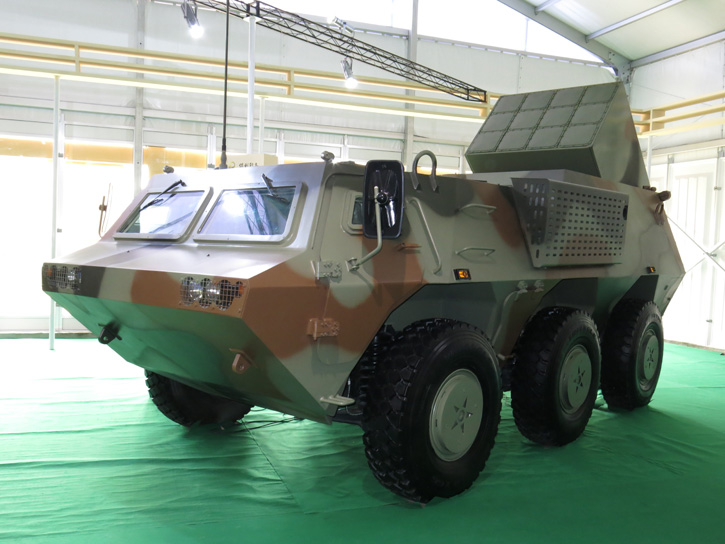
Sharp Claw 2 wheeled 6×6 UGV, an unmanned platform designed for combat recce, patrol, assault and transport missions. The system is designed to move and perform its mission along manned units, assisting war fighters by carrying missions of high risk or sustaining the unit by carrying heavy weights. It can also deploy additional UGVs, designed for specific missions such as Sharp Claw 1 tracked small UGV, deployed as an armed or unarmed UGV on indoors operations and counter IEDs.
Photo: Tamir Eshel, Defense-UpdatePhoto: Tamir Eshel, Defense-UpdatePhoto: Tamir Eshel, Defense-UpdateInfantry support mule from NORINCO. Photo: Tamir Eshel, Defense-Update
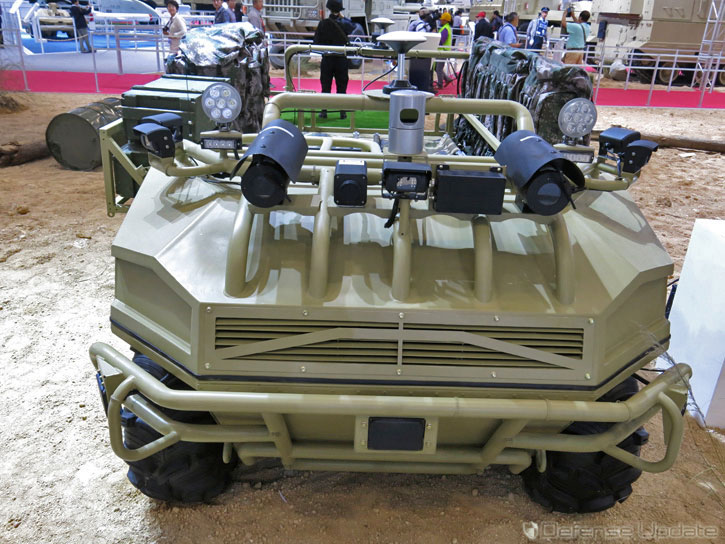
The Crew Task Support Unmanned Mobile Platform is a lightweight unmanned all-terrain vehicle which can carry the weapons, equipment and personal supplies of an infantry squad. The 6×6 vehicle has four operating modes – manned drive, remote control, semi autonomous and full autonomous. The photo shows the sensor package employed with the vehicle to support autonomous operation.
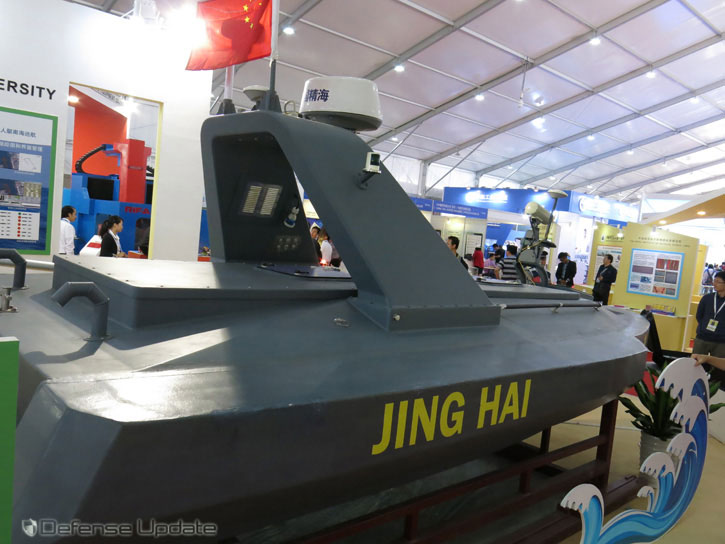
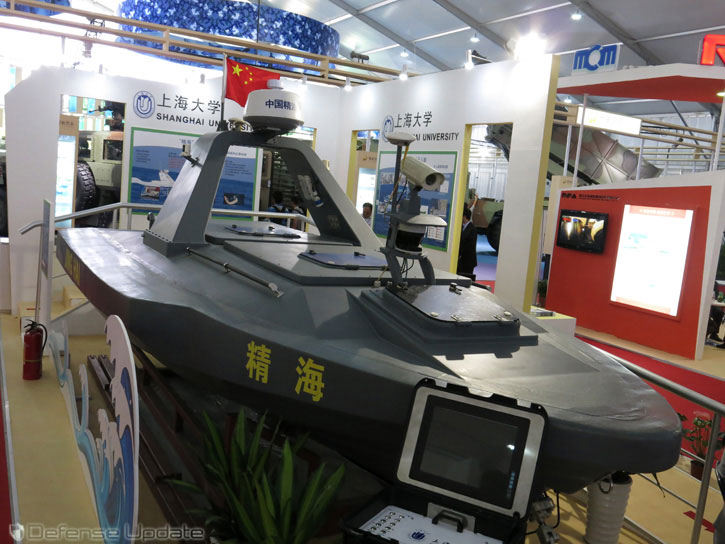
Photo: Tamir Eshel, Defense-UpdateRemotely controlled unmanned combat system, enabling war fighters to deploy firepower in complex areas such as inside buildings, caves etc. Photo: Tamir Eshel, Defense-UpdateJing Hai Unmanned Surface Vessel. Photo: Tamir Eshel, Defense-UpdateJing Hai Unmanned Surface Vessel. Photo: Tamir Eshel, Defense-Update
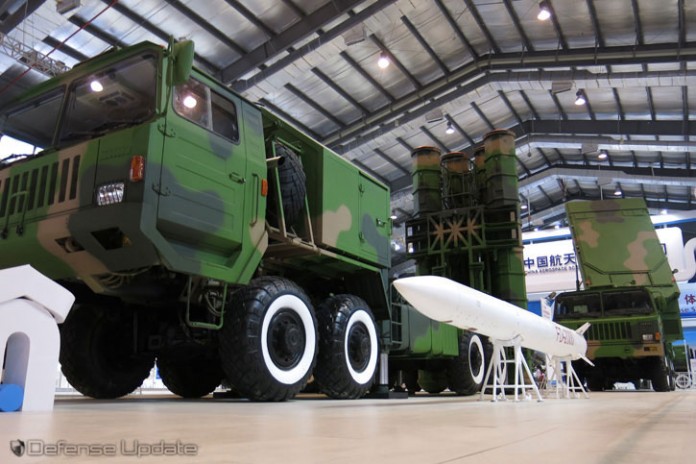
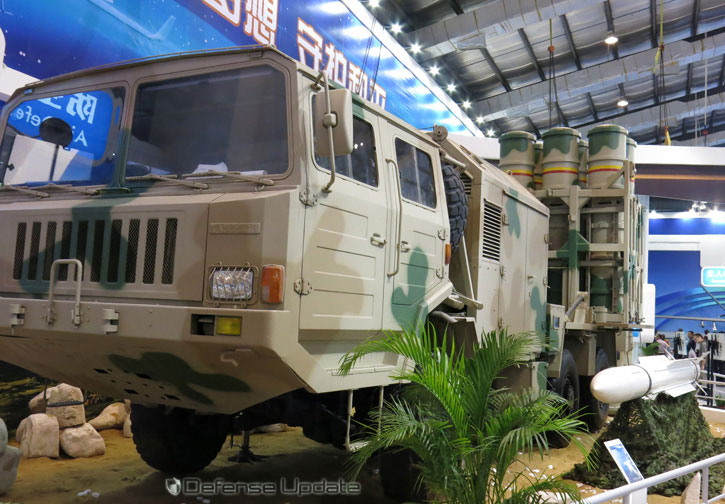
Sky Dragon 50 medium range SAM displayed by NORINCO. The system is designed for low, medium and high altitude air defense at ranges of 50 km. The SAM unit comprises a single IBIS 150 3D target designation radar and one fire distribution vehicle, controlling 2-6 mobile fire units each carrying four launchers.
Sky Dragon 50. Photo: Tamir Eshel, Defense-Update
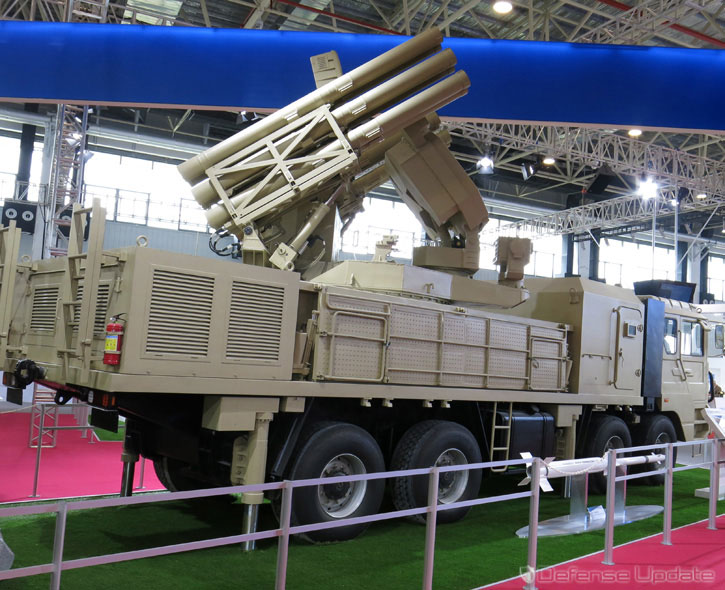
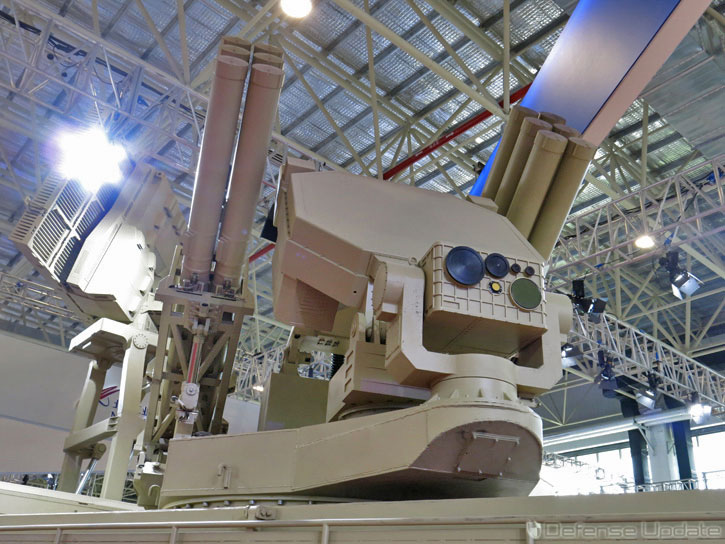
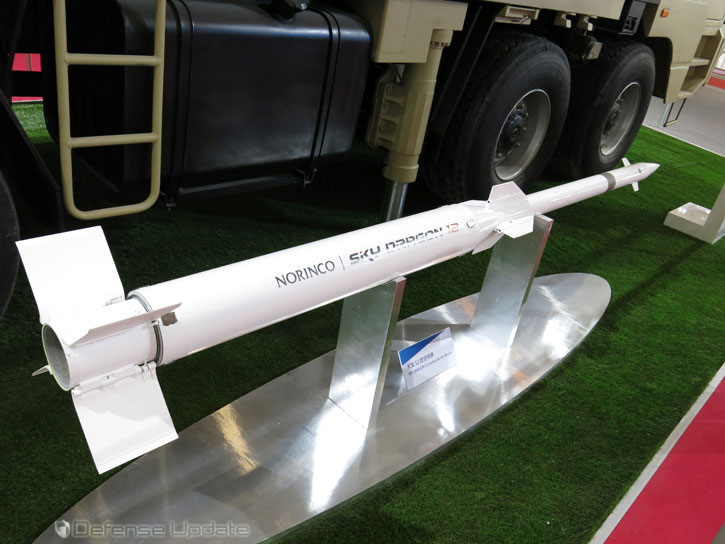
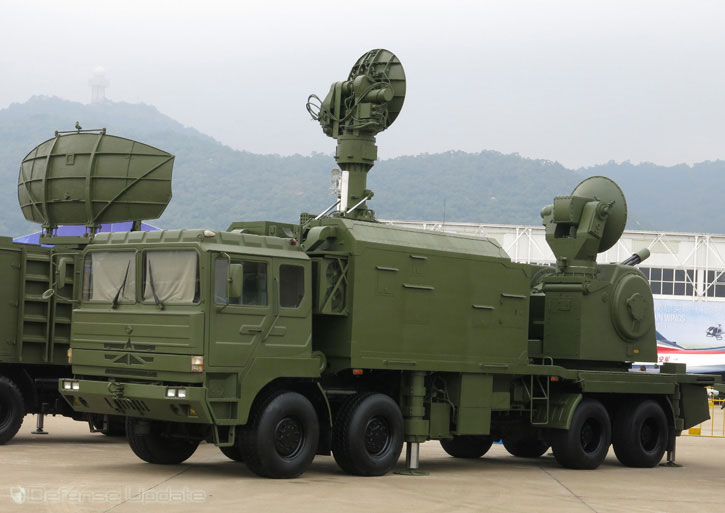
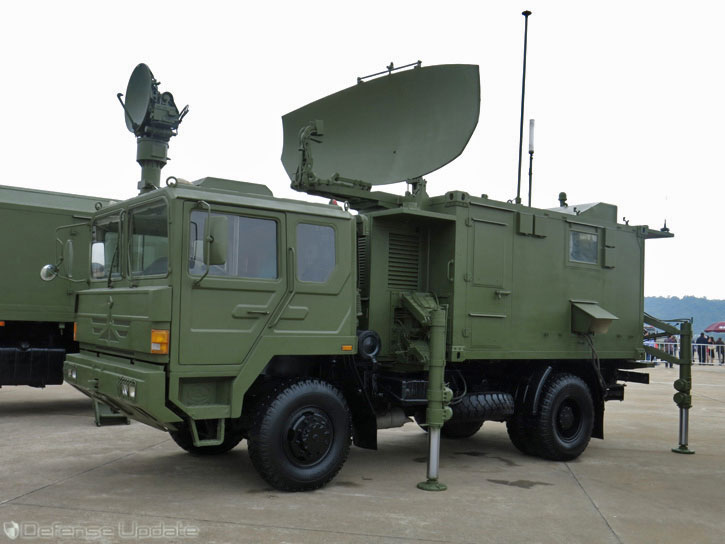
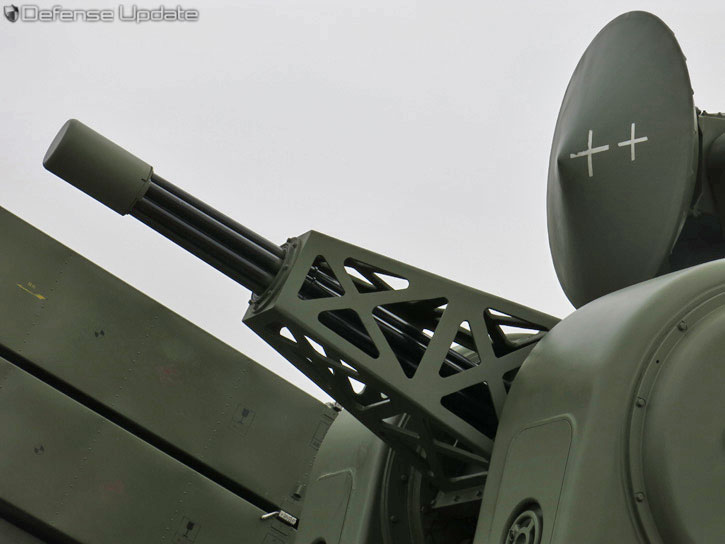
Sky Dragon 12 – An integrated, mobile SHORAD system similar to the Russian KBP Pantsir S1 system. Sky Dragon 12 has an effective range of 12 km, and altitude of 5 km. The radar and battle management system can be integrated with 35mm AA guns to form an integrated forward-based air defense weapon system.
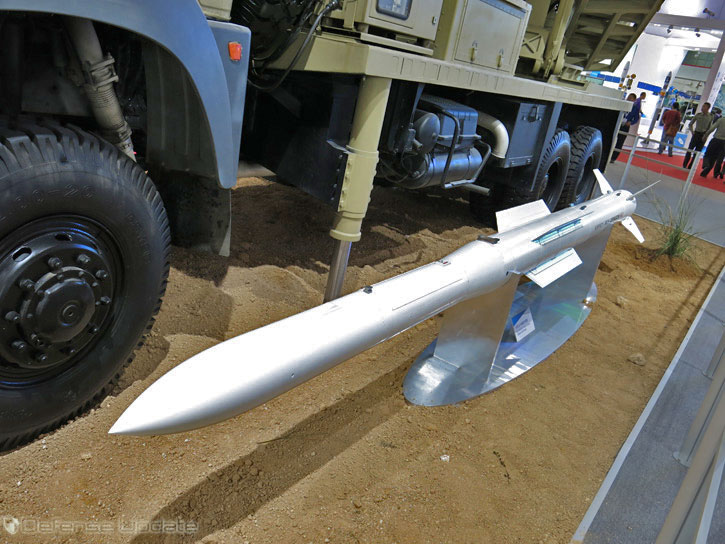
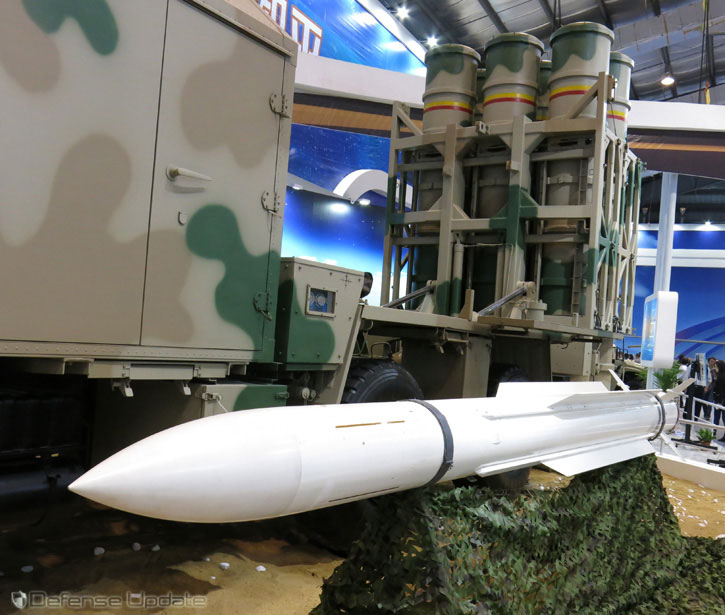
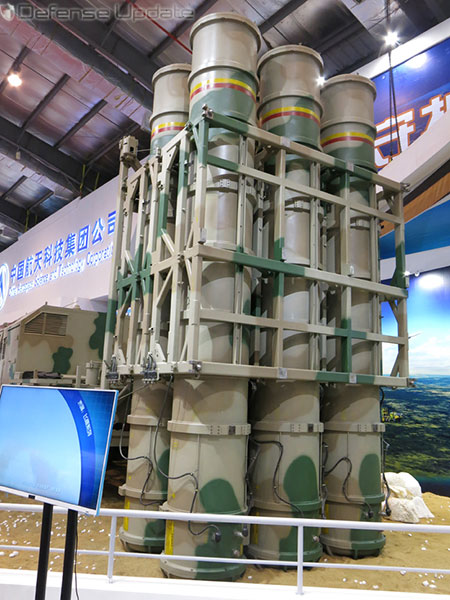
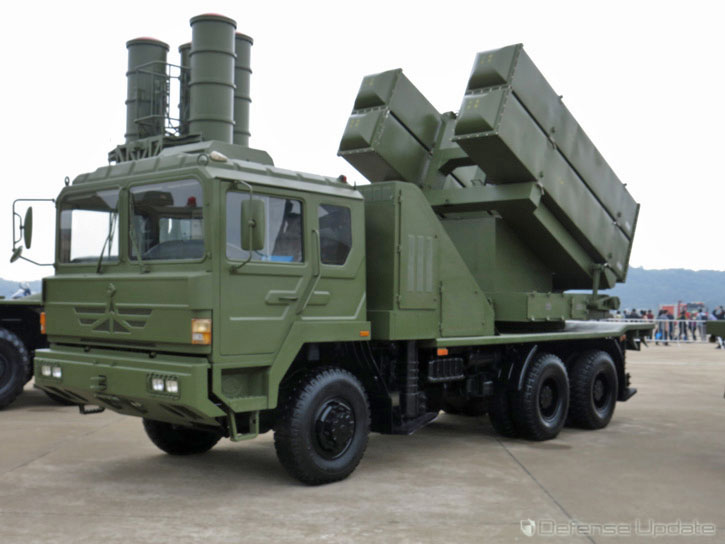
LY-80 medium range SAM from China Aerospace Science and Technology Corp. (CASC) providing area air defense of critical assets. The system employs a multifunction phased array tracking and guidance radar searching at ranges up to 140 km. The system uses a combined guidance system employing both ground illuminating and semi-active homing, at ranges up to 85km. Interception altitude from ground level to 15 km, at ranges of 3.5-40 km.
LY-80 medium range SAM. Photo: Tamir Eshel, Defense-UpdateLY-80 SAM. Photo: Tamir Eshel, Defense-UpdateLY-80 SAMPhoto: Tamir Eshel, Defense-UpdateI-9 Air Defense System. Photo: Tamir Eshel, Defense-Update
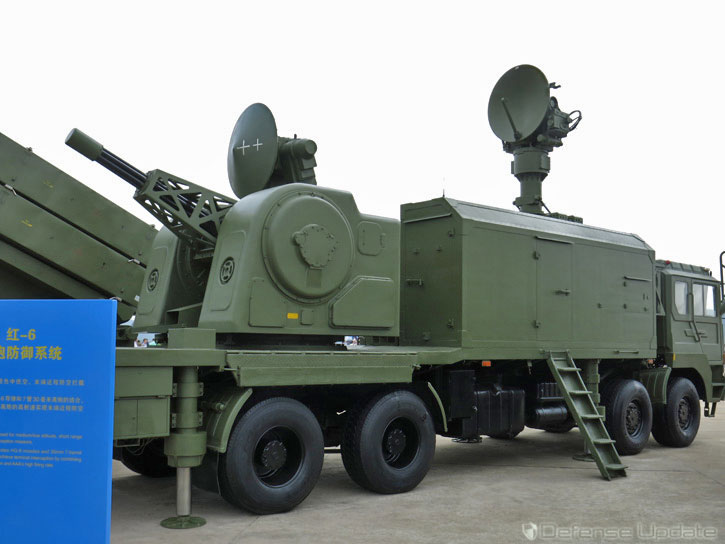
I-6 short range air defense system. The I-6 integrates the HQ-6 missile system and 7 barrel 30mm anti-aircraft artillery and command and control vehicle carrying a low-altitude search and target acquisition radar. Both gun and missiles are designed to provide a terminal defensive layer protecting the I-9 weapon system against air attacks by stand-off precision guided weapons, covering medium to low altitude.
I-6 Short Range Air Defense. Photo: Tamir Eshel, Defense-UpdateI-6 Short Range Air Defense. Photo: Tamir Eshel, Defense-UpdateI-6 Short Range Air Defense. Photo: Tamir Eshel, Defense-UpdateI-6 Short Range Air Defense. Photo: Tamir Eshel, Defense-Update
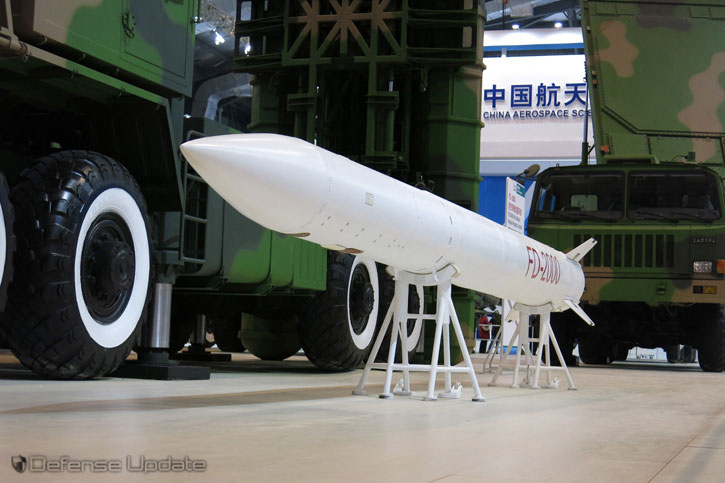
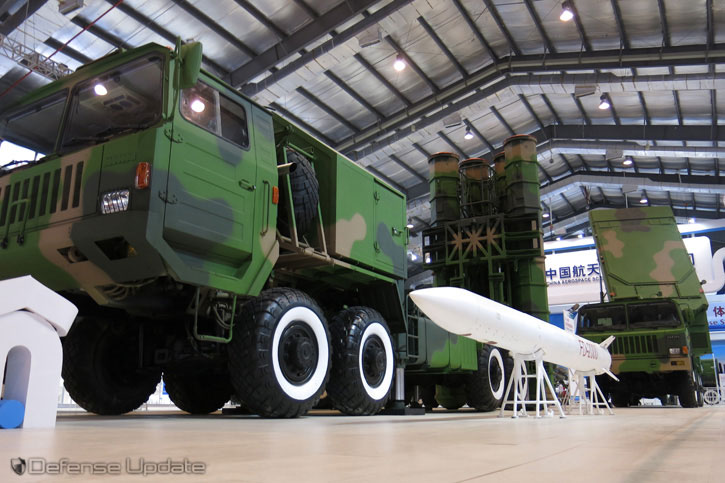
Several Chinese companies have displayed advanced medim range air defense systems at Airshow China 2014. This variant, the FD-2000 was offered by CPIMEC to Turkey. The photo shows the Transporter-Erector-Launcher (TEL) and radar associated with the system.
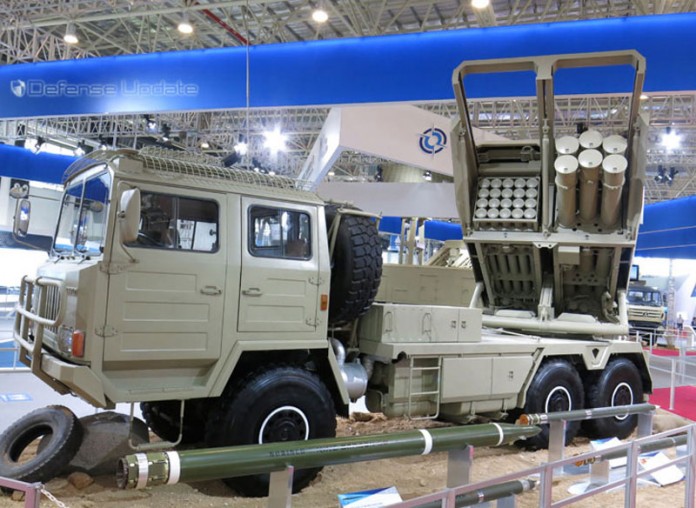
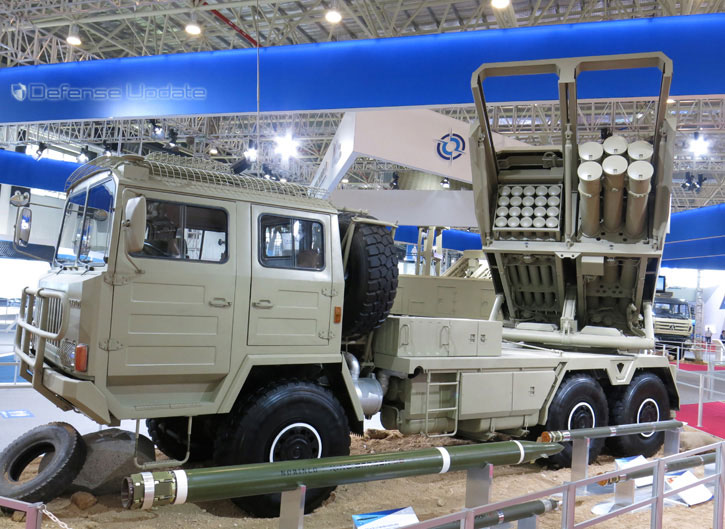
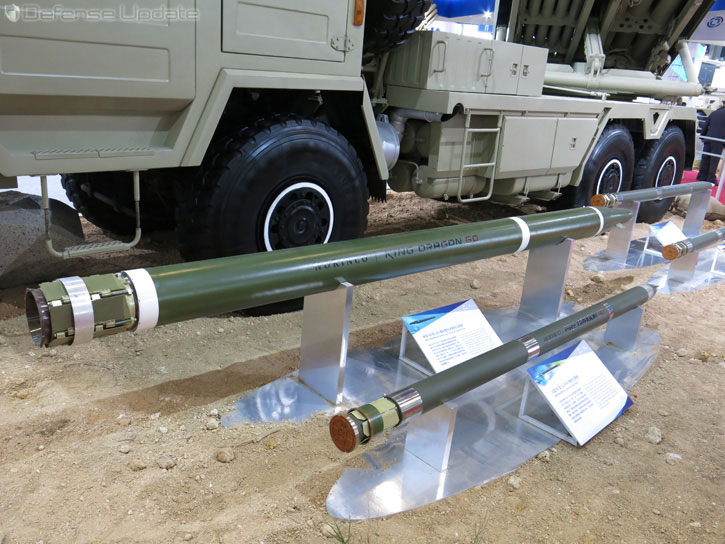
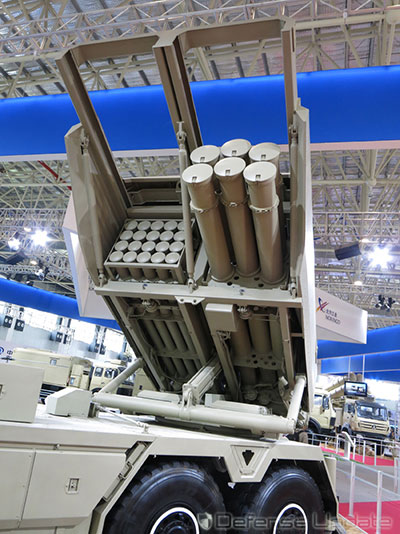
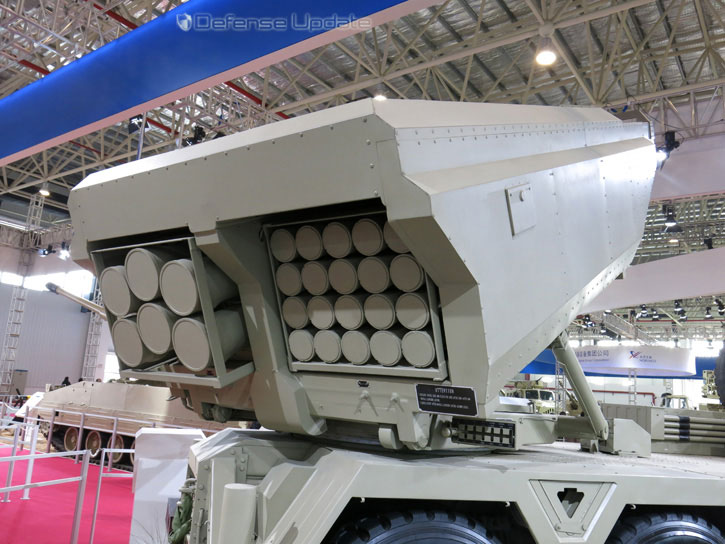
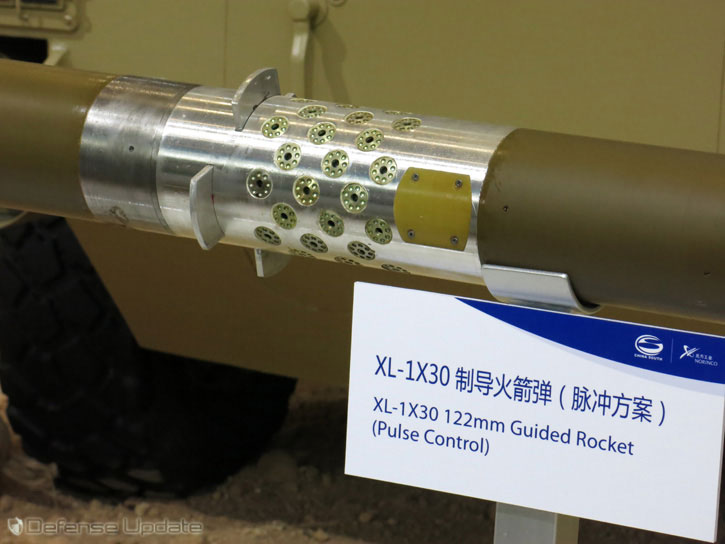
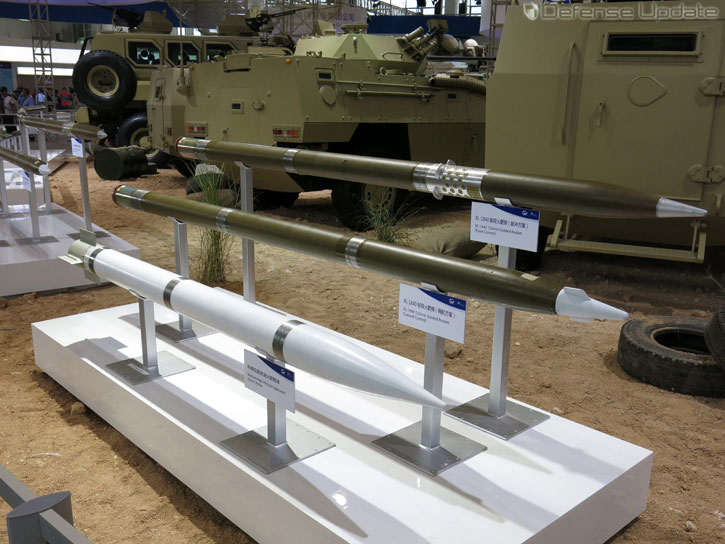
NORINCO unveiled two variants of the King Dragon family of guided rockets, launched from the SR5 multiple rocket launcher. The King Dragon 60(GR1) 220mm laser terminal guided rocket and fire Dragon 40 122mm guided rocket systems. King Dragon provides highly accurate rocket attack using INS/GPS and laser homing guidance. SM5 can carry 12 such rockets. The Fire Dragon 40(BRE) can be employed with NORINCO Type 81, 90B, SR4 and SR5 MLRS, as well as the standard BM-21 (Grad). The guidance method was not mentioned but is assumed to be INS/GPS. To provide the course correction necessary for precision strike the rockets 220mm and 122mm rockets are also provided with pulser or canard controls. To provide precision target acquisition for the rocket unit NORINCO is offering an unarmed rocket carrying reconnaissance systems.
King Dragon/Fire Dragon. Photo: Tamir Eshel, Defense-Update
SR5 guided MLRS is a short-medium range universal launching platform designed to deploy several types of rockets in a common launcher. It can carry the 122mm and 220mm guided or unguided rockets including terminal-homing rockets.
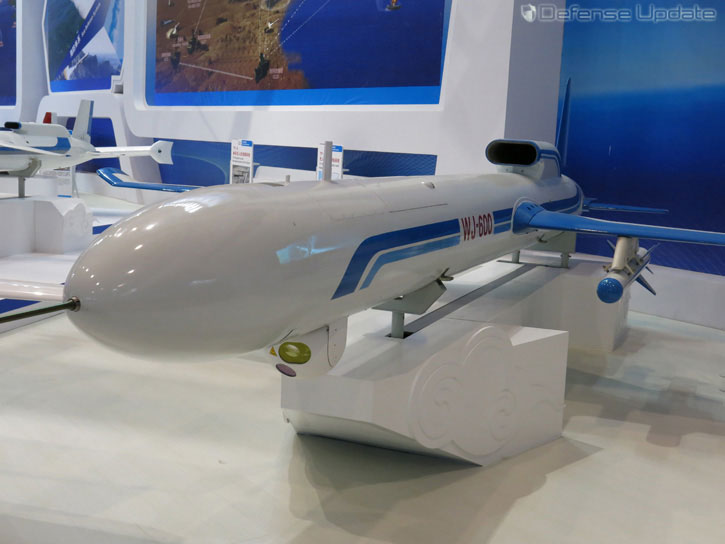
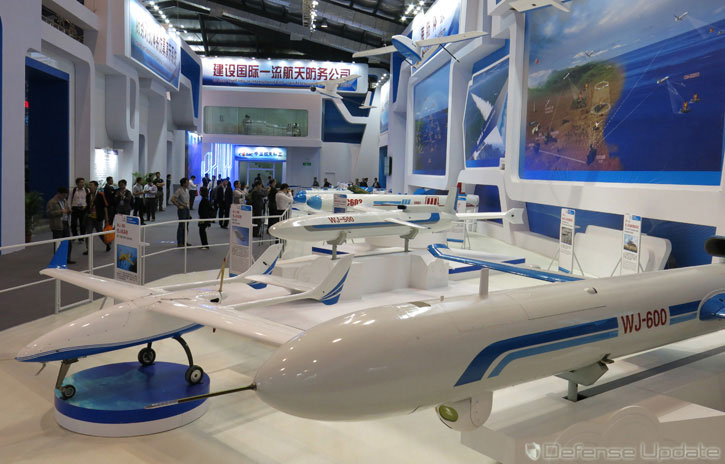
WJ-600A/D high altitude and high speed UAV designed for aerial recce and strike. It is equipped with EO and SAR payloads, and carries small air-to-ground precision weapons with a combined weight of 130kg. The drone can loiter at an altitude of 8000 meters for 5 hours, cruising at a speed of 500 – 700 km/h. The WJ-600A/D is launched with a rocket booster and recovered by parachute and airbag.
WJ-600A/D high altitude and high speed UAV . Photo: Tamir Eshel, Defense-UpdatePhoto: Tamir Eshel, Defense-Update
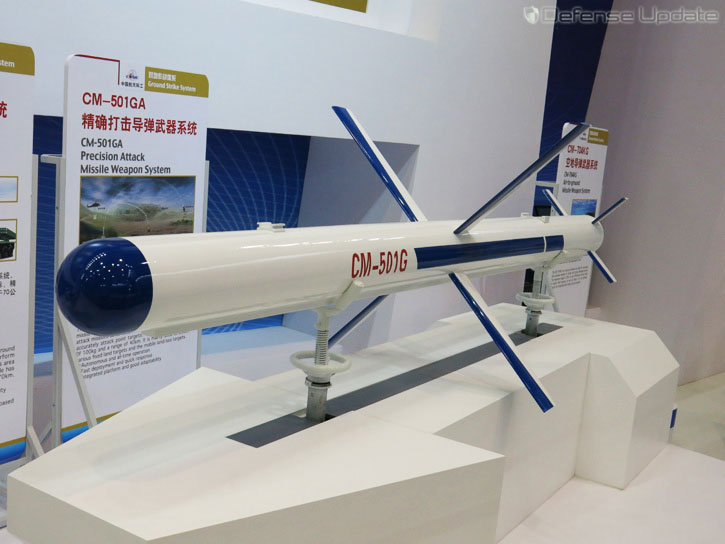
The CM-510GA is a multi-purpose tactical precision attack missile. The autonomous guided missile that weighs 100 kg is designed to attack point targets at distances of up to 40 km. The heavier CM-501G (150 kg) variant has a range of 70 km and optional ‘cooperative engagement’ capability hinting some type of target updating functions which could consist of laser seeker.
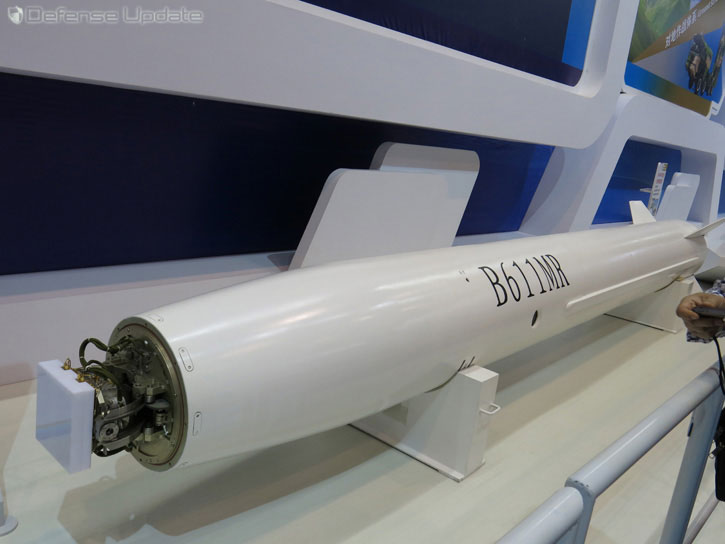
China Aerospace Science and Technology Corp. (CASC) unveiled at Airshow China the B611MR tactical missile system, capable of attacking high value targets from long distances. The missile is launched ballistically to the edge of space, where it continues through a glide and manoeuvring flight in the thin upper atmosphere. When approaching the target the missile dives down to hit its target in a near vertical strike. Navigation is performed by inertial and satellite based system, with sideband, passive radar homing used for terminal guidance. The B611MR is equipped with RF seeker enabling the weapon to strike strategic radar sites.
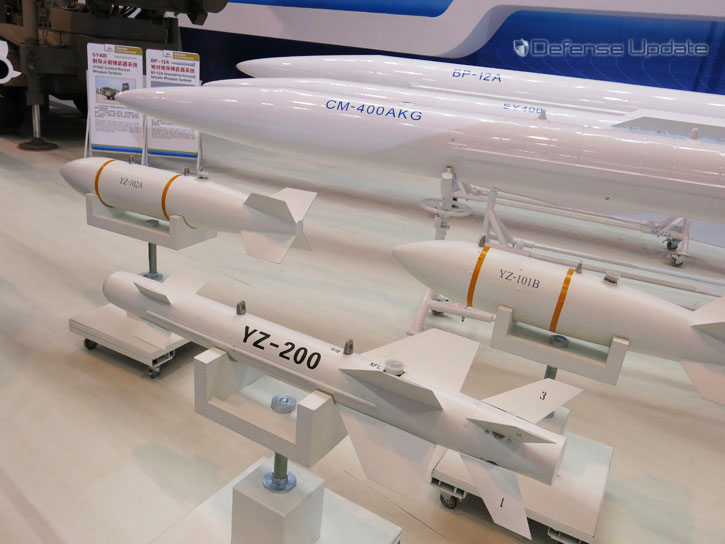
Two of the missiles designed for the mobile missile transporters displayed by CASIC are the BP-12A and SY-400 guided missiles. Eight SY400 can be carried on a single transporter-launcher. The rockets can be launched in salvo and designed to maximise attack density and simultaneous, multipoint or repeat attack.
The BP-12A missile is designed for tactical attack.
Photo: Tamir Eshel, Defense-Update
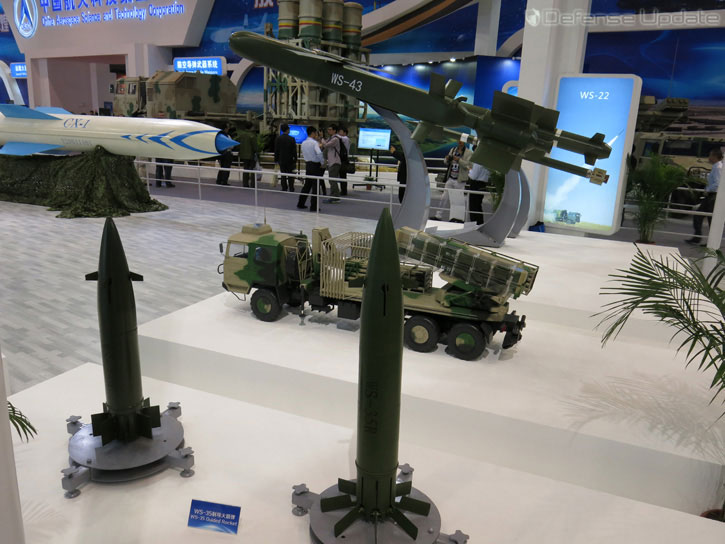
Ballistic (unguided) rockets are used by military forces and terrorists as a statistical weapon that has the potential to cause significant damage to unprotected targets. The trend evident at Airshow China is to shift from standard ballistic rockets to precision guided ones, enabling those weapons to be relevant in a modern battlefield, when available publicly available information such as Google Earth already provides unprecedented accuracy for such ‘point and hit’ attacks.
Such GPS/INS guided rockets are available for the SY300 rockets (300/302 mm) seen in the picture, 220mm and 122 mm Grad rupe weapons.
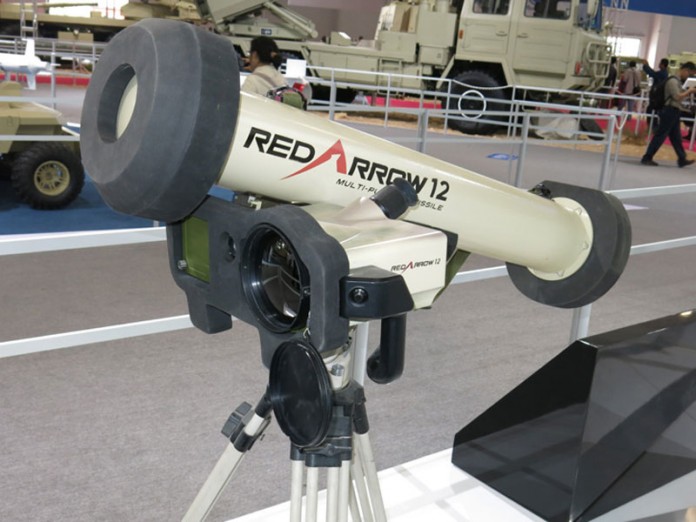
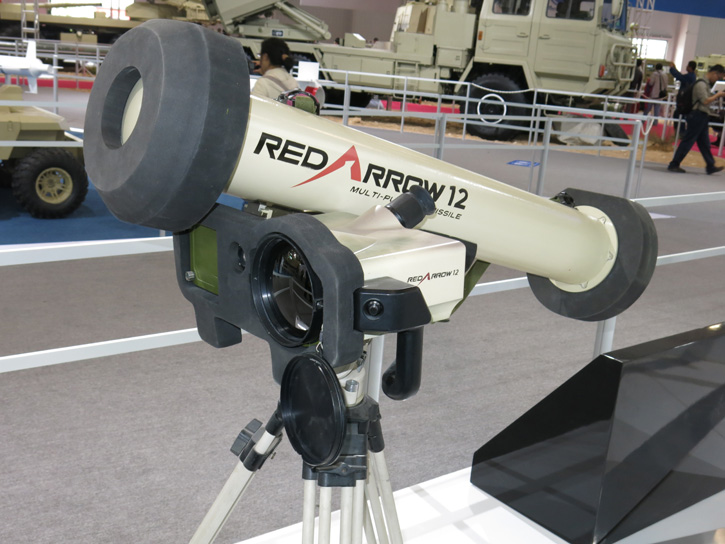
The Red Arrow 12, a man portable guided missile system. Photo: Tamir Eshel, Defense-Update
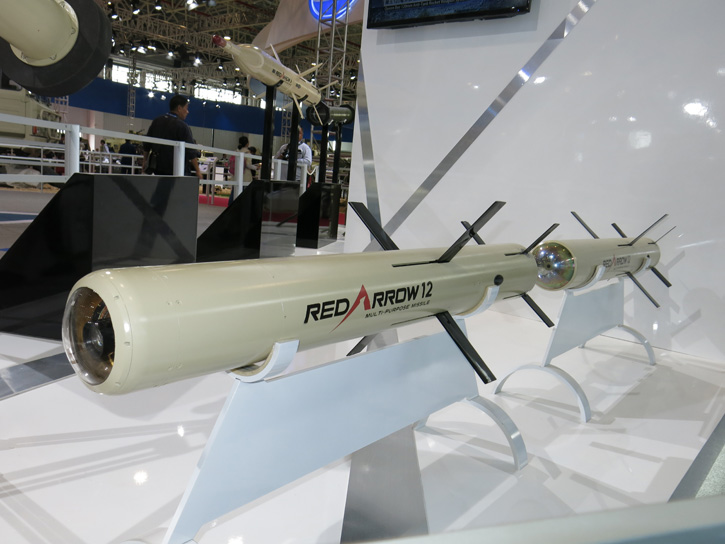
A man portable guided missile system, the Red Arrow 12 is similar to the Israeli Spike MR, another version of the missile seems a copy of the US Javelin.
The missile uses an IR or TV imaging seekers for all weather day/night operation. The missile uses ‘soft launch’ techniques to enable safe firing from enclosure. Once aimed at the target, the ‘fire and forget’ system controls the missile through an autonomous flight to hit the target, enabling the operator to seek shelter. The missile can neutralise tanks, bunkers, small boats and helicopters.
The mobile PA01 ‘intelligent tactical precision strike platform comprises 12 CM-501/PA01 precision attack ‘fire and forget’ missiles capable of striking point targets system at ranges of 40km. While the missile seems to be a copy of the Israeli Spike NLOS, it is more likely a copy of the US Precision Attack Missile (XM-501) which did not make it through development. In this case, the Chinese developers felt free to copy the US weapon designation number as well. An extended version of the Chinese missile is likely to has ‘lock on after launch’ capability, enabling the missile to strike at targets at a range of 70 km.
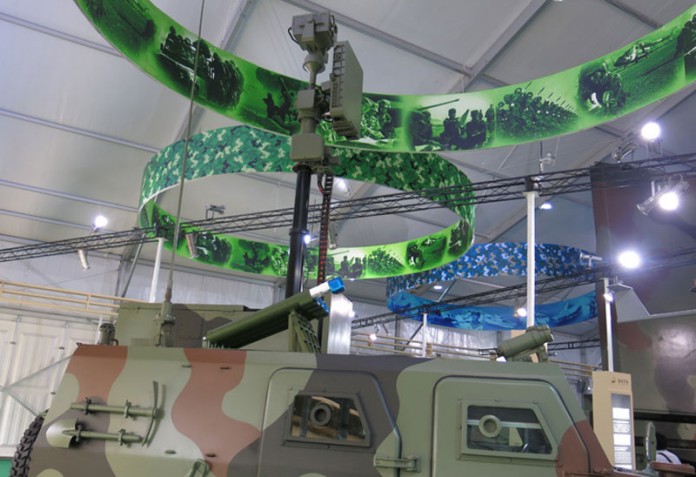
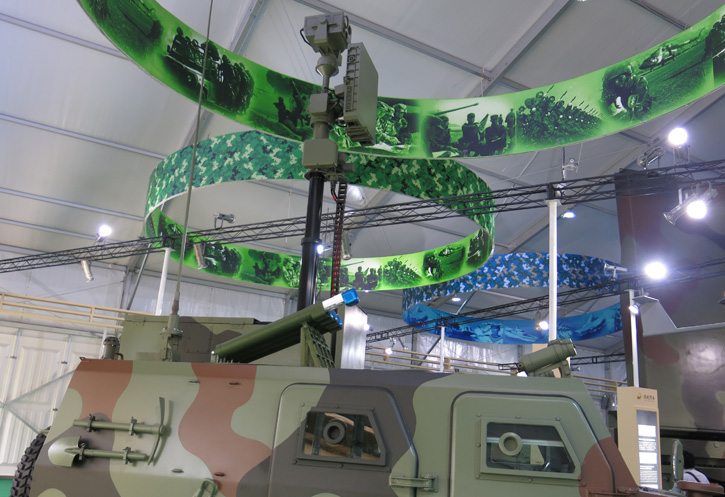
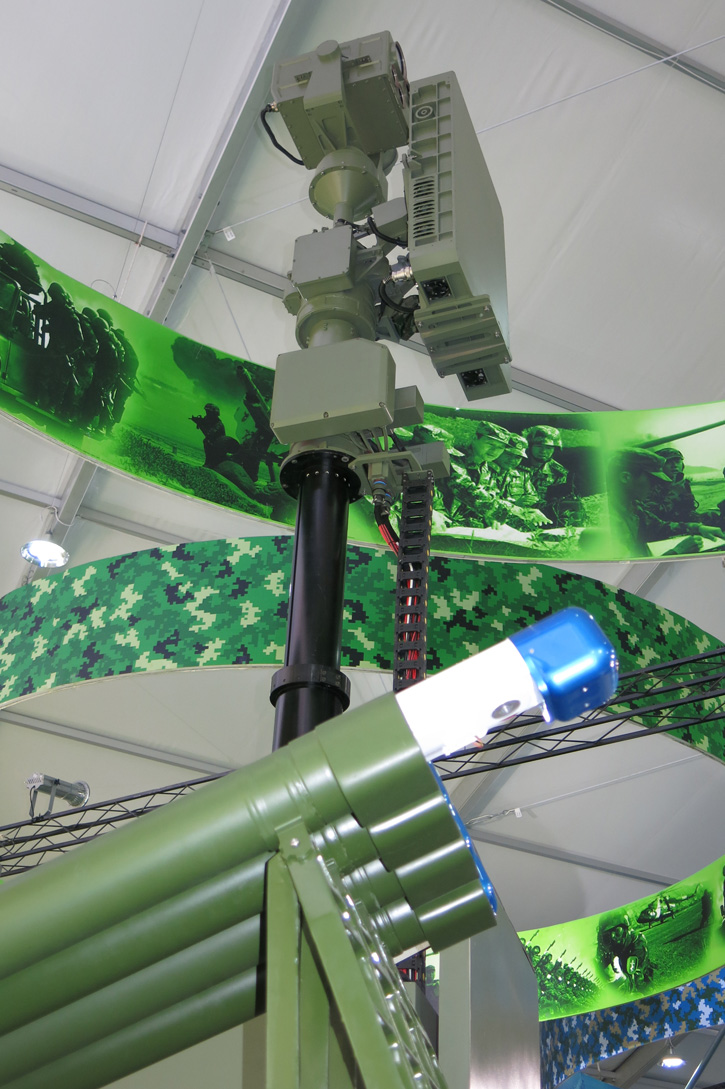
PL02 is a vehicle mounted integrated battlefield reconnaissance comprising a ground surveillance radar with fire detection, location and artillery fire direction capabilities. The radar is mounted on a telescopic mast, along with EO payload. Target location data can be translated automatically between radar and EO, to be fed to the artillery network or precision fires units. At Airshow China 2014 the PL02 was displayed with what looks like four copied ‘Switchblade’ type micro UAVs, these could be used for target acquisition or for precision strike, if the Chinese version is capable of such function, as the US developed mini-drones.
The Switchblade developed by Aerovironment under a DARPA funded research and development program is a brand new weapon system, which has been inservice for about one year.
The Switchblade developed by Aerovironment under a DARPA funded research and development program is a brand new weapon system, which has been inservice for about one year.
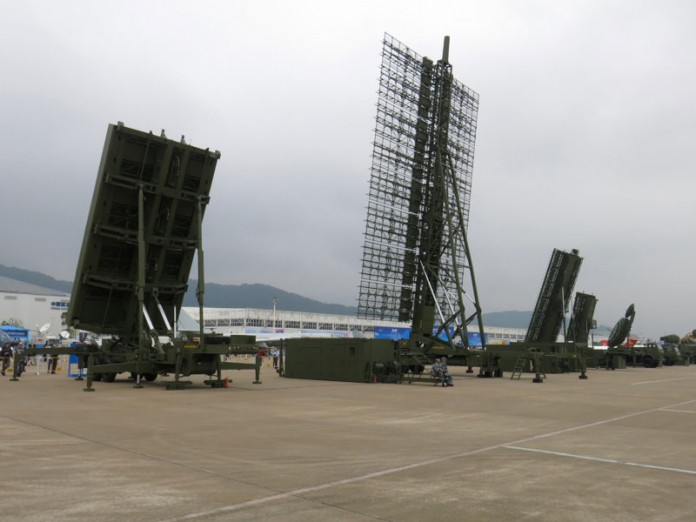
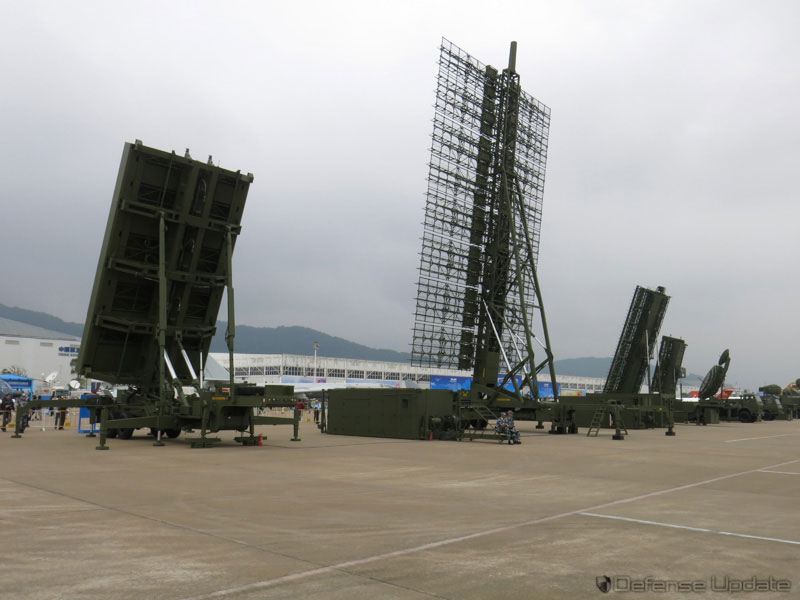
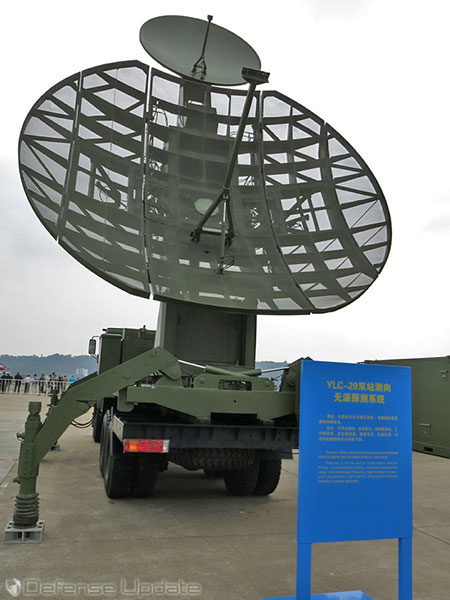
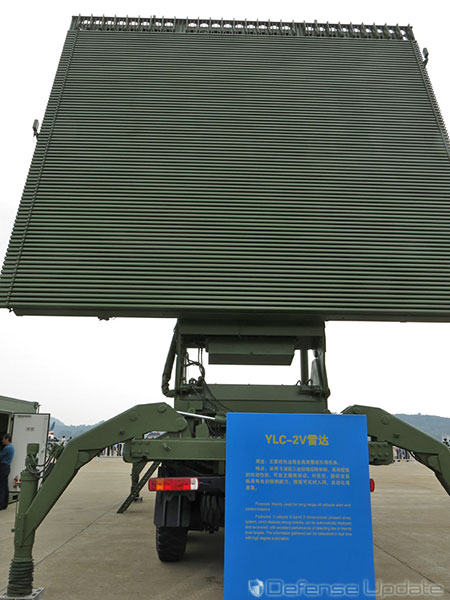
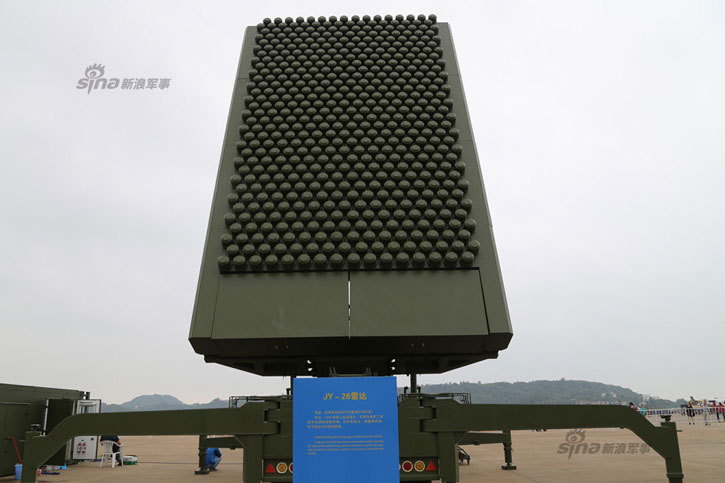
China’s impressive Air-Defense Radars display at Airshow China 2014. Photo: Tamir Eshel, Defense-UpdateThe YLC-20 is a signals intelligence system detecting RF emitting targets beyond visual range. The system can be used as a single unit or a network of several sensors. According to the Chinese developers, it operates over a wide frequency range and delivers high location accuracy and powerful signal analysis capabilities.Photo: Tamir Eshel, Defense-UpdateYLC-2V is an S band 3D phased array radar covering long range all altitude alert and ground control radar. Photo: Tamir Eshel, Defense-UpdateYLC-8B – a UHF 3D radar utilising full coherent digital pulse compression and moving target detection technology. Despite its size, the antenna fold-able array is designed for automatic, rapidly deployment and recovery. Photo: Tamir Eshel, Defense-UpdateJY-26: The latest UHF 3D radar adopts advanced 2D digital active phased array system with a long operational range, high accuracy of detection, powerful anti-jamming capability. Photo: Tamir Eshel, Defense-Update
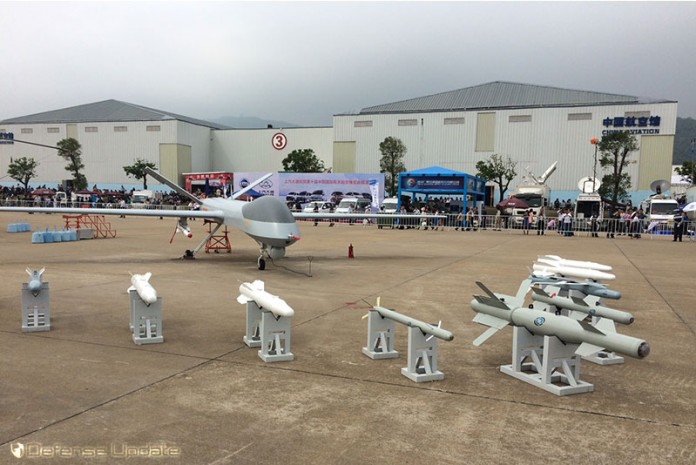
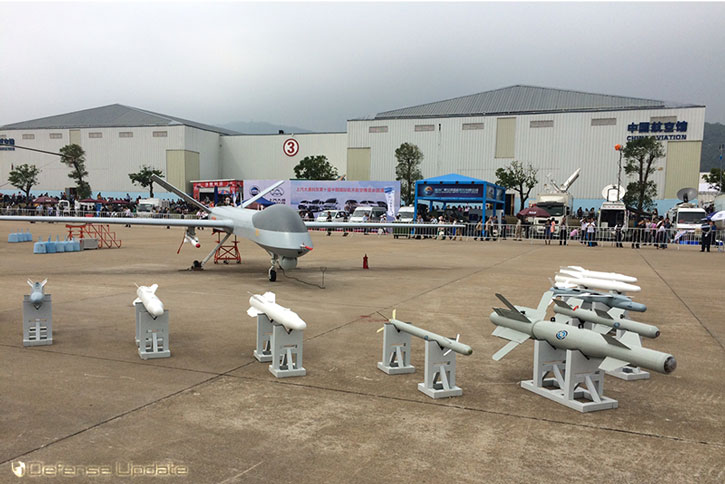
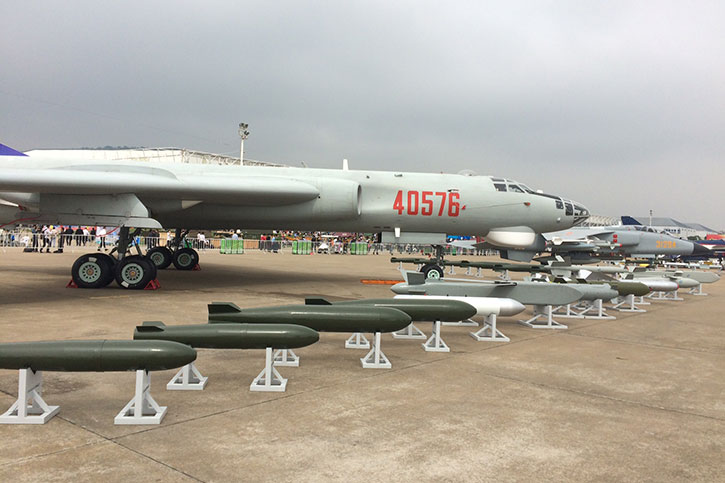
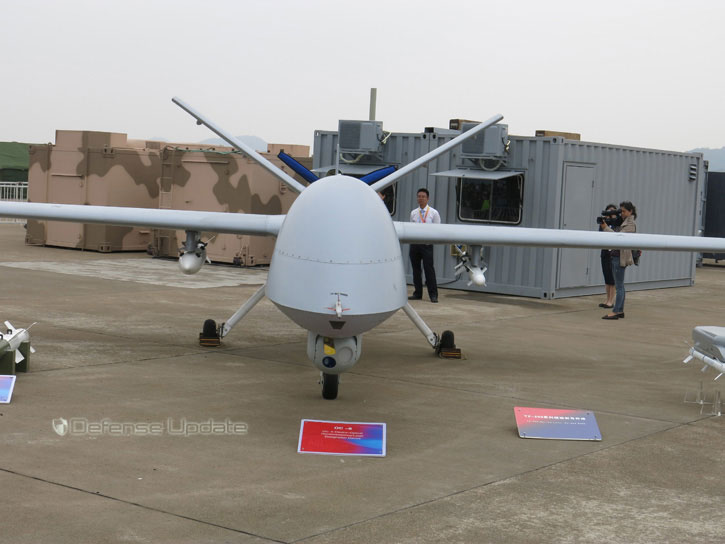
The Chinese Wing Loong I, a Chinese copy of the 1990s’ U.S. designed General Atomics Predator I UAV, displayed at Airshow China with the Y-6M bomber at the background, itself a 30 year old Chinese copy of the Russian Tupolev Tu-16,bomber, designed in the 1960’s. While the drone carries much less in weight, and its destruction power is limited, in terms of precision and persistence it is far more effective than the bomber, carrying much heavier loads free fall bombs. The Y-6M was also displayed with a number of precision strike weapons, such as anti-ship missiles, stand-off, modular weapon container and EO guided missiles.
Y-6M Bomber. Photo: Tamir Eshel, Defense-Update
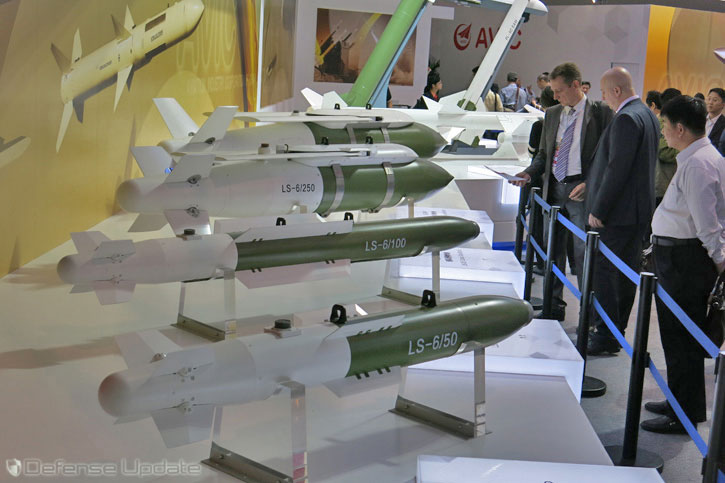
a line of guided weapons displayed by AVIC, including the LS/50 and LS/100 laser guided weapons, carried by unmanned aircraft and LS-6/250 and 500, extended range ‘glide bombs’ guided by satellite navigation. These two types are equipped with retractable wing kit extending their strike range. They are designed primarily for attack aircraft.
LS/50 and LS/100 laser guided weapons. Photo: Tamir Eshel, Defense-Update
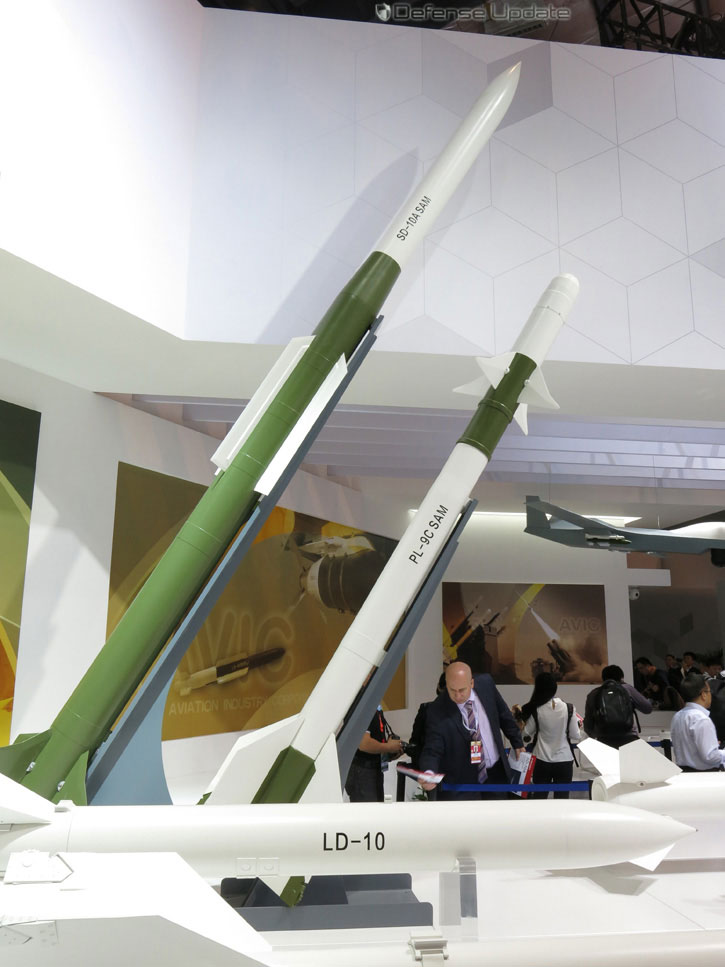
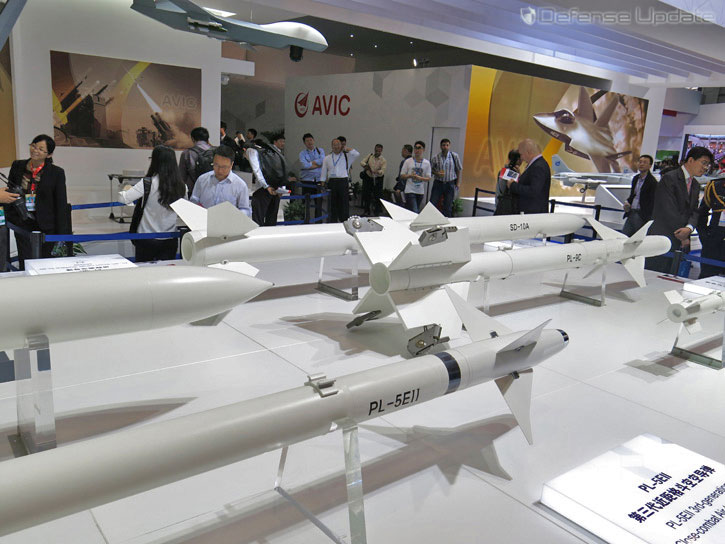
A range of air/air missiles displayed by AVIC is equipping China’s fighter jets as well as some air/ground systems. The missiles include heat seeking (infrared) variants, SD-10A medium-range radar guided air/air missiles and the LD-10 anti-radiation (anti-radar) missiles. The surface launched variants are the PL-9C SAM and SD-10A.
SD-10A medium-range radar guided air/air missiles and the LD-10 anti-radiation (anti-radar) missiles. Photo: Tamir Eshel, Defense-UpdatePL-5EII short-range IR air-to-air missile. Photo: Tamir Eshel, Defense-Update
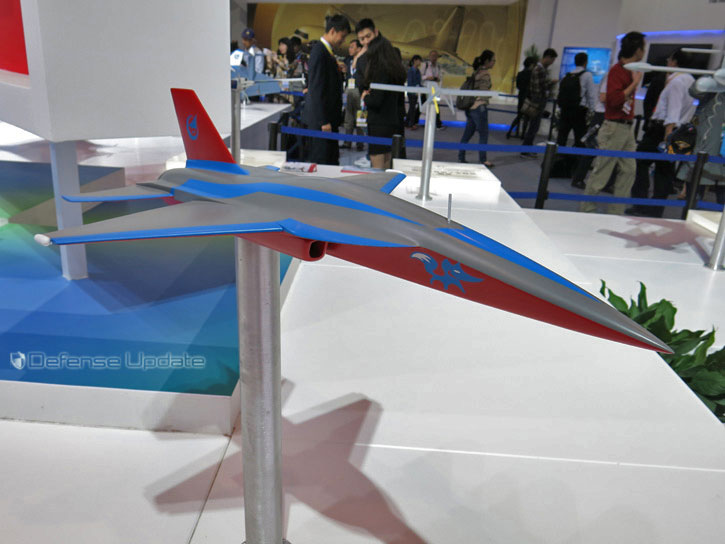
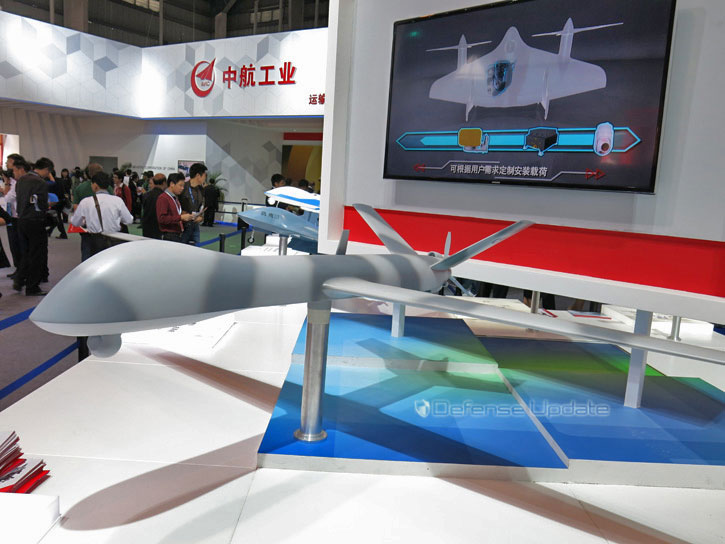
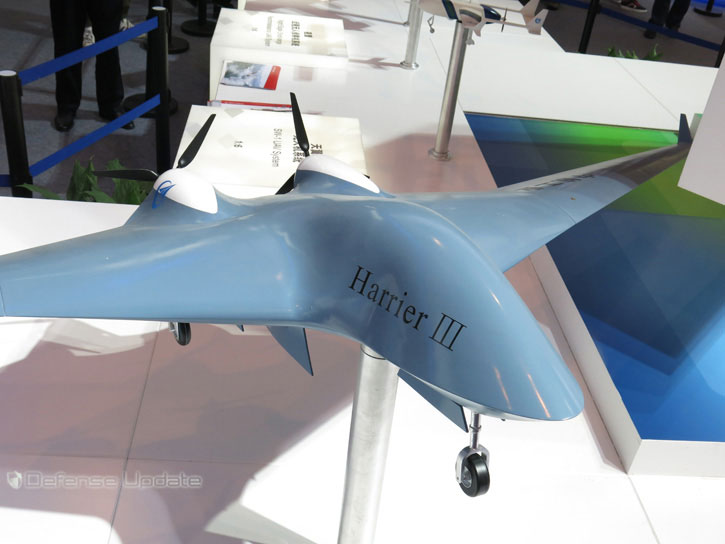
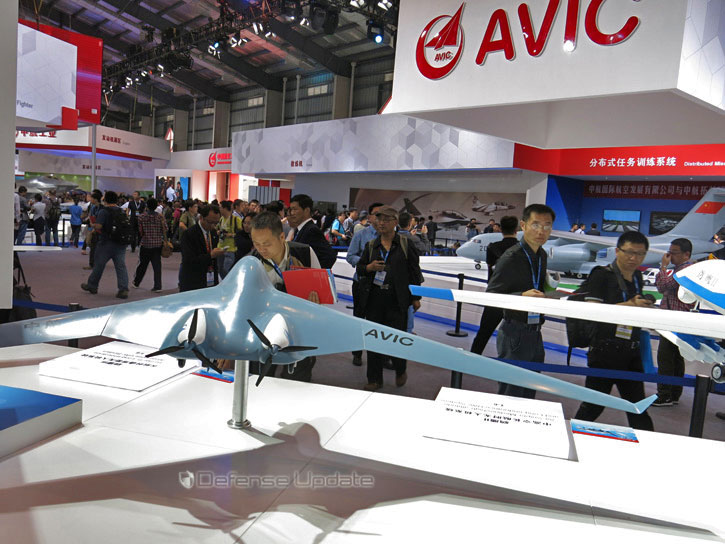
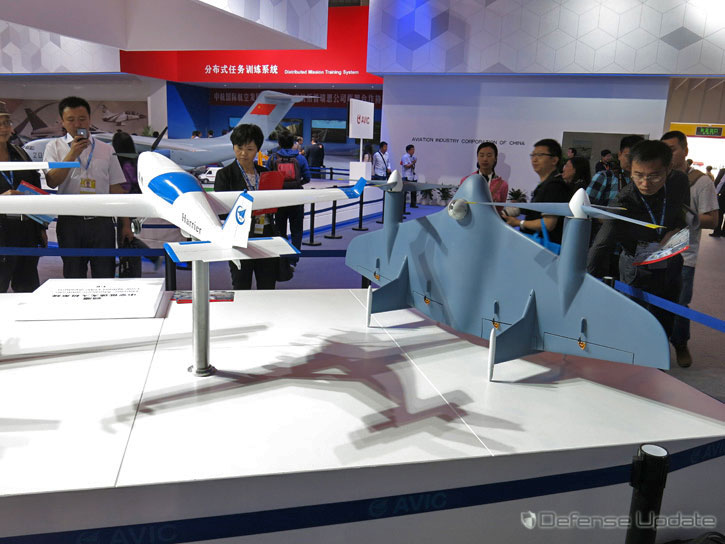
AVIC displayed a number of drones including a 1:6 model of the ‘Blue Fox’ high maneuverability jet powered drone, and the twin propeller driven Harrier III long endurance drone. a 1:5 model of the Wing Loong I – the real drone was shown at the static display area, armed with lightweight weapons. Another model displayed here was the ‘Air Sniper’, while configured to be at the same size and weight class of Wing Loong I, the Air Sniper is capable of flying at higher altitude on longer missions, carrying twice the payload of the Wing Loong I.
The Blue Fox is a high-maneouverability target drone based on AVIC’s L-15 advanced trainer. It is capable of simulating the modern, high manoeuvrability fighters from third generation up. The target drone will be powered by two turbojets, each providing maximum thrust of 60dN.
A 1:5 model of the Wing Loong I drone. Photo: Tamir Eshel, Defense-UpdateHarrier III long endurance drone. Photo: Tamir Eshel, Defense-Update
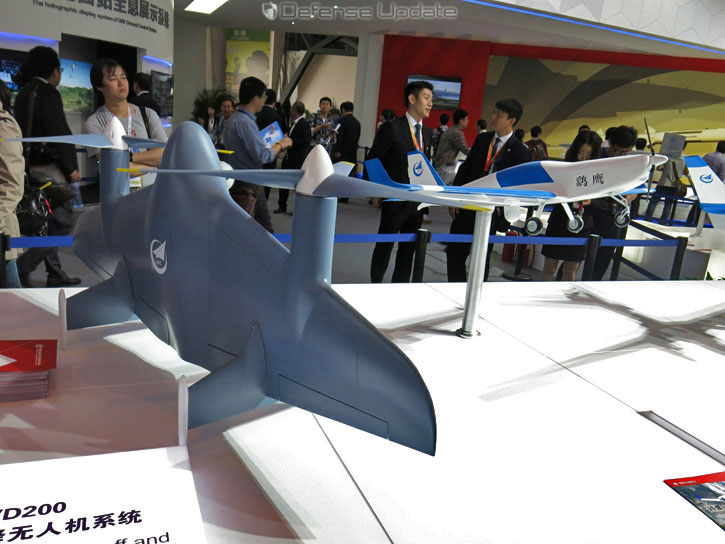
Another twin-prop is the VD200 vertical take-off and landing drone. As a tail sitter the VD200 takes off and land in vertical position, transitioning to horizontal flight for the rest of the mission. At a 200kg gross take-off weight the VD-200 can carry a payload weighing 20kg on a three hour mission.
VD200 vertical take-off and landing drone. Photo: Tamir Eshel, Defense-UpdateThe Harrier III bears some similarity design features with Lockheed Martin’s Fury. Photo: Tamir Eshel, Defense-UpdateAs a tail sitter the VD200 takes off and land in vertical position, transitioning to horizontal flight for the rest of the mission. Photo: Tamir Eshel, Defense-UpdateThe Wing Loong I drone was shown at the static display area in Airshow China 2014 .Photo: Tamir Eshel, Defense-UpdateNimble-Loong – China’s version of the US RQ-21. Photo: Tamir Eshel, Defense-Update
A UAV designed for maritime operations from vessels Nimble Loong is a short range UAV operating at low-to-medium altitude (its operation ceiling is 10,000 ft) with an endurance of 6-8 hours. It was developed by the AVIC Chengdu Aircraft Design & Research Institute (CADI). Similar to the Scan Eagle and RQ-21A Blackjack developed for the US Marine Corps, the Nimble-Loong adopts a twin tail boom layout with a pusher propeller, it is launched from a catapult and retrieved by suspended cable arrest. Endurance depends on the propulsion used – a gasoline engine makes 3-4 hours, a heavy fuel diesel would make 6-8 hours.
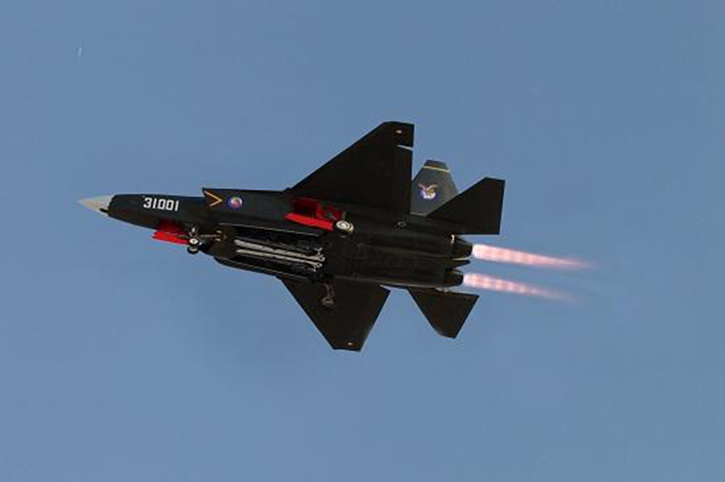
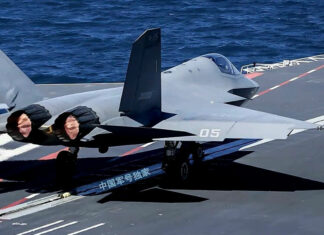
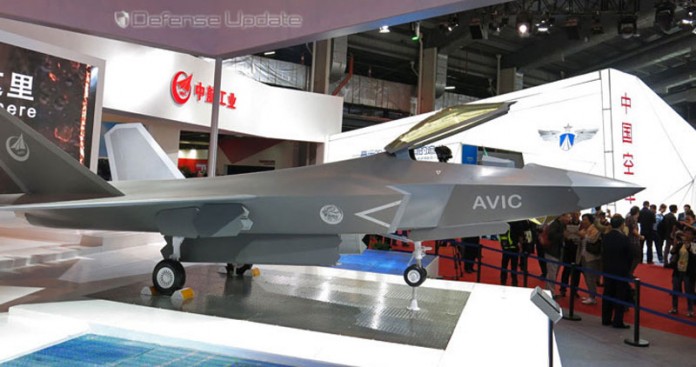
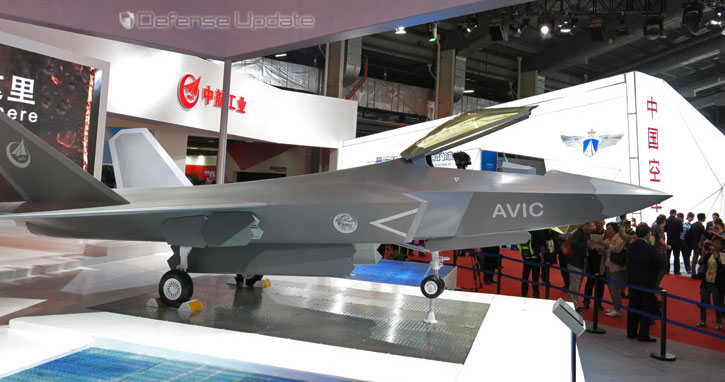
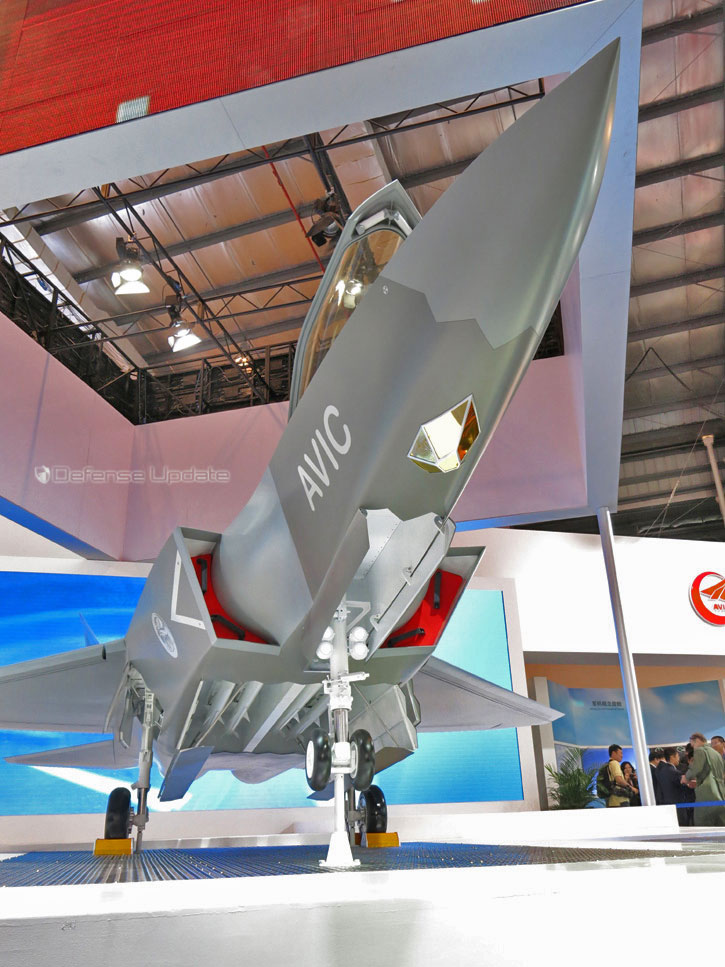
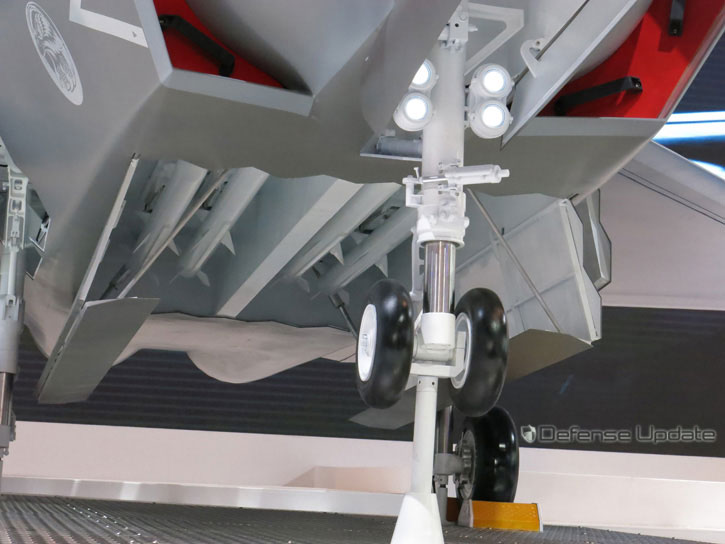
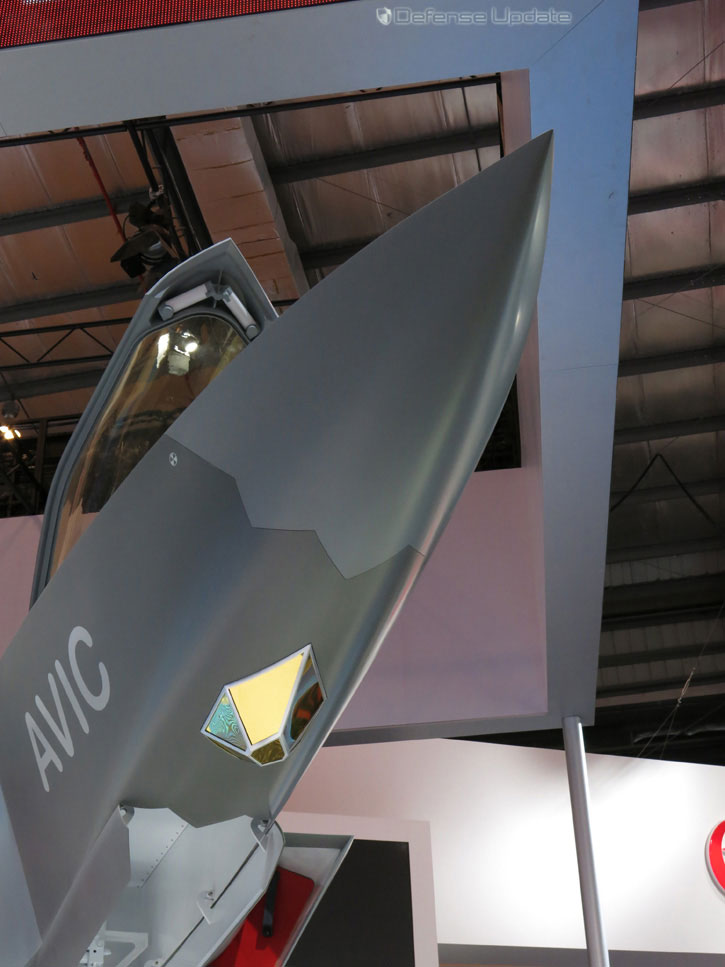
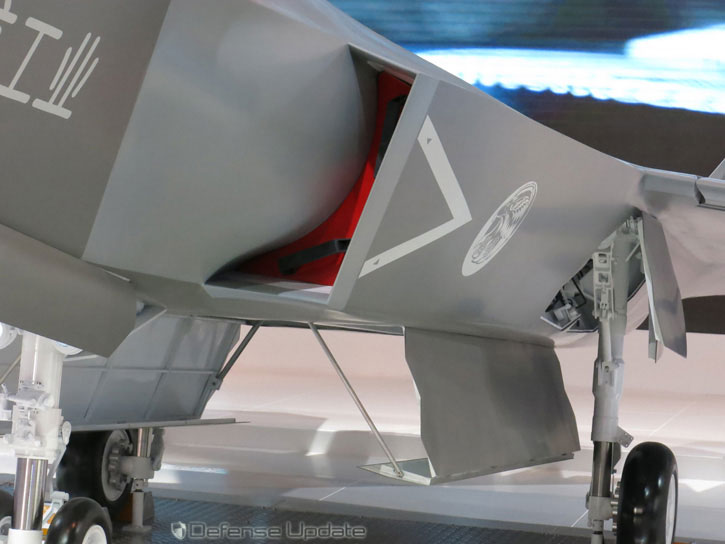
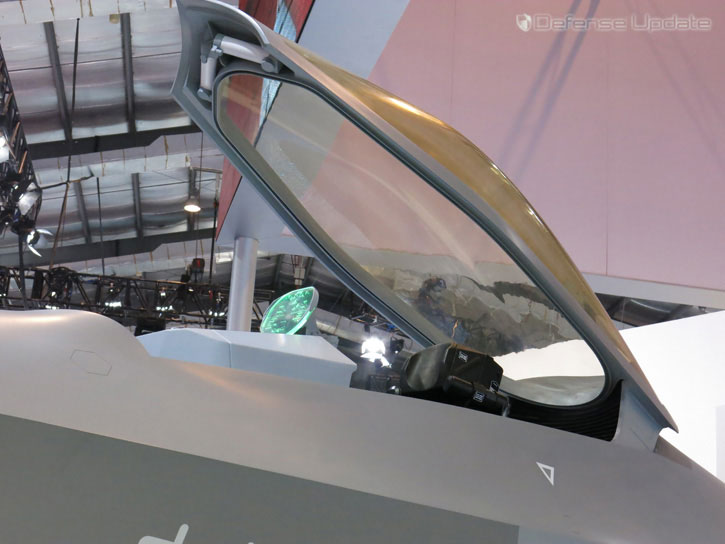
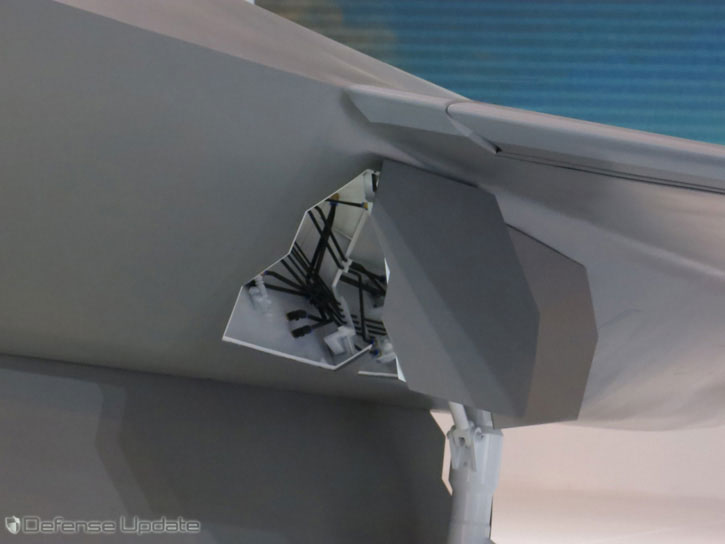
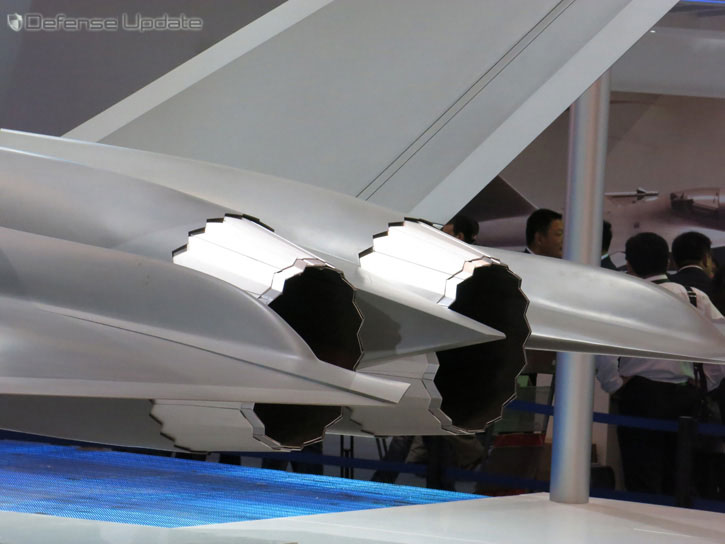
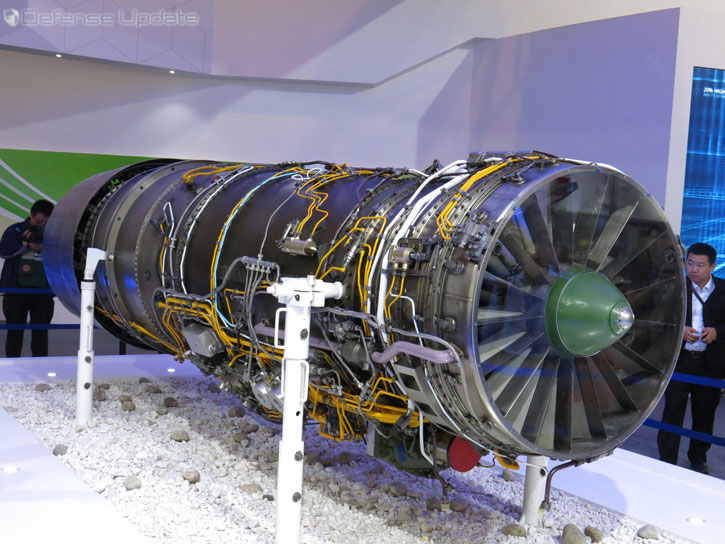
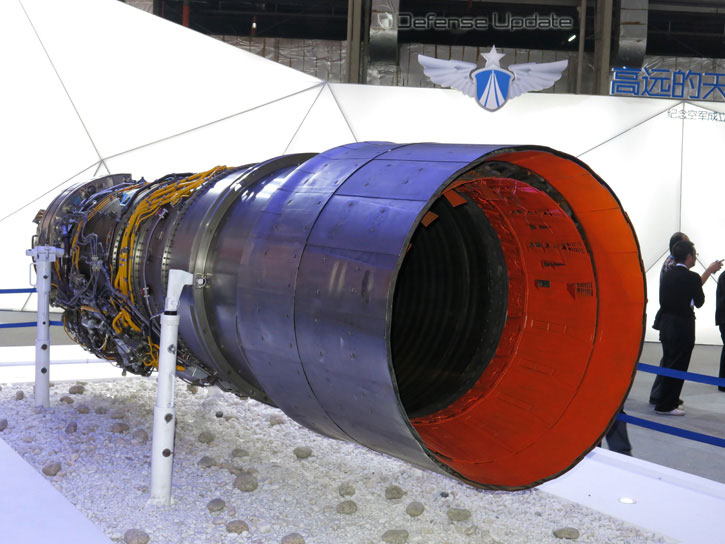
While the J-31 prototype was flying outside, AVIC has shown what the production J-31 stealth fighter could look like. Among the new elements shown were strengthened fuselage (the bow visible in the weapons bay, designed to strengthen the airframe, enabling carrier landing with full load). The aircraft is also shown with low-observable EO reconnaissance and target acquisition system, similar to a unit used on the F-35. Other photos depict the RD93 power plant used with the J-31, as well as the redesigned nozzles and tail section.
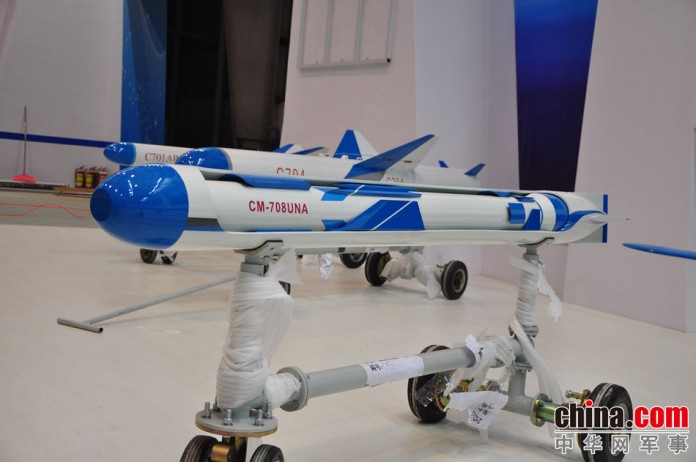
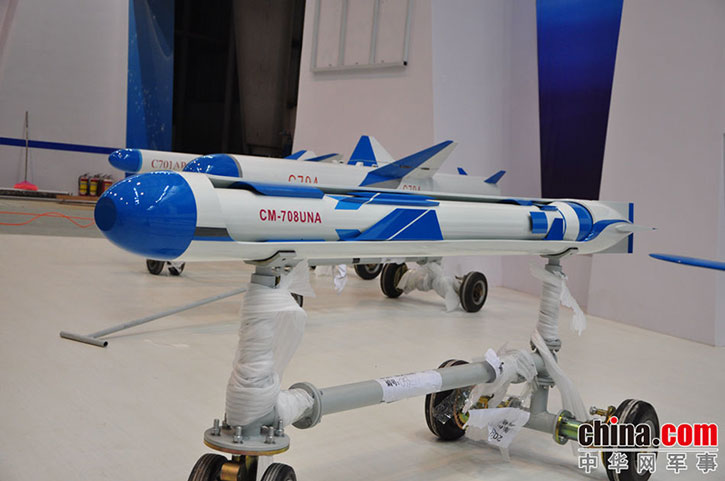
The new CM-708 Cruise Missile by CASIC. Photo: China.com
A cruise missile designed to be launched from attack submarines was unveiled today at Airshow China. The new missile, designated CM-708UNA, was developed by Aerospace Science and Industry Corporation (CASIC). Company sources confirmed the missile has entered production.
The CM-708UNA is launched by torpedo tube and is therefore adaptable to conventional submarines (not equipped with vertical launchers). The missile employs an inertial navigation and satellite navigation for mid-course guidance, using a radar seeker for terminal homing. The missile is powered by a rocket boosted turbojet engine carrying the missile to a range of 128 km.
Chinese submarines are already equipped with Ying Ji (C-801) submarine launched anti-ship missiles, which have also been exported to Pakistan. These missiles have a range of up to 42 km.
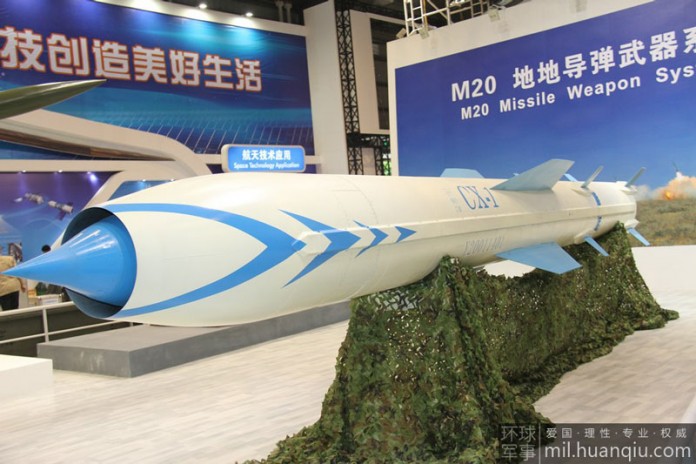
Given the weapon’s active terminal seeker, CX-1 can be launched at targets without prior location setting, enabling short reaction time for the coastal battery and minimal warning to the target. Photo: mil.huanqiu.com
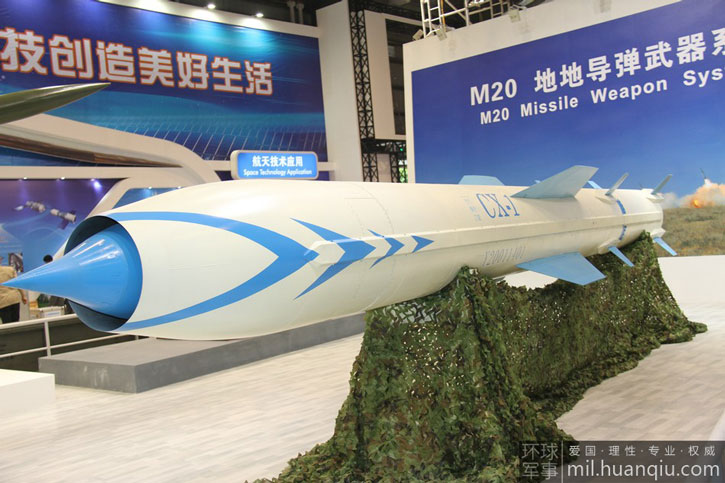
The CX-1 cruise missile is designed for launch from land-based mobile launchers. Designed for supersonic cruise at medium and low level, CX-1 endgame flexibility offers the selection of a number of attack trajectories high altitude dive or a low-altitude sea-skimming attack. The high speed and large warhead design maximize penetration and damage to the target, enabling the missile to defeat targets from frigates to aircraft carriers. The missile was developed by China’s Academy of Launch Vehicle Technology (CALT). The new missile resembles in shape and form the Russian Yakhont and Indo-Russian BrahMos missiles, both are presented at Airshow China 2014 in a full-size display mock-up.
The export version of CX-1 has a strike range of 40km to 280km. Photo: Sina Defense
Given the weapon’s active terminal seeker, CX-1 can be launched at targets without prior location setting, enabling short reaction time for the coastal battery and minimal warning to the target. Moreover, the weapon’s supersonic further shortens the flight time and employment of evasive manoeuvres countermeasures and by the target.
The export version of CX-1 has a strike range of 40km to 280km.
A variant designed for domestic use is also available, designated DF-12 which could be able to carry a heavier warhead.
Both CX-1 supersonic cruise missile and M-20 tactical ballistic missiles are sharing the same mobile Transporter Erector Launcher (TEL) platform. The M-20/DF-12, thought to be a Chinese derivative or copy of the Russian SS-X-26 (Iskander E) was shown at the IDEX exhibition in 2013. It is a solid-rocket propelled missile using INS and satellite navigation (GPS/Glonass) to achieve strike precision of 10-30 meters. A similar weapon developed in Iran has already demonstrated high precision attack capability against mobile surface targets (such as vessels at sea) using a terminal EO/IR seeker.
The weapon can be carried by a multi-purpose mobile rocket launcher mounted on a heavy duty 8×8 chassis supporting off-road operation. The gross vehicle weight carrying two missiles in launch canisters is 45 tons. The same launcher can also carry two M-20 ballistic missiles, 10 A100 rockets, or eight A200 or A300 rockets.
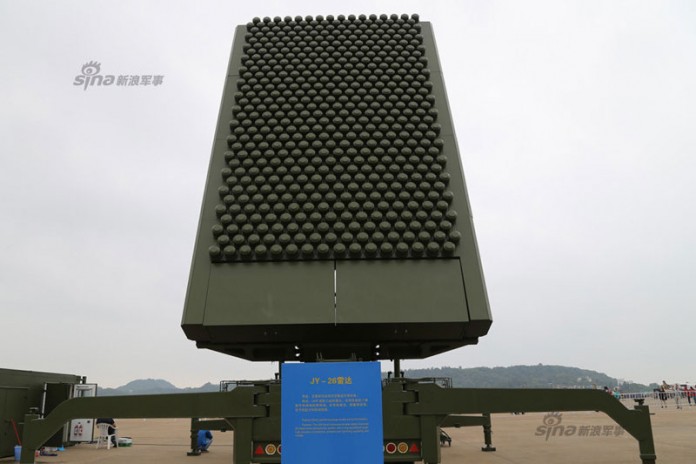
The JY-26 Radar om display at the Zhuhai Air show. Photo: Sina Defense
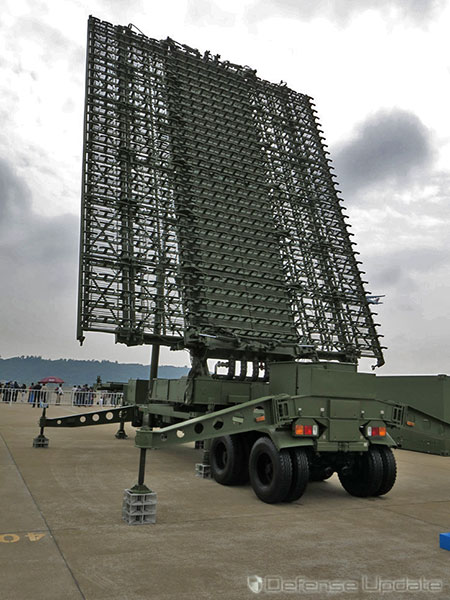
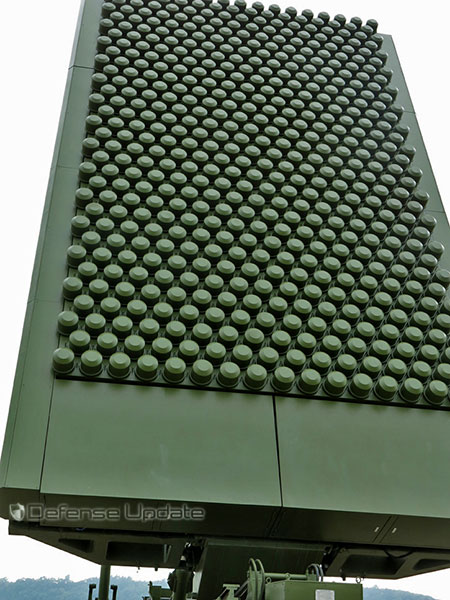
China’s Nanjing defense electronics technology group is unveiling a new phased array radar iterating in the VHF/UHF waveband, designed for long range air surveillance and target acquisition role. Operating in the long wave band – VHF/UHF enables the JY-26 to detect targets presenting low radar cross section (stealth aircraft) at the decimetric, centimetre and millimetre wave bands. The use of phased array technology also provides users the ability to increase the power transmitted at a certain location where a target presence is suspected, thus increasing the probability of detection of low-RCS targets.
The manufacturer also claims the radar is designed with robust anti-jam and electronic counter-countermeasures, enabling it to face strike forces conducting advanced anti-access/area denial (a2/ad).
It is using advanced, two dimensional digital, active phased array system, enabling high accuracy, target tracking and separation as well as operation at long ranges of up to 500 km.
The US is currently deploying advanced stealth aircraft in the Pacific, including B-2 bombers and F-22 Raptor stealth fighters. Both have also deployed on missions near China, providing the Chinese the opportunities to test their new radars against those planes.
Chinese designers at the Airshow China claim the JY-26 radar has already spotted the US Air Force most advanced stealth fighter – the F-22 Raptor stealth fighter, as it flew in South Korea on recent exercises. The radar is being developed at Shandong, located just across the Yellow Sea, separating the Korean peninsula from mainland China.
The capability of the new radar is becoming a critical asset for Beijing, as in the next decade more air forces in Asia Pacific will be equipped with stealth capabilities, these will include new bombers from the USA and Russia, a stealthy fighter plane the Russians are developing with India, an indigenous Korean stealth fighter and F-35s, to be used by the USA, Japan, Australia, and South Korea.
RD-93 engines made in Russia will power the Chinese J-31 fifth generation fighters. (Internet Photo)
RD-93 engines made in Russia will power the Chinese J-31 fifth generation fighters, Sergei Kornev an official from the Russian Rosoboronexport said. He mentioned that there is a solution to the problem of China’s reverse engineering of Russian weapons.
RD-93 Engine. Photo via RT
“J-31 with the Russian engine RD-93 is considered to be an export program, able to compete with the American F-35 fifth generation aircraft on the regional markets,” Kornev told RIA Novosti news agency.
“The program is ambitious, but very real, especially considering the high cost of F-35 and some problems with its development,” Kornev added.
Sergey Kornev is heading the Russian delegation at China International Aviation & Aerospace Exhibition in Zhuhai.
Russian RD-93 engines are a variant of the RD-33 engines, initially developed to power MiG-29 fighters. The RD-93 was developed by Russia’s Klimov design bureau specifically for the FC-1 fighter, known in Pakistan as the JF-17 Thunder.
“The problem [of China violating copyright of Russian weapons] exists, but it is solvable, and both sides are seeking the settlement of controversial situations.”
He cited a 2008 deal on intellectual property protection in military-technical cooperation between the two nations as a good example of Russia-China cooperation on the issue.
“We continue joint activities on elaboration of working mechanisms of exposing violations. The problem is concealed in the inconsistence of local legislations as well as international acts,” Kornev added.
The defense official, however, underscored that military-technical cooperation between Russia and China has no hurdles which could not be cleared.
In 1992, China bought Russia’s Su-27 fighter jets. Fifteen years later, Beijing unveiled J-11B aircraft which Moscow labeled as a copycat version of Su-27.
Russia has also accused China of producing cloned versions of Su-33 fighter jet, S-300 air defense system, the Smerch multiple rocket launcher and the Msta self-propelled howitzer in violation of intellectual property agreements.
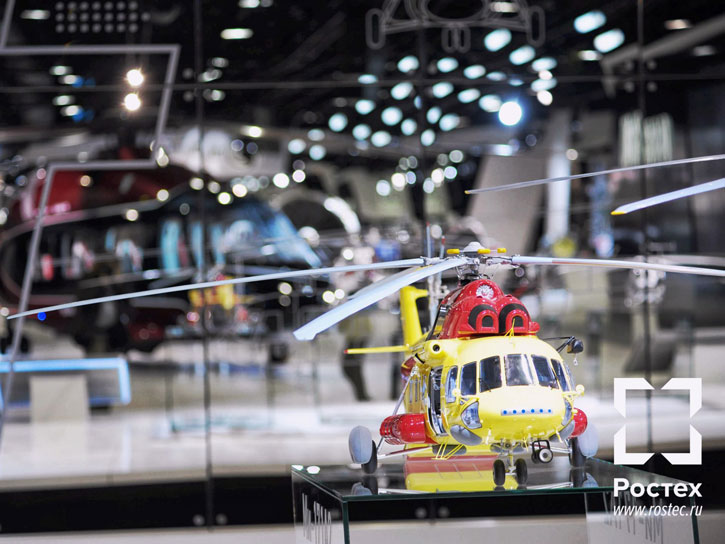
Rostec and AVIC have reached an agreement regarding strategic cooperation between the two companies, Addressing future joint projects in aircraft, helicopter, and engine production areas. Photo: Rostec
Russian Rostec Corporation and the Chinese industrial aviation corporation AVIC have reached an agreement regarding strategic cooperation between the two companies, Addressing future joint projects in aircraft, helicopter, and engine production, as well as in the manufacturing of aircraft materials, avionics, and similar products.
Nikolai Volobuev, Deputy CEO of Rostec Corporation, and Li Yuhai, Deputy CEO of AVIC, signed the agreement for strategic cooperation on behalf of their two corporations on November 11, 2014, as part of the tenth Airshow China, held in the city of Zhuai.
“We particularly value cooperation with AVIC, which will impact key industries for which Rostec Corporation has all the necessary competencies” Volobuev said, mentioning the fields of helicopter and engine construction, as well as the manufacturing of aircraft materials, avionics, and other onboard electronics equipment as priority areas for the new cooperation.
He added that the agreement could lead to the implementation of joint projects in the Russian Federation, China, and other countries.
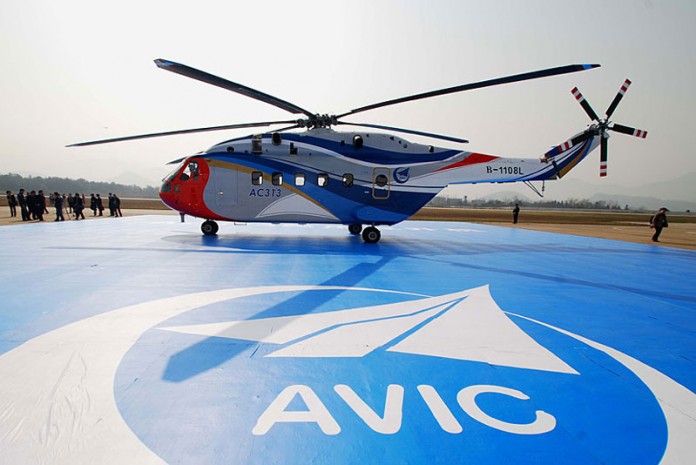
Avicopter AC313. Photo: AVIC
Another aspect of the new cooperation will be the offering of extended warranties, increase in warranty periods, minimizing the period of warranty repair and maintenance and arrangements for post-warranty service, thus overcoming a major obstacle the Chinese are facing in low availability and reliability of reversed engineered products.
Russian Helicopters, United Engine Corporation, and other Rostec Corporation subsidiaries have already actively pursued cooperation with companies such as Avicopter and AVIC Engine through work on projects such as a heavy helicopter. This is the banner cooperation project between the two companies, which benefits from the close attention of both of the governments.
AVIC is also considering partnering other Rostec enterprises besides Russian Helicopters and United Engine Corporation.
For example, VSMPO-AVISMA has signed an agency agreement to manufacture and sell titanium and aluminum prefabricated products to AVIC.
KRET is considering a partnership that will enable them to shape the format of the next generation of avionics and other onboard systems. In September 2014, a delegation from AVIC visited an enterprise of the holding company RT-Chemcomposite in Obninsk. The Chinese delegation expressed interest in establishing cooperation with Russian partners in the research and manufacturing of products made from silicate glass.
Rostec Corporation was established in 2007 to promote the development, production, and export of high-tech industrial products for civil and military use. The corporation brings together around 700 enterprises across nine defense industry holding companies and five civilian industry holding companies. Rostec subsidiaries can be found in 60 regions of the Russian Federation and export products to markets of more than 70 countries.
AVIC is China’s leader in the aviation industry, as well as one of the top companies in the global aviation industry. The corporation maintains strong partnerships with leading aviation companies worldwide and is ranked by the journal Forbes in 178th place among the world’s 500 largest companies.
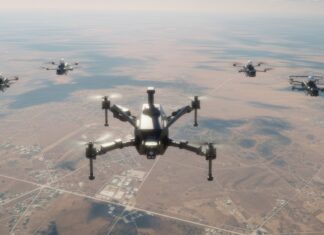
Lockheed Martin Skunk Works® and XTEND have achieved a major milestone in JADC2 by integrating the XOS operating system with the MDCX™ autonomy platform. This technical breakthrough enables a single operator to simultaneously command multiple drone classes, eliminating the friction of mission handoffs. From "marsupial" drone deployments to operating in GPS-denied environments, explore how this collaboration is abbreviating the data-to-decision timeline and redefining autonomous mission execution.
As traditional defense primes face mounting competition from agile “neoprimes” such as Anduril, Palantir and Helsing, the balance of innovation is shifting toward software-defined warfare and scalable, dual-use technologies, while global industry consolidation—marked by Boeing’s integration of Spirit AeroSystems and other strategic mergers—signals an intensified race to secure control over the defense technology value chain. Our Defense-Tech weekly report highlights these trends.
In early October 2025, a coordinated wave of unmanned aerial system (UAS) incursions—widely attributed to Russia—targeted critical infrastructure across at least ten European nations. The unprecedented campaign exposed the fragility of Europe’s air defenses...
Executive Summary
The past week (September 18-25, 2025) represents an inflection point where strategic defense concepts have transitioned from doctrine to tangible reality. An analysis of global events reveals four primary, interconnected trends shaping an...
At the 2025 Air, Space & Cyber Conference, U.S. Air Force and Space Force leaders unveiled major updates on next-generation fighters, bombers, unmanned systems, and space initiatives, highlighting both rapid innovation and critical readiness challenges as the services race to outpace global competitors. A short version is available here, with a more detailed version for subscribers.
The Taipei Aerospace & Defense Technology Exhibition (TADTE) 2025 crystallized around four dominant strategic themes that collectively illustrate Taiwan's comprehensive approach to defense modernization amid escalating regional tensions. Based on a detailed report by Pleronix (available upon request). Includes a Podcast discussion on TADTE 2025's highlighting Taiwan's four strategic themes beyond the post's coverage.
Israel’s Iron Beam 450 high-power laser system has completed final testing, marking a major leap in air defense. Developed by Rafael, it offers precise, cost-effective interception of rockets, UAVs, and mortars, and is set for IDF deployment by 2025.






 The manufacturer also claims the radar is designed with robust anti-jam and electronic counter-countermeasures, enabling it to face strike forces conducting advanced anti-access/area denial (a2/ad).