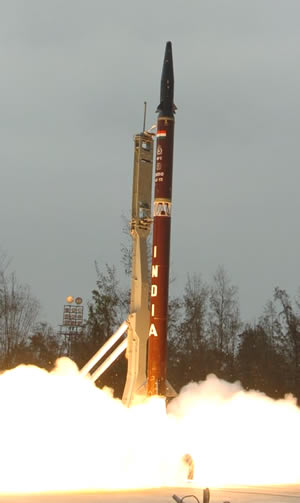
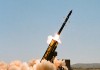
An Indian Agni II Plus missile failed on its first test launch December 10, 2010. This photo shows an earlier Agni II missile launched on another flight. Photo: DRDO
India’s Defense Research & Development organization (DRDO) is planning to test fly the Agni-5 intermediate range ballistic missile for its full range in December 2011. The missile will be launched from Wheeler Island, on the Orissa coast, traveling its full range of 5,000 km southward, halfway to Antarctica. The 17.5 m’ high Agni-5 weighs about 50 tons. The DRDO predicts that if all goes well, the can strike within a few hundred meters of the designated target. This high level of precision enables the Agni-5 to carry relatively small nuclear weapon while maintaining an effective deterrence high priority targets deep inside hostile territory.
Agni-5 is similar in size and weight to its predecessor, the Agni-3, with a range of 3,500 km. The extensive use of composite materials allows Agni-5 to propel a warhead 1,500 km further. The new missile uses the Agni-3 first stage, matched with a composite-made second stage which is significantly lighter than the Agni-3. The weight saving could enable designers to add a third stage fitted with a shaped, conical rocket motor, that further accelerates the warhead section to its full range. Agni-5 will be stored, carried and launched from a sealed canister carried on a truck transporter.
An Indian Agni II Plus missile failed on its first test launch December 10, 2010. This photo shows an earlier Agni II missile launched on another flight. Photo: DRDO
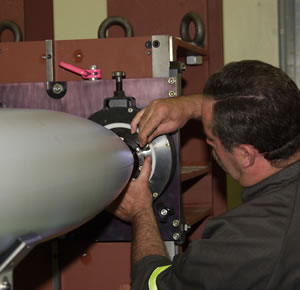
MBDA will process over 33,000 cluster weapons and destroy 15 million bomblets before 2018, as part of NATO's commitment to the elimination of cluster weapons. Photo: MBDA
MBDA will process over 33,000 cluster weapons and destroy 15 million bomblets before 2018. Photo: MBDA
Most defense companies are making money on producing weapon systems and supporting them through their life cycle. But what happens when these weapons reach the end of their lives? for MBDA, ‘demilitarization’ of complex weapons has become a new strategic activity, says Chief Executive Officer Antoine Bouvier. Earlier this month his company won a contract from NATO Maintenance and Supply Agency (NAMSA) for the dismantling and destruction of 36,000 cluster munitions. Under this contract MBDA will establish a facility to process classified munitions in accordance with the very strict regulations that apply to defense safety; namely operational reliability and respect for the environment. The facility will be running in two years time and will be able to process and dispose of over 1,000 missiles, 22,000 M26 (MLRS) rockets and 13,000 155-mm artillery shells before the year 2017. All together, these weapons contain over 15 million sub-munitions of different types and makes, which will have to be disposed of safely.
This contract has been established within the framework of the Oslo Convention, which was ratified by France in 2010 and requires all signatory countries to dispose of their cluster munitions before 2018. To expand the weapon and submunition specialization for the handling of the wide range of submunitions MBDA has teamed with Esplodenti Sabino and AID in Italy, and Nammo in Norway. The munition processing plant will be installed at MBDA’s Bourges Subdray site in central France. This activity represents an investment of around €12 million and should create about 20 direct jobs. MBDA will own and operate the facility which will provide the services to the NATO members Defense Ministries; funding for ongoing operations (cost of demilitarization) will be covered paid by the different ministries, based on the the type and complexity of ammunition or missile.
“This fits in perfectly with our determination to establish close and sustainable partnerships with our domestic and export customers” Bouvier added, “These customers not only require guaranteed availability and sustained support for their equipment, but also that we ensure the safe end of life disposal of their complex weapons as well”.
The decision to scrap the Sentinel spy plane under defense cuts is to be reviewed. According RAF Air Chief Marshal Sir Stephen Dalton, during the six month Libyan campaign the aircraft has played a ‘pivotal’ role in spotting and identifying Colonel Gaddafi’s forces. Dalton insists the Sentinel R1 should be retained within his air forces’ force structure.
Under the Strategic Defence and Security Review (SDSR), all five Sentinels have been listed for withdrawal from service by 2015.
“The value of Sentinel and the value of the picture it provided was so critical that I think we will need to have another look and see what way we can provide that capability in the future.” Dalton said during an interview with BBC4.
“Sentinel was pivotal to be able to provide the picture – the picture in electronic terms, the picture in imagery terms – so that our intelligence was well-placed therefore to identify those targets and to precisely target against them,” he said. “It was also important because we were able to demonstrate that to lawyers, to the targeteers, to the politicians, that we could see what was going on, we could identify them moving as well as the static, and we could therefore focus on what was important to achieve the overall effect.”
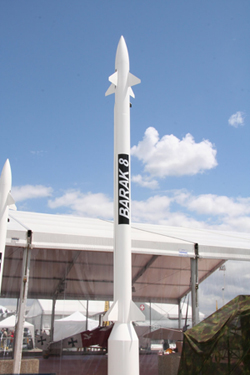
Barak 8 air-defense missile was developed by Rafael, using a booster developed in India. The system was developed by IAI and the radar by Elta Systems. Photo: Noam Eshel
India and Israel are planning to conduct a system test of Barak 8 Medium Range Surface-to-Air Missile (MR-SAM) early next year. IAI and DRDO are cooperating in the development of the Medium and Long Range Surface to Air Missile (MR-SAM/LR-SAM) missiles, also known as Barak-8, are preparing for the next milestone in the program – testing with its entire supporting system, in early 2012. The Israel Navy also expects to filed the missile with its upgraded/new Saar 5 / 5B corvettes.
Barak 8, a critical development program for the navies of both countries, went through significant development delays since parts of the missile were not completed in time for testing. The first Barak 8 missile test took place in israel in May 2010. The Economic Times of india has recently quoted DRDO officials saying the test is now planned to be conducted in Israel in January of February 2012. The weapon qualification program will include eight test firings, to take place in israel and India, prior to induction into service. Elements of the system have already been delivered to India, including the four-plane MF-STAR phased array radar and shipboard electronic modules supporting the system.
The MRSAM missiles are scheduled to equip the three Kolkata class (Project 15A) guided missile destroyers currently under construction at the Mazagon shipyards in India. These vessels will be delivered to the Indian Navy in 2012 and their Barak-8 systems are expected to become operational a year later in 2013. Four additional Kolkata class destroyers (Project15B) will be equipped with an extended range version of the missile (ER-SAM) capable of intercepting targets at a range of 100 km. These destroyers will also carry the Brahmos II supersonic and new Nirbhany subsonic cruise missiles with offensive reach of 1,000 km.
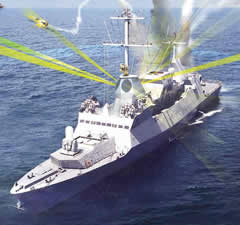
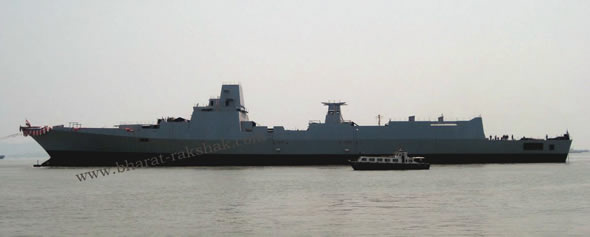
INS Kochi, the second Kolkata class guided missile destroyer built at the Mazagon Docks shipyard afloat. Note the two masts - the large superstructure above the bridge is designed to carry the EL/M-2248 MF-STAR radar while the one further to the rear will mount the IAI EL/M-2238 L-band STAR surveillance radar. Photo via Bharat-Rakshak.com
The Indian Air Force is also planning to field the extended range version of the missile, as part of the LR-SAM program, enhancing the nation’s air defense capability with wide area, The system will employ advanced surface radars, airborne sensors and advanced datalinks to provide network-centric air defense capability against aircraft, cruise missiles and anti-ship guided missiles, with each site covering a range of 100-110km.
Barak 8 have incorporated an advanced multi-function electronically scanning array that continuously covers 360 degree, thereby providing a defensive shield in all directions while simultaneously functioning in target acquisition and surface search modes. In principle, each destroyer could provide air cover for a large battle group, or share defense assets with other surface combattants, to best respond to aerial or missile threats.
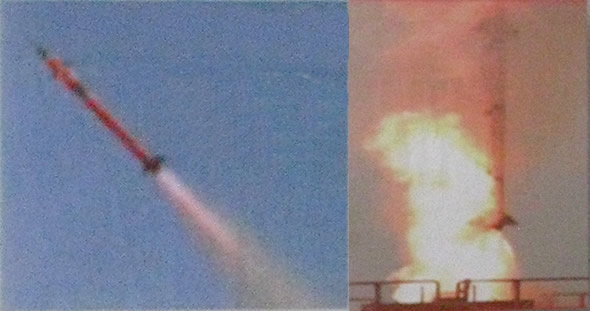
Two images taken during the Barak 8 test firing show a flight testing of the propulsion system (left) and vertical launch system (right). Both versions were the basic barak 8 missile (without booster). Photos: Tamir Eshel, Defense Update
For the ground based system, each battery has it’s own control van and mobile command. Network centricity of the system is supported by the Command & Control element of each of these batteries communicating with other batteries and other air defense assets, sharing a common ‘sky picture’ thus providing positive identification of threats or friendly aircraft, missiles or non combatant elements, assisting commanders in deciding ow best to react to a threat. (co author: Debojit Sarkar, India)
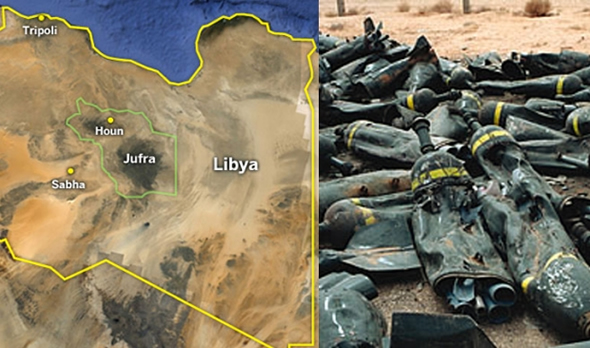
Right: The location of the two sites where stockpiles of nerve gas filled artillery shells were found. Right: Destroyed nerve gas canisters designed for aerial bombs displayed by Libya in 2003. Photos: iWatch News,
The Obama administration is investigating whether Iran supplied the Libyan government of Moammar Gadhafi with hundreds of special artillery shells for chemical weapons that Libya kept secret for decades, the iWatch news and the Washington Post reported today.
The shells, which Libya filled with mustard chemical warfare agent, were uncovered in recent weeks by revolutionary fighters at two sites in central Libya, reportedly Houn and Sabha. Both are under heavy guard and round-the-clock drone surveillance, U.S. and Libyan officials said. A U.S. official with access to classified information confirmed there were “serious concerns” that Iran had provided the shells, albeit some years ago.
Right: The location of the two sites where stockpiles of nerve gas filled artillery shells were found. Right: Destroyed nerve gas canisters designed for aerial bombs displayed by Libya in 2003. Photos: iWatch News,
During the recent civil conflict, some foreign powers and Libyan rebels worried that Gadhafi might use chemical weapons, but they were only aware of a previously-declared stockpile of mustard agent in bulk storage at a remote desert site. They were unaware of the filled artillery shells, which posed a much greater threat. Gadhafi’s government was “sitting on stuff that was not secure, and the world did not know about it,” a third U.S. official said. “There were no seals and no inventories” by international inspectors, the official added.
This newly-discovered stockpile will now need to be protected from theft by militia groups or others in the politically unsettled nation. Disposal of the munitions poses an additional challenge for Libya’s new government and allied Western powers, since the chemical-filled shells cannot be readily relocated, and may take as long as a year to destroy in place, according to some estimates.
The stockpile’s existence violated Gadhafi’s promises in 2004 to the United States, Britain, and the United Nations to declare and begin destruction of all of Libya’s chemical arms, and raises new questions about the ability of the world’s most powerful nations to police such pledges in tightly-closed societies.
Washington to Transfer an F-16 Squadron to Indonesia
Indonesia The U.S. is offering to transfer a squadron of ex-U.S. Air Force F-16 fighters to bolster the air defense capability of the Indonesian Air Force. Jakarta has requested Washington to receive the first of the 24 aircraft in the year 2014. The new agreement expected to be worth around $750 million represents the largest transfer of defense articles in the history of the U.S.-Indonesia bilateral relationship. Indonesia currently operates 10 Su-27/30 and 10 F-16 A/B fighter planes which could also be upgraded to meet a similar level as the new planes. The new Indonesian Falcons will be F-16C/D Block 25 aircraft. In addition to renovation and modernization of the aircraft the package will also include training of at least 30 Indonesian pilots in the U.S., and local training for maintenance and support teams. Indonesia will receive the 24 F-16C/D Block 25 aircraft with their original engines (F100-PW-200 or F100-PW-220E) granted as excess defense articles. In addition Jakarta will pay for a comprehensive upgrade packages, to include a new mission computer, advanced targeting pods, ARC-164/186 Radios, Situational Awareness Data Link (SADL) and Enhance Position Location Reporting Systems (EPLRS), advanced self protection system including ALR-69 Radar Warning Receivers, ALQ-213 Electronic Warfare Management Systems and ALE-47 Countermeasures Dispenser Systems. and more. A weapons suite for the aircraft will be decided at a later stage.
India is Set to Test Fly the Nirbhany Cruise Missile in early 2012
Taiwan’s SRP Complex
Taiwan plans to complete the construction of the long-range early warning Surveillance Radar Program (SRP) site enabling the deployment of the $752 million radar next year. The completion of the site, currently under construction in Hsinchu County of northern Taiwan has delayed the program for over a year. According to Deputy Defense Minister Chao Shih-chang, the site will be completed in November 2012. Raytheon will deliver the UHF electronically scanning FPS-115 PAVE PAWS radar and two missile warning centers to provide better protection from possible ballistic missile attack from China. In 2004 Taiwan requested to deploy two such sites, at a total cost of more than $1.7 billion however, only one radar was ordered to date. Chao reassured the new radar will be able to support Taiwan’s Patriot air defense systems and link to the Heng Shan Military Command Center, a military emergency facility also located in the north. “The preliminary tests have showed that there are no problems with the integration between the systems,” Chao said at the Legislature’s Foreign Affairs and National Defense Committee.
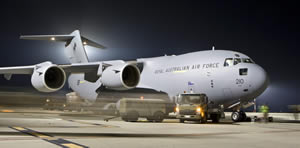
Australian C-17A Globemaster III
Canberra Wants a Sixth Globemaster III for the RAAF
Australia is considering buying a sixth Boeing C-17 Globemaster III t an investment of about US$300 million. The Royal Australian Air Force already acquired five such aircraft to be based at RAAF Base Amberley, the primary base for C-17 airlift planes and Airbus A-330 Multi-Role Transport Tanker (MRTT) aircraft. The base is currently undergoing the infrastructure upgrades required to support the C-17 and other large aircraft Australia has already received or is under contract to receive in future years.
… and More Ammo for the Carl Gustafs
The Australian Defence Materiel Organisation (DMO) has awarded the Saab company of Sweden an order worth $23.92 million for the delivery of for 84mm ammunition for the Carl-Gustaf M3 weapon system. In late 2009 the Australian Defence Force selected the Carl-Gustaf M3 weapon system after thorough evaluation as their future multi-purpose weapon system. Manufacturing will be done by Saab in Karlskoga, Sweden, and deliveries take place within the next half year.
Poland delivers Four Swidniks to the Philippines
Sokol Swindik assault/utility helicopter
The first four of the eight PZL Swidnik utility helicopters procured by the Philippine Air Force (PAF) in Poland are being delivered in November 2011. The remaining four will be delivered in 2012. The Polish company won the US$73 million public tender in 2008. The Philippines plan to use the helicopters in utility transport and armed-assault configuration, in support for internal security operations, counter-terrorism, and territorial defense. Some of the helicopters are equipped with with radar and night vision devices for night operations. The Swidnik can carry 14 persons, including the two-man crew. Maximum speed is 260 km/h and the range is 745 kilometers. The helicopter can be armed with air-to-air missiles, rail-launched air-to-ground rockets, .50 caliber machine guns. Counter-insurgency operations in the Philippines have intensified in recent months, fighting against islamic terror organizations in the archipelago, such as the Abu Sayyaf Group and some elements of the Jemaah Islamiyah both having links to the al-Qaeda international terror group. In its fighting against those groups the Philippine Army is using aging UH1-H “Huey” and MG-520 helicopter gunships. Both are worn out after decades of activity.
Opportunities and Entry Strategies, Analyses and Forecasts to 2016
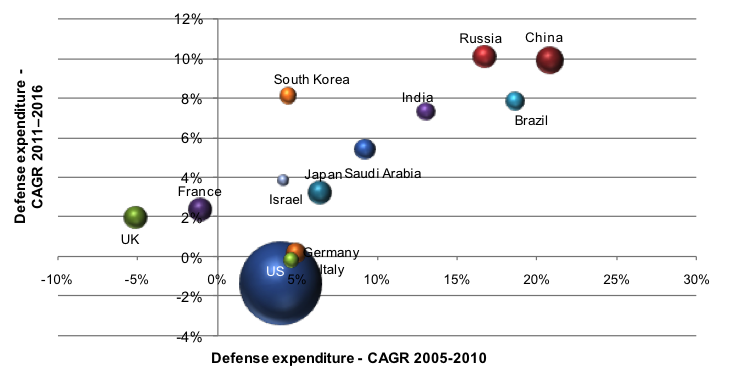
China’s defense budget is one of the largest in the world, second only to the US. In addition, China has a rapidly expanding presence in the international arms export market. The Chinese defense budget is expected to grow at a CAGR of 9.90% during the forecast period. While the Chinese defense budget will grow at a faster rate than the US defense budget growth during the forecast period, the Chinese defense budget will still be considerably smaller than the US defense budget in 2016.
China has the largest defense budget in Asia, and has the second-largest defense budget in the world. Due to the US and Western European countries imposing an arms embargo on China following the 1989 Tiananmen Square massacre, China has sought to procure advanced defense equipment by establishing a domestic, self-reliant, profit-making defense industry. China’s budget grew at a compound annual growth rate (CAGR) of 20.86% during the review period (2005–2010), which was fueled by the nation’s desire to become a global superpower, containing a strong economy and superior military force which can rival that of the United States. China’s defense industry has also benefited from the country’s strong economic growth, which has enabled large sums to be allocated for its defense industry.
Although the US currently dominates the world’s political, military and cultural outlook, China aims to emerge as one of the world’s largest economic powers and threaten the US’s military and economic supremacy. As such, the country has focused on modernizing its defense capabilities through the acquisition of advanced foreign weapons, significant investments in its domestic industrial technology, and upgrading its strategic nuclear force. As such, China’s defense expenditure grew at a CAGR of 20.86% during the review period, and is expected to grow at a CAGR of 9.90% during the forecast period.
China has instigated a military modernization program, which focuses on developing its navy, air defense systems, missile defense systems, C4I (command, control, communications, computers and intelligence) capabilities and surveillance equipment. This program will continue throughout the forecast period with China raising its defense capital expenditure allocation from 34% of the total defense budget in 2010 to 39% in 2016.
Rising internal threats, alongside increased criminal activity, pose a security risk to Chinese homeland security. To address these risks, China is expected to spend a similar amount on homeland security as it does for external defense in 2011. The spending on homeland security aims to reduce criminal activity, riots, illegal immigration, illicit drug trading and human trafficking in the country. As Chinese homeland security is threatened by the protests and criminal activity of separatist groups from Tibet, Taiwan and Xinjiang, a substantial portion of the nation’s military budget is spent on policing these areas.
China does not have access to advanced military technology developed in Western countries due to the arms embargo placed on the country by the US and European countries following the 1989 Tiananmen Square massacre. Despite this several foreign companies have participated in the joint development, assembly and co-production of a variety of civilian products with Chinese companies, which have the potential to be used by the defense industry. As such, China has integrated its civil and military industries, which enables civilian technology to be utilized for defense products and vice versa.
About ICD Research
ICD Research is a full-service market research consultancy providing both online and offline research capabilities. Our areas of expertise include online research, qualitative and quantitative research, custom approaches, and actionable insights. Our capabilities provide a one-stop research and analysis service with full-spectrum consulting, from problem recognition and conducting fieldwork to the delivery of strategic recommendations. We deliver our expertise across a broad range of industry sectors and product lifecycle areas. From product innovation to brand management and CRM, we offer full service research and analysis that drives loyalty and lifetime value.
Elta Systems' ISRV providing the baseline for the Granite
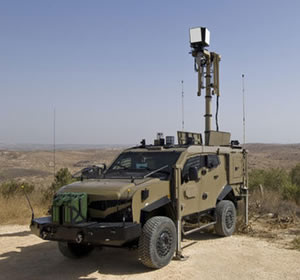
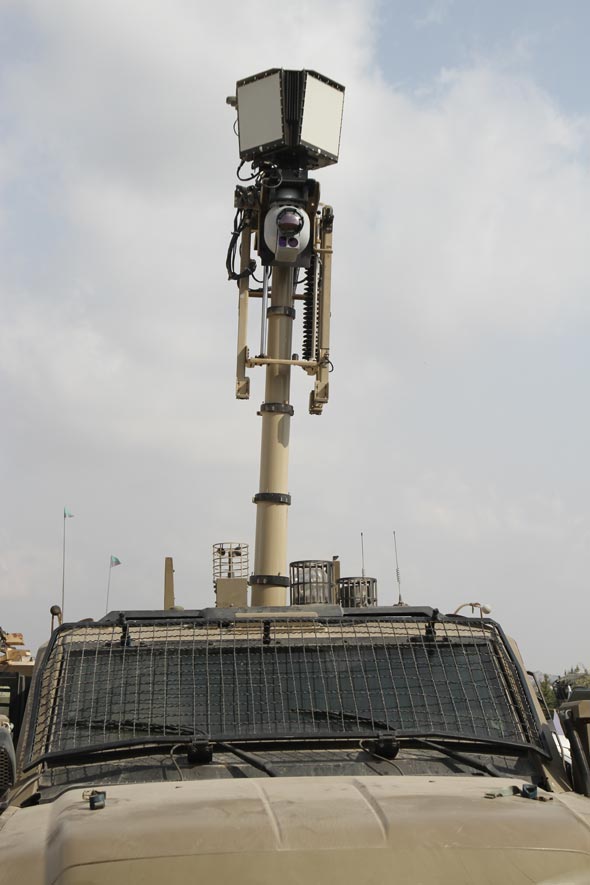
The IDF new Granite tactical intelligence collection vehicle is based on Elta Systems' ISRV system. Photo: Noam Eshel, Defense Update
Israel Defense Forces’ (IDF) Field Intelligence Corps’s has fielded an advanced reconnaissance vehicle called ‘Granite’, based on IAIs’ EL/I-3302 Intelligence Surveillance & Reconnaissance Vehicle (ISRV) developed by ELTA Systems Ltd. Elta has integrated the mission payload on the SandCat, an armored vehicle based on Commercial Off The Shelf (COTS) Ford 550 model. The vehicle has full armor protection and concealed telescopic mast, which can be erected rapidly as the vehicle halts.
Granite will augment and later, replace HMMWV based Racoon, delivered by Rafael in the early 2000s. Both vehicles are equipped with mast mounted multi-sensor payloads comprising a surveillance radar, and day/night electro-optical observation system.
Granite is based on Elta Systems' ISRV - based on the Plasan SandCat platform. Photo: IAI
Unlike the task specific Racoon, ISRV was designed to provide a as a hub for tactical intelligence gathering operations. The system architecture, user interface and reduced workload enables operation by multiple users assigned to different tasks, or a single operator supporting routine surveillance activity through semi-automated means,including slaving EO payloads to the targets spotted by the radar.
The vehicle carries the new EL/M-2207 electronically scanner array (AESA) detecting man-size targets at a distance of eight kilometers, with EO payloads such as long range POP-300 recognizing such targets from seven kilometers and designating targets for engagement by precision guided weapons. Elta designed the ISRV to deploy forward observations using the Man Portable Ground Observation & Surveillance System (MNPGOSS) and lightweight unmanned aerial vehicles, supporting manned or unmanned forward observations. The system also integrates with supported units can be performed over the IDF new ‘digital army program’ (Zayad).
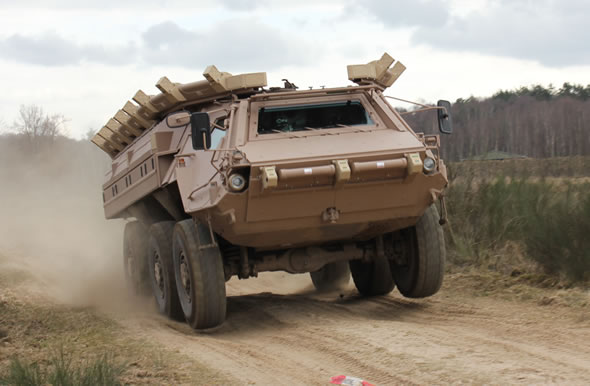
ADS equipped Fuchs undergoing mobility tests by Defence Technology Detachment 41 in Trier. Photo: Rheinmetall
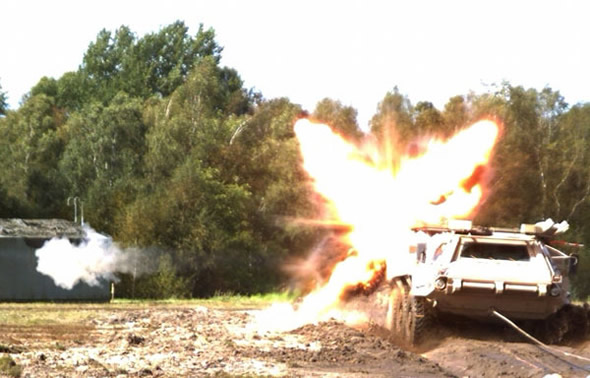
A new active protection system developed by Rheinmetall and ADS GmbH was successfully demonstrated in live firing test earlier in the summer of 2011, validating the design parameters of the proprietary blast-based defeat mechanism in development by IBD Diesenroth for years. Since the test ADS has booked a first serial order for the system.
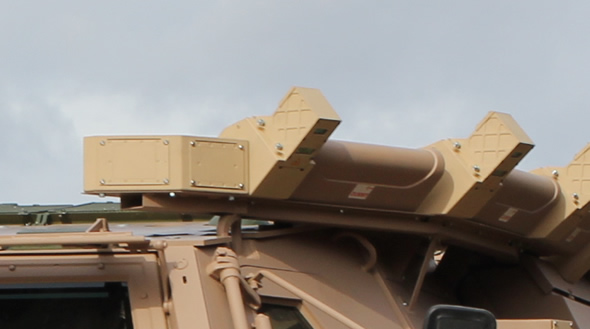
A rocket propelled weapon fired from a distance of 18 meters is intercepted and destroyed at close range by the ADS system protecting the Fuchs armored personnel carrier. Photo: RheinmetallThe ADS installation includes modules combining sensors and explosive charges that blast away at the instance the threat is in effective range. The system combines threat detection sensors and electro-optical triggering systems, each segment protecting a specific sector of the protector perimeter and provide overlapping of its neighboring sectors. Photo: Rheinmetall
The test vehicle was a standard Fuchs/Fox 1A8 armored personnel carrier modified to carry the system, configured as an appliqué assembly ‘crowning’ above the vehicle’s perimeter, enabling the 6×6 vehicle to assume full protection against Rocket Propelled Grenades (RPGs) without significantly altering the basic parameters of volume, weight and electrical output, mobility and handling trials.
For the APS a Panzerfaust rocket propelled weapon was fired at the ADS protected Fuchs as it travelled at a speed of 20 km/h. Triggered by a pressure detonator of the type commonly used to set off IEDs in urban areas and along routes of march, an RPG was fired at the side of the vehicle from a distance of 18 meters. The small standoff was intended to demonstrate ADS’s unique effectiveness in responding to an attack at close quarters, while simultaneously assuring that the detonator of the shaped charge was armed.
The ADS sensors detected the attack, identified the incoming projectile as a threat and immediately initiated its destruction. Its residual impact was insufficient to penetrate the vehicle’s armor, and was in fact so weak that the vehicle was able to drive away under its own power after being fired on. The low collateral risk was highlighted by the proximity of the test to the VIPs attending the test, viewing the live test from a distance of 150 meters.
Rheinmetall AG owns a 74% share of the ADS GmbH, with the remaining shares held by the technology developer IBD GmbH.
ADS equipped Fuchs undergoing mobility tests by Defence Technology Detachment 41 in Trier. Photo: Rheinmetall
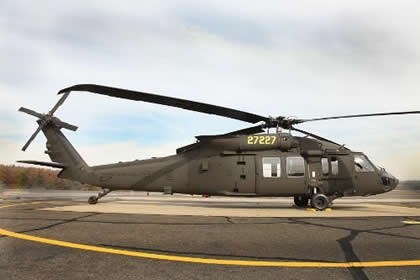
Sweden has requested accelerated delivery of 15 UH-60M Black Hawk helicopters to meet the scheduled deployment of Swedish military in Afghanistan in April 2013. The helicopters produced by Sikorsky Aircraft are delivered through the U.S. Foreign Military Sales (FMS). Since production has began in May 2011 seven helicopters are expected to be delivered by December, with the remaining eight transferred within 12 months. The the aircraft will support coalition and Afghan forces providing medical evacuation, utility, and search and rescue missions.
First delivery of four UH-60M helicopters handed to Swedish Procurement Agency. Photo: Sikorsky Aircraft
The UH-60M is in service with the U.S. Army since 2007. Sweden’s aircraft come equipped from Sikorsky with an advanced flight control system to reduce pilot workload, full night vision device capability for night operations, and a state-of-the-art communications suite. The U.S. Army will further modify the aircraft with a variety of equipment, including an exterior rescue hoist, gunner seats, armored floor, stackable litters, a cockpit heater and environmental control system.
Swedish aircrew already flight qualified in UH-60M aircraft at the U.S. Army Aviation Center of Excellence, Fort Rucker, Ala. will receive follow on unit training at the Swedish Air Force base in Linkoping following the arrival of the first four unmodified aircraft in Sweden in early 2012.
A new technique that can remotely locate suspected IED sites over a wide area was developed by U.S. Navy scientists at the Naval Surface Warfare Center Dahlgren Division (NSWCDD). The technique employs airborne polarimetric Synthetic Aperture Radar (SAR), processing multiple polarization analysis at the pixel level, thus providing detailed information from SAR imagery obtained through airborne or satellite surveillance. According to the developers, expected results include improved ability to conduct target detection and discrimination and supporting intelligence analysis. NSWCDD Dr. George Rogers and Houra Rais made the discovery while working on an Office of Naval Research sponsored project. The two scientists were named the two winners of the 2011 NSWCDD ILIR Excellence award.
The two scientists have also studied various aspects of SAR imagery, including applications supporting the location of downed aircraft. Other researchers have already suggested the use of airborne polarimetric radar techniques to search for crash sites in remote areas, with radar surveillance cueing search and rescue teams to possible istes based on radar signals echoed from metal parts characteristic of aircraft segments. hypothetically, similar techniques could be employed for spotting specific metallic elements used in explosive materials. Other algorithms can monitor wide areas for specific and indicative changes over surface areas that seem homogenic.An example of such research was done by Son V. Nghiem,of the University of California, studying multi-polarisation SAR to monitor icing conditions on lakes.
“New detection techniques will lead to enhanced remote sensing capabilities with immediate application to asymmetric operations and battle space awareness in addition to intelligence, surveillance, reconnaissance and targeting applications,” said Rais. According to NSWCDD, the discovery is expected to significantly impact U.S. warfighter’s target detection and discrimination capabilities in measurement and signatures intelligence.
Iraq has deposited the initial payment toward the procurement of 18 F-16C Block 52 fighters in September 2011. The planes are scheduled for delivery in late 2014 or 2015. Along with the fighter aircraft Iraq also purchased various weapons including AIM-9 air-to-air missiles, GBU-12 laser-guided bombs, a logistics package and training.
There are currently six Iraqi F-16 candidates in the U.S. for different phases of pilot training. These students will form the core of Iraq’s future F-16 force. The training is all inclusive and typically starts with English language training, which is the international language of aviation. At present, some are finishing an English language course while others are finishing their initial training in the T-6, a trainer aircraft. One of the pilots is scheduled to begin Introduction to Fighter Fundamentals, a preliminary course to the actual F-16 training program, as early as January.
The Chief of Iraqi air force staff Lt. Gen. Anwer Amin said Iraq’s purchase of 18 F-16C Fighting Falcons, for their future air defense, will encourage and strengthen the strategic partnership between the U.S. and Iraq. During the past few years, the Iraqi air force, which celebrated its 80th anniversary this year, has steadily modernized its infrastructure and increased its number of personnel. At the end of 2006, the Iraqi air force had 748 airmen and 28 aircraft. Now, there are more than 6,000 airmen and 72 aircraft, including the T-6 Texan and C-130E Hercules.
A rocket propelled weapon intercepted and destroyed at close range by the ADS system protecting the Fuchs armored personnel carrier. Photo: Rheinmetall
First delivery of four UH-60M helicopters handed to Swedish Procurement Agency. Photo: Sikorsky Aircraft
November 18, 2011: Sweden has requested accelerated delivery of 15 UH-60M Black Hawk helicopters to meet the scheduled deployment of Swedish military in Afghanistan in April 2013. The first four helicopters were delivered this week to the U.S. Army, which manages the delivery of the aircraft via Foreign Military Sales program. The U.S. Army will further modify the aircraft with a variety of equipment, including an exterior rescue hoist, gunner seats, armored floor, stackable litters, a cockpit heater and environmental control system. Swedish aircrew already flight qualified in UH-60M aircraft at the U.S. Army Aviation Center of Excellence, Fort Rucker, Ala. will receive follow on unit training at the Swedish Air Force base in Linkoping following the arrival of the first four unmodified aircraft in Sweden in early 2012. (Defense-Update)
Airbus Military Opens a C295 MRO Center in Poland
November 17, 2011: Airbus Military has opened a new Maintenance, repair and Overhaul (MRO) service center near Warsaw, Poland to support C295 aircraft. The new facility is the second service center Airbus Military has established in Europe, in addition to the first center operating in Seville, Spain. The new center will support 11 C295 currently operating with the Polish Air Force and other potential customers in Europe. The facility utilizes the assets of EADS PZL Warszawa-Okęcie, now Airbus Military, the Polish company has been granted a certificate to service Airbus Military C295 airlifters, following training of 30 personnel in Seville.
A new active protection system developed by Rheinmetall and ADS GmbH was successfully demonstrated in live firing test earlier in the summer of 2011, validating the design parameters of the proprietary AMAP-ADS blast-based defeat mechanism in development by IBD Diesenroth for years. Since the test ADS has booked a first serial order for the system. (Defense-Update)
November 16, 2011: The PAC-3 Missile Segment Enhancement (MSE) performed a successful intercept test today, the first time it was fired from the Medium Extended Air Defense System (MEADS) MEADS lightweight launcher and employed the MEADS system battle manager. The test followed a successful simulated engagement against targets representing realistic missile threats, performed earlier this week as part of the ‘plug-and-fight’ testing. The test series demonstrated successful integration of BMC4I hardware and software by completing essential system functions including attaching and detaching the launcher from the MEADS plug-and-fight network; These tests represent an important step toward the integration and test events to be conducted at Pratica di Mare, Italy. (Defense-Update)
Italy accepted the first T-346A advanced trainer
Italy Accepts First T-346 Advanced Jet Trainer
November 14, 2011: Following type certification of Alenia Aermacchi M-346 advanced jet trainer by the Italian Ministry of Defense’s certification office in June 2011, the Italian Air Force has formally accepted the first T-346A variant of the aircraft designed specifically to its requirements. The first aircraft will soon be followed the second plane procured under a under a €220 million contract for an integrated training system comprising six aircraft, signed in 2009. The first two will be assigned to the Flight Test Unit at the Pratica di Mare air base, where it will undergo operational tests. The Air Force will take delivery of the other four aircraft and the associated ground-based training system by 2012, thus becoming the first air force in the world to have the use of a training line based on the M-346. One of the M-346 prototypes participating this week at the Dubai airshow crashed at sea off the Dubai coast, on its return flight to Italy.
German Government to Own Part of EADS
November 11, 2011: The German state-owned development bank KfW Group acquired 7.5 percent shares of EADS, valued at 1.2 billion euros ($1.6 billion), maintaining parity with France in ownership of the European aerospace & defense giant. Germany has failed to find an investor to swap the German share of ownership of EADS owned by the Daimler group, after Daimler decided to divest part of its holdings earlier in 2011. Under the agreement that created EADS, the parent of Airbus SAS, investors from France and Germany must hold balanced voting rights in the company. (Blumberg)
Secure Positioning from Saab
November 11, 2011: Saab has developed a multi-purpose micro processor controlled GPS secure tracking modem, designed for secure military and civilian supporting mapping, messaging and situational awareness applications. The new device called IMPI was developed by Saab South African subsidiary Grintek, IMPI provides encrypted positional updates communicating over GSM cellular networks or Iridium satellite link or utilize Saab proprietary Inline Data Communication Unit (IDCU) supporting tactical radio networks.
Cassidian to Maintain Spanish Air Force C130
November 11, 2011: Cassidian Spain won a Spanish Air Force contract to provide MRO services for twelve C130 Hercules military transport planes. The contract runs until 2015 and includes all maintenance of the fleet of 12 aircraft which is beyond the capacities of the Air Force repair depots. The work will be carried out at Cassidian’s facilities in Getafe, Technical assistance will be provided at the Zaragoza air base and the depot facilities in Seville. The contract also includes purchasing of spare parts, and modifications of the aircraft.
MBDA has delivered the first VL MICA naval surface-to-air defense systems to the first export customer and is moving the land-based VL MICA land system into production, anticipating first export deliveries starting in 2012. The launch customer for both systems is believed to be Oman.
system’s elements will be networked to validate a standard operational configuration. The French Air Force has taken part in the VL MICA land program since 2009, as part of the technical and operational assessment of the VL MICA demonstrator. Photo: MBDA
The naval-based Mica-VL will be deployed on three Omani Navy Khareef corvettes scheduled for delivery starting in 2012. The land-based version is expected to replace the obsolete Rapier currently in service with the Omani land forces. The Moroccan Navy is also believed to be a customer for the Naval Mica VL , to equip its Dutch built Sigma class corvettes built in the Netherlands.
MBDA is moving the land-based VL MICA land system into production, anticipating first export deliveries starting in 2012. Photo: MBDA
Mica VL (Land) has been ordered by the French Air Force and part of the system’s equipment has already been delivered to the French airbase, where the system’s elements will be networked to validate a standard operational configuration. The French Air Force has taken part in the VL MICA land program since 2009, as part of the technical and operational assessment of the VL MICA demonstrator.
Lockheed Martin Skunk Works® and XTEND have achieved a major milestone in JADC2 by integrating the XOS operating system with the MDCX™ autonomy platform. This technical breakthrough enables a single operator to simultaneously command multiple drone classes, eliminating the friction of mission handoffs. From "marsupial" drone deployments to operating in GPS-denied environments, explore how this collaboration is abbreviating the data-to-decision timeline and redefining autonomous mission execution.
As traditional defense primes face mounting competition from agile “neoprimes” such as Anduril, Palantir and Helsing, the balance of innovation is shifting toward software-defined warfare and scalable, dual-use technologies, while global industry consolidation—marked by Boeing’s integration of Spirit AeroSystems and other strategic mergers—signals an intensified race to secure control over the defense technology value chain. Our Defense-Tech weekly report highlights these trends.
In early October 2025, a coordinated wave of unmanned aerial system (UAS) incursions—widely attributed to Russia—targeted critical infrastructure across at least ten European nations. The unprecedented campaign exposed the fragility of Europe’s air defenses...
Executive Summary
The past week (September 18-25, 2025) represents an inflection point where strategic defense concepts have transitioned from doctrine to tangible reality. An analysis of global events reveals four primary, interconnected trends shaping an...
At the 2025 Air, Space & Cyber Conference, U.S. Air Force and Space Force leaders unveiled major updates on next-generation fighters, bombers, unmanned systems, and space initiatives, highlighting both rapid innovation and critical readiness challenges as the services race to outpace global competitors. A short version is available here, with a more detailed version for subscribers.
The Taipei Aerospace & Defense Technology Exhibition (TADTE) 2025 crystallized around four dominant strategic themes that collectively illustrate Taiwan's comprehensive approach to defense modernization amid escalating regional tensions. Based on a detailed report by Pleronix (available upon request). Includes a Podcast discussion on TADTE 2025's highlighting Taiwan's four strategic themes beyond the post's coverage.
Israel’s Iron Beam 450 high-power laser system has completed final testing, marking a major leap in air defense. Developed by Rafael, it offers precise, cost-effective interception of rockets, UAVs, and mortars, and is set for IDF deployment by 2025.