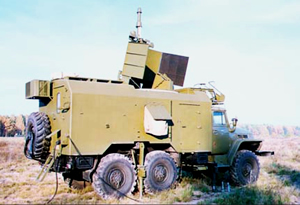
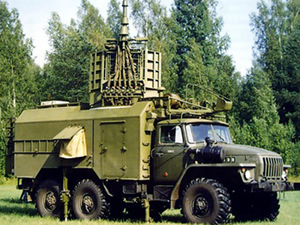
Russia has transferred a number of Kvant 1L222 Avtobaza Electronic Intelligence (ELINT) systems to Iran in October, RIA Novosti news agency announced. Each 1L222 system includes an passive ELINT signals interception system and a jamming module capable of disrupting airborne radars including fire control radars, terrain following radars and ground mapping radars as well as weapon (missile) data links.
1L222 Avtobaza ELINT system was transferred by Russia to Iran in late 2011.
1L222 operates over the Ku and X bands (8-18 GHz frequency range)and its effective range is 150 km. It covers 360 degrees hemisphere, monitoring up to 60 targets simultaneously.
Some reports are hinting about the role the Avtobaza system had in the alleged downing of U.S. stealth drone by the Iranian electronic warfare and air defense units early December.
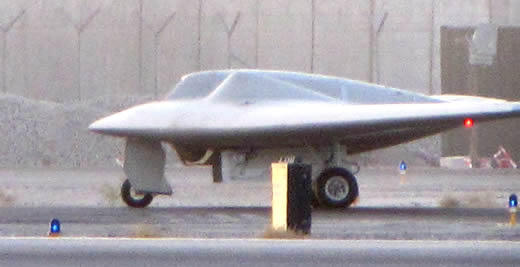
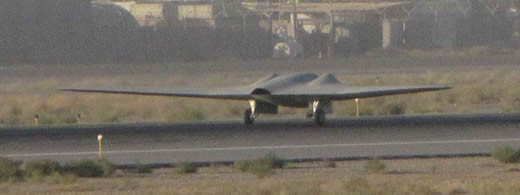
More recent photos showing the RQ-170 Sentinel at Kandahar airfield, Afghanistan. Although these images are sharper, they don't offer much more insight into the aircraft design, payload or mission.
Iran’s semi-official news agencies released today some details about a possible intercept and downing of a U.S. RQ-170 Sentinel jet-powered stealth unmanned aerial vehicle. Iran’s semi-official news agency Press TV quoted a senior official saying the Iran’s electronic warfare unit successfully targeted the Sentinel drone after it crossed into Iranian airspace over the Eastern border with Afghanistan. The Iranians claim they have seized the recce drone with minimum damage. The next day (December 6) the U.S. confirmed it was an RQ-170 was lost on operation in Western Afghanistan (Ares).
More recent photos showing the RQ-170 Sentinel at Kandahar airfield, Afghanistan. Although these images are sharper, they don't offer much more insight into the aircraft design, payload or mission.
The U.S. Air Force has been operating the Sentinel, built by Lockheed Martin, from the Afghan air base in Kandahar at least since 2009. The Iranian agency quoted the unnamed official saying Iran will not limit its response to such violations within its borders. According to the CNN, the stealth drone was operating on covert CIA missions when contact was lost. It wasn’t clear whether the drone was flying inside Iranian territory or flying over Afghanistan, toward the Iranian border when contact was lost.
According to Flight International DEW Line blog by Stephen Trimble, Iran has recently received a shipment of Russian 1L222 Avtobaza, a ground mobile electronic intelligence system, designed to spoof airborne fire control and ‘side looking’ radars (commonly referring to synthetic aperture radars); It is also capable of intercepting weapon datalink communications operating on similar wavebands. The new gear may have helped the Iranians employ active deception/jamming to intercept and ‘hijack’ the Sentinel’s control link.
A possible confirmation for the loss of the UAV came from across the border, as an official statement by the International Security Assistance Force (ISAF) stated “The UAV to which the Iranians are referring may be a US unarmed reconnaissance aircraft that had been flying a mission over western Afghanistan late last week. The operators of the UAV lost control of the aircraft and had been working to determine its status,” read the statement titled “ISAF Releases Statement on Missing Unmanned Aerial Vehicle”.
On December 8 Tehran came out open displaying footage of the captured drone which seems in pristine condition (below).
Having the mysterious drone in hand, the Iranians were likely extra careful inspecting it after Iranian officers were killed when inspecting a captured Israeli drone at a Hezbollah compound in South Lebanon. The drone, supposedly rigged with explosives exploded at the base causing significant damage and claiming the lives of several Lebanese and Iranian intelligence officers.
We are happy to introduce our readers to a new event sponsored by Defense Update highlighting Chemical, Biological, Radiological, Nuclear explosive (CBRNe) to be held in Bangkok, Thailand.
Event name: CBRNe Asia 2012
Event summary: CBRNe Asia is Asia’s first and largest CBRNe conference, exhibition and exercise. CBRNe Asia 2012 on 3-7 September in Bangkok, Thailand will bring together experts, end users, policymakers, industry and procurement staff and is being organised in full partnership with the Royal Thai Government.
The five-day event will include a two-day conference with high level speakers from the Thai government, ASEAN and the NATO WMD Centre, among others. A special focus session will examine the Fukushima case and simultaneous stream sessions will examine themes including detect and decon, medical CBRN countermeasures, CBRN forensics and improvised chemical devices. The event will be held in conjunction with the annual Thai National CBRN Exercise, which will focus on a number of chemical and radiological scenarios, and will be fully accessible to all conference delegates. During the exercise, equipment made available by exhibiting companies will be used by the Thai Civil and Military authorities.
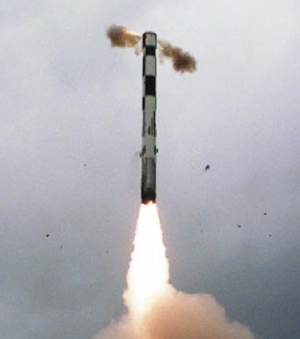
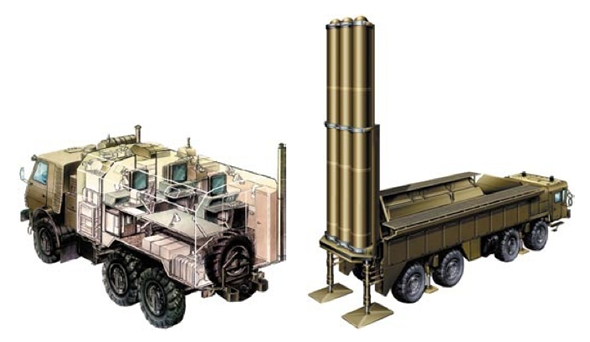
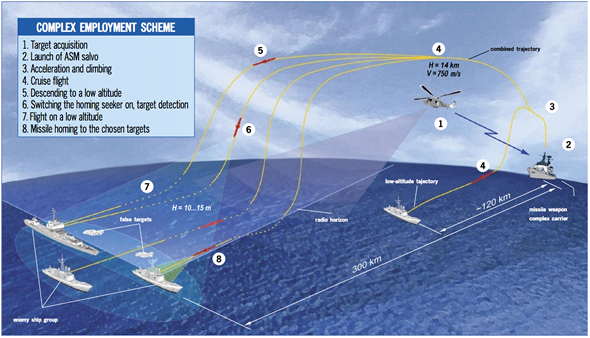
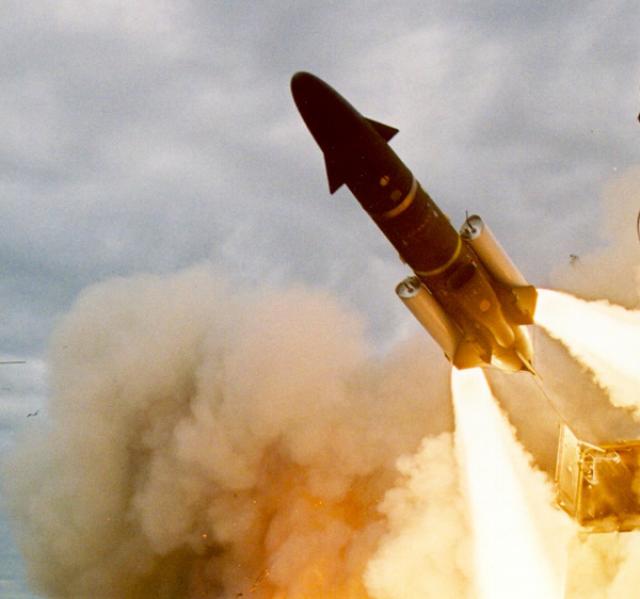
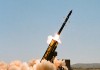
The Yakhont is launched vertically from its mobile carrier. Once airborne, the missile is pointed to the target's direction, opens its air scoop for the ramjet to kick in.
The Yakhont is launched vertically from its mobile carrier. Once airborne, the missile is pointed to the target's direction, opens its air scoop for the ramjet to kick in.
December 2, 2011: Russia has supplied two Bastion coastal missile systems to Syria, concluding a controversial $300 million arms deal inked with the Syrian government four years ago. Russian sources claim the new missile system will “enable Syria to protect its entire coast from a possible seaborne attack”, the delivery of these medium range shore-based anti-ship missile system is taking place as the Syrian regime is extremely unstable. If the Asad regime falls, these weapons could be transferred to his allies – Iranian backed Hezbollah, or fall into the hands of extremist islamic factions fighting the regime. The Bastion battery comprises 18 mobile launchers each carrying two 3M55E Yakhont supersonic cruise missiles capable of striking surface targets on land and at sea at a range of 300 km, with their devastating 200 kg warhead. With these parameters, such missiles could put at risk elements of the Six Fleet patrolling the eastern Mediterranean, as well as Israel navy vessels and Israeli offshore rigs.
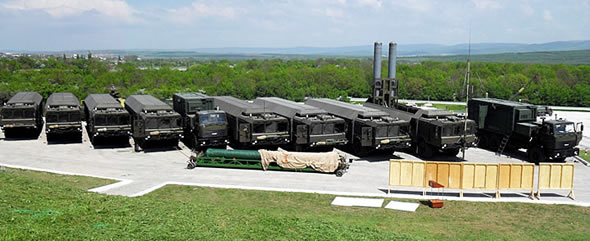
The bastion battery comprises eight twin-missile mobile launchers, command and control vehicles and logistics support trucks.
Part of the Bastion battery shown in a group picture in Russia.
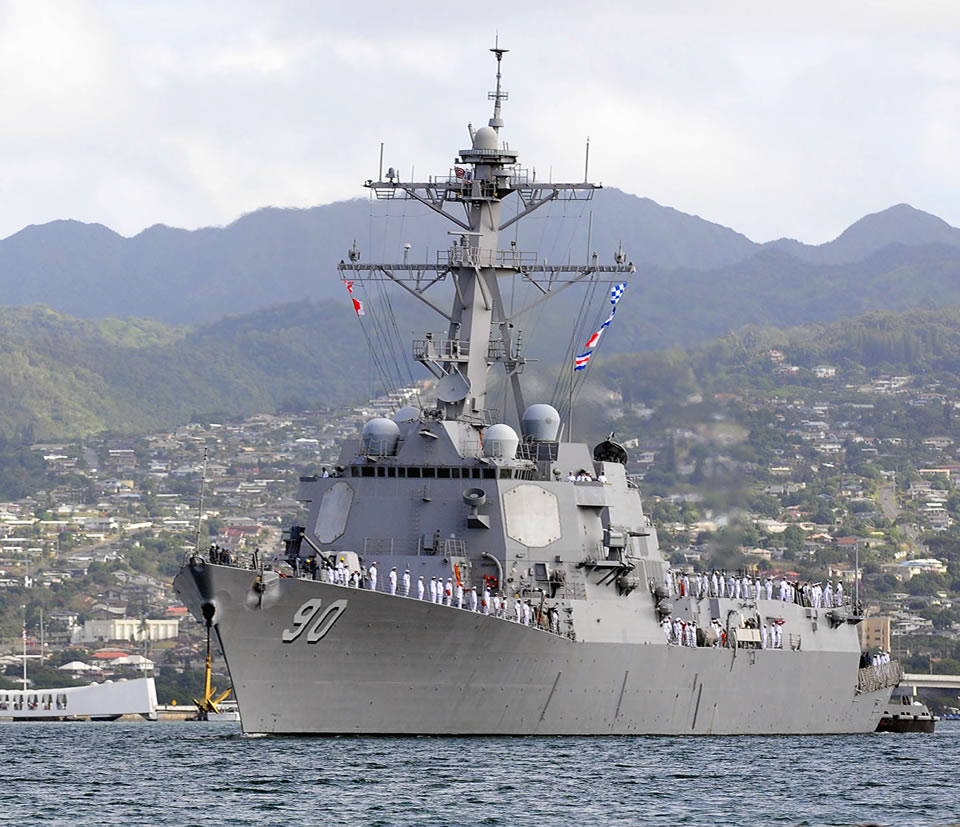
The guided-missile destroyer USS Chafee (DDG 90) departs Joint Base Pearl Harbor-Hickam on an independent deployment to the western Pacific region. Photo: U.S. Navy, Brett Morton
The guided-missile destroyer USS Chafee (DDG 90) departs Joint Base Pearl Harbor-Hickam on an independent deployment to the western Pacific region. Photo: U.S. Navy, Brett Morton
For many years the United States has enjoyed a comfortable position of economic strength and superior military competency throughout the Asia-Pacific region. Since the end of World War Two, no nation in the vast Pacific has posed a realistic challenge to the power projection capability of the American military forces or the monopoly of American economic influence.
If the history of human experience has taught us anything, it is that nothing remains the same. With change comes challenges and the challenges facing all the players in the Asia-Pacific region are complicated, sensitive, and immediate.
Europe has become a drain on the limited resources of its allies and trading partners. The United States can no longer afford to continue manning expensive military outposts in a Europe that is militarily stabilized when more pressing threats and more lucrative opportunities are screaming for attention. Considering the economic opportunities awaiting the United States in the Asia-Pacific region and the region’s political dynamics, President Obama has demonstrated an astute understanding that the United States must expand its presence to reaffirm America’s position as the most influential power in the area.
The economic morass the Europeans find themselves in today is just one of many compelling reasons for the United States to be looking elsewhere for markets and economic alliances that will feed the voracious appetite of the American economy. The Asia-Pacific nations have much more to offer than the quagmire of capitalistic failure now crippling Europe.
While China and the United States are mutually dependent on each other for continued economic growth, both nations have a multitude of reasons for adopting a policy of military expansion in the Pacific. The task at hand is to field a viable force structured to overcome the challenges that presently exist and to surmount the threats that are likely to appear in the near future.
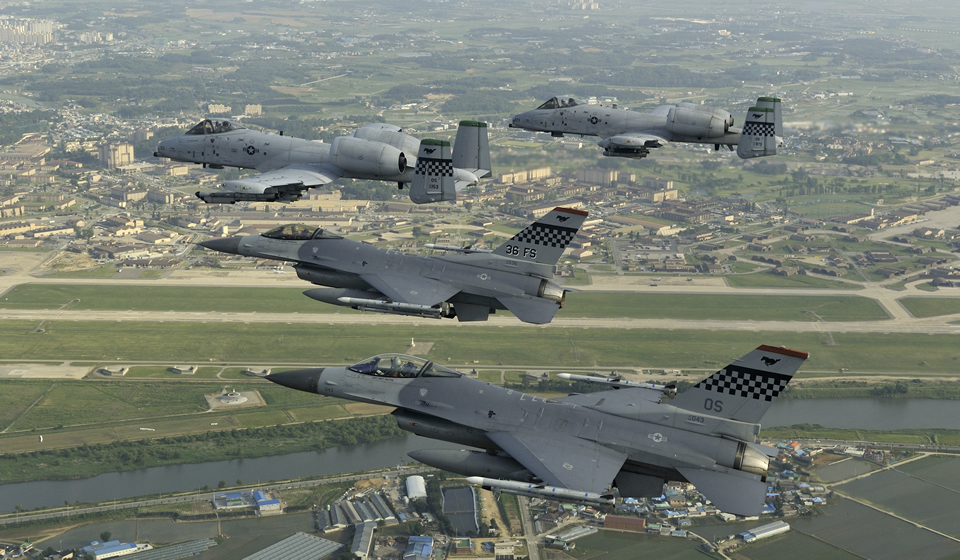
F-16 Falcons and A-10 Thunderbolt of the 51st Tactical Fighter Wing flying in formation over their home base, Osan in South Korea. U.S. Air Force photo/Lt. Col. Judd Fancher
China has embarked on a strategy aimed at securing a dominant and respected presence in the Asia-Pacific region while also achieving recognition as a leading power in international relations. China’s military build-up can be divided into two distinct parts. The first and most immediate focus is on the rapid development of weapon systems that exploit the greatest vulnerabilities of American and Allied forces now deployed in the Pacific – anti-ship ballistic missiles, cruise missiles, submarines, and stealth aircraft. The second phase is occupied with the gradual development of more ambitious weapon systems better suited to power projection worldwide – aircraft carriers, surface warfare ships, and long-range attack submarines.
In the Asia-Pacific region, Chinese military capability is improving at an intense rate and will soon reach a high degree of defensive and offensive potential. This inevitability places considerable stress on the American forces now stationed in the Pacific and all of America’s allies.
Deployed as they are now, United States forces are vulnerable to the enhanced generation of Chinese anti-ship and cruise missiles. American and Allied anti-missile defenses in the Pacific are not in a state of readiness likely to successfully counter the Chinese missile threat and are in immediate need of upgrade and reinforcement. American and Allied air and naval forces in the Pacific are also not adequately equipped to counter Chinese capabilities.
The Obama administration, recognizing the existing shortcomings in the present alignment of friendly forces in the Pacific, is laying the foundation for improving and reinforcing the military capability of US forces currently in the Pacific. Given the current budget crisis in the United States, a Pacific expansion and restructuring will have to be achieved within a restrictive plan of critical prioritization. The American and Australian agreement to establish a permanent US Marine installation in Australia is a sound beginning, but only a beginning.
American allies in the Pacific also are in need of military upgrades. For quite some years past, the United States has maintained a steady schedule of warfighting training exercises with Japan, the Philippines, Australia, Thailand, and other nations as a means of standardizing threat response and tactical familiarization. In recent months, the intensity of these exercises has escalated.
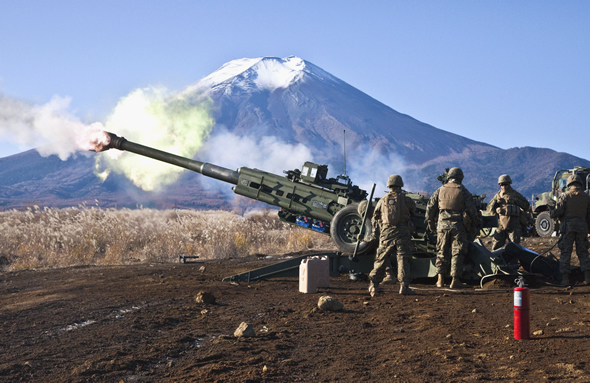
Smoke billows from a U.S. Marine Corps M777A2 155 mm howitzer after being fired at the North Fuji Maneuver Area, Camp Fuji, Japan. Photo: Lance Cpl. Chance M. Hiser
Japan, the Philippines, Taiwan, Australia, and other Pacific allies are actively seeking replacements for their aging air and naval assets and are anxious to strengthen their military ties with the US out of concern for the Chinese military expansion and increasingly aggressive behavior especially in the South China Sea. China naturally opposes the sale of F-16’s to Taiwan, the renewal of a stronger American/Australian military alliance, Japanese acquisition of American F-35’s, and all proposals to enhance South Korea’s military capability.
In time, the availability of money may become a critical consideration overshadowing any proposed expansion of American military capability in the Pacific. America’s Pacific allies are also experiencing economic distress and are in desperate need of American assistance and cooperation. Finding a viable solution to the Asia-Pacific situation, given the apprehension and uncertainty created by recent Chinese actions, will require an unprecedented level of sound judgment and commitment from the American administration.
The United States and her allies in the Asia-Pacific region are in need of an immediate response to the military challenge posed by China while continuing to maintain friendly relations with the Chinese on the economic front – a double-edged task that will require firm leadership, diplomacy, thoughtful strategy, perseverance, and considerable amounts of money. The manner in which all of this is accomplished may determine the real players on the future world stage.
U.S. Marine Corps Maj. (Ret) Richard D. Dudley has been serving with the Marine Corps in active duty for 26 years, rising from Private (E1) to retire as a Major (O4) with experience in numerous shipboard and shore-based deployments. During his service Maj. Dudley has specialized in logistics and support. For the past 15 years he is living in Japan serving as an independent sales consultant/local area manager with the Marine Corps Air Station in Japan.
December 4, 2011: Iran’s semi-official news agencies released today some details about a possible intercept and downing of a U.S. RQ-170 Sentinel jet-powered stealth unmanned aerial vehicle. Iran’s semi-official news agency Press TV quoted a senior official saying the Iran’s electronic warfare unit successfully targeted the Sentinel drone after it crossed into Iranian airspace over the Eastern border with Afghanistan. The Iranian agency quoted the unnamed official saying Iran will not limit its response to such violations within its borders. (Defense-Update)
December , 2011: Russia has supplied two Bastion coastal missile systems to Syria, concluding a controversial $300 million arms deal inked with the Syrian government four years ago. Russian sources claim the new missile system will “enable Syria to protect its entire coast from a possible seaborne attack”, the delivery of these medium range shore-based anti-ship missile system is taking place as the Syrian regime is extremely unstable. (Defense-Update)
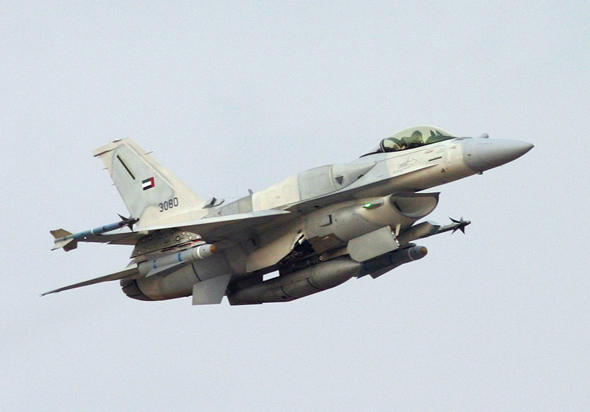
F-16E Block 60 of the UAE Air Force carrying Maverick missiles and Sniper targeting pod.
JDAMs to Arm the Emirate’s F-16s
November 30, 2011: The UAE plans to equip its advanced Block 60 F-16s with thousands of JDAM guided weapon kits for an estimated cost of $304 million. The pentagon considers these weapons to bring the UAE Air Force and Air defense Force to become one of the most capable air forces in the Middle East. The package includes up to 4,900 guidance kits, comprising 3,300 general purpose (BLU111) 500 lb. warheads associated 3,000 GBU-38 and 304 GBU-54 laser-JDAM guidance kits. In addition, the Emirate requests 1,600 GBU-31 2,000 lb. JDAM guided weapons, of which 1,000 will comprise BLU117 2,000 lb. general purpose warheads and 600 BLU-109 target penetrating warheads.
Iran Equips Navy with Highly Advanced Anti-Ship Cruise Missile
November 28, 2011: The Iranian Navy received the first shipment of the coastal defense variant of the Qader anti-ship missile. The ship-launched variant was delivered to equip Iranian Navy frigates back in September. Qader, a locally produced version of the Chinese C-802 is capable of attacking surface targets at sea and on land, at a maximum range of about 200km. the Islamic Republic has excelled in naval capabilities and is able to wage unique asymmetric warfare against larger naval forces. According to the report, Iran’s Navy has been transformed into a highly motivated, well-equipped, and well-financed force and is effectively in control of the world’s oil lifeline, the Strait of Hormuz.
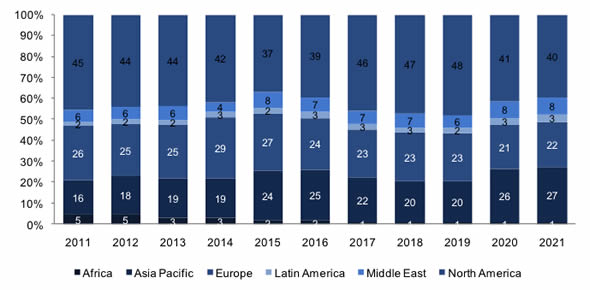
Despite massive cuts in defense procurement North America is expected to account for the largest share of the global military aircraft market sharing 42.9% of the total global expenditure on military aircraft during the next 10 decade. Two programs dominate this procurement – the development and production of 2,456 F-35 multi-role fighter aircraft as part of the Joint Strike Fighter program and continued procurement of 452 V-22 Osprey tilt-rotor transport aircraft. Despite significant austerity measures, Europe and most notably Asia, are expected to account for a significant portion of the total military aircraft, with shares of 24.1% and 21.8% respectively.
Aircraft fleet modernization will be the main driver for military aircraft procurement during the forecast period. After ten years of intensive operations in Afghanistan and Iraq the US and allied countries in Europe will have to replace their aircraft which have been in continuous use over the past decade. Countries in Asia-Pacific, Latin America and the Middle East also need to modernize and replace their aircraft further driving the market forward.
The global environment is characterized by ongoing tensions and conflicts among various countries around the world which is supporting demand for military aircraft. Historically, countries follow a policy of enhancing their military as a deterrent to hostile nations and consequently the military aircraft market is recording strong growth despite the commercial aircraft industry exhibiting a downward trend.
The modernization of fighter aircraft also drive the demand for advanced trainer aircraft. In meeting this growing needs, manufacturers are developing trainer aircraft that are more flexible in adapting to perform a number of training roles.
Investment in Intelligence, reconnaissance and surveillance (ISR) is also growing, driven by countries involved in border disputes with neighbors, as well as those investing in maintaining high alertness and deterrence.
Multi-role aircraft category is expected to account for the highest proportion of spending in the global military aircraft market due to its suitability to perform multiple missions, therefore better adapting to offer savings mandated by budget cuts. Multi-mission aircraft and helicopters are commonly applied to various missions including attack, reconnaissance, rescue operations and transport.
To increase the capabilities of modern military aircraft, the global defense industry is investing significantly in R&D which has led to the development of technologies to enhance the speed, power, stealth capabilities, destructive force and takeoff and landing capabilities of the various types of military aircraft.
The global economic slowdown has reduced the defense budgets of most leading spenders in the world, including the US, France, Germany and the UK. Cuts to military expenditure have led to the cancellation and indefinite delays of various military aircraft programs, and are having a detrimental impact on the growth of the industry.
The global economic slowdown has also reduced military expenditure worldwide, driving more countries to share the R&D, and procurement costs through the establishment of joint projects. Partnerships between defense firms have also increased with more countries seeking to develop indigenous capabilities in platform manufacturing but lack the R&D capability to achieve these goals by themselves. Establishing strategic alliances and technology-transfer agreements with global military aircraft manufacturers enable them to achieve their goals.
About ICD Research
ICD Research is a full-service global market research agency and premium business information brand specializing in industry analysis in a wide set of B2B and B2C markets. ICD Research has access to over 400 in-house analysts and journalists and a global media presence in over 30 professional markets enabling us to conduct unique and insightful research via our trusted business communities. Through its unique B2B and B2C research panels and access to key industry bodies, ICD Research delivers insightful and actionable analysis. The ICD Research survey capabilities grant readers access to the opinions and strategies of key business decision makers, industry experts and competitors as well as examining their actions surrounding business priorities.
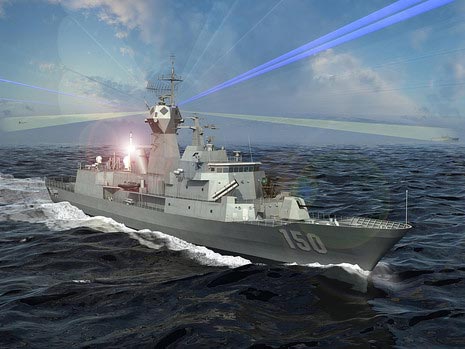
The Australian Government has approved an upgrade of all ANZAC class frigates to the full anti-ship missile defense standard. System upgrade of seven ANZAC frigates will be performed by the Saab Group in cooperation with the Australian Defence Materiel Organisation and BAE Systems. The upgrade includes the integration enhanced 9LV combat management system, phased array radar and missile director, infrared sensors and an advanced navigation radar system.
Saab have teamed with BAE Systems and CEA Technologies to create the variant of the 9LV combat management system (CMS) introduced with HMAS Perth frigate earlier this year. The upgrade features an extensively redesigned operations room providing improved situational awareness and weapon systems coordination. The operations room has been reorganised to enhance the capability of the ship’s command team. Newly-designed consoles come with 30 inch wide screen displays and 42 inch large screen displays show operational command information across the room. The CMS integrates the entire combat system through a dual redundant Gigabit optical fibre LAN.
Through the year Perth has been performing systems trials including the radar, missile and combat system. According to Australian Chief of Navy, Vice Admiral Ray Griggs, the tests proved that the new system can defend the ship from modern cruise missile attack.
Night Attack The Royal Danish Air Force has validated the use of Night Vision Cueing and Display/ Aviator’s Night Vision Imaging System (NVCD/ ANVIS) on its F-16s, offering a night vision enhancement for the daylight functionality provided by standard Joint Helmet Mounted Cueing System (JHMCS). The system was flown for more than 300 hours as part of Operation Unified Protector during the summer of 2011.
The JHMCS developed by Vision Systems International (VSI) provides the pilot with “first look, first shot” high off-boresight weapons engagement capabilities. The system enables the pilot to accurately cue onboard weapons and sensors against enemy aircraft and ground targets without the need to aggressively turn the aircraft or place the target in the Heads-Up Display (HUD) field-of-view for designation. Critical information and symbology, such as targeting cues and aircraft performance parameters, are displayed directly on the pilot’s visor. The main drawback of JHMCS was that it is limited for use in daylight.
The NVCD/ ANVIS system is based on standard ANVIS-F4949 NVGs, modified with a VSI kit, providing the pilot with full JHMCS symbols and cueing capability during night operations with NVGs. The flights conducted were in an RDAF F-16 MLU M5 configuration with no modifications required to the aircraft. According to the RDAF, the tactical information and situational awareness that the system provided was outstanding and provided an efficient merge of Night Vision Goggle (NVG) and Joint Helmet Mounted Cueing System (JHMCS) information.
Terma is launching an upgrade for the AN/ALQ-213 Electronic Countermeasure system, offering a modern version of the Countermeasures Management System Processor otherwise known as the Electronic Warfare Management System (EWMS). The enhanced processor will support new capabilities including Radio Frequency sensor integration, sensor fusion, geo-location capabilities, networking, and situational awareness improvements.
The new module is part of the Reliability, Maintainability and Performance (RMP) upgrade solution to become available in 2013. The new module will significantly increase processing power and memory capacity yet retain physical form-fit compatibility with current installations. The modernized system will be fully compatible with F-16 and U.S. Army rotorcraft environmental requirements, additional interfaces to include a third Mil-std-1553 interface and Gigabit Ethernet, high reliability and Anti-tamper provisions.
The ALQ-213 Electronic Warfare Management System is operational on more than 2.000 fighters, transporters, and helicopters worldwide including more than 1.000 US Air Force F-16s and A-10s.
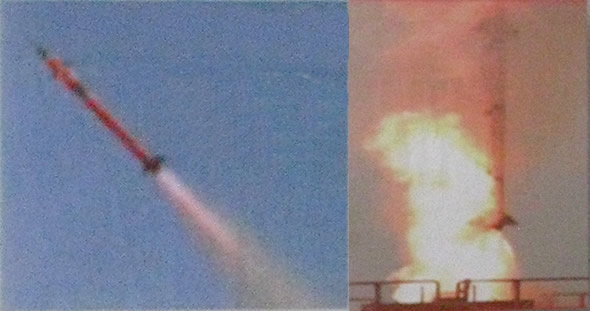
Two images taken during the Barak 8 test firing show a flight testing of the propulsion system (left) and vertical launch system (right). Both versions were the basic barak 8 missile (without booster). Photos: Tamir Eshel, Defense Update
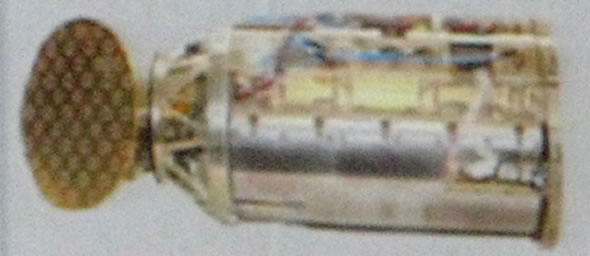
The first Barak 8 missile test took place in israel in May 2010 however, the first images were released unofficially only today. According to Indian DRDO officials, the next test phase is planned to be conducted in Israel in January of February 2012. The missile was developed by Rafael Advanced Defense Systems in Israel with the booster for the extended range version provided by India. The missile is equipped with an advanced RF seeker (seen below) and is designed for fully autonomous operation in addition to ‘fire and update’ modes, enabling maximum use of available assets in complex, multi-target scenarios.
Two images taken during the Barak 8 test firing show a flight testing of the propulsion system (left) and vertical launch system (right). Both versions were the basic barak 8 missile (without booster). Photos: Tamir Eshel, Defense UpdateBarak 8 advanced RF Seeker, developed by IAI MBT division.
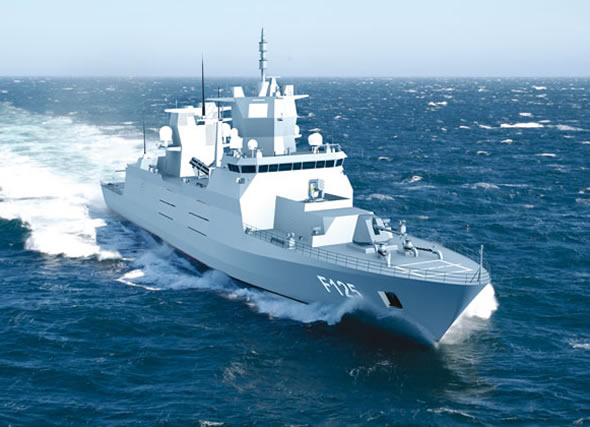
The first of four F125 class frigates is scheduled for delivery by 2016. Photo: TKMS
RBS15 Mk3 is the main surface offensive weapon carried on the new K130 missile corvette.
One of the largest fleets in NATO, the German Navy appears to have escaped most of the recent cuts imposed by the government’s austerity plan, since construction of the new vessels and upgrades for existing platforms seems to continue. However, the planned reduction of 60 percent in its defense budget could have negative effect in the future, if the government decides to press on with the cuts. To continue operating under these restricted budgetary constraints the Navy may have to reduce its mission sets, whilst assuming a reduced ‘asymmetric’ role focused on counter-piracy, peacemaking and peacekeeping operations, rather than full scale, high intensity operations.
In addition to taking part in current NATO activities the German Navy deploys routinely at the Baltic Sea and is taking part in many international operations, including peacekeeping operations, security and counter piracy activities, as far as Africa and the Indian Ocean. In total, there are about 90 commissioned warships in the German Navy including 43 auxiliary ships; the total displacement of the navy is 220,000 tons. In addition to this, the German Navy and the Royal Danish Navy are in cooperation in the “Ark Project”. This agreement made the Ark Project responsible for the strategic sealift of German armed forces where the full-time charter of three roll-on-roll-off cargo and troop ships are ready for deployments. In addition, these ships are also kept available for the use of the other European NATO countries. The three vessels have a combined displacement of 60,000 tons. Including these ships, the total ships’ displacement available to the Deutsche Marine is 280,000 tons.
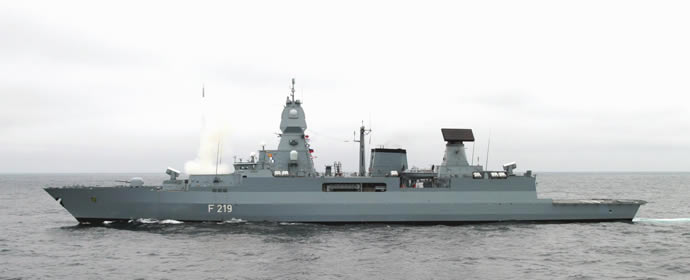
F219 Sachsen, the lead F124 class frigate german navy fires an ESSM air defense missile.
The German Navy operates two flotillas, the surface fleet which includes 15 frigates of three types and Type 212 subs, with a squadron of ten fast missile boats operating in the Baltic sea. In recent years the German Navy went through major modernization, with the fielding of the F-124 class frigates, K130 corvettes and Type 212 submarines, all locally built by the Blohm & Voss, Lürssen, ThyssenKrupp Marine Systems (TKMS) and Howaldtswerke Deutschland Werct (HDW) shipyards.
The seeming stability does not reflect years of decline in new orders, which almost brought the HDW submarine builder to a standstill and drove TKMS to sell most of its naval and commercial surface shipbuilding assets to the UAE in 2009. The company agreed to establish a “close strategic partnership” and Memorandum of Understanding with the Abu Dhabi MAR (ADM) group in the United Arab Emirates. The proposed sale followed related purchases in Germany by Abu Dhabi MAR, and other recent shipyard sales by TKMS. The net effect was a restructuring of Germany’s naval shipbuilding industry.
The envisioned agreement involved a 50/50 joint venture to build naval surface ships, with TKMS retaining a lead role and know-how in all projects with the German Navy and NATO partners, while ADM was responsible for the Middle East and North Africa. At the same time, however, Abu Dhabi MAR would acquiring 80% of TKMS’ key surface ship firms: Blohm and Voss Shipyards, Blohm and Voss Repair, and Blohm and Voss Industries. That deal has largely fallen through in 2011, leaving TKMS naval assets “in play” again.
Today, the German Navy maintains two operates 15 frigates of three types – the Bremen (8), Brandenburg (4) and Sachsen class (3), which is also the newest (F124 class) air defense frigates. In November 2011 Germany laid the keel of the first of four F125 next generation frigates ‘stealth design’, likely to be one of the world’s largest class of frigates with a displacement in excess of 7,200 tonnes, expected to enter service in 2016 in time to replace the first Bremen class frigates. Although the crew is to be reduced to 120 sailors, instead of the planned 235 crew, the vessels will operate with the “two crew concept”, as the vessel is capable of long endurance at sea. Completion of the F125 fleet is anticipated by December 2018.
The German frigates carry MBDA MM-38 Exocet anti-ship missiles, Raytheon RIM-162 Evolved Sea-Sparrow Missiles developed under a multinational NATO cooperation and RIM-116 Rolling Airframe Missiles built under a German-U.S. cooperation also led by Raytheon with Diehl BGT Defence as its German partner. The vessels are also equipped with advanced radars, sophisticated combat information systems built by EADS and combined ESM/ECM supplied by the UK.
New Shipbuilding Programs
There are three ongoing naval construction programs: Type 212 submarines (two of a total six boats on order are yet to be delivered), four F125 frigates, the keel of the first one was laid this month, and three K130 corvettes yet to be delivered.
The first of four F125 class frigates is scheduled for delivery by 2016. Photo: TKMS
While all shipbuilding programs are exclusive to Germany, the weapon systems, parts of the radar and other electronics subsystems are being developed as part of international cooperations, to reduce development cost.
The F125 program will deliver four ships between 2014 and 2018. The program focuses on long endurance vessel optimized for asymmetric warfare and peacetime operation far from its home port. As such, the 5,500 ton vessel will have a crew of up to 120 personnel, about half of the crew that were required to operate previous generation frigates. The vessel will also be able to support special forces teams of 50 personnel.
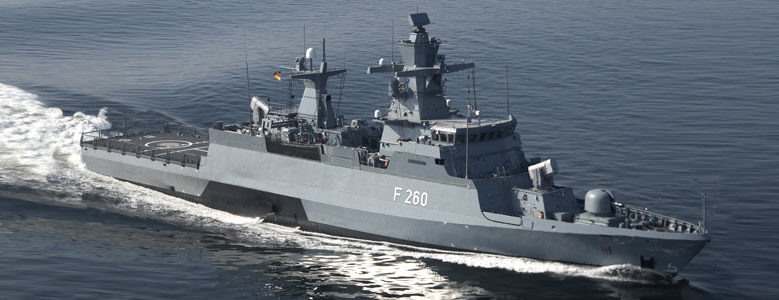
The navy is in the process of inducting the first two of five new Braunschweig Class K130 corvettes, based on the MEKO A design, with three more under construction. These corvettes are supplementing the squadron of fast missile boats and will better support typical operations assumed by the German Navy, including anti-piracy support. K130 is also designed for a lean crew, operated by a complement of 65. These corvettes represent a mix of systems and technologies from different European and Scandinavian makers – the radar is made by EADS in Germany, as well as the ESM and countermeasure systems. The command, control, communications and optronic fire control systems comes from Thales Netherlands; the 76/62mm gun is an Italian system from Oto-Melara while the main weapon system is the Swedish RBS15 Mk3. The later is a surface launched fire-and-forget long range anti-ship and land attack missile, developed by the Saab Group. To gain economy of scale and share the program’s life cycle cost, Germany, Poland and Sweden have decided to collaborate and equip their new vessels with the new missile. Marketed jointly by Diehl and Saab, RBS-15 Mk3 is being offered as a future armament of its frigates and potential replacement of earlier Exocet and Harpoon missiles.
The german Navy will operate five K130 Braunschweig class corvettes. The vessel in the photo is the fourth ship, F263 Oldenburg. Photo: TKMS.
A squadron of ten Gepard class Fast Missile Boats, equipped with MM38 Exocet anti-ship missiles is also operational, but the number of boats has being reduced gradually. Under the 2010 announced budget cuts, the Navy will retire its Gepard class fast missile boats. The first vessels, Nerz and Dachs will be retired by March 2012. Other Type 143A boats retained as operational performed training in the Baltic Sea in November 2011.
Modernizing the Submarine Force
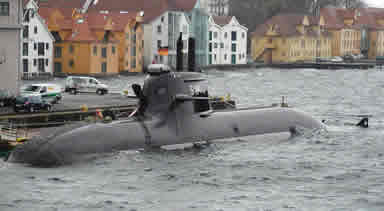
U-212 class submarine U-34 (S-184) at Bremen, 2007
Until recently the German Navy operated a flotilla of ten submarines, based at Eckernförde. Up to 2010 the German submarine fleet consisted of modernized Type 206A diesel-electric submarines, which were originally commissioned between 1973 and 1975, and upgraded since 1992, and four new hybrid diesel-electric/fuel cell air independent propulsion (AIP) Type 212A submarines, which were commissioned between 2004 and 2006. In 2010 the remaining Type 206A subs were retired from active service as part of the Bundeswehr budget cuts. Current plans foresee a total of six Type 212A boats, with the final two vessels projected to become operational by 2012 and 2013 respectively. The original plan was to construct a total of eight Type 212 vessels, but in January 2004 the German Defense Ministry announced that no more submarines would be ordered until 2016.
Germany possesses a manufacturing capability at HDW for a diesel-electric special export-only submarine, the type 800 Dolphin class and has exported numerous variants of these, Turkey and Israel being amongst its customers. This is perceived as a very capable conventional submarine, with various shipyards offering upgrades.
The German Navy’s main roles, in conjunction with other NATO navies or as part of a UN force, are conflict prevention, crisis management, peacekeeping and counter-terrorism operations. As a result of the 212A submarine’s stealth capabilities, it is also able to carry out effective covert intelligence and reconnaissance missions. German submarines were deployed as part of peacekeeping operations in the Adriatic Sea during the mid-1990s, and as part of NATO operation “Active Endeavour” and support to the US-led conflict in Afghanistan “Enduring Freedom”.
In support of new operational priorities, there are future plans to equip the 212A with a land-attack capability. The Interactive Defense and Attack System for Submarines (IDAS), currently under development by Diehl BGT Defence, HDW and Kongsberg of Norway, uses a wire-guided missile to engage helicopters and mobile targets on shore. The third Type 212 submarine, U33 was selected as the platform for testing the new weapon. The missile made the first flight in June 2008, successfully launched from the torpedo tubes of the submerged submarine.
Mine Countermeasures Fleet
The German Navy operates five Type 352 minesweepers equipped with hull mounted DSQS-11 mine detection sonar and the ‘Troika Plus’ system, comprising a manned mothership and unmanned Seahound (seal) vessels being the lead element. Some of the older Type 333 (converted fast gun boats) are currently being retired.
With 41+ years experience in defense electronics (radar, electronic warfare, C3I and CIS and mission systems) and associated activities, Peter Hartley offers a wide range of skills and capabilities in the field of Systems including System Architecture, Bid Management, Bid Reviews at national/international levels, Business Development (and Business Creation), Customer Liaison, Contract Negotiation, Marketing Support, Engineering Management, Design Authority, Team Building, and Research.
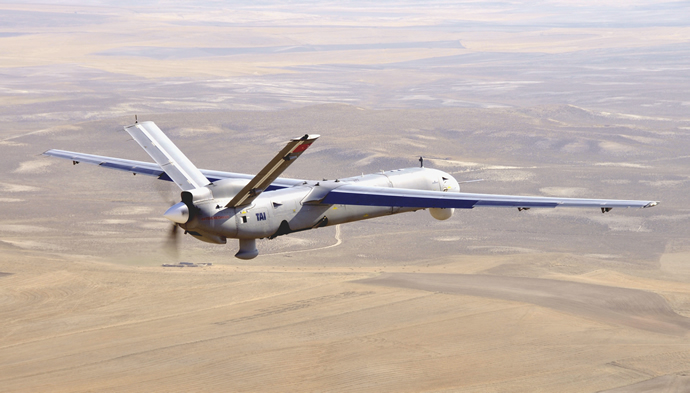
The Turkish ANKA Medium Altitude Long Endurance (MALE) drone is one of two candidates proposed for the UAE unmanned aerial systems program. Photo: TAI
The ANKA (MALE UAS) is one of two candidates for the UAE unmanned aerial systems program. Photo: TAI
Unmanned Aerial Systems (UAS) have proven their worth by successful, continued operations in the War Against Terror for more than a decade, raising the bar, after the elimination of arch-terrorist Osama Ben Laden by United States Forces in Pakistan.
As more countries seek to induct UASs with their defense forces, some of those who wish to develop their technological and industrial capabilities deliver Intelligence, Surveillance and Target Acquisition and Reconnaissance (ISR/ISTAR) platforms, establishing local manufacturing of UASs. The UAE is one of the most prominent of these countries. At the Dubai International Air Chiefs’ Conference on 12 November, Deputy Air Force Chief, Maj Gen Ibrahim Naser al-Alawi, announced that the United Arab Emirates (UAE) would be acquiring an unarmed unmanned air system for intelligence gathering and that the UAE soon intends to expand its surveillance technology and capabilities by using UASs. He continued that the UAE will be operating an air operations centre in 2013 and will establish a terminal high-altitude area defense missile system shortly afterwards.
The two companies who intend to compete on the ensuing UAE’s UAS programme are UAE based, International Golden Group (IGG) and Turkish based, Turkish Aerospace Industries (TAI). International Golden Group distributes security and marine defense products and systems, which includes systems engineering, sensors, robotics and observation solutions. IGG is a well-known private joint stock company based in Abu Dhabi, UAE.
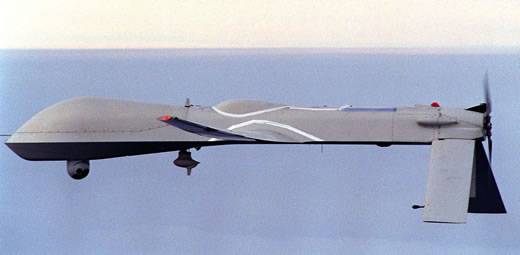
General Atomics is introducing an export version of the RQ-1, designated XP. The new UAS is currently offered to the government of the UAE. Photo: GA-ASI.Predator
On February 24, 2011, the 5th day of IDEX defense show, IGG announced that twenty-six percent (26%) of the total shareholdings of IGG had been purchased by Tawazun Holdings, the investment arm of the UAE Bureau of Offsets Program under a year 2010 agreement. The CEO of the Offsets Bureau and Tawazun Holdings is H.E. Saif Mohamed al Hajeri. Tawazun operates within the scope of various commercial mandates that contribute to the industrialization of the UAE. Consequently, Mr. Fadil Al Kaabi, the CEO of IGG recently said that his company would be advancing to manufacturing capabilities of certain products.
On February 23, 2011, General Atomics Aeronautical Systems, Inc. (GA-ASI) announced that it had signed an MOU with the International Golden Group (IGG) to sell a new version of its premier UAS, the Predator known as the the XP model to the UAE government. The GA-ISA Predator XP is set for production for the Predator XP in 18 months. Although the Predator has been in service as an unarmed platform during the Balkan war since 1995, its weaponization in 2001 was significant. The RQ-1 Predator drone (later designated MQ-1 for its weapon carrying role) became the primary UAS used for offensive combat operations by the US Air Force and the CIA in Afghanistan and Pakistan for use against insurgents, logging over a million flight hours. Despite its high profile, however, the Predator was not widely exportable due to U.S. export regulations. On March 3, 2011, the GA-ASI ceased production of the Predator A (RQ-1) since nowadays GA-ASI produces only the larger MQ-9 Reaper (Predator B) and other UASs for the US Air Force and few NATO customers.
While the Predator XP is still being developed, it has been reported that it will offer comparable Intelligence, Surveillance and Reconnaissance (ISR) capabilities as the RQ-1 version. It is assumed that the Predator XP exhibits the same physical dimensions. The Predator XP may be integrated with multiple exportable sensors, including Electro-Optical Infrared (EO/IR) multi-sensor payload and the Lynx Multi Mode Synthetic Aperture Radar (SAR) also produced by GA-ASI.
[box type=”info” style=”rounded” border=”full”]
MTCR Guidelines Regarding Category II Weapons section 5 (a) and (b)
“Where the transfer could contribute to a delivery system for weapons of mass destruction, the Government will authorize transfers of items in the Annex only on receipt of appropriate assurances from the government of the recipient state that:
The items will be used only for the purpose stated and that such use will not be modified nor the items modified or replicated without the prior consent of the Government;
Neither the items nor replicas nor derivatives thereof will be re-transferred without the consent of the Government.”
[/box]
This specific model of the Predator, the XP, has recently been licensed by the U.S. Government for export, under the Missile Technology Control Regime (MTCR) Category II in order to be proposed for sale to a broader customer base worldwide, especially countries in the Middle East and North Africa. The Predator combat design has been modified to remove the hard points used by the USAF to carry weapons such as air-to-surface missiles and restricted to maintain a gross takeoff weight below 500kg (1,100lb),operating at a distance of 160nm (300km). Production is set to begin by the year 2013.
“We’re trying to market that version to the UAE, Saudi Arabia and a few other countries” Mr Frank Pace, CEO of GA-ASI, noted. “GA-ASI’s establishment of a working relationship with IGG represents a strategic commitment by both companies to help the UAE strengthen its national security and protect critical infrastructure”, said J. Neal Blue, chairman of GA. While the details of the MOU have not been disclosed, perhaps under the new export classification, know-how for the manufacture and production of the Predator XP could be transferred, at least in part, from GA-ASI (USA) to IGG (UAE) as part of an offset arrangement. GA-ASI is not the only company eyeing this lucrative market. TAI of Turkey is promoting the Anka UAS to fulfill the UAE requirement. While Anka is currently undergoing flight testing, this MALE drone is also expected to be available and operational by the year 2013.
Unlike the Category II Predator XP, the baseline performance of Anka is designed as a heavier platform (1.6 ton maximum takeoff weight) carrying 200 kg (440 lb) of useful payload on 24 hour missions. The Turkish Air Force is expected to be the lead customer for the drone, fielding the Anka in 2012. The question remains if the new UASs will be game changers, which will push the leading UAS manufacturers to offer innovative design solutions to meet new operational objectives within these MTCR guidelines.
About the author: Lori Solberg (MBA, Adv.)
Former deputy general counsel of Rafael Advanced Defense Systems (international), Lori Solberg provides customized general and business advice to advanced technology and defense companies. She specializes in business market expansion in the defense and HLS fields worldwide as well as representation before international export control authorities.
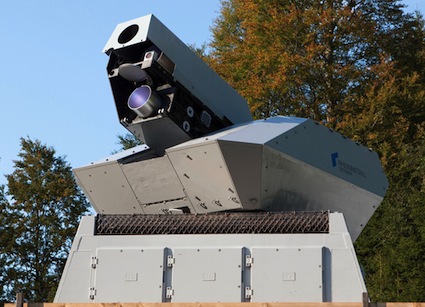
The laser beam hitting the unmanned target.Photo: Rheinmetall Defense
Rheinmetall laser weapon
Rheinmetall Defense has successfully combined a powerful laser weapon with an advanced air defense system. The demonstrator systems were tested at the Ochsenboden proving ground in Switzerland where they destroyed an aerial target and engaged and defeated other targets representing other threats.
Two weapon systems participated in these tests. One device employed two 5-kilowatt laser modules integrated into a 10 kW laser based air defense system, using an Oerlikon Skyguard 3 fire control unit and a Skyshield gun turret. The second device, integrating a 1-kW laser weapon module, was mounted on a TM 170-type vehicle. The two weapon demonstrators were used in different scenarios protecting against asymmetric, terrorist-type threats; countering incoming rockets, artillery and mortar rounds; and defending against an aircraft target.
By doubling the laser output from the 5-kW of the 2010 design to the 10 kW device tested this year Rheinmetall demonstrated improved performance and reduced time to engage a target by half in the artillery, mortar and rocket scenario. In the anti-aircraft scenario the 10 kW laser successfully detected, tracked, engaged and destroyed a UAV in flight. Rheinmetall claims its modular, scalable design of the lasers is already capable to meet a variety of military weapon requirements. The company plans to have a 100-kW laser weapon available in three to five years.
Engaging a floating target, the 1-kW laser weapon demonstrator sank a moving rubber raft (substituting as a speedboat) and was also effective in destroying improvised explosive devices and in neutralizing unexploded ordnance.
The laser beam hitting the unmanned target. Photo: Rheinmetall Defense
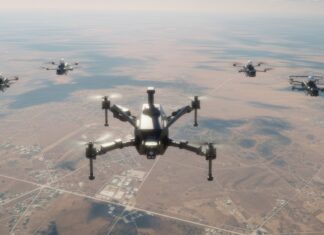
Lockheed Martin Skunk Works® and XTEND have achieved a major milestone in JADC2 by integrating the XOS operating system with the MDCX™ autonomy platform. This technical breakthrough enables a single operator to simultaneously command multiple drone classes, eliminating the friction of mission handoffs. From "marsupial" drone deployments to operating in GPS-denied environments, explore how this collaboration is abbreviating the data-to-decision timeline and redefining autonomous mission execution.
As traditional defense primes face mounting competition from agile “neoprimes” such as Anduril, Palantir and Helsing, the balance of innovation is shifting toward software-defined warfare and scalable, dual-use technologies, while global industry consolidation—marked by Boeing’s integration of Spirit AeroSystems and other strategic mergers—signals an intensified race to secure control over the defense technology value chain. Our Defense-Tech weekly report highlights these trends.
In early October 2025, a coordinated wave of unmanned aerial system (UAS) incursions—widely attributed to Russia—targeted critical infrastructure across at least ten European nations. The unprecedented campaign exposed the fragility of Europe’s air defenses...
Executive Summary
The past week (September 18-25, 2025) represents an inflection point where strategic defense concepts have transitioned from doctrine to tangible reality. An analysis of global events reveals four primary, interconnected trends shaping an...
At the 2025 Air, Space & Cyber Conference, U.S. Air Force and Space Force leaders unveiled major updates on next-generation fighters, bombers, unmanned systems, and space initiatives, highlighting both rapid innovation and critical readiness challenges as the services race to outpace global competitors. A short version is available here, with a more detailed version for subscribers.
The Taipei Aerospace & Defense Technology Exhibition (TADTE) 2025 crystallized around four dominant strategic themes that collectively illustrate Taiwan's comprehensive approach to defense modernization amid escalating regional tensions. Based on a detailed report by Pleronix (available upon request). Includes a Podcast discussion on TADTE 2025's highlighting Taiwan's four strategic themes beyond the post's coverage.
Israel’s Iron Beam 450 high-power laser system has completed final testing, marking a major leap in air defense. Developed by Rafael, it offers precise, cost-effective interception of rockets, UAVs, and mortars, and is set for IDF deployment by 2025.