Monday, December 22, 2025
More
    Home Blog Page 396

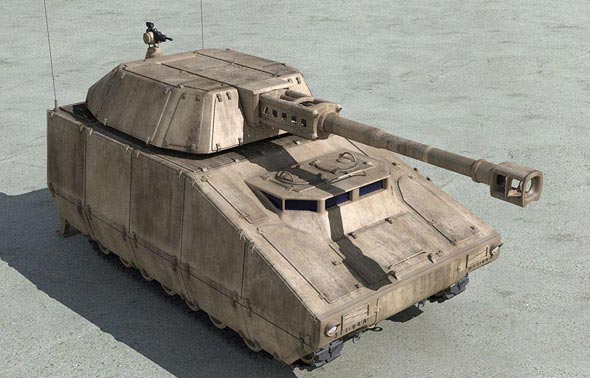
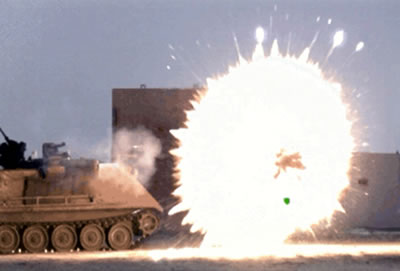
    Future Combat Systems – SP Mortar NLOS – Non Line Of Sight

    BAE System’s United Defense, as a member of the integrated design team for the manned ground vehicle portion of the FCS program is developing the Non-Line-of-Sight-Cannon, and the Non-Line-of-Sight-Mortar designs.

    The mortar system and mortar platoon are designed to be highly flexible and agile in establishing sensor-shooter linkages supporting 24/7 availability of support fire, in all weather and terrain conditions at extended ranges. The Non-Line-of-Sight Mortar (NLOS-M) will provide fires in close support of tactical maneuvers that include destructive fires and special purpose fires. The system will be capable of firing Precision Guided Mortar Munitions, to destroy high payoff and most dangerous targets, and provide area suppression in support of Modular Force companies and platoons. The system will employ improved handling, loading and firing systems to accelerate the rate of fire. The mortar platoon will retain a dismounted 81mm mortar capability for complex terrain.

    The system will support the Modular Force Combined Arms Battalions (CABs) maneuver units. The platoon will be capable of responding to fire requests on-demand to engage complex and simultaneous target sets. The systems will employ a network centric communications system to share intelligence and targeting information and fire control procedures to enable each system to pursue semi- to fully autonomous computation of technical fire direction, automatic gun lay, preparation of the ammunition for firing and mortar round firing.

    Much of the advanced technology being developed for the NLOS Cannon is being incorporated into the design and development of other vehicles in the MGV family, such as the NLOS Mortar. The NLOS Mortar is being designed by BAE Systems to have an estimated 80 percent commonality with the NLOS Cannon chassis and mission equipment to reduce maintenance and logistics. A NLOS Mortar Firing Platform is expected to be delivered for testing and qualification in spring 2007. The Army plans for FCS first unit equipped in 2008 and initial operational capability in 2010.


    New Programs Highlight Land Systems Simulator Fielding

    August, 2006: New simulator programs recently announced by several programs mark the continued deployment of simulation systems with land forces worldwide. New programs are fielded with the German and Swiss Armies, Thai land forces and Australian Armored Corps.

    The Australian Army Armor School Deploy New M-1A1 Simulators

    is operating new training facilities at Hopkins Barracks in Puckapunyal and in Darwin, base of the First Armored regiment, where M-1A1 tank crews will develop driving and gunnery skills. The new facility is part of the logistical package supporting 59 M-1A1 tanks procured from the USA back in 2004. The Australian Army procured the tanks as “Abrams Integrated Management” (AIM) versions, to replace its Leopard 1.


    The contract called for delivery of two relocatable Advanced Gunnery Training Systems (AGTS), four fixed-site AGTS and one Tank Driver Trainer (TDT). Utilizing virtual environment, AGTS provides trainees basic skills they need before the live-fire training. The simulator is aimed at the individuals, crews and platoons levels, developing precision gunnery skills to a level of proficiency which permits rapid transition to live fire training or combat gunnery. Battlefield training areas delivered with the systems include all theatres of operation that may confront the Australian Defence Force. Also included is a scenario generation system which will allow the Australians to develop training exercises unique to their combat doctrine.

    Germany, Switzerland and Thailand place orders worth €50 million

    The German Rheinmetall Defence Electronics company recently announced multiple orders worth some €50 million of simulation systems received from Germany, Switzerland and Thailand for simulation systems. The company will modernize the GÜZ combat training facility at Altmark in Saxony-Anhalt for the German Army. This facility first entered service in 1997. The upgrade package will include the deployment of TETRA wireless system and installation of new high-performance networks and communication servers.

    Swiss Army Upgrades ELSA Trainers for Artillery, AIFVs

    In Switzerland the company will field the ELSA electronic gunnery training system and enhance the artillery simulation system. The system will use simulated artillery command, control and observation vehicles and qualify artillery troops in target acquisition and observation skills. ELSA systems will also be used for the training of infantry troops, operating CV9030 AFVs.

    Thai Army Upgrades M-60A3 Trainers

    Rheinmetall Defense Electronics will also upgrade its TACOS I gunnery simulator which has been deployed with the Thai military since 1998. TACOS II will give the Thai military the most advanced networked simulation centre for ground forces in the entire Asia-Pacific region. The new system consists of five true-to-life mock-ups of the fighting compartment of the M60 A3 main battle tank used for gunnery and combat training. In addition, TACOS II will feature five state-of-the-art driving simulators with electrical movement systems, suitable not only for entry-level driver’s training but also for driving licence training at all relevant exercise units. An important new feature of the order is the networking of both TACOS simulation units to form a joint virtual world. Starting in 2008, ten four-man tank crews, consisting of the commander, gunner, driver and loader, will be able to act out numerous scenarios in a networked environment.

    New Simulation Programs

    CAE awarded £13 million in U.K. contracts

    CAE will deliver 36 Warrior Gunnery Turret Trainers under a £5 million contract signed with the British MOD. The simulators will be used to train British Army Warrior Armored Fighting Vehicle (AFV) crewmen and commanders in the gunnery operations, supporting individual, crew and small unit up to platoon level by utilizing Network-Enabled connectivity. Four trainers will be installed at the AFV Gunnery School in Lulworth U.K. in early 2007. The remaining systems will be delivered throughout 2007 to British Army Armored Infantry Units deployed across the U.K. and Germany.

    VirTra Systems Awarded U.S. Marine Corps Simulation Contract

    The US Marine Corps will lease VirTra Systems’ IVR immersive small arms training simulator to handle new weapons and develop urban warfare skills with the troops. Immersive simulation allows Marines to train in environments that replicate current challenges they face in today’s urban theaters of war worldwide. The training center will employ customized close- quarter-battle scenarios developed specifically for the Marine Corps.

    According to Michael Kitchen, VirTra Systems’ executive vice-president responsible for IVR sales, commented, this contract, totaling over $500,000, is expected to pave the way for continued procurement of IVR immersive small arms training simulators within the Marine Corps. IVR simulation will utilize VirTra Systems’ weapon-conversion systems for light and heavy weaponry and Threat-Fire belt.

    Joint Tactical Radio System (JTRS)

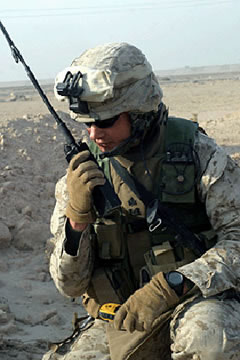
    A new family of Software Defined Radios (SDR) currently under development will provide a common platform for wireless applications, ranging from low cost, single purpose terminals, to multi-band, multi-mode, multi-channel voice/data radios supporting narrowband and wideband waveforms. JTRS family of tactical radios support provides line-of-sight and beyond-line-of-sight C4I capabilities. Covering the spectrum from 2 to 2000 MHz, JTRS will be capable of transmitting voice, video and high-speed data. The program is being developed in several “Clusters”, each addressing specific uses and requirements. Some of these clusters cover vehicular, airborne and portable configurations including manpack, handheld and Small Form Factor (SFF) – for a variety of mission requirements. The FCS combat formation, roughly equating to a small brigade, will combine vehicle- and helicopter-based JTRS radios, typically using the Wideband Networking Waveform (WNW), with personal communicator JTRS radios typically using the Soldier Radio Waveform (SRW), the latter addressing all the embedded applications associated with FCS.


    JTRS Personal Role Radios and FCS

    JTRS Cluster V focuses primarily on the Small Form Factor radio requirements of future land forces, which will be incorporated into existing and new equipment and systems. The embedded radio-on-the-man platform, for instance, will not have its own power source, but rely on the power package carried by the soldier as part of the Future Force Warrior system. These radios are under development with the Soldier Level Integrated Communications Environment (SLICE) program. Similar systems will also be integrated into unmanned applications such as Unattended Ground Sensors (UGS), Unmanned Aerial Vehicles (UAVs), small Unattended Ground Vehicles (UGV) and Intelligent Munitions, as part of the Future Combat family of Systems (FCS) family of systems.

    SLICE uses technologies and waveforms derived from the DARPA’s Small Unit Operation-Situational Awareness System, optimized as a personal role radio, for small, low power devices. The system is expected to mature by 2006. Systems conforming to the Soldier Radio Waveform (SRW) will operate at frequencies between 450Mhz and 1000Mhz at Band 2 and 1 from 350Mhz to 2700Mhz in Band 3. Standard SRW will operate in a single channel for intrateam network while “leader’s radios” will support both channels and enable links to command and control networks. Other applications of SFF radios include Blue Force Tracking and Combat ID. SRW radios are designed to deliver an instantaneous burst data rate ranging from 450Kbps to 1.2Mbps and 2Kbps to 23.4Kbps, under a low-probability of intercept “stealth” mode which will be almost immune from detection by enemy electronic surveillance. Another waveform planned for integration in Cluster 5 radios is the support of cellular network – under Mobile User Objective System (MUOS) waveforms. This capability will also support UHF DAMA protocols for satellite communications.

    JTRS Cluster V is under development by an industry team headed by General Dynamics Decision Systems with BAE Systems, Rockwell Collins and Thales Communications Inc. (TCI), supported by Motorola, Vanu, Agile Communications, Altera and RedZone Robotics.

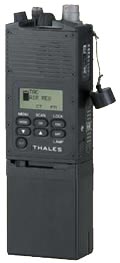
    AN/PRC-148 (JEM) – JTRS Enhanced Multi-Band Inter/Intra Team Radio

    The AN/PRC-148 JTRS Enhanced MBITR, (JEM), is based on the  AN/PRC-148 MBITR developed by Thales Communications. Thales Communications is the prime contractor for the JTRS JEM Program (formerly Cluster 2).

    JEM Operating Environment is certified Software Communications Architecture SCA 2.2 compliant. SCA is the baseline architecture for future JTRS based software-defined radios. The new radio is also undergoing certification for Type 1 encryption through the Top Secret level. As an SCA-compliant platform, JEM supports new JTRS waveforms, such as high-capacity data, networking, and new encryption algorithms. The JEM also provides a cost-effective path to JTRS since all MBITR system elements, accessories, and ancillaries can be used with the JEM. The radio weighs about 860 gram. It is available in waterproof variants immersible at depths of up to 20 meters. To further support special operations, the radio supports Low Probability of Intercept / detects (LPI/LPD) operating modes.

    Users can program up to 256 preset AM or FM channels, selected over a frequency range between 30 and 512 MHz, at 5 – 6.25 KHz steps. It also supports 12.5KHz AM narrow-band analog channel. The radio supports both voice and data. The radio can connect to any digital device supporting USB connection. It can interface with HAVE QUICK I/II, SINCGARS ESIP radios at single channel and frequency hopping, ANDVT. The radio supports ad-hoc relay, by employing retransmission between two handheld radios, utilizing special filters to cancel acoustic feedback. The tactical advantages of such capabilities are the elimination of use of specific radios for different applications (such as tactical com [VHF/FM] and intra-squad and ground-to-air (UHF/AM). Furthermore, the new radios will enable easier and better inter-service communication.

    In September 2006 Thales Communications Corp. received a first order for its handheld JTRS compatible radio known as JEM. Under the US$7.6million contract Thales will supply 1675 radio sets to the US Air Force, The initial procurement provides immediate relief to the Air Force warfighters in Afghanistan and Iraq who are currently borrowing radios from the Army to communicate with U.S. soldiers. Additional 10,000 sets will be bought next year. The contract marks the first JTRS procurement order. The USAF is planning to spend over 2.9 billion in the JTRS program, which promises to streamline communications across different systems. Other JTRS radios are expected to be fielded within five years. The new radios will be used by Air Force Special Operations Command operators, Security Forces and Civil Engineers as well as within Air Operations Centers, Distributed Common Ground System facilities and other command and control centers.

    Tangram – Fully Automated Intelligence Analysis Support

    The TANGRAM program, managed by the US Air Force Research Lab at Rome is developing a fully automated intelligence analysis support system to continuously process intelligence information from classified and unclassified sources, rapidly detecting suspected terrorist activities. To date, many of the intelligence analysis programs have focused on systems, tools and algorithms to suspected activities and events of interest. They relied on prior knowledge about known terrorists, groups, affiliations and activities, to tracking terrorist suspects and detecting their threat event intentions. Current analysis methods are searching large data banks for patterns of terrorist behaviors. Current procedures are effective, yet despite recent improvements, the total production time for a single answer is currently measured in days and weeks. To have any demonstrable improvement in the intelligence process we need to provide answers in hours or minutes.

    The Tangram program will address fundamental challenges limiting current technology. The new processes will be x100 times more productive and x100 times faster discovering threat entities, delivering high quality intelligence and improve the probability of detection of low observable threats and events, where “guilt by association” assumptions may not apply.

    However, to achieve their potential, we must develop the processes, procedures and standards to deploy a fully automated, analytic system capable of processing tens of thousands of simultaneous analytic inquiries in an efficient and scalable manner.

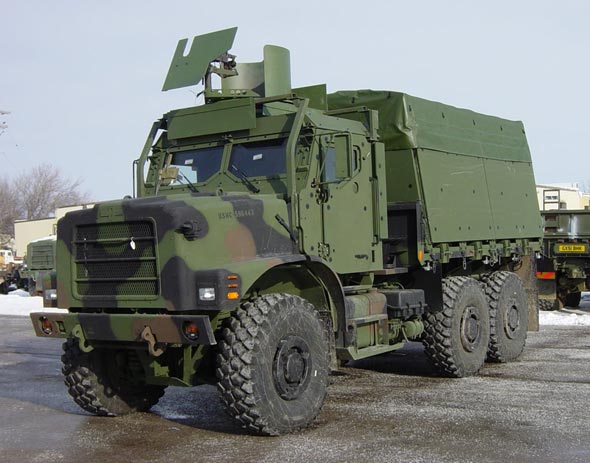
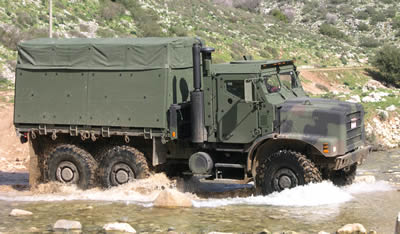
    MTVR Medium Truck Armor Protection Kits ECP-59

    New protection suits were recently introduced for the Oshkosh Medium Tactical Vehicle Replacement truck (MTVR), used by the US Marine Corps. The corps is planning to protect 3,000 of its 3,600 trucks. Plasan Sasa has also introduced an MTVR armoring solution. Plasan and Oshkosh recently won a $144 million US Marine Corps contract to supply 796 ECP-59 Armor Protection Kits (APK) for MTVR trucks, based on Plasan Sasa’s protection systems. According to the Pentagon release, 75% of the work will be done by Plasan Sasa in Israel. With options for  124 additional kits, exercised in February 2005. The completion of this contract is scheduled for December 2005. In September 2005 the Marines added $100 million for 930 additional kits. Completion of the new order which is subcontracted to Plasan Sasa by Armor Holdings, is scheduled by the end of 2006. The total value of the program to date (aprox. 2,000 vehicles) is set at $305 million.

    The ECP-59 APK were designed specifically for the MTVR and include cabin protection and armor plating of the cargo bed as well as suspension upgrades and air-conditioning systems. The armor is designed to enable the occupants to return fire behind protected positions. The trucks will be delivered through 2005 starting in the first quarter. The solution provides ballistic and mine protection against various small arms and IED threats. Armor Systems International (ASI) has also proposed an armor kit for the truck. This kit weighs 6,700 lbs and includes the armor, transparent armor windshield and windows. The cab weight is 2,200 lb, and the armor protection for the cargo bed weighs 4,500 lbs. The kit includes LLM blast mitigation system for mine/blast protection.

    August 2006: Oshkosh and Plasan Sasa won a US Marine Corps contract to supply armor kits for 700 LVSR trucks. The kits will be developed by Plasan Sasa beginning 2007, to be followed by deliveries through 2010.

    WK-450 Watchkeeper – Tactical UAV System for the British Army

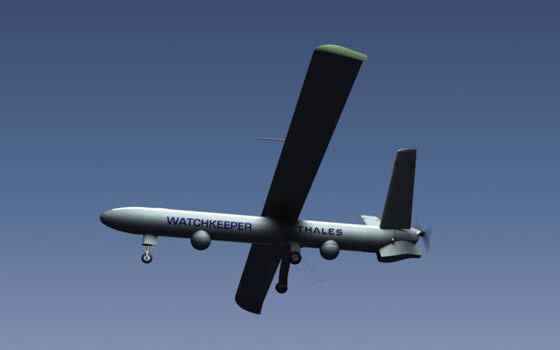
    Thales/Elbit Systems Watchkeeper

    The WK450 Watchkeeper is a derivative of the Hermes 450, developed by Elbit System’s Silver Arrow subsidiary. Watchkeeper is expected to be operational in the British Army around 2010. Both systems are using the same configuration of a high wing and V for optimal aerodynamic and mission performance.

    When deployed the Initial Operational Capability (IOC) Watchkeeper regiment will deploy 12 WK450 UAVs (regular regiment will have 16). The regiment will operate four batteries, each supporting a Brigade and two BattleGroup field headquarters. The regiment will also operate the launch sites, ground control and recovery teams while tactical command parties will dispatch to supported elements, they will be equipped to maintain different levels of control of the payload; all units will be able to receive raw images directly from the sensors. An entire system, ready for an initial 24 hours operation, will be deployable on a single C-130 aircraft.

    The information collected on a mission is transmitted via line-of-sight datalink to the ground station for processing and interpretation by the ground element, and rapidly processed through existing intelligence and communications to the users. The aircraft was tested with an overwing satellite communication pod, which enables the aircraft to establish wideband datalink beyond-line-of-sight. Watchkeeper will support UK and coalition forces, including Special Forces, battlegroup command posts, attack helicopter formations, attack aircraft or battleships throughout the battlespace. The system is designed to be integrated with existing and future ISTAR capabilities, future command and effects systems over NATO common protocols.
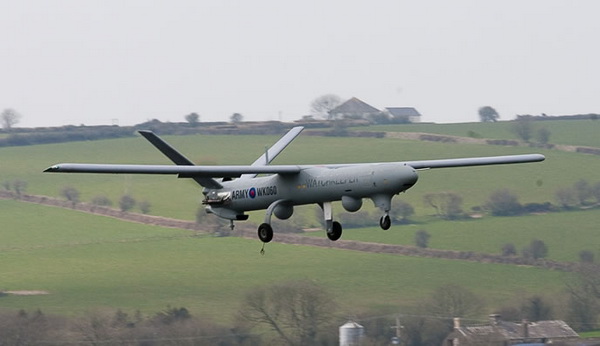

    Under a £317 million order (over $500 million) awarded in October 2005 to the Leicester based UAv Tactical Systems Ltd. (U-Tacs) a joint venture formed by Thales UK and Elbit Systems up to 99 WK-450 UAVs will be produced over eight years. This order is part of the overall £700 UK MOD Wathkeeper program. WK450 follows the lines of Elbit’s Hermes 450, in service with the Israel Defense Forces (IDF) and the US Department of Homeland Security (DHS). WK450 is different from the Israeli version in its automatic landing capability, multiple payload configuration among other features. WK450 was designed for the “upper range” of tactical missions. Built of a spacious composite structure, it is optimized for long range, long endurance (+16 hours) multi-payload missions. Payloads include the Compass EO payload, comprised of four electro-optical systems (visual, Infra-Red (IR) laser rangefinder and designator), offering advanced scan modes and automatic target tracking, and the Thales I-Master Synthetic Aperture Radar (SAR)-Ground Moving Target Indicator (GMTI), radio relay, COMINT etc. When multiple payloads are carried, an EO/IR payload is mounted in the lower front section while SAR or other electronic sensors are mounted in the lower aft section. As WK450  is designed to support brigades and division levels, air vehicles are expected to operate at different altitudes – SAR missions are expected to be flown at maximum altitude (+16,000 feet) for optimal area coverage while EO/IR are expected to fly at around 10,000′ delivering optimal image quality.

    Communications and electronic surveillance antennae are mounted on the wings and along the fuselage. Satellite communication support and external stores carrying capability, including extra fuel or weapons are inherent in the WK450 design and have been evaluated in the UK under the JUEP program. WK450 is designed for fully autonomous operation. It can be automatically deployed from short airstrips or catapult, and are retrieved back at the airstrip through automatic landing.
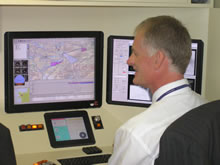
    The Ground Control Station (GCS) is mounted on a standard 20 foot ISO container. The GCS facilitates workspace for up to four operators, including two image analysts and a communications specialist. GCS performs image processing, storage and intelligence dissemination, as well as ad-hoc mission planning. The GCS also handles interoperability and communications with all supported forces and other ISTAR assets. The GCS is equipped to control three UAVs. The IOC systems will use the C band datalinks already used in the Hermes, produced by Spectralink.

    For the Full Operational Capability phase, Thales will use Qubic Common Data-Link (CDL) for the system, which are compatible datalinks used by US forces. Maximum operating range is limited by the line-of-sight datalink to 200 km. When satellite link is used, operational range can be extended. Current requirements do not provide for direct feed of image to helicopters, but such capability could evolve after the initial deployment and will be provided by adaptations to hardware used by its “clients”. The airborne segment of the datalink has built-in relay capability to enable all airborne UAVs to support each other to overcome topographical limitations. This feature is also supported by the mission planning system providing significant advantage over current systems.

    The majority of the system will be produced in the UK. Airframes will be produced at Leicester (airframes), the ground segment relies entirely on British technology. Hardware will be produced in Cambridge (shelters). other companies involved include Vega, Praxis and Cobham. Flight testing will be performed at Cardigan Bay. LogicaCMG will be providing the digital battlespace integration and QinetiQ will contribute its image processing capability. Boeing is also involved, to ensure integration with US systems. Thales’ has also established a system integration site at its Crawley site, where a synthetic Watchkeeper environment will support the modeling and integration of the system’s elements, to reduce development risks and complete the program within the ambitious schedule set by the MOD.


    Precision Attack Missile (PAM)

    Non Line Of Sight Missile System (NLOS)

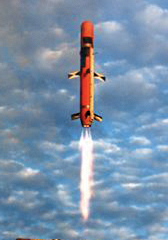
    The Precision Attack Missile (PAM) is a low-cost direct attack missile designed as part of the Netfires NLOS-LS system. It measures seven inch diameter, to fit the same launchers used by LAM. The five foot long missile weighs about 117 pounds. Using a variable thrust solid rocket motor, optimized for the launch, acceleration and cruise phases, PAM will be designed to support operations at a range up to 40 km. It will be equipped with a dual-mode Uncooled Imaging Infrared/Semi-Active Laser (UCIIR/SAL) seeker, and a multi-mode warhead. A two-way data links will link the LAM and PAM with the command center and to each other, to verify targeting before attack, assess battle damage, support “lock-on after launch” PAM has a multi-node network radio that will provide in-flight retargeting and battle damage imagery to the war fighter.

    The seeker and warhead elements of the PAM are considered for implementation in other aerial and ground launched weapons, specifically PAAMS, a follow-on to the cancelled JCM, proposed by Raytheon.

    The NLOS CLU has 15 canistered missiles, the CLU has an autonomous vertical launcher weighing 3,150 lbs. Each CLU is self contained with autonomous location unit, data radio and launch control systems.

    August 2006: NetFires will develop Non Line-of-Sight-Launch System for the Navy Littoral Combat Ships under a US$54.8 million contract awarded by the U.S. Navy. The common vertical launcher will be initially designed to store and fire the Precision Attack Missile (PAM) and later, accept future missile variants. The Non Line-of-Sight-Launch System has been selected to be the premier engagement capability against surface threats such as small moving boats deployed with the U.S. Navy’s Littoral Combat Ship (LCS). The U.S. Navy expects to build in excess of 50 such with the first ship, USS Freedom, being commissioned in fiscal year 2007. The Non Line-of-Sight-Launch System is slated for integration into the USS Independence in 2008.

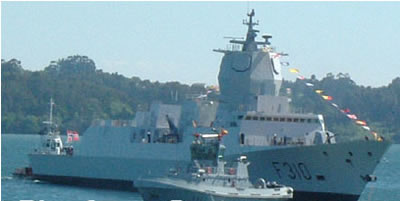
    AEGIS Frigate F-310

    Fridtjof Nansen is the first of five vessels of this to be fielded by the Norwegian Navy. It was formally commissioned at Navantia’s shipyard in Ferrol, Spain, in April 2006. In June, Lockheed Martin completed factory production of the fifth, and final, SPY-1F Aegis Weapon System to be installed on F-314, Thor Heyerdahl.


    The SPY-1F radar is designed to provide high performance surveillance, detection and tracking, and operate with the Evolved Sea Sparrow Missile (ESSM) and Standard Missile 2. Lockheed Martin is responsible for system integration of the multi-mission Integrated Warfare System, including sensors, command and control, communications and weapons, for the Fridtjof Nansen-class frigates.

    The Aegis Weapon System includes the SPY-1 radar paired with the MK-41 Vertical Launching System, capable of delivering rapid reaction time and simultaneous firepower for every mission and threat environment in naval warfare. The Aegis Weapon System is currently deployed on 80 ships around the globe, with more than 25 additional ships planned. In addition to the U.S. Navy Aegis has been deployed with Australia, Japan, South Korea and Spain.

    In September 2006 The Norwegian AEGIS frigate F-310 Fridtjof Nansen performed its first live missile firing test. During the test, the ship’s SPY-1F Aegis Weapon System detected, tracked and engaged the unmanned target with an Evolved Sea Sparrow Missile (ESSM).

    Delivery schedule:

    2005: F 310 HNoMS Fridtjof Nansen
    2006: F 311 HNoMS Roald Amundsen
    2007: F 312 HNoMS Otto Sverdrup
    2008: F 313 HNoMS Helge Ingstad
    2009: F 314 HNoMS Thor Heyerdahl

    Shalon EPS-21 Tactical Goggles

    Shalon Chemical Industries from Israel developed another version of eye protection goggles designated EPS-21 which looks much more attractive than the old plastic goggles it replaced, which ‘protected’ only from wind and dust. EPS-21 was designed to offer ‘one size fits all’ product, accommodating all the most common sizes.

    The new Israeli goggles can be worn directly or over a helmet, thus integrating comfortably with the combat gear and accessories, such as binoculars, sights and night vision devices. Ventilation ports placed throughout the frame use labyrinth design to provide efficient ventilation without the need for filtration elements. EPS-21 uses an improved format offering improved peripheral vision while optimizing dust, wind and protection from low-velocity particles and fragments. The goggles accommodate replaceable polycarbonate visor offering the ballistic protection and an integral adaptor for prescription lenses frame, and add-on secondary lenses protects against solar or laser radiation, when required.

    In this series Defense Update covers the following topics:

    Forecast Predicts the Military EO Market to Peak by 2010

    September 20, 2006: According to a new analysis by Forecast International, an estimated $8.1 billion will be spent over the next 10 years on the development and production of key EO systems. “The Market for Land and Sea-Based EO Systems” reports that, through 2015, an estimated 566,586 units will be produced – 339,696 systems from 2006-2010 and 226,890 systems from 2011-2015.

    “Many of the leading systems in this analysis are being produced and procured in the highest numbers in their history,” said Andrew Dardine, Forecast International’s EO Systems Analyst and author of the analysis. “The immediate needs of a large number of deployed military forces are likely to shape the direction of this segment of the defense electronics industry for many years to come.”

    As in previous years, it is the U.S., whose military forces are deeply engaged in fighting in Iraq and Afghanistan, that is driving the incredible demand for key EO systems. “The very nature of this persistent fighting has forced military planners not only to ask for huge supplemental budget increases to pay for the procurement of needed systems today, but also to plan for long-term needs for the systems over the next several years,” said Dardine.


    Raytheon and ITT are expected to continue to strengthen their market presence in the years ahead based on the remarkable recent success of two of their systems: respectively, the PAS-13 thermal weapon sight (TWS) and the PVS-14 night vision goggle. Such is the enormous demand for these two systems, and so important is their role in providing security forces with essential capabilities, that the government of Saudi Arabia highlighted them in its recent announcement that it is seeking some $6 billion worth of U.S.-produced defense equipment.
    The market for these two systems alone in the U.S. constitutes a major portion of the land and sea-based EO segment in this analysis. Combined, some 455,000 units having a value of $1.5 billion are expected to be produced over the next 10 years. ITT, in late 2005, won a major portion of a sweeping U.S. Army Omnibus procurement contract for production of a variety of night vision devices, especially the PVS-14. The five-year order is valued at $1.4 billion.

    The other companies in the top-five ranking of this analysis, Northrop Grumman, Thales, and Australia’s Electro-Optical Systems Holdings Ltd, are also in the position of developing and producing advanced EO systems that are designed to provide unique capabilities for a variety of applications.

    Thales was involved in the early development of an emerging, sea-based, long-range infrared search-and-track system called SIRIUS. Primary production of the system was expected to be handed off to DRS Technologies after the award of a $142 million development contract in April 2006. This system is most notable for the fact that it may be one of the first major naval-based EO systems designed and deployed specifically to address the threat of terrorists using small craft to carry out attacks. Already due to be in service with the navies of Canada and the Netherlands, SIRIUS is also of serious interest to Austria, Germany and South Korea.

    Conformal Airborne Early Warning (CAEW) – IAF Nachshon

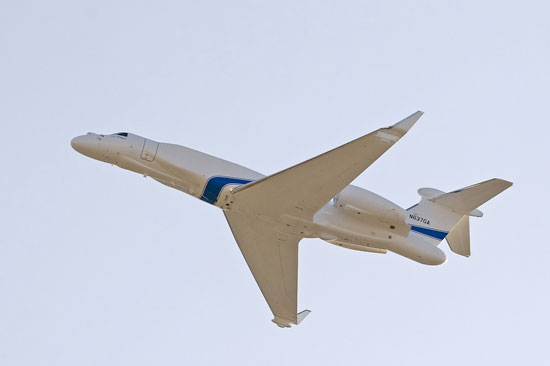
    G500 / 550 Special Mission Aircraft – IAF/ Gulfstream

    On September 19, 2006 the Israel Air Force (IAF) received its first of three Airborne Early Warning and Control (AEW&C) platform. The remaining two are scheduled for delivery in 2007 and 2008. In Israel, the aircraft will be fitted with the airborne radar system, electronic support measures (ESM) and communications equipment to support the AEW&C mission. The aircraft will be integrated into the Israeli Early Warning & Control system, comprising terrestrial and tethered sensors, and land based and aerial command and control elements. The aircraft dubbed Eitam, is equipped with an advanced version of the IAI/ELTA PHALCON airborne early warning system, which is operational with the Chilean Air Force. The system was also selected by India to equip its Il-76 based AEW aircraft. The Eitam will also provide the Israeli Air Force optional support of long range strikes. The modified Gulfstream G-550 special mission aircraft will be operated by the Nachshon Squadron recently established at Airbase 27, the military annex of the Ben-Gurion International Airport.

    Armored Vehicles at the 2006 Eurosatory Exhibition

    Armor improvements were one of the hottest topics at Eurosatory 2006. Challenged with growing threats, armor providers must design improved protection systems, while maintaining the armor within the weight limits of existing combat vehicles.


    Some improvements call for the use of lightweight armor protection, including Boron Carbide and other ceramics that offer higher protection levels at lower specific weight. The latest armor solutions are providing impressive durability and multi-hit protection, and offer modular design, to enable routine upgrading and quick field repair of damaged modules. Further improvements have been introduced with explosive reactive armor. The latest versions, such as those provided by RAFAEL and IMI, employ Insensitive explosive sheets for optimal operation against all types of shaped charges, and also allow installation on relatively light platforms such as up-armored trucks.

    Further advancements are introduced with active protection systems demonstrated at Eurosatory by RAFAELIMI and IBD, in cooperation with Akers and Thales. The most mature system is believed to be RAFAEL’s Trophy, currently undergoing testing with US Army Strykers and Israeli Merkava tanks. The system could be ready for fielding within a year. IMI’s Iron Fist was shown with all its components, installed on a 4×4 VAB troop carrier modified by Elbit systems to demonstrate asymmetric warfare capabilities.

    The modular Active Armor Concept (AAC) from IBD was displayed on the CV90120, based on a design tailored to this vehicle by Akers. Thales’ classified SHARK active protection system was not shown at the show, but the general concept was described at the DGA display.

    US and European truck manufacturers responded to growing demands for improved protection of military trucks by introducing modular armored cabs and retrofits, as well as new armored personnel carriers based on commercially available light trucks. Among the exhibitors were US truck makers International Trucks and Engines Corp., Oshkosh Trucks, Stewart and Stevenson, recently merged within the Armor Holdings group, and the UK based HMT (Supacat), newly acquired by Lockheed Martin. European truck manufacturers and armor systems providers at the show included the French Renault Defense Trucks, German KMW, Rheinmetall Defense and Mercedes Benz, Tatra from the Czech Republic and the Swiss company Mowag.

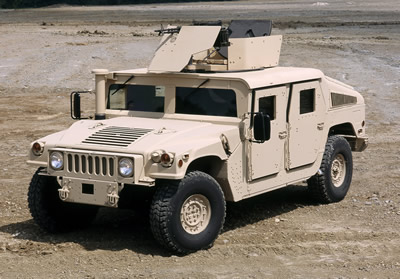
    Protection of the Humvee continues to be a hot topic, due to the wide deployment of these vehicles and the vulnerability of the basic platform. AM General is introducing new models designed to carry twice the payload of the original vehicle, thus providing a much improved capability for an add-on armor suit. Responding to the growing demands, AM General is rolling out the up-armored Humvees directly from its production line, or install the armor kits in the field. Previously Armor Holdings performed these modifications.

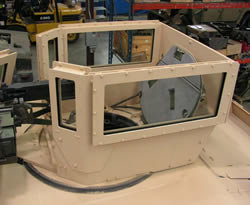
     With improved payload, the Humvee can mount additional protection for the gunner. Two versions of Gunner Protection Kits (GPK) were displayed at Eurosatory, each weighing about 100 kg. The new GPK uses transparent armor shields to provide the gunner with an unobstructed view of the vehicle’s surroundings. Armor protection kits designed for almost every military truck were on display, indicating the prosperity and growth of this market.

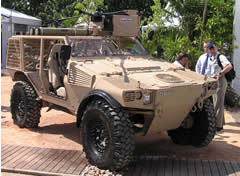
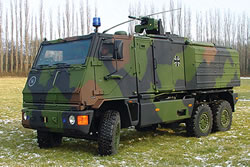
    Panhard unveiled several new platforms, including a desert raiding vehicle designated VAP, formerly known as the experimental desert patrol vehicle. It is designed for long range patrols and deep penetration raids. The vehicle is based on an unarmored version of the VBL. Another armored vehicle introduced by Panhard is the AVL, previously known as the Auverland A5. This air transportable armored vehicle is designed as a command vehicle or for patrol missions. A special version of AVL called Gavial was modified to meet German Army requirements. Another armored command vehicle, the Yak was modified specifically as a command vehicle by Rheinmetall Landsysteme. This high mobility, armored 12 ton vehicle is based on the 6×6 multi-role Duro wheeled vehicle chassis, fitted with interchangeable multi-purpose modules to fulfill all Command Post (CP) functions. YAK is also built for German Army use.

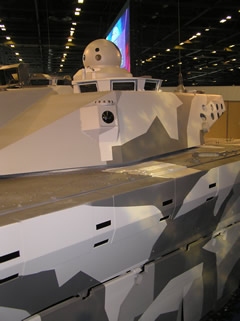
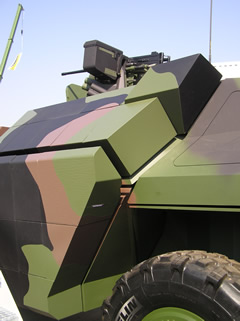
    New at Eurosatory 2006 was the wooden mock-up of the German GEFAS, presenting a distinctive shape, impressive protection level and innovative, modular design. GEFAS stands for “Geschuetztes Fahrzeug System” or “Advanced Protected Vehicle system”. This hybrid electric powered  vehicle is designed to provide high level of protection and will be easily reconfigureable to accommodate various mission specific modules. The basic protected vehicle displayed at Eurosatory was configured for convoy protection, patrol and escort missions. It was armed with a remotely operated weapon station and fitted with a high level of protection consisting of the basic armor suite for defeating small arms, fragments, IEDs and mines. The vehicle will accommodate a crew of four. Rheinmetall plans to have the first vehicle ready for field demonstrations by the end of 2007.

    Start < Page 1 of 6 >

    Skunk Works and XTEND Simplify Multi-Drone Command

    0
    Lockheed Martin Skunk Works® and XTEND have achieved a major milestone in JADC2 by integrating the XOS operating system with the MDCX™ autonomy platform. This technical breakthrough enables a single operator to simultaneously command multiple drone classes, eliminating the friction of mission handoffs. From "marsupial" drone deployments to operating in GPS-denied environments, explore how this collaboration is abbreviating the data-to-decision timeline and redefining autonomous mission execution.

    From Ukraine to Taiwan: The Global Race to Dominate the New Defense Tech Frontier

    0
    As traditional defense primes face mounting competition from agile “neoprimes” such as Anduril, Palantir and Helsing, the balance of innovation is shifting toward software-defined warfare and scalable, dual-use technologies, while global industry consolidation—marked by Boeing’s integration of Spirit AeroSystems and other strategic mergers—signals an intensified race to secure control over the defense technology value chain. Our Defense-Tech weekly report highlights these trends.

    Europe’s “Drone Wall”

    0
    In early October 2025, a coordinated wave of unmanned aerial system (UAS) incursions—widely attributed to Russia—targeted critical infrastructure across at least ten European nations. The unprecedented campaign exposed the fragility of Europe’s air defenses...

    Weekly Defense Update & Global Security Assessment

    0
    Executive Summary The past week (September 18-25, 2025) represents an inflection point where strategic defense concepts have transitioned from doctrine to tangible reality. An analysis of global events reveals four primary, interconnected trends shaping an...

    U.S. Air and Space Forces Push Next-Gen Programs at the AS&C 2025 Conference and...

    0
    At the 2025 Air, Space & Cyber Conference, U.S. Air Force and Space Force leaders unveiled major updates on next-generation fighters, bombers, unmanned systems, and space initiatives, highlighting both rapid innovation and critical readiness challenges as the services race to outpace global competitors. A short version is available here, with a more detailed version for subscribers.

    TADTE 2025: Reflecting Taiwan’s Strategic Themes

    0
    The Taipei Aerospace & Defense Technology Exhibition (TADTE) 2025 crystallized around four dominant strategic themes that collectively illustrate Taiwan's comprehensive approach to defense modernization amid escalating regional tensions. Based on a detailed report by Pleronix (available upon request). Includes a Podcast discussion on TADTE 2025's highlighting Taiwan's four strategic themes beyond the post's coverage.

    Iron Beam 450 Completes Testing, Soon to Join With Operational Air Defense Units

    0
    Israel’s Iron Beam 450 high-power laser system has completed final testing, marking a major leap in air defense. Developed by Rafael, it offers precise, cost-effective interception of rockets, UAVs, and mortars, and is set for IDF deployment by 2025.