
Monday, December 22, 2025
More
    Home Blog Page 397

    Littoral Combat Ship (LCS)

    The new LCS will provide a platform for intelligence gathering, employ surface (anti-ship) and land attacks precision weapons, and operate manned and unmanned aerial and surface vehicles (UAV/USV). To further adapt for specific missions, LCS will incorporate a modular and interchangeable approach, enabling it to be reconfigured to specific missions such as antisubmarine warfare, mine warfare, or surface warfare missions on an as-needed basis. The LCS will be able to swap out mission packages pier-side in a matter of hours, adapting as the tactical situation demands. These ships will also feature advanced networking capability to share tactical information with other Navy aircraft, ships, submarines and joint units.


    Freedom is specifically designed to operate in shallow water environments to counter threats in coastal regions, specifically mines, submarines and fast surface craft. The 377 foot vessel has a displacement of 3,000 metric tons and is capable of speeds in excess of 40 knots and can operate in water less than 20 feet deep. The ship is designed with a survivable, semi-planning steel monohull offering proven sea-keeping characteristics and good maneuverability to support launch and recovery operations, mission execution and optimum crew comfort.

    Similar to the rotational crews assigned to Trident submarines. Freedom will be manned by one of two rotational crews, blue – commanded by Cmdr. Donald Gabrielson and gold commanded by Cmdr. Michael Doran. The crews will be augmented by one of three mission package crews during focused mission assignments.

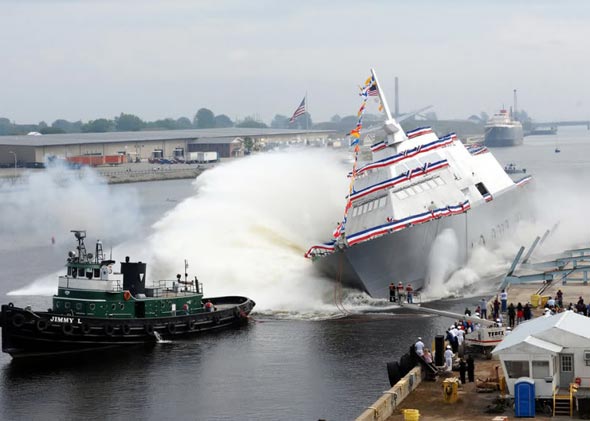
    USS Freedom was christened today (Sept. 23, 2006) as the first Littoral Combat Ship (LCS). Built by Lockheed Martin at the Marinette Marine shipyard, USS Freedom is the first of two LCS sea-frames produced for the US Navy. FREEDOM will continue to undergo outfitting and testing at Marinette Marine. Upon the ship’s commissioning in 2007, Freedom will be home-ported at Naval Station San Diego, California.

    The Lockheed Martin LCS team received a contract in June 2006 to build a second Littoral Combat Ship. Construction on this ship, yet to be named, will begin in Bollinger Shipyards Lockport, LA (near New Orleans), in early 2007. The Lockheed Martin-led industry team for LCS includes naval architect Gibbs & Cox, ship builders Marinette Marine Corporation, a subsidiary of The Manitowoc Company, Inc., and Bollinger Shipyards, as well as best-of-industry domestic and international teammates to provide a flexible, low-risk warfighting solution. The second LCS type selected by the US Navy is under construction with General Dynamics in Bath, Maine.
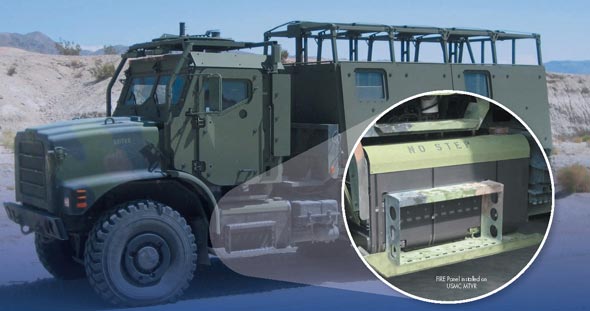
    FIRE Panel – Fuel Tank Protection Systems

    The FIRE panel was created to inhibit explosions and prevent catastrophic fires in the fuel tanks of aircraft and ground vehicles during an attack.

    As vehicle crew compartments become more protected, attacks are directed to other vulnerable parts of the vehicle, including the fuel tank. The fuel tank has increasingly become the target of hostilities due to the flammability of the contents as well as the possibility of an explosion. The explosion and ensuing fire typically incapacitates the vehicle, forcing the crew from out of the protection of the hardened compartment.

    FIRE Panel was designed by Firetrace Aerospace to protect fuel tanks form explosion and catastrophic fire following the impact of a variety of threats, including small arms fire, explosive ordnance and IEDs. It can be applied in the field, and requires no special tools or training. The panel can be molded to protect virtually any size or shape of a fuel cell. It can be designed from a single panel, to protect a small or mid-sized application or a series of panels, to protect a larger surface. The panel weighs only 25% of the weight of a comparable armor shield. It also costs considerably less than standard armor.

    Unlike an armor shield, the FIRE panel is not designed to stop the threat from penetrating the fuel tank but rather to inhibit the explosion and prevent a fire from such an event. The panel is fabricated from a blend of polymers featuring chambers filled with fire suppressing powder. When the panel suffers a high-energy impact (by shrapnel or round) the suppressant is released around and into the impact area thus proceeding rather than reacting to a potential fire. The vehicle, through damaged, is able to leave the engagement under its own power and can be easily repaired and returned to service.

    On September 13th, 2006 The US Army Tank automotive and Armaments Command (TACOM) awarded Firetrace Aerospace a US$3.8 million contract to install 164 FIRE Panels kits on its Heavy Equipment Transporter (HET) vehicles. Similar devices are being evaluated by the USMC for its MTVRs. The same technology is also available to protect jerry cans in the field.

    Eagle MALE System

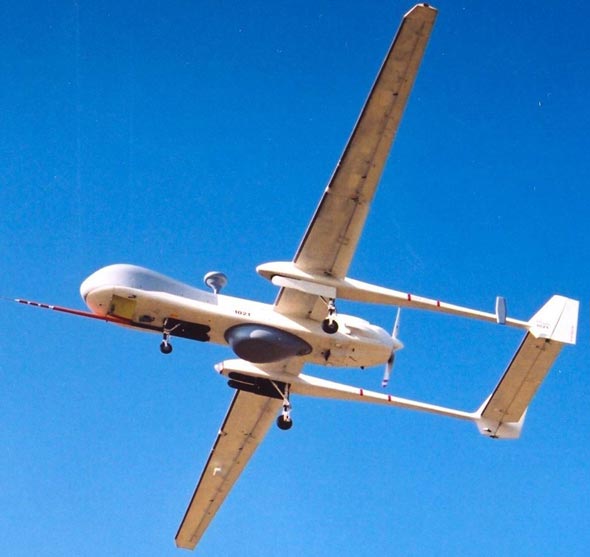
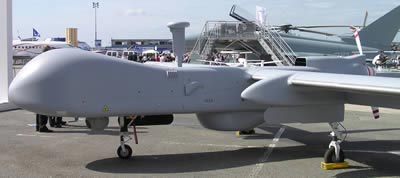
    The EAGLE Système Intérimaire de Drone Male (SDIM) UAV system has been developed by EADS, in order to meet European requirements for strategic reconnaissance and surveillance, in support of out-of area operations. Two versions are planned – Eagle 1, powered by a 115 hp Rotax 914 engine which can fly at 25,000′ and the Eagle 2 turboprop powered version (1200 hp PT6A engine), designed for 24 hours operation at 45,000′. Fully integrated into modern NATO C4I infrastructures, EAGLE will become a major asset in future network centric operations of the French army. It is also expected to be fielded with other NATO members.

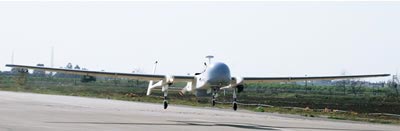
    Eagle was selected by the French Air Force, to provide strategic and theater reconnaissance, intelligence collection and communications support. It is also expected to operate in the maritime surveillance and anti-surface warfare role. As a European program, Eagle is expected to compete on other MALE oriented NATO programs, to become an integral part of NATO’s C4ISR and Intelligence, Surveillance, Target Acquisition and Reconnaissance (ISTAR) capabilities. The UAV will have a secondary role in support of surveillance of maritime traffic, and support of homeland security, search and rescue missions and support operations over coastal regions. The aircraft is designed to meet airworthiness criteria and operate in military and civil airspace, ensuring flight safety at every phase of the mission. The aircraft can be deployed from airstrips with runways as short as 600 meters (eagle 1) and 1,000 m’ (Eagle 2).

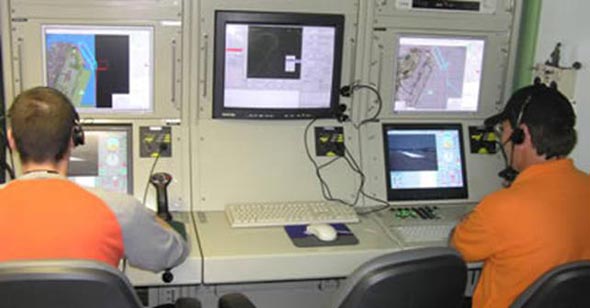
    The SDIM drone flew from the DGA flight test centre at Isrers on Sept. 11, 2006 fitted with full communication package including satellite communication and line-of-sight data links. The flight, operated from the operational SIDM ground station, demonstrated the integrity of the UAV system, in particular the Automatic Take-Off and Landing (ATOL), satellite communication and the integral command and control functions. Further flights from Istres are planned to allow the customer to verify the system performance in the coming few months prior to final training of the French Air Force operators.

    SDIM is designed for carrying out surveillance, reconnaissance and intelligence and target acquisition missions over long distance, by day and night as well as in all weather conditions with integrated anti icing system. SIDM is designed to be employed as an independent ISTAR system or as a key component of a full C4ISR system. With total payload carrying capacity of 1,250 kg, SDI can carry multiple payloads at a total weight of 250kg. With a wing span of 16.6 meters, the drone can carry out missions at a range exceeding 1,000 km from its point of departure. It can cruise at a maximum ceiling of 30,000 feet and remain airborne for more than 24 hours.

    The Eagle program will be comprised of two versions of air vehicles; the Eagle 1 utilizes an IAI Heron, modified to meet European and particularly French Air Force requirements. One of the most visible elements is the introduction of the satellite link, in the upper forward section. Addition of deicing system, at the wing leading edge enables the Eagle to safely fly through icing conditions. Eagle 2 is under development under a joint EADS/IAI program, believed to be based on IAI’s Heron TP program (Designed for the Israel Air Force Eitan MALE program). Both vehicles are fully autonomous throughout the mission, including the automatic takeoff and landing phases. The vehicle is designed to carry multiple payloads, and perform multiple missions, such as COMINT, SIGINT and IMINT or SAR, IMINT and communications relay etc. Eagle can carry several types of sensors, including maritime patrol radar (MPR), different types of SAR/MTI, EO/IR payloads, SIGINT, COMINT, laser designator, communications relays etc.

     September 11, 2006: The Système Intérimaire de Drone Male (SDIM) unmanned aerial system made its first flight from Istres air base flight test center in Southern France. A Medium Altitude Long Endurance (MALE) Unmanned Aerial Vehicle (UAV) System, SDIM program is led by the French armaments procurement agency (DGA) and is developed under cooperation between EADS and IAI/MALAT. When fully developed, SDIM will be deployed by the French Air Force as a strategic ISR asset.

    SPYDER Short Range Air Defense

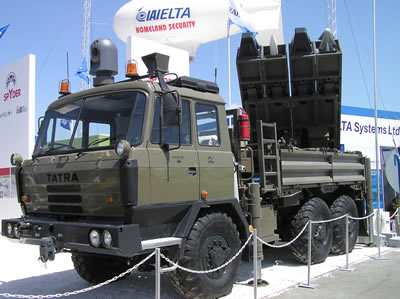
    RAFAEL and Israel Aircraft Industries (IAI) have teamed to introduce a short range (15km max range) low level (20 – 9,000m altitude) integrated, all-weather air defense system, which consists of the Python 5 IR guided, and Derby RF guided Beyond Visual Range (BVR) missiles.


    Both missile systems are offering Lock-on Before Launch (LOBL) and Lock-on After Launch (LOAL) modes, for faster response time and improved engagement flexibility. The system can effectively defeat all modern aerial threats including aircraft, helicopters, cruise missiles, UAVs and precision guided weapons. It uses two operational missiles which complement each other in their target detection, tracking and pursuit profile – the Python 5 missile is equipped with a dual waveband Imaging IR (IIR) seeker, while Derby is fitted with an active RF seeker, both missiles are highly immune to advanced countermeasures.

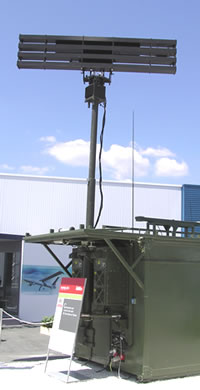
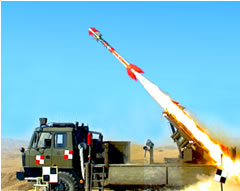
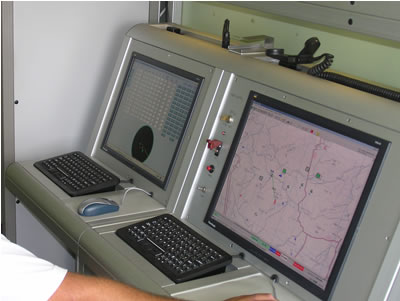
    SPYDER firing unit deploys four missiles stored in ready-to-fire launcher-containers, installed on a high mobility vehicle, this configuration enables simultaneous engagement of multi-targets and ripple firing capability. A SPYDER system supports up to six firing units, missile reloaders and Command and Control Unit which can also accommodate the Elta EL/M-2106NG ATAR 3D surveillance radar and two operating consoles. The surveillance radar can simultaneously track and engage up to 60 targets, at a range beyond 35km (depending on the terrain). The control unit interfaces with the firing units via wireless datalink to enable optimal unit dispersion for effective area coverage, mutual protection and survivability. The system’s high mobility offers quick deployment and operational agility. The system has VHF/HF communication for internal squadron communication and to upper tier command.

    A typical SPYDER Squadron consists of one Mobile Command & Control Unit (CCU) for its operation and four Mobile Firing Units (MFU). The CCU is equipped with surveillance radar and two operator’s stations. Each MFU can carry up to four ready-to-fire missiles (RF or IIR) in any combination. The CCU controls the MFUs and supplies them with engagement data. The missiles can be fired either from the CCU in remote mode or from the CCU with the confirmation of the MFU operator.

    By using the latest Air Situation Picture (ASP), which is available by the local surveillance radar, the CCU assigns the targets for destruction to the appropriate MFU. The CCU system is built in an open architecture design and can receive data from upper tier Command & Control from a distance of up to 100km. In addition, there is a provision for receiving Air Situation Pictures communicated by other agencies.

    Once the operator decides to launch, an automatic procedure begins. The CCU assigns the target to the appropriate MFU and the selected missile will start to search for the target. If the target is within acquisition range the missile will be launched in LOBL mode. If the target is beyond seeker acquisition range the missile will be launched in LOAL mode. The seeker searches for the target and when it acquires the target it begins the final homing phase. Both LOAL and LOBL modes are available for the Derby and for the Python 5. Destruction of the target is achieved either by warhead blasting upon impact or by the proximity fuze.

    September 2006: The Indian Army is all set to acquire the Israeli quick-reaction Spyder air defense system, developed by RAFAEL, which would enhance the capability to overcome the vulnerability of its formations to threats from the air. According to India Defence online magazine, the army has finalized plans to acquire four regiments of the Spyder systems, equipped with Derby surface-to-air radar guided missiles and Python-5 infra-red missiles as part of a contract worth over US$250 million (Rs 1,100, crore) awaiting the approval of the Cabinet Committee on Security (CCS). The new systems will replace the army’s Russian-made OSA-AKM and Strela-10M missile systems. The system has been proposed and is being evaluated by the Israel Air Force, as a future replacement of the Vulcan, Chaparral air defense systems. A Medium Range version of the system (Spyder MR) is also under development, and proposed to several international customers.

    Response Mobile Communications System (RMCS)

    The First Responder – Response Mobile Communications System (RMCS), developed by CERDEC’s Space and Terrestrial Communications Directorate (S&TCD), was recently demonstrated at the U.S. Army Garrison, Fort Monmouth August 29, 2005. “The RMCS will bridge the communications interoperability gaps between defense and civil support missions,” said Gary Blohm, S&TCD director. The new, rapidly deployable communications system provides wireless connectivity, situational awareness and 3-D location and tracking in the absence of a fixed communications infrastructure. RMCS monitors vital signs of responding personnel and provides the incident commander cognitive oversight of the responders’ environmental conditions. It also delivers voice communications and live high-quality video to the incident commander and headquarters coordinating the operation.

    First demonstrated in August 2005, RMCS went through a year of refinement based on feedback received from Defense Department emergency response personnel and Department of Homeland Security public safety experts. Improvements resulted in reduced size, weight and power consumption of the overall system, while increasing range and data capacity to enable broad integration with standard first responder applications.

    Future Force Warrior Communication and Computation

    Start < Page 6 of 6 >

    The net-centric Future Force Warrior will operate in squads or sub-squad teams, requiring dedicated wireless communications network for operation. Each warrior will be equipped with a sensor set, comprised of a helmet integrating day and night cameras and weapon’s mounted sight cameras. The images will be displayed on a helmet integrated half inch see-through monocular display, or on a hand held PDA like terminal. Images could also be relayed to other team members for coordination. FFW digital assistants will also display navigation and situational awareness pictures, and images received from team members. The performance of FFW class personal role radio will be significantly improved over current systems, offering wideband data communications in addition to current voice radio. Soldiers will be able to talk naturally with each other, whisper, or chat with text messages during missions. The new system has the ability for tying each soldier into tactical local and wide-area networks by onboard computer that sits at the base of the soldier’s back. Troops will also be able to share data with vehicles, aircraft and other individuals.

    The entire system suite has a total power budget of 15 watt. Battery packs or alternative fuel-cells and energy harvesting power sources should support 72-hour continuous autonomous team operations. For this purpose, high density, low weight, low volume batteries are considered, but modern power cells are also proposed for this role. Self-generating and regenerating power solutions are also considered. Advanced power management was realized as one of the most critical factors in the program. General Dynamics is planning to integrate a specially developed version of InHand BatterySmart dynamic power management software to minimize the consumption of the main processor as well as overall soldier system.

    Additional parts of this article:

    Future Force Warrior Uniform, Protection and Combat Gear

    Start < Page 5 of 6 >

    The Future Force Warrior uniform suite will be fabricated from flexible structural framework designed for unconstrained vertical or lateral movement, even with full combat/assault load. For protection and enhanced survivability, standard uniforms will be replaced by a full spectrum protective combat ensemble, fabricated from ultra-lightweight materials which will also provide resistance to friction and wear, water, chemical and biological agents.

    Protection elements
    The suite will have a built-in microclimate conditioning system in garments made of spaced fabric, with built-in capillaries blowing hot or cold air through the system. Future combat clothing may also include embedded electrical conductors, for power distribution, communications and signature (heat) suppression. Additional layers of ballistic protective shield will provide sufficient multi-hit protection from small arms fire and shrapnel. The bulletproof shell will be separated from the body by foam pads absorbing impact trauma. This design provides additional protection to the rib cage, while maintaining air flow for body cooling. The protective vest will also be used as load-bearing chassis. New robotic platforms will be developed as part of the FFW program, to augment the team during dismounted operations. One vehicle will be the small individual soldier support system, a miniature robotic vehicle will help clear inside buildings; a squad level support vehicle assisting to transport loads and sustain the troops on dismounted missions; and a larger vehicle with both direct and indirect fire capabilities linking the FFW and FCS programs.

    Helmet & Headgear
    The helmet will mount a new high definition see-through eyepiece, a GPS antenna, 3D audio and integrated bone conduction microphones (osteophone), which will replace the current headsets and enable efficient hands-free communications. Gel based sensors will also be integrated into the helmet, to monitor the human life signs (pulse and breathing rate). This information will become available for remote assisted medical support and real-time unit level status monitoring. The system will also support remote health monitoring and medical treatment. To assess the soldier’s physical condition and health status, the system will monitor the individual’s blood pressure, heart rate, internal and external body temperature, and caloric consumption rate. Commanders and medics will be able to access the information through a tactical local area network. Early warning of heat and cold injuries could be provided before serious effects develop. Such conditions are responsible for a large percentage of casualties in both battle and training. If a soldier is injured, medics can start making an assessment before they even get to an injured soldier. A specialist physician, who can be miles away, will now be able to diagnose and treat a soldier who is about to have sunstroke, without even physically seeing the soldier.

    Additional parts of this article:

    Future Force Warrior Infantry Combat Suite

    Start < Page 4 of 6 >

    Future Force Warrior (previously known as Objective Force Warrior) is now scheduled to be the third capability upgrade phase of the Land warrior System (also known as Land Warrior Block III). Future Force Warrior (FFW) is designed as an integrated “system of systems”, as part of the army transformation to a soldier-centric force which will complement and fully integrate with the Future Combat Systems (FCS). Two uniform systems are under development. The Future Force Warrior system will be available for fielding to soldiers in 2010. The Vision 2020 Future Warrior system, which will follow on the concept of the 2010 Future Force Warrior system, 10 years later. General Dynamics Eagle Enterprise unit is the technology integration team leader for FFW, Currently in detailed design phase. The current program will be followed by prototype development and demonstration and non-competitive system development and demonstration phases FFW program is scheduled for completion by the year 2010 and worth between one to three billion US$ over a ten year period.


    FFW is designed to provide ten-fold increase in lethality and survivability of the infantry platoon. Such dramatic increase will be achieved by enhanced situational awareness, precise and effective firepower and netted communications, far better than current standards for tactical communications. Individual dismounted soldiers will get direct access to network-centric information and access any relevant service required and made available for their mission. Another key issue resulting from this process, is to lighten the soldier’s load. From over 100 pounds currently carried by combat soldiers, to around 45 pounds.

    The Land Warrior basic unit will be a four men strike team, provided with an independent intra-team and squad and platoon communication. The squad will have communications and command and control facilities to manage multiple strike teams including coordinated, multi-directional assaults. The squad will operate three strike teams, a squad leader, a system’s squad leader and a situational awareness and effects non-commissioned officer (NCO). The unit will also have provisions to control direct and indirect fire by their own unit as well as adjacent formations. The unit will be self-sustained for 24 hours and will also carry additional supplies for further 48 hours on a manned/unmanned “mule”. The squad will have 81mm and 60mm mortars, new support weapons,

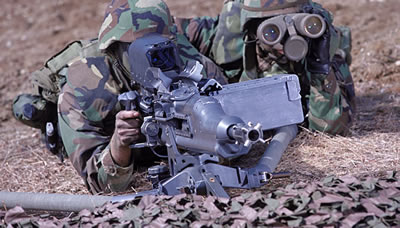
    The integrated individual combat system will comprise weapon system, protection suite, navigation, and information processing and communications systems. The program supports both individual and unit level operations, with increased lethality, survivability, communications, and responsiveness. Future Force Warriors will initially use existing individual weapons, while current squad weapons will be replaced by a new XM-307 Individual weapons will be equipped with advanced fire control, optimized for urban combat, and enable to synchronize direct and indirect fires from Future Combat System such as NLOS-LS and JCM missileprecision mortar and artillery support and more.

    Additional parts of this article:

    CARDOM 120mm Mobile Mortar System

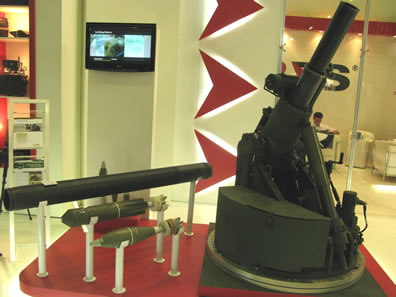
    The Cardom mortar system displayed at the Ares stand in LAAD 2011 exhibition in Brazil last month. Two types of mortar bombs provided by the company are also displayed, a standard 120mm bomb and the LG2MK laser guided kit for 120mm mortar bombs. The Cardom is providing the centerpiece of the IDF Keshet self propelled system, as well as the Stryker mortar carrier, employed by the U.S. Army. Photo: Tamir Eshel, defense Update
    Photo: Tamir Eshel, defense Update

    The Soltam Systems 120mm mobile Cardom (Hatchet), a 120 mm K-6 mortar barrel held in a turntable platform system comprises new Computerized Integrated Navigation, Self Positioning and Aiming systems. Its modern Target Acquisition Devices together with special designed Recoiling Mortar System  attenuates the firing loads and enables mounting the systems on wheeled and soft AFV’s, or even trucks. The CARDOM Aiming mechanisms are linked to state-of-the-art command, control and communication systems, to achieve quick response automatic laying mode. The IDF delivered Cardom system takes target acquisition data, typically from a locally developed Azimuth Atlas Mk 2 system that provides range, bearing, position and other data from an observation position and transmits it direct to the Cardom system. Using electrical servo motors the mortar barrel is then set to the exact traverse and elevation angles ready for firing.

    Although the Cardom is not breech loaded, Soltam officials claim a burst rate of 16 rpm, followed by a 4 rpm sustained rate of fire, by a trained crew. Asked wether Soltam could develop an under armour version, the officials said that a Turret Mortar Under Armour (TMUAS) long barrel system was developed by Soltam in the past but discontinued, for commercial reasons. Soltam is currently providing an automatic breech loading 60mm mortar for the IDF Merkava Mk4.

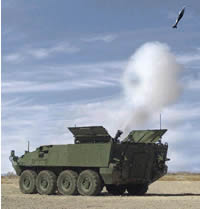
    The “Cardom” Recoil Mortar System has been qualified for fielding with the 3d US Army Stryker brigade, and will be coupled to the US Army’s M95 Mortar Fire Control System. Over 300 mortars are currently in production for the US Army. In the past Cardom also competed for the US Marine Corps’ Expeditionary Fire Support System (EFSS) as part of the Lockheed Martin team. Work is underway to examine alternatives to meet the United States Marine Corps requirements for an expeditionary weapons systems that will make up the 3rd leg of their fire support triad in support of their “Ship to Objective Maneuver” requirements and Soltam Systems is supporting a number of US based prime contractors to propose suitable configuration options for the Fiscal Year ’06 acquisition program.

    September 8, 2006: The Israeli Army is fielding the Cardom 120mm mortar system with the fire support company of the Nahal (900) infantry brigade. The advanced mortar, developed by Soltam, is mounted on a traversable plane which provides automatic aiming and fire adjustments performed through the fire control computer or via communications. The mortar replaces 91mm mortars currently deployed in this role.

    Wireless for Warfighter (W4W)

    A new process designed to rapidly establish computer networks when joint warfighters move in to areas where there is no established communications network was developed by the U.S. Joint Forces Command. Known as Wireless for the Warfighter (W4W), the service provides an advanced wireless capability for faster setup, communication and dissemination of critical data. It is designed to cover an area of 5-10 miles with secure unclassified wireless and secure classified local wireless access. An important advantage of the new wireless service is the mobility it provides the users, an aspect which proved to reduce logistical clutter in recent exercises. The initial system will consist of local wireless connectivity but an enhanced system, expected by May-June 2007 will improve coverage, by employing a metropolitan area network (MAN) wireless capability.

    Small Diameter Bomb (SDB) – GBU – 39

    The new 250 pound class bombs are designed to provide high precision and effective stand-off range when launched from fighter bombers or unmanned platforms. This type of weapon offers increased weapon’s loads on current bombers and strike fighters, as well as flexible loading options for future Unmanned Combat Aircraft Systems (J-UCAS).

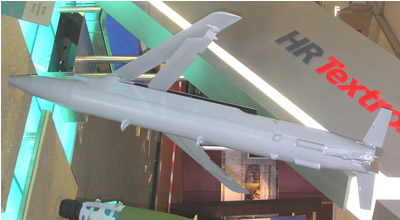
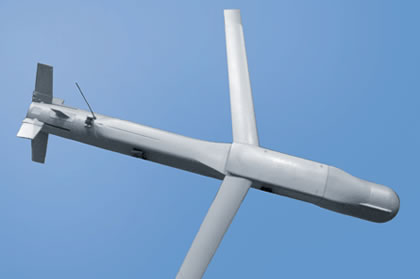
    SDB is designed to destroy a variety of targets, penetrate over 1.20 meters of steel reinforced concrete while inflicting minimum collateral damage, from ranges of 70km (40nm). The US Air Force plans to use these weapons with its fleet of F-15E, F/A-22, F-35 and unmanned combat air vehicles (UCAV). Current plans call for procurement of 24,000 SDBs and associated Diamond Back kits over the period 2005 – 2015. SDB will also offer extended range capability, utilizing standoff, precision attack gliding kits such as the Diamond Back, offered by MBDA. Other SDB enhancements include seekerless configurations, such as the Lockheed Martin PNAV.


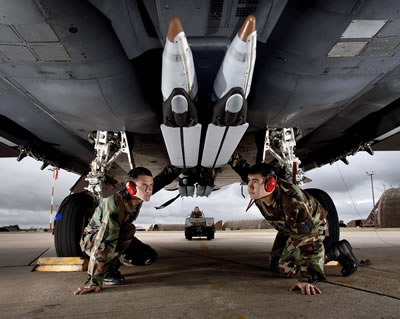
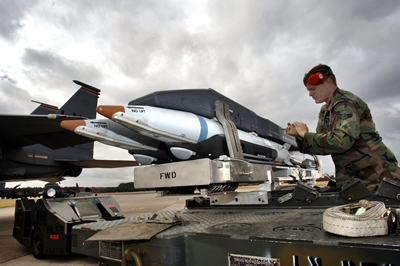
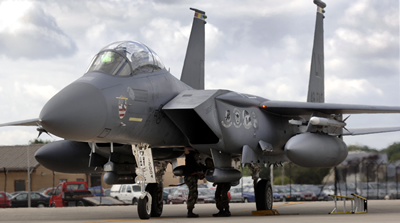
    September 8, 2006: USAF F-15Es recently received the new 250 pound Small Diameter Bomb I weapon, offering precision-guided accuracy within 1.2 meters of the aim point. The weapons are expected to equip the USAF 494th Fighter Squadron scheduled to deploys to Southwest Asia later this year. The squadron will be the first to use the Air Force’s new Guided Bomb Unit-39 bomb fitted with diamond-back wings that enable the weapon to glide to its target from a stand-off distance.

    This high accuracy combined with a smaller warhead enables the fighters to achieve the effects while minimizing potential collateral damage. With the introduction of SDB I to the Air Force inventory, the Strike Eagle aircrews also benefit from increased weapon employment range. SDB I has a standoff range of up to 60 nautical miles in front of the aircraft, 40 miles to the left and right of the aircraft and can even turn around and attack targets behind the aircraft. Each SDB can be targeted at a specific target. Targeting programming can be done on the ground or updated while airborne, before release. All bombs can be targeted separately or directed to attack a single target, as required.

    SDB I enables the Strike eagles to carry four weapons on every precision-guided missile weapon station; four weapons in place of one. The four-place carriage (BRU-61/A) developed and manufactured by the Boeing Team to carry SDBs virtually eliminates periodic maintenance and cleaning. It’s a pneumatically operated carriage versus the traditional, explosively operated carriage that fires a cartridge to release the weapon. After a number of firings, these current inventory carriages must be cleaned, a labor-intensive operation.

    The US Air Force is developing a Focused Lethality Munition warhead for the Small Diameter Bomb. The new warhead employs multi-phase blast explosive and a composite carbon fiber warhead case, allowing for pinpoint strikes with low collateral damage. The FLM warhead technology was developed at the Lawrence Livermore National Laboratory and the U.S Air Force Research Laboratory. Under a US$27 million Joint Capability Technology Demonstration (JCTD) program contract awarded in September 2006, Boeing will incorporate the FLM technology into the SDB I system, perform a series of ground and flight tests, and manufacture a limited number of FLM weapons. Boeing is expected to deliver the first 50 weapons for operational assessment in January 2008, with the Air Force procuring as many as 450 SDB I FLM units through 2012.

    The SDB family of weapons developed by Boeing has quadruples the number of weapons an aircraft can carry, enabling aircrews to attack more targets on each sortie. Boeing led the SDB-I team with Lockheed Martin, with Boeing acting as the prime contractor, supplying the air vehicle, a derivative of SDB I, as well as the network data link system. Lockheed Martin, is responsible for the multi-mode seeker system, derived from the Joint Air-to-Ground Missile (JAGM).

    In April 2006 Boeing, teamed with Lockheed Martin and Raytheon won two U.S. Air Force contracts (about $145 million each) for the competitive risk reduction phase of the SDB II program. SDB II is designed to accurately hit moving targets under all-weather conditions. SDB II will be equipped with a tri-mode seeker comprising a millimetre-wave radar, imaging infrared (IIR) camera and semi-active laser (SAL) all integrated into a single system. In August 2010 the Air Force announced Raytheon as the winner, selecting the GBU-53B design for the future increment of SDB.

    For the SDB II phase Raytheon has developed an all-new, streamlined bomb casing and folding swept-wing. Raytheon is developing a tri-mode sensor for this weapon, based on the dual-mode seeker employed in the Precision Attack Missile (PAM) missile and Army Medium Range Munition (MRM) programs.

    Patriot Advanced Capability III (PAC-3) Air Defense System

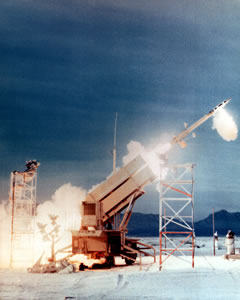
    Patriot PAC-3 Launch

    The ‘hit-to-kill’ PAC-3 Missile is the world’s most advanced, capable and powerful theater air defense missile. It defeats the entire threat to the Patriot Air Defense System: tactical ballistic missiles (TBMs) carrying weapons of mass destruction, advanced cruise missiles and aircraft. PAC-3 Missiles significantly increase the Patriot system’s firepower, since 16 PAC-3s load-out on a Patriot launcher, compared with four of the older Patriot PAC-2 missiles.

    The PAC-3 Missile Segment upgrade to the Patriot air defense system consists of the PAC-3 Missile agile hit-to-kill interceptor, the PAC-3 Missile canisters (in four packs), a Fire Solution Computer and an Enhanced Launcher Electronics System. These elements are being integrated into the Patriot augmenting its high to medium altitude, long- range air defense capability.

    The PAC-3 Missile has been selected as the primary interceptor for the multi-national Medium Extended Air Defense System (MEADS). Managed by the NATO MEADS Management Agency, Current MEADS development focus on risk reduction, application of key technologies and validation of a system design incorporating the PAC-3 Missile as the prime interceptor.

    During recent tests, conducted in September and November 2004 at White Sands test range, PAC-3 missiles engaged multiple targets, both short, long range and cruise missiles, with “ripple fire” attacks. In the most recent test, four PAC-3s were “ripple-fired” at two incoming targets. All targets were destroyed by the first missile. Test objectives included demonstrating the system’s ability to detect, track and engage a TBM and cruise missile simultaneously, and validating the performance of several components of the PAC-3 Missile that were part of on- going cost reduction initiatives. These include an Advanced Master Frequency Generator (AMFG), Multi-Band Radio Frequency Data Link (MRFDL) and a Simplified Inertial Measurement Unit (SIMU). In the second test, the PAC-3 system received tracking information from THAAD system radar.

    During Operation Iraqi Freedom (OIF) March-April 2003, a mix of PAC-3 missile interceptors and PAC-2 air defense missiles destroyed a series of short range ballistic missiles fired by Iraq, failed to engage and intercept several cruise missiles fired on Kuwait City from Iraqi coastal missile batteries.

    A possible future complement to the Patriot is the Low Cost Interceptor (LCI), 10 inch diameter single-stage missile, designed to intercept and destroy cruise missiles and UAVs. The booster will loft the missile to high altitude and then the missile will use gravity to increase its speed before an intercept.

    September 8, 2006: The Government of Germany has requested a possible sale of 72 PAC-3 Cost Reduction Initiative (CRI) missiles, plus 12 each Missile Round Trainers, and their logistical support. Germany has already fielded Patriots with 32 fire units in four air defense wings. However, according to current plans, the number of active units will decline to 24. The new missiles are expected to enhance remaining squadrons. The estimated cost is $298 million.

    Tactical Satellite Communications Networks

    Start < Page 5 of 7 >

    With flexible operational services and compact ground terminals, Satellite Communications (SATCOM) services offer attractive solutions for military users in theater and on global links. Dedicated military satellite networks are augmented by commercial services, primarily Demand Assigned Multiple Access (DAMA) controlled networks that offer the user total control of the space link. When deployed in theater, SATCOM offers terrain independent communications, flexible networking and direct link to the final destinations – without reliance on radio relays. 

    Future concepts currently under consideration call for the deployment of a global grid of communications satellites that could support the warfighter, enabling flexible command and control of task forces anywhere in the world. Such networks will utilize new EHF satellites (follow-on to the current Milstar program) and will seamlessly integrate the local combat net radio with the strategic global network, facilitating effective access to all levels of command and military operations anywhere in the world.

    Due to the high cost of satellite systems development and operations, outsourcing of services is considered by many nations. In the UK, the Skynet-5 military satellite is being evaluated as a private venture. The program is under development and the system is expected to enter service by 2005. The French Syracuse III military satellite constellation is also offered for rent, to the German government and Army. Belgium and the Netherlands have also expressed interest in such arrangements. Israel is licensing commercial traffic on the Israeli Amos-2 and other communications satellites, and is also planning to deploy a dedicated military SATCOM later in the decade. NATO is still utilizing its NATO IV system, which is due for replacement in the near future. Candidates for such replacement are Syracuse III, Skynet-5 and Milstar. Turkey is planning a large scale investment in space, including enhancement of its satellite communications infrastructure.

    The satellite network can support thousands of terminals in net-centric system formation. For redundancy, the network can use multiple satellites or other types of communications.

    For mobile operation, SATCOM terminals using commercially available Ku-band already provide data rates up to 512 Kbps on the move. When a vehicle comes to a halt, performance increase dramatically to two, and up to five Mbps. Future SATCOM on the move technologies are currently in development for commercial and military applications. Such systems are part of the WIN-T program, which will utilize future Ka band satellites and dedicated terminals to provide 1Mbps continuous data rates to command elements on the move.

    Military grade on-the-move SATCOM ground terminal must provide continuous connectivity in conditions where commercial terminals usually fail. They must be able to automatically and rapidly recover from signal blockages, due to man made objects, terrain/foliage, weather and other atmospheric effects. Such terminals are designed to work with a wide range of military and commercial satellite services, including wideband commercial Low Earth Orbit (LEO), Medium Earth Orbit (MEO), and Military Geosynchronous Earth Orbit (GEO) satellites, as well as Protected (Advanced EHF) Narrowband Satellite communications.

    Additional parts of this article:

    AN/TSC-154 – SMART-T Mobile Satellite terminal

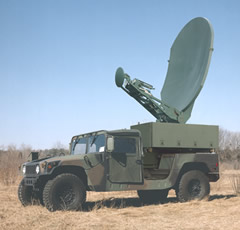
    SMART-T is a MILSTAR satellite-compatible communications terminal mounted on a High Mobility Multi-Purpose Wheeled Vehicle (HMMWV). The terminal provides voice and data communications at Low to Medium Data Rates (LDR/MDR). The terminal transmits in EHF and receives in SHF. It allows long-haul tactical communications for Digital Transmission Groups (DTG), Digital Subscriber Voice Terminal (DSVT), and individual encrypted subscribers, at data rates ranging from 75 bps to 1.544 Mbps. The terminal supports an aggregate data rate of 2240 kbps with a maximum data rate of 2400 bps for LDR communications and a maximum data rate of 2240 kbps for MDR communications. SMART-T is compact, utilizing an offset-fed Gregorian antenna with a 4.5-foot (1.4 m) composite reflector. A similar configuration, utilizing larger version (START-T) offers three-band communications capability.

    Skunk Works and XTEND Simplify Multi-Drone Command

    0
    Lockheed Martin Skunk Works® and XTEND have achieved a major milestone in JADC2 by integrating the XOS operating system with the MDCX™ autonomy platform. This technical breakthrough enables a single operator to simultaneously command multiple drone classes, eliminating the friction of mission handoffs. From "marsupial" drone deployments to operating in GPS-denied environments, explore how this collaboration is abbreviating the data-to-decision timeline and redefining autonomous mission execution.

    From Ukraine to Taiwan: The Global Race to Dominate the New Defense Tech Frontier

    0
    As traditional defense primes face mounting competition from agile “neoprimes” such as Anduril, Palantir and Helsing, the balance of innovation is shifting toward software-defined warfare and scalable, dual-use technologies, while global industry consolidation—marked by Boeing’s integration of Spirit AeroSystems and other strategic mergers—signals an intensified race to secure control over the defense technology value chain. Our Defense-Tech weekly report highlights these trends.

    Europe’s “Drone Wall”

    0
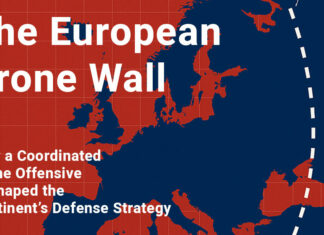
    In early October 2025, a coordinated wave of unmanned aerial system (UAS) incursions—widely attributed to Russia—targeted critical infrastructure across at least ten European nations. The unprecedented campaign exposed the fragility of Europe’s air defenses...

    Weekly Defense Update & Global Security Assessment

    0
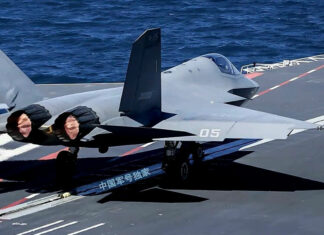
    Executive Summary The past week (September 18-25, 2025) represents an inflection point where strategic defense concepts have transitioned from doctrine to tangible reality. An analysis of global events reveals four primary, interconnected trends shaping an...

    U.S. Air and Space Forces Push Next-Gen Programs at the AS&C 2025 Conference and...

    0
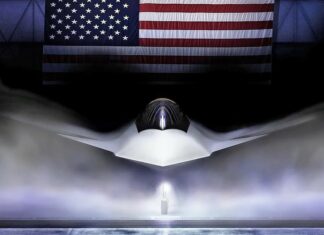
    At the 2025 Air, Space & Cyber Conference, U.S. Air Force and Space Force leaders unveiled major updates on next-generation fighters, bombers, unmanned systems, and space initiatives, highlighting both rapid innovation and critical readiness challenges as the services race to outpace global competitors. A short version is available here, with a more detailed version for subscribers.

    TADTE 2025: Reflecting Taiwan’s Strategic Themes

    0
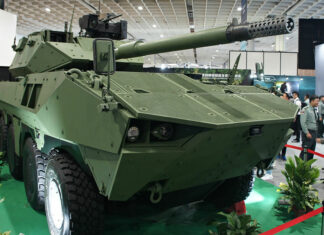
    The Taipei Aerospace & Defense Technology Exhibition (TADTE) 2025 crystallized around four dominant strategic themes that collectively illustrate Taiwan's comprehensive approach to defense modernization amid escalating regional tensions. Based on a detailed report by Pleronix (available upon request). Includes a Podcast discussion on TADTE 2025's highlighting Taiwan's four strategic themes beyond the post's coverage.

    Iron Beam 450 Completes Testing, Soon to Join With Operational Air Defense Units

    0
    Israel’s Iron Beam 450 high-power laser system has completed final testing, marking a major leap in air defense. Developed by Rafael, it offers precise, cost-effective interception of rockets, UAVs, and mortars, and is set for IDF deployment by 2025.