
Monday, December 22, 2025
More
    Home Blog Page 395

    Joint Standoff Weapon (JSOW)

    The JSOW family of precision strike weapons is a joint US Navy and US Air Force program, based on a modular design that uses a common airframe, guidance systems and flight control. The missile has a maximum range of 70 km which allows delivery well outside of the lethal range of most enemy air defenses. JSOW uses an autonomous, integrated Global Positioning System and Inertial Measurement System (GPS/IMS) navigation system. JSOW receives the targeting information in a pre-briefed mode or via targeting updates received while airborne, through onboard sensors or other third party targeting assets. After it arrives in the target area, the AGM-154C activates the IIR seeker for autonomous guidance in the terminal phase of the flight to attack with precision accuracy.
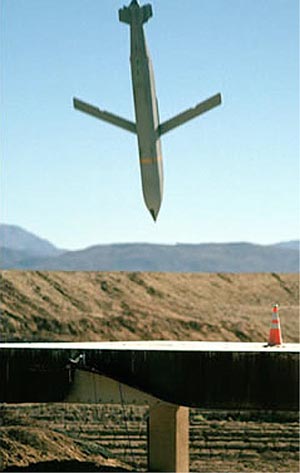
    JSOW is designed to destroy soft and hardened targets, including armored vehicles and fixed structures. The weapon has a low signature design, which contributes to high probability of survival enroute to defended targets. Two JSOW variants are currently available – AGM-154A (JSOW-A) integrates the BLU-97, Combined Effects Munitions Bomblets and the BLU-108, Sensor Fused Weapon submunitions used against area targets, armor and land combatants. JSOW-C is equipped with an imaging infrared (IIR) seeker and Automatic Target Acquisition (ATA) algorithms, providing a true launch-and-leave weapon with a demonstrated standoff range of 63 nautical miles precision strike capability. JSOW C uses the unitary blast/fragmentation Broach penetrating multi-stage warhead (also used in the Storm Shadow/ SCALP EG cruise missile) built by BAE Systems and a fuze built by Thales. JSOW-C has a unique capability for a glide weapon in its ability to attack a hardened target in a near-horizontal mode. During operational testing recently completed by the US Navy, the missile demonstrated an accuracy of four feet circular error probability (CEP), well within the 3 meter requirement. In this series of tests, JSOW C scored nine direct hits out of ten missiles launches. By December 2004 the weapon completed operational testing and is scheduled to become operational by early 2005. It is expected to become operational with the US Navy F/A-18s and on the new F-16 Block 52‘s of the air force of Poland.

    JSOW Block II, currently under development for the US Navy, has started flight testing with  initial deliveries scheduled by 2007. The improved weapon will offer lower cost and be more adaptable for future modifications. Block II has significantly reduced unit cost through airframe redesign to a major single piece, employment of less expensive components, advanced technology and a reduction in parts count. JSOW’s shelf life has been doubled, eliminating major lifecycle costs. Block II reduces the unit cost of JSOW by more than 25 percent.
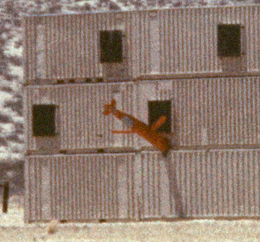
    Block II will maintain all of the standoff and survivability of the current JSOW and include an improved anti-jam Global Positioning System receiver. A new payload option for the JSOW A is also part of the Block II program. This new version uses a 500-pound BLU-111 (MK-82) warhead and is designated the AGM-154A-1. The BLU-111 variant is the lowest cost JSOW variant and eliminates unexploded ordnance concerns of cluster munitions while maintaining or increasing effectiveness against a broad target set. It is primarily intended for the international market. It is designed as insensitive munition for additional safety. Further JSOW improvements include an anti-ship version, addition of moving-target attack capability, and the introduction of a datalink for bomb-hit indication and net-centric integration.

    JSOW is currently mounted on the F/A-18, F-16 B-52 and B-2 aircraft and will soon be flying on the B-1B, and F-15E. JSOW is also a threshold weapon for the F-35 (JSF) initial operational capability. More than 400 JSOW-A weapons have been used in combat operations to date, 100 of which were fired during OIF. The missile is currently in production, for Navy F/A-18s and has been selected by Poland for use on its F-16s. JSOW A and C versions are currently in production under $200 million in contracts awarded to Raytheon by the US DOD. The contracts covers 546 JSOW-As (231 for the Navy and 315 for the Air Force) and 328 JSOW-Cs (all Navy) plus additional missiles for testing purposes. Deliveries are expected to complete by February 2006.

    Joint Light Tactical Vehicle (JLTV)

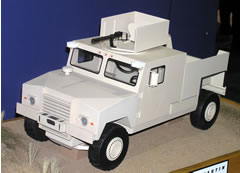
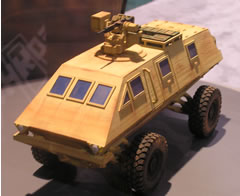
    The Office of Naval Research has selected General Dynamics Land Systems and Oshkosh Truck to build Joint Light Tactical Vehicle (JLTV) mock-ups and conceptual designs, modeling and simulation to provide tradeoff analysis for the evaluation of future development of such vehicles. Lockheed Martin introduced its team for the program in October 2006. The future family of vehicles will comprise five armored versions, ranging from infantry combat vehicles, command vehicles, reconnaissance, and armored utility vehicles. The contract was announced in August 2006 and the work is expected to be completed during the first quarter of 2007.
    Specifications defined by the services for the JLTV family of vehicles address current capabilities gaps, to increase force protection, survivability, fuel-efficiency, capacity, maneuverability and automotive safety balanced with the total cost of ownership. Vehicles also must meet current weight and dimension requirements for transportability aboard ships and aircraft. In general, JLTV is expected to provide the U.S. Army and Marine Corps with a family of more survivable vehicles and greater payload than the current HMWWV.

    The future family of vehicles will comprise five “Mission Role” variants: the Combat Tactical Variant, the Command and Control Variant, the Utility Variant, the Light Infantry Squad Carrier Variant and the Reconnaissance Variant. The vehicle family will also include compatible trailers.

    JLTV design will include a basic armor protection package as well as provisions to accommodate an additional add-on armor kit. The vehicle’s power-plant will supply power for all on-board electronic components to enable continuous network-enabled operation. The engine will provide the primary source of electrical power. The power-plant will also be required to provide external power for dismounted users, during extended silent watch. Satisfying these design issues, meeting transportability and mobility requirements, and making this an affordable family of vehicles will require the use of innovative technologies and design strategies.

    POP 200 Lightweight Modular EO payload

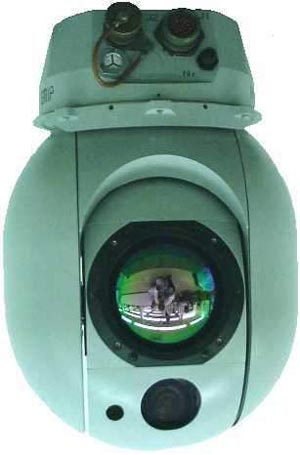
    POP is a compact, modular, lightweight EO payload system designed for a variety of surveillance and observation roles. The payload is gyro-stabilized in two axis, (pitch over yaw) and has a sensor bay that can be configured for specific mission with specially designed sensors “slices”.
    Such slices include high resolution FLIR and high magnification color CCD, laser rangefinder, target marker etc. The system has automatic or manual Iris control, gain control, and focus. It offers enhanced image processing, including correlative automatic target tracking capturing target from 3×3 pixels at 8% contrast.

    In October 2006 the US Army awarded AAI Corp. US$ 13.5 million contract for the supply of a first lot of IAI/Tamam POP-300 EO/IR payloads, to replace currently used POP-200.  A follow-on order expected in early 2007 will bring the total value of this procurement is expected to be $27 million.

    Shadow 200 Tactical UAV System

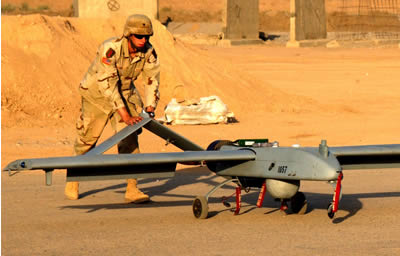
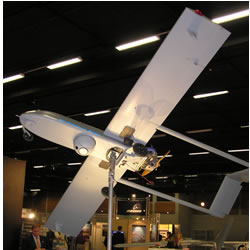
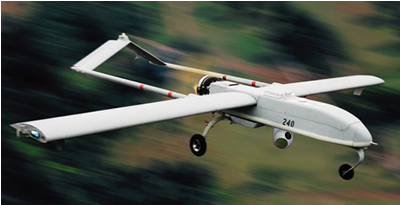
    Shaddow-200 RQ-7B Tactical UAV is used to support the brigade with integral intelligence, reconnaissance and target acquisition at distances of up to 125 km. The UAV uses the IAI/Tamam POP-200 payload, which detects and identifies targets from a range of 3-5 kilometers. It also offers automatic target tracking. With Imagery received at the Shadow’s One System ground system is shared via datalinks with other intelligence assets, including ASAS, the Air Forces’ Joint STARS, Intelligence and field artillery information systems.

    The all composite constructed Shadow 200 uses a hydraulic launcher for takeoff. The Shadow can be launched over a distance of 10 meters, and in crosswinds as strong as 20kt. Landing is performed automatically in day or night using a portable tracking system, an airborne transponder and arresting cable system. The entire Shadow unit is air transportable with three C-130 aircraft.

    The US Army plans to buy a total of 70 TUAV systems. According to planning, every brigade sent to Iraq or Afghanistan will be equipped with the Shadow. The units currently operating the TUAV in Iraq include the 4th Infantry, 1st Cavalry and 82nd Airborne and 2nd Infantry divisions and the Stryker brigades. Some units also operate the Hunter and I-Gnat UAV systems. 51 systems have already been delivered by October 2006, when the Shadow 200 fleet accumulated 129,000 flight hours, more than 85% in support of combat operations in Southwest Asia. Production is scheduled to commence through September 2008.

    In Iraq the Shadow 200 is flown by nine Brigade’s military intelligence (MI) platoons, in reconnaissance missions and in support of force protection missions, to oversee vehicle convoys. Shadow companies are deployed with maneuver brigades, including the new Stryker brigades. Although the basic system has been operating well, some improvements are already planned, including enhanced wing, which will carry more fuel, and increase endurance by 20%. The system will also get the tactical common datalink (TCDL), which will eliminate interference encountered in dense electromagnetic environments. Other improvements will improve the system’s POP200 payload, refining the target location error, and adding laser designator. The Army also considers fielding a new “Step & Stare” payload (probably L-3 11SST type) to augment the POP-200 with the capability of rapid mapping of large area. In October 2006 the US Army awarded AAI US$ 13.5 million contract for the first lot of POP-300 payloads, to replace currently used POP-200. A follow-on order expected in early 2007 will bring the total value of this procurement is expected to be $27 million.

    Since December 1999, when the U. S. Army selected AAI to be the Shadow TUAV system prime contractor, the company has received awards for the production of 64Shadow systems, bringing to 256 the total number of air vehicles ordered. As of May 2006, 43 systems have thus far been delivered, with system deliveries now extending through November 2006. On May 4th 2006 the US Army contracted AAI $87 million to deliver nine additional Shadow 200 systems under full rate production. The order covers 36RQ-7B UAVs,  18 ground control systems, This program will continue through December 2009. The company also received $65 million for technical support and logistics to be provided through October 2007.
    Unmanned & Robotic Systems at Defendory 2006

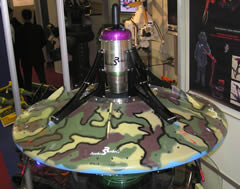
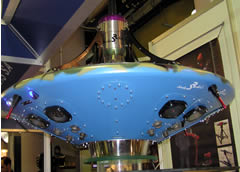
    Another view of the tethered platform from Sokus Robots

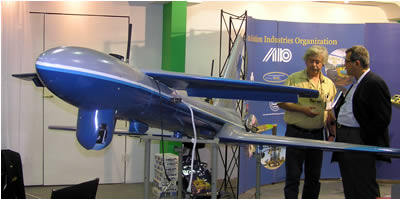
    Photo above: Iranian Ababil S

    In the UAV field, companies highlighted primarily the small platforms. The German EMT company discussed their new Fancopter , a micro UAV designed for surveillance missions in urban terrain. Other UAVs at Defendory included the Skylite B from RAFAEL, which recently made its combat debut, flown by RAFAEL’s teams operating in support of IDF ground troops during the August 2006 war in Lebanon. RAFAEL also displayed its unmanned surface vessel, the Protector.

    Tethered jet-powered platform from Sokus Robots

    Sokus Robots, a domestic producer of robotic platforms introduced several new platforms, including a lightweight weapon carrier, demonstrated with two RPG launchers and an elevated surveillance platform, utilizing a small jet turbine to keep the tethered platform in position, elevated at about 1000 meters for up to 50 hours. The platform has several windows mounting various surveillance means, providing complete hemisphere coverage. Two other UAVs represented at the show follow more traditional approaches – the Night Intruder 2, developed by Korea Aerospace Industries can carry payloads of a total weight of 45 kg on missions of nine hours and the Iranian Ababil S, (swallow) a version of the Ababil platform produced by Iran’s Aircraft Manufacturing Industry. The vehicle was displayed with a large stabilized electro-optical payload system, different from previously shown integral, blended sensors. If the Ababil actually uses this payload, it is most likely to deploy from catapult and retrieved by parachute and airbag system.

    Start < Page 8 of 8 >

    Air Defense Systems at Defendory 2006

    Based on its past commercial success in Greece, the Russian air defense display was equally impressive, including the mobile, long-range Antey-2500 and S-300PMU2 Favorit, medium-range Buk-M1-2, and short-range Tor-M1 with its modular version, and the new Pantsir-S1 air defense gun/missile system which recently won its first order, from the UAE. Also on display was the Polyana-D4M1, an automated command and control system, providing battle management integrating various types of air defense systems under a unified command and control network.

    Following the success of Tor M1 in international markets, Russia is now promoting its companion system, Buk-M1-2 medium-range air defense missile system, which is considered to be the follow-on to the ubiquitous SA-6 Gadfly. According to the manufacturer, BUk M1-2 is capable of defeating, strategic and tactical aircraft, helicopters and cruise missiles, as well as tactical ballistic, anti-radiation and air-launched missiles. The system is claimed to be resistant to electronic countermeasures and anti-radiation attack weapons. Capitalizing on the popularity of the SA-3 system, a remnant of the arms proliferation strategy of the Soviet era, Moscow is now marketing an upgrade program for the Pechora (SA-3) system.

    Start Page 7 of 8 >

    Land Vehicles at Defendory 2006

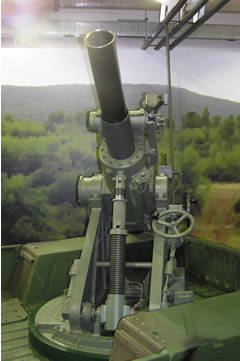
    AM General displayed at Defendory 06 two configurations of a HMMWV (Humvee). One was designed specifically for the Greek Army, with a protection suite developed and manufactured by Plasan Sasa. Two versions are produced, the standard utility vehicle and the higher version, designed to carry communications gear and provide various mobile services. The other, also an Israeli implementation, uses a flatbed version mounting a derivative of the Cardom 120mm low-recoil mortar designed by the Israeli company Soltam. The mortar uses a unique base which dampens the firing loads generated by the mortar, therefore enabling the vehicle to endure the firing without special modifications. Prior to the firing, the crew will deploy two support arms which assist with the alignment of the platform and mitigation of the firing loads.

    Greece is already operating several types of anti-tank / multi-purpose missiles, including the vehicular mounted or man portable TOW, Milan and AT-4 Spigot, but its most modern guided weapon is the AT-14 Kornet-E missiles produced by KBP. At Defendory, KBP highlighted the latest version of the Metis M1 (also known as AT-13). This portable anti-tank weapon is positioned as follow-on to the AT-4. The Kornet missiles were also displayed on a modified version of the VBL light patrol vehicle, fitted with the Kvartet four missile target acquisition/launcher system.

    Greece is also operating the Hellfire II missile with its AH-64A helicopters. Further delivery of 12 AH-64Ds is expected next year, to be augmented by anti-tank and bunker busting versions of the Hellfire II missile. The Russians also promoted rocket systems and air defense weapons, considered to be follow-on to those currently in service. Among these were Slepok-1 automated command and control system of Smerch 300 MRLS brigade. Greece is also planning to add a battalion (eight units) of self propelled truck mounted artillery guns (155mm) these vehicles will be procured in addition to the 24 PzH2000155/52 tracked SP howitzers already supplied from Germany.

    Start < Page 6 of 8 >

    Armored Fighting Vehicles at Defendory 2006

    For its ground forces, the Greek Army has started to take delivery of the first Leopard 2 HEL tanks. In addition to the 170 tanks on order, Greece will also receive six Legun bridge-layers, 12 armored recovery vehicles, supported by a comprehensive training and logistical package. Procurement of additional 26 armored recovery vehicles was also planned. The Leopard 2 HEL program contributed significantly to improve the local industry, transferring technology to some 20 industries. KMW established its Hellenic Defense Vehicle Systems (HDVS) subsidiary in Volos, for the production of armor protection, suspension systems and other components. Also in Volos, METRA is responsible for welding and machining of steel parts. ELBO SA in Thessaloniki is responsible for the integration and assembly of the tanks. Intracom is responsible for the electronics and optronics systems.

    Follow-on to the Leopard program, Greece is expected to decide on the procurement of 291 tracked armoured fighting vehicles. (Greece plans to buy Marder A3 AIFVs to be withdrawn from German Army service). The vehicles will be refurbished them with a new turret, gun and optronics. Greece is also planning to buy about 400 wheeled armoured vehicles – either 8×8 or 6×6 will be selected. The current program allocated 430 million Euros for 84 vehicles. Defendory was held at a perfect timing to shape the opinions and attitudes of top level decision makers about their forthcoming decisions about wheeled AFV programs.

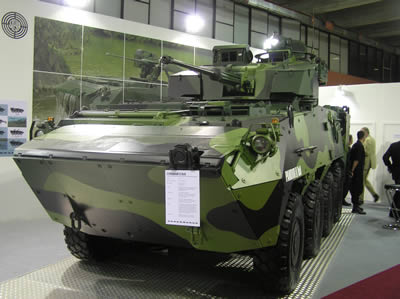
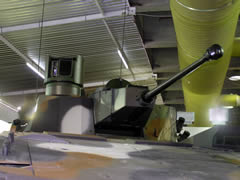
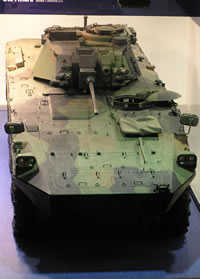
    Manufacturers of armoured vehicles brought the actual hardware to Athens, including the 8×8 version of the Pandur II, displayed by Styre, the AMV brought here by Patria and Centauro, displayed by Iveco. This program is considered to be among the largest pending procurements of 8×8 armored vehicles. Patria is well positioned to win in this market, producing AMVs to fulfil about 800 orders from Finland and Poland. By year’s end (2006) the company expects to complete production of the 200th AMV. The vehicle utilizes a uses an 8×8 chassis to support modular configurations, utilizing various levels of protection, armaments, and systems. Among these are the turreted vehicle, armed with an automatic 30mm canon, proposed for the Greek program, vehicle equipped with remotely controlled gun, self propelled dual-barrel or single barrel 120mm mortar, and other versions.

    Greece is planning to withdraw 300 BMP-1 from active service by 2007. (100 units have already been transferred to Iraq). Once these vehicles are to be transferred to another user, there may be an opportunity for their upgrade. Russia is also realizing another opportunity for the amphibious capable BMP-3F marine combat vehicle which is offered for the special operations units of the Hellenic Ground Forces. It uses a modified propulsion system to steer the vehicle afloat, climb ashore without difficulty in up to sea state 3, employ its main armament (gun and missiles) at sea state 2 and endure and travel in water for seven hours.

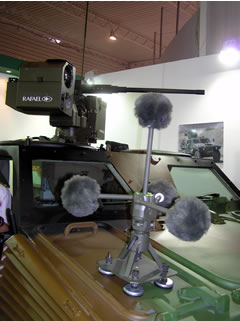
    Other procurement plans call for the acquisition of 50 amphibious assault vehicles and 209 light reconnaissance vehicles. Addressing this opportunity were KMW, with the Fenek, and Panhard, with the VBL, which is already in use with the Hellenic ground forces. In recent months Fenek has been deployed to Afghanistan where it was demonstrated as effective and capable of performing tough missions in extremely difficult terrain. VBL was displayed here in two configurations – an anti-tank missile carrier, fitted with the Russian Quadrat missile launcher, firing the KBP Kornet E anti-tank missileand the light patrol vehicle, equipped with RAFAEL’s mini Samson remotely controlled weapon station and acoustic gunshot detection system.

    Start < page 5 of 8 >

    Aerospace Systems at Defendory 2006

    For obvious reasons, combat aircraft and advanced trainers were among the show’s highlights. For the fighter program, General Dynamics, with the F-16 Block 52, Dasault Rafale and Eurofighter Typhoon are offering their aircraft to fulfil the Greek requirement. Lockheed Martin and Dassault also hope to gain more, and offer considerable cooperation for local industries, participating in upgrading of Mirage 2000 and F-16s currently in service. Upgrade programs of both platforms are currently underway but future upgrades are currently funded only for the F-16s.


    Addressing the Greek interest in an advanced trainer to replace the ageing T-2E (Buckeye), the Italian Aermacchi already secured close cooperation with Hellenic Aerospace Industries (HAI) for cooperation on the M346 program. BAE systems is also a strong contender, being able to an attractive integration between the Hawk and future Typhoon programs. Other trainers displayed here included the Russian Yak-130, Aero L-159 from the Czech Republic and Golden Eagle T-50 pitched by a joint venture between Lockheed Martin and Korean Aerospace Industries (KAI).

    Acquisition of NH-90 helicopters, assault, configured for special operations and combat, search and rescue roles is also underway. Among the 20 NH-90s recently ordered from Eurocopter, four are configured for special operations; another four will be used for combat search and rescue and medical evacuations. Also on the Greek shopping list are three SH-70B and eight new (yet unspecified) transport helicopters. 12 C-27J medium transports are on order. The total cost of all aerospace systems is well over 5 billion Euros. Upgrading the current fleet of F-16 Block 30/52 is also included in the program.

    The multi-year plan includes support for several programs based on unmanned systems. Funding of 100 million Euros is allocated for an unspecified Unmanned Combat Aerial Vehicles (Greece is supporting the French-Swedish Neuron UCAV program). The Greek army also plans to improve its air defense suppression capability by acquiring more anti-radiation missiles and EW capable UAVs designed for SEAD missions. Self protection capabilities will also be improved, with installation of better ECM and decoys with to all helicopters, and transports. The Hellenic Navy is also planning to modernize its maritime patrol capabilities, with the introduction of five new maritime patrol aircraft.

    Start < Page 4 of 8 >

    Naval Defense Systems at Defendory 2006

    Part I – Part II

    At Defendory 2006 Lockheed Martin displayed their Evolved Sea-Sparrow and advanced versions of SM-2 while MBDA discussed weapon suite for the FREMM, comprising of Aster-30 missiles, offering both anti-aircraft and ballistic missile defense. An offensive weapon option provided by the FREMM will be the deployment of SCALP Naval cruise missiles, these are naval variants of the Storm Shadow air launched cruise missiles, designed for vertical launch from ships. Self protection for naval ships was also a hot topic. Rheinmetall Defence introduced here a new and unique array of weapons, sensors and countermeasures designed to offer a vessel at sea or in harbour an effective protection suite addressing all types of threats. The system comprises the FIRST infrared scanner, which provides real-time early warning of any threatening event, detected by its infrared imaging sensor over 360 degrees.

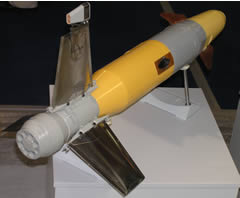
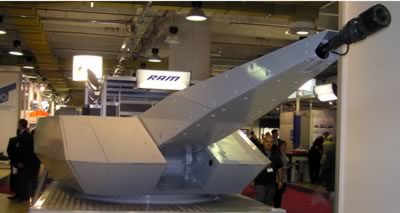
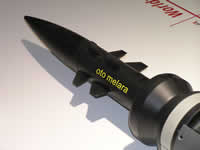
    Naval surface ships operating in littoral area are required to engage land targets with precision and lethality comparable to modern aircraft. Such effects cannot be achieved with conventional ammunition and therefore, require more advanced weaponry, including guided missiles and ammunition. At Defendory 2006, Finmeccanica displayed some of the concepts currently under development at Oto Melara. These include a range of heavy (127mm), medium (76) and small caliber gun turrets (40mm and below) designed specifically for surface combatants. Two types of guided munitions were on display, the Davide RF guided projectile, designed to engage aerial targets, including incoming missiles, by 76mm/62 caliber guns and the Vulcano precision guided munitions for the 127mm naval gun.

    Start < Page 3 of 8 >

    Naval Highlights at Defendory 2006


    Part I – Part II

    The biggest investments under the Hellenic government EMPAE multiyear defense program are the construction of six new air-defense frigates, (three are funded in the current multi-year program) as part of a 2.2 billion Euro program. More vessels will be bought to improve coastal defense, and maritime control across the Greek archipelago. These include a command and support landing ship, general support ship, gunboats, fast patrol (missile) boats, mine-hunters, and amphibious assault vehicles. To maintain the Hellenic navy readiness and capabilities until the new frigates are commissioned, the navy is upgrading its existing fleet of 10 “S” class ex-Dutch navy frigates. The first ship to undergo this modernization phase was handed over to the Hellenic Navy on September 12,2006. Six ships will be upgraded until 2009, introducing a modern tactical weapons, communications, navigation and propulsion systems.

    The Hellenic Navy ordered four Papanikolis Type 214 submarines from Germany, with the lead ship expected to be delivered soon. Class U 214 submarines are based on construction principles known from U 209. But U 214 was improved by incorporating the innovations of U 212A class, produced for the German Navy, principally the unique air-independent fuel-cell propulsion system. This provides extremely increased underwater endurance.

    In February 2000 the Hellenic Navy was the first foreign navy to order fuel-celled U 214 submarines. Greece is already operating eight type 209 submarines; three of them are being refitted with air independent propulsion (AIP) systems, under the Neptune II program. The upgrading program is conducted by the Hellenic Shipyards. Type 214 submarines for the Hellenic Navy will be armed with the WASS (Whitehead Alenia Sistemi Subaquei) Black Shark heavyweight torpedo. The Black Shark is a dual purpose, wire-guided torpedo which is fitted with Astra active / passive acoustic head and a multi-target guidance and control unit incorporating a counter-countermeasures system. It has an electrical propulsion system based on a silver oxide and aluminum battery.

    The leading European shipbuilders were prospecting on the new air defense frigate program and its armament suite. These included the German Blohm & Voss, one of the leading contenders for the program, the Dutch Royal Schlede, the producer of the S class frigates, currently in Greek service, and French shipbuilder Armaris, which has proposed Greece to participate in the Franco-Italian FREMM AAW Frigate program. The FREMM is in production for the French and Italian Navies.

    While Germany has established its foothold in Greece, producing submarines and investing in local shipbuilding infrastructure, the French consortium has yet to penetrate the local market. Both Armaris and Royal Schelde are also pursuing the Hellenic Navy command and landing support vessel, with platforms previously produced for French, Italian and Dutch navies. As decision on the platform is yet to be made, significant effort is made by the producers of combat systems, primarily air defense missiles, which will be the primary weapons for the new frigates.

    Among the naval systems presented by the Russians were the Zubr air-cushion amphibious landing crafts, and the smaller, Project 12061 Murena landing assault air cushion craft. The manufacturer claims that joint employment of the two vessels increases combat manoeuvrability and survivability of naval forces. Russia is also offering its diesel electric powered missile carrying submarines. Two versions are currently offered. Amur-1650 and Amur-950 class submarines. Both can be equipped with the Club submarine-launched cruise missiles. These missiles can be deployed from surface ships (Club N) and submarines (Club S) targeting strategic naval or land-based, radar definable targets which can be defined by their radar signature.

    Start < Page 2 of 8 >

    Defendory 2006 Exhibition Highlights

    The Hellenic ministry of Defense is funding a defense modernization program at a cost of some 22 billion Euros, under the multi-year Unified Mid-Term Armaments Development Program (EMPAE). Refreshed every five years, the current program covers arms procurement over a period of ten years (2006 – 2015). The largest items on the list are the procurement of three new frigates, 40 new fighter aircraft, advanced trainers, hundreds of new armoured vehicles, a spy satellite and associated intelligence facilities. Defendory International 2006 provided the arena for international arms suppliers to address these plans, although based on past experience it is unclear how much of these hyped plans will actually be implemented.

    In the following pages Defense Update covers the various highlights of Defendory, related to:

    Start < Page 1 of 8 >

    Shared Reconnaissance Pod (SHARP)

    The US Navy Shared Reconnaissance Pod (SHARP) system is the primary tactical reconnaissance system deployed by US Navy carrier Air Groups. SHARP replaces the current Carrier Air Wing tactical reconnaissance capability provided by the film-based F-14 TARPS (Tactical Air Reconnaissance Pod System). Fleet introduction of the SHARP system on the F/A-18F Super Hornet began with early operational capability on the USS Nimitz (CVN 68) in 2003. Recently, the pod has been successfully flown as part of a rapid-deployment initiative in support of fielded operations.

    Raytheon is enhancing the US Navy Shared Reconnaissance Pod (SHARP) system with a new target cueing system. The new feature is designed to reduce the workload of image analysts. With the TCS upgrade, the system’s tactical imaging sensor will deliver more refined information to the image analyst. By reducing the amount of manual labor required of the analyst to make identifications, specific targets can be more quickly located and action taken. Under the contract, Raytheon Technical Systems will manage all aspects of the TCS program, including selection and acquisition of the sensors, design integration, manufacture of an upgraded pod design, and coordination of flight testing for the system on an F/A-18E/F aircraft.

    The SHARP pod incorporates a rotating mid-section to optimize coverage, to protect the window by allowing stowage under the strongback, and to reduce the size and life-cycle expense of large fixed windows. The pod’s design also provides mobility — it mounts on a bomb rack like a smart weapon — allowing for more flexibility in reconnaissance mission planning. Although the initial systems employ electro-optical/infrared sensors for use on the F/A-18E/F aircraft, the pod design is readily adaptable to many sensor payloads on a wide range of aircraft.

    FAB-T – Family of Advanced Beyond-line-of-sight Terminals

    FAB-T is designed to provide strategic forces with a multi-mission capable family of software-defined radios that use a common open system architecture to link to different satellites and enable information exchange between ground, air and space platforms. The system will be capable of hosting a multitude of waveforms that accommodate data rates in excess of 300 megabytes per second. FAB-T is designed to become the first survivable Software Communications Architecture (SCA)-compliant communications system.

    SCA Compliance enables the system’s waveforms to be ported to other SCA-compliant radios and for FAB-T to host waveforms developed for other systems. The initial development phase involves creating a FAB-T system that will fulfill operational terminal requirements for the Milstar and Advanced EHF satellite systems. Increment 2 will develop terminals to support Wideband Gapfiller System operations on surveillance aircraft including Global Hawk and Predator, with other platforms to follow.

    Boeing reported that the system passed a preliminary design review in October 2006.

    Skunk Works and XTEND Simplify Multi-Drone Command

    0
    Lockheed Martin Skunk Works® and XTEND have achieved a major milestone in JADC2 by integrating the XOS operating system with the MDCX™ autonomy platform. This technical breakthrough enables a single operator to simultaneously command multiple drone classes, eliminating the friction of mission handoffs. From "marsupial" drone deployments to operating in GPS-denied environments, explore how this collaboration is abbreviating the data-to-decision timeline and redefining autonomous mission execution.

    From Ukraine to Taiwan: The Global Race to Dominate the New Defense Tech Frontier

    0
    As traditional defense primes face mounting competition from agile “neoprimes” such as Anduril, Palantir and Helsing, the balance of innovation is shifting toward software-defined warfare and scalable, dual-use technologies, while global industry consolidation—marked by Boeing’s integration of Spirit AeroSystems and other strategic mergers—signals an intensified race to secure control over the defense technology value chain. Our Defense-Tech weekly report highlights these trends.

    Europe’s “Drone Wall”

    0
    In early October 2025, a coordinated wave of unmanned aerial system (UAS) incursions—widely attributed to Russia—targeted critical infrastructure across at least ten European nations. The unprecedented campaign exposed the fragility of Europe’s air defenses...

    Weekly Defense Update & Global Security Assessment

    0
    Executive Summary The past week (September 18-25, 2025) represents an inflection point where strategic defense concepts have transitioned from doctrine to tangible reality. An analysis of global events reveals four primary, interconnected trends shaping an...

    U.S. Air and Space Forces Push Next-Gen Programs at the AS&C 2025 Conference and...

    0
    At the 2025 Air, Space & Cyber Conference, U.S. Air Force and Space Force leaders unveiled major updates on next-generation fighters, bombers, unmanned systems, and space initiatives, highlighting both rapid innovation and critical readiness challenges as the services race to outpace global competitors. A short version is available here, with a more detailed version for subscribers.

    TADTE 2025: Reflecting Taiwan’s Strategic Themes

    0
    The Taipei Aerospace & Defense Technology Exhibition (TADTE) 2025 crystallized around four dominant strategic themes that collectively illustrate Taiwan's comprehensive approach to defense modernization amid escalating regional tensions. Based on a detailed report by Pleronix (available upon request). Includes a Podcast discussion on TADTE 2025's highlighting Taiwan's four strategic themes beyond the post's coverage.

    Iron Beam 450 Completes Testing, Soon to Join With Operational Air Defense Units

    0
    Israel’s Iron Beam 450 high-power laser system has completed final testing, marking a major leap in air defense. Developed by Rafael, it offers precise, cost-effective interception of rockets, UAVs, and mortars, and is set for IDF deployment by 2025.