Tuesday, December 23, 2025
More
    Home Blog Page 413

    X-Tar 3D – Air Surveillance & Tracking Radar

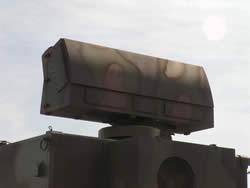
    X-TAR 3D radar

    Orlikon Contraves unveiled the X-Tar 3D radar, which completed development recently. The new radar is proposed as a primary sensor for German and Canadian tactical air defense systems. Following the testing phase scheduled for 2006, the radar will be ready for production by early 2007.

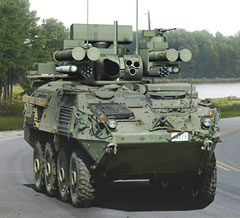
    X-TAR 3D radar on the MMEV

    The development of X-Tar 3D follows several generations of search and acquisition radars developed by Oerlikon Contraves. A fully coherent I-band pulse Doppler radar, X-Tar 3D provides an effective early warning for associated weapon systems, cueing accurate three-dimensional data for target engagement. It has track while scan, target classification and automatic threat evaluation and integrated IFF providing complete local air picture.

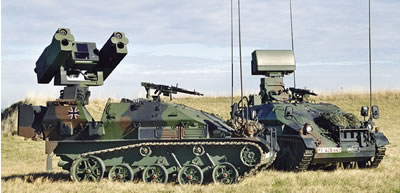
    The new radar is optimized for the detection and automatic tracking of highly maneuvering air and surface targets, and can operate in dense ECM environment. The radar is available in Short, Medium and Long range configurations. When integrated into a VSHORAD command post, X-Tar 3D-S and M versions provide 25 – 30 km detection ranges and are optimized as a primary sensor for guns and MANPADS effectors. The X-Tar 3D-L version is optimized for the SHORAD mission, covering a range of 45km. X-Tar 3D is expected to be included in the German SysFla project (below) and the Canadian MMEV program.

    X-Tar 3D - Air Surveillance & Tracking Radar as part of LEFLASYS-KL

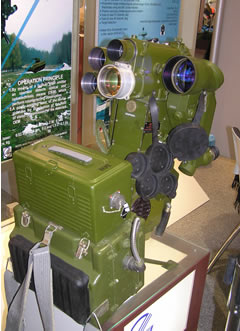
    PAPV Counter-Optical System – Portable Laser Countermeasure

    The Portable Laser Countermeasure System known as PAPV, developed and produced by the Russian Nudelman Precision Engineering design bureau. The system weighs 56 kg, yet, is considered “portable”. The system enables performs detection and neutralization of snipers, and performs as an EO countermeasure unit against combat systems equipped with electro-optical devices such as tanks, attack helicopters etc. The PAPV system uses a low-power laser (2W) to detect EO systems. When located, the system transmits a more powerful laser pulse (1.5 Joul at the 1.06 micron or 0.2 Joule in the 0.53 micron wavelengths) to blind and disrupt the optical system. The system operates at ranges from 300 to 1,500 meters.

    Microlight – Miniature Modular Software Defined Radio (SDR)

    Microlight is a hands-free Software Defined Radio (SDR) designed as a miniature set, fitting a small form factor typically required for dismounted infantry operations, unmanned systems, remote sensing platforms and expendable weapon datalinks. When networked in a given area, Microlights establish ad-hoc, self healing network for high reliability and availability networking.

    This lightweight radio (weighing only 250-500gr.) is available as a portable radio (MLP) or Data-Link (MLD) configuration, providing IP compliant connectivity to support voice, video (via up to 1 Mbps packetized imagery) and data transfer. The radio enables simultaneous tracking of the position and location of all network nodes. Microlight operates at the 420-450 UHF band utilizing waveforms for interoperability with various data networks including JTRS, EPLRS UAF and SRW as well as the US Air Force Situational Awareness Data Link (SADL).

    Microlight is introducing a new class of flexible radio that provides secure voice and data communications, critical position, location, tracking and information to enable “situational awareness” for networked users. To provide such service, Microlight automatically locates users, giving commanders the ability to know where their people are at all times.

    RobuROC – All-Terrain Robotic Platform

    RobuROC was developed as part of the DGA robotics program. Two versions of RobuROC robots are also available, in 4×4 and 6×6 configurations. RobuROC 4 is an outdoor mobile platform weighing 140 kg. It is equipped with four independently driven wheels, powered by four DC motors. The six-wheeled RobuROC 6 weighs around 130kg. Both vehicles carry a payload of about 100kg.

    The platform is comprised of three two wheel pods, enabling rapid movements (up to 3 – 5.5 m/sec). Each pod is capable of withstanding tilt and roll of +/- 30 degrees without overturning. It also enables the vehicle to move across obstacles such as steps, debris or gaps larger than the wheel diameter. Another advantage of this design is the high stability the vehicle keeps when moving in harsh terrain – when one the front element of the robot goes up, the rocker system automatically reduces the height of the rear element, thus reducing the load on each wheel and maintaining a low center of gravity.

    RobuROC is powered by three Li-ION battery packs. It is controlled by a cb555 (Motorola SMPC 555) controller, running embedded emPC555 Linux PC and iCORE technology.

    Multi-Purpose Combat Vehicle (MPVC)

    Developed under a joint venture between MBDA and Rheinmetal Defense Electronics (RDE) Multi-Purpose Combat Vehicle (MPVC) addresses emerging European requirements for highly mobile weapon system, which can be adapted for different missions, especially air defense and anti-armor or anti-bunker missions. The MPVC demonstrator shown at Eurosatory was mounted on a Panhard General Defense VBR 4×4 light armored vehicle. The system utilizes an automated turret mounting the missiles and machine gun used for self defense and a fire control system with an electro-optical sensor suit. The turret uses a stabilized EOSS day/thermal sensor suite integrated with laser rangefinder, developed by RDE. The turret can mount Mistral missiles for the air defense role and Milan guided missiles, for the anti-tank /anti-bunker missions. MPVC can operate autonomously; acquiring targets at ranges up to 10km, or operate in a networked environment, sharing target data and situational picture with other combat elements.

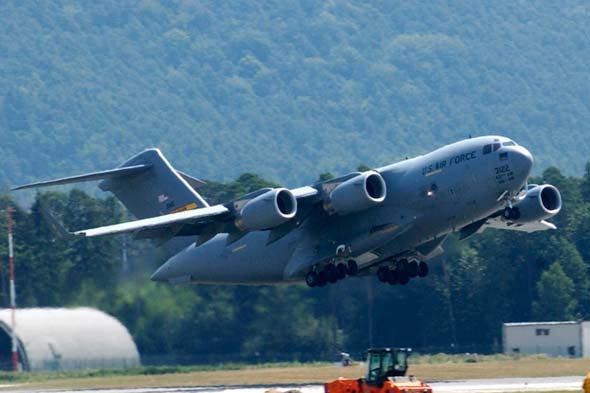
    C-17 Globemaster III – Strategic Airlift Transport Aircraft

    Boeing's C-17 Production Line at Long Beach is expected to takes off again, producing at least ten Globemaster III heavy lift jets for India. Photo: Boeing

    Photo: Boeing

    After receiving the last orders from the US, UK and Australia, due for delivery in the next few years, Boeing is preparing to shut down production by 2009. The company is pressing the U.S. Government to commit to continued C-17 procurement to sustain future production. As these commitments did not come, Boeing alerted its suppliers to stop working on uncommitted airplanes.

    According to the company, Boeing kept the production line “live” for several years, anticipating further orders as it expected the U.S. Government to update its mobility requirements after 9/11 and the Afghanistan and Iraq wars. In this period Boeing did receive international orders and commitments for more than a dozen of the advanced air lifters, enough to support production through 2009. “The C-17 is one of the Defense Department’s most successful acquisition programs ever,” said Ron Marcotte, vice president and general manager of Boeing Global Mobility Systems. “No one questions its operational value. But we can’t continue carrying the program without additional orders from the U.S. Government.” The stop-work orders affect long-lead items from suppliers that, in many cases, are built 34 months before a C-17 is delivered. The decision will ultimately affect the 5,500 Boeing jobs in California, Missouri, Georgia, and Arizona, directly tied to the C-17, and the program’s nationwide supplier workforce that totals more than 25,000 people. Nearly 700 companies in 42 states provide parts and services that go into each C-17.

    The US Air Force reduced its C-17 Globemaster III procurement from 222 to 180. Britain has four and will get an additional aircraft. Australia and Canada are buying four aircraft each. Three additional aircraft are planned for procurement to compensate for attrition, but these are not yet committed. The US Congress and Senate have allocated funding to buy 42 additional aircraft, bringing the total fleet to 222, as previously planned but the US. Air Force is not pursuing the acquisition.
    NATO Plans Strategic Airlift Capability Based on C-17s

    Following six months of negotiations, NATO released an official Letter of Intent (LOI) endorsed by 13 NATO Allies, to launch contract negotiations for the purchase of C-17 transport aircraft. NATO Maintenance and Supply Agency (NAMSA) has begun negotiations with Boeing. The SAC planes will be configured in the same way as the C-17s flown by the US Air Force and the UK Royal Air Force The air crews will be trained to the same basic standards, including air-to-air refueling and night vision operations.

    NATO is planning to establish a “Strategic Airlift Capability (SAC)” based at Ramstein Air Force Base in Germany. The force will initially comprised of 3 to 4 C-17s, flown by multinational aircrews (pilots and loadmasters). Membership in the airlift fleet remains open to other nations, and some additional nations are considering joining. A multinational military structure will be created to command and control the aircraft. The first C-17 is scheduled to be delivered by the middle or end of 2007. Additional planes will be delivered every six months, reaching an initial operating capability by 3rd Quarter, 2007 and full operating capability in 2009. NATO is already operating the SALIS (Strategic Airlift Interim Solution) arrangement, utilizing chartered An-124 aircraft.


    SLD500 Sniper Locator

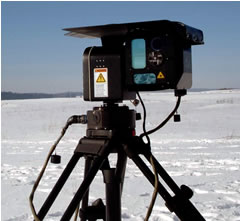
    CILAS introduced at Eurosatory 2006 the SLD-500, a new electro-optical sensor system, designed for area surveillance and sniper detection. The new system is a follow-on to the operationally successful SLD 400 Laser Sniper Detector, enhancing the sniper location capability with surveillance functions, the system can detect and locate any kind of optical sight systems: optical scopes, cameras, binoculars etc. The system uses a wide angle coded laser beam to illuminate the sector to be searched. SLD500 sensors will accurately localize a threat and perform target identification by spotting the laser reflected from the optical elements of the weapon’s sights, using high definition daylight or infra-red cameras. The system can also be used for crowd surveillance or battlefield monitoring, allowing efficient response from police or military forces. A laser pointer, range finder, compass and inclinometer complement the system providing target designation and localization. The system is currently in evaluation within the French Army.

    The system can be linked to an array of acoustic sensors to form a multi-sensor detection system. The system can be fitted on a fixed mount, on a tripod or on a vehicle. Laser scanning can be performed manually or automatically, while the optronic head is in motion. Fixed on a turret, the system automatically scans the field and detects any person using a sight. Images are automatically post processed by a dedicated computer which automatically displays the coordinates and a view of the threat localization in a panoramic picture of the scene. Optional features include remote broadcast unit, enabling an intervention team to see in real time the view available from the main control unit, an infrared camera for night vision and GPS.

    UCS – Advanced Multi-Unmanned Aerial System’s Cockpit

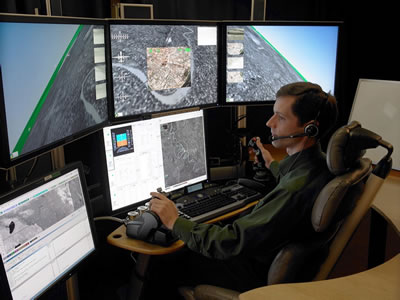
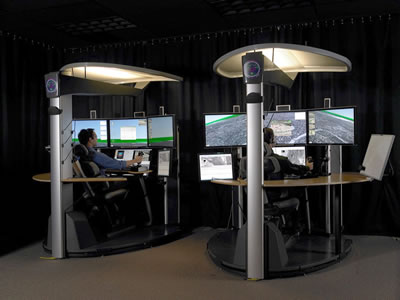
    A new “cockpit” designed specifically for UAV pilots unveiled yesterday by Raytheon promises to improve operational efficiency and flight safety of unmanned aerial systems. The new cockpit, called Universal Control System (UCS) is designed to simplify control of multiple unmanned aerial systems, by improving situational awareness and ability to control multiple unmanned platforms. The system uses open architecture to control multiple platforms and sensors utilizing STANAG 4586 compliant systems, configured as a ground based “glass cockpit”. Raytheon is confident that the new cockpit can improve the flight safety of unmanned systems, particularly of piloted UAVs such as the USAF Predator.


    A 2004 study by the Federal Aviation Administration, “A Summary of Unmanned Aircraft Accident/Incident Data: Human Factors Implications,” stated that ” … a common theme across many of the mishaps reported involved a problem with the command interface to the system.” The study also noted that “In the systems analyzed, human factors issues were present in 21 percent (Shadow) to 67 percent (Predator) of the accidents. The report recommended that “human factors issues … can be identified and addressed.” Raytheon is addressing this issue with the Universal Control System (UCS), promising to improve operational efficiency and flight safety of unmanned aerial systems by improving situational awareness and ability to control multiple unmanned platforms.

    “Aircrews today need UCS superior control interfaces and situational awareness, which will dramatically improve the combat effectiveness of pilot and sensor operators,” said Michael Keaton, former commander of a U.S. Air Force Predator squadron who is now working for Raytheon. “We developed the essential tools and technology needed to bring UCS to fruition, and I believe this is the only UAS control system on the market designed specifically around the operator to enhance combat operations.”

    “We broke down the operator’s tasks and objectives and constructed a system built entirely around them, rather than building the system around the air vehicle first, without input from the operators. Improvements included adding a wrap-around display to enhance operator effectiveness” Says Mark Bigham, business development director for Raytheon’s Intelligence and Information Systems. “We wanted to put operators in the UAS ‘cockpit’ virtually and dramatically enhance their situational awareness. UCS operators will have better situational awareness than any manned platform, which dramatically improves safety.”

    Leveraging the investments made in advanced gaming technologies Raytheon’s UCS uses an intuitive interface, enabling effective learning and reduced training requirements mastering UAS missions. Raytheon designed and developed the UCS to meet operator demands and decrease human factors issues when operating a UAS. The enhanced operating system addresses ergonomic concerns and caters to the needs of the operators to help them perform their jobs more effectively.

    In addition, the system gives the operator the option of standing or sitting and provides flexibility in controlling multiple functions. Moreover, the technology provides a safer work environment for operators, keeping their minds more focused to perform their missions more effectively and safer. The UCS system can control multiple dissimilar UASs simultaneously, using software designed and developed by Raytheon.

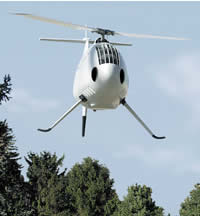
    Camcopter S-100 VTOL UAV from Schiebel

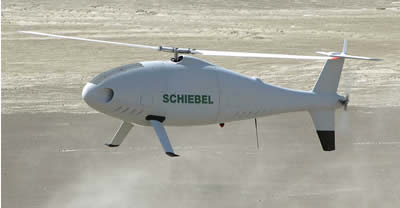
    Schiebel S-100

    S-100 UAV System has been developed to carry various sensors for both military and civilian applications. The UAV can be launched automatically performing Vertical Take Off and Landing (VTOL), eliminating the need for special equipment and preparations at the launch and recovery sites. The helicopter navigates by following preprogrammed GPS waypoints, it can also be operated manually by the pilot. The fuselage is constructed of carbon-fiber monocoque providing maximum capacity for a wide range of payload/endurance combinations.

    The Unmanned Research and Technology center (UAVRTC) at the United Arab Emirates (UAE) has ordered 40 Al-Saber UAV systems (Austrian made Schiebel S-100), each comprising of two unmanned helicopters and a ground station. In March 2006 Al-Saber UAV completed acceptance tests in the UAE, where it met all performance requirements, including flying at an altitude of 13,000 feet (3,962 m’) with almost full gross weight. Airspeeds in excess of 100 knots (185 km/h) were demonstrated, with mission endurance of six hours carrying a 25kg payload. The trials were conducted at average temperature of 35˚C deg. and surface winds of 25 knots.

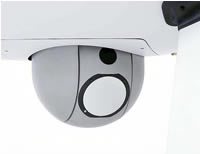
    POP EO Payload on the Camcopter

    When performing security missions, Al-Saber UAVs will be equipped with a stabilized gimbal, based on the IAI/Elta POP-300 day/night payload, fitted with daylight and night thermal observation equipment. The payload is installed in a primary payload bay, which is configured to carry loads of up to 50 kg. The helicopter can also mount an additional forward looking camera for pilot orientation. The UAV can also accommodate other payloads, including multi-spectral sensors,Synthetic Aperture Radar (SAR), Laser Imaging radar (LIDAR) and Ground Penetrating Radar (GPR).

    The unmanned helicopters will be used for military and security operations, providing ground and maritime surveillance missions. The Emirate’s expanding UAV strategy now comprises several programs, including the South African Denel Seeker UAV, and the CybAero Apid 55, from Sweden, which will be locally assembled in the UAE. Parts of the fuselage of the Al-Saber UAV will also be produced in the UAE, at a new production facility Schiebel constructed here. UAVRTC is cooperating with South Korean expert Uconsystem, to develop a common ground control station to support all UAVs.

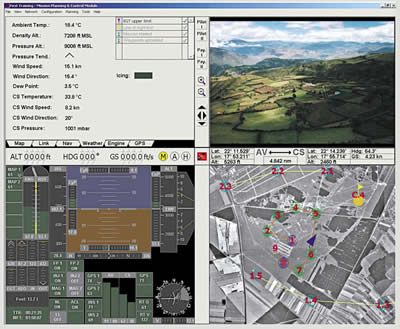
    S-100 Camcopter remote control mission display

    Bright Onyx – active multi-spectral chemical sensor

    Akamai Physics Inc., a New Mexico based company will develop a lightweight, compact sensor to enable the U.S. government to monitor ships inbound to United States ports in an attempt to detect traces of chemical substances related to Weapons of Mass destruction (WMD).

    The sensor, known as Bright Onyx, will use an active multi-spectral chemical sensor, operating in the 5-um region. It will operate on an Unmanned Aerial Vehicle (UAV) and will enable detection of substances at a sensitivity 10ppm*m from the UAV cruising altitude and speed. The Bright Onyx development is expected to be completed by June 2008. the program is managed by the U.S. Air Force under a $10 million contract.

    MMSR – SYDERA Counter-Mine System

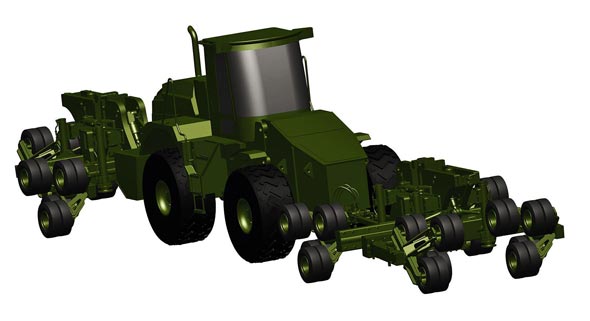
    Developed under cooperation between Rheinmetall Defense, MBDA and Thales, the Franco-German MMSR-SYDERA consortium is developing a system consisting of various vehicles for detecting and detonating landmines and IEDs.

    MMSR SYDERA program will demonstrate how a single system can create a mine-free path as well as clearing a large area, such as an airfield, from hazardous mines. The demonstrator has been completed and is ready to begin trials in Germany, with operational evaluation planned for 2007. Full scale development is expected to start in 2009.

    The system will include five vehicles. The command and control vehicle (CCV), developed by Thales, will be traveling behind the group, remotely controlling the system’s decoys, and counter-mine vehicles traveling in front. These will include MBDA developed Smart Decoy Vehicle (SDV) and Heavy Decoy Vehicle (HDV), based on the SOUVIM-2 currently operational with the French Army. SDV travels at 20 kph, detonating all types of non-pressure sensitive mines. The HDV will be an articulated vehicle, specially designed to clear pressure-sensitive mines covering routes up to 4.5 meters wide. The system will also comprise two unmanned systems developed in Germany by Rheinmetall Land Systems – the Detection Vehicle (DEV), Verification Vehicle (VEV) clearing the

    HERTI Autonomous UAV

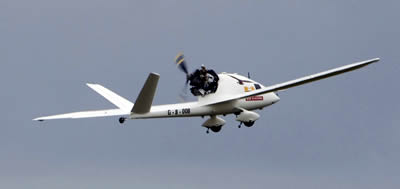
    Developed by BAE Systems, the air platform known as HERTI is one of a new generation of UAVs suitable for both military and commercial operations. HERTI can take off, complete a full mission and land in fully autonomous mode of operation.

    When coupled with BAE System’ Imagery Collection & Exploitation (ICE) system, the aircraft can provide imagery and intelligence collection services maritime, coastline and border surveillance as well as showing broader potential for areas such as pipeline, plant and infrastructure surveillance.

    A concept demonstrator system was first flown in December 2004 using off the shelf systems, power-plants and ground stations, developed for other BAE Systems UAV programs. At Farnborough 2006 BAE displayed a production configuration of the vehicle. HERTI was also demonstrated at the UK MOD’s Coalition Warrior Interoperability Demonstration (CWID) at Portsdown in June 2006, where the system demonstrate its ability to integrate with the networked environment, supporting the generation of a single integrated surface picture by multiple, networked sensors. In September, 2006 the Royal Air Force’s Air Warfare Centre Unmanned Air Vehicle Battlelab (AUB) launched a joint project with BAE systems, to test the HERTI in various military exercises over a two-year period.

    Protector Unmanned Surface Vehicle

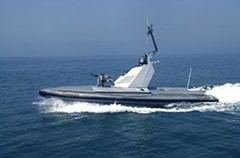
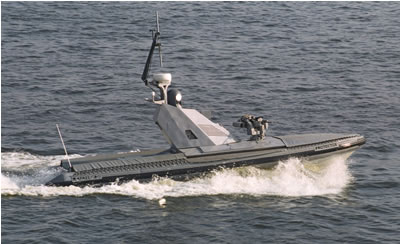
    Protector is a remote-controlled Unmanned Surface Vehicle (USV) equipped with a stabilized mini-Typhoon weapon system (MK 49 Mod 0), cameras, radar equipment and electro optics. Highly autonomous, the Protector can successfully operate with general guidance from a commander and operator in port, riverine, harbor and coastal waterways – making it an innovative solution for today’s critical missions, including force protection, anti-terror, and surveillance and reconnaissance. The Protector was developed by Rafael in response to emerging terrorist threats against maritime assets, and is the only operational USV that exists today.

    In 2006, BAE Systems and Rafael are teamed for product production and all other program developments with Lockheed Martin leading the Protector team for Littoral Combat Ship and Deepwater programs and Combat System integration efforts. According to Steve Kelly, director of BAE Systems Naval Systems in Minneapolis, “The Protector has performed exceptionally well in the Persian Gulf and Mediterranean,” said “This system is ready and available today to meet the needs of our maritime security and defense forces.”

    The Protector will provide Sailors with the capabilities they need to complete their missions more efficiently. The Protector can be the first line of defense, checking-out vessels of interest at arm’s length, while our personnel and capital assets are held at a safe distance.”

    In August 2006 the Israeli Protector Unmanned Surface Vehicle (USV) has arrived in the U.S. , to take part in a series of demonstrations for the U.S. Navy, Coast Guard and other maritime security agencies. The main advantage of the system is its flexible configuration ability, accommodating mission specific modules, while preserving speed, stealth and maneuverability. RAFAEL, the developer of the Protector is cooperating with BAE Systems, and Lockheed Martin to pursue business opportunities in North America. Protector has been demonstrated in service with navies in Asia, Persian Gulf and the Middle east. The Protector USV was featured at the U.S. Special Operations Command trade show in Tampa Bay, Fla., in June, and will be demonstrated in Little Creek, Va, San Diego, and Washington, D.C. in the coming months.

    WGS – Wideband Gapfiller Satellite

    Boeing will build three Block II Wideband Gapfiller Satellites (WGS) for the U.S. Air Force MILSATCOM Systems Wing. The Block II satellites will be similar to the three Block I satellites already in production. The 13-kilowatt WGS satellites are based on Boeing’s 702 bus, utilizing digital signal processors and phased array antennas. The first WGS satellite is scheduled for launch in 2007. The initial Block II will be ready for launch by the first quarter of 2011 and subsequent launches every year thereafter. WGS will augment and eventually replace the DSCS currently on station. The total value of the three satellites could sum at $1.067 billion.

    Under Block II, Boeing will add a radio frequency bypass capability designed to support airborne intelligence, surveillance and reconnaissance platforms requiring ultra-high bandwidth and data rates demanded by unmanned aerial vehicles. According to U.S. Air Force Lt. Col. Adam Mortenson, WGS Block II program manager, “One WGS satellite will provide more throughput than the entire Defense Service Communications Satellite (DSCS) constellation currently on station.

    Skunk Works and XTEND Simplify Multi-Drone Command

    0
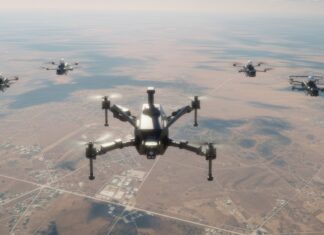
    Lockheed Martin Skunk Works® and XTEND have achieved a major milestone in JADC2 by integrating the XOS operating system with the MDCX™ autonomy platform. This technical breakthrough enables a single operator to simultaneously command multiple drone classes, eliminating the friction of mission handoffs. From "marsupial" drone deployments to operating in GPS-denied environments, explore how this collaboration is abbreviating the data-to-decision timeline and redefining autonomous mission execution.

    From Ukraine to Taiwan: The Global Race to Dominate the New Defense Tech Frontier

    0
    As traditional defense primes face mounting competition from agile “neoprimes” such as Anduril, Palantir and Helsing, the balance of innovation is shifting toward software-defined warfare and scalable, dual-use technologies, while global industry consolidation—marked by Boeing’s integration of Spirit AeroSystems and other strategic mergers—signals an intensified race to secure control over the defense technology value chain. Our Defense-Tech weekly report highlights these trends.

    Europe’s “Drone Wall”

    0
    In early October 2025, a coordinated wave of unmanned aerial system (UAS) incursions—widely attributed to Russia—targeted critical infrastructure across at least ten European nations. The unprecedented campaign exposed the fragility of Europe’s air defenses...

    Weekly Defense Update & Global Security Assessment

    0
    Executive Summary The past week (September 18-25, 2025) represents an inflection point where strategic defense concepts have transitioned from doctrine to tangible reality. An analysis of global events reveals four primary, interconnected trends shaping an...

    U.S. Air and Space Forces Push Next-Gen Programs at the AS&C 2025 Conference and...

    0
    At the 2025 Air, Space & Cyber Conference, U.S. Air Force and Space Force leaders unveiled major updates on next-generation fighters, bombers, unmanned systems, and space initiatives, highlighting both rapid innovation and critical readiness challenges as the services race to outpace global competitors. A short version is available here, with a more detailed version for subscribers.

    TADTE 2025: Reflecting Taiwan’s Strategic Themes

    0
    The Taipei Aerospace & Defense Technology Exhibition (TADTE) 2025 crystallized around four dominant strategic themes that collectively illustrate Taiwan's comprehensive approach to defense modernization amid escalating regional tensions. Based on a detailed report by Pleronix (available upon request). Includes a Podcast discussion on TADTE 2025's highlighting Taiwan's four strategic themes beyond the post's coverage.

    Iron Beam 450 Completes Testing, Soon to Join With Operational Air Defense Units

    0
    Israel’s Iron Beam 450 high-power laser system has completed final testing, marking a major leap in air defense. Developed by Rafael, it offers precise, cost-effective interception of rockets, UAVs, and mortars, and is set for IDF deployment by 2025.