Tuesday, December 23, 2025
More
    Home Blog Page 412

    Technical Principles of Hybrid Electric Drive

    Start < Page 2 of 6 >

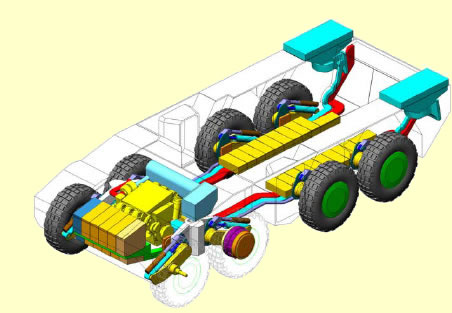
    There versions of hybrid-electric vehicle propulsion systems are currently evaluated under different programs. The “Series Hybrid Electric Drive (HED)” decouples the diesel engine from the wheels, driving each axel or wheel by an electrical motor. Typical examples of Series HED are the AHED and SEP combat vehicles, developed for future armored vehicle programs, and the future tactical truck (FTTV). This configuration is viewed as more suitable for weapon carriers, missile launchers (such as HIMARS, LOSAT, Patriot and MEADS). Elimination of the heavy mechanical drive train reduces the total weight of the vehicle and enables more flexible “packaging” of a mission system. Further advantage is the ability to be stationed on “silent watch” for extended periods or driven in “stealth” movement (battery powered). This feature is absent from comercial ‘hybrid cars’ applications, due to the high cost of battery and motors, required for extended propulsion of the vehicle.

    The “parallel hybrid electric” retains the mechanical link from the engine to the wheels and augments it with electrical power regenerated when the vehicle is braking or decelerates. A “hybrid hydraulic” mechanism stores energy in hydraulic recuperators, rather than chemical batteries. Although parallel hybrid is heavier than serial HED, it offers the redundancy advantage of a conventional, mechanical link when operating a heavy duty truck. HED can be applied into existing vehicles (“plug-in” – Humvee, HEMTT-A3, FMTV) or implemented in the basic design of new vehicles (RST-V, FTTS, FCS)

    Additional parts of this article:

    CPX4 – QUADROCOPTER micro UAV

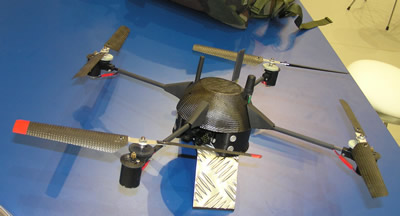
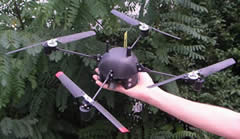
    The new CPX4 quadrocopter system was displayed by Novadem. This system is currently being evaluated by the DGA as a mini-UAV concept for future FELIN enhancement. This miniature four rotor platform was developed by the Institute National Polytechnique of Grenoble and the Novadem Company.

    The vehicle is stored in a small tube and can be assembled and prepared for mission within few seconds. Powered by a quadruple rotor driven by electrical motor, the system can hover for up to 30 minutes. CPX4 is equipped with a side camera (optional down looking sensor can also be mounted). The vehicle mounts an ultrasonic obstacle avoidance system, to safely avoid obstacles while flying or hovering near walls. The propulsion system uses differential compensation between the rotors to maintain position even under strong side winds.

    Networked UGS

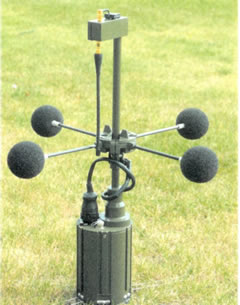
    Qinetiq is offering UGS which could be deployed by rockets, vehicles aircraft or manually emplaced. Its primary sensor is an acoustic array used for initial location and tracking of targets. A low cost thermal imager producing panoramic survey of the area is used for target classification. The main advantage of this UGS is its network sensing – the system uses emerging, self organizing networking to link several sensors to provide persistent surveillance and targeting over a large area. Networking also helps reducing false alarm rate, by having several sensors “agree” on the identification of a target before an alarm is triggered. By generating “fixes” from different positions, by several sensors, the system can generate accurate target positioning, and effectively track a target as it moves from one location to another.

    Military Applications of Hybrid Cars and Trucks

    Start < Page 1 of 6 >

    With surging fuel prices military forces are re-examining the potential savings of alternative propulsion, hybrid cars and trucks are becoming a reality in the commercial market. “Hybrid-Electric Drive” (HED) systems are promising up to 30 – 40 percent savings, compared to current internal-combustion engines. Typical Hybrid-Electric Drive (HED) systems store regenerative power when braking and using it for acceleration and off-road maneuvering, to augment the main engine. By electronically controlling each wheel, HED systems dynamically manage the drive torque going to each wheel; accommodating any driving condition on and off-road. While HED systems have great benefits in fuel economy, improved performance and weight saving, hybrid cars still challenge users with expensive systems, primarily battery costs and sensitivity due to environmental effects.

    The US Army expects hybrid-electric powered trucks and the hybrid-electric Future Combat Systems (FCS) to help the service attain its stated objective of 75 percent lower fuel consumption by 2020. Significant savings have already been demonstrated. Operating as a hybrid, with a 24-gallon tank, a truck could travel 375 miles without refueling compared to a conventionally-powered vehicle, traveling less than 60% of that range. Savings will not relate from the cost of fuel itself, but trim a considerable volume off the army logistical transportation requirements – as fuel takes up about 70 percent of the logistical tonnage haul in a heavy armored division.

    When used in combat vehicles, hybrid-electric drives have even more benefits. The acoustic signature can be reduced by moving on electrical power with main engine shut off and the placement of engine exhaust below the vehicle, to minimizing noise signature when the engine is running. Thermal signature is reduced by burying the hot mufflers and manifolds deeper in the vehicle to reduce infrared signatures. When used for logistical support, hybrid electric vehicles can generate enough “exportable” power to run most field equipment currently used by the military.

    Additional parts of this article:

    IRIS Netted Video Surveillance

    IRIS Video from EADS can observe, detect and identify vehicles and individuals operating in restricted or sensitive zones. IRIS can be linked by multiple VHF video links to the optronic sensor units positioned at distances of up to 500 meters, and record four simultaneous channels. Each sensor unit links to a pyrometer detector, daylight camera and a night vision sensor.

    Body Ventilation System (BVS)

    Global-Secure Safety Corporation

    The combination of the intense heat of the Middle East summers and the weight and body heat generated by the ballistic vest imposes significant burden and heat stress on troops operating under extreme climate conditions. As body armor and load bearing vest are blocking air circulation around the chest and back, up to 60% of the natural body cooling process is eliminated.

    The Body Ventilation System (BVS) developed by GlobalSecure Safety Corporation uses a battery powered blower to circulate air through an air distribution device worn under the soldier’s body armor. As fresh air is circulated beneath the interceptor body armor and battledress uniform (BDU), natural body cooling is regained, resulting in improved physiology. The system weighs only 5 pounds (2.5 kg) and runs on standard rechargeable li-ion batteries for up to eight hours. This patent pending system designed to keep the body cool and dry by evaporating perspiration under the ballistic vest.

    BVS can be worn by a soldier as part of the personal gear and is compatible with the MOLLE load bearing vest and assault pack and commercial hydration packs. It can be worn in a variety of deployments on or around the vest, using MOLLE straps. The system was tested last year in Iraq.

    M-388 APFSDS-T

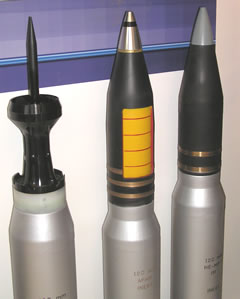
    IMI introduced a third generation of its Armor-Piercing Fin-Stabilized Discarding Sabbot (APFSDS) round designated M-338. The new round improves the Kinetic energy (KE) penetrator’s  performance of primary 120mm anti-tank rounds, and is suitable for all types of guns (including L44). M-338 uses a tungsten core designed for improved penetration and performance. Using new Low Vulnerability (LOVA) propellant enabled IMI to increase the M-338’s muzzle velocity with large safety margin while maintaining precision and operability over the entire temperature range defined by STANAG criteria. IMI used a uniquely designed tungsten alloy core, with unique mechanical properties and sabot design to improve accuracy at all combat ranges.

    MRM KE / CE 120mm

    Medium Range Precision Attack Munition 105/120mm Tank Round

    The US Army Medium Range Munition program is designed to provide main battle tanks an extended range, beyond line-of-sight precision engagement capability. The MRM program is pursueing both Kinetic Energy (KE) and Shaped Charge (Chemical Energy – CE) solutions. MRM is a fire and forget, guided, “smart,” tank fired, projectile that could employ either a kinetic energy penetrator or an advanced warhead to defeat high valued targets including the most advanced armored threats. MRM will have dual mode sensor, enabling either full autonomous acquisition of vehicle targets in it’s field of view or can be directed to engage a specific vehicle or non-signature target through the use of a laser designator.
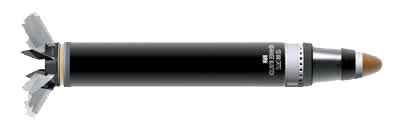
    MRM-KE  is designed for 105mm and 120mm cartridges and comprises an interchangeable sensor component using multi-mode Semi-Active Laser (SAL), GPS and MMW guidance, a common rocket motor and a kinetic penetrator packed into the warhead section. The MRM will be fired by a tank as a conventional round, as it starts it flight, the round will acquire GPS position followed by mid-course updates and at the peak of its trajectory, ignite the rocket motor to accelerating to achieve maximum lethality. The round will be able to maneuver by employing impulse thrusters to maneuver and hit at the target’s center. It is designed for effective range of up to 7.5 km. MRM-KE was first tested in August 2004.


    MRM CE – Raytheon, developing a CE version of the MRM fitted with a SAL seeker, performed a first successful test of the new projectile in June 2006, fired at a moving tank at a range of 8.7 km. The semi-active laser seeker projectile survived gun launch, then acquired, tracked and maneuvered toward the moving target. This was the first test shot in a planned series of SAL projectiles fired from a M1A2 SEP as Raytheon continues to mature its semi-active laser seeker capabilities. The MRM-CE will be able to engage battlefield targets at extended ranges, including beyond line of sight, autonomously or designated with external laser target designation. The MRM-CE is a key component of the Army’s FCS (Future Combat Systems) vehicles and a potential spin-out to M1A2 Abrams SEP.

    The first beyond line of sight mission test, held at the U.S. Army’s Yuma, Ariz., Proving Grounds on Sept. 25, 2006, the laser guided MRM-CE projectile was fired from an Abrams M1A2 SEP (system enhancement program) tank, scored an extended-range, guided direct hit at a moving T-72 tank at a range of 5.4 miles (8.7 km). The test demonstrated the laser-guided seeker’s ability to successfully target, acquire and track a moving tank and guide the munition to intercept at the required range.

    In a test firing conducted March 1st, 2007 the MRM-CE fired from an M1A2 Abrams tank demonstrated dual-mode seeker demonstrated its most flexible mode that exploits sensor fusion. During the flight the projectile successfully acquired laser designation and transitioned the tracking function to the imaging infrared sensor against a T-72 tank target. The sensor guided the munition to a direct hit at a distance of 5.2 kilometers (3.5 miles). During this test the target was designated through an “off-set designation” procedure, minimizing exposure and warning to the enemy tank. The laser spot was first used to mark a location near the intended target, and then using sensor fusion, the imaging infrared seeker autonomously founds the qualified target closest to the laser spot. “The round hit within inches of the aim point, demonstrating complete mission success,” said Rick Williams, Raytheon Mid-Range Munition program manager. “Mid-Range Munition, Chemical-Energy has demonstrated all required operational modes.”

    The Raytheon Mid-Range Munition, Chemical-Energy projectile is designed to provide the U.S. Army with lethal, one-shot capability as the service continues its transformation to lighter, more deployable combat forces. The Mid-Range Munition, Chemical-Energy, which will autonomously attack battlefield targets at beyond-line-of-sight ranges, with or without external laser target designation, is a key component of the Army’s Future Combat Systems vehicles.


    120FER – 120mm Low-Recoil Gun

    The French company GIAT is developing a low-recoil 120mm gun to equip future air transportable armored fighting vehicles weighing around 18 tons. The 120 FER is a derivative of the F1 gun mounted on the Leclerc main battle tank, retaining the same qualities, such as a long barrel, providing better accuracy, trunnion balance and stabilization. The main difference is the lower recoil forces extracted to the turret and, therefore, reducing integration constraints. The new 52 Cal. Smooth bore, chromium plated gun weighs 2.5 tons (including cradle) and measures 7.1 meters in length (barrel length is 6.2 meters). It can fire all current NATO ammunition (STANAG 4385) as well as newly developed ammunition and is suitable for future ETC-ignited ammunition.

    Airborne, Maritime and Fixed Stations (AMF) Joint Tactical Radio System (JTRS)

    The Airborne, Maritime and Fixed Stations (AMF) JTRS program will deliver a suite of software defined, multi-function radios for use throughout the Department of Defense, as well as potential use in the Department of Homeland Security. A single radio will be capable of operating on highly secure, high performance military tactical networks in net-centric operations. AMF JTRS radios will interoperate with legacy data and voice circuits used by the U.S., allied or NATO military forces, as well as communicate with civilian first-responder voice and data systems used in disaster relief and other national emergencies.


    The Lockheed Martin  AMF/JTRS team is currently under contract for the Pre-System Development and Demonstration (Pre-SDD) phase of the AMF JTRS competition. The AMF JTRS program is expected to be awarded in February 2007. The Lockheed Martin team includes BAE SYSTEMS, General Dynamics, Raytheon and Northrop Grumman.

    In September 2006 Lockheed Martin completed a series of flight demonstrations of the AMF component of the US military’s JTRS. The tests consisted of eight consecutive dynamic segments, which demonstrated the ability to seamlessly integrate the waveforms into an interoperable network. The network will be able to support shared situational awareness information, enable interoperability between platforms out of line-of-sight, share streaming video and maintain wideband network quality of service.

    The test involved various airborne platforms, including a helicopter, F-16 and simulated UAV which transmitted data and video in real-time using both new and legacy systems. The demonstration highlighted the ability to use the future systems utilizing elements of the Wideband Networking Waveform (WNW) and Solider Radio Waveform (SRW) and effectively integrate them with legacy aircraft equipped with Link-16 communications. Such integration yields “enhanced theater applications like the Theater Battle Management Core System, Distributed Common Ground System and Joint Tactical Observation systems” said John Mengucci, vice president and General Manager of DoD Systems for Lockheed Martin Integrated Systems & Solutions.

    During the recent demonstration, ground and aerial nodes interfaced in a dynamic joint tactical Mobile Ad hoc Network using an enhanced version of the Ground Mobile Radio (GMR), WNW, SRW and Legacy Link-16 communications. Receiving sites were networked directly into the mission network through the government’s Defense Research and Engineering Network.

    “We ported WNW and SRW on prototype Software Defined Radios to support dynamic routing, streaming video and cross-banding utilizing both IPv4 and IPv6” Said Lockheed Martin’s AMF JTRS Program Director Glenn Kurowski.

    MiniROC (Mini Robot de Choc) robotic platform family

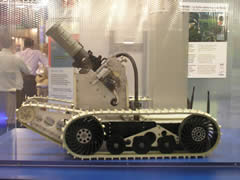
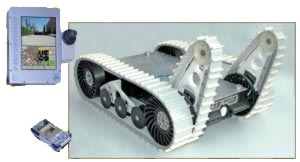
    A family of miniature robotic platforms developed by AMT and ECA in France is designed to operate in urban terrain. It is under evaluation under by the French DGA “Mini-Robot de Choc” (MiniROC) technology demonstration program for future robotic platforms for FELINBOA and Scorpion future combat programs. The MiniROC concept relies on the combination of several platforms carrying a range of modular payloads, to effectively cover the broad requirements of urban warfare, including observation, localization, surveillance, load carrying and sentry operations, performed both indoor and outdoor. The different platforms differ in weight, volume, speed and mobility. The family is based on a small scout robot, utilizing tracks and flippers, offering high mobility in indoor and outdoor environments. The portable scout weighs 26 kg without payload.

    The MiniROC Scout can operate for 2.5 hours at a maximum speed of 7.2 km/h, surveying buildings through autonomous or remotely controlled operation. The scout can negotiate staircases and obstacles, thus surveying elevated floors or subterranean spaces. Although this platform clearly resembles the PacBot, defense Update could not yet confirm the use of the iRobot platform in this program.

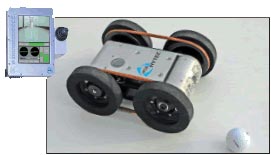
    Another indoor sensor is the four wheeled, lightweight mini-robot (2.1 kg weight) is designed for indoor operations. This robust autonomous sensor can be tossed into a room, to remotely sense and survey the target. Operating autonomously for up to 30 minutes, the mini-robot can travel at a speed of 1.8 km/h and carry an integral video and audio sensor.

    A larger support robot is used for outdoor operations. This 160kg six wheeled platform can carry a payload of up to 100 kg for mission duration of 1 – 5 hours. The support robot can perform reconnaissance missions near and around buildings and obstacles and can employ weapons in support of manned operational maneuvers. Both platforms can be configured with a variety of payloads, including a thermal imager, multi-spectral EO sensor and illuminator, passive infrared detector, gun mount, or munition launcher.

    SMERCH 300 – 300mm Multiple Launch Rocket System

    The SMERCH system fires several different types of 300mm rockets. The rockets weigh approximately 800 kg and most have a maximum range of 70 km.

    The basic rocket for the SMERCH 300 is the 9M55F, which carries a separable, unitary high-explosive warhead weighing 72 kg. (Warhead weight is 258 kg, explosive weight 95 kg, sub-munitions are 50 grams) The 9M55S variant carries 100 kg of fuel-air explosive. There is also an extended range rocket, the 9M528, which weighs 815kg and carries a 95 kg (243 kg warhead, 95 kg of explosive) unitary separable warhead to a maximum range of 95km.

    Several different submunition carrying rockets are also available. The 9M55K carries 72 high explosive submunitions each weighing 1.75 kg. The 9M55K5 carries 646 combined effect submunitions (armor-piercing shaped charge and fragmentation). Each submunition can penetrate 120mm of steel armor. Where more precision is required, the 9M55K1 rocket can be used. It carries five sensor-fused submunitions weighing 15 kg each, which can penetrate up to 70 mm of steel armor.

    Vehicle Protection Concepts

    Start < Page 1 of 4 >

    During the conflict in Kosovo and more recently in Afghanistan and Iraq, it became clear that soft, unprotected vehicles became primary targets for guerilla attacks. These vehicles are highly vulnerable to any type of attack – mines, Improvised Explosive Devices (IED), firebombs, grenades, small arms or mortar fire and especially RPG. While US and French forces confronted highly determined guerilla forces in Algeria and Indo-China (Vietnam), lack of recent experience left most of the western armies and peacekeeping forces unprotected against such highly lethal threats. The painful experience NATO forces encountered from mines in Bosnia identified the need to equip the patrol, command and supply vehicles with effective counter-mine capability. The results were evolutionary developments of the M1114 up-armored Humvees, and the protected patrol vehicle (PVP), which was later transformed into the Dingo (German Army) and the MLV/LMV (British and Italian forces). These vehicles are offering better protection, and were considered to be used to lead and protect convoys and as patrol vehicles. Adequate to lead and provide convoy security and acting as light combat patrol vehicles.

    Additional parts of this article:

    Shtil-1 Naval Air Defense System

    Pechora (SA-3)Upgrade Program

    Upgrades for India’s Pechora 2A (SA-3 OSA) missiles were also promoted at Defexpo 2006 by the Russian company Almaz-Antey. Under the upgrade program the system’s engagement range and kill zone will be extended (currently 3.5 to 28 km range, 60 – 60,000 feet altitude, engaging targets with speeds up to 700 m/sec) and efficiency in handling current technology threats will be increased. Electronic counter-countermeasures (ECCM) will also be improved by increasing operating power to 2000 W/MHz. An additional EO/TV tracking channel will be integrated as a backup. Up to 50% of the analog systems in the missiles will be replaced by new and more reliable digital systems in order to improve reliability and performance while decreasing power consumption. The upgraded system will be capable of detecting and engaging targets with typical radar cross-sections as small as 0.3 square meters

    Skunk Works and XTEND Simplify Multi-Drone Command

    0
    Lockheed Martin Skunk Works® and XTEND have achieved a major milestone in JADC2 by integrating the XOS operating system with the MDCX™ autonomy platform. This technical breakthrough enables a single operator to simultaneously command multiple drone classes, eliminating the friction of mission handoffs. From "marsupial" drone deployments to operating in GPS-denied environments, explore how this collaboration is abbreviating the data-to-decision timeline and redefining autonomous mission execution.

    From Ukraine to Taiwan: The Global Race to Dominate the New Defense Tech Frontier

    0
    As traditional defense primes face mounting competition from agile “neoprimes” such as Anduril, Palantir and Helsing, the balance of innovation is shifting toward software-defined warfare and scalable, dual-use technologies, while global industry consolidation—marked by Boeing’s integration of Spirit AeroSystems and other strategic mergers—signals an intensified race to secure control over the defense technology value chain. Our Defense-Tech weekly report highlights these trends.

    Europe’s “Drone Wall”

    0
    In early October 2025, a coordinated wave of unmanned aerial system (UAS) incursions—widely attributed to Russia—targeted critical infrastructure across at least ten European nations. The unprecedented campaign exposed the fragility of Europe’s air defenses...

    Weekly Defense Update & Global Security Assessment

    0
    Executive Summary The past week (September 18-25, 2025) represents an inflection point where strategic defense concepts have transitioned from doctrine to tangible reality. An analysis of global events reveals four primary, interconnected trends shaping an...

    U.S. Air and Space Forces Push Next-Gen Programs at the AS&C 2025 Conference and...

    0
    At the 2025 Air, Space & Cyber Conference, U.S. Air Force and Space Force leaders unveiled major updates on next-generation fighters, bombers, unmanned systems, and space initiatives, highlighting both rapid innovation and critical readiness challenges as the services race to outpace global competitors. A short version is available here, with a more detailed version for subscribers.

    TADTE 2025: Reflecting Taiwan’s Strategic Themes

    0
    The Taipei Aerospace & Defense Technology Exhibition (TADTE) 2025 crystallized around four dominant strategic themes that collectively illustrate Taiwan's comprehensive approach to defense modernization amid escalating regional tensions. Based on a detailed report by Pleronix (available upon request). Includes a Podcast discussion on TADTE 2025's highlighting Taiwan's four strategic themes beyond the post's coverage.

    Iron Beam 450 Completes Testing, Soon to Join With Operational Air Defense Units

    0
    Israel’s Iron Beam 450 high-power laser system has completed final testing, marking a major leap in air defense. Developed by Rafael, it offers precise, cost-effective interception of rockets, UAVs, and mortars, and is set for IDF deployment by 2025.