
Tuesday, December 23, 2025
More
    Home Blog Page 414

    Non Lethal Directed Energy Weapons

    Start < Page 5 of 6 >

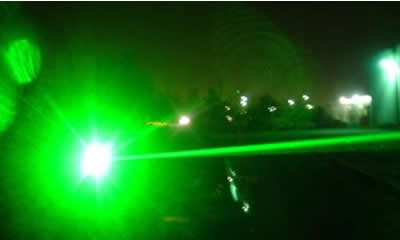
    Anti-personnel non lethal directed energy weapons include lasers, high power electro-magnetic pulse and directional acoustic weapons. One of the systems currently in use is the SaberShot laser dazzler – this hand held or weapon mounted low-power device uses 250Mw of 532nm green-laser. When directed at the target, the laser’s optics temporarily expand to generate a blinding light which penetrates smoke, fog at twice the range of white light. Modulation of such high intensity light cause disorientation, dazzle and blink reaction that reduces the target’s activity. Such weapon could be used to disorient and degrade performance of potential threats, such as snipers, or RPG launchers.
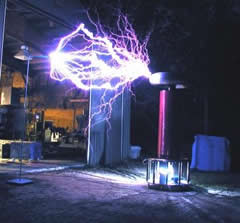
    Other laser-guided directed-energy weapons work like “artificial lightning” to disable human targets or electronic circuits. Laser Induced Plasma Channel (LIPC) technology was developed by Ionatron to channel electrical energy through the air at the target. The interaction of the air and laser light at specific wavelength, causes light to break into filaments, which form a plasma channel that conducts the energy like a virtual wire. This technology can be adjusted for non-lethal or lethal use. LIPC operate at line of sight, allowing propagation of electrical pulses to be directed at a specific target. LPIC based weapon could, in theory, be fired around corners if mirrors were used.

    Directed microwave energy is also utilized for non lethal weapon system applications. Raytheon’s Active denial System (ADS) is a non lethal, counter-personnel directed energy non-lethal weapon which can be used to protect fixed positions or from mobile as well as airborne platforms,  against human targets at distances beyond the effective range of small arms. A similar system is currently at an initial development phase at applied physics lab of the the Israeli Technion.

    Directed Acoustic Weapons
    In the past, acoustic non lethal weapons were primarily used as “flash bang” weapons. When blasted over a crowd or in a room, they created a loud noise and bright flash incapacitated people exposed to the effect for a few seconds. Flash bang charges are used on forced entry and counter-terror operations, when hostages are involved. As they indiscriminately hit every human exposed to the effect, operation of “flash-bang” requires precise timing and procedures to maximize effect on hostiles and eliminate potential damage to friendly forces.

    Currently, acoustics are far more advanced than mere noise. Following the impressive technology advancement in solid state electronics, advanced acoustic systems are becoming operational. In 2004 American soldiers in Iraq were equipped with a Long Range Acoustic Device (LRAD) used for land based and naval applications. LARD works like a highly directional, high power megaphone, able to blast sounds (such as crowd-dispersal instructions in Arabic) in a narrow beam and with great clarity at a deafening 150 decibels (50 times the human threshold of pain). LRAD can also create deafening noises which can incapacitate people within 300 meters by “firing” short bursts of intense acoustic energy.
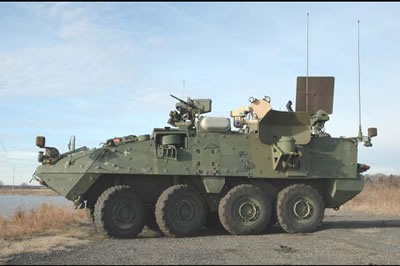
    A different acoustic weapon is the vehicle mounted Acoustic Blaster, developed by PRIMEX Physics International. This weapon can be used for area denial, and against selected groups in crowds, mobs and rioters or in a hostile situation. The weapon can be operated by a single person. So far the system was developed as a prototype consisting of an array of four combustion detonation driven devices fired simultaneously or independently. The detonation creates an acoustic pressure of up to 165dB at a distance of 15 meters. The resulting acoustic pressure waveform can be optimized for acoustic-physiological coupling to targets for antipersonnel applications. The US Air Force Research Laboratory (ARL) is also working on a Sequential Arc Discharge Acoustic Generator (SADAG) which produces high-intensity impulsive sound waves generated by  electrical means.

    A different acoustic weapon is the high power acoustic phased array of 36 horns which can focus the acoustic output at the target. The high power noise created within the target can incapacitate humans from a standoff range. The system can be mounted on a tactical vehicle, and radiate a narrow, high power steerable acoustic beam, disorientating humans. Both horizontal and vertical beams can be formed simultaneously to create a point effect within buildings.

    A different application is the shockwave weapon, employing the Vortex Ring Gun system. Generating high power shockwave propagating at supersonic speed, Vortex ring Guns can generate high pressures which inflict considerable damage to a target, or carry a payload of kinetic or chemical agents over a distance beyond 20 meters.

    Additional parts of this article:
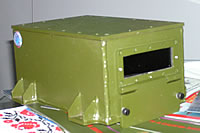
    F-3 LRF Deceptor (Laser Rangefinder Countermeasure)

    F-3, a new “Soft Countermeasure” system from the Ukraine Company Magnit Ltd, was displayed at Defexpo 06 for the first time. This passive system is activated by laser rangefinder pulses received when the protected target is illuminated by an enemy laser, prior to firing. When a pulse is detected, F-3 emits a false echo, disrupting the range measurement, and causing the enemy to overshoot to the falsely extended range. The false laser signal is emitted at a wavelength of 1.06 micron, causing an error of +/- 400 meters (this error rate can be changed at the factory). F-3 is designed to defeat both direct fire and semi-automatic beam-riding missiles. F-3 performs equally well against amplitude-time selection based Fire Control Systems (FCS), used in modern Russian tanks (&T-80, 84, 90), which cannot determine the actual range to the target, and against time selection based FCS, used in most western tanks (Abrams, Leclerc, Leopard) which cannot read exact range and consequently, hit probability is reduced and shot preparation time is increased by 15-20 seconds. According to the manufacturer, F-3 is being fielded by the Ukrainian Armed forces.

    UNIFIL Strengthened with international contingents with troops, armor & artillery

    UN Forces in South Lebanon (UNIFIL) are being strengthened with new forces from European and Asian countries. The new forces are far better equipped, compared with previous UNIFIL detachments deployed to South Lebanon in the past three decades.

    France is preparing a first armored unit, the 6th-12th Cuirassiers  Regiment to deploy to Lebanon with 13 Leclerc tanks, heavy artillery unit and two mechanized infantry companies, a total of 900 soldiers. The deployment is expected to begin September 15. According to brigade
    commander, General Pierre de Villiers the Leclercs are expected to deploy with 155mm guns to defend against mobile missile teams known to exist in the area. A second battalion of 700 men is expected to arrive in Lebanon in the coming weeks, augmenting the first battalion and lead force of 400 soldiers already deployed.

    The Italians have already deployed a first contingent of 1,000 soldiers. The Italian forces deployed with five navy ships, 132 wheeled vehicles, 16 tracked vehicles and 10 armored attack vehicles.

    The Indonesian military is planning to purchase 32 armored vehicles from Renault, to support the planned peace-keeping operation in Lebanon. About a 1000 military personnel and their supporting equipment have been prepared for the dispatch to Lebanon while waiting for official decision from the United Nations on the time of departure, concept of operation, and the rule of engagement.

    Pinaka – 214mm multi-barrel rocket system

    Pinaka, a multi-barrel rocket system, was developed at the DRDO and is in production for the Indian Army. This area weapon is used to supplement current field artillery as well as add some capability beyond their typical 30 km range.

    The self-propelled, truck mounted system is equipped with 12 rockets contained in two pods. The complete system also includes a command post vehicle, a munitions carrier / reloader and a meteorological and radar unit.

    Pinaka rockets weigh 276kg and are 4.95 meters long and 214mm in diameter. They carry a 100 kg warhead, which can be either a unitary warhead, or a cargo container filled with AP bomblets, mines or incendiary munitions. Rockets can be fired at ranges from 10 to 38 km. The control unit incorporates the same Trajectory Correction System that has recently entered service with the MLRS operated by the Israel Defense Forces. This TCS can handle trajectory correction for multiple rockets improving their effectiveness, accuracy and survivability.

    RIF-M Naval Air Defense System

    The RIF-M system provides protection against threats at altitudes from sea level up to 90,000 feet and at ranges from 7 to 150 km. One of the missiles used with the system is the 48H6E2, which is similar to the type used in the Favorit missile defense system and has a warhead weight of 180 kg. Another option is the 9M96E, which is similar to the missile used by the ground based S-300PMU-2 (Favorit).

    These missiles have a range of 2 to 40 km, and are capable of defeating targets from sea level to 70,000 feet. The 9M96E has a smaller yet highly potent warhead, weighing 24 kg. RIF-M can fire missiles at 4 second intervals when engaging one or more targets. The typical interval between missile firings is 2-4 seconds.

    SWARM – Stabilized Weapons & Reconnaissance Mount Remotely Controlled Weapon Station

    SWARM (Stabilized Weapons & Reconnaissance Mount) is a multi-weapon station produced by Thales. It’s the latest remotely weapon system to enter service with tracked vehicles of the British Army. Weighing 125kg, excluding the weapon and 200 – 600 rounds of ammunition, SWARM can be configured with M249/M240 7.62mm and M2HB machine guns. The system is capable of fast 45 deg/sec rotation, through an unlimited 360 deg. Rotation, and -20 to +45 deg. Elevation (30 degrees of elevation/sec).

    FoxBot Small Unmanned, Autonomous Ground Vehicle


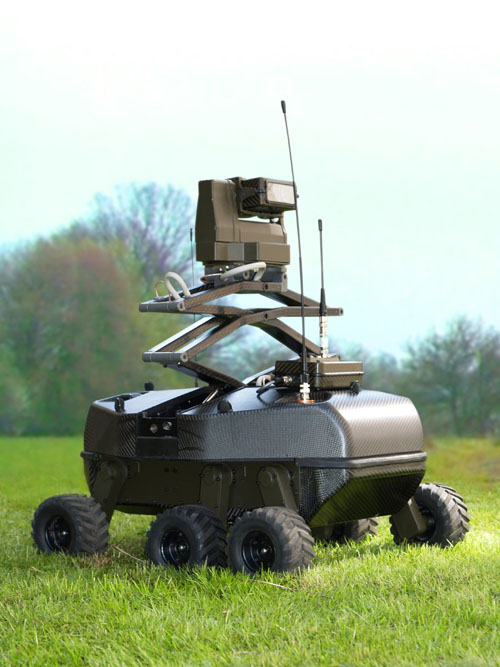
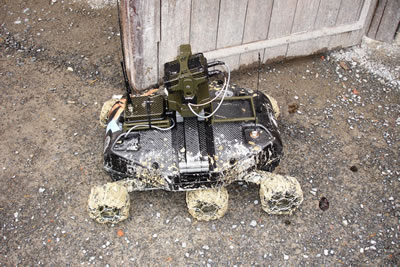
    Developed by Rheinmetall Defense, Foxbot is a small radio-controlled robot featuring semi-autonomous capabilities, supporting surveillance and recce missions. The robot is fitted with EO and acoustical sensors and is designed to operate at the tactical level. The robot uses a mast mounted omni-directional acoustic sensor, enabling location and tracking of detected signals with stereo acoustic capability, enabling effective spatial reconstruction of the signal. Utilizing a dual datalink for command and transmission of data and video, enables the Foxbot to operate autonomously over a range of 1,000 meters.

    SLS Sniper Locator System

    Rheinmetall Defense introduced a Sniper Location System (SLS) which enables reliable detection of snipers even before a single shot has been fired. The system locates optical scopes, at the sniper’s effective range. SLS is available two versions – manual binocular like module and an automatic scanner, which can be networked into a central surveillance center. A mobile version is also in development.

    Combat Survivor Evader locator (CSEL)

    The Combat Survivor Evader locator (CSEL) supports unique communication and message encryption techniques to prevent signals from being intercepted or decoded. It supports communications satellites and global positioning technology to send information about the precise location of isolated personnel such as downed pilots. In addition, the hand-held survival radios provide line-of-sight recovery forces and over-the-horizon joint search and rescue centers with two-way secure data communications capability. CSEL enables rescue forces to authenticate and communicate with isolated personnel in near real-time, anywhere in the world. In March this year CSEL was authorized for use by the joint services now operating in Operation Iraqi Freedom.

    CSEL program supports the procurement and fielding of up to 46,000 sets under a US$250 million multi-year program, to be supported by all services. By mid 2006 Boeing delivered more than 8,200 radios to the joint services. In 2006 Boeing received US$80 million contracts to supply 9364 radios, to be delivered between January and March 2007.

    EROS B Satellite Program

    On April 25 ImageSat launched the second very high resolution satellite in the EROS family – EROS B. The launch took place at the Cosmodrome in Svobodni, Siberia by a Start 1 launcher. It is expected to begin operation in few days. Similar to EROS A, the EROS B will provide better performance. The new satellite is expected to provide services for 8-10 years.

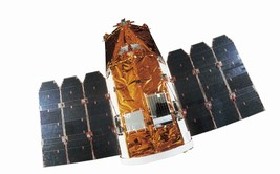
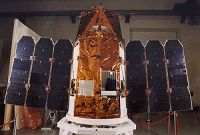
    Slightly larger and similar in appearance to EROS A, the new satellite weighs 290 kg and have superior capabilities compared to EROS A, including a larger camera of CCD/TDI type (Charge Coupled Device/Time Delay Integration), with standard panchromatic resolution of 0.70 m at an altitude of about 500 km, a larger on-board recorder, improved pointing accuracy and a faster data communication link.

    Eros B specifications:
    Launch weight: 290 kg
    Orbit: 500 km Sun Synchronous
    Over-sampling: 1.0 m
    Swath width: 7 km
    Scanning: Asynchronous push broom
    Sensor type: CCD / TDI (selectable)
    Spectral band: 0.5 – 0.9μ
    Sampling depth: 10 bits
    Datalink rate: 280 MBit/sec

    Israel offers High Resolution Satellite Imagery

    IAI/MBT Eros A1 satellite is integrating the ElOp high resolution camera.

    Proliferation of commercial, high resolution satellite imagery improves intelligence gathering

    The proliferation of high resolution space imagery is providing all governments with access to unprecedented intelligence information, which was previously the privileges of the few. However, response time provided by commercial services left much to be desired. Based on the Ofeq 3 spy satellite, built by Israel Aircraft Industries, and the space camera payload, developed by Elbit/ElOp, the Cyprus based ImageSat International is offering imagery gathered by the Eros A satellite under an innovative time-sharing scheme that enables partners to “own” the satellite when it passes over their region. When the client is in control, they can point the payload to look at the locations of interest, and choose the appropriate operational mode most suitable for the mission. They also receive, decode and interpret the data exclusively, which ensures the highest security levels for such operations. Foreign sources have mentioned Taiwan as one of the primary customers for the EROS A Satellite Operation Partners. Foreign sources informed that Taipei can receive and point the camera at any target they want, and receive instant imagery, as the satellite over flies within a 1,000 kilometer from the island.

    IAI/MBT Eros A1 satellite is integrating the ElOp high resolution camera.

    EROS A has a planned lifespan of ten years in orbit and is scheduled to remain in service until 2010, when it will be replaced by the more advanced EROS C satellite. Imagesat launched the second satellite, EROS B in April 2006. EROS A and EROS B are part of ImageSat’s vision of a constellation of very high resolution satellites which are expected to include up to six EROS C type spacecraft. IAI/MBT end Elbit/Elop are cooperating  on the development of this satellite.

    Eros A specifications:
    Launch weight: 260 kg
    Orbit: 500 km polar (Sun Synchronous – SSO)
    Ground sampling: 1.9 m
    Hyper-sampling: 1.0 m
    Swath width: 14 km
    Scanning: Asynchronous push broom
    Sensor type: CCD
    Spectral band: 0.5 – 0.9μ
    Sampling depth: 11 bits
    Datalink rate: 70 MBit/sec

    Active Protection Systems for AFVs

    Hard Kill Systems

    Start < Page 6 of 6 >

    Russian Active Protection Systems were matured much earlier than the west’s, as they were designed to counter the threat from the west’s anti-tank systems such as TOW, Hellfire and HOT missiles fired from ground and helicopter platforms, as well as airborne launched anti-tank missiles (such as the Maverick). Although the Russian systems were much heavier than their current Western counterparts, they provided the countermeasures that could decimate the western threat. These heavy countermeasure systems were designed to protect the most important elements in the heavy armored divisions – and were applied to platforms such as the T-55, T-72, T-80, T-90 tanks and BMP-3 APCs. The Drozd systems entered full scale development when as Russia was no longer planning to confront NATO, but was deeply engaged in a war of attrition in Afghanistan and later – in Chechnya, where defensive these countermeasures were required to protect much older T-55 tanks against Russian made RPGs and AT missiles. The Russian APS systems introduced innovative and proven defeat mechanisms against CE and KE threats. First was the Drozd, which protected the tank’s forward arc. This system was later followed by the Arena-E system, which introduced 360 degrees protection from side, front and partially top attacks.


    The US Army is considering to replace the 1990’s technology of the MCD, with a Full Spectrum Active Protection (FSAP), a new system approach that will be balanced with the capabilities of future advanced armor technology. Such advanced active protection systems will be considered to provide the primary survivability component of future armored vehicles. FSAP will include missile engagement capabilities, to-attack munitions intercept and defeat capability and kinetic energy threat engagement concept. As the system addresses both  Kinetic Energy (KE) threats and Chemical Energy (CE) threats, it will utilize different countermeasures concepts to engage each threat. CE countermeasures rely on technologically proven sensors and kill mechanisms.

    For the near term, potential candidate for the near-term CE countermeasures system is the FCLAS system, under development at the US Army Tank Automotive Research, Development and Engineering Center (ARDEC) and the Israeli / General Dynamics developed Trophy. Another addition considered for future survivability applications are various laser based infrared countermeasures, applicable against thermal guided weapons. In Germany, Diehl is developing a similar active protection system designated AWiSS, which will be able to counter RPGs and other CE threats. A near-term Close-in countermeasure (CICM) was also developed and tested by United Defense destined for rapid fielding with US forces in Iraq.

    The KE countermeasures require longer detection range and faster data processing, to provide for effective response rate against the faster threat. These have already been demonstrated in testing, but require more development to mature. Kill mechanisms compatible with KE countermeasures rely on different concepts, including radial shaped charge warheads, multiple explosive formed projectiles (Multi EFP), blast deflection mechanism as well as momentum transfer methods. The Multi EFP concept is considered to be the most mature, as it can be utilized for both KE and CE engagements. An advanced generation of the Trophy is reported to be capable of intercepting and countering such kinetic threats. It is also anticipated that the full capability version of IAAPS will also feature such performance. These munitions are set to explode ahead of the incoming threat,  forming a dense “curtain” of high velocity fragments within one milisecond.

    More About Protection for Modern AFVs:

    Active Defense & Countermeasures

    Start < Page 5 of 6 >

    Applications For Western Armies

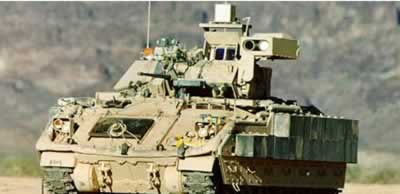
    Missile Countermeasure Device (MCD) seen installed on an M-2 Bradley (white rectangle on the top of the turret).

     In western armies, countermeasures rely mainly on deployment of smoke screen, and, to some extent, on IR countermeasures. Smoke which enable the tank to perform evasive maneuvers to counter the threat. Since 1991, as lessons learned from Desert Storm, some platforms received electro-optical (IR) jammers. The US Army fitted the Loral VLQ-6 Missile Countermeasures Device (MCD) also known as HardHat, that just missed the 1991 war, and later bought the Sanders VLQ-8As, equipping M-1A1 Abrams MBTs and M-2/3 Bradley AIFVs. The MCD is used as a part of a comprehensive warning and threat response ECM system, which detects and intercepts laser signals indicating an imminent attack. The system then emits IR signals to disrupt the threat’s missile/command unit tracking loop. MCDs are typically mounted high above the turret and scan the frontal arc to detect and decoy away most of the widely used ATGMs. The system is also integrated with the M6 countermeasure device which launch smoke and flares. A similar concept was developed in Israel by IMI – The Violin Mk1 (shown on left photo) and Violin Mk 2 were deployed as follow-on protection to IR flares that were used as ATGM decoys. These protection devices were proven effective in combat, protecting both stationary and mobile assets.

    However, in combat operations where threats were unexpected, MCD systems would not provide optimal protection, as they are effective only against specific threats. Furthermore, deception techniques divert the incoming missile from the intended target, but do not destroy it. Missiles diverted by protection systems are known to cause damage and casualties in several cases. The US Army is considering to replace the 1990’s technology of the MCD, with a Full Spectrum Active Protection (FSAP), a new system approach that will be balanced with the capabilities of future advanced armor technology.

    The US Marine Corps are studying a different concept for their future amphibious assault vehicle (AAAV) – a Retractable sensor-Decoy Mast (RDM), which can be deployed within two seconds from a given cue. Its payload will provides false targets to multi-spectral IR/laser or millimeter-wave threats such as Sensor Fuse Munitions (SFM). The decoy provides survivable miss distance against missiles and SFM threats.

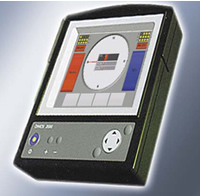
    In Europe, The French Army has equipped its AMX-30B2 MBTs with decoy systems from developed by GIAT. The MUSS self protection system, produced by EADS is used on French Army AMX-10C armored vehicles. MUSS consists of an Eirel NG infrared jammer, which provides self-protection against a broad range of western and eastern block anti-tank utilizing the SACLOS guidance mode. Eirel is part of integrated self-defense systems as ADAS, MUSS and KBCM. (MUSS control panel is shown above. Eirel rotateable protection module shown on picture on the right.

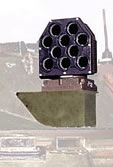
    Thales Optronic Systems is also introducing laser warning defensive aid system for AFV Systems, named Cerberus. Typical layout uses four detector arrays and 16 launchers covering the front and rear; other configurations incorporate seven sets of sector arrays (6 in azimuth, one in elevation) to cover the entire hemisphere. The detectors are sensitive to all types of lasers, (400 – 1600 nm). The warning system triggers various alarms, such as “single pulse lasers” (rangefinders), “multi-pulse lasers” (target designation) and “overhead laser” (top attack). The system can automatically activate appropriate countermeasures from the 66/76mm grenade dischargers, such as forming a smoke screen over an arc of 180 degrees within two seconds.

    Additional Parts of this article :

    Active Defense & Countermeasures Soft Kill

    Start < Page 4 of 6 >

    To augment the massive armor of modern AFVs, new Active Protection System (APS) or “active defense suite” concepts are developed, for heavy AFVs (main battle tanks), light tanks, wheeled armored vehicles, and armored infantry fighting vehicles. An active defense system commonly utilize various means of protection, activated at very close range, and designed to destroy, disrupt or degrade an incoming missile or projectile, thus eliminating or reducing its penetration capability.

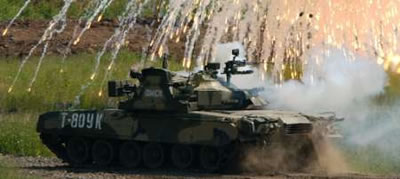
    Russian T-80 deploys instant smoke, to foil a simulated attack. Under the cover, the tank would reposition to avoid the threat.

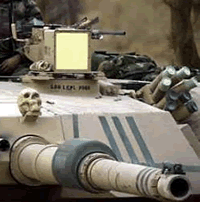
    Active Protection Systems commonly consist of an array of soft- and hard-kill techniques. Soft-kill methods, similar to Electronic Counter-Measures (ECM) in aircraft, seduce and confuse an incoming missile, by using decoys, smoke and electro-optical signals, infrared or laser jamming. Other concepts which include “Hard-kill” means, are designed to intercept and destroy the incoming projectile or missile before it hits its target. Countermeasures include fragmentation charges, steel bars, high pressure shock waves that will destroy the threat, destabilize or disrupt it flight path,  or divert it from its course. The optimal implementation of APS should be “design-dependent” thus, make it adaptable to tracked or a wheeled vehicle as well as fixed positions. Most of the currently available systems are, however, too heavy and are therefore suitable only for AFVs with weight class over 25 tons. (In photo – US Army M-1A1 equipped with the VLQ-6 MCD system and M6 countermeasure dispensers, in Iraq, 2003)

    Additional Parts of this article :

    Skunk Works and XTEND Simplify Multi-Drone Command

    0
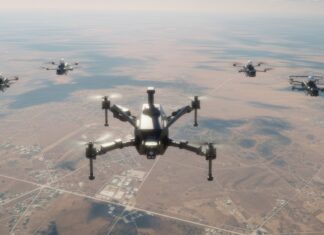
    Lockheed Martin Skunk Works® and XTEND have achieved a major milestone in JADC2 by integrating the XOS operating system with the MDCX™ autonomy platform. This technical breakthrough enables a single operator to simultaneously command multiple drone classes, eliminating the friction of mission handoffs. From "marsupial" drone deployments to operating in GPS-denied environments, explore how this collaboration is abbreviating the data-to-decision timeline and redefining autonomous mission execution.

    From Ukraine to Taiwan: The Global Race to Dominate the New Defense Tech Frontier

    0
    As traditional defense primes face mounting competition from agile “neoprimes” such as Anduril, Palantir and Helsing, the balance of innovation is shifting toward software-defined warfare and scalable, dual-use technologies, while global industry consolidation—marked by Boeing’s integration of Spirit AeroSystems and other strategic mergers—signals an intensified race to secure control over the defense technology value chain. Our Defense-Tech weekly report highlights these trends.

    Europe’s “Drone Wall”

    0
    In early October 2025, a coordinated wave of unmanned aerial system (UAS) incursions—widely attributed to Russia—targeted critical infrastructure across at least ten European nations. The unprecedented campaign exposed the fragility of Europe’s air defenses...

    Weekly Defense Update & Global Security Assessment

    0
    Executive Summary The past week (September 18-25, 2025) represents an inflection point where strategic defense concepts have transitioned from doctrine to tangible reality. An analysis of global events reveals four primary, interconnected trends shaping an...

    U.S. Air and Space Forces Push Next-Gen Programs at the AS&C 2025 Conference and...

    0
    At the 2025 Air, Space & Cyber Conference, U.S. Air Force and Space Force leaders unveiled major updates on next-generation fighters, bombers, unmanned systems, and space initiatives, highlighting both rapid innovation and critical readiness challenges as the services race to outpace global competitors. A short version is available here, with a more detailed version for subscribers.

    TADTE 2025: Reflecting Taiwan’s Strategic Themes

    0
    The Taipei Aerospace & Defense Technology Exhibition (TADTE) 2025 crystallized around four dominant strategic themes that collectively illustrate Taiwan's comprehensive approach to defense modernization amid escalating regional tensions. Based on a detailed report by Pleronix (available upon request). Includes a Podcast discussion on TADTE 2025's highlighting Taiwan's four strategic themes beyond the post's coverage.

    Iron Beam 450 Completes Testing, Soon to Join With Operational Air Defense Units

    0
    Israel’s Iron Beam 450 high-power laser system has completed final testing, marking a major leap in air defense. Developed by Rafael, it offers precise, cost-effective interception of rockets, UAVs, and mortars, and is set for IDF deployment by 2025.