Wednesday, December 24, 2025
More
    Home Blog Page 433

    Mobility Denial

    Start < Page 8 of 9 >

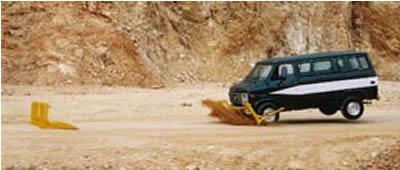
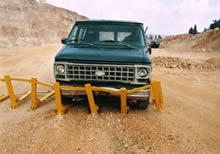
    Car-bombs have demonstrated their deadly effects in many attacks against military and civilian targets in many countries. While a single suicide bomber can carry a 10 – 15kg of explosives, that will create a deadly attack against unprotected people, car bombs can carry several tons of explosives, which can be devastating against large buildings. Therefore, controlling and denying mobility in the vicinity of the potential target is of critical importance. Road blocks have evolved to meet the new challenges of suicide attacks. Modern road blocks are designed to be transportable, deploy rapidly and absorb high energy to stop heavier vehicles at higher speeds.

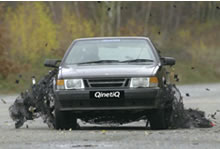
    X-Net, designed by Qinetiq is a portable net constructed from super-strong dyneema polyethylene, with spikes positioned along its leading edge. X-Net is capable of bringing a vehicle to a complete standstill within 75 meters. X-Net can be used to secure checkpoints and deny traffic at secured areas, as well as on pursuit of suspicious vehicles, where opening fire is not an option. A different system is offered by General Dynamics – the Portable Vehicle Arresting Barrier comprised of a rapidly erecting net (erected within two seconds). The net wraps around the target’s wheels, bringing it to a stop within a distance of 35 meters. The system is designed to stop up to 7 ton vehicles at a speed of 45 mph. Much simpler but highly effective barrier is the Modular Vehicle Barrier (MVB) offered by Mifram. This lightweight steel structure is quickly assembled into a highly effective barrier, which stops a vehicle on the spot, with zero penetration for any sized ramming vehicle. Other devices are using high power microwave to disrupt vehicle electrical or electronic systems.

    Additional parts of this article:

    Vehicle Protection Systems

    Other aspects of LIC are the modification and adaptation of vehicles, primarily armored vehicles, to cope with the threats posed by urban guerilla. A new system officially unveiled here for the first time is the Trophy Atcive Protection System, developed by RAFAEL (weapon system) and IAI/Elta (sensor). Trophy uses distributed sensors which detect and localize the incoming anti-tank missiles, RPG etc. When a threat is detected coming within range, the system fires an explosive countermeasure fragmentation charge which hits and destroys the threat before it reaches the protected vehicle.

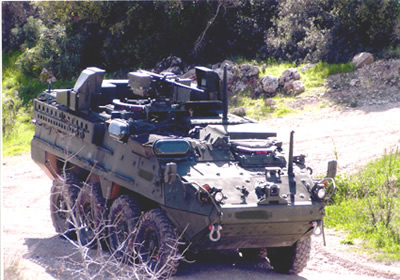
    Trophy is designed to equip armored fighting vehicles, and one of the first platforms which will be fitted on is the new Merkava Mk 4 main battle tank. It was demonstrated at the exhibition in two configurations. One was mounted as an integral element of a modified Merkava Mk 3 tank, while a lighter version was displayed as an add-on element, installed on a Stryker armored vehicle.

    Elisra announced at LIC a new derivative of its PAWS IR missile warning system used on helicopters and aircraft. The new sensor designated TANDIR will be using a passive warning system for combat vehicles, an essential element for future lightweight active protection systems. As in the airborne installations, TANDIR will provide full hemispherical coverage enabling detection and tracking of multiple simultaneous threats. As an imaging IR sensor it will contribute to the platform’s situational awareness and threat assessment capability.

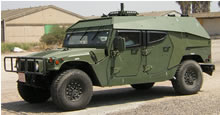
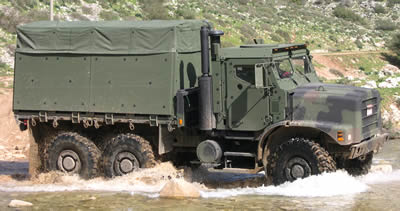
    Protection of light vehicles is the specialty of Plasan Sasa. At LIC-2005 Plasan demonstrated two of its most recent designs, the armored MTVR, developed for Oshkosh for the US Marines, and a new version of up-armored communications version of the Humvee, developed for the Greek Army.

    < page 7 out of 10 > Start – Previous –  Next

    Protection of Vehicles and Fixed Positions

    Start < Page 7 of 9 >

    Vehicle armoring has been a major concern for many armies, which participate in the war on terror and specifically the conflicts in Afghanistan and Iraq. These armies are utilizing various means of protection, including conventional armor plating for heavy vehicles (such as trucks and engineering vehicles). Lightweight vehicles require more advanced, lightweight armor to protect against small arms fire, improvised explosive devices (IED), mines and RPGs. Effective countermeasures against the later requires heavier or reactive armor, or special active protection systems which are currently under development.

    Protection of static positions such as checkpoints, observation posts, and inspection sites presents a major challenge. In these applications, specially designed pre-fabricated structures can be used, where advanced materials are employed to minimize the risk of attack without degrading the effectiveness and performance of the facility. Such structures can be constructed from a combination of reinforced concrete, steel, composite materials, and blast mitigation structures. Examples of such structures are BAM-1A wall panels, which can be used for add-on protection for existing buildings. The material offers various levels of anti-ballistic protection, blast and forced entry protection. BAM is manufactured by ASAP Inc. Protected positions can also be constructed from Rapid Armored Shelter System (RASS), or Personel Balistic Shield produced by Plasan Sasa, which can be used as a personal shield by an individual soldier, or, when combined together – as a protection of a forward medical point, machine gun firing post, or even makeshift protection for an unarmored vehicle.

    A different method of rapid deployment force protection is utilized by the German Army – which will soon field container sized protected structures produced by EADS, which are designed to support German Army out-of-area deployments on peacekeeping missions. IBD from Germany is developing a mobile version of a protected container, which uses the company’s advanced AMAP composite armor, formed into a cylindrical, sealed and highly protected compartment in which troops, medical teams or sensitive supplies such as explosives or ammunition can be transported through hot zones, in relative safety.

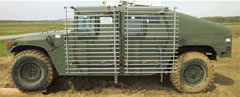
    Prefabricated armored structures offer augmented protection for fixed and vulnerable facilities, such as checkpoints, observation posts and guards positions etc. Such structures use blast mitigation structures, as well as steel meshes, to activate RPGs and AT missiles before they strike the surface. When weight is a consideration, composite armor can also be used. When the threat of anti-tank missiles is high, IR countermeasures can be applied selectively – including laser dazzlers, infrared countermeasures etc.

    Additional parts of this article:

    Integrated Infantry Combat Systems

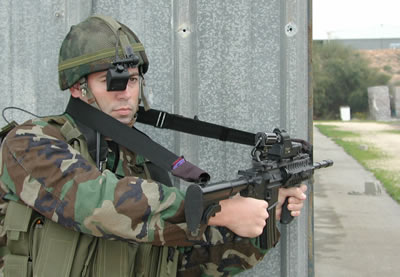
    This trend has been implemented with infantry combat systems. Various soldier’s integrated systems are under development by Elbit Systems and ITL. Among such systems, on display at LIC-2005 are the AISS integrated combat system developed by ITL, the MPRS integrated, small-arms fire control sight system, and multi-purpose weapon system (Refaim MPRS) developed by IMI. This system has gone through extensive development and testing in the recent year, with three types of ammunition – enhanced direct attack weapon, utilizing proximity fused fragmentation grenade, a non-lethal grenade, and an observation grenade, which can be fired over the target area and transmit real-time images throughout its flight. A different system, developed by RAFAEL is the Firefly, a 145 gr. grenade designed to be launched from 40mm launchers (such as the M-203). The projectile is equipped with two CCD cameras. The video stream is transmitted in real-time to the operator in the field, viewed and recorded on a PocketPC or PDA console.

    Future tactical observation systems pursued by the IDF will utilize the new miniature D-STAMP day and night payloads under development by Controp, as part of IDF/MOD development program. The fully stabilized payload weighs only 650 gr. D-STAMP is deployed with the Elbit System’s Skylark miniature UAV and is setting the baseline for future MAVs platforms considered by the IDF.

    PNR-500 (Personal Net Radio) developed by Tadiran Communications is a UHF personal communicator designed specifically for intra-squad and combat team communications. The system can accommodate an internal or external GPS and links to peripheral devices over a distance of 10 – 100 meters, via wireless Bluetooth connectivity. Such devices include rugged PDA, headsets, video cameras, sensors and displays etc. IAI/MLM is offering a simpler communications device called “Personal Location Unit” – a lightweight (350gr.) device, programmed to transmit five structured messages, ‘panic’ button transmitting high-priority emergency message, the device has built in GPS location and two-way modem supporting C4I and live training exercises.

     < page 6 out of 10 > Start – Previous –  Next

    Integrated Systems for AFVs

    Tight integration between sensors, weapon systems and command levels is already reflected throughout all levels of the Israel Defense Forces. The armor and mechanized units are receiving elements of “Battle Management Systems” (BMS). These units developed by Elbit Systems, integrate the vehicle’s sensors such as tank commander’s thermal sights, navigation and communications systems. The sight images, viewed by the tank commander, can be transmitted and shared by other crew members of his unit, as well as by commanders at higher echelons.

    Elevated views of the area, as captured by a UAV, and other elevated sensors can also be shared by all units, equipped with Tadiran Spectralink’s vehicular Tactical Video Receiver (V-TVR). The user can tune into the channel of a specific sensor, presenting the video and telemetry on the vehicle’s digital display. Similar equipment is used by helicopter pilots, to receive UAV sensor data directly from the UAVs, en-route to their target. Similar devices are also provided to dismounted commanders, equipped with the V-Rambo kit – comprising miniature receiver, and wrist display.

     < page 5 out of 10 > Start – Previous –  Next

    Panoramic IR Scanners & Stand-Off Measures

    Start < Page 4 of 9 >

    Automatic infrared systems can augment, and sometime replace radars in certain missions. Typical systems are the ADIR, from Elbit Systems and Spider or CEDAR from Controp. Such systems are comprised of a FLIR installed on a rotating plate, scanning a sector of up to 180 degrees, detecting suspicious targets, tracking them and triggering alerts after targets are identified as hostile. The system can track suspicious targets without setting an alarm, until their behavior becomes threatening or as they enter a high security zone, thus enabling effective operation in populated areas. The main advantage such system has over radar is the fact that it actually produces an image, for alarm verification.

    Stand off Countermeasures:

    Even when an effective sterile buffer zone is established between the forces and the surrounding inhabitants, troops must maintain close contact with the population on checkpoints, roadblocks etc. Utilizing advanced technology, such contact can now be initiated at extended range, enhancing the protection of soldiers while also improving cross-language communication. Utilizing the Long Range Acoustic Device (LARD), troops can issue a verbal challenge with instructions at a distance in excess of 500 meters. In Iraq and Afghanistan, LARD systems are integrated with the Phraselator vocal translator, to transmit hundreds of messages in Arabic, and Afghan Pashtu languages. LARD employs directed acoustic signals to which enable troops to communicate over an acoustic beam 15-30 degrees wide, transmitting clear voice or other audible signals.

    Non-lethal weapon systems can be employed in the “sterile” zone, to act as early warning and deter innocent people from entering the restricted area. Non lethal area denial weapons are ranging from sticky or slippery foams and liquids, eliminating movement within buildings, or streets, to stun guns and electronic shock inducers, used to immobilize vehicle’s electrical systems. Two of the most recent area denial systems are the M-5 Modular Crowd Control Munition (MCCM) and Taser Anti-Personal Munition (TAPM) both are a less than lethal mines, MCCM is loaded with rubber balls instead of steel pellets exploding when triggered by tripwire or sensor input. TAPM uses Taser electrical shock devices and can disable any human target by remote control or self activation. Such devices are used to deter, disorient and temporarily incapacitate assailants, separating them from innocent bystanders. Further into the future, troops could utilize Active denial System (ADS) directed energy non-lethal weapon system developed by Raytheon for the Air Force Research Labs. ADS projects a focused millimeter wave energy beam which induces intolerable heating sensation on an adversary’s skin and cause that individual to be repelled without injury. ADS could be used to stop, deter and repel hostile elements without applying of lethal force.

    Additional parts of this article:

    Security Applications of Ground Surveillance Radars

    Start < Page 3 of 9 >

    Typical military radars which can be employed for such missions include the Thales RB-12, Elta MDSR (EL/M-2129) or PPS-5 (currently enhanced by Syracuse Research Corporation into the PPS-5D version). These systems are capable of detecting a human target at a distance of 3-10 km. Airborne threats (such as ULM or UAVs) can be spotted at long distance, while vehicles can be detected and tracked at a distance of 10 – 20 km. Due to their high sensitivity and wide area coverage, these radars usually generate substantial “noise”, especially when operating adjacent to populated areas. To reduce such noise, radars are optimized to cover shorter ranges, and implement special filtering algorithms which improve their performance in force protection roles.

    Motorola Perimeter Surveillance Radar System (PSRS) and EL/M-2128 MINDER from Elta are two examples of such radars – they are designed to operate under all weather conditions, spot movement at short distances of up to 1,000 meters from a fence and trigger an instantaneous alarm including location, bearing and distance of the target. Perimeter Surveillance Radar System (PSRS) is a compact ground based radar designed by Motorola Israel for detection of human and vehicular targets, at a short distance from the fence. Modern radars can link directly to digital maps and geographical databases, feeding target data directly into net-centric tactical command systems.

    Plextek is offering the BLightER electronically scanned surveillance radar capable of detecting human targets at ranges from 50 meters up to 5 km. The BLightER 200 uses static antenna covers an arc of 80 degrees BLightER uses a wireless network to automatically linking with neighboring radars and command centers. When security coverage of a large area is required, aerostats are providing an effective solution – medium size aerostats with volumes of 50 – 35 cubic meters can lift electro-optical, radar and ESM sensors for extended durations, and provide continuous coverage of wide area, at ranges of several kilometers around the site. Typical aerostat borne systems are TAOS and Mini-TAOS, produced by RAFAEL. Larger aerostats such as JLENS, by Raytheon extend ground and air defense capability to protect from cruise missile attacks.

    Additional parts of this article:

    Wireless Data Communications

    One of the main challenges which surfaced in recent conflicts in Israel and Iraq is the shortage of bandwidth, particularly in frequencies allocated for datalinks (video and telemetry communications). New systems are already maturing, with the introduction of enhancements for current VHF and UHF communications systems, introduction of digital datalinks and utilization of existing infrastructure such as commercial and military cellular networks.

    One of the primary efforts is to extract maximum data transfer capability available with existing communications links. This effort has already paid-off with excellent results, through enhancement of data-communications capability of Tadiran Communications’ CNR-9000 family of manpack and vehicular radios. The current version, CNR-9000 HDR unit can transfer 115 KBps over standard 25Khz spaced VHF tactical radio channels. Tadiran achieved this capability, considered to be the highest data rate over standard VHF channel on the market, through the use of advanced digital processing algorithms implemented into the current set, designed as a Software Defined Radio (SDR).

    IAI/Elta is demonstrating their EL/S-8018B Data & Image Exchange Unit (DIDU) at LIC-2005 which facilitates data and high quality image transfer over standard VHF tactical radios. When video transfer is concerned, bandwidth restrictions become even more critical, requiring special compression to facilitate improved quality video exchange.

    Visual Defense, a member of Emblaze Systems group which offers video transfer technology developed for commercial 3G cellular phones. The same technology facilitates video archiving and distribution over existing channels, as narrow as 10kbps, over TETRA (such as the Motorola communication’s Mountain Rose (cellular tactical network recently fielded by the IDF), and commercial GSM and GPRS cellular networks.

    Tadiran Spectralink has fielded other technologies to address the datalinks bandwidth allocation challenge. The company’s StarLink family of miniature datalinks is designed to facilitate digital communications of video, data and telemetry, over a narrow bandwidth (up to a factor of 10 compared to existing datalinks). The datalink is designed for the new generation of miniature UAVs, which will be fielded in large numbers by small infantry units and Special Forces teams.

    < page 3 out of 10 > Start – Previous –  Next

    Terrain modeling and tactical decision support systems

    Most of the current Low Intensity Conflict (LIC) operations between the Palestinians and Israelis over the occupied territories in the Gaza Strip and West Bank are taking place in densely built-up environment. This type of terrain is favorable for urban guerilla warfare, and poses tough challenges for the deployment of regular military forces.

    Having to engage the enemy in such terrain, the Israel Defense Forces (IDF) developed unique urban combat effects based capabilities which enabling forces to localize effects on the target, while minimizing collateral damage to surrounding area, friendly forces and non-combatant population. Based on experience gathered during operations in Jenin and especially in its refugee camps in 2003, the IDF is examining several systems which will enhance terrain and situational assessment, planning and tracking of complex urban operations. A typical system is the DTACT developed by IAI/MLM for situational awareness, operational planning, simulation and mission rehearsal.

    Such systems are based on advanced simulation tools, including Tiltan Systems’ T-View 3D terrain model enabling commanders to plan, track and assess the situation on a detailed 3D representation of a complex urban terrain, including thousands of geo-specific structures. The system provides commanders at different levels and locations capabilities to share a common visualization of an area, simultaneous to the same viewpoint as seen by each combat element. Tiltan also offers the ArenaViewer produces an interactive visualization of the battlespace created from real-time imagery and video feeds overlayed on 3D terrain and fused with geo-referenced data layers. ArenaViewer simplifies access to multiple sensor and data layers via existing low bandwidth communications channels.

    < page 2 out of 10 > Start  –  Next

    Mosquito Micro UAV

    Mosquito 1
    Mosquito 1
    Mosquito 1.5 micro UAV

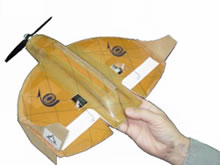
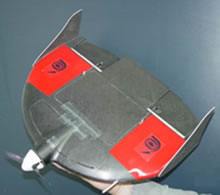
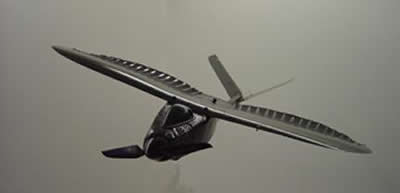
    The Mosquito 1 is a micro UAV designed by Israel Aircraft Industries, in response to the Israel MOD Defense Research & Development Directorate (DRDD) micro systems technology development. First flight was performed on January 1, 2003. The miniature saucer shaped plane weighs 250 gram and as a wing span of about 30 cm. The vehicle carries a miniature video camera and already performed several flights with up to 40 minutes endurance each. The Mosquito is launched by hand and lands on its skids at the end of its mission.

    The company is planning to test the advanced Mosquito 1.5 version soon. This improved design will weigh twice the Mosquito 1 weight, will be capable of flying a 60 minute mission with enhanced video camera (two gimbals provide roll control with electronic image stabilization), and carry improved avionics, enabling fully autonomous missions.

    CV90 AFV / Armor Upgrade

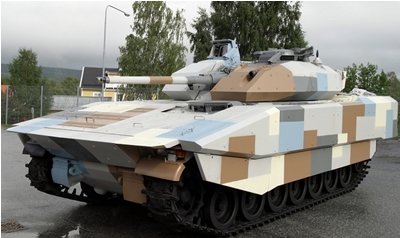
    Export of the BAE Systems Land Systems Hägglunds CV90 Mk II series IFV continues as the vehicle gets new upgrades preparing it for the latest threats. Since entering service with the Swedish Army in 1993 the CV 90 is operated by Norway, Finland and Switzerland. Netherlands became the fifth country to operate the vehicle; the first of 184 ordered will be delivered in 2007. The Dutch configuration will be armed with a 35mm/50mm cannon. At DSEi 05 the vehicle was shown installed with a new modular appliqué armor kit, developed by RAFAEL. The armor suit can be adapted to meet specific threats including mines, horizontal HEAT and kinetic energy (KE) projectiles and top attacks. The vehicle will also be offered with an integrated defensive aid suite, comprising laser warning, radar and missile approach warning. According to Rafael, this new-generation armor is based in part on its new insensitive reactive armor, combined with various types of passive armor appliqués.

    CV90 vehicles are operated by the armies of Norway, Finland, Switzerland, Netherlands and now Denmark. Total orders of CV90s series vehicles including the 4th generation CV9035 MkIII amount to for 1,170, of which 45 are on order by Denmark. The CV9035, built by , is a new-generation CV90, with improved fire power, protection, mobility and ergonomics plus an advanced electronics architecture.

    Dragon Eye Miniature UAV

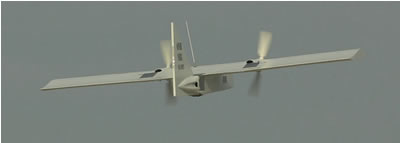
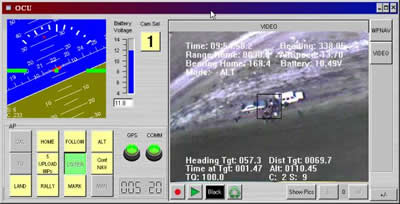
    Dragon Eye is a five-pound, back-packable, modular unmanned aerial vehicle (UAV) providing organic aerial reconnaissance and surveillance for the US Marine Corps at low tactical units levels. Dragon Eye’s twin electric engines run quietly on battery power. It is flown autonomously at an altitude of 150m’. The total weight of the Dragon Eye is 2.5 kg, of the payload (camera and equipment) weighs 1 pound. The US Marines Corps are planning to procure an enhanced version of Dragon-Eye, known as model X-63.

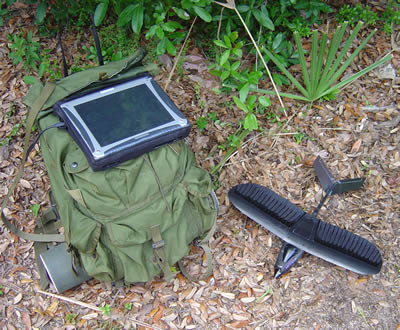
    The system is carried in a standard backpack, disassembled into five sections and carried with the 5 kg control station. Prior to the mission it is quickly assembled in the field within ten minutes. Dragon Eye is made of lightweight Styrofoam-like materials. It has a 18 cm wingspan once assembled and weighs about five pounds. The missions is programmed on the control station and transmitted to the UAV via wireless modem. The UAV is launched by a bungee cord or by hand. After launch it climbs to the cruise altitude and sweeps through the pre-assigned waypoints, navigating via GPS. The fuselage mounted side looking sensor comprises of a low-light b/w camera, capable of transmitting live video to the ground station from a distance of 10 km, via line-of-sight video datalink. Operator’s training requires less than a week for soldiers to be able to operate them.

    A Dragon Eye system consists of two air vehicles, four cameras, two replacement noses and one ground control station. The target cost at full rate production is approximately $60,000-70,000 per system. Aero Vironment has won the competition to supply the 342 Dragon Eye systems to the USMC from 2004 through 2006. The system is expected to field with initially at battalion and company level and further reach down to the platoon.

    The Dragon Eye is undergoing further development with testing of a high-resolution 640 x 480 infrared camera, development of a communications relay payload, an integrated communications system, and introduction of experimentation with alternate power supplies and air vehicle design to improve endurance. A prototype zinc-air battery developed by Arotech Corp’s Electric Fuel subsidiary has already been tested with the Dragon Eye unmanned drone.

    An enhanced version is currently under development at Aerovironment based on requirements and operational feedback from combat units operating the drone. The Dragon Eye UAV Block Upgrade, also known as X-63 will get air frame modifications and improved power sources increasing its loitering capability. It will have an autopilot for improved landing accuracy and in-flight navigation, and a new sensor payload with an IR and zoom camera that will providing true day/night capability. The system will have a new Level-4 compliant communications control board with 16 software selectable channels for uplink and downlink, twice the current capacity.

    • Air vehicle: 2.5 kg

    • Wing span: 18 cm

    • GCS – 6 kg

    • Endurance: 60 minutes

    • Cruise speed: 65 km/h

    TACMAV

    The Tactical Mini UAV (TACMAV) system is operating with special operations forces, and is currently evaluated by the US Army for deployment with lower echelon units deployed in Iraq. TACMAV system includes three aerial vehicles, modular payloads, and ground control unit and communications equipment. The MAV has a cruising speed of 80 kph.

    The 50 cm long miniature drone has a wing span of 53 cm. It uses flexible wings which can be folded around its fuselage, allowing the entire UAV to be stored in a 56 cm long, 13 cm diameter tube carried soldier’s backpack. When pulled out of the tube, the folded wings automatically snap into place.

    TACMAV uses a payload pod containing two color CCD cameras and a video transmitter, weighing only 40 gram. The total payload capacity of the TACMAV is 80 gram. The user can select forward or side looking camera. 15 frame “snapshots” can be used to recorded target of interest. The battery operated vehicle has an endurance of 30-50 minutes, using rechargeable lithium polymer cells. Higher capacity cells can extend the mission twofold. The GCU is running standard Air Force Portable Flight Planning System (PFPS) interface for mission planning, supporting pre-flight planning, in-flight updates and manual control.

    Miniature Aerial vehicles Design considerations

    Start < Page 4 of 7 >

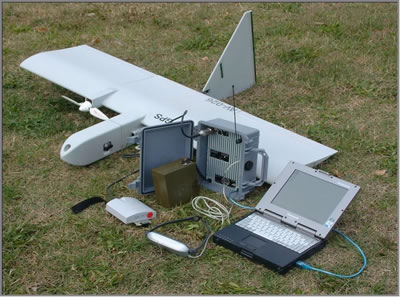
    Currently available MAV are larger than DARPA’s target platforms, but are already backpackable and operated by a single soldier or a team of two. It is designed to be fully autonomous – and require no special expertise or support at the operational level, at the platoon or battalion. The small drones are built to survive harsh conditions, operate in difficult weather conditions and communicate with their ground systems without the use of sophisticated directional links. The small dimensions dictate the use of lightweight sensors and payloads, based on miniature day or night cameras as well as uncooled infrared systems. Datalinks are maintained as simple systems, as the requirement is for short range operation (10km) directly over the combat area, where enemy electronic countermeasures are not expected.

    Structural Design

    As the design goal of current MAVs is aimed at 10kg weight, the most critical aspect of the aerial vehicle is weight. Therefore, lightweight materials are used extensively to form large assemblies that are easily interconnected to form the aerial vehicle. Future materials in development today will integrate power sources into the structural assemblies, providing “multifunction structures”. In order to reduce weight, various approaches are used, from prefabricated shell, made of durable lightweight composites, to a podded payload, carried by a hollow tube connected, to film laminated wings and tail, as demonstrated by the Skylark miniature UAV designed for Elbit Systems by AD&D. Other approaches are based on inflatable aero dynamic structures, which enable deployment of miniature UAVs from artillery projectiles and rockets. Vertical takeoff and landing systems are also proposed for MAV, utilizing miniature helicopters as well as various ducted fan tail sitters, as demonstrated by Singapore Technologies Engineering (ST Aero) Fantail. Other systems utilize effective aerodynamics to perform a “one way” glide mission, as they are deployed from UAVs, aircraft or guns, over the target. Such expendable MAVs can also be used for attack missions.

    Propulsion and Energy Sources

    Most miniature UAVs are powered by electrical motors, which limit their endurance to 1 – 2 hours, enabled by the power density provided by the batteries carried on board. Although internal combustion (piston) engines could provide a good alternative, their noise signature, weight and reliability are not suitable for MAV applications. Current MAVs are using specially designed lithium primary batteries, while new high density zinc-air cells have also been introduced, to offer up to 33% higher density power compared to lithium batteries. Zinc-Air batteries are designed specifically for mini-UAV applications. Developmental items have already been tested with NASA on a micro-UAV, flying a 58 minute mission. Other designs are underway for micro UAVs such as IAI Mosquito, as part of an Israel’s MOD R&D program. Future applications of DARPA’s “palm power” power cells could also be applied to MAVs, offering extended range and endurance.

    Payloads

    Advanced MAV payload weigh from just less than 1 kg to few tens of grams, yet include two or four axis stabilization, and high performance television camera, infrared sensors, mostly those operating in the 3-5 micron range, for day/night surveillance, as well as acoustic sensors. Other sensors can include chemical-biological sensors, and electronic surveillance equipment.

    Mission Control

    The control systems utilized with current MAVs offer “mission control”, rather than “flying” the aircraft like RC modelers do. The operator, usually an infantryman or a special forces warrior, carry a small laptop or palmtop PC, with a ruggedized “joystick, which enable functional control of the payload, and basic mission commands such as “maintain position” or “go to point” and “come home” etc. Mission specific control features also include “convoy protection“, recently demonstrated by MLB.

    All the flight control and auto-pilot functions must be performed autonomously by the aerial vehicle. The MAV must fly itself in calm or harsh weather conditions, including turbulence and wind gusts. Its flight controls include all motion and air data sensors, flight actuators and control surfaces, all driven by the an automatic piloting and control system. Control surface actuators are also driven by electric motors.

    Future applications of micro mechanical components (MEMS), ultrasonic devices and piezoelectric actuators are foreseen for future MAVs. Such components are expected to improve reliability, save weight and reduce overall power consumption. Most MAVs are utilizing Global Positioning Satellite (GPS) data for navigation and positioning. Other sensors required for position sensing include angle rate sensor, pressure, accelerometers, and altimeter, to name only a few .

    Communications & Data-link

    The airborne communications equipment performing video down link and command uplink, is also “hungry” for scarce power resources. The use of miniature, low power high frequency communications, specially designed for such applications, provide an important element in a successful MAV design. As higher the frequencies are, the antennae can be shorter and smaller. Since most MAVs are built of composite materials, antennas can be integrated into the vehicle’s structure to gain maximum coverage and minimize electromagnetic interference between on board radio systems.

    Packaging & Logistics
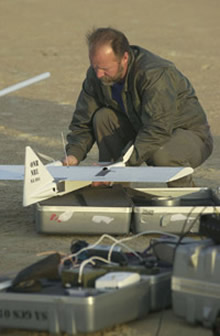
    While packaging of conventional UAV systems is a secondary logistical consideration, the packaging, assembly and reconditioning of a MAV is an critical aspect for efficient use by the field troops. Several approaches considered for such systems are assembling the aerial vehicle by hand, prior to a mission, firing the drone from a canister, like a missile, or deploying a UAV from a storage/launch cassette. Each of these concepts should enable compact carriage of the entire system in a backpack (drone, ground station and data-links), quick and simple assembly, automatic per-flight testing, and sensor calibration. Systems should also be designed for easy and simple interchanging of structural assemblies, to enable simple and rapid reconditioning of aerial vehicles at the field level.

    Additional parts of this article:

    Skunk Works and XTEND Simplify Multi-Drone Command

    0
    Lockheed Martin Skunk Works® and XTEND have achieved a major milestone in JADC2 by integrating the XOS operating system with the MDCX™ autonomy platform. This technical breakthrough enables a single operator to simultaneously command multiple drone classes, eliminating the friction of mission handoffs. From "marsupial" drone deployments to operating in GPS-denied environments, explore how this collaboration is abbreviating the data-to-decision timeline and redefining autonomous mission execution.

    From Ukraine to Taiwan: The Global Race to Dominate the New Defense Tech Frontier

    0
    As traditional defense primes face mounting competition from agile “neoprimes” such as Anduril, Palantir and Helsing, the balance of innovation is shifting toward software-defined warfare and scalable, dual-use technologies, while global industry consolidation—marked by Boeing’s integration of Spirit AeroSystems and other strategic mergers—signals an intensified race to secure control over the defense technology value chain. Our Defense-Tech weekly report highlights these trends.

    Europe’s “Drone Wall”

    0
    In early October 2025, a coordinated wave of unmanned aerial system (UAS) incursions—widely attributed to Russia—targeted critical infrastructure across at least ten European nations. The unprecedented campaign exposed the fragility of Europe’s air defenses...

    Weekly Defense Update & Global Security Assessment

    0
    Executive Summary The past week (September 18-25, 2025) represents an inflection point where strategic defense concepts have transitioned from doctrine to tangible reality. An analysis of global events reveals four primary, interconnected trends shaping an...

    U.S. Air and Space Forces Push Next-Gen Programs at the AS&C 2025 Conference and...

    0
    At the 2025 Air, Space & Cyber Conference, U.S. Air Force and Space Force leaders unveiled major updates on next-generation fighters, bombers, unmanned systems, and space initiatives, highlighting both rapid innovation and critical readiness challenges as the services race to outpace global competitors. A short version is available here, with a more detailed version for subscribers.

    TADTE 2025: Reflecting Taiwan’s Strategic Themes

    0
    The Taipei Aerospace & Defense Technology Exhibition (TADTE) 2025 crystallized around four dominant strategic themes that collectively illustrate Taiwan's comprehensive approach to defense modernization amid escalating regional tensions. Based on a detailed report by Pleronix (available upon request). Includes a Podcast discussion on TADTE 2025's highlighting Taiwan's four strategic themes beyond the post's coverage.

    Iron Beam 450 Completes Testing, Soon to Join With Operational Air Defense Units

    0
    Israel’s Iron Beam 450 high-power laser system has completed final testing, marking a major leap in air defense. Developed by Rafael, it offers precise, cost-effective interception of rockets, UAVs, and mortars, and is set for IDF deployment by 2025.