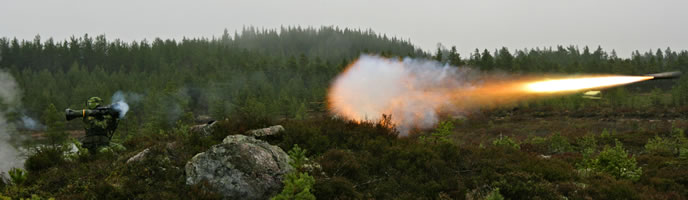
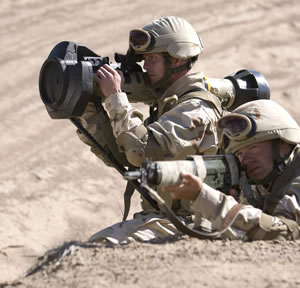
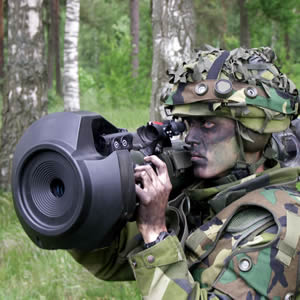
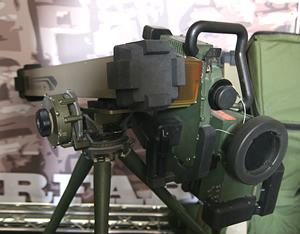
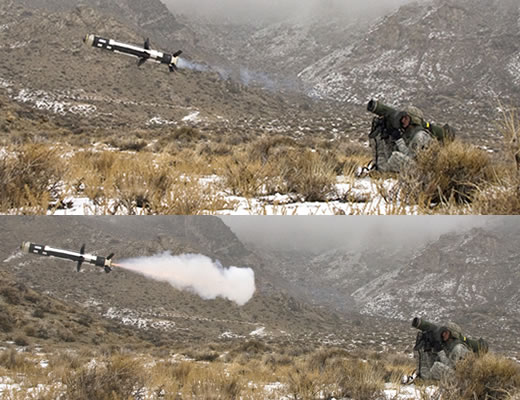
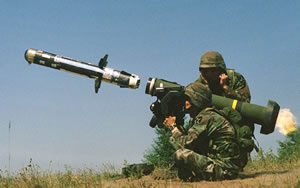
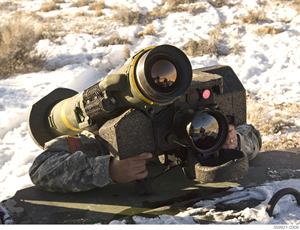
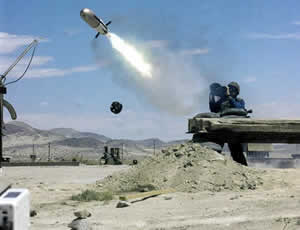
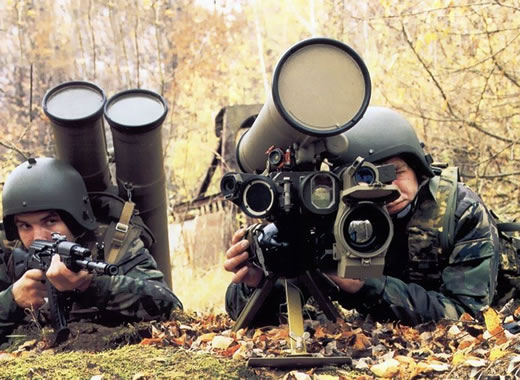
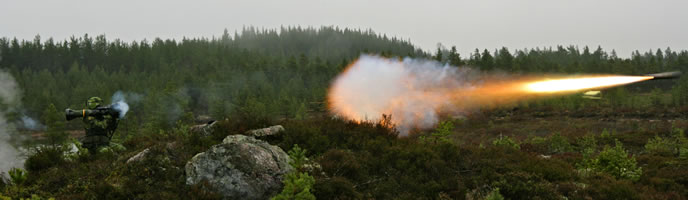
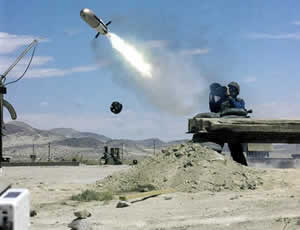
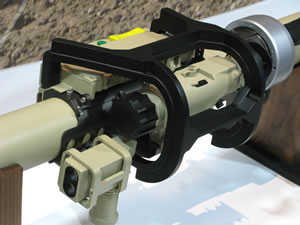
NLAW demonstrated in desert tan colors.NLAW Simulator demonstrated as part of the Saab interactive training system. Photos: Saab AB.
The Swedish ‘Next Generation Light Anti-tank Weapon’ (NLAW) RB-57 took off in recent years as more users line up with new orders. NLAW was developed by Saab Dynamics (originally Bofors) as a ‘point and shoot,’ short range anti-tank weapon, designed to defeat modern main battle tanks through ‘top attack’. Today, NLAW is considered the world’s newest light-weight anti-tank weapon, NLAW is currently operating with the British, Finish and Swedish armies since 2009. It has recently won another order from Luxembourg, equipping forces deployed on peacekeeping operations. Surprisingly, Saab has not addressed requirements for adding multi-purpose capabilities with NLAW, although having a proven technology in hand – the High Explosive Dual Purpose (HEDP) round for the Carl Gustaf M-3. The rapid conversion of the Predator proves the feasibility of such an option.
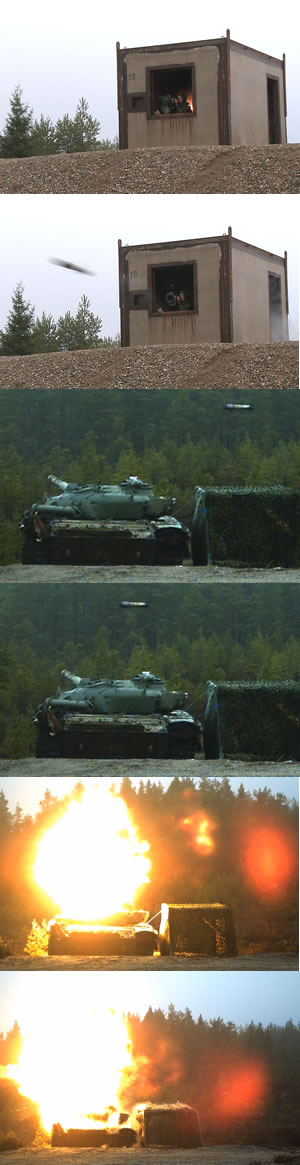
The flight course can be programmed as a flat trajectory, engaging the target in direct attack with the warhead fired forward, or aiming just above the target, by overflying about one meter above the target, with the warhead pointing downward, initiated by proximity fuse. The missile is designed for operation at ranges of 20 – 600 meters, using a reloadable launcher. The missile weighs 11.6 kg, including the reusable launcher. It has a diameter of 115 mm with an oversized warhead of 150mm, containing the high explosive anti-tank warhead. As a modern weapon, the NLAW is designed with insensitive energetic materials as an ‘insensitive munition’ (IM) and is capable of being fired from enclosure.
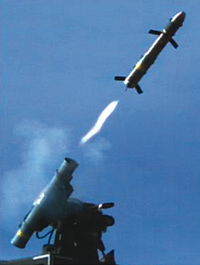
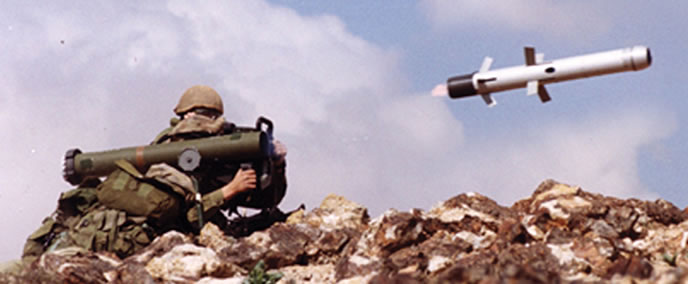
Firing seequence of a NLAW missile, launched from a building. The warhead is initiated as the missile is overflying the target, resulting in a massive explosion as the EFP charge penetrates the tank's top armor.
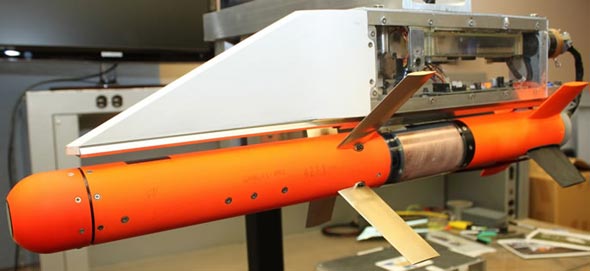
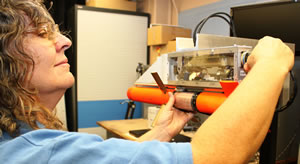
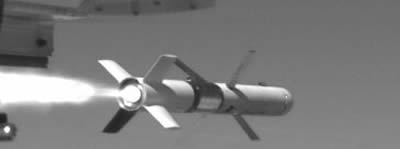
The miniature electro-optically guided, ‘fire and forget’ SPIKE missile was developed by the US Navy Weapons Division of the Naval Air Warfare Center, Weapons Division (NAWCWD) with assistance of DRS Technologies. Originally designed as a man-portable weapon for the Marines and the Navy’s special operations force, Spike fills a critical niche for a low-cost, lightweight guided weapon for U.S. ground forces.
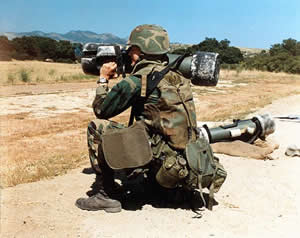
A modular, low-cost, high precision missile capable of engaging ‘asymmetric aggressors’ in complex terrain, at ranges exceeding 2 miles, with high precision, and minimal risk of collateral damage. The missile was designed as very low cost weapon, with unit cost goal of US$5,000. The Spike weighs about five pounds (2.26 kg), and is 25 in. (63.5 cm) long. It uses fire and forget guidance using a general purpose strap-down electro-optical seeker. It was designed as a shoulder fired tactical missile or a UGV, UAV boat or ship launched weapon. The warhead weighing about 1 pound (450 gr.) is located at the center and employs Explosively Formed Projectile effect to drive a focused yet lethal effect. NAWCWD plans to test the Spike missile with a new lightweight weapons management system (WMS) developed for small UAVs.
The missile uses EO / Semi-Active Laser (SAL) seeker to engage laser designated targets from a distance of two miles. It’s potential applications go beyond ground combat; it is a realistic armament choice for tactical unmanned aerial vehicles and a force-protection weapon to defend surface ships from small-boat swarms or light aircraft.
The missile performed its first controlled flights in 2005. SPIKE will offer safer, more accurate alternative to rocket propelled grenades (RPGs). The compact system is tailored for man-portable operations. Three missiles and a launcher could fit in a standard military backpack. Due to its light weight, Spike is considered to arm unmanned systems. According to John Baylouny, vice president of DRS Technologies, Spike missile could be used on almost any UAV and that “future spirals” in the program are expected to involve putting Spike on unmanned aircraft. Spike has already been tested with the DRS Sentry HP drone at Eglin AFB, Florida, as part of US Air Force UAV Battlelab evaluation.
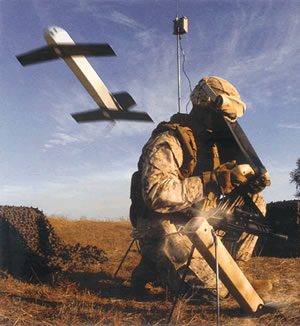
Following the conclusion of DARPA’s Close Combat Lethal Recon (CCLR) project the U.S. Air Force has embarked on a rapid acquisition program for a Lethal Miniature Aerial Munition System (LMAMS), offering the warfighter portable, non-line-of-sight precision strike capability against individual targets, ensuring high precision effect with a very low risk of collateral damage.
The program is run by the Rapid Acquisition Cell (RAC), the Air Force’s unit handling rapid acquisition and deployment of systems responding to urgent operational requirements. LMAMS will meet a requirement identified by the Special Operations Command, for a weapon system designed for small tactical units, capable of accurately engaging targets beyond the range of current organic direct fire weapons (ALGL, M2, M3 Carl-Gustaf, and AT-4). According to Air Force documents, LMAMS will increase lethality by quickly locating, tracking, and engaging time sensitive, fleeting targets, or enemy in defilade without exposure to threat precision small arms fire. ‘Absence of visual or acoustic launch signature is essential to maintain covert operation’ the document emphasized.
The miniature warhead carried by one of the systems proposed for LMAMS - the TiGER from MBDA. This warhead weighs few hundred grams and is slightly larger than a 40mm grenade. It is designed to focus lethal effect maximize lethality against unprotected, soft targets. Photo: Defense Update
Both tube-launch or hand-tossed versions will be tested. These expendable, electro-optically guided weapons will be fitted with a small warhead. The miniature killer drone will be able to loiter quietly over the target for limited time, waiting for optimal conditions to attack, while maintaining constant communications with the operator, transferring live video of the target below. Once attack permission is granted by the user, the drone’s mission-control becomes a guidance system, employing automatic-target tracking to lock on target, descending through a fast, controlled diving guiding itself to hit the target with the highest precision.
In November 2010 several companies have submitted inert ‘suicide MAV’ to demonstrate mature technologies. Although none was specifically attributed to CCLR program it is believed that at least some of the elements, including the electro-optical sensor and its operating algorithms provided by the government were derived from the program. Following these tests three contractors were selected to continue and provide weaponized systems for a test series, planned for April 2011 – Aerovironment, IAT and Textron Defense Systems. The Air Force plans to begin procurement of such weapons as early as 2012. Two representative systems in this category are a new ‘Point and Toss’ mini-drone from IAT and the Switchblade developed by Aerovironment, presumably under ‘Project Anubis’. Another concept from MBDA known as TiGER was not accepted.
The Air Force expects the new weapon to weigh around 3 lbs (1.36 kg). The user will also carry the integrated operating console and communications unit, weighing additional 3 pounds. The entire system could deploy and be ready to fire within 30 seconds. Once launched, the system should be capable to acquire a man-size target at the system’s combat range, in less than 20 seconds, flying at an altitude of 100 meter above ground. If conditions for attack are not met, the MAV will be able to loiter over the target for up to 30 minutes. For the terminal phase, the MAV is designed to hit target within 3.28 ft (1 meter) radius, at maximum speed of 80 – 100 mph (35-44m/sec). This accuracy matches the warhead’s effectiveness to kill or incapacitate personnel in the open or on soft skinned vehicles, within a two meter radius from the point of detonation.
Such a miniature guided weapon could become useful during an engagement in which the enemy has an advantageous position that direct fires cannot neutralize. LMAMS will also reduce the risk to the operator from unabated sniper or similar concealed hostile fire increasing the operator’s survivability. The weapon system will consist of a ground control station, associated with a portable wideband data link and mission planning functionality. The system will also comprise two munitions, consisting of an airframe, interchangeable warhead or inert payloads, day/night full-motion video sensor, data-link, and launcher.
Anubis has been in the making for several years and could be the ‘missing link’ between CCLR and LMAMS. Last January the small UAV specialist Aerovironment has been awarded the final increment of $1.18 million for the third phase of development. According to the Air Force, Anubis will be able to track-down high-value maneuvering targets flying in ‘non-line-of-sight’ conditions (hinting at urban warfare). Relying on high precision and target identification capability at close range, the weapon will rely on a small warhead which will result in ‘very low collateral damage’. In fact, Anubis will be able to perform what special operations snipers are doing today – but offer operators more opportunities to strike, higher operational flexibility with enhanced safety. If Anubis is in fact the Switchblade Aerovironment is already offering, it will also have a potential to become an aerial munition offering new capabilities for small UAVs sofar unable to carry out such missions.
IAT’s ‘Point and Toss’ unmanned aircraft system was unveiled by IATech at the Association for Unmanned Vehicle Systems International (AUVSI) Conference in August 2009. The system, configured as a flying wing micro-UAV is designed so that a single user can independently assemble, hand launch, and recover the UAS. When starting a mission, the UAS is pointed at the target’s direction and is ‘toss launched’ for takeoff. The UAV is controlled by IATech’s autopilot, SmartIMU GPS/inertial suite, and embedded vision system. The payloads include day imaging or infrared for day/night missions. All aerial photographs are geo-referenced and retrieved by datalink, overlaid on a FalconView or Google Earth display maps.
The Spike C4I system (Tycoon) enables Spike firing teams to share information, allocated targets, update mission plans and improve communications among Spike units and other combat elements, using data and image communications. Photo: Rafael
The Israeli Spike missile was developed by Rafael to meet IDF requirement for an infantry operated, precision guided weapon capable of defeating enemy armor from long distance. The missile employs electro-optical guidance and is provided in a ‘fire and forget’ variant or ‘fire and forget/fire and update’ variant, equipped with fiber-optical link maintaining optional ‘man in the loop’ control throughout the engagement. Once fired at a target, the missile flies an elevated trajectory from where it can acquire and engage targets which are not visible prior to launch, engaging targets from above, where they are least protected.
Over 21,000 Spike missiles were ordered and are operational with 18 armies worldwide. Over 3,000 were fired, many in routine operational training and combat scenarios in conflict areas worldwide. The IDF fielded the missile with regular infantry battalions in 1998. Delivery of more missiles continues, with acquisitions supplying reserve battalions expected to be completed by 2012. By that year the IDF plans to introduce enhanced systems, comprising of lightweight, improved launchers and sights, integrated with position location and connectivity to battle management systems.
Rafael, in coordination with the IDF Ground Forces Command is already working on such improvements. Through the years the Spike was improved through continues improvement, technological modernization introducing improved imaging, MEMS, lighter and thinner fiber optical links and electronic circuitry, thus improving reliability, dealing with obsolescence and reducing weight, providing more weight and space reserve for increasing the warhead and extending the range. Backward compatibility with early generation warheads is also provided by upgrading launchers, enabling older systems to handle the newest Spike missiles.
Planned enhancements include the integration of position location systems into the system’s command module, enabling operators to quickly orientate at the firing position and align their position and aiming sights with networked battle command systems. The system known at Rafael as ‘Tycoon’, employs a GPS unit and link to the land forces’ ‘Digital Army Network’ also known as ‘Zayad’.
The weapon has also received a new lightweight launcher that will be integrated with the new command and sight, position reporting and power supply systems will weigh 7.5 kg less than the current system. The new launcher weighs 10 kg, instead of 13kg of the current launcher. The entire system will require fewer batteries, saving additional 4.5 kg from the load carried by the Spike team. The new sight will use an improved thermal imager with four fields of view, enabling better target acquisition in day and night. The new system will also include a digital video recorder enabling instant replay for battle damage assessment, post mission debriefing and training purposes.
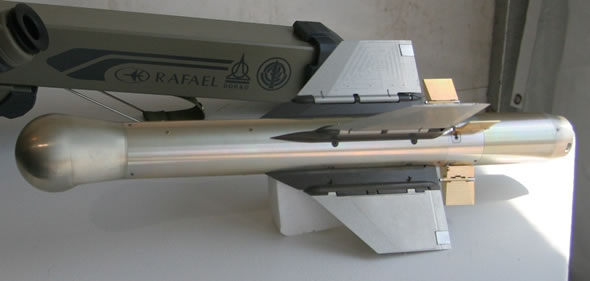
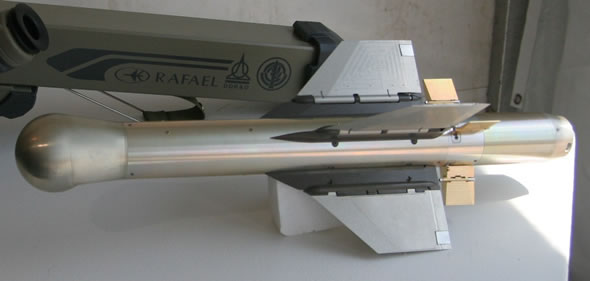
Rafael's Mini-Spike guided missile is designed to operate from standard Spike launchers (seen in the bottom-right photo). This miniature missile weighs about a third of a Spike MR and can hit targets with the same precision 1,300 meters. Its warhead is designed to maximize effect against unarmored targets. Photos: Defense Update
A derivative of the Spike is the short range ‘Mini-Spike’ variant, known in Hebrew as ‘Gilon’. This weapon was unveiled by Defense Update in September 2009. “The Mini Spike is expected to cost and weigh about a third of the Spike, while having an effective range of 1,500 m’. The new missile will also introduce new flight modes, designed to enable precision strikes in urban areas – such as flying through an open windows or attacking an enemy target hidden behind defilade or obstacles using ‘non line of sight’ engagement. The Mini Spike will be much lighter – weighing about four kg, compared to 13 kg of the Spike LR. To minimize the load on the infantry, Mini Spike will use the same launcher and sight system used for current Spike LR, loading the missile on a special adaptor.
The Spike C4I system (Tycoon) enables Spike firing teams to share information, allocated targets, update mission plans and improve communications among Spike units and other combat elements, using data and image communications. Photo: Rafael
A different member of the Spike family currently in early development is the Spike Short Range (Spike SR) – a shoulder-fired, ‘fire-and-forget’ direct-attack precision guided weapon designed for precision engagement at ranges of 25 – 1,000 meter. The weapon will weigh about 7 kg, and utilize a low-cost thermal camera and guidance electronics, strapped to the missile’s nose (eliminating the mechanical gimbal). Spike SR will be carried in a disposable container-launcher. The system will not require a separate sight – as the missile’s ‘eye’ will provide this function through a low-cost display integrated into the launcher, showing the target until the missile is launched. The weapon will carry relatively large multipurpose warhead, comparable in size and effect to Rafael’s ‘Matador’ – extending the unguided weapon’s effect beyond 1,000 m.
A typical Spike MR team carrtwo missiles , the command and launch unit and the tripod. The IDF plans to field a new launcher, lighter tripod (below), more powerful battery and improved command-launch unit to reduce the load carried by the team while extending endurance and improving performance.
Another Spike innovation presented for the first time at the Eurosatory exhibition in Paris this year is the unit level simulator developed for the system. The new simulator trains entire guided missile units, instead of single teams, enabling commanders, and team leaders to practice complex tasks of situational awareness, target allocation and coordination with supported units, in addition to common technical operator skills.
U.S. Army troops firing a Javelin missile during a joint exercise with the Indian Army. India is considering buying the missile through a U.S. Foreign Military Sale program, to replace existing wir-guided missiles such as the French Milann-2 and Russian AT-5. Photo: U.S. Army
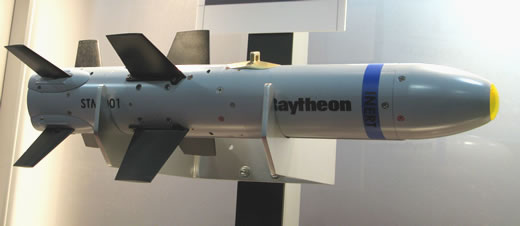
The FMG-148 Javelin man portable guided missile has been widely accepted among the leading modern anti-tank weapons. To bring the weapon up-to-date with current and future requirements, particularly regarding hybrid warfare, the U.S. Army plans to field by 2014 the ‘Javelin Increment II’ weapon system – an enhanced version of the missile. These improvements will increase the weapon’s effective range, precision and introduce a ‘regret’ function to avoid fratricide or excessive collateral damage by introducing ‘Precision Terminal Guidance’ capability.
U.S. Army troops firing a Javelin missile during a joint exercise with the Indian Army. India is considering buying the missile through a U.S. Foreign Military Sale program, to replace existing wir-guided missiles such as the French Milann-2 and Russian AT-5. Photo: U.S. Army
The improved missiles will also receive modernized components, such as an advanced seeker and other elements replacing components that became obsolete through the years. An improved warhead will also increase the Javelin’s hard armor penetration requirements, a new fragmenting case and fuse to increase the weapon’s lethality against soft targets and personnel in the open. The warhead and propulsion motor will employ insensitive propellant and explosives, thus reducing vulnerability to impact and fire. Other enhancements considered for future increments include advanced fusing and higher performance propulsion, employing insensitive energetic materials. To compensate for the additional weight the missile will get a new mid-body made of lightweight composites. The launch tube and motor case will be produced of ultra-durable structure made of new nano-composites.
Javelin is designed for safe firing from enclosed spaces, to enable such function, the missile is expelled from the launcher by a gas generator, and the rocket ignites after the missile has cleared a safe distance from the operator. Photo: Raytheon
In parallel, the Army is expected to implement new features with the weapon’s fire control system and missile seeker, as part of the ‘Close Combat Networking of Weapons and Sensors’ (CCNWS) strategy. Currently under evaluation is a ‘people tracker’ algorithm and image stabilization capabilities, embedded into an advanced ‘system on a chip’ type integrated processor architecture.
Another enhancement tested with the Javelin in 2008. The test scenario involved using a Universal Control System to cross-cue a Javelin gunner with an unmanned aircraft system (UAS). This solution provides the javelin gunner with improved situational awareness and target location.
Raytheon’s Universal Control System (UCS) provides an open architecture used to monitor, display and control multiple, dissimilar unmanned vehicles concurrently with advanced control capabilities. The system includes several Vehicle Specific Modules (VSMs) developed for a variety of platforms, including UASs, unmanned ground vehicles (UGV) and unmanned surface vehicles (USV). Each VSM provides capabilities to extend native platform functionality. Multi-Vehicle Control System (MVCS) includes VSMs for the Silver Fox, Manta, Cobra and Raven UASs and the Navy’s USSV unmanned surface vehicle.
Javelin is currently in service with the U.S. Army, U.S. Marine Corps and 11 allied customers. In 2009 the Javelin Joint Venture received a $176 million contract from the United Kingdom’s Ministry of Defense for more than 1,300 Javelin missile rounds; deliveries of the missiles began in 2010 and will continue through 2012. In 2010 Saudi Arabia also selected the missile, buying 20 command systems and 150 missiles to equip its infantry and, possibly national guards. France has also placed an order for the missiles to support its forces deployed in AFghanistan, and consider increasing orders to equip all infantry regiments. India is also considering buying the missile.
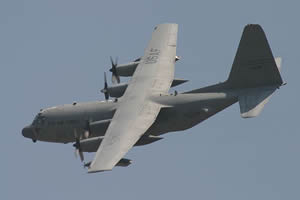
The first of twelve MC-130W Dragon Spears arrives at Cannon Air Force Base, N.M. July 29, 2010. The Dragon Spear will be assigned to the 73rd Special Operations Squadron and provide new cutting edge mission capabilities. (U.S. Air Force photo by Airman 1st Class Maynelinne De La Cruz)
The MC-130W Combat Spear conducts infiltration, exfiltration and resupply of U.S. and Allied Special Operations Forces.
The MC-130W has the most technologically advanced refueling system available and provides the ability to refuel special operations helicopters and the CV-22. The navigation suite is a fully integrated Global Positioning System/Inertial Navigation System that interfaces with Low Power Color Radar and Infrared Detection System.
The first of twelve MC-130W Dragon Spears arrives at Cannon Air Force Base, N.M. July 29, 2010. The Dragon Spear will be assigned to the 73rd Special Operations Squadron and provide new cutting edge mission capabilities. (U.S. Air Force photo by Airman 1st Class Maynelinne De La Cruz)
Other collateral missions include forward arming and refueling, specialized ordnance delivery, airdrops in support of psychological operations and limited command and control capabilities.
The 73rd Special Operation Squadron takes on a new type of aircraft, the MC-130W Dragon Spear, July 29, 2010. In the future, Cannon will be host to 12 Dragon Spears. (U.S. Air Force photo by Airman 1st Class Maynelinne De La Cruz)AFSOC MC130W over Hurlburt.
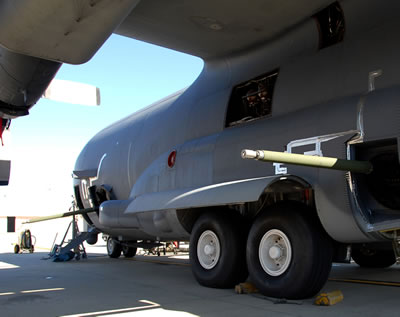
Seeking to augment the aging AC-130 gunships operated by Air Force Special Operantions Command (AFSOC) The U.S. Air Force began exploring optional conversion of MC-130Ws into interim gunships. The Combat Spear conversion included the introduction of wing-mounted pylons carrying GBU-39 Small-Diameter Bombs (SDB’s), and provision for ‘roll-on, roll-off’ gun mounts equipped with an integrated package of sensors, communications systems, Gunslinger launch tubes firing ‘Stand Off Precision Guided Munition (SOPGM) such as the GBU-44V Viper Strike or Griffin Small tactical Munition (STM) precision guided weapons. These weapons are managed and controlled from a battle management system (BMS) which comes with the Gunslinger kit, providing the weapon’s operator aircrew member the ability to operate all aspects of the Gunslinger system. The kit also includes Bushmaster II Mk44 30mm guns. The Air Forces’ goal was to deliver a conversion system that will enable the squadron to equip an MC-130W into a Gunslinger armed platform in five minutes.
In September 2010 L-3 Communications was awarded $61 million to deliver eight such Ro-Ro kits, converting the MC-130W Combat Spear into ‘Dragon Spear’ gunships. the conversion of four additional aircraft is an option, expanding the contract t 12 planes.
The MC-130W Weapons suite includes Gunslinger launch tubes firing GBU-44V Viper Strike or Grffin Small tactical Munition (STM) precision guided weapons and Bushmaster II Mk44 30mm guns. Photo: USAF
During the mid-2000s DARPA, later followed by the U.S. Air Force esearch Lab, promoted research and development of technologies related to the use of miniaturized, loitering aerial weapon systems. One of the programs evolving from these studies was Project Anubis. The objective of the project was the development of a prototype for a Non Line of Sight (NLOS) weapon system to engage time-sensitive, fleeting, high value targets. The Anubis weapon was an armed, tactical miniature aerial system (MAV), equipped with an imaging sensor capable of target identification, tracking and terminal guidance. The MAV is also equipped with a small warhead for lethal attack.
The system employs innovative seeker/tracking sensor algorithms that enable engagement of stationary or maneuvering targets ensuring high kill probability. The small warhead utilized with the system results in ‘very low collateral damage’. In fact, Anubis will be able to perform what special operations snipers are doing today – but offer operators more opportunities to strike, perform more complex missions at longer range and ensure maximum safety for the shooter.
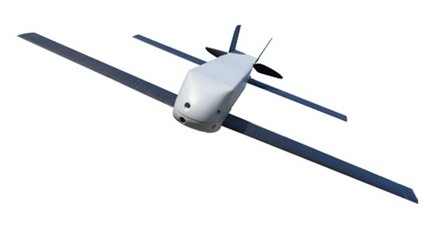
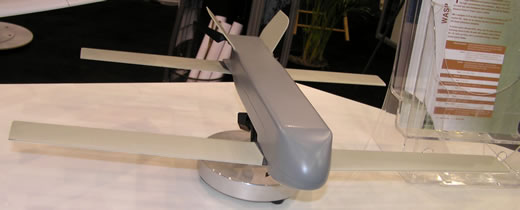
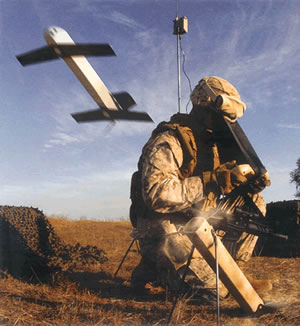
Switchblade, seen on display at Aerovironment's booth, AUVSI 2007. Photo: Defense Update
Since 2008 Anubis was tested and demonstrated such capabilities, achieving the range, accuracy, flight time and lethality to defeat target sets beyond the range of current squad level weapons. In January 2010 small UAV specialist Aerovironment has been awarded the final increment of $1.18 million for the third phase of development. According to the Air Force, Anubis will be able to track-down high-value maneuvering targets flying in ‘non-line-of-sight’ conditions (hinting at urban warfare).
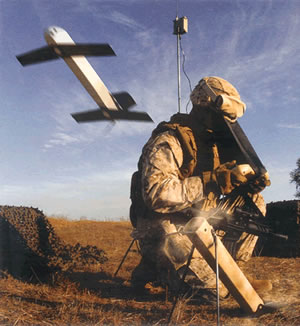
Aerovironment is not relating officially to the Anubis program, but has unveiled a similar weapon system called Switchblade. If Anubis is in fact the Switchblade Aerovironment is already offering, it will also have a potential to become an aerial munition offering new capabilities for small UAVs sofar unable to carry out such missions. In December 2010 the company was selected as one of three finalists for the Air Force’s LMAMS program, aiming to fieldminiature-lethal drone capability with Special Operations units by 2012.
Switchblade is contained in a compact (5.5 lbs) container/launcher, that fits inside an ALICE pack. A common ground launcher, used for controlling the RQ-11B Raven, Wasp or Puma, controls the Switchblade as well. It can be launched safely from vehicles, watercraft or aerial vehicles.
AeroVironment describes the Switchblade as the warfighter’s “magic bullet”. It can rapidly provide a powerful, but expendable miniature flying Intelligence, Surveillance and Reconnaissance (ISR) package on a Beyond Line-of-Sight (BLOS) target within minutes. This miniature, remotely-piloted or autonomous platform can either glide or propel itself via quiet electric propulsion, providing real-time GPS coordinates and video for information gathering, targeting, or feature/object recognition. The vehicle’s small size and quiet motor make it difficult to detect, recognize, and track even at very close range. The Switchblade is fully scalable and can be launched from a variety of air and ground platforms. It is controlled via a common ground launcher, also used for controlling the RQ-11B Raven, Wasp or Puma.
The Switchblade’s payload and launcher, weighing less than six pounds total, can be carried in a backpack by a single soldier. The mini UAV, which sends streaming video and GPS coordinates back to its operator, can be transformed from an intelligence, surveillance and reconnaissance UAV into a mini bomb striking a target beyond the line of sight.
The battery-powered vehicle has a very low visual, acoustic and thermal signature. AeroVironment says the the weapon can also be deployed from submarines, ground vehicles and a manned, as well as unmanned, aircraft. It is designed to operate at low level – below 500 ft above ground, and at a maximum altitude 15,000 ft. Officially, Switchblade has an endurance of ‘greater than five minutes’, but the system is scalable to meet changing user requirements.
The company already produces the Wasp III micro-UAV for the U.S. Special forces and Marine Corps and in 2008 has been awarded a development project for the “Stealthy, Persistent, Perch and Stare (SP2S) UAS”, based on a modified WASP design.
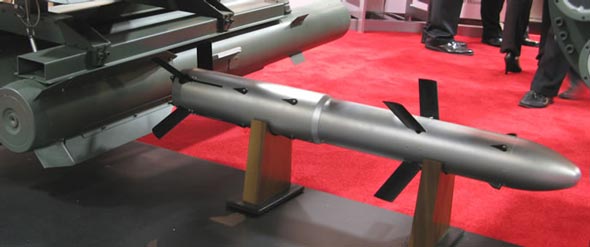
The Griffin developed by Raytheon was publicly displayed at AUSA 2010. The missile, described by the manufacturer as a ‘Real Time Attack System’, weighs 33 pounds, about a third of the Hellfire’s weight, yet is capable of hitting targets at a range of 12.5 km when launched from an aerial vehicle. ” We originally developed the Griffin missile with our own funding, using components from other proven systems, and it is now integrated aboard the AFSOC C-130W Dragon Spear.” said Harry Schulte, vice president of Raytheon Missile System’s Air Warfare Systems’ product line.
The Griffin B on display at AUSA 2010.
Two versions of the missile are available. The A round is an aft-eject missile, designed for integration on aircraft such as the Dragon Spear; the B round is a forward-firing missile that can fire from unmanned platforms, helicopters and ground launchers. Griffin has been demonstrated firing from launchers attached to the U.S. Army Remote Weapon Station and Multi-round Wedge launcher. The Wedge can be mounted on vehicles or used as a ground launcher, offering short-range precision fire and combat outpost protection.
The Small Tactical Munition is in development at Raytheon, as a small, light weapon, (weight 13 pounds), more than half is the warhead (7 pound). This weapon is a gravity bomb which has proven extremely successful during testing.(Griffin A) is dropped from 'Gunslinger' weapon systems installed on U.S. Special Operations Command MC-130W Dragon Spear. The B version of the missile (shown on top) is carried underwing in a container-launcher. Photo: Defense Update.The Griffin's 'Smart Launcher' simplify the integration of the new weapon on platforms carrying other missiles. Photo: DOD/Raytheon
When employed from a ground launcher Griffin can hit targets at a minimal ranges of 1000 m’ up to 5.5 km. The missile was designed for wheight-critical applications, including arming unmanned systems, light scout helicopters or support of dismounted, light infantry operations.
Griffin was designed to maintain commonality with existing launchers, such as the Hellfire Common Launcher Tube, by using a pattented ‘Smart Launcher’ that attaches the missile to existing weapon stations facilitating communications across the platform’s interface. This integration method enables simple adaptation to multiple manned and unmanned platforms.
This small missile is expected to be a weapon of choice to be employed by UAVs, light helicopters as well as large C-130 platforms, providing a localized, yet effective impact on the target, while minimizing collateral damage to non combatants and nearby troops. The Griffin uses semi-active laser guidance, integrated with GPS/INS for backup, enabling non-line-of-sight engagement. The 13 pounds warhead is a blast-fragmenting type, optimized for soft target lethality rather than armor penetration. The fuse can be set to one of three modes – point detonate, height of burst or delay.
Photo Below: Defense UpdateThe 'Wedge' launcher can be mounted on a vehicle or positioned on the ground, to operate as a short range precision weapon for close fire support or forward base protection. Photo: Raytheon
‘Griffin enables the user to shape an attack through a simple, easy to use graphic user interface’, describes Raytheon, ‘The user can select to guide the weapon precisely to the target using GPS coordinates, inertial navigation or laser designation. To maximize kinetic effects and lethality the system also enables the conduct of Multiple Round Simultaneous Impact (MRSI) target engagement, increasing the effectiveness of the attack. The missile is also designed to attack moving targets and has demonstrated this capability in several test firings.
The Small Tactical Munition (Pyros) is another miniature weapon in development at Raytheon. This small and light weapon, (weight 13.5 pounds), more than half its weight the warhead (7 pound). This weapon is a precision guided gravity bomb with INS/GPS and Semi-Active Laser guidance, which has proven extremely successful during testing.
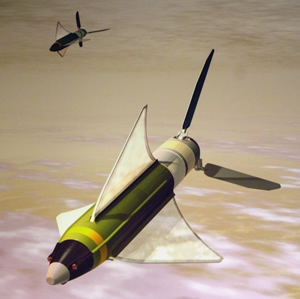
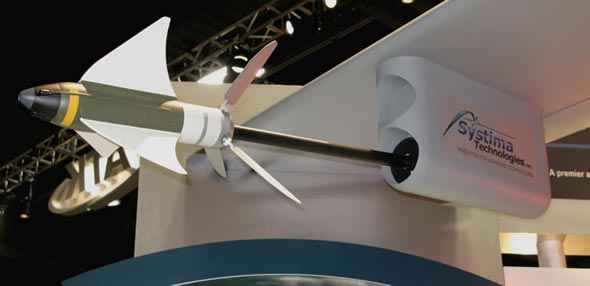
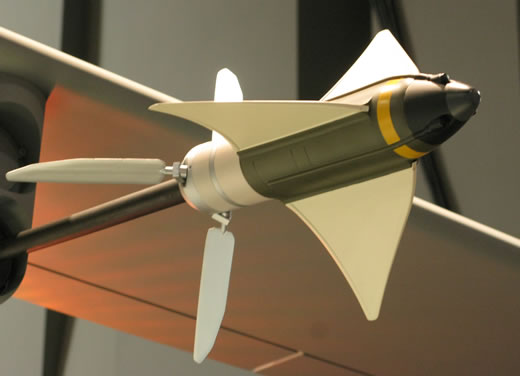
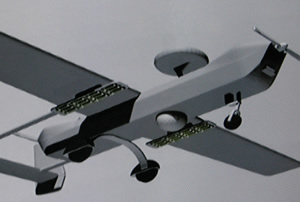
ATK is developing a lightweight precision guided munition, compact and light enough to be carried by the dozens or even hundreds by unmanned aerial aircraft. The new glide weapon is packed into a conformal container launcher carried under the wing of the Shadow, fitted on top of the strut root. Upon release the weapon’s fins are extracted and three airfoils pop into place, as the weapon glides on its path to the ground. As the three laser detectors are activated, they seek laser signals reflected from the designated target. Once the laser spot is detected, the weapon’s flight control processor computes the necessary corrections and activates the tail fins to point the weapon on the course homing in on the spot, hitting the target with high precision.
Photo: Defense-Update
The weapon weighs about six pounds (2.7 kg). Its hand-grenade size warhead makes more than half that weight (about four pounds or 1.8 kg). The resulting effect offers maximum lethality against exposed targets, with minimal collateral damage to their surrounding.
ATK has unveiled this GPS/SAL guided weapon, believed to be the G2M. Photo: Defense UpdateThe first artist impression of the laser augmented miniature GPS Guided Munition was provided in this artist concept, displayed at the ATK booth at AUSA 2009. A year later the company displayed a full scale model as well as some technical details, but did not release the name or designation of the product.
Persistence and immediate response close air support based on such weapons has the potential to transform combined air/ground operations, as UAVs loitering above a ground combat element could continuously support ground forces through sustained combat engagements, without the logistical and operational burden when rotating through rearmament or replenishment cycles. Brigades could rely on their own Small UAVs assets like the Shadow, each carrying four weapons in addition to the standard ISR and radio relay payloads. Larger drones will employ multiple ejector racks packing 12 weapons or more, each loaded rack could be carried under a pylon currently carrying Hellfire missiles. Therefore, an MQ-1A Predator currently carrying two Hellfires will carry 24 of the new weapons. A similar load will be carried by the MQ-5B Hunter, while the MQ-1C Grey Eagle will be able to carry twice that load. The Air Forces’ MQ-9 Reaper will be able to carry 72 units and the A-160 destined for the Special Operations Command will haul over 200 such weapons.
This image shows possible carriage configuration of 24 miniature GPS guided munitions carried by two canisters on the Hunter MQ-5B
The miniature guided weapon currently under development could, potentially, replace current cluster weapons banned by international treaties. When employed in weapon systems, individually targeted guided weapons could be directed to scatter over the area to focus on specific target location, guided by GPS – or disperse over a specific area in a pattern maximizing the desired effect. Optional carriers such as new cruise missiles, or loitering weapons, will be able to employ such guided submunitions to attack multiple targets along their flight path, on a single mission.
Back in the early 2000s the U.S. Marines pioneered a new concept fielding a low cost, lightweight precision guided anti-tank missile called the FGM-172A Predator. The missile was developed by Lockheed Martin [NYSE: LMT], and was designed to provide the corps’ firepower beyond the range of their unguided SMAW weapons. The missile employed two major advantages – ‘point and shoot’ aiming system and ‘fire and forget’ inertial guidance, enabling quick, simple yet accurate and effective operation. The autonomous guidance compensated with cross-wind and other disturbances with in flight corrections. Another advantage was the ‘soft launch’, enabling firing from enclosure, enabling the warfighter to fire the missile through windows or from the protection of building without wearing special ear protection.
The missile system is delivered as a disposable system, weighing about 9.7kg. (21 lb). To enable this lightweight missile to defeat heavily protected tanks, the missile was designed to engage the target with a shaped-charge ‘Explosively Formed Penetrator’ (EFP) pointed downward, through ‘top attack’, hitting the tank’s most vulnerable upper area. Despite its superior capability the Predator has not been accepted beyond the Marine Corps, as in the U.S. Army did not follow the Marines lead and preferred to remain with the more capable yet expensive Javelin, while considering a new derivative of the unguided Saab AT-4 to enable firing from confined space when operating in built-up area. Lockheed Martin lost another prospect in the U.K., which opted for the Swedish competitor – MBT LAW.
Lockheed Martin produced Responding to an urgent request from warfighters, Lockheed Martin expanded the capabilities of its Predator anti-tank weapon and delivered 400 rounds to the U.S. Marine Corps. The conversion of Predator from a top-down anti-armor weapon to a direct-fire urban assault weapon was prompted by the need for fire-from-enclosure assault weapons, which has become paramount to support combat actions in Iraq. It took the company only six months to come up with the redesign, The program Renamed as the ‘Short-Range Assault Weapon-Multiple Purpose Variant’ (SRAW-MPV) MFG-172B, the Predator evolved into the precursor of today’s ‘urban assault missile’, fitted with a multiple-purpose blast warhead, enabling it to defeat a variety of targets such as buildings and bunkers, as well as light-armored vehicles. For direct attacks the missile flies an unguided, flattened trajectory employed in line-of-sight engagement. Its main advantage is the capability of being firing from confined spaces and improved accuracy up to the missile’s maximum range of 600 meters.
Russian Metis M anti-tank guided missiles were designed specifically for dismounted infantry units. The system, comprising a launcher, thermal imaging sensor and three missiles weigh about 30 kg.
Above: this NLOW anti-tank weapon firing clearly show the delayed activiation of the rocket motor, ensuring the effects of flash, pressure acoustic overload are minimized on the user or on nearby troops. As many modern anti-tank weapons, NLOW can be fired from vehicles or from enclosures. Photo: Saab AB
New Guided Missiles, Programmable Munitions Are Required To Enhance The Infantry Precision Fire Effects
These modern missiles were designed exclusively as anti-tank weapons, providing dismounted infantry an effective counter-armor capability. However, in asymmetric warfare absent of heavily armored targets, these weapons may not be as effective. Hybrid Warfare, which combines elements of guerilla and ’empty battlefield’ with the high lethality of full scale war provides opportunities for the use of such weapons. For example, the Russian Metis M was used by the Hezbollah against the Israeli armor, and has, along with its larger sibling Kornet, had few engagements in Iraq as well. As mentioned above, Javelin missiles were fired at Iraqi T-72 tanks in 2003. Rather than engaging hard armor, these missiles are commonly used today against soft targets, in situations where dismounted infantry need an organic precision firepower, at extended range – reaching beyond other combat support weapons. Under such circumstances, despite its limitations, the guided anti-tank missile is the only organic weapon available to the unit.
Russian Metis M anti-tank guided missiles were designed specifically for dismounted infantry units. The system, comprising a launcher, thermal imaging sensor and three missiles weigh about 30 kg.The Predator FGM-172A missile was converted by Lockheed Martin to meet an urgent USMC requirement for multi-purpose 'yrban' attack weapon. Photo: Lockheed Martin
Lightweight, man portable guided missiles currently available in military arsenals range from heavy, cumbersome and obsolete ‘first generation’ systems to lightweight, short range weapons designed primarily for self defense. The early generations are represented by the Russian AT-3 Sagger and the French Milan, The Sagger using ‘Manual Command to Line of Sight guidance and the Milan employing more advanced Semi-Automatic Command to Line of Sight – relieving the operator from ‘flying’ the missile – requiring him only to maintain the sight crosshair on target throughout the engagement. While this guidance system has proved effective, it is still vulnerable to counterfire, countermeasures or interference.
Although popular, such weapons rarely come to effect in modern warfare, as their directional High Explosive Anti-Tank (HEAT) warhead is not designed to defeat targets in the open or inside buildings. To provide such effect current shapd-charge warheads should be augmented with a ‘fragmentation sleeve’ or replaced by ‘Blast Fragmenting’ charges, which often come with multi-mode fusing, thus offering selectable, optimized effect against exposed targets, protected or personnel (hidden behind defilade or indoors). Such conversion was provided for the U.S. Marine Corps’ Predator missile. Other approaches are the use of dedicated missiles – for example, the SMAW II NE or the thermobaric charge used with one of the versions of Metis M1. Other limitations experienced in urban warfare are the inability of firing the weapons from enclosure (from vehicle turrets or through windows) due to the toxic fumes, excessive pressure and dangerous backblast.
Above: Eryx anti-tank wire-guided weapon system is in use with the French Army and Special Forces. Photo: MBDA
New Guided Missiles, Programmable Munitions Enhancing The Infantry Precision Fire Effects
Today, western armies are equipping their dismounted infantry with light anti-tank weaponry. These compact, short range missiles are designed to be effective at ranges of about 600 meters, and are fired safely from enclosure.
One such weapon is the French ERYX which also uses command-to-line-of-sight wire guidance to deliver effective firepower at ranges of 50 – 600 meters. The short flight time minimizes the limitations inherent to this method of guidance at longer ranges since the enemy has less time to react.
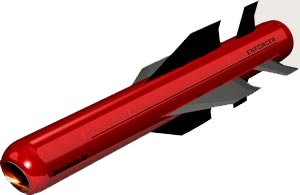
Enforcer is one of MBDA's Concept-Vision future weapons. Photo: MBDA
Modern miniaturized electro-mechanic systems (MEMS), low-cost inertial measurement units (IMU) and powerful optronics embedded on microchips enable missile designers to include ‘fire and forget’ guidance in modern missiles, packing sufficient accuracy and lethality to almost double the effective range of shoulder fired, unguided anti-tank weapons. Several future weapons employing these techniques are currently in development – the Spike SR from Rafael, and a new ‘concept weapon’ called ‘Enforcer’ from MBDA.
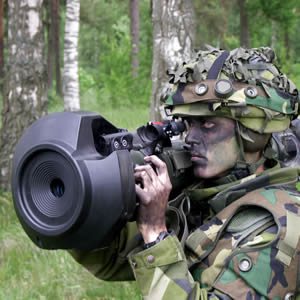
Two weapons in this category are the U.S. Predator and Swedish RB57 the later employs ‘Predicted Line of Sight’ (PLOS) guidance method using on-board IMU, to fly the missile at a straight line to the designated point – aiming directly at the target on direct attack or slightly above it – for top attack. In the PLOS mode, the gunner tracks the target for about 3 seconds, training the missile’s guidance electronics to compute the target’s angular speed. After launch the missile flies autonomously to the target adjusting the necessary corrections according to the data acquired by the tracking.
The NLAW system utilized motion inertial measurement units to sense angular motion to compute aiming solution for the weapon's unguided rocket, improving the hit brobability on moving targets. The weapon simulator shown in this photo represents all the weapon's functions except actual firing, supporting realistic training of infantry units. Photo: Saab AB,
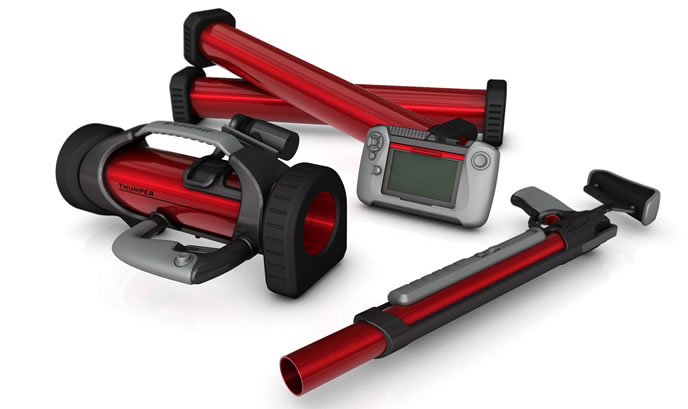
Above: Different launchers were designed by MBDA’s ‘Concept Vision’ team, for the system’s principal weapons – the Sniper and Enforcer missiles. The smart munitions are employed by a common control system, enabling the use of relatively simple and lightweight launchers. Photo: MBDA
New Guided Missiles, Programmable Munitions Enhancing The Infantry Precision Fire Effects
Designing a portable weapon that will providing a significant effect yet, remain compact and lightweight enough for dismounted combat poses a great challenge for designers. Some favor the ‘smart ammunition’ strategy while others opt for ‘smart launcher’ approach. The smart launcher employs the sensors, fire control and ballistic computing, to provide the best available aiming solution, to score a direct hit. Others enhance it with programmable fusing to achieve an optimal ‘airburst’ effect. The advantage of this strategy is lower ammunition acquisition cost and the ability to modernize existing weapons with such new capabilities.
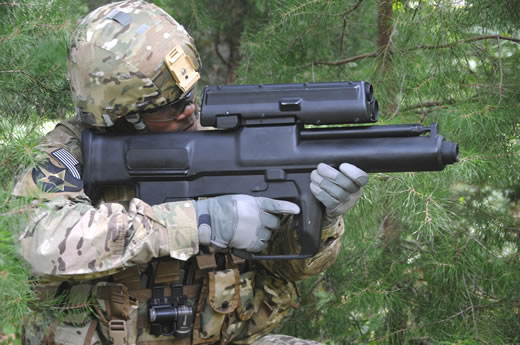
The XM-25 weapon system is an sophisticated launcher firing programmable 25mm grenades. The weapon's fire control system positioned above the barrel provides rangefinding, ballistic computing and aiming solutions for the weapon. Photo: U.S. ArmyThe new SMAW-2 developed for the U.S. Marine Corps has become a 'smart launcher', with the addition of a standard laser rangefinder, thermal night sight and fire control computer, providing the user with high probability of direct hit when firing at targets within the weapon's combat range. Photo: Tamir eshel
Such multi-purpose grenade systems achieve optimal precision engagement, satisfying most of the common infantry requirements, particularly where situations demanding flexible, scalable effects – from non lethal weapons to effective yet localized lethal force. Several systems are maturing for potential fielding in upcoming years – the SMAW-2, developed for the U.S. Marine Corps, the Multi-Purpose Rifle System (MPRS) from IMI and similar systems from Rheimnetall Defence, Nammo and Singapore ST Kinetics – are all using advanced fire control systems with low velocity 40mm air-burst grenades, with fuses set through different programming and communications methods to explode at a specific distance. Other systems are built to provide the same capabilities as a new, integrated weapon – such as the XM-25 Counter Defilade Target Engagement (CDTE) weapon from ATK, South Korean K-11 from Daiwoo or the Predator short range missile, developed at Lockheed Martin.
Grenadiers used these grenades on dismounted operations commonly carry launchers under-slung on their assault rifles, firing low velocity munitions that have limited range. To gain an accurate firepower long distance, infantry units employ large caliber sniper rifles, capable of scoring direct hits on human targets over 1,000 away. While these rifles can reach over two kilometers, snipers cannot easily score effective hits at these ranges.
The ‘Extreme Accuracy Tactical Ordnance’ or ‘Exacto‘ program currently underway at the U.S. Defense Advanced Research Projects Agency (DARPA) is developing guided projectiles for these 12.7mm (0.5″) rifles, along with an optical sight and control systems that will more than double the rifle’s effective range, while allowing the sniper to prosecute moving targets even in high wind conditions – a capability unavailable with today’s weapons.
The NLAW system utilized motion inertial measurement units to sense angular motion to compute aiming solution for the weapon's unguided rocket, improving the hit brobability on moving targets. The weapon simulator shown in this photo represents all the weapon's functions except actual firing, supporting realistic training of infantry units. Photo: Saab AB,
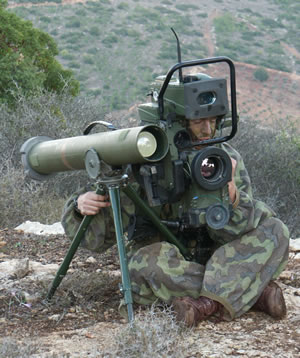
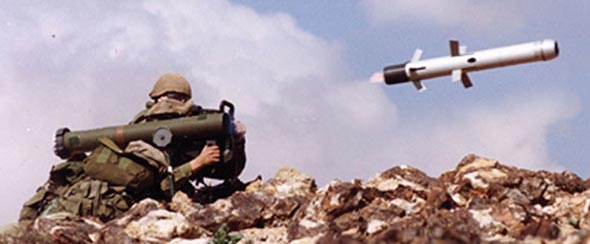
Above: The Israeli Spike MR is an advanced ‘fire and forget’ electro-optically (EO) guided anti-tank missile. A family of missiles based on the Spike developed by Rafael now offrers multi-mission capability with specific variants designed to engage different types of targets, at longer or shorter ranges, with pinpoint accuracy. Photo: Rafael
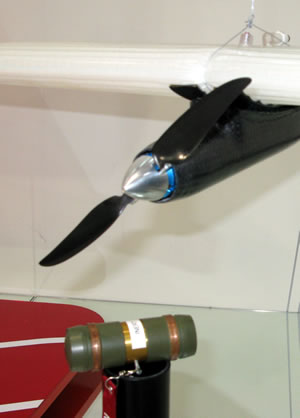
The Switchblade loitering miniature weapon from Aerovironment. Photo: Aerovironment
Electro-optical (EO) guidance has sofar been considered an effective yet costly option for weapon guidance, therefore it was reserved only for more expensive weapons reserved for special missions.
Several examples are demonstrating potential uses of modern off-the shelf EO sensors for guidance systems. Low cost strapdown EO sensors have been used in small weapons for a while, the lightweight Spike missile developed by the U.S. Navy Weapons Division of the Naval Air Warfare Center, Weapons Division (NAWCWD) uses such sensor to guide the missile through ‘fire and forget’ engagement. Another Spike – unrelated to the U.S. version is the new Spike SR ‘fire and forget’ missile – the newest member of Rafael’s Spike family. The missile uses a strapdown imaging camera that acts both as a sight and target seeker. The camera does not require mechanical stabilization as it uses ultra-rapid image processing to provides the steering control.
Another miniature weapon making use of low-cost EO sensors is the Switchblade, (shown in the photo above left) a miniature loitering anati-personnel precision weapon developed by Aerovironment for the U.S. Special Operations Command. The weapon uses strapdown EO camera commonly used for low-level ISR missions to acquire and pursue the target from an altitude of over 100 meters.
A different missile developed at Rafael is the Mini-Spike. This weapon employs ‘fire and update’ guidance method, offering ‘man in the loop’ control throughout the engagement for maximum precision, while minimizing the risk of collateral damage. The gimballed EO sensor used for the Mini Spike enables this miniature missile to fly through complex trajectories, offering all the advances of the Spike LR missile at infantry combat ranges (about 1.3 km) for about a third of the weight, and cost.
Rafael's Mini-Spike guided missile is designed to operate from standard Spike launchers (seen in the photo below). This miniature missile weighs about a third of a Spike MR and can hit targets with the same precision 1,300 meters. Its warhead is designed to maximize effect against unarmored targets. Photos: Defense Update
But state-of-the-art commercial off the shelf technology opens new capabilities for EO seekers. Dual-mode guidance utilizing imaging sensor as laser seekers has the potential to revolutionize laser guidance, by introducing low cost, light-weight yet highly accurate means for target acquisition and weapon guidance. Current laser designators employ pulse lasers to generate high-power laser beams.
Combining affordable EO guidance with laser seeking techniques can provide even better performance and, more importantly, supperior coordination between ‘shooters’ and the supported echelon. A new type of laser designator is employing low-power laser diodes to generate Continuous Wave (CW) beams, operating at relatively low power levels and available for much lower cost.
The new method, patented by an Israeli start-up company Shilat Optronics employs ultra-small components that can be used at the lower echelon, for target acquisition and designation. On the weapon’s end, enhanced imaging sensors are used instead of the standard four quadrant laser detectors. These cameras are modified to detect and identify targets marked by specific CW or pulsed lasers. Employing variable gain to compensate for over exposure to specific frequencies, the new seeker overcomes the inherent limitation of current laser-homing seekers being saturated at the terminal phase of their flight. The new designator/seeker combination offered by Shilat is packable into a small form factor, embedded into standard thermal, or optical binoculars used by the warfighter and into small guided weapons supporting the lowest echelons.
Lockheed Martin Skunk Works® and XTEND have achieved a major milestone in JADC2 by integrating the XOS operating system with the MDCX™ autonomy platform. This technical breakthrough enables a single operator to simultaneously command multiple drone classes, eliminating the friction of mission handoffs. From "marsupial" drone deployments to operating in GPS-denied environments, explore how this collaboration is abbreviating the data-to-decision timeline and redefining autonomous mission execution.
As traditional defense primes face mounting competition from agile “neoprimes” such as Anduril, Palantir and Helsing, the balance of innovation is shifting toward software-defined warfare and scalable, dual-use technologies, while global industry consolidation—marked by Boeing’s integration of Spirit AeroSystems and other strategic mergers—signals an intensified race to secure control over the defense technology value chain. Our Defense-Tech weekly report highlights these trends.
In early October 2025, a coordinated wave of unmanned aerial system (UAS) incursions—widely attributed to Russia—targeted critical infrastructure across at least ten European nations. The unprecedented campaign exposed the fragility of Europe’s air defenses...
Executive Summary
The past week (September 18-25, 2025) represents an inflection point where strategic defense concepts have transitioned from doctrine to tangible reality. An analysis of global events reveals four primary, interconnected trends shaping an...
At the 2025 Air, Space & Cyber Conference, U.S. Air Force and Space Force leaders unveiled major updates on next-generation fighters, bombers, unmanned systems, and space initiatives, highlighting both rapid innovation and critical readiness challenges as the services race to outpace global competitors. A short version is available here, with a more detailed version for subscribers.
The Taipei Aerospace & Defense Technology Exhibition (TADTE) 2025 crystallized around four dominant strategic themes that collectively illustrate Taiwan's comprehensive approach to defense modernization amid escalating regional tensions. Based on a detailed report by Pleronix (available upon request). Includes a Podcast discussion on TADTE 2025's highlighting Taiwan's four strategic themes beyond the post's coverage.
Israel’s Iron Beam 450 high-power laser system has completed final testing, marking a major leap in air defense. Developed by Rafael, it offers precise, cost-effective interception of rockets, UAVs, and mortars, and is set for IDF deployment by 2025.