Tuesday, December 23, 2025
More
    Home Blog Page 406

    Autonomous Airborne Refueling Demonstration (AARD)

    The Defense Advanced Research Projects Agency (DARPA), in a joint effort with NASA Dryden Flight Research Center, performed the first-ever autonomous probe-and-drogue airborne refueling operation August 30, at Edwards Air Force Base, Calif. USA.

    Utilizing the demonstrated techniques, future unmanned systems will be able to automatically locate the tanker, form up, accept clearances, refuel, and disengage without any human intervention.

    The demonstration was conducted with a NASA F/A-18 configured to operate as an unmanned test bed. The Autonomous Airborne Refueling Demonstration (AARD) system used GPS-based relative navigation, coupled with an optical tracker, to provide the precise positioning required, putting a refueling probe into the center of a 32-inch basket dangling in the air stream behind an airborne tanker. The tanker was equipped with a small relative navigation pallet, but production refueling equipment was not modified in any way. Pilots were on board the F/A-18 for safety purposes. Autonomous in-flight refueling is a critical enabler for affordable, persistent, unmanned strike systems. The AARD system was developed by Sierra Nevada Corp., with team member OCTEC Ltd. providing the optical tracking system.

    During the tests, the aircraft made several attempts to hook up with the tanker. successfully engaged the basket in two out of six attempts. As important as the successful engagements, the system safely recovered from each missed attempt.

    “This flight is a significant milestone – it demonstrates that autonomous systems can employ the benefits of air-refueling that have proven so valuable to military aviation,” said Lt. Col. Jim McCormick, DARPA program manager. “We chose to demonstrate the probe and drogue refueling method because it is the most challenging for autonomous systems. The precise station-keeping capability we’ve demonstrated applies equally to the boom and receptacle method used by most Air Force aircraft,” noted McCormick. The same technology also promises to enhance reliability, safety and the range of operating conditions for air refueling manned aircraft.

    Laser Guided Joint Direct Attack Munitions (LJDAM)

    An enhanced version of the JDAM, the Laser targeted Joint Direct Attack Munition (LJDAM) has the flexibility to engage both fixed and moving targets. Boeing plans to complete its development of the 500-pound LJDAM in 2006. Initial production deliveries are planned to begin as early as 2007.

    The weapon was successfully tested June 30, 2006 against a moving target. During the test at Eglin Air Force Base, Fla., a U.S. Air Force F-16 flying at 20,000 feet scored a direct hit on an Armored Personnel Carrier (APC) moving at 25 mph. Using its onboard targeting pod, the F-16 laser-designated the APC and released the 500-pound LJDAM approximately four miles from the target. The Laser JDAM sensor used is a modular, field installable kit.

    In December 2009 EADS Defence & Security (DS) and the Bundeswehr Technical Centre WTD 61 performed flight tests of the Laser JDAM weapon (GBU-54/B), as part of the ongoing combat efficiency improvement programme ASSTA (Avionics Software System Tornado Ada) for the German Air Force Tornados. Currently in the third phase, the ASSTA program is being implemented with Tornado aircraft in service with Germany and Italy. The adaptation of the Laser JDAM for the Tornado makes the German Air Force the first export customer for the weapon, paving the way for future integration with German Air Force Eurofighters.

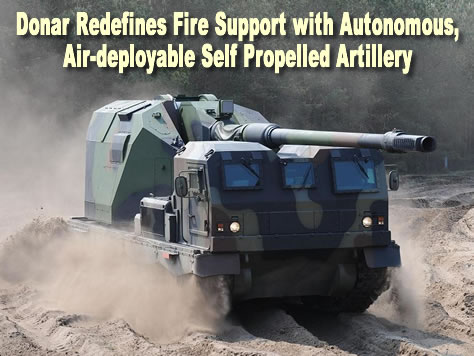
    Donar Redefines Fire Support with Autonomous, Air-deployable Self Propelled Artillery

    Krauss-Maffei Wegmann (KMW) and General Dynamics European Land Systems (GD ELS) announced a teaming agreement to develop and market a new generation, air deployable, autonomous and remotely operated 155mm artillery system. The two companies are unveiling at Eurosatory 2008 a new self-propelled 155/52 howitzer system utilizing KMW’s Autonomous Gun Module (AGM) mounted on the Spanish ASCOD 2 chassis built by GDELS. The team is addressing the growing need for precise indirect fire capabilities to support NATO forces in remote areas of operations, augmenting or even replacing close-air-support operations previously conducted by costly fixed- or rotary-wing aircraft.

    The system, named Donar, utilizes the Autonomous Gun Module (AGM) system developed by KMW. The total system weighs less than 31 metric tons, allowing it to be transported in the future European Transport Aircraft A400M. The self propelled gun operates as an autonomous weapon system, enabling a single barrel to create the effect previously achieved by a whole battery. It is designed to be air-deployable in the future A-400M tactical airlifter. Furthermore, the system will offer considerable logistical benefits including reduction in crew and logistics requirements. The system is targeted to replace heavier self propelled guns such as the M109, AS90 and K9 currently in service with modern armies. A first prototype has already undergone mobility and fire trials at the test facility of the German procurement agency BWB (Bundesamt für Wehrtechnik und Beschaffung). Donar will be unveiled this month at the Eurosatory 2008 exhibition in Paris, France.

    The unmanned turret accommodates a remotely operated, auto-loaded 155mm (52 cal.) cannon, the same cannon used in the German Army’s PzH2000 self propelled gun. This weapon can fire at a maximum range of 56 km. The turret carries 30 ready to fire fuzed 155mm shells and charge modules. According to KMW, despite a marked reduction in weight and size, the gun module is operational without any additional stabilization and provides a 360-degree azimuth range.

    The chassis made by GDELS’ is derived from the ASCOD 2 infantry fighting vehicle. A crew of two soldiers (a driver and a commander) operates the entire system from a highly protected driver cabin, increasing survivability and allowing for extremely rapid fire and movement maneuvers. A prototype of the AGM system developed by KMW used a lighter chassis derived from the MLRS, contributing to a total system weight of 27 tons. However, the current version is offering better mobility and protection.

    Intelligent Munitions System (IMS)

    Start < Page 5 of 5 >

    Enhancing the concept of UGS into a closed-loop net-centric weapon system, the IMS systems will be fielded as part of the Future Combat Systems (FCS) program, providing alerting, location and destruction of enemy forces, as well as reliable battle damage information.

    The IMS sensor will gather data and transmit target features based on three types of target signatures: acoustic, magnetic and seismic. Each sensor node will be able to provide signatures to estimate the target type, bearing and direction of movement. The system will be able to differentiate between tanks, trucks and personnel carriers and send reports to the control point. IMS will use self-configuring and self-healing communications network integrated into the Brigade-and-Below (FBCB2) and the Unit of Action networks.

    The system will also be able to determine the appropriate effects module to engage the target and the time it should activate for maximum effectiveness. Distributed situational awareness nodes will be used as an integral part of the system, providing sensing and communications to the intelligent munitions. The munitions will use mature Skeet based scatterable mine warhead technology providing wide area top attack effects against vehicles and fragmenting grenade lethality against dismounted personnel. It will be interoperable with the Spider antipersonnel landmine system.


    Used for battlefield shaping, IMS will be employed to deny terrain and isolate enemy forces, objectives and areas of decisive operations, preventing enemy reinforcement their withdrawal. As enemy movements in areas under IMS attacks are reduced, targets will also become easy prey for other means of attack. With the capability to be switched on and off on command from friendly forces, IMS will render a flexible obstacle providing the Unit of Action (UA) maximum security and maneuvering flexibility. Operated in force protection roles, IMS will be used to secure flanks, protect fixed facilities, provide close-in protection of small units, fill gaps in dangerous terrain. When equipped with non-lethal munitions, IMS will be able to deny non-combatant movement in certain areas, and reduce the risk of collateral damage in uncertain situations.

    The IMS will be deployed dynamically, as part of the UA maneuverability and battlefield shaping actions. Systems could be hand-emplaced, remotely delivered, or launched from a dispenser module carried by manned or unmanned ground vehicles.

    On 6th July 2006 Textron Systems was awarded a US$115 million contract for the IMS design and development phase. Low-rate initial production of IMS is scheduled to start in 2008; delivery is scheduled for 2010. Textron Systems’ team partners include Northrop Grumman, ITT Industries and BAE Systems. The IMS program is managed by the Army’s Office of Project Manager Close Combat Systems.

    Additional parts of this article:

    Skylark II sMALL UAV / eLBIT sYSTEMS

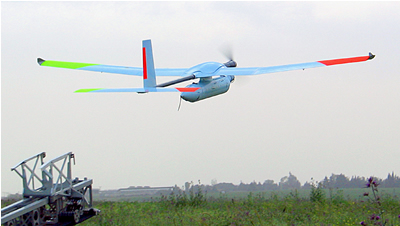
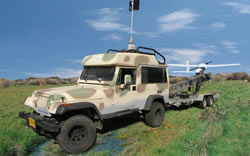
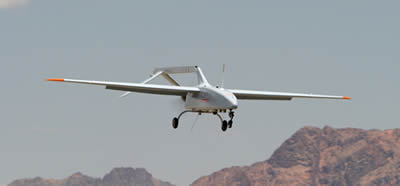
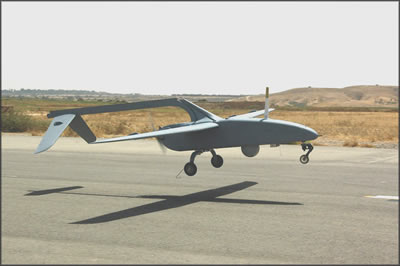
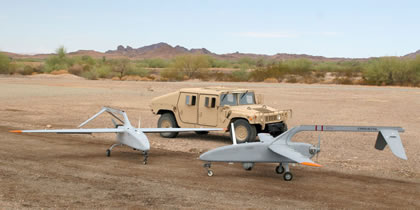
    At Eurosatory 2006 Elbit Systems unveiled its latest Skylark II Small UAV system, designed to fly covert missions at low to medium altitude, in day, night, and under low clouds, when other observations systems are not operable due to limited visibility. The system is designed for operation at battalion level. Skylark II will be self contained in an all-terrain vehicle such as the Humvee, equipped with launching rail, storage for two aerial vehicles, mission control stations, communications and datalinks. It can be operated by a crew of two. The system retains the compact ground station and datalink of the Skylark Mini uav.

    Skylark II is an outgrowth of the Skylark mini-UAV system, currently operational with several armies. The 35 kg GTOW vehicle has a wingspan of 4.2 meter. It is designed to carry 6 hour missions at ranges up to 50km. The vehicle is powered by a new 4 kilowatt electrical motor, developed by Bental Industries, and driven by a battery pack contained in the payload pod underneath the main boom. The propulsion system is comprised of a dual-channel Permanent Magnet Brushless Motor and a Driver/Controller. The system delivers up to 4 kW during takeoff and climbing stages of the mission, but during cruising, when less power is needed, the driver switches one channel off, to save power, enabling extended vehicle endurance. This tandem design introduces propulsion system redundancy even with a single motor. In case of failure in on of the two systems, the control will automatically switch to the other system. This enables the mission control either continue the mission or cancel the mission and return to base safely. 

    The new vehicle utilizes a similar design and is constructed of the same materials as its smaller brother. It will be equipped with a new, 8″ stabilized lightweight EO/IR multi-sensor payload carrying color CCD, 3rd generation (3-5 micron) thermal imager with three fields of view, a laser illuminator and an optional laser designator.

    Accelerating the kill chain Closing the Sensor-to-shooter Cycle

    Start < Page 7 of 7 >
    Operations in urban terrain are characterized by “fluidity” of events, where opportunities to engage high priority targets occur unexpectedly and for only a few seconds, or at most, minutes. Rapid processing of information, on-the-spot decision making, and maintaining the ability to respond with split-second timing enables the military to take advantage of these transient opportunities. Coalition forces in Iraq and Afghanistan, and Israeli forces attempting to control the activities of the Palestinian fighters in Gaza and West Bank are already using such means.

    Utilization of these capabilities requires the fielding of an extensive intelligence network, integrating all types of ISR operations including persistent sensors (operating continuously throughout the day, night, and adverse weather conditions), satellite imagery, aerial reconnaissance, elevated, stand-off aerial observation by long-range telescopes, and close-in views by mini UAVs, mast mounted or aerostat tethered imagers, radars and FLIRs, etc. Other feeds can be provided by covert, unattended ground sensors designed to monitor suspected enemy locations and report on enemy activity and movements before an operation. 
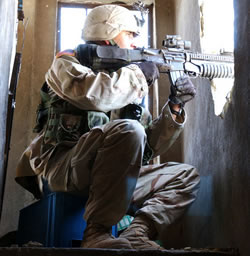
    Other means used to collect information and build the total intelligence picture include signal intelligence, surveillance systems such as tracking radars, IR scanners and acoustic sensors, which can determine the location and concentration of suspicious activities.

    Employment of snipers, linked via wireless into the intelligence sensor network, is an example of such close-loop kill chain. When a target of opportunity appears, and is positively verified by the intelligence team at the command level, the commander can order the sniper to take it out, rapidly “closing the loop” between sensor and shooter.

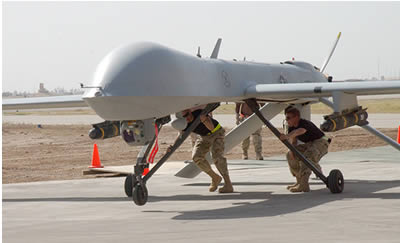
    A different example of “accelerated kill-chain” involves the use of UAVs for “Hunter Killer” activities. These operations are becoming the basis for a new concept of “Air Domination” of urban areas. The operations are performed by armed UAVs that are equipped with sensors and weapons in order to perform surveillance and intervention missions simultaneously. UAVs are particularly suitable for this role because of their ability to cover large areas for extended durations.

    UAVs also have the ability to accurately strike targets of opportunity, with localized lethal effect. Covering an area with observation and fire, UAVs such as the General Atomics Predatoror IAI/Northrop Grumman Hunter fly at an altitude of 10,000-16,000 feet, equipped with EO or SAR sensors and armed with Lockheed Martin Hellfire or Northrop/Grumman Viper Strike laser-guided weapons.

    Sperwer B, a French derivative of the combat proven Sperwer UAV developed by Sagem, can be armed with two Israeli RAFAEL Spike LR electro-optically guided missiles. Other UAVs, such as the Elbit Systems Hermes 450 and IAI/MALAT Heron (both are in service with the Israeli Air Force) have already demonstrated the capability to carry significant external payloads, but no details have been released about the payloads that these vehicles will carry. Palestinian sources have repeatedly claimed that Israeli weaponized UAVs are frequently used against terrorists in the Gaza Strip.


    Several systems currently under development in the USA, Europe and Israel, are pushing this concept to the limit, with the ability to simultaneously control many sensors and multiple UAVs over a large area, in support of multiple missions. When mature, these systems will be integrated into regional command centers to support overall intelligence gathering and activity and to facilitate rapid engagement of time critical targets. The ability to monitor multiple video streams gives command centers a total grasp of the battlefield situation as they examine it from every angle. Automated processes, such as automatic change detection, and movement indication assist in detection, and tracking of targets in real time. Other features, such as automatic target tracking have special significance for intelligence collection. Modern systems can turn observations into intelligence – for example, the Terrasight system is used by US forces for automatic tracking of a specific person through a crowded scene, plotting precise geolocation coordinates for each place the subject visits. Future capabilities will enhance this feature and enable specific ‘fingerprinting” of targets. Image surveillance data can be used in real time or stored for later analysis. Examining video records let intelligence teams review suspicious patterns of enemy movements. Integrated data allows them to locate and track centers of activity. And by watching for any increase in activity, analysts can estimate when an attack is imminent.

    For urban combat operations, Human Intelligence (HUMINT) is still the most important intelligence gathering method. HUMINT does not necessarily involve use of specialized operators. Troops and patrols constantly operating in an area can provide excellent and highly focused HUMINT if properly trained and equipped. The ‘Every Soldier is a Sensor’ (ES2) program, currently in use by the US Army, is developing the skills and capabilities necessary to utilize regular soldiers for intelligence gathering activities.

    Thanks to modern cellular communications, HUMINT does not always require direct contact between operators, agents, and the local population. Internet, wireless mobile phones, commercial phones, cameras, and SMS messaging have replaced the secret radio transmitters and Morse code of the past. These collaboration techniques enable HUMINT operators to recruit informers over the Internet, or via leaflets airdropped over an area of interest.
    The Israelis in the Gaza area successfully employed these methods after the 2005 disengagement. Israeli intelligence organizations engaged in an integrated Information Warfare (IW) and PSYOPS campaign that provided Palestinians in Gaza with phone numbers where they could send information about suspected terrorist activities and locations of improvised rockets. The informers were not motivated by their love for Israel, or greed, but by the hope of removing the threat of Israeli retaliation from their homes. Over 1,500 calls were received during the first month. Many of the messages provided valuable, verifiable, real-time information proving that this innovative concept is viable in modern counter-insurgency warfare.

    Additional parts of this article:

    Skylynx II UAV

    The Skylynx II unmanned air system meets the US Marine Corps’ regiment-level needs for “TIER II” (regiment-level) UAV system, as a simple to use, field deployable and portable system. The fixed-wing aircraft can be launched without a runway and is capable of carrying payloads weighing up to 70 pounds. It is powered by a UEL-741 engine, which is already in use with other UAVs, providing sufficient margin of power and performance to meet future needs.

    The full Skylynx II system, consisting of three air vehicles, ground control station, launcher, and remote receive terminal, plus six Marines, can be transported by two CH-46 helicopters or by two High-mobility Multipurpose Wheeled Vehicles.

    In August 2006 BAE Systems completed a series of tests on its Skylynx II unmanned aircraft system at Yuma Proving Grounds. During these test flights it met key requirements including acoustic performance, endurance, and payload capability for reconnaissance, surveillance, and target acquisition missions. The Skylynx II flew in a series of flight patterns to demonstrate agility. Using an integrated electro-optical/infrared imaging payload, the aircraft automatically located and tracked vehicle and human targets, transmitting coordinates to a ground station.

    Puma Armored Infantry Fighting Vehicle

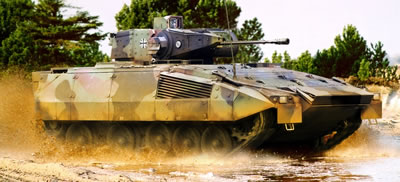
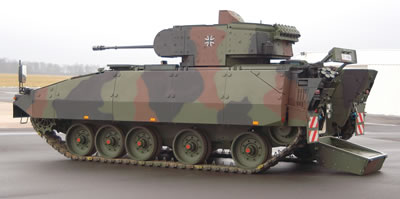
    Puma is the new armored infantry fighting vehicle developed for the German Army, which is expected to procure 405 vehicles with a total budget of 3 billion Euros.

    Puma is based on a new design reflecting the armed forces new mission profiles, highlighting expeditionary warfare while maintaining high level of protection and good mobility. The Puma provides full protection against mines and anti-tank weapons, at a level previously unavailable to similar systems (such as the Marder it will replacing in service). To maintain high protection levels and air mobility with the future Airbus A-400M European transport, Puma will be produced in a basic “Level A” protection featuring a total gross weight of 31.45 tons. Additional armor protection called “Level C” could be applied after the vehicles are deployed at their destination area, providing increased protection against shaped charge threats, medium caliber guns and heavier mines. Further protection is applied to the vehicle’s roof, protecting from top attacks by AP bomblets.

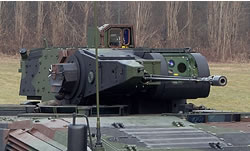
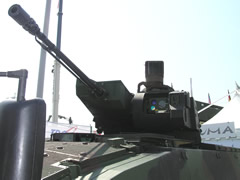
    Puma is equipped with a new MTU 10V 892 HPD 800 kW high power density turbo diesel engine, driving a Renk HSWL 256 hydrostatic/hydrodynamic shifting, reversing and steering transmission. The automotive system also includes a decoupled drive assembly comprising hydro-pneumatic suspension, improving the smooth cross country traveling. By eliminating the need for torsion bars, the space under the floor is cleared for better countermine protection. The use of lightweight tracks further reduces weight. The vehicle uses an unmanned fully stabilized turret, mounting an automatic 30mm Mk30-2 ABM Mauser gun firing standard AP or airburst munitions (ABM). A secondary armament mounting an MG4 5.56mm machine gun. The turret is also installed with a gunner’s thermal sight, a commander’s independent panoramic sight, 400 ready to fire rounds of ammunition and smoke dischargers. 

    Initial production orders are expected by mid 2007, following parliamentary approvals. PSM is currently working toward the delivery of five pre-production vehicles, under a previous order issued in 2004. The first five prototype Puma vehicles will also be equipped with the MUSS multifunctional self-protection system, to be supplied by EADS Defense Electronics.

    CARPET – New Mine Breaching System Based on Fuel-Air Explosive (FAE)

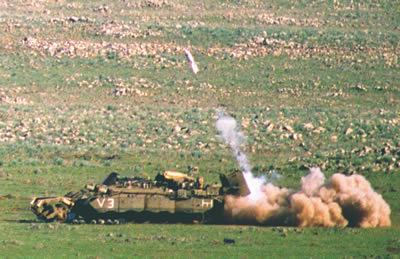
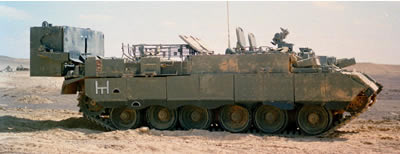
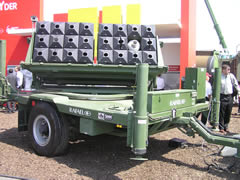
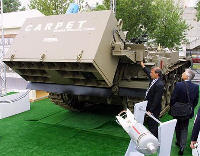
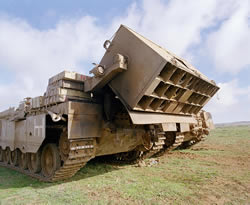
    Israel’s weapon development company Rafael is producing a minefield breaching system called “Carpet”. The system is currently in use by the Israeli Army and will be fielded with the French Army by 2007. The system is a unique implementation of fuel-air explosive technology. It is an autonomous add-on kit that can be quickly fitted in the field to any armored vehicle. For minefield breaching, up to 20 rockets are fired in a rapid sequence. The number of rockets used is tailored for the type of target engaged. At the impact point, each rocket disperses a spray of fuel above the target area, to form the fuel-air explosive cloud. The detonation creates a strong impulse over a wide area, which triggers most mines, regardless of terrain, foliage or man-made obstacles. The explosion clears a safe passage, wide enough for safe movement of all combat vehicles. Firing a salvo of rockets from a distance of 65-165 meters from the forward edge of the minefield, Carpet enables breaching a path 100 meters long, within one minute.

    Pre-programmed for automatic, semi-automatic or manual operation, Carpet is operated remotely from inside the vehicle’s compartment, under cover from enemy fire. The system can also be reloaded rapidly in the forward area. Unlike the Vipers, firing line charges across the minefields, Carpet rockets contain only liquid fuel which is flammable but not explosive in regular operating conditions. Therefore, if Carpet rockets are hit in their canisters, they do not cause any danger to the system, vehicle or nearby troops.

    Fully loaded, the Carpet launcher weighs only 3.5 tons. It can carry up to 20 x 265 mm rockets, each weighing 46 kg. Fully functional training rockets can also be fired with the system for training exercises, safely simulating the entire operation (without fuel-air explosion). The system can be towed, mounted on the rear of the armored fighting vehicle (as shown on the IDF Puma AFV at EuroSatory 2002) or installed inside an APC. The IDF used the Carper during the war in Lebanon, neutralizing and clearing Hezbollah strongholds near the Israeli- Lebanese border. (See video here)

    France will field the Carpet system in 2007. The French Army plans to buy 12 AMX-B2 EBG combat engineering vehicle, which will be mount the armored, pyrotechnic anti-tank mine clearing systems (French abbreviations: SDPMAC) – employing 20 Carpet rockets. The SPDMAC will be installed on the EBG built by Giat Industries. These armored engineering vehicles are designed to deploy several types of mine clearing systems, and the Carpet will add versatility to these capabilities. The vehicles will be fielded with the French Army combat engineering brigade, which will assign three vehicles to support each mechanized brigade.

    CaVA Unattended Imaging Sensor

    Camouflaged as a stone, CaVA developed by Surveycopter is a remotely operated unattended ground sensor can be equipped with CCD or IR cameras for day and night operation. The CaCA2 system can accommodate two CCD sensors covering up to 360 degrees. CaVA 3 uses a remotely controlled 1/6″ sensor coupled to a x25 optical zoom, with elevation of up to 20 deg. And traverse over 90 degrees arc.

    Smover Robotic Vehicle Control System from Rheinmetall

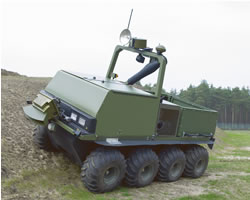
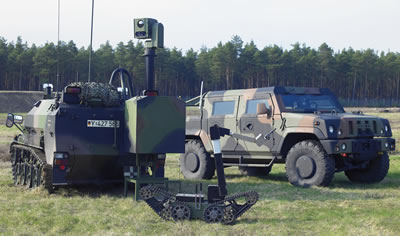
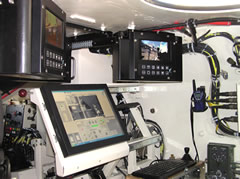
    The system can be used to convert conventional tactical vehicles into hybrid (manned/unmanned) robotic platforms. Manned vehicles equipped with Smover can be used as unmanned reconnaissance or weapons platform, for example, in minefield breaching or recovering vehicles under fire. Equipped with Smover, a lead element of a convoy can be driven remotely without being visibly distinctive from the rest of the convoy vehicles. The vehicle can be remotely controlled or use autarkic drives, moving along predetermined routes, negotiating obstacles by automatic recognition etc. Smover technology was implemented in the 8×8 multi-mission Trobot (Tactical robot, shown above), which can be used as a load carrier, weapon platform or recce vehicle. Other applications range from NBC sensor to a field MEDEVAC platform and more.

    Microclimate Cooling System (MCS)

    Microclimate cooling system (MCS) is provided as part of US Army Air Warrior program, for helicopter crews, operating in the hot climate of Southwest Asia. It is designed to offset heat stress from air crews operating for extended durations under full NBC protected gear. This system protects the individual from heat stroke and heat stress. Equipped with MCS, helicopter crews wearing NBC protection gear can safely endure 5.7 hour mission, compared to 1.6 hours without such protection. The microclimate cooling garment is worn as an undergarment beneath the body and closing. The garment is connected to a condenser unit which chills water and pumps it through small tubes embedded in the vest.

    Iron Fist Active Protection System (APS)

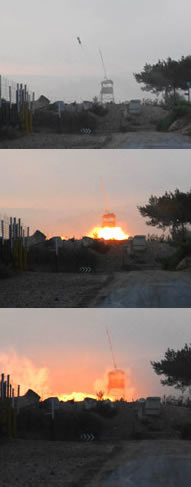
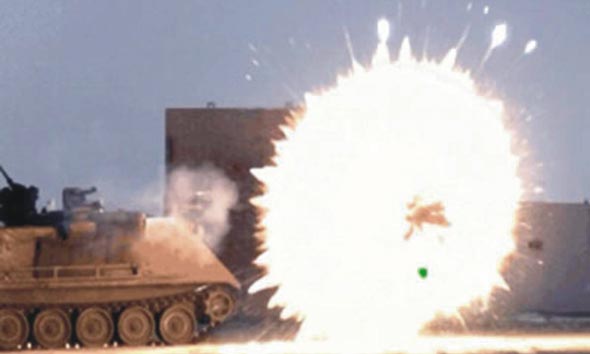
    In Eurosatory 2006 IMI unveiled its new Active Defense System (ADS) called – Iron Fist. Until recently, the development of Iron Fist was shrouded in secrecy, as it was developed in parallel to a different Israeli developed ADS system – RAFAEL’s Trophy, which entered full scale development in 2005. However, due to rapid development pace and successful testing, IMI expects to deliver the first systems for IDF testing and qualifications by mid 2007. Unlike competing systems, IMI’s Iron Fist can be installed on light vehicles, including trucks and even Humvees, offering effective protection from RPGs. IMI conducted extensive testing against a full spectrum of threats, engaging various types of threats from stationary and moving armored personnel carriers. The system already demonstrated effective protection of light vehicles and heavy armored vehicles, from small rocket propelled grenades, anti-tank missiles and tank rounds equipped with shaped charge warheads as well as advanced kinetic threats (armor piercing tank rounds).

    The system uses a fixed radar sensor, mounted on the protected platform, to detect potential threats, measure distance and trajectory, providing the fire control system with data for calculation of engagement plans. When a threat is identified as imminent, an explosive projectile interceptor is launched toward it. The interceptor, shaped similar to a small mortar bomb, is designed to defeat the threat even when flying in very close proximity. Unlike other systems, the Iron Fist uses only the blast effect to defeat the threat, crushing the soft components of a shaped charge or deflecting and destabilizing the missile or kinetic rod in their flight. The interceptor is made of combustible envelope, fully consumed in the explosion. Without the risk of shrapnel, Iron Fist provides an effective, close-in protection for vehicles operating in dense, urban environment. The use of close proximity, rather than “hit to kill” mechanism avoids complex interception techniques and contributes to reduced cost.

    One of the main advantages of the Iron Fist is its integration into routine operations. Its sensor provides essential input to situational awareness systems, based on ground radar surveillance, moving target detection, classification and tracking and motion detection. Furthermore, by loading other types of projectiles, such as non lethal, anti-personnel, smoke or illumination, the system can be used in support of routine operation.

    Iron Fist is supported by Israel’s MOD Directorate for Defense Research & Development (DDR&D). The program is designed to protect medium and light vehicles, but based on its performance, has the potential to be fielded on heavy armor as well. In future configurations, the system has a growth potential to protect sensitive elements of fixed installations or patrol boats, protecting from RPG attacks, frequently encountered in counter insurgency operations.


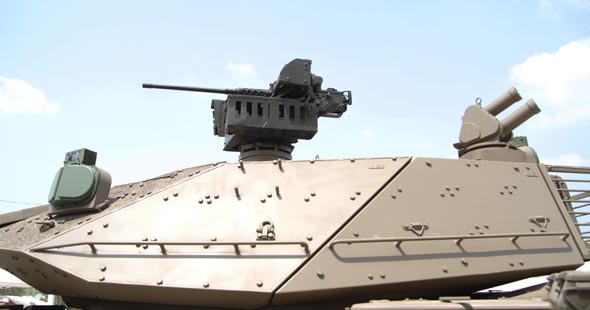
    At Eurosatory 2008 IMI unveiled an advanced version of the Iron Fist active protection system developed for the protection of medium weight armored protected vehicles such as the Wildcat on which it was installed at the show. Iron Fist uses two twin-tube rotateable launchers employing redesigned fin-stabilized canisters (compared to the previous mortar-like ammunition used in the previous design). IMI claims the canister has better aerodynamic qualities and is more stable in flight, thus enabling the system to address treats at various ranges. Made of composite casing fully consumed by the blast, the system poses minimal risk of collateral damage to nearby troops or non combatants. It is activated by command from the fire control system, employing an Elta Systems conformal, distributed radar system and an infrared sensor called Tandir, developed at Elbit Systems Elisra. Redesigned as a multi-dimensional protection system, Iron-Fist provides the crew with early warning and situational picture of incoming threats, employing ‘soft-kill’ means at mid-range and only if the threat is not eliminated by other means, intercepts it with remotely detonated hard-kill munitions. Iron-Fist can handle multiple targets simultaneously with different intercept methods, including multiple countermeasures fired at two simultaneous threats at the same sector.

    At Eurosatory 2008 IMI unveiled an advanced version of the Iron Fist active protection system developed for the protection of medium weight armored protected vehicles such as the Wildcat on which it was installed at the show. Iron Fist uses two twin-tube rotateable launchers employing redesigned fin-stabilized canisters (compared to the previous mortar-like ammunition used in the previous design). IMI claims the canister has better aerodynamic qualities and is more stable in flight, thus enabling the system to address treats at various ranges. Made of composite casing fully consumed by the blast, the system poses minimal risk of collateral damage to nearby troops or non combatants. It is activated by command from the fire control system, employing an Elta Systems conformal, distributed radar system and an infrared sensor called Tandir, developed at Elbit Systems Elisra. Redesigned as a multi-dimensional protection system, Iron-Fist provides the crew with early warning and situational picture of incoming threats, employing ‘soft-kill’ means at mid-range and only if the threat is not eliminated by other means, intercepts it with remotely detonated hard-kill munitions. Iron-Fist can handle multiple targets simultaneously with different intercept methods, including multiple countermeasures fired at two simultaneous threats at the same sector.

    June 2009: The Israel Defense Forces (IDF) is moving forward with the development and fielding of active protection systems (APS) for tanks and armored infantry fighting vehicles (AIFV). Maj. General Dan Harel, IDF 2nd in Command has approved the acquisition of ‘Iron Fist’ APS for the Namer AIFVs, parallel to the continued acquisition of Aspro-A (Trophy) systems for the Merkava 4 tanks. Currently in advanced developmental phase, Iron Fist is expected to provide multi-level protection against anti-tank threats, from short range tandem-warhead rockets that demonstrated their ability to defeat reactive armor, to sophisticated, heavy guided missiles such as the Kornet, employed by the Hezbollah during the 2006 2nd Lebanon War. The system has also been designed to counter tank fired (kinetic) threats. Each Iron-Fist system employs two turrets, containing two launch tubes firing the interceptor projectile and several types of sensors, covering 360 degrees. The system can also include various countermeasures, which could attempt to engage threats at extended range with ‘soft kill’, saving ‘hard kill’ means as the last line of defense. By utilizing soft launch techniques, firing loads generated by the Iron Fist are reducing potential adverse effect on the platform’s mobility or fire accuracy.

    An Upgraded Magach Tank, equipped with IMI's WAVE Remote Controlled Weapon System and IMI's Iron Fist Active Defense System, showing newly developed RPS-10 radar and EO threat detection system, at the Latrun 2011 Exhibition. Photo: Noam Eshel, Defense-Update

    LINK 16 Datalink

    Link 16 provides real-time, jam-resistant secure transfer of combat data, voice and relative navigation information between widely dispersed battle elements. Participants gain situational awareness by exchanging digital data over a common communication link that is continuously and automatically updated in real time, reducing the chance of fratricide, duplicate assignments or missed targets. Each participant in the communication link is able to electronically see the battle space, including assigned targets or threats. The MIDS represents the latest generation of Link 16 equipment incorporating secure data and voice into a single, small, affordable and highly reliable unit.

    Skunk Works and XTEND Simplify Multi-Drone Command

    0
    Lockheed Martin Skunk Works® and XTEND have achieved a major milestone in JADC2 by integrating the XOS operating system with the MDCX™ autonomy platform. This technical breakthrough enables a single operator to simultaneously command multiple drone classes, eliminating the friction of mission handoffs. From "marsupial" drone deployments to operating in GPS-denied environments, explore how this collaboration is abbreviating the data-to-decision timeline and redefining autonomous mission execution.

    From Ukraine to Taiwan: The Global Race to Dominate the New Defense Tech Frontier

    0
    As traditional defense primes face mounting competition from agile “neoprimes” such as Anduril, Palantir and Helsing, the balance of innovation is shifting toward software-defined warfare and scalable, dual-use technologies, while global industry consolidation—marked by Boeing’s integration of Spirit AeroSystems and other strategic mergers—signals an intensified race to secure control over the defense technology value chain. Our Defense-Tech weekly report highlights these trends.

    Europe’s “Drone Wall”

    0
    In early October 2025, a coordinated wave of unmanned aerial system (UAS) incursions—widely attributed to Russia—targeted critical infrastructure across at least ten European nations. The unprecedented campaign exposed the fragility of Europe’s air defenses...

    Weekly Defense Update & Global Security Assessment

    0
    Executive Summary The past week (September 18-25, 2025) represents an inflection point where strategic defense concepts have transitioned from doctrine to tangible reality. An analysis of global events reveals four primary, interconnected trends shaping an...

    U.S. Air and Space Forces Push Next-Gen Programs at the AS&C 2025 Conference and...

    0
    At the 2025 Air, Space & Cyber Conference, U.S. Air Force and Space Force leaders unveiled major updates on next-generation fighters, bombers, unmanned systems, and space initiatives, highlighting both rapid innovation and critical readiness challenges as the services race to outpace global competitors. A short version is available here, with a more detailed version for subscribers.

    TADTE 2025: Reflecting Taiwan’s Strategic Themes

    0
    The Taipei Aerospace & Defense Technology Exhibition (TADTE) 2025 crystallized around four dominant strategic themes that collectively illustrate Taiwan's comprehensive approach to defense modernization amid escalating regional tensions. Based on a detailed report by Pleronix (available upon request). Includes a Podcast discussion on TADTE 2025's highlighting Taiwan's four strategic themes beyond the post's coverage.

    Iron Beam 450 Completes Testing, Soon to Join With Operational Air Defense Units

    0
    Israel’s Iron Beam 450 high-power laser system has completed final testing, marking a major leap in air defense. Developed by Rafael, it offers precise, cost-effective interception of rockets, UAVs, and mortars, and is set for IDF deployment by 2025.