
Tuesday, December 23, 2025
More
    Home Blog Page 409

    Supporting the Field Commander

    Start < Page 2 of 4 >

    Resulting from lessons learned during years of low intensity conflict in an urban environment, the Israel Defense Forces is expanding its capabilities and autonomy at tactical levels. New developments enable organic intelligence collection at battalion and below, improving real-time situational awareness and response, through comprehensive network centric systems and the use of unmanned and robotic systems. Other developments improve the survivability and protection of platforms and personnel, through the use of exotic new materials, reactive and active armor systems, as well as sophisticated countermeasures, combating Improvised Explosive Devices (IEDs) and other short range anti-armor threats (such as RPGs).
    Several programs managed by the Israel Ministry of Defense Directorate of Defense Research & Development (DDR&D) are addressing these issues, in an attempt to provide battalion commanders maximum autonomy, relying on organic intelligence gathering capability. A grenade-like, disposable reconnaissance sensor fired from a grenade launcher, a tennis ball-sized observation device which can be rolled into a room before an assault, man-portable unmanned Miniature Aerial Vehicle (MAV) and miniature aerostat loitering over a target for hours and a new, low-cost, small ground robot that autonomously roams an urban battlefield, are only few representative systems in this field. These new platforms can be quite exotic but DDR&D deputy director, Brig. Gen. (ret) Yakov Nagel is focusing on the subsystems and capabilities which render the Israeli systems unique: “Sensors, communications and the wisdom emplaced in these vehicle’s computers are the key elements for their success”. According to Nagel, DDR&D is supporting specific programs, from the technology demonstration through full scale development. “Unmanned vehicles are becoming commodity platforms, Our advantage is the quality of the output provided by the payload. We decided to invest in this technology and supported the development of the miniature payload. We are planning to use these compact payloads in all our future mini UAVs programs” says Nagel. DDR&D is pursuing ground robotics programs, with the introduction of autonomous border patroller and a new, highly agile small robot, designed for operation in urban environment.

    Additional parts of this article:

    Israel Refine R&D to Support Asymmetric Warfare

    Start < Page 1 of 4 >

    Resulting from lessons learned during years of low intensity conflict in an urban environment, the Israel Defense Forces is expanding its capabilities and autonomy at tactical levels. The close cooperation and geographical proximity of industry, military services and R&D authorities all contribute to exceptionally fast and economical development cycle, from concept through system maturation, yielding advanced and sophisticated solutions responding exactly to most critical operational needs.


    Defense Update was invited by the Israel Ministry of Defense and leading defense industries, for a briefing on the new developments, which are enabling organic intelligence collection at battalion and below, improving situational awareness and response, through comprehensive network centric systems and the use of unmanned and robotic systems. The briefings also covered other developments improve survivability and protection of platforms and personnel, through the use of exotic new materials, including reactive and active armor systems, as well as sophisticated countermeasures, combating Improvised Explosive Devices (IEDs) and short range anti-armor threats.
    These briefings were organized as part of our preparation for the biannual Eurosatory show. This show provides a unique platform displaying the most up-to-date military systems. Israel’s defense industries have backed this show since its beginning, and 2006 will mark one of the peaks of Israeli participation here, with 42 official booths of Israeli companies, in addition to many more products, displayed here by foreign partners.

    Some of the hottest topics covered by the Israelis are asymmetric warfare, intelligence, command and control, and systems developed to augment and support the infantry warrior, Special Forces and counter-terror units. Unmanned systems made in Israel have a significant influence on the new trends of C4ISR. Force protection and survivability is another focus of the Israeli presentation, where companies offer advanced lightweight armor concepts, for personnel, vehicles and active protection systems for vehicles to counter various improvised explosive devices (IED) and other elements required to safeguard military operations in hostile environment. In the armor arena, Israeli companies are displaying advanced concepts enabling fighting “buttoned-up” under armor protection. New types of ammunition are available for tanks, artillery, mortars and rockets completing the range of military options available for the land forces in the 21 century, highlighting high precision and long range capabilities. The close cooperation and geographical proximity of industry, military services and R&D authorities all contribute to exceptionally fast and economical development cycle, from concept through system maturation, yielding advanced and sophisticated solutions that respond exactly to most critical operational needs.

    Additional parts of this article:

    High Power EM Pulse Weapon

    High Power ElectroMagnetic  (HPEM) wepon can be used as a powerful IED countermeasure. HPEM system, available from Diehl and Rheinmetall Defense. HPEM can be effective against roadside bombs and IEDs containing electronic devices (such as an electronic fuze, cellphone or any other actuating device). Rheinmetall and Diehl are offering several types of HPEM modules, including elements concealed in the doors police cars, enabling highway patrols to stop a suspect vehicle when driving side by side.

    A similar system can be used to protect a vehicle or a convoy from IEDs. An HPEM based counter IED system can cause controlled explosion or deactivation of the charge, at a safe distance from the protected vehicle. Both companies are collaborating on the development of an ultra-wideband HPEM technology, which will cover the frequency range from Megaherz to Gigaherz, effectively denying all types of communications with a directional or omni-directional coverage. Diehl is specializing in HPEM systems operating at the UHF (hundreds of Megaherz) waveband, which, according to Diehl’s experts, is most suitable for engaging all types of electronic devices, including IEDs. A typical system is the compact, battery operated DS-110, which disrupts and destroys processor driven electronic modules in any system, by generating resets or inducing power latch-ups, therefore immediately neutralizing the target. The basic system is omni-directional but it can be configured to generate a directional radiation pattern.

    TransProtec – Armored Transportation Container

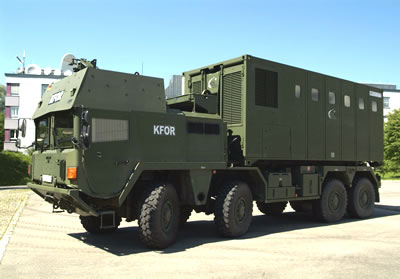
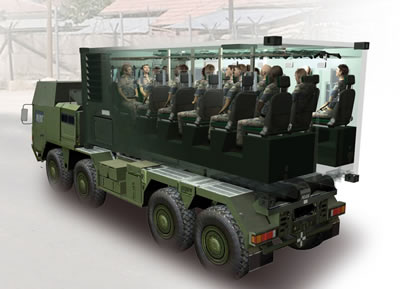
    EADS will supply two protected personal transport to the Danish Army. The TransProtec containers were specially developed for the safe transport of people in crisis areas. TransProtec was developed by EADS, in cooperation with the German Federal Office of Defence Technology and Procurement (BWB) and Krauss-Maffei Wegmann. The new protection system offers optimal protection against attacks with improvised explosive devices (IED), sniper fire, shrapnel, mines and ABC attacks. The protected container can accommodate up to 18 persons including equipment. In future, a modified version of TransProtec will be capable of transporting a larger number of casualties and nursing staff together with the necessary facilities. The hook loading system makes it possible to quickly load and unload the transport vehicle, which has a protected driver’s cab. The German Army was the first service to use the system, under the name “MuConPers” (Multifähiger Container für die Personenbeförderung – multi-capable container for transporting individuals). These containers were first deployed with the German Armed Forces in the Balkans. The containers ordered by the Danish Army have the same configuration as the containers. According to Bernhard Gerwert, Head of EADS Defence Electronics. the system was developed to provide safe logistical transportation of people and supplies, which that always involve exposure to certain dangers. “We developed and built the protective containers in order to counteract this potential danger and to ensure the best possible protection for soldiers and civilians being transported“, says Gerwet, “The level of protection and comfort during transportation is much higher than with the vehicles already used for this purpose, in particular with regard to protection against mines and attacks with explosives.”

    Mobile Gun System (MGS)

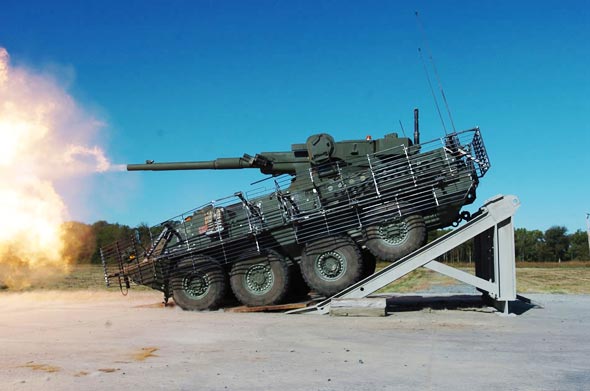
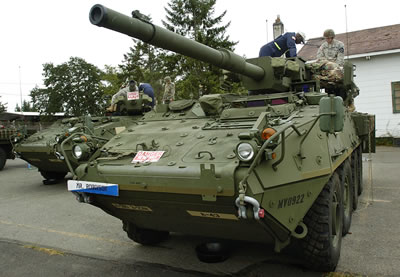
    The 2nd Battalion, 23rd Infantry, received its complement of Mobile Gun System (MGS) vehicles in July. They are the first vehicles to be fielded in the Army. The MGS vehicles to equip the Stryker brigades. The 21 ton vehicle is otherwise similar to other Stryker armored fighting vehicles. There will be three MGS assigned to each infantry company.

    The MGS uses a Stryker chassis fitted with a low profile turret that mounts a 105mm gun, 12.7mm Heavy machine gun and 7.62 light machine gun. controlled from inside the vehicle.

    The gun is a modified version of the 105mm used on old M-60 and M-1 tanks. The new gun uses an autoloader, and carries 18  rounds of ammunition, including armor piercing discarding sabbot (APFSDS), using a depleted uranium penetrator that can take out most tanks), HEAT (anti-tank, using a shaped charge, like ATGMs and RPGs), HEP (a high explosive round that either blows a hole through thick walls, or causes concrete or metal to come—at high speed off the inside of the wall) and canister (like a shotgun shell). The most useful round in Iraq would be HEP and SABOT, for blasting buildings or bunkers the enemy is in. The vehicle carries 400 rounds for the 12.7mm machine-gun and 3,500 for the 7.62mm machine-gun.

    MDR-78 / 80 Airborne Mission Data Recorder

    TEAC offers two basic versions of mission data recorders, the MDR-87 and MDR-80. These mission data recorders come with removable, expandable memory modules that are capable of storing up to 80 Gigabytes of digital video, monitoring data captured from the 1553 data-bus and system’s health status, and monitoring the engine and other critical mechanical systems on board. Vehicular data is processed by the Health & Usage Management System (HUMS). The MDR-80 records all data on removable memory modules, which interface directly to the Ground Debriefing System for debriefing and post mission analysis.


    The MDR-87 has been designed as a form, fit and function replacement for the V-83 and V-1000 avionics tape recorders (AVTR). The MDR-87 uses solid state Removable Memory Modules (RMM), with a capacity of up to 80 GB, and supports simultaneous recording and playback of a single channel. It has six expansion slots to accommodate five additional video channels and a time-synchronized Air-Combat Maneuvering Instrumentation (ACMI) card.

    TEAC’s MDR-80 is offered as a Form, Fit, and Function replacement for the V-80 series AVTR. The system supports the V-80 serial I/O communication protocol while adding new functionality, such as simultaneous record and playback, and utilizes MPEG-2 video compression. The system supports up to five video channels. The MDR-80 provides modular, user-configurable functionality through the use of plug-in user application cards (UACs) that define the operational system configuration. TEAC offers UACs for single and multi-channel MPEG-2 video recording, multi-channel 1553 recording, multi-channel PCM recording, and Autonomous ACMI.

    The MDR-80 was recently selected to equip 240 Eurofighter Typhoon multi mission fighters, as well as over 60 of the new Spanish and French Tiger HAD attack helicopters. For the Eurofighter Typhoon, the solid state digital MDR-80 will be configured to record four critical video sources, each with over 90 minutes of high-resolution digital recording capacity, and the 1553 data bus. The HAD application will support simultaneous recording of three channels, with in-flight playback, plus one channel of recorded video. TEAC is providing the MDR-80 for the newly produced AH-64D as well as the upgraded AH-64A helicopters currently being equipped with the Arrowhead EO fire control system. The system is configured to record critical video sources, with over 180 minutes of high-resolution digital recording capacity. When combined with the new recorder, in-flight playback and in-cockpit image analysis will benefit from a video quality significantly superior, in resolution and lack of FLIR scanning effects, to previous Apache cockpit systems.

    Shaldag MkII Fast Patrol Boat

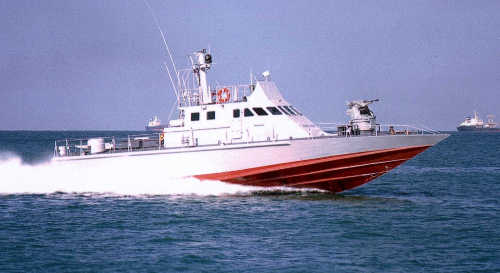
    Shaldag Mk-II class Fast Patrol Boat is the latest version of the original design, launched in 1989. Constructed of welded marine aluminum structure, 24.80 m long, and maximum beam width of 6 meters. The hull is shaped with smooth lines both above and below the water line, offering exceptional handling even at high sea state. The hull is divided into six watertight, full height compartments, that provides easy access to below-deck compartments housing spacious air-conditioned crew accommodations for up to 10 persons, the engines, reduction gears and water-jet, storage for ammunition and supplies. The integral double bottom tank contains the diesel fuel, which also provides additional gravity at the center. The propulsion systems are located aft, for protection and improved crew comfort in the accommodation area. The command center and mess are located at the center of the deck, with the open bridge on top, providing improved visibility in all directions. In the Israel Navy configuration, the living quarters were moved below deck, and locating the open bridge aft to the command center. This configuration reduces the silhouette of the vessel, thus improving its survivability in close encounters.

    Shaldag Mk-II is designed for coastal security, and patrol missions, in law enforcement, coast guard and counter insurgency and naval operations in coastal area. Designed for very high accelerations, the boat can reach its top speed of 45–50 knots in one minute. Maneuverability is also impressive, for example, the Shaldag demonstrated entering a full 360 degree turn from maximum speed, and completing it in a 100 yard diameter. Operation in coastal area, estuaries and rivers, where shallow water, natural and man made obstacles such as fishing nets, floating ropes and vegetation restrict operations of patrol boats propelled with articulated drives.

    Shaldag Mk II Characteristics:

    Full displacement: 56 tons
    Standard displacement: 50 tons
    Length: 24.8 m.
    Beam: 6 m.
    Draft: 1.2 m.
    Main propulsion:

    2 Deutz/MWM TBO 604 BV16 diesels or MTU 12V 396 TE diesels with Ka Me Wa water-jets or / 2×2,500 hp(m) (3.68 MW) with  / 2 LIPS water-jets

    Speed: 48 Knots
    Range at 16 kt: 850 nm
    Range at 32 kt: 650 nm
    Complement: 15
    Fuel capacity: 10 tons
    Payload: 6 tons
    Guns: 1xTyphoon stabilized gun station, 1×20 mm gun, 2 0.5 mm machine—gun pedestals.
    Radar: Surface search MD 3220 Mk-II I band
    Observation/targeting: multi-sensor stabilized electro-optical director

    30mm Armor-Piercing Ammunition

    To enable effective engagement of fast aerial targets, medium caliber guns use ammunition offering high rate of fire and short time of flight. On stationary targets, slower munitions means more precise engagement by short bursts or even single shots. Rheinmetall Defense introduced two new versions for its 30mm ammunition, based on its new Fragmenting Payload (FRAP) concept, developed to defeat both “soft” and “hard” targets utilizing the same projectile and fuse. FRAP uses a frangible tungsten penetrator and additional tungsten preformed fragments. This composition result in the design FRAP penetrating the hard, outer skin of the target and then progressively breaking up inside it, releasing a cloud of fragments inside the target.

    The Frangible Armor Piercing Discarding Sabot with Tracer (FAPDS-T) type is used as a general purpose ammunition, with sub-caliber “frangible” core. Due to the subcaliber design, the muzzle velocity of this projectile is much higher than a full caliber round. This kinetic energy, coupled with its improved aero-ballistic, render this type shorter flight time and higher hit probability.

    Another version is the full caliber Frangible Armor Piercing (FAP) round utilizing the same frangible core and additional preformed fragments, held in molded plastic and steel body. This type is usually used in aircraft, to eliminate the risk of discarding sabot elements. When heavier armor is addressed, APFSDS-T rounds are used, utilizing tungsten made, fin-stabilized sub-caliber to reach maximum muzzle velocity and low drag characteristic with long rod penetrator.

    IMI Introduces a new design for the Wildcat Armored Vehicle

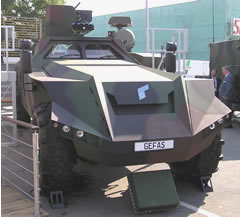
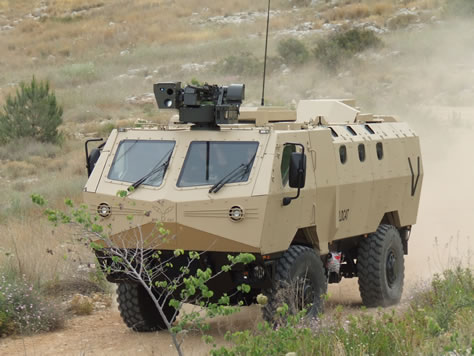
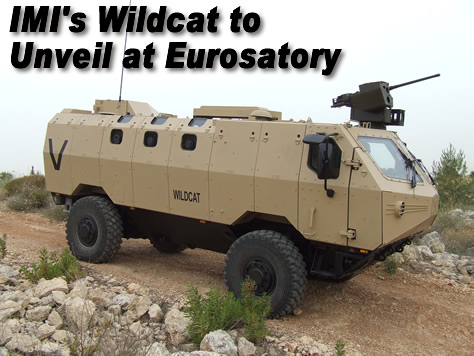
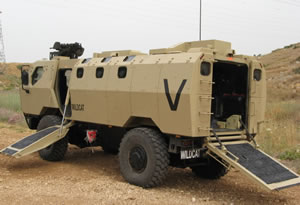
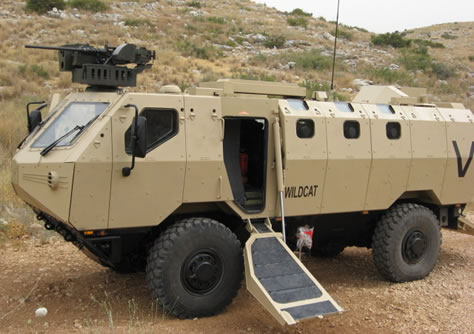
    Introduced by IMI as a proof of concept vehicle, the development of the Wildcat continues with the promise to introduce the worlds first RPG protected wheeled vehicle. In 2006 the vehicle’s configuration changed to reflect the evolving requirements for a versatile urban warfare combat vehicle. IMI based its platform on the Czech built Tatra 4×4 platforms, providing excellent cross-country and road mobility. In late 2007 the Wildcat ‘Alpha’ prototype went through a series of mobility tests held in Israel, demonstrating excellent cross-country mobility, as well as unpaved road mobility. Wildcat was designed to meet current USMC specifications for a medium weight personnel carrier (MPC). In early 2008 the Wildcat went through a US Marine Corps evaluation in the USA. The vehicle is scheduled to make its public debut at theEurosatory 2008 exhibition in Paris, June 2008.

    The WildCat is powered by water cooled, turbocharged 321 HP EPA 2004 compliant diesel engine (Cummins ISLe+325) coupled with an automatic 6 speed transmission (Allison model 3066P). The chassis uses TATRA’s unique backbone tube and swing axle Independent suspension offering excellent cross country mobility and improved crew comfort, provided by the independent suspension and high ground clearance of 367mm (adjustable). At a maximum gross weight of 15 tons, the WildCat will be able to travel up to 700km on road, and retain full cross country and obstacle handling capabilities.

    The WildCat will be designed as a family of armored vehicles, introducing several variants, all using a single chassis, an integrated welded monocoque hull accommodating 12 fully equipped crew members, offering counter-mine, small-arms and IED protection (STANAG 4569 Level 2a and 3b). The levels of protection will be provided. The vehicle is designed with multiple accesses in the sides, top and rear (full width ramp) enabling flexible mount/dismount for troops and equipment, eliminating the need to expose troops to enemy fire. The Wildcat is equipped with run-flat tires, central tire inflation system CTIS), NBC protection and automatic fire extinguishing systems.

    The basic protection level, common to all Wildcat configurations will meet STANAG 4569 Level 3 (small arms bullet-proof armor). The vehicle is designed for C-130 and A-400M air transportability. An up-armored version, equipped with hybrid armor suite will meet STANAG 4569 Level 4 using passive lightweight armor based on IMI’s ‘Iron Wall’ counter IED design. Battle damaged modules are designed to be field replaceable by the forward support elements, and unlike larger and heavier armor plates, do not require the use of heavy lifting equipment. This armor can be augmented with a hybrid armor suite, using IMI’s explosive reactive armor (ERA) specially designed for thin armored vehicles, to protect against shaped charge attacks including RPG. (Such Kit B armor protection is depicted in the artist concept drawing below)

    Some of the variants will include an infantry carrier carrying 11 passengers – 3 crewmen and 8 troops seated in protected seating compartments; a police/border patrol vehicle will be designed for low intensity warfare and general security tasks. A scout and combat support vehicle is also planned, utilizing a reduced fighting compartment and open deck for equipment and mounting of external equipment. Reconnaissance and command and control versions will be optimized for carrying and operating of electronics equipment, while combat service support vehicles, including ambulance, recovery and logistics will be modeled with installations and interior design for each of these specific roles.

    The photos on this page depict the Wildcat equipped with the Kit A armor, providing bullet proof, counter mine and counter IED protection, based on IMI’s ‘Iron Wall’ counter IED protection modules. The Wildcat is provided with three access ports two ramps – on the side and rear and a cabin door on the right. The crew compartment and front cabin also connected, offer comfortable movement fore and aft. Other access ports include multiple armored hatches on the deck. The vehicle also has side and elevated windows, to provide the vehicle’s crew with unobstructed view and improved situational awareness in open area as well as in dense urban environment. This vehicle is designed for medium protection level (STANAG 4586 level 4). It is also fitted with eight firing ports (three to each side and two at the rear). When fully configured, the Wildcat will also mount a remotely controlled weapon station.

    Multi-Mission Effect Vehicle (MMEV)

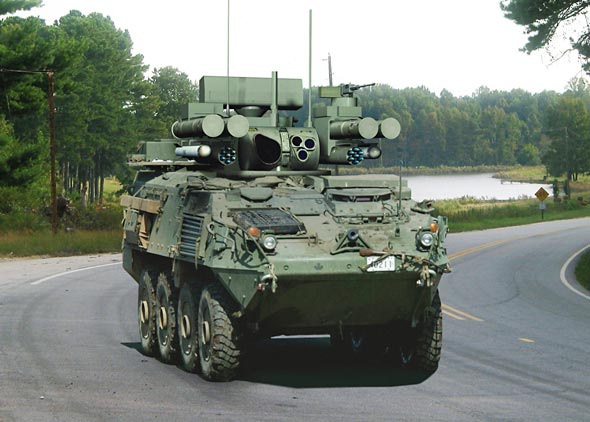
    As part of the Canadian forces army transformation initiative, the new Direct Fire Squadrons will include Multi-Mission Effect Vehicles (MMEV) based on the modernized and upgraded ADATS anti-tank/air defense systems. The upgrades, to be carried out by Oerlikon Contraves will introduce non-line-of-sight engagement capability and range overmatch against ground and armor targets, improve operational capability within joint forces and coalition environment and improve Canadian point defense capabilities for the homeland protection and defense.

    To convert from the tracked ADATS into MMEV, the turret will be updated and install on a new, air-transportable 8×8 wheeled Light Armored Vehicles (LAV) chassis built by General Dynamics land Systems. Fire units will be integrated with new 3D radar and EO/IR target acquisition systems, to better detect and track aerial and ground targets. These modifications will enable the system to engage targets at greater ranges and higher level of confidence, while minimizing the likelihood of fratricide and collateral damage. The system will retain its original ADATS missiles, but could also introduce NLOS missiles, such as a Spike ER. By collaborating with other direct fire elements, such as TOW Under Armor and Mobile Gun System, MMEV will be able to engage targets designated by other elements, including UAVs, while retaining its inherent air defense capability.

    TOUTATIS Remotely Controlled Turret System

    GIAT is developing the TOUTATIS 40mm remotely-controlled turret demonstrator designed for integration in current or future combat vehicles (EBRC and FRES are currently considered for this design). The system utilizes the CDI 40mm automatic, Case Telescopic Weapon System (CTWS) firing at a maximum rate of 200 rounds per minute.

    TOUTATIS uses electrical traverse and elevation, and is fully stabilized in traverse and elevation, providing a traverse rate of 0.6 rad/sec. and elevation of -10 +45 at the same rate. The turret weighs less than 1.5 ton and has Level 3 protection. It is equipped with 68 automatically loaded CT ammunition.

    The system uses a panoramic gunner’s sight with 3rd GEN thermal imager, and an independent commander’s sight, to offer 95% hit probability at a stationary target sized 2.3×2.3 meters (+80% probability against moving target), with a first three rounds burst. TOUTATIS is designed to “drop-into” existing 1.20 meter diameter turret rings.

    Trojan – Mine Protected Armored vehicle

    This vehicle is designed to enable army patrols and intervention forces to enter “hot areas” under fire, rapidly detect enemy positions, and engage the enemy from under armor protection. According to sources at OFB the Trojan production line has been expanded to accommodate new orders from the Indian Army as well as orders from the new Iraqi Army.

    The latest version of the Trojan mine protected vehicle was demonstrated at Defexpo 2006 equipped with a remotely controlled weapon station that is also designed by OFB, and is based on the IMI SRWS design. The 3 meter high vehicle was designed with a V shaped hull to deflect mine blasts. It weighs 11 tons and can carry a payload of 1,400 kg. The normal crew is two and it can carry up to 10 passengers with a range of 1,000 km. With a ground clearance of 30 cm, it can travel on and off road at an average speed of 50 km/h. The top speed is 85 km/h. The vehicles currently in production are for use by Indian counter-insurgency forces and border patrols. There is a smaller six ton version can carry 8 passengers plus the crew of 2.

    CornerShot APR (Assault/Personnel Rifle)

    Retrofitting the FAMAS assault rifle for FELIN include the installation of a front handle, ensuring the weapon can be handled effectively in all firing positions, especially when a bipod cannot be used. This handle enables a firm grip of the rifle when employing it to observe and engage targets in an indirect mode – around corners or behind cover. Remote controls for the weapon’s sights and radio ‘push to talk’ buttons are mounted on the handle. Each button has distinctive dexterity and form, enabling safe and intuitive operation in the dark. With the addition of day/night sight, FAMAS becomes an effective observation device, which enables the warfighter to simultaneously observe, capture images and video sequences, acquire targets and engage them while employing the radio, and maintaining constant line of sight with the target. Modifications also replaced the weapon’s top and iron sights with a Picatinny rail, mounting a new sight with an advanced thermal observation and sighting device, fitted with a holographic daylight sight for daylight operation and instinctive aiming. The weapon also received a new bayonet.

    Infantry Systems at Eurosatory 2004

    Recent combat lessons reemphasized the lack of availability in weapon systems suitable for urban warfare. Among infantry systems on display at Eurosatory 2004, were many familiar models were modified for urban environment combat.

    Many programs are currently underway with different armies, to replace, improve or add anti-structure weapons capability to their infantry units. Current shoulder fired missiles and rockets are designed primarily to defeat tanks and armored vehicles, but inadequate when fired against brick walls or fortified concrete targets. Another deficiency of most current weapons is the fact that they cannot be fired from enclosures, such as rooms or bunkers, rendering the user vulnerable to enemy fire. Dedicated anti-structure weapons should give the infantry soldier capability to defeat buildings, bunkers or fortifications, a task previously provided only by heavier artillery or direct fire from tank guns. There are various types of anti-structure weapons. Two programs are currently in advanced stages – the US Marine Corps is evaluating two types of weapons for its Follow-On To SMAW (FOTS) program, which is expected to be followed by similar program to be launched by the US Army. The systems are under development at Lockheed Martin (teamed with IMI, based on the Shipon design) and General Dynamics (teamed with Dynamit Nobel and RAFAEL, based on the Panzerfaust design). FOTS is designed for ranges of 10 – 500 meters in urban or open terrain, and be capable of operation from confined spaces. The weapon should be effective as an anti-structure, anti-tank weapon, against soft targets and means to force man-sized openings in triple line brick walls. The Israeli Army is expected to follow the US decision after system selection is announced.

    A British Army requirement for a similar system with a weight of less than 10 kg and an effective range of at least 200 meters, is expected to be available for operational use by 2009. Both Dynamit Nobel Defense and versions of the Saab Bofors Dynamics are competing on this program. Saab Bofors Dynamics offer two weapon’s families compatible with these requirements, based on the AT4 weapon and M3 Carl Gustaf weapons. Companies currently developing or offering such weapons include the Russian Basalt, developed of the RPG-7, Dynamit Nobel with the Panzerfaust weapon, the new anti-structure version of IMI Shipon, IMI also develops with Lockheed Martin a special weapon for the US Marine Corps Follow-on to SMAW program, a program which RAFAEL is also competing on. RAFAEL has also developed the Wallbuster and MPM90 multi-purpose weapons.

    Start – Previous – Next

    Skunk Works and XTEND Simplify Multi-Drone Command

    0
    Lockheed Martin Skunk Works® and XTEND have achieved a major milestone in JADC2 by integrating the XOS operating system with the MDCX™ autonomy platform. This technical breakthrough enables a single operator to simultaneously command multiple drone classes, eliminating the friction of mission handoffs. From "marsupial" drone deployments to operating in GPS-denied environments, explore how this collaboration is abbreviating the data-to-decision timeline and redefining autonomous mission execution.

    From Ukraine to Taiwan: The Global Race to Dominate the New Defense Tech Frontier

    0
    As traditional defense primes face mounting competition from agile “neoprimes” such as Anduril, Palantir and Helsing, the balance of innovation is shifting toward software-defined warfare and scalable, dual-use technologies, while global industry consolidation—marked by Boeing’s integration of Spirit AeroSystems and other strategic mergers—signals an intensified race to secure control over the defense technology value chain. Our Defense-Tech weekly report highlights these trends.

    Europe’s “Drone Wall”

    0
    In early October 2025, a coordinated wave of unmanned aerial system (UAS) incursions—widely attributed to Russia—targeted critical infrastructure across at least ten European nations. The unprecedented campaign exposed the fragility of Europe’s air defenses...

    Weekly Defense Update & Global Security Assessment

    0
    Executive Summary The past week (September 18-25, 2025) represents an inflection point where strategic defense concepts have transitioned from doctrine to tangible reality. An analysis of global events reveals four primary, interconnected trends shaping an...

    U.S. Air and Space Forces Push Next-Gen Programs at the AS&C 2025 Conference and...

    0
    At the 2025 Air, Space & Cyber Conference, U.S. Air Force and Space Force leaders unveiled major updates on next-generation fighters, bombers, unmanned systems, and space initiatives, highlighting both rapid innovation and critical readiness challenges as the services race to outpace global competitors. A short version is available here, with a more detailed version for subscribers.

    TADTE 2025: Reflecting Taiwan’s Strategic Themes

    0
    The Taipei Aerospace & Defense Technology Exhibition (TADTE) 2025 crystallized around four dominant strategic themes that collectively illustrate Taiwan's comprehensive approach to defense modernization amid escalating regional tensions. Based on a detailed report by Pleronix (available upon request). Includes a Podcast discussion on TADTE 2025's highlighting Taiwan's four strategic themes beyond the post's coverage.

    Iron Beam 450 Completes Testing, Soon to Join With Operational Air Defense Units

    0
    Israel’s Iron Beam 450 high-power laser system has completed final testing, marking a major leap in air defense. Developed by Rafael, it offers precise, cost-effective interception of rockets, UAVs, and mortars, and is set for IDF deployment by 2025.