
Tuesday, December 23, 2025
More
    Home Blog Page 410

    C4I & UAV Systems at Eurosatory 2004

    Command, Control, Communications and Intelligence, Surveillance and Reconnaissance (C4ISR) are becoming a most essential element in modern military operations. Under current ‘transformation’ programs, C4ISR means are being distributed to all every operational level, beginning in the individual soldier, tank and aircraft which are being connected via seamless communications through all command levels. This network centric warfighting capability is becoming a major advantage derived from 21st century military modernization and transformation plans, currently evaluated by the US armed forces (FCS, Land Warrior), British (FRES /FIST), French (BOA/FELIN), and other armies.

    Unattended and unmanned sensors as being developed as part of these futuristic programs. Among these systems are various robotic and autonomous ground vehicles, unattended ground sensors and unmanned aerial vehicles. Unmanned systems are are becoming an essential element of these programs, providing real-time intelligence at the various levels. At Eurosatory 2004, several new UAVs were unveiled, especially smaller systems designed for dismounted low-echelon operations. Among the new systems displayed here were the Merlin (by Sagem), Skylark (RAFAEL),  and the CybereyeBushmaster and Parasight (Cyberflight), and AladinMikado and BirdEye 500 (IAI). Other models offer vertical take-off and landing capability, they can also maintain a position for an extended period of time over a target area, where continuous watch is required. These systems are particularly suitable for urban warfare, as they can maintain a position over a target, street or in front of a window, to provide valuable intelligence from such scenes. Among the systems on display here were the US M-65/85 (TAG)  FanCopter (EMT), and Odin (Sagem) and HoverEye, dveloped by Bertin. Much larger systems, are also under development, including Northrop Grumman’s and the Bell Tilt-Rotor XV-15.

    Among the unattended ground sensors seen on display were the Terrain Commander (Textron), which can also be associated with a weaponized Spider weapon system, and various autonomous robots, from the IAI Guardium and Robowatch’s OFRO, through the combat proven PackBot (iRobot), IQBOT (Qinetiq)to the futuristic unmanned vehicles considered within the French BOA program. An interesting new idea was an autonomous sensor / load carrier, Vipere, presented as part of the Thales future systems display.
    Start – Previous

    Gun Systems and Ammunition for AFV

    Weapons and Systems upgrades were introduced for the familiar VBL displayed here with the new KBP Kvartet turret, mounting four Kornet anti-tank missile and associated electro-optical equipment. Other upgrades on the site included the British Warrior which was introduced with a new 40mm turret, utilizing the new CTI-40mm case telescopic gun turret.


    Among the highlights at Eurosatory were weapons systems and ammunition designed for light vehicles, primarily new wheeled armored gun systems, current and future combat systems. Among the weapons designed for such platforms are lightweight guns, displayed by Rheinmetall (120mm derivative) and IMI’s 105mm Low recoil gun. The 120mm version is already installed on the CV90 platform, while IMI’s gun is proposed for applications similar to the US Striker Brigade’s AGS. Advanced tank munitions were on display for both calibers. Rheinmetall showed its M53/63, General Dynamics displayed the KEW-A1/A2 and ATK’s presented its M-829A3. IMI also displayed KE ammunition but did not divulge new information about its characteristics. Other multi-purpose munitions were also on display. Generally, the new models use longer, heavier penetrating rods made of tungsten or depleted uranium, lighter sabots made composite materials and advanced propellant, which maintain stable characteristics through a wide temperature range. To enable the tank to engage targets beyond its visual range, several types of guided munitions are considered. The most mature are Russian guided missiles, such as the 9M119M designed for 125mm guns, demonstrated here by KBP and the Israeli Lahat, available for 105 and 120mm guns, displayed by IAI. Diehl is also developing a version of the SPAR gun-fired missile. All three are using shaped charges to defeat the target. A different approach, utilizing kinetic energy by projectile guidance and acceleration at the terminal phase, is under development at ATK.

    The debate on what weather HE or multi-purpose ammunition should augment the KE rounds demonstrate a shift from the pure anti-armor role of tanks, to a re balanced employment of tanks, against soft or armored targets, bunkers or buildings, on the ground, or in the air. Typical solutions are calling for replacements for the M830 HEAT round, with more versatile projectile composed of dual-purpose explosive or shaped charge, fitted with fragmenting case, equipped with delay/percussion/time fuse, for penetration, impact, airburst (against unprotected infantry or helicopters) effects. ATK M-830A1 HEAT-MP-T is one such example, while Rheinmetall is using another approach, with its new 120mm HE. A more radical departure from HEAT is IMI’s APAM which also have the capability to engage dispersed soft targets. General Dynamics displayed the XM1028 a 120mm canister cartridge, designed for close range engagement of soft targets such as infantry and unprotected RPG threats. Ammunition safety measures, including a complete fire resistant ammunition stowage developed by Orlite for Israeli tanks, including Merkava and improved M60s.

    Start – Previous – Next

    Eurosatory 2004 AFV Weapon Stations & Turrets

    Remote controlled weapon stations were also a popular exhibit in this year’s Eurosatory, addressing new lessons learned on asymmetric counter guerilla warfare in urban area.

    New systems were unveiled by FN Herstal (Arrows 300), Bofors (LEMUR), IMI (Wave-ASRWS) and Oto-Melara (HITROLE), joining companies such as KMW (IWS-10), RAFAEL (RCWS), Kongsberg (Protector) and Thales which have already mastered this concept with operationally fielded systems. Most systems are offering semi-stabilized “soft” mount for precision firing, high elevations for engaging targets in urban scenarios electrical operation with and mechanical override for critical functions. Etc.

    While performing similar roles, the various systems types differ from each other in operational concept and man-machine interfaces, which reflect the customer’s requirements or designer’s approach. Some aspects, such as firing accuracy, traverse and elevation servo speeds, and accuracy, deck penetration, ammunition capacity, reloading capability etc, reflect the operational and cost preferences such as weight and cost.

    In general, two principal classes were demonstrated – the modular “strap-on” systems, utilizing servo-actuated soft mount, attached with electro-optical observation and aiming payload and control servos highlighting easier modification and adaptation to specific customer’s requirements and inherent growth potential. This class is represented by RAFAEL’s RCWS, IMI WAVE and Kongsberg Protector. The second class comprises fully enclosed systems, where sensors, payloads and weapons are covered by special casing, protecting them from environmental and ballistic threats. Most of the new systems shown here were the members of this class, including LEMUR, ARROWS-300, HITROLE and others.

    Start – Previous – Next

    Combat Vehicles at Eurosatory 2004


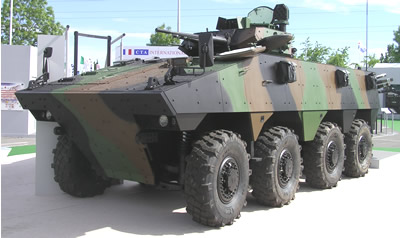
    As in previous year events, combat vehicle systems captured much of the outdoor area of Eurosatory 2004 and a significant part of the indoor section. On display were the new versions of wheeled APCs which are planned for replacement of aging APCs in several European armies. Two new 8×8 vehicles on display were the French VBCI and German Boxer, both designed for similar missions supporting light and medium weight mechanized forces, designed for out of area operations and urban warfare scenarios, as part of modern high mobility forces. The futuristic French EBRC vehicle was not presented here but was widely referred to in an impressive presentation of future combat systems. The Boxer was displayed here with the Virtus driver’s enhanced vision system. These two vehicles are pioneering a new generation of APCs which is now supported by the larger European industries such as Giat in France and KMW in Germany. Sofar, such designs were pursued only by defense industries in non-NATO countries such as the Pandur II (Styre Daimler Puch – Austria), AMV (Finland – Patria) and Piranha (Mowag – Switzerland). Plans for the development of new family of wheeled AFVs were also announced, by Iveco. The first Iveco VBC command vehicle derivative of the 8×8 Centauro 105mm mobile gun system was displayed here for the first time. Other derivatives considered for this family include an Armored IFV, equipped with 25mm turreted gun, armored ambulance, an engineering vehicle, mobile mortar (fitted with the Thales DRD2 system) and an up-gunned 120mm Centauro mobile gun system. A different concept for close fire support was presented by the Russian T-72 Tank Support System. The system packs rapid firing 2x30mm gun, long range and missiles to support armored elements in close-in combat in open terrain or urban terrain, effectively engaging dismounted infantry and ATGW teams.

    Another newcomer was the Alvis Hagglunds CV9035 MkIII tracked infantry fighting vehicle (IFV) currently competing on a Dutch requirement for over 200 AIFVs. Other displays presented by Alvis were oriented toward the upcoming British Army FRES program, (CTA turrets for Warrior), Skyranger, first introduced by Oerlikon and Mowag, was also on display.

    Intelligence gathering is a dominant factor in modern net-centric warfare; scout and reconnaissance vehicles such as the FENEK, Stalker and Mantis are providing the essential organic eyes and ears for land forces. Specialized recce vehicles are also part of the French BOA net centric concept, visualized in details at the Thales pavilion.

    Upgrading programs were demonstrated for a number of armored vehicles, including the Leclerc SXXI tank upgrade which will be implemented in operational and new production tanks. Further enhancements are expected to be included with AMX-10P and EBG armored engineer vehicles. Among upgrades introduced for the AMX-10RC are the introduction of thermal imager and BMC, survivability improvements (top armor protection, Gallix defensive aids suit (KBCM), reinforced suspension, aided gearbox control, improved stations ans stowage capacity.

    Among the all-armored and mine protected vehicles shown here were the MLV displayed in both British and Italian versions, Mowag Eagle IV, the Belgian Iguana and Australian Bushmaster mine protected vehicles and German Dingo 2 which is also marketed by Textron Marine & Land Systems.

    Start – Previous – Next

    CLAW – Clean Lightweight Area Weapon

    The CLAW smart munition introduced by Textron Systems is a new air-to-ground weapon optimized to defeat soft, widely dispersed targets. (Anti-Personnel/Anti-Material). The 64 lb CLAW uses blast-fragmentation-incendiary effect covering the footprint of a 1,000 lbs cluster bomb. CLAW explodes above the ground level, but does not disperse submunitions of any kind, thus leaving a clean battlefield and eliminating collateral damage from unexploded bombs. CLAW is designed as an insensitive munition and by using deactivation fuze, it is renders harmless within minutes after delivery. CLAW can be designed for carriage by UAVs, tactical munitions dispensers, cruise missiles and glide weapons and guided rockets.

    idZ Program

    German Infantry of the Future


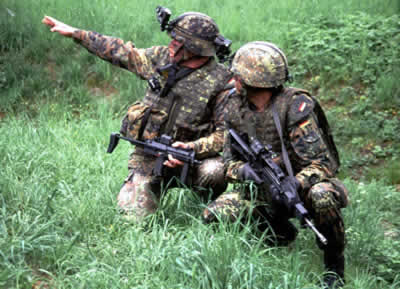
    The German Future Infantryman (idZ) system is one of the more mature soldier modernization systems, currently under development by EADS for the German Army. The system supports the soldier with updated situational picture, enabling covert, silent communications and assists him with navigational services.

    The situational picture provides information about the soldier’s own position, relative to the positions of his comrades, and a threat situational picture, depicting the locations of suspected threats such as obstacles and minefields and course of movement of targets, designated with accurate coordinates. The idZ units will also integrate miniature unmanned vehicles, both ground based and aerial mini- and micro-UAVs and UGVs to utilize battlefield preparation, patrol and reconnaissance and resupply missions.

    The idZ soldier’s gear will be based on a mission oriented and reconfigurable portable system including modular, ballistic vest with stab protection and NBC clothing set. It will be integrated with electronics devices, including digital intra-section radio for voice and data communications and computerized navigation system. These electronic processors will display data, overlayed with situational display showing all relevant elements, positioned on a digital map. The suit also includes weapon’s thermal sight and an integrated, hand held observation system, comprising digital day/night imager, laser rangefinder and a digital compass. The weapon selected by the German Army for idZ is the G-36 from heckler & Koch, fitted with 40mm grenade launcher, target tagging and close-field illumination. A long range rifle and personal defense weapon, shoulder fired anti-tank/anti-material weapon are also included in the section’s arsenal. Mission oriented eye and ear protection systems are also included.

    Modern Air Defense Concepts

    Start < Page 2 of 4 >

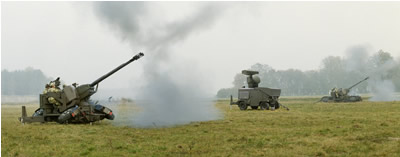
    Effective air defense is based on an integrated and coordinated approach including airborne (AEW or tethered radars), active and passive ground based sensors (radar, IR scanners, ESM), command centers and “shooters” of various types. The air defense network usually includes the surveillance and control of the protected airspace, projection of airpower for air defense missions, wide area air defense at medium and high altitude and site point air defense, covering medium and low altitudes. Each of these elements utilizes typical weapon systems, sensors and command and control facilities designed to meet the specific environmental and tactical scenario.

    This article will cover the medium – low altitude point and area defense systems. Wide area air defense systems will be covered in a future article. The systems designed for medium and low level defenses, usually referred to as point defense systems and SHOrt Range Air Defense systems (SHORAD), employ various types of heat seeking, radar guided and command to line of sight guided missiles, augmented by rapid firing radar/EO directed automatic guns, for close-in defense. During the 1970s, most SHORAD systems relied on short-medium range, medium altitude Surface to Air Missile (SAM) systems, such as the Russian SA-3, and SA-6, US Hawk and Chaparral and the Franco – German Roland and Crotale Surface to Air Missiles.

    The low altitude defense of mobile forces was maintained by manual or radar directed guns, which were later improved with the introduction of radar directed guns such as the Russian ZSU-23/4 (Shilka) 23mm quad automatic Self Propelled Anti-Aircraft (SPAA) gun, US M-163 Vulcan that utilized the 6x20mm Gatling gun, and the German Gepard 2x35mm SPAA. Protection of large area and strategic sites was maintained by air defense guns such as the Swiss Skyguard radar directed gun system and Russian 23, 37, 57 and 85mm guns. During the 1970s and 1980s, at the peak of the cold war, the combination of guns and missiles evolved as means for the protection of mobile forces in the battlefield. For the first time, an effective multi-target engagement system was introduced, utilizing an integrated defense concept, where guns, missiles and radars of various types were mutually covering each other to provide an effective air defense “umbrella”. This concept was later complemented by the evolution of high performance, compact short range missiles, such as the Starstreak, Mistral, Stinger in the west and the SA-8 and SA-19 in the East. With these missiles, advanced VSHORAD systems evolved during the late 1980s and 1990s, offering means of autonomous escort for mobile forces, protecting primarily from direct attack by attack helicopters and close air support assets.

    Additional parts of this article:

    Counter IED Techniques – Change Detection

    IED Change Detection is being developed by the US Army Communications – Electronics Research, Development and Engineering Center (CERDEC), to detect IEDs along travel routes using high resolution aerial/overhead imagery. It uses day and night sights and is currently mounted on manned and unmanned aviation systems. The data is sent to a Change Detection Work Station, where a warfighter views day-to-day thermal or TV imagery that is collected by the airborne asset. This system helps an operator to identify and locate “new” environmental changes on a route which could indicate the presence of IEDs or landmines.

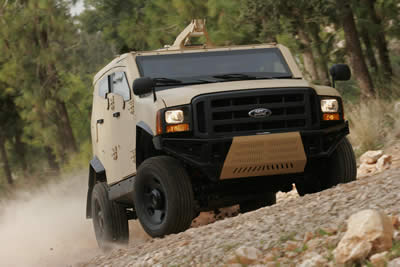
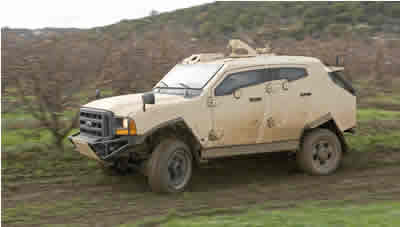
    SandCat – All-Protected Combat Vehicle from Plasan Sasa (Test Drive)

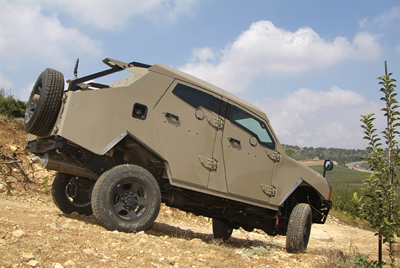
    Earlier in 2006 Defense Update had the opportunity to ride the new Sand Cat armored concept vehicle developed by Plasan Sasa. Traveling through dirt roads and fields of the mountains of the upper Galilee, just outside the Plasan’s R&D and production center at Kibbutz Sasa we appreciated the excellent handling and acceleration of the vehicle. Unlike noisy armored vehicles, this ride was surprisingly quiet. The six liter engine was humming along just normally, as we maneuvered the vehicle through steep and narrow roads of the Kibbutz, demonstrating extremely tight turns. We continued dashing at high speed on the perimeter road, and off-road, through fields, to demonstrate patrol missions profiles.


    Throughout the ride, the vehicle demonstrated a quiet, soft ride, good road handling, and maneuverability using power steering and the torque-shift automatic 5 speed transmission, effectively managing the power to sustain a smooth ride, even over rough terrain and steep slopes. Adding to the comfort and confidence are significant power reserves of the V8, 325 hp turbo diesel (a gasoline powered version is also available for even quieter performance), leaving ample capacity for effective air conditioning. Despite the narrow side windows, sideways visibility was unobstructed, through the thick, transparent armored windows, while the bullet-proof one-piece windshield provided clear forward view. Compared to the claustrophobic experienced and hard rides experienced with some up-armored vehicles, and most armored personnel carriers, this compact armored vehicle is quite comfortable. It is fitted with Autoflug safety seats to further improve blast protection. These seats absorb the majority of impact forces in an event of a mine blast, improving the survivability of the crew. (The vehicle is also equipped with an integral fire suppression system in case a fire erupts after such explosion).

    Equipped for long missions, the spacious internal volume leaves much space for mission and personal equipment. The original configuration uses an external baggage compartment and open cargo compartment, accessible from the protected hull via two access doors. The newly redesigned configuration uses internal stowage compartments and a full size access door, which can be lowered into a ramp. The hull can be configured to accommodate an open stretcher, loaded from the side or rear access doors. The wide, flat guards installed on each side of the vehicle enable placement for antennae mounts, eliminating the need for drilling into the armor.

    Monolit B – Coastal Defense Missile System

    Typhoon JSC displayed the Monolit B coastal surface and air surveillance system, which is designed to support coastal defense batteries that fire Club M and Uran (SS-NX-27) missiles. Monolit B utilizes a ground based or aerial radar to detect and acquire targets. The system can also operate in quiet mode, employing two radars operating in receive-only mode, to “fix” target location by triangulation.

    The system can detect up to 50 targets over the horizon at ranges of up to 250 km in passive mode, and up to 450 km in active mode. It can designate up to 10 targets simultaneously. In active mode the system can simultaneously handle up to 30 targets.


    In passive mode the system can detect as many as 50 targets ‘over the horizon’ at ranges up to 250km and handle up to 10 targets simultaneously. In active mode detection range can be up to 450km and as many as 30 targets can be handled simultaneously.

    This capability is especially useful with the Uran/Club M, which is a family of relatively inexpensive fire and forget cruise missiles that are usually fired in salvos. During the targeting phase the target’s parameters (type, location, etc) are processed by the fire control system and fed to the missile, which is then launched toward the target. Each missile follows a different course to reach a position where the target can be acquired by its on-board sensor. This allows multiple missiles to execute a “ripple attack” from different directions.

    The Uran missile is a relatively small sub-sonic sea-skimmer, which can engage targets at ranges of up to 250 km. The Monolit / Uran/Club M system uses common transporters, launcher vehicles, communications and C3 systems to accommodate three different missiles – the 3M-54E anti-ship missile, with supersonic terminal stage, 3M-54E1 anti-ship subsonic missile, or the 3M-14E land attack missile. The range of Club M is specified as up to 275 km although it is believed to be extendable by making a tradeoff between warhead weight and fuel capacity. Another Monolit compatible system is the 130mm Bereg E coastal artillery system, which is also called Titan. Bereg E consists of self-propelled guns with a range of 20 – 23 km (depending on type of gun and ammunition). Bereg E can engage multiple targets with a hit probability of 80% and can eliminate typical targets at sea within 1 – 2 minutes.

    Thor – Multi-Mission air defense

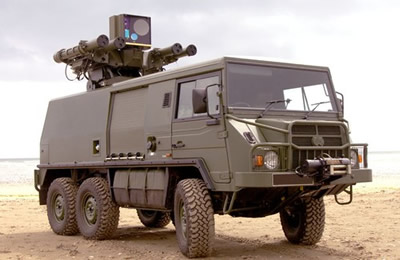
    Thor vehicle mounted Multi Mission System (MMS) was first demonstrated at DSEi 05, mounted on the ATL Pinzgauer (6×6) cross-country chassis.

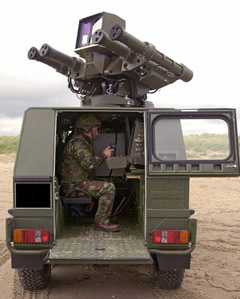
    Thor comprises a four-missile turret with an integral stabilized sighting system, TV camera and thermal viewer and integrated auto-tracker, providing 24 hour capability. The system mounted the Starstreak High Velocity Missiles (HVMs) in the ready-to-launch position. Starstreak HVM is a laser-guided missile with a maximum speed in excess of Mach 3 and a range greater than 6km. Starstreak is in service with the British and South African armies.

    The launcher weighs about 500 kg and can be integrated onto a range of wheeled or tracked vehicles. Preparing for what Thales defines as “force protection” missions; Thor’s missile payload is not limited anti-aircraft missiles. The system can carry a mix of missiles, including Hellfire anti-tank laser homing missile, and SPIKE multi-purpose missiles and the South African Ingwe. According to Thales, the system already entered a series of test firing to demonstrate and validate its capabilities. The system can be operated by a single person but the normal crew consists of two – commander and gunner.

    Israel Plans Short-Range Ballistic Missile Defense (SRMD)

    Raytheon Company and Rafael Armament Development Authority have been selected by the Israel Ministry of Defense’ Defense Research and development Directorate (DDRD) to develop a new terminal missile defense interceptor to defeat a variety of low-cost, short-range ballistic missile threats. According to an IMOD announcement, The next step in the program will be a feasibility study. No decision about full scale development has been made.

    The Short Range Ballistic Missile Defense program is an IMDO initiative to address the proliferating threat of short-range ballistic threats. Such missiles and rockets are cheap, plentiful, easily concealed and largely exempt from international arms control accords. These relatively insignificant battlefield weapons can be transformed into deadly, strategic threats when fitted with unconventional warheads and deployed in large quantities.


    Israel and the US have agreed to jointly develop new Short Range Missile Defense (SRMD) capability. The systems will be optimized to defend against short range ballistic missiles and long range rockets with ranges of 70 – 200 km. The new system will establish a lower tier, complementing the Israeli Arrow system, which extends the defensive capability to longer range and higher altitude. The program will be managed by the Israel Missile Defense Organization (IMDO), which already supervises Israel’s ballistic missile defense program.

    The SRMD program will be based on a interceptor, under development by RAFAEL. The IMDO selected the solution proposed by a team headed by Raytheon and RAFAEL. This team competed against another plan, proposed by Boeing, IAI/MLM and ATK which proposed an Arrow derivative missile interceptor, augmented by a lower tier RAM solution, based on a low cost rocket to be developed by IMI. “Raytheon’s cooperation with Rafael ensures that Rafael’s multi-mission interceptor is designed from the start for seamless insertion into U.S. terminal missile defense systems. Our approach provides the U.S. Army with a low-cost extended air defense option for the future,” said Michael Booen, Raytheon vice president of Advanced Missile Defense programs commenting on the company’s selection by the IMDO.

    The interceptor proposed by Raytheon and RAFAEL, is specially designed for all-weather, day and night “hit to kill” intercept, and is considered to be low cost and optimized for the trajectory and short flight  time of the potential SRMD and rocket targets. “Our interceptor solution fundamentally redefines the performance-cost value equation for terminal missile defense, providing all-weather, hit-to-kill performance at a tactical missile price,” said David Stemer, Rafael Missile Division general manager.

    IAI, RAFAEL and Northrop Grumman have teamed in the past to develop the Nautilus chemical laser based rocket and mortar defense program, which has recently been cancelled due to lack of funding and limited access to current generation (solid state laser) technology. Facing the new threat of improvised rockets fired from the Gaza strip, Israel could revive this program, which will be based on locally developed directed energy sources.

    Thor – High Energy Laser IED Neutralization System

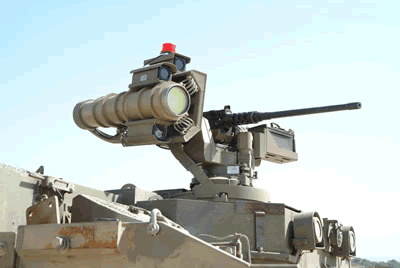
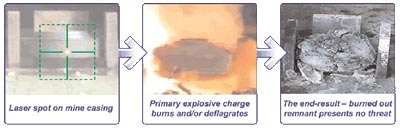
    RAFAEL is introducing at Eurosatory a new high-energy laser weapon system, developed in Israel to defeat improvised explosive charges (IEDs), roadside bombs and unexploded ordnance (UXO) and other objects categorized “potentially explosive hazards”. The vehicular, system is mounted on a remotely controlled weapon station, carrying the laser beam director and high-energy laser and coaxial 12.7mm machine gun to neutralize improvised explosive devices from a safe, standoff distance. This dual capability enables Thor to be used for offensive and defensive purposes, as well as for safe stand-off removal of explosive obstacles by laser directed energy or projectile kinetic energy. Since the laser is used to burn the IED, rather than activate it, it can be used to avoid collateral damage which can result from other neutralization procedures. The system’s total weight is 850 kg, of which 250, including heavy machine gun and beam director are mounted on the externally.

    The directed energy from the laser is capable of rapidly clearing unexploded ordnance and defeating IEDs by inducing a low-order burning or deflagration reaction in the explosive fill at safe stand-off ranges (see photos above). THOR uses powerful, air cooled laser, measuring up to 700 watt. The kinetic energy from the 12.7mm bullet fired by the M2 functions as a standoff disrupter, destroying fusing, thick-cased munitions and booby traps. The M2 machine gun also provides accurate, direct fire upon enemy forces and targets in either an offensive or defensive role.

    The system is modular and can be installed on a variety of vehicles and weapon stations, as an add-on system. The system is already operational is used by Combat Engineering and EOD/IED Defeat Forces, to enable on-the-move removal of explosive obstacles such as IED’s, mines, UXO and others, with embedded self-protection capability. Thor has demonstrated combat effectiveness in operational engagements bringing an additional precision fire gun platform to the fight, while at the same time filling a unique tactical mission role.

    Developed by Rafael Armament Development Authority Ltd., Thor is now available for sale and integration in the United States by GD-OTS through a teaming agreement with Rafael. The system will be on display at the Eurosatory 2006 exhibition in June, 2006.

    Laser radar (LADAR) based Guidance System

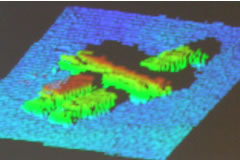
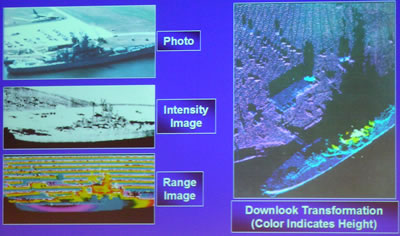
    Laser Radar (LADAR) is employed similar to millimeter wave radar, but uses laser beams to scans and process the signal echoed from targets, to create a virtual picture of the area. The LADAR processor looks for familiar patterns in the scenes. The processor continuously compares these patterns with 3D targets files stored in the weapon’s memory. Due to its capability to scan large areas with very high precision, and its ability to gradually build a detailed picture of the area under surveillance, LADAR sensors are usually employed on loitering systems, which can look at the target from different angles, verify the target identification and select the best attack position for the desired effect.

    Laser Radar (LADAR) seeker can detect objects and identify specific features with very high definition of up to 15cm resolution (from a distance of 1,000 meers). An Automatic Target Acquisition (ATA) algorithm continually processes the images to identify and acquire targets based on 3D templates preloaded into the weapon’s memory before the mission. The process determines if priority targets are present in the area, and when evidence of such targets is detected, the weapon is commanded to loiter over the suspected target, to acquire more data. Gradually, a 3D image of the target is generated, to either reject or verify the target. Once a target is verified and assigned for attack, the weapon is commanded to place itself in a position and aim to the point that will yield the best effect on the target.

    On 24 May 2006 Lockheed Martin was awarded a US $7.8 million contract for the development of a 3D laser radar for the US Air Force Predator UAV fleet. the Predator Imaging Laser Radar program, will demonstrates a 3-dimensional imaging laser radar sensor suitable for installation on an unmanned air vehicle (UAV) such as a Predator, meeting the volume and weight constraints of such platform. The program is scheduled to continue through May 2009.

    Skunk Works and XTEND Simplify Multi-Drone Command

    0
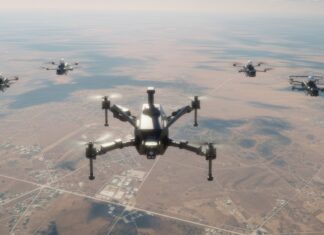
    Lockheed Martin Skunk Works® and XTEND have achieved a major milestone in JADC2 by integrating the XOS operating system with the MDCX™ autonomy platform. This technical breakthrough enables a single operator to simultaneously command multiple drone classes, eliminating the friction of mission handoffs. From "marsupial" drone deployments to operating in GPS-denied environments, explore how this collaboration is abbreviating the data-to-decision timeline and redefining autonomous mission execution.

    From Ukraine to Taiwan: The Global Race to Dominate the New Defense Tech Frontier

    0
    As traditional defense primes face mounting competition from agile “neoprimes” such as Anduril, Palantir and Helsing, the balance of innovation is shifting toward software-defined warfare and scalable, dual-use technologies, while global industry consolidation—marked by Boeing’s integration of Spirit AeroSystems and other strategic mergers—signals an intensified race to secure control over the defense technology value chain. Our Defense-Tech weekly report highlights these trends.

    Europe’s “Drone Wall”

    0
    In early October 2025, a coordinated wave of unmanned aerial system (UAS) incursions—widely attributed to Russia—targeted critical infrastructure across at least ten European nations. The unprecedented campaign exposed the fragility of Europe’s air defenses...

    Weekly Defense Update & Global Security Assessment

    0
    Executive Summary The past week (September 18-25, 2025) represents an inflection point where strategic defense concepts have transitioned from doctrine to tangible reality. An analysis of global events reveals four primary, interconnected trends shaping an...

    U.S. Air and Space Forces Push Next-Gen Programs at the AS&C 2025 Conference and...

    0
    At the 2025 Air, Space & Cyber Conference, U.S. Air Force and Space Force leaders unveiled major updates on next-generation fighters, bombers, unmanned systems, and space initiatives, highlighting both rapid innovation and critical readiness challenges as the services race to outpace global competitors. A short version is available here, with a more detailed version for subscribers.

    TADTE 2025: Reflecting Taiwan’s Strategic Themes

    0
    The Taipei Aerospace & Defense Technology Exhibition (TADTE) 2025 crystallized around four dominant strategic themes that collectively illustrate Taiwan's comprehensive approach to defense modernization amid escalating regional tensions. Based on a detailed report by Pleronix (available upon request). Includes a Podcast discussion on TADTE 2025's highlighting Taiwan's four strategic themes beyond the post's coverage.

    Iron Beam 450 Completes Testing, Soon to Join With Operational Air Defense Units

    0
    Israel’s Iron Beam 450 high-power laser system has completed final testing, marking a major leap in air defense. Developed by Rafael, it offers precise, cost-effective interception of rockets, UAVs, and mortars, and is set for IDF deployment by 2025.