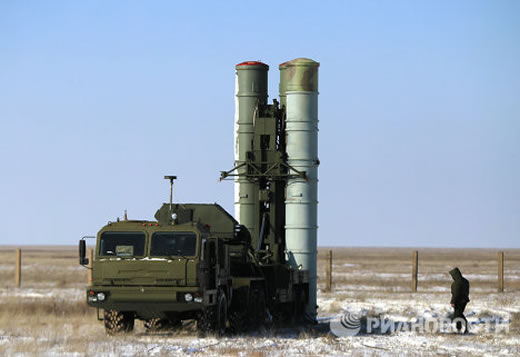
Russia will begin deploying the new S-500 air defense systems in 2020. They will replace the S-400 (in picture) currently used in 19 air defense divisions. Photo: RIA-Novosti
Russia is beginning to deploy the third S-400 Triumph Air Defense Missile System with an air-defense regiment based in Russia’s Far-East.
Russia will deploy the third S-400 Triumph air-defense unit in the Far East. Photo: RIA-Novosti
S-400 (NATO reporting name SA-21 Growler) was developed by the Almaz Central Design Bureau as an upgrade of the S-300PMU-3 air defense missile system. Development began in 1999 and the first unit was declared operational in 2007 – the first S-400 regiment stationed near the town of Elektrostal. The second unit has recently completed training at Kapustin Yar and is currently shipping equipment to its permanent base outside Dmitrov near Moscow. The base is expected to become operational in March 2011.
An S-400 regiment comprises two squadrons each equipped with eight launchers (a total of 32 ready to fire missiles per squadron). The Triumph unit employs three different missiles to cover its entire envelope – the very long range 40N6, long range 48N6E3 and short range 9M96E or 9M96E2 missiles. The S-400 system has demonstrated its capability to perform ballistic missile interception, by successfully intercepting a ballistic missile target with an upgraded 48N6DM interceptor missile.
According to Russian sources, the S-400 is capable of detecting six targets out to a range of 400 km (250 miles), including aircraft, cruise missiles, and ballistic missiles having a range of maximum 3,500 km and a speed of maximum 4.8 km/s and then engaging them at ranges of up to 200 km. It is designed to have improved performance against stealth aircraft.
According to aerospace defense strategic commander Lt. Gen. Valery Ivanov, the S-500, the successor of the current SA-10 (S-300PMU-1/2) is expected to enter full rate production in 2014. The new S-400, and Pantsir mobile air defense system and currently in development S-500 are expected to be the centerpiece of the Russian air defense modernization plan, scheduled to follow through the decade and be completed by the year 2020.
Lockheed Martin Corp. has received a $726.6 million contract modification from the U.S. Air Force for the sustainment of the F-22 Raptor fleet. This modification is for the 2011 Follow-On Agile Sustainment for the Raptor (FASTeR) sustainment contract, a Performance-Based Logistics (PBL) program providing weapon systems sustainment of the F-22 fleet at all operational bases. In 2010 these locations included to Guam, Japan and the United Arab Emirates. In January, F-22s from Elmendorf AFB, Alaska, flew 100 percent of scheduled sorties during a deployment to Kadena Air Base, Japan.
Awarded initially in 2008, the program was extended under an option in 2009, and later followed with contract modification for 2010. For the 2011 calendar year, the current plan includes training systems, customer support, integrated support planning, supply chain management, aircraft modifications and heavy maintenance, sustained engineering, support products and systems engineering.
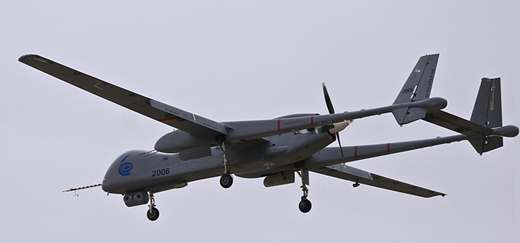
Dassault is proposing to support the French Ministry of Defense Intelligence gathering operations with Heron TP Medium Altitude Long Endurance (MALE) Unmanned Aerial Systems (UAS) to be leased from Israel Aerospace Industries (IAI). Dassault considers the Israeli UAV as suitable to answer the urgent operational requirements of the French armed forces. With a maximum take-off weight of over 4,000kg (8,820lb), Heron TP is capable of carrying large-volume multiple payloads, fly at an altitude above 45,000ft (13,700m) and sustain missions spanning over several days without landing.
Dassault and IAI have entered a teaming agreement in 2008 along with Thales and Indra, to jointly offer the Heron TP for strategic intelligence gathering services in France and Spain. IAI has also embarked on a similar cooperation with the German Rheinmetall defense company, offering t Heron TP for a similar role in Germany. In May 2008 the team submitted proposals to the French and Spanish ministries of defense, addressing the two countries’ MALE UAV requirements, offering operational availability of the aircraft by the end of 2012.
According to Dassault chief executive Charles Edelstenne speaking to the lower house of the French parliament, Dassault has already proposed he Heron TP to the Ministry of Defense, acknowledging the original schedule proposed in 2012 is still in effect. The French army currently operates IAI’s Heron Medium Altitude Long Endurance UAV delivered under cooperation between IAI and EADS, with a payload capacity of about a third of the weight carried by the Heron TP. IAI and Dassault have entered the current cooperation after EADS decided to embark on its ambitious Talarion program.
Unlike Talarion that is still in development and has not flown yet, IAI’s Heron TP flew for the first time in 2006 and is already operational with the Israel Air Force since early 2010.
Oshkosh Defense unveiled its prototype for Canada’s Tactical Armoured Patrol Vehicle (TAPV) program, as well as the company’s plans to work with its subsidiary, London Machinery, Inc. (LMI), to leverage that company’s new facility in London, Ontario, in pursuit of Canadian Department of National Defence (DND) vehicle programs.
Oshkosh Defense and General Dynamics Land Systems-Canada teamed for the TAPV program, which will replace the 4×4 RG-31 mine protected Armoured Patrol Vehicle (APV) and the Light Armored Vehicle LAV-2 6×6 Coyote reconnaissance vehicle.
Oshkosh TAPV Prototype. Photo: Oshkosh Defense
The two companies also are teamed up for the MSVS program, which will replace the Medium Logistics Vehicles, Wheeled (MLVW) fleet. This new fleet will be used by the Regular Forces and the Canadian Army Reserves in a wide range of roles – from support during domestic emergencies, to deployed operations.
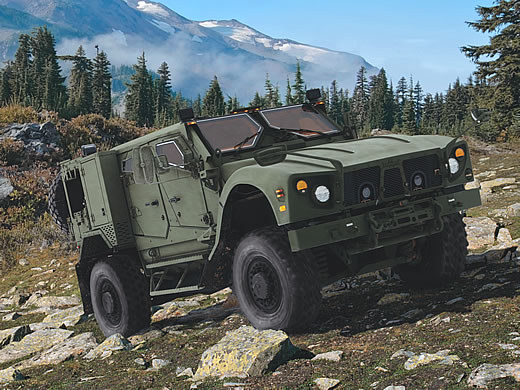
Oshkosh will serve as the prime contractor for both programs. The company plans to leverage proven vehicle platforms and advanced technologies for proposal submissions, including the MRAP All-Terrain Vehicle (M-ATV) and the Medium Tactical Vehicle Replacement (MTVR).
Oshkosh MRAP All terrain Vehicle (M-ATV) proposed for Canada's TAPV Program. Photo: Oshkosh Defense
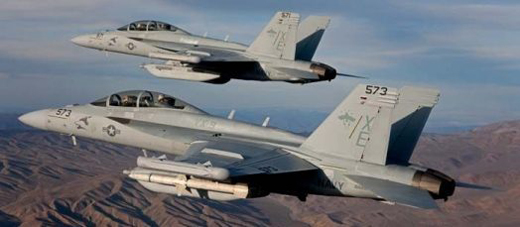
The Boeing EA-18G Growler airborne electronic attack aircraft has entered operational servcie with the U.S. Navy. It is replacing the Navy’s current AEA platform, the EA-6B Prowler built by Northrop Grumman, which has been in service since 1971.
A derivative of the two-seat F/A-18E/F Block II Super Hornet, the EA-18G is the only air combat platform currenlty in servcie that delivers full-spectrum Airborne Electronic Attack (AEA) capabilities along with the targeting and self-defense capabilities derived from the F/A-18E/F Block II Super Hornet.
Growlers will be operating from the deck of aircraft carriers as well as from land-based airfields. The EA-18G joined the Navy’s aircraft fleet in 2008, when it was introduced to fleet training squadron VAQ-129.
Boeing, acting as the weapon system integrator and prime contractor, leads the EA-18G Growler industry team, which also includes Northrop Grumman, Raytheon and General Electric Aircraft Engines.
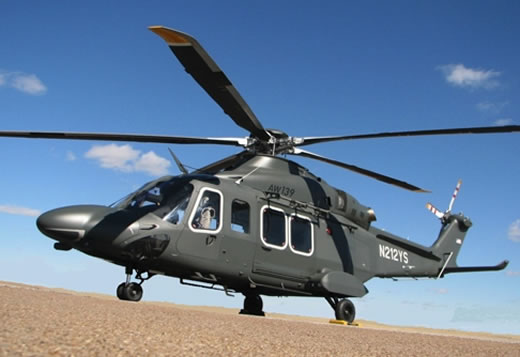
AgustaWestland is offering a redesigned version of the AW139M helicopter as a replacement for the Bell UH-1N currently used for security and transport missions. Photo: AgustaWestlandhe U.S. Air Force
The U.S. Air Force is planning to modernize a fleet of 205 helicopters as part of the Common Vertical Lift Support [helicopter] Program (CVLSP), securing missile bases throughout the continental USA and performing executive transport missions. The service plans to invest about $3 billion in the acquisition, replacing the Bell UH-1N with a modern multi-mission helicopter. According to Aviation Week, the Air Force considers bypassing a competition, sole-sourcing CVLSP to buy Sikorsky’s HH-60M Black Hawk, given the vast logistical support already provided for this model with the U.S. military.
AgustaWestland is offering a redesigned version of the AW139M helicopter as a replacement for the Bell UH-1N currently used for security and transport missions. Photo: AgustaWestlandhe U.S. Air Force
If a competition is pursued, this program could attract two European competitors. EADS Eurocopter and AgustaWestland of the Finmeccannica group. AgustaWestland is proposing the AW139M, a customized military version of the multi-role AW139 helicopter for the U.S. Air Force’s Common Vertical Lift Support Program (CVLSP). The company presented the helicopter last month in Orlando, at the Air Force Association (AFA) Air Warfare Symposium. According to R. Scott Rettig, chief executive officer, the helicopter meets every U.S. Air Force CVLSP mission requirement while offering low risk and substantial acquisition and operational savings.
If it wins the Air Force tender, the company plans to manufactured the helicopter at it’s Philadelphia, Pa. facility, where AW139 are currently produced. The AW139M will be equipped with U.S. produced mission systems including a high-definition FLIR, self protection equipment including infrared detection and countermeasures, avionics and heavy duty landing gear. For military missions, the AW139M features a low thermal and acoustic signature and is available with a full ice protection system, allowing all-weather operation at the U.S. Air Force’s northern-tier missile bases. Armored seats to improve crew protection; ballistically-tolerant, self-sealing fuel tanks; and an external stores system for carrying gun pods, missiles and air-to-ground rockets are complementing the military mission kit.
The AW139M maintains cruise speed of 165 knots multi-mission performance in hot and high conditions. The manufacturer claims the new model provides 30 percent more cabin volume and 50 percent more payload than the legacy CVLSP platform (UH-1N), while maintaining a similarly-sized external footprint.
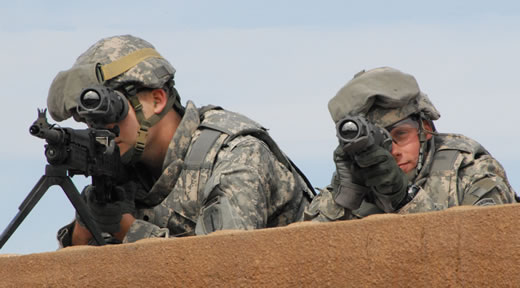
The AN/PAS-13 Thermal Weapon Sight (TWS), AN/PAS-13 family enables Soldiers with individual and crew served weapons to see deep into the battlefield, increase surveillance and target acquisition range, and penetrate obscurants, day or night. Photo: U.S. Army, PEO Soldier
The U.S. Army is ordering 21,877 Thermal Weapon Sights at an investment of about $195 million. AN/PAS-13 According to the U.S. Army Program Executive Office PEO Soldier, Thermal Weapon Sights (TWS) gives Soldiers with individual and crew served weapons the capability to see deep into the battlefield, increase surveillance and target acquisition range, and penetrate obscurants, day or night.
A view through the thermal sight shows targets even under total darkness. Photo: U.S. Army, PEO Soldier
The TWS systems use uncooled, forward-looking infrared technology and provide a standard video output for training, image transfer, or remote viewing. Thermal Weapon Sights are lightweight systems that are mountable onto a weapon rail and operate to the maximum effective range of the weapon. TWS are providing soldiers in Afghanistan better capability to see and aim at night, or in dark indoors and underground space where Image Intensifier sights do not perform well.
The Army is fielding three different types of TWS Sights. The heavier one, fitted with x10 magnification is issued to leaders, snipers and operators of heavy support weapons. Photo: U.S. Army, PEO Soldier
PEO Soldier is fielding three types of TWS – the An/PAS-13(V)1 Light weapon thermal Sight (LwtS) weighing only 1.95 pounds (0.88 kg) is issued to infantry soldiers using M16/M4 type assault rifles and carbines as well as for the M-136 Javelin guided missile0 system. The (V)2 Medium weapon thermal Sight (MwtS) weighs 2.9 pounds (1.3 kg) and offers magnification of x5, is used with M249 and M240 series medium machine guns, and the 3.9 pounds (1.76 kg) An/PAS-13(V)3 heavy weapon thermal Sight (hwtS) issused for squad leaders using M16 and M4 weapons, snipers using M24 and M107 sniper rifles, and heavy machine guns and automatic grenade launchers (M2 HB and MK19). This type has a magnification of x10.
Three TWS manufacturers have recently won orders for this equipment, Raytheon, DRS an BAE Systems have won new orders for Thermal Weapons Sights, under ongoing indefinite-delivery/indefinite-quality contract (IDIQ) contracts with the U.S. Army. Raytheon and DRS have each received orders worth $68 million while BAE Systems received an order worth $58 million. The unit costs represented by the different orders may reflect different types of thermal sights, as the DRS and BAE systems won the orders at unit price of 9922.- and 9670.- respectively while Raytheon is selling its product at a cost of $7630.- All deliveries will be completed by mid-year 2012.
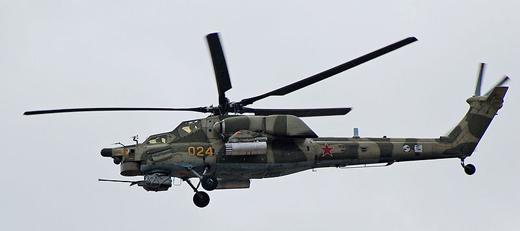
A Mil Mi-28N flying at the international air show MAKS in 2007
A Russian Army Mi-28N ‘Night Hunter’ helicopter crashed today injuring the two crew members. The gunship commander later died of his wounds at a nearby hospital. The helicopter crashed at the southern Stavropol territory. The helicopter on a training flight when it lost control at an altitude of some 400 meters and fell down near the settlement of Praskoveya in the Budennovsk district of the Caucasus, at about 10:40 a.m. Moscow time. According to preliminary assessment, the crash was caused by engine failure.
A Mil Mi-28N like this helicopter crashed today killing the commander and seriously wounding the second crew member.
Two years ago another Mi-28N crashed during firing trials on a range near Moscow. The cause of that accident has not yet been confirmed, but is thought to be related to a loss of power following gas ingestion during rocket firing. The mishape occured when the helicopter was firing unguided rockets from a low hover of around 130ft (40m) when it suddenly lost power and landed heavily. Its tail rotor and pylon were destroyed in the crash, but both aircrew survived that crash unscathed, and left the crashed aircraft unassisted. Today’s accident apparently occured at a higher altitude and involved uncontrolled descent, causing severe, and fatal injury despite the plane’s inherent impact absorbing design.
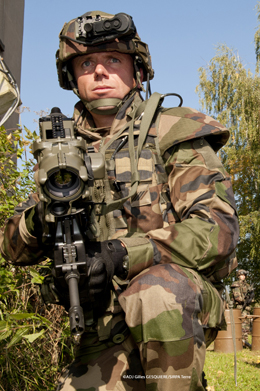
The 1st Infantry Regiment, the oldest unit in the French Army, is also the first unit in Europe to implement a full digitized soldier system for dismounted combat.
During the past six weeks the regiment went through an extensive technical orientation process, evaluating the system in direct assault drills, urban combat, stealthy advance in a dark building, offensive reconnaissance, neutralization of hidden enemies, site protection from an observation post. This phase is now followed by the integration of FELIN systems into the regiment’s tactical plans and deployment in foreign theaters scheduled by the end of 2011. Sagem Defense & Security, the prime contractor ans system integrator of FELIN completed the delivery of some 1,000 Felin sets in early September 2010.
Sagem Defense & Security, the prime contractor ans system integrator of FELIN completed the delivery of some 1,000 sets in early September 2010, leading to the 1re Infantry Regiment technical orientation phase.Photo: Philippe Wodka-Gallien, Sagem DSThe addition of optronics equipment has considerably increased the effective firing range of Famas rifles, even at night.In addition, observation around corners is made feasible. Photo: Sagem DS
FELIN, an integrated equipment suite developed by Sagem for the French army as part of an overall soldier modernization program. At the heart of the system is the “tactical vest”, an advanced combat webbing integrated with cabling harnesses, power packs and electronic units mounting an individual radio with integrated GPS – a first for infantry soldiers – its processing unit, batteries and man-machine interface, namely a miniature terminal that displays data, including orders, positions of fellow troops, and images from gun sights for round-the-corner firing.
Another innovative new item is the osteophonic headband. Placed around the soldier’s head, the headband captures or transmits via the bones of the skull the vibrations from the soldier’s speech or audio receiver. This ensures discreet voice communications in both directions, and leaves the ears free to stay alert to all outside noises. A keyboard on the rifle handgrip allows soldiers to control vital FELIN functions, radio and sight, while keeping their hands on the weapon, eyes on the target, and ready to fire.
FELIN, an integrated equipment suite developed by Sagem for the French army as part of an overall soldier modernization program. At the heart of the system is the “tactical vest”, an advanced combat webbing integrated with cabling harnesses, power packs and electronic units mounting an individual radio with integrated GPS – a first for infantry soldiers – its processing unit, batteries and man-machine interface, namely a miniature terminal that displays data, including orders, positions of fellow troops, and images from gun sights for round-the-corner firing.
Another innovative new item is the osteophonic headband. Placed around the soldier’s head, the headband captures or transmits via the bones of the skull the vibrations from the soldier’s speech or audio receiver. This ensures discreet voice communications in both directions, and leaves the ears free to stay alert to all outside noises. A keyboard on the rifle handgrip allows soldiers to control vital FELIN functions, radio and sight, while keeping their hands on the weapon, eyes on the target, and ready to fire.
Expanded Capabilities
FELIN is a modular system designed to match the role and missions of each user and function. Squad and section leaders have larger terminals with a mapping function, dubbed SITComDE (dismounted warfighter information system terminal), that allows exchanging information with their troops and sending orders. In particular, the blue force tracking (BFT) function: this terminal tracks the positions of friendly forces in real-time, for very effective control of operations. It also enhances intelligence, since it can transmit images from cameras integrated on sights deployed by FELIN-equipped soldiers.
The addition of optronics equipment has considerably increased the effective firing range of Famas rifles, even at night. And the new scopes are especially appreciated during different phases of combat, as one of the regiment commanders explains: “The FELIN scopes give us new day and night firing capabilities. With the Famas rifle, our range now extends out to 400, or even 600 meters.” A squad leader adds: “The Famas rifle now offers real long-distance sharpshooter capability. Furthermore, FELIN technology greatly increases our mobility.” Another officer of the Regiment added “At 400 m, we recorded 100 % shoot-to-kill, 70 % at 600 m.”
The FELIN scopes extends the rifle's day and night firing capabilities out to 400, or even 600 meters. Photo: French Army
Observation and protection capabilities have also been considerably enhanced by the use of new JIM multifunction infrared binoculars. “The FELIN system design is an excellent example of human engineering,” says one captain. “It integrates all ergonomic requirements, while facilitating logistic support and durability. For example, the sight, binoculars and other equipment all run off the same battery.” It has to be notice, that, JIM MR can improve detection of threats and C2, by transmitting sectors of observations to the soldiers of the combat group. In the near future, FELIN will receive a new radio, RIF-NG. Developed also by Sagem, RIF-NG (Réseau d’Information du Fantassin de Nouvelle Génération) new-generation soldier information network is being developed to take account of the planned allocation of the 800 MHz bandwidth used by the RIF, the information network now used by FELIN-equipped units, to civilian 4G (very high speed) mobile networks. The RIF-NG will provide new services in addition to the phone and data functions that are already available on RIF, including radio relay, encryption and transmission protection. Deployed by each soldier and integrated in armored infantry vehicles, the RIF-NG is designed to ensure continuous communications between soldiers and with vehicles, for both mounted and dismounted operations.
From technology, doctrine, training to tactical advantages
This brand-new system will obviously require a dedicated training period before it can be used under combat conditions. Sagem has therefore trained all instructors at the Infantry School, and these instructors are teaching soldiers at regiment level. Starting in January 2011, the men in the 13th Mountain Infantry Battalion at Chambéry, the second regiment to be outfitted with the FELIN system, started a tactical trial in training zones in order to validate operational concepts. This operational training was also an occasion to arrange a period of two weeks for a tactical training for the national school of NCO of the French Army. Four other regiments will take delivery of the system this year, and the overall objective is for 22,600 French soldiers to be equipped with FELIN systems by 2015. According the chief of operations and training of the 1st regiment, “FELIN bring a significant and decisive improvement of our capabilities. Our doctrine has to evolve, in order to translate this new technological step in tactical advantage”.
SITComDE (dismounted warfighter information system terminal), provides information exchange, order dissemination and blue force tracking (BFT). It also provides an intelligence dissemination tool, enabling commanders and leaders to view images from remote cameras and rifle sights. Photo: Sagem DS
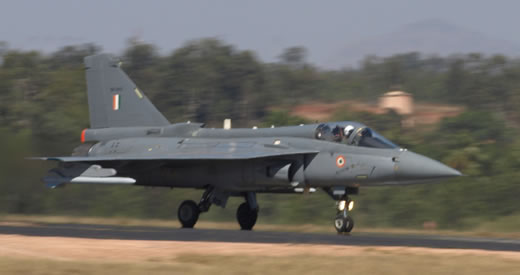
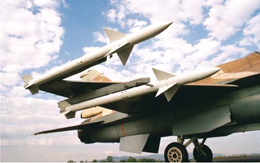
Israeli Derby missiles were selected to arm India's indigenous light fighter, Tejas. Photo: Tamir Eshel, Defense-Update
Israel’s Derby missile is the weapon of choice for India’s Tejas fighter. A contract will be signed by March with Rafael Advanced Defence Systems Ltd to supply the air-to-air weapon for the indigenous Indian jets. P.S. Subramanya, director of India’s Aeronautical Development Agency, which is developing the light combat aircraft. According to Subramanya, a key criterion for the full clearance is the integration of a Beyond-Visual-Range (BVR) missile. The Rafael Python V missile, closely related to the Derby, was also an option for the Tejas, Subramanya stated. Delivery of the missiles is expected in the second half of 2012, toward the final phase of testing, expected to conclude by December 2012.
Israeli Derby missiles were selected to arm India’s indigenous light fighter, Tejas. Photo: Tamir Eshel, Defense-UpdatePhoto: Rafael
Sofar the Indian Air Force (IAF) has ordered 40 Tejas planes and according to the government’s plans 160 additional jets are to be produced – 100 of the Mk-II version for the Air Force and 60 for the Indian Navy. India’s Sea Harrier jets already carry the Israeli Derby missiles, fourteen of them were recently upgraded, wired to operate the new missile. Both Derby and Python V are also selected to equip the Indian Air Force Short Range Surface/Air System (SRSAM) as part of Rafael’s Spyder air defense system.
While long-term plans were to deploy the locally produced Astra air/air missile with Tejas, the decision to go with a foreign missile was made last year to accelerate the induction of the aircraft into operational service. Astra, under development by the Defence Research and Development Organisation (DRDO) is “doing well” on ground tests, according nto Subramanya, will begin aerial tests o the Sukhoi-30 MKI fighter. The Astra is intended to have a range of about 80km.
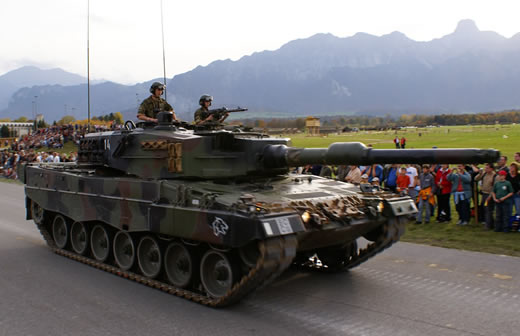
Switzerland is transferring 12 Pz87 Leo (Leopard 2) tanks to Canada, to be converted into 'support vehicles'.
Implementing the Armed Forces 95 and Armed Forces XXI programs, Switzerland is phasing out some of its heavy armor units. As part of this program Bern will transfer 12 Leopard 2 main battle tanks (Pz 87 Leo) to Canada. More of of the Swiss Pz 87 Leo fleet was therefore mothballed at various storage sites.
In recent years Canada has acquired surplus Leopard 2 tanks from a number of European countries, supporting its military operations in Afghanistan. 100 tanks (80 Leo 2A4, 20 Leo 2A6) were bought from the Netherlands in 2007. Twenty additional Leopard 2A6M were ‘borrowed’ from Germany from mid-2007 to support the Canadian deployment in Afghanistan, along with two Bergepanzer 3 Büffel (Buffalo) armored recovery vehicles. Canada has also acquired 15 German Army surplus Leopard 2A4 tanks to be used for spare parts. According to the Swiss Government announcement, the Swiss tanks to be delivered to Canada will be converted into support vehicles. The tanks are being transferred from Switzerland were stripped of the armament, radio-and intercom systems, to be used as spare parts for the Swiss Armed Forces.
Switzerland is transferring 12 Pz87 Leo (Leopard 2) tanks to Canada, to be converted into 'support vehicles'.
Switzerland has bought 380 Leopard 2 tanks from Germany (of which 345 were locally built in Switzerland) to equip its heavy mechanized units; these tanks were delivered between 1987 and 1993. 134 of the tanks went through mid-life upgrade program in 2006. As part of the current force reduction, 12 tanks were converted into armored engineer and mine clearing vehicles designated “Pionierpanzer 3 Kodiak”, a combat engineering and mine-clearing vehicle, supporting the mechanized brigades.
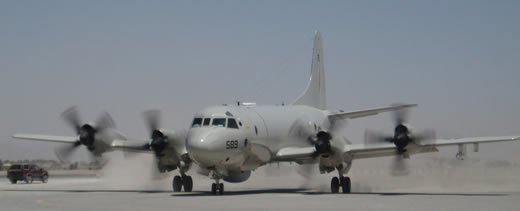
NP-3D operated by Naval Research Lab 'Project Perseus' in Afghanistan, 2008. The group deployed in 2006 and 2008 to Afghanistan to conduct geological survey of country's remote regions, under the 'Rampant Lion' missions. The same systems were also used to support counter-drug operations in Columbia. Photo: Sean Maloney
Northrop Grumman Corporation’s software-defined Multi-Band Synthetic Aperture Radar (MB SAR), recently provided counter-improvised explosive device (IED) support assisting the drawdown of U.S. combat troops in Iraq. The radar was deployed aboard a U.S. Navy NP-3D Orion aircraft, which performed missions as a part of Task Force Observe, Detect, Identify and Neutralize (ODIN).
Arriving in theater, July 20, 2010, the aircraft, operating under the Naval Research Lab ‘Team Perseus’, performed performance of 34 flights, approximately 6-7 hours each, obtaining MB-SAR and scene-change images along the movement routes used by the ground forces. The images were produced onboard the aircraft with the latency of only few minutes. Data were collected in circular passes to illuminate objects from all directions, enhancing the ability to see objects with any orientation.
NP-3D operated by Naval Research Lab 'Project Perseus' in Afghanistan, 2008. The group deployed in 2006 and 2008 to Afghanistan to conduct geological survey of country's remote regions, under the 'Rampant Lion' missions. The same systems were also used to support counter-drug operations in Columbia. It was recently used for Counter-IED road surveillance, securing U.S. ground forces withdrawal from Iraq . Photo: Sean Maloney
A typical circle of about 20 kilometers in diameter took about 10 minutes to fly and illuminated a 12-kilometer section of a road and its surroundings. The SAR and scene change images were available 10 minutes after the completion of each circle and were calculated while the next circle was being flown. This flight profile was executed for more than 20 consecutive circle passes, covering up to 200 kilometers of road in a single flight while NRL and Northrop Grumman personnel performed data acquisition and image exploitation onboard the aircraft as constant imagery feeds from the L3 Wescam MX-15 stabilized electro-optical payload assisted in analyzing and adding visual situational awareness to the acquired scene change data.
Operating as a multi-band sensor, the unique radar and associated real-time processing system could support many missions, including locating IEDs, imaging under foliage and into buildings, and detecting changes over a wide area. “We initially used MB-SAR in a sensor suite tailored for counter-narcotics work in Colombia,” said Dr. Joan Gardner, co-manager at Project Perseus, “We saw its value and quickly recognized its greatest capabilities were being under utilized. The ability to survey very large areas in all weather conditions, day or night, and to cue other on-board sensors enables airborne assets to provide real-time, tactically-relevant information directly to troops on the ground or for border surveillance. Designed as a software-defined system, users could flexibly reconfigure the operating parameters of the radar, to rapidly adapt to mission requirements as well as integrating, testing and calibrating the system in less than five weeks.
“Missions such as these are incredibly beneficial to us as scientists and researchers,” said NRL Project Perseus co-manager Dr. John Brozena, “Direct interface with the end-user in the environment that the technology is to be applied allows us to better understand what direction to focus research. More importantly, it gives us an awareness of what needs to be done in order to effectively transition the technology to the operational environment.”
With the success of this deployment, Northrop Grumman is investigating other opportunities to deploy MB-SAR to support broader airborne missions. “We are gratified with the recent feedback from the Naval Research Laboratory [NRL] that our sensor suite performed so well and helped protect our armed forces,” said John Olesak, vice president of integrated intelligence systems for Northrop Grumman. “The rapid integration performed by the team to get this sensor to the field is a credit to the team’s engineering capability and mission focus. The working relationship with NRL was a key ingredient in the success of the quick reaction deployment.”
MB-SAR was developed with support from the U.S. Air Force’s Aeronautical Systems Center. A team from NRL Project Perseus provided the MB-SAR system integration on the NP-3D. The design leverages internal Northrop Grumman R&D, which was assisted by Defense Advanced Research Projects Agency and the Naval Aviation Systems Command supported programs.
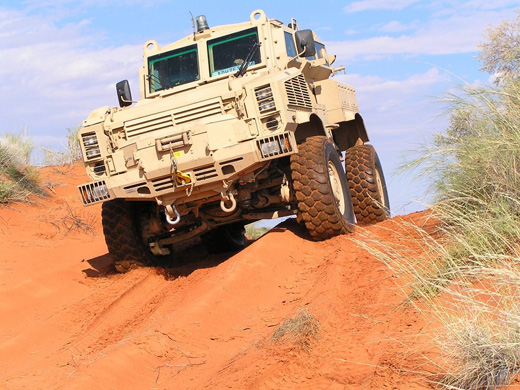
The RG31 mine protected armoured personnel carrier. Photo: BAE Systems
BAE Systems, Land Systems South Africa will produce survivability and mobility upgrades kits for the RG31 Mine Resistant Ambush Protected (MRAP) vehicles under an order received from General Dynamics Land Systems Canada (GDLS-C), as part of the teaming agreement between the two companies. The order is worth more than ZAR900 million ($130 million). As part of the modernization work developed and produced in South Africa, a higher performance powerpack providing new suspension components and transfer cases, designed and manufactured by BAE Systems, will be incorporated into the upgrade kits.
The RG31 mine protected armoured personnel carrier. Photo: BAE Systems
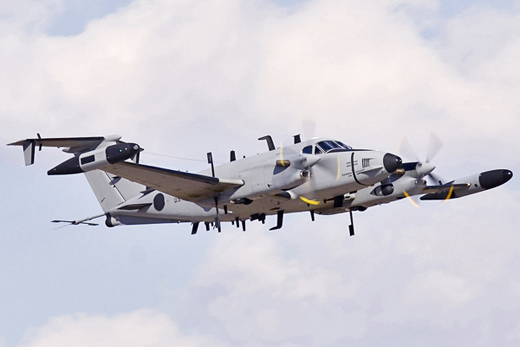
Upgrading the U.S. Army RC-12X Guardrail fleet of Signals Intelligence (SIGINT) aircraft under a U.S. Army task order, Northropt Grumman is scheduled to deliver the first aircraft in the second quarter of this year. The company has already delivered the first two upgraded planes in January 2011. The second pair is in the final stages of their cockpit upgrades and will be deploying to theater in March 2011. According t Northrop Grumman, these initial four systems will complete final outfitting and testing during the first quarter of 2011 before becoming fully operational. An additional 10 RC-12X’s will be fielded in the 2011-2012 timeframe bringing the total modernized Guardrail fleet to 14 systems.
The RC-12X Guardrail. Photo: Northrop Grumman
The US Army operates 48 RC-12s in six units, each operating a different configuration of the aircraft. These include the RC-12N Guardrail I, RC-12P Guardrail II, RC-12H Guardrail III, RC-12K Guardrail IV, RC-12D Guardrail V and RC-12Q Guardrail Common Sensor. The $462 million RC-12X program currently underway at Northrop Grumman is expected to bring the different aircraft to introduce common standards throughout the RC-12 Guardrail fleet.
The RC-12X Guardrail Modernization program extends the life of the aircraft through 2025 and introduces new payloads to the system with enhanced capabilities to sense and exploit emerging and rapidly evolving irregular and conventional warfare threats. The program also enhances the sustainability of the RC-12X through commonality, a new glass cockpit, structural upgrades, and significant hardware and software improvements.
RC-12X Guardrail is the Army’s premier airborne SIGINT sensor. With its associated ground processing system, Guardrail provides instantaneous, precision geo-location and identification of electronic emitters supporting the Brigade Combat Team’s intelligence and electronic combat providing Find, Fix, Finish, Exploit, Analyze and Disseminate – F3EAD functions.
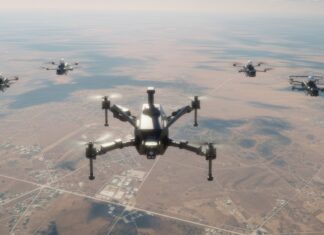
Lockheed Martin Skunk Works® and XTEND have achieved a major milestone in JADC2 by integrating the XOS operating system with the MDCX™ autonomy platform. This technical breakthrough enables a single operator to simultaneously command multiple drone classes, eliminating the friction of mission handoffs. From "marsupial" drone deployments to operating in GPS-denied environments, explore how this collaboration is abbreviating the data-to-decision timeline and redefining autonomous mission execution.
As traditional defense primes face mounting competition from agile “neoprimes” such as Anduril, Palantir and Helsing, the balance of innovation is shifting toward software-defined warfare and scalable, dual-use technologies, while global industry consolidation—marked by Boeing’s integration of Spirit AeroSystems and other strategic mergers—signals an intensified race to secure control over the defense technology value chain. Our Defense-Tech weekly report highlights these trends.
In early October 2025, a coordinated wave of unmanned aerial system (UAS) incursions—widely attributed to Russia—targeted critical infrastructure across at least ten European nations. The unprecedented campaign exposed the fragility of Europe’s air defenses...
Executive Summary
The past week (September 18-25, 2025) represents an inflection point where strategic defense concepts have transitioned from doctrine to tangible reality. An analysis of global events reveals four primary, interconnected trends shaping an...
At the 2025 Air, Space & Cyber Conference, U.S. Air Force and Space Force leaders unveiled major updates on next-generation fighters, bombers, unmanned systems, and space initiatives, highlighting both rapid innovation and critical readiness challenges as the services race to outpace global competitors. A short version is available here, with a more detailed version for subscribers.
The Taipei Aerospace & Defense Technology Exhibition (TADTE) 2025 crystallized around four dominant strategic themes that collectively illustrate Taiwan's comprehensive approach to defense modernization amid escalating regional tensions. Based on a detailed report by Pleronix (available upon request). Includes a Podcast discussion on TADTE 2025's highlighting Taiwan's four strategic themes beyond the post's coverage.
Israel’s Iron Beam 450 high-power laser system has completed final testing, marking a major leap in air defense. Developed by Rafael, it offers precise, cost-effective interception of rockets, UAVs, and mortars, and is set for IDF deployment by 2025.