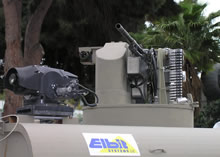
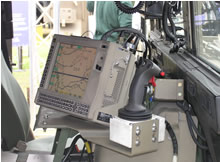
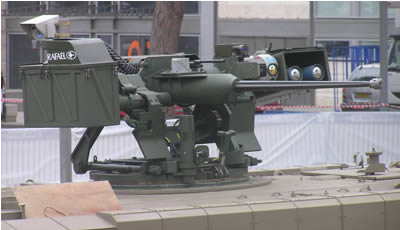
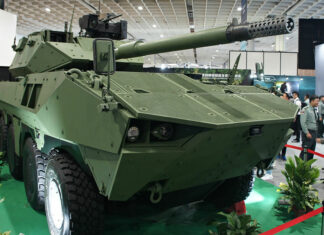
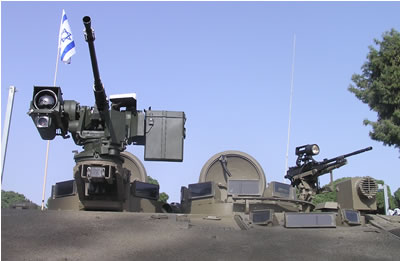
Another feature designed for the Merkava Mk 4 is a new turret mounted weapon station, controlled by the crew from within the fighting compartment. The IDF is testing several weapon stations, developed by RAFAEL, IMI and Elbit Systems.
Elbit is proposing this weapon station for lightweight patrol vehicles, such as the up-armored Humvee. Elbit and RAFAEL have also developed new overhead weapon stations, designed for APCs and wheeled fighting vehicles (such as the Stryker). Both systems use an elevated system design, mounting the ATK Mk44 automatic 30 mm gun, operated via remote control from within the fighting compartment. The RAFAEL system is designated RCWS-30 while Elbit’s entry is designated ORCWS-25-30.
Remote Control Weapon Systems
Ground Sensors – Electro-Optical
While radars and IR scanners are effective for open area surveillance, urban combat poses distinct environmental challenges for troop protection. Special sensors are designed for such applications. For example, sensors are required to trigger an alarm when movement is detected inside a specific building or room, which could otherwise be considered as “clean”. Other sensors are designed to “look through walls” and identify human presence, movement beyond etc.
Ground sensors designed for urban operations are usually multi-sensor packages; their communications are designed to overcome the obstacles and multi-path reflections of urban terrain, and camouflaged to mimic common urban terrain features. An example is the Miniature Unattended Ground Imager (MUGI), developed by Seraphim. It provides covert, persistent visual surveillance of a target using periscopic EO, NIR and IR imaging devices, fitted with internal pan, tilt and zoom, As the device has no external movement the system can blend into the surrounding scene for covert operation. The device can remain in the field, delivering up to 10 days of imaging without battery replacement. BAE Systems has integrated a collection of four types of sensors for the US Army including Moving Target Indicator (MTI) Radar, Magnetic, Seismic, and Single Pixel IR packed into an integrated sensor unit. The unit will monitor its surrounding area and send reports to the user’s pager, PDA, or laptop PC. The different sensors are selected to match the specific environment. For example, where radar is blocked by metal siding, seismic and magnetic sensors can provide comparable coverage. The seismic sensor can also be highly effective to identify footsteps in a wood frame building but though unable to provide a direction or distance of such movement. The single pixel IR can localize the direction of a human if there is no blockage. By deploying different types of sensors, virtually uninterrupted coverage can be obtained.
Sniper Detectors
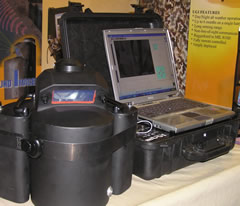
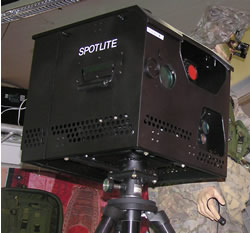
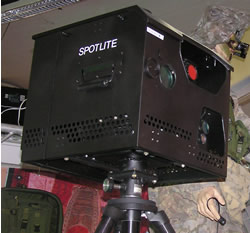
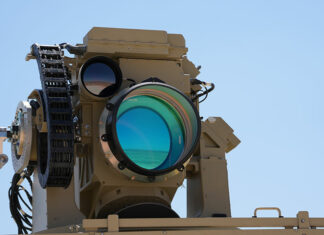
Other sensors are used to identify fire sources to facilitate quick and effective response. Such systems utilize both acoustic and EO sensors. These systems measure azimuth, elevation and distance of a sniper or small arms firing source. An example is the Viper Counter-Sniper System, developed in the mid 1990s for the US Naval Research Lab for counter-sniper activity. Viper is comprised of an infrared camera automatically detecting muzzle flash signature distinctive of small arms fire. A television camera with high power zoom provides target identification, and fire control. The system can be integrated with remotely controlled counterfire payload, which can mount lethal or less lethal means. Viper can be employed on fixed sites or in a vehicular installation. The system detects rifle fire within seventy milliseconds of its occurrence, during this time a supersonic bullet would travel less than 50 meters. A different system developed by RAFAEL is the Spotlite – a high precision, IR sensor capable of detection of small arms fire sources. The system detects multiple small arms/sniper fire sources simultaneously, day and night, at long distances. Spotlite analyzes the fire sources detected, verifying that it is actually enemy fire. Once verified, target parameters (type, location, elevation etc) are transferred to snipers and other weapon systems, thereby closing the sensor-to-shooter loop quickly and efficiently. Similar camera-based systems such as the Pivot system are integrating a camera and an acoustic detector (Pilar).
Additional parts of this article:
Surveillance Systems for Perimeter Defense
Effective surveillance extending deep beyond the surrounding perimeter enables guarding forces to establish an adequate security around their base. Use of ground surveillance radars, optimized for short and medium range operations, augmented by panoramic electro-optical scanners are employed to maintain constant surveillance of the area, track suspicious movements and warn of evolving threats before these come within combat range with the security troops. Such systems enhance situational awareness of perimeter patrols, supporting them while attempting to intercept such suspects. Such sensors can also be linked directly to remote controlled firing posts, to engage potential targets when they can be confirmed as hostile. Further into the future, perimeter security could be augmented by robotic or autonomous vehicles equipped with non-lethal or lethal means, to engage, suppress and eliminate potential threats.
Additional parts of this article:
RS-22 Reflex Sight
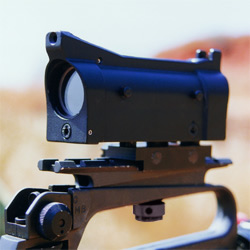
The Meprolight RS-22 is a maintenance-free, dual illuminated, “red dot” reflex sight designed for quick and instinctive accurate shooting with both eyes open. Illumination of the aiming point is achieved by a fiber optic collector system during the day and by a miniature self-powered tritium light source at night. The MEPRO RS-22 is suitable for use with Night Vision Goggles or scopes, including those with GEN III tubes. The sight is designed to provide optimal shooting conditions under difficult lighting conditions.
The aiming dot illumination changes automatically according to the surrounding available light to maintain good contrast between the aiming dot and the target area. The fiber optic collector located on the front face gathers maximum light when shooting from within a dark enclosed space toward a bright target area. RS-22 can be equipped with a photo-chromatic lens which, will darken to improve contrast when aiming against extremely bright backgrounds. The sight is designed with back-Up Sight, automatically zeroed at the same time as the optical sight, and having a line of sight parallel to the optical line of sight. Using the emergency sight, the soldier can hit a full size figure at 100 meters – 7 shots out of 10.
Miniature/Micro UAV Systems
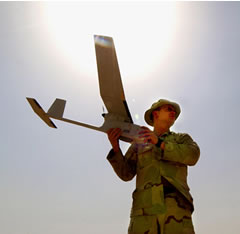
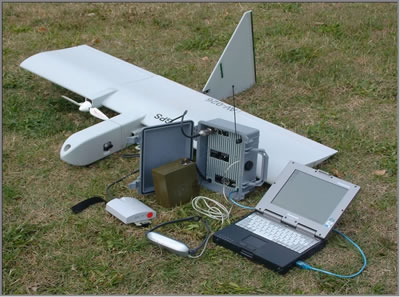
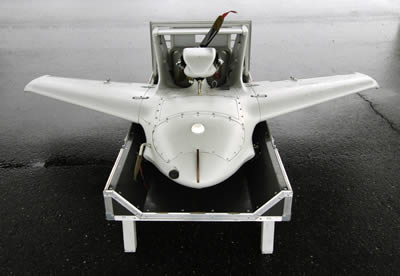
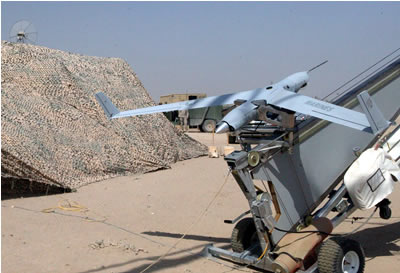
Miniature aerial systems are the smallest UAVs used by lowest tactical echelons and special operation forces to gather intelligence “over the hill” and “around the corner”. These systems include many small UAVs, such as Raven, Desert Hawk, Pointer and Dragon-Eye, used by US forces, Tracker (DRAC) bought by France and Aladin, used by the German Army, the Israeli Skylark and more. Unlike the relatively noisy short range and tactical UAVs, these platforms are simple to operate, and can fly 1- 2 hours missions covering a pre-planned route or responding to specific requests from the operator. They are very quiet as they are powered by an electrical motor. Even smaller Micro-UAVs such as TACMAV are currently deployed with Special Forces and will soon be delivered to regular US Army units.
New stabilized payloads equipped with high power zooms specially developed for such small UAVs, deliver imagery from very low altitude (200 meters or lower) that sometime equal the quality and details provided by standard UAV payloads. A major shortfall of such systems is the low quality imagery provided by non-stabilized payloads. Electronic stabilization provides partial solution for video imagery not for still imagery. These small platforms are highly sensitive to vibrations caused by buffeting and wind wind gusts affecting low flying aircraft. Field support of these systems causes significant logistical burden on small units. Such aircraft are frequently damaged on landing, sustaining high operational tempo requiring continuous feed of replacement parts. US Marines witnessed this problem in Iraq with their Dragon-Eye systems. Another issue of concern is obstacle avoidance. Since the mini UAV flies at very low altitude, special measures must be taken, especially when operating in an urban area or in rough terrain covered with high vegetation.
This feature covers the following chapters:
- Unmanned Systems (UAV) Persistent Surveillance
- HALE UAV Systems – UAS High Flyers
- MALE UAV Systems – Persistent UAS Platforms
- Tactical UAVs
- Miniature/micro uav Systems
- Turning raw data into actionable intelligence
- Enhanced Vision
- Electro Optical Stabilized Payloads
- SAR systems
- Target Geolocation
- Computer Mapping & Modeling
- Automatic Change Detection Applications
- UAVs role in Convoy protection and IED patrols
Tactical UAVs
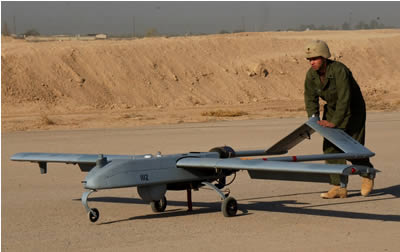
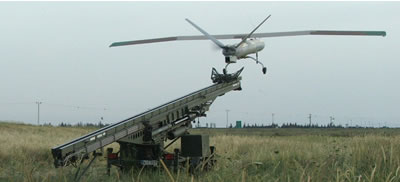
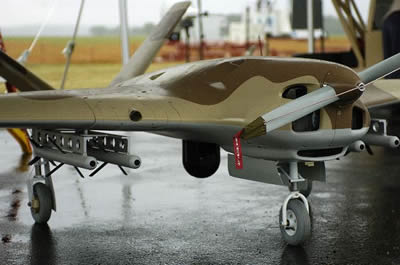
Lower echelons are supported by other systems, including Short Range and Tactical UAVs (TUAV). The short range category includes the IAI/Malat Searcher, Elbit Systems Hermes 450, General Atomics Predator, Northrop Grumman/IAIHunter and Sagem Sperwer while Tactical versions includes AAI Shadow, IAI/Malat Pioneer and the new IAI/Malt I-View. These unmanned aircraft are built to operate with the forward troops, operating at lower altitudes of up to 15,000 feet, and ranges of 125 – 250 km. Systems are designed to be self sustained in the field, deployable by lightweight vehicles and C-130 transports, equipped with the logistical support required for extended operations. Mission endurance is relatively short, around 7 – 20 hours. Short range tactical systems can utilize low-cost day only or night only sensors, but field experience has demonstrated that the use of multi-sensor payloads (EO/IR) provide more flexibility and better performance far beyond the cost saving of single sensor systems.
One of the biggest challenges of the tactical and short range UAVs is the weather. During OIF 60% of the missions were cancelled due to weather conditions. UAVs require relatively calm weather for takeoff and landing, and are adversely affected by turbulence. Operating at various altitudes, different sensors, from diverse locations in flexible concepts could improve mission success and overall system availability. Another issue EO payload operators is the limited field of view of the typical EO/IR payload. To gain situational awareness, operators must switch back and forth between narrow and wide fields of view, risking missing important details or losing tracks of moving targets. A functional solution for this problem is offered by “photo navigation” – building wide area mosaic of the area from individual video frames, or individual views taken in a special “stepping” mode. These images are geo-referenced to a standard grid and can also embed intelligence data and ‘blue force’ locations to provide optimal situational awareness. Stepping images can be obtained by standard or special payloads.
This feature covers the following chapters:
- Unmanned Systems (UAV) Persistent Surveillance
- HALE UAV Systems – UAS High Flyers
- MALE UAV Systems – Persistent UAS Platforms
- Tactical UAVs
- Miniature/micro uav Systems
- Turning raw data into actionable intelligence
- Enhanced Vision
- Electro Optical Stabilized Payloads
- SAR systems
- Target Geolocation
- Computer Mapping & Modeling
- Automatic Change Detection Applications
- UAVs role in Convoy protection and IED patrols
EO Payloads – Comparison
Full Size Systems
-
Compact Payloads (< 10 kg)
-
Miniature Payloads (< 1,000 gr.)
Convoy Protection and IED Patrols
Patrolling highways in hostile area, while protecting convoys is part of the regular mission of UAVs in Iraq. Relying on continuous communications and positioning from blue force tracking systems, UAVs can cover a convoy, controlled from ground control stations at distances of up to 100 km. However, a more suitable solution is to use a small UAV loitering overhead, equipped with ground surveillance systems to monitor the area ahead of the convoy forewarn ambushes or suspected IEDs lying ahead. Such systems were demonstrated by several manufacturers at the UAV Battlelabs. One of the system, the Boeing/Insitu ScanEagle unmanned aerial vehicle (UAV) could be used for convoy protection in Iraq before the end of 2005.
New sensor suits are evaluated for these missions, providing situational awareness and early warning of hostile intent. Such sensors are including close coverage by acoustic gunshot detectors, such as the ShotSpotter, which automatically slews the UAV’s camera to source of fire; EO/IR imaging sensors offer coverage at longer range, and enable the UAV to fly ahead of the convoy, providing early warning about potential threats. Synthetic aperture radar can also employed by “sweeping” roadsides from long distance, detecting changes in the terrain, which could indicate IED locations. To better coordinate between the UAV and the convoy, the UAV or its sensor has to be controlled from the moving vehicles, providing continuous feed of video imagery while on the move. The UAV can perform several tasks automatically, including Continuous Change Detection (CCD) processing and moving target detection. Advanced operating modes enable the UAV to autonomously maintain a fixed distance ahead of a convoy, by following the route and GPS location of the ground station (security team).
Additional parts of this article:
- Turning raw data into actionable intelligence
- Enhanced Vision Systems
- Target Geolocation
- Computer Mapping & Modeling
- Automatic Change Detection
- Convoy protection and IED patrols
Automatic Change Detection
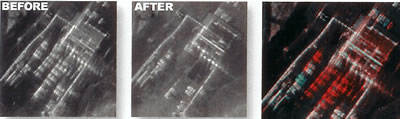
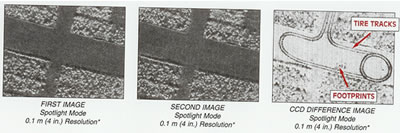
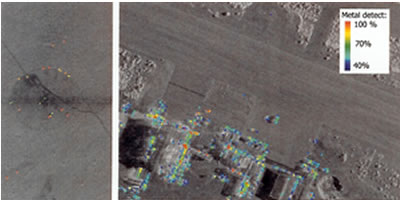
An important feature of image processing is the comparison of new and stored images to detect changes over time. This method is called Coherent Change Detection (CCD) and its uses are rapidly spreading throughout the military. By comparing live images with past images of the same area, systems can automatically detect and identify changes which can show placement of new objects such as hidden IEDs, faint signatures of recent movement, such as vehicle tracks, changes in foliage indicating human movements, or application of camouflage that could indicate suspicious activity. Through the image analysis and investigative process, these views can be superimposed with thermal images, showing latent signatures of recent human activity. When searching for a specific type of object, hyperspectral analysis can be performed, by dedicated sensors, which are designed to identify specific traces of chemical or organic materials, by their distinctive spectral reflections.
Multi-spectral image fusing is also performed to enable target identification from very long range, particularly at night. For example, combining Near IR (NIR) with TV overcomes the visual reflection from a car windshield, to show people inside a car. Identifying these people from a long distance can be done by illuminating the target with an invisible laser beam, and using a special telescopic “gated CCD” sensor to view the target in great details.
Progress is also evident in solving the “bandwidth bottleneck”, transferring large files over communications networks. The US Marine Corps are planning to field the Video Storage Wide Area Network, which collects and provides information on situational awareness. The network uses multiple image collectors including Pioneer and ScanEagle UAVs. The ground stations of these UAVs are streaming live video over satellite communications to a central repository which provides digitization, compression, editing and storage services. These video databases are then made available to multiple users in theater as well as worldwide. While the system supports multiple users and multiple streams, bandwidth availability becomes an issue when 128K “pipes” are used – typical streaming video requires around 400-Kbps bandwidth, which is not always available for field users.
Additional parts of this article:
Computer Mapping & Modeling
For hundreds of years, maps and cartography provided critical means for command and decision support. Their value was derived from the accuracy, timeliness and relevance of their data sets. Maps are still valuable command tools, but today their production is faster, the data is much more accurate and most important – when embedded into digital processing and presentation environment, they provide a common denominator for command and control. With new technology geographical information systems (GIS) are used to process sensor information; generate spatial presentation of intelligence products.
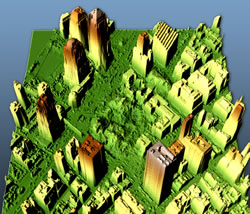
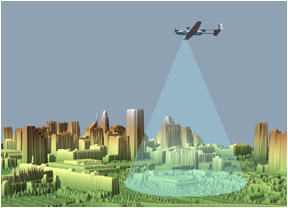
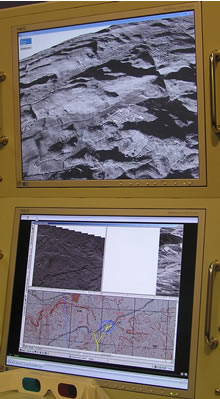
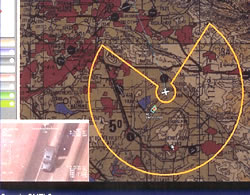
Geospatial products are also used for presentation of terrain measurement data, as input from SAR, LIDAR and LADAR sensors is processed and represented as realistic 3D models, used for operational planning. Rectified over a common grid, ISR data can automatically update a situational picture, or further process it with satellite or aerial imagery presenting realistic 3D models of an area, including updated man-made features. Such models are used for mission planning and rehearsal, briefing on a synthetic “sand-box”, spatial orientation and training.
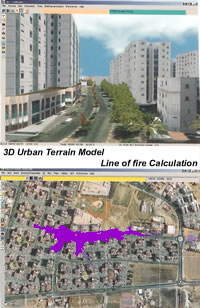
Geo-registration is an essential capability for advanced image processing. Images are referenced to a common geographical grid enabling detailed comparison between different views of the same area. In the past, such referencing was done in a manual, a time consuming process prone to human errors. Today, geo-registration automation is done in a real-time process, performed on still images, including SAR and GMTI, and most recently on live video. This capability enables endless ways to manipulate the images, by merging them into wide-area mosaics, morphing them to suite the proportions of 3D models, correcting optical and perspective distortions etc. Accurately registered into a common grid, images are fused into common views, providing stereoscopic views (depicting height and depth of objects) and true, dynamic 3D computer generated models and “fly through”, which can be generated in few hours, rather than weeks, offering realistic views of an object from different angles.
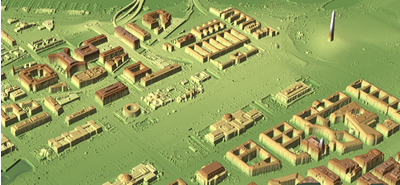
Additional parts of this article:

Enhanced Vision Systems
By using state of the art technology, much of the information can be shared, fused and used to improve the final product. For example, scanning a wide area for time critical targets cannot rely only on EO means alone. By merging GMTI and Stripmap SAR images, wide areas can be scanned rapidly for moving targets, man-made objects and potential targets. Such elements can be anything from a pick-up truck to a transportable missile launcher. When potential targets are detected, Spot mode is used to automatically scan through each location in an attempt to distinguish differently shaped targets such as a specific type of tank or truck. Known targets can be tagged by their distinct signature, or actively marked for automatic detection and tracking. SAR imagery is sufficient for identification of military targets, identifying the distinctive 3D signatures and object shapes of specific vehicle types; further investigation of the target is required for engagement of typical targets in asymmetric warfare.
EO sensors are employed to further examine specific locations or suspicious objects detected by the radar. By fusing SAR, IIR, thermal and EO images, analysts can now focus on the potential “needles”, which automatic processes have weeded out of the larger “haystack”.
As all data is geo-referenced, target coordinates can be extracted immediately for rapid response. The fusion of signals from different spectral bands enable better visualization of information which could be not be seen in by visible means. The US Air Force pursues several Foliage Penetrating (FOPEN) concepts, including processing of hyperspectral sensor data, for collection, location, and identification of camouflaged and concealed targets and foliage penetrating SAR.
Additional parts of this article:
Turning Raw Data Into Actionable Intelligence
Start < Page 1 of 6 >
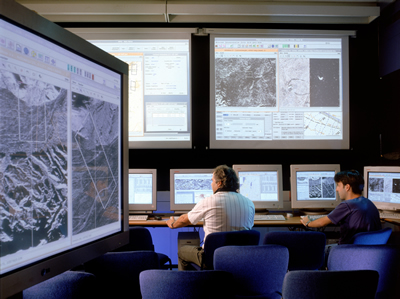
UAV and their sensors are only part of the Intelligence, Surveillance and Reconnaissance (ISR) “big picture”. Completing that concerns processing, storing and retrieving the data into actionable intelligence. Utilizing modern commercial off the shelf (COTS) technology, sensor data can be rapidly processed. Correlated to geographical grid, and merged with live and stored images, imagery and spatial information including EO, SAR, MTI maps, SIGINT and ESM can be fused and presented over common map display, showing a detailed and accurate multi-dimensional situational picture. The use of ISR products is not limited to intelligence analysts, but can also be used by warfighters in the field, using tactical computer terminals and PDAs. Prior to delivery products are trimmed, wrapped, and compressed to adapt to narrow-band wireless communications.
Presently, “stovepipe” systems are employed to provide intelligence. These include various airborne and ground based sensors, such as Global Hawk and Predator UAVs, Joint STARS ground surveillance systems and various ELINT/COMINT assets. Each system is operated separately, utilizing specific sensors, airborne and ground based processing and exploitation systems. The refined intelligence is shared at a higher level, where it supports operational planning and ongoing operations.
Additional parts of this article:
- Turning raw data into actionable intelligence
- Enhanced Vision Systems
- Target Geolocation
- Computer Mapping & Modeling
- Automatic Change Detection
- Convoy protection and IED patrols
Counter-Sniper Systems
Engaging snipers is another LIC priority. RAFAEL is unveiling the Spotlite sniper detection, location and engagement system. The system comprises a FLIR, CCD with continuous zoom, a Laser Range Finder, and GPS position location system. The Spotlite can be linked with multiple “subscribers” – either snipers or other countermeasures of weapon systems. Spotlite operators can analyze fire sources and verify that a specific source is actually hostile fire. Once verified, the image of the hostile fire position is captured, and transferred to snipers or other support units, which can engage the target with direct or indirect fire. The Spotlite system is currently operational. It was designed for use by observation and reconnaissance forces, sniper units and Special Forces as well as for the protection of static posts under enemy threat.
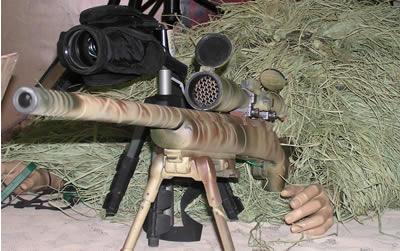
Elbit systems displayed the active gated imaging day/night sight, attached to a sniper sight. The system can operate passively or with laser illumination, enabling snipers and observers to get high definition images from extended range, including recognizing face images through glass windows or vehicle’s windshield, reading license plate numbers from long distance, in day and night. It also enables effective operation in urban area, in both day and night where adverse lighting conditions can limit operations with other devices. As the system is immune to lighting sources, it cannot be blinded (virtually canceling the blooming effect).