
Wednesday, December 24, 2025
More
    Home Blog Page 430

    Mine / IED protected Vehicles Design Principles

    Start < Page 4 of 4 >

    One of the most important requirements for combat vehicle’s protection is counter mine design. Traditionally, guerilla forces used standard mines to hit enemy patrols and military vehicles. Such mines included small (anti-personnel) or larger anti-tank mines, as well as armor penetrating and self-forged fragmentation (SFF) mines. Mines originally developed as a defensive weapon, were originally used to delay and disrupt enemy movements into a defense organized area. Mines are usually laid on the ground either exposed or buried, and are activated by pressure, magnetic influence, or other effects (tripwire, etc.). When employed by paramilitary and guerilla forces, mines are used mainly buried in unpaved remote countryside routes. Mines are usually based on few common operating mechanisms, which are familiar to mine disposal professionals. Therefore, effective protection and countermine techniques can be employed against such threats.
    Protection of vehicles against mines generally follows several guidelines, including blast deflection, mitigation and roll prevention. The most common technique is the use of oblique blast absorbing panels, on the hull floor. These panels are deflecting the shock and fragments outside the fighting compartment, and stabilize the vehicle, preventing it from rolling over. Another concept is the use of outrider wheels, covered by spacious wheel bays which disintegrate by the blast, absorbing much of the pressure thereby reducing the lethal effect on the vehicle’s hull. Such elements were implemented on South African and Indian mine-protected vehicles, as well as the Israeli RAM and RAM-2000 and the mine protected Abir version.

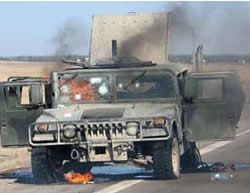
    The rise of the global terror, assisted by the proliferation of modern communications technology, introduced a dangerous shift from the familiar standard issue weapons, to the use of improvised explosive devices (IEDs). The introduction of such makeshift weapons proliferated in Ireland, Chechnya, Iraq and Afghanistan, Bosnia, Lebanon and by the Palestinians in the occupied territories. As evidently proved in Iraq and Chechnya, the use of such explosive devices is not adopted from lack of basic, standard issue weapons, but due to the tactical advantages of such systems, when employed by loosely organized urban guerilla cells. Unlike the mine which is triggered by pressure or magnetic influence, IEDs do not necessarily require physical contact or pressure for activation but can be activated by remote control, including wire, electronic signals or cellular phone. This mode of operation can be employed against selective targets, even on busy urban traffic lanes, as repeatedly demonstrated in Iraq. In fact, the IED has become the symbol of the modern urban guerilla.
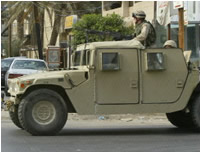
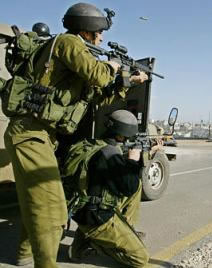
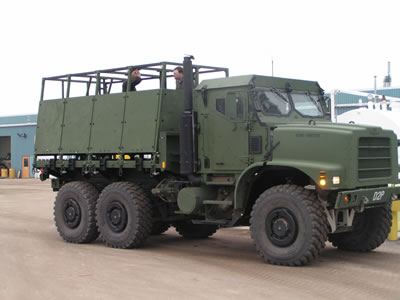
    Standard mine protected vehicles do not always provide the optimal protection against IED. But they can provide the first of defense when an army encounters IED environment. Since operation of IED is characteristic of urban guerilla warfare, rapid response against IED is imperative for survival. Unarmored vehicles must be fitted with armored cabins, providing reasonable blast protection, on top of standard bullet-proof defense. Large windows, firing ports and access doors on both sides of the vehicle, are required for rapid and safe dismounting of the crew, enabling them to regroup and respond quickly with effective fire. Such concepts are provided for both Humvee tactical utility and transportation vehicles, such as the MTVR truck and Remote controlled firing stations, mounting light machine guns, Automatic Grenade Launchers (AGL),


    observation systems and ranging devices (target markers, laser rangefinders etc), are required for effective counter-IED action in an urban environment. Such equipment is of course vulnerable, but mutual cover by precision firepower from adjacent vehicles in the combat patrol denies the enemy further damage, provided that the engagement is quick, decisive and accurate.

    Additional parts of this article:

    Protection of vehicles for LIC & Peacekeeping Operations

    Start < Page 2 of 4 >

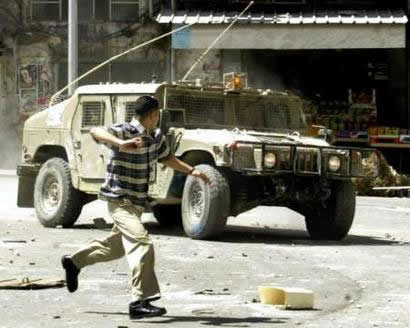
    Based on its combat experience fighting against guerilla forces in difficult terrain (Lebanon) and in urban terrain (occupied territories) the Israeli army has upgraded its light tactical vehicles with enhanced armor protection. Among these are the up-armored Humvees and locally produced Sufa Jeep versions, used as rapid reaction vehicles. These vehicles are utilized mainly for security and patrol missions, where military forces rapidly respond to low risk contingencies, such as riot control of mass demonstrations, transportation security, anti-infiltration border patrols etc. In result of painful incidents, in which such vehicles were destroyed by relatively lethal improvised weapons, the IDF has beefed up the vehicles protection level, considerably above the US Army standard. This higher level of protection resulted in much heavier platforms, which frequently required automotive modifications, retaining adequate mobility in combat.

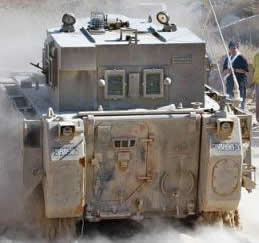
    For operations in high-threat environment, the IDF deploys its heaviest vehicles; sofar, most of these include Merkava Mk-2/Mk-3 main battle tanks, and heavily protected Infantry Fighting Vehicles, based on turretless Centurion and T-55 tank hulls – Nagmachon and Nakpadon. These vehicles were developed during the Lebanon conflict, in which the IDF was forced to patrol and protect its supply routes against Hezbollah roadside ambushes, directing small arms fire, AT rockets and missiles, mortars and IEDs against troop transport. These specially mission designed tracked vehicles are mounting massive 360 degrees protection by special armor on the front, sides and rear, as well as the top. The hull bottom is protected by an additional armored base plate withstanding heavy mines and buried explosives.

    For operations in the West Bank and especially in the Gaza Strip, further adaptations of heavy IFV concepts were introduced, to counter different threats existing in urban environment, like the densely populated refugee camps.

    An elevated fighting compartment, fitted with firing ports for machine guns, small arms and snipers was installed on top of the hull, offering improved visibility for observation and urban fightability for the crew. An up-armored version of the IDF M-113 platform has been designed extending its combat use under the new threat environment. This vehicle is equipped with add-on mesh armor, which adds adequate protection against RPGs and IED. A further enhanced version of the IDF up-armored M-113 is currently under procurement plan. This version utilizes a combination of hybrid (passive and reactive) armor, which can defeat multiple attacks by known heavy weapons. Other vehicles in use are the turretless hull-based T-55 Achzarit heavy IFV which is mounting improved protection, overhead weapons stations, and rear door access/exit. A similar concept, the Russian BMP-4, uses a T-54 chassis, to deploy troops to high threat environment combat.

    Military and peacekeeping forces operating in Low Intensity Conflict, such as the US and coalition forces in Iraq and Afghanistan, KFOR in Bosnia, the Israeli forces in the Occupied Territories of Gaza and the West Bank, are employing different systems to counter the threat of RPGs, roadside bombs, mines and IEDs

    For example, the US 4th and 82nd Airborne divisions employ the Meerkat sensor carrying vehicle and the Buffalo mine protected vehicle, equipped with a manipulator arm, to handle, disarm or disrupt IEDs. The Israelis are using heavy armored vehicles, and heavily protected bulldozers designed to deliberately activate IEDs placed on known movement routes. Armored EOD vehicle, which can carry two robots is also employed to safely deactivate IEDs. When tasked with off-road threats, the IDF also uses tele-operated vehicles to sweep dirt tracks and other suspect locations uncovering camouflaged buried threats. IED disposal is normally handled by specialist Explosive Ordnance Disposal (EOD) experts. The IDF operates its EOD from special EOD Vehicles and the standard combat engineers armored vehicles, the Puma. This vehicle, based on turretless Centurion hull is equipped with special array of electro-optical observation and tele-operating equipment for this task. Armored Caterpillar D-9 bulldozers are used frequently in high risk urban combat environments.

    Additional parts of this article:

    Armored Tomcar

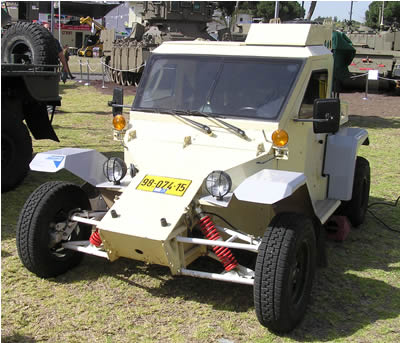
    The Tomcar All Terrain Vehicle (ATV) is used by the IDF and Israeli Border Police and a number of development programs, in various manned and unmanned applications. The Tomcar is a small, lightweight (ca. 600 kg) vehicle, designed to carry two people and their gear to patrol at low speeds over rough terrain for prolonged periods of time with minimum downtime and maximum safety and report to their base or act in an event.

    The IDF is currently evaluating a protected version of the Tomcar, weighing 1,230 kg. The vehicle is equipped with a fully protected cabin, fitted with bullet proof windscreen and side windows and an escape/firing hatch on the roof. The vehicle can be used to transport troops, supplies and equipment in urban terrain, where speed and agility that can protect it in open terrain cannot be used. Elbit Systems demonstrated another configuration of the Mil Tomcar, equipped with an elevated optronic sensor, operating console and firing position.

    IAI/Lahav is using the tomcar as the basis for its autonomous sentry, in the Guardium Unmanned Security Vehicle (USV) system. The IDF is also evaluating the Flyer Defense ITV, a 1,750 kg high mobility vehicle, designed to carry five soldiers and a total 1,350 kg. of payload. The vehicle is built from a lightweight tubular space frame and is equipped with an independent suspension that ensures very high mobility.

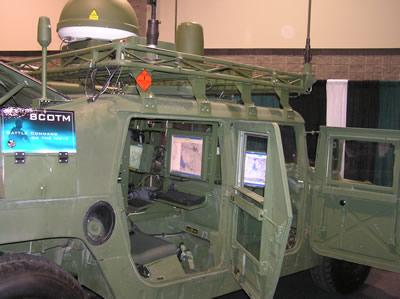
    Mounted Battle Command On The Move (MBCOTM)

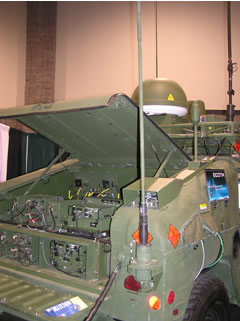
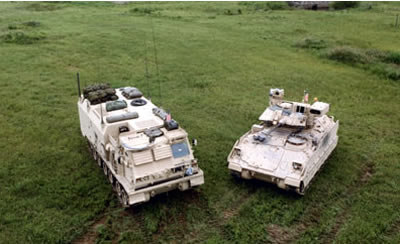
    Current MBCOTM systems comprise of Bradley, Stryker Command Variant (CV) and Humvee. Each vehicle is equipped with multiple SINCGARS systems, mobile satellite terminal, and is wired to support multiple workstations with complete access through Keyboard, Video Mouse (KVM) supporting Army Battle Command Systems (ABCS) applications hosted on Multiple Processing Units (MPU). Such applications include MCSFBCB2, ASAS, AFATDS, AMDWS, and GCCS-A. All applications are interconnected, and are networked to external elements via wireless networking through EPLRS, NTDR, or AN/VRC-103 (which also enables satellite communications).

    The vehicle is also equipped with a 64kb INMARSAT satellite link for satellite voice and limited data communication. Enhanced performance are is expected, with follow-on systems, offering up to 512kb on the move. Current broadband connectivity is maintained when the command elements stops for a brief halt, when the MBCOTM links with the Secure, Mobile, Antijam, Reliable Tactical Terminal (SMART-T) following the command team, is linking it through a MILSTAR Medium Data Rate satellite. The MBCOTM vehicles are currently tested by the Army. Initial fielding of command Humvees is expected for 2006, followed by Stryker CV and Bradleys in 2007 and 2008.


    Mobile Cellular Networks in Military Use

    Start < Page 2 of 7 >

    For more than a decade, military Command, Control and Communications (C3) systems benefit from the rapid pace of development of consumer mobile wireless communications and computing products. In sharp contrast to the past time, when military communications were far more advanced than commercial systems, contemporary personal communicators (mobile phones, PCS, PDAs and other gadgets) are providing far better performance than any military device, and are available for a fraction of the cost of military devices.  Modern soldiers are better prepared to use computers and accept them as an essential part of every mission. Therefore, fielding of more complex systems is now feasible and affordable than ever before.


    Military Cellular Networks
    In recent conflicts, such as Operation Iraqi Freedom (OIF), it became clear that such networks cannot keep pace with rapid movements, and the nodes presenting priority targets for enemy attack. To support users on the move, the US Army and some NATO countries use dedicated military “mobile subscriber” networks (MSE), operating similar to commercial cellular wireless networks. While supporting users on the move, such systems rely on stationary nodes to maintain an efficient area coverage. Commercial systems based on GSM, TDMA, CDMA and IDEN are used primarily as backup networks, with voice and data support. But these networks are not reliable enough for military use as they lack availability, redundancy and required military security levels. The third generations (G3 systems) of such systems, currently deployed in few countries, could offer more advanced services but it is not available on a wide basis which could support dependable military or homeland security applications.

    Even the standard Cellular systems are offering advanced services, well beyond the capabilities of available modern military systems. Commercial networks are used by the military mainly for general purpose services during peacetime, for coordination activity and personal communications. Military forces are adapting the commercial TETRA standard to field mobile networks for military and security forces. Such systems are currently fielded with French forces (utilizing the Tetrapol standard), British forces, Finnish (based on Nokia systems, operated as part of KFOR in Bosnia). The US Defense Department has also embarked on a program to develop and produce secure PDA Phone supporting commercial GSM and CDMA networks, for military and homeland security applications. The largest system of this type has been fielded recently in Israel by Motorola (the IDF new “Mountain Rose” – TETRA based military mobile cellular system). TETRA systems as well as commercial cellular services are  planned for migration to G3 standards later in the decade, and further enhance interoperability, with the introduction of software defined radios such as the JTRS, which will enable seamless integration of wireless and wire-line systems into one “mesh”.

    Current combat net radios (CNR) are providing voice and data connectivity and form the basic layer for tactical command and control from division to battalion and company level. Modern systems offer sophisticated communications security (encryption) and frequency hopping for efficient spectrum utilization and electronic counter-countermeasures (ECCM). Such systems support voice and data communications and offer data transfer rates ranging from 19.2 up to 115 kbps.

    Additional parts of this article:

    Power Sources – Logistics Lessons Learned from Iraq 2003

    Portable Electrical Power
    Battery Supplies and Logistics Lessons Learned in Operation Iraqi Freedom 2003
    Battery shortage limited US military operations and caused changes to combat plans. Army is now seeking more funding for batteries and better planning its supplies.

    The shortage, caused by supplies depleted by many years of insufficient funding,  first surfaced when Central Command’s maintenance branch began packing supplies for an anticipated war with Iraq. Batteries as other supplies, were sent by ship on a two week voyage. More vital cargo, such as fuel, was sent by Air Force cargo planes. When combat operations started earlier than planned, batteries were rushed to the theater, loaded onto Air Force cargo planes. Eventually, 95 percent of the BA 5590s were flown into Kuwait. Delivering batteries to forward units, over the long supply lines, was another challenge.  In fact, until U.S. forces secured forward airfields near Baghdad, Kirkuk and Umm Qasr, there were no safe means of deliveries to forward troops. Forces landed in Northern Iraq and East of Baghdad received their supplies directly from Germany.

    Due to the shortage in primary batteries, troops were instructed to use rechargeable batteries, previously used only for training. To support the operations, units would have to forward deploy a battery charging van but none was actually used operationally during the war. The Army is looking at alternative power sources, for example,  small and flexible solar panels that could be folded and stored in a soldier’s rucksack. In desert conditions, solar panels can be used to recharge batteries or even run radios.

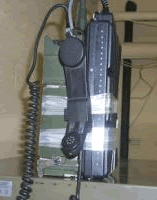
    Combat lessons in Iraq have demonstrated the importance of users understanding that batteries are not made equal. Different types and capacities can provide extended usage. Furthermore, reliable power reading of fresh and used batteries. Lithium batteries power many systems, including the radio communications equipment (PRC-119), the Javelin missile command and guidance system, rugged portable computers, navigation systems, Chemical, Biological and Radiological (CBR) sensors, Satellite Communications equipment, night vision equipment, weapons sights and target acquisition systems, and the command and guidance unit of the. The most common battery is the BA 5590, which was also in the shortest supply. This battery is based on the Li/SO2 chemistry, in use the US Military in communications applications over the past 10 – 15 years, as it was the only lithium technology currently available that has a proven successful record in combat situations.

    With a nominal 200 mA drain in typical use, the battery could provide 28 hours of operation at the minimum temperature. In ordinary combat usage, the soldiers are instructed to change them before 24 hours of operation are experienced. New BA 5390 (Li/MnO2) cylindrical cell version of this battery has a capacity of approximately 10 Ah. (The capacity of a Li/MnO2 pouch version, which utilizes the full volume of the battery case, can be as high as 12 Ah – almost doubling the life of primary batteries). However, US troops are using a different battery for training. The BB2590 Lithium-ion battery is rated at 5.6Ah. Soldiers get used to carry four or five batteries to sustain a 24 hour combat training cycle – the equivalent of one primary BA5590. Lithium-ion cells also have integral capacity gauges so State of Charge (SoC) of each battery was clearly presented to the user. When they prepared for combat, soldiers were instructed not to take any chances, and change the BA5590s at four hour intervals, therefore quadrupling supply requirements. If the soldiers training followed “train as you fight”, such precautions wouldn’t be necessary as they would have better confidence in their equipment.

    The scramble to find batteries and get them to troops fighting in Operation Iraqi Freedom is leading to a policy review of non-rechargeable batteries, as well as an examination of alternative power sources, such as fuel cells and solar panels.

    Logistics of Military Rechargeable Battery

    Start < Page 5 of 5 >

    Monitoring State of Charge (SoC)

    “Smart” monitoring of effective battery power is a significant aspect for military use, but it is rarely available with primary batteries. The use of State of Charge (SoC) Indicators and “Smart Bus” type communications enable users to monitor the health and charge state of the battery. While such implementations add to the cost of each battery, they reduce the total life cycle cost of the entire battery inventory, by reducing unnecessary replacement of batteries and enable the use of much of the available power. For rechargeable batteries, a combat device also requires an additional State of Health (SoH) indication that depicts the expected life expectancy of the fully charged device.

    In a network centric environment, where communications (and transmission) of data at high capacity are required, power requirements for portable and mobile electronics is outgrowing existing power sources capacity, leading to a shorter service per battery. The use of regenerable power is therefore becoming critical for military missions.

    Additional Parts of this article :

    Logistic Aspects of Military Batteries

    Start < Page 4 of 5 >

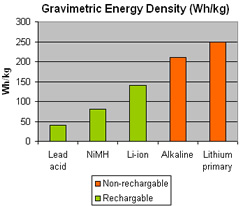
    Primary batteries, particularly those made from lithium can deliver up to eight times the watt-hour capacity of conventional rechargeable batteries. However, new rechargeable batteries using lithium anode will also have higher capacity than the conventional rechargeable batteries. Although lower than those of the primary sources, they will provide a choice between freedom from charging and longer shelf life of the primary, or the potential cost saving with rechargeable batteries.

    Logistics of primary batteries are simple as portable energy can be made available at remote distribution points that are unmanned and have no electricity. Disposal is easy because little toxic material is used. However, because of one-time use, the cost of the primary battery is about 30 times higher than that of rechargeable cells. Primary batteries are also simple to store, as they require no maintenance. Primary battery has a shelf life of 10 years. In contrast, lithium-based batteries are good for 2-3 years only, whether used or not. Cool storage at a 40% charge level prolongs longevity. Nickel-based batteries are good for five years and longer, but require priming to regain performance after long storage.

    Stocking of rechargeable batteries require significant maintenance, keeping track of the battery’s state of health, cycle count and age. Due to high self-discharge, nickel-based batteries exhibit a 10-20% self-discharge per month. This compares with 5-10% for lithium and lead-based batteries. Self-discharge increases at higher temperatures. For this reason, secondary batteries are not an effective media for long-term energy storage, and must be fed before each activity. Specific maintenance procedures must be followed with each type of chemistry, operational use and environmental conditions.

    Additional Parts of this article :

    Military use of Primary Lithium Batteries

    Start < Page 2 of 5 >

    While the commercial market is moving toward rechargeable power sources, military users are consuming the primary power sources (non rechargeable batteries) due to the simple logistics, long shelf life, readiness and robustness. Performance requirements for military grade portable power sources are much more demanding than commercial batteries. Military equipment requires high power rate and light weight (more power per volume unit). Weight consideration is a critical aspect, especially for dismounted operations. Military specs are also more demanding in the operating temperature and humidity range, water and salt resistance, as well as safety. These requirements limited the variations of primary battery chemistries and designs. In recent years, several armies have shifted to the use of rechargeable batteries for peacetime, training and garrison operations, as well as specific combat uses, to save in cost and transportation.

    The consideration for primary batteries is clear – combat readiness require immediate response, therefore, immediate availability of full and consistent power, no charging and priming before use – dictates the use of primary batteries that have no voltage delays, even after long storage periods. The implementation of modern lithium batteries significantly increased power density and reduced weight, when compared to earlier alkaline and carbon-zinc technology. One such technology is the matured Lithium sulfur dioxide (Li/SO2) primary battery technology. However, one of the major concerns for military users was the pressurized cylinders that compose the Li/SO2 cell. These cylinders contain electrolytes stored at high pressure that can explode if punctured by enemy fire or physical abuse. New production processes of Li/SO2 batteries have utilized non-pressurized cells. For example, a lithium-manganese dioxide (Li/MnO2) cell is constructed as a laminated, aluminized pouch that offers high energy density. Another concern was the emission of hazardous gases, in case of short circuit or overheating. Modern designs, especially those used in night vision equipment, are now being replaced with Li/MnO2 cells that have safety features to automatically shut down of the battery, when overheated. Modern portable electronic equipment is now moving toward the new Li/MnO2 chemistry, which has higher energy density than Li/SO2, since the cell utilizes the entire battery cavity.

    Additional Parts of this article :

    Zinc-Air Battery Applications

    Zinc-Air BA 8180 battery

    On Sept. 19 2005 Arotech announced a new type of 12V zinc-air battery compatible with the MBITR radios, operated by the US Special Forces, designated BA-8140/U. The non-rechargeable battery delivers 12V at 400 watt-hour. The company reported preliminary orders worth $478,000 for the new product.

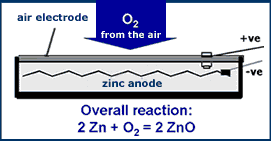
    The BA-8180/U Zinc Air primary (non-rechargeable) battery is a 12/24 Volt, 800 Watt-hour battery pack, approximately the size and weight of a notebook computer. The battery is based on the new generation of lightweight, 30 ampere-hours cells developed by Electric Fuel. Rated at 350 wh/kg, the battery typically provided 4 to 6 times the run time of conventional BA-5590 offering longer mission endurance, improved safety and redundancy and considerable logistics saving. BA-8180/U is typically used with portable equipment, in locations where reliable electrical power is not available, or where long endurance operation of equipment is required – such as with long range patrols, and special operations teams, where the battery pack is carried in a rucksack, adjacent to the radio pack. In satellite communications applications, PSC-5 SATCOM terminals operated continuously for four days, powered by a hybrid zinc-air/lead-acid pack. The battery is used as an external power source, where it replace standard power packs such as BA-5590/U, BA-5390/U and BA-3590/U by using compatible adapters that fits into the battery compartment and plugs into the external source. Similar adapters can replace BB-390A/U, BB-5990/U, BB-690/Y and BB-2590/U rechargeable batteries.

    Another application of zinc-air power cells is charging of rechargeable batteries such as li-ion cells. The US Army is planning to field Forward Field Chargers, to support extended, dismounted operations. Advanced charging solutions are an integral part of the program, and the new Charger enables charging from a number of sources. Electric-Fuel is offering a version of the Forward Field Charger which uses the BA 8180 battery as a source of energy for field charging of military rechargeable batteries. Other sources supported by the system include solar panels, 24-volt vehicle batteries and 110/220 AC.

    Zinc-air battery electrochemistry is similar to Alkaline Manganese thus has similar safety and environmental properties
    MnO2 is replaced by oxygen from the
    atmosphere.

    Zinc-air batteries are considerably safer in combat situations and more environmentally friendly than lithium batteries. The US Army Communications Electronic Command (CECOM) orders started in 2003 after extensive testing and positive experience with troops during operations in Iraq and Afghanistan. In training, Zinc-Air packs powered PRC-119 radio sets for an average period of 6 – 9 days. Arotech reported in November 2003 an order of $5.2 worth of BA-8180/U zinc-air primary batteries, in addition to an ongoing 2003 order worth $4.1 million. The US Army plans to buy 150,000 BA-8180/U batteries under a sole source program announced in November 2003. In March 2005 CECOM ordered more 8180 and 8140 type batteries under a three-year $24 million contract signed in 2005. Arotech is producing the zinc-air batteries at its US production line in Auburn, Alabama.

    Laser Warning Devices for AFV

    A key component in Missile Countermeasures Devices (MCD) and Active Protection Systems (APS) is the threat warning. The most mature system is the laser warning device.

    VVR-2 produced by Goodrich, has been deployed with USMC LAV reconnaissance vehicles since 1996, and are currently being augmented by the more advanced VVR-3, which is capable of detecting laser rangefinders, designators as well as beam-riding missiles at a 360 degrees azimuth and 55 deg. elevation. A similar system developed by EFW, is the Threat Detection System (TDS) a multi-spectral system that can detect both laser and IR illuminators. Offering high accuracy, the system has an expanded coverage of 110 degrees in elevation and 360 degrees azimuth.

    SHTORA-1 Active Defense System

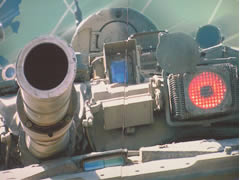
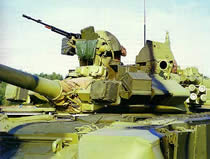
    A typical deployment of IR jammer can be seen on the Russian T-90, which mounts the Shtora-1 Defensive Aids System (DAS) shown on picture, with Kontakt5 ERA modules (left). The system protects the tank against guided missiles, using both the semi-active command to line of sight (SACLOS) guidance, by an IR source that mimics the flare on the back of missiles, as well as laser beam riders and laser-homing weapons. It should be effective against missiles such as the TOW, HOT, AT-4, AT-5 and Sagger (Malyutka). The Russian system also has some capability to counter laser-guided munitions and ATGMs (Such as Hellfire, Kornet etc).

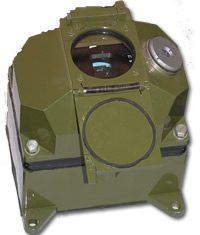
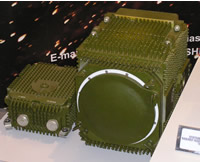
    Shtora-1 uses a laser warning device operating in the 0.65-1.6 micron range, comprising of an array of coarse (photo below right) and fine resolution (photo below left) sensors, mounted externally on the turret. Each of the rough (coarse) laser sensor covers a sector of 135 degrees, while the fine sensor covers a 45 degrees, with 3.75 degrees angle of arrival resolution, and -5 to 25 deg. elevation coverage. The system can automatically slew the turret and gun at the direction of the threat, to optimize the deployment of a thermal smoke screen or activation of active protection systems. The sensor detects laser illuminating and alerts the crew and defensive systems. The warning display provides the commander and gunner with threat warning cueing, by sector (at a resolution of 5 degrees) and at a resolution of 3.75 degrees at the 90 deg. frontal arc. The display also provides jammer and countermeasures status indication. Countermeasures can employ a 81mm thermal instant smoke grenades, which deploy an instant smoke screen at a range of 50-80 meters from the tank, within 1.5 – 3 seconds. The 20 meter wide, 15 meter high screen blocks visual, thermal and laser (0.4 – 14 micron) wave bands. The system also employs a pair of electro-optical jammer, designated TShU1-7, which “hijacks” the missile’s command link by feeding the tracker with modulated signals that cause the missile to deviate from its course, and away from its intended target.

    Tavor Assault Rifle

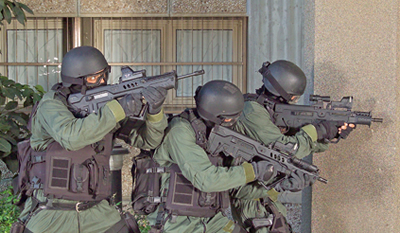
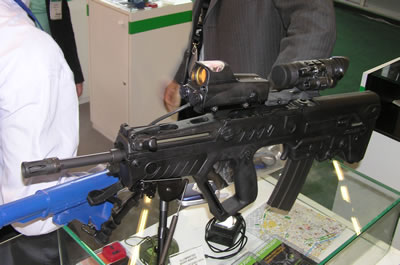
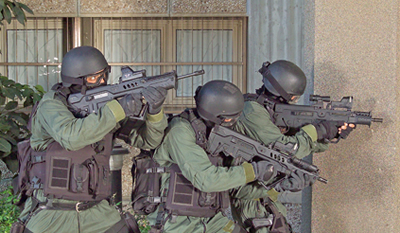
    Tavor, the new Israeli assault rifle is lightweight, compact and ergonomically designed to become an ‘organic’ part of the warfighter. It has already been chosen to arm the Israeli (IDF) and Indian elite troops, and is aggressively marketed worldwide, to become a weapon of choice for future infantry combat suits. Tavor is based on extensive research and development and close cooperation with the Israel Defense Forces. It was selected by the IDF in 2003, following an extensive competition against the M-4. The plant is gearing up to serial production delivering thousands of rifles starting 2006. TheGivati infantry brigade is the first unit to be equipped with the new rifle, gradually fielding the new weapon, beginning with all Summer 2006 new recruits. By March 2007, the Golani infantry brigade and the Kfir infantry brigade are scheduled to get the new weapons, completing the initial procurement batch of 15,000 assault rifles.

    Tavor assault rifles were tested extensively through three years with field units, modified to respond to evolving requirements realized during actual combat engagements in urban combat and special operations. Tavor was selected to be the future assault rifle for the IDF infantry units, and the weapon of choice for the IDF future infantry combat suits, replacing various types of M-16, M-4 and Galil. In 2004 India became the second country to choose Tavor for its elite troops. Georgia reportedly selected the weapon for its special operations units.

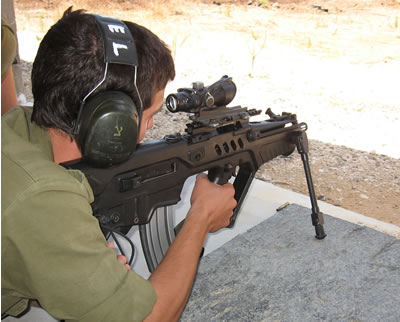
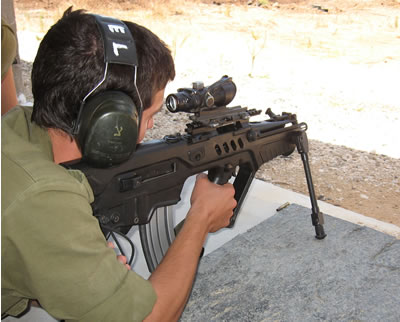
    Unlike conventional assault rifles, Tavor was developed to produce effective, fast and accurate fire in all conditions, including close combat. Its ergonomic design enables the soldier to operate the weapon as part of an integrated weapon system – such system does not rely only on technology, the system must rely on the human senses and capabilities, and respond best to the human needs. Tavor is well balanced and easily operated with a single (right or left) hand. Specific models can be configured for right or left handed users. With its integral optical sight, it can be aimed and fire accurately with both eyes opened, maintaining constant eye contact with the target, improving the soldier’s peripheral vision and maintaining effective situational awareness. The compact weapon fits comfortably, aimed instinctively and fired instantly and effectively even by a heavily loaded warfighter, in tight enclosures, where the use of longer weapons is impractical. All Tavor models use flat-top design to accommodate advanced sights and accessories. The current model selected by the IDF is produced of black composites (the original was olive green), some models, such as the sharpshooter version (shown in the picture above) uses Mil-Std 1913 (Picatinny) rail attachment mounting optical sights and other accessories. All versions have a foldable iron sights for backup.

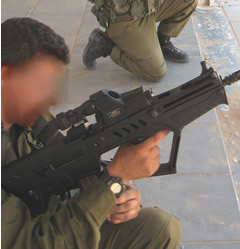
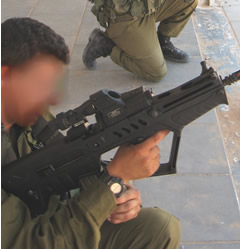
    Tavor family includes three different models – TAR 21 assault rifle, slightly shorter TAR C21 designed for paratroopers and commanders and TAR S21 optimized for sharpshooters. The version taken by the IDF uses an integral sight, either the ITL MARS or self-luminous reflex sight Mepro-21, produced by Meprolite (the latest version of this sight is shown at the bottom of this page). The commander’s version TAR C21 can also use a combination of a reflex sight and telescope, or reflex sight and camera, configured for integrated combat suits. A sharpshooter version, TAR S21 also mounts a bipod and 4X telescope for precision firing. All weapons share a common bull-pup configuration use a common platform, with different barrel lengths. The Bull-Pup design enables Tavor to maintain short and compact dimensions with a long barrel. The standard rifle measures 725mm and uses a 480mm barrel (TAR21/S21) while the smaller (640mm total length) C21 has a 380mm barrel. The total weight of the weapon ranges from 3.18 kg for C21 to 3.67 kg of the fully equipped S21. A wide range of sights is available for the Tavor, including the MARS integrated laser pointer and reflex sight night vision 3X magnifying sight, day telescope with 4X magnification, 3X daylight or night vision viewer mounted behind the reflex sight, enabling day and night operation without sight change, special reflex sight for the grenade launcher. Other accessories include 40mm grenade launcher kit, silencer, 20 or 30 round magazines, clip for two magazines, etc. Tavor is capable of sustained rate of fire of 750 – 900 rounds per minute.

    Tavor Assault Rifle

    Manufacture: Israel’s Weapons Industries (IWI)

    Tavor, the new Israeli assault rifle is lightweight, compact and ergonomically designed to become an ‘organic’ part of the warfighter. It has already been chosen to arm the Israeli (IDF) and Indian elite troops, and is aggressively marketed worldwide, to become a weapon of choice for future infantry combat suits. Tavor is based on extensive research and development and close cooperation with the Israel Defense Forces. It was selected by the IDF in 2003, following an extensive competition against the M-4. The plant is gearing up to serial production delivering thousands of rifles starting 2006. TheGivati infantry brigade is the first unit to be equipped with the new rifle, gradually fielding the new weapon, beginning with all Summer 2006 new recruits. By March 2007, the Golani infantry brigade and the Kfir infantry brigade are scheduled to get the new weapons, completing the initial procurement batch of 15,000 assault rifles.

    Tavor assault rifles were tested extensively through three years with field units, modified to respond to evolving requirements realized during actual combat engagements in urban combat and special operations. Tavor was selected to be the future assault rifle for the IDF infantry units, and the weapon of choice for the IDF future infantry combat suits, replacing various types of M-16, M-4 and Galil. In 2004 India became the second country to choose Tavor for its elite troops. Georgia reportedly selected the weapon for its special operations units.

    Unlike conventional assault rifles, Tavor was developed to produce effective, fast and accurate fire in all conditions, including close combat. Its ergonomic design enables the soldier to operate the weapon as part of an integrated weapon system – such system does not rely only on technology, the system must rely on the human senses and capabilities, and respond best to the human needs. Tavor is well balanced and easily operated with a single (right or left) hand. Specific models can be configured for right or left handed users. With its integral optical sight, it can be aimed and fire accurately with both eyes opened, maintaining constant eye contact with the target, improving the soldier’s peripheral vision and maintaining effective situational awareness. The compact weapon fits comfortably, aimed instinctively and fired instantly and effectively even by a heavily loaded warfighter, in tight enclosures, where the use of longer weapons is impractical. All Tavor models use flat-top design to accommodate advanced sights and accessories. The current model selected by the IDF is produced of black composites (the original was olive green), some models, such as the sharpshooter version (shown in the picture above) uses Mil-Std 1913 (Picatinny) rail attachment mounting optical sights and other accessories. All versions have a foldable iron sights for backup.

    Tavor family includes three different models – TAR 21 assault rifle, slightly shorter TAR C21 designed for paratroopers and commanders and TAR S21 optimized for sharpshooters. The version taken by the IDF uses an integral sight, either the ITL MARS or self-luminous reflex sight Mepro-21, produced by Meprolite (the latest version of this sight is shown at the bottom of this page). The commander’s version TAR C21 can also use a combination of a reflex sight and telescope, or reflex sight and camera, configured for integrated combat suits. A sharpshooter version, TAR S21 also mounts a bipod and 4X telescope for precision firing. All weapons share a common bull-pup configuration use a common platform, with different barrel lengths. The Bull-Pup design enables Tavor to maintain short and compact dimensions with a long barrel. The standard rifle measures 725mm and uses a 480mm barrel (TAR21/S21) while the smaller (640mm total length) C21 has a 380mm barrel. The total weight of the weapon ranges from 3.18 kg for C21 to 3.67 kg of the fully equipped S21. A wide range of sights is available for the Tavor, including the  MARS integrated laser pointer and reflex sight night vision 3X magnifying sight, day telescope with 4X magnification, 3X daylight or night vision viewer mounted behind the reflex sight, enabling day and night operation without sight change, special reflex sight for the grenade launcher. Other accessories include 40mm grenade launcher kit, silencer, 20 or 30 round magazines, clip for two magazines, etc. Tavor is capable of sustained rate of fire of 750 – 900 rounds per minute.

    Skunk Works and XTEND Simplify Multi-Drone Command

    0
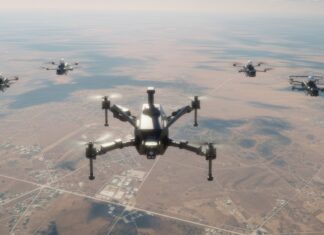
    Lockheed Martin Skunk Works® and XTEND have achieved a major milestone in JADC2 by integrating the XOS operating system with the MDCX™ autonomy platform. This technical breakthrough enables a single operator to simultaneously command multiple drone classes, eliminating the friction of mission handoffs. From "marsupial" drone deployments to operating in GPS-denied environments, explore how this collaboration is abbreviating the data-to-decision timeline and redefining autonomous mission execution.

    From Ukraine to Taiwan: The Global Race to Dominate the New Defense Tech Frontier

    0
    As traditional defense primes face mounting competition from agile “neoprimes” such as Anduril, Palantir and Helsing, the balance of innovation is shifting toward software-defined warfare and scalable, dual-use technologies, while global industry consolidation—marked by Boeing’s integration of Spirit AeroSystems and other strategic mergers—signals an intensified race to secure control over the defense technology value chain. Our Defense-Tech weekly report highlights these trends.

    Europe’s “Drone Wall”

    0
    In early October 2025, a coordinated wave of unmanned aerial system (UAS) incursions—widely attributed to Russia—targeted critical infrastructure across at least ten European nations. The unprecedented campaign exposed the fragility of Europe’s air defenses...

    Weekly Defense Update & Global Security Assessment

    0
    Executive Summary The past week (September 18-25, 2025) represents an inflection point where strategic defense concepts have transitioned from doctrine to tangible reality. An analysis of global events reveals four primary, interconnected trends shaping an...

    U.S. Air and Space Forces Push Next-Gen Programs at the AS&C 2025 Conference and...

    0
    At the 2025 Air, Space & Cyber Conference, U.S. Air Force and Space Force leaders unveiled major updates on next-generation fighters, bombers, unmanned systems, and space initiatives, highlighting both rapid innovation and critical readiness challenges as the services race to outpace global competitors. A short version is available here, with a more detailed version for subscribers.

    TADTE 2025: Reflecting Taiwan’s Strategic Themes

    0
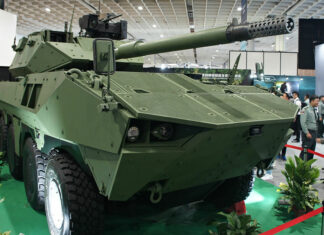
    The Taipei Aerospace & Defense Technology Exhibition (TADTE) 2025 crystallized around four dominant strategic themes that collectively illustrate Taiwan's comprehensive approach to defense modernization amid escalating regional tensions. Based on a detailed report by Pleronix (available upon request). Includes a Podcast discussion on TADTE 2025's highlighting Taiwan's four strategic themes beyond the post's coverage.

    Iron Beam 450 Completes Testing, Soon to Join With Operational Air Defense Units

    0
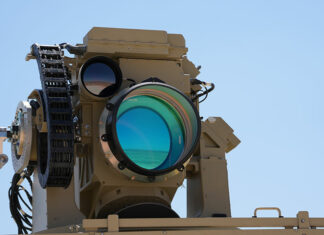
    Israel’s Iron Beam 450 high-power laser system has completed final testing, marking a major leap in air defense. Developed by Rafael, it offers precise, cost-effective interception of rockets, UAVs, and mortars, and is set for IDF deployment by 2025.