
Monday, December 22, 2025
More
    Home Blog Page 399

    Lynx / AN/APY-8

    UAV SAR Recce Payload (General Atomics/ USA)

    Lynx is a multifunction Synthetic Aperture Radar (SAR) operating in SAR and Ground Moving Target Indication (GMTI) modes. The echoes of the radar signals are processed by the system into a high resolution images, and delivered via datalink to the Ground Exploitation Station. LYNX consists of a radar electronics module and antenna mounted on a gimbal assembly weighing a total of 52kg. The Lynx’s provides photographic quality ground pictures at resolutions ranging from 0.1 to 3 meters. The radar can also scan a large or small area for moving objects, detecting targets at speeds typical of vehicular movements (10 – 70 kph). When transferred to the ground station, moving target data is usually overlaid on a digital map to generate situational awareness map.

    AN/APY-8 Lynx II is a lightweight version of Lynx operating on the US Air Force Predator RQ-1 UAV. A new version designed for operation at extended range and high altitude is Lynx ER, currently fielded with US Air force Predator B MQ-9. Lynx II is planned for fielding with the US Army in 2007, on several platforms, including FireScout (FCS Class IV), ER/MP and Hunter.


    All Lynx models are offering several operating modes including STRIP, SPOT and MTI. STRIP mode is used for large area coverage. Flying at a speed of 70 knots, Lynx II can cover an area of 25 km2 per minute at a resolution of 1 meter. Lynx ER is designed for faster platforms (Predator B flying at 250 knots) at higher altitude (45,000 feet vs. 25,000 ft. for RQ-1) will be able to double the rate to a coverage of about 60 km2 per minute. When a closer look is required, the radar can be pointed at specific locations or targets utilizing the SPOT mode. In SPOT, Lynx can deliver a detailed image of a 300×170 meter target area, showing objects with details as small as 10cm, from a distance of 40 kilometers.

    August 2006: General Atomics and BAE Systems completed a first phase of a demonstration of Synthetic Aperture Radar (SAR) pod flown on an F-16, mounting a derivative of the Lynx SAR radar, previously used on UAV. Follow-on demonstrations will include SAR/EOIR sensor fusion.

    The flight demonstration is a critical milestone in a two-year cooperative research effort between GA-ASI’s Reconnaissance Systems Group and BAE Systems. The ultimate goal of the research is to provide the U.S. Air Force and U.S. Air National Guard with the capability to “fuse” the products of two high-resolution sensors integrated into a single reconnaissance pod. The fused product is designed to provide the Warfighter with target detection and geo-location benefits that exceed the capability of each sensor used singly. The next phase, scheduled for the upcoming weeks, will demonstrate combined SAR and Electro-Optical/Infrared (EO/IR) data collection. This data will be processed using state-of-the-art sensor fusion algorithms developed by BAE Systems.

    According to Linden P. Blue, president, Reconnaissance Systems Group, General Atomics Aeronautical Systems, Inc. “A total of 74 images were collected and processed by the team, including a mix of high-resolution spot images, as well as wide field-of-view images at various resolutions.” BAE Systems is building and sustaining the Theater Airborne Reconnaissance System (TARS) currently used by the U.S. Air Force and Air National Guard. The Lynx system was installed in an identical pod.
    AGM-88 HARM – High-speed Anti-Radiation Missile

    The AGM-88 HARM (high-speed anti-radiation missile) is an air-to-surface anti-radiation tactical missile designed to seek and destroy enemy radar-equipped air defense systems. The AGM-88 can detect, attack and destroy a target with minimum aircrew input. The proportional guidance system that homes in on enemy radar emissions has a fixed antenna and seeker head in the missile nose. A smokeless, solid-propellant, dual-thrust rocket motor propels the missile.

    The supersonic missile uses a dual-thrust rocket motor, produced by Thiokol. Its launch weight is 800 pounds (360 kg). The missile has a range of over 30 miles (46 km). It is equipped with a radar seeker, and a proportional navigation system, enabling the missile to attack any active emitter within the predetermined area.


    Once airborne, HARM can operate in three modes: preemptive, missile-as-sensor and self-protect. In long-range preemptive scenarios, HARM is fired before locking on to the threat radar. Targeting is provided through preflight planning or cued via on- or off-board sensors. Most aircraft are equipped to utilize HARM as a sensor, providing cockpit displays that enhance aircrew target selection and threat prosecution. Radar warning receivers used with the self-protect mode and other more sophisticated electronic warfare support measures (ESM) systems provide additional capabilities for locating enemy radar emitters. Once the aircrew selects the target, the missile is launched, homes in on the target, makes in-flight corrections and eliminates the threat.

    In production since 1983, the missile was first used with U.S. Air Force F-4G Wild Weasel, supported by the APR-47 radar attack and warning system on the aircraft. The missile is operationally deployed throughout the Air Force and in full production as a joint U.S. Air Force-U.S. Navy project. The missile is cleared for operation with F-16, F/A-18, EA-6B and Tornado fighter aircraft.
    An enhanced version of the missile is the “HDAM” (HARM Destruction of enemy air defense Attack Module). This version is equipped with GPS/INS system, improving the missile’s capability to pursue targets in electromagnetically cluttered environment, while coping with restrictive rules of engagement. HDAM uses the on-board GPS/IMU (fiber optic gyro) navigation system to restrict the missile’s seeker to pursue targets located in a pre-programmed missile impact zone (MIZ). The seeker will reject any target located outside the MIZ. If an emitter is shut down during the attack, or if the signal is lost during the flight, the HDAM will continue to search and will lock onto radars located in the MIZ as soon as they are activated. Provided with the new navigation system, HDAM can also be utilized as a long-range, supersonic strike weapon against non-radiating, time critical targets. The missile is also compatible with MIL-STD-1553 aircraft databus, providing pilots more flexibility in re-programming the missile in flight. HDAM is developed by Raytheon Company in the U.S. with support from Bodenseewerk Gerätetechnik GmBH (BGT) in Germany.


    The missile’s performance were demonstrated in August 2006. It is scheduled to begin low rate production in 2007.

    IED – a weapons’ profile

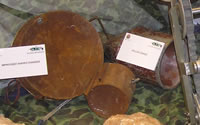
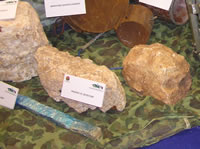
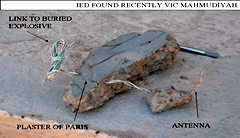
    IEDs can be prepared almost everywhere, with materials that can be acquired from agricultural and medical supplies. The preparation does not require highly technical knowledge. In fact, many “IED engineers” practiced what they have learned through instructions they received from documents distributed by terrorist organizations, on CDROMs or over the internet. As they are not based on standard production formula, IEDs are more difficult to track and detect, (although they sometime have traces that can identify their origin). When constructed properly, IEDs can defeat even the highly protected threats, including main battle tanks and heavily armored bulldozers. Some IEDs utilize very heavy (200 pounds and more) explosive devices, buried below the surface of unpaved or paved roads, where they are covered, wait for activation by remote control. Such activation is usually dependent on opportunity.

    IED usually combined the effects of blast, fragmentation as well as armor penetration, through the use of shaped charge liners. Camouflaged explosives frequently serve as roadside bombs. These devices are remote controlled, triggered by infra-red, pressure bars or trip wires or remote control, when aimed to delay, or disrupt enemy forces in their movement into a secured area. These IEDs are aimed at the softer sides of unprotected vehicles and armored vehicles, and can be effective even from a distance of several meters. IEDs can also be grouped by “daisy chains” inflicting maximum damage on military patrols consisting of several vehicles. Using time delay activation, programmed to hit the rescue teams that rush to the scene is a frequent IED tactic. A common tactic aims at stopping the softer vehicle in a convoy or group, which can then be targeted by heavier charges employed by special teams covered by small arms fire, or RPG.

    An IED scene is usually covered by a fire support team which will attack the target with small arms or RPGs, once the vehicles are stopped, or when the convoy or patrol disintegrate into individually, sometime isolated vehicles, such teams could try to assault the most vulnerable target, usually the one which suffered mobility kill, in an attempt to kill, or kidnap the crew.

    Total protection of vehicles against IED is virtually impossible, due to the illusive nature of the threat. Attempts to overcome this deficiency frequently led to “overkill” solutions, resulting in creation of super heavy monsters, which by limiting their mobility, became even more vulnerable to heavier fire. The most effective countermeasures against IED is a balanced combination between physical protection and tactical conduct of operation. This becomes extremely difficult during prolonged peacekeeping security and stabilization operations under asymmetric warfare conditions, in which regular forces must quickly adapt their tactical drill procedures to unfamiliar combat situations. Troops operating in such high-risk environment must be able to improvise their tactics to counter the evolving threats facing them.

    Physical protection generally relies on conventional armor technologies, consisting of steel/aluminum armor. The more expensive advanced armor kits utilize ceramic protection, enhancing survival chances heavier attacks and shaped charges. Lightweight composite armor suits offer protection against IED, fragmentation and small arms, for soft vehicles. Since IED charges have low penetration efficiency, one of the most important add-on protections are the ballistic liners, made of composite materials. Such liners can also absorb much of the melted metal spall generated when a shaped charge penetrates through the main armor, therefore limiting the internal damage and casualties.

    Experienced guerilla attacks try to target the weakest vehicle in the convoy. To counter this, it is imperative to protect the critical mobility elements, allowing rapid reaction dash-ot of the danger zone, before the convoy stalls in the fire beaten zone. High priority protection therefore will focus on the engine, running gear, cabin and installation of ‘run-flat’ tires.

    Merkava Mk 4 – Firepower Improvements

    Heavyweights are Adapting to LIC

    Start < Page 2 of 5 >


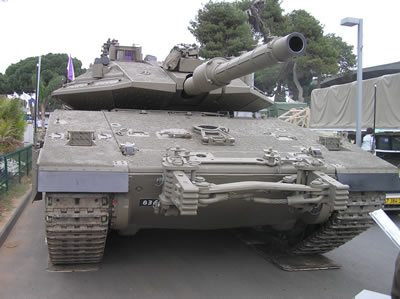
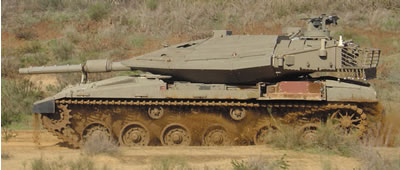
    Further improving the crew and commander’s operational capability under armor protection, the commander’s position has been augmented by a ring of panoramic vision blocks that provide a wide field of view. The addition of an independent commander’s sight fitted with a thermal imaging system, and its own full capability fire control computer, enables the commander and gunner to simultaneously and independently engage two disparate targets, thus multiplying the tank’s observation and fire coverage capabilities.

    Further protection for the crew was considered by employing Autoflug safety seat systems, to protect the crew from side and bottom mine and IED blasts as well as reducing stress and fatigue during long duration missions. Several types of seats were tested in Merkava Mk4. The driver’s and commander’s seats utilized elevated designs, while the loader and gunner’s seat positions were fixed. However, seats are not used in serial production tanks. Autoflug safety seats are also being considered for use with the new Namer and various wheeled APCs under development by the IDF.

    A remotely controlled weapon station mounting a 7.62 machine gun and a coaxial M2 heavy 12.7 mm machine gun above the main gun are also fully integrated into, and controlled through, the existing fire control system, enabling the Merkava crew to use either machine gun as a high powered sniper rifle for optimal pinpoint effect and accuracy at medium and short range.

    The 60mm ‘under armor mortar’ will also be linked into the fire control system in order to provide automatic aiming and the use of extended range ammunition as part of the telescopic development spiral.

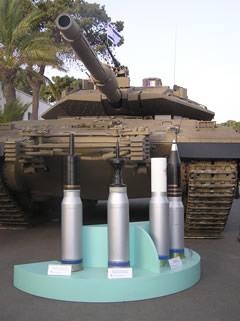
    Introduction of the new IMI Kalanit 120mm Anti-Personnel-Anti-Material (APAM) round for the main gun will further enhance the tank’s ability to engage dispersed infantry, buildings, and fortified structures as well as helicopters.

    A new addition, specifically designed for urban warfare, is the sniper’s position located at the rear access door. Firing through the protected porthole window a sniper can engage approaching tank killer teams advancing towards the vehicle’s most vulnerable area. Other improvements, designed specifically for urban combat include a rammer, which enables the tank to safely knock down obstructions, avoiding damage to the gun or optronics. A pre-installed tow chain harness is also used, to facilitates extraction and recovery of a disabled tank by another tank or a bulldozer, without exposing the crew.

    Additional parts of this article:

    Read more:

    LVSR – Logistics Vehicle System Replacement (USMC)

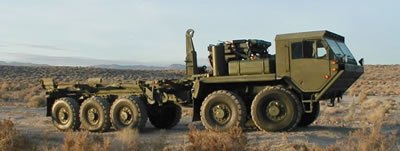
    Oshkosh and Plasan Sasa won a US Marine Corps contract to supply armor kits for 700 LVSR trucks. The kits will be developed by Plasan Sasa beginning 2007, to be followed by deliveries through 2010.

    Logistics Vehicle System Replacement (LVSR) trucks – which will replace the current Marine Corps LVS – will be used as a heavy tactical logistics distribution system for the transport of bulk liquids and cargo, ammunition, containers, and tactical support equipment, and will also be utilized for wrecker, towing, and recovery missions. The armor kit, engineered from composite materials, will be customized to protect the driver’s cabin against Improvised Explosive Devices (IEDs), mines, and other threats. Plasan’s modular Armor Protection Kits (APKs) are designed for field assembly, and can be transferred from one vehicle to another, enabling rapid responses to evolving situations.

    Joint Air to Surface Standoff Missile (JASSM)

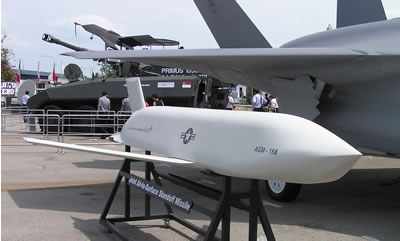
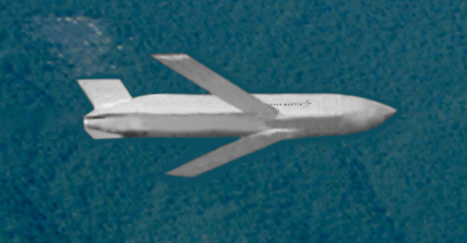
    The Joint Air-to Surface Standoff Missile (JASSM) is an autonomous, stealthy, long range conventional, air-to-ground, precision standoff missile used by the US Air Force and US Navy. The weapon is designed to destroy high value, well defended fixed or relocateable targets, from ranges of over 200 nm. The 14 foot long missile weighs 2,250 pound is employed as a fully autonomous “Fire and Forget” weapon. JASSM is currently deployed by B-52 and B2 bombers. Flight testing is conducted on B-1F-16 units will get the missile by 2006. The US Navy considered the missile for its fleet of F/A-18E/F but eventuallt favored the SLAM-ER weapon. The Navy considered such weapon to augment the capabilities currently obtained only by the Tomahawk cruise missiles. Australia and South Korea have selected JASSM for their F/A-18E/F (Australia) and F-15K (South Korea).


    The missile uses autonomous navigation, based on inertial and GPS navigation systems, to follow a pre-planned route which will bring it to the target area. Once in predesignated location, the missile uses its imaging infrared seeker and on-board, real-time Automatic Target Correlating (ATC) algorithms to precisely locate and guide the missile to the desired target aimpoint. Lockheed Martin’s ATC algorithms use an insensitive, redundant approach and real-time processors to provide a robust system that significantly reduces the missile’s impact circular error probability (CEP) any time of the day or night. This allows the missile to hit a precise spot, such as a specific point in a hardened bunker, cave entry or ventilation shaft, using a target model that was built months earlier. To make the missile more immune to GPS deception and jamming, JASSM Block 1A missiles are equipped with the Selective Availability Anti-spoofing Module (SAASM) technology – an enhanced, digital anti-jam Global Positioning System (GPS) receiver. This capability gives JASSM the ability to successfully complete its mission even in intense jamming environments. The entire system is prepared on the mission planning system. A typical mission can be planned in less than 30 minutes. JASSM is equipped with a 1,000 lb dual mode blast-fragmentation penetrator warhead for maximum effect against soft or hard targets. The missile is designed to fly low-level terrain following flight path, which enables effective bypassing of most enemy defenses. The advantages of its low observable properties ensure its survivability during the missile ingress to the target. The missile is also prepared to engage enemy jammers.

    One of the unique features of the current model of JASSM is its capability to send back a sequence of pre-strike images of the target, just before impact. Such information provides partial battle damage assessment (BDA) capability and eliminates the need to send dedicated recce assets to verify the results of the strike.

    Further improvements of JASSM ER will include an improved engine and larger fuel capacity, and an improved two-way datalink which will provide flexible re-targeting of the missile, including tracked, moving maritime targets. The ER version maintains the same outer mold lines of the stealthy airframe, which makes JASSM extremely difficult for air defense systems to engage. It also retains the dual-mode penetration and blast fragmentation warhead of the baseline JASSM missile. This capability will transform JASSM into a network-enabled system, providing in-flight re-routing, retargeting, or aimpoint refinements and blue-force tracking, to eliminate fratricide risks. The introduction of the JASSM-ER will also provide limited loitering capability or further range extension beyond 500nm. Loitering will enable planners to more flexibly integrate JASSM with other means of attacks, such as decoys, defense suppression weapons etc. Flight testing for JASSM-ER began in mid-2006 and initial fielding is expected with B-1B squadrons by 2013. The U.S. Air Force plans the total procurement of 4,900 JASSMs – both the 200 nautical-miles basic weapon and 500 nm JASSM-ERs. By late 2009 the weapon successfully completed six successful flight demonstration tests at White Sands missile testing range in New Mexico. During the latest flight test, the missile was released from a B-1B aircraft and flew a preplanned course to collect data, to fine-tune navigation algorithms, and then destroyed the designated target. The flight also confirmed the missile’s ability to be employed from the aft weapons bay of the B-1B. Flight testing will continue through mid-2010 in preparation for Operational Test and Evaluation, which will commence in 2011. A low-rate initial production decision is anticipated in 2011. The JASSM-ER missile is being integrated on the B-1B with Initial Operational Capability planned for early 2013. The JASSM-ER design is compatible with the B-2, B-52, and F-16 aircraft that currently deploy JASSM. Acquisitions are expected to last through 2018.

    Defexpo 2006 – Asymmetric Warfare

    OFB introduced the Zittara, a compact assault rifle designed specifically for close quarter battle. The Zittara multi-purpose carbine is generally based on Israel’s IWI Micro Tavor assault rifle, which was designed for use by special operations units and is being proposed as the standard weapon for Israel’s intervention and special ops forces. The OFB Zittara differs from the Israeli design by allowing the use of three different configurations and ammunition types for different situations – a carbine (firing 5.56×30 ammunition), an assault rifle (firing 5.56x45mm) or a submachine-gun firing 9x19mm rounds with accuracy of up to 200 meters. These conversions can be performed in the field with standard tools.


    RAFAEL unveiled the new MPFC, a weapon that can fire an explosive charge through a 20cm reinforced concrete wall. Use of this type of weapon eliminate A threat inside buildings without requiring forced entry by troops. The design of the charge is also intended to restrict collateral damage by confining blast effects to the targeted room. Weighing only a few kilograms, this expendable weapon can be placed near the wall which offers optimal penetration. It is activated from a safe distance by remote control.

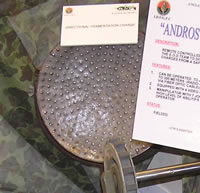
    Vectra Advanced Engineering also demonstrated Scorpio, an unmanned robotic vehicle designed to assist with investigation and inspections of suspicious objects. The Indian Defense Research and Development Organization displayed several robotic vehicles, including a range of remotely operated vehicles (ROVs) designed for use by bomb disposal units of the armed forces and police. These vehicles utilize control systems developed by the Israeli company InRob, which also supplies the “brain” for a new remotely controlled weapon station that has been jointly developed by IMI and OFB. Several types of IED jammers were displayed, including the EJAB series from Elisra and a family of RF jammers from Netline.

    Various dismounted infantry combat suites were displayed. The US Army gave presentations on some of the new developments in the Future Force Warrior (FFW) program, including the newly designed helmet and combat vest. Finmeccanica, with some of its subsidiaries, displayed some of the components of Soldato Futuro, the Italian Dismounted Soldier program, including the 5.56mm weapon from Beretta, wearable computer, display and sight, communications gear etc.

    Start < Page 4 of 6 >

    Defexpo 2006 – Exhibition Report

    The Indian market for military equipment is growing rapidly due to continued modernization of India’s armed forces, and a transformation program that is aimed at coping with long-term strategic threats as well as low-intensity asymmetric and counter-terror operations. On the strategic level, significant modernization is underway particularly by the Air Force, Navy and Air Defense. Land force modernization is aimed specifically at the artillery and infantry, with the goal of providing better mobility and protection, and increased operability through sophisticated command and control.

    India’s defense industry, which is built on a foundation of skilled engineering and production capabilities, enables the country to be self sufficient in the production of main platforms such as missiles, aircraft, ships and ground vehicles, including heavy armored vehicles, but indigenous R&D programs have either not materialized or have suffered from very long delays in progress.


    Most successful in adapting sales efforts to the peculiarities of the Indian market are the Russians, who have been the traditional arms suppliers for India for many years. However, some significant programs have also had European suppliers as sources, mainly British and French companies. Two of the most successful programs are the recent sale of six Armaris Scorpene class submarines, which will be locally built by Mazagon Dock Ltd. in India, and the local production of missiles under cooperation between MBDA and Bharat Dynamics Ltd (BDL). BDL currently produces the Milan 2 anti-tank missile and will be involved in the Milan ER program when development is complete. MBDA will also be the supplier for the Indian Navy’s SM-39 Exocet submarine launched missiles as part of their submarine’s combat systems suite. In recent years, Israel has established close relations with India as the two countries explore the benefits of combining Israel’s efficient and innovative R&D with Indian engineering and production capabilities. Cooperation agreements between Israeli and Indian industries that have been signed in recent years are paving the way for further cooperation in joint R&D as well as international marketing of jointly produced defense systems.

    Easing of US government restrictions has opened the Indian market to the US defense industry and several large companies displayed their wares at this year’s Defexpo. Boeing and Lockheed Martin are already offering the latest versions of the F-16 and F/A-18E/F as options for the Indian Air Force fighter modernization program in competition with other new contenders such as the Swedish Grippen and Russian MiG-35. According to Orville Prins, Vice President for Lockheed Martin Business Development – India, LM is also offering India the C-130J Super Hercules, their latest version of this proven transport aircraft, which is already in service in Southwest Asia and regularly operates at high altitude in hot conditions similar to the ones that it would encounter in India. American companies are also offering air defense systems such as the SLAMRAAMPatriot PAC2 and PAC3. For maritime surveillance and control, Boeing is promoting the P-8 MMA while Northrop Grumman is showcasing the carrier operable Hawkeye 2000. The Eagle-Eye tilt-rotor UAV, in development for the US Coast Guard, is also being promoted for maritime surveillance applications. In contrast to past practices in this region, the US companies are making a point of their readiness to offer technology transfer and local production of their systems.

    More in this review:

    Start < Page 1 of 6 >

    Convoy Protection & Escort

    Start < Page 9 of 9 >

    Protection of military convoys is becoming a critical issue for military operational planners facing modern guerilla warfare threats. A major concern is the security of the drivers and passengers as well as maintaining the vehicle’s mobility under attack. This is achieved by adding armor to the cabin and engine compartment. Additional measures are provided by active protection means, required when facing RPGs. Convoys are usually secured by heavily armed escort vehicles, which cover the convoy through locations known as high risk areas. These vehicles are armored more heavily than the trucks, and will be the first to be equipped with active countermeasures, used to secure the platform as well as other vehicles from RPG attack.

    Typical convoy protectors are Mobile Counter-Fire System vehicles (mentioned above), equipped with acoustic firearms and sniper detection systems, and coupled with stabilized remote operated weapon stations. (The US Army uses the BBN’s Boomerang acoustic detector and SRWS developed by Recon Optical). This integrated sensor-system can instantly return fire in the enemy direction, while on the move. These vehicles are also equipped with electronic countermeasures, to jam radio-controlled improvised explosive devices (IED). These jammers are designed to pre-activate IEDs (by mimicking the command signal) or disrupt the communications channel when the convoy passes nearby. Among the latest jammers currently deployed are the Warlock family of jammers, currently produced for the US Army by EDO Corp. Elisra has developed a wideband RF jammer, which was successfully deployed by the IDF in South Lebanon and the Gaza strip. This jammer covers wide frequency ranges from 20 MHz to 2.5 Ghz and is designed to disable, rather than pre-activate IEDs.

    Enemy activity along the road or at specific locations suspected to be ambush points can also be monitored from the air, by unmanned vehicles. While tactical UAVs are tasked primarily with intelligence gathering and are rarely available for such missions, miniature UAVs (MAV) are currently being optimized for such missions. By the application of on-the-move control systems, such MAVs can operate as advanced guard”, securing an area few kilometers to some hundred of meters ahead of the convoy lead element. EO sensors employed by these MAVs can be programmed to detect recent changes in the terrain indicating the existence of an IED or ambush on the roadside. Several MAVs are currently available for such missions, including the ScanEagle, Silver-Fox, Skylark and others.

    Additional parts of this article:

    Multifunction Self Protection System (MUSS)

    The prototype system is currently under development  under a technology evaluation of the Federal office of Defense Technology & Procurement (BWB). EADS Defense Electroncis provides the sensors, central computer and electronic countermeasures. Krauss Maffei Wegmann (providing system integration) and pyrotechnik countermeasures supplier Buk. During the test phase, the system was mounted on a Leopard 2 tank which successfully defended itself against various missile threats.

    MUSS comprises three main elements: (1) warning sensors, based on EADS’ MILDS UV missile warning sensor and laser detector, which detect the incoming missile or laser beam directed at the target vehicle and report this to the (2) central computer of the MUSS system. This in turn activates (3) electronic or pyrotechnic countermeasures, to defeat and confuse the threat, significantly reducing hit probability.

    MUSS weighs 65 to 160kg, depending on the equipment application, uses a combination of four sensors each covering an arc of 95×70 degrees, with a resolution of +/- 1.5 degrees. The sensors employ UV missile launch signature and laser detectors. When a threat is detected, the system responds within 1 – 1.5 seconds activating a smoke screen or directing infrared jamming signal toward the launching platform. During testing integration of the MUSS was designed for BOXER, FENNEK, and PUMA vehicles, as well as the Leopard 2A5 tanks.

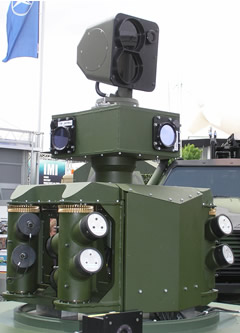
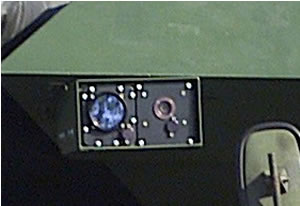
    The MUSS warning systemis based on a UV missile warning sensor and a laser warning sensor. Both are compactly contained in a single device (shown left) which makes  integration into the turret fairly simple. As a result, it is also much easier to retrofit old vehicles. The missile warner was specially designed for use in ground vehicles for the detection of various anti-tank missiles, including semi-automatic, fire-and forget and beam-riders such as AT-15 Kornet as well as unguided RPGs. It is based on the operational MILDS missile warning system originally developed for helicopters and aircraft. MUSS has demonstrated its effectiveness against various different threats during extensive tests, including testing on board the Leopard II main battle tank.

    MUSS was selected by the German MOD to protect the new Puma armored infantry fighting vehicles. Initially, EADS will supply systems to equip the five prototypes currently in production.


    First MAARS Weaponized Robot Delivered for Testing

    Foster-Miller, a subsidiary of QinetiQ North America shipped the first Modular Advanced Armed Robotic System (MAARS) ground robot to the U.S. military under a contract from the Explosive Ordnance Disposal/Low-Intensity Conflict (EOD/LIC) Program within the Combating Terrorism Technical Support Office (CTTSO). In the coming months the new weaponized robotic system will be tested to ensure full compliance with standards and a safety release for fielding.

    “Government has been working with us over the last 18 months to develop and provide an innovative and evolutionary approach to combat situations that address the battlefield of the future,” said Dr. William Ribich, President of the Technology Solutions Group, QinetiQ North America. MAARS, a modular ground robot system was designed as a successor to the combat tested SWORDS weaponized robotic system, based on Foster Miller’s Talon robotic platform. Foster Miller produced over 2,000 Talons, which are extensively used in Iraq and Afghanistan on counter IED and surveillance missions. However, the SWORDS was not used extensively in combat and the lessons learned during initial evaluations contributed to the system definition and refinement of the MAARS system.

    Unlike its predecessors, MAARS was designed from the start to employ various lethal and non lethal weapons, to provide measured response capability at stand-off distance, contributing to warfighter’s safety and tactical flexibility. The system employs a uni-body chassis with a plug-and-play design, allowing rapid reconfiguration in the field, employing a range of sensors, effectors and weapon systems. Among the system’s non-lethal means is the ability to project the operator’s voice through mounted loudspeakers, or alternatively to activate pulsed eye-safe green laser dazzler to disorientate and incapacitate people. MAARS also has the capability to launch 40mm less-lethal ammunition, such as bean bags, smoke, star clusters, pepper spray and ‘flash-bang’ non-lethal grenades. Optional lethal weapons which can be carried by the robot include 40mm high-explosive grenades or M240B 7.62 medium machine gun.

    MAARS comes with tracks that can traverse all terrains, including stairs, and it is also capable of using wheels to increase speed and further reduce noise. The robot’s turret system is able to support a drop-in manipulator arm, multiple types of weapons and a wide range of sensor packages. Additional features include up to seven cameras with multi-modal capabilities. In the MAARS weapons-configured system, the operator always sees where the weapon is pointed in relation to himself and other friendly forces.

    MAARS Weaponized robot. Photo: Foster Miller / QinetiQ North America

    Light Improved Ballistic Armor (LIBA)

    LIBA (Light Improved Ballistic Armor) is a composite ballistic armor panel developed by Mofet Etzion Ltd. of Israel. The LIBA technology offers ballistic protection against small arms up to 14.5mm AP caliber projectiles and 20mm fragments, at half or even a third the weight of comparable steel protection, retaining exceptional multi-impact (more than 20 7.62 AP hits on a 10 x 12 cm panel) and shock resistance properties. A property that is unique to LIBA is the possibility of repairing ballistic panels that have been shot at and damaged in the field without need to withdraw the vehicle or aircraft to rear echelon installations for replacing the panel. Using simple tools and simple instructions the crew of the vehicle can replace the effected pellets in the panel and return the panel to full ballistic integrity.

    With high resistance to multi-impact and shock, LIBA is claimed to have high anti-vandalism properties that has eliminated the problems of ceramic cracking and shock resistance so vital in ballistic armor for protection in low intensity warfare scenarios. LIBA armor was tested and proved to be effective against Improvised Explosive Devices (IED), according to tests performed recently at the IDF ordinance testing facility.

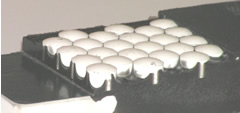
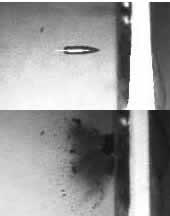
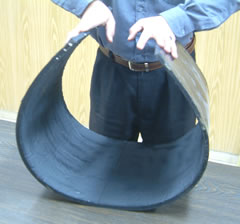
    The panels are composed of different sizes and shapes of ceramic pellets composed of various types of advanced ceramic materials embedded in an elastomeric matrix, attached to a composite fiber, metal base or stand alone solutions.The panel retains a certain degree of flexibility as demonstrated in the photo shown here (left). The LIBA technology panels are being employed in different types of Armored Fighting Vehicles (AFV), rotary and fixed wing aircraft, armored cars and limousines and personal armor. In the photo below, a Liba ceramic matrix armor showing a panel withstanding multi-hit of 14.5 mm ammunition.


    Improved Ammunition for the 120mm Tank Gun – 2006 Eurosatory Exhibition

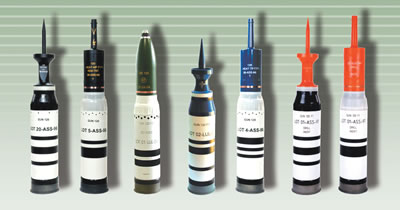
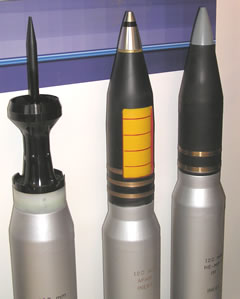
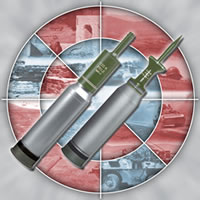
    To better prepare the Leclerc tanks to cope with asymmetric and urban warfare, the French Army is buying 1,000 new 120mm HE-T Mk II high explosive rounds, capable of destroying all types of constructions, light and medium armored vehicles. GIAT is studying the addition of a time fuze to enable indirect (overhead) activation when engaging dug-in targets.

     IMI introduced the M-337 High Explosive Multi-Purpose 120mm round, designed for similar roles. The new HE-MP-T inherits components, such as fuse and stabilizers, from IMI’s Anti-Personnel/Anti-Material (APAM) cartridge, which has become standard 105mm ammunition with the IDF. Its 120mm derivative is currently in final development, under a $60 million development and multi-year procurement program awarded by the Israel MOD. The 120mm APAM is scheduled for fielding by 2009.

    Newly introduced ammunition is the PELE, from Rheinmetall defense reduced lethality ammunition. PELE uses non-explosive frangible warheads, designed to fragmentize as a result of the impact’s pressures, scattering fragments over a short, confined radius avoiding further damage. PELE can be optimized for close-in urban combat. Development started in 2002, under cooperation with GEKE Technologies.

    Improvements are made with conventional KE ammunition. Rheinmetall Defense introduced the DM63 tungsten based KE round which uses new temperature independent powder, suitable for use in extreme climatic zones, without limitation. This round will improve the KE capability of the L44 gun, used with Leopard 2A4. So far, these capabilities were limited only to the L55 120mm gun fitted to the latest Leopard 2A6 tanks.

    IMI introduced a similar round designated M-338, which improves the KE performance of its 120mm KE rounds, and is suitable for all types of guns (including L44). M-338 uses a tungsten core designed for improved penetration and performance. Using new Low Vulnerability (LOVA) propellant enabled IMI to increase the M-338’s muzzle velocity with large safety margin while maintaining precision and operability over the entire temperature range defined by STANAG criteria. IMI used a uniquely designed tungsten alloy core, with unique mechanical properties and sabot design to improve accuracy at all combat ranges.

    Start < Page 5 of 6 >

    Defexpo 2006 – Air Defense on Land & At Sea

    For a long time India has been relying on Russian technology for its air defense systems. The Indian Army currently uses locally produced SA-6 missiles, designated Akash, as well as Russian made Tungushka self propelled air defense systems, for its air defense. The Indian Navy also relies heavily on Russian technology with units deployed primarily on its larger vessels. Defexpo 06 provided insight into some of the air defense modernization trends, and showed India’s interest in western technology, including US systems.

    Two US companies, Raytheon and Lockheed Martin, provided offerings including a new Patriot PAC-3 version, for which Raytheon can provide “Guided Enhanced Missile Plus” (GEM+)improvements that give it improved acquisition and tracking performance in clutter, and against lower cross-section targets. These improvements enable the Patriot to defeat air breathing targets, cruise missiles and ballistic missile threats when used in combination with standard Patriot PAC-3 missiles.


    Another missile promoted here by Raytheon is SLAMRAAM, but they decided not to bid on the Indian Air Force Quick Reaction Missile Air Defense System, a short-range air defense missile competition. The two contenders for this system are RAFAEL’s Spyder SR and MBDA’s Mica VL. Unofficially, it has been reported that the selection process concluded just after the show, in favor of the Israeli Spyder SR. The Indian program initiated much interest in both France and Israel. Since the beginning of the Indian competition the French MoD has issued a request for proposal for both ground and naval Mica VL variants. The Israeli MoD has also become involved in evaluations of the Spyder for use against low level threats and UAVs, and is considering the system as a future replacement for Chaparral and M163 Vulcan. The Spyder system has also evolved since its original presentation to the Indian client, as RAFAEL is now offering a boosted MR version, which is designed to defeat targets at medium ranges.

    For the protection of its naval vessels, India has already chosen to proceed with procurement of the Israeli Barak missile, which is already deployed on some of its ships. In February, India and Israel signed an agreement to jointly develop an advanced version of the Barak.

    Other naval air defense systems promoted at Defexpo included the Phalanx Close In Weapon System(CIWS), which is now offered in the Block 1B version equipped with radar and thermal imager for target identification and rapid tactical engagement in cluttered littoral environments. Phalanx Block 1B can also be integrated with Raytheon’s Rolling Airframe Missile (RAM), which is already deployed aboard more than 60 ships worldwide. The missile is offered in its SeaRAM configuration, which allows up to 11 missile launchers to be used with the Phalanx system’s sensors. For larger ships, Raytheon is promoting the Standard missile, which is already in use with 16 navies worldwide for the protection of missile cruisers, destroyers and frigates. The missile currently in production is the enhanced SM-2 version, which is being produced in Block IIIA and B versions that are designed to defeat advanced anti-ship threats. The SM-3 is currently under development as the “Navy Theater Wide” (NTW) Tactical Ballistic Missile Defense system. It will be capable of engaging medium and long-range ballistic missile threats. SM-3 will utilize the SM-2 Block IV airframe and propulsion components coupled with a third stage rocket motor, GPS/INS guidance section, and a LEAP kinetic warhead.

    Russia’s Almaz is offering a comparable system based on the long range SN-300F “Fort” system, (The export version designation is RIF-M) NATO designation Gargoyle (SA-N-20). A shorter ranged system is the 9K30 M-22 Uragan Air Defense Missile Systems (ADMS). (The export version is the “Shtil-1” (SA-N-7)). The Klinok radar assembly, and Ghibka launchers for firing Igla short-range missile, are also proposed for export.

    Among the larger systems being considered by India are the Lockheed Martin/Raytheon Patriot PAC-3, French SAAM (produced by MBDA), Russian S-300 (Antey) and Israeli Arrow, jointly produced by IAI/MLM and Boeing. While India seems to prefer the Israeli system, (New Delhi has already procured the system’s “Green Pine” early warning and fire control radar) the Arrow system is subject to US export approval and no quick decision is expected. Moscow is stepping into this void with by promoting the Almaz S-300 air and missile defense system. The S-300 system is offered for export in two variants, the S-300PMU2 (known as Favorit) and the Antey 2500. India has been interested in developing its missile defense capability for many years, and is especially keen to cooperate or locally produce this capability.

    Start < Page 6 of 6 >

    Skunk Works and XTEND Simplify Multi-Drone Command

    0
    Lockheed Martin Skunk Works® and XTEND have achieved a major milestone in JADC2 by integrating the XOS operating system with the MDCX™ autonomy platform. This technical breakthrough enables a single operator to simultaneously command multiple drone classes, eliminating the friction of mission handoffs. From "marsupial" drone deployments to operating in GPS-denied environments, explore how this collaboration is abbreviating the data-to-decision timeline and redefining autonomous mission execution.

    From Ukraine to Taiwan: The Global Race to Dominate the New Defense Tech Frontier

    0
    As traditional defense primes face mounting competition from agile “neoprimes” such as Anduril, Palantir and Helsing, the balance of innovation is shifting toward software-defined warfare and scalable, dual-use technologies, while global industry consolidation—marked by Boeing’s integration of Spirit AeroSystems and other strategic mergers—signals an intensified race to secure control over the defense technology value chain. Our Defense-Tech weekly report highlights these trends.

    Europe’s “Drone Wall”

    0
    In early October 2025, a coordinated wave of unmanned aerial system (UAS) incursions—widely attributed to Russia—targeted critical infrastructure across at least ten European nations. The unprecedented campaign exposed the fragility of Europe’s air defenses...

    Weekly Defense Update & Global Security Assessment

    0
    Executive Summary The past week (September 18-25, 2025) represents an inflection point where strategic defense concepts have transitioned from doctrine to tangible reality. An analysis of global events reveals four primary, interconnected trends shaping an...

    U.S. Air and Space Forces Push Next-Gen Programs at the AS&C 2025 Conference and...

    0
    At the 2025 Air, Space & Cyber Conference, U.S. Air Force and Space Force leaders unveiled major updates on next-generation fighters, bombers, unmanned systems, and space initiatives, highlighting both rapid innovation and critical readiness challenges as the services race to outpace global competitors. A short version is available here, with a more detailed version for subscribers.

    TADTE 2025: Reflecting Taiwan’s Strategic Themes

    0
    The Taipei Aerospace & Defense Technology Exhibition (TADTE) 2025 crystallized around four dominant strategic themes that collectively illustrate Taiwan's comprehensive approach to defense modernization amid escalating regional tensions. Based on a detailed report by Pleronix (available upon request). Includes a Podcast discussion on TADTE 2025's highlighting Taiwan's four strategic themes beyond the post's coverage.

    Iron Beam 450 Completes Testing, Soon to Join With Operational Air Defense Units

    0
    Israel’s Iron Beam 450 high-power laser system has completed final testing, marking a major leap in air defense. Developed by Rafael, it offers precise, cost-effective interception of rockets, UAVs, and mortars, and is set for IDF deployment by 2025.