Sunday, December 21, 2025
More
    Home Blog Page 380

    New Procurement and Aircraft Upgrading

    Aero India – 2007

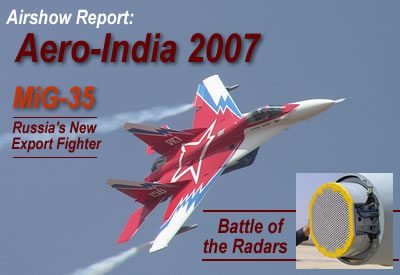
    The stars of Aero-India 07 were the MiG twins – MiG-35 and MiG-29M OVT. The MiG-35 utilizes the basic MiG-29M aerodynamic design, enhanced propulsion, flight control and avionics. Compared to previous MiG-29 models, it provides significant improvement in flight range, maneuverability, and engagement capability of airborne and ground targets. The Indian Air Force is already flying 65 MiG 29 fighter jets, which are currently undergoing modernization under a US$ 400 million program. The upgrade could include improvement of the fighter’s capability of beyond visual range (BVR) engagement, improvement of the central computer and avionics, especially in ground attack functionality.

    The Indian Navy has recently acquired 16 of the marine versions of the MiG 29K to be operated from the aircraft carrier newly acquired from Russia. The first aircraft will arrive in India in June 2007.
    Boeing is offering the Indians joint production of the Hornet, the first time the company is willing to go that far in international cooperation. India has always insisted on the local production of a substantial number of the defense hardware it buys. India’s Hindustan Aeronautics Limited (HAL) is currently producing the Sukhoi Su-30 and MiG-series aircraft, as well as the British Jaguar and the Hawk trainer, to begin local production in 2008.

    Most recently, India increased its order of Su-30MKI with an additional 40 aircraft, which could fulfill urgently needed aircraft replacement at some of the squadrons suffering the highest attrition, buying some time for the MRCA program to mature.

    The 75th Su-30MKI  delivered to the Indian Air Force deonstrated the excellent capabilities of this aircraft during the Aero India 07 airshow.

    Tejas LCA on static display at Aero-India 2007
    Indigenous development of aircraft and helicopters continues in India. The most prominent, alas longest program is the Tejas Light Combat Aircraft (LCA) family developed by HAL. Currently the fifth prototype is in final assembly and is expected to fly in August 2007, to be followed up by the naval version, slated to fly in 2008. A two-seater trainer version is one of the seven prototypes planned for the indigenously developed LCA. Production is gearing up for the low-rate initial production, with the first of eight Limited Series Production Aircraft (LSP-1) aircraft completed, making its ground runs at HAL’s facility at Bangalore in February 2007. The remaining seven LSP-1 aircraft will be delivered by 2008. These aircraft will be equipped with a foreign engine (GE F-404, same as the prototype’s powerplant) and non indigenous radar. The first aircraft of a batch of 20 production aircraft contracted by the Indian Air Force is scheduled to start rolling out of the HAL facilities from 2009-10, at a planned production rate of eight aircraft a year. However, the program continues to experience delays. Initial Operational Clearance (IOC) for LCA was recently pushed back o 2010. The first three prototypes are currently undergoing flight testing and integration. Three prototypes are currently flying, accumulating over 500 hours in test flights. Integration and flight testing of weapon systems is also underway. A model at Aero-India provided a glimpse of this work, equipped with missiles (R-73) and targeting pod (Litening).

    The Jaguar upgrading program is also underway. 20 aircraft were upgraded through the Darin-II program, which included upgrades for the aircraft avionic systems. The aircraft also received new hardpoints, bringing the total hardpoints to nine, supporting enhanced weapon configurations. An inertial navigation platform and a digital map display are now included. While two prototypes of the subsonic aircraft are flying, the government has also placed an order for the limited series production of 12 aircraft.

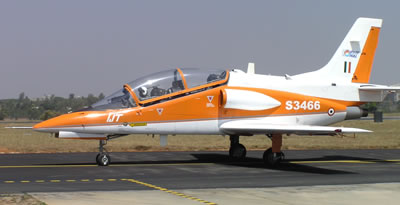
    Another indigenously developed aircraft is the HJT-36 trainer developed by HAL. This Intermediate Jet Trainer (IJT) is expected to become operational by 2008.

    Our Aero-India 2007 report will cover the following topics:

    Fighter Aircraft Programs

    Aero India – 2007

    The Gripen performs an aerial demonstration aat Aero India 2007. Gripen is one of the strong contenders for the upcoming $11 billion Indian Air Force MRCA acquisition program.

    The most prominent program that dominated the recent air-show is the long expected US$6–11 billion plan to replace aging MiG-21s, 27 and Jaguars with 126 new multi-role combat aircraft (MRCA). The program was repeatedly delayed since 2005, when a formal request for Proposal (RFP) was expected. Although such request has not been filed yet, unofficial plans are calling for initial procuring of aircraft as early as 2010, as these are desperately needed to enhance operational readiness primarily with current MiG-21 squadrons, severely depleted in recent years due to the deterioration of aircraft, frequent technical failures and crashes.

    Considered to be the largest, single fighter procurement outside the U.S. market, this program attracted all major world players gathering in Bangalore. The optimistic tried to impress the locals with stunning flight demonstrations while others opted to reserve their resources pitching their offers pampered with attractive economical benefits.

    MiG-35 performs an inverted  flypast at Aero India 2007

    All major producers of combat aircraft were present. The Russian Aircraft Corporation (RAC) MiG Company, demonstrated two versions of the MiG-29 – the MiG-29M OTV flight demonstrator, equipped with two 3D thrust vector nozzles, RD33 engines and fly-by-wire technology. (Thrust vector technology is already used on the Indian Air Force Su-30MKI.) Bangalore was the first international debut for the production version of the MiG-35 (Nato reporting name Fulcrum F), which was unveiled in Russia only one month before the exhibition. This aircraft is based on the MiG-29M OTV, using the RD-33 which could mount the OVT thrust vectoring control (TVC) kit to improve the aircraft maneuverability. It also uses the latest Zhuk-AE phased array active electronically scanning array (AESA) radar. On the parked MiG-35 VIPs could get a closer look at the Russian latest AESA radar – the Zhuk-AE AESA, developed by Phazotron NIIR Corporation. India is already operating the BAR phased array radar on its Su-30MKI and has specified AESA as a critical element of the MRCA platform.

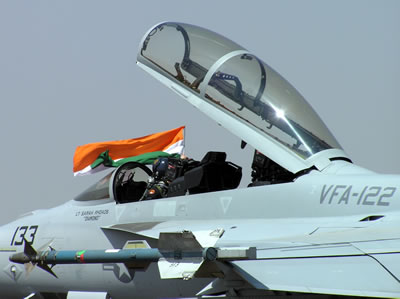
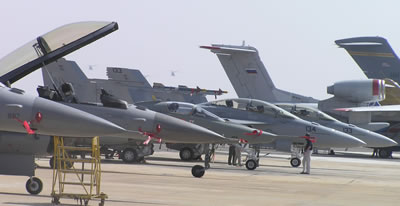
    An F/A-18 was flown by Boeing as part of the flight demonstration at Aero India 2007Two American competitors entered the contest – Lockheed Martin displayed the F-16 while Boeing demonstrated the twin-engine F/A-18E/F. Both companies are proposing their latest versions for the MRCA program. The Super Hornet is slightly large and considered to be an expensive proposition for the Indian requirement but is including almost all Indian requirements in the basic ‘Super hornet’ standard. The F-16 is also a suitable option. Although the aircraft is considered to be at the end of its “career”, and its maneuverability is inferior to the MiG-35, Lockheed Martin is expected to offer the F-16 with highly sophisticated avionics package, including the APG-80-0 AESA radar, making this mature platform an interesting proposition for the Indian requirement, especially when net-centric precision attack is considered.

    Gripen International sent three aircraft to participate at the airshow, two twin-seater JAS-39D and a single seater JAS-39C. Saab also installed a complete Gripen cockpit simulator, at a special pavilion, to introduce visitors to the aircraft unique attributes. Gripen is well positioned to attract Indian attention with a sleek, modern and cost efficient platform, designed as a multi-mission aircraft suitable as a compact companion to the larger Su-30MKI. The manufacturer plans to offer India the new version, similar to the JAS-39N competing against the JSF for a Norwegian Air Force order. Saab has designed the aircraft with an “open” architecture, enabling efficient integration of modern or indigenous avionics, weapons and other systems. Designed to address Swedish operational concept of deployment from dispersed emergency locations, Gripen requires minimal support when operating at forward operating bases and offers the lowest life cycle, operating and support costs for its class. The JAS-39 engines is the F-404, identical to the one used in the first batch of LCA Tejas, offering logistical advantages for the IAF.

    French Dassault is promoting the Rafale for the MRCA competition. Experienced with the way decisions can be dragged in India, sources at Dassault told Defense Update that they expect the decision may not be as imminent as some tend to think. The company is also expecting an Indian decision to modernize part of its Mirage 2000 fighters. The European consortium Eurofighter will also submit its proposal for the MRCA, offering the Typhoon, which has recently won an important order from Saudi-Arabia.

    The MRCA decision will not be based only on technical consideration. India is expected to gain the highest dividends of its investment, either by gaining more concessions from Russia, such as imposing of export restrictions on China, preventing the delivery of advanced engines slated for the upgrade of Pakistani air-force Chinese made aircraft. While Russia leans more toward India, the U.S. continues supporting Pakistan. Within the recent months, the US government cleared multiple arms transfers to Pakistan, including F-16 fighters, helicopters, maritime patrol aircraft and various missiles. Balancing its close ties with Pakistan, the U.S. recently softened its position toward India – one such step was the relaxation or export restrictions related to business transactions with India’s civilian nuclear plants.

    Our Aero-India 2007 report will cover the following topics:

    Aero India – 2007

    New: Aero India 2011 Review

    Aero-India took place early February 2007 at the Yelahanka air station near Bangalore. It was the sixth edition of this bi-annual airshow, and, by far the largest one, due primarily to the rapid growth of the Indian aviation market. Covering both civil and military, as well as the entry of U.S. aerospace companies, this became possible by opening previous government imposed restrictions to deal with India. These sanctions have been lifted recently, offering a huge market sofar dominated by Russian, to European and Israeli companies. In an effort to grab the Indian support and attention to its new hardware, Russia chose this event for the international debut of its latest MiG-35 fighter aircraft, which was unveiled in Russia only one month before the airshow.

    According to a recent estimate published in the India Strategic monthly magazine, India will be spending some US$35 billion on military aviation over the next two decades. Plans include spending well over US$13 billion on the procurement of additional strike fighters and multi-mission aircraft, modernizing existing aircraft, and buying new attack helicopters, transport helicopters and transport aircraft. Fielding of a new systems, includes network – centric communications system, acquisition of advanced of precision attack systems, weapons, new UAVs and pursuing space programs and more…

    Another interesting feature at Yelahanka was the participation of a large number of engineering and software industries that were eyeing the 30 per cent offset introduced into Indian defence procurement procedures. IT majors like Wipro, Infosys, HCL Technologies and Satyam, among others were there. Moreover, several foreign aeronautics majors would also seek partners from among these small and medium companies.

    Our Aero-India 2007 report will cover the following topics:

    NESA2 – Network Enabled Situational Awareness

    Network Enabled Situational Awareness – Army (NESA2) / L3 Com Implementing these technologies into sensors controlled at the brigade level and below, L3 Communications’ Com-Cept Division is offering the Network Enabled Situational Awareness – Army (NESA2), networking existing sensors to accelerate and improve target location.

    NESA2 links to existing sensors such as artillery locating radars, Sentinel air defense radar, JSTARS ground control segment, Prophet SIGINT system and Shadow or Warrior UAVs and theater assets such as the Guardrail / ACS. NESA2 will establish a self-forming, software based sensor to sensor connectivity that will allow sensors to cross-cue each other based on a set of rules that reflect the tactical commanders ISR/Targeting priorities for the area of operation. L3 is planning to implement in NESA2 technologies proven and fielded with current USAF ISR systems. NESA2 will deliver a common, joint picture, leveraging all information currently in place, such as MCS, ASAS, BFT and MTS and incorporate info DCGS-A and CPOF.

    Hamastan Gaza- to become a Wahhabist Outpost?

    Just a little over a year has elapsed since Hamas won the controversial elections for the Palestinian parliament, but by the signing of the Mecca Agreement, it must now be celebrating its ultimate victory against all odds: The Saudi throne endorsed Ismail Haniyeh as Palestinian prime minister but any unity government to be established will from now on come under Saudi patronage. Money is no object either. The Saudi benefactor and its allies can funnel the Palestinian protectorate aid amounting to USD three billion every year without butting an eyelid. Their oil revenues last year alone, totaled some US$ 480 billion.

    The most pressing goal in the Saudi Monarch’s sights was Haniyeh’s personal guarantee to scale down in stages the Iranian and Hezbollah presence in Gaza and nullify Mahmoud Ahmadinejad’s painstaking efforts, made last year to establish Tehran’s strategic Mediterranian outpost in Gaza “Hamastan”. King Abdullah bin Abdul Aziz al-Saud had groomed Ismail Haniyeh’s rise to the top of the Hamas’ leadership during his visit to Riyadh in the second half of January. In fact, Haniyeh seems to have made a shrewd bargaining move last December which certainly comes within the best traditions of Middle East Qasba haggling. His three-day visit to Tehran, during which he held high-profile meetings with top Iranian officials, including Iran’s supreme leader Ayatollah Ali Khamenei and President Mahmoud Ahmadinejad, offered Haniyeh more than he had ever dreamt of. In the words of one Palestinian observer, the Iranians treated Haniyeh like a second prodigal son (the first being Hezbollah). In a press conference at Tehran airport, the Palestinian prime minister, joyfully referred to Iran as now being “our strategic depth”.

    The unexpected generosity of Shia Iran towards a Sunni Islamist movement like Hamas, should have been viewed as a rebuff and direct challenge not only to American hegemony in the region, but to Saudi Arabia which regards itself as protector of Sunni Islam. Naturally, Riyadh’s strategic move which followed was to lure Hamas away from Iran’s influence and bring it back into the Arab fold, in spite of the fact, that the United States views Hamas as a terrorist organization. Whether invited or not, Haniyeh’s next destination was Riyadh, where in a secret deal the elements of cooperation between the Saudi government and Hamas political leaders in Gaza were laid out. Whatever may be claimed against Ismail Haniyeh’s fundamentalist ideologies, his December trip must mark him as an excellent political manipulator! As it seems after all, Iran’s entry into the world of Palestinian funding has not transformed Hamas into a pro-Iranian group or one that is controlled by Tehran, but has given it a great deal of political room to maneuver and this Haniyeh has exploited with maximum effect. No doubt that the Saudi sponsored Mecca Agreement will establish an emboldened Hamas government in its negotiations with both Abu Mazen and Israel.


    But Hamas will have to pick up a price tag which may not be cheap. First it is doubtful whether the Tehran clerics and especially Mahmoud Ahmadinejad will accept willingly to lose another of his strategic assets, having lost his forward base in Hezbollastan in Lebanon last summer. Under his orders Gaza might well explode once more into a new series of sectarian violence, aimed to destabilize any newly formed “unity government” between Hamas and Fatah.

    There is enough sectarian tension and unfinnished business with local warlords and terrorist clans, which view such a government with suspicion. Moreover, Saudi Arabian influence into the Gaza strip will undoubtedly introduce a new danger to secular Palestine- Wahhabism, which no less extreme than Hezbollah or al Qaeda to nullify any future return to a dialogue with Israel or the West.

    Wahhabism (also known as Salafism), is named after Muhammad ibn al Wahhab (1703-1792). The Wahhabis differ from traditional Sunnis in that they believe in the literal interpretation of the words of the prophet Mohammed. They are extremely puritanical and legalistic in matters of faith and religious practice. Wahhabism considers any modernism to be contrary to the Islamic faith. They reject any other branches of Islam and consider these heretics and killing them is not considered a sin.

    Wahhabism is an expansionist sect intolerant of Shi‘ite Islam, Judaism, Christianity, and Hinduism; in fact, Wahhabists seek to challenge and destroy all these faiths. In essence, oil has been the tool that enables Saudi Wahhabi fanaticism to acquire petrodollars to use in activities aimed at undermining, attacking and ultimately subjugating the West. The Saudi-Wahhabi threat must not be underestimated by the delusion that the Saudi royal family is a moderating force within Saudi politics when the realty is that it has produced a well-funded launch pad for extreme ideologies. Indeed, Saudi Arabia and its militant Islamic doctrines constitute a clear and present danger to western societies and especially Israel.

    The royal Saud’s relationship with Wahhabis is symbiotic. The rulers rely on the religious establishment for legitimacy and support, while the religious establishment relies on the government for maintaining and spreading its ideology. From time to time, however, this arrangement fails to work, when extreme fundamentalist elements, either Shi’ite or al Qaeda affiliated cause severe terrorist acts throughout Saudi Arabia.

    Anywhere trouble is found, Wahhabism may thrive and the lawless Gaza strip with its armed chaos may be an ideal place for it. Hamas, as an extreme and relentless anti-Israel and anti-US element represents pure Wahhabism ideology and could become an ideal breeding ground for Wahhabi mosques, financed with Saudi petrodollars. Such a move will certainly not be tolerated by Hezbollah and al Qaeda, who have already established substantial influence in the Gaza Strip among the huge refugee population. But in the long run, Sunni Wahhabism, sponsored by Saudi Arabia, may well gain more public access than the Shi’ite Islam preachers of Hezbollah, or al Qaeda, which is still regarded as too dangerous by the majority of Palestinians.

    But what worries the Saudi king is not Iran’s active involvement in Palestinian affairs, but rather the domino theory of Iranian influence: the concern that this is yet another political move, coming on top of its intervention in Iraq and Lebanon. The attention that Saudi Arabia is paying to the Palestine Authority, whether Hamas or Fatah, is seen primarily as a way of attempting to contain the Iranian domino effect. The Saudi mediation initiative is therefore viewed as one that must succeed, or challenge the ultimate test of Saudi prestige in the region, a situation which the Saudi royal household cannot tolerate.

    From Israel’s point of view, the Mecca Agreement is certainly a worrisome development. The battle to hinder Hamas from gaining the world’s acceptance may well end in defeat, because even the Bush administration would not be able to reject an intra-Palestinian compromise agreement led by the Saudi king. American interests in Saudi Arabia are dominant. Riyadh is the third-largest supplier of oil to the US and no administration in Washington would dare reject the Mecca Agreement that the Saudi king is so proud of, even if there are officials, which regard such an agreement as misplaced and counter to Israel’s interest. But under the circumstances, it is clearly evident, that Israel can blame no one but its own shortsighted political leadership, which allowed the controversial January 2006 elections to be held at all, contrary to all forebodings and which brought Hamas to power.

    Airborne Systems Group Demonstrates new Tactical Parachutes

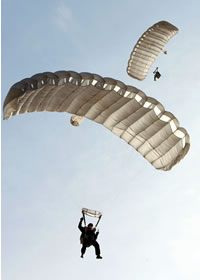
    Airborne Systems Group demonstrated new parachute delivery systems during the company’s “Airborne Days” demonstration event. Among the highlights were the Advanced Tactical Parachute System (ATPS) slated to replace the US Army’s aging T-10 series non-steerable troop parachutes in use since the 1950’s. ATPS is designed for improved safety, by reducing the rate of descent by 25 percent from 22 feet per second with the T-10 to an average rate of descent of 18 feet per second for a 385lbs Total Jumper Weight. Consequently, the decline in rate of descent will reduce the impact energy by almost 40% to lessen the potential for injury. It has a newly redesigned reserve parachute and an integrated harness system more adaptable for use by a wide range of jumpers (fifth percentile to the 95th percentile soldier).

    Airborne is supplying the U.S. Army’s latest steerable troop parachute, the MC-6 system which is being fielded to replace the U.S. Army’s MC1-1 series of steerable troop parachutes. Several high performance military parachutes were also featured. These included the Hi Glide HAHO (High Altitude, High Opening) system which has the highest gliding capability available and has been adopted by the U.S. Marine Corps, along with the Raider/Intruder System currently under evaluation as a candidate for the replacement of the U.S. Army’s MC-4 Ram Air Parachute System. Airborne also demonstrated the LLP (Low Level Parachute) system, the standard non-steerable troop parachute in the United Kingdom, and the SAP (Steerable Assault Parachute).

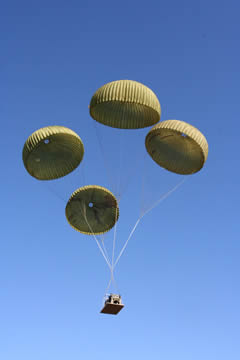
    THis Megafly parachute system can deliver  loads up to 26,000 pounds from an altitude of 25,000 feet using  self-navigating GPS based paraglide systemAirborne is offering a new family of GPS guided autonomous parachute delivery systems known as Joint Precision Aerial Delivery System (JPADS). Airborne developed these products as a family of platforms, with varying weights and sizes using the same software platform. With this “family” approach, the user interface on the autonomous guidance units and the mission planer are identical across the various models of “smart” cargo delivery products. Demonstrations were provided for the ARK (Aerial Rescue Kit) and SPARK (Small Pack Rescue Kit) which are the latest technologies used in aerial delivery rescue and survival equipment.

    NJ based Airborne Systems has combined the core technologies of four of the world’s leading parachute brands; Irvin Aerospace, GQ Parachutes, Para-Flite and AML (Aircraft Materials, Ltd).

    U.S. Army Conducts First Live Fire Test of FCS Systems

    Earlier this month (February 2007) the U.S. Army reached an important milestone in the Future Combat Systems’ program, completing the first live-fire exercise, Experiment 1.1, involving Future Combat Systems technologies and equipment. The exercise was conducted at the Oro Grande Range at Fort Bliss, Texas. Experiment 1.1 evaluated the system and performance in three phases, involving laboratory evaluation of hardware, software networking integration and interoperability. Another phase focused on a more realistic interoperability testing, in a joint operational environment involving more than a dozen Soldiers at Fort Bliss. The third phase involved a larger unit, conducting live fire exercise involving FCS equipment.

    A Soldier (left) from the Future Combat Systems, Evaluation Brigade Combat Team, views his screen for unforeseen obstacles during an exercise and live demonstration Feb. 1 at Oro Grande Range, Fort Bliss, Texas. Photo: by Maj. Deanna Bague, US Army
    The exercise involved the Non-Line-of-Sight Launch System (NLOS-LS) which is a part of Spin-Out 1 scheduled to deploy with current force units by 2008. NLOS-LS gives the Army a highly deployable, long-range “precision attack on-demand” capability, with a much-reduced logistical footprint for faster and more sustainable deployments.

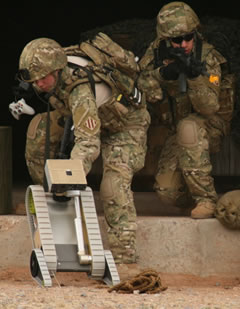
    It was the first step in an accelerated process to mature key capabilities of the FCS program, in an attempt to deploy them to current force combat units. During the exercise a platoon of 36 Soldiers tested FCS systems in urban operations. Among the systems tested were urban and tactical unattended ground sensors (UGS). The unattended ground sensors are part of FCS spin-out 1. This phase also includes an early version of the FCS Network. Other systems tested included unmanned ground vehicles (UGV), designed to clear roads and buildings, as well as detect persons and objects that may enter a building occupied by Soldiers. Robotics and unmanned vehicles used to help clear buildings without risking warfighter’s lives.

    Warfighters were equipped with the Future Force Warrior Individual Ground System (FFWIGS), enabling unit commanders and fellow Soldier to monitor the location and status of each combatant. Another advantage of the FFWIGS is the ability of the platoon leader and the platoon sergeant to locate all their Soldiers on their screen and communicate with them by radio.

    Network Offers Real-Time Link to Imagery Resources Worldwide

    The U.S. Air Force has deployed a new intelligence sharing capability offering commanders and analysts at different locations an immediate access to each other’s intelligence imagery and services, utilizing the recently fielded Distributed Common Ground System (DCGS) Integration Backbone (DIB) provided by Lockheed Martin (NYSE:LMT). By connecting three independent and autonomous intelligence databases, located at Langley Air Force Base in Virginia, Beale Air Force Base in California, and a forward location in Europe, DIB enabled qualified users operating DGCS an access to imagery and intelligence libraries in real-time, at other Air Force sites as well as other agencies. According to Colonel Alan Tucker, Commander, 950th Electronic Systems Group, Electronic Systems Center at Hanscom AFB, follow-on expansion of DIB will create a worldwide intelligence sharing enterprise, providing users with access to information portals offering immediate access to more than 80 percent of the imagery produced.

    The DCGS mission is to collect and process vast amounts of intelligence and imagery from manned and unmanned reconnaissance sources. Prior to the development of the DIB, intelligence analysts had to visit multiple collection sources to locate the data needed. By incorporating a set of common interface standards and a Service-Oriented Architecture (SOA), the DIB connects disparate locations and allows analysts with the appropriate security clearance to access a multitude of intelligence sources. Being SOA-based also facilitates the interface with other SOA-based systems and assures the continuous evolution of a web of capabilities.

    Four Unmanned Systems Removed from FCS, Saving US$3.4 Billion

    In an attempt to balance between sustaining the current force, and equipping the future force, the U.S. Army is restructuring and stretching the “Future Combat Systems” (FCS) program, eliminating $3.4 billion from its budget over the next five fiscal years. These savings were achieved by stretching the fielding of the 15 brigades over five years, starting 2015 and eliminating or deferring four systems from the 18 planned, including the Class II and Class III UAVs, the Armed Robotic Vehicle (ARV) and Intelligent Munitions System (IMS). Total cost of the restructured program is expected to be $162 billion with another $2 billion slated for additional construction required. The FCS was designed as a “family” of 18 individual systems, plus the network and the soldier — referred to as 18+1+1. With four of the systems deferred, the system is now 14+1+1.

    Most significantly, the changes call for stretching the fielding of the 15 FCS brigade combat teams from over a 10-year period to 15 years. The fielding for the first is slated for fiscal 2015. This will reduce costs by roughly $700 million. Army Maj. Gen. Jeffrey A. Sorenson, deputy for acquisition and systems management, told Pentagon reporters. Sorenson said that, despite the cuts, FCS remains the largest modernization program for the Army. He said that the program is on time, on cost and still the No. 1 priority of Army leadership.

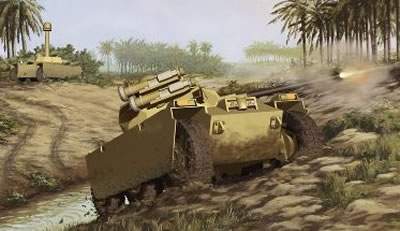
    Both versions of teh Armed Robotic Vehicle (ARV) are developped by BAE Systems. The recce vehicle and armed combat vehicle. Artist drawing: BAE Systems.


    Besides reducing costs, the changes will deliver future technologies into the hands of troops in the fight quicker, Sorenson said. Since 2005 the FCS program was restructured with “spin out” strategy, enabling rapid fielding of elements of the FCS family, instead of waiting until the complete system is fielded. This strategy will enable the fielding of Unmanned Ground Systems (UGS) and part of the network by fiscal year 2008. The network, which will enhance battle command capabilities, will be available as much as two years earlier under the restructuring.Class I mini-UAV developed by Honeywell for the FCS program. Photo: US DOD

    All four systems eliminated from the FCS programs are unmanned systems. These include the Class II and Class III unmanned aerial systems (UAS), which were considered to be low priority for some time, the Armed Robotic Vehicle, considered to be the largest and most expensive system among the FCS Unmanned Ground Vehicles family, and the Intelligent Munitions System (IMS), an array of unattended, autonomous and remotely controlled weapons designed to enable warfighters to remotely dominate an area by selectively denying movement and enemy activity.
    While these systems are eliminated, some of the fund savings will be diverted to increasing procurement of the remaining systems, such as Honeywell’s Class I mini-UAV and Northrop Grumman’s Class IV FireScout. The funds saved by the deferred ARV will be allocated to larger procurements of other, smaller UGVs. The ARV included two types of vehicles. Apparently, both will be shleved for some time. The IMS program was separated from FCS. The systems currently being contracted will be fielded. Elimination of IMS will, however, require investment of released funds into other sensors in the program.

    Companies affectd by the decision could be Textron Systems, a Textron Inc. company (NYSE:TXT), the prime contractof for the IMS program, and BAE Systems, which was involved with the ARV. However, both companies are heavily engaged with other elements of the FCS program. For example, Textron Systems is also pursueing the FCS-UGS system which should receive more focused resulting from the elimination of IMS. Honeywell (NYSE: HON) which was working on a candisdate for Class II UAV, Piasecki Aircraft Corp. and Aurora Flight Sciences, which was working on models for bot classes. Companies about to gain from the new plan are Honeywell, which could get increased orders for its mini-UAV (Class I) and Northrop Grumman (NYSE: NOC), which could get a larger share for its Class IV (Fire Scout).

    Textron System's IMS - has now been separated from the FCS program. Photo: Defense Update

    Deadly Scourge of the US Helicopter Pilots in Iraq

    By Colonel David Eshel

    The downing of six helicopters in the past three weeks shows that Iraqi insurgents are becoming more adept at attacking these aircraft, which the military relies on for a variety of critical functions, regarding them as central elements to counter insurgency warfare. U.S. military officials are carefully studying the downing to determine whether they reflect a mere statistical anomaly, or “some new kind of tactics and techniques that we need to adjust to,” said Marine General Peter Pace, chairman of the US Joint Chiefs of Staff. Intelligence reports caution that it is unclear whether insurgents have obtained new sophisticated anti-helicopter missiles, but that probably small-arms fire was responsible for the recent shoot-downs. A U.S. Army “shootdown assessment team” from Fort Rucker, Ala., is currently in Iraq investigating the crashes of a UH-60 Black Hawk and two AH-64 Apaches between Jan. 20 and Feb. 2 that left 16 Soldiers dead, Col. Robert Quackenbush from the Army Aviation Directorate told American Forces Press Service.

    Officials believe two of the Army incidents were linked. According to U.S. Army Maj. Gen. James E. Simmons, deputy commanding general for support for Multinational Corps Iraq, in two separate incidents, insurgents set up explosive devices along the routes most likely to be used by the deploying coalition quick-reaction force. Simmons discounted reports, though, that advanced missile systems are being used to shoot down helicopters in Iraq. There is no evidence supporting that, Simmons said. He also said there is no evidence that a specific group has been targeting the aircraft. But, he said, insurgents are adapting, their tactics have evolved, and Army air missions have increased.
    The U.S. Army has lost more than 120 helicopters in the war on terror, about 25 percent of them due to enemy engagements. According to recent official statistics, some 57 U.S. helicopters had been downed in Iraq until Feb. 4, resulting in 172 deaths, or about 5.5 percent of total American deaths since the conflict began in March 2003. According to U.S. Army General Simmons, the U.S. Army has lost 29 helicopters to enemy fire since March 2003. The majority of the firefights involve machine-gun and heavy-machine-gun fire, categorized as up to 23 mm, Simmons said. But, he added, some surface-to-air missiles, such as SA-7s, SA-14s and SA-16s, have been used to shoot down Army helicopters. Army helicopters average 100 enemy firefights monthly and are hit about 17 times a month. Most times the helicopters are able to fly back to base. Simmons said that is a testament to the quality of pilots, crews and equipment. The number of flight hours for the Army has nearly doubled in the past two years. In 2005, pilots logged about 240,000 hours. This year, Simmons said, he expects that number to reach nearly 400,000 hours. In 2006, pilots and crews flew 334,000 hours.

    While still substantially lower than the U.S. suffered in the Vietnam War, during which about 5,000 helicopters went down, officials are extremely concerned over the latest trend. In fact, the last recorded incident seems especially disturbing. On Wednesday, Feb 9, 2007 a Marine CH-46 helicopter crashed in the western province of Al-Anbar, killing seven. The London-based Arabic newspaper Al-Hayat has reported the advanced SA-16/18 Igla — a more modern version of the Strela which is harder to defend against — might have found its way into Iraq. It could only have come from Syrian military arsenals, as Russia has sold these weapons to Damascus recently. It is widely known that Syrian border towns in the area are used to funnel arms and money into Iraq.

    In an Internet statement, the al-Qaeda-affilated Islamic State of Iraq claimed responsibility for the latest crashes “We tell the enemies of God that the airspace of the Islamic State in Iraq is prohibited to your aircraft just like its lands are,” the statement said. “God has granted new ways for the soldiers of the State of Iraq to confront your aircraft.” Intelligence sources are unclear if the “new ways” referred to new and advanced anti-aircraft weapons – such as SA-18 missiles – or was simply a boast of recent successes.

    Insurgent's Favorite weapon - the RPGAccording to John Pike, of GlobalSecurity.com, a military information Web site, U.S. forces should be concerned over the latest crashes because of “newer more modern and effective anti-aircraft missiles.” Helicopter countermeasures are probably effective against the 1960s era SA-7, but “their effectiveness against the 1980s era SA-18 is less certain, cautions John Pike. As result, U.S. military helicopter pilots in Iraq tried flying low and fast, hoping to elude heat-seeking missiles fired by insurgents. But the insurgents responded with heavy weapons such as machine guns and rocket-propelled grenades, and the loss rate of American helicopters soared. So the pilots went high again and insurgents replied with lethal surface-to-air missiles. The vicious circle continued.

    What is still more vexing to Helicopter pilots flying combat missions in Iraq is the constant threat from RPGs. U.S. military helicopters are equipped with long-range sensors and devices to jam radar and infrared technology, but they have proven vulnerable to intense gunfire, as well as rocket-propelled grenades. In one new tactic aimed at helicopters, groups of insurgents have waited in places where helicopters frequently fly and then attacked with a combination of small arms, rocket-propelled grenades, The “swarming” strategy may have played a role in some of the recent crashes.

    The first shoot down from RPG is recorded on August 6, 1966 in Vietnam, when a ‘Stingray’ team UH-1E ‘Huey’ gunship was downed by ground fire, suspected to be a rocket propelled grenade fired by the NVA.

    This AH-64 suffered an RPG hit but managed to land safely. Others were not so lucky.During the Afghan war against the Soviets, the Mujahideen perfected anti-helicopter tactics by luring these into well placed ambushes, from which multiple RPGs would be fired at them in volleys. The Mujahideen found that a frontal shoot at 100m range was the optimum, but helicopters at longer ranges, 700-800m were also attacked; by using the explosion of the rocket’s self-destruct mechanism, although chances at this range deteriorated substantially. In order to get close to their targets, insurgents would lay ambush to hovering helicopters, by hiding RPG gunners in tree tops overlooking landing pads. The Al Qaeda technique, found in captured documents in Afghanistan, used to shorten the warhead’s time fuse, resulting in the warhead detonating much earlier in an air-burst, making it a highly effective and cheap weapon against low-flying helicopters.

    Perhaps the most publicized incident in which RPGs destroyed low flying helicopters was over Mogadishu, Somalia in 1993,when two Blackhawk helicopters were shot down by RPG in quick succession over the urban battlefield.

    During Operation Iraqi Freedom 2003, over Karbala, 32 AH-64D Longbow were attacked in a classic ambush, by the Iraqi Medina armored division. The world was shocked when nearly all aircraft were hit by withering ground fire, including RPG salvoes, which forced one of those gunships to crash land, its crew captured. It was a bitter taste of what a simple 750 US Dollar ‘black market’ RPG rocket could still do to a highly sophisticated and ultra-expensive weapon system!

    UH-60 flying low over Mosul, Iraq 2005 (US Army photo)In October 2004 Iraqi insurgents first used a rocket propelled grenade to bring down a UH-60 Blackhawk helicopter over Tikrit. The RPG hit one of the engines, forcing the pilot to make an immediate emergency landing. The five crew member, unhurt by the attack emerging from their damaged craft, came under intense ground fire, which also flamed the helicopter. This incident, although not the first in US history, became the harbinger of things to come in Iraq.

    Two months later, another Blackhawk was not so lucky. On November 16 two US helicopters crashed after being hit by ground fire, killing 17 soldiers on board, the worst single loss of American lives in Iraq since the start of Operation Iraqi Freedom. Investigation of the crash scene indicated clearly, that at least one of the choppers was hit by RPG in the tail section, causing the pilot to lose control, colliding in mid-air with his wingman, bringing both of them down.

    Helicopter pilots soon realized that they were facing a big problem. Rocket propelled weapons do not respond to chaff and flares, the only way for protection is skilled flying techniques, trying to evade hovering over high-risk zones, or adding heavier armour suites, which is not practical for transport helicopters due to their excessive weight factor.
    Inevitably change of operational flight patterns and avoiding routine was thought to be the answer. Lieutenant Colonel Orlando Lopez , a UH-60 Blackhawk pilot and a member of the Army’s Aviation Task Force in the Pentagon Helicopter mentioned that counter-measures include flying more nighttime missions, using unmanned aircraft and pairing more vulnerable transport helicopters with Apache attack helicopters to suppress ground fire had been ordered in the field. But US officials have redoubled their efforts to identify innovative ways to protect the helicopters.

    Plasan's Crashworthy Armored Seats were designed specifically  to protect helicopter crews flying in combat conditionsThe US Army has already added armored crew seats on its Black Hawk helicopters, for instance, along with shielding critical engine components, and in some instances fitting vulnerable sections of the fuselage with ballistic blankets. The Israeli firm Plasan Sasa has developed and fielded a lightweight armor “cockpit protection” solutions for aircraft that are expected to operate in the forward battle area. Both the pilot and co-pilot are provided with armor-protective seats. Protective armor on the Black Hawk, for example, can already withstand hits from 23mm shells. But US helicopter commanders caution that “We do not have the ability to detect small arms, large caliber weapons, RPGs [rocket-propelled grenades],” unleash a barrage of different weapons when a helicopter flies nearby”. Such an an ambush can simply consist of training insurgent troops to ‘swarm’ their fire if a helicopter happens to fly by and only the use of on-the-ground intelligence to determine safer routes can be a solution. Each leg of helicopter flights — whether to transport wounded soldiers and or deliver VIPs has to be painstakingly planned, altitudes and flight profiles are tailored based on the best available intelligence. However, a constantly changing flight profile also contributes to stress on pilots and equipment, which over time can become problematic on sustaining operations. There is already a determined lookout for any technical advancement to solve the dilemma. But it usually takes years for the Pentagon to develop and field new defensive technology such as infrared jammers.

    Flares fired from a US Army Chinook, decepting infrared-guided missilesMeanwhile, pilots have armed their automatic flare dispensers, which fire showers of white-hot fireworks to confuse heat-seeking missiles, and “yank and bank” in a corkscrew motion when approaching a dangerous or “hot” landing zone, dropping with a gut-churning, nose-high descent. Hovering, a helicopter is at its most vulnerable. being down low is the small arms threat. Brig. Gen. Robert Milstead, a Cobra pilot who recently returned from commanding a Marine air wing in Iraq claims: “Above about 2,500 or 3,000 feet you are out of small arms range but you’ve got to worry about the MANPADS threat, by all means avoid 500 to 1,000 feet because you’re hanging out there like a grape, to be picked!”

    Indeed, a new generation of infrared-guided SAMS can attack from any direction, unlike earlier versions which had to be fired directly at a heat source such as a jet exhaust. The missiles carry “staring array” sensors that see a wide field of view and are less easily fooled by flares. Defenses against improved missiles seem to take agonizingly long to develop and field. A new missile warning system that the Pentagon had been working on for years suddenly became a high priority early in 2004, when the Defense Department realized that it was needed to help protect helicopters in Iraq. Every helicopter in Iraq now has one, but it took 2 1/2 years to accomplish. A new device called a “laser jamhead,” which scrambles a missile’s brain, is under development.

    A new Iraqi Sunni insurgent anti-air weapon which is proving deadly for low-flying helicopters became known early last year as “aerial improvised explosive devices” (AIED). It works on the same principle as the roadside bomb (IED or improvised explosive device). This primitive weapon was thought to account for the unexplained downing in 10 days of three American combat helicopters. The projectile is fired to a height of some 50 feet before being detonated, proximity fuse alongside a chopper and covering it in a shower of sharp metal shards. This assumption was confirmed when a unit of the US 101st Airborne Division discovered a large cache of materials for building improvised explosive devices near Hawija on the Tigris River east of Balad. fired to a height of about 50ft before a proximity fuse detonates the explosive, filling the air with thousands of metal shards. By firing a salvo of these improvised bombs simultaneously, the Iraqi insurgents create an aerial “daisy chain,” a trap the targeted helicopters finds it very hard to evade. In some cases, the Iraqi guerrillas set a double trap. A roadside bomb first strikes a US land convoy. The medical helicopter summoned to lift the casualties will then be targeted by the new weapon as it comes in low to pick them up.

    To sum up: a helicopter, if hit by an RPG-7 round stands little chance, especially if scored in the rotor head. The main reason is that ‘there is no warning unless someone on board can actually see the launch below’. If not, there is no indication until the actually rocket slams into the aircraft. Then survival depends on luck-or where it hit!

    If you have sufficient altitude left, you may get away with a controlled crash landing, but usually the RPG gunners aim at low flying or hovering helicopters, so there is not much time left for evasive tactics.

    The most dangerous area to chopper pilots flying at low altitude is the so-called “six o’clock” shadow. RPG shooters prefer to launch their weapon when the chopper has passed, usually aiming for the trailing aircraft, if these fly in wingman formation. In the words of a veteran helicopter pilot: ” There is no real defense against a lucky RPG shot ‘if they are in the right place and you are in the wrong place’ at the wrong time!”


    Thermal Vest (TPI)

    New Trends in Infantry Gear

    A typical system is the thermal vest developed by TPI. The system is designed to be worn under body armor and/or CB protective ensembles. This modular system consists of a wearable underwear garment including shorts, vest and other elements such as sleeves or helmet liner. The garment has coolant lines embedded into flat laminate with each channel, containing a ribbon of closed cell foam. These lines are connected to a temperature controlled fluid supply and conditioning. For a heat transfer fluid, the system uses drinkable water contained in a ‘camelback’ style back-pack integrated with a hydration system supplying cold drinking water to the soldier. The combination of shorts and vest provides optimal cooling flow over most of the body’s large muscle groups and major organs. When a helmet liner is added, cooling the head and neck, an optimal conditioning can be achieved. The system’s dry weight is only 3 pounds. When loaded with water sustaining 500 W/h capacity (4 hours operation at 125 Watt) the system’s weight is about 15 pounds, including a quart of cold drinking water which can be consumed without affecting the cooling system. The system is powered by four AA or C cells, depending on life requirements.

    The back pack contains the system support assembly: the pump, battery pack, control valve and heat exchange/hydration bladder. This assembly fits into a standard 100-oz hydration back-pack (such as Camel-bak, Platypus, Hydrastorm, etc.) or can be integrated into a standard combat or assault pack. An important feature is the The incorporation of the hydration function into the cooling system is a significant advantage for the TPI system, saving considerable weight of the total combat load.
    Using a large bladder up to 100 oz. could provide up to 30 to 40oz of cold drinking water while the remainder of the fluid continues to support the cooling function throughout the mission.

    The cooling vest decapitates over 125 watts of metabolic heat. Adding the shorts and helmet liner for use under intense heat, increase the system’s performance well over 200 Watts. Furthermore, the system is automatically controlled to sustain the required temperature to extend operational endurance. For example, a 500 Watt/hour capacity system could extract 125 Watt for 4 hours or 65 Watt for approximately 8 hours.
    In this series Defense Update covers the following topics:

    Vehicles for Air-Mobile Operations at The 2006 Eurosatory Exhibition

    Special Forces, airborne and air assault units have always relied on all-terrain vehicles to provide mobility and carry some of the heavier loads to support the troops on the ground. These vehicles provide high mobility over rough terrain but rarely have armor protection due to the weight penalty of the armor. New vehicle designs introduced at Eurosatory 06 displayed new capabilities in this field.

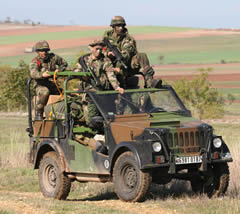
    The Panhard A3 VPS all terrain vehicle is designed to fit into the confined space of CH-53 and NH90 helicopters. This vehicle was selected to equip the 11th parachute Brigade of the French Army, which operates 250 A3F vehicles. A3 is available in 15 versions. The basic platform hauls a 700 kg payload and carries four soldiers. The A3L can carry 900 kg and six soldiers. Both vehicles are powered by a turbo diesel engine, allowing speeds of up to 130 km/h, with a traveling range up to 700 km. Forty vehicles VPS vehicles were ordered for the French Special Forces in 2005. At maximum loading the VPS can carry a payload of 1.2 tons. It has an inherent protection against anti-personnel mines by an integral armored floor. VPS is fitted with slinging rings for rapid deployment by parachute or air. It is designed for long missions in extreme climate conditions.

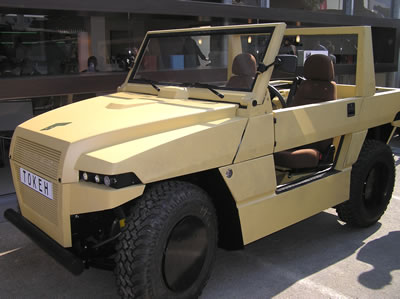
    A different design is the TOKEH, a concept vehicle developed by Rheinmetall Defense. This light tactical vehicle is optimized for internal carriage in an NH-90 helicopters, in support of special operations. It has accommodations for a driver and commander, with an optional third seat. It is a high mobility vehicle with a maximum gross weight of 2.4 ton, including a payload of up to 600 kg. and limited frontal protection.

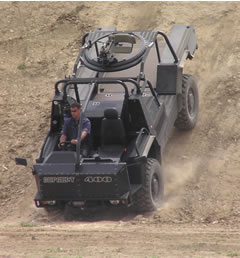
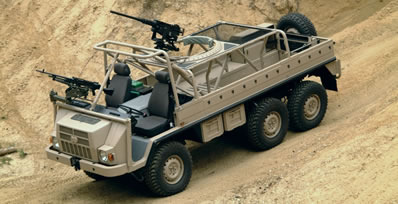
    The Pinzgauer, in service with the British elite and Special Forces, are designed to fit inside a C-130, CH-47 Chinook or MV-22 Osprey, or slung carried by most heavy helicopters. The British (Supacat) designed and manufactured by the British HMT Vehicles company, recently acquired by Lockheed Martin, is offering another air-mobile Tactical Wheeled Vehicles designated LM4x4 and 6×6. This light truck is designed to offer high off-road mobility, enabling it to keep pace with tracked vehicles. The Supacat is provided in armored or standard non-armored, which are transportable with CH-47, CH-53 and MV-22 or C-130 aircraft. Lockheed Martin plans on incorporating HMT’s designs into its vehicles for U.S. programs such as the Lightweight Prime Mover program and the U.S. Army’s Future Tactical Truck System (FTTS).

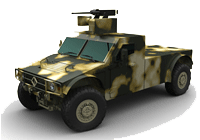
    The armored version of the new Renault Defense Trucks Sherpa 3A is based on the air transportable Sherpa 3 all-terrain platform, with a gross total weight of 12.5 tons. It is equipped with a fully protected hull, which conforms to N2 ballistic protection level and N1 mine protection level. The utility truck version, called Sherpa 3, (12.5 Ton GTW) can carry a total load of 4.5 tons, including a driver and passenger.

    Start < Page 2 of 2 >

    Moldable Ballistic Armor based on Glass-Ceramics

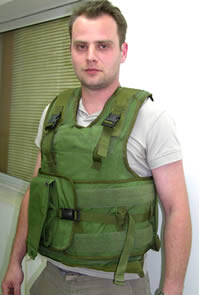
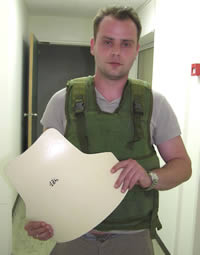
    A new insert offers Level III ‘plus’ protection at 26 kg/m2 aera density, the insert was selected by the IDF for its new body armor vest, produced by GlassCerax. The company developed a low-cost manufacturing process that enables designers to mold an armor module into an ergonomically shaped form that fits the human body while maintaining effective impact protection and ballistic performance.

    Through the process the material is formed into ‘ceramic glass’, which is 20% lighter than comparable tiles fabricated from alumina and cost 25% of comparable plates made of alumina or high density polyethylene. The multi-hit endurance of the molded tile is superior to conventional ceramic tiles, since, its amorphic molecular structure and poreless composition contribute to the reduction of ballistic damage within the impact area, therefore limiting the distribution shockwave and fractures throughout the tile.

    The IDF Hashmonai enhanced bulletproof vest and the new molded plate, developed by Glasscerax.

    The plate is wrapped with polyethylene and adhesives to improve impact protection. The company is currently working on a similar process that will produce plates with Level 4 protection, at the same weight but quarter of the cost of comparable Boron Carbide modules. The complete vest weighs around 7.5 kg, including front, back and side protection and load bearing vest, favorably comparable with the US Army Interceptor Body Armor, which offers half the protected area (since it uses smaller SAPI inserts to protect only the center body vital organs). The enhanced Interceptor, with enhanced front and back E-SAPI, plates and two side armor ESBI inserts weighs much more. Level 4 ‘plus’ ceramic composite inserts are providing further protection against higher threats, including the common armor-piercing AK-47 as well as IEDs.

    In this series Defense Update covers the following topics:

    Quadeye – Panoramic Night Vision Device

    Quadeye panoramic night vision system is developed by Kollsman, an Elbit Systems of America company. The system provides a panoramic night vision goggles (PNVG) covering a central 40 deg. Binocular field of view plus monocular vision of an additional 30 degrees to either side.

    The extended view is similar to the normal eye’s peripheral vision and reduces the need and degree to which panning the head is needed when wearing goggles. Quadeye incorporates four 16 mm I2R, selectable by the user to show either the inner two or the whole panoramic channel of four. The display also uses projected HUD symbology from the helicopter’s avionics or targeting system and has a built-in HUD camera for mission recording and debriefing. A four channel Quadeye adds 13 ounces (370 gram) to existing ANVIS/HUD assembly and can be attached to any ANVIS suitable helmet.

    Skunk Works and XTEND Simplify Multi-Drone Command

    0
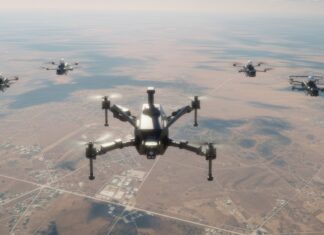
    Lockheed Martin Skunk Works® and XTEND have achieved a major milestone in JADC2 by integrating the XOS operating system with the MDCX™ autonomy platform. This technical breakthrough enables a single operator to simultaneously command multiple drone classes, eliminating the friction of mission handoffs. From "marsupial" drone deployments to operating in GPS-denied environments, explore how this collaboration is abbreviating the data-to-decision timeline and redefining autonomous mission execution.

    From Ukraine to Taiwan: The Global Race to Dominate the New Defense Tech Frontier

    0
    As traditional defense primes face mounting competition from agile “neoprimes” such as Anduril, Palantir and Helsing, the balance of innovation is shifting toward software-defined warfare and scalable, dual-use technologies, while global industry consolidation—marked by Boeing’s integration of Spirit AeroSystems and other strategic mergers—signals an intensified race to secure control over the defense technology value chain. Our Defense-Tech weekly report highlights these trends.

    Europe’s “Drone Wall”

    0
    In early October 2025, a coordinated wave of unmanned aerial system (UAS) incursions—widely attributed to Russia—targeted critical infrastructure across at least ten European nations. The unprecedented campaign exposed the fragility of Europe’s air defenses...

    Weekly Defense Update & Global Security Assessment

    0
    Executive Summary The past week (September 18-25, 2025) represents an inflection point where strategic defense concepts have transitioned from doctrine to tangible reality. An analysis of global events reveals four primary, interconnected trends shaping an...

    U.S. Air and Space Forces Push Next-Gen Programs at the AS&C 2025 Conference and...

    0
    At the 2025 Air, Space & Cyber Conference, U.S. Air Force and Space Force leaders unveiled major updates on next-generation fighters, bombers, unmanned systems, and space initiatives, highlighting both rapid innovation and critical readiness challenges as the services race to outpace global competitors. A short version is available here, with a more detailed version for subscribers.

    TADTE 2025: Reflecting Taiwan’s Strategic Themes

    0
    The Taipei Aerospace & Defense Technology Exhibition (TADTE) 2025 crystallized around four dominant strategic themes that collectively illustrate Taiwan's comprehensive approach to defense modernization amid escalating regional tensions. Based on a detailed report by Pleronix (available upon request). Includes a Podcast discussion on TADTE 2025's highlighting Taiwan's four strategic themes beyond the post's coverage.

    Iron Beam 450 Completes Testing, Soon to Join With Operational Air Defense Units

    0
    Israel’s Iron Beam 450 high-power laser system has completed final testing, marking a major leap in air defense. Developed by Rafael, it offers precise, cost-effective interception of rockets, UAVs, and mortars, and is set for IDF deployment by 2025.