Monday, December 22, 2025
More
    Home Blog Page 390

    HH-47 CSAR – Combat Search and Rescue helicopter

    On November 9th 2006 the US Air Force selected a new version of the Boeing’s Chinook helicopter for the future Combat Search and Rescue (CSAR) helicopter. Boeing is expected to build 145 of the new Chinooks, to be designated HH-47. The new helicopter will replace the HH-60G (Pave Hawk) helicopters which are quickly approaching their useful service life limit, adding much needed endurance and load capacity for extended operations.

    The CSAR program calls for initial operational capability of the HH-47 aircraft in 2012. Under the program, which is valued at up to $10 billion, Boeing will build 141 production aircraft and four test aircraft. Chinook helicopters are already serving with the US Special Operations Command (MH-47G) and US Army (CH-47F). The new helicopter will be designed to deploy quickly and to operate out of austere locations worldwide. The combat search and rescue mission requires the helicopter to operate in the day or night during adverse weather conditions and in a variety of spectrums of warfare to include nuclear, biological and chemical environments. CSAR specific mission equipment should include all-weather navigation equipment and systems for the location of personnel, including special-forces and downed pilots. On-board defensive capabilities will include armor protection, electronic countermeasures, and machine-guns permitting the helicopter to operate and survive in a higher threat environment than current systems.

    Unmanned Counter-mine Systems at the 2006 Eurosatory Exhibition

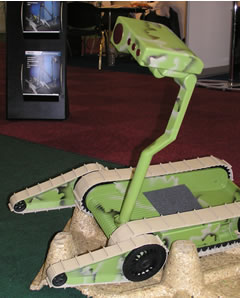
    Robotization of the counter-mine vehicles significantly reduces the risks this type of mission pose to humans. The mission parameters of these operations impose major technical challenges for robots. For example, the vehicles have to be able to follow exactly in each other’s tracks even when traveling at high speed with a substantial interval between them for stand-off purposes.

    Concealed mines and explosive devices represent a permanent danger to soldiers and civilians in crisis torn regions around the globe. Roads and tracks are frequently targeted and, therefore, have to be cleared quickly and reliably. The French defense development agency DGA has been involved in unmanned ground vehicles (UGV) programs since the early 1990s, testing robotic systems designed for counter-mine and reconnaissance activities.

    Current systems are focusing on developmental and operationally testable platforms, including two combat-engineering platforms. One is based on the AMX-30B2DT unmanned tank team, equipped for minefield-breaching, and the MMSR SYDERA route opening and mine clearing ensemble, which is currently being developed under a joint Franco-German cooperation agreement.

    At Eurosatory 2006 DGA demonstrated a large variety of robotic vehicles resulting from a comprehensive land robotic program covering multiple applications of robotic systems to replace humans in high-risk operations.

    Other combat engineering systems include the Combat Engineer Vehicle (CEV). The French Army ordered from GIAT 54 such systems, designated EBG. The program will include 42 EBG F1s vehicles and 12 SDPMAC vehicles. The upgrades include improved protection, integration of DEDALE mine-clearing system, ergonomic modifications to the commander’s and driver’s positions, and improvement of night driving capability. The assault mine clearing vehicles are planned for operation as part of the future modular assault mine-clearing system, which consists of sections of three remotely operated AMX30B2DT vehicles, equipped with mine clearing systems, operated by remote control from a VAB armored personnel carrier.

    The system was approved for production in 2005 after a series of field tests conducted by the DGA. Following the successful field trial in 2005, twelve EBG vehicles will also receive the Pyrotechnic Antitank Mine-clearing System (SDPMAC). This system consists of the fuel-air explosive based Carpet system, developed by RAFAEL and is scheduled for delivery to the French Army by 2007.

    Trojan & Titan – Combat Engineering Vehicles

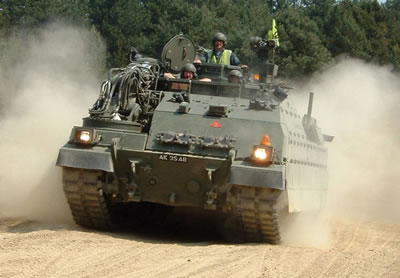
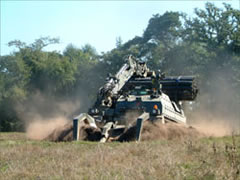
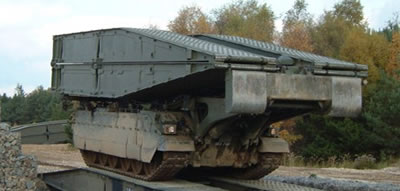
    The UK Ministry of Defence (MoD) unveiled in November 2006two of the new combat engineering armored vehicles destined for service with the British Army. 33 Trojan counter-obstacle vehicles and 33 Titan bridge-layers are being produced under a £250 million contract with BAE Systems Land Systems. The Army plans to operate 66 of these vehicles with its combat engineering regiments. All 66 vehicles due to be delivered by 2008. The new vehicles will replace the Chieftain based Armored Vehicle Royal Engineer (ChAVRE) and the Armored Vehicle Layer Bridge (ChAVLB) currently in service.

    The combined capability of Trojan and Titan can overcome almost every obstacle on the modern battlefield – from breaching minefields to crossing gaps such as rivers and chasms. Trojan can plough through minefields, dig trenches and defensive ditches while Titan can lay a bridge over a 26 meter gap in two minutes whilst maintaining full crew protection – giving operational commanders a potentially battle-winning edge, with the fastest bridge-layer in the world.

    Trojan is first and foremost a minefield breaching machine. It will prepare and mark safe routes using an obstacle marking system, clear complex obstacles and provide short gap crossing utilizing its excavator arm, earth-moving blade and a midi fascine.

    Titan will carry and lay the current range of in-service close support bridges, laying them faster, and in a wider variety of terrain conditions, than previous equipment. Both vehicles are designed to mount and tow the current range of in-service Royal Engineer equipment (Python, AVRE Trailer, Track/Full Width Mineploughs and earth moving blades).

    Suppliers on the programme include Caterpillar, David Brown Engineering, domnick hunter, Kidde Graviner, Ferranti Technologies, Joyce Loebl, Parker Hannifin, Pearson Engineering, Thales AFV, TMS Publications, Ultra Electronics and William Cook Defence.

    Rafael Scutter Expandable Torpedo Decoy

    SCUTTER is an intelligent expandable torpedo decoy for submarines. Operating as a self-propelled decoy, SCUTTER can be launched instantly, at any depth and provide the submarine with an omnidirectional protection against attacks by all known torpedoes.

    On receipt of a torpedo alert, SCUTTER is launched from the Submarine Signal Ejector (SSE) or external launchers. The system is automatically activated after launch, propelling itself autonomously to its operating position. Torpedo transmissions are received and analysed. After identifying the specific torpedo by its characteristic signature, Scutter will select the appropriate deception signals. If an unknown torpedo is encountered, SCUTTER will employ an appropriate deception technique from its portfolio, including Doppler,elongation and range gates, as well as highlights discrimination.

    Concequently, torpedoes will always prefer SCUTTER as a legitimate target, attacking repeatedly while the submarine performs evasive maneuvers. SCUTTER can operate for 10 minutes at a depth of 300 meters, and will self destruct and sink on the completion of its mission.

    SCUTTER can be accommodated on all types of submarines and has no special installation requirements. It is designed from the submariner’s view – as a compact cylinder, it requires only small volume of the valuable submarine space and has been designed to consume no maintenance or facilities on board. No pre-launch tests or presets are required prior to launch, eliminating any chance of human error and ensuring error-proof launch and in-water operation.

    Rosvertol Introduce Modernized Mi-24PN Upgrades

    Prospects programs are expected in Eastern Europe, India as well as other third world air forces.

    However, the “westernization” of Mi-24/35 in service with in Poland, Czech republic, Hungary and Bulgaria are the most lucrative modernization programs for this type. Rostvertol, the Russian manufacturer of the M-24 has introduced weight saving features, which include fixed landing gear and shortened stub wings, to save weight. Avionics modifications include the installation of Russian made thermal imaging system, and integral stores loading system. The “Westernized” Hind also includes a five-bladed glass-fiber main rotor, X-type tail rotor, and 2,400 shp Klimov TV3-117MA-SB3 powerplants.

    The helicopter is installed with a NATO-standard 1553B type KNEI-24 digital mission system avionics. Cockpit improvements include the installation of two color multifunction screens at the upper (pilot) cockpit. These displays can show flight data, maps and thermal or TV imaging. The electro-mechanical systems are also retained for stand-by instrumentation. Radio navigation, TACAN and GPS systems are also used. The sensor payload consists of the UOMZ gyro-stabilized GOES 342 sensor turret installed beneath the nose, integrating infrared imagers, TV and laser rangefinder/designator, all controlled from a single multifunction display at the weapons operator (forward) cockpit.

    The helicopter retain the Russian 9K113M Ataka missiles, but will also be able to use western anti-tank missiles chosen by the operating air force. For example, in Poland, the Israeli Spike ER (formerly known as NT-D) was chosen.

    Unmanned Systems (UAV) Persistent Surveillance

    Start < Page 1 of 5 >

    Unmanned Aerial Systems (UAS, formerly known as UAVs) are being integrated in all levels of military operations offering unprecedented intelligence collection capabilities and “battlefield transparency”. From small and autonomous Special Forces units, through army battalions, brigades, divisions and corps, to joint services theater operations centers UAS provide a wide range of combat support services. Missions include reconnaissance and intelligence missions categorized by performance classes. These include strategic high altitude long endurance platforms (HALE), medium altitude extended range systems (MALE), Short Range UAVs also called Tactical UAVs (TUAV) and small sized systems (Mini UAVs).

    This feature covers the following chapters:

    How OLED Works?

    Start < Page 4 of 4 >

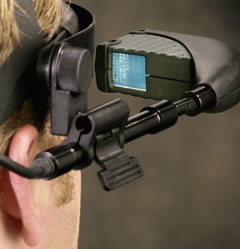
    OLED technology is based on layers organic (carbon-based) chemical compounds that emit light when an electric current flows through the device. OLEDs are emissive devices, which mean they create their own light, as opposed to liquid crystal displays, which require a separate light source (backlight). As a result, OLED devices use less power and can be capable of high, higher brightness and fuller color than liquid crystal microdisplays.


    Further power economies will be provided by Phosphorescent OLED (PHOLED) technology developed by UDC. PHOLEDs will attain up to four times greater efficiency than previously thought possible. Using the principle of electro-phosphorescence to convert up to 100% of the electrical energy in an OLED into light, such devices could be four times more efficient compared to current (fluorescent) OLED technology and up to ten times more efficient than backlit liquid crystal displays (LCDs).

    OLEDs are “imprinted” on a silicon substrate. Since OLED is self luminescent and does not require back-lighting for operation, it is consuming significantly less power than alternative Liquid Crystal Displays (LCD). The active matrix silicon integrated circuits are imprinted directly under the display controlling the power to each organic point of light diode (pixel), performing certain image control functions at very high speed. OLEDs capability to refresh in microseconds rather than milliseconds, as LCD displays do, contribute to virtually flicker-free display in near-eye applications, resulting in smooth display even with highly dynamic motion video.

    OLED technology has several advantages to the military user – since solid-state OLED displays do not use liquid crystal fluids, they instantly switch images on and off even at low temperatures (-40 degrees C) preventing image fade out at high temperatures (+65 degrees C). The OLED concept, patented by Kodak is not new, however, only in recent years it matured into practical technology, especially with the use of more efficient barrier layers (glass and other plastics), lower cost and extended lifespan of the luminescent organic materials.

    In an effort to solve one of the critical OLED limitations, eMagin Corporation and the University of Michigan’s Solid-State Electronics Laboratory (SSEL) are studying novel approaches for thin-film encapsulation to enable the production of small, lightweight rugged displays and, potentially, flexible OLED displays. The program is funded by the Office of Naval Research as a Small Business Technology Transfer (STTR) rugged and reliable thin-film encapsulation method for OLED displays. According to Susan Jones, executive vice president and chief marketing officer, at eMagin, this research could foster new generations of rugged, lower cost encapsulation techniques that could be applied to the production of micro-displays as well as larger format OLED devices.”

    Additional parts of this article:

    Applications Using OLED Microdisplays

    Start < Page 2 of 4 >

    Among the applications already utilizing OLED include the full-color ProView SO-35 monocular viewer from Kaiser Electro-Optics, providing thermal sighting and situational awareness. Proview SO-35 developed for the US Army Land Warrior Program. Another helmet mounted display was introduced in 2004 by Liteye. The LE-450 monocular rugged pod-mounted viewer fits comfortably on the helmet’s NVG attachment, providing day/night viewing capability. The ruggedized system conforms to Milspec 810E / 640, can be submerges in water up to 10 meters deep, It can be used in cold temperatures of up to -40C to +85 degrees, LE-500 head-mounted viewer provides similar performance with “see-through” capability.

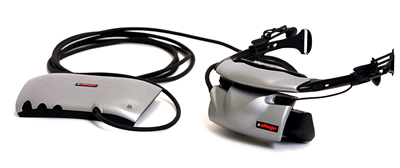
    A different device is the Expedition system from Quantum3D’s, integrating eMagin’s Z800 3D Visor with a THERMITE wearable computer into an embedded-training platform. This Tactical Visual Computer can be coupled with a weapon-mounted synthetic environment controller, correlated head/body/weapon motion trackers, and load-bearing vest, to provide an integrated, wireless, open-architecture platform enabling rapid development and deployment of embedded training and mission-rehearsal scenarios. eMagin’s Z800 3DVisor provides full-color, 360-degree 3D stereovision, hi-fi stereo sound and a noise-canceling microphone to support group training scenarios as well as individual-based training sessions.

    A different application for the Z800 is the a new anxiety therapy system called “Virtual Iraq”. Under development by Virtually Better, with Naval Research Office funding, the Virtual Reality (VR) system supports exposure therapy of anxiety disorders resulting from the high-stress environment. The treatment involves exposing the patient to a virtual environment containing the feared situation rather than taking the patient into the actual environment or having the patient imagine the stimulus. The 3DVisor is used to delivering an immersive VR exposure required for a successful treatments.

    eMagin’s microdisplay is also used in the Hand-Held Thermal Imager (HHTI) from DRS Technologies’ Surveillance and Reconnaissance Group. OLED displays are integrated into Simrad Optronics’ LP10TL Target Locator, used by forward observers. The system has a dual 7x or12x magnification and target locator system, incorporating GPS and digital magnetic compass. LP10TL operates effectively in temperatures as low as -30oC, demonstrating the OLED’s endurance to low temperature conditions. At the other temperature extreme, OLED is embedded in the Fire-Warrior micro thermal imaging system, produced by Total Fire. This monochrome, helmet-based unit provides hands-free thermal imaging for firefighters, leaving both hands free for the work of fighting while providing critical visual information.

    Two additional applications have integrated OLED into a weapon’s sights designed for modern warrior programs – SaabTech is using the displays in head-mounted devices for applications that require visualization of full-color, high-resolution information, such as evaluation of reconnaissance photos, communication of critical command and control information, computer-aided design, urban planning, medical training, and similar applications. ITL’s subsidiary NA-OR is fitting eMagin’s OLEDs into their Advanced Integrated Soldier System (AISS). All visual interfaces to the user in the AISS system feature eMagin’s OLED displays. According to Giora Kutz, Managing Director of NA-OR subsidiary, AISS is designed to provide the soldier with instant access to the information he needs. “eMagin’s OLED displays are immediately responsive, bright and easy on the eye during extended use, they’ve proven rugged enough to withstand harsh environments.” Says Kutz. The system has already been presented to potential customers and is currently being evaluated by the IDF.

    Another application using OLED will be the next generation AN/AVS-7 (ANVIS-HUD) Head Unit Display developed by Elbit Systems. Mounted on a night vision goggle, the AN/AVS-7 system enables display of mission-critical information to the pilot while flying heads up. This advanced electro-optical system combines images seen through the night vision headset with computer-generated graphic and digital symbology. Announced in mid 2004, this was the first avionic application of OLED microdisplays.

    Additional parts of this article:

    SUGV – Small Unmanned, Autonomous Ground Vehicle (FCS Class I UGV)

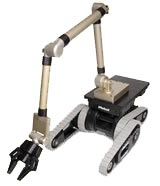
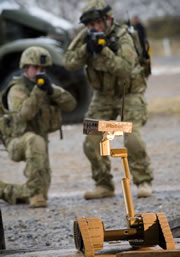
    iROBOT, the developer and producer of the PacBot, demonstrated a model of the Small UGV (SUGV) currently under development for the US Army Future Combat Systems (FCS) program. The SUGV will weigh around 10 kg (20 pounds), compared with 22kg (48 pounds) of the current PacBot. It will carry a payload weight of about 3 kg, utilizing multiple payloads, utilizing “plug-and-play” architecture. This man-portable SUGV will feature tele-operated control or autonomous operation, supported by ad-hoc communications to establish swarm operation by grouping several SUGVs together on a single mission. The new SUGV will offer higher durability, withstanding being tossed through a window or thrown from an upper floor. Equipped with mission specific modules, SUGVs will be configured to conduct military operations in urban terrain, including tunnels, sewers, and caves, assisting warfighters tasked with manpower intensive or high-risk functions without exposing Soldiers directly to the hazard. (i.e. urban Intelligence, Surveillance, and Reconnaissance (ISR) missions, chemical/Toxic Industrial Chemicals (TIC)/Toxic Industrial Materials (TIM), reconnaissance, etc.)

    At AUSA 2008 iRobot launched its family of SUGV 300 robots, based on the SUGV. A member of this new family, the SUGV320 is the robot designated for the future FCS mission (SUGV) while other versions are being produced for near term fielding, as part of the first ‘Spinout’ of the FS program. Among these are the SUGV300 designed as a basic reconnaissance lightweight robot and the SUGV310, designed for dismounted EOD missions. The ‘300 is the basic platform, without payloads, weighing only 25 lbs (11.3 kg). All the SUGV300 family robots fit into the soldier’s backpack (MOLLE) or ALICE packs, and are powered by standard BB-2590/U batteries for more than six hours of operation.

    iROBOT also released develops a larger platform called NEOMover – 150 kg platform, carrying a payload of 100kg (200 pounds). The new robot will follow the design principles of the smaller PacBot (including the characteristic tracks and flippers design). NEOmover will be more durable and robust, NEOMover will be capable of climbing steps and obstacles, drop from a one storey high rooftop and endure harsh environmental conditions.

    Counter IED Systems at AUSA 06

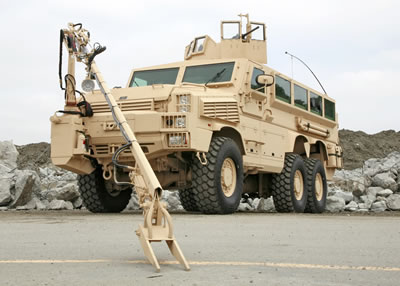
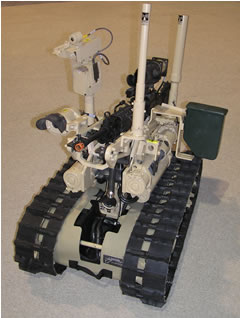
    One of the toughest challenges facing coalition forces operating in Iraq and Afghanistan is the threat of Improvised Explosive Devices (IED). In the U.S., a joint task force was assigned with evaluating, developing and rapidly fielding suitable measures to protect from and defeat IEDs. Capabilities shown at AUSA 06 included IED detection concepts, convoy command and control systems, and various countermeasures ranging from vehicular to man-portable and individual RF jammers, protection systems, and specialized vehicles such as the JERRV and various robotic systems, designed to combat IEDs.

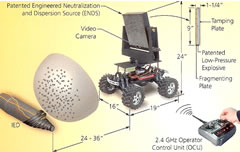
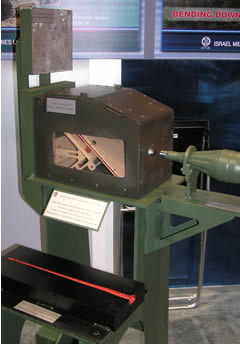
    One of the companies tasked with counter-IED research is SRI, which introduced the Mobile Obliteration Platform, (MOP) to combat IEDs. The system uses a low cost wireless controlled platform mounting SRI’s Engineered Neutralization and Dispersion Source (ENDS), combining a fragmentation panel placed on an explosive sheet made of low-pressure explosive, backed by a tampering plate. Other counter IED concepts demonstrated by the company included aerial sweeps, using laser-induced fluorescence, detecting IED vapor traces, and the use of airborne ground penetrating radar, to spot suspected locations of buried IED.

    Two types of the Broadshield counter-IED jammers were displayed by the UK based TRL company, a member of the L3 Communications group. Future models of the system, currently under development will extend frequency coverage of the BroadShield, integrated with a signal generator and power amplification components. Other jammers, designed for dismounted operations include the Thor, from ACM Systems, a 15 lbs (6.8 kg) system, transmitting 16 watts.

    The company also provides the ShadowBolt IV vehicle borne RCIED jammer, which not only disrupts RC communications but also provides warning on suspected threats. The system also logs the geo-location of the points where signals are located, for further analysis and post-mission intelligence processing.

    Thales launched its latest,Storm H man-portable individual Radio-Controlled IED (RCIED) counter-measure jammer at AUSA, designed to protect dismounted troops on foot patrols. The device is sized similar to a hand-held radio, and can be worn in a pouch or pocket, or clipped to webbing. These new devices enable dismounted troops to move safely away from the restricted field of operation immediately surrounding an ECM vehicle or the ECM member of a foot patrol, enabling each individual soldier to move freely, taking their IED protection with them.

    Start < Page 5 of 5

    Active Protection Systems at AUSA 06

    Various active protection concepts were on display. Trophy and Iron Fist are the two Israeli systems competing for an upcoming IDF active armor program were on display. Active protection is recognized as one of the most urgent requirements resulted from the acute vulnerability of the Israeli and US armor to non-frontal attacks, a typical threat of asymmetric warfare, as demonstrated by Israeli armor during the 2nd Lebanon War.

    A non-lethal RPG defeat concept is the RPGNet, incorporating a net shaped “trap” made of super-high strength ballistic fiber, developed under a joint ONR/DARPA program. The trap will intercept and disrupt the flight trajectory at a safe distance from the protected vehicle.

    Other techniques are proposed to protect light vehicles. These include an airbag based RPG protection concept displayed by Textron Systems. The Tactical Rocket Propelled Grenade Airbag Protection System (TRAPS) is designed to defeat RPGs by employing modified, commercial airbag system to protect vehicles, soldiers and guard posts, without risk of injury to nearby dismounted soldiers or non-combatants. Both TRAPS and RPGNet are providing multi-directional protection but since they are low-cost solutions, are designed as “one-shot” systems and are therefore vulnerable to attacks by rocket salvos.

    Other active protection systems displayed here included the inner layer defense, developed by Northrop Grumman. The system uses a close-in radar warning system, triggering the launch of an interceptor from fixed fans of multiple launchers mounted at the corners of the protected vehicles. Northrop Grumman is also proposing the Porcupine RPG countermeasure assembly, integrating a pack of interceptors (4 or 8) mounted on a remotely controlled weapon station which also carries an XM307 crew served weapon.

    Another directional active protection system is the Close-In Countermeasure System (CICM), developed by BAE Systems. CICM was demonstrated to the US Army during the early APS evaluation phases. According to BAE Systems, CICM will be configurable for land vehicles and helicopters. Raytheon’s Quick-Kill active protection system, currently under development for the U.S. Army’s Future Combat Systems, has not been displayed or discussed despite the public interest in the program.

    Start  < Page 4 of 5 >

    Advanced Protection Systems at AUSA 06

    Various types of appliqué armor were displayed at AUSA 2006, used for enhancement of armor protection of soft and armored vehicles. Among the systems displayed was the LAST armor system developed by Foster Miller. LAST uses a unique hook-and-loop fasteners similar to the Velcro, but five times stronger, enabling rapid application, removal and replacement of external (ceramic) armor tiles and external (spall liners) armor. A different type of protective material was introduced by Boeing. The company displayed a new range of lightweight composite based materials acquired as part of the recent acquisition of Macro Industries Inc. The new armor uses aramid fibers, specially weaved to form a lightweight structure that is thinner and weighs less than comparable panels made of Kevlar. The basic structure effectively protects against 0.5 Caliber Ammunition and can be upgraded to defeat even 14.5mm rounds.

    A range of advanced armor materials was displayed by General Dynamics Armament & Technical Products (ATP) and GD Land Systems divisions. GD-ATP has recently expanded its ass-on reactive armor protection offering beyond the Bradley, for which it relied on the reactive armor kits produced by RAFAEL. GD is now supplying reactive armor suites for the US Army Stryker and M-1A2 Abrams tanks. GDLS has also displayed advanced armor concepts, including the composite/ceramic LIBA matrix known as Surmax, providing appliqué frontal protection for the U.S. Army Stryker vehicles.

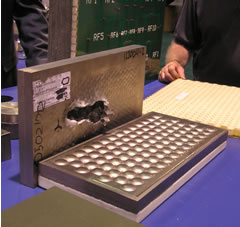
    Other armor designs utilize aluminum sheet formed honeycomb, embedded with Silicon Carbide pellets, creating a lightweight armor capable of defeating multiple hits of high speed (APFSDS) 25mm armor-piercing ammunition fired at short range.  Other lightweight armor materials displayed were Titanium carbide and Boron carbide ceramic modules. A different concept demonstrated a composite armor element embedded with electronic circuits forming antennas for communications and sensor applications.

    A new type of Electro-Magnetic Armor (EMA) is under development by SAIC. This system incorporates modules of layered conductive plates applied to the vehicle’s surface. Conducting plates within the modules are charged to high voltage, and, as a shaped charge jet passes through the electrified area between the conducting plates, it draws a large current from a capacitor bank, dispersing before it hits the vehicle’s surface. To maintain the armor fully charged at all time, EMA systems will require using high energy density components and advanced energy storage technologies. SAIC has already tested EMA on combat vehicles, against multiple, live fire threats. EMA is proposed for both future combat vehicles, equipped with hybrid electric power systems and as an upgrade for current platforms. Start  < Page 3 of 5 >

    Heavier Armored Platforms are Required

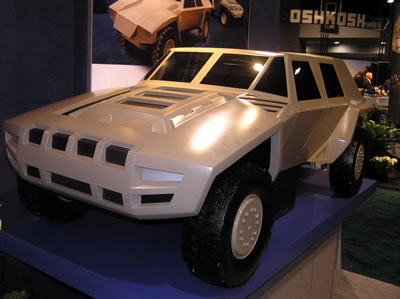
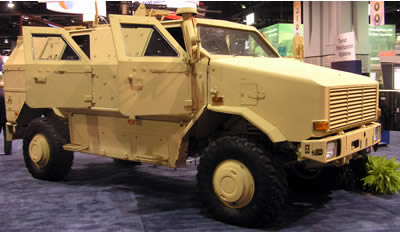
    The weight penalty of the armor is taking its toll in terms of decreased performance and maneuverability, increasing operating costs and accelerating the wear of up-armored vehicles. Therefore, the U.S. Army is seeking heavier, more powerful vehicles which could carry the extra load of the armor while maintaining sufficient load capacity for mission payload. This trend was evident at AUSA 2006, with the display of preliminary concept models of the JLTV shown by Oshkosh Trucks and General Dynamics, and the introduction of near-term armored trucks and utility vehicles, proposed to fulfill ad-hoc requirements, all adhering to the concepts prescribed by the pentagon’s Long Term Armoring Strategy (LTAS).
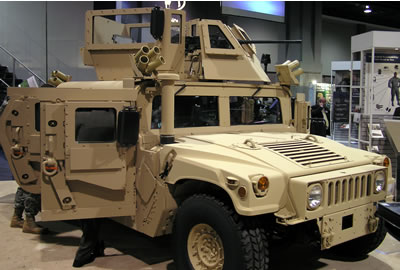
    The latest version of the Up Armored Humvee was on display at Armor Holdings, demonstrating the latest armor add-ons, including a new armor kit, improved gunner’s protection kit (I-GPK) designed to defeat small-arms’ AP threats. It is fitted with rock-strike resistant transparent armor keeping the gunner protected while in weapon engagement posture. I-GPK is available as retrofit for M-1114 up-armored Humveesalready fitted with GPK. Four mount quad launchers are installed at the four corners of the vehicle, where they can screen all directions with smoke or non-lethal munitions. The vehicle can be fitted with air-conditioning system derived from an airborne system designed by Foster Miller. This air conditioning system supports up to five individual micro-cooling vests, reducing cabin temperature to less than 29C deg. (85 F). The system also supports the gunner, even with the turret hatch open.
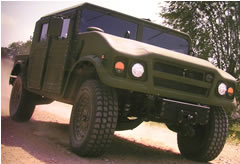
    The Turkish Otokar Cobra light armored vehicle, based on the HMMWV chassis, was displayed by AM General, which also displayed the HMMWV successor – the Evolutionary Combat System (ECV II). This concept vehicle promises to take the current HMMWV to a higher level, retaining full payload capacity when armored. Armoring of the ECV II will adhere to the US Army Long Term Armoring Strategy (LTAS), providing the basic protection as an integral part of the vehicle’s structure. ECV II will be equipped with 250 hp engine, using JP8 fuel. For improved mobility and comfort the vehicle uses semi-active suspension, central tire inflation system and an integrated air conditioning system.
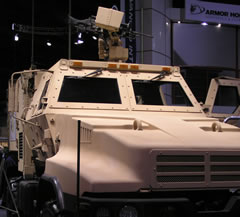
    Several versions of armored trucks were shown, including the FMTV, from Armor Holdings’ subsidiary Stewart Stevenson which displayed two new versions of the lightweight FMTV family of trucks. These included a new utility variant, based on the M1078 (LMTV) chassis, capable of carrying a payload of three tons with full armor, without degradation in vehicle’s performance, handling and mobility. Another vehicle demonstrated the “next generation” configuration for the FMTV armored cab. The new cabin improves visibility, safety, handling and comfort, while providing base level ballistic protection and prepared attachments and bolts for the add-on armor kits (B-kit).

    Lockheed Martin’s is developing the new Lightweight Prime Mover (LMPW). The new all-terrain vehicle is designed to address US Marine Corps’ requirements for 120 tow vehicles for their new M777 155mm howitzers. This powerful, light vehicle can tow over 10,000 pounds (4.53 tons) of weight. It is transportable externally with MV-22 and CH-53. The company displayed the Proof of Concept Vehicle, shown with add-on armor suite developed by ArmorWorks. ArmorWroks offers especially lightweight version of the Ballistic Advantage armor kit, tailored for the Fast Attack Vehicle based on the G-Wagon from Mercedes Benz. The armor kit can be installed in the field within five hours, offering protection against 5.56mm and 7.62mm ball and AP ammunition, IEDs, artillery fragmentation and mine blasts.
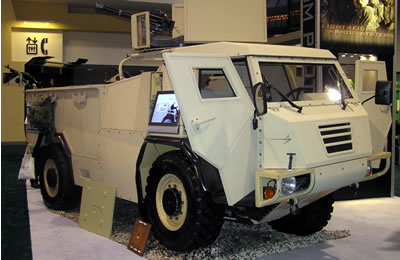
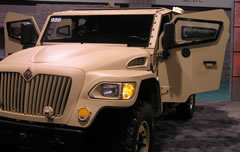
    Similar armor kits are available for field installation on the HMMWV, FMTV and as add-on protection on M915 truck cabs. An armored version of the MXT-MV utility vehicle developed by International Truck and Engines, was unveiled here with an armor suite designed by Plasan Sasa, protecting the driver and passengers against all types of 7.62mm AP ammo, mines, and IED threats. Ceramic armor specialist Ceradyne presented here an add-on armor “B kit”, designed for the Mack Granite truck cab.

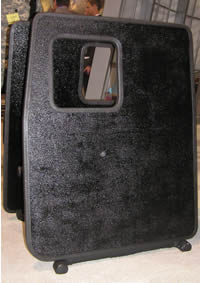
    Physical protection for troops traveling in convoys could be provided by the Multi-purpose Troop Transport Carrier System (MTTCS) developed by Teledyne Brown Engineering and SAIC, to address military requirements for safe transport and rapid deployment of troops and fortifications. The basic shelter accommodates up to 10 persons and their associated gear while countering the ballistic threats of small-arms fire, up to and including 7.62 mm AP, and most fragmentation from Improvised Explosive Device (IED) blast threats. The MTTCS has been test proven by the Rapid Equipping Force (REF) at the U.S. Army Test and Evaluation Command, and has undergone combat operational evaluation under REF sponsorship in Iraq.
    Start  < Page 2 of 5 >
    Precision attack Missiles at AUSA 06

    Raytheon unveiled new details about the Precision Attack, Air-to-Surface Missile (PASSM), under development addressing future requirements for airborne multi-sensor precision attack weapon designed against a target set including armored vehicles and buildings, hardened bunkers and small naval targets. PASSM will use the current Hellfire rail launchers, enabling simple integration with AH-64 Apache and Longbow and Super Cobra attack helicopters and MH-60B naval helicopters. The missile will be equipped with the tri-mode seeker technology developed by Raytheon for the JCM and PAM program, enabling fully autonomous engagement as well as laser designation capability. Each missile will be fitted with a radio, establishing itself as a “node” on the battlefield network. This capability will enable it to receive targeting from multiple on-board and remote sources.

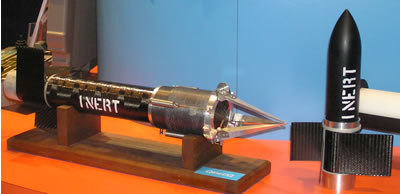
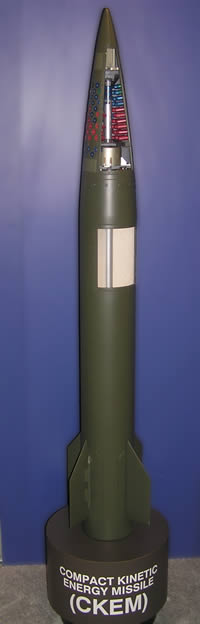
    Non Line Of-Sight Launch Systems (NLOS-LS) was also displayed, as part of the NLOS weapon system which is expected to provide the core precision attack capability to the FCS BCT. NLOS is expected to “spiral out” of the FCS program in “spin-out 1” phase to accelerate its deployment with current forces. When employed with current forces NLOS-LS will be tasked by the Advanced Field Artillery Tactical Data System (AFATDS) for targeting and control. Other anti-tank weapon displayed here included the Compact Kinetic Energy Missile (CKEM) and two versions of the Medium Range Munition, extending the range of 120mm tank guns.

    Urban Assault Weapons

    Upgrade for the veteran TOW II missiles are underway. Raytheon is currently promoting a Bunker-Buster version of the TOW, which recently “spiraled out” of the TOW program. TOW missiles are undergoing improvements that will maintain them in service through 2025. The TOW Bunker Buster uses a fragmentation high-explosive bulk charge to breach up to 8 inches (20.3cm) of double-reinforced concrete walls and destroy fortified targets in complex urban terrain.

    The Hellfire AGM-114K anti-tank version has also been modified to improve its fragmentation capability, when engaging soft targets. The Mod-K modification, pursued by Dynetics for the Aviation & Missiles R&D and Evaluation Center, included the installation of a fragmentation sleeve placed around the shaped charge, optimizing fragment lethality against a broad target set, while minimizing degradation of shaped charge performance.

    Much smaller, but with potential to be most effective, is the lightweight Urban Assault Weapon (UAW) was displayed by Qinetiq. The company conducted extensive research evaluating various shoulder launched weapon concepts, designed to provide infantry troops an effective urban engagement capability. Qinetiq designed their UAW concept to be lightweight (less than 17.6 lbs (8 kg) but capable to provide multiple effects from a single munition, defeating bunkers, buildings or light armored vehicles.

    Start < Page 2 of 2 >

    Skunk Works and XTEND Simplify Multi-Drone Command

    0
    Lockheed Martin Skunk Works® and XTEND have achieved a major milestone in JADC2 by integrating the XOS operating system with the MDCX™ autonomy platform. This technical breakthrough enables a single operator to simultaneously command multiple drone classes, eliminating the friction of mission handoffs. From "marsupial" drone deployments to operating in GPS-denied environments, explore how this collaboration is abbreviating the data-to-decision timeline and redefining autonomous mission execution.

    From Ukraine to Taiwan: The Global Race to Dominate the New Defense Tech Frontier

    0
    As traditional defense primes face mounting competition from agile “neoprimes” such as Anduril, Palantir and Helsing, the balance of innovation is shifting toward software-defined warfare and scalable, dual-use technologies, while global industry consolidation—marked by Boeing’s integration of Spirit AeroSystems and other strategic mergers—signals an intensified race to secure control over the defense technology value chain. Our Defense-Tech weekly report highlights these trends.

    Europe’s “Drone Wall”

    0
    In early October 2025, a coordinated wave of unmanned aerial system (UAS) incursions—widely attributed to Russia—targeted critical infrastructure across at least ten European nations. The unprecedented campaign exposed the fragility of Europe’s air defenses...

    Weekly Defense Update & Global Security Assessment

    0
    Executive Summary The past week (September 18-25, 2025) represents an inflection point where strategic defense concepts have transitioned from doctrine to tangible reality. An analysis of global events reveals four primary, interconnected trends shaping an...

    U.S. Air and Space Forces Push Next-Gen Programs at the AS&C 2025 Conference and...

    0
    At the 2025 Air, Space & Cyber Conference, U.S. Air Force and Space Force leaders unveiled major updates on next-generation fighters, bombers, unmanned systems, and space initiatives, highlighting both rapid innovation and critical readiness challenges as the services race to outpace global competitors. A short version is available here, with a more detailed version for subscribers.

    TADTE 2025: Reflecting Taiwan’s Strategic Themes

    0
    The Taipei Aerospace & Defense Technology Exhibition (TADTE) 2025 crystallized around four dominant strategic themes that collectively illustrate Taiwan's comprehensive approach to defense modernization amid escalating regional tensions. Based on a detailed report by Pleronix (available upon request). Includes a Podcast discussion on TADTE 2025's highlighting Taiwan's four strategic themes beyond the post's coverage.

    Iron Beam 450 Completes Testing, Soon to Join With Operational Air Defense Units

    0
    Israel’s Iron Beam 450 high-power laser system has completed final testing, marking a major leap in air defense. Developed by Rafael, it offers precise, cost-effective interception of rockets, UAVs, and mortars, and is set for IDF deployment by 2025.