
Tuesday, December 23, 2025
More
    Home Blog Page 403

    Terrain Commander Unattended Netted Ground Sensor

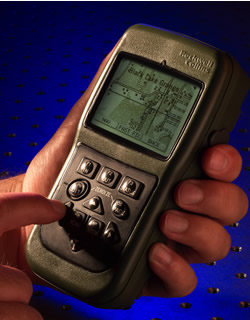
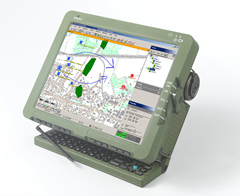
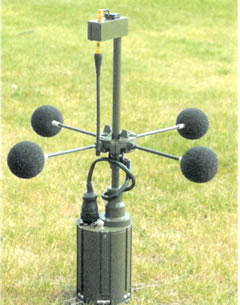
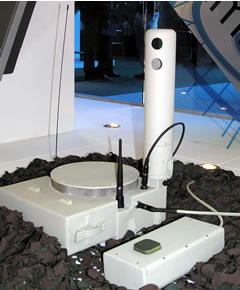
    Terrain Commander (TC) (left below) and Terrain Commander 2 (right below) are network enabled surveillance systems, used for military intelligence gathering and battlefield surveillance, force protection, perimeter security, border control. The TC system’s base unit is a self contained 11 kg platform and 6kg payload, both fit well into an oversized backpack and is deployed in minutes and can operate continuously for up to three months.
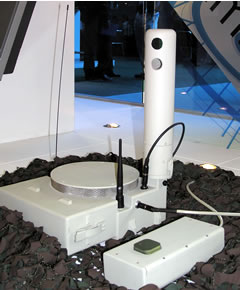
    The Optical Acoustic SATCOM Integrated Sensor (OASIS) payload is an autonomous, day and night multi-sensor suit, which includes electro-optical day/night and acoustic sensors; these can be augmented by additional Miniature Intrusion Sensors (MIS) such as passive infrared, magnetic, seismic and piezoelectric (pressure) sensors which can be deployed up to 300 meters from the OASIS base unit, communicating via wireless links. The system can recognize a personnel size target (day or night) at a range of 150 meters and a vehicle at 500 m., where it is also detectable by the acoustic sensor. A tank target can be detected by acoustic signals at a range of 2.5 km, while a helicopter will be picked up at 10 km. the acoustic detector electro-optics recognition range.
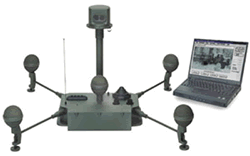
    Enhanced OASIS sensors provide vital battlefield intelligence as they monitor the battlefield deep inside enemy area or monitor sensitive locations which are unattended by security forces. They provide automatic detection, classification, capture and processing of images of activities in their area. Images and data are transmitted in real time to Command and Control Station (CCS) where feeds from several sensors are compiled and monitored. Target data can be displayed as maps, static images as well as multi-frame sequences, which can be used to detect obscured targets by their motion.

    The new version from Textron Systems is Terrain Commander 2. It is comprised of more compact, lightweight elements  weighing a total 4.4kg (9.8 lbs). Terrain Commander 2 can operate autonomously on a single battery pack for 30 days. Mission duration can be further extended with auxiliary power pack. TC2 can detect vehicles at a distance of 500 meters and helicopters at 10 km distance, recognizing a human target at 150 – 500 meters and vehicles, at 0.5 – 1.5km. It will detect any tampering attempt.
    Merkava Mk 4 – Optronics and BMS

    Heavyweights are Adapting to LIC

    Start < Page 3 of 5 >

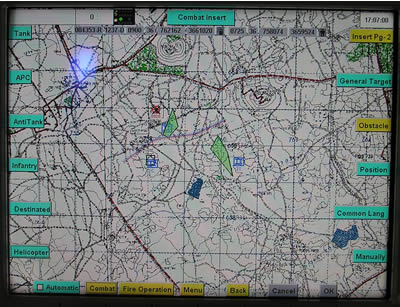
    In addition to the machine guns, all weapons and sensors are linked to the Battle Management System (BMS) and can thus be operated and monitored from any crew station, providing flexibility through crew task assignments.


    The tank is equipped with dual range thermal imaging optics to cover both 3-5 micron and 8-12 micron channels in order to provide improved performance and redundancy under all visibility conditions, day and night. The imagery resolution and performance of the tanks optronics matches the most sophisticated systems currently in service, offering exceptionally clear visibility under all weather conditions. Further enhancements of the optronic capability include an improved target tracker that is designed to effectively combat low-flying helicopters, as well as image processing software that can detect human ground activity. The tank is also equipped fixed video cameras covering the rear and sides of the vehicle.

    The tank is designed as a net-centric system with four redundant networks, which use standard TCP/IP Ethernet protocol. The network is managed by dedicated servers for the turret and hull. It also has a digitally controlled power distribution system for the turret and all weapon and observation systems. The crewmembers use common workstations, which connect to the tank’s ‘intranet’, to operate and display specific information.

    In a typical situation, the tank commander views BMS, his independent sight display and monitors the gunner’s view. The gunner monitors his sight display, orientation, and target data. The loader monitors ammunition count, communications and perimeter views, and the driver monitors engine controls, thermal forward view and rear camera. All crewmembers can view emergency information, such as threat indications, fire alerts etc., and share resources such as communications, video etc.

    According to Lt. Colonel Nissim Nissim, Systems manager at the Merkava Program Office, These networks were recently enhanced with external wireless connectivity, enabling the latest Merkava 4 tanks to share sensor data, situational displays and other information with nearby tanks or other units. He told Defense Update that the current Merkava was designed with sufficient power, processing, communications and interfaces to enable future growth, including adding crewmembers, sensors and processors.

    Additional parts of this article:

    Read more:

    Combat Boat 90H – Fast patrol Boat

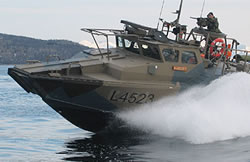
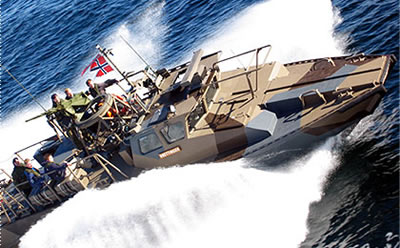
    The Swedish shipbuilder DOCKSTAVARVET has developed the CB90H Combat Boat to answer Norwegian and Swedish Navy requirements. Over 225 boats have already been supplied. The CB90H is constructed of aluminum and designed to operate as a fast attack boat, patrol boat and special operations support vessel. Heavy machine guns are mounted in fixed installations, or stabilized and remotely controlled from a monitor in the wheelhouse. The boat can also carry mines or Hellfire missiles, and a gyro-stabilized twin-barrel 12-cm mortar. The boats have a loading capacity of 21 armed soldiers or up to 4.5 tons of cargo. The boat uses two waterjet propulsion units, each powered by a 460 kW diesel engine, developing continuous speeds exceeding 40 knots and high maneuverability. 

    A non-military Patrol Crafts version of the CB-90 can be equipped with twin 550 kW diesels, to cruise at up to 45 knots. Such a high speed interceptor was recently supplied to the Malaysian Customs service. Equipped with two MAN D2842 LE410 main engines, each with a medium duty rating of 810 kW and two Rolls-Royce Kamewa FF-410 with waterjets, the 16 meter boat has a sprint speed of 50 knots and a cruise at 42 kt. The Malaysian Navy is also operating 17 CB-90H boats.

    Dingo – All Protected Vehicle (APV)

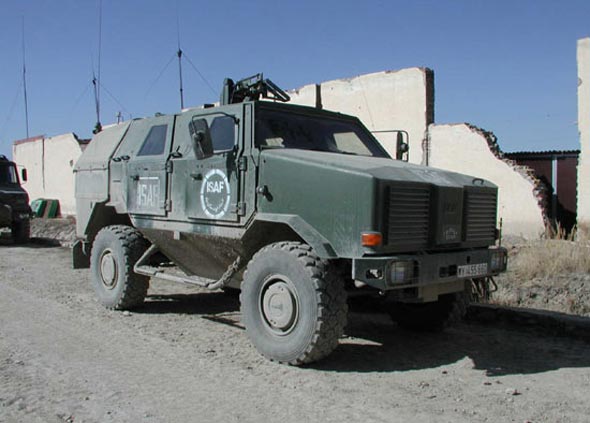
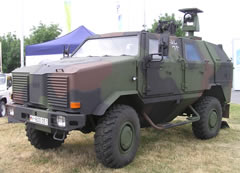
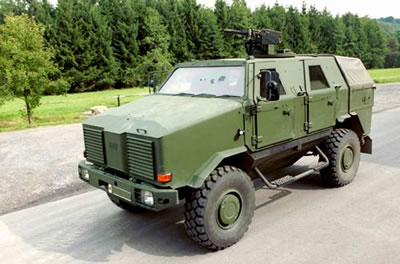
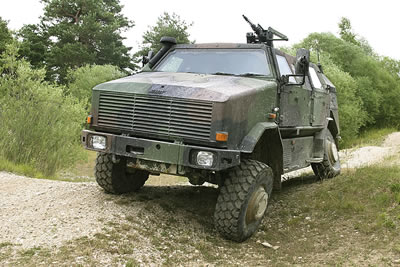
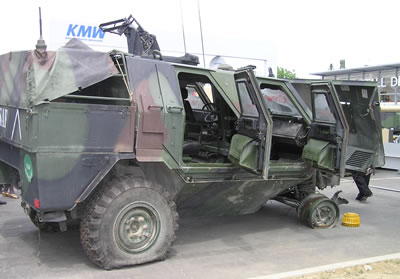
    The Dingo APV was designed to provide a safe and secure multi-purpose vehicle for military and peacekeeping operations. The Dingo 2 is an air transportable, armored mine-proof vehicle, based on a commercial Unimog U1550L chassis produced by DaimlerChrysler, designed for high mobility in any type of terrain.

    The vehicle is fitted with an armored cage protecting the passengers, engine compartment, fuel tank and cargo bay. The modular, repairable armor provides all-round protection against all types of hand-held weapons, as well as artillery fragments up to 155mm. In addition, the DINGO is fitted with an oblique “blast deflector” floor, providing crew protection against heavy anti-tank (AT), EFP (Explosive Formed Penetration) mines and anti-personnel (AP) mines. It is designed to travel at speeds of up to 100 km/h (62mph), has a range of 1000 km (621 miles), is air transportable by C-130 and C-160 aircraft and can be airlifted by CH47/CH53 helicopters.

    So far the German Army ordered 145 Dingo I and II vehicles for its rapid deployment units, currently operating with KFOR in Kosovo and Macedonia and with coalition forces in Afghanistan. Belgium also ordered 352 of the new Dingo III version, also known as Multi-Purpose Protected Vehicles (MPPV). Two versions of the Dingo 2 will be offered, with wheel bases of 3,250 (short version) and 3,850mm (long version), tailored for a variety of transport and carrier configurations designed for reconnaissance, command and control, ambulance, mission platform, forward air control and other missions.

    The DINGO 2 is based on the Unimog 5000 chassis. The diesel powered vehicle is offered in two versions – the short (3.25m’ wheel base) and long (3.85m’ wheel base) which can carry eight fully equipped troops. The Dingo-2 can be fitted with an overhead weapon station, and has an integral collective NBC (nuclear, biological, chemical) protection and air-conditioning system. Other integral systems include GPS navigation, rear-view camera, ABS, as well as radio and internal communications systems.

    The vehicle has an authorized total weight of 9,200 kg for a payload of 1,200 kg plus five fully equipped soldiers. The German Bundeswehr is arming its Dingo version with an under-armor operated 7.62 mm machine gun. Alternatively, a .50 cal. machine gun or a 40-mm automatic grenade-launcher can be mounted on the same weapon station. The German Army requirement for Dingo is over 450 units which are expected to be the stretched version of the Dingo-2.

    To date, Dingo 2 orders amount to over 200 vehicles. In 2005 the Bundeswehr ordered 52 vehicles and on June 29, 2006 KMW announced it is expecting additional 149 Dingo 2s orders, for a total of 109 million Euros. Belgium will also buy 200 Dingo 2 vehicles. Austria received 20 such vehicles in 2005.

    Textron Systems has secured local production license for a similar Dingo 2 vehicle in the US for domestic and foreign military sales contracts. The Israel Defense Forces has already secured funding in its five year plan (2005-2008) for the procurement of 60 Dingo-2 vehicles. Dingos were intended for operations in the West Bank, replacing existing locally manufactured light armored vehicles such as Sufa and Abir.  The estimated cost per unit is $500,000. The IDF requested 103 vehicles which also reflect test vehicles and options for additional batches over the 60 originally planned. The total cost amounted to $99 million, to be financed by US military aid. However, following German opposition to the deal, the IDF procurement was suspended for indefinite time.

    More recently in July 2006, the German opposition seem to have soften; sources in Germany indicated that the German parliament could waive its opposition and approve preliminary sales for testing. However, this may be too late, since Israel is currently considering heavier vehicles, including 4×4 heavily armored trucks,M-1117 ASV armored cars or even the new SandCat up-armored, Ford 350 radically modified and armored by Plasan Sasa, which offers the same protection but cost less than half of the German vehicle.

    SPACIDO – Artillery Trajectory Correction System

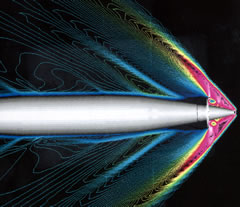
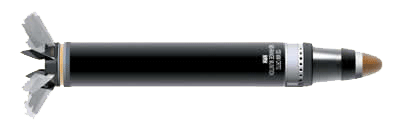
    Improvement of the accuracy of artillery fire can also be achieved by the use of course correction techniques, implementing new braking mechanisms. Such an application is SPACIDO fuse developed under a DGA program by GIAT, TDA Armament and IN-SNEC as an upgrade for in-service artillery shells. The system is built into the fuse and is composed of three discs air-brake and associated electronics. SPACIDO designed to improve by x4 the hit accuracy, by adjusting the actual ballistic trajectory of the specific shell to match the theoretical trajectory which is used to compute the firing parameters.

    SOVIM-2 Mine Clearing Systems

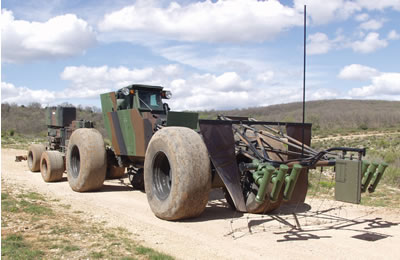
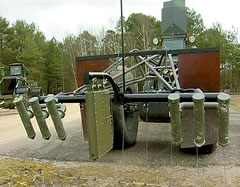
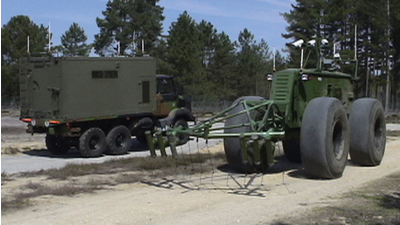
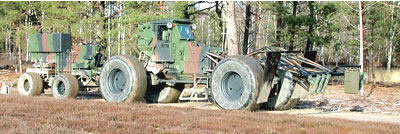
    The upgraded SOVIM-2 system incorporates two vehicles and three trailers. The first vehicle designated VDM carries magnetic and thermal decoys that trigger heat sensitive, trip wire and tilt-rod activated mines. The vehicle travels at a speed of 25 km/h and uses low pressure tires which makes it practically immune to pressure sensitive mines. These are detonated by the heavyweight trailer, towed behind the VDM. A follow-on vehicle is the VTR, which tows two additional trailers to tackle residual un-detonated mines to create a safe track up to a width of 3.9 meters. According to MBDA, a single SOUVIM –2 team can clear 150 km of roads in one day. These vehicles are particularly efficient in securing roads on peacekeeping operations and prior to the insertion of humanitarian aid activities in combat zones. SOUVIM-2 is undergoing field trials with the French Army in 2004. Upgrading of the remaining systems currently in service (4) is expected by 2006-2007.

    Follow-on replacement of the VTR could be the SYDERA, developed under a joint Franco-German demonstration program launched in 2003. SYDERA comprises a Smart Decoy Vehicle (SDV) remotely controlled from a command vehicle (CCV) both traveling at a speed of 20km/h. Detection and verification vehicles are clearing the remaining mines. The system could be implemented on rout, area and airfield clearing missions. MBDA is the prime contractor for the program, while Rheinmetall Land Systems work on the vehicles and detection systems, and Thales Airborne Systems supplies the remote control aspects of the system. The prototype is scheduled for completion by 2005 and will undergo operational evaluations in 2006. If proven successful, the system could enter service around 2010.

    EBRC – French Army Future Armored Vehicle Platform

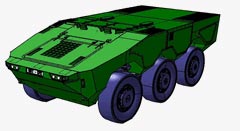
    The future armored vehicles family under development for the French Army is a central element of BOA – the French Army Transformation program. Fielding of the entire family of wheeled and tracked vehicles is planned for 2025. Emphasis of the EBRC family is on wheeled platforms, which is considered more suitable for high mobility and operations in urban terrain. The vehicles will be equipped as direct and indirect effectors (the new buzzword for “weapons platforms”) and will combine cannons of various calibers, (including the 40mm Case Telescopic gun) mortars and missile systems.

    EBRC will utilize hybrid-electric propulsion combining both diesel and electrical propulsion. Other features considered for the new vehicles include the application of mission-specific protection kits (special kits could be tailored for Low Intensity Conflicts (LIC), new weapons (high intensity laser, microwave weapons etc), urban combat (IED, snipers, RPG sent), and even law enforcement & peacekeeping scenarios etc (countering fire bombs, stones etc.) An integral application of stealth will be provided via multi-spectral camouflage, active protection system and countermeasures, integration of battle-management information applications assisted by decision support systems, which will relieve commanders from the workload generated by multiple sensors and information feeds generated in the networked battlespace.

    Electronic Warfare for the Asymmetric Warfare at the 2006 Eurosatory Exhibition

    As modern warfare is adapting to asymmetric warfare, so does electronic combat, which is diverging from the fixation on engagement in the vicious circle of EW-ECM-ECCM towards addressing the sophisticated, commercial communications and electronic systems, currently used by terrorists and insurgents. The new threat systems range from devices used maintaining loose control over a diversified network of collaborators to the employment of sophisticated IEDs triggered by cellular phones and used as remote controls. Several systems developed to combat these threats were introduced at Eurosatory.

    A new complex of Cellular SIGINT and EW systems was exhibited by Tadiran Electronic Systems, a subsidiary of the Elisra Group, which has developed these capabilities as a result of the Israeli war against terror. These new systems enable military and law enforcement security forces to track, trace and engage suspect cellular phones. In contrast to common use of “brute force” jamming, in the attempt to disrupt communications or isolate a suspected IED from the cellular network, the new system employs selective jamming, therefore enabling continued operation of friendly units while incapacitating suspected or unidentified cell-phones. When specific sets are identified as “suspects”, they can be individually intercepted, localized and deactivated by the use of Elisra’s hand-held passive Locator, which can lead intervention forces to the suspect source, or the intervention force can use the Cellective, a selective cellular jammer to deactivate the suspected device even without locating it. This new ensemble enables security forces to intervene in an evolving situation in a “surgical” way, without alarming or inconveniencing the local population, or alerting the suspects.

    A different system, which can be used as a powerful IED countermeasure, is the High Power Electro-Magnetics (HEPM)system, available from Diehl and Rheinmetall Defense. HPEM can be effective against roadside bombs and IEDs containing electronic devices (such as acellphone or any other electronic actuating device). An HPEM based counter IED system can cause controlled explosion or deactivation of the charge at a safe distance from the protected vehicle. Rheinmetall and Diehl are offering several types of HPEM modules, including concealed devices that can be embedded in the doors of police cars or convoy protectors. These devices enable highway patrols to stop a suspect vehicle when driving side by side. A similar system can be used to protect a vehicle or a convoy from IEDs. (A typical application was demonstrated by the GEFAS concept vehicle). Different systems developed by both companies will offer ultra-wideband HPEM coverage, from Megaherz to Gigaherz, effectively denying all types of communications with either directional or omni-directional coverage. A typical system is the compact, battery operated DS-110, which disrupts and destroys processor driven electronic modules in any system, by generating resets or inducing power latch-ups, therefore immediately neutralizing the target. The basic system is omni-directional but it can be configured to generate a directional radiation pattern.

    Start < Page 3 of 3 >

    Multi-Mission Combat Vehicles at the 2006 Eurosatory Exhibition

    A new concept, first introduced at last year’s DSEI by Thales, was the THOR multi-mission vehicle. Interest in this vehicle type is increasing as could be seen by the number of new designs presented at Eurosatory this year. The multi-mission concept enables a single vehicle to undertake several different missions depending on weapons fit, such as air defense, anti-tank, precision attack, bunker buster and self defense. The implementation calls for the integration of powerful optronics for intelligence gathering and target acquisition, and the use of modular or multi-mission launcher, which can fit several types of weapons, such as anti-aircraft, anti-tank / multi-purpose guided weapons and guns for direct fire.
    This concept was first introduced in combat by the Israeli Army, when they employed the M-163 Vulcan as a fire support element in urban combat during the Lebanese conflict and later in urban combat during the Intifada. The Russians took this concept a step further, by developing the Tank Support Vehicle based on lessons learned during their military actions in Chechnya. With the introduction of multi-purpose guided weapons such as the Hellfire, Spike and Milan families, the concept migrated to the west.

    At Eurosatory, several versions of Multi-Purpose platforms were introduced, including the Canadian MMEV, the French MPVC, which was developed by MBDA and the Avenger Multi-Role Weapon System (AMWS) by Boeing.

    Start < Page 1 of 2 >

    C4I Merge with Tactical Internet at the 2006 Eurosatory Exhibition

    With the progressive fielding of tactical radios capable of voice and data transfer, as well as dedicated data radios, the next step in the evolution of tactical command and control is the creation of a  “tactical internet”, enabling combatants at all levels to exchange and access information from any connected source. DI@NE, a mobile tactical internet developed by Thales, is an example of this type of network. Similar systems displayed at Eurosatory 06 included the digital networking system, based on the Israeli Army DAP developed by Elbit Systems and the new Aw@renet system, developed by Tadiran Communications.

    A new concept of integrating planning, rehearsal and operational control was demonstrated by EADS with the new APLET tactical engagement planning tool, which is intended for motorized and armored brigades and is interoperable with the French Forces’ SICF C3 system. The system simulates the structure and operations of French Army Battalions, enabling the Brigade staff to simulate a 24 hour operation ito fit into a 10 minute time frame.

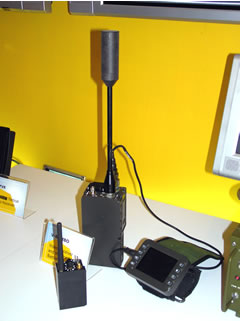
    Enabling personal communications and support of dismounted troops, SOLAR Personnel role radio, developed by Thales Land & Joint Systems Division is providing voice, data and video at rates of up to 1Mbps. The system uses waveform optimized for urban combat environments. Thales positions SOLAR as the heart of its wireless local area combat network, interfacing directly with battle management systems in their man portable or vehicular configurations.

    Applications deployed over the “tactical internet” include BMS systems such as the new SIT-V1 demonstrated by GIAT Industries. The company has already delivered some 400 SIT systems to the French and UAE armies, and is set to begin deliveries of an additional 1,000 SIT V-1 systems to equip French Army tactical level combat units. Further improvements on the horizon will integrate SIT BMS with formations operating the FELIN dismounted infantry combat systems. Designated SIT COMDE, (FELIN BMS Dismounted Combat), the system relies on tactical radio networks, satellite navigation (GPS) and digital mapping to provide situational awareness for dismounted units. SIT COMDE uses a palm sized BMS to be employed by squad, and platoon leaders, to complement the vehicle’s BMS. When development is complete Sagem will deliver 1,500 SIT COMDE units, to equip squad and dismounted soldier (FELIN) group leaders, and 4,500 SITEL units, adapted for various vehicles operated by infantry, cavalry and combat engineering units.

    As of early 2006, SIT is currently in service with 250 command vehicles deployed with the first two “digitized combined brigades”. According to plans, the delivery of a total 750 command vehicles will be completed by 2010.

    Tadiran Spectralink introduced the new TARGET (Tactical Ruggedized Video Transmitter) to enable video and data transmissions for special operations forces. The miniature transmitter weighs only 140 grams and can operate continuously for 3 hours on its battery power. This device can be connected to a video camera carried on a miniature unmanned platform, a helmet mounted camera carried by a soldier or coupled into a sniper’s sight, to transfer the views to command elements to ranges up to 2,000 meters. Video signals can be received by standard remote video terminals, such as V-RAMBO, VTVR and TVL-II.

    Start < Page 2 of 3 >

    Special Operations Combat Assault Rifle (SCAR)

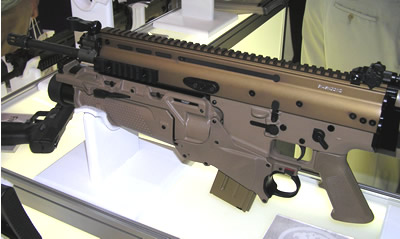
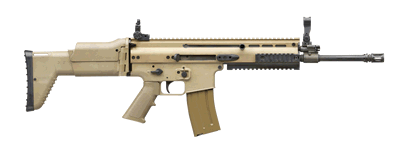
    The Special Operations Forces Combat Assault Rifle (SCAR) is a modular assault rifle family, designed by FN Herstal (FNH) responding to US special Operations Command requirement. FN won US Special Operations Command (SOCOM) development contract in November 2004. The SCAR family of weapons include the SCAR Heavy 7.62mm rifle, SCAR L (Light) 5.56 mm version and Enhanced Grenade Launcher (EGLM) grenade launcher which will be able to fire Fuse Programmable Ammunition. (as shown in the photo above).

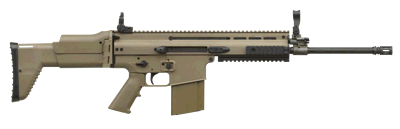
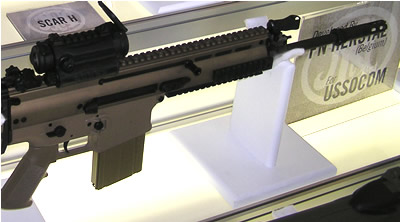
    SCAR L (above) is a 5.56 mm assault rifle, which will be replacing the M4A1, Close Quarters Battle Rifle (CQBR) and Mk12 currently in SOCOM service. SCAR H, a 7.62mm assault rifle (below), will replace the M14 and Mk11 sniper rifles. Both variants share 90% commonality and will have a choice of three barrel lengths, allowing operators to tailor the weapon for specific operations, using a “standard”, Close Quarters Combat (CQC), or “sniper” barrels. These changes will affect the velocity and directly relate to lethality. The EGLM is a 40mm grenade launcher with a side-opening breech to allow loading longer munitions, and has target ranging and ballistic solution for enhanced fire control.

    Following the final design review of SOF Combat Assault Rifle (SCAR), FNH is completing the finalphase of development and is preparing for serial production of the new weapon. After a series of design reviews and testing with United States Special Operation Command (USSOCOM) and Naval Surface Warfare Center (NSWC Crane) the SCAR is ready for low-rate initial production. Delivery of first 1,000 out of the total 85,000 rifles included under teh SOCOM contract are scheduled to be delivered by January 2007. The SCAR will be built at the FN Manufacturing LLC, plant in Columbia, South Carolina.

    SCAR-L is designed to enable 70% hit ratio on 500 meter point target and 600 meter area target (These are threshold levels, the objective is to extend the range by 100 and 200 meters, respectively) SCAR-H provides better accuracy and range, enabling 70% hit ratio on 600 meter point target and 800 meter area target (objective – 800 / 1000 meters).


    Following SOF specifications, SCAR has multiple MIL-STD 1913 rails (Picatiny rail) enabling flexible configure the weapon for various missions. On the top of the weapon (12 O’clock) a long rail is running continuously from the rear sight to the front sight, where sights, night vision devices or cameras are commonly used. Additional rails are attached to both sides and at the bottom, in the fore-arm and hand guard area. All rails are boresight aligned with the barrel, thus eliminating the need of individual zeroing of each configuration. These rails are designed as part of the weapon’s structure, improving durability, isolating the harmonic vibrations induced by the barrel during automatic firing. The bottom rail (6 o’clock) enables installation of future systems more closely to the gun barrel thus improving aiming accuracy and reducing error rate, especially at long range. It is designed with higher durability to withstand recoil forces generated by the Enhanced Grenade Launcher Module (EGLM) producing a pressure of 230 bar. All SCAR types will be compatible with EGLM, including SCAR-L.

    The new family of rifles was optimized for ergonomic handling and reliability, availability and maintainability (RAM). Parts commonality between the SCAR-L and SCAR-H will be maximized to create a family of SCAR weapons. The weapon is finished in a durable desert tan color, specified by SOCOM. It is manufactured to be corrosion resistant, and is capable of lube-less firing. The commonality between all models is essential to reduce training time, improving the SOF operators ingrained operational and emergency procedure autonomic responses that are critical during high stress situations.

    SCAR is following a SOCOM Joint Operational Requirements Document which defined high reliability standards for the assault rifle. SCAR is designed to meet x3 times the reliability levels, compared to existing assault rifles such as the M4.

    On February 2006, at the Las Vegas SHOT Show in Nevada, FNH announced plans to introduce within two years (ca. 2008) a semi-automatic version of the SCAR modular rifle system, designed for the law enforcement and commercial markets.

    Feature SCAR L SCAR H
    Operation principle Gas Operates, Rotating Bolt,
    Short Stroke Gas Piston
    Caliber 5.56×45 NATO 7.62×51 NATO
    / 7.62×39 M43 & others
    Max. Overall length 33″ / 838 mm 40.2″ / 1,021mm
    Minimum length 31.02″ / 612 mm 38.7″ / 798mm
    Barrel length 13.78″ / 350 mm 19.70″ / 500 mm
    Weight (unloaded) 6.8 lb / 3.08 kg 7.2 lb / 3.26 kg
    Rate of fire (auto) 550 RPM 550 RPM
    Magazine capacity 30 (M16 magazine) 20 (7.62×51)
    / 30 (7.62×39)

    Surveillance and Intelligence Gathering Equipment at the 2006 Eurosatory Exhibition

    While robotics provide the promise of more autonomous and sophisticated intelligence gathering for future, autonomous, remotely controlled unattended ground sensors already provide some of these capabilities today. These systems rely on sophisticated communications, sensor fusion, camouflage and concealment techniques to function. At Eurosatory, several systems were introduced. These included: Caladiom, a smart remotely controlled video surveillance sensor from Bertin; CaVA concealed video surveillance sensor from Surveycopter and the Terrain Commander Mk II from Textron Systems.

    Qinetiq displayed a new concept for “networked UGS“, that is similar to the US planned FCS UGS system also pursued by Textron. EADS demonstrated its concept for a stand-alone video surveillance network called IRIS, providing a system to control four field deployable video cameras for security, force protection or area surveillance application. Another perimeter surveillance system is the Laser Perimeter Awareness System (LPAS) from Goodrich. This system can operate from fixed positions or as a mobile / deployable sensor operating under all visibility conditions, day or night. ODF demonstrated a new version of the Gatekeeper and the Eyeball R1. These unique observation devices are designed for operation in confined spaces. The recent versions are provided with special camouflage coating that conceals the device and make it look like a pebble.

    Start < Page 1 of 3 >

    Advanced Tank Ammunition

    New trends in tank ammunition also reflect the shift from full scale high intensity wars to low intensity, asymmetric conflicts. More range, higher precision and controlled lethality are the guidelines of new developments of tank munitions. Several new products shown at Eurosatory 2006 already indicated these changes.

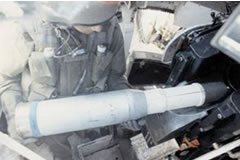
    ATK displayed the Mid-Range Munition (MRM), a precision guided KE round, combining precision guidance with the lethality of KE warhead. MRM-KE is designed for 105mm and 120mm cartridges and comprises an interchangeable sensor component using multi-mode seeker. Another version of MRM – equipped with a shaped charge warhead, is developed by Raytheon. The company performed its first successful test of the new projectile in June 2006, fired at a moving tank at a range of 8700 meters. The MRM program is considered a key component of the Army’s FCS (Future Combat Systems) vehicles and a potential spin-out to M1A2 Abrams SEP.

    In France, GIAT is developing a similar program called Polynege, designed for platforms equipped with the smoothbore 120mm gun. Polynege will engage targets beyond line- of- sight or under non-line-of-sight conditions. Polynege can strike a target at range between 2500 to 8000 meters. It will be able to defeat heavy armor as well as light/unarmored and infrastructure targets. Components of the weapon and its aerodynamic profile have already been tested in wind tunnel.

    IAI/MBT completed the development of a laser guided 105/120mm rocket propelled tank round (called Lahat). This weapon is considered for optional retrofit for current Merkava, Leopard and Indian Arjoon tanks.

    Start < Page 6 of 6 >

    Unmanned turrets at the 2006 Eurosatory Exhibition

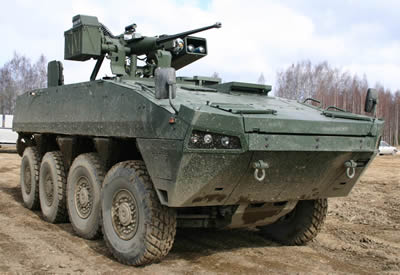
    The Patria Advanced Modular armored Vehicle fitted with the Rafael Samson 30mm remotely operated weapon station. Photo: Patria

    Elbit Systems displayed its dual-axis stabilized 30 mm cannon, recently selected by Belgium for its new MOWAG Piranha Armored Infantry Vehicle (AFV). A similar system will be installed on the Portugese Army Pandur II 8×8 AFV as part of a $32 million order. This system recently completed tests in Finland, on a Patria AMV armored vehicle, firing effectively at moving targets, while stationary or moving, at ranges of 1 – 2.7km. Assisted by the system’s automatic target tracker, the gun scored 90% hits of all rounds fired in field tests. (A similar program is underway with the Slovenian Army. However, the weapon station’s provider has not been announced yet.)

    RAFAEL recently reported the receipt of a $120 million order for providing 30mm elevated unmanned weapon stations for Pandur II 8×8 vehicles, which were recently adopted by the Czech army.

    Remotely operated weapon stations are not limited to the small arms – GIAT is pursuing similar capabilities with the TOUTATIS 40mm remote-controlled turret demonstrator designed for integration in current or future combat vehicles (EBRC and FRES are currently being considered as platforms for this design). The system utilizes the CDI 40mm automatic, case telescopic weaponsystem firing at a maximum rate of 200 rounds per minute.

    Start < Page 5 of 5 >

    Skunk Works and XTEND Simplify Multi-Drone Command

    0
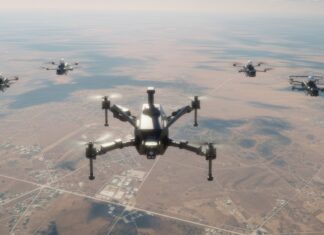
    Lockheed Martin Skunk Works® and XTEND have achieved a major milestone in JADC2 by integrating the XOS operating system with the MDCX™ autonomy platform. This technical breakthrough enables a single operator to simultaneously command multiple drone classes, eliminating the friction of mission handoffs. From "marsupial" drone deployments to operating in GPS-denied environments, explore how this collaboration is abbreviating the data-to-decision timeline and redefining autonomous mission execution.

    From Ukraine to Taiwan: The Global Race to Dominate the New Defense Tech Frontier

    0
    As traditional defense primes face mounting competition from agile “neoprimes” such as Anduril, Palantir and Helsing, the balance of innovation is shifting toward software-defined warfare and scalable, dual-use technologies, while global industry consolidation—marked by Boeing’s integration of Spirit AeroSystems and other strategic mergers—signals an intensified race to secure control over the defense technology value chain. Our Defense-Tech weekly report highlights these trends.

    Europe’s “Drone Wall”

    0
    In early October 2025, a coordinated wave of unmanned aerial system (UAS) incursions—widely attributed to Russia—targeted critical infrastructure across at least ten European nations. The unprecedented campaign exposed the fragility of Europe’s air defenses...

    Weekly Defense Update & Global Security Assessment

    0
    Executive Summary The past week (September 18-25, 2025) represents an inflection point where strategic defense concepts have transitioned from doctrine to tangible reality. An analysis of global events reveals four primary, interconnected trends shaping an...

    U.S. Air and Space Forces Push Next-Gen Programs at the AS&C 2025 Conference and...

    0
    At the 2025 Air, Space & Cyber Conference, U.S. Air Force and Space Force leaders unveiled major updates on next-generation fighters, bombers, unmanned systems, and space initiatives, highlighting both rapid innovation and critical readiness challenges as the services race to outpace global competitors. A short version is available here, with a more detailed version for subscribers.

    TADTE 2025: Reflecting Taiwan’s Strategic Themes

    0
    The Taipei Aerospace & Defense Technology Exhibition (TADTE) 2025 crystallized around four dominant strategic themes that collectively illustrate Taiwan's comprehensive approach to defense modernization amid escalating regional tensions. Based on a detailed report by Pleronix (available upon request). Includes a Podcast discussion on TADTE 2025's highlighting Taiwan's four strategic themes beyond the post's coverage.

    Iron Beam 450 Completes Testing, Soon to Join With Operational Air Defense Units

    0
    Israel’s Iron Beam 450 high-power laser system has completed final testing, marking a major leap in air defense. Developed by Rafael, it offers precise, cost-effective interception of rockets, UAVs, and mortars, and is set for IDF deployment by 2025.