
Tuesday, December 23, 2025
More
    Home Blog Page 404

    French Army Demonstrates Urban Combat Experimentation – 2006 Eurosatory Exhibition

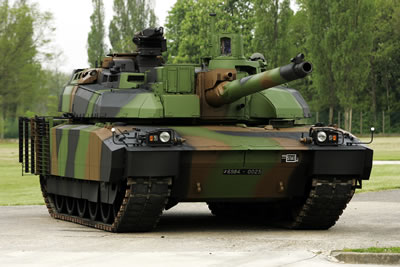
    Planning to improve its urban combat capabilities, the French Army is testing new concepts under the AZUR Urban Survivability Functions Demonstration program. Three vehicles specially modified for AZUR were displayed.
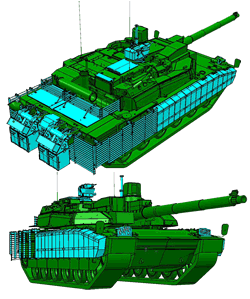
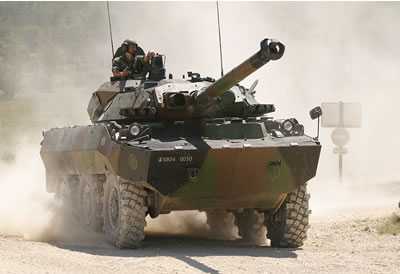
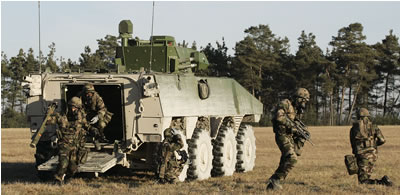
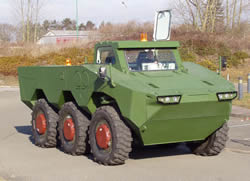
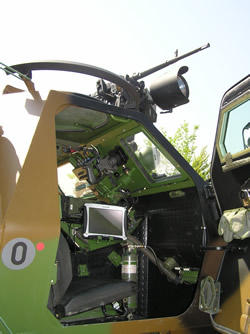
    A GIAT Leclerc Main Battle Tank, a Renault VAB armored troop carrier and a Panhard VBL light armored scout. Each vehicle was fitted with a special AZUR kit designed for field installation within few hours, requiring no workshop infrastructure. The AZUR kit developed by GIAT for the Leclerc includes improved firepower, observation and situational awareness, upgraded protection and survivability, enhanced C3I and better ergonomics. Collaboration, identification and situational awareness are maintained by sharing a wireless communication and networking with all combat elements. All vehicles are equipped with this wireless network, facilitating direct collaborative networking between all elements. Each of the vehicles is also equipped with daylight night/thermal visible combat identification panels and an Omni-directional Video Camera (ODR) developed in Israel by ODF Optronics.

    The visible additions of the Leclerc include appliqué side panels and rear protection slate armor, additional coverage and density of the GALIX close defense systems, through the additional launchers covering 360 deg. (firing smoke, non-lethal ammunition and grenades). Other enhancements include the protection of all openings, against burning liquid, securing all explosive materials and strengthening external mounts, to minimize damage of vandalism by hostile crowd. The tank is equipped with jettisoned multi-purpose logistics load racks used to rearm and support dismounted troops under fire. An FNH Arrows Remotely Controlled Weapon Station mounting 7.62mm machine gun replaces the commander’s pintle mounted machinegun, featuring day/night sighting and the ability to engage targets near the tank and at high elevations.
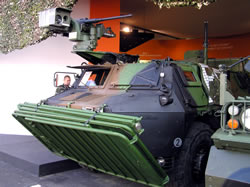
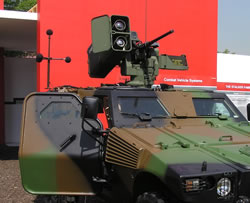
    The VAB troop carrier is equipped with a RAFAEL Mini-Samson day/night remote controlled weapon station, an ODR panoramic camera, wireless intercom, multi-purpose removable storage devices, multi-functional socket extensions and CID panels. The VBL light patrol vehicle AZUR demonstrator is equipped with white light/IR projector, mounted in parallel to the machine gun, GALIX close defense systems and additional firearms which can be reloaded from within the armored cabin, firing non lethal crowd dispersal munitions.
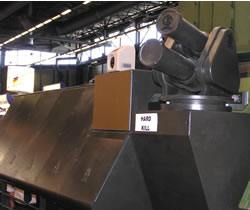
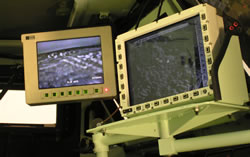
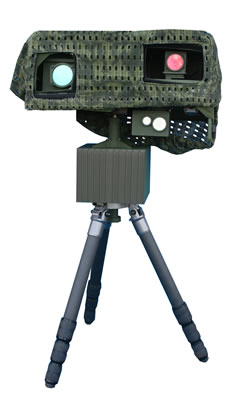
    A different urban combat application was displayed by Elbit Systems, demonstrating an array of sensors and weapons, mounted for demonstration purposes on a Renault VAB 4×4 vehicle. The system’s ensemble included dual-axis stabilized unmanned turret, mounting an automatic 25mm cannon, a model of the IMI Iron Fist active protection system, augmented by the infrared sensor Tandir, which can be linked to the APS or on-board situational display. An Elisra EJAB IED jammer is also installed in the vehicle. A new product displayed on the VAB was the ‘omni-vision’ multi-sensor assembly, providing a panoramic view of the vehicle’s rear area. Omni-Vision could also be installed on a UGV, offering continuous hemispheric coverage. Tandir can be integrated with the Threat Detection System, which detects, categorizes and localizes laser sources from rangefinders, designators, beam-riding missiles and IR target illuminators.
    Start < Page 4 of 6 >

    Remotely Controlled Weapon Stations at the 2006 Eurosatory Exhibition

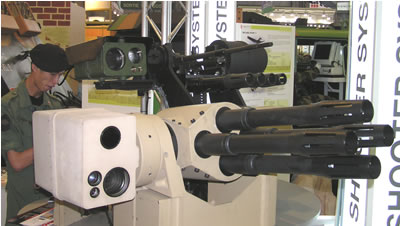
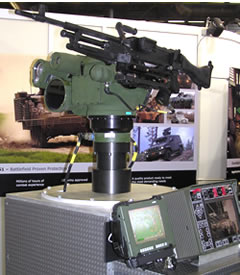
    Remotely controlled sensors and weapon stations form another facet of unmanned systems, enabling soldiers to operate their weapons from a safe distance or behind the cover of armor. A wide range of remotely operated weapon stations was on display at Eurosatory 2006, ranging from small remotely controlled mounts for 5.56 and 7.62 mm automatic guns to 30mm unmanned and remotely operated turrets.

    Rheinmetall Landsysteme and Kongsberg Protech exhibited the first results of their recently announced cooperation to satisfy a German Bundeswehr requirement for remotely operated weapon stations to be mounted on new wheeled and tracked armored multipurpose vehicles. The two companies displayed two types of systems: the 609 L (light) and P (heavy) versions, with 80% parts commonality, through the use of identical control stations but different external mounts. Thales demonstrated the SWARM multi-weapon station – the latest generation of remote weapon system entering service with tracked vehicles of the British Army.

    Several companies demonstrated light weapon stations mounting 7.62mm machine guns or 12.7mm heavy machine guns. Among these were Elbit Systems (ORCWS), Thales (SWARM) and Kongsberg / Rheinmetall Defense (WS609L). RAFAEL introduced a new enhancement for its Mini-Samson RCWS, featuring a unique net-centric recording capability, monitoring on-board optronics and information systems. This capability is based on the integration of Mini-Samson with RADA’s avionic NCDR digital recorder system, which was featured here in its first vehicular application.

    Elbit Systems also exhibited its compact 7.62mm unmanned turret and 25-30mm unmanned overhead remotely controlled weapon station. The 7.62mm turret is evaluated by the Israeli Army, for potential use with the Merkava Mk 4 tank. The 25-30mm ORCWS was displayed on a Renault VAP (4×4) vehicle. The unmanned turret uses a stabilized, remotely controlled mount for standard 7.62 automatic weapons. This design can be used on various vehicles, and does not require deck penetration for installation.

    Being one of the pioneers in the Remotely Controlled Weapon Stations (RCWS) market, RAFAEL’s Mini-Samson received an impressive endorsement at Eurosatory 06. One derivative was displayed by Thales integrated into their urban-warfare modified VAB AZUR vehicle. Another installation developed by the Turkish armored vehicle manufacturer Otoklar, was displayed on their Cobra armored patrol vehicle, which is based on a Humvee chassis.

    A Mini-Samson installation also appeared on the Panhard VBL light armored scout, demonstrating an advanced configuration integrated with a net-centric recording system provided by RADA. Similar systems were displayed on the Plasan Sasa Sand-Cat armored vehicle, ST Kinetics Bronco, and Uro VAM T5 vehicles. 

    The Enforcer, a derivative of RAFAEL’s Mini-Samson system was also displayed on BAE System’s Hagglunds Viking. The IDF is already operating the Mini-Samson RCWS, with some 200 systems in production to be mounted on Humvee patrol vehicles, to supply immediate IDF requirements. The IDF is also testing RAFAEL’s Mini Samson as an optional weapon for the Merkava Mk 4 main battle tank system and could include it as part of the basic configuration of future Merkava based heavy armored infantry fighting vehicles, the Namer. Mini-Samson weighs 95kg (without the weapon and ammunition). Standard ammunition load is 690 rounds, upgradable to 1,150.

    Start  < Page 4 of 5 >

    Heavy Armored Fighting Vehicles at the 2006 Eurosatory Exhibition

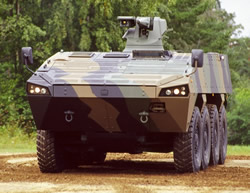
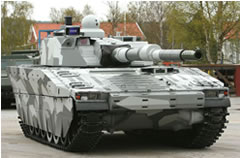
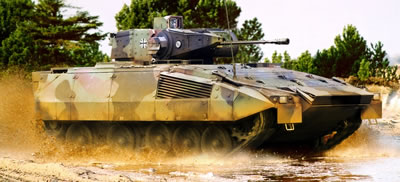
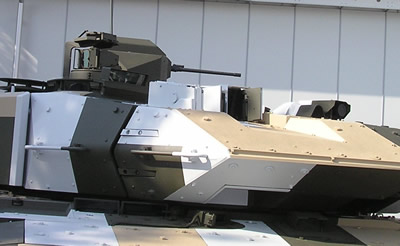
    At the time 8×8 armored vehicles are dominating world markets, the introduction of new tracked armored vehicles is unusual. Still two new tracked vehicles were unveiled at Eurosatory 2006 – the Swedish CV90120-T and the German Puma Armored Infantry Combat Vehicle. The CV-90120 is a new member of the BAE Systems Hägglunds CV90 family of which over 1,000 tanks and AFVs have been produced to date. It is the first member of this family to be armed with a low-recoil 120mm gun and introduces innovative soft and hard kill protection to augment the basic light armor. It was designed from the beginning to operate in either high intensity or asymmetric warfare. Both vehicles were displayed were equipped with a  wide range of new weapons, armor and protection, optronic systems, C4I and vetronics.

    The Puma will be the new Armored Infantry fighting Vehicle (AIFV) developed for the German Army. Display of the prototype at Eurosatory 2006 was the first time this new vehicle was presented to an international audience, only one month after its official rollout in Germany. The vehicle was displayed by the German manufacturer PSM GmbH – a joint venture of Krauss Maffei Wegmann and Rheinmetall Defence. The German Army is expected to procure 405 vehicles for a total cost of 3 billion Euros. Initial production orders are expected by mid 2007, following parliamentary approvals. PSM is currently working toward the delivery of five pre-production vehicles, under a previous order issued in 2004. Puma is equipped with an advanced 30mm automatic cannon firing AP or ABM munitions.

    Smaller, but not less impressive were three new configurations of the familiar Wiesel-2, developed for the new German Army air-mobile fire support units. The three vehicles comprise the world’s first airborne 120mm mortar carrier, a reconnaissance and target acquisition vehicle and a command vehicle, all utilizing the modernized Wiesel-2 tracked chassis.

    Adaptations for modern asymmetric combat dominated the tracked segment of this year’s Eurosatory show. Two urban combat tank demonstrators were displayed – the French Leclerc AZUR and the Leopard 2 PSO. Apart from these radically upgraded tanks, many companies displayed specific systems designed to improve the tank’s survivability, firepower and situational awareness in urban warfare scenarios.

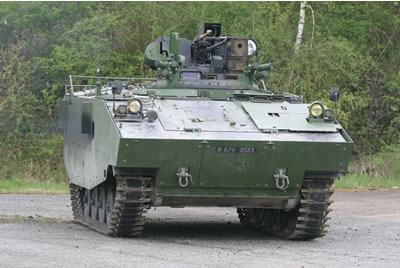
    Under a parallel program to the Leclerc AZUR, upgrades to 108 AMX10P tracked APCs are underway. The modifications  including installation of appliqué armor, and mobility improvements including modified suspension, gearbox and rear ramp. The first modified vehicle is expected to be completed by January 2007.The AMX-10P will eventually be replaced by the new wheeled VBCI, currently undergoing qualification tests. Several versions of VBCI will be produced.

    Start < Page 3 of 6 >

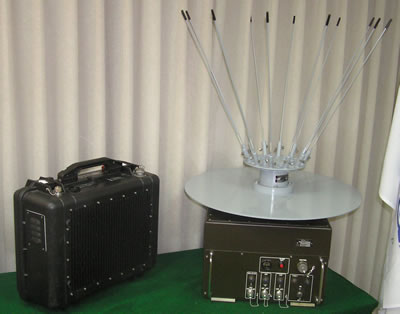
    EJAB Family of Electronic Jammers

    EJAB family of electronic jammers was unveiled by Elisra at the LIC-2005 exhibition in Tel Aviv. This jammer is designed to disrupt and deny remote activation of Improvised Explosive Devices (IEDs). EJAB jammers comprise various modules, covering a wide frequency band, from VHF to UHF and high cellular bandwidths, dealing with all types of remote-controlled applications, from simple RC transmitters to the most sophisticated cellular phones and wireless devices.

    EJAB was developed by Elisra in response to Israel MOD requirements, and was fielded since the late years of conflict in Lebanon in the 1990s. These jammers operate as stand-alone systems, and have proved themselves through years of combat operations in Lebanon and the current conflict in Gaza and the West Bank, where they were they have successfully protected combat vehicles, convoys, and fixed facilities as well as protection of EOD teams and isolation of terrorist attack scenes. The system is available as a mobile (vehicular) system, and in portable (suitcase) configuration, utilized for the isolation of EOD scenes.

    Elisra reported the first sale of EJAB systems on December 2005, as part of a US $4 million sale of EJAB jammers to Poland. The sale includes both vehicular and portable jammers to be used by the Polish deployed as part of the coalition forces in Iraq.

    Wheeled Armored Fighting Vehicles at the 2006 Eurosatory Exhibition

    VBCI, the new troop carrier for the French Army is progressing. In 2004 the first VCI infantry carrier was delivered and in 2005, the VPC command vehicle were introduced to the French Army. Future VCI ERYX / Milan anti-tank and mortar vehicle variants are also considered. The vehicles have been tested in both urban and cross country environments. By 2008, GIAT will deliver the first batch of 85 vehicles. The complete program calls for the production of 700 vehicles (550 VCIs and 150 VPCs).

    Further development is focused on future 6×6 vehicles, replacing the current fleet of 4×4 and 6×6 Renault VAB vehicles, in service for the past 30+ years. Such developments are expected to be undertaken under a collaboration agreement between France and Germany. Future 6×6 vehicles are expected to field new technologies such as hybrid electric propulsion, advanced protection, modern vetronics etc. Some of these technologies are already under development in various R&D programs by the current partners.

    On a similar note, BAE Hägglunds also displayed its two modular armored tactical SEP platforms, which have already completed 8,000 kilometers of test drives. Four test vehicles are currently involved in the program. The first, tracked vehicle tested the electric drive, silent run (battery only) capability, rubber band tracks, and other automotive elements. The second vehicle was the 6×6 wheeled platform, followed by the third 17.5 ton vehicle which tested a more mature electric drive and gearbox. The fourth vehicle to join the team is a 17.4 ton tracked vehicle. An 8×8 variant is currently in production and is expected to enter testing by the end of 2006.

    In France a parallel R&D is underway to evaluate the benefits of hybrid electrical drive systems for medium armored combat vehicles considered for future systems such as the French EBRC and British FRES. GIAT is building the Demonstrator Propulsion Electric (DPE), a 6.3 meter long, 3 m wide 6×6 18 ton troop carrier which is designed to travel up to 750km at 60 km/h powered by a diesel/electric hybrid system (the vehicle has a top speed of 105 km/h), or 15 km at a speed of 30 km/h, utilizing its battery powered, all-electric “stealth mode”. The vehicle will enable variable ground clearance, from 30 to 52 cm. thus having the potential to reduce height or improve cross obstacle mobility when required. Completion of the initial test vehicle is expected by summer 2006.

    The French Army is gradually improving all its armored vehicles, which are expected to remain in service for the next 10 – 15 years. As part of this initiative, improvements for the AMX-10RC continue with scheduled modifications planned for up to 256 French Army vehicles. Under this program the vehicles received new command and control systems and PR4G radios. Among the modifications underway are the installation of GALIX smoke dischargers, LIRE and DAL countermeasures systems, as well as appliqué armor, an improved NBC system, various mobility improvements, installation of SIT-V1 battle management systems and improved fire control systems. First series production upgraded vehicles were delivered to the French Army in 2004. Future modifications could also include replacing the 105mm gun with the new 120 FER, currently in development.

    Start < Page 2 of 6 >

    Bushmaster Mini UAV System

    Cyberflight displayed four different mini UAVs at Eurosatory. The Bushmaster was delivered to the Royal Marines, for operational testing. It was successfully tested in mountainous terrain, at altitudes above 15,000 feet. According to Cyberflight, performance can be extended to 18,000 feet with minor modifications to the engine. Bushmaster weighs 2 kg on takeoff, and is manually launched for its mission. It is equipped a fuselage mounted color TV camera, fitted with an X10 optical zoom and a fixed focal length (x4 digital) wing mounted low-light level TV camera. Mission endurance is 1.5 hours and operating range: 5 miles at a height of 1,000 – 2,000 feet above the ground. Operating speed is between 70 maximum and 15 knots minimum speed. Bushmaster is equipped with four communications links for TV and navigation transmissions. It has manual or automatic piloting modes and an autonomous “back home” GPS based retrieval mode, if communications fail.

    Unmanned Ground Vehicles (UGVs) at the 2006 Eurosatory Exhibition

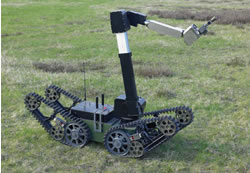
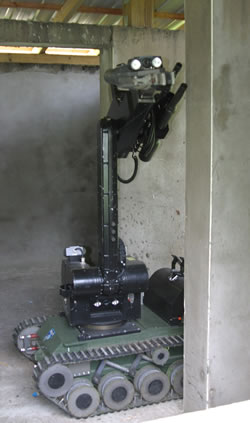
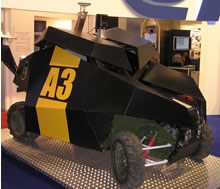
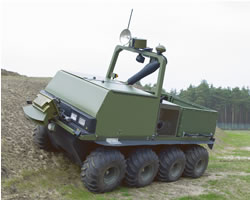
    Robotic platforms can serve as an effective substitute for personnel for high-risk or highly fatiguing operations. Unmanned systems create a standoff capability that significantly improves the chances of survival of combat troops, thus widening the operational scope of modern military units. One of the first applications of military robotics was the Explosive Ordnance Disposal (EOD) robot. The design focused on inspection and investigation of suspicious objects, and neutralizing them by disrupting sensitive activation devices, or safely removing them to a safe place. All these activities are performed under continuous human control by experts utilizing the robots as “tele-operated” systems. These are large, and relatively slow robotic platforms used for high risk combat engineering tasks, such as counter IED and counter mine patrols or heavy earthmoving operations in areas saturated by enemy fire.

    Military and law enforcement agencies worldwide are already operating different versions of this type of EOD robots. Recent improvements in EOD robotics include faster and more agile platforms, which provide faster movement over obstacles, the ability to climb steps, etc. More sensitive and ergonomically designed controls allow better and more sensitive control of the manipulation devices and sensors providing improved performance. Two examples of this type are the German Teodor and Telemax.

    A more ambitious task, which involves a higher level of autonomy, is the sentry mission. Sentry robots carry out routine guard and patrol missions, monitoring restricted areas, detecting and reporting any suspicious movement in the area under surveillance. Unlike a fixed camera or unattended ground sensor, the robotic sentry can be programmed to patrol randomly, and respond to specific triggers by assessing the situation in order to improve response rate and efficiency while reducing the probability of false alarms. As a mobile, intelligent sensor-effectors, robot sentries allow coverage of more area with fewer resources. Types of robotic autonomous sentries include small sensor packed spheres, which can roll into any location over a flat surface, effectively covering indoor spaces such as warehouses, yards or storage area. Larger robots include wheeled or tracked platforms, which mount an array of sensors on an elevated mast. Modified “robotized” all-terrain vehicles such as IAI’s Guardium which was displayed at Eurosatory 06, have also been converted to autonomous patrol vehicles, patrolling along a borderline, secured roads or anti-infiltration perimeter lines.

    Start < Page 2 of 5 >

    Leopard 2 PSO

    Indonesia is expecting to receive 103 Leopard II tanks from german army surplus.

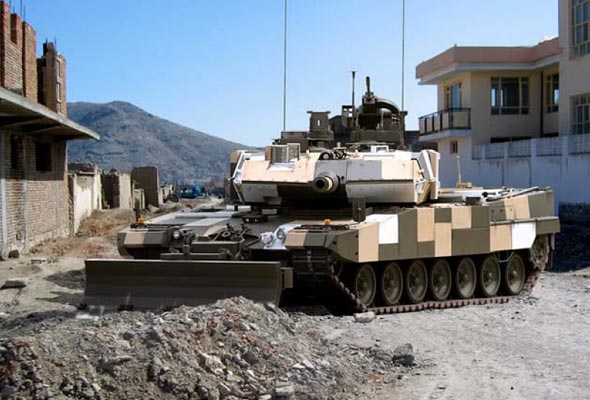
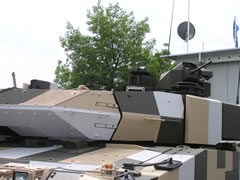
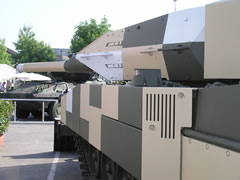
    Leopard Peace Support Operations (PSO) is a demonstrator vehicle, developed by Krauss Maffei Wegmann (KMW) to enable the German Army and other Leopard 2 users to evaluate the use of tanks in urban warfare scenarios. The PSO was displayed at Eurosatory 2006 fitted with add-on armor to the turret and hull (skirts), a dozer blade, operated by the driver, to remove road obstacles. A remotely controlled weapon station is mounted on the side of the turret, next to the loader’s position, enabling the crew to effectively engage close-in targets under the protection of the tank’s armor. This station also improves the tank’s capability to engage targets at higher elevations.

    Close-in panoramic coverage is provided by hull-mounted cameras, covering 360 degrees, augmenting the tank’s vision and targeting systems. Existing sights are protected with metal screens to prevent damage by stones or debris. Internally, images from the vision systems can be distributed to all crew members, to share workload in continuous operation. To improve interoperability with nearby troops, external radio/intercom interface was added, enabling nearby troops to communicate with the tank. The tank was painted in an experimental urban combat pattern, recommended for deployment in Afghanistan.


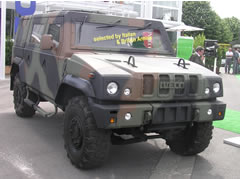
    Multi-Role Light Vehicle (MLV/CLV/Panther)

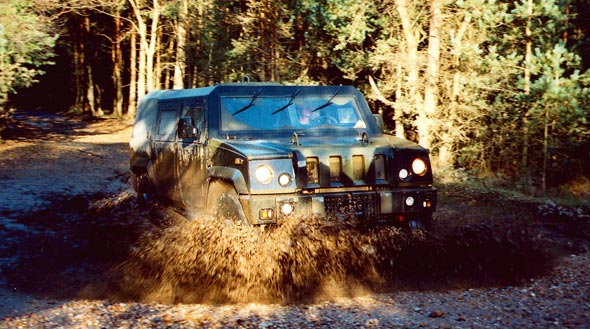
    The Multirole Light Vehicle (MLV) is a new family of light armored 4×4 vehicles available in soft-skinned or armored versions. It is based on the Iveco LMV vehicle, of which 2,500 are in production for the Italian Army. The UK version accommodates up to four fully equipped troops, while the Italian version can take five. A stretched version will be able to carry seven troops under armor. Belgium also selected the LMV for its Light Armored tactical Vehicle (LATV) 440 vehicle program.

    The MLV has a gross weight of 6,500kg (STANAG level 3 protection) and a payload in excess of 1,200 kg. It uses a 3,000cc Iveco 186 Bhp diesel engine and fully automatic 6 speed gearbox. Some of the vehicles are expected to be armed with the Enforcer remote controlled weapon systems. The FCLV’s system of choice was based on RAFAEL’s RCWS design and is armed with 5.56/7.62/12.7mm Machine Guns / 40mm Automatic Grenade Launcher, to be provided by AEI.

    The MLV Protection system meets various levels, from STANAG level 1 to STANAG level 4, which was required by the Italian Army. The Italian MLVs use the latest version AMAP composite armor, protection while the British version uses lower level of protection. The armoring system uses appliqué armor panels, placed between the inner and outer hull. This concept provides for protection upgrade capability, to meet changing mission requirements, as well as introduction of new, lightweight materials as they become available. The crew is also protected from mines of up to 6kg under the wheels. The MLV can be fitted with a mission configured overhead weapon station, equipped with day and night vision.

    The British Army has ordered 486 MLVs designated “Panther” for its Command and Liaison Vehicle program (CLV). In this role, MLVs will be used for a wide range of battlefield missions, with variants for infantry, artillery, armor, engineer and signals users, and will replace the ageing vehicles such as Saxon, Spartan, FV-430 and unarmored Land-Rovers. By 2005 Alvis is expected to introduce specific MLV based prototypes for each of the mission configurations, while production of the vehicles is expected between 2006 and 2009. According to the 140 million pound procurement contract, the British MOD has options to buy 400 additional vehicles. The program’s cost will also be enhanced by support services to be provided over the life of the vehicle.

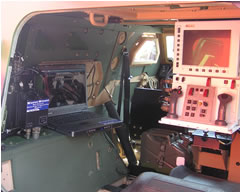
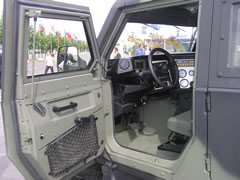
    The Panther is equipped with a remotely controlled Defender 7.62mm Self-Defense Weapon Station (SDW) equipped with 7.62 machine gun and a day/night sight. The vehicle on display was configured as a command vehicle, equipped with multiple Bowman radios, and situational display for the commander. Other displays are serving the driver’s station and weapon station’s operator. First production Panthers are due for delivery in mid-2006, in time for the vehicle’s entry to service in 2007. Up to 15 variants of the Panther are expected to be used by the British Army, and Royal Air Force Regiment.

    In May 2009 the MoD announced the first batch of Panther Command and Liaison Vehicles has been delivered to British troops in Afghanistan. The vehicles will be first used by both the RAF Regiment and the Army’s Close Support Logistics Regiment. More vehicles are en route to theatre later this month for deployment on the front line.

    FELIN Infantry Combat Suite

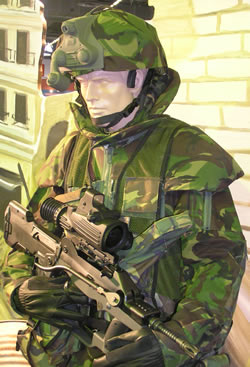
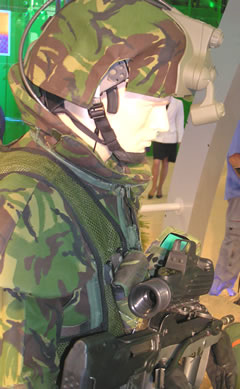
    FELIN is a modular infantry combat suite, offering efficient ergonomics, autonomy and weight saving. In March 2004 Sagem won the DGA contract to develop and produce up to 30,000 infantry combat suits, to field with all French Army active infantry regiments beginning in mid 2010, as part of the future air/ground system of systems called BOA. The total contract worth is estimated at about one billion Euro including development, engineering and production of close to 31,500 suites.

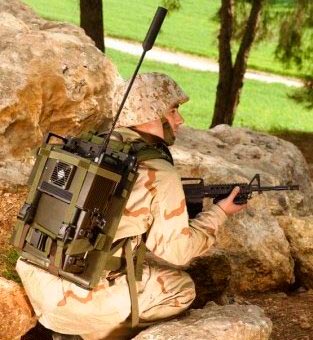
    FELIN systems will comprise a modified weapon system, integral sensors, wearable computer, communications and display systems, advanced uniform, protection and headgear. At an advanced stage it will also include team allocated equipment such as ODIN mini-UAV, robotic mule and commander’s specific equipment. The weight of the entire FELIN system will be 24 kg, including weaponry, energy, ammunition, water and food.

    Clothing

    Superior resistance, comfort and stealth will enable the soldier to move faster with extra protection. The uniforms are designed for sufficient ventilation, and are fabricated from fire retardant materials, replacing current fire retardant coveralls used AFV crews. Torso protection will be improved removable modular combat jacket which will have significantly larger protection area, provided by soft, rather than hard ballistic protection plates. It will be supplemented by ceramic inserts for extra protection of critical areas, when required by the mission or threat level. The garment’s structure will be modular, allowing the soldier to adjust the weight according to the mission. The suite will also be provided in a special Nuclear, Radiological, Bacteriological and Chemical protection configuration.

    The Weapon System

    The FELIN infantryman will use an upgraded FAMAS assault rifle which has been fitted with image intensifying (I2) sight and a wireless video camera that relay the sight images over wireless local network to either the torso or helmet displays, or directly to transmits them to the platoon commander or team leader. The commander’s FAMAS will be equipped with thermal weapon sights. IR optronics will also increase the effectiveness of the Minimi machine gun and the FRF2 sniper rifle. FELIN V1 will field with four types of sights – a reflex day/night sight for the FAMAS, a day/night sight for Minimi, an improved long-range day/night (I2) sight integrated with a laser rangefinder for the FR-F2 sniper rifle and hand held imager, integrated with GPS, LRF and Digital Magnetic Compass (DMC) for commanders.

    Electronics Systems

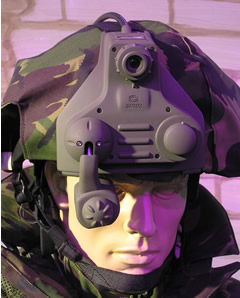
    The helmet offers enhanced protection with an outer layer that contains a wide-angle day/night camera improving dismounted soldier’s mobility in both day and night combat, relaying images to the helmet ocular, or  thorax display unit. The soldier does not use a microphone for voice commands, but instead wears a headband with an osteo-phone. The helmet will also be equipped with passive elements for audio protection. The helmet mounted day/night microcamera will offer 50 degrees field of view. Using the standard headgear, the soldier will be able to detect a human target at 150 meters and identify it at a range of 70 meters.

    The wearable computer (PEP), the hub of FELIN system is built around a high speed processor and USB 2.0 high speed, open universal port interfaces which controls the energy and links with different components, such as imaging sensors, weapon, displays, radio etc. The computer is connected to a man-machine interface enabling the soldier to control the system and carry out operations such as firing around a corner or see through obstacles.

    The infantryman will use a small personal radio (RIF) transmitting voice and data communication. The RIF will be functional both in mounted or dismounted operations enabling GPS position tracking and information sharing within the squad and platoon. The communication bandwidth provided by the RIF is sufficient to pass operational graphics, imagery, maps and video sequences between team members and back to the higher echelon. They will operate with either all-in-one or sub-network architecture and interface with the fourth generation radio (PR4G) which remains the link between the dismounted platoon and the vehicles. As it is separated from the PEP computer, the radio will operate even in the event of computer breakdown. FELIN platoon will operate five networks: four will operate as RIFintra squad networks, (three infantry and one antitank squads) maintaining continuous and open “conference” between the squad members. Each RIFIntra network will also be separable into two intra-team sub-networks, allowing control of small team operations when required. At the platoon level, RIF Command network will operate, communicating between squad leaders, platoon commander, CO, snipers and the unit’s armored personnel carriers.

    Each section commander will be equipped with multifunction, un-cooled thermal binoculars used for day/night observation and targeting. The specialized section commanders will get portable information system terminals, (SIT), which are PDA sized digital assistants, used for tactical situation assessment. The SIT will display images, maps with overlaid symbology, and will be able to exchange encrypted messages with other commanders and higher echelons.

    The FELIN electronic ensemble will be powered by two rechargeable Li-ion batteries will be used to ensure that the soldier can operate the system for 24 hours once dismounted. The unit will also be equipped with a collective fuel-cell based battery charger,  which will sustain the team for two more days of continuous dismounted operation. Batteries can be recharged using collective devices. These will be integrated into the futuristic EBRC, AMX-10P, VBCI and VAB armored vehicles, in support of FELIN equipped infantry teams.

    Brimstone Anti Armor Missile

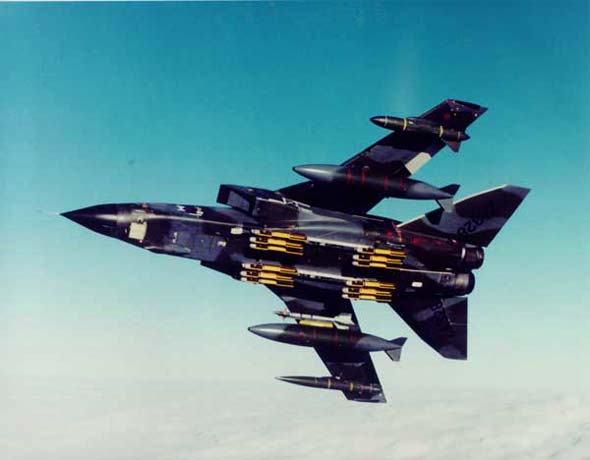
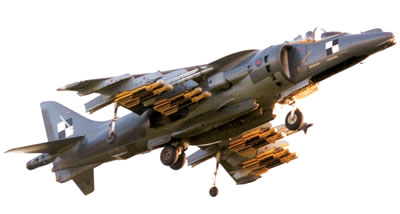
    Brimstone advanced anti-armor, air-to-surface missile is a Hellfire Longbow derivative, designed for use by the British forces. Offering all-weather “fire and forget” capability, Brimstone is optimized for both fast jets and attack helicopters. The millimeter-wave seeker autonomously detects, recognizes and tracks targets in daylight or at night and is unaffected by adverse weather conditions, countermeasures, smoke, dust, fog, clouds or sandstorms. The Brimstone system comprises three missiles each weighing 50 kg. The missiles are carried under a triple-rail launcher designed for high speed aircraft. The system is integrated on Harrier GR9, Tornado GR4 and Typhoon aircraft. Brimstone is scheduled to enter RAF service in 2004.

    Brimstone can be employed in direct or indirect attack modes. In a direct attack mode the pilot visually selects the target prior to weapon’s release, which may be assisted by an on-board target designation system (such as a targeting pod or laser spot tracker). This mode is designed for the attack of targets of opportunity, or self defense against air defense assets. The Indirect Attack Mode uses targeting information provided by a remote platform, such as a UAV, or ground based target designation teams. The target data is fed directly to the missile via datalink, during flight. This mode is particularly useful on close air support missions. When large formation of targets can be engaged, salvo firing of multiple missiles can performed, up to a full platform load.

    The missiles can be programmed to fly on separate paths spreading out to cover a large area, or follow a flight corridor, when engaging targets in convoys or marching order. After launch, the missile follows an inertial trajectory up to a certain point where it activates its millimeter-wave radar seeker to acquire and track the target. The radar uses a narrow, high frequency beam for search and track, which maintains low-probability of intercept and rejects much of the ground clutter to provide a clear target signature. Target recognition algorithms are employed to detect and recognize priority targets such as main battle tanks, self propelled guns and air defense vehicles. The missile uses tandem shaped charge warhead designed to defeat all known armored vehicles and ignore civilian vehicles or low value targets.

    Development of the Brimstone began in 1996 under UK MOD contract. The latest test firing from Tornado GR4 aircraft were conducted in October 2003 under the RAF Strike Attack Operational Evaluation Unit (SAOEU). The test involved three missiles fired on a single path at T-72 and M60 targets at the US National Air Warfare Center at China Lake. All three missiles scored three hits at different targets.

    Combat – Laser Guided Anti-Tank Missile

    Manufactured by Artem from Russia, The Combat missile is an advanced, extended range missile which can be fired through the 125mm gun of the T-80UD, T-84, T-72AG, B and C models. The missile is composed of separate head and tail sections which are stored separately but loaded and combined as a unified cartridge, designed for the automatic loaders of the individual tanks (T-72 or T-80).

    The laser (beam riding) missile can be fired on the move, at speeds of up to 30km/h and engage stationary or moving targets at speeds up to 70 km/h. the missile uses tandem shaped charge warhead and due to its guidance system, can penetrate both active, reactive and passive protection systems. The high precision of the missile enables effective engagement of point targets such as protected positions, helicopters and other targets. The system’s range is 5,000 and target engagement at this range will take 17 seconds.

    Eurosatory 2006 – Exhibition Review

    Eurosatory 2006 presented an impressive demonstration of the latest land forces systems and technologies. Considered as the world’s leading exhibition for land and land-air defense equipment, Eurosatory gathered 48,000 defense professionals from around the to examine the latest developments in land forces and air-land warfare technology. Major topics covered were modern soldier systems; armor protection; counter IED and counter-mine systems; Homeland Defense; network centric and network enabled warfare and unmanned systems and robotics.

    1083 Exhibitors participated in the show. 340 French companies and 740 foreign exhibitors from 47 countries. The largest non-French exhibits were those of the US, German, the United Kingdom Israel and Italy. 110 official delegations from 71 countries and some 24,000 international visitors (half of the total audience) attended the event demonstrating its international relevance. The next Eurosatory exhibition is planned at the same location, Paris Nord Parc d’Expositions, from 16 to 20 June, 2008.

    Included in this review are: Armored Combat Vehicles, C4ISR, Survivability & protection, Artillery, Combat Engineering, UAVs, UGVs, force protection, counter sniper and Counter IED systems and more.

    The following topics are covered in this review:

    Remotely controlled unmanned systems:
    C4ISR:
    Dismounted Combat:

    Survivability & Protection:

    New Vehicles:
    Fire Support Weapons:

    Counter-Sniper Systems at the 2006 Eurosatory Exhibition

    Troops engaged in modern asymmetric warfare are often exposed to high-risk threats, including surprise attacks by well planned and camouflaged ambushes involving well orchestrated use of IEDs, automatic fire and sniping. Such ambushes are difficult to detect as the enemy utilizes stealth, deception and concealment to hide the sources of fire.

    To cope with these lethal traps, military forces must be equipped with the necessary tools for locating hostile fire sources and responding effectively and rapidly while minimizing exposure to snipers. New systems introduced at Eurosatory 2006 address these needs with acoustic gunshot detection, electro-optical sniper location, remotely controlled IED engagement capabilities and effective RF countermeasures that can denying the enemy the use of radio-frequency remote control systems.

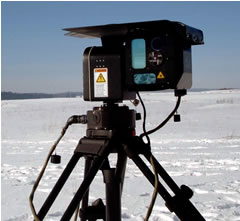
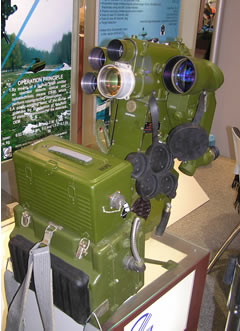
    The requirement for gunshot detection and counter-sniper systems has developed as a result of experience gained during recent counter-insurgency combat situations in South-West Asia. Several systems utilizing either acoustic or optronic methods of detection, were demonstrated at Eurosatory 2006. Among the acoustic systems was the Pilar, which was displayed in both a mobile configuration and a newly developed man portable version.

    RAFAEL displayed its SADS system as part of a “Sniper Hunter” vehicle equipped with the Mini-Samson Remotely controlled weapon station, which can be coupled with an acoustic gunshot detector to provide instant response to gunshot threats. Other systems can deliver a warning as early as when a sniper is aiming his weapon.–These include the new Spotlite II from RAFAEL, SLD-500 from CILAS and SLS from Rheinmetall defense.

    When a threat is located, laser countermeasures can be employed to defeat it. Among the systems displayed at Eurosatory, only a few addressed this potential, including the Russian PAPV system, which was developed and is produced by the Russian Nudelman Precision Engineering design bureau and the DHY322 laser countermeasure system from CILAS, with.

    Start < Page 3 of 3 >

    Skunk Works and XTEND Simplify Multi-Drone Command

    0
    Lockheed Martin Skunk Works® and XTEND have achieved a major milestone in JADC2 by integrating the XOS operating system with the MDCX™ autonomy platform. This technical breakthrough enables a single operator to simultaneously command multiple drone classes, eliminating the friction of mission handoffs. From "marsupial" drone deployments to operating in GPS-denied environments, explore how this collaboration is abbreviating the data-to-decision timeline and redefining autonomous mission execution.

    From Ukraine to Taiwan: The Global Race to Dominate the New Defense Tech Frontier

    0
    As traditional defense primes face mounting competition from agile “neoprimes” such as Anduril, Palantir and Helsing, the balance of innovation is shifting toward software-defined warfare and scalable, dual-use technologies, while global industry consolidation—marked by Boeing’s integration of Spirit AeroSystems and other strategic mergers—signals an intensified race to secure control over the defense technology value chain. Our Defense-Tech weekly report highlights these trends.

    Europe’s “Drone Wall”

    0
    In early October 2025, a coordinated wave of unmanned aerial system (UAS) incursions—widely attributed to Russia—targeted critical infrastructure across at least ten European nations. The unprecedented campaign exposed the fragility of Europe’s air defenses...

    Weekly Defense Update & Global Security Assessment

    0
    Executive Summary The past week (September 18-25, 2025) represents an inflection point where strategic defense concepts have transitioned from doctrine to tangible reality. An analysis of global events reveals four primary, interconnected trends shaping an...

    U.S. Air and Space Forces Push Next-Gen Programs at the AS&C 2025 Conference and...

    0
    At the 2025 Air, Space & Cyber Conference, U.S. Air Force and Space Force leaders unveiled major updates on next-generation fighters, bombers, unmanned systems, and space initiatives, highlighting both rapid innovation and critical readiness challenges as the services race to outpace global competitors. A short version is available here, with a more detailed version for subscribers.

    TADTE 2025: Reflecting Taiwan’s Strategic Themes

    0
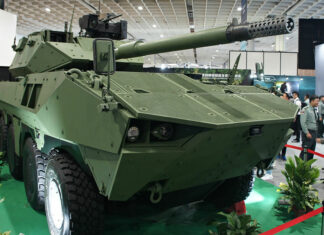
    The Taipei Aerospace & Defense Technology Exhibition (TADTE) 2025 crystallized around four dominant strategic themes that collectively illustrate Taiwan's comprehensive approach to defense modernization amid escalating regional tensions. Based on a detailed report by Pleronix (available upon request). Includes a Podcast discussion on TADTE 2025's highlighting Taiwan's four strategic themes beyond the post's coverage.
    Iron Beam 450 Completes Testing, Soon to Join With Operational Air Defense Units

    0
    Israel’s Iron Beam 450 high-power laser system has completed final testing, marking a major leap in air defense. Developed by Rafael, it offers precise, cost-effective interception of rockets, UAVs, and mortars, and is set for IDF deployment by 2025.