Sunday, December 21, 2025
More
    Home Blog Page 378

    The US Navy Broad Area Marine Surveillance (BAMS) Program

    BAMS will supply the US Navy with persistent global intelligence, surveillance and reconnaissance system to protect the fleet and provide a capability to detect, track, classify and identify maritime, littoral and land targets. three companies are competing on this program. Teams are led by Northrop Grumman, Lockheed Martin and Boeing.

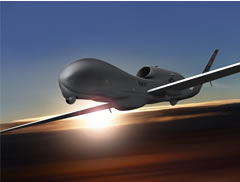
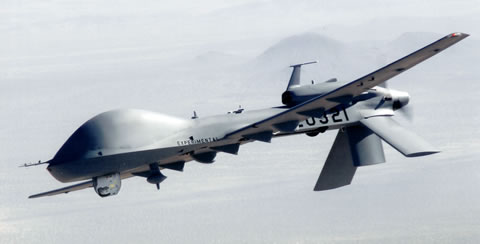
    Mariner UAV, Photo: General Atomics

    The Lockheed Martin teaming includes General Atomics, offering the Mariner Unmanned Aerial System (UAS) designed for operations at an altitude of 45,000 ft.. The proposed solution will augment a fleet of manned maritime surveillance platforms, such as the Lockheed martin P3C and future P-8A (MMA) aircraft. The platform proposed by the team is the Mariner, a high altitude derivative of the Predator B (Reaper) system, designed to operate as an all-weather, multi-mission altitude agile, persistent intelligence, surveillance and reconnaissance asset supporting naval operations. Mariner shares several systems with the Reaper, including major fuselage elements, avionics, flight controls and powerplant (both are using the Honeywell TPE-331-10GD turbo prop engine with 49 kVA power generator).

    Northrop Grumman is offering the maritime derivative of the Global Hawk, designated RQ-4N for the BAMS program. According to Northrop Grumman, BAMS will benefit from a HALE platform, since the whole program could utilize only five orbits operating at a range of 2,000 nautical miles, or even three, operating at 3,000 nmi orbits, thus minimizing the operating bases required for the global mission with assured worldwide access to all mission areas, independent on local operating bases. The company claims that the HALE platform is better positioned to support ISR missions conducted over very large areas, since these platforms can support the highest rate of ‘target revisit’, in order to determine its status, location, heading and intentions.

    The Optionally Piloted G550  is the platform proposed by Boeing for BAMS. It will augment the P-8A  maritime patroller. (Photo: Boeing)Boeing is offering an optionally piloted platform for BAMS, based on a special mission Gulfstream G550 platform, currently in US Navy service. Boeing popposes to leverage the investments made in its P-8A Posedon to ensure a high degree of commonality between the manned and unmanned maritime surveillance platforms. Boeing’s BAMS team also includes Gulfstream, Raytheon, Rolls-Royce and Honeywell. In the BAMS configuration the unmanned G550 has a maximum takeoff weight of 95,000 lbs (43,250 kg). It will offer mission endurance of 16 hours, operational ceiling of 51,000 ft and top speed of 480 knots (440 kt. Cruise and 350 kt loiter). The aircraft will be fitted with an advanced digital radar system and EO/IR sensor, navigation radar, due regard optical system based in a conformal ‘gondola’ shaped bay, ESM sensors, common datalink and wideband satellite coms.

    Operators in a combat/hazardous environment are often subjected to situations that test the limits of physical and cognitive abilities. Input devices for human-technology interaction therefore must be flexible, easy to use, and must reflect the potential need for common control of computer-based assets such as a robot or wearable computer.

    Topics covered in AUVSI 2007 review:

    The P-8A maritime patrol aircraft (MMA) from Boeing (Photo: Boeing)

    Robotic Security Vehicles at AUVSI 2007

    One of the most mature applications of robotic vehicles is perimeter security and sentry missions. At AUVSI, three robotic platforms designed for such missions were displayed or discussed. These included the MDRAS which has already been integrated with operational security systems protecting military facilities in the USA. This robotic vehicle was developed by General Dynamics Robotic Systems, and demonstrated at the Webster Field prior to AUVSI 07. Two additional vehicles were on display at the exhibition – the Defender, a robotic armed security vehicle developed by the Air Force Research Lab (AFRL) and RAPTRS based on John Deer and iRobot’s R-Gator, modified for sentry missions by Navy Space and Naval Warfare Systems Center.
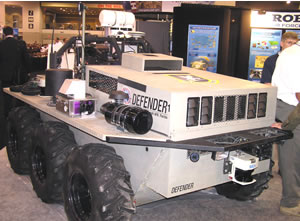
    RAPTRS

    A UGV developed at the US Navy Space and Naval Warfare Systems Center, San Diego is the Recon Adaptive Patrol Tactical Robotic System (RAPTRS) developed at SPAWAR utilizes the John Deer’s R-Gator robotic platform, developed by i-Robot. The vehicle is designed to operate as an unmanned patrol sentry, guarding the base perimeter. Utilizing obstacles and object avoidance algorithms, RAPTRS can operate autonomously over a known terrain; identify obstacles, as well as moving objects such as parked cars, moving cars and people. It is designed to automatically avoid such obstacles, while performing its mission.

    Defender

    The Robotics Development and Research group at the US Air Force Research Laboratory (AFRL) is pursuing a different sentry known as Defender – described as an automated perimeter security (APS) ‘engagement platform’. The Defender is built on a high mobility all terrain vehicle, capable of traveling at a speed of 35 mph., over rough terrain. The vehicle is fitted with color cameras to provide video feedback and road view for the driver. The vehicle can patrol continuously for up to six hours equipped with strobe flashing light system, a speaker microphone system and both lethal and non lethal weapons, comprising pepper spray fogger M-16A2 rifle or M240/249 machine guns.

    MDARS

    General Dynamics displayed its Mobile detection Assessment Response System (MDARS), a small diesel powered four wheel vehicle used as a robotic patrol platform. The 3,500 lbs vehicle can carry up to 500 lbs of payload, and operate at a speed up to 20 mph for 16 hours. Its payload comprises a video cameras and two-way audio communications. Its primary mission is to patrol secured areas, tracking potentially dangerous intruders without risking human guards. The robot autonomously and randomly patrols around inventory sensitive warehouses, airfields, ammunition supply depots and port facilities. It can monitor RFID tagged inventories, and determine the status of inventory, batteries and locks while detecting intruders, maintaining visual contact, alerting other forces and conducting first response countermeasures. MDARS was developed for the joint program office force protection systems and, since 2004, has been deployed by civilian guards at the Hawthorne Army Depot. By 2010 the system is expected to support guards operations in six depots in the USA. GDRS is currently developing a naval surface vessel to assume similar roles guarding ports and coastal facilities.

    Combat Engineering Robots

    Applied Research Associates (ARA) from the USA and FrontRunner Robotics, a joint venture led by Israel Aerospace Industries, InRob Tech and Zoko Enterprises, both developed robotic applications for the Caterpillar Multi Terrain Loader (MTL). ARA’s demonstrated its Modular Robotic Control System (MRCS) at the AUVSI 07, the MRCS kit equipped a Cat 247B MTL customized for handling heavy unexploded ordnance. The vehicle can be fitted with various attachments, including grappler, IED disruptor, forks, bucket, backhoe, or mission specific sensors. A version of this vehicle is customized for the US Army Nemesis demining vehicle. Nemesis will utilize the robotic vehicle with counter-mine systems automatically detecting anti-personnel and anti-tank mine. For FrontRunner, AUVSI 07 provided the first introduction of the new robotic MTL. A week later, this vehicle was demonstrated at the Force Protection exhibition in the USA (FPED 07). The Israeli MTL Weighs 3.8 tons and can lift up to 1.5 tons or push up to 2.5 tons. The standard tool is the blade, but many other tools can be attached for specific missions. Apart from the standard tools the FrontRunner can also mount a remotely controlled weapon station carrying a machine gun or grenade launchers.

    Another UGV program that will soon be operational in Israel is the border patrol robot. The IDF plans to introduce the first version of the autonomous, unmanned border patroller developed by Genius Unmanned Ground Systems company, a joint ventrure between Israel Aerospace Industries and Elbit Systems. The vehicle will be based on a lightweight, all-terrain Jeep Wrangler size platform. A full coverage of this program will soon be published by Defense Update.

    Back Packable Robots

    iRobot displayed a wide range of PackBot UGVs, tailored for different missions utilizing various payloads and sensors. The company introduced the multi-sensor RedOwl Sniper Detection Kit, enabling detection and targeting of hostile threats. Red Owl packs an impressive, integrated package of acoustic and imaging sensor s to support dismounted infantry combat missions.Eventually, the Red Owl package will be reduced in size to fit the furure Small Unmanned Ground Vehicle (SUGV) Early designed for the FCS program.

    A version of this new unmanned vehicle is the “SUGV Early”, displayed by Boeing and iRobot. Early will weigh about 30 pounds (14 kg), about 30% lighter than the current PacBot. The robot will be able to carry a maximum payload weight of 6 pounds (2.7 kg.) It will be smaller, and fit into standard MOLLE or ALICE back packs. The robot will be waterproof when fully submerged at depths up to 9.8 feet 3 meters. The tracked mobility system, similar to the PacBot’s allows the new robot to climb stairs, drive over rubble or through tunnels and over difficult terrain. It will be powered by standard rechargeable BB2590 military batteries.

    Protonex, a fuel cell technology developer introduced at AUVSI a new fuel cell processor and replaceable cartridges, storing 720 W/h each. The ProCore fuel cell system generates 2-4 times the energy density of advanced batteries, significantly extending the run time of ground robots or UAVs and increasing their payload carrying capability. The cell generates full power within 60 seconds from activation, for up to 24 hours. A fuel cell with three fuel cartridges replaces three BA5590 batteries, saving 62% on weight, 50% on size and about 20% on cost per mission.

    Command and Control for UGVs

    To effectively control unmanned ground vehicles in combat conditions, General Dynamics Robotics Systems developed the Thor, a scalable battle management system, designed for robotic and unmanned systems. The system enables the small combat unit to operate various unmanned systems as part of their routine activities providing situational understanding, battle management, mission planning and execution. Thor supports four levels of control, including tele-operation of vehicles and payloads, autonomous tactical behaviors incorporating movement, vision, and shooting skills, automatic planning and computerized aids assisting in the rapid execution of time critical tasks. The system also supports collaborative operation, communicating between multiple platforms, sensors and users.

    Another control system called V-Star was displayed by Tadiran Systems. This video receiving system, provides the warfighter a single ‘all-in-one’ console, integrating video receiving, support of situational picture buildup, and advanced imagery analysis. Advanced services include correlation between images and maps, video enhancement and image processing, and optional data transmission capability. The system can be utilized as a command and control element for unmanned systems, as well as supporting other remotely controlled sensors. Another remote control device called visually integrated sensor (VIS) was introduced by AnthroTronix. VIS, currently under development, will be used as an imaging and orientation device as well as a display and control to guide unmanned systems.

    During a firefight, warfighters are focusing on their surrounding and could be distracted by manually controlling a robot. Various types of control devices introduced at AUVSI07 show some of the more mature systems which could be used to control future robots. AnthroTronix also introduced other innovative devices designed to enable intuitive control of robotic systems and UGVs. Among these were the instrumented glove (iGlove), which operates as an ‘air joystick’, enabling unobtrusive and dexterous control of uunmanned systems, including EOD robots, a patent pending weapon mounted force controller (MFC), and the vibrotactile Feedback belt, (VFB), providing feedback from a remote sensor, indicating directional or situational information by silent, non visual sensory stimulus.

    Another application developed by Think-a-Move specifically for the PacBot robotic vehicles family introduces heads-up, hands free control of the system. The new system uses speech commands and tongue signals to control the robot. It relies on a special earpiece that picks distinct sounds created in the ear canal, by tongue movement or whisper. These signals are interpreted and used to replace standard mechanical controls. The system can differentiate between operators, and is effective in noisy environments.


    Topics covered in AUVSI 2007 review:

    UAV Payloads at AUVSI 2007

    Several companies introduced new and advanced payload systems at AUVSI 07. Among these were AST, presenting the lightweight Cell Spotter system to covertly monitor cellular communications traffic over a limited area. Enerdyne introduced a new hardware add-on which can be easily installed on any UAV, enabling users to send high capacity digital feed over existing analog datalinks. Controp, AeroMech and CloudCap unveiled new versions of stabilized payloads weighing under two pounds each, designed specifically for emerging mini-UAVs while Rockwell Collins unveiled the new TacVue Mini-SAR designed for small UAVs, developed in cooperation Sandia Labs.

    CellPhone Spotter

    Applied Signal Technology (AST) is offering several types of electronic payloads enhancing target acquisition and identification from unmanned aerial systems. These include the Model 580 STYX small-size wireless interrogator, designed for interrogation of wireless communications using CDMA protocol. The system weighs only 7 pounds and consumes 7-12 watts that actively interacts with the cell station to obtain a mobile identification of dialed numbers from cellphones operating at any direction, over a distance of about 100 meters. Targets at longer distances can be obtained using directional antennae. STYX can operate in stealth mode, without any interruption of calls in progress. Alternatively, the STYX can operate passively to collect cal activity messages from a base station and nearby cell phones, including SMS messages, paging messages and responses and calls.

    Another COMINT system developed by AST for UAVs is the Hydra. This system integrates adaptive beam forming and direction finding systems configured into small-size package. The system uses a software defined radio architecture to host a variety of signal-specific applications. The prototype Hydra has eight RF channels covering the 20-3000MHz range with 25 MHz IF bandwidth. The system weighs 30 pounds and consumes 180 watts. Further enhancements of the Hydra will include GSM identification and monitoring of GSM emitters, including the ability to geolocate each emitter.

    Advanced Datalinks

    Cubic Corp. and Rockwell Collins performed the first successful flight test of the Mini Common Data Link (CDL) system linking a King Air aircraft and a KillerBee unmanned system with ground stations. The prototype M-CDL weighs 1.5 pounds and demonstrated communications over a distance of 20 miles transmitting signals at data rates up to 10.7 Mbps. The tests support the US military’s goal of developing CDL terminals that meet the payload restrictions of small unmanned aerial systems (SUAS) platforms and enable data link communications with current ground systems. Existing CDL systems are too heavy and too large to fit within SUAS platforms. The Mini TCDL is designed to operate at rates up to 45 Mbps and achieves interoperability with other vendor units through compliance with current DoD CDL waveform specifications.

    A new datalink innovator at AUVSI was Enerdyne Technologies, a subsidiary of ViaSat. The company that specialized in video compression is now introducing a conversion system enabling analog datalinks to transfer digital signals at high data rates. Analog links are s widely used with current UAVs, including most of the MALE, SUAVs, mini and micro UAVs. The system uses a signal modulator that ‘superimposes’ a digital protocol over a standard analog link. After the conversion the link can carry digital data rates of 4-5 Mbps data. The signals are demodulated at the ground station using a special receiver provided by Enerdyne. The airborne segment weighs only four ounces (100 gr.) and its power consumption is very low. It can be installed in a UAV within few hours.

    Miniature Stabilized EO Payloads

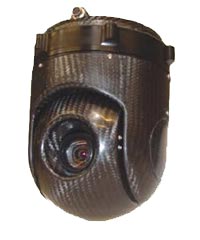
    AeroMech Engineering introduced the TigerEye miniature EO payload designed for small UAS (SUAS). The five inch diameter turret weighs 1.7 pounds in the EO configuration (0.1 lb heavier for the IR version)is designed for unmanned aerial and ground vehicles, with interface to the Cloud cap plug and play operating systemcomplying with CAN or serial bus interface. TigerEye uses on board video processor providing electronic image stabilization and hardware embedded target tracking. The design uses a quick change of sensors in the field, without special tools. Optional sensors include a Sony EX980S camera with x26 zoom, a Flir Photon with 50 mm lense, a laser illuminator or low light CCD imager.

    Cloud Cap Technologies offers several versions of its lightweight payload known as TASE weighing about 1 kg. The payload can accommodate a number of sensors, including daylight cameras such as the Sony EX980S with x26 zoom or EX480C with 18x zoom. A range of FLIRs is also available for this payload, including the FLIR Photon Block II core (324×256) with a single or dual lense, Thermoteknix Miricle modules (384×288 or 640×480) or a Short Wave InfraRed (SWIR) 320×240 sensor from Goodrich. Cloud Cap also offers a unique mechanism retracting the TASE gimbal into the aircraft to support belly landing or other operations. The entire mechanism adds only 280 grams to the payload weight while eliminating the need for much heavier parachute, airbag or landing carriage.
    Controp Precision Technologies from Israel, a pioneer in the field of miniature EO turrets for UAVs, unveiled enhanced versions of its STAMP miniature stabilized payload at AUVSI 07, introducing an operational Uncooled IR sensor packed version (U-STAMP) for the first time. This payload weighing only one kilogram is designed for nighttime missions, and, according to Controp, has already been delivered to several customers worldwide. According to Controp, the 3 axis gyro stabilization of the STAMP platform’s line of sight provides unique attributes to this turret, including highly stable video imaging including high quality pictures in full zoom, without vibrations or jittering, It also provides continuous target tracking regardless of aircraft attitude and motion. Wide field of regard and the ability to ‘point to coordinates’ makes this small payload simple to use and highly efficient when operated by ordinary soldiers.
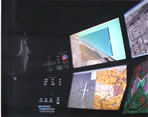
    TacVue MiniSAR

    Enabling effective tactical battlefield reconnaissance/surveillance from UAS or manned platform applications, today’s unmanned/manned vehicle platforms need superior all weather, obscurant, day/night operational radar systems for all environments. Towards this requirement, Rockwell Collins and Sandia National Laboratories have joined together to develop a high performance Synthetic Aperature Radar (SAR) system. With Sandia’s radar experience and Rockwell Collins’ ability to manufacture field-grade reliable products for use in harsh environments, we ensure unmanned/manned vehicle platforms superior radar performance. The radar operates at the Ku band (16.8 GHz) providing 4-inch resolution imagery from a distance of 10 kilometers or 1 meter resolution from 23 km. Images can be used for identification and accurate geo-location of small targets at a geolocation error level of 25 meters. The current system weighs about 27 lbs, with future version downsized to about 18 lbs.

    Topics covered in AUVSI 2007 review:

    UAS/Mission Control Systems

    Several companies introduced new and advanced controls and payload systems at AUVSI 07. Among these were General Atomics, introducing their Next Generation Ground Control Station just prior to the event, Raytheon demonstrating their Multi Vehicle Control System (MVCS), a derivative of the UCS Ground Control System and IAI, introducing the latest version of the ground control console, known as iUCS.

    AST, presenting the lightweight Cell Spotter system to covertly monitor cellular communications traffic over a limited area. Enerdyne introduced a new hardware add-on which can be easily installed on any UAV, enabling users to send high capacity digital feed over existing analog datalinks. Controp, AeroMech and CloudCap unveiled new versions of stabilized payloads weighing under two pounds each, designed specifically for emerging mini-UAVs while Rockwell Collins unveiled the new TacVue Mini-SAR designed for small UAVs, developed in cooperation Sandia Labs.

    Israel Aerospace industries unveiled at AUVSI 07 its latest concept for the modular ground control system called iUCS. The new system will support all of Malat’s UAV fleet. The first UAV to be supported by the new system is the IAI/Malat Heron, and IAI’s latest entry into the MALE market – the Eitan (Heron TP).

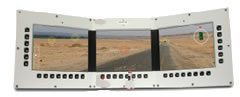
    The new system fully supports STANAG 4586 ergonomically designed with a stacked mount supporting multiple displays and control table with a small footprint. The stacked design considerably saves space enabling multiple operators to comfortably work in a small shelter. The same display mount can converted into a ‘side by side’ configuration where space is available.

    Procerus Technologies introduced an airborne and ground segment ensemble featuring the Kestrel autopilot, associated with the ‘virtual cockpit’ ground control software and ‘OnPoint’ targeting system. Kestrel is a 16.7 gram autopilot, designed for autonomous flight. Controlled by the ‘Virtual Cockpit’, Kestrel automatically follows a‘click and fly’ commands performed by the operator. The Kestrel includes the autonomous GPS navigation system, an inertial measurement unit, and payload communications and support. The OnPoint targeting application offers precision target tracking initiated by a click of a mouse, localization and video stabilization. In addition to the Virtual Cockpit controls, it also enables ‘Click and Fly’ vision based flight control, by dragging the mouse over a visible target or flight route to initiate a new task.

    Several companies introduced advanced image provessing designed to improve the products or overcome the limitations of EO payloads currently used by UAVs. For example, Toyon developed novel video tracking algorithms that can effectively track multiple targets in video collected by low-cost small UAVs using unstable imaging systems. The company also developed the wireless communications algorithms and supporting hardware for these applications. Another system was presented by Pyramid Vision, which launched their Video Quest product which can be integrated into the TeraMax 3D system showing the payload image in still photo or image, inlaid in the proper perspective ‘footprint’ on a 3d map or ortophoto to improve situational awareness, thus eliminating the ‘soda straw’ views of traditional payloads.

    With Video Quest, the real-time video can be enhanced with with online geodatabase, automatically tagging and storing new streams with metadata and retrieving stored media for further analysis upon request. A search can be performed based on location, time, movement or other historical features. Video retrieval is performed much rapidly, compared to standard video recording systems. Future versions of VideoQuest will also feature ‘quality search’ reducing the time spent in downloading unusable videos, such as blurred videos or feeds with heavy cloud coverage. Other enhancements anticipated with future version include the integration of laser rangefinder to reduce geolocation error. Currently, the geolocation accuracy depends on the payload and sensors, average geolocation error provided by the system is within 10 meters. TerraMax and VideoQuest are already fielded with the US Army’s PTSD aerostat borne sensor system and with the ScanEagle UAV system. It will also be used with the Army’s Sky Warrior UAV systems.

    Kutta Consulting unveiled its unified ground control station (UGCS) interface, developed for the US Army small UAV systems. This interface was supporting Rockwell Collins’ Mini SAR. This intercafe packs a sophisticated control into a small hand held module such as a PDA or tablet PC. The fully functional UGCS is a lightweight STANAG 4586 compliant controller offering advanced features such as 3D or 2D flight planning, full VGA real-time video display with post-flight reviews, autonomous ‘point’ and ‘flow’ modes of operation, 2D or 3D footprint with terrain shadowing, grid search modes, automatic routing and intelligent health monitoring. For the Army project Kutta teamed with Boeing Phantom Works, Advanced Ceramics Research (ACR), and Neural Robotics Incorporated. Other uses for this hand controller include homeland Security, and first responder applications.
    Topics covered in AUVSI 2007 review:

    Unmanned Monster Vehicles Designed for Heavy Transport

    New unmanned vehicles are being proposed to carry heavy cargo mission, such as tanks, armored vehicles and supply logistics over long distances, as well as from ship to shore hauling heavy vehicles and outsized cargo loads. Two concepts were unveiled at AUVSI 07 – the Hybrid Unmanned Air Vehicle (HUAV), developed by Lockheed Martin, and the T-Craft, designed by General Dynamics.

    Hybrid airship/aircraft, developed by Lockheed Martin (Photo: Lockheed Martin)

    Combining buoyancy and aerodynamic lift, HUAV is creating an aircraft capable of carrying payloads of up to 2,500 – 12,000 pounds to an altitude of 20,000 ft, maintaining long persistence over the target area, at costs significantly lower than other manned or unmanned platforms. While the 250 foot long HUAV is designed for long persistence, cruising slowly at about 20 knots, it will also be able to move from one location to another at a top speed of 60 knots. HUAV will be ideally suited for long dwell missions (over 7 days without refueling) over low-threat environments. The large volume available for the payload enables the integration of sensors having very large aperture (up to 100 ft long, 20 ft wide). According to Lockheed Martin, the HUAV could be fully developed within 24 – 30 months and, if sufficiently funded, could fly by 2010.

    Lockheed Martin is also planning a much larger version of the hybrid aircraft, capable of delivering heavy cargo over a range of 2,000 miles. The hybrid airship/aircraft will be constructed from high-strength fabrics providing buoyancy and aerodynamic lift. Its large size will accommodate outsized cargo, or 10 – 14 standard pallets weighing up to 50 tons. It will be equipped with four pusher thrust vectoring propellers and a landing system utilizing four air cushions enabling the airship to be airfield independent, land and takeoff from short unprepared surfaces. The crew controlling the hybrid aircraft will use on board weather monitoring and route planning to establish the best, safest flight route for the aircraft.

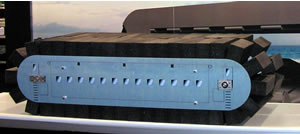
    Completely different concept is pursued by General Dynamics, with the T-Craft Captive Air Amphibious Transporter (CAAT). The program addresses the Office of Naval Research (ONR) Seabasing Innovative Naval Prototype program, with an unmanned floating vessel capable of transverse sand bar and mud flats, offering the US Marines Corps with ‘feet dry on the beach” capability. CAAT will be able to carry twice the load of current amphibious landing crafts (LCAC), deployed from flat bed vessels such as LHDs and future Catamaran landing support ships. At AUVSI CAAT was displayed wit a load of two M-1 tanks and two HMMWVs. The autonomously controlled vessels will be propelled by linked buoyant cells forming a track-like propulsion system. Each vessel will have two tracks enabling forward and backward motion and steering by differential movement. The CAAT concept is currently under evaluation and, if funded, could become reality within a few years.

    Topics covered in AUVSI 2007 review:

    HALE UAVs Come of Age

    The High Altitude, Long Endurance mission profile was never meant to be used with manned platform, but is perfectly suited for unmanned systems. Only few manned aircraft are prepared to fly and operate at these altitudes. The thin air at the Tropopause limits the use of conventional engines, but opens new horizons for surveillance, communications and electronic eavesdropping activities. After overcoming the technical obstacles, mission planners could benefit from unobstructed operations at altitudes well above civilian or military air traffic. At these altitudes, the atmosphere is calm, the thin air causes reduced drag, resulting in less energy required to maintain higher ground speed. Aircraft flying at these lofty altitudes are well above the jet stream and other high velocity currents, averaging 40 – 80 knots in speed, with peaks of up to 160 knots. These currents encountered at the high troposphere, at altitudes between 20,000 to 35,000 ft., usually affect the performance of aircraft operating at medium altitudes.

    Until the early 2000s, only few manned platforms could soar to such heights. One of the first to explore these altitude was the Lockheed U-2 strategic reconnaissance aircraft, designed in the late 1950s. A decade later, the SR-71A strategic reconnaissance aircraft, unofficially known as the “Blackbird,” was used as long-range, advanced, strategic reconnaissance aircraft. The first flight took place on Dec. 22, 1964. Then the ‘Blackbird’ served for 22 years providing strategic reconnaissance missions and was retired in 1990 only to return five years later to fill a critical recce gap. Throughout its nearly 24-year career, the SR-71 remained the world’s fastest and highest-flying operational aircraft. The SR-71 flew at more than three times the speed of sound (Mach 3) at altitudes in excess of 80,000 feet (approximately 15 miles high).

    The successor of the U-2, the U-2R ‘Dragon Lady’ is still operational today. Designed for high-altitude intelligence and reconnaissance missions, this aircraft can fly above 70,000 feet and carry some o the most advanced long-range reconnaissance gear available today. Its mission payloads include highest resolution SAR radar in service today, as well as sophisticated SIGINT systems. Providing near-real-time imagery and signals intelligence to warfighters and national authorities, the ‘Dragon Lady’ was used extensively during operation Iraqi Freedom in 2003 and provided important damage assessment information after Hurricane Katrina struck the Gulf of Mexico in 2005.

    With the arrival of the RQ-4A Global Hawk, the missions of U-2R were reduced to those specific services which could not be supported yet by the unmanned platform. These missions will be transferred to the Global hawk fleet in the next decade, as the RQ-4B (Block 20, 30 and 40) aircraft are fielded, capable of carrying heavier payloads, including SIGINT and advanced SAR payloads.

    Global Hawk may be dominating the high altitudes today, but in the near future, it will have to share those heights with more unmanned platforms. One such system is theIntegrated Sensor Is Structure (ISIS) developed by Lockheed Martin Aeronautics. ISIS will provide a new model for persistent, autonomous ISR platform. Utilizing a stationary stratospheric airship, ISIS will establish a position on the ‘high ground’ at an altitude of 70,000 ft. This airship will be deployed for long missions, staying in position for one, five or even ten years. It will provide a persistent early warning sensor able to detect cruise missiles at distances of 600 kilometers or dismounted enemy combatants at a range of 300 km.

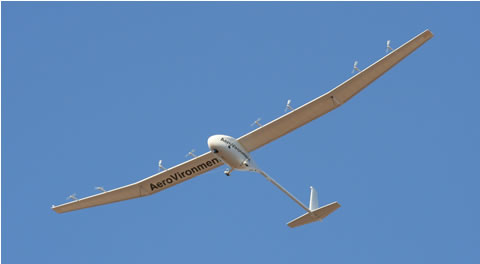
    Smaller but but not less effective for its proposed mission is the Global Observer high altitude UAV system developed by Aerovironment. This aircraft was designed to provide long dwelling stratospheric capability with global range and no latitude restrictions. Operating at these heights, the platforms provides ‘near space’ capability comparable to satellites, providing services such as persistent ISR and communications relay, including dedicated communications support and satellite link redundancy for other UAVs.

    Another system under development by Aurora Flight Science and Boeing is the the Orion, High Altitude, Long Loiter (HALL) Unmanned Aerial System. This stratospheric platform will be able to cruise at an altitude of 65,000 ft for about 100 hours, powered by reciprocating engines consuming liquid hydrogen fuel. With a gross takeoff weight of 7,000 lbs (3.175 tons) HALL will be able to carry payloads weighing about 400 lbs (181kg). The U.S. Army/SMDC is supporting a team lead by Aurora and Boeing as a strategic partner, developing two Orion HALL platforms, to demonstrate the new technology. First flight is expected by 2009. Aurora and Boeing have also teamed since 2004 on a Boeing-led concept definition study of a twin-engine, larger unmanned platform designed for missions over a week long, carrying multi-sensor payloads weighing up to 2,000 lbs.

    Flying at the edge of space in the high stratosphere, a future unmanned aircraft could one day carry weapons or other payloads anywhere in the world within few hours, or deploy cargo to lower space orbit, responding within minutes to urgent mission requirements. These high flyers will be designed to carry our fast strikes deep into enemy territory, anywhere in the world. Such a project known as FALCON is pursued by DARPA and the US Air Force. Lockheed Marin, the system’s developer is planning to fly the first FALCON demonstrator by the end of 2018, and is preparing to have such platform operational in about 10 years.
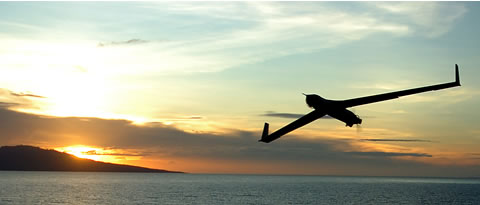
    A similar platform expected to be demonstrated around that time is the X-51 WaveRider, developed by Boeing. This vehicle will demonstrate capabilities similar to the FALCON, as Boeing aims to compete with Lockheed Martin to fulfill the future USAF requirement for global strike with the hypersonic atmospheric vehicles. The waveRider will integrate a scramjet engine developed by Pratt & Whitney, a boost rocket motor derived from an ATACMS missile matched with an airframe built by Boeing. It will demonstrate acceleration from boost (Mach 4.5+) to Mach 6 -7 cruise.

    Topics covered in AUVSI 2007 review:

    The US Navy/USMC Tier II Tactical UAV Program

    The US Navy and US Marine Corps have decided to delay the tactical-level unmanned aircraft system program for a year, splitting the program into two separate phases, the first to begin in the first quarter of fiscal year 2009. Industry teams preparing for the tender, originally expected in the fall of 2007, will now re-evaluate their plans to address what seems to be a much larger program, aiming at the acquisition for thousands of new air vehicles over the next several years. In addition to US Marine Corps and US Navy uses, the new program is also expected to address US Air Force requirements for base protection.

    The Navy and USMC plan to launch the program in 2008, with a baseline day/night imaging and target designation capability, similar to what the Boeing/Insitu Scan Eagle system is providing today. The Air Force program will follow by 2010 primarily addressing base security mission. In addition to standard EO payloads, these aircraft could also be equipped with acoustic sensors, to spot gunshots and other threats.

    Companies that considered competing for the program include the Boeing/Insitu team, offering the Scan eagle, Raytheon, offering the Killer-Bee from Swift Engineering, AAI offering the Australian Aerosonde and MTC Technologies, offering the SpyHawk, designed by Arcturus. Northrop Grumman and Aurora Flight Sciences teamed to offer the Golden Eye 80 ducted-fan UAS and Israel Aerospace Industries prepared to offer its I-View 50 system with yet unnamed local partner.

    Topics covered in AUVSI 2007 review:

    Latest Miniature Unmanned Aerial Systems on Display at AUVSI

    To improve mission range, persistence and raid response, some UAS are designed to be air-insertable. Since such missions could be ‘one way’ only, these UAVs are designed to be low-cost, optionally expendable systems. Among these are the the Finder from SAIC and the future SECC from Boeing. Two smaller, electrically powered UAVs also designed as optionally expendable systems, are the Coyote from ACR and Voyeur from Lite Machines as well as Aerovironment’s Switchblade. At the lower tier, unmanned systems are rapidly maturing, with some systems already fielded with US forces, particularly special forces and light infantry and airborne units.

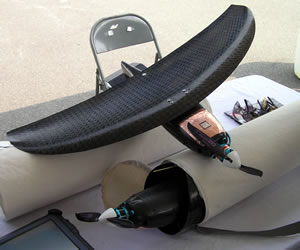
    Wasp III micro UAV and the Switchblade expendable (tube launcehd ) UAV, both from Aerovironment. Photo: Tamir Eshel

    Some of the latest developments shown here include the BatMav (Wasp III) micro UAV from Aerovironment, recently selected for the Pentagon’s SUAV program. Its competitor, the Nighthawk (previously known as BatCam), is undergoing continuous development and was now introduced in a redesigned, lightweight 3rd generation model. Nighthawk and the new Maverick from Prioria, both represent a new concept of an ‘always ready’ UAV carried in a tube, with wings wrapped around the fuselage. When needed, the UAV is pulled out of tube, the wings automatically snapping into position making the UAV is ready to launch.

    Other micro-designs at AUVSI included vertical take-off and landing designs, including the new electrically powered Micro-Air Vehicle from CRG, and new turbine-based propulsion developed for the Class I Micro UAV from Honeywell.

    Topics covered in AUVSI 2007 review:

    New Unmanned Aerial Systems Unveiled at AUVSI 2007

    In recent years, as weaponized robots evolved from controversial science fiction into grim reality, particularly in the Middle East skies, new systems are being developed and deployed. The Sky Warrior and Reaper are representative systems pursued by the US Army and Air Force, based on the Predator platform. But some argue that payload capacity may not be the most important factor, as smaller aircraft such as the Sky Raider, designed for field operation could offer superior persistence, resulting in more opportunities to pursue time-critical targets of opportunity.

    A nother program dominating the show was the US Navy Broad Area Maritime Search (BAMS), which is expected to select an unmanned platform to augment and replace part of the Navy’s maritime surveillance aircraft in the next decade. The Navy considers three alternatives representing totally different solutions, based on the Global Hawk HALE from Northrop Grumman, the Mariner MALE UAV proposed by Lockheed Martin and General Atomics or an optionally piloted G550 platform from Boeing.

    Obtaining High Altitude Long Endurance (HALE) capability is becoming a new trend, with systems becoming more dominant in coming years with the maturation of unmanned platforms, introducing long persistence and ‘near space’ capabilities, replacing satellites being vulnerable to enemy attacks. HALE platforms could also augment existing space and aerial assets, supporting heightened operational needs in certain theaters. Our coverage includes an update on the various developments and missions proposed forNorthrop Grumman’s Global Hawk, the ISIS and FALCON systems from Lockheed martin, the HALL, from Aurora and Boeing, and the Global Observer from Aerovironment.

    Between the large HALE systems and the smaller mini and Micro-UAVs, a new range of unmanned aerial systems are evolving, and are expected to define the future tactical systems for years to come. Several classes of unmanned aerial systems (UAS) are considered by the US armed services, among them, two relatively new groups, currently defined as Tier II and Tier III by the US Navy/Marine Corps, the latter considered to be themore mature. However, just prior to the event, Tier II changed direction, somewhat reshuffling the cards for many participants. AUVSI provided the stage for several companies to display relevant technologies related to the tactical Tier II program. These included the New Integrator, developed by InSitu, as well as the new versions and payloads for the Scan Eagle developed by InSitu and Boeing. Among the new versions unveiled by Boeing were a redesigned Scan Eagle Compressed Carriage (SECC) configuration to be adapted for air insertion.

    Other Tier II candidates at the show were the GoldenEye 80 from Aurora, teaming with Northrop Grumman to pursue this program. SpyHawk displayed by MTC and the original designer Arcturus, the KillerBee, presented Swift Engineering teamed with Raytheon to pursue this opportunity while IAI’s I-View 50, the Israeli was newcomer to this program. Elbit Systems’ Skylark II was also on display and could become an attractive option for theUS Marines. Smaller systems, such as the the new Stalker and Desert Hawk III from Lockheed Martin, the Skylark from Elbit Systems, and Skylite from RAFAEL, brought to the show by Advanced Ceramics Research (ACR), which also displayed its own Sky Fox UAV.

    Representative Tier III also included future weaponized UAVs; these platforms, considerably larger than Tier II are designed for closely supporting tactical units providing persistent operations over the battlezone.

    They will be used for fire support, armed scout and ISR missions directly supporting maneuver forces. They are designed augmenting or replacing manned helicopter gunships or manned close air support. These Vertical Take-Off and Landing (VTOL) Combat UAVs are expected to follow fielding of FireScout later in the next decade. Such futuristic designs are already under development, including the Excalibur from AuroraAD-150, proposed by American Dynamics, and the VARIOUS UCAV, a concept for a future lightweight Unmanned Combat Aerial System developed by Lockheed Martin. Northrop Grumman also highlighted its newly selected X-47B UCAS-D vehicle, selected by the US Navy for evaluation for future carrier borne operations.

    A unique sensor system for aerial refueling, designed by Cobham was introduced at AUVSI. This sensor is part of an aerial refueling system can be adapted to refuel unmanned aerial systems. The system utilizes the VisNav series 100 Dci sensor system can be applied to any buddy refueling pod and drogue, to accurately tracks measure the drogue position in azimuth and elevation. The system performs over 100 measurements every second and relay the data to the UAV for effective station keeping. The sensor performs under all lighting conditions and can be integrated with existing drogues and buddy store tanks.


    Payloads and Control Systems

    Advanced mission control systems were also introduced, including the Virtual Cockpit from Procerus Technologies. Among the new payloads, novel systems included the latest version of the miniature, stabilized U-STAMP payload from Controp.

    Pyramid Vision introduced at AUVSI the Video Quest product, supporting processing, storage and management of video streams. Two lightweight 5″ turrets included new versions of the TASE displayed by CloudCap and the new TigerEye from AeroMech. Rockwell. Collins and Sandia labs unveiled the new TacVu Mini SAR payload and control system, introducing all weather imaging technology available for tactical UAVs. Applied Signal Technology also introduced a cellphone spotter payload enabling a uAV to covertly spot, identify and localize cellphone users from a distance.

    Other new airborne payloads for unmanned systems included two new communications systems, the Mini-Common Data Link which recently passed a major demonstration phase and a new add-on unveiled by Enerdyne, enabling transmission of digital communications protocols and high capacity digital data over existing analog links.

    Israel Aerospace Industries’ Malat division introduced a new systems designed to improve command and control of Unmanned Ground Vehicles (UGVs) which were introduced at AUVSI. Finally, the naval application of unmanned systems was represented by a range of surface vehicles (USV) and sub-surface (UUVs) systems.

    Topics covered in AUVSI 2007 review:

    AUVSI Review – 2007

    The “Unmanned Systems North America” exhibition and conference was held in August 2007 by the Association of Unmanned Vehicles Systems International (AUVSI) at the Washington Convention Center was the Unmanned Systems industry’s largest gathering. The event was associated with the live demonstration of unmanned systems, where some 30 vehicles participated in the largest unmanned systems demonstration in history held on August 6, 2007 at the Webster Field Annex of Naval Air Station, Patuxent River, Md. The demonstration was hosted by the US Navy and Marine Corps Unmanned Systems unit PMA-263 which organized the event at Webster Field. AUVSI began with an impressive flight demonstration of 18 unmanned vehicles. First was the Shadow small UAV, followed by the first public demonstration of the Cobra, a small experimental UAV introduced by Raytheon. The Cobra was flown from Raytheon’s Multi-Vehicle Control System (MVCS).

    ScanEagle retrieved by a  member of the Insitu team, after the flight demonstration at Webster Field. Photo: Tamir Eshel, Defense UpdateIsrael Aerospace Industries’ MALAT group actually demonstrated the simultaneous launch, flight and recovery of two I-View 50 Small UAVs. One of the I-Views was deployed from the truck mounted mobile launcher, also accommodating the control system, while the other bird took off from the runway. IAI also demonstrated two landing methods – the first aircraft used a parafoil recovery on a short strip, while the other was retrieved using the system’s automatic landing capability. Impressive demonstrations were provided by the Australian made Aerosonde, flown by AAI and the ScanEagle displayed by Insitu. Northrop Grumman demonstrated the latest model of the FireScout MQ-8B VTUAV, currently being tested by the US Navy at nearby Patuxent River.

    The RQ-4N Global Hawk was also flown from the nearby Naval facility. Spectators could not see the UAV in flight, nor watch real-time imagery from the scene, but toward the end of the day, after some of the images were declassified by the Navy, Northrop Grumman showed examples of the images taken during the day. These included the flight line, display booths, and even some of the UAVs in flight, taken during the demonstrations by the aircraft circling an area over the ocean, about 60 nautical miles off the coast. Another UAV that provided continuous cover of the event throughout the day, was Aeronautics Aerostar, flown by PMA-263.


    Different unmanned systems participated in a mock battle scenario, involving a team of marines, engaging insurgents in a simulated urban area. First in line was the MDARS from General Dynamics. As the robot patrolled the road, it was covered from the air by an Aerovironment Raven-B mini-UAV. Then, supported by two robots, a team of marines moved in. Suddenly, the team was engaged by enemy snipers! Taking cover behind a wall, they reacted, assessing the situation, using support from air and ground robots. One of these were the Foster Miller SWORDS, joining the team used as an unmanned scout, while an iRobot Pacbot, equipped with Red Owl sniper detection kit spotted the hostile shooters.

    A miniature Nighthawk hand-launched UAV was tossed to patrol the area, while Adaptive Flight’s autonomous Hornet Micro UAS (derivative of the commercial T-Rex 450 radio-controlled helicopter) perched over the area, watching suspected enemy locations, providing the team with a real-time bird’s eye-view of the area. As IEDs were spotted, unmanned ground vehicles (UGVs) were sent in, including the robotic Caterpilar 247B designed by ARA and remotely controlled HMMWV, equipped with tele-operated grappler to remove the threat. Once the enemy location was spotted by the Pacbot and UAVs, an armed SRWS moved in, aligned in position blocking the enemy’s escape route. Last but not least, a Remotec EOD robot moved in to deal with remaining unexploded IEDs and munitions left in the area.


    Back at the convention center, the exhibition provided professionals with a vision of where the industry is heading, highlighting exotic futuristic designs, advanced materials and new sensors.

    In recent years, as weaponized robots evolved from controversial science fiction into grim reality, particularly in the Middle East skies, new systems are being developed and deployed. The Sky Warriorand Reaper are representative systems pursued by the US Army and Air Force, based on the Predator platform. But some argue that payload capacity may not be the most important factor, as smaller aircraft such as the Sky Raider, designed for field operation could offer superior persistence, resulting in more opportunities to pursue time-critical targets of opportunity.

    Another program dominating the show was the US Navy Broad Area Maritime Search (BAMS), which is expected to select an unmanned platform to augment and replace part of the Navy’s maritime surveillance aircraft in the next decade. The Navy considers three alternatives representing totally different solutions, based on the Global Hawk HALE from Northrop Grumman, the Mariner MALE UAV proposed by Lockheed Martin and General Atomics or an optionally piloted G550 platform from Boeing.
    Topics covered in AUVSI 2007 review:

    Enhanced Combat Body Armor (ECBA)

    The US Army is shipping 430,000 nape pads to augment the protection of soldiers in Iraq and Afghanistan. Attached to the helmet’s harness, by ‘hook-and-loop’ fasteners, the pads’ soft armor adds to the protection of the vulnerable upper neck while adding only 2.9-ounces in weight. Under a parallel program, the Marines are planning to procure additional 75,000 sets. The pads are closing the gap between the collar of the body armor vest and the rim of the soldier’s Kevlar Advanced Combat Helmet. The pads are produced by Crye Precision LLC.

    The new nape pads are expected to further reduce the occurrence and severity of spinal injuries among combat troops. Other improvements to the Army’s personal soldier protection in the recent past have included an advanced combat helmet with an improved harness to hold it on the head; better ballistic eyewear; improved ceramic small arms protection inserts, or SAPI, plates, for the body armor vests; and side arm, or deltoid protectors that snap onto the vests.

    In this series Defense Update covers the following topics:

    Modular Combat Cooling System

    Mist’n Go, Inc is offering the Modular Combat Cooling System (MCCS) first deployed with US troops in 2003. An upgraded vest was introduced in 2005. MCCS provides a two tier system, covering the thorax, head, neck and arms. It is worn under standard military body armor. The vest has detachable sleeves which allow wearing an OTV directly on top of the cooling garment, which is worn over the T-shirt. The system’s design allows for exchange of rear packs while on patrol, without removing the protective OTV. The torso represents the main heat-sink for managing the core body temperature. To control the greatly increased heat stress from interceptor OTV armor, phase change packs are attached to the cooling vest’s pockets, maintaining a constant temperature of 58 degrees for over hours. Head cooling is provided by an evaporative cooling beanie cap. When worn under a helmet, phase change packs are added inside the helmet.

    Advanced Hybrid Electric Demonstrator vehicle AHED 8×8 Vehicle


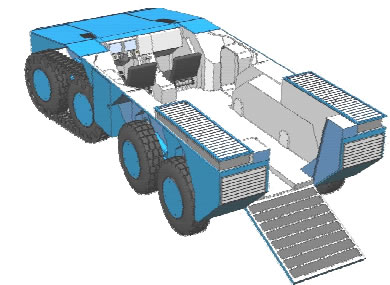
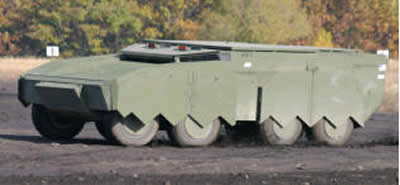
    The AHED8x8 advanced hybrid electric drive technology demonstrator introducing several enabling technologies expected to become the foundation of future vehicle design. The vehicle will be equipped with a 536hp engine, augmented by electrical power burst delivering up to 850 hp for 30 – 60 second bursts. The application of in-hub electric motor drive and hybrid power enables high flexibility of design, especially with low profile vehicles. AHED uses air suspension to enable adjustable height and attitude control changing the ground clearance from 13 to 58 cm (5-23 inches), depending on operational requirement and terrain. This feature and the use of all wheel 8×8 drive are contributing to the impressive cross-country mobility of the vehicle. Mobility is further enhanced with the use of wheel and track hybrid steering offering different steering modes for fast-road and slow and off-road travel. With differential (track) steer, AHED could take a tight turn at 33% tighter than a LAV III. Since all wheels are controlled independently, the vehicle could also use pivot turning, when stationary (turn like a tank).

    AHED will use an efficient, quiet in-hub permanent magnet motor. By dynamically managing the torque at each wheel, the vehicle could be configured for full 8×8, 4×4+2 or 6×6 for maximum traction without shifting between “low” and “high” gears. It will also have high redundancy in case of failure or battle damage to some of the wheels. The use of run-flat tires further improves mobilityunder combat conditions. The Hybrid Electric Drive (HED) uses a diesel engine which drives an electrical generator that feeds the in-hub electrical motors and maintains the full state of charge of li-ion batteries located below the floor. This system can be used in three different modes of operation. The diesel electric transmission drive mode is used with batteries disconnected, damaged or removed. When driving in hybrid mode, battery power will be used to supplement the diesel engine power, absorb deceleration energy and soften engine transients. The vehicle will be able to move very quietly on electrical power only, at speeds of up to 20 mph.

    Another benefit is the increased fighting compartment volume, improved accessibility via low load deck and large rear door. Further benefit of the new design is the side-by-side front crew seating. The driver and commander will be able to comfortably operate the vehicle and its remotely controlled weapons and sensors from large “virtual windows” displaying a panoramic view of the forward arc, enhanced with target acquisition cues, situational picture and driving aids, including navigation aids, obstacle alerts etc.

    AHED family of vehicles will be designed for C-130 mobility and include vehicles weighing from 16 to 20 US tons (14.5 – 18 metric tons), be designed with a common chassis and common components to optimize supportability. Three basic types are planned, derived from the base chassis – a medium profile vehicle, a vehicle with increased head room for command and control, MEDEVAC etc. and a cab-forward base vehicle with maximum payload volume.

    The base vehicle will be designed of an aluminum and composite structure, utilizing titanium and ballistic armor and appliqué armor protection. The vehicle is designed to reduce visual and thermal signature, with low a profile chassis, sub-floor exhaust and forward fuel tank, masking the engine. The vehicle can be structured with a new mine resistant capsule providing protection to the crew and systems while saving up to 1 ton compared to equivalent LAV III design.

    AHED has advanced through several test phases in recent years, accumulating over 4,200 km of road and cross-country testing. By the end of the FRES evaluation phase, AHED is expected to log over 12,000 km.

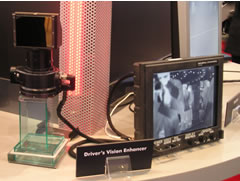
    Driver’s Vision Enhancer

    DRS’s Driver’s Vision Enhancer (DVE) B-kit provides combat and tactical-wheeled vehicle operators with the capability to conduct day/night operations or maneuver in severely degraded visual conditions caused by smoke, fog, dust or other battlefield obscurants.

    The DVE provides situational awareness, vehicle tracking, support elements for the combat force, and enhances the driver’s ability to detect targets, Improvised Explosive Devices (IED’s) or ambushes located at the roadsides.

    The DVE B-kit System is comprised of two Line Replaceable Units (LRUs): the Sensor Module (SM) with the integral Uncooled Mini-Microbolometer module and the Display and Control Module (DCM). The system can be fitted into the vision block of various combat vehicles or mounted externally on the vehicle to maximize the viewing area.

    Dec 18, 2006: DRS will supply the U.S. Army with Driver Vision Enhancer (DVE) systems, which will be mounted on Army combat vehicles. Two divisions of DRS will provide the hardware for the program. Training & Control Systems will provide the installation kits (A-Kits) under an initial U.S. $10 million funding. DRS Sensors & Targeting Systems will provide the EO hardware (B-Kit) for the vehicles. Over the next four years the total order could mount to U.S. $145 million.

    On January 11, 2007 DRS received another contract worth $60 million, for the supply of additional DVE systems. To date, the company have been awarded DVE contracts valued at $124 million. The first production deliveries occurred in 2004 and are scheduled to continue through July 2008.

    Skunk Works and XTEND Simplify Multi-Drone Command

    0
    Lockheed Martin Skunk Works® and XTEND have achieved a major milestone in JADC2 by integrating the XOS operating system with the MDCX™ autonomy platform. This technical breakthrough enables a single operator to simultaneously command multiple drone classes, eliminating the friction of mission handoffs. From "marsupial" drone deployments to operating in GPS-denied environments, explore how this collaboration is abbreviating the data-to-decision timeline and redefining autonomous mission execution.

    From Ukraine to Taiwan: The Global Race to Dominate the New Defense Tech Frontier

    0
    As traditional defense primes face mounting competition from agile “neoprimes” such as Anduril, Palantir and Helsing, the balance of innovation is shifting toward software-defined warfare and scalable, dual-use technologies, while global industry consolidation—marked by Boeing’s integration of Spirit AeroSystems and other strategic mergers—signals an intensified race to secure control over the defense technology value chain. Our Defense-Tech weekly report highlights these trends.

    Europe’s “Drone Wall”

    0
    In early October 2025, a coordinated wave of unmanned aerial system (UAS) incursions—widely attributed to Russia—targeted critical infrastructure across at least ten European nations. The unprecedented campaign exposed the fragility of Europe’s air defenses...

    Weekly Defense Update & Global Security Assessment

    0
    Executive Summary The past week (September 18-25, 2025) represents an inflection point where strategic defense concepts have transitioned from doctrine to tangible reality. An analysis of global events reveals four primary, interconnected trends shaping an...

    U.S. Air and Space Forces Push Next-Gen Programs at the AS&C 2025 Conference and...

    0
    At the 2025 Air, Space & Cyber Conference, U.S. Air Force and Space Force leaders unveiled major updates on next-generation fighters, bombers, unmanned systems, and space initiatives, highlighting both rapid innovation and critical readiness challenges as the services race to outpace global competitors. A short version is available here, with a more detailed version for subscribers.

    TADTE 2025: Reflecting Taiwan’s Strategic Themes

    0
    The Taipei Aerospace & Defense Technology Exhibition (TADTE) 2025 crystallized around four dominant strategic themes that collectively illustrate Taiwan's comprehensive approach to defense modernization amid escalating regional tensions. Based on a detailed report by Pleronix (available upon request). Includes a Podcast discussion on TADTE 2025's highlighting Taiwan's four strategic themes beyond the post's coverage.

    Iron Beam 450 Completes Testing, Soon to Join With Operational Air Defense Units

    0
    Israel’s Iron Beam 450 high-power laser system has completed final testing, marking a major leap in air defense. Developed by Rafael, it offers precise, cost-effective interception of rockets, UAVs, and mortars, and is set for IDF deployment by 2025.